

Submitted:
24 November 2026
Posted:
25 November 2026
You are already at the latest version
Abstract
Retrieval-augmented generation (RAG) requires sequential decisions about evidence acquisition, query reformulation, generation, verification, and abstention under resource constraints. A fixed workflow does not adapt its acquisition cost to observed evidence, while fully optimal partially observable control generally requires unknown stochastic models. We present Feedback-Greedy Agentic Orchestration (FGAO), a training-free controller for budgeted RAG. FGAO represents the state by externally assessed goal conditions and action preconditions, estimates state-normalized gain and harm rates by combining declared effects with within-query feedback, and scores actions by predicted deficiency reduction, cost, and bounded continuation value. We establish multi-action, budget-feasible source escalation; finite-horizon concentration for adaptively sampled feedback with explicit within-class heterogeneity; a continuation-aware action-selection error bound; and stopping and dependency-depth results under stated assumptions. We also characterize what verification can and cannot guarantee. On a matched 100-question SQuAD 2.0 evaluation using the same Sonnet-based serving path, FGAO v2 attains 76% exact match versus 72% for a CRAG-style implementation (exact paired p = .39); the difference is not statistically significant. FGAO v3 reaches 77% exact match at a higher mean cost (11.36 versus 8.48 declared units per question). In 1,000 synthetic episodes, the unlock-lookahead variant reaches 94.3% completion, comparable to a tuned verified planner (92.5%), whereas removing feedback or lookahead reduces completion to 72.9% or 2.6%, respectively. Beyond the mathematical analysis, FGAO is released as an open-source Python framework with reusable controller and RAG interfaces and a publicly deployed Docker-based HTTP API on Hugging Face Spaces. The analysis and experiments delimit the benefits and failure modes of explicit, cost-aware feedback control without claiming global POMDP optimality.
Keywords:
retrieval-augmented generation
; sequential decision making
; adaptive acquisition
; feedback control
; greedy optimization
; partially observable Markov decision processes
; verification
; budgeted inference
1. Introduction
Retrieval-augmented generation (RAG) combines a language model with retrieved evidence [1]. Retrieval and answer synthesis range from sparse and dense search to multi-passage fusion [2,3,4], yet even available evidence can be obscured by context position [5]. A query may require depth adjustment, rewriting, alternative-source access, answer generation, grading, verification, or abstention. Selecting the next operation under a budget is therefore a sequential acquisition problem. CRAG introduces retrieval correction [6]; Self-RAG uses trained reflection decisions [7]. FGAO instead exposes an explicit numerical control rule.
Sequential retrieval is directly studied by forward-looking active retrieval (FLARE) [8], interleaved reasoning and retrieval (IRCoT) [9], complexity-adaptive retrieval (Adaptive-RAG) [10], and interleaved reasoning and tool use (ReAct) [11]. These approaches choose or alternate retrieval and inference operations, but do not impose the particular state-normalized feedback and budget-feasible escalation rule analyzed here. More generally, planning in partially observed environments and adaptive stochastic optimization provide the formal background for reasoning about information-dependent actions [12,13]. Evaluation and hallucination detection are fallible measurements rather than guarantees of truth [14,15,16,17].
Contributions. FGAO (Feedback-Greedy Agentic Orchestration) (i) constructs a verifiable-deficiency surrogate motivated, but not derived, from partially observable control; (ii) combines state-normalized online effect estimates with cost-aware, dependency-sensitive action scoring; (iii) proves adaptive finite-horizon feedback bounds, candidate-set-aware unlock perturbation bounds, finite-budget source escalation, and stopping and dependency limits; (iv) evaluates the unchanged controller on 100 matched RAG questions and mechanism-isolating synthetic, real-file, noisy-verification and parallel tests; and (v) releases a model-independent Python controller, RAG/workflow APIs and a public Docker HTTP endpoint. No adaptive-submodularity or global-optimality claim is made [13]. The primary application is RAG; controlled auxiliary workloads probe mechanisms that a small QA sample cannot isolate. Raw data and replication scripts are separately archived [18].
2. From Partially Observable Control to Verifiable Progress
2.1. POMDP Formulation
Fix a query q, evidence-acquisition operations, an execution budget , and at most T decisions. Let denote the hidden information state, including whether relevant evidence exists and whether a proposed answer is substantively correct. The controller chooses from the history and observes according to unknown transition and observation laws. The exact objective is
subject to the cumulative cost constraint . The optimal belief-state policy solves a Bellman recursion over posterior distributions of [12]. The unknown posteriors prevent direct computation of the ideal Bayesian risk reduction , with . This expression motivates rather than derives the operational deficiency in (2); passages are not physical measurements. FGAO records (query, evidence, answer, verification, preconditions and remaining budget). The transition is bookkeeping, not a learned environmental kernel, and need not be Markov sufficient.
2.2. Observable Deficiency and Terminal Mismatch
Let be externally assessed goal conditions with values and fixed , . The deficiency is
Let denote mandatory conditions. Verified success means for every ; optional conditions may remain incomplete. Define the observed step gain
This telescoping identity is exact, including when an action increases deficiency. It does not imply that maximizing is equivalent to maximizing the original utility ; mandatory success and weighted deficiency are different notions.
In the tested RAG system, the mandatory conditions are answered (), grounded (), and supported (). Grounding checks that the normalized answer string appears in a passage from which it was generated. The separate support operation uses an LLM judgment over the corresponding passage. The distinction matters: string occurrence is mechanically checkable, but entailment by an LLM is imperfect and is not ground truth.
2.3. Cost-normalized One-Step Control
For an action a, the unknown conditional expected deficiency reduction is , equivalently , where . We reserve a hat for an estimated quantity and a star for its unknown conditional reference. The estimated one-step score (denoted , without an additional hat, throughout) is
The cost is normalized by the initial budget; is measured in goal-value units. In contrast, the ratio ranks actions differently, particularly when preparation steps deliver only downstream value. Equation (4) defines a tractable surrogate action score motivated by (1); it is not a Bellman approximation and need not rank actions as the optimal partially observable policy does.
3. The FGAO Controller
3.1. Action Semantics and Online Rate Estimates
An operation a declares preconditions, cost , goal-wise gain rates, harm rates, and probabilities of enabling predicates. Rates normalize changes by the remaining or achieved fraction of each goal; they are not raw state increments. The true conditional normalized rates, if meaningful, are written and .
After an action changes by , feedback records
Both records lie in and undefined rates are skipped. Feedback groups are identical signatures (exact), tool names (type), or task-defined classes (task). Write and for the gain-rate count and mean, and analogously for harm:
where is the prior strength; for only the prior is used. Predicted goal change and progress become
Cost and predicate-production rates are blended similarly. Feedback is local to each query: KB variants share a class, while the alternative source is separate; no neural weights are trained.
3.2. Dependency-Aware Continuation
Actions must satisfy declared preconditions and the residual budget. Since retrieval may not immediately verify an answer, the controller adds a continuation term
The implementation supports three forms. Throughout, means evaluating the estimated immediate score (4) at an operational state z, with the feedback statistics and estimated costs held fixed at decision t. With a predicted successor , deterministic lookahead uses
The stochastic version averages over enumerated predicted outcomes, capped at six binary effect dimensions in the implementation. In both expressions the subscript t identifies the current, frozen feedback estimator; the score is evaluated at a hypothetical successor state, without executing a, observing a new outcome, or updating the estimator. Any “next-step” terminology refers solely to this successor-state evaluation. The default unlock approximation uses a success-conditioned successor : each positively predicted gain completes its target goal, each positively predicted predicate becomes true, and, with corrective lookahead enabled, predicted harm reduces the attained goal value by its estimated harm fraction. The predicted cost is deducted from the residual budget. This is not the conditional-mean successor.
Let contain newly admissible, affordable actions other than a; contains affordable, successor-admissible repair actions associated with goals harmed by a. The former receive the product-form unlocking factor, obtained by multiplying the estimated rates of prerequisites newly enabled by a; the latter receive the increment over their current positive value. The product is the controller’s approximation, not in general the conditional probability that all required effects occur jointly: that interpretation additionally requires suitable conditional independence of the prerequisite outcomes. The default rule uses the product regardless of whether independence holds. Write , where always uses the current feedback estimates. At default lookahead depth one, the implementation computes
Both maxima over empty candidate sets are interpreted as zero. The repair increment is not multiplied by an unlock probability; the repair set is formed from the controller’s declared or observed goal-gaining actions. In particular, it does not credit the full positive score of a repair that was already useful. Equations (9) and (Section 3.2) are different approximations; deterministic lookahead may repeatedly credit an unsuccessful preparatory operation, while a large absolute continuation term can distort ratio scoring. The evaluated v2 configuration uses (Section 3.2) with lookahead depth one; greater depth is supported by the software but is not covered by the one-step perturbation bound below.
3.3. Action and Termination Policy
The selected action is
FGAO stops on verified mandatory completion, empty admissible actions, exhaustion of budget/step limit, or . Reading stored verification values is bookkeeping; a new relevance or support check occurs only as an admissible, budget-charged operation. The latter is a surrogate-value stopping rule and cannot certify the absence of a longer profitable plan. No exploration bonus is used in the main configuration: the tested bonus was neutral or detrimental.
| Algorithm 1:FGAO for one budgeted query |
|
3.4. RAG Specialization
The tested v2 macro-action answer(source,graded) executes retrieval, optional grading and generation; verify is a separate paid operation for each new answer. Source costs for KB top-5, KB top-10, rewritten KB, and alternative-source top-5 are ; grading and generation cost 2 each, with . KB variants share feedback, while the alternative source does not. Answering requires existence, substring grounding and support verification. Sonnet supplies language operations but never the numerical decision. The benchmark’s “web” source is a second BM25-indexed collection, not live internet search.
3.5. Open-Source Implementation and Public API
The open-source Python implementation [19] offers FGAOController (decision/update/stop), Workflow (goal-checked tools), and FGAORAG (retrieval/generation/verification). It exposes score and budget traces, synchronous/asynchronous streaming and batch interfaces, and LangChain, LangGraph and MCP adapters. The model-independent HTTP API supplies /v1/answer, /v1/answer/stream, /v1/batch and interactive /docs; a Docker Space is publicly listed on Hugging Face [20]. These interfaces are engineering features, not independently tested policies. The limited local-service validation is in Section 5.3.
4. Analysis
The results below state explicit conditions. In particular, feedback grouped solely by tool name need not be stationary, and an LLM support judgment need not be correct. The analysis does not silently assume either property.
4.1. When Does Feedback Correct Optimistic Action Estimates?
The feedback record is sampled adaptively: the decision to execute a member of comparison class k, and whether a gain or harm rate is defined, depend on earlier tool outcomes. Consequently an ordinary fixed-n i.i.d. concentration bound [21] cannot directly certify decisions made after repeatedly inspecting the same estimate. We allow different conditional means for executions pooled into one class.
Assumption 1
(Complete-history predictable sampling). Fix an execution horizon T (counting received operation outcomes), m goals and finitely many comparison classes, giving M bounded feedback streams. At execution index s, let contain thecompleteexecution history immediately before the outcome is observed: all earlier operation results, all other feedback streams, the selected current action and arguments, and all pre-observation randomization. Let include the new observation and all feedback derived from it. For each stream ℓ, the indicator that an observation will be recorded is -measurable; any recorded value lies in . In particular, eligibility of a normalized gain or harm rate is determined by thepre-actiongoal value. Write for its jth selected index and . At decision t an offered action a has conditional target rate . Priors and comparison-class assignments are fixed before the outcomes they affect. No independence or common-mean hypothesis is made, either within a stream or across streams.
For prior observations in the comparison class, define its within-class heterogeneity at the current decision by
The quantity is a theoretical bias term, not information available to the controller. It can be large when a common tool name pools noncomparable queries. We set when .
Theorem 1
(Uniform adaptive feedback bound). Under Assumption 1, fix . With probability at least ,simultaneouslyfor every , every candidate action a, every relevant stream ℓ, and every data-dependent count , the implemented shrinkage estimator satisfies
For , the statistical term is zero and the bound reduces to the prior error. The same statement applies to normalized bounded predicate-production and cost feedback when those observations are assigned feedback streams.
Proof.
For each stream let be the index of its jth recorded observation. As and the selected action are known from , the selected-time conditional mean is defined using the whole history just before observation. Hence has conditional mean zero given , which contains the post-observation history of every preceding selected index, including outcomes of all other streams. Thus is a martingale-difference sequence under predictable sampling, with conditional range width at most one. Conditional Hoeffding gives for each fixed . If a stream has fewer than n observations, adjoin zero increments after the last observed one. A union bound over streams and yields one event controlling all data-dependent sample counts, without requiring independence among streams. For any offered a, put and decompose . The triangle inequality and (12) prove (13); the same event works for all offered actions because their target-specific deviations occur only in the deterministic bias terms. □
Counterfactual target rates. The concentration event in Theorem 1 controls the selected-observation martingale sum, which does not depend on the rate to which the historical observations are compared. Thus, for any well-defined counterfactual conditional target rate —including a second-step action evaluated at a predicted successor without a fresh observation—the same event yields (13), with replaced by throughout and the corresponding heterogeneity for (zero for ). The prior-error term is likewise evaluated against this target. The stochastic term and confidence level are unchanged; this extension does not assert that the historical feedback is unbiased for the counterfactual action or that such a conditional rate is known to the controller.
Remark 1
(Meaning of feedback pooling). The sampling term decreases at the usual scale, but need not decrease. Thus increasing the number of pooled observations need not improve a prediction if the sampled actions have different conditional effects. The guarantee is uniform in the adaptive query history,nota claim that all pooled RAG operations are interchangeable. The finite horizon and finite stream set matter.
Let and denote the right-hand side of (13) for the corresponding conditional gain and harm rates at . More generally, write , , and for the same target-specific bounds evaluated at any operational state z (including a well-defined counterfactual state), so and similarly for harm. Because the normalized positive and negative changes satisfy the identity (Section 3.1), the conditional mean goal increment is exactly , with undefined boundary rates multiplied by zero. Therefore,
The identity covers state overwrites as well as incremental updates; their conditional rates may nevertheless vary sharply with the state, leading to a large heterogeneity term.
4.2. When Does Short Lookahead Correctly Value Dependencies?
The released controller’s default unlock routine evaluates a success-conditioned successor, not a conditional-mean state. For a first action a, let , and be, respectively, the supports of its strictly positive conditional gain rates, predicate-production rates and eligible harm rates. Eligible harm excludes a goal with an active gain, as in the implementation. Define the reference successor
where sets a goal in to one, makes a predicate in true, applies for an eligible harm in when corrective lookahead is enabled, and deducts the respective estimated or reference action cost. This choice matches the implemented _success_state rule. Thus, when and , a positive predicted gain sets rather than its conditional mean .
For either the estimated or true-rate reference state, define the newly unlocked, affordable candidate set and the affordable, successor-admissible repair set as in (Section 3.2), excluding a itself. The repair set contains recorded or declared gainers of harmed goals. Let denote the same product-form factor with each estimated prerequisite rate replaced by its true conditional rate, and put . Neither nor is generally the true joint unlocking probability; conditional independence of the required effects would be needed for that identification. The true-parameter immediate score is the same state-conditioned scoring function as , with estimated rates and cost replaced by their conditional reference quantities; neither score entails a new feedback update. The true-rate reference continuation is . Its unlock contribution is . For the repair contribution, define the incremental repair score of a candidate b as ; is its maximum over (with empty maxima interpreted as zero). The action sets and their baseline-admissibility predicates are computed by the same fixed precondition and affordability rules as the implementation. This is the true-parameter version of the implemented one-step unlock surrogate, not a Bellman continuation or an optimal RAG policy.
Assumption 2
(Stable local unlock comparisons). For every first action a, restrict attention to candidates common to the estimated and reference unlock or repair sets. The success-conditioned successors obey ; for a common candidate the reference immediate score is -Lipschitz between these successors. At the predicted successor, , and at the actual current state, . For common unlock candidates, and . The original-state baseline-admissibility indicator is the same in both comparisons. Finally, bounds the largest nonnegative unmatched contribution in the two candidate families, after taking a positive part of a repair increment. These bounds hold uniformly over all first actions being ranked.
Lemma 1
(Unlock and incremental-repair perturbation). Under Assumption 2, the exact one-step unlock rule (Section 3.2) satisfies
Proof.
For a common unlock candidate, the map is 1-Lipschitz and each product-form unlocking factor is in . The argument compares the estimated and true-parameter products, not either product with an unknown joint unlocking probability. Hence the absolute difference between and its reference contribution is at most . For a common repair candidate, the implemented contribution is a difference of two positive scores. Its successor term differs by at most , while its original-state baseline differs by at most . Thus the repair-contribution error is at most their sum. The maximum with zero and the maximum over common candidates are each 1-Lipschitz in the supremum norm. Adding or deleting candidates changes the maximum by no more than the largest nonnegative unmatched contribution, bounded by . Taking the larger of the two family-wise bounds yields (16). □
Under state-invariant conditional rates and state-independent action cost, for a fixed feasible candidate and the sup norm on normalized goal coordinates: each score derivative is bounded by . Discrete changes in admissibility, availability, affordability, or action support cannot be hidden inside this Lipschitz constant; candidate mismatches contribute to , while successor-support mismatches are treated explicitly below.
Theorem 2
(High-probability one-step unlock-score selection bound). Under Assumption 1, consider a decision where the first-step affordable/admissible action set is correctly identified. Assume the local conditions of Assumption 2 with unmatched-candidate contribution at most . On the joint high-probability event of Theorem 1, let , and be the respective bounds from (13), with cost rescaled to actual cost units. For any operational state z, extend the error definition in (14) by setting . Define the first-step bounds and ; their combined immediate-score bound is . For the second-step candidates b common to the estimated and reference sets, the error bound is as follows (with empty maxima interpreted as zero). By the counterfactual-target extension of Theorem 1, the same adaptive concentration event applies at , with prior errors and within-class heterogeneity evaluated against the corresponding counterfactual conditional rates. No new outcome is observed and the estimator remains unchanged. Thus the second-step bound is , where the maximum is over candidates common to the estimated and reference continuation sets (and equals zero when empty). Let bound the difference between estimated and true-parameterproduct-formunlocking factors on common unlock candidates (not an error relative to the generally unknown joint unlocking probability). The success-conditioned map in (15) has discontinuous dependence on thesupportof positive effects. Set . When , positively predicted gains set the same goal values to one, the same predicates become true, and only expected harm attenuation and deducted cost differ. With the sup norm on goal coordinates, Boolean predicates and , a valid reference-successor bound is therefore
If , the unit term covers the possibly discontinuous difference in the bounded goal and predicate coordinates; cost remains bounded separately. Extra modeled successor coordinates require their own error terms. In particular, simply replacing by the error of theconditional-meansuccessor is invalid even with perfect rate estimation.
Define , and put . Let maximize (8), and let maximize the true-parametersuccess-conditioned unlock surrogate over the same first-step candidate set. With probability at least on the stated joint event, . An estimated best-versus-second-best gap above suffices for the same reference maximizer; if , then . These are conditional,analytically specifiedguarantees, not directly computable runtime certificates unless independent valid upper bounds on heterogeneity, successor-support errors and unmatched-candidate effects are available.
Proof.
On the event of Theorem 1, (14) and the cost bound yield the current-state score error . The same decomposition at gives . Conditional on identical positive-effect supports, the success-conditioned transition is exactly constant in the magnitude of a positive gain or positive predicate-production probability; its remaining continuous errors are the harm attenuation and cost differences. When supports differ, a bounded binary or goal coordinate can change by as much as one, captured by . Thus (17) bounds the implemented success-conditioned successor relative to its true-rate reference. Apply Lemma 1 with , , , and . Combining with the first-step score error gives uniformly. The estimated maximizer then has reference regret at most twice the bound by the usual three-term comparison; the score-gap and stalled-decision claims follow from the same uniform inequality. □
Scope of the bound. Because the controller’s unlocking factor is a product of prerequisite rates, telescoping that product yields , with gain or predicate rate errors chosen for each requirement. The magnitude of is not generally inferable from finite-sample absolute errors without a strict positive-effect margin; it may remain one even when the errors are small. Likewise, depends on the missed or extra candidates and is not provided by the running controller. The theorem requires externally established bounds on these quantities and on within-class heterogeneity. It is a perturbation result for the fixed one-step algorithm, not a guarantee of POMDP optimality or an automatically verifiable runtime action-ranking certificate.
Remark 2.
Even when the estimation errors vanish, FGAO may miss a deep profitable dependency because the one-step candidate set is restricted. A small feedback error therefore does not imply global optimality or completeness of the selected retrieval plan.
4.3. When Does Feedback Force Source Escalation?
The RAG source hierarchy provides a concrete instance in which optimistic beliefs about a cheap source should be revised after failures. The following result extends the two-action argument to competing KB variants, alternative acquisition actions, and finite budget. It is deliberately conditioned on frozen nonfeedback score components, because FGAO’s actual verification and admissibility state may change after an operation.
Proposition 1
(Multi-action escalation with residual-budget feasibility). Suppose an escalation episode begins at decision t, with residual budget and execution slots. Consider one unmet binary evidence condition of weight and a family of eligible cheap actions whose normalized gain observations are pooled in one comparison class. After n zero-gain observations, let their nonfeedback score components be fixed and their declared priors , so that . The displayed are interpreted as the effective prior mass and prior rateat the episode start. With earlier pooled observations having sum , the very same implemented estimator takes this form exactly after the algebraic substitution and ; this is notation only, not an estimator change. Let the other eligible actions have fixed scores , and let have . Suppose that these competing actions and their score components remain available and unchanged throughout the episode. Set .Only if for every j, define the finite strict-dominance threshold
Then after pooled zero-gain observations, strictly outscores every remaining . Assume the actual cost of every cheap execution is at most and both the declared affordability cost and realized cost of are at most . The twoepisode-localconditions
are sufficient for to remain affordable and executable at the threshold. If the only selections before escalation are cheap zero-gain executions, and these remain eligible until that point, the controller selects an alternative no later than its st decision in the episode (possibly earlier).
Proof.
For , strict dominance is equivalent to . The integer threshold in (18) ensures this simultaneously for all j. After any cheap executions, the residual budget is at least , and at most k of the slots have been used. Both inequalities in (19) therefore preserve one available slot and the declared/actual affordability of at . Until then, either an alternative is chosen already or the assumed cheap zero-gain selection increments the shared feedback count. At the alternative has the largest score, which is positive, and hence cannot be rejected by the nonpositive-score stopping rule. This is a conditional guarantee for the stated episode, not an unconditional guarantee about arbitrary intervening operations. □
Remark 3
(Scope of the escalation threshold). If any , the strict threshold is intentionallyundefined; repeated failures alone do not establish the claimed strict dominance. The residual budget , not the original , must be used at the beginning of any later escalation episode. The result is conditional on fixed scores and availability, a valid cost upper bound, and enough cheap actions to supply the indicated observations. One-shot KB variants can be exhausted earlier; a new candidate, changed verifier state, additional spending, or earlier stopping invalidates the fixed-episode premise. Conditions (19) are sufficient, not necessary.
Corollary 1
(Pooling and cost of delayed escalation). Suppose the r cheap variants have identical prior p, fixed component b, and actual cost at most . Pooled failed executions decrease the estimated gain ofeveryvariant as . Under exact-signature feedback, a variant not yet executed retains its prior p. Consequently, pooling can force all variants below a fixed alternative score after total failures, whereas exact-signature feedback may require up to failures if each variant remains repeatable. The additional episode budget required by the pooled bound is at most and must be available from with the remaining horizon as in (19); this is conditional on genuine within-class comparability.
Proof.
The monotonicity of and Proposition 1 give the pooled claim. With separate counts , each variant retains ; reducing all r variants below the same threshold can require . The cost bound is additive. □
Theorem 3
(Uniform stochastic escalation with its own feasibility threshold). Consider the fixed candidate scores and episode beginning at in Proposition 1. Suppose the common cheap-source feedback stream consists of adaptively selected with conditional means , each conditioned on thecomplete pre-observation historyof Assumption 1. For , with probability at least , simultaneously for and all cheap variants j,
Assume for every j; in particular . Define as thesmallestinteger in satisfyingsimultaneouslyfor all j,
If no such count exists within the residual horizon, set and make no finite-horizon escalation claim. If and
then, on the same high-probability event, the controller selects an alternative by at most cheap observations (or earlier), provided the fixed-score, availability and cheap-selection premises of Proposition 1 continue to hold. In general may exceed ; satisfying (19) alone does not imply (22).
Proof.
Apply the selected-stream concentration argument of Theorem 1 with one pooled stream. Its sum of centered observations is at most simultaneously for every ; . Substituting into the common shrinkage estimator yields (20) for all variants, without a separate union bound over j because they share the same feedback observations. Inequality (21) makes every resulting upper score strictly less than . The independent residual-budget and remaining-horizon conditions (22) guarantee that is feasible at that stochastic threshold; the same episode induction as Proposition 1 proves selection. The confidence statement is valid for the adaptively attained count because the deviation event is uniform over all counts. □
4.4. Dependency Depth and Macro-Actions
Write for a chain in which solely enables for , and only has positive verified goal gain. Call d the number of zero-progress prerequisite edges from the first action to a gain-bearing operation.
Proposition 2
(Lookahead-depth obstruction). Fix . For any controller that credits only paths of at most dependency edges, uses strictly positive execution costs, assigns no intrinsic reward to merely enabled predicates, and stops when all estimated scores are nonpositive, there exists a feasible d-edge chain with positive total terminal net gain on which the controller stalls before executing .
Proof.
Construct d preparatory operations with zero change in every verified condition and deterministic enabling of the next operation. Choose small positive costs and a final action with deterministic goal gain . The entire chain then has positive net gain. Yet for , the truncated score of sees no goal-improving action. Its continuation is zero and its immediate score is (including ). If it is the only initially admissible operation, the stipulated stopping rule halts before executing it. □
The obstruction is structural, not stochastic. Combining retrieval and generation into a macro-action reduces the number of unseen zero-progress dependencies. Conversely, deeper lookahead may recover a valuable sequence if its predicted discounted gain outweighs the accumulated cost. Neither technique universally resolves long, correlated, or falsely specified dependency chains.
4.5. Stopping, Verification, and Objective Mismatch
Theorem 4
(Conditional expected stopping time). Let τ be the first time FGAO stops, capped by . Assume and that there exists a single constant such that, for every ,
Then .
Proof.
For , the event is measurable from . Multiplying (23) by its indicator and summing gives by telescoping and nonnegativity. Since , the result follows. □
Remark 4.
Theorem 4 does not assert that FGAO always satisfies (23); failures, costly preparatory steps and verification noise can violate positive drift. The bound applies to stopping foranyreason, not necessarily successful completion.
Proposition 3
(Terminal false-acceptance bound). Suppose that at the algorithm’s (possibly adaptive) stopping time τ, each mandatory verifier i satisfies thejointerror bound . Then, writing for the event that success is reported while some mandatory goal is false, .
Proof.
Every falsely reported success includes at least one accepted but false mandatory goal. Apply the union bound to these events. □
Every execution of the support verifier is an action with positive recorded cost and may be ruled out by residual-budget feasibility. The terminal joint-error assumption is stronger than evaluating a verifier once on nonadaptively selected data; repeated prompting and adaptive selection can increase error. If two checks share the same wrong judgment almost surely, repeating the check does not square its false-positive probability. This is consistent with the negative v3 corroboration experiment in Section 5.2.
Corollary 2
(Charged, adaptively repeated verification). Let be the fallible mandatory verifiers; all other mandatory checks are assumed exact. A verification is invalidated whenever a change to the answer or evidence could invalidate the verified condition, so every accepted terminal condition has a still-valid corresponding invocation. Suppose each invocation of verifier has realized cost at least . Conditional on every history at which it is invoked, assume its probability of jointly accepting a false condition is at most , with no independence required across calls. Let count its invocations before termination, and suppose every invocation is budget-charged. For the event defined above, . Moreover, for each i, so the corresponding sum of these budget-limited terms also bounds the false-success probability.
Proof.
By the validity/invalidation condition and exactness of the remaining mandatory checks, every false success entails a false acceptance at some invoked . For each step, condition on its pre-invocation history and use the assumed joint-error bound. Summing these predictable call events gives at most , without relying on independence. The budget and horizon bound the number of charged invocations of each verifier. □
Remark 5.
The per-invocation conditional error assumption is stronger than an error rate measured on a fixed held-out sample. In particular, the same LLM examiner evaluated on adaptively modified evidence need not satisfy it. The bound quantifies the cost of repeated checksunderthat assumption; it does not certify the Sonnet support checker.
4.6. Objective Transfer and Answer–Abstain Decisions
Proposition 4
(Surrogate transfer with explicit cost units). Suppose the true terminal utility satisfies for all feasible terminal states, with and . Let policies have cumulative realized cost almost surely. Define
For any feasible , write its surrogate policy gap as and define the cost-coefficient mismatch . Then . If , the cost mismatch vanishes. No bound on for FGAO follows solely from local score stability.
Proof.
For each policy, subtract the two objectives in (24). The absolute difference is at most by the terminal approximation and budget bound. Apply this inequality to a true-optimal policy and , and insert the definition of . The normalized FGAO stage cost is in deficiency units; the terminal surrogate is multiplied by , giving the factor . □
Remark 6.
This is an objective-comparison statement, not a proof of global optimality. The exact identity (3) supports the undiscounted cumulative-progress surrogate, but truncated continuation and local greedy selection need not minimize expected terminal deficiency. A small error κ does not make the unquantified policy gap disappear.
Proposition 5
(Answer–abstain threshold and useless corroboration). Let p be a calibrated conditional probability that a candidate answer is correct, with correctness payoff 1, wrong-answer loss and abstention payoff 0. In thesecorrectness-payoff units, answering without another observation is preferable to abstaining exactly when . Let be the cost coefficientin these payoff units per normalized full budget. If a proposed paid verification costs , is affordable () and fits one remaining execution slot, and yields a calibrated posterior , then its net value of information is
If almost surely, then , negative if and zero if or .
Proof.
Answering has expected payoff ; abstaining gives zero. Following the observation one can select the better of the two actions at the updated posterior, giving the first term in (25). Deduct the best pre-observation payoff and the budget-normalized cost in the same payoff units. If almost surely, the information terms cancel. No independence between verification attempts is used. □
Remark 7
(Cost-unit identification and limitation). The coefficient η is intentionally distinct from the FGAO controller’s deficiency-unit coefficient λ. Under the additional affine surrogate normalization of Proposition 4, choosing the same normalized cost tradeoffin utility unitswould set (equivalently ). Absent that calibration, no numerical equality between η and λ is justified. The proposition concerns an ideal calibrated posterior and interprets the optional v3 experiment; v2 does not calculate such posteriors. Correlated checks can have negligible additional information, and the v2 support check itself is a charged action, not a free oracle.
These results distinguish the cost coefficient in deficiency units from the correctness-payoff coefficient and characterize the limited value of correlated corroboration; neither result asserts that the v2 policy solves the corresponding Bayes decision problem.
4.7. Complexity and Parallel Operations
Let be the number of admissible affordable actions, m the number of conditions, and the total number of action-effect evaluations (including continuation rescoring). With per effect evaluation, the arithmetic scoring cost is ; if each first-step action explores at most L continuation candidates, and
Deterministic and stochastic continuation may require additional evaluations; enumerating r binary effect dimensions costs up to predicted successors. The measured implementation caps r at six. Equation (26) excludes LLM inference, retrieval, verification, candidate enumeration, and data transfer. If itself scales proportionally to m, the total is quadratic in m, not linear.
4.8. Parallel Operation Batches
Proposition 6
(Commutativity of genuinely independent batches). Suppose two admissible operations act on disjoint goal/predicate coordinates, have no cross-action preconditions or shared mutable resources, and their joint outcome law factors conditionally on the starting state. If both are executed regardless of intermediate observations, either sequential ordering and concurrent execution yield the same distribution of final recorded coordinates and the same total additive cost.
Proof.
The updates modify disjoint coordinates and hence commute. The product outcome distribution is invariant to execution order, and addition of costs is commutative. □
Remark 8.
Proposition 6 concerns afixed batch, not the adaptive policy: sequential FGAO might change the second decision after observing the first. Unverified independence declarations and loss of within-batch feedback can reduce success even when elapsed time decreases.
4.9. Additional Structural Limitations
Proposition 7
(Ratio continuation can reward null actions). Suppose and two candidate actions a and b have equal, positive absolute continuation estimate . Let , , and , . The ranking selects a for all sufficiently small ε, despite a contributing zero immediate gain. In contrast, the additive rule (8) selects b if .
Proof.
The ratio scores are and . The first tends to infinity as . The additive scores are and ; subtracting them gives the stated inequality. □
The proposition diagnoses the extreme failures of ratio ranking in Table 9 with absolute continuation estimates. It does not imply that ratios are universally inferior: the same ablation is benign when the continuation is restricted to marginally unlocked actions.
Proposition 8
(Optional conditions can dominate mandatory completion). For every there exists a unit-budget two-condition task with one mandatory condition of weight ε and one optional condition of weight , where a greedy policy maximizing immediate weighted progress completes the optional condition and fails the mandatory task, although successful completion was feasible.
Proof.
Start with both binary conditions at zero. Let action satisfy the mandatory condition and action satisfy the optional condition. Give each cost one and allow exactly one call. Their predicted gains are and . The greedy policy chooses and fails; would have succeeded. □
This explains why the optional-weight parameter must be documented independently of the mandatory success predicate. Weighted deficiency is a progress surrogate, not a complete representation of discrete feasibility.
5. Experiments
5.1. Protocol and Provenance
The experimental archive is separately deposited on Zenodo [18]; the software repository [19] does not host the dump. Frozen configurations, cached responses, per-instance traces and aggregation scripts support metric reproduction, not an independent replay of every original model call. Synthetic hyperparameters were selected on 300 distinct tuning seeds (10000–10299): deterministic , stochastic , and unlock , each with and optional-condition mass . The principal plan-and-execute baseline uses five retries; fixed workflow uses eight. Test seeds are disjoint. Success denotes completion of mandatory conditions, not minimum deficiency. Exact McNemar tests and 95% intervals are reproduced from the archive.
The RAG experiment uses SQuAD 2.0 [22], the same Sonnet serving path and declared (not monetary) operation costs. The final, distinct sample comprises 100 matched questions (75 answerable, 25 unanswerable); 30 answerable items require a secondary BM25 passage index [2], not live internet access. The original 48 plus 52 added items form this sample; earlier samples 0 and 1 (48 each) informed v2 and v3 respectively. Neither prompted CRAG nor prompted Self-RAG replicates the original learned evaluator or reflection-token model. The exact Sonnet model release and per-call token/latency records were not preserved.
5.2. Matched RAG Comparison
Table 1 reports 76/100 exact matches for FGAO v2 versus 72/100 for CRAG-style (eight paired wins, four losses; ), 56/100 for vanilla RAG (22 wins, two losses; ), and 58/100 for prompted Self-RAG (21 wins, three losses; ). The FGAO v2 point-estimate advantage over CRAG is not statistically established or cost-dominant: v2 incurs 8.475 instead of 7.460 declared units/query (13.6% more). On secondary-only questions, CRAG correctly answers 20/30 versus FGAO v2’s 18/30; on unanswerable questions, v2/CRAG/Self-RAG abstain correctly on 18/25, 15/25 and 20/25. The 48+52 subcomparison and historical development samples are detailed in Section 5.7.1.
V3 reaches 77/100 EM and 20/25 correct abstentions but costs 11.355 units/query (34.0% above v2) and 531 versus 436 calls. It has only two paired EM wins and one loss against v2 (). On the earlier 48-question evaluation it improved neither EM nor abstention while costing 39.2% more; repeated support assessments were correlated (23/24 agreements). This is evidence about the limits of extra corroboration, not proof of general verifier independence or accuracy; cf. Proposition 3.
5.3. HTTP Service
The public Docker interface is described in Section 3.5. A separate test sent 144 requests to three local FGAO v2 HTTP instances, not to the Hugging Face Space. All returned HTTP 200; earlier sample runs reproduced saved answers, operations and costs. The third local 48-query subset obtained EM .708 and cost 8.17/query. These responses validate the tested API path, not long-term availability or answer correctness; full service results appear in Table 4.
5.4. Controlled Synthetic Studies
The latent synthetic truth evaluates prerequisite handling, regressions, unreliable outcomes, and operation costs but is never revealed to the controller. Over 1,000 held-out episodes, FGAO unlock completes .943 versus .925 for a tuned verified planner (paired ). Oracle priors reach .961 but are inaccessible in operation; the ReAct proxy is rule-based rather than a real LLM controller.

Table 2.
Synthetic benchmark (1,000 held-out instances). Budget used is the mean fraction consumed. Overhead measures controller time outside environment execution.
Table 2.
Synthetic benchmark (1,000 held-out instances). Budget used is the mean fraction consumed. Overhead measures controller time outside environment execution.
| Method | Success | 95% CI | Budget fraction |
Calls | Failed-call recovery |
Overhead (ms/call) |
|---|---|---|---|---|---|---|
| Random | .015 | [.009,.025] | .99 | 23.1 | .482 | .062 |
| Fixed workflow (8 retries) | .574 | [.543,.604] | .59 | 14.6 | .617 | .019 |
| ReAct proxy (self-report) | .083 | [.067,.102] | .40 | 9.7 | .167 | .097 |
| ReAct proxy + verifier | .176 | [.154,.201] | .42 | 9.9 | .301 | .092 |
| Plan-and-execute (5 retries) | .925 | [.907,.940] | .62 | 15.1 | .952 | .087 |
| Greedy, prior only | .021 | [.014,.032] | .49 | 9.6 | .636 | .251 |
| Greedy, feedback, no lookahead | .026 | [.018,.038] | .41 | 7.9 | .776 | .499 |
| FGAO deterministic continuation | .936 | [.919,.950] | .64 | 14.1 | .908 | .972 |
| FGAO stochastic continuation | .938 | [.921,.951] | .63 | 14.1 | .914 | 1.035 |
| FGAO unlock continuation | .943 | [.927,.956] | .63 | 14.0 | .926 | .764 |
| Oracle-prior reference | .961 | [.947,.971] | .56 | 12.5 | .974 | .565 |
The graphical counterpart is in Figure 1. Table 9 isolates adaptation and short lookahead. Removing feedback lowers unlock success from .943 to .729; removing lookahead lowers it to .026. Tool-type pooling lowers it to .864. Removing the explicit cost penalty has little effect on this synthetic success metric; ratio ranking can fail for alternative continuation forms.
5.5. Budgets, Dependencies, and Real Execution
At budget slack 2.0, unlock FGAO completes .960 versus .917 for the tuned planner; at slack 1.0 the planner does better (Table 5). At .70 misleading self-report rate, unlock succeeds .920 versus .620 without feedback (Table 6). In the depth-two preparatory chain, depth-one variants complete .106 of 500 tasks while depth-two unlock and the planner reach .956; this supports the obstruction in Proposition 2 without establishing general planning optimality.
The 200 real-file workspaces execute actual load/clean/summarize operations. Unlock and stochastic lookahead each complete 100%; however, the verified planner with zero retries also reaches 100% at lower budget fraction (.60 versus .78). Transferring the tuned five-retry planner setting yields only .110. Alternate lookahead forms are sensitive to parameter transfer.
Table 3.
Real-file benchmark (200 workspaces), transferred parameters.
| Method | Success | Budget fraction |
|---|---|---|
| Fixed workflow (8 retries) | .000 | .59 |
| Plan-and-execute (5 retries) | .110 | .98 |
| Plan-and-execute (0 retries) | 1.000 | .60 |
| Greedy without lookahead | .000 | .30 |
| FGAO deterministic | .975 | .80 |
| FGAO stochastic | 1.000 | .78 |
| FGAO unlock | 1.000 | .78 |
| FGAO unlock without feedback | .000 | 1.00 |
| FGAO deterministic at unlock parameters | .495 | .85 |
| FGAO stochastic at unlock parameters | .445 | .98 |
| FGAO stochastic, raw-delta estimator | .100 | 1.00 |
5.6. Imperfect Verification, Overhead, and Parallelism
The noisy-verifier results in Table 10 demonstrate why a repeated LLM judgment is not a correctness certificate [14,16]. V3 reduces wrong outcomes in these different synthetic and file regimes, at additional confirmation cost; this improvement does not generalize to the near-duplicate natural-language support checks.
The arithmetic decision time is 31.7 ms for unlock at 64 goals, excluding tool inference and retrieval (Table 7). Conditional on independent resources and outcome effects, parallelism can shorten makespan; nevertheless, batching removes intervening feedback and may lower success, as Table 8 demonstrates. The fixed-batch mathematical statement is Proposition 6.
5.7. Historical and Extended Experimental Analyses
5.7.1. Historical RAG Samples
The 100-question sample 2 combines its initial 48 questions with 52 subsequently added questions. On the initial 48 alone, FGAO v2/CRAG/FGAO v3 score 34/31/33 correct; on the added 52 they score 42/41/44, respectively. The latter split does not constitute an independent benchmark with separately tuned controllers. Sample 0 (48 questions) informed the v2 design and yields FGAO v2 EM .750 versus CRAG .604; sample 1 (48 questions) informed v3 and yields FGAO v2 EM .708 versus CRAG .667. Neither historical subset is presented as a new independent confirmatory evaluation.
5.7.2. HTTP-Service Response Replication
Table 4.
HTTP-service replication: FGAO v2 only; 48 queries per sample.
| Sample | EM | F1 | Secondary-only EM | Abstain | Cost/q |
|---|---|---|---|---|---|
| 0 (matched) | .750 | .808 | .533 | .917 | 9.12 |
| 1 (matched) | .708 | .764 | .615 | .583 | 8.08 |
| 2 (initial 48) | .708 | .729 | .462 | .667 | 8.17 |
5.7.3. Budget Sensitivity
Table 5.
Success versus relative budget slack (300 trials per setting).
| Slack | Plan | Det. | Stoch. | Unlock | No feedback |
|---|---|---|---|---|---|
| 1.00 | .277 | .223 | .227 | .243 | .210 |
| 1.25 | .543 | .543 | .570 | .600 | .467 |
| 1.50 | .747 | .787 | .763 | .770 | .617 |
| 2.00 | .917 | .950 | .910 | .960 | .743 |
| 3.00 | .977 | .997 | .987 | .993 | .797 |
| 4.00 | .977 | .997 | .990 | .993 | .863 |
5.7.4. Misleading Self-Reports
Table 6.
Synthetic success versus probability of misleading tool self-reports (300 trials per setting).
Table 6.
Synthetic success versus probability of misleading tool self-reports (300 trials per setting).
| Overclaim | Plan | Det. | Stoch. | Unlock | No feedback |
|---|---|---|---|---|---|
| .00 | .987 | .963 | .960 | .973 | .970 |
| .20 | .943 | .973 | .957 | .950 | .827 |
| .35 | .917 | .950 | .910 | .960 | .743 |
| .50 | .923 | .930 | .927 | .933 | .680 |
| .70 | .887 | .917 | .947 | .920 | .620 |
5.7.5. Controller Selection Overhead
Table 7.
Controller scaling (mean s per decision); grows with the number m of conditions.
| m | (unlock) | Unlock | Determ. | Stoch. | (unlock) |
|---|---|---|---|---|---|
| 4 | 6.8 | 219 | 417 | 368 | 16.1 |
| 8 | 14.4 | 687 | 911 | 986 | 34.3 |
| 16 | 28.7 | 2263 | 3169 | 3198 | 67.6 |
| 32 | 58.4 | 9111 | 10354 | 11578 | 141.2 |
| 64 | 117.7 | 31684 | 39930 | 39207 | 279.0 |
5.7.6. Parallel Execution
Table 8.
Parallel evaluation: success and makespan relative to sequential FGAO. These seeds are distinct from the main synthetic table.
Table 8.
Parallel evaluation: success and makespan relative to sequential FGAO. These seeds are distinct from the main synthetic table.
| Domain | Policy | Success | Makespan ratio |
|---|---|---|---|
| Synthetic (1,000) | Sequential | .930 | 1.00 |
| Naive | .798 | .74 | |
| Independent | .884 | .78 | |
| Real-file (200) | Sequential | 1.000 | 1.00 |
| Naive | .505 | .71 | |
| Independent | 1.000 | .78 |
5.8. Controller Ablations and Noisy-Verifier Outcomes
5.8.1. Full Controller Ablations
Table 9.
Ablations on 1,000 synthetic test instances: reported values are success probabilities. Hyperparameters were tuned on separate seeds.
Table 9.
Ablations on 1,000 synthetic test instances: reported values are success probabilities. Hyperparameters were tuned on separate seeds.
| Change relative to each variant | Deterministic | Stochastic | Unlock |
|---|---|---|---|
| Full FGAO | .936 | .938 | .943 |
| Without lookahead (greedy with feedback) | .026 | .026 | .026 |
| Without feedback | .727 | .724 | .729 |
| Without cost penalty () | .936 | .940 | .944 |
| Tool-type feedback matching | .861 | .837 | .864 |
| Raw-delta effect estimator | .935 | .939 | .945 |
| Original task weights (no optional mass adjustment) | .856 | .856 | .837 |
| Progress/cost ranking | .004 | .008 | .946 |
| Exploration bonus () | .811 | .934 | .946 |
5.8.2. Noisy-Verifier Decision Outcomes
Table 10.
Correct / wrong / abstain under noisy verification. V3 uses explicit terminal decisions with wrong-answer penalty 1.
Table 10.
Correct / wrong / abstain under noisy verification. V3 uses explicit terminal decisions with wrong-answer penalty 1.
| Domain and policy | Correct | Wrong | Abstain |
|---|---|---|---|
| Synthetic, v2 (1,000) | .164 | .554 | .282 |
| Synthetic, v3 (1,000) | .558 | .079 | .363 |
| Real-file, v2 (200) | .130 | .470 | .400 |
| Real-file, v3 (200) | .360 | .125 | .515 |
5.9. Detailed Experimental Aggregates
Table 11.
RAG sample 0 (development-context sample), 48 questions. Strict output policy.
| Method | EM | F1 | Secondary EM | Abstain |
|---|---|---|---|---|
| Vanilla RAG | .583 | .617 | .133 | .667 |
| CRAG-style | .604 | .686 | .600 | .333 |
| Self-RAG-style | .500 | .587 | .267 | .500 |
| FGAO v1 unlock | .583 | .603 | .000 | .917 |
| FGAO v2 unlock | .750 | .808 | .533 | .917 |
Table 12.
Subset of tuned success rates over prior strength and cost weight (300 tuning seeds; unlock continuation, optional mass .1).
Table 12.
Subset of tuned success rates over prior strength and cost weight (300 tuning seeds; unlock continuation, optional mass .1).
| .00 | .907 | .917 | .887 |
| .05 | .913 | .920 | .887 |
| .10 | .923 | .927 | .890 |
| .25 | .920 | .913 | .887 |
Table 13.
Noisy verification: wrong-answer penalty sweep for v3 explicit terminal decisions. Synthetic ; real-file .
Table 13.
Noisy verification: wrong-answer penalty sweep for v3 explicit terminal decisions. Synthetic ; real-file .
| Synthetic | Real-file | |||||
|---|---|---|---|---|---|---|
| Correct | Wrong | Abstain | Correct | Wrong | Abstain | |
| .25 | .423 | .227 | .350 | .150 | .440 | .410 |
| 1 | .558 | .079 | .363 | .360 | .125 | .515 |
| 4 | .511 | .050 | .439 | .320 | .045 | .635 |
| 19 | .448 | .004 | .548 | .275 | .005 | .720 |
Table 14.
Selective validation and completion coverage. The first panel gives real-execution verified versus unverified planner comparison.
Table 14.
Selective validation and completion coverage. The first panel gives real-execution verified versus unverified planner comparison.
| 200-workspace execution | Success | False claims |
|---|---|---|
| Plan/execution, self-report | .000 | 200 |
| Plan/execution, verified | 1.000 | 0 |
| FGAO unlock, verified | 1.000 | 0 |
5.10. Implementation and Model-Use Boundaries
The software comprises a pure arithmetic controller and independently pluggable RAG operations. The controller’s effect updates require observed condition values and reported cost, not LLM-derived policy scores. The RAG operation layer used here nevertheless invokes Sonnet for rewriting, relevance grading, generation, and a separate support judgment. Consequently “model-free” denotes no trained orchestration model, not absence of a generative language model. The support judgment is a fallible observation channel. The implementation’s optional explorative bonus, deeper lookahead, and parallel batches are extensions of the same numerical decision rule, not separately trained variants.
For numerical-result reproduction, the separately published experimental archive [18] contains per-instance records, cached Sonnet prompt–response pairs, and table/figure-generation scripts. The public software repository does not contain this experimental dump. The exact resolved Sonnet release and complete historical inference harness are not preserved, so a fresh model-service replay cannot be guaranteed. The packaged public API may also serve new queries, but the demonstrated results remain conditional on the archived question split, prompts, retrieval collection, cached responses, and serving conditions. Replacing the generator or evaluator requires new benchmarks rather than recycling the same answer scores.
5.11. Interpretation and Reproducibility
The archive [18] preserves raw experimental metrics, frozen configurations, action traces, cache records and figure/table scripts. Its missing resolved Sonnet release and complete original serving harness limit model-level replay. The numerical advantages over CRAG remain nonsignificant; the real-file planner may be cheaper; and correlated verification can waste budget. Released interfaces beyond the benchmark configuration are engineering capabilities rather than separately validated algorithms.
6. Discussion and Conclusions
FGAO treats budgeted RAG operation selection as explicit cost-sensitive feedback control over externally verifiable progress, rather than a claim to Bellman-optimal planning. Under stated assumptions, the analysis bounds adaptive estimator errors, selection and unlock-continuation perturbations, retrieval-source escalation and stopping. The matched 100-question RAG results favor v2 over prompted comparators in point accuracy, but its gain over CRAG is nonsignificant and costs 13.6% more. Mechanism-isolating ablations show that feedback and dependency-aware continuation matter for the tested distributions; a tuned verified planner can be cheaper on real-file tasks, and extra corroboration may be wasteful. The model-independent Python framework and public Docker API expose these decisions and traces [19,20], while the experimental archive is separately citable [18]. Reliable context-specific effect estimation and error-controlled verification remain open limitations.
References
- Lewis, P.; Perez, E.; Piktus, A.; Petroni, F.; Karpukhin, V.; Goyal, N.; Kuttler, H.; Lewis, M.; tau Yih, W.; Rocktaschel, T.; et al. Retrieval-Augmented Generation for Knowledge-Intensive NLP Tasks. In Proceedings of the Advances in Neural Information Processing Systems, 2020, Vol. 33, pp. 9459–9474.
- Robertson, S.; Zaragoza, H. The Probabilistic Relevance Framework: BM25 and Beyond. Found. Trends Inf. Retr. 2009; 3, pp. 333–389. [CrossRef]
- Karpukhin, V.; Oguz, B.; Min, S.; Lewis, P.; Wu, L.; Edunov, S.; Chen, D.; tau Yih, W. Dense Passage Retrieval for Open-Domain Question Answering. In Proceedings of the Proceedings of the Conference on Empirical Methods in Natural Language Processing, 2020, pp. 6769–6781. [CrossRef]
- Izacard, G.; Grave, E. Leveraging Passage Retrieval with Generative Models for Open Domain Question Answering. In Proceedings of the Proceedings of the European Chapter of the Association for Computational Linguistics, 2021, pp. 874–880. [CrossRef]
- Liu, N.F.; Lin, K.; Hewitt, J.; Paranjape, A.; Bevilacqua, M.; Petroni, F.; Liang, P. Lost in the Middle: How Language Models Use Long Contexts. Trans. Assoc. Comput. Linguist. 2024, 12, 157–173. [Google Scholar] [CrossRef]
- Yan, S.Q.; Gu, J.C.; Zhu, Y.; Ling, Z.H. Corrective Retrieval Augmented Generation. In Proceedings of the Findings of the Association for Computational Linguistics: IJCNLP-AACL 2026. Association for Computational Linguistics, 2026, pp. 2991–3003. [CrossRef]
- Asai, A.; Wu, Z.; Wang, Y.; Sil, A.; Hajishirzi, H. Self-RAG: Learning to Retrieve, Generate, and Critique through Self-Reflection. In Proceedings of the International Conference on Learning Representations, 2024.
- Jiang, Z.; Xu, F.; Gao, L.; Sun, Z.; Liu, Q.; Dwivedi-Yu, J.; Yang, Y.; Callan, J.; Neubig, G. Active Retrieval Augmented Generation. In Proceedings of the Proceedings of the 2023 Conference on Empirical Methods in Natural Language Processing, 2023; pp. 7969–7992. [Google Scholar] [CrossRef]
- Trivedi, H.; Balasubramanian, N.; Khot, T.; Sabharwal, A. Interleaving Retrieval with Chain-of-Thought Reasoning for Knowledge-Intensive Multi-Step Questions. In Proceedings of the Proceedings of the 61st Annual Meeting of the Association for Computational Linguistics (Volume 1: Long Papers), 2023, pp. 10014–10037. [CrossRef]
- Jeong, S.; Baek, J.; Cho, S.; Hwang, S.J.; Park, J. Adaptive-RAG: Learning to Adapt Retrieval-Augmented Large Language Models through Question Complexity. In Proceedings of the Proceedings of the 2024 Conference of the North American Chapter of the Association for Computational Linguistics: Human Language Technologies (Volume 1: Long Papers), 2024, pp. 7036–7050. [CrossRef]
- Yao, S.; Zhao, J.; Yu, D.; Du, N.; Shafran, I.; Narasimhan, K.R.; Cao, Y. ReAct: Synergizing Reasoning and Acting in Language Models. In Proceedings of the International Conference on Learning Representations, 2023. [Google Scholar]
- Kaelbling, L.P.; Littman, M.L.; Cassandra, A.R. Planning and Acting in Partially Observable Stochastic Domains. Artif. Intell. 1998, 101, 99–134. [Google Scholar] [CrossRef]
- Golovin, D.; Krause, A. Adaptive Submodularity: Theory and Applications in Active Learning and Stochastic Optimization. J. Artif. Intell. Res. 2011, 42, 427–486. [Google Scholar] [CrossRef]
- Saad-Falcon, J.; Khattab, O.; Potts, C.; Zaharia, M. ARES: An Automated Evaluation Framework for Retrieval-Augmented Generation Systems. In Proceedings of the Proceedings of NAACL-HLT; 2024; pp. 338–354. [Google Scholar] [CrossRef]
- Es, S.; James, J.; Anke, L.E.; Schockaert, S. RAGAs: Automated Evaluation of Retrieval Augmented Generation. In Proceedings of the Proceedings of EACL: System Demonstrations, 2024, pp. 150–158. [CrossRef]
- Manakul, P.; Liusie, A.; Gales, M. SelfCheckGPT: Zero-Resource Black-Box Hallucination Detection for Generative Large Language Models. In Proceedings of the Proceedings of the Conference on Empirical Methods in Natural Language Processing, 2023; pp. 9004–9017. [Google Scholar] [CrossRef]
- Dhuliawala, S.; Komeili, M.; Xu, J.; Raileanu, R.; Li, X.; Celikyilmaz, A.; Weston, J. Chain-of-Verification Reduces Hallucination in Large Language Models. In Proceedings of the Findings of the Association for Computational Linguistics: ACL 2024, 2024, pp. 3563–3578. [CrossRef]
- Majumdar, A. FGAO: Feedback-Greedy Agentic Orchestration — Experimental Dataset and Reproducibility Archive. In Zenodo research data record; 2026. [Google Scholar] [CrossRef]
- Majumdar, A. FGAO: Feedback-Greedy Agentic Orchestration, Public Software Repository. 2026. Available online: https://github.com/AngshulMajumdar/FGAO (accessed on November 2026).
- Majumdar, A. FGAO API: Public Docker Deployment on Hugging Face Spaces. 2026. Available online: https://huggingface.co/spaces/Angshul/FGAO-API (accessed on November 2026).
- Hoeffding, W. Probability Inequalities for Sums of Bounded Random Variables. J. Am. Stat. Assoc. 1963, 58, 13–30. [Google Scholar] [CrossRef]
- Rajpurkar, P.; Jia, R.; Liang, P. Know What You Don’t Know: Unanswerable Questions for SQuAD. Proceedings of the Proceedings of the 56th Annual Meeting of the Association for Computational Linguistics 2018, Vol. 2, 784–789. [Google Scholar] [CrossRef]
Figure 1.
Synthetic benchmark success with 95% Wilson confidence intervals (1,000 instances), reproduced from the fixed evaluation archive. The oracle uses true environment parameters. “ReAct proxy” is not an LLM ReAct implementation.
Figure 1.
Synthetic benchmark success with 95% Wilson confidence intervals (1,000 instances), reproduced from the fixed evaluation archive. The oracle uses true environment parameters. “ReAct proxy” is not an LLM ReAct implementation.
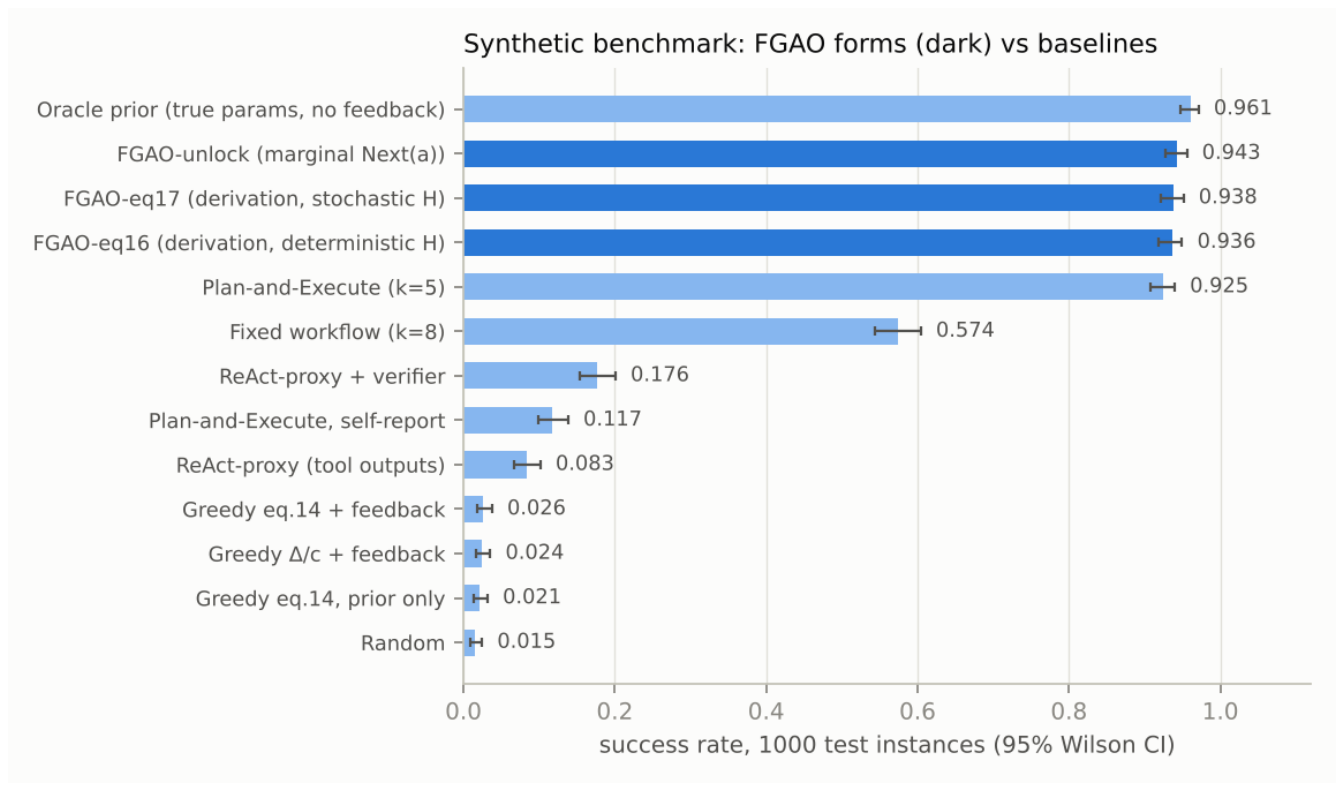
Table 1.
Matched RAG evaluation, SQuAD 2.0 sample 2 (100 questions: 75 answerable, 25 unanswerable; 30 require the secondary index). Shared Sonnet prompt-serving procedure, retrieval corpora, costs, and budget . “Cost” is in declared operation units.
Table 1.
Matched RAG evaluation, SQuAD 2.0 sample 2 (100 questions: 75 answerable, 25 unanswerable; 30 require the secondary index). Shared Sonnet prompt-serving procedure, retrieval corpora, costs, and budget . “Cost” is in declared operation units.
| Method | EM | F1 | Answerable EM |
Secondary only EM |
Correct abstain |
Cost per query |
Total tool calls |
|---|---|---|---|---|---|---|---|
| Vanilla RAG | .560 | .570 | .547 | .033 | .600 | 3.00 | 200 |
| CRAG-style | .720 | .762 | .760 | .667 | .600 | 7.46 | 382 |
| Self-RAG-style | .580 | .615 | .507 | .133 | .800 | 13.08 | 696 |
| FGAO v1 (unlock) | .580 | .594 | .533 | .000 | .720 | 9.21 | 525 |
| FGAO v2 (unlock) | .760 | .786 | .773 | .600 | .720 | 8.48 | 436 |
| FGAO v3 (corroboration) | .770 | .796 | .760 | .600 | .800 | 11.36 | 531 |
Disclaimer/Publisher’s Note: The statements, opinions and data contained in all publications are solely those of the individual author(s) and contributor(s) and not of MDPI and/or the editor(s). MDPI and/or the editor(s) disclaim responsibility for any injury to people or property resulting from any ideas, methods, instructions or products referred to in the content. |
© 2026 by the author. Licensee MDPI, Basel, Switzerland. This article is an open access article distributed under the terms and conditions of the Creative Commons Attribution (CC BY) license.
Copyright: This open access article is published under a Creative Commons CC BY 4.0 license, which permit the free download, distribution, and reuse, provided that the author and preprint are cited in any reuse.