

Submitted:
23 November 2026
Posted:
25 November 2026
You are already at the latest version
Abstract
AI chatbots are making their way into ecommerce as "24/7" on-demand interfaces to guide, resolve, and inquiry. However, its implementation does not promise a better experience or increased brand attachment. We theorize from available research about chatbot property-construals on consumers' experience and satisfaction, and how those experiences lead to retention, repurchase and loyalty. A structured integrative review of peer reviewed empirical articles and reviews, derived mainly from 2020 to November 2026, and the extant literature on customer experience, information-systems success and expectation-confirmation was conducted in which publications were analyzed via thematic comparisons and a study-level matrix; no primary data, pooled effects, or statistical models were studied. Consistently, responsiveness, informational quality, relevance, reliability and service recovery lead to positive end-states; empathy and social presence foster trust, and social cues (such as humanlike appearance) may do so as well. Meta-analyses show that chatbot satisfaction is positively correlated with behavioral intentions but that the relatively large between-studies heterogeneity tempers the generality of these findings. Research in other industries shows that although chatbots can grab consumers' attention, its effects on emotional stimulation are uncertain and technology-induced errors cause cognitive dissonance, with accompanying frustration and reduced service quality ratings. We conclude with an integrative journey framework involving interaction personality-construals, experience, satisfaction and outcomes. Chatbots will be most effective at engendering loyalty if they guide consumers accurately, effectively and with good timing, manage their own capabilities and provide quick escalation procedures when conditions demand.
Keywords:
artificial intelligence chatbots
; electronic commerce
; customer experience
; customer satisfaction
; customer loyalty
; service quality
; human-computer interaction
1. Introduction
E-commerce customers connect with businesses through multiple electronic contact points along the customer journey (pre-transaction, transaction and post-transaction phase: such as researching and choosing the product, trying the checkout process, tracking parcel, returns, and customer complaints etc. (Lemon & Verhoef, 2016). Customer experience thus is not just a single service encounter but it is made up of customers' observable emotional, sensory, and behavioural responses along the journey to interactions with multiple touchpoints. AI chatbots are some of the touchpoints at which businesses arrange their interactions.
In many presentations of the business case for chatbots the common need for them is defined as greater availability, speed, scale and lower service costs. But service efficiency and customer outcome are not the same thing: a fast reply may be wrong; a polite reply does not solve the problem; and a satisfied customer may not buy from that retailer again. This is important because customer experience is the interaction; satisfaction is the evaluative judgement of the interaction according to expectations; and loyalty is the cumulative affective and behavioral response to the interaction as expressed in repurchase, preference and/or word-of-mouth. Some studies in some but not all situations treat continuance intention or repurchase intention as a single customer outcome.
But, under what circumstances of service to improve, and when to impoverish, the online shopping experience? Earlier research have been dealing with technology acceptance and contentment after use (Ashfaq et al., 2020; ATM et al., 2020), and more recently, with service quality, service trust, recovery and loyalty (Chen et al., 2023; Shahzad et al., 2024). The latter has empirically tested the online retailing tool against real online shopping journeys, human presence, and the risks of generative-AI errors (Roemer et al., 2026; Wu et al., 2026; Chen et al., 2026). All streams are relevant but do not yet converge their topic, context and construct foci.
While there is some literature on chatbot engagement and experience, little attempts have been made to demonstrate the relationship to customer satisfaction and loyalty. This paper consolidates knowledge and offers so pathways between chatbot design and customer experience, satisfaction and loyalty. The contribution lies in an integrative analysis with definitions of functional utility, relational quality and service recovery. These are mapped to the stage of the online shopping journey.
2. Literature Review
2.1. Functional Quality, Usefulness and Expectation Confirmation
A common thread was that a customer used a chatbot or not, hinge on whether or not it actually worked for him or her. Ashfaq et al. (2020), examining 370 actual customer service chatbots, combined the expectation-confirmation model, the information-systems success, and the technology-acceptance paradigms. Customers' satisfaction was determined by quality of information and service, and perceived value was determined by perceived usefulness, perceived ease of use, and enjoyment, of the customer. Automation was valued only when it offers to remove friction, but if there is an override option of a person, that controls how useful and easy to use the chatbot gets.
Chen et al. (2023) studied 459 respondents and derived 9 aspects of chatbot service quality. They obtained a service quality-loyalty model that was mediated by value, cognition and affect based trust, and satisfaction. The importance of this finding is that, instead of the chatbot itself as immediate predictor of loyalty, the availability of chatbot was a trigger of the subsequent evaluation. Liu et al. (2023) carried out focus groups and survey in China and Hong Kong to compare task-oriented chatbots, they found in both markets presence of the dimensions of relevance, completeness, pleasure and assurance, and while response time and empathy were of importance in Hong Kong but not in China mainland. These two work imply that vendors should infer that information and task-finishibility will be dependable but the relative weight of the aspects will be different according to circumstances.
2.2. Social Presence, Anthropomorphism and Trust
Chatbots also serve as social interfaces. In their research of 395 online shoppers, Fu et al. (2023) found that social cues (empathy and social presence) exhibited a positive influence on trust and intention to adopt a chatbot, whereas perceived anthropomorphism (how human-like a chatbot appears to be) had a negative impact on the more trusting behavior. This seems to raise an inconsistency when comparing other research findings, where it suggests that a richer anthropomorphic appearance might bring additional insight into the chatbot relationship. However, this makes sense when human-like cues produce past experiences and expectations on how the chatbot system can be understood and perform, and trust will be built around information, structure and assistance rather than the anthropomorphic appearance.
Huang et al. (2024) compared a chatbot-only to a human-only configuration - and concluded that: both dispositional, learned and situational trust variables predicted satisfaction, acceptance and repatronage intention; human-only service surpassed the chatbot-only service in the current scenarios; and light-touch human input in chatbot matched human service for all dependent variables – showcasing the advantages of a hybrid service rather than complete computerization. Wu et al. (2026) with 685 e-commerce respondents, established that trust was the best service quality predictor of satisfaction (further along with information support and anthropomorphism), and habit was the best (UTAUT2) predictor of behavioural intention.
2.3. Satisfaction, Repeat Purchase and Brand Loyalty
Primary research and reviews for the effect of satisfaction on loyalty were also present. First, Jenneboer et al. (2022), using a systematic review, discovered that the evidence pointed to a positive relationship of chatbots with customer loyalty, but there was some tension over privacy and personalisation. Second, Shahzad et al. (2024), using 301 Chinese consumers of luxury-fashion goods, found, by using the Stimulus-Organism-Response (S-O-R) paradigm, that chatbot service quality was positively related to e-brand loyalty through trust, user experience and electronic Word-of-Mouth (eWOM). Third, Gupta et al. (2025), with 600 online shoppers from north India, found that customer satisfaction had a positive relationship with continued intention in a model that included digital payment and virtual try-on.
Even closer to repurchase are the behavioural variables. Zhao et al. (2026) studied 344 Chinese online consumers and found the effects of responsiveness, anthropomorphism and social presence on satisfaction, and the effect of satisfaction on repurchase intention; the positive influence of e-shopping enjoyment on satisfaction. The former one was noted as the neighbouring evidence and thus no direct estimate can be provided. As a similar study using more generic ChatGPT rather than chatbots in e-commerce context, Niu and Mvondo (2024) learned that satisfaction successfully predicted loyalty and ethical concerns weakened the relation between satisfaction and loyalty.
2.4. Customer Experience During the Experience and the Failure
The results are slightly more nuanced, though. Roemer et al. (2026) examined one AI chatbot in an online shop, using measures of electrodermal activity (a proxy for arousal) and eye tracking. Customers exhibited greater visual attention and higher cognitive activity in relation to the chatbot, versus the website alone, but their affective arousal showed no statistically significant difference. Customer experience shouldn't therefore be boiled down to a single aggregated satisfaction or engagement score. A chatbot might provide better advice, but it's not necessarily more emotionally delightful.
Human-computer service failures are more important. For instance, Chen et al. (2026) conducted two scenario studies on e-commerce chatbot hallucination, where the severity of hallucination was positively related to chatbot service quality negatively by dissonance and technologically frustrating. Human-agent service recovery (transferred to human agent) reduced technologically frustrating but failed to fully offset dissonance, thus, merely apologizing to the consumer and transferring to human is inadequate if misinformation had been delivered; while accuracy control and correction have to occur before the consumer encounters any misinformation.
Two recent reviews illustrate this point. Castillo and Caruana (2026) reviewed 91 papers and found the literature to be biased towards post-interaction judgments and behaviours and away from precursors to the interaction. Fares and Lee (2026) reviewed 64 journal articles and 48 meta-analyses covering 117 effect sizes based on 34,302 respondents and established that perceived usefulness, perceived ease of use, trust and satisfaction were all reliably connected to acceptance but anthropomorphism more so with enjoyment and not trust. In fact, the significant heterogeneity observed in many relationships suggests the importance of using different chatbots for different retail contexts as one may not perform equally well in each one.
3. Research Gap
The evolution of the literature has ranged from adoption models to sophisticated tests of trust, satisfaction and loyalty. Yet, three issues remain underexplored. Conceptually, researchers often treat customers' experience, satisfaction, continuance intention, repurchase intention and loyalty as interchangeable constructs. Measurement-wise, researchers rely mostly on cross-sectional self-report measures, and journey-based and physiological approaches. Context-wise, research has been conducted in China, the US and some Indian states, in various product categories and on different levels of maturity of chatbots. Conceptually, the ambiguity is address by taking a multi-faceted (functional, relational and recovery) perspective of chatbot service quality along a journey-based model and by defining post-interaction customer experience separate from satisfaction, continuance intention and loyalty.
4. Research Aims and Questions
A1: To investigate the impacts of functional, informational and relational aspects of AI chatbots on customer experience and customer satisfaction in online shopping.
Objective 2: To incorporate the influence of customer experience and satisfaction on repurchase intention and brand loyalty and to determine the moderator effect (what may strengthen or weaken the relationships) of both the factors.
Research Question 1: What aspects of the chatbot service are most consistently associated with a more negative and positive experience and satisfaction?
Research Question 2: What are the evaluative and relational pathway mechanisms driving continuance intention, repurchase and loyalty through website/brand trust when consumers visit a chatbot?
There are no tests for formal hypotheses in this paper in that we do not generate a common respondent-level data set, nor re-estimate effects with the original samples. The questions are answered via the first approach and by comparing published results. In this case, the propositions are used as heuristics rather than hypotheses that have been statistically tested.
5. Theoretical Foundation and Conceptual Framework
The synthesis is based on three related but distinct sets of tests. One sees the chatbot as a stimulus (S), environmental cue (O), customer state (R), and continuing (O) or loyalty response (Mehrabian & Russell, 1974). Another notes that if the usefulness of the anticipated performance has been confirmed, the continuing response will be better (Bhattacherjee, 2001). Third, DeLone and McLean (2003) posit that a system's quality and the user satisfaction depend on system quality, information quality and service quality. Lemon and Verhoef (2016) use a customer-journey perspective that models all types of dialogue and links the one-on-one interactions with the prepurchase, purchase and postpurchase touchpoints.
It has had the benefit of not being anything new to the statistical model. These map: attributes of the chatbot service experienced (cognitive and affective); the experienced is measured by through satisfaction and.
Trust; and these appraisals result in repurchase, repurchase, and brand loyalty. The highway is dependent on complexity of task, customer requirement, risk associated with the product, intimacy of information, experience, magnitude of error and human support.
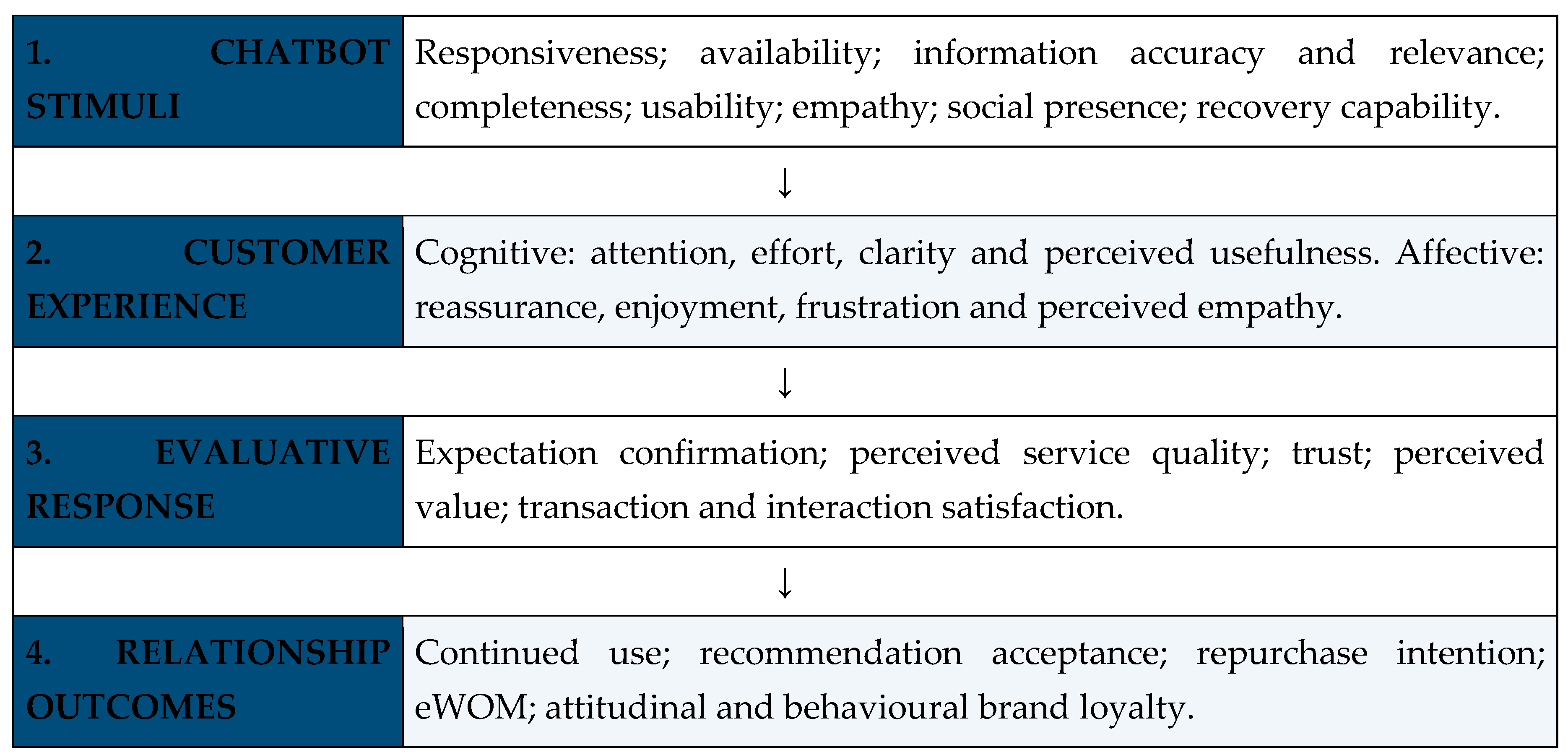
Boundary conditions: task difficulty, sensitive information, product type, culture, pre-existing trust, level of expectation, severity of mistake, ability to call human.
6. Research Methodology
6.1. Research Design and Data Sources
The study will be conducted via an integrative review of secondary evidence. This design is appropriate as it is broad in terms of scope of inquiry into each research stream (ie, technology acceptance, service quality, HCI, customer experience and relation outcomes) and the range of primary research studies (ie, in terms of population, measures and research approaches). An integrative synthesis was used to make comparisons across the research streams as it did not require the effect estimates to be harmonized. The secondary research evidence came from peerreviewed journal and review papers published by established academic publishers (eg, Elsevier, Emerald, Wiley, Springer, Taylor & Francis, MDPI, Frontiers) and other publication records of respective institutions to enable bibliographical verification.
6.2. Identification and Process of Selection
Specific searches were performed at this stage using combinations of the terms 'AI chatbot'; 'conversational agent'; 'e-commerce'; 'online shopping'; 'customer experience'; 'customer satisfaction'; 'trust'; 'loyalty'; 'repurchase'; 'service recovery' limited to peer-reviewed journal articles published in English from 2020 to 13 November 2026. Citations of already reviewed articles on the basic principles were kept. A consumer focussed AI chatbot and at least one customer outcome aligned with the study's objectives was necessary for inclusion. Non-retail focused articles or technical articles with no consumer outcome were not considered as evidence, only adjacent research on more general chatbots was included if sufficiently defined.
The evidence matrix contains 14 core studies and reviews identified as pertinent and confirmable; it is a purposive synthesis set, not a statement that 14 papers (as listed) is exhaustive, nor that the authors did not screen all relevant publications. We do not give a PRISMA flow or database-hit figures for this limited-source search, as a systematic, multi-database review was not conducted. The search record is reproducible, by searching principles and source-picking criteria; but not as a systematic-review protocol.
6.3. Analytical Procedure, Quality and Ethics
Then, for each source, coding was conducted according to context, design, chatbot, and CX, satisfaction and loyalty requirements and limitations. Second synthesis was comprised of three steps: (1) evidence was coded according to main themes of functional quality, trust, journey and recoverability; (2) evidence was coded according to outcome, measure of experience, measure of satisfaction, measure of use, measure of convenience, or measure of performance, measure of adoption, measure of continuance, measure of repurchase and measure of loyalty; (3) common pathways and boundary conditions were extracted. Counts and coefficients are available only if published by the review, original, or single study, and no extra correlation, regression, pooled effect size, or significance test was calculated.
Determining credibility was dependent on peer review publication, publisher or institutional metatags and the extent to which the design was clear and directly relevant to consumer e-commerce. Limitations: Convenience or non-probability samples, self-report measures, single country, scenario tasks, differences between scripted and generative chatbots and measuring loyalty. Cited sources are in author-date format and results are interpretted within the context of each study. No personal or sensitive data was collected or stored.
7. Secondary Data Analysis and Interpretation
7.1. Objetivo 1: Chatbot Features, Customer Service Experience and Customer Satisfaction
Availability and speed put you back in line but depth of answer is what you need to feel there. Ashfaq et al. (2020), Liu et al. (2023) show that service and information quality details and relevance as well as completeness matters. Chen et al. (2023) infer design scheme of multiple dimensions of service-quality and their influence on value, trust and satisfaction. Gupta et al. (2025) contextualize this core in northern India, where chatbot predicted satisfaction (t-0.73) in a model controlling for virtual try-on and digital payment; the chatbot coefficient is controlled for multiple other technologies and does not infer causality on its own.
The value of the cognitive-affective distinction is demonstrated. Roemer et al. (2026) document way more attention to the online retail chatbot by eye-tracking, but no differences in EDA arousal the baseline condition. Producing arousing effort, and making it easier to find product information in a more easy and effortless manner, is valuable, but the resulting effort does not transfer to the affection recreation. The euphoria you produce does not transfer to a warmer, or more reassuring, interaction. So that is the entire point of the distinction, and advocates separate measures of attention, effort, arousal, and perceived reassurance as distinct, and not as one overall experience.
Relational cues can also be of conditional effectiveness. Fu et al. (2023) find positive effects of both social presence and empathy, and negative effects of anthropomorphism on trust. In a set of service quality indicators, Wu et al. (2026) show anthropomorphism as a positive cue, however in a meta-analytic review (Fares and Lee, 2026) the construct as here considered as a cue of enjoyment is only inconsistently related to trust. This does not necessarily seem to be a contradiction: the operationalisation of the construct, the customer's expectations, the task in hand and the cue of competence the chatbot displays, will all have an effect. To this end, this review sets up the ability of anthropomorphism to be operationalised differently across all.

Table 1.
Synthesis of selected empirical and review studies.
| Study | Context and method | Main published evidence | Important limitation |
|---|---|---|---|
| Ashfaq et al. (2020) | 370 actual chatbot users; survey model combining ECM, IS success and TAM. | Information and service quality supported satisfaction; usefulness, ease and enjoyment explained continuance. | Self-reported usage and general service context; not limited to e-commerce. |
| Jenneboer et al. (2022) | Systematic literature review of chatbot and loyalty research. | A chatbot–loyalty link was likely; personalisation raised a privacy-paradox concern. | Earlier chatbot generation and heterogeneous outcome measures. |
| Chen et al. (2023) | 459 respondents; service-quality/loyalty model. | Service quality related to loyalty through value, cognitive and affective trust, and satisfaction. | Survey design; contextual transfer needs caution. |
| Fu et al. (2023) | 395 online shoppers; trust and human-like characteristics. | Empathy and social presence supported trust; anthropomorphism reduced trust; trust supported use willingness. | One online-shopping context; perceived attributes are context-sensitive. |
| Liu et al. (2023) | Mixed methods; focus groups (15), surveys in mainland China (637) and Hong Kong (647). | Relevance, completeness, pleasure and assurance supported satisfaction; some effects varied by region. | Task-oriented bots; cross-market and service-context differences. |
| Huang et al. (2024) | Three online experiments; total N=643; human vs chatbot service. | Trust mattered; light-touch human intervention matched human service on most tested outcomes. | Vignette/experimental context; not all real transactions. |
| Shahzad et al. (2024) | 301 Chinese luxury-fashion consumers; S-O-R and PLS-SEM. | Trust, experience and eWOM mediated service-quality links to e-brand loyalty. | Luxury fashion and single-country convenience sample. |
| Gupta et al. (2025) | 600 online shoppers in northern India; UTAUT2/PLS-SEM. | Chatbot, virtual try-on and payment mode positively related to satisfaction; satisfaction supported continuance. | Multiple technologies in one model; snowball sampling. |
| Castillo & Caruana (2026) | Systematic review of 91 consumer-chatbot studies. | Research favours post-use perceptions; functional and experiential pre-interaction expectations need more attention. | Synthesis across contexts; not exclusively e-commerce. |
| Roemer et al. (2026) | Online retail experiment; EDA and eye-tracking across journey stages. | Chatbot use increased attention, but did not significantly alter affective arousal versus control. | A particular shop/chatbot and journey; physiological measures do not equal loyalty. |
| Zhao et al. (2026) | 344 Chinese online shoppers; survey/SEM. | Responsiveness, anthropomorphism and social presence supported satisfaction; satisfaction predicted repurchase intention. | Cross-sectional self-report; Chinese online-shopper context. |
| Wu et al. (2026) | 685 Chinese e-commerce users; UTAUT2 extension and SEM. | Trust was the strongest service-quality predictor of satisfaction; habit most strongly drove behavioural intention. | Single national context; data not publicly available. |
| Fares & Lee (2026) | SLR: 64 articles; meta-analysis: 48 articles, 117 effects, N=34,302. | Usefulness, ease, trust and satisfaction support acceptance; anthropomorphism–trust relationship was not significant overall. | High heterogeneity; most links had fewer than 10 studies; broad consumer-bot scope. |
| Chen et al. (2026) | Two e-commerce scenario experiments (N=236 and N=364) on AI hallucination and recovery. | Hallucination lowered service-quality evaluations via dissonance and frustration; human help eased frustration but not dissonance. | Scripted responses, not live LLM output; scenario rather than field transactions. |
Note. Sample sizes and results are copied from the articles cited. They are not pooled or re-analyzed in this paper. ECM = expectation-confirmation model; IS = information system; TAM = technology acceptance model; S-O-R = stimulus-organism-response; PLS-SEM = partial least square-structural equation modeling.
7.2. Objective 2: From Satisfaction to Repetition and Loyalty
Most specifically quantitative synthesise can be seen in Fares and Lee (2026). They showed the meta analysis of 17 relationships with 14 statistically significant and the 17 relationship's had 117 effect sizes with 34,302 total N. They found the overall pooled correlation between satisfaction and behavioural intention was r=.562 (10 studies, 3,079 total N p <.001). Trust and behavioural intention was also positively and significantly related (r=.282, 12 studies, 4,518 total N, p =.010). Heterogeneity was very high for both (I2 about 98.1%), which indicates a high amount of variance between effect sizes. Setting to setting and measure to measure. Those values are only from Fares and Lee (2026), and are not computed to be used by this particular set of studies.
From the reviews, one can derive a linear order where chatbot experience improves performance, experience affects satisfaction and trust, and that these attitudes enable continued use/loyalty. Chen et al. (2023) and Shahzad et al. (2024) are the most relevant direct trust and satisfaction related loyalty pathways in brands, whereby the former for experience enhancement and latter for satisfaction. The other direct loyalty pathways are Zhao et al. (2026) to a bivariate association of satisfaction and repurchase intention; Gupta et al. (2025) to a correlation between satisfaction and future online-shopping intention and Huang et al. (2024) to trust and human intervention affecting repatronage intention, although only in intentions.
Failure conditions put a cap on the loyalty route. Chen et al. (2026) show that misinformation impacts service-quality perceptions via cognition and affect. Similar to the credibility above, the conflict situation will generate cognitive dissonance which the system-turned-human agent cannot easily resolve. Liu et al. (2024) also show that the identity of the system-agent and the sensitivity of information provided by the user impact user's privacy concerns and intention of using the service – all when dealing with privacy management in China and the US. Also in the service quality section, think here of transparency and data minimisation – this is not just about meeting legal requirements. A trusted experience is one where the system has an awareness of what it is capable of doing and shares minimal, relevant information about difficult or sensitive matters.
8. Discussion
This synthesis addresses to the first research question, outlining an order of importance of chatbot features. In the initial phase, functional accuracy and information quality constitute condition standards: Help needed should be provided promptly, relevantly, comprehensively and correctly. Relational cues such as empathy and social presence could enrich interactions but anthropomorphism do not make up for lack of competence. Journey evidence suggest that chatbot effects can be affective rather than cognitive. Customer satisfaction can therefore be achieved without attention, speed or usage.
The second question is answered by a flow of chain-events: service quality and usefulness influences the cognitive and affective experience; expectation confirmation, trust and satisfaction forms the decisive mediators; and, they collectively influences the behavioral intention of continuance-, repurchase- and loyalty-related dimensions. This sequence is in line with the expectation-confirmation theory and the IS success model. S-O-R paradigm, however, would maintain that these constructs are not solely simple additive predictors but rather sequential ones. Yet, due to the existence of the variation in the meta-analyses and the cross-sectional data, the assumption of causality should not be over-considered.
The next step is also to extend the definition of loyalty. Some studies simply measure continuance with the chatbot (or e-channel), others consider repetitional behaviour, e-brand loyalty or e-repetition. Since a customer can continuance with a chatbot because it is easy to use and not necessarily be loyal towards the retailer, and vice versa, since a customer can be loyal towards a brand with a human agent as intermediary, the future studies and managers dashboards should clearly distinguish between chatbot-channel loyalty and brand loyalty or re-user, and not attribute any positive intention to this as a sign of loyalty. My synthesis brings it back to a customer-journey model and does not treat any positive intention as equaling to loyalty.
9. Findings
Objective 1: The studies most consistently support the importance of information quality, responsiveness, relevance, completeness, reliability and service recovery. Empathy and social presence may increase trust while anthropomorphism may have both positive and negative effects. Physiological results indicate greater cognitive attention, while the degree of affective arousal did not change. Hallucination and misproduced responses have a negative impact as they evoke frustration and conflict.
Evidence would support a positive satisfaction-trust and behavioural intention (continued use, repurchase, loyalty results) one. A 2026 meta analysis revealed a moderate positive pooled satisfaction-behavioural-intention connection, but heterogeneity was so high it couldn't be generalised consistently. This hybrid chatbot-human service appears to enhance acceptance under tested conditions, but most related loyalty evidence was based on stated intentions or self-reporting rather than buy history.
10. Suggestions and Implications
- Prioritize answer quality, not conversational naturalness. Monitor answer accuracy, informativeness, exhaustiveness, time-to-answer and resolution rate for each task type. This is driven by the recurring service-quality observations and negative effects of hallucination.
- KISS the customer journey. Use chatbots for product discovery, comparison, order status and simple returns but make the chatbot experience right for the visitor and data requirements. Provide alternatives and enable transactional clarity.
- Use the human escalation as a service strategy, not a tactic of desperation. For unresolved, high dollar or emotional case escalate and share the context of the conversation so the customer has to repeat himself. Hybrid-service outcomes support this.
- Make sure it is obvious that the agent is a machine what it can and cannot do make it clear when people do not get it and when they are mistaken explicitly state how and when the system is mistaken don't make the system appear to have all the abilities of a human.
- Be specific about the outcomes. Assess cognitive effort, interaction satisfaction, brand satisfaction, re-purchase intention and observed retention separately. Never track click-through, chatbot usage or continuance intention as representative of brand loyalty.
- Test by customer groups and customer segments. Test language, accessibility, digital literacy, product risk and cultural expectations. It is dangerous to generalise from responses from luxury fashion or single-country samples to all e-commerce segments.
11. Conclusions
Previous research on the role of AI chatbots in customer experience, satisfaction and brand loyalty in e-commerce context (Secondary research) The previous researches examined in this paper have all suggested the value of chatbots in the situation where a) service is easier to access and less effort-based as well as b) when accurate, practical and relevant data is provided. The relationship between interaction and downstream intention is mediated by satisfaction and trust and the moderating effect depends on the specific task structure. Anthropomorphism per se cannot be a valid predictor of trust and increased cognitive task does not necessarily generate affective satisfaction. Errors, privacy invasion and lack of proper service recovery may neutralize the automated advantages.
The bottom line: Chatbots are not good or bad, whether they result in repurchase or greater brand loyalty depends on how good the entire journey is, how much the info they provide as accurate, the level of automation that is appropriate for the task and the need for human intervention. The evidence is hopeful but far from conclusive that bot use always leads to greater loyalty or repurchase.
12. Limitations and Future Research
Two caveats follow from the purposive, not comprehensive, selection of sources and reliance on mired studies with different methods, construct definitions, samples and chatbot systems. Much of the empirical evidence rests on convenience samples and self-report intentions. Several (but not all) of the studies are limited to China, United States and Indian states, which limits the generalisability. Some recent studies are on scripted, task-based chatbots, some with certain of the chatbots using the move to generative models for e-commerce, but do not generalise across technology. The meta-analysis itself shows considerable heterogeneity. Future research on interactions involving chatbots could productively include pre-registered, cross-national designs; a comparison of task-based and generative models; field experiments, including transaction-based measures of repurchase and retention over time; distinctions between channel continuance and brand commitment; and research on human escalation, error handling, privacy and accessibility across each stage of the customer journey.
References
- Panchal, M. R.; Shah, C. A. Green Consumer Values in Purchasing Decisions: A Study in Bharuch District. J. Mark. Soc. Res. 2025, 2, 216–227. [Google Scholar]
- Ashfaq, M.; Yun, J.; Yu, S.; Loureiro, S. M. C. I, chatbot: Modeling the determinants of users’ satisfaction and continuance intention of AI-powered service agents. Telemat. Inform. 2020, 54, 101473. [Google Scholar] [CrossRef]
- Bhattacherjee, A. Understanding information systems continuance: An expectation confirmation model. MIS Q. 2001, 25(3), 351–370. [Google Scholar] [CrossRef]
- Shah, A. 5% Canary Application: A Tool for Early Warning in Indian Financial Markets. 2026. [Google Scholar] [CrossRef] [PubMed]
- Shah, C. A.; Bhagat, J.; Sanghani, P. AN EMPIRICAL STUDY OF CRYPTOCURRENCY-ITS GROWTH, CHALLENGES & POTENTIAL IMPACT ON LEGISLATION IN INDIA. [PubMed]
- Shah, A.; Panchal, R. Generative AI in Digital Marketing; 2026. [Google Scholar]
- Panchal, R.; Shah, A. Social Media Influencer Marketing and Consumer Buying Behaviour: The Mediating Roles of Brand Trust and Electronic Word-of-Mouth. 2026. [Google Scholar] [CrossRef]
- Shah, A.; Panchal, R. ESG Disclosure Quality, Cost of Capital and Financial Performance: Evidence from Indian Listed Firms. 2026. [Google Scholar] [CrossRef]
- Shah, A.; Salehbhai, F.; Panchal, R. Economic Policy Uncertainty and Corporate Investment Efficiency: Evidence from Indian Listed Firms. 2026. [Google Scholar] [CrossRef] [PubMed]
- Shah, A. The Rise of Passive Investing in India: Performance, Risk and Market Efficiency of Index Funds and Actively Managed Mutual Funds. 2026. [Google Scholar] [CrossRef]
- Castillo, D.; Caruana, L. F. Unveiling customer expectations of chatbot interactions: A systematic literature review and research agenda. Int. J. Human–Computer Interact. 2026, 42(14), 10767–10794. [Google Scholar] [CrossRef]
- Chen, Q.; Lu, Y.; Gong, Y.; Xiong, J. Can AI chatbots help retain customers? Impact of AI service quality on customer loyalty. Internet Res. 2023, 33(6), 2205–2243. [Google Scholar] [CrossRef]
- Chen, X.; Liu, J.; Chen, Q.; Li, L. The impact of AI hallucination on the chatbot service quality in e-commerce: The moderating role of human agent based service recovery. Front. Psychol. 2026, 17, 1870991. [Google Scholar] [CrossRef] [PubMed]
- DeLone, W. H.; McLean, E. R. The DeLone and McLean model of information systems success: A ten-year update. J. Manag. Inf. Syst. 2003, 19(4), 9–30. [Google Scholar] [CrossRef]
- Fares, O. H.; Lee, S. H. M. Consumer acceptance of conversational bots: Systematic literature review and meta-analysis. J. Consum. Behav. 2026, 25(3), 1488–1520. [Google Scholar] [CrossRef]
- Fu, J.; Mouakket, S.; Sun, Y. The role of chatbots’ human-like characteristics in online shopping. Electron. Commer. Res. Appl. 2023, 61, 101304. [Google Scholar] [CrossRef]
- Gupta, S.; Kiran, R.; Sharma, R. K. Analyzing the complexities of chatbots, virtual try-on and digital payment mode on customer satisfaction: An empirical study of online shoppers. Eur. J. Manag. Bus. Econ. Advance online publication. 2025. [Google Scholar] [CrossRef]
- Huang, D.; Markovitch, D. G.; Stough, R. A. Can chatbot customer service match human service agents on customer satisfaction? An investigation in the role of trust. J. Retail. Consum. Serv. 2024, 76, 103600. [Google Scholar] [CrossRef]
- Patel, T.; Shah, A.; Patel, D.; Sanghani, P. Do Political Skills Enhance Emotional Intelligence in Organization? 2026. [Google Scholar] [CrossRef]
- Jenneboer, L.; Herrando, C.; Constantinides, E. The impact of chatbots on customer loyalty: A systematic literature review. J. Theor. Appl. Electron. Commer. Res. 2022, 17(1), 212–229. [Google Scholar] [CrossRef]
- Lemon, K. N.; Verhoef, P. C. Understanding customer experience throughout the customer journey. J. Mark. 2016, 80(6), 69–96. [Google Scholar] [CrossRef]
- Liu, Y.; Hu, B.; Yan, W.; Lin, Z. Can chatbots satisfy me? A mixed-method comparative study of satisfaction with task-oriented chatbots in mainland China and Hong Kong. Comput. Hum. Behav. 2023, 143, 107716. [Google Scholar] [CrossRef]
- Liu, Y. L.; Yan, W.; Hu, B.; Lin, Z.; Song, Y. Chatbots or humans? Effects of agent identity and information sensitivity on users’ privacy management and behavioral intentions: A comparative experimental study between China and the United States. Int. J. Human–Computer Interact. 2024, 40(19), 5632–5647. [Google Scholar] [CrossRef]
- Mehrabian, A.; Russell, J. A. An approach to environmental psychology; MIT Press, 1974. [Google Scholar]
- Niu, B.; Mvondo, G. F. N. I am ChatGPT, the ultimate AI chatbot! Investigating the determinants of users’ loyalty and ethical usage concerns of ChatGPT. J. Retail. Consum. Serv. 2024, 76, 103562. [Google Scholar] [CrossRef]
- Roemer, E.; Trynczyk, M.; Eisel-Ende, C. Unveiling the dynamics of customer experience with AI-powered chatbots in online retail: A neuroscientific study. J. Consum. Mark. 2026, 43(4), 459–476. [Google Scholar] [CrossRef]
- Shahzad, M. F.; Xu, S.; An, X.; Javed, I. Assessing the impact of AI-chatbot service quality on user e-brand loyalty through chatbot user trust, experience and electronic word of mouth. J. Retail. Consum. Serv. 2024, 79, 103867. [Google Scholar] [CrossRef]
- Wu, C.-F.; Lin, M.-C.; Chiou, C.-C. The impact of human-robot interaction in AI customer service on consumers’ online shopping behaviour: Extending UTAUT2 model. Expert Syst. 2026, 43(8), e70355. [Google Scholar] [CrossRef]
- Zhao, X.; Khan, A. N.; Shahzad, K.; Soomro, M. A. Chatbots that win hearts and wallets: Maximizing customer satisfaction and repeat purchases. Eur. Res. Manag. Bus. Econ. 2026, 32(1), 100307. [Google Scholar] [CrossRef]
Disclaimer/Publisher’s Note: The statements, opinions and data contained in all publications are solely those of the individual author(s) and contributor(s) and not of MDPI and/or the editor(s). MDPI and/or the editor(s) disclaim responsibility for any injury to people or property resulting from any ideas, methods, instructions or products referred to in the content. |
© 2026 by the authors. Licensee MDPI, Basel, Switzerland. This article is an open access article distributed under the terms and conditions of the Creative Commons Attribution (CC BY) license (http://creativecommons.org/licenses/by/4.0/).
Copyright: This open access article is published under a Creative Commons CC BY 4.0 license, which permit the free download, distribution, and reuse, provided that the author and preprint are cited in any reuse.