

Submitted:
23 November 2026
Posted:
25 November 2026
You are already at the latest version
Abstract
Introduction: Take-home naloxone is a key component of overdose prevention efforts in Australia. We examined national trends in naloxone supply under Australia's National Take-Home Naloxone (THN) Program, including exploring potential drivers for periods of increased naloxone supply. Methods: Monthly naloxone supply data were obtained for the period July 2022 to June 2025 and examined nationally and by jurisdiction. Interrupted time series analyses were undertaken to assess changes in pharmacy naloxone supply following key events. Level and slope changes were estimated using segmented regression models accounting for seasonality and autocorrelation. Results: Naloxone supply increased substantially over the study period, rising from 196,461 units in the first full year of the program to 343,643 units in the second year and 474,825 units in the third year. Growth was driven primarily by pharmacy distribution, with much smaller quantities supplied via hospitals and authorised suppliers such as needle and syringe programs. Victoria accounted for the largest proportion of naloxone supplied nationally. Two events associated with synthetic opioids were associated with significant increases in pharmacy naloxone supply. Discussion: Naloxone supply increased substantially during the first three years of Australia's National Take-Home Naloxone Program. The largest increases in pharmacy naloxone supply coincided with periods of heightened awareness of synthetic opioid harms. Continued monitoring of naloxone supply may help inform our understanding of how emerging drug threats and other events drive community uptake of THN.
Keywords:
naloxone
; overdose
; synthetic opioid
Introduction
Naloxone is an evidence-based intervention that reverses opioid overdose, and has become a cornerstone of overdose prevention strategies internationally [1]. In Australia, the national Take-Home Naloxone (THN) Program started as a pilot in three states, and from June 2022 was funded as a national program where naloxone is available at no cost to people at risk of opioid overdose, their families, and potential bystanders via community pharmacies, hospitals and other authorised suppliers [2,3,4].
People may seek naloxone for different reasons, reflecting the increasingly diverse populations that are at risk of witnessing or experiencing an opioid overdose. These include people prescribed opioids for pain, people who use heroin or other illicit opioids, and increasingly, people who may be unknowingly exposed to potent synthetic opioids such as nitazenes [5,6], as well as their family members, carers or peers. Consequently, the drivers of naloxone access and uptake have evolved, potentially shifting supply volumes, in response to different forms of public health messaging and information in the community.
Over the past decade in Australia, one of the largest groups represented in opioid mortality data are people prescribed opioids [7]. In response to these harms, a suite of co-designed tools and resources were developed as part of a digital Opioid Safety Toolkit (saferopioiduse.com.au) [8,9]. The Toolkit underwent a randomised controlled trial, before being actively disseminated via a national campaign from August 2024 to June 2025. This multi-modal dissemination campaign aimed to raise awareness of the Toolkit and naloxone, particularly among people prescribed opioids and their clinicians.
Over the same period, Australia experienced several outbreaks involving nitazene-class synthetic opioids. These were accompanied by public health alerts, multiple hospitalisations, fatalities, and substantial media attention [5,6] and had the potential to influence naloxone uptake independently of formal health promotion activities. Little is known, however, about how targeted harm awareness raising initiatives nor media attention may impact naloxone supply. To address these gaps, this study aimed to: (1) characterise national and jurisdictional patterns of naloxone supply under Australia’s expanding THN program; (2) identify major changes in naloxone supply over time; and (3) explore whether periods of increased supply coincided with highly publicised synthetic opioid overdose events or awareness raising activities.
Methods
Data Source
The analysis used the de-identified aggregated THN Program dataset provided by the Australian Government Department of Health in September 2025. The Department approved an extension of the permitted use of the dataset to allow examination of supply trends, identification of unusual shifts in dispensing, and exploration of whether observable patterns aligned with key community events.
Study Design
We mapped naloxone supply volumes across Australia for the first three years of the program from July 2022 to June 2025, broken down by supply site types (i.e., community pharmacy, hospital and authorised alternative supplier [e.g., Needle Syringe Program or other harm reduction services]).
Identification of Novel Synthetic Public Awareness Events
Potential overdose events were identified from public health alerts involving nitazenes and related synthetic opioids [5].
To determine whether an event was likely to have generated sufficient public awareness to influence naloxone supply, a structured media search was conducted. Search terms included “nitazene”, “isotonitazene”, “protonitazene”, “synthetic opioid”, “opioid overdose”, “naloxone”, and “opioid contamin*”. Searches were restricted to Australian news, broadcast, and RSS sources published in English. Media coverage was quantified for each event, and events receiving extensive coverage focused on overdose harms were selected for analysis (see Supplementary Material). Two events met these criteria: an alert around detection of isotonitazene in New South Wales in May 2023. The May 2023 NSW Health alert regarding isotonitazene appears to have been one of the earliest public health warnings in Australia that attracted media concerning nitazenes and was issued following detection of the drug in samples associated with serious harms and possible deaths under investigation [10]. The second identified event was four deaths associated with protonitazene-contaminated codeine in Broadmeadows, Victoria, in July 2024 [11].
Statistical Analysis
Naloxone supply data were received as quantities (units) of naloxone supplied and were summed into monthly volumes and presented over time to describe overall trends, including changes in supply volumes, periods of growth or decline, and notable peaks or fluctuations. These monthly volumes were examined descriptively using time-series plots at the national and state/territory levels by supply type (pharmacy, hospital and authorised alternative supplier) to examine geographic variation in supply trends.
Segmented regression was used to examine changes in pharmacy naloxone supply associated with the two overdose events identified through the media search process: the May 2023 alert and the July 2024 protonitazene-related deaths. Analyses were conducted for New South Wales, Victoria and national pharmacy supply data. Other supply types (i.e hospital and authorised alternative supplier) and jurisdictions were not included in segmented regression analyses due to intermittent data availability and low monthly counts, which precluded robust modelling.
Models estimated baseline trends, immediate level changes and trend changes following the two events. Models accounted for seasonality (sine and cosine) and temporal autocorrelation. Given the exploratory nature of the study, findings should be interpreted as temporal associations rather than evidence of causation. Cumby-Huizinga tests indicated autocorrelation at lag 4; therefore, Newey-West standard errors with a lag of 4 were used. All statistical analyses and data visualisation were performed using Stata, version. 17.0; StataCorp.
Results
Monthly naloxone supply increased across the observation period, with substantial variation month-to-month observed (Figure 1). National supply was relatively low prior to 2023, generally below 15,000 units per month, before increasing during 2023 and reaching approximately 32,000–45,000 units during several peak periods (Table S2). Naloxone supply increased steadily over the first three years of the National Take-Home Naloxone Program, rising from 196,461 units in the first year to 343,643 units in the second year and 474,825 units in the third year.
Victoria consistently accounted for the largest proportion of total naloxone supply, ranging from 20% to 50%, and was the principal contributor to the major national peaks. New South Wales and Queensland also contributed substantial volumes, particularly from late 2023 onwards, while Western Australia and South Australia contributed relatively smaller volumes. Supply in less populated states and territories including Tasmania, the Australian Capital Territory and the Northern Territory remained comparatively the lowest throughout the study period.
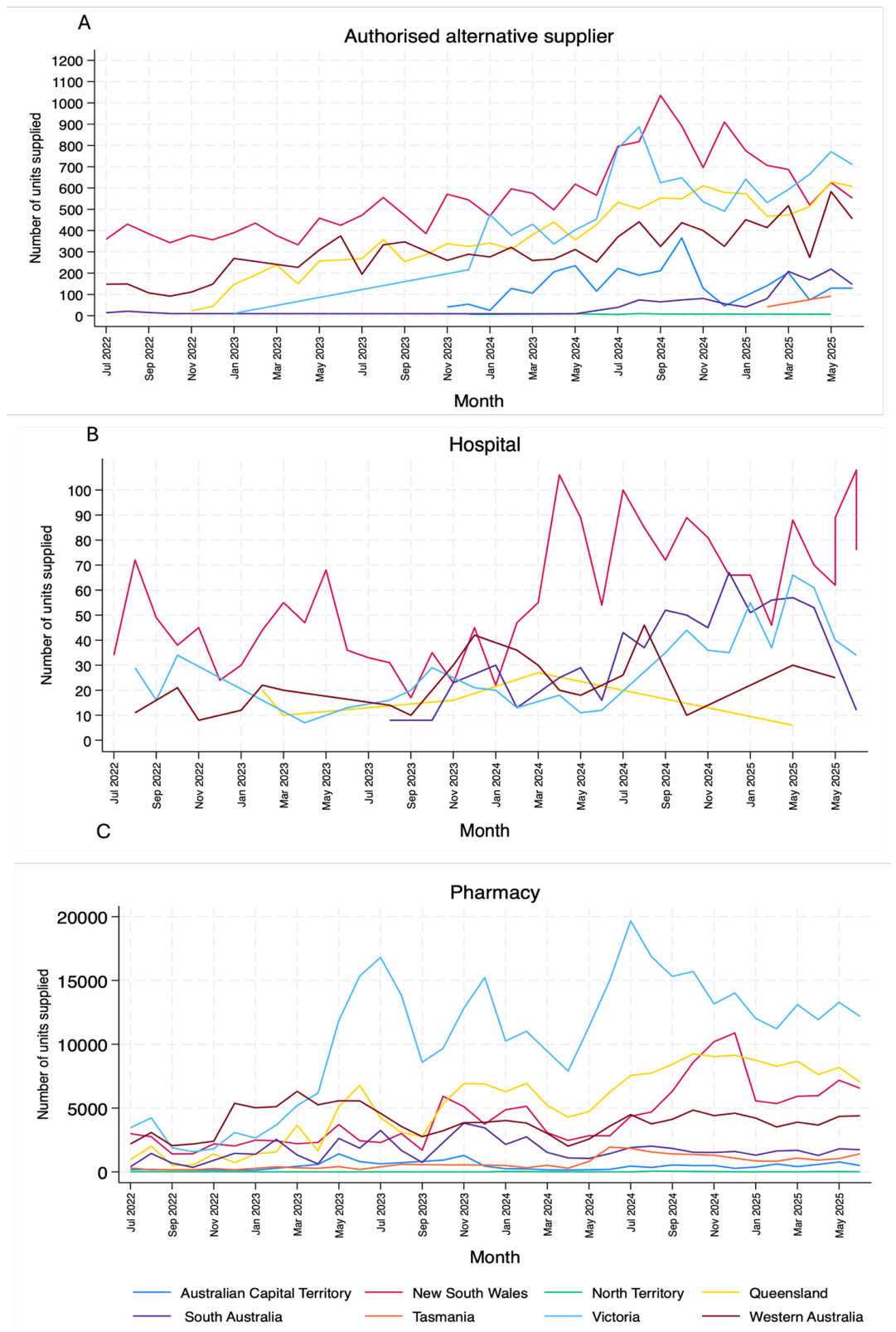
Figure 2 demonstrates the naloxone supply by type of supplier. Supply by pharmacies accounted for the vast majority of naloxone supplied nationally (>90%) throughout the observation period and largely drove the overall temporal pattern. Pharmacy supply increased from approximately 10,000 units in July 2022 to more than 40,000 units during several months in the second half of 2024. Supply through authorised alternative suppliers also increased gradually, from less than 500 units per month in 2022 to approximately 2,000 to 3,000 units per month by 2024–2025. Hospital supply remained very low throughout the study period, ranging from approximately 50 to 250 units per month.

Table 1.
Segmented regression estimates of level and slope changes of pharmacy naloxone supply through the national Take-Home naloxone program.
Table 1.
Segmented regression estimates of level and slope changes of pharmacy naloxone supply through the national Take-Home naloxone program.
| Intervention | Output | NSW (ß, 95%) |
VIC (ß, 95%) |
National (ß, 95%) |
|---|---|---|---|---|
| Pre-intervention | Baseline trend (per month) |
−23.5 (−436.3 to 389.3) |
466.2 (52.6 to 879.9) | 893.7 (−346.1 to 2,133.4) |
| May 2023 | Level change | 1,688.3 (−761.1 to 4,137.6) | 6,690.3 (3,658.9 to 9,721.6) | 13,164.3 (5,273.3 to 21,055.3) |
| Slope change | 35.2 (−350.3 to 420.7) | −610.3 (−1,027.3 to −193.3) | −1,301.3 (−2,522.8 to −79.9) | |
| July 2024 | Level change | 2,415.2 (145.8 to 4,684.5) | 6,163.5 (3,559.7 to 8,767.3) | 15,804.6 (7,987.9 to 23,621.4) |
| Slope change | 104.8 (−121.9 to 331.6) | −395.3 (−689.6 to −101.1) | −285.6 (−1,020.0 to 448.8) | |
| Resulting trend (per month) | 116.5 (−120.5 to 353.5) | −539.4 (−774.1 to −304.8) | −693.2 (−1,423.1 to 36.6) |
Estimates are regression coefficients (ß) with 95% confidence intervals (95CI%). Bold indicates statistical significance at p < 0.05. Level changes represent immediate changes in monthly naloxone supply, while slope changes represent changes in the monthly trend following each intervention.
No clear increase in naloxone supply coincided with the timing of the Opioid Safety Toolkit promotion activities, which began in August 2024, and continued steadily through to July 2025.
In New South Wales, there was no significant baseline trend in pharmacy naloxone supply prior to the May 2023 alert (−23.5 units per month; 95% CI −436.3 to 389.3). The May 2023 alert was not associated with a significant immediate change in supply (1,688.3 units; 95% CI −761.1 to 4,137.6) or a significant change in slope (35.2 units per month; 95% CI −350.3 to 420.7). In contrast, Victoria demonstrated a significant increasing trend in supply prior to the alert (466.2 units per month; 95% CI 52.6 to 879.9). Following the May 2023 alert, there was a significant immediate increase in supply of 6,690.3 units (95% CI 3,658.9 to 9,721.6), followed by a significant reduction in slope of 610.3 units per month (95% CI −1,027.3 to −193.3). Nationally, there was no significant pre-alert trend (893.7 units per month; 95% CI −346.1 to 2,133.4); however, the May 2023 alert was associated with a significant immediate increase in supply of 13,164.3 units (95% CI 5,273.3 to 21,055.3) and a subsequent reduction in slope of 1,301.3 units per month (95% CI −2,522.8 to −79.9).
Following the July 2024 overdose event (4 deaths in Victoria), New South Wales experienced a significant immediate increase in pharmacy naloxone supply of 2,415.2 units (95% CI 145.8 to 4,684.5), although the change in slope was not significant (104.8 units per month; 95% CI −121.9 to 331.6). In Victoria, the July 2024 overdose event was associated with a further significant immediate increase in supply of 6,163.5 units (95% CI 3559.7 to 8,767.3), followed by a decrease (−395.3 units per month; 95% CI −689.6 to −101.1). Nationally, the July 2024 overdose event was also associated with a significant immediate increase in supply of 15,804.6 units (95% CI 7,987.9 to 23,621.4), while the associated change in slope was not significant (−285.6 units per month; 95% CI −1,230.0 to 658.9).
Discussion
Naloxone supply increased substantially across Australia between 2022 and 2025, to more than 450000 units in 2025. Supply under the THN program was driven primarily by community pharmacy distribution, although patterns varied over time and between jurisdictions. Although overall supply increased across the study period, several pronounced peaks were observed.
Against a background of gradually increasing naloxone uptake, two substantial increases in naloxone supply coincided with highly publicised synthetic opioid overdose events, the first widely publicised alert of isotonitazene detection in New South Wales in May 2023 [10]. Significant immediate increases in pharmacy naloxone supply were observed following this alert, though notably these were most marked in Victoria, suggesting other contributors to supply may have also been present. The July 2024 protonitazene-related deaths in Broadmeadows, Victoria [11,12], were associated with a much larger increase in naloxone supply in Victoria, New South Wales and nationally. Given this was a cluster of high-profile deaths involving a widely used substance (cocaine) contaminated with expected potent synthetic opioids, the large uptake in naloxone that followed is not unexpected. While these findings cannot establish a causal relationship, they suggest that heightened public awareness of overdose risk may contribute to short-term increases in naloxone uptake. As concerns regarding synthetic opioids, including nitazenes, continue to emerge in Australia [5,6] demand for naloxone among people who use drugs, their families, and the broader community may continue to increase.
The findings also highlight the difficulty of attributing changes in naloxone supply to individual awareness initiatives. Over the period leading up to the launch of the national THN program, there were documented increases in public support and awareness of naloxone [13], demonstrating that multiple factors may influence supply trends over time. Although this study was initially motivated to understand the impact of promotion of the Opioid Safety Toolkit and associated naloxone awareness activities, the most notable changes in supply coincided with highly publicised synthetic opioid alerts and overdose events. This reflects that naloxone is distributed across a range of settings and diverse populations, including people who inject opioids, those who use pain medicines and people who may not intend to use opioids at all, including those primarily using stimulants like cocaine.
The large supply from Victoria, relative to overall national supply patterns, warrants further investigation. Victoria consistently supplied the greatest volume of naloxone and contributed substantially to several national peaks despite Victorian pharmacies having slightly lower rates of naloxone stocking compared to other states [14], suggesting that though the rates of stocking may be slightly lower, those pharmacies supplying naloxone in Victoria are potentially supplying it more often or in larger quantities. Differences in program implementation, local opioid use and harm patterns, local awareness activities, or responses to public health events may also explain these patterns. Monitoring naloxone supply alongside emerging drug-related harms and public awareness activities may provide a useful way to understand community response to overdose prevention messaging.
There are some limitations to consider. The study could not directly link naloxone supply to external datasets or individual-level characteristics of the population receiving naloxone, limiting the ability to assess causality. Twenty-two of 288 possible state-month observations (7.6%) were not reported, including seven months in the ACT, 11 months in the Northern Territory and four months in Tasmania (Table S2). While the overall dataset was substantially complete, these missing observations may have affected estimates of temporal trends and jurisdictional comparisons. Media coverage is just one element of public awareness and it may not capture social media dissemination or community-level conversations that are also likely to be important in driving naloxone uptake. Additionally, ongoing general naloxone education and media reporting on opioid-related harms may have contributed to supply trends independently of the specific events examined. The temporal alignment of supply peaks should therefore be interpreted cautiously. It is also not clear the extent to which any stock shortages of naloxone over the study period may have constrained supply during other time periods, and across different jurisdictions.
Conclusions
Naloxone supply increased substantially in Australia between 2022 and 2025, driven primarily by pharmacy distribution under the THN program. Significant increases in pharmacy naloxone supply coincided with public awareness of synthetic opioid overdose harm, and rising public awareness of naloxone more generally. These findings reflect the dynamic factors influencing naloxone supply and demand and the importance of maintaining accessible supply during periods of increased public concern about overdose risk.
Supplementary Materials
The following supporting information can be downloaded at website of this paper posted on Preprints.org.
Author Contributions
Suzanne Nielsen: Conceptualization, Data curation, Funding acquisition, Methodology, Supervision, Writing—Original Draft, Writing—Review & Editing; Louisa Picco: Conceptualization, Methodology, Writing—Review & Editing; Kirsty Scholes-Balog: Formal analysis, Project administration, Writing—Review & Editing; Paul Dietze: Methodology, Writing—Review & Editing; Ting Xia: Conceptualization, Data curation, Formal analysis, Methodology, Visualization, Writing—Original Draft, Writing—Review & Editing. All author have read and agreed to the published version of the manuscript.
Funding
SN and LP are supported by NHMRC Investigator Grants (L2 GNT2025894 & EL1 GNT2016909). All authors report they have no conflicts to declare.
References
- Strang, J.; McDonald, R.; Campbell, G.; Degenhardt, L.; Nielsen, S.; Ritter, A.; et al. Take-Home Naloxone for the Emergency Interim Management of Opioid Overdose: The Public Health Application of an Emergency Medicine. Drugs 2019, 79(13), 1395–418. [Google Scholar] [CrossRef] [PubMed]
- Lenton, S.; Nielsen, S.; Oh, G.; Dessauer, P.; Crawford, S.; Lintzeris, N.; et al. Wider Availability of Naloxone in Australia 1999–2025: Across-Sector Collaboration in Policy and Practice Development and Diffusion. Drug Alcohol Rev. 2026, 45(7), e70287. [Google Scholar] [CrossRef] [PubMed]
- Australian Government Department of Health DaA. Take Home Naloxone program. 2025. Available online: https://www.health.gov.au/our-work/take-home-naloxone-program?language=en.
- Salom, C.L. M.J.; Thomas, N.; Juckel, J.; Daly, C.; Peacock, A.; Gisev, N. Evaluation of the Pharmaceutical Benefits Scheme Subsidised Take Home Naloxone Pilot; Institute for Social Science Research, The University of Queensland: Brisbane Australia, 2021. [Google Scholar]
- Clifford, B.; Peacock, A.; Siefried, K.J.; Gobeil, J.; Smith, J.L.; Ezard, N. Responding to reports of nitazene toxicity in Australia. Med. J. Aust. 2025, 222(5), 216–9. [Google Scholar] [CrossRef] [PubMed]
- Mammoliti, E.; Nielsen, S.; Roxburgh, A. A Scoping Review of the Emergence of Novel Synthetic Opioids in Australian Drug Markets: What Does This Mean for Harm Reduction Responses? Drug Alcohol Rev. 2026, 45(1), e14079. [Google Scholar] [CrossRef] [PubMed]
- Nielsen, S.; Xia, T. Interventions for reducing the prescribing of pharmaceutical opioids in Australia: are they effectively reducing opioid harm? Med. J. Aust. 2024, 220(6), 311–2. [Google Scholar] [CrossRef]
- Nielsen, S.; Fox, F.; Lam, T.; Waddell, A.; Jung, M.; Rowland, B.; et al. The Opioid Safety Toolkit: An interactive prescription opioid safety toolkit to increase opioid safety literacy and behaviours among people prescribed opioids for pain—a randomised controlled trial. Addiction 2026, 121(8), 2071–82. [Google Scholar] [CrossRef] [PubMed]
- Waddell, A.; Watterson, J.L.; Basur, D.; Prawira, C.O.; Picco, L.; Lam, T.; et al. An evidence-based digital prescription opioid safety toolkit for national dissemination: co-design and user testing. Front Digit Health 2025, 7, 1600836. [Google Scholar] [CrossRef] [PubMed]
- Health, N. NSW Health warns of increased risk of overdose from nitazenes and other potent opioids; NSW Health: Sydney, 5 May 2023; Available online: https://www.health.nsw.gov.au/news/Pages/20230505_02.aspx.
- Department of Health (Victoria). Cocaine adulterated with protonitazene [Drug alert]; Victorian Department of Health: Melbourne, 2024; Available online: https://www.health.vic.gov.au/drug-alerts/cocaine-adulterated-with-protonitazene.
- Cann, G. Neighbour smashed his way into Broadmeadows house with mallet before discovering overdose victims, court hears [Internet]. ABC News. 2025 Apr 15 [cited 2026 Jul 22]. Available online: https://www.abc.net.au/news/2025-04-15/victoria-nitazenes-overdose-death-coronial-inquest/105179444.
- McNeilage, A.G.; Roxburgh, A.; Nielsen, S.; Picco, L. Trends in Australian attitudes towards the availability of take-home naloxone: Evidence from the National Drug Strategy Household Survey. Int. J. Drug Policy 2026, 154, 105354. [Google Scholar] [CrossRef] [PubMed]
- Picco, L.; Jung, M.; Fox, F.; Laing, R.; Yuan, V.; Li, A.; et al. Provision of harm reduction services in community pharmacies: Findings from an Australian national sample. Int. J. Drug Policy 2026, 154, 105351. [Google Scholar] [CrossRef] [PubMed]
Figure 1.
Trend in total naloxone supply by jurisdiction.
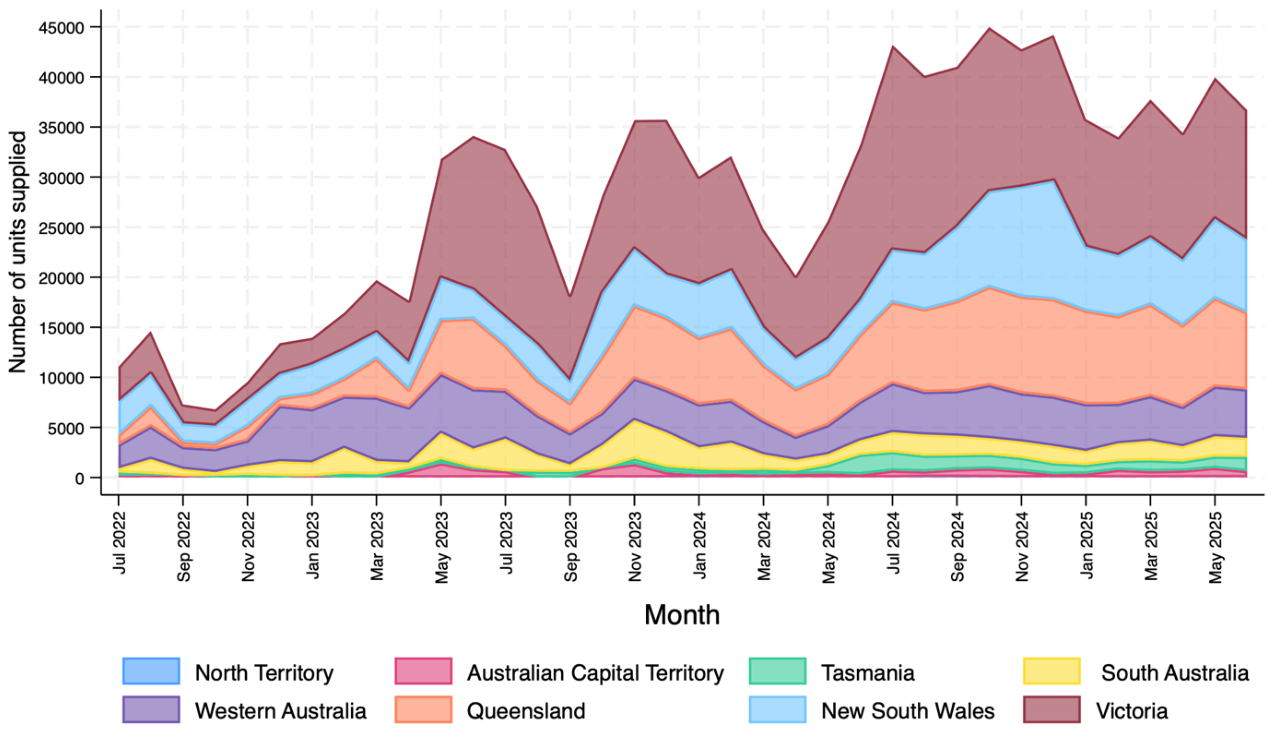
Figure 2.
Trend in in total naloxone units supplied by supplier type across jurisdictions.
Disclaimer/Publisher’s Note: The statements, opinions and data contained in all publications are solely those of the individual author(s) and contributor(s) and not of MDPI and/or the editor(s). MDPI and/or the editor(s) disclaim responsibility for any injury to people or property resulting from any ideas, methods, instructions or products referred to in the content. |
© 2026 by the authors. Licensee MDPI, Basel, Switzerland. This article is an open access article distributed under the terms and conditions of the Creative Commons Attribution (CC BY) license (http://creativecommons.org/licenses/by/4.0/).
Copyright: This open access article is published under a Creative Commons CC BY 4.0 license, which permit the free download, distribution, and reuse, provided that the author and preprint are cited in any reuse.