
Submitted:
23 November 2026
Posted:
25 November 2026
You are already at the latest version
Abstract
Background/Objectives: Personal Data Spaces (PDSs) are increasingly promoted as infrastructures for transparent and participatory health data governance. However, it remains unclear how citizens envision such governance in practice and which conditions they consider important for its implementation. This study explores citizens’ perspectives on health data governance in the context of PDSs, focusing on perceived feasibility, appropriateness, meaningfulness, and effectiveness. Methods: Two citizen panel sessions were conducted with 20 adults in Flanders, Belgium. Participants reflected on a desirable future of health data governance using a PDS-based scenario and identified conditions for its realization. Discussions were audio-recorded, transcribed, and thematically analyzed. Findings were subsequently organized using the FAME framework (feasibility, appropriateness, meaningfulness, and effectiveness). Results: Participants identified several governance-related conditions they considered important for realizing a desirable future of health data governance. Feasibility was associated with trusted and independent oversight, inclusive access, and integration with existing systems. Appropriateness was linked to context-sensitive data use and interpretation, with concerns about normative applications, political influence, and post-mortem data governance. Meaningfulness involved receiving tangible and personalized benefits, achieving manageable control and transparency, and recognizing that relying solely on individual choice may limit broader societal value, while emphasizing citizen involvement in defining collective benefits. Regarding effectiveness, participants identified potential value in using underutilized health data for prevention and early disease detection from a longitudinal perspective. Conclusions: Participants identified several governance conditions they considered important for realizing a desirable future of health data governance in the context of PDS. These findings suggest that implementing PDS may benefit from moving beyond technological solutions toward participatory governance models that combine trusted oversight, inclusive access, and meaningful citizen engagement.
Keywords:
Personal Data Spaces
; health data
; governance
; citizen participation
; digital health
; public benefit
; citizen panels
1. Introduction
Digital health technologies are rapidly expanding the collection and use of personal health data [1] and thereby create opportunities to improve healthcare delivery and evidence-based policymaking [2,3,4,5]. At the same time, this proliferation raises questions about privacy, transparency, and democratic control over data use [6]. In response, European regulatory frameworks, including the General Data Protection Regulation (GDPR), the Data Governance Act (DGA), and the European Health Data Space (EHDS), seek to strengthen individuals’ rights concerning their personal data and establish conditions for data access, sharing, and reuse [7,8]. However, strengthening individual rights over data does not necessarily translate into meaningful citizen participation in decisions about how health data are governed. Previous research has shown that citizens are frequently informed or consulted about data use, rather than empowered to shape decisions about it [9]. In this study, health data governance is understood as the frameworks, actors, and power relations that shape how health data are accessed, shared, and used, including who makes decisions and how [10].
Personal Data Spaces (PDSs) have emerged as a potential infrastructure for strengthening individuals’ transparency and control over their personal data. A PDS is a digital environment in which individuals can collect, manage, and selectively share their health data, with the aim of making transparency and control more concrete and actionable [11,12]. PDSs have attracted research attention from a technical perspective, particularly regarding privacy-preserving architectures and security mechanisms [13,14]. However, their potential contribution to meaningful citizen participation also depends on how governance is organized around these infrastructures [15]. This raises questions about how citizens envision health data governance in the context of PDSs and which conditions they consider important for its implementation.
Meaningful participation in health data governance depends on more than technical infrastructure alone. Prior research identifies several conditions for substantive citizen engagement, including transparency and control over data use [16,17], trust in data security [18], clear accountability mechanisms [19], and sufficient levels of digital and health literacy [20]. Although previous research has identified several conditions for meaningful citizen participation in health data governance, less is known about how citizens envision their practical realization in the context of PDSs. In particular, understanding how citizens imagine a desirable future of health data governance and what they consider necessary to achieve it may provide insights into how such governance arrangements could be developed in practice.
This study addresses this gap by exploring how citizens evaluate and envision health data governance in the context of a PDS-based future scenario. Using citizen panels, participants were invited to reflect on a desirable future of health data governance using We Are [21] as a concrete example. We Are is a citizen-centric personal data space initiative in Flanders, Belgium, that enables individuals to collect, manage, and selectively share their health data under defined governance conditions, combining a data infrastructure with a governance framework for access and use (Figure 1). Participants were asked to articulate the conditions they considered important for realizing such a future in practice.
This study forms part of a broader mixed methods research design examining citizen perspectives on PDSs. While a parallel survey study assessed how citizens evaluate PDSs as a governance instrument [15], the citizen panels adopted a future-oriented and implementation-focused approach. By exploring how participants envision desirable health data governance and the conditions they consider important for its realization, this study contributes to understanding how citizens themselves reflect on the practical implementation of health data governance in the context of PDSs.
2. Materials and Methods
2.1. Study Design
The study was conducted in Flanders, Belgium. Two citizen panel sessions were held in Brussels on 27 April and 4 May 2024, each lasting approximately three hours. The sessions were conducted to explore how citizens envision a desirable future of health data governance in the context of PDSs, and which conditions they consider important for realizing such a future in practice. The panels adopted a future-oriented approach inspired by backcasting, in which participants were invited to envision desirable outcomes and reflect on the conditions required to achieve them [22]. Rather than evaluating PDSs as standalone technologies, participants deliberated on a desirable future of health data governance using We Are as a concrete scenario. This approach informed the organization of the panel discussions but did not guide the subsequent data analysis.
2.2. Participant Sampling
The citizen panels involved 20 adult residents of Flanders, Belgium. Participants were primarily recruited from a previously conducted large-scale survey in Flanders, in which respondents could indicate their willingness to participate in follow-up research [15]. All respondents who expressed interest were invited to take part in the citizen panels. As the resulting group showed imbalances in age and gender, additional targeted recruitment through the researchers’ networks was undertaken to enhance diversity. Eligibility criteria included being at least 18 years old and being able to speak Dutch.
The target of 20 participants was determined by the planned format of the panel discussions, which involved four discussion tables across two rounds. This allowed participants to engage in small group discussions of five people while maintaining a sufficiently large group for exchanging different perspectives across the panels. This group size is consistent with recommendations for focus group discussions, which generally favor relatively small groups to facilitate active participation and interaction among participants [23].
2.3. Data Collection
Data were collected during the two facilitated citizen panel sessions involving the same group of 20 participants. The first session provided contextual information the health data governance ecosystem in Flanders and the functioning of We Are as a PDS-based scenario. This introductory session aimed to establish a shared understanding of the context and provide participants with sufficient background information to engage in the deliberations during the second session.
The second session involved structured discussions on six themes derived from the four pairs of core values developed by the We Are partners, which draw on a broader justice framework for health data governance [24] and principles of biomedical ethics [25]. The six themes were data solidarity, governance, quality and efficiency, privacy and security, self-determination, and care and equity.
Participants selected two themes for discussion across two rounds of small-group discussions, followed by plenary exchanges. For each theme, discussions focused on why the theme was important, what desirable outcomes could be achieved if it were adequately addressed, which conditions would be necessary to realize these outcomes, and what recommendations participants would formulate. This structure encouraged participants to move from envisioning desirable outcomes toward identifying conditions for their realization in practice.
The sessions were facilitated by Levuur, a professional participation agency, while three members of the We Are research team and one employee of Levuur moderated discussions on the individual topics. All discussions were conducted in Dutch and audio-recorded with participants’ consent. Recordings were transcribed verbatim and pseudonymized before analysis.
2.4. Data Analysis
The transcripts were analyzed using thematic analysis following Braun and Clarke [26]. The six discussion themes provided an initial structure for the analysis, within which codes were developed inductively from the data. Coding and initial interpretation were carried out by the first author. Preliminary codes and the organization of findings were subsequently discussed with three other members of the research team. Two of these researchers were involved in the We Are initiative, while one was not.
As the analysis progressed, the research team decided to organize the findings according to the FAME framework (feasibility, appropriateness, meaningfulness, and effectiveness), drawn from the Joanna Briggs Institute (JBI) model of evidence-based healthcare [27]. FAME provided an additional interpretive lens, allowing findings from across the six discussion themes to be considered together in relation to different dimensions of implementation. Rather than treating the original discussion themes as separate categories, the findings were organized according to their relevance to feasibility, appropriateness, meaningfulness, or effectiveness. This approach allowed consideration of contextual, practical, and experiential dimensions of implementation alongside anticipated outcomes. The application of FAME followed the approach used in our previous overview of reviews on citizen participation in health data governance [9]. Definitions of the FAME dimensions as applied in this study are provided in Table 1. Quotations presented in this article were translated from Dutch into English.
2.5. Ethical Considerations
Ethical approval was obtained from the Ethics Committee of Antwerp University Hospital (UZA), Belgium (Belgian registration number: B300201940638). Written informed consent was collected from all participants at the start of the citizen panels. Recordings were transcribed and pseudonymized to protect participants’ identities. Due to privacy considerations, the transcripts are not publicly available but may be made available upon reasonable request, subject to applicable ethical and data protection requirements.
3. Results
3.1. Participant Characteristics
The citizen panels involved 20 participants, of whom 13 were men and 7 were women. Participants’ birth years ranged from 1950 to 2006, with the largest group born between 1990 and 2006.
3.2. Findings Organized According to the FAME Framework
The findings are organized according to the FAME framework, bringing together insights from across the six discussion themes to reflect participants’ perspectives on the feasibility, appropriateness, meaningfulness, and potential effectiveness of health data governance in the context of PDSs.
3.2.1. Feasibility
Participants associated the feasibility of health data governance in the context of PDSs with trustworthy governance and oversight, inclusive access, and integration with existing systems. These considerations reflected what participants perceived as important for realizing a desirable future of health data governance in practice.
First, participants associated trust in PDSs with how governance and oversight are organized, rather than with the system itself. Several participants explicitly rejected the idea of having to control the system themselves, with one stating: “I don’t want to be the watchdog”. Instead, trust was linked to robust supervision and enforcement, illustrated by comparisons to regulated sectors such as banking: “you don’t have blind trust in banks, but rather in the fact that banks are strictly controlled to prevent cheating”. At the same time, several participants warned that governance of PDSs should remain proportionate and workable, noting that regulations such as GDPR can be both “a fantastic initiative” and overly restrictive in practice.
Second, participants emphasized inclusive access as an important consideration for the feasibility of PDSs. Some participants challenged the assumption that digital participation requires smartphones, stressing that “digital is not the same as smartphone”. Instead, they emphasized the potential of familiar and already integrated technologies, such as wearables or alarm systems, as more accessible entry points. Accessibility was described as not only technical but also relational and social, requiring trusted intermediaries and clear explanations.
Finally, participants highlighted the importance of integrating PDSs with existing health data systems. Several participants emphasized that standalone solutions would not work in practice, stressing the need to connect with established platforms and major actors: “if the big players don’t cooperate, you actually miss 80% of the data”.
3.2.2. Appropriateness
Participants’ perspectives on the appropriateness of health data governance in the context of PDSs were shaped by how data are used and interpreted, the role of trusted intermediaries, and how governance is organized in complex situations such as post-mortem data use.
First, a prominent concern was the risk that the greater availability of lifestyle data in the context of PDSs could result in normative applications, in which individual behaviors are judged against implicit standards. One participant expressed concern that such data use could reflect the “perspective of the white middle class”, reproducing biases related to class, gender, and health behavior. Participants expressed particular concerns about the potential consequences of using lifestyle data to evaluate individual health behaviors. One participant noted that data about smoking or diet already affect insurance premiums and feared that broader data use could amplify these effects. Some participants were explicit that data use should never lead to people being “punished” or “penalized”, even when unhealthy patterns become visible. Autonomy was framed as the right to remain in control of one’s health choices. In this context, one participant also noted that younger people may underestimate the sensitivity of health data, as they are used to “just accept cookies”, blurring boundaries between social media and health data.
Rather than rejecting data use as such, some participants emphasized the importance of contextual interpretation and human judgment. In this regard, general practitioners or dietitians were identified as trusted intermediaries who could support citizens in interpreting and navigating data use. Their role was described as encouraging and suggestive, “have you thought about …” rather than enforcing change. A key safeguard was human judgment: data must be “discussed with someone who knows your situation”. Political influence was seen as an additional risk, with several participants warning that political actors could exert “normative influence” over how data are interpreted.
Finally, some participants raised questions about post-mortem data governance in the context of PDSs, particularly regarding who should retain access after death and under what conditions. While some argued “my dossier should be closed”, others acknowledged value in limited access for hereditary conditions, restricted to medical professionals. These discussions highlighted participants’ uncertainty about how access to personal health data should be governed after death.
3.2.3. Meaningfulness
Participants associated the meaningfulness of health data governance in the context of PDSs with perceived benefits for both individuals and society, manageable control over how their data are governed, and transparency about how data are used and interpreted.
First, meaningfulness was closely linked to benefit and reciprocity. One participant stressed that sharing data through PDSs should provide a return, for example in the form of information rather than financial compensation. This return was expected to be personally meaningful, with several participants emphasizing the importance of personalized feedback. One participant indicated that some users only need a simple signal, “green means I’m fine, red means I should call my general practitioner”, while others prefer more detailed insights. Beyond this personal return, participants reflected on the balance between individual choice and collective benefit. While participants valued voluntary participation, several also recognized that relying solely on individual choice could limit the collective benefits of health data use, with some agreeing that “if you always give people the choice… you might miss a lot”. At the same time, importantly, participants emphasized that citizens should have a say in how these collective benefits are defined.
Second, participants associated meaningfulness with having control over how their data are governed in PDSs, provided this control remains manageable. Some participants distinguished between ownership and editing rights, arguing that medical data should not be freely alterable: “if a doctor says it is A, then it has to be A”. Autonomy was understood as controlling relevance and visibility, for example by flagging errors or hiding outdated information. At the same time, too much control was seen as burdensome, with participants referring to “choice overload”. Limits to autonomy were also recognized in specific situations, such as psychosis or dementia, where “a period of limited choice” was seen as protective. Advance directives were proposed as a way to preserve autonomy over time.
Finally, meaningfulness was linked to transparency, particularly regarding how data governed in PDSs are interpreted and used. Some participants criticized existing consent mechanisms, describing privacy statements as unreadable: “a privacy statement is often a document of 50 pages, who reads that?”. They also stressed the need for clarity about who interprets data, with what expertise, and for what purpose, as health data can be interpreted in different ways.
3.2.4. Effectiveness
Participants discussed the potential effectiveness of health data governance in the context of PDSs in terms of making better use of lifestyle and self-tracked data, supporting earlier detection of health issues, and generating new insights through the combination of data over time.
First, some participants emphasized that health data are often not used to their full potential because they remain separated across systems or contexts. In particular, lifestyle and self-tracked data were described as a “missed opportunity” when they remain in individual data vaults and are not used for broader insight. Participants envisioned PDSs as a possible way to facilitate such data use, for example by allowing aggregated and anonymized analysis.
Second, some participants associated PDSs with the potential for earlier detection and more timely intervention. One participant referred to situations where aggregated data across individuals could reveal emerging patterns, such as increases in specific symptoms or health behaviors within a region, which could enable faster responses: “if in a certain region a disease breaks out, that is very valuable information that allows you to intervene quickly”, provided data remain anonymous and are analyzed collectively.
Finally, some participants emphasized the potential long-term value of combining different types of health data over time. Participants anticipated that linking data from different sources could generate insights that are not visible in isolation, with one participant noting that “we may discover in five years that the combination of data that seem unimportant now turns out to be important”. This was envisioned as a shift from fragmented information toward a more integrated understanding of health.
4. Discussion
4.1. Interpretation of Findings
This study explored how citizens evaluate and envision the governance of personal health data in the context of PDSs, focusing on the conditions under which such governance is perceived as feasible, appropriate, meaningful, and potentially effective. Across the four FAME dimensions, participants discussed how health data governance could be organized in practice. Their reflections concerned the organization of oversight, accessibility for different groups of citizens, the interpretation and use of health data, and the balance between individual choice and collective benefits. Our previous overview of reviews identified conditions that citizens consider important for meaningful participation in health data governance [9]. In addition, our survey study examined how citizens evaluate PDSs as instruments for participation in health data governance, including their preferences regarding transparency, control, and different types and purposes of data use [15]. The present study complements this research by exploring how citizens envision desirable health data governance in the context of PDSs and what they consider necessary to realize it in practice.
Regarding feasibility, participants associated trust in PDSs with how governance and oversight are organized, rather than with their own ability to monitor the system. They emphasized the importance of robust supervision and enforcement, suggesting that giving individuals control over their data does not remove the need for broader governance structures. At the same time, participants stressed that governance should remain proportionate and workable in practice. Their concerns about regulations becoming overly restrictive reflect broader discussions about the complexity frameworks such as GDPR in practice [28]. Accessibility was another important consideration. Previous research on the digital divide has highlighted inequalities in access to and use of digital health technologies [20]. Our findings add that participants did not consider accessibility solely a question of whether citizens have access to digital devices or sufficient digital skills. They also emphasized that PDSs could be made more accessible by connecting them to technologies people already know and use, such as wearables or alarm systems. In addition, participants highlighted the importance of trusted intermediaries who could help citizens understand and navigate data use. Finally, participants stressed that PDSs should be connected to existing health data systems rather than developed as standalone solutions. This concern reflects broader challenges related to fragmentation and interoperability in healthcare [29]. Together, these findings suggest that participants considered the feasibility of PDSs not only in terms of their technical functioning, but also in relation to the governance structures, support mechanisms, and integration with existing systems.
Regarding appropriateness, participants emphasized that the acceptability of health data use depends not only on which data are accessed, but also on how they are interpreted and what consequences may follow from their use. In particular, participants expressed concerns that lifestyle data could be used to evaluate individual health behaviors against certain norms or expectations, potentially leading to unfair or punitive consequences. These concerns align with literature on data justice [30] and algorithmic bias [31]. They are also relevant in relation to our survey findings, which showed that respondents were more willing to store medical data than lifestyle data in a PDS [15]. While the survey identified this difference in preferences, the citizen panels highlighted concerns about how lifestyle data might be interpreted and used, particularly when individual behaviors are judged against normative standards. Participants illustrated these concerns through existing practices in which information about smoking or diet may affect insurance premiums, reflecting broader societal concerns about the use of citizen-generated and behavioral data in insurance contexts [32]. One participant also raised concerns that younger people may be less sensitive to the implications of sharing health data because they are accustomed to sharing information in digital environments. This relates to existing research on differences in attitudes between younger and older people toward health data sharing [33]. Importantly, participants did not reject the use of lifestyle data altogether. Instead, they emphasized that such data should be interpreted in relation to an individual's circumstances and that human judgment remains important. General practitioners and other healthcare professionals were identified as trusted intermediaries who could help citizens interpret health information without imposing particular health behaviors. Participants also raised concerns about political influence over how data are interpreted and used, illustrating their awareness that decisions about health data may be shaped by interests beyond those of the individual. Finally, participants discussed post-mortem data governance, particularly who should retain access to personal health data after death and under which conditions. These questions relate to an area that remains insufficiently addressed within existing governance frameworks [34]. Overall, the findings suggest that participants considered data use appropriate when sufficient attention is given to its purpose, the context in which data are interpreted, and the possible consequences for individuals.
Regarding meaningfulness, participants emphasized the importance of receiving benefits from data sharing, having manageable control over their data, and understanding how these data are interpreted and used. Previous research has highlighted that citizens value receiving some form of return when sharing their health data [35]. Our findings add that participants considered it important for this return to be personally relevant. For example, they discussed the value of receiving feedback adapted to individual needs, recognizing that some citizens may prefer simple indications about their health while others may want more detailed information. Participants also reflected on the meaning and limits of individual control. Our survey study found that respondents valued control over their data more strongly than transparency [15]. The citizen panels provide a complementary perspective by showing that participants valued having control but did not necessarily want to make every decision about their data themselves. Some participants expressed concerns that too many choices could become burdensome, reflecting existing discussions about the limits of individual control [36]. Participants also recognized that autonomy may need to be limited temporarily in specific circumstances, such as during periods of cognitive vulnerability, and discussed advance directives as a possible way to preserve individuals' preferences over time. Beyond these individual considerations, participants reflected on the relationship between personal choice and collective benefit. While they valued voluntary participation, some recognized that relying entirely on individual data-sharing decisions could limit opportunities to generate knowledge that benefits society. At the same time, they emphasized that citizens should have a say in determining which collective benefits are worth pursuing. This finding suggests that meaningful participation in health data governance involves more than allowing individuals to decide whether to share their own data. It also concerns opportunities for citizens to influence decisions about the purposes for which health data are used and the collective benefits that such use should serve. Finally, participants emphasized that transparency should not be limited to informing citizens about who accesses their data. They also wanted to understand who interprets these data, what expertise these individuals have, and for what purposes the information is used. This adds a further dimension to existing discussions about transparency in health data governance [33].
Regarding effectiveness, participants reflected on the potential benefits of using health data that they considered to be insufficiently utilized, particularly lifestyle and self-tracked data. Existing literature has highlighted the potential value of these data for healthcare and health research [37]. Our findings provide insight into how citizens envision this potential being realized in practice. Participants expressed concerns that valuable information remains separated across different systems or is collected for individual use without contributing to broader knowledge. They envisioned PDSs as a possible way to bring together data from different sources and facilitate their use for purposes beyond individual self-management. For example, participants discussed how aggregated and anonymized data could help identify emerging health problems within a population and support earlier interventions. They also anticipated that combining different types of health data over time could reveal relationships that are not apparent when data are considered separately. These findings suggest that participants associated the potential effectiveness of PDSs not simply with making more health data available, but with enabling their use to generate insights that could benefit individuals and society. Because the discussions concerned a desirable future rather than experiences with an operational PDS, these findings reflect anticipated benefits rather than demonstrated effectiveness.
Across the four dimensions, participants discussed more than their individual preferences regarding health data sharing. They considered how health data governance should be organized, which uses of data they regarded as acceptable, and how individual interests could be balanced with collective benefits. In doing so, they identified tensions that cannot necessarily be resolved by giving citizens more information or more individual control. For example, participants valued autonomy but also recognized that extensive individual choices can become burdensome and that decisions about data use may have implications beyond the individual. The citizen panels provided an opportunity to explore these considerations and the reasoning behind them. The contribution of this study therefore lies not only in identifying conditions that participants considered important for health data governance, but also in showing how citizens reflect on what would be needed to realize desirable governance arrangements in practice.
4.2. Implications for Policy and Practice
The findings have several implications for the development of health data governance in the context of PDSs. First, they suggest that PDSs should not be approached solely as technological solutions that provide individuals with greater transparency and control over their data. Their implementation also requires attention to the broader governance arrangements within which these technologies operate. Participants emphasized that they did not want to be responsible for monitoring data use themselves, but expected appropriate supervision and enforcement to be in place. This suggests that strengthening individual control should be accompanied by robust oversight and safeguards that citizens can trust. At the same time, governance arrangements should remain workable in practice, and PDSs should be designed to connect with existing health data systems rather than function as isolated infrastructures.
Second, the findings highlight the importance of ensuring that citizens can access and use PDSs and that health data are interpreted in ways that take individual circumstances into consideration. Participants' discussions suggest that accessibility should not be understood solely in terms of providing digital access. Familiar technologies and support from trusted intermediaries may help citizens who would otherwise experience difficulties navigating these systems. Participants also raised concerns about the potential consequences of using lifestyle data to evaluate individual health behaviors. These findings suggest that governance arrangements should consider not only who is allowed to access health data and for which purposes, but also how the information is interpreted and used in practice. In particular, safeguards may be needed to prevent data from being used to make normative judgments about individuals without sufficient consideration of their circumstances.
Third, the findings suggest that meaningful citizen participation in health data governance requires attention to both individual and collective decision-making. Providing individuals with control over their own data remains important, but participants also recognized that extensive decision-making responsibilities may be burdensome and that individual choices can affect the potential collective benefits of health data use. Importantly, they emphasized that citizens should have a say in determining what constitutes a desirable collective benefit. This points to the potential value of participatory governance arrangements that complement individual consent and data-sharing decisions. Such arrangements could allow citizens to contribute to decisions about which purposes of data use are considered acceptable and which benefits should be pursued.
Finally, the study illustrates how citizen panels can contribute to the development of health data governance by creating opportunities for citizens to reflect on desirable outcomes and the conditions needed to achieve them. Rather than asking participants only to evaluate a predefined technological solution, the future-oriented discussions encouraged them to consider how health data governance could be organized and which challenges might arise in practice. Similar approaches could be incorporated into the development and adaptation of governance arrangements, allowing citizens to contribute their perspectives before decisions have been finalized. However, further research is needed to examine how such deliberative input can be incorporated into ongoing governance processes and whether it translates into substantive influence over decision-making.
4.3. Strengths and Limitations
This study has several strengths. First, the two-stage citizen panel design allowed participants to discuss health data governance after receiving contextual information about the health data landscape and the We Are initiative. The introductory session was intended to provide participants with a shared basis for the discussions during the second session, in which they explored desirable future arrangements for health data governance. Second, the future-oriented approach encouraged participants to consider not only what they would like health data governance to achieve, but also what would be needed to realize these outcomes in practice. This allowed the study to explore considerations that extend beyond immediate evaluations of existing technologies. Third, additional recruitment efforts increased diversity within the sample in terms of age and gender, allowing different perspectives to be included in the discussions.
Several limitations should also be considered. First, participants were recruited partly from respondents to an earlier survey who had expressed interest in further participation, as well as through the researchers' networks. This approach may have attracted individuals with a greater interest in health data governance or digital health technologies. Although additional recruitment increased diversity in age and gender, the relatively small sample was not intended to be representative of the Flemish population. Moreover, participation was limited to Dutch-speaking individuals. The findings should therefore be interpreted as perspectives expressed by this particular group of participants rather than as views shared by the broader population. Nevertheless, the study forms part of a broader mixed methods research design that also includes a large-scale survey examining citizens' evaluations of PDSs in Flanders, Belgium [15]. Considering the findings from both studies together allows the perspectives expressed during the citizen panels to be viewed alongside broader patterns identified in the survey.
Second, participants were introduced to the We Are initiative before discussing desirable future arrangements for health data governance. While this provided a concrete context for the discussions, the information presented may have influenced which aspects of health data governance participants emphasized. The findings should therefore be interpreted considering this context.
Finally, the future-oriented design meant that participants discussed how they expected or hoped health data governance could function, rather than drawing on experiences with an operational PDS. This was appropriate for the study's purpose of exploring desirable future arrangements, but it also means that the findings cannot establish whether the proposed arrangements would be feasible, appropriate, meaningful or effective in practice. Further research involving operational PDSs would be valuable to examine how citizens experience governance in practice.
5. Conclusions
This study explored how citizens envision desirable health data governance in the context of PDSs and the conditions they consider important for realizing it in practice. Participants emphasized the importance of trustworthy governance, with robust oversight and enforcement, while recognizing that governance arrangements should remain workable in practice. They also highlighted the need to consider how health data are interpreted and used, particularly to prevent normative or punitive judgments based on individual health behaviors. Beyond individual control over data sharing, participants valued the potential collective benefits of health data use, such as prevention and earlier detection of health issues, while emphasizing that citizens should have a say in defining which collective benefits are worth pursuing. Inclusive access, including support from trusted intermediaries, was another important consideration. Together, these findings suggest that the potential of PDSs to support meaningful citizen participation depends not only on their technological capabilities, but also on how health data governance is organized. The study further illustrates how citizen panels can contribute to discussions about desirable governance arrangements by allowing citizens to reflect on competing values and the practical conditions needed to realize them. These insights support the consideration of participatory governance approaches alongside individual data-sharing choices when developing PDSs.
Author Contributions
Conceptualization, C.v.S. (lead), E.L. (lead), K.H. (equal) and N.L. (equal); methodology, C.v.S., E.L. and N.L.; formal analysis, C.v.S.; investigation, C.v.S., E.L. and N.L.; data curation, C.v.S.; writing—original draft preparation, C.v.S.; writing—review and editing, C.v.S., E.L., K.H. and N.L.; supervision, E.L. (lead), N.L. (equal) and K.H. (equal); project administration, C.v.S.; funding acquisition, N.L. (lead) and E.L. (equal). All authors have read and agreed to the published version of the manuscript..
Funding
This research was funded by the Flemish Government (contract number VV023/12) and by the European Union through the NextGenerationEU initiative, as part of funding for the We Are project.
Institutional Review Board Statement
The study was approved by the Ethics Committee of the University Hospital of Antwerp with protocol code BUN B300201940638, approval date: 31 March 2023.
Informed Consent Statement
Informed consent was obtained from all subjects involved in the study.
Data Availability Statement
The data generated and analyzed during this study are not publicly available due to privacy and confidentiality considerations. Data may be made available by the corresponding author upon reasonable request, subject to applicable ethical and data protection requirements.
Acknowledgments
The authors would first like to express their sincere gratitude to all participants for their time, active engagement, and willingness to share their perspectives. This research would not have been possible without their contributions. We also thank the partners of the We Are project for their valuable contributions to the design and organization of the citizen panels, in particular Vlaams Patiëntenplatform, Zorgnet-Icuro, and Domus Medica. Finally, we thank Levuur for their professional facilitation of the citizen panel sessions.
Conflicts of Interest
The authors declare no conflicts of interest. The funders had no role in the design of the study; in the collection, analyses, or interpretation of data; in the writing of the manuscript; or in the decision to publish the results.
Abbreviations
The following abbreviations are used in this manuscript:
| DGA | Data Governance Act |
| EHDS | European Health Data Space |
| FAME | Feasibility, Appropriateness, Meaningfulness, Effectiveness |
| GDPR | General Data Protection Regulation |
| JBI | Joanna Briggs Institute |
| PDS | Personal Data Space |
| UZA | Antwerp University Hospital |
References
- Cancela, J.; Charlafti, I.; Colloud, S.; Wu, C. Digital health in the era of personalized healthcare: opportunities and challenges for bringing research and patient care to a new level. Digital health 2021, 7-31.
- Calzada, I. Citizens’ data privacy in china: The state of the art of the personal information protection law (pipl). Smart Cities 2022, 5, 1129-1150. [CrossRef]
- Ebeling, M.F. Patient disempowerment through the commercial access to digital health records. Health 2019, 23, 385-400. [CrossRef]
- Jakob, R.; Harperink, S.; Rudolf, A.M.; Fleisch, E.; Haug, S.; Mair, J.L.; Salamanca-Sanabria, A.; Kowatsch, T. Factors influencing adherence to mHealth apps for prevention or management of noncommunicable diseases: systematic review. Journal of Medical Internet Research 2022, 24, e35371. [CrossRef]
- Kruse, C.S.; Stein, A.; Thomas, H.; Kaur, H. The use of electronic health records to support population health: a systematic review of the literature. Journal of medical systems 2018, 42, 214. [CrossRef]
- Al-Saggaf, Y. The Use of Data Mining by Private Health Insurance Companies and Customers’ Privacy: An Ethical Analysis. Cambridge Quarterly of Healthcare Ethics 2015, 24, 281-292.
- European Commission. European Health Data Space. Available online: https://health.ec.europa.eu/ehealth-digital-health-and-care/european-health-data-space_en (accessed on 16 July 2024).
- European Commission. From dream to reality – the European Health Data Space. Available online: https://ec.europa.eu/newsroom/sante/items/826353/en (accessed on 11 December 2024).
- van Schyndel, C.; De Clerck, C.; Laes, E.; Hannes, K.; Lambrechts, N. Empowering citizens in digital health data governance: Insights from an overview of reviews. Big Data & Society 2026, 13, 20539517261467358. [CrossRef]
- Micheli, M.; Ponti, M.; Craglia, M.; Berti Suman, A. Emerging models of data governance in the age of datafication. Big Data & Society 2020, 7, 2053951720948087. [CrossRef]
- Lehtiniemi, T. Personal data spaces: An intervention in surveillance capitalism? Surveillance & Society 2017, 15, 626-639. [CrossRef]
- Verbrugge, S.; Vannieuwenborg, F.; Van der Wee, M.; Colle, D.; Taelman, R.; Verborgh, R. Towards a personal data vault society: an interplay between technological and business perspectives. In Proceedings of the 2021 60th FITCE Communication Days Congress for ICT Professionals: Industrial Data–Cloud, Low Latency and Privacy (FITCE), 2021; pp. 1-6.
- Fallatah, K.U.; Barhamgi, M.; Perera, C. Personal data stores (PDS): a review. Sensors 2023, 23, 1477. [CrossRef]
- Maes, M.; Bourgeus, A.; De Wolf, R. SolidLab Deliverable WP7: Solidmonitor 2022: Privacy, persoonlijke data & datakluizen. 2023.
- van Schyndel, C.; van Noord, J.; Laes, E.; Hannes, K.; Lambrechts, N. Public Perceptions of Personal Data Spaces for Citizen-Centered Health Data Governance in Belgium: Cross-Sectional Survey. In Proceedings of the Healthcare, 2026; p. 3461. [CrossRef]
- Beets, B.; Newman, T.P.; Howell, E.L.; Bao, L.; Yang, S. Surveying Public Perceptions of Artificial Intelligence in Health Care in the United States: Systematic Review. Journal of medical Internet research 2023, 25, e40337. [CrossRef]
- Cumyn, A.; Ménard, J.F.; Barton, A.; Dault, R.; Lévesque, F.; Ethier, J.F. Patients’ and Members of the Public’s Wishes Regarding Transparency in the Context of Secondary Use of Health Data: Scoping Review. Journal of Medical Internet Research 2023, 25. [CrossRef]
- Stockdale, J.; Cassell, J.; Ford, E. “Giving something back”: A systematic review and ethical enquiry into public views on the use of patient data for research in the United Kingdom and the Republic of Ireland [version 2; referees: 2 approved]. Wellcome Open Research 2019, 3. [CrossRef]
- Clayton, E.W.; Halverson, C.M.; Sathe, N.A.; Malin, B.A. A systematic literature review of individuals’ perspectives on privacy and genetic information in the United States. PLoS One 2018, 13. [CrossRef]
- Househ, M.; Grainger, R.; Petersen, C.; Bamidis, P.; Merolli, M. Balancing Between Privacy and Patient Needs for Health Information in the Age of Participatory Health and Social Media: A Scoping Review. Yearbook of medical informatics 2018, 27, 29-36. [CrossRef]
- We Are. Your data, your story. Available online: https://we-are-health.be/en (accessed on.
- Quist, J. Backcasting. In Foresight in organizations; Routledge: 2016; pp. 125-144.
- Kitzinger, J. Qualitative research: introducing focus groups. Bmj 1995, 311, 299-302. [CrossRef]
- Laes, E.; Denier, Y.; Goesaert, E.; van Schyndel, C.; Lambrechts, N. Justice in the governance of personal health data spaces: stakeholder perspectives in Belgium. BMC Medical Ethics 2026. [CrossRef]
- Beauchamp, T.; Childress, J. Principles of biomedical ethics: marking its fortieth anniversary. 2019, 19, 9-12. [CrossRef]
- Braun, V.; Clarke, V. Using thematic analysis in psychology. Qualitative research in psychology 2006, 3, 77-101.
- Jordan, Z.; Lockwood, C.; Aromataris, E.; Munn, Z. The updated JBI model of Evidencebased Healthcare: A model reconsidered. Adelide, Australia: The Joanna Briggs Institute 2016.
- Gudepu, B.K.; Jaladi, D.S. GDPR Compliance Challenges and How to Overcome Them. International Journal of Modern Computing 2021, 4, 61-71.
- Leventer-Roberts, M.; Balicer, R. Data integration in health care. In Handbook integrated care; Springer: 2017; pp. 121-129.
- Braun, M.; Hummel, P. Data justice and data solidarity. Patterns 2022, 3. [CrossRef]
- Panch, T.; Mattie, H.; Atun, R. Artificial intelligence and algorithmic bias: implications for health systems. Journal of global health 2019, 9, 020318. [CrossRef]
- Meyers, G.; Hoyweghen, I.V. ‘Happy failures’: Experimentation with behaviour-based personalisation in car insurance. Big Data & Society 2020, 7, 2053951720914650.
- Aitken, M.; de St Jorre, J.; Pagliari, C.; Jepson, R.; Cunningham-Burley, S. Public responses to the sharing and linkage of health data for research purposes: a systematic review and thematic synthesis of qualitative studies. BMC medical ethics 2016, 17, 73. [CrossRef]
- Chassang, G. What About Post-Mortem Digital Privacy and Personal Health Data Protection? Deep diving into data protection: 1979-2019: celebrating 40 years of research on privacy and data protection at the CRIDS 2021, 433-460.
- Kalkman, S.; van Delden, J.; Banerjee, A.; Tyl, B.; Mostert, M.; van Thiel, G. Patients' and public views and attitudes towards the sharing of health data for research: a narrative review of the empirical evidence. Journal of medical ethics 2022, 48, 3-13. [CrossRef]
- Hermansen, A.; Regier, D.A.; Pollard, S. Developing Data Sharing Models for Health Research with Real-World Data: A Scoping Review of Patient and Public Preferences. Journal of Medical Systems 2022, 46. [CrossRef]
- Walker, P.H.; Walker, J.M. Citizen generated data: Opening new doors in health IT research and practice. In Nursing Informatics: A Health Informatics, Interprofessional and Global Perspective; Springer: 2022; pp. 219-239.
Figure 1.
Schematic depiction of the We Are initiative.
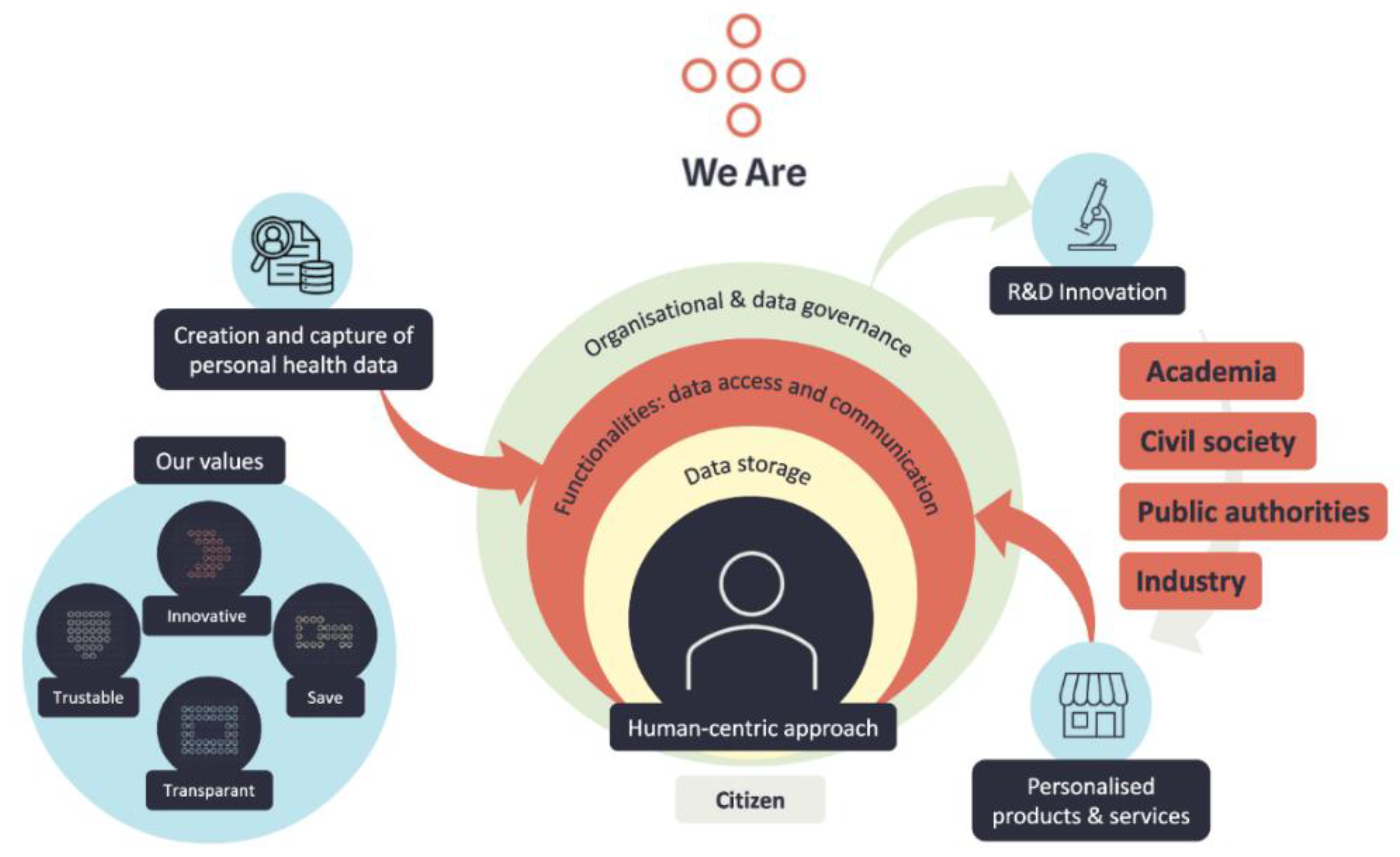

Table 1.
Definitions of FAME1 dimensions.
| Concept | Definition |
|---|---|
| Feasibility | Refers to the extent to which governing personal health data in the context of PDSs2 is practically attainable within existing legal, institutional, and technical constraints. This dimension assesses whether such governance arrangements can be realistically implemented in practice. |
| Appropriateness | Pertains to the perceived suitability and acceptability of governing personal health data in the context of PDSs at a societal level. It evaluates whether proposed governance arrangements align with citizens’ values, norms, and expectations. |
| Meaningfulness | Encompasses the perceived value and significance of governing personal health data in the context of PDSs for citizens. It assesses whether governance arrangements generate meaningful benefits, address citizen needs, and support a sense of relevance and control. |
| Effectiveness | Refers to the extent to which governing personal health data in the context of PDSs is expected to achieve intended outcomes. |
1 FAME: Feasibility, Appropriateness, Meaningfulness, Effectiveness. 2 PDSs: Personal Data Spaces.
Disclaimer/Publisher’s Note: The statements, opinions and data contained in all publications are solely those of the individual author(s) and contributor(s) and not of MDPI and/or the editor(s). MDPI and/or the editor(s) disclaim responsibility for any injury to people or property resulting from any ideas, methods, instructions or products referred to in the content. |
© 2026 by the authors. Licensee MDPI, Basel, Switzerland. This article is an open access article distributed under the terms and conditions of the Creative Commons Attribution (CC BY) license.
Copyright: This open access article is published under a Creative Commons CC BY 4.0 license, which permit the free download, distribution, and reuse, provided that the author and preprint are cited in any reuse.