
Submitted:
23 November 2026
Posted:
25 November 2026
You are already at the latest version
Abstract
Virtual reality narratives increasingly use bodily participation to shape how stories unfold and are experienced. This systematic review examines the narrative functions of bodily mechanisms and the theories and evidence used to explain them in VR and related spatially embodied AR/MR environments. Searches of Web of Science, Scopus, IEEE Xplore, and ACM Digital Library identified 370 reports published between January 2015 and April 2026. Cinematic VR and 360-degree embodiment, avatar embodiment and perspective-taking, and locomotion were the primary foci in 219 of 367 RQ1 reports. Substantive theoretical use appeared in 340 reports, including 44 with explicit cross-family integration. Comparative or associational evidence appeared in 232 reports; 54 contributed methodological diagnoses only. Close comparison of 32 purposively selected reports examined how bodily configurations acquire narrative functions and how designed cues relate to participant interpretations. Body-Centered Narrative Coherence (BCNC) brings these relations into an analytical framework organized through bodily anchoring, theoretical congruence, and empirical traceability.
Keywords:
virtual reality
; embodied interaction
; narrative
; systematic review
; Body-Centered Narrative Coherence
1. Introduction
Virtual reality (VR) storytelling transforms audiences from external observers into physically situated participants. Hand actions, walking, gaze, and avatar perspectives are increasingly used to regulate discovery, guide attention, and situate users in narrative roles. Furthermore, tangible objects, physiological feedback, and shared co-presence can anchor a story in bodily sensation.
However, bodily participation in a VR system does not automatically amount to narrative function. A user may perform physical actions simply because they are required to operate the system. To understand why the body holds narrative significance, scholars draw upon concepts such as embodied cognition, presence, body ownership, agency, narrative transportation, empathy, and flow [1,2,3,4,5]. These concepts address overlapping but distinct dimensions of experience, including spatial presence, bodily self-identification, perceived control over action, and engagement with narrative content. For a bodily modality to become analytically relevant, it must perform identifiable narrative work.
Existing research has explored body–narrative relationships through embodied designs and experiential evaluations. Kim and Kim [6] linked narrative-role matching to self-presence, while Vendrell Ferran [7] examined narrative support for deeper emotional empathy during body-swapping. Other approaches range from material anchoring in Tangible VR [8] to performer-facilitated bodily responses [9]. These studies connect bodily actions and embodied perspectives to particular narrative functions and experiences.
Studies of body–narrative relationships are distributed across human–computer interaction, immersive media, interactive narrative, and psychology, using different research designs and outcome measures. Comparing these contributions requires distinguishing the bodily modalities present in a system from the mechanism investigated, the theoretical explanation of its narrative function, and the evidence supporting that relationship. Comparisons across reports therefore need to distinguish shared relationships from those tied to a particular design or evaluation setting.
VR presents a virtual environment, whereas AR adds virtual content to physical surroundings. Milgram and Kishino position mixed reality (MR) between real and virtual endpoints, encompassing both AR and augmented virtuality, in which real elements enter a predominantly virtual environment [10]. Skarbez et al. extend this discussion to the user's multisensory experience [11]. Here, extended reality (XR) serves as an umbrella term. VR is the review's focal medium; eligible related environments contribute comparisons of how spatial conditions affect body–narrative relations. Heritage, education, and performance supply application contexts for these relations.
Prior reviews provide two useful points of departure. Dooley [12] examines how screen studies, game studies, interactive digital narrative, and human–computer interaction conceptualize and develop narrative VR. Hadjipanayi et al. [13] review 20 empathy-oriented studies, comparing narrative types, interaction techniques, and empathy measures. The present review extends this work by connecting bodily configurations and narrative functions with their theoretical explanations and supporting evidence within a common coding scheme. Report-level frequencies map the research landscape, while close comparisons across 32 reports show how these connections are proposed, implemented, and interpreted.
To address this gap, this review synthesizes the dominant mechanisms, theoretical operationalizations, and methodological evidence across the corpus. The review addresses three research questions:
RQ1. What dominant body–narrative mechanisms are studied in VR narrative storytelling, and what narrative functions do they serve?
RQ2. How are theories used, operationalized, and integrated to explain relationships between bodily engagement and narrative phenomena in VR?
RQ3. How have existing studies measured the relationship between embodied engagement and narrative outcomes, and what methodological limitations constrain its interpretation?
Body-Centered Narrative Coherence (BCNC) organizes the cross-RQ synthesis around what bodily participation contributes to a narrative, how that contribution is explained, and what evidence supports the account. The analysis follows connections among designed functions, implemented interactions, and participant interpretations.
2. Methods
2.1. Review Design, Search Strategy, and Eligibility
This systematic review combined database searching, structured selection, report-level coding, and thematic synthesis, using PRISMA 2020 to guide reporting [14]. The diversity of experimental, qualitative, design, and conceptual contributions supported a descriptive and interpretive synthesis [15].
Web of Science Core Collection, Scopus, IEEE Xplore, and ACM Digital Library were searched for reports first formally published between 1 January 2015 and 30 April 2026. The searches were completed on 2 May 2026. Three complementary streams combined terms for immersive media, bodily engagement, and narrative with additional terms for theory and evaluation. Data File D3 distinguishes archived query designs from retained export evidence.

Table 1.
Databases, archived search fields, and retained export entries.
| Database | Archived search field | Retained export entries |
| Web of Science Core Collection | Topic | 1,790 |
| Scopus | TITLE-ABS-KEY | 2,916 |
| IEEE Xplore | Title, abstract, author keywords | 750 |
| ACM Digital Library | Title and abstract | 277 |
The review centers on VR; related AR/MR and spatially immersive cases were eligible when the same body–narrative criteria applied. Eligibility required an immersive medium with spatial or embodied positioning, a substantive narrative object, and sufficient report content to answer at least one RQ (Table 2). Body-centered engagement included actions, sensations, orientations, perspectives, avatar configurations, physiological feedback, and co-presence that served a narrative function. Cinematic viewing, game-based participation, and animated VR were within scope; animation describes a representational form and can support either cinematic presentation or interactive action. Cinematic VR and 360-degree viewing qualified when bodily orientation, spatial perspective, or embodied spectatorship was substantively analyzed. Related AR/MR cases were interpreted in their physical and virtual settings. Selection details are provided in Supplementary Methods and Data, Section 2, and Data File D4b.
2.2. Study Selection, Reconciliation, and Data Extraction
Records were screened by title and abstract, assessed for eligibility using full texts and documented exclusion evidence, and reconciled at report level (Fig. 1). A single author performed screening and initial coding. Historical screening used automated rules and AI-assisted batches; AI subsequently helped review the author’s coding and supported data organization, consistency checks, translation, and typesetting. Data File D4a summarizes the selection stages, and D4b provides candidate-level exclusion decisions and reports not retrieved.
Report IDs linked bibliographic identity to RQ assignments and coding rationales. Data File D1 supplies the bibliography, primary and secondary themes, theory-use levels, evidence labels, retained coding explanations, and available source locators for all 370 reports. Design, measures and evidence units are described where relevant to the reported comparisons. Historical title-and-abstract decisions were linked to the final eligibility register; record-level links and counts are documented in Supplementary Methods and Data, Section 1 and Section 2.
2.3. Coding, Evidence Forms, and Interpretation
Coding distinguished modalities available in a system, the mechanism investigated as a primary research focus, and evidence concerning its narrative relationship (Table 3). RQ assignments were non-exclusive.
For RQ1, a report needed an identifiable bodily configuration that contributed to narrative design, experience, interpretation, or evaluation. A single primary theme was assigned by prioritizing the research question, manipulated or measured variable, core finding, and stated contribution. Nine themes were organized across action, sensory/embodied, medium, and social families. These counts describe research foci. Secondary-theme and multimodal descriptions supported contextual interpretation; their prevalence was not independently estimated.
For RQ2, four elements were required: a named theory or framework (A), an identifiable bodily mechanism (B), a narrative object (C), and substantive use of that theory in design, hypotheses, measurement, coding, analysis, or interpretation (D). L1 indicated conceptual explanation, L2 analytical or operational use, and L3 an explicit body–narrative bridge between at least two theory families. Naming a theory without substantive use was coded L0 and did not qualify for RQ2. Theory-use codes described explanatory roles independently of research quality or statistical significance.
For RQ3, comparative evidence contrasted embodiment, interaction, or presentation conditions while examining narrative outcomes. Associational or trace-based evidence linked bodily factors with narrative outcomes through quantitative, behavioral, physiological, or qualitative observations. Gap-diagnostic evidence required a specific methodological issue identified in the original report concerning the interpretation of a body–narrative relationship. General sample-size or hardware limitations alone did not qualify. Labels were non-exclusive; diagnosis-only reports lacked qualifying comparative and associational evidence.
2.4. Targeted Relation Synthesis and BCNC Development
A single author assembled a purposive set of 32 reports for detailed cross-RQ analysis. Reports were selected to contrast bodily configurations and narrative functions, clarify theory-use boundaries, and examine differences among proposed designs, implemented interactions, and participant interpretations. An identifiable relation and sufficient source detail for comparison were required. Data File D2 gives a case-specific selection rationale and source locator for each report; the set complements report-level frequency analysis. Six reports are presented in Table 7 to illustrate implemented action–function mappings, explanatory connections, and differences between intended and interpreted narrative relations.
Framework development combined RQ-guided organization with interpretive comparison of the case records. The RQs supplied initial questions about bodily function, explanation, and evidence. Comparisons then examined how these elements aligned or diverged within the same narrative relation, informing bodily anchoring, theoretical congruence, and empirical traceability. These perspectives organize analysis of the functional and interpretable integration defined by BCNC. Supplementary Methods and Data, Section 4 documents the comparison steps and representative selection rationales.
3. Results
3.1. Study Selection and Corpus Characteristics
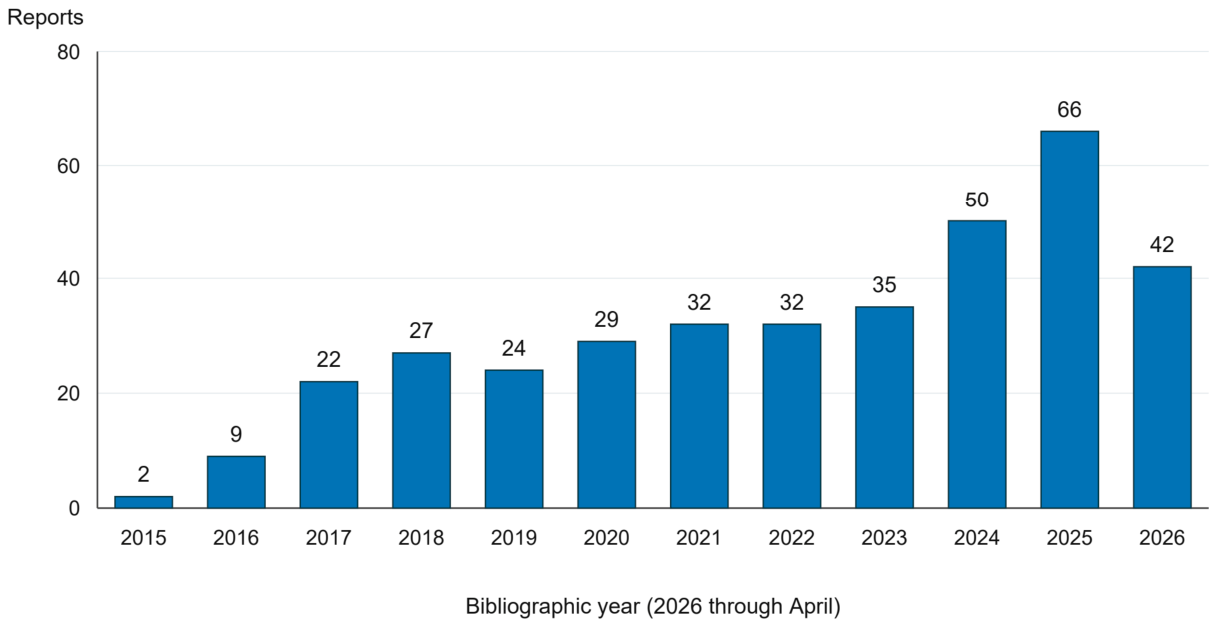
Title-and-abstract screening and targeted reassessment advanced 663 records for eligibility assessment. After eligibility decisions and report-identity reconciliation, the synthesis comprised 370 reports published between January 2015 and April 2026 (Fig. 1). Reports assigned bibliographic years from 2023 to 2026 accounted for 193 of the 370 reports (52.2%). The highest counts among complete publication years occurred in 2025 (n = 66) and 2024 (n = 50); 42 reports were assigned to 2026 within the eligibility window ending in April (Fig. 2).
Figure 1.
Study selection from database identification to the final synthesis of 370 reports. Selection totals and exclusion reasons are provided in Data Files D4a and D4b.
Figure 1.
Study selection from database identification to the final synthesis of 370 reports. Selection totals and exclusion reasons are provided in Data Files D4a and D4b.
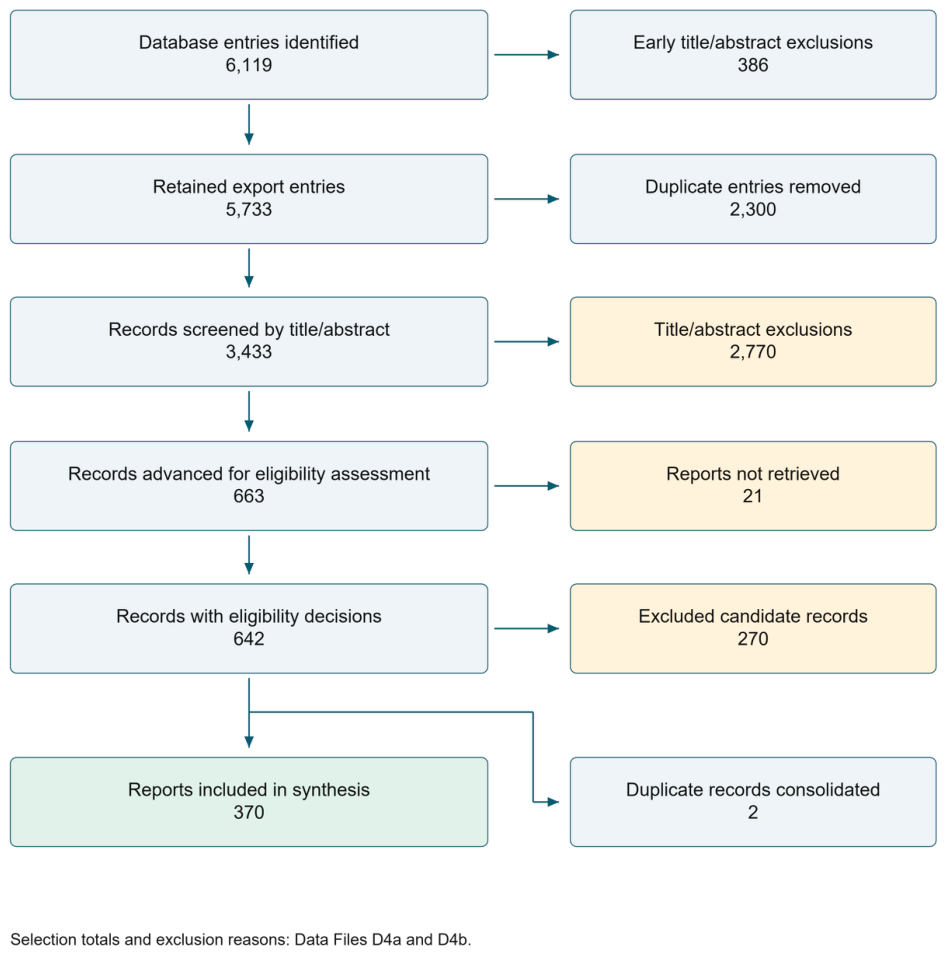
Figure 2.
Annual publication counts for the 370 included reports. Years are stored bibliographic years; 2026 covers only the review window through April and is not a full-year comparison. Eligibility is determined by first formal publication within January 2015–April 2026.
Figure 2.
Annual publication counts for the 370 included reports. Years are stored bibliographic years; 2026 covers only the review window through April and is not a full-year comparison. Eligibility is determined by first formal publication within January 2015–April 2026.
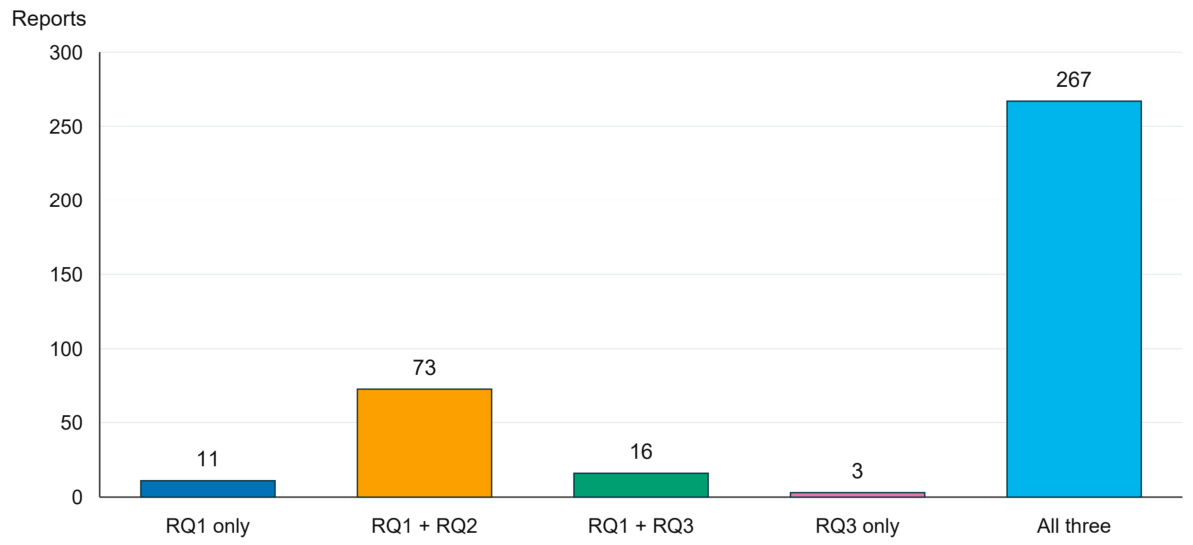
Research-question assignments were non-exclusive. Of the 370 reports, 367 addressed body–narrative mechanisms and functions (RQ1), 340 addressed theoretical use and integration (RQ2), and 286 contributed relationship evidence or methodological diagnoses (RQ3). Among these reports, 267 addressed all three research questions, 73 addressed RQ1 and RQ2 only, 16 addressed RQ1 and RQ3 only, 11 addressed RQ1 only, and 3 addressed RQ3 only (Fig. 3). No report addressed RQ2 only. The 3 RQ3-only reports contributed specific methodological diagnoses without qualifying for primary RQ1 mechanism coding. Figure source data are provided in Data File D1.
Figure 3.
Distribution of the 370 reports across multi-label RQ combinations. RQ assignment is non-exclusive; the three RQ3-only reports contribute diagnosis without a qualifying primary RQ1 mechanism.
Figure 3.
Distribution of the 370 reports across multi-label RQ combinations. RQ assignment is non-exclusive; the three RQ3-only reports contribute diagnosis without a qualifying primary RQ1 mechanism.
3.2. RQ1: Dominant Body–Narrative Mechanisms
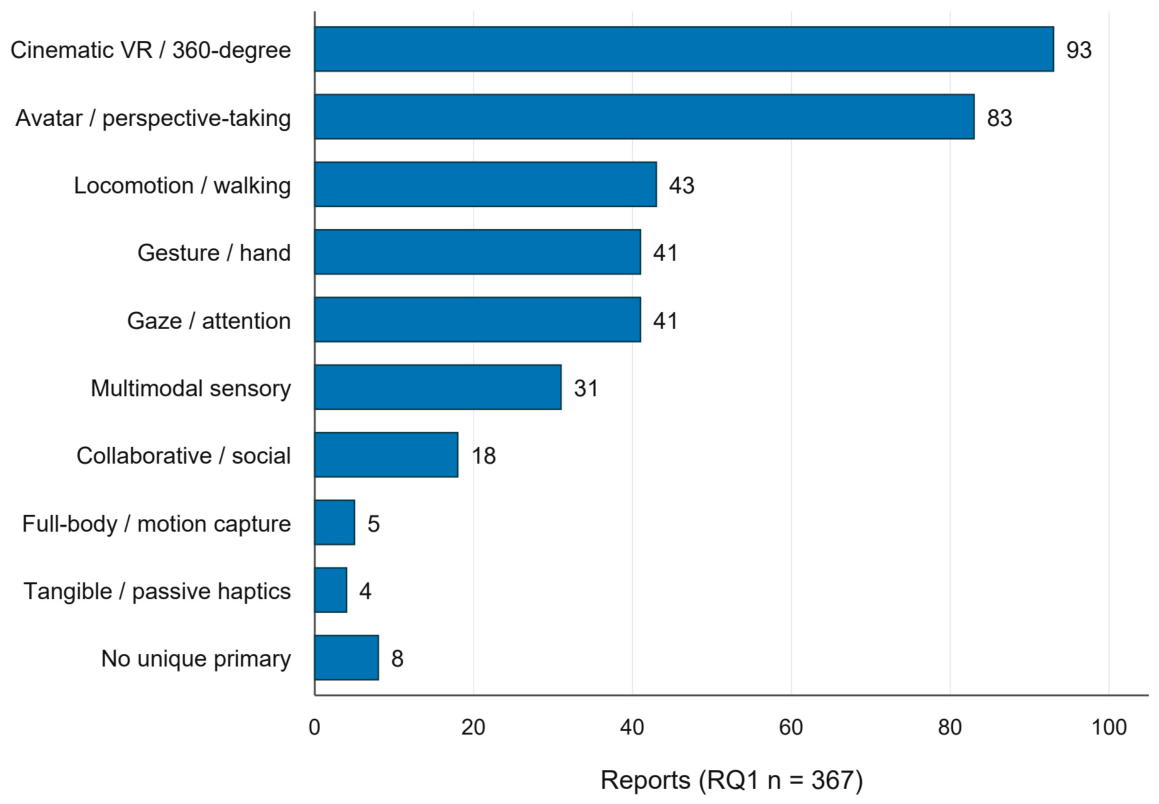
Of the 370 included reports, 367 addressed body–narrative mechanisms and their narrative functions. A single primary theme was assigned to 359 reports, while 8 supported RQ1 without a unique primary assignment. Cinematic VR and 360-degree embodiment (n = 93), avatar embodiment and perspective-taking (n = 83), and locomotion and walking (n = 43) were the three most frequent primary research foci, together accounting for 219 of the 367 RQ1 reports (59.7%; Table 4).
Gesture, tangibility, and material action. Gestural and hand interaction formed the primary research focus of 41 reports, while tangible objects and passive haptics accounted for four. Narrative functions included agency expression, object manipulation, enactment, and material anchoring. Fan and Bolter [25] connected object operation with the discovery, collection, and revisitation of memories, whereas Arendttorp et al. [24] examined culturally situated gestures developed through co-design. Tangible VR by Harley et al. [8] linked physical object properties and handling to actions within the virtual story. Together, T1 (n = 41) and T2 (n = 4) accounted for 45 reports (12.3% of RQ1).
Embodied spectatorship and avatar perspective. Cinematic VR and 360-degree embodiment formed the largest primary-focus group (n = 93), examining spatial spectatorship, head orientation, viewing position, and attention. Bala et al. [16] compared tablet and mobile-VR viewing in relation to narrative transportation, while Farmer et al. [19] examined posture and character identification within narrative 360-degree video.
Avatar embodiment and perspective-taking constituted the second-largest group (n = 83). The reviewed reports connected narrative roles and perspective transformation with bodily self-location and ownership. Vindenes and Nyre [37] used storyboards and pilot productions to analyze how first-person viewer positions organize narrative role and orientation. Kim and Kim [6] associated narrative-role matching with self-presence, while self-mirroring alone did not improve overall user experience.
Social, spatial, and attentional configurations. Collaborative and social embodiment accounted for 18 primary-focus reports addressing co-presence, shared performance, and collaborative meaning-making. Desnoyers-Stewart et al. [9] examined performer-facilitated touch within a prerecorded narrative, while Yu et al. [34] investigated card-based interaction and collaborative story co-creation in VR.
Locomotion and walking formed the third-largest primary-focus group (n = 43). Narrative functions included spatial progression, pacing, and environmental interpretation. Han et al. [21] examined natural walking in architectural narrative generation, while Kan and Tso [38] explored reconstructed cinematic spaces as navigable heritage environments.
Gaze and attention guidance accounted for 41 reports. These studies addressed spatial attention, narrative revelation, and the relation between viewing orientation and story information. Bala et al. [27] aligned head-rotation records with attention shifts in immersive narratives, while Huang et al. [29] related gaze and physiological measures to narrative outcomes.
Whole-body and multisensory mechanisms. Full-body and motion-capture interaction accounted for five primary-focus reports, compared with 31 focusing on multimodal sensory immersion. Schmidt et al. [35] examined recording and replaying embodied virtual-puppet performances for story creation. Harley et al. [30] combined environmental sensory affordances with narrative settings; Ge et al. [31] incorporated physiological biofeedback into immersive performance; and Song and Evans [32] examined sensory design in museum VR. These reports examine distinct roles of embodied performance, sensory materials, and physiological cues in narrative design or experience.
Figure 4.
Distribution of primary body–narrative research foci among 367 RQ1 reports, including 8 without a unique primary assignment.
Figure 4.
Distribution of primary body–narrative research foci among 367 RQ1 reports, including 8 without a unique primary assignment.
3.3. RQ2: Theory Use and Integration
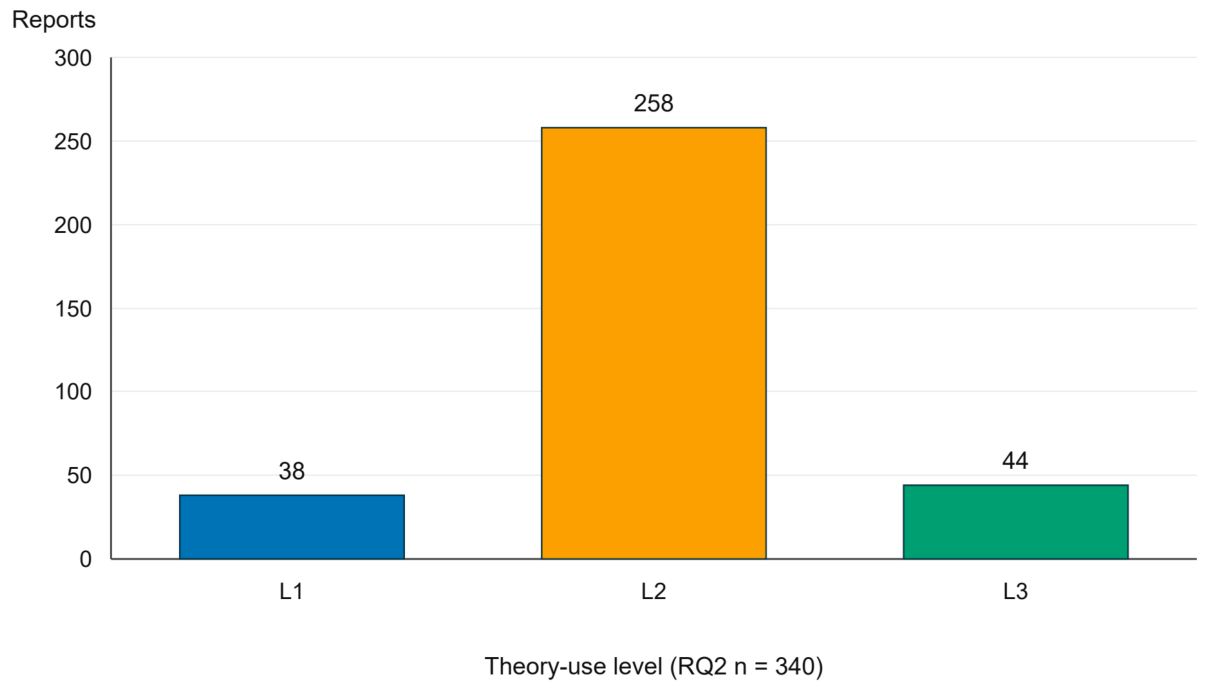
Of the 370 included reports, 340 (91.9%) met the RQ2 criteria for substantive theoretical use. Among the 340 RQ2 reports, 38 (11.2%) were classified as L1, providing conceptual explanations of body–narrative relationships; 258 (75.9%) were classified as L2, in which theory structured analytical or operational procedures; and 44 (12.9%) were classified as L3, involving explicit integration of multiple theory families through a body–narrative mechanism (Table 5). Analytical and operational use constituted the largest category.
Conceptual explanations and analytical use performed different roles in the reviewed reports. In Rekindle, Fan and Bolter [25] translated Active Creation of Belief and dramatic agency into spatial layers, memory collection, and revisitation controls, supporting L2 design use. Vindenes and Nyre [37] applied postphenomenological user–environment relations and multistability to the analysis of storyboards and pilot productions, providing an L2 example of theory-guided interpretation.
The 44 L3 reports connected different theoretical families through identifiable body–narrative relations. Ármeán [39] brought together hodological space, presence, and narrative loops to interpret bodily position and access to story information in a VR play. Harley et al. [30] joined embodied and tangible interaction with diegetic and intersensory design to organize sensory participation within storyworld situations. Navarro-Ligero et al. [40] mapped narrative actant roles onto perceptual opportunities for exploration, attention, and navigation in VR urban scenes. Other L3 reports linked embodied perception and participation to mental-health representation, place narrativization, and cinematic duration [17,22,41]. These reports offer several forms of explanatory integration across specific narrative contexts.
Figure 5.
Distribution of theory-use levels among the 340 RQ2 reports. L1 denotes conceptual explanation, L2 operational or analytical use, and L3 explicit integration of multiple theory families through a body–narrative mechanism.
Figure 5.
Distribution of theory-use levels among the 340 RQ2 reports. L1 denotes conceptual explanation, L2 operational or analytical use, and L3 explicit integration of multiple theory families through a body–narrative mechanism.
3.4. RQ3: Measurement Evidence and Methodological Gaps
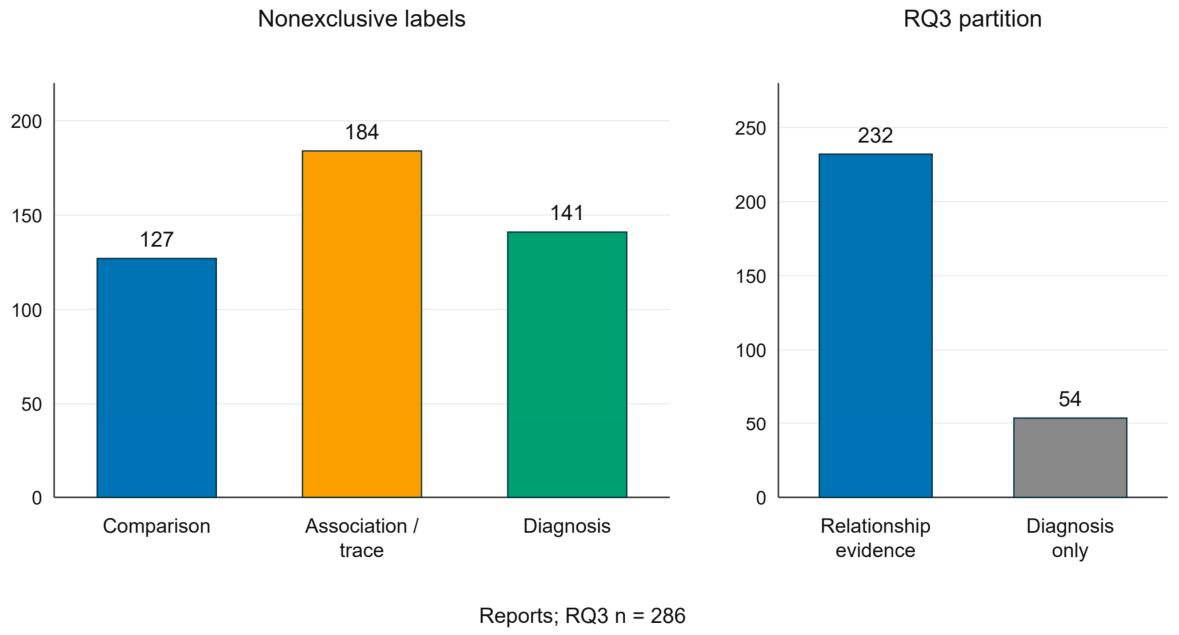
Of the 370 reports, 286 (77.3%) addressed empirical relationships or methodological issues relevant to RQ3. Among these, 232 provided comparative or associational evidence linking embodied engagement with narrative outcomes, while 54 contributed specific original methodological diagnoses without either form of relationship evidence.
The RQ3 reports were assigned three non-exclusive evidence labels (Fig. 6). Comparative evidence appeared in 127 reports (44.4%), associational or trace-based evidence in 184 (64.3%), and gap-diagnostic evidence in 141 (49.3%). Comparative and associational evidence co-occurred in 79 reports, yielding 232 with at least one form of relationship evidence. Of the 141 diagnostic reports, 87 also provided comparative or associational evidence and 54 contributed diagnosis only.
Figure 6.
Comparative, associational/trace-based, and gap-diagnostic labels among the 286 RQ3 reports. Labels overlap and are not an ordered quality scale; 54 reports contribute diagnosis only.
Figure 6.
Comparative, associational/trace-based, and gap-diagnostic labels among the 286 RQ3 reports. Labels overlap and are not an ordered quality scale; 54 reports contribute diagnosis only.
Comparative evidence. Reports compared narrative outcomes across embodiment, interaction, and presentation conditions. Shin [18] grouped HMD and flat-screen viewing with high and low trait empathy. Huang et al. [29] randomly assigned 30 participants to NPC-guided or unguided heritage exploration, combining condition comparisons with gaze, physiological, and understanding measures. Bala et al. [16] varied location and medium: the reported narrative-transportation means were higher on-site, while the overall tablet and mobile-VR means were similar. Huynh et al. [42] provided descriptive comparisons from eight direct HMD users alongside responses from 23 demonstration viewers. Tong et al. [43] compared directorial cues and recorded target-linked head-orientation traces in a swivel-chair narrative. The comparative examples therefore range from measured group differences to descriptive configuration comparisons (Table 6).
Associational and trace-based evidence. Relationships were documented through orientation records, physiological measurements, self-reported constructs, and qualitative accounts. Bala et al. [27] aligned head rotation with attention shifts. Shin [18] reported a positive embodiment–engagement association (r = .452), and Zhao et al. [20] used interviews to connect avatar identity and cultural familiarity with narrative interpretation. In the T7 reports, Warp et al. [44] aligned audio conditions with physiological and orienting responses during Pearl, while Xu et al. [45] combined movement, gaze, and physiological measures in projected narrative conditions. These examples represent behavioral traces, modeled construct relations, and participants' accounts of experience.
Methodological diagnoses. Source-authored diagnoses addressed both evaluation and narrative production. Ge et al. [31] identified ambiguity in biofeedback sources and interference among sensory and narrative cues; their twelve-person comparison used a television for audience viewing. Navarro-Ligero et al. [40] identified unclear avatar motivations and fragmented cues during the translation of narrative concepts into VR scenes. Bala et al. [16] discussed arm-extension demands and self-consciousness when orienting a tablet in public. These diagnoses specify the research or design conditions affecting the interpretation of the reported relationships.
3.5. Cross-RQ Synthesis of Body–Narrative Relations
The 32 targeted comparisons connected bodily configurations and narrative functions with explanatory propositions and evidence in individual report contexts. Table 7 presents six illustrative cases from this set. The records distinguished proposed relations, implemented interactions, and participant interpretations. Data File D2 provides the complete current set and its evidence locators.
Actions and narrative functions. In Tangible VR, stroking a frightened squirrel slows its heartbeat and permits the companion to continue, making care an implemented condition of narrative progression [8]. In the first-person production analysis by Vindenes and Nyre [37], camera and viewer positions organize narrative roles and access to events. The former documents an action–event mapping in an artifact, while the latter explains viewer positioning through creator materials and postphenomenological analysis.
Theory as a link between configuration and function. Sensory VR connected embodied and tangible interaction with diegetic and intersensory design: physical sensations such as sand, wind, smell, and food established a situated sensory relation to a beach or forest storyworld [30]. Navarro-Ligero et al. [40] connected Greimas's actantial model with Fencott's perceptual opportunities, mapping subjects and rewards, senders and attention cues, and helpers or opponents and navigation. In both cases, theory guided how bodily participation was configured around a narrative object. Their evidence comprises prototype/workshop accounts and design analysis.
Implemented cues and participant interpretation. In Echo of the Abyss, transforming avatar hands were designed to express ecological interconnectedness, but participants in a pilot iteration struggled to recognize the transformation [51]. In Eve 3.0, performer touch and a physical diary invited responses to characters and story objects; observed action, remembered action, and participant accounts sometimes diverged [9]. These cases locate differences between designed cues, enacted participation, and experienced meaning within specific narrative situations.
Table 7.
Six illustrative cases from the 32-report targeted comparison set.
| Report | Bodily configuration and narrative function | Explanatory connection | Evidence supporting the relation | Interpretation boundary |
| Harley et al. [8], A0117 | Stroking a physical animal prop calms a virtual companion and enables narrative continuation | Diegetic object properties and bodily action organize care | Implemented prototype; preliminary observations and interviews | Fixed order and increasing feature complexity constrain attribution of participant responses. |
| Vindenes and Nyre [37], A0002 | First-person positions organize roles and access to events | Postphenomenology explains user–environment mediation and multistability | Storyboards, creator reports, and eight pilot productions | Creator materials and pilot productions support design interpretation; audience effects were not measured. |
| Harley et al. [30], A0050 | Environmental sensations establish beach and forest storyworld situations | Embodied/tangible interaction joins diegetic and intersensory design | Proof-of-concept artifacts and design workshops | Prototype and workshop evidence concerns situated sensory design; longer-term audience outcomes were not evaluated. |
| Navarro-Ligero et al. [40], A0486 | Avatar roles, attention cues, and routes organize exploration | Actantial roles connect with perceptual opportunities | Conceptual mapping and preproduction workshop diagnoses | The mapping supports preproduction analysis; direct VR-audience testing was future work. |
| Maggipinto et al. [51], A0017 | Swimming and hand transformation express ecological connection | Ecopsychology and hydrocommons inform narrative design | Three prototype pilots; reported difficulty recognizing hand transformation | Recognition difficulties concern the hand-transformation cue; versions and participant experience also vary. |
| Desnoyers-Stewart et al. [9], A0052 | Performer touch and diary handling invite character-directed responses | Presence, embodiment, and social-connection accounts structure the study | Touch-condition comparisons, observation, questionnaires, and interviews | Observed action, remembered action, and interpretation differ; facilitator and setting also vary. |
Together, the selected comparisons identify three objects of explanation: the bodily action and its narrative function, the theoretical account joining them, and the evidence concerning implementation or interpretation. Design mappings, creator analyses, and participant accounts support different parts of that relationship. This cross-RQ organization supplies the source-level basis for the BCNC synthesis developed in Section 4.4.
4. Discussion
4.1. Body Modalities as Narrative Mechanisms
The RQ1 synthesis locates the narrative significance of bodily participation in the function it performs. In Dooley's analysis of The Under Presents, reaching and pulling enact the scrunch teleport mechanic, making the manipulation of virtual space part of narrative exploration [52]. In Walking in the Head, listeners' routes determine encounters with place-based historical narratives, while head-tracked sound remains registered to the surrounding geography [53]. Comparing these accounts shows how movement can organize story discovery through different spatial arrangements: manipulable virtual space in the VR game and location-linked content along physical routes in sonic AR. The narrative function provides a basis for comparison, while the available actions and spatial constraints explain differences in its implementation.
Cinematic VR and 360-degree embodiment, avatar embodiment and perspective-taking, and locomotion were the largest primary research foci. Their prominence reflects which narrative configurations received the most attention in this corpus. These foci cut across narrative and representational forms. Kim and Khajavi identify virtual bodies, interaction, and spatial perspective as strategies for activating viewers' roles in animated VR [54]. In their analysis, animation accommodates both cinematic presentation and actions that affect the story. The distinction relevant to this review is what bodily participation makes available within a narrative: access to information, an enacted role, or a consequence of action.
This distinction is especially useful for multimodal design. When walking, gaze, hand input, and sensory cues coexist, a narrative claim should identify their respective roles and dependencies. Only 5 reports took full-body and motion-capture mechanisms as their primary focus, compared with 31 on multimodal sensory immersion. This frequency describes a specific research focus; gestural and walking studies also investigate embodied action. Matched narrative tasks would help clarify how performance, movement, and sensory participation contribute under different design conditions.
4.2. From Theory Citation to Explanatory Integration
RQ2 distinguishes theory that explains a relation conceptually, theory that structures design or analysis, and theory that connects explanatory families around a body–narrative mechanism. Analytical and operational use was the most common role of theory among the RQ2 reports. Explicit cross-family integration adds a further task: explaining how concepts from different traditions jointly account for the same narrative relation.
The examples in Section 3.3 give this task concrete form. Ármeán [39] uses spatial and presence-related accounts to explain how bodily positioning organizes narrative experience. Thomas and Benhur [22] examine this connection through cinematic duration and embodied perception. Theory also guides specific design decisions. Rekindle uses dramatic agency and active creation of belief to organize the identification, collection, and revisiting of story memories through its Memory Illuminator [25]. Sensory VR uses diegetic and intersensory design to connect physical sensations with the storyworld and with one another [30]. Navarro-Ligero et al. combine actantial roles with perceptual opportunities to develop story models for VR scenes [40]. These examples distinguish theories that organize action from connections that explain how bodily cues belong to a narrative situation. The L1–L3 categories distinguish forms of theoretical work, while empirical support for individual claims is interpreted in light of the available evidence and study design.
A useful explanatory proposition specifies the bodily mechanism, the theorized experiential process, the narrative object or function, and the evidence relevant to that relationship. For example, touch can be investigated in relation to ownership, credibility, intimacy, or participation; each outcome calls for a corresponding account of how the bodily event matters. Stating these connections explicitly makes theoretical choices inspectable and guides the selection of observations, comparisons, and interpretive material.
4.3. From Experience Scores to Empirical Traceability
RQ3 asks how directly the evidence supports a body–narrative relationship and which features can account for the reported outcome. Comparative and associational reports document different forms of evidence concerning relationships between bodily participation and narrative experience. The central question is how closely a particular observation supports the narrative claim being made.
Comparative findings depend on which features vary between conditions. A contrast involving device, content, viewing position, and interaction describes the combined configuration; isolating a bodily contribution requires a comparison suited to that claim. The outcome measure also matters. In Action Units, viewing-direction measures tracked the search for narrative targets, while object-recall performance did not differ significantly across the four conditions [43]. The measures distinguish encountering a target from remembering the objects presented in the scene. Self-reports and interviews address further questions about reported experience and situated interpretation. Each contributes to a different part of the explanation.
Differences between implementation and interpretation can be located within particular narrative events. In the third prototype pilot of Echo of the Abyss, both divers and non-divers struggled to recognize the changing appearance of the hands as a bodily transformation [51]. In Eve 3.0, participants' recollections of trying to catch the diary sometimes differed from the observed behavior [9]. The first case concerns recognition of an implemented bodily cue; the second concerns recollection of an action at a specific story event. Following each relation from its design through observation and participant accounts clarifies which part of a body–narrative claim the evidence supports.
Evidence requirements follow the research question and design. Design documentation can establish an implemented action–function mapping; observations and interviews can support interpretations of experience; and controlled comparisons can assess differences attributable to specified changes. Event-aligned interaction logs, gaze or movement records, physiological measures, and interpretive accounts can strengthen the relevant connection when the study's claim calls for them. This approach makes the evidence chain specific to the narrative question while accommodating different research traditions.
4.4. Body-Centered Narrative Coherence as a Conceptual Synthesis
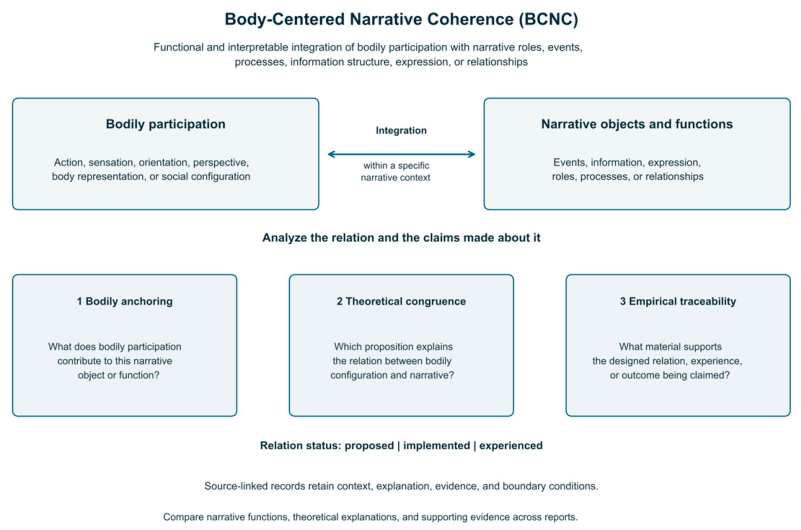
Body-Centered Narrative Coherence (BCNC) refers to the functional and interpretable integration of bodily participation with narrative roles, events, processes, information structure, expression, or relationships. As an analytical framework derived from the review, BCNC examines how a bodily configuration contributes to a particular narrative function and how that contribution is interpreted in context. Actions, sensations, perspectives, and social configurations can organize progression, access to information, role identification, or expression. Intentional restriction or disruption can also carry narrative meaning, as illustrated by the glitch-based analysis of Ryan Bengtsson and Van Couvering [55].
The three RQs provide complementary grounds for this synthesis. RQ1 supplies the bodily configuration and its function, RQ2 the explanatory proposition, and RQ3 the evidence bearing on claims about design, participation, or outcomes. The targeted comparisons in Section 3.5 bring these elements together in specific relations, including differences between implemented cues and participants' recognition of them.
BCNC organizes this examination through three analytical perspectives. Bodily anchoring identifies what bodily participation contributes to a narrative role, event, process, or object. Theoretical congruence examines how an explanation connects that configuration to its proposed function in a particular experiential context. Empirical traceability follows the material supporting claims about implementation, participant interpretation, or outcomes. Used together, these perspectives make the reasoning behind a body–narrative claim available for comparison (Fig. 7).
Figure 7.
BCNC as functional and interpretable bodily–narrative integration. Bodily anchoring, theoretical congruence, and empirical traceability organize the analysis of function, explanation, and evidential support. Arrows indicate analytical relations.
Figure 7.
BCNC as functional and interpretable bodily–narrative integration. Bodily anchoring, theoretical congruence, and empirical traceability organize the analysis of function, explanation, and evidential support. Arrows indicate analytical relations.
Existing frameworks supply important foundations for relating bodies to narratives. Chu and Mazalek [56] organize engagement through diegetic/non-diegetic, internal/external, and ontological/exploratory spectra in their Tangible and Embodied Narrative Framework. Kim and Khajavi [54] identify strategies for activating viewers’ roles through interaction, bodily representation, perspective, and directed viewing. Tong et al. [57] connect viewer roles and authorial control through Adaptive Playback Control. BCNC connects this design vocabulary to the theoretical explanations and evidence offered for a narrative function. Applying the same questions across reports supports comparisons among proposed mappings, implemented interactions, and participant interpretations (Data File D2).
BCNC makes these differences available for analysis within the same body–narrative relation. A bodily cue can be implemented as intended while its narrative significance remains unrecognized or is interpreted differently. Locating that difference helps formulate a specific design or research question about the cue, its relation to the narrative event, or the explanation used to interpret it. The same analytical questions can be applied across VR and related environments, with conclusions tied to each case's spatial conditions, narrative organization, and evidence.
For design and evaluation, BCNC offers a sequence of analytical tasks: specify the intended narrative function, configure bodily participation in context, articulate the explanatory proposition, and select evidence appropriate to the claim. These literature-derived relations can inform design guidance organized around narrative functions, bodily configurations, and implementation conditions. Expert assessment and design applications can examine its clarity and usefulness across VR narrative contexts.
5. Limitations and Future Research
The review covers four databases and obtainable English-language reports. Artistic practice, festival work, design portfolios, non-English scholarship, and inaccessible proceedings may be underrepresented. Single-reviewer screening and coding can introduce selection and interpretive bias. The RQ1 categories span action, sensory, medium, and social configurations, and 8 reports lacked a unique primary assignment. Comparisons therefore depend on the research focus and context represented by each category. RQ3 frequencies describe evidence forms across heterogeneous designs; formal corpus-wide risk-of-bias and certainty assessments were not undertaken. Differences in evidence units and shared study material further constrain comparisons of outcomes. The corpus also spans technological configurations and narrative forms. Because the synthesis organizes evidence by body–narrative relation without estimating separate platform effects, these differences remain conditions for interpreting individual findings.
Future studies can compare a specified narrative function across configurations while documenting changes in viewpoint, available action, and story progression, and connect behavioral or physiological observations to narrative events and participant accounts. Longitudinal and cross-cultural designs can examine enduring and context-dependent outcomes. Expert assessment and applications to new design cases can test BCNC’s conceptual clarity and usefulness for analysis.
6. Conclusions
This systematic review synthesized 370 reports on body-centered interaction in VR and related immersive narrative environments. Cinematic VR and 360-degree embodiment, avatar embodiment and perspective-taking, and locomotion received the most attention. Theory was most often used to structure analysis or operational decisions, with explicit cross-family integration appearing less frequently. Comparative and associational studies offered different ways to examine narrative relationships, while methodological diagnoses identified problems in how those relationships were studied.
BCNC relates the narrative work of bodily participation to its theoretical explanation and evidential support. The 32 targeted comparisons show how proposed design mappings, implemented interactions, and participant interpretations can be examined together. The framework provides a way to identify where these accounts align and where a specific relation calls for further design or investigation.
Conflicts of Interests
The authors declare no conflict of interest.
Ethics Approval
Not applicable. This review analyzed published reports and did not collect new data from human participants or animals.
Materials Availability
AI Assistance
The author completed the initial coding and used AI to assist with its subsequent review. Workbuddy supported literature search and download organization; Codex assisted with consistency checks, translation, and Word typesetting.
Final Manuscript Approval
All listed authors have read and approved the final version of the manuscript and agree to its submission to Multimodal Technologies and Interaction (MTI).
Supplementary Materials
The following supporting information can be downloaded at the website of this paper posted on Preprints.org. Supplementary_Methods_and_Data.docxSupplementary_Methods_and_Data.docx describes selection, coding, and protocol amendments. The accompanying files are: D1_Report_Bibliography_and_Coding_370.csv: bibliography and coding for the 370 reports. D2_Body_Narrative_Relations_32.csv: targeted relation comparisons and source locators. D3_Archived_Search_Strategies.txt: archived strategies and available execution evidence. D4a_Selection_Flow_Summary.csv: stage totals and exclusion categories. D4b_Selection_Dispositions_291.csv: candidate-level exclusions and reports not retrieved. PRISMA_2020_Checklist.docx: reporting-item locations.
Author Contributions
Yue Chen: Conceptualization, Methodology, Investigation, Data curation, Formal analysis, Visualization, and Writing – original draft. Nazlena Binti Mohamad Ali: Supervision. Ummul Hanan Binti Mohamad: Supervision. Ahmad Hanif Bin Ahmad Baharin: Supervision.
Funding
This research received no external funding.
Institutional Review Board Statement
Not applicable.
Informed Consent Statement
Not applicable.
Data Availability Statement
Report-level coding data and evidence mappings supporting the current synthesis are included in the supplementary information accompanying this article. The linked supplementary records provide the database search documentation, corpus dispositions, mappings among report IDs, RQs, themes, levels, and evidence classes, coding rules and worked examples with source locators.
References
- Csikszentmihalyi, M. Flow: The Psychology of Optimal Experience; Harper & Row: New York, NY, 1990; ISBN 978-0-06-016253-5. [Google Scholar]
- Gallagher, S. How the Body Shapes the Mind; Oxford University Press: Oxford, UK, 2005; ISBN 978-0-19-927194-8. [Google Scholar]
- Kilteni, K.; Groten, R.; Slater, M. The Sense of Embodiment in Virtual Reality. Presence Teleoperators Virtual Environ. 2012, 21, 373–387. [Google Scholar] [CrossRef]
- Davis, M.H. Measuring Individual Differences in Empathy: Evidence for a Multidimensional Approach. J. Pers. Soc. Psychol. 1983, 44, 113–126. [Google Scholar] [CrossRef]
- Green, M.C.; Brock, T.C. The Role of Transportation in the Persuasiveness of Public Narratives. J. Pers. Soc. Psychol. 2000, 79, 701–721. [Google Scholar] [CrossRef]
- Kim, E.J.; Kim, J. Virtual Reflections: Self-Mirroring and Its Influence on Self-Presence in Virtual Reality Environments. Vis. Comput. 2025, 41, 8271–8283. [Google Scholar] [CrossRef]
- Vendrell Ferran, Í. From Immersive Body Swapping to Apprehending the Other’s Emotions: Perspective-Taking and Levels of Empathy in Embodied Virtual Reality. In Phenomenologies of the Digital Age: The Virtual, the Fictional, the Magical; Cavallaro, M., de Warren, N., Eds.; Routledge: New York, 2024; pp. 186–205. ISBN 978-1-003-31228-4. [Google Scholar] [CrossRef]
- Harley, D.; Tarun, A.P.; Germinario, D.; Mazalek, A. Tangible VR. In Proceedings of the 2017 Conference on Designing Interactive Systems, June 10 2017; ACM: New York, NY, USA; pp. 1253–1263. [Google Scholar] [CrossRef]
- Desnoyers-Stewart, J.; Bergamo Meneghini, M.; Stepanova, E.R.; Riecke, B.E. Real Human Touch: Performer-Facilitated Touch Enhances Presence and Embodiment in Immersive Performance. Front. Virtual Real. 2024, 4, 1336581. [Google Scholar] [CrossRef]
- Milgram, P.; Kishino, F. A Taxonomy of Mixed Reality Visual Displays. IEICE Trans. Inf. Syst. 1994, E77-D, 1321–1329. Available online: https://globals.ieice.org/en_transactions/information/10.1587/e77-d_12_1321/_p.
- Skarbez, R.; Smith, M.; Whitton, M.C. Revisiting Milgram and Kishino’s Reality-Virtuality Continuum. Front. Virtual Real. 2021, 2, 647997. [Google Scholar] [CrossRef]
- Dooley, K. Conceptualizing and Developing Narrative-Based Virtual Reality Experiences: A Review of Disciplinary Frameworks and Approaches to Research. J. Screenwriting 2023, 14, 229–249. [Google Scholar] [CrossRef]
- Hadjipanayi, C.; Christofi, M.; Banakou, D.; Michael-Grigoriou, D. Cultivating Empathy through Narratives in Virtual Reality: A Review. Pers. Ubiquitous Comput. 2024, 28, 507–519. [Google Scholar] [CrossRef]
- Page, M.J.; McKenzie, J.E.; Bossuyt, P.M.; Boutron, I.; Hoffmann, T.C.; Mulrow, C.D.; Shamseer, L.; Tetzlaff, J.M.; Akl, E.A.; Brennan, S.E.; et al. The PRISMA 2020 Statement: An Updated Guideline for Reporting Systematic Reviews. BMJ 2021, 372, n71. [Google Scholar] [CrossRef]
- Pollock, A.; Berge, E. How to Do a Systematic Review. Int. J. Stroke 2018, 13, 138–156. [Google Scholar] [CrossRef]
- Bala, P.; Dionísio, M.; Trindade, R.; Olim, S.; Nisi, V.; Nunes, N. Evaluating the Influence of Location and Medium Applied to Mobile VR Storytelling. In Proceedings of the 16th International Conference on Mobile and Ubiquitous Multimedia, November 26 2017; ACM: New York, NY, USA; pp. 371–378. [Google Scholar] [CrossRef]
- Ceplitis, A. Kinaesthetic Narrativization of Place in 360° Stereoscopic Flânerie. ENTHYMEMA 2025, 241–257. [Google Scholar] [CrossRef]
- Shin, D. Empathy and Embodied Experience in Virtual Environment: To What Extent Can Virtual Reality Stimulate Empathy and Embodied Experience? Comput. Hum. Behav. 2018, 78, 64–73. [Google Scholar] [CrossRef]
- Farmer, H.; Skoulikari, E.; Bevan, C.; Gray, S.; Cater, K.; Stanton Fraser, D. Using Narrative 360° Video as a Tool to Promote Breast Self-Examination. Virtual Real. 2024, 28, 34. [Google Scholar] [CrossRef]
- Zhao, K.; Chen, R.; Zhang, X.; Wang, C.; Chen, S.; Wang, X.; Wang, Y.; Tong, X. Immersive Biography: Supporting Intercultural Empathy and Understanding for Displaced Cultural Objects in Virtual Reality. In Proceedings of the 2025 CHI Conference on Human Factors in Computing Systems, April 26 2025; ACM: New York, NY, USA; pp. 1–17. [Google Scholar] [CrossRef]
- Han, J.; Vande Moere, A.; Simeone, A.L. Architectural Narrative VR: Towards Generatively Designing Natural Walkable Spaces. In Proceedings of the 2023 ACM Designing Interactive Systems Conference, July 10 2023; ACM: New York, NY, USA; pp. 523–536. [Google Scholar] [CrossRef]
- Thomas, A.; Benhur, S. Reimagining Cinema: Durée, Perception, and Participation. Acta Univ. Sapientiae Film. Media Stud. 2025, 27, 9. [Google Scholar] [CrossRef]
- Yu, R.; Duer, Z.; Ogle, T.; Bowman, D.A.; Tucker, T.; Hicks, D.; Choi, D.; Bush, Z.; Ngo, H.; Nguyen, P.; et al. Experiencing an Invisible World War I Battlefield Through Narrative-Driven Redirected Walking in Virtual Reality. In Proceedings of the 2018 IEEE Conference on Virtual Reality and 3D User Interfaces (VR); IEEE: Tuebingen/Reutlingen, Germany, March 2018; pp. 313–319. [Google Scholar] [CrossRef]
- Arendttorp, E.M.N.; Winschiers-Theophilus, H.; Rodil, K.; Johansen, F.B.K.; Rosengreen Jørgensen, M.; Kjeldsen, T.K.K.; Magot, S. Grab It, While You Can: A VR Gesture Evaluation of a Co-Designed Traditional Narrative by Indigenous People. In Proceedings of the 2023 CHI Conference on Human Factors in Computing Systems; ACM: New York, NY, USA, 19 April 2023; pp. 1–13. [Google Scholar] [CrossRef]
- Fan, H.; Bolter, J.D. Rekindle: Enhancing Interactive Narrative in Virtual Reality with Coherent, Agency-Driven Interactions. In Proceedings of the Extended Abstracts of the CHI Conference on Human Factors in Computing Systems; ACM: New York, NY, USA, 11 May 2024; pp. 1–5. [Google Scholar] [CrossRef]
- Yin, M.; Xiao, R. TravelGalleria: Supporting Remembrance and Reflection of Travel Experiences through Digital Storytelling in Virtual Reality. In Proceedings of the 2025 CHI Conference on Human Factors in Computing Systems, April 26 2025; ACM: New York, NY, USA; pp. 1–14. [Google Scholar] [CrossRef]
- Bala, P.; Dionisio, M.; Nisi, V.; Nunes, N. IVRUX: A Tool for Analyzing Immersive Narratives in Virtual Reality. In Interactive Storytelling; Lecture Notes in Computer Science; Nack, F., Gordon, A.S., Eds.; Springer: Cham, Switzerland, 2016; Vol. 10045, pp. 3–11. ISBN 978-3-319-48278-1. [Google Scholar] [CrossRef]
- Walter, M. Where to Look? Sustaining Presence While Directing Attention in Virtual Reality Stories. Aniki Rev. Port. Imagem Em Mov. 2023, 10, 138–158. [Google Scholar] [CrossRef]
- Huang, X.; Liang, H.; Wang, Y.; Wang, Y.; Li, D.; Zhang, B. Narrative as Cognitive Infrastructure Reduces Semantic Opacity in Virtual Industrial Heritage. npj Herit. Sci. 2026, 14, 126. [Google Scholar] [CrossRef]
- Harley, D.; Verni, A.; Willis, M.; Ng, A.; Bozzo, L.; Mazalek, A. Sensory VR: Smelling, Touching, and Eating Virtual Reality. In Proceedings of the Twelfth International Conference on Tangible, Embedded, and Embodied Interaction; ACM: New York, NY, USA, 18 March 2018; pp. 386–397. [Google Scholar] [CrossRef]
- Ge, S.; Luo, S.; Yan, S.; Shen, X. Effects of Augmenting Real-Time Biofeedback in An Immersive VR Performance. In Proceedings of the 2022 IEEE International Symposium on Mixed and Augmented Reality Adjunct (ISMAR-Adjunct); IEEE, October 2022; pp. 751–756. [Google Scholar] [CrossRef]
- Song, Z.; Evans, L. Immersion as Convergence: How Storytelling, Interaction, and Sensory Design Co-Produce Museum Virtual Reality Experiences. Information 2026, 17, 75. [Google Scholar] [CrossRef]
- Regenbrecht, H.; Park, N.; Duncan, S.; Mills, S.; Lutz, R.; Lloyd-Jones, L.; Ott, C.; Thompson, B.; Whaanga, D.; Lindeman, R.W.; et al. Ātea Presence— Enabling Virtual Storytelling, Presence, and Tele-Co-Presence in an Indigenous Setting. IEEE Technol. Soc. Mag. 2022, 41, 32–42. [Google Scholar] [CrossRef]
- Yu, Y.; Phillips, M.; Corino, G. “It Felt Like Solving a Mystery Together”: Exploring Virtual Reality Card-Based Interaction and Story Co-Creation Collaborative System Design. Appl. Sci. 2025, 15, 8046. [Google Scholar] [CrossRef]
- Schmidt, A.G.; Tauritis, D.; Niess, J.; Woźniak, P.W.; Stefanidi, E. PuppetVR: Towards Supporting Pretend Play through VR Storytelling for Neurodivergent Children. In Proceedings of the 24th Interaction Design and Children; ACM: New York, NY, USA, 23 June 2025; pp. 895–903. [Google Scholar] [CrossRef]
- Harley, D.; P. Tarun, A.; J. Stinson, B.; Tibu, T.; Mazalek, A. Playing by Ear: Designing for the Physical in a Sound-Based Virtual Reality Narrative. In Proceedings of the Fifteenth International Conference on Tangible, Embedded, and Embodied Interaction, February 14 2021; ACM: New York, NY, USA; pp. 1–9. [Google Scholar] [CrossRef]
- Vindenes, J.; Nyre, L. Prototyping First-Person Viewer Positions for VR Narratives with Storyboards and Pilot Productions. J. Screenwriting 2023, 14, 251–269. [Google Scholar] [CrossRef]
- Kan, T.; Tso, K. From Watching to Entering: A VR Approach to Cinematic Storytelling as Digital Heritage. In Proceedings of the 2025 20th ACM SIGGRAPH International Conference on Virtual-Reality Continuum and its Applications in Industry, New York, NY, USA, December 13 2025; ACM; pp. 1–5. [Google Scholar] [CrossRef]
- Ármeán, O. In-Betweenness and Interactional Presence in Adrian Sitaru’s VR Play, Illegitimate. Acta Univ. Sapientiae Film. Media Stud. 2019, 17, 131–142. [Google Scholar] [CrossRef]
- Navarro-Ligero, M.L.; García-Triviño, F.; Pérez-Docampo, M.; Soria-Lara, J.A. A Conceptual Framework for Prototyping Futures Scenarios through Narrative Design of VR Urban Scenes. Futures 2026, 180, 103830. [Google Scholar] [CrossRef]
- Bakk, Á.K. Representing Mental Disorders with Virtual Reality Applications: Designing for Multimodality and Complex Participation. Front. Virtual Real. 2023, 3, 881766. [Google Scholar] [CrossRef]
- Huynh, C.-T.; Le-Hinh, N.-T.; Tran, M.-T.; Huynh, V.-T. From Story to Reality: Generative VR for Immersive Fairy Tales. In Proceedings of the 2025 International Conference on Intelligent Computing and Virtual & Augmented Reality Simulations (ICVARS); IEEE: Birmingham, United Kingdom, 25 July 2025; pp. 159–163. [Google Scholar] [CrossRef]
- Tong, L.; Jung, S.; Li, R.C.; Lindeman, R.W.; Regenbrecht, H. Action Units: Exploring the Use of Directorial Cues for Effective Storytelling with Swivel-Chair Virtual Reality. In Proceedings of the 32nd Australian Conference on Human-Computer Interaction; ACM: New York, NY, USA, 2 December 2020; pp. 45–54. [Google Scholar] [CrossRef]
- Warp, R.; Zhu, M.; Kiprijanovska, I.; Wiesler, J.; Stafford, S.; Mavridou, I. Moved by Sound: How Head-Tracked Spatial Audio Affects Autonomic Emotional State and Immersion-Driven Auditory Orienting Response in VR Environments. In Proceedings of the 152nd Audio Engineering Society Convention, 2022; AES E-Library; pp. 1–11 Paper 10590. [Google Scholar]
- Xu, C.; Gani, M.A.A.B.A.; Bin Ismail, I.; Cao, Y.; Aziz, A.A.; Arshard, W.N.R.M. Digital Projection Immersive Narrative Display and Interactive Technology: A Study on the Impact on Audience Engagement. In Proceedings of the 2024 IEEE 22nd Student Conference on Research and Development (SCOReD); IEEE: Selangor, Malaysia, 19 December 2024; pp. 623–627. [Google Scholar] [CrossRef]
- Liu, Z.; Yan, S.; Lu, Y.; Zhao, Y. Generating Embodied Storytelling and Interactive Experience of China Intangible Cultural Heritage “Hua’er” in Virtual Reality. In Proceedings of the CHI Conference on Human Factors in Computing Systems Extended Abstracts, April 27 2022; ACM: New York, NY, USA; pp. 1–7. [Google Scholar] [CrossRef]
- Halbritter, C.; Kudnick, J.; Mohanto, B.; Fu, B.; Weier, M. GENIE: Generative Narrative Immersion Engine for Deep Reading Engagement. In Proceedings of the 2026 IEEE Conference on Virtual Reality and 3D User Interfaces Abstracts and Workshops (VRW); IEEE: Daegu, Korea, Republic of, 21 March 2026; pp. 60–65. [Google Scholar] [CrossRef]
- Reyes, M.C.; Dettori, G. Developing a Media Hybridization Based on Interactive Narrative and Cinematic Virtual Reality. Ekphrasis Images Cine. Theory Media 2019, 22, 131–151. [Google Scholar] [CrossRef]
- Lau, K.H.C.; Yun, B.; Saruba, S.; Bozkir, E.; Kasneci, E. Wrapped in Anansi’s Web: Unweaving the Impacts of Generative-AI Personalization and VR Immersion in Oral Storytelling. In Proceedings of the Augmented Humans International Conference 2025; ACM: New York, NY, USA, 16 March 2025; pp. 312–332. [Google Scholar] [CrossRef]
- Yuan, L.-P.; Han, F.; Xie, L.; Zhang, J.; Zhao, J.; Qu, H. “You’ll Be Alice Adventuring in Wonderland!” Processes, Challenges, and Opportunities of Creating Animated Virtual Reality Stories. In Proceedings of the 2025 CHI Conference on Human Factors in Computing Systems; ACM: New York, NY, USA, 26 April 2025; pp. 1–21. [Google Scholar] [CrossRef]
- Maggipinto, B.; Trindade, Y.; Hammer, J.; Nunes, N.J.; Nisi, V. Echo of the Abyss: Understanding More-than-Human Interconnectedness in the Deep Sea Through Virtual Reality Experiences. In Proceedings of the Nineteenth International Conference on Tangible, Embedded, and Embodied Interaction; ACM: New York, NY, USA, 4 March 2025; pp. 1–14. [Google Scholar] [CrossRef]
- Dooley, K. Traversing Space in The Under Presents (2019), a VR Game. In Interactive Storytelling; Lecture Notes in Computer Science; Holloway-Attaway, L., Murray, J.T., Eds.; Springer Nature Switzerland: Cham, 2023; Vol. 14383, pp. 442–453. ISBN 978-3-031-47654-9. [Google Scholar] [CrossRef]
- Kratky, A. Walking in the Head: Methods of Sonic Augmented Reality Navigation. In Human-Computer Interaction. Recognition and Interaction Technologies; Lecture Notes in Computer Science; Kurosu, M., Ed.; Springer International Publishing: Cham, 2019; Vol. 11567, pp. 469–483. ISBN 978-3-030-22642-8. [Google Scholar] [CrossRef]
- Kim, Y.E.; Khajavi, M.J. Exploring the Viewer’s Role in Narrative-Based Animated Virtual Reality Experiences: Strategies for Role Activation and Immersive Storytelling. Animation 2024, 19, 101–128. [Google Scholar] [CrossRef]
- Ryan Bengtsson, L.; Van Couvering, E. Stretching Immersion in Virtual Reality: How Glitches Reveal Aspects of Presence, Interactivity and Plausibility. Converg. Int. J. Res. New Media Technol. 2023, 29, 432–448. [Google Scholar] [CrossRef]
- Chu, J.H.; Mazalek, A. Embodied Engagement with Narrative: A Design Framework for Presenting Cultural Heritage Artifacts. Multimodal Technol. Interact. 2019, 3, 1. [Google Scholar] [CrossRef]
- Tong, L.; Lindeman, R.W.; Regenbrecht, H. Viewer’s Role and Viewer Interaction in Cinematic Virtual Reality. Computers 2021, 10, 66. [Google Scholar] [CrossRef]
Table 2.
Inclusion and exclusion criteria.
| Criterion | Included | Excluded |
| Medium | VR, including cinematic and interactive configurations; related AR/MR or other immersive environments with spatial or embodied positioning meeting the body–narrative criteria | Flat-screen-only media or generic digital systems without immersive embodiment |
| Narrative relevance | Storytelling, documentary, theater, heritage, fiction, journalism, performance, or substantive meaning-making | Narrative used only as a label, visual background, or non-substantive scenario |
| Body-centered relevance | Movement, sensation, orientation, embodied perspective, avatar, gaze, touch, haptics, full-body action, physiological feedback, or co-presence with narrative relevance | Generic system operation without a body–narrative function |
| Evidence sufficiency | Sufficient full-text evidence to answer at least one RQ | Studies that could not answer RQ1, RQ2, or RQ3 after full-text review |
| Publication | English-language reports of at least five pages: journal articles, conference/proceedings reports or independently identifiable chapters meeting peer-review or explicit scholarly-selection conditions; original contributions in hybrid reports | Whole monographs or edited volumes; reports shorter than five pages, pure secondary reviews, non-English full texts and records outside the review period |
Table 3.
Three-layer coding framework.
| Layer | Question | Coding approach |
| System-use layer | Which bodily modalities are present in the reviewed system? | Auxiliary modality descriptions for contextual interpretation; not a corpus-wide prevalence estimate |
| Research-focus layer | Which body–narrative mechanism is the study primarily investigating? | One primary theme for frequency counts where the source supports a unique assignment; a secondary theme only when independently supported |
| Measurement layer | How is the relationship between bodily engagement and narrative outcomes compared, tracked, or diagnosed? | RQ3 evidence class |
Table 4.
Distribution of primary body–narrative research foci.
| Theme | Analytical family | n | % of RQ1 | Narrative functions identified in the reviewed reports | Representative studies |
| T9 Cinematic VR and 360-Degree Embodiment | Medium configuration | 93 | 25.3% | Embodied spectatorship, spatial perspective, frameless attention, cinematic positioning | Bala et al. [16]; Ceplitis [17]; Shin [18] |
| T5 Avatar Embodiment and Perspective-Taking | Sensory and embodied mechanism | 83 | 22.6% | Identification, body ownership, role-taking, perspective transformation | Farmer et al. [19]; Kim and Kim [6]; Zhao et al. [20] |
| T3 Locomotion and Walking | Body input and action | 43 | 11.7% | Spatial progression, narrative pacing, environmental interpretation | Han et al. [21]; Thomas and Benhur [22]; Yu et al. [23] |
| T1 Gestural and Hand Interaction | Body input and action | 41 | 11.2% | Agency expression, manipulation, enactment, symbolic or task-based action | Arendttorp et al. [24]; Fan and Bolter [25]; Yin and Xiao [26] |
| T6 Gaze and Attention Guidance | Body input and action | 41 | 11.2% | Attention choreography, implicit selection, discovery and revelation | Bala et al. [27]; Walter [28]; Huang et al. [29] |
| T7 Multimodal Sensory Immersion | Sensory and embodied mechanism | 31 | 8.4% | Cross-sensory integration and physiological feedback | Harley et al. [30]; Ge et al. [31]; Song and Evans [32] |
| T10 Collaborative and Social Embodiment | Social configuration | 18 | 4.9% | Co-presence, collaboration, social performance, shared meaning-making | Desnoyers-Stewart et al. [9]; Regenbrecht et al. [33]; Yu et al. [34] |
| T4 Full-Body and Motion Capture | Body input and action | 5 | 1.4% | Kinesthetic enactment, performance, body-as-actor | Schmidt et al. [35] |
| T2 Tangible Objects and Passive Haptics | Sensory and embodied mechanism | 4 | 1.1% | Material anchoring, tactile credibility, object-centered participation | Harley et al. [8,36] |
| No unique primary assignment | Unresolved primary ordering | 8 | 2.2% | RQ1 supported; unique focus not assigned | See Data File D1 |
Table 5.
Theory use and integration in the RQ2 corpus.
| RQ2 level | Theory or theory families | Bodily mechanism | Narrative object | Analytical role | Representative studies |
| L1 (n = 38) | Embodied cognition, phenomenology, participatory memory, philosophical and design frameworks | Agency, re-embodiment, role switching, gesture, spatial participation | Adaptation, illness experience, empathy, collective memory, philosophical narrative | Conceptual explanation without systematic analytical or operational mapping | Report-level entries in Data File D1 |
| L2 (n = 258) | Embodiment, presence, agency, transportation, empathy, haptics, trauma, media-effects and narrative models | Posture, locomotion, gesture, touch, avatar perspective, sound, gaze, movement, physiological response | Identification, pacing, engagement, empathy, memory, reflection, understanding | Theory structures analysis, design, operational definitions, or measurement | Fan and Bolter [25]; Farmer et al. [19]; Desnoyers-Stewart et al. [9] |
| L3 (n = 44) | Embodied interaction + diegetic/intersensory design; narrative semiotics + perceptual opportunities; spatial narrative + bodily presence | Spatial choice, disrupted interaction, embodied perception, multimodal participation, orientational gaze, avatar perspective | Narrative loops, critical reflection, cinematic meaning, mental-health representation, place narrativization, intercultural biography | Named families explain the same relation: sensory material–storyworld belonging; actant roles–attention and navigation; bodily position–story information | Ármeán [39]; Harley et al. [30]; Navarro-Ligero et al. [40] |
Table 6.
Illustrative RQ3 evidence forms and their interpretation boundaries.
| Reference | Body-narrative focus | Evidence class | Core evidence | Interpretation boundary |
| Ge et al. [31] | Multimodal biofeedback | Gap-diagnostic | The original design pre-test diagnosed ambiguity in physiological-feedback sources and interference among movement, sound and plot cues. | The twelve-person TV-audience comparison is not counted as HMD audience relationship evidence; diagnosis only under the review rule. |
| Huynh et al. [42] | Immersive fairy-tale presentation | Comparative | Eight direct HMD users contributed descriptive comparisons of an eBook and two VR configurations; the other 23 participants viewed prerecorded demonstrations. | The 31 participants cannot be treated as one direct HMD experiment; presentation, content layers and medium co-vary. |
| Bala et al. [16] | Head-rotated spatial exploration | Comparative; Gap-diagnostic | Tablet and mobile-VR conditions contrasted arm-supported viewing with head-rotated exploration and measured narrative transportation. | Device and viewing actions differ; authors discuss arm-extension demands and public-space self-consciousness (PDF p. 6). These source-authored issues support the diagnostic label. |
| Liu et al. [46] | Avatar-based participatory performance | Comparative | A participatory VR-theater system compared experience and learning outcomes around a virtual-avatar performance format. | Avatar, performance, game, and presentation components were bundled. |
| Halbritter et al. [47] | Adaptive panoramic narrative setting | Comparative | Adaptive panoramic story scenes were compared with a fixed reading room, with narrative absorption outcomes. | The 32-person study reports story-dependent results; yaw coverage is not an independently tested yaw–absorption association. |
| Bala et al. [27] | Head-orientation attention | Associational/trace-based; Gap-diagnostic | Head-rotation data were aligned with attention shifts in 360-degree narrative scenes. | Head-rotation trajectories and original cue/pacing diagnoses; not eye tracking or a causal manipulation. |
| Shin [18] | Perceived avatar embodiment | Comparative; Associational/trace-based | A 2 × 2 design groups HMD versus flat-screen viewing and high versus low trait empathy (N = 200); Table 3 reports embodiment–engagement r = .452, alongside path models. | Predominantly correlational self-report evidence rather than a behavioral trace. |
| Reyes and Dettori [48] | Observed bodily movement | Associational/trace-based; Gap-diagnostic | System mirroring and observation grids recorded bodily movement and participant comments alongside narrative units and narrative immersion. | Observational alignment does not isolate causal contribution. |
| Huang et al. [29] | Gaze and physiological response | Comparative; Associational/trace-based | Thirty participants were randomly assigned to NPC-guided or unguided exploration; gaze, EDA, HRV, respiration, and narrative-related understanding were analyzed. | The randomized comparison concerns NPC-guided presentation; gaze and physiological measures characterize responses, and mediation findings depend on the model specification. |
| Lau et al. [49] | VR/non-VR bodily participation | Comparative; Associational/trace-based; Gap-diagnostic | VR/presentation and personalization conditions were compared; interviews connected movement and non-player-character (NPC) exchange with story-role participation. | Media packages co-vary; the original report also identifies ceiling effects and limits of retrospective accounts. |
| Yuan et al. [50] | Creator-side exploration alignment | Associational/trace-based; Gap-diagnostic | Creator accounts connected bodily exploration and gaze with intended routes, points of interest and storylines, and identified visualization needs. | Qualitative creator-process relations and original diagnosis, not a controlled audience effect. |
| Zhao et al. [20] | Avatar embodiment and perspective transformation | Associational/trace-based | Interviews connected avatar/object identity, cultural familiarity and character biography with participants' interpretations. | Qualitative relationship evidence; no manipulated embodiment condition or isolated causal effect. |
| Schmidt et al. [35] | Embodied story authoring | Associational/trace-based; Gap-diagnostic | Observed recorded/replayed performances and participant accounts show how bodily action produced story material. | Exploratory adult evaluation; general user-experience (UX) scales do not isolate the narrative function. |
| Navarro-Ligero et al. [40] | Embodied narrative pre-production | Gap-diagnostic | Expert consultation and workshops diagnosed lost theme, motivation and scene-cue connections during design translation. | Original design-process diagnosis; testing with VR audiences remains future work. |
Disclaimer/Publisher’s Note: The statements, opinions and data contained in all publications are solely those of the individual author(s) and contributor(s) and not of MDPI and/or the editor(s). MDPI and/or the editor(s) disclaim responsibility for any injury to people or property resulting from any ideas, methods, instructions or products referred to in the content. |
© 2026 by the authors. Licensee MDPI, Basel, Switzerland. This article is an open access article distributed under the terms and conditions of the Creative Commons Attribution (CC BY) license.
Copyright: This open access article is published under a Creative Commons CC BY 4.0 license, which permit the free download, distribution, and reuse, provided that the author and preprint are cited in any reuse.