

Submitted:
23 November 2026
Posted:
24 November 2026
You are already at the latest version
Abstract
In Pakistan, rapid population growth, financial constraints, and chronic underinvestment have weakened the public healthcare system. Following the 2010–2011 constitutional devolution, healthcare governance and financing were transferred to provincial governments through a three-tiered public network comprising primary, secondary, and tertiary facilities. This critical review analyzes structural issues and inter-provincial disparities following the devolution of authority, based on the WHO’s “Health System Building Blocks” framework. A total of 40 peer-reviewed studies and 7 official documents (n = 47) were examined. The findings reveal that despite the devolution of authority and the scaling back of social health protection programs such as Sehat Sahulat, Pakistan continues to lag behind South Asian benchmarks in maternal and child survival and public health investments. Public health expenditure stagnates at 0.8–0.9% of Gross Domestic Product (GDP), leaving out-of-pocket (OOP) payments at 52.93% of total health spending—more than triple the global average of 17.33%. Progress across the WHO’s six core building blocks is hindered by an imbalance between nurses and physicians (5.2 nurses per 10,000 population), a shortage of healthcare workers in rural areas, and fragmented pharmaceutical regulations. The District Health Information System (DHIS2) fails to integrate with other systems. Macro-fiscal constraints, such as low tax revenues, a heavy debt burden, and the channeling of resources toward treatment-focused hospitals, continue to weaken the state's capacity for implementation. To achieve Universal Health Coverage (UHC), priority must be given to primary healthcare services and public health policies. It is essential to restructure insurance packages through local health taxes, regulate informal healthcare providers at the provincial level, and institutionalize coordination between federal and provincial authorities.
Keywords:
healthcare system
; health financing
; universal health coverage
; political economy
; Pakistan
1. Introduction
Achieving Universal Health Coverage (UHC) poses a major problem for low- and middle-income countries [1]. In Pakistan, the world’s fifth most populous nation, these challenges also exist [2]. However, over the past fifteen years, the country has undergone a significant administrative transformation aimed at decentralizing governance and improving public services [3,4].
Following the 18th Constitutional Amendment in April 2010 and the abolition of the federal Ministry of Health in June 2011, the planning, delivery, and financing of healthcare services were devolved to the provinces [5]. Meanwhile, the management of national health standards, pharmaceutical regulations, and vertical public health programs was transferred to the Ministry of National Health Services, Regulations and Coordination (NHSRC), established in April 2013 [6]. The objective was to make healthcare services more responsive to local needs [3]. However, significant disparities emerged among the provinces in administrative capacity, budgetary resources, and coordination levels [3,4].
Despite new strategic frameworks and publicly supported social health insurance initiatives, Pakistan has failed to reach the South Asian average regarding maternal and child mortality rates and public health expenditure [7,8]. In the existing literature, Pakistan’s health system is often addressed in a fragmented manner, with research focusing on individual disease-specific programs or limited economic indicators [1,2]. However, there is a scarcity of holistic analyses that simultaneously examine political-economy dynamics, inter-provincial disparities, and interactions among the six "building blocks" of the health system [3,9].
This critical review examines Pakistan’s health system within the framework of the WHO’s “Health System Building Blocks” [9].
2. Methodology
2.1. Research Design and Analytical Framework
In this critical narrative review, a method based on the WHO’s "Health System Building Blocks" framework for health systems was employed [9]. The results were categorized into the six components defined by the WHO: service delivery, health workforce, health information systems, access to essential medicines, health financing, and governance [9].
2.2. Search Strategy and Information Sources
A two-stage search was conducted to identify works published in English between January 2010 and November 2026. First, academic databases were queried, then official institutional documents were examined.
Academic Databases:Searches were executed in PubMed/MEDLINE and Google Scholar. In PubMed, the following Boolean query was applied: ("healthcare system"[Title/Abstract] OR "health policy"[Title/Abstract] OR "healthcare delivery"[Title/Abstract] OR "health financing"[Title/Abstract]) AND ("Pakistan"[Title/Abstract]) AND ("18th Constitutional Amendment"[All Fields] OR "devolution"[All Fields] OR "universal health coverage"[All Fields] OR "Sehat Sahulat"[All Fields] OR "primary healthcare"[All Fields]). To capture grey academic policy literature and regional journals not indexed in MEDLINE, a title-focused search was conducted in Google Scholar using: allintitle: "healthcare system" OR "health policy" OR "health financing" "Pakistan". Google Scholar ranks results based on relevance. To filter out irrelevant entries and focus on key policy studies, the search scope was limited to the first 40 records (the first four pages).
Official Institutional and Legislative Sources:Seven official documents have been included to evaluate the framework, strategic plans, and official macroeconomic data.
2.3. Eligibility Criteria and Evidence Stratification
The inclusion and exclusion criteria for the studies were defined under four categories: time frame, publication type, scope, and language/accessibility (Table 1). The analysis was based on evidence from the 2010–2026 period, following the devolution of authority [5], and the 2007 framework established by the WHO [9]. The period before 2010 (1947–2001) was addressed through policy reviews covering the post-2010 era [10,11].
During synthesis, included sources were stratified by methodological design to appropriately weigh the evidence: empirical econometric studies and household expenditure surveys (e.g., out-of-pocket catastrophic spending and UHC coverage indices), cross-sectional facility and workforce assessments, qualitative political economy and governance analyses, and official macro-statistical datasets.
2.4. Record Selection and Synthesis Process
Database queries yielded 66 records from PubMed and 149 records from Google Scholar (with the top 40 screened). Combined with the seven official institutional and legislative documents, an initial screening pool of 113 records was compiled (Figure 1, Table 2). After removing 6 cross-database duplicates, 107 unique records underwent title, abstract, and executive summary screening against the eligibility criteria. Sixty records were excluded (46 from PubMed and 14 from Google Scholar) due to narrow clinical focus, single-district scope without policy relevance, or non-peer-reviewed status. Ultimately, 47 sources, comprising 20 PubMed articles, 20 Google Scholar articles, and 7 official institutional and legislative documents, were included in the final thematic synthesis (Figure 1, Table 2).
3. Results
An analysis of the 47 included sources reveals structural performance issues that are increasingly compounded by population growth and the burden of disease (Table 4) [2,12]. There are also profound disparities among the provinces in how their healthcare systems function [3,12].
3.1. Service Delivery and Infrastructure
In Pakistan’s healthcare system, approximately 70% of medical services are provided by the private sector, while the public sector delivers 30% [10]. Pakistan Economic Survey (2025–26) declared that the country has 5,746 Basic Health Units (BHUs) and 1,934 hospitals [13]. Also, Rural Health Centers (RHCs), dispensaries, and specialized clinics (focusing on areas such as maternal and child health or tuberculosis) support this system [13,14]. The density of hospital beds in the public sector remains quite low: there is only one bed for every 1,800 people in Punjab and 1,400 in Sindh [3,13].
Public service delivery is structured across a three-tiered referral hierarchy managed by provincial health departments (Table 3) [14,15]:
- Primary Care:BHUs serve catchment populations of approximately 25,000 at the Union Council level, providing maternal and child health (MCH) services, routine immunizations under the Expanded Program on Immunization (EPI, established in 1978), and supervision of approximately 90,000 community-based Lady Health Workers (LHWs, deployed since 1994) [14,16]. RHCs serve populations of up to 100,000, providing basic laboratory/radiology diagnostics and 10–20 inpatient beds [14,15].
- Secondary Care:Tehsil Headquarters Hospitals (THQs; 40–60 beds, serving 500,000–1,000,000 residents) provide specialist consultations and Emergency Obstetric and Newborn Care (EmONC), while District Headquarters Hospitals (DHQs; 100–250+ beds, serving 1–3 million residents) deliver multi-specialty inpatient and surgical care [15].
- Tertiary Care:University-affiliated teaching hospitals (500–2,000+ beds) manage complex referrals and subspecialty care in major urban centers [15].
A lack of diagnostic and laboratory equipment, as well as a shortage of personnel, at BHUs and RHCs leads patients to bypass primary care and go directly to overcrowded tertiary-care hospitals [14,15]. Concurrently, Pakistan faces a dual burden of disease, characterized by rising non-communicable diseases alongside persistent infectious diseases, amid rapid annual population growth (1.6%), a life expectancy of 68 years, a maternal mortality ratio of 155 per 100,000 live births, an infant mortality rate of 48.2 per 1,000 live births, and an under-five mortality rate of 56 per 1,000 live births (World Bank WDI, 2025) [7]. Public health emergencies such as COVID-19, along with the devastating floods of 2022, have damaged hundreds of facilities, exposing the vulnerability of healthcare infrastructure to climate shocks [17,18,19].
3.2. Health Workforce: Skill-Mix Imbalances and Rural Absenteeism
A shortage of healthcare personnel significantly disrupts service delivery at all levels of the system [20]. There are 336,582 physicians, 138,391 nurses, 46,801 midwives, and 42,118 dentists registered in the country [13]. The nurse-to-population ratio is only 5.2 per 10,000 people, far below the WHO-established minimum of 30 nurses per 10,000 people [20,21]. Meanwhile, the number of physicians stands at approximately 1.2 per 1,000 people [13,20].
While the vast majority of medical professionals work in urban tertiary healthcare centers, rural healthcare facilities face staff shortages [20]. The most common reasons are inadequate compensation, poor housing and security conditions, limited career opportunities, and weak supervision [20,21]. Patients living in rural areas are driven to seek care from unauthorized and unregistered individuals who operate outside of legal regulations and licensing frameworks [2,22].
3.3. Health Information Systems: Fragmentation and Incomplete Digital Interoperability
In Pakistan, health data is fragmented across federal agencies, provincial governments, and the private sector [23]. Consequently, it is not possible to carry out data-driven health planning [23,24]. The District Health Information System (DHIS2), implemented in over 1,650 public health facilities, has led to tangible improvements in provinces such as Balochistan [23]. The reporting rate for facilities in Balochistan has risen from 55% to 90%, and the rate of facility-based births has increased from 35% to 62% [23]. However, digital integration remains lacking nationwide [23]. There is no electronic record system at the primary healthcare level; the private sector does not share data with the public system, and digital referral linkages between BHUs, DHQ hospitals, and tertiary-care facilities are not interoperable [23,25]. To establish common data standards, the NHSRC launched the National Digital Health Framework (2022–2030) [26]. Yet, due to inadequate IT infrastructure and funding constraints, this initiative has not yet yielded the expected results [23,26].
3.4. Access to Essential Medicines
While the federal government handles licensing and price ceilings, provincial authorities are responsible for procurement and distribution [27]. As a result, the supply of medicines is not functioning properly due to pricing disputes and procurement disruptions [27,28]. In such situations, patients are forced to obtain their medications from private pharmacies at a high cost [28].
3.5. Health Financing: Sub-1% Public Spending, OOP Burden, and Insurance Strains
Pakistan faces greater challenges in healthcare financing than the global average [29]. According to WHO data for 2025, health expenditure accounts for 2.52% of GDP, below the South Asian average of 3.26% [8]. Out-of-pocket payments account for 52.93% of total health expenditure, more than three times the global average of 17.33% [8,30]. Public sector health spending stands at 942.2 billion Pakistani Rupees, corresponding to 0.8–0.9% of the GDP [8,13].
The federal and provincial governments have implemented the Sehat Sahulat Program to enhance financial protection regarding healthcare expenditures [2]. This program is a form of social health insurance financed directly through the state budget [2,31]. Under this system, patients can receive inpatient treatment at contracted public and private hospitals at no cost [2,31].
3.6. Leadership and Governance: Post-Devolution Asymmetries and Regulatory Gaps
With the 18th Constitutional Amendment, the management of healthcare services was devolved to the provinces [5]. However, prior to this devolution, the provinces' technical capacities were not equalized, nor was a binding inter-institutional coordination mechanism established [3,4]. As a result, healthcare management and the scope of services provided have come to vary significantly from one province to another [3]. Khyber Pakhtunkhwa and Punjab have adopted large-scale social health insurance schemes to support public hospitals [2]. Sindh has focused on centralized programs and contractual models in which primary healthcare services are outsourced to the private sector [3,33]. Balochistan has lagged behind in these developments due to severe resource constraints, geographical challenges, and governance weaknesses [3,33].
At the federal level, coordination between the NHSRC and provincial health departments remains weak, particularly regarding vertical communicable disease programs (tuberculosis, HIV/AIDS, malaria) and external donor alignment [4,34,35,36]. Meanwhile, professional regulatory oversight experienced institutional instability when the Pakistan Medical and Dental Council (PM&DC, established 1962) was dissolved and replaced by the Pakistan Medical Commission (PMC) between 2019 and 2020 before being reinstated under the PM&DC Act of 2023, while nursing education remains regulated by the Pakistan Nursing and Midwifery Council (PNMC) [21,33]. Across provinces, healthcare commissions continue to struggle to enforce anti-quackery laws and regulate quality standards in the dominant private sector [22].
4. Discussion
By analyzing WHO’s “Health System Building Blocks” model, the challenges facing Pakistan’s health sector cannot be explained solely by administrative or technical shortcomings [1,9]. Political-economic issues and structural flaws within the system reinforce one another [3,36].
4.1. Political Economy of Underfunding and Curative Bias
Public health spending has remained below 1% of GDP [8,13]. Healthcare services face financial difficulties due to low tax revenue, high debt-repayment obligations, and other priority expenditures [13,37,38]. Furthermore, the available budget is spent on large hospitals and medical equipment [39].
Preventive healthcare services and clean water infrastructure are sidelined because their benefits emerge only in the long term and offer no immediate electoral advantage [38,39]. This approach, focused exclusively on treatment, allows preventable diseases and risks to maternal health to persist [11,40,41]. Consequently, tertiary hospitals become increasingly overcrowded, and citizens are forced to cover healthcare costs out of their own pockets [14,30].
4.2. Post-Devolution Governance Asymmetries and Fragmented Accountability
The institutional gap created by the closure of the federal Ministry of Health has weakened the national governance and oversight structure [3,4]. In the absence of a formal coordination mechanism between the central government and the provinces, the latter have pursued disjointed, independent policies [3,33]. This has resulted in an inequitable system where the quality of care and financial protection are determined by the budgetary capacity and political priorities of individual provinces [12,33]. Independent programs funded by external donors, combined with inconsistencies within the DHIS2 data system, have blurred the lines of institutional responsibility [23,34,35]. It is not possible to systematically track patient referrals, pharmaceutical stocks, or treatment outcomes across the various levels of the healthcare system [23,27,28].
4.3. Workforce Political Economy and the Rise of Informal Care
Healthcare policies and public-sector appointments focus on specialist physician positions in big cities rather than on primary healthcare services in rural areas [16,20]. Nursing, on the other hand, is not a preferred profession due to its low social status, inadequate education, and limited career opportunities [21]. The imbalance in the distribution of nurses and doctors, coupled with the inability to retain personnel in rural areas, represents a management problem [20,21].
4.4. Actuarial and Structural Limits of Inpatient-Only Health Insurance
The implementation process of the Sehat Sahulat Program illustrates both the gains and the structural weaknesses of demand-side health financing in Pakistan [2,31]. The program provides financial protection for inpatient care [2]. It depends on tax revenues and lacks a dedicated funding source [31,42]. During periods of economic stagnation, it has been unable to cover the costs of chronic care and medication, and has proven inadequate in alleviating the financial burden [30,31]. This experience demonstrates that directing budget resources toward payments for private hospitals, without first strengthening the foundational public healthcare infrastructure, ultimately weakens the public health system in the long term [31,39].
4.5. Methodological Limitations
The findings of this study are subject to certain methodological limitations. The article takes the form of a critical literature review rather than a quantitative meta-analysis. The studies examined were selected for their conceptual depth and policy relevance, rather than for statistical synthesis. Database searches were restricted to English-language sources and the first 40 results from Google Scholar. Reports in local languages and unpublished data from local government authorities may have been excluded. Although this study highlights key differences between provinces, provincial-level health insurance policies are continually updated due to rapid political and fiscal changes within the country.
5. Policy Recommendations
Addressing shortcomings in healthcare services is possible through policy arrangements that are both fiscally sustainable and aligned with the administrative capacity of the provinces [1,3].
5.1. Prioritizing Primary Care and Environmental Health
Increases in resources allocated to the healthcare sector within budget planning should be directed toward primary healthcare services [14,39,43]. Strengthening local health units, implementing vaccination programs, and supporting community health workers are the top priorities [14,15,25].
Furthermore, priority must be given to reducing preventable diseases through infrastructure investments, access to clean drinking water, and sanitation services [38,39]. By decreasing the incidence of waterborne infectious diseases, the heavy patient burden currently placed on large hospitals will be directly alleviated [14,39].
5.2. Targeted Taxes and Sehat Sahulat Expansion
Increasing taxes on tobacco products and sugary beverages can contribute to the budget, thereby providing a source of funding for healthcare expenditures [29,44,45]. Consequently, the scope of the “Sehat Sahulat” (Health Facility) program can be expanded [2,31]. For this approach to be successful, patients must first consult a primary healthcare facility [16,31]. This facilitates the oversight of the healthcare services provided to the patient [16,42]. Proper oversight reduces healthcare costs and allows the system to function more efficiently [29,42].
5.3. Reforming Workforce Skill-Mix, Rural Retention, and Anti-Quackery Enforcement
The number of nurses and midwives can be increased by expanding schools that provide healthcare education and by creating more career opportunities [20,21]. Having healthcare staff work through planned rotations within provincial borders could also serve as a solution to personnel shortages [20]. Other potential solutions include prioritizing specialization, providing additional financial incentives, ensuring access to safe housing, and utilizing biometric systems to track attendance [16,20]. Also, provincial health commissions and the PM&DC should strengthen oversight of professional licenses [21,22].
5.4. Institutionalizing Federal–Provincial Coordination, Digital Interoperability, and Climate Resilience
The fragmentation in management resulting from the devolution of authority can be addressed by establishing a legally constituted coordination council that operates within the NHSRC and provincial health departments [4,6]. This council will bring together separately managed disease programs under a single umbrella [34,35]. At the same time, it will harmonize pharmaceutical procurement planning and ensure nationwide standards for insurance coverage [27,29].
It is also of critical importance that provinces rapidly implement the National Digital Health Framework (2022–2030) [23,26]. By strengthening the DHIS2 infrastructure, electronic health records across all healthcare facilities can be directly linked to national identification and insurance systems [23,46]. Furthermore, to ensure the continuity of services during floods and public health emergencies, standards for climate-resilient facilities and the maintenance of emergency stockpiles must be made mandatory [18,19,47].
6. Conclusion
Budget constraints and staff shortages are the most significant problems facing Pakistan’s healthcare system. Consequently, those who turn to public healthcare institutions are unable to access adequate services. Meanwhile, a shift toward private clinics results in individuals having to cover their own treatment costs out of pocket. It is impossible to provide equitable healthcare to the entire population without investing in infrastructure, oversight, and medical staffing.
A lasting transformation of Pakistan’s healthcare system is possible through specific changes. Local taxes earmarked for healthcare would strengthen the budget, while existing resources should be directed toward preventive primary care and clean water infrastructure. Oversight of clinics in rural areas must be increased, and cooperation and data sharing between the central government and the provinces should be established on a formal basis. Only by creating an integrated governance structure can Pakistan translate its strategies, which currently exist only on paper, into tangible and equitable public health outcomes.
References
- Shaikh, B.T. Universal health coverage in Pakistan: challenges, reforms, and the road to 2030. Ann. Glob. Health 2026, 92(1), 87. [Google Scholar] [CrossRef] [PubMed]
- Khan, S.J.; Asif, M.; Aslam, S.; Khan, W.J.; Hamza, S.A. Pakistan's healthcare system: a review of major challenges and the first comprehensive universal health coverage initiative. Cureus 2023, 15(9), e44641. [Google Scholar] [CrossRef] [PubMed]
- Zaidi, S.A.; Bigdeli, M.; Langlois, E.V.; Riaz, A.; Orr, D.W.; Idrees, N.; et al. Health systems changes after decentralisation: progress, challenges and dynamics in Pakistan. BMJ Glob. Health 2019, 4(1), e001013. [Google Scholar] [CrossRef] [PubMed]
- Sarfraz, S.; Ahmad, R. 10 minutes with Dr Shabnum Sarfraz, Senior Advisor for Health Systems and Policy Research at P2Impact Associates and Member Social Sector & Devolution, Planning Commission, Government of Pakistan. BMJ Lead. 2022, 6(3), 248–250. [Google Scholar] [CrossRef] [PubMed]
- Government of Pakistan. Eighteenth Amendment to the Constitution of Pakistan (Act No. X of 2010). National Assembly of Pakistan: Islamabad, 2010. Available online: https://na.gov.pk/uploads/documents/1302138356_934.pdf.
- Ministry of National Health Services; Regulations and Coordination (NHSRC). National Health Vision Pakistan 2016–2025; Government of Pakistan: Islamabad, 2016; Available online: https://extranet.who.int/countryplanningcycles/sites/default/files/planning_cycle_repository/pakistan/national_health_vision_2016-25_30-08-2016.pdf.
- World Bank. World Development Indicators: Pakistan Health and Demographic Dataset; World Bank Group: Washington, DC, 2025; Available online: https://data.worldbank.org/country/pakistan.
- World Health Organization (WHO). Global Health Expenditure Database (GHED); WHO: Geneva, 2025; Available online: https://apps.who.int/nha/database/.
- World Health Organization (WHO). Everybody's Business: Strengthening Health Systems to Improve Health Outcomes: WHO's Framework for Action; WHO: Geneva, 2007; Available online: https://www.who.int/publications/i/item/everybody-s-business----strengthening-health-systems-to-improve-health-outcomes.
- Ali, A.; Ahmad, F.; Danish, S.H.; Zahid, N.; Israr, N.; Farooq, S. Healthcare system of Pakistan: strengths and weaknesses. Adv. Res. 2021, 21(2), 45–49. [Google Scholar] [CrossRef]
- Malik, M.A.; Nahyoun, A.S.; Rizvi, A.; Bhatti, Z.A.; Bhutta, Z.A. Expenditure tracking and review of reproductive maternal, newborn and child health policy in Pakistan. Health Policy Plan. 2017, 32(6), 781–790. [Google Scholar] [CrossRef] [PubMed]
- Yang, D.; Nikoloski, Z.; Khalid, G.; Mossialos, E. Pakistan's path to universal health coverage: national and regional insights. Int. J. Equity Health 2024, 23(1), 162. [Google Scholar] [CrossRef] [PubMed]
- Government of Pakistan; Ministry of Finance. Pakistan Economic Survey 2025–26: Health and Nutrition. Finance Division: Islamabad, 2026. Available online: https://www.finance.gov.pk/survey/chapter_26/Complete_PES2025_26.pdf.
- Ahmed, S.H.; Zahid, M.; Waseem, S.; Zafar, A.; Shaikh, T.G.; Sabri, T.; et al. The current state of primary healthcare in Pakistan: a way forward for low-to-middle income countries. Prim. Health Care Res. Dev. 2024, 25, e59. [Google Scholar] [CrossRef] [PubMed]
- Tahir, M.N.; Ch, N.A.; Farooq, M.W.; Mubin, G.; Kataria, J.R. Situation analysis of the quality of primary health care services in Pakistan. East Mediterr. Health J. 2024, 30(2), 103–108. [Google Scholar] [CrossRef] [PubMed]
- Ansari, R.M.; Hosseinzadeh, H.; Zwar, N. Status of general practice and challenges to healthcare system of Pakistan. Open J. Prev. Med. 2015, 5(12), 463–467. [Google Scholar] [CrossRef]
- Khalid, A.; Ali, S. COVID-19 and its challenges for the healthcare system in Pakistan. Asian Bioeth. Rev. 2020, 12(4), 551–564. [Google Scholar] [CrossRef] [PubMed]
- Riaz, K.; Ahmad, M.; Gul, S.; Malik, M.H.B.A.; Ur Rehman, M.E. Climate change and its implications on health and the healthcare system: a perspective from Pakistan. Ann. Med. Surg. (Lond) 2022, 81, 104507. [Google Scholar] [CrossRef] [PubMed]
- Akhtar, T.M.; Akhtar, H.; Shaikh, B.T.; Hassan, Z. Climate change as a health security threat in Pakistan: preparing health systems for extreme events. Ann. Glob. Health 2026, 92(1), 76. [Google Scholar] [CrossRef] [PubMed]
- Nawaz, R.; Gong, S.; Khan, M.; Khalid, N.; Zhou, Z.; Azram, M. Effect of human resources for health distribution to improve maternal and child healthcare outcomes in the public healthcare system of Pakistan. BMC Public Health 2026, 26, 112. [Google Scholar] [CrossRef]
- Ashiqali, A.; Ullah, W. The role of nursing leadership in shaping a uniform national health policy in Pakistan. I-Manag. J. Nurs. 2024, 14(1), 20–26. [Google Scholar] [CrossRef]
- Waraich, R.S. Healthcare system and medical malpractice law in Pakistan. Policy Perspect. 2018, 15(3), 85–98. [Google Scholar] [CrossRef]
- Malik, M.; Kazi, A.F.; Hussain, A. Adoption of health technologies for effective health information system: need of the hour for Pakistan. PLoS ONE 2021, 16(10), e0258081. [Google Scholar] [CrossRef] [PubMed]
- Haq, Z.; Hafeez, A.; Zafar, S.; Ghaffar, A. Dynamics of evidence-informed health policy making in Pakistan. Health Policy Plan. 2017, 32(10), 1449–1456. [Google Scholar] [CrossRef] [PubMed]
- Muhjazi, G.; Idrees, N.; Salah, H.; Asghar, M.N.; Shirazi, A.; Hutin, Y. Engagement of private health sector in communicable disease and immunization programmes in Pakistan. East Mediterr. Health J. 2024, 30(1), 46–52. [Google Scholar] [CrossRef] [PubMed]
- Ministry of National Health Services; Regulations and Coordination (NHSRC). National Digital Health Framework 2022–2030; Government of Pakistan: Islamabad, 2022; Available online: https://ndhh.nhsrc.pk/knowledge/documents/national-digital-health-framework-pakistan-2022-30-d343e0a5.
- Zaidi, S.; Bigdeli, M.; Aleem, N.; Rashidian, A. Access to essential medicines in Pakistan: policy and health systems research concerns. PLoS ONE 2013, 8(5), e63515. [Google Scholar] [CrossRef] [PubMed]
- Omer, S.; Pan, M.; Ali, S.; Shukar, S.; Fang, Y.; Yang, C. Perceptions of pharmacists towards drug shortages in the healthcare system of Pakistan and its impact on patient care: findings from a cross-sectional survey. BMJ Open 2021, 11(12), e050196. [Google Scholar] [CrossRef] [PubMed]
- Khan, M.R.; Nazir, M.A.; Afzal, S. A need for a comprehensive health financing strategy in Pakistan: an analysis of key health financing issues. J. Health Organ Manag. 2025, 39(4), 531–549. [Google Scholar] [CrossRef] [PubMed]
- Malik, A.M.; Azam, I.; Khan, A.; Rifaq, F.; Chaudhary, K. Spatiotemporal variation and socioeconomic factors of financial hardships of out-of-pocket health expenditure in Pakistan. East Mediterr. Health J. 2021, 27(10), 962–973. [Google Scholar] [CrossRef] [PubMed]
- Mustafa, G. Social insurance as health care system financing in Pakistan: is it a solution to all healthcare related problems? J. Sheikh Zayed Med. Coll. 2021, 12(3), 1–4. Available online: https://journalszmc.com/ojs/index.php/jszmc/article/view/195. [CrossRef]
- Khan, M.R.; Nazir, M.A.; Afzal, S.; Sohail, J. Health financing and public financial management during the Covid-19 pandemic: evidence from Pakistan as low-income country. Int. J. Health Plan. Manag. 2023, 38(3), 847–872. [Google Scholar] [CrossRef] [PubMed]
- Khan, S.J.; Akbar, M.A.; Mahmood, S. Strengthening health systems in Pakistan: policy reforms and implementation challenges. Pak. J. Health Sol. 2025, 3(1), 27–38. [Google Scholar] [CrossRef]
- Khalid, F.; Afzal, S.; Shirazi, A.; Quick, I.; Mataria, A. Coordinating external assistance for UHC: Pakistan's early experience of the SDG3 GAP. Health Policy Plan. 2024, 39(2), 247–251. [Google Scholar] [CrossRef] [PubMed]
- Zaidi, S.; Habib, S.S.; Shoaib, A.; Shah, Z.; Blanchet, K.; Jouhad, R.; et al. Global health initiatives and Universal Health Coverage in Pakistan—aligned for the future? Int. J. Health Plan. Manag. 2026, 41(1), 156–170. [Google Scholar] [CrossRef] [PubMed]
- Khan, M.S.; Meghani, A.; Liverani, M.; Roychowdhury, I.; Parkhurst, J. How do external donors influence national health policy processes? Experiences of domestic policy actors in Cambodia and Pakistan. Health Policy Plan. 2018, 33(2), 215–223. [Google Scholar] [CrossRef] [PubMed]
- Ather, F.; Sherin, A. Health system financing in Pakistan: reviewing resources and opportunities. Khyber Med. Univ. J. 2014, 6(2), 53–55. Available online: https://www.kmuj.kmu.edu.pk/article/view/13994.
- Jooma, R.; Sabatinelli, G. Political determinants of health: lessons for Pakistan. Pak. J. Med. Sci. 2014, 30(3), 457–461. [Google Scholar] [CrossRef] [PubMed]
- Shaikh, B.T.; Ejaz, I.; Mazhar, A.; Hafeez, A. Resource allocation in Pakistan's health sector: a critical appraisal and a path toward the Millennium Development Goals. World Health Popul. 2013, 14(3), 22–31. [Google Scholar] [CrossRef] [PubMed]
- Mazhar, A.; Shaikh, B.T. Reforms in Pakistan: decisive times for improving maternal and child health. Healthc. Policy 2012, 8(1), 24–32. Available online: https://pmc.ncbi.nlm.nih.gov/articles/PMC3430152/. [CrossRef] [PubMed] [PubMed Central]
- Hirose, A.; Hall, S.; Memon, Z.; Hussein, J. Bridging evidence, policy, and practice to strengthen health systems for improved maternal and newborn health in Pakistan. Health Res. Policy Syst. 2015, 13 (Suppl 1), 47. [Google Scholar] [CrossRef] [PubMed]
- Tunio, H.K.; Bhutto, R.A.; Khokhar, S.R.; Jamal, M.; Memon, F.; Siddique, S. Healthcare financing and payment options in Pakistan: a review of Pakistan's health financing. J. Peoples Univ. Med. Health Sci. 2021, 11(04), 62–66. [Google Scholar] [CrossRef]
- Jehan, N. Primary health care financing in Pakistan: bridging policy and practice. Kashmir Res. Rev. J. 2024, 2(1), 23–35. Available online: https://www.thekrrj.com/index.php/krrj/article/view/10.
- Mirza, Z.; Munir, D. Conflicting interests, institutional fragmentation and opportunity structures: an analysis of political institutions and the health taxes regime in Pakistan. BMJ Glob. Health 2023, 8 (Suppl 8), e012045. [Google Scholar] [CrossRef] [PubMed]
- Kazemikhasragh, A.; Buoni Pineda, M.V. Inclusive policies for health financing towards universal health coverage in Pakistan: direct or indirect taxes. Int. J. Health Gov. 2023, 28(1), 10–16. [Google Scholar] [CrossRef]
- Nishtar, S.; Khalid, F.; Kazi, A.; Batool, N.; Ikram, A.; Khattak, I.H. Heartfile Health Financing: Striving to achieve health equity in Pakistan [Internet] Draft Background Paper No.: 26 (WCSDH/BCKGRT/26/2011); World Health Organization: Geneva, Oct 2011; Available online: https://www.heartfile.org/wp-content/uploads/2015/02/332_draftbackgroundpaper26pakistan2.pdf.
- Soomro, M.A.; Yaqoob, S.; Khan, O.; Khan, S. Financing health under climate shocks: risk pricing, data poverty and financial protection in Pakistan. Adv. Soc. Sci. Arch. J. 2026, 5(1), 6887–6910. [Google Scholar] [CrossRef]
Figure 1.
Flow diagram of the literature search and selection process.
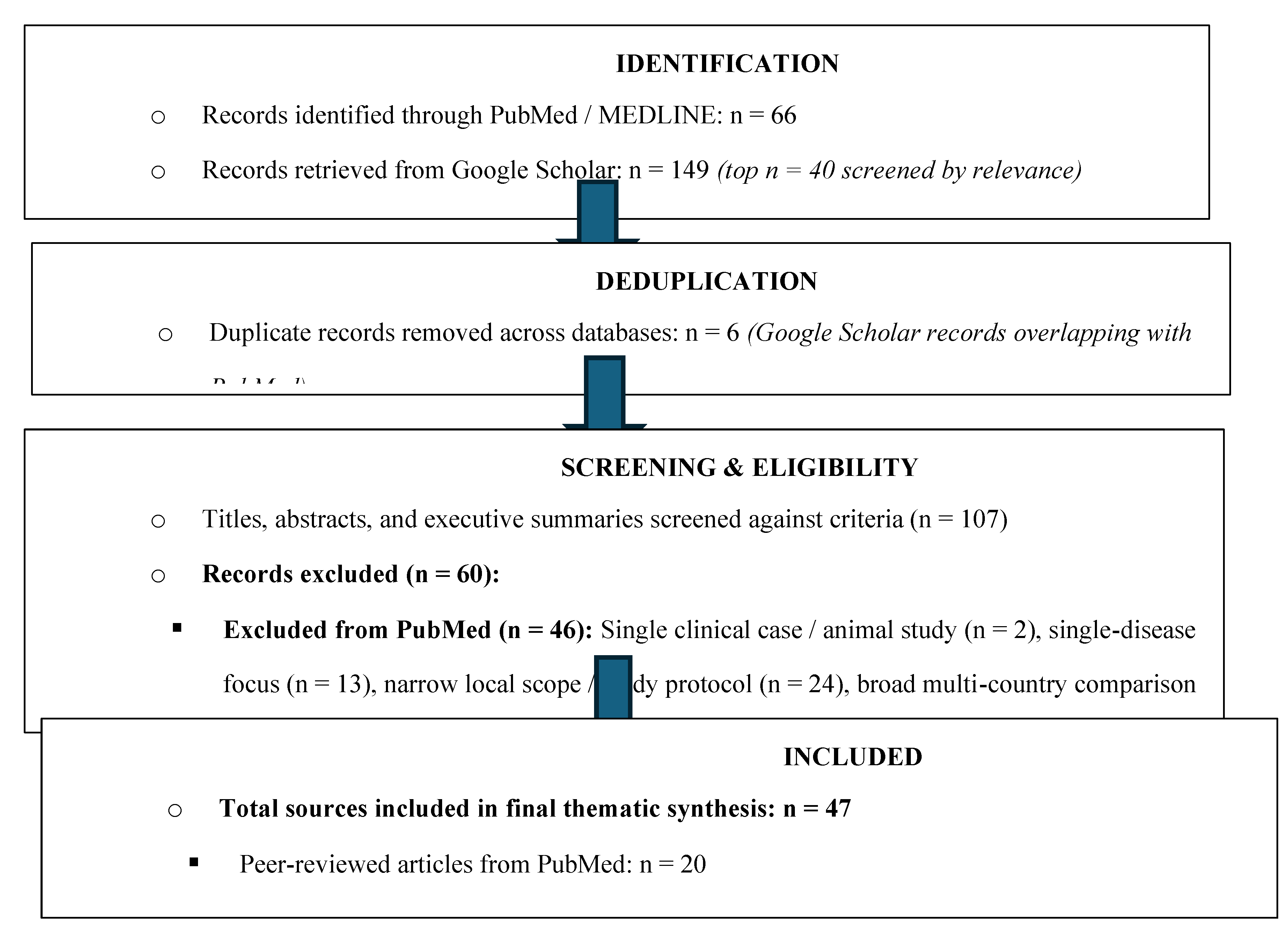

Table 1.
Inclusion and Exclusion Criteria for the Literature Review.
| Criteria Domain | Inclusion Criteria | Exclusion Criteria |
|---|---|---|
| Time Period | • 2010–2026 (Post-devolution era following the 18th Constitutional Amendment; including the foundational 2007 WHO* analytical framework) | • Pre-2010 studies (except the foundational 2007 WHO framework) |
| Publication Type | • Peer-reviewed review and original research articles • Official government health policies and strategic frameworks • Statistical datasets and technical reports from international agencies (WHO, World Bank) |
• Clinical case reports, animal experiments, and study protocols • Postgraduate theses and institutional working papers • Non-peer-reviewed preprints |
| Scope and Focus | • National or provincial healthcare structure, governance, financing, workforce, medicine supply, and health information systems • UHC, Sehat Sahulat, and vertical public health programs (EPI, LHW, etc.) |
• Narrow clinical studies focusing on the treatment of a single disease • Single-hospital or single-district surveys lacking national policy implications • Broad multi-country comparative studies lacking in-depth policy analysis specific to Pakistan • Studies focusing primarily on healthcare systems outside Pakistan |
| Language and Accessibility | • Full-text publications written in English | • Publications in languages other than English or without full-text access |
*Note: The 2007 WHO report was included solely as the foundational analytical framework for categorizing the findings, rather than as post-devolution empirical evidence.
Table 2.
Summary of the Literature Search and Screening Process.
| Search and Screening Stage | PubMed / MEDLINE | Google Scholar (Top 40 Screened)* | Grey Literature (Official Reports) | Total |
|---|---|---|---|---|
| Records Identified for Screening | 66 | 40 | 7 | 113 |
| Duplicate Records Removed | 0 | -6 | 0 | -6 |
| Records Excluded Based on Criteria | -46 | -14 | 0 | -60 |
| Final Sources Included in Synthesis | 20 | 20 | 7 | 47 |
*Note: Out of 149 initial results retrieved from Google Scholar, the top 40 most relevant records were screened for eligibility.
Table 3.
Comparative Structure of Pakistan’s Three-Tiered Public Healthcare Delivery System.
| Healthcare Tier | Facility Type | Administrative Level | Catchment Population | Bed Capacity | Core Functions & Services |
|---|---|---|---|---|---|
| Primary Care | Basic Health Units (BHUs; n = 5,746) | Union Council (Village/Neighborhood) | ~25,000 | Outpatient (0–2 observation beds) | Maternal and child health (MCH), routine immunization (EPI), basic curative care, supervision of LHWs, and referrals |
| Primary Care | Rural Health Centers (RHCs) | Rural Sub-District | Up to 100,000 | 10–20 beds | Promotive, preventive, curative, and basic diagnostic services (lab/X-ray), limited inpatient care, and referral support for BHUs |
| Secondary Care | Tehsil Headquarters (THQ) Hospitals | Tehsil (Sub-District) | 500,000 – 1,000,000 | 40–60 beds | Specialist consultations, Emergency Obstetric and Newborn Care (EmONC), diagnostics, and inpatient care |
| Secondary Care | District Headquarters (DHQ) Hospitals | District | 1,000,000 – 3,000,000 | 100–250+ beds | Multi-specialty inpatient and outpatient care, advanced diagnostics, surgical services, and tertiary referrals |
| Tertiary Care | Teaching & University Hospitals | Provincial / Major Urban Centers | Provincial / National | 500–2,000+ beds | Subspecialty clinical care, complex medical and surgical referrals, advanced diagnostics, and medical education |
Table 4.
Comprehensive Characteristics of All Included Studies and Official Reports (n = 47).
| # | Author(s) & Year / Institution | Source / Study Type | Primary Focus Area | Key Findings & Health System Implications |
|---|---|---|---|---|
| 1 | Shaikh (2026) | Policy Review (Ann Glob Health) | UHC Reforms & SDG 2030 | Evaluates Pakistan's UHC trajectory, identifying governance and financing reforms needed by 2030. |
| 2 | Khan et al. (2023) | Narrative Review (Cureus) | Systemic Challenges & Sehat Sahulat | Reviews core system weaknesses alongside the rollout of Pakistan's first nationwide health insurance scheme. |
| 3 | Zaidi et al. (2019) | Health Policy Analysis (BMJ Glob Health) | Post-Devolution Governance | Evaluates post-18th Amendment decentralization, highlighting provincial autonomy alongside capacity gaps. |
| 4 | Sarfraz & Ahmad (2022) | Policy Interview (BMJ Lead) | Devolution & Leadership | Discusses institutional bottlenecks and coordination challenges between federal and provincial health bodies. |
| 5 | Government of Pakistan (2010) | Constitutional Legislation | Legal Framework of Devolution | Enacts the 18th Constitutional Amendment, transferring health service delivery authority to provinces. |
| 6 | NHSRC (2016) | National Policy Document | Universal Health Coverage (UHC) | Sets the 2016–2025 strategic roadmap for achieving UHC and strengthening federal-provincial coordination. |
| 7 | World Bank (2025) | Statistical Dataset (WDI) | Demographic & Mortality Indicators | Documents Pakistan's 1.6% population growth rate, 68-year life expectancy, MMR of 155, and IMR of 48.2. |
| 8 | WHO GHED (2025) | Statistical Database (GHED) | Health Financing & Expenditures | Reports total health expenditure at 2.52% of GDP and public health spending at only 0.9% of GDP. |
| 9 | WHO (2007)* | Conceptual Framework Report | Health System Governance & Structure | Establishes the six WHO Health System Building Blocks used to evaluate health system performance. |
| 10 | Ali et al. (2021) | Narrative Review (Adv Res) | Historical Legacy & System Structure | Examines the post-1947 colonial healthcare inheritance and the rapid expansion of the private sector. |
| 11 | Malik et al. (2017) | Expenditure Tracking (Health Policy Plan) | Reproductive & Child Health Policy | Tracks RMNCH financing since the 2001 policy, revealing persistent inequities across socio-economic groups. |
| 12 | Yang et al. (2024) | Quantitative Equity Study (Int J Equity Health) | UHC Progress & Regional Gaps | Measures national and provincial UHC service coverage, revealing stark urban-rural disparities. |
| 13 | Ministry of Finance (2026) | Government Economic Survey | Healthcare Infrastructure & Budget | Details national public healthcare facility counts (5,746 BHUs, 1,934 hospitals), registered workforce numbers, and annual budget allocations. |
| 14 | Ahmed et al. (2024) | System Review (Prim Health Care Res Dev) | Primary Healthcare (PHC) Delivery | Identifies resource deficits in BHUs and RHCs that drive patients to bypass primary care for tertiary hospitals. |
| 15 | Tahir et al. (2024) | Situation Analysis (East Mediterr Health J) | Primary Healthcare Quality | Evaluates service readiness and clinical quality gaps across primary healthcare facilities in Pakistan. |
| 16 | Ansari et al. (2015) | System Assessment (Open J Prev Med) | General Practice & Primary Care | Assesses the structural challenges facing general practice and family medicine in Pakistan, highlighting the need for formal postgraduate training and primary care integration. |
| 17 | Khalid & Ali (2020) | Bioethics & System Review (Asian Bioeth Rev) | Pandemic Preparedness (COVID-19) | Exposes how chronic underfunding and workforce shortages strained system capacity during COVID-19. |
| 18 | Riaz et al. (2022) | Perspective Review (Ann Med Surg) | Climate Change & Health System | Examines the devastating impact of extreme weather events and floods on Pakistan's health infrastructure. |
| 19 | Akhtar et al. (2026) | Health Security Analysis (Ann Glob Health) | Climate Resilience | Proposes structural adaptation strategies to protect primary healthcare facilities from climate shocks. |
| 20 | Nawaz et al. (2026) | Quantitative Workforce Study (BMC Public Health) | Health Workforce & MCH Outcomes | Demonstrates that maldistribution of doctors and nurses directly worsens maternal and child health outcomes. |
| 21 | Ashiqali & Ullah (2024) | Policy Review (i-Manager's J Nurs) | Nursing Workforce & Regulation | Highlights the role of nursing leadership and regulatory bodies (PNMC) in shaping uniform health policies. |
| 22 | Waraich (2018) | Legal & Policy Analysis (Policy Perspect) | Medical Malpractice & Legal Oversight | Analyzes fragmented legal frameworks governing medical negligence, consumer courts, and regulatory accountability in Pakistan's mixed healthcare system. |
| 23 | Malik et al. (2021) | Health Informatics Study (PLoS One) | Health Information Systems (HIS) | Highlights the urgent need to adopt interoperable digital health technologies across care tiers. |
| 24 | Haq et al. (2017) | Qualitative Policy Study (Health Policy Plan) | Evidence-Informed Policy Making | Examines institutional barriers to translating public health research into national and provincial policies. |
| 25 | Muhjazi et al. (2024) | Health Systems Study (East Mediterr Health J) | Private Sector & Immunization | Analyzes private sector engagement in communicable disease control and the EPI, highlighting regulatory and reporting integration gaps. |
| 26 | NHSRC (2022) | National Strategy Framework | Health Information Systems | Outlines the 2022–2030 digital health architecture to address data fragmentation across care tiers. |
| 27 | Zaidi et al. (2013) | Health Systems Research (PLoS One) | Access to Essential Medicines | Identifies regulatory fragmentation, pricing issues, and supply bottlenecks in the pharmaceutical sector. |
| 28 | Omer et al. (2021) | Cross-Sectional Survey (BMJ Open) | Drug Shortages & Patient Care | Documents frequent essential medicine stockouts in public hospitals and their negative impact on care quality. |
| 29 | Khan et al. (2025) | Health Financing Review (J Health Organ Manag) | Comprehensive Financing Strategy | Calls for pooling fragmented health funds and increasing fiscal space to achieve sustainable UHC. |
| 30 | Malik et al. (2021) | Empirical Expenditure Study (East Mediterr Health J) | Out-of-Pocket (OOP) Spending | Demonstrates spatiotemporal disparities and catastrophic financial hardships caused by high OOP payments. |
| 31 | Mustafa (2021) | Critical Policy Review (J Sheikh Zayed Med Coll) | Social Health Insurance Limits | Critiques Sehat Sahulat for covering only inpatient care while leaving outpatient and drug costs uncovered. |
| 32 | Khan et al. (2023) | Public Finance Study (Int J Health Plann Manage) | Public Financial Management | Identifies rigid budget execution rules that delay fund disbursement to frontline health facilities. |
| 33 | Khan et al. (2025) | Policy Analysis (Pak J Health Sol) | Implementation Challenges | Traces historical health policy reforms (1990–2025) and diagnoses persistent implementation gaps. |
| 34 | Khalid et al. (2024) | Global Health Policy (Health Policy Plan) | External Assistance & SDG3 GAP | Evaluates coordination challenges among international donors supporting Pakistan's UHC agenda. |
| 35 | Zaidi et al. (2026) | Health Planning Study (Int J Health Plann Manage) | Global Health Initiatives & UHC | Examines alignment between vertical donor-funded programs and domestic primary healthcare systems. |
| 36 | Khan et al. (2018) | Comparative Policy Study (Health Policy Plan) | Donor Influence on Policy | Investigates how external funding agencies shape priority setting and policy formulation in Pakistan. |
| 37 | Ather & Sherin (2014) | System Review (Khyber Med Univ J) | Health Financing Resources | Reviews domestic revenue generation constraints and inefficiencies in public health resource utilization. |
| 38 | Jooma & Sabatinelli (2014) | Policy Perspective (Pak J Med Sci) | Political Determinants of Health | Analyzes how political instability and low prioritization hinder sustained public health investment. |
| 39 | Shaikh et al. (2013) | Critical Appraisal (World Health Popul) | Resource Allocation | Critiques hospital-centric budget allocations that neglect preventive medicine and primary care. |
| 40 | Mazhar & Shaikh (2012) | Policy Commentary (Healthc Policy) | Maternal & Child Health (MCH) | Analyzes post-devolution structural reforms required to reduce high maternal and neonatal mortality rates. |
| 41 | Hirose et al. (2015) | Implementation Synthesis (Health Res Policy Syst) | Maternal & Newborn Health | Demonstrates how bridging research and policy advocacy strengthens provincial MNCH service delivery. |
| 42 | Tunio et al. (2021) | Narrative Review (J Peoples Univ Med Health Sci) | Payment & Financing Mechanisms | Evaluates provider payment models and recommends shifting away from fee-for-service OOP structures. |
| 43 | Jehan (2024) | Policy Analysis (Kashmir Res Rev J) | Primary Care Financing | Highlights the disconnect between national primary care financing policies and grassroots budget execution. |
| 44 | Mirza & Munir (2023) | Political Economy Study (BMJ Glob Health) | Health Taxes Regime | Explores institutional conflicts hindering the implementation of tobacco and sugary drink taxes for health revenue. |
| 45 | Kazemikhasragh & Buoni Pineda (2023) | Economic Policy Analysis (Int J Health Gov) | Taxation & Health Financing | Compares direct versus indirect taxation mechanisms for equitably financing UHC in Pakistan. |
| 46 | Nishtar et al. (2011) | WHO Draft Background Paper (Heartfile) | Health Equity & Financial Protection | Proposes innovative digital and social protection mechanisms to prevent medical impoverishment. |
| 47 | Soomro et al. (2026) | Health Economics Study (Adv Soc Sci Arch J) | Climate Shocks & Financial Risk | Analyzes risk pricing, data poverty, and household financial vulnerability during climate-induced disasters. |
*Included solely as the foundational analytical framework (seeTable 1).
Disclaimer/Publisher’s Note: The statements, opinions and data contained in all publications are solely those of the individual author(s) and contributor(s) and not of MDPI and/or the editor(s). MDPI and/or the editor(s) disclaim responsibility for any injury to people or property resulting from any ideas, methods, instructions or products referred to in the content. |
© 2026 by the authors. Licensee MDPI, Basel, Switzerland. This article is an open access article distributed under the terms and conditions of the Creative Commons Attribution (CC BY) license (http://creativecommons.org/licenses/by/4.0/).
Copyright: This open access article is published under a Creative Commons CC BY 4.0 license, which permit the free download, distribution, and reuse, provided that the author and preprint are cited in any reuse.