

Submitted:
21 November 2026
Posted:
24 November 2026
You are already at the latest version
Abstract
Speculative inference uses predictions to prepare computation before it is needed, then verifies which results can be retained. As contexts grow and agents take more steps, repeated history processing and tool waits make reducing task latency an increasingly important objective. This review develops a connected account from exact token sampling to long-context decoding and agent execution. We organize drafting and verification around information sources, candidate dependencies, selection procedures, and training objectives. We then examine how sparse contexts, shared caches, and bounded draft representations reduce repeated historical processing, and how retrieval and trajectory-aware adaptation exploit evolving interactions. At the agent level, call generation, action execution, observation prediction, and trajectory verification expose different opportunities to shorten the task critical path. Controlled comparisons and negative results explain how proposal quality, runtime behavior, and workload composition determine the realized gain. The analysis motivates joint context and candidate selection, learning from deployment feedback, adaptation over the deployment lifetime, dependency-aware reuse, and scheduling across model and tool execution. It also identifies a broader opportunity to reinvest saved computation in additional checking and exploration. This perspective connects faster generation to sustained efficiency and better task outcomes within finite time and compute budgets.
Keywords:
speculative decoding
; long-context inference
; long-horizon agents
; context reuse
; speculative execution
1. Introduction
Long-horizon agents turn inference latency into a recurring cost of completing useful work. A software repair can require repeated cycles of reading, editing, testing, and diagnosis, with each cycle waiting on decisions made in the preceding one. Faster generation can reduce these waits and leave time for another test or repair attempt. Speculative inference is particularly relevant to this setting because much of the computation prepares a continuation whose usefulness can be checked more cheaply than it can be produced sequentially.
From Token Latency to Task Latency
Autoregressive generation repeatedly applies an expensive model to produce a small amount of new information, making sequential latency a central constraint on its use. Speculative decoding proposes several tokens cheaply and confirms them together, reducing the sequential cost of generation. With an appropriate acceptance and correction rule, the final sequence follows the target distribution even when the drafter is imperfect [1,2]. This makes speculation an attractive way to retain a capable model while changing how its computation is executed. The central design problem is to make useful predictions at a cost lower than the work they save.
Long contexts bring the cost of predictive information to the foreground. Historical keys and values can dominate draft storage and access even when the draft has few parameters. Verification can amortize repeated history reads across candidate positions, while sparse or shared draft state can reduce duplicated processing. TriForce, MagicDec, and LongSpec pursue different forms of this opportunity [3,4,5]. Their designs make clear why context handling is central to speculative inference. A draft needs enough history to predict well, but retrieving and maintaining that history can consume the very savings it seeks to create.
Long-horizon agents accumulate these latency costs across decisions made on changing state. A software agent may read code, produce an edit, wait for a test, and revise its next action many times before completing a task. Repeated content offers cheap draft material, while new observations change which predictions are useful. As model calls become faster, waiting for tools can become the dominant delay. Trajectory-aware decoding and speculative actions address these opportunities at different levels [6,7,8,9]. A long interaction can involve either growing histories or many short calls, so context length and execution horizon describe complementary dimensions of the workload.
Coupled Design Problems
The opportunities above share three constraints. Predictive information must be affordable to obtain. A drafter that reads the entire history may reproduce the memory traffic it is intended to save, while a restricted view can omit the dependency that determines the next token. Sparse contexts, target-derived features, and retrieved continuations offer different ways to manage this tension. Their value depends on the information delivered per unit of draft cost.
Useful predictions must also survive verification and state changes. Adding candidates can improve coverage while increasing the target computation required to select a continuation. Predicting a tool call early can hide execution latency, but reusing its result additionally requires agreement on the relevant environment state. These distinctions make the verification boundary central to both algorithm design and implementation.
Finally, saved work must lie on the task critical path. Accepted length alone does not capture draft overhead, cache maintenance, or interference with other requests. A correctly anticipated action may save little if another dependency still determines when execution can continue. Work on shared serving and action-observation speculation makes these costs explicit [9,10,11]. Reading prediction quality together with complete execution time is therefore essential to understanding where speculation helps.
These developments motivate a view of speculative inference centered on task completion time and the interaction of predictive information, verification, and execution cost. Candidate structure determines what verification can recover from a draft. Context representation determines what the draft can know. Training determines which states it predicts well, and scheduling determines whether the resulting work shortens the task. Studying these choices together is particularly useful for agents, where one improvement can shift the bottleneck from history access to decoding or from decoding to external execution.
Perspective and Organization
Existing speculative-decoding surveys provide broad accounts of proposal generation, verification, and system design [12,13,14]. Building on that foundation, this review connects long-context decoding to evolving histories and long-horizon execution. We explain how mechanisms at these levels use and retain predictive information, how they confirm useful work, and how their costs interact. This focus brings token-level algorithms and agent execution into a common analysis while preserving the different conditions under which their results can be used.
Figure 1 summarizes this progression from exact token sampling to speculation across long agent interactions. Figure 2 places representative methods and evaluation studies along a publication timeline, showing how context handling, agent execution, and empirical assessment have become increasingly prominent in the selected work.
Saved time can fund another candidate, a targeted check, or a repair attempt. Speculative decoding for test-time scaling connects acceleration to additional reasoning [15]. Extending this connection to agents requires allocating the saved budget to decisions that improve the completed task.
Section 2 and Section 3 establish the foundations and algorithmic choices. Section 4 through Section 6 follow the progression from long contexts to cross-turn adaptation and agent execution. Scheduling and empirical evidence are examined in Section 7 and Section 8. Section 9 then develops research directions aimed at sustained acceleration and better task outcomes under finite time and compute budgets.
Figure 3 maps representative studies onto this progression, connecting the foundations of speculative decoding to the context, adaptation, and execution mechanisms that shape its value for long-horizon agents.
2. Foundations of Speculative Inference
Speculative inference uses predictions to reduce the expensive sequential work needed to reach a confirmed result. In language generation, a draft continuation lets the target check several positions in one pass. In an agent, a predicted invocation or observation can expose work that would otherwise wait for a previous decision. These mechanisms share a useful asymmetry. Prediction can be cheap and imperfect when confirmation efficiently identifies the work worth retaining. Making that asymmetry precise explains both the appeal of speculation and the conditions for acceleration.
2.1. Exact sampling
Let h denote the committed token history, including the input, and let be the target distribution after the specified sampling transformations. A drafter proposes . Standard speculative sampling accepts this proposal with probability
If it is rejected, the replacement is sampled from the normalized positive residual
The residual is needed only when rejection has nonzero probability. Accepted proposals contribute probability mass , and replacements contribute the remaining mass. Their sum is . This is the essential reason an imperfect draft can accelerate sampling without changing its target distribution [1,2].
The target evaluates several proposed positions in one causal forward pass. Although this pass computes distributions at all draft prefixes, only the distributions on an accepted prefix can be used directly. After a rejection, later predictions were conditioned on a history that is no longer authoritative. Standard linear speculation therefore discards that suffix, samples the correction, and starts a new round. When every proposal is accepted, an additional target token can be sampled from the final distribution, subject to termination and output limits.
Exactness refers to a specified reference computation. Changing temperature, truncation, target context, numerical precision, or the target itself can change that reference. Equality in distribution also does not require identical text under the same random seed, since the two algorithms consume randomness differently. Greedy verification has a different contract. It accepts a candidate only while it agrees with the target argmax along the same path, with a consistent rule for ties. Blockwise parallel decoding already illustrates the distinction between exact greedy agreement and relaxed acceptance [64].
2.2. Prefix survival and candidate coverage
For a linear draft of length K, let A be the number of accepted draft tokens before the first rejection. The tail probability identity gives
where is the acceptance probability at position j conditional on all earlier proposals surviving, under the stated distribution of rounds. No independence assumption is needed for these conditional probabilities. Replacing them by a single mean acceptance rate is an additional approximation. It can conceal the difference between correcting an early bottleneck and improving predictions that are rarely reached.
At a fixed history, the mean acceptance probability of Equation 1 is . This connects draft quality to distributional overlap, while Equation 3 explains where an improvement has the greatest effect. Improving an early prediction benefits every continuation that passes through it. Improving a rarely reached position contributes much less. Training for useful accepted prefixes therefore requires attention to both prediction accuracy and the positions at which that accuracy is gained.
Multiple candidates provide alternative paths after an early prediction is wrong. Their value depends on how the candidates are generated, which target probabilities are available, and how probability mass is assigned during selection. SpecTr formulates candidate selection through optimal transport, while theoretical work on multi-draft sampling characterizes limits under a specified proposal setting [16,65]. Block Verification demonstrates that joint confirmation can improve expected progress beyond a particular tokenwise rule [66]. Each construction couples its acceptance procedure to the available proposals. For candidate trees, preserving the target distribution likewise requires a sampling rule consistent with the proposal and traversal procedure.
2.3. The cost of verified progress
Let M be the number of newly committed output tokens in a round, including any correction or bonus token. For a stationary operating regime with well-defined average round costs, the long-run time per committed token can be expressed as
State cost includes candidate construction and cache maintenance. Synchronization includes work that delays progress between components. The terms must be measured without double counting. In an asynchronous system, their sum must be replaced by the elapsed critical path because overlapping operations are not additive. A favorable proposal is one that lowers this cost relative to autoregressive execution under matched conditions. Longer accepted prefixes alone do not establish that result [61,63].
Input length, output length, interaction horizon, and speculative depth are separate variables. A long document followed by a short answer emphasizes initialization and historical attention. A long answer repeatedly grows the decoding state. An agent can perform many short calls while maintaining only a bounded visible history. Speculative depth controls how much uncertain work is attempted before confirmation. Their effects meet in Equation 4, but none can substitute for the others.
Table 1 connects the predicted object to the confirmation it requires. Token sampling is governed by probabilities, tool execution by arguments and state dependencies, and semantic verification by the class of acceptable outcomes. This organization supports a broader design space for speculation while keeping the meaning of successful verification explicit.
3. Drafting and Verification
The central algorithmic problem is to give a limited verification budget enough useful candidates to make rapid progress. Four choices shape the solution. The draft needs predictive information, its candidates need to represent dependencies, verification needs an efficient selection rule, and training needs to reward proposals that can actually be used. Table 2 summarizes the information sources and their costs. These choices can be combined, allowing a lightweight head, retrieved text, and a candidate tree to contribute to the same decoding system.
3.1. Draft Information Sources
An independent draft model supplies its own representation of the context. This creates a clear interface to the target, but duplicates weights and often duplicates historical state. DistillSpec improves the fit between draft and target through distillation, including choices of training data and divergence suited to the task [17]. Online Speculative Decoding uses deployment requests and target feedback to update the drafter [42]. These approaches make draft quality adaptable, while adding training and maintenance costs that must be amortized over future requests.
Self-speculation obtains a cheaper proposal by reducing the computation of the target architecture. Draft & Verify skips layers during drafting and uses the full model for confirmation [67]. LayerSkip trains models to support early exits and shares computation between shallow drafting and deeper verification [18]. Its reference is the full model after this training procedure. Sharing parameters and intermediate states reduces duplication, making self-speculation attractive when an additional draft model would impose a substantial memory cost.
Feature-based drafting reuses target representations that have already been computed. EAGLE combines feature prediction with token information to address uncertainty in extrapolated hidden states [68]. HASS aligns the representations encountered during multistep drafting, and EAGLE-3 uses features from multiple target layers together with training-time simulation of inference [19,69]. These methods exploit a richer signal than token history alone. Their interface also couples the draft to the target architecture and to the states available during serving.
3.2. Parallelism and conditional dependence
Predicting several positions at once removes serial draft latency but makes dependency modeling more difficult. Medusa adds multiple future-token heads and assembles their predictions into candidate trees [20]. Multi-token prediction changes the training objective of a shared backbone, whereas ParallelSpec explicitly trains a parallel draft model [70,71]. Parallel prediction determines how candidates are produced; the acceptance rule determines their output guarantee. Medusa variants illustrate this flexibility through different choices of base-model training and candidate acceptance.
Recurrent drafting preserves dependencies through a small recurrent component, while P-EAGLE parallelizes feature-based drafting [21,72]. DFlash uses a block diffusion drafter whose candidates are still checked by an autoregressive target [22]. It therefore differs from replacing autoregressive generation with a diffusion target. DSpark introduces confidence-scheduled semi-autoregressive generation to balance parallel prediction with dependency correction [73].
The central difficulty is that a correct prediction at a later position may become unusable when an earlier candidate is rejected. A parallel model can have good marginal predictions without producing a likely joint continuation. Conditioning lightweight corrections on candidate parents offers one response. Parent-Conditioned Drafting and DARTree extend existing parallel or semi-autoregressive proposals into trees, while DForkTree addresses conditioning away from the main draft path [74,75,76]. These methods expose a design choice between spending computation on better joint proposals and retaining more alternatives for target verification.
3.3. Candidate Trees and Verification
Tree verification shares the committed prefix while applying a mask that restricts each candidate to its ancestors. SpecInfer establishes this organization as a serving mechanism, EAGLE-2 adapts tree structure to the current context, and OPT-Tree allocates a node budget to increase expected accepted length [23,24,77]. Sequoia additionally connects tree size and sampling to hardware costs [25]. A deeper tree offers a longer possible continuation; a wider tree protects against early ambiguity. Both consume target computation, and only one committed continuation usually survives.
Hardware efficiency depends on how shared history and branch states are accessed. DeFT reduces tree-attention data movement through shared-prefix organization and work partitioning [78]. Traversal Verification instead changes how candidate sequences are examined and accepted [79]. The former lowers the cost of checking a tree, while the latter seeks more progress from the candidates already checked. Their combination motivates verification design that accounts for both sampling efficiency and the execution cost of the chosen traversal.
For parallel drafts, branch scores must also account for the gap between position marginals and path probabilities. TAPS develops target-aware prefix-tree selection, while Bastion combines an acceptance surrogate with a hardware cost estimate to control tree expansion [80,81]. Their shared lesson is that node count is an incomplete budget. The useful quantity is the expected extra committed progress obtained for the additional verification cost. The best tree can therefore change with context length, active batch, and the target kernel.
3.4. Training for Verification
Draft training increasingly targets the opportunities created by verification. Group Tree Optimization trains against tree-level proposal utility [26]. Acceptance-aware training develops objectives suited to greedy and stochastic decoding [82]. Work on expected decoding rounds accounts for future state occupancy, while DScout separates the positions receiving supervision, their weights, and the prediction loss [83,84]. Together, these approaches extend optimization from local token fit to prefix survival, candidate coverage, and progress over successive decoding rounds.
TreeSpark advances this line of work by aligning draft training with the candidate trees used during verification [27]. Its deployment-aware supervision emphasizes continuations that can contribute under a limited verification budget. The close integration of candidate selection and learning is a valuable contribution, offering a useful route to more effective parallel drafting.
Training for the deployed candidate structure opens a broader question about what the draft will encounter. Long histories change the information and computation available to it, while agent trajectories change the kinds of decisions it must predict. These two sources of variation motivate the context and adaptation mechanisms considered next.
4. Long-Context Speculative Decoding
Long contexts make access to predictive information a major part of the decoding cost. A small draft can repeatedly read a large history, duplicating work already performed by the target. Restricting that access saves computation but can hide the distant fact needed for the next continuation. This tension makes long-context speculation a problem of information allocation as well as model compression. A successful design delivers the history needed for useful proposals at a cost that several accepted tokens can repay.
Figure 4 separates the information supplied to the drafter from the computation used for verification, connecting these design choices to history growth and the serving bottleneck.
4.1. Context Storage and Verification Cost
For a dense transformer with L cached tokens, layers, key-value heads, head width , and b bytes per element, the key-value storage of one sequence is approximately
This expression accounts for the cached tensors; allocation overhead, temporary tensors, and branch states add further storage. A separate autoregressive drafter inherits this linear dependence on history length even when its parameter count is small. Sharing or bounding historical state can therefore matter as much as reducing draft weights.
Verification processes several candidate positions against a common committed prefix. Efficient attention can reuse historical keys and values across those positions, amortizing access that autoregressive decoding would repeat. Yet the target must still evaluate candidate queries, projections, and feed-forward operations. A larger tree also adds branch states and irregular masking. Whether verification is cheaper than the sequential work it replaces depends on the balance of memory traffic and computation at the chosen context and batch size.
MagicDec connects sparse draft state to the hardware regimes of long-context serving [4]. When historical key-value traffic dominates, checking several positions together can amortize repeated reads. When the target is compute constrained, the same additional positions compete with useful work from other requests. This dependence on the active bottleneck explains why context length and batch size jointly influence the value of speculation.
4.2. Sparse Draft Contexts
TriForce uses hierarchical speculation in which an intermediate draft accesses a retrieved sparse cache while the final target retains authoritative verification [3]. This separates the context used to propose from the context used to confirm. The hierarchy can make a relatively capable intermediate model affordable, but its benefit depends on the cost of every level, including retrieval and intermediate verification.
LongSpec maintains a bounded local self-attention state for the drafter and accesses the target cache through cross-attention [5]. Sharing historical storage avoids another full cache. Positional training helps the draft operate beyond common training lengths, while hybrid attention combines efficient shared-prefix computation with flexible tree masking. The resulting architecture bounds additional draft storage while retaining access to the full target history, whose reading cost still grows with context length.
SpecExtend uses target-attention guidance to retrieve draft context, while Vegas feeds information from full verification into the next sparse drafting step [28,85]. Their designs exploit an asymmetry. The target has already performed expensive computation that can inform subsequent proposals. Reusing this signal can reduce separate selection work, provided the selected context remains useful as generation proceeds. RIFT studies the resulting staleness through refreshing selected draft state and training for compressibility, while BudgetDraft trains across multiple cache budgets [29,86]. Cache selection is consequently a temporal decision as well as a spatial one.
4.3. Bounded Draft State
LongSpark extracts fixed-size views from target verification, combining a boundary state, recent context, and a global summary to drive parallel drafting [30]. DLite similarly obtains contextual information from target hidden states while avoiding a separate historical draft cache [31]. These interfaces let the target supply expensive context processing while the draft operates on a compact representation. They concentrate the design problem on how much predictive information that representation preserves for future positions.
Windowed-MTP restricts the history used by an internal multi-token prediction component and reclaims draft cache entries outside the retained window [87]. Work on extending short-context drafters instead combines bounded caches with positional rebasing [88]. These approaches show that the context capacity needed for independent generation need not equal the capacity needed to propose locally plausible continuations for a stronger verifier. However, their success is conditional on the information delivered through retained tokens or target features.
Position and content selection address different sources of draft error. FOLD preserves local order while representing distant history through a separate positional treatment [89]. SharpDraft studies query scaling as the number of visible keys grows, and DeLS-Spec separates long-context information from local draft correction [90,91]. OWL uses a recurrent draft informed by the latest target representation [92]. These approaches seek to preserve sensitivity to decisive distant information through better positional treatment, contextual features, or recurrent state. Their effectiveness depends on both the information retained and the ability of the draft to use it.
4.4. Approximate Verification
Quantizing only draft state reduces storage while leaving the target distribution intact, with gains determined by proposal quality and conversion overhead [93]. QuantSpec combines quantized drafting with a hierarchical cache representation and also evaluates a quantized target cache [94]. In that setting, the reference computation includes the chosen target precision. Perplexity comparisons with a higher-precision baseline assess the quality retained by this additional approximation.
SpecPV performs partial verification with periodic full checks, SpecAttn predicts sparse target attention, and Dustin uses draft and historical target signals to reduce verification work [32,33,34]. Other work sparsifies several components of the verification computation [95]. These methods address the target-side bottleneck left after draft optimization. Their operating point is a quality-cost tradeoff whenever tokens are committed using approximate target probabilities. Periodic full checks help control subsequent verification, while the treatment of previously committed tokens determines the scope of recovery.
The same distinction applies before decoding. Speculative Prefill uses a lightweight model to select input information for target prefilling [35]. Its target sees a changed input computation, so the resulting benefit is a quality-efficiency tradeoff rather than a direct consequence of exact speculative sampling. RAPID uses shortened retrieved contexts for drafting and also offers knowledge transfer into the target distribution [96]. The retrieval-based proposal and the distribution-changing transfer are separate components and should be interpreted separately.
Table 3 organizes these reductions by where they act. The resulting comparison identifies the state stored, the history read, the frequency of refresh, and the target computation used for confirmation. It also exposes opportunities to combine complementary savings, such as bounded draft storage with more efficient full-context verification.
4.5. Long Inputs and Long Outputs
Long input increases prefilling and historical access before many output tokens have been produced. Long output creates a growing state over repeated speculative rounds and gives initialization more opportunities to amortize. TokenSwift addresses this latter regime through cache management and repeated-generation structure [36]. Workloads with long outputs therefore reward sustained draft efficiency, while long-input, short-output workloads place greater weight on initialization and early-round costs.
Positional acceptance trends depend on the draft architecture and the content generated. A diagnostic of long reasoning traces with independent drafts finds that aggregate trends change with task and temperature controls [97]. Feature-based and windowed drafts face additional constraints from their representation and positional treatment. For an agent, these conditions vary between calls as well as within them, making the evolving composition of history central to draft design.
5. Context Reuse and Draft Adaptation
A long interaction accumulates information that can make later predictions cheaper. Previously generated code, retrieved passages, and recurring tool arguments supply reusable continuations. At the same time, each observation or edit can change what the agent needs to produce next. Context reuse exploits this accumulated structure, while draft adaptation learns the changing distribution of decisions. Their combination is especially relevant to repeated model calls over a persistent workspace.
Figure 5 connects retrieval and draft adaptation through the information accumulated during interaction, while distinguishing the validity conditions for proposal text, target state, and tool results.
5.1. State Reuse and Invalidation
Reuse depends on the role of the stored information. A retrieved continuation is a proposal that the target can reject, so an outdated fragment mainly costs candidate budget. Cached target keys and values determine the verification probabilities themselves. Their reuse requires the relevant prefix computation to remain valid. This difference permits flexible retrieval for drafting and more selective reuse of authoritative target state.
At a turn boundary, appending a tool observation may preserve an existing token prefix but change what is useful to predict next. Editing an earlier message or rearranging a prompt can invalidate a much larger part of the target cache. Updating a repository file changes the validity of a tool result even when the conversation tokens remain unchanged. Table 4 summarizes these changes. The state of an agent includes both a visible text prefix and external dependencies that are not encoded by prefix length alone.
5.2. Retrieval-Based Drafting
REST retrieves continuations from an existing text collection, making retrieval itself a source of draft proposals [37]. SuffixDecoding and SAM Decoding exploit suffix structure in prompts, histories, or auxiliary corpora [38,39]. Cacheback uses a compact recency-based cache, while Token Recycling retains predictive token transitions for subsequent candidate construction [40,98]. These methods move part of the drafting effort from model execution to finding and organizing continuations that already exist.
Repetition is particularly valuable when output contains long stretches of existing material. EfficientEdit separates reused code spans from regions requiring new edits [41]. AgSpec extends retrieval across session, workspace, and broader text sources in coding-agent pipelines [7]. Such specialization can make proposals cheap and long, but it also makes performance sensitive to workflow structure. A workload with repeated file contents offers a different opportunity from one that produces mostly new explanations.
Lexical matching is not the only retrieval strategy. DReSD uses contextual similarity, RASD combines retrieved and model-generated trees, and AdaPLD adapts retrieval and reuse to the current continuation [99,100,101]. Semantic retrieval can supply a useful draft even when exact text matching fails. Whether it changes output fidelity depends on the downstream acceptance rule, not on the semantic nature of retrieval alone. Index lookup, candidate fusion, and cache warmup remain part of the cost.
5.3. Trajectory-Aware Adaptation
Training can exploit regularities that extend beyond repeated text. Browsing, editing, and responding to test feedback expose a drafter to different decision states, even at similar context lengths.
TraceSpec connects the analysis of agent trajectories with adaptive draft training [6]. It uses differences across decision states to guide supervision, bringing draft optimization closer to the workloads encountered during agent execution. This link between workload diagnosis and training is a particularly useful contribution, turning trajectory variation into an actionable source of improvement.
State-aware supervision complements DLite, which changes how history is represented, and AgentSpec, which adapts decoding to workflow segments and batch opportunities [31,43]. Representation, supervision, and execution thus offer three concrete ways to tailor speculative decoding to agent workloads.
5.4. Reuse Across Timescales
Three timescales emerge from these methods. Candidate reuse operates across nearby rounds. Retrieval memories persist across turns or tasks. Draft parameters adapt across collections of deployment experience. Longer persistence offers more opportunities to recover the cost of acquiring useful information, while increasing the need to refresh it as workloads change. Online Speculative Decoding supplies one mechanism for maintaining this alignment through deployment feedback [42]. The useful lifetime of an update becomes as important as its immediate acceptance gain.
As decoding becomes faster, tool waits can account for more of an agent’s elapsed time. The same accumulated experience that supports draft reuse may also help predict future actions and observations. Exploiting that opportunity moves speculation from model computation into execution over external state.
6. Speculative Execution for Agents
An agent repeatedly waits for information that determines its next action. Across a long task, model calls, tool execution, and observation processing form a sequence of delays. Speculation can shorten that sequence by predicting call syntax, starting a likely action early, or preparing a continuation for an expected observation. Reducing these repeated waits is especially valuable in long-horizon tasks, where delays accumulate across successive decisions. Table 5 organizes the mechanisms by what they predict and how their results become usable.
Figure 6 locates these mechanisms within the agent execution loop and links each predicted object to the checks required before its results enter committed state.
6.1. Structured Tool-Call Generation
Tool calls contain regular structure around request-dependent values. ToolSpec uses schema-driven and retrieved proposals to exploit this structure, while SchemaFill generates argument slots in parallel before target confirmation [44,45]. The predictable scaffold reduces the amount of difficult generation, but a schema-valid call can still select the wrong tool or arguments. Target verification remains responsible for the proposed text.
OoO-Spec separates semantic proposal order from textual commitment order [46]. A sidecar predicts the function and argument slots concurrently while the target continues decoding. Available proposals join later candidate-construction boundaries without delaying the target for an unfinished hint. The target commits verified tokens in textual order. This allows independent slot predictions to proceed in parallel while preserving the ordinary tool-call interface.
Agent-X combines model-free speculation with improved input and prefix reuse, addressing initialization and decoding within one pipeline [102]. AgentSpec adapts decoding to the workflow and batch structure of agent requests [43]. Both approaches accelerate the model-call portion of agent execution. Predicting and executing the tools themselves offers a further opportunity to reduce waiting time.
6.2. Speculative Actions
Action speculation proposes what the authoritative agent will do next and performs some of the required work in advance. Speculative Actions studies this approach with explicit confirmation, while systems for speculative tool calls and overlapping tool execution with model generation move waiting time off the ordinary agent path [8,103,104]. The opportunity depends on how early a useful call can be identified and how much of its latency can overlap current computation.
SPORK derives speculative probes from the target state, and Speculate with Memory augments prediction with recurring action transitions and episodic information [47,105]. Skim exploits structure in web-agent workloads [106]. These approaches obtain predictive information from different sources. Their effectiveness depends respectively on available model state, repetition across experience, and regularity of the environment. A high aggregate hit rate can still hide poor performance on the few actions that dominate waiting time.
LEAP trains a small draft on canonical actions generated by a frozen target and verifies proposals using target computations on the corresponding prefixes [48]. Learning at the action level gives the draft a unit of prediction aligned with the work that can be executed early. Its target-authorship criterion applies to each committed action under the protocol, while task outcomes and timings describe the resulting full execution. Concurrent execution and numerical behavior can still affect the trajectory through which those actions are reached.
Action equality is only one condition for reusing an executed result. Consider a proposed file read whose path matches the eventual call. If an intervening edit changes that file, the earlier result may no longer correspond to execution from the committed state. For a stateful tool, a useful abstract reuse condition is
where f is a speculative execution, includes the tool and arguments, denotes the dependencies relevant to that execution, and states that its effects have been contained until commitment. The expression summarizes the obligations of result reuse. Implementing it requires a tool-specific account of dependencies, including any relevant hidden state, randomness, or time dependence.
6.3. Observation Prediction and Execution Isolation
Predicting an observation can start the next model call before a slow tool finishes. Its benefit depends on both the prediction probability and the delay hidden if it is right. AOSpec combines action and observation speculation and explicitly prioritizes expected hidden latency [9]. Its observation path retains a continuation when the predicted observation matches the actual bytes. Its action path additionally checks the action and the originating environment state before reusing an isolated execution. These mechanisms address distinct failures of observation-only and action-only prediction.
TomasuLLM explores out-of-order execution in isolated forks with dependency and effect tracking followed by ordered validation and commit [49]. Tracking dependencies can expose overlap beyond the immediately next action and retain unaffected work after a change. The runtime determines which tools support this treatment. Local filesystem effects can be isolated through snapshots, while remote effects require their own containment and commit mechanism.
Sherlock runs downstream work while reliability checks are pending and rolls back when they fail [50]. This makes validation latency itself an opportunity for overlap, with recovery cost determining the benefit. IdleSpec uses waiting periods for speculative planning, while Speculative Interaction Agents explore asynchronous interaction and speculative calls [107,108]. Their provisional reasoning can change later decisions, so task utility and latency describe the value of the resulting policy.
6.4. Trajectory Verification
Speculative Macro Commit extends the proposal unit to groups of actions, while trajectory-level speculation asks a stronger model to review a segment produced by a cheaper agent [51,53]. Segment verification can amortize expensive model calls over several decisions. Semantic acceptance allows multiple action sequences to count as useful progress, giving the cheaper agent more freedom and placing greater responsibility on the verifier to judge the segment as a whole.
Trajectory-level semantic verification executes eligible reads immediately and defers writes until confirmation. This can gather evidence for a segment before deciding which effects to retain. Eligibility depends on the actual tool semantics, since even a remote read can consume a quota or change service state. DualSpec uses task-specific semantic confirmation in deep-research workflows [52]. In both cases, the evaluated task and tool interface define what an acceptable segment means.
Figure 7 relates these opportunities to software engineering, web navigation, and deep research. Repeated code, recurring interfaces, and retrieval delays provide different ways to prepare useful work before it is needed.
Certified Speculative Execution admits proposals through a trusted domain-specific solver or certificate [109]. Feasibility conditions or value bounds can provide precise acceptance criteria for the supported decision problem. This suggests a useful direction for agent speculation in environments where inexpensive formal checks are available alongside costly decision making.
Long-horizon execution magnifies both overlap opportunities and the cost of invalidation. Predicting farther ahead can hide more delay, yet it also creates more dependencies that may fail. B-PASTE offers a preliminary study of resource-aware branch selection [110]. The broader opportunity is to choose how far to speculate according to the latency hidden, the stability of dependencies, and the cost of recovery. This turns agent speculation into a resource allocation problem over the task critical path.
7. Scheduling and Resource Allocation
Scheduling determines whether local speculative gains survive in a shared service. Candidate generation and verification compete with other requests for compute, memory, and execution slots. A budget that accelerates an isolated sequence can delay a loaded server. Adapting speculation to current demand is therefore essential for turning algorithmic gains into sustained throughput and predictable response times.
Figure 8 connects request budgets, device placement, and bottleneck-aware control through runtime feedback, illustrating how overlap can shorten execution under a fixed device budget.
7.1. Budget Allocation Across Requests
BASS studies the interaction between speculative sampling and batched attention, while TETRIS allocates draft tokens across requests rather than treating every request as an independent fixed-budget problem [10,54]. This changes the unit of optimization. A candidate with a high acceptance probability can still be unattractive if including it expands padding, increases the verification batch beyond an efficient kernel regime, or delays a request with a tighter deadline.
For a fixed operating state, write for expected committed progress and for round cost at budget K. Increasing the budget by one improves the local progress-to-cost ratio only when
assuming a positive cost increment. The condition compares the marginal value of a larger budget with the value of the current round at a fixed operating state. In a changing queue, both increments depend on other requests and on discontinuous changes in execution shape. Online budget allocation therefore needs estimates conditioned on the current batch and memory capacity.
TurboSpec uses feedback to control speculation for serving goodput, and AdaServe customizes speculation to request service objectives [11,111]. Goodput counts work meeting a stated latency requirement, so a throughput improvement can coexist with a goodput loss. ForeSpark jointly chooses draft and verification budgets before parallel proposal generation, and SpecSearch explores configurations under workload and hardware constraints [55,112]. These approaches move budget selection from a fixed algorithm parameter to a deployment decision.
7.2. Overlap and Placement
Distributed Speculative Inference uses parallel execution to reduce blocking between draft and target computations [56]. SpecExec exploits large parallel candidate sets in settings where target execution is particularly expensive, including consumer-device configurations [57]. Placement determines which operations can overlap and which transfers become necessary. Reporting the device budget alongside latency makes the resulting exchange between added resources and faster execution explicit.
SwiftSpec separates and overlaps speculative components while managing tree generation, cache consistency, and latency-oriented kernels [58]. Draft work hidden from the critical path still occupies compute and memory, so successful overlap also depends on controlling interference with the target. An agent planning while a tool runs faces the same tradeoff. Waiting periods provide scheduling opportunities whose value depends on spare capacity and the usefulness of the work completed before the wait ends.
SPIRe combines several mechanisms and uses throughput modeling to study their potential [113]. Such analysis helps locate promising operating regimes and identify the overlap needed to reach them. Wall-clock measurements then reveal the cost of state transfer, contention, and synchronization that determines how much of the projected gain is realized.
7.3. Bottleneck Migration and Composition
Reducing draft cost can move the bottleneck to verification. Increasing accepted length can make a larger verification batch compute constrained. Accelerating model generation can expose tool latency, which in turn changes the value of action speculation. Composition is therefore an optimization problem in its own right. The gain from a second mechanism depends on the execution profile created by the first.
A useful composition study starts from one matched baseline and adds mechanisms individually and jointly. For each configuration it records committed progress, complete round time, memory use, and the relevant service objective. If token speculation and action speculation share a device, their interaction also belongs in the comparison. A combined method succeeds when saved critical-path time exceeds added prediction, maintenance, contention, and recovery costs under the same task-quality requirement.
Adaptive control follows naturally from this view. Increasing, shortening, or disabling speculation are all useful actions as the bottleneck changes. A system that makes those decisions reliably can preserve the benefits of speculation across a much wider range of requests than one tuned for a single favorable configuration.
8. Performance and Evaluation
Empirical evidence explains which mechanisms improve predictions, which lower execution cost, and which shorten completed tasks. These levels connect algorithm design to deployment. Accepted length measures usable candidate coverage, round timing captures its computational price, and request or task measurements show the benefit under actual scheduling and interaction. Reading the evidence at each level helps identify where further improvement is most likely to matter.
Figure 9 organizes this evidence from implementation fidelity and candidate benefit to runtime efficiency and completed-task outcomes, relating each level to the conditions needed for a controlled comparison.
8.1. Implementation Fidelity
An exact sampling implementation relies on consistent probabilities, conditioning, and state. Variable accepted lengths across a batch complicate positions, masks, and cache updates. Correctness Forensics for Batch Speculative Decoding identifies failures caused by these synchronization requirements [59]. Cache and mask consistency therefore belong in the experimental account of how an exact algorithm is realized on a serving engine.
For greedy decoding, agreement is assessed under matched model precision, kernel behavior, tie handling, and termination. For stochastic decoding, output statistics complement the algorithmic argument for distribution preservation. Consumer-hardware studies illustrate the practical interaction between numerical behavior and execution overhead [114]. These factors become particularly relevant when verification kernels or target precision change.
8.2. Workload and Runtime Alignment
Spec-Bench and SPEED-Bench organize common tasks and workload regimes for evaluating speculative decoding [61,62]. Shared tasks reduce one source of variation, but do not align schedulers, cache policies, graph capture, or attention kernels. Performance or Illusion examines speculative decoding under production-engine settings and shows why batching and realized verification costs matter [115]. Runtime-Controlled Evaluation further separates common runtime policies from execution paths that are intrinsic to a method [60].
Absolute performance and relative gain answer complementary questions. Tokens per second describes the delivered service, while speedup against a matched baseline isolates the improvement. Input and output lengths, active batch, model artifacts, sampling configuration, hardware, and timing scope explain the operating point. Energy measurements add the resource cost of reaching that performance, including cases where shorter execution uses more power [116].
8.3. Evidence from controlled training
Controlled training comparisons help identify whether a gain comes from the objective, the data allocation, or the deployed candidate policy. Matching draft capacity and inference policy isolates changes to supervision, while a fixed training budget makes different allocation strategies comparable [6,27]. Relating these controls to both accepted length and execution time explains how better predictions translate into practical acceleration.
8.4. Negative Results and Workload Effects
Negative results help locate the source of a missed gain. Target Regeneration Shrinks the Gains finds that target-generated data can account for improvements otherwise attributed to the draft objective [117]. The PEFT block-diffusion study shows how a small trainable parameter count can coexist with an expensive draft forward pass [118]. Controlled acceptance-cost studies reveal how improved predictions interact with the cost of a complete round [63]. These findings redirect effort toward data alignment, executable draft cost, and the verification regime in which better proposals are used.
Workload composition can also reverse an apparent trend. Disparate Impacts reports uneven benefits across tasks, and software-engineering evaluations distinguish generation, editing, and repository-level work [119,120]. Long-reasoning diagnostics and TraceSpec show how position and length interact with task identity, temperature, and trajectory phase [6,97]. Conditioning on these variables helps distinguish missing information and unfamiliar states from expensive draft execution or unfavorable verification shapes. Each diagnosis suggests a different intervention.
8.5. Evaluation Over Complete Tasks
Fixed-prefix replay isolates generation behavior on identical histories. Dynamic execution measures the histories a method actually induces. Real tool execution adds state changes and waiting times that a recorded observation cannot reproduce. These evaluation modes answer complementary questions and should be reported separately.
For an agent, complete-task timing includes tool waits, retries, cancellations, and recovery. Total cost across attempted tasks divided by the number of successful tasks captures resources spent on both successful and unsuccessful execution. Success rate and latency distributions then show whether a favorable average also serves difficult cases. Application studies such as Commerce Agent acceleration additionally illustrate the role of the serving engine in full-pipeline performance [121].
Test-time scaling gives acceleration a further use. Faster sampling can produce more candidates within a time budget and thereby change the final task result [15]. Holding generated work fixed measures execution efficiency; holding latency or cost fixed measures what the saved resources enable. The latter connects speculative inference to the quality of decisions an agent can afford to make.
9. Research Directions
Long contexts and extended agent interactions create a distinctive opportunity for speculative inference. Repeated history provides reusable information, verification supplies feedback, and tool waits create room for useful computation. The challenge is to turn these opportunities into sustained reductions in task latency and cost as histories, decisions, and resource availability change. The directions below connect mechanisms already developed in the literature to questions that emerge when they operate within the same task.
Figure 10 groups the six directions around information and learning, adaptation and reuse, and scheduling and task quality. These connections frame a common objective of sustained efficiency and better outcomes within finite budgets.
9.1. Joint Context and Candidate Selection
Context and candidate budgets compete for the same resources but compensate for different errors. A wider tree helps when several continuations are plausible. Reading a relevant distant passage helps when the draft lacks the information needed to propose any of them. For a coding agent, spending more nodes on alternatives can be less useful than recovering the interface definition that determines the next edit. A controller capable of recognizing these situations could use a small draft much more effectively.
BudgetDraft, LongSpark, and hardware-aware tree selection provide components for such a design [29,30,81]. KVShot adds a useful diagnostic result. Access to target KV information improves some long-range predictions, yet the gains narrow in its larger, matched evaluation and incur additional draft latency [122]. Richer information becomes valuable when the draft can exploit it at an acceptable execution cost.
A promising direction is to select a historical view together with tree depth, width, and verification budget. Target feedback could help estimate whether an early rejection arose from missing context or insufficient candidate coverage. The difficult part is obtaining that diagnosis cheaply. Comparing joint selection with independently tuned context and tree policies would reveal whether the interaction offers gains beyond either component, particularly under changes in task phase and active batch.
9.2. Learning from Deployment Feedback
Candidate selection and trajectory-state coverage determine which predictions receive useful supervision [6,27]. This motivates a training objective concerned with the predictions that can advance deployed computation. A missed first branch, a rarely visited late position, and a difficult tool-dependent call can have very different consequences for elapsed time despite contributing similar token losses.
This suggests weighting supervision by both reachable prefix coverage and the cost of the rounds it can save. Objectives based on expected decoding rounds offer one starting point [83]. Extending them to long-context agents requires accounting for how representation, candidate policy, and state occupancy change together. The central research question is whether a fixed training budget can produce a drafter that remains useful across these changes.
Deployment feedback is also selective. The current tree policy determines which branches receive target evaluation, while the current agent policy determines which histories are encountered. Training only on frequently selected cases may reinforce an already narrow proposal strategy. Occasional verification of alternative branches and replay of underrepresented states could help measure this bias. Their cost and contribution to later accepted progress would determine how much exploration is worthwhile. This offers a concrete way to study the proposed connection between candidate selection and trajectory-aware learning.
9.3. Adaptation Over the Deployment Lifetime
Online adaptation offers a way to recover draft quality after a workload changes. Online Speculative Decoding learns from deployment requests, and OnlineSPEC develops draft updates and ensembles driven by verification feedback [42,123]. Long-horizon agents supply repeated encounters with a workspace, tool interface, or task family, making specialization potentially useful beyond a single call. The opportunity depends on how long the acquired alignment remains relevant.
An update pays for itself when its future savings exceed the cost of training, transferring parameters, and rebuilding any affected state. This creates a finite horizon for adaptation. A short, unfamiliar task may favor retrieval or a generic draft, while a recurring workflow may justify a specialized head. Fast adaptation and retained performance on returning workloads become competing objectives. A useful policy could choose among refreshing retrieval state, routing to an existing draft, and updating parameters according to the expected duration of the shift.
A useful evaluation follows the complete path from a workload change to cumulative benefit. Recovery time, peak memory, training contention, and performance when earlier tasks return all influence that path. A further challenge arises when a controller has disabled speculation, leaving little acceptance feedback from which to detect renewed usefulness. Limited probing may help, but it also consumes serving capacity. Resolving these decisions would make adaptation useful throughout deployment, including the period in which it is still learning.
9.4. Dependency-Aware Reuse
Persistent agents accumulate several kinds of reusable state. Text fragments can remain good proposals after an edit, while a target cache or a tool result may become invalid immediately. AOSpec and TomasuLLM make environment dependencies central to speculative reuse [9,49]. Extending this idea across model and tool state could preserve more useful work through the changes that characterize long tasks.
The opportunity is selective invalidation. If one file changes, a dependency graph could discard the speculative results that read it while retaining independent branches. Target caches would follow token-prefix and position dependencies, and retrieved proposals could remain available with updated relevance scores. These layers need different validity rules but could share mechanisms for recording provenance, tracking versions, and locating affected work.
Precision has a cost. Fine-grained tracking can retain more work but consume enough time and memory to erase the benefit. Coarse tracking is cheaper but may discard large speculative branches after a small change. Tool-specific uncertainty, including nondeterministic or time-sensitive results, adds another dimension. Workloads with edits, context compaction, and interrupted execution would make this tradeoff measurable. Progress here could let agents carry useful speculation across task boundaries instead of rebuilding it after every state change.
9.5. Scheduling Along the Task Critical Path
The most likely prediction is not always the most valuable one. Correctly anticipating a short tool call may save little time, while a less frequent but predictable test run can dominate task latency. AOSpec uses expected hidden latency to guide action and observation speculation, and request schedulers allocate token budgets according to serving conditions [9,11]. Bringing these decisions together is a natural next step.
A scheduler could estimate how much model or tool waiting each proposal can remove, then account for verification, discarded work, and interference with other requests. During a long tool wait, action prediction or draft adaptation may be useful. Near a response deadline, the same resources may be better spent on completing target verification. Decisions at these different timescales require a common view of resource availability and task dependencies.
The research challenge is maintaining that view without a costly scheduling loop. Lightweight estimates need to remain calibrated as context length, tool latency, and traffic change. Evaluation across such transitions would reveal whether a joint controller improves tail latency and completed-task cost over fixed token-level or action-level policies. Reliable decisions to pause speculation are part of the solution, especially when competing requests have more immediate value.
9.6. Task Quality Under Fixed Budgets
Speculation can also change what an agent can afford to do. Time saved during generation could fund an additional solution candidate, a test, or another repair attempt before a deadline. Work on speculative decoding for test-time scaling already connects acceleration to repeated reasoning and candidate generation [15]. Extending this connection to long-horizon tasks would give efficiency research a direct role in improving the quality of completed work.
The difficult question is how to allocate the saved budget. Repeated reasoning is often easy to draft, yet additional copies of a familiar approach may contribute little to success. Novel alternatives may be harder to predict but more useful for resolving a failure. A joint policy for search and speculation would therefore need to balance execution efficiency with the expected value of another candidate or check. For a coding agent, this could mean choosing between quickly proposing several similar edits and spending more time on a different diagnosis followed by a targeted test.
This direction calls for quality-latency and quality-cost comparisons under fixed model, tool, and hardware budgets. Measuring the same search procedure with and without speculation first isolates the acceleration available. Allowing the procedure to reinvest those savings then tests whether they improve task success. The result would clarify when speculative inference merely shortens an existing workflow and when it enables a more capable one within the same practical budget.
10. Conclusion
Speculative inference offers a way to reduce sequential computation while retaining an explicit procedure for confirming useful work. Exact token sampling provides its clearest foundation. Parallel drafts, candidate trees, and training for verification extend the amount of progress obtained from each target pass. Long contexts then make information access central to the design, creating a need for draft representations that preserve predictive value at a modest storage and execution cost.
Long-horizon agents give these mechanisms a broader role. Repeated histories support reuse and adaptation, while actions and observations create opportunities to overlap delays across successive decisions. Realizing their value requires maintaining valid state and allocating speculation to the work that determines task completion. The resulting research agenda connects context and candidate selection, learning from deployment, adaptation over time, and scheduling across model and tool execution. It also opens a further possibility. By reducing the cost of useful computation, speculative inference can make room for additional checking and exploration within the same practical budget. Establishing when those savings improve task outcomes within a fixed deadline would connect faster inference to more effective long-horizon agents.
References
- Leviathan, Y.; Kalman, M.; Matias, Y. Fast Inference from Transformers via Speculative Decoding. 2022, 2211.17192v2. [Google Scholar]
- Chen, C.; Borgeaud, S.; Irving, G.; Lespiau, J.B.; Sifre, L.; Jumper, J. Accelerating Large Language Model Decoding with Speculative Sampling. 2023, 2302.01318v1. [Google Scholar]
- Sun, H.; Chen, Z.; Yang, X.; Tian, Y.; Chen, B. TriForce: Lossless Acceleration of Long Sequence Generation with Hierarchical Speculative Decoding. 2024, 2404.11912v3. [Google Scholar]
- Sadhukhan, R.; Chen, J.; Chen, Z.; Tiwari, V.; Lai, R.; Shi, J.; Yen, I.E.H.; May, A.; Chen, T.; Chen, B. MagicDec: Breaking the Latency-Throughput Tradeoff for Long Context Generation with Speculative Decoding. 2024, 2408.11049v5. [Google Scholar]
- Yang, P.; Du, C.; Zhang, F.; Wang, H.; Pang, T.; Du, C.; An, B. LongSpec: Long-Context Lossless Speculative Decoding with Efficient Drafting and Verification. 2025, 2502.17421v4. [Google Scholar]
- Zhao, J.; Zu, S.; Li, P.; Qin, B.; Fang, G.; Feng, B.; Yang, B. TraceSpec: Understanding and Improving Speculative Decoding for LLM Agents. 2026, 2610.41177v2. [Google Scholar]
- Lee, S.; Cho, S.; Lim, S.; Kwon, Y. AgSpec: Pushing the Limits of Retrieval-Based Speculative Decoding in Coding Agent Pipelines. 2026, 2610.01108v2. [Google Scholar]
- Ye, N.; Ahuja, A.; Liargkovas, G.; Lu, Y.; Kaffes, K.; Peng, T. Speculative Actions: A Lossless Framework for Faster Agentic Systems. 2025, 2510.04371v2. [Google Scholar]
- Chen, H.M.; Guo, J.; Luk, W.; Fan, H. AOSpec: Action and Observation Co-Speculation for Low-Latency Agent Serving. 2026, 2608.00881v1. [Google Scholar]
- Wu, Z.; Zhou, Z.; Verma, A.; Prakash, A.; Rus, D.; Low, B.K.H. TETRIS: Optimal Draft Token Selection for Batch Speculative Decoding. 2025, 2502.15197v2. [Google Scholar]
- Li, Z.; Chen, Z.; Delacourt, R.; Oliaro, G.; Wang, Z.; Chen, Q.; Lin, S.; Yang, A.; Zhang, Z.; Chen, Z.; et al. AdaServe: Accelerating Multi-SLO LLM Serving with SLO-Customized Speculative Decoding. 2025, 2501.12162v2. [Google Scholar]
- Xia, H.; Yang, Z.; Dong, Q.; Wang, P.; Li, Y.; Ge, T.; Liu, T.; Li, W.; Sui, Z. Unlocking Efficiency in Large Language Model Inference: A Comprehensive Survey of Speculative Decoding. 2024, 2401.07851v3. [Google Scholar]
- Hu, Y.; Liu, Z.; Dong, Z.; Peng, T.; McDanel, B.; Zhang, S.Q. Speculative Decoding and Beyond: An In-Depth Survey of Techniques. 2025, 2502.19732v4. [Google Scholar]
- Zhao, K.; Liu, Z.; Jiang, C.; Chen, P.; Wang, X.; Tian, K.; Wang, N.; Wang, Y.; Shen, Y.; Yan, J.; et al. From Draft-Then-Verify to Systems Co-Design: A Survey of Speculative Decoding for Autoregressive Large Language Models. 2026. [Google Scholar] [CrossRef]
- Sun, S.; Li, Y.; Li, X.; Lian, Y.; Lin, W.; Zhen, H.L.; Yang, Z.; Chen, C.; Yu, X.; Yuan, M.; et al. Scaling Up, Speeding Up: A Benchmark of Speculative Decoding for Efficient LLM Test-Time Scaling. 2025, 2509.04474v1. [Google Scholar]
- Sun, Z.; Suresh, A.T.; Ro, J.H.; Beirami, A.; Jain, H.; Yu, F. SpecTr: Fast Speculative Decoding via Optimal Transport. 2023, 2310.15141v2. [Google Scholar]
- Zhou, Y.; Lyu, K.; Rawat, A.S.; Menon, A.K.; Rostamizadeh, A.; Kumar, S.; Kagy, J.F.; Agarwal, R. DistillSpec: Improving Speculative Decoding via Knowledge Distillation. 2023, 2310.08461v2. [Google Scholar]
- Elhoushi, M.; Shrivastava, A.; Liskovich, D.; Hosmer, B.; Wasti, B.; Lai, L.; Mahmoud, A.; Acun, B.; Agarwal, S.; Roman, A.; et al. LayerSkip: Enabling Early Exit Inference and Self-Speculative Decoding. 2024, 2404.16710v4. [Google Scholar] [CrossRef]
- Li, Y.; Wei, F.; Zhang, C.; Zhang, H. EAGLE-3: Scaling up Inference Acceleration of Large Language Models via Training-Time Test. 2025. [Google Scholar] [CrossRef]
- Cai, T.; Li, Y.; Geng, Z.; Peng, H.; Lee, J.D.; Chen, D.; Dao, T. Medusa: Simple LLM Inference Acceleration Framework with Multiple Decoding Heads. 2024, 2401.10774v3. [Google Scholar]
- Hui, M.; Huang, X.; Salas, J.C.; Sun, Y.; Pemberton, N.; Song, X.; Khetan, A.; Karypis, G. P-EAGLE: Parallel-Drafting EAGLE with Scalable Training. 2026, 2602.01469v1. [Google Scholar]
- Chen, J.; Liang, Y.; Liu, Z. DFlash: Block Diffusion for Flash Speculative Decoding. 2026, 2602.06036v2. [Google Scholar]
- Miao, X.; Oliaro, G.; Zhang, Z.; Cheng, X.; Wang, Z.; Zhang, Z.; Wong, R.Y.Y.; Zhu, A.; Yang, L.; Shi, X.; et al. SpecInfer: Accelerating Generative Large Language Model Serving with Tree-based Speculative Inference and Verification. 2023, 2305.09781v4. [Google Scholar] [CrossRef]
- Li, Y.; Wei, F.; Zhang, C.; Zhang, H. EAGLE-2: Faster Inference of Language Models with Dynamic Draft Trees. 2024, 2406.16858v2. [Google Scholar]
- Chen, Z.; May, A.; Svirschevski, R.; Huang, Y.; Ryabinin, M.; Jia, Z.; Chen, B. Sequoia: Scalable, Robust, and Hardware-aware Speculative Decoding. 2024, 2402.12374v3. [Google Scholar]
- Hu, S.; Li, J.; Lu, Z.; Zhou, P. Bridging Draft Policy Misalignment: Group Tree Optimization for Speculative Decoding. 2025, 2509.22134v2. [Google Scholar]
- Zhao, J.; Jiang, Q.; Zu, S.; Li, P.; Fang, G.; Feng, B.; Qin, B.; Wang, Z.; Yang, B. TreeSpark: Learning to Draft the Trees You Verify for Speculative Decoding, 2026. 2610.20175v1.
- Yue, Y.; Xue, Y.; Huang, J. Vegas: Self-Speculative Decoding with Verification-Guided Sparse Attention. 2026, 2602.07223v2. [Google Scholar]
- He, L.; Wen, J.; Zhan, Q.; Chen, Y.; Cui, K.; Lan, Q.; Wang, X. BudgetDraft: Acceptance-Aware Multi-View Training for Sparse-KV Speculative Decoding. 2026, 2606.00144v1. [Google Scholar]
- He, H.Y.; Liu, P.F.; Chen, C.; Shen, S.; He, Q.; Liu, R.; Li, X.; Dong, Z.; Li, M. LongSpark: Efficient speculative decoding with a fixed-cost parallel drafter. 2026, 2609.37029v2. [Google Scholar]
- Xu, J.; Wang, H.; Zhao, T.; Xiao, J.; Yuan, C.; Pan, J.; Zhou, Y.; Ye, J.; Wang, Y.; Dai, G. DLite: History-free Speculative Decoding for Agentic AI, 2026. 2610.23787v1.
- Tan, Z.; Zhang, X.; Hu, C.; Peng, J.; Xia, K. SpecPV: Improving Self-Speculative Decoding for Long-Context Generation via Partial Verification. 2025, 2512.02337v2. [Google Scholar]
- Shah, H. SpecAttn: Speculating Sparse Attention. 2025, 2510.27641v1. [Google Scholar]
- Lee, W.; Chen, J.J.; Lin, X.; Wang, P.S.; Chang, C.C.; Yang, C.C.; Huang, N.C.; Zhang, G.L.; Wu, K.C. Dustin: Draft-Augmented Sparse Verification for Efficient Long-Context Generation with Speculative Decoding. 2026, 2606.24957v1. [Google Scholar]
- Liu, J.; Chen, B.; Zhang, C. Speculative Prefill: Turbocharging TTFT with Lightweight and Training-Free Token Importance Estimation. 2025, 2502.02789v2. [Google Scholar]
- Wu, T.; Shen, J.; Jia, Z.; Wang, Y.; Zheng, Z. TokenSwift: Lossless Acceleration of Ultra Long Sequence Generation. 2025, 2502.18890v2. [Google Scholar]
- He, Z.; Zhong, Z.; Cai, T.; Lee, J.D.; He, D. REST: Retrieval-Based Speculative Decoding. 2023, 2311.08252v2. [Google Scholar]
- Oliaro, G.; Jia, Z.; Campos, D.; Qiao, A. SuffixDecoding: Extreme Speculative Decoding for Emerging AI Applications. 2024, 2411.04975v3. [Google Scholar]
- Hu, Y.; Wang, K.; Zhang, X.; Zhang, F.; Li, C.; Chen, H.; Zhang, J. SAM Decoding: Speculative Decoding via Suffix Automaton. 2024, 2411.10666v3. [Google Scholar]
- Luo, X.; Wang, Y.; Zhu, Q.; Zhang, Z.; Zhang, X.; Yang, Q.; Xu, D. Turning Trash into Treasure: Accelerating Inference of Large Language Models with Token Recycling. 2024, 2408.08696v3. [Google Scholar]
- Wang, P.; Zhang, L.; Liu, F.; Zhu, Y.; Xu, W.; Shi, L.; Lian, X.; Li, M.; Shen, B.; Fu, A. EfficientEdit: Accelerating Code Editing via Edit-Oriented Speculative Decoding. 2025, 2506.02780v2. [Google Scholar]
- Liu, X.; Hu, L.; Bailis, P.; Cheung, A.; Deng, Z.; Stoica, I.; Zhang, H. Online Speculative Decoding. 2023, 2310.07177v4. [Google Scholar]
- Wang, X.; Miao, Z.; Zhu, Y.; Shen, H.; Wan, Z.; Yang, F.; Zhang, M. AgentSpec: Speculative Decoding for Batch Inference of LLM Agents. 2026, 2608.24004v1. [Google Scholar]
- Xia, H.; Li, Y.; Du, C.; Song, M.; Li, W. ToolSpec: Accelerating Tool Calling via Schema-Aware and Retrieval-Augmented Speculative Decoding. 2026, 2604.13519v2. [Google Scholar]
- Chen, Z.K.; Li, S.Y.; Zhan, D.C.; Ye, H.J. SchemaFill: Efficient LLM Tool Calling via Slot-Parallel Speculative Decoding. 2026, 2610.07086v1. [Google Scholar]
- Zhang, Z.; Xu, M.; Sun, F.; Zhang, Z. OoO-Spec: Out-of-Order Semantic Speculation for Fast Tool Calling. 2026, 2608.00814v1. [Google Scholar]
- Bai, H.; Lv, W.; Zheng, H.; Lu, Y.; Shu, J. SPORK: Self-Speculative Forking to Accelerate Agentic LLM Inference. 2026, 2607.03333v1. [Google Scholar]
- Xu, Z.; Zhang, Q.; Wan, G.; Zhu, S.; Zhang, C. LEAP: Learning Efficient Action Proposals For LLM Agents. 2026, 2610.02670v1. [Google Scholar]
- Yu, J.; Xu, C.; Li, M.; Huang, S.; Xia, Y.; Weng, J.; Xue, H.; Mai, H.; Xie, Y. TomasuLLM: Out-of-Order Speculative Execution for LLM Agents. 2026, 2609.38201v2. [Google Scholar]
- Ro, Y.; Qiu, H.; Goiri, Íñigo; Fonseca, R.; Bianchini, R.; Akella, A.; Wang, Z.; Erez, M.; Choukse, E. Sherlock: Reliable and Efficient Agentic Workflow Execution. 2025, 2511.00330v1. [Google Scholar]
- Liu, Z.; Kundu, S.; Beerel, P.A. Speculative Macro Commit for Faster Tool-Using Agents. 2026, 2609.03236v1. [Google Scholar]
- Zhong, S.; Lu, B.; Chen, Q.; Liu, C.; Yang, F.; Li, M. DualSpec: Accelerating Deep Research Agents via Dual-Process Action Speculation. 2026, 2603.07416v1. [Google Scholar]
- Wang, Z.; Liu, Y.; Chen, C.; Liu, Q.; Guo, Z. Trajectory-Level Speculation with Semantic Verification for Tool-Using Agents. 2026, 2610.21463v1. [Google Scholar]
- Qian, H.; Gonugondla, S.K.; Ha, S.; Shang, M.; Gouda, S.K.; Nallapati, R.; Sengupta, S.; Ma, X.; Deoras, A. BASS: Batched Attention-optimized Speculative Sampling. 2024, 2404.15778v2. [Google Scholar]
- Song, J.; Wang, D.; Patel, P.; Kong, J.; Shah, P.; Kanaujia, S. ForeSpark: Joint Draft and Verification Budget Scheduling for Parallel Speculative Decoding. 2026, 2611.13442v2. [Google Scholar]
- Timor, N.; Mamou, J.; Korat, D.; Berchansky, M.; Pereg, O.; Wasserblat, M.; Galanti, T.; Gordon, M.; Harel, D. Distributed Speculative Inference (DSI): Speculation Parallelism for Provably Faster Lossless Language Model Inference. 2024, 2405.14105v5. [Google Scholar]
- Svirschevski, R.; May, A.; Chen, Z.; Chen, B.; Jia, Z.; Ryabinin, M. SpecExec: Massively Parallel Speculative Decoding for Interactive LLM Inference on Consumer Devices. 2024, 2406.02532v3. [Google Scholar]
- Zhang, Z.; Jiang, Z.; Jiang, C.; Yu, M.; Zheng, S.; Lin, H.; Hoffmann, H.; Liu, X. SwiftSpec: Ultra-Low Latency LLM Decoding by Scaling Asynchronous Speculative Decoding. 2025, 2506.11309v1. [Google Scholar]
- Zhang, R.H.; Dey, S.; Mishra, A.; Wu, H.; Li, B.; Zhang, R. Correctness Forensics for Batch Speculative Decoding: Diagnosing the Ragged Tensor Problem. 2025, 2510.22876v4. [Google Scholar]
- Kim, S.; Kim, J.; Cho, Y.; Seo, J. Runtime-Controlled Evaluation of Speculative Decoding Methods. 2026. [Google Scholar] [CrossRef]
- Yan, M.; Agarwal, S.; Venkataraman, S. Decoding Speculative Decoding. 2024, 2402.01528v4. [Google Scholar]
- Abramovich, T.; Ashkenazi, M.; Putterman, I.; Chislett, B.; Mitra, T.; Rouhani, B.D.; Zilberstein, R.; Geifman, Y. SPEED-Bench: A Unified and Diverse Benchmark for Speculative Decoding. 2026, 2604.09557v2. [Google Scholar]
- Long, Y.; Zheng, C.; Zhou, Y.; Nie, G.; Ma, T.C.; Pang, C.; Wang, S.; Ding, Y.; Wen, X.; Yu, D.; et al. When Does Better Acceptance Pay? A Controlled Study of Speculative Decoding. 2026, 2610.24993v3. [Google Scholar]
- Stern, M.; Shazeer, N.; Uszkoreit, J. Blockwise Parallel Decoding for Deep Autoregressive Models. 2018, 1811.03115v1. [Google Scholar]
- Khisti, A.; Ebrahimi, M.R.; Dbouk, H.; Behboodi, A.; Memisevic, R.; Louizos, C. Multi-Draft Speculative Sampling: Canonical Decomposition and Theoretical Limits. 2024, 2410.18234v2. [Google Scholar]
- Sun, Z.; Mendlovic, U.; Leviathan, Y.; Aharoni, A.; Ro, J.H.; Beirami, A.; Suresh, A.T. Block Verification Accelerates Speculative Decoding. 2024, 2403.10444v3. [Google Scholar]
- Zhang, J.; Wang, J.; Li, H.; Shou, L.; Chen, K.; Chen, G.; Mehrotra, S. Draft & Verify: Lossless Large Language Model Acceleration via Self-Speculative Decoding. 2023, 2309.08168v2. [Google Scholar] [CrossRef]
- Li, Y.; Wei, F.; Zhang, C.; Zhang, H. EAGLE: Speculative Sampling Requires Rethinking Feature Uncertainty. 2024, 2401.15077v3. [Google Scholar]
- Zhang, L.; Wang, X.; Huang, Y.; Xu, R. Learning Harmonized Representations for Speculative Sampling. 2024, 2408.15766v3. [Google Scholar]
- Gloeckle, F.; Idrissi, B.Y.; Rozière, B.; Lopez-Paz, D.; Synnaeve, G. Better & Faster Large Language Models via Multi-token Prediction. 2024, 2404.19737v1. [Google Scholar]
- Xiao, Z.; Zhang, H.; Ge, T.; Ouyang, S.; Ordonez, V.; Yu, D. ParallelSpec: Parallel Drafter for Efficient Speculative Decoding. 2024, 2410.05589v1. [Google Scholar]
- Cheng, Y.; Zhang, A.; Zhang, X.; Wang, C.; Wang, Y. Recurrent Drafter for Fast Speculative Decoding in Large Language Models. 2024, 2403.09919v5. [Google Scholar]
- Cheng, X.; Yu, X.; Shao, C.; Li, J.; Xiong, Y.; Qian, Y.; Zhu, J.; Ma, S.; Zhang, X.; Ye, J.; et al. DSpark: Confidence-Scheduled Speculative Decoding with Semi-Autoregressive Generation. 2026, 2607.05147v1. [Google Scholar]
- Li, Z.; Li, T.; Xie, C.; Song, X.; Lu, H. From Chains to Trees: Parent-Conditioned Drafting for Semi-Autoregressive Speculative Decoding. 2026, 2608.02123v1. [Google Scholar]
- Li, T.; Luo, Y.; Shang, X.; Shen, Z. DARTree: Speculative Diffusion Decoding with Autoregressive Draft Trees. 2026, 2608.13524v1. [Google Scholar]
- Zheng, Z.; Zhang, C.; Tang, C.; Zhao, T. DForkTree: Accelerating Speculative Decoding with Fork-Aware Block Diffusion Draft Trees. 2026, 2611.12356v2. [Google Scholar]
- Wang, J.; Su, Y.; Li, J.; Xia, Q.; Ye, Z.; Duan, X.; Wang, Z.; Zhang, M. OPT-Tree: Speculative Decoding with Adaptive Draft Tree Structure. 2024, 2406.17276v4. [Google Scholar]
- Yao, J.; Chen, K.; Zhang, K.; You, J.; Yuan, B.; Wang, Z.; Lin, T. DeFT: Decoding with Flash Tree-attention for Efficient Tree-structured LLM Inference. 2024, 2404.00242v4. [Google Scholar]
- Weng, Y.; Hu, Q.; Chen, X.; Liu, L.; Mei, D.; Qiu, H.; Tian, J.; Shi, Z. Traversal Verification for Speculative Tree Decoding. 2025, 2505.12398v2. [Google Scholar]
- Wang, Z.; Huang, J.; Chen, X. TAPS: Target-Aware Prefix Tree Selection for Diffusion-Drafted Speculative Decoding. 2026, 2606.00487v1. [Google Scholar]
- Oh, S.; Cao, N.; Kim, Y.; Jung, H.; Ahmad, H.; Bae, S.; Yun, S.Y. Bastion: Budget-Aware Speculative Decoding with Tree-structured Block Diffusion Drafting. 2026, 2605.29727v3. [Google Scholar]
- Xia, T.; Ganesan, M.; Feng, Y.; Wang, H.; Egger, M.; Zhang, S.Q. Acceptance-Aware Draft Model Training for Speculative Decoding. 2026, 2609.24150v2. [Google Scholar]
- Zhao, Y.; Cai, C. Training Parallel Speculative Draft Models by Directly Minimizing Expected Decoding Rounds. 2026, 2610.10411v1. [Google Scholar]
- Fan, J.; Xiao, M.; Wang, Q.; Ling, N.; Liu, Z.; Jia, Z.; Nikolopoulos, D.S.; Wei, Z. Factorization-Guided Training and Inference for Diffusion-Drafted Speculative Decoding. 2026, 2610.23935v1. [Google Scholar]
- Cha, J.; Kim, H.; Cho, S. SpecExtend: A Drop-in Enhancement for Speculative Decoding of Long Sequences. 2025, 2505.20776v4. [Google Scholar]
- Tsur, D.; Ashkenazi, M.; Golub, M.; Hicks, P.; Galron, Y.; Abramovich, T.; Miron, Y.; Mitra, T.; Rouhani, B.D.; Zilberstein, R. RIFT: KV Cache Compression for Draft Models with Complementary Compressibility Training, 2026. 2610.31098v1.
- Valliappan, A. Windowed-MTP: Removing the Full-Context Draft-KV Tax at Million-Token Context. 2026, 2607.21535v1. [Google Scholar]
- Jafari, A.; Bhatia, V.; Qin, M.; Chowdhury, S.D.; Lee, B.; Appia, V.; Ghodsi, A.; Rezagholizadeh, M. Long-Context Drafting Does Not Require Long-Context Drafters. 2026, 2610.20865v1. [Google Scholar]
- Li, S.; Kang, J.; Zhou, Y.; Zhu, Z.; Yang, X. FOLD: Position-Free Far Memory with Local Order for Long-Context Speculative Decoding, 2026. 2610.20392v1.
- Park, J.; Jo, S.; Lee, J.; Gong, T. SharpDraft: Accelerating Long-Context Speculative Decoding with Cardinality-Aware Query Scaling. 2026, 2610.05106v1. [Google Scholar]
- Zheng, H.K.; Li, P. DeLS-Spec: Decoupled Long-Short Contexts for Parallel Speculative Drafting. 2026, 2607.07409v1. [Google Scholar]
- Lee, J.; hwang, seung-won; Qiao, A.; Oliaro, G.; Wang, Y.; Rajbhandari, S. OWL: Overcoming Window Length-Dependence in Speculative Decoding for Long-Context Inputs. 2025, 2510.07535v1. [Google Scholar]
- Gupta, S.; Li, M. Memory-Efficient Speculative Decoding with Quantized Draft KV Cache, 2026. 2611.20565v1.
- Tiwari, R.; Xi, H.; Tomar, A.; Hooper, C.; Kim, S.; Horton, M.; Najibi, M.; Mahoney, M.W.; Keutzer, K.; Gholami, A. QuantSpec: Self-Speculative Decoding with Hierarchical Quantized KV Cache. 2025, 2502.10424v1. [Google Scholar]
- Wang, J.; Tan, J.; Hu, Y.; Qin, J.; Sun, Y.; Xie, Y.; Cai, X.; Li, J.; Zhang, M. Accelerate Speculative Decoding with Sparse Computation in Verification. 2025, 2512.21911v1. [Google Scholar]
- Chen, G.; Feng, Q.; Ni, J.; Li, X.; Shieh, M.Q. RAPID: Long-Context Inference with Retrieval-Augmented Speculative Decoding. 2025, 2502.20330v2. [Google Scholar]
- Meng, Z. Speculative Acceptance Does Not Decay with Position: A Full-Length Diagnostic on Long Chain-of-Thought with Independent Drafts. 2026, 2610.30644v1. [Google Scholar]
- Ma, Z.; Gim, I.; Zhong, L. Cacheback: Speculative Decoding With Nothing But Cache. 2025, 2511.21699v1. [Google Scholar] [CrossRef]
- Gritta, M.; Xue, H.; Lampouras, G. DReSD: Dense Retrieval for Speculative Decoding. 2025, 2502.15572v2. [Google Scholar]
- Quan, G.; Feng, W.; Hao, C.; Jiang, G.; Zhang, Y.; Wang, H. RASD: Retrieval-Augmented Speculative Decoding. 2025, 2503.03434v1. [Google Scholar]
- Liu, R.; Xie, J.; Hu, W.; Xiao, X.; Huang, H. AdaPLD: Adaptive Retrieval and Reuse for Efficient Model-Free Speculative Decoding. 2026, 2606.05742v2. [Google Scholar]
- Chung, J.; Shin, B.; Kim, J.; Rhu, M. Agent-X: Full Pipeline Acceleration of On-device AI Agents. 2026, 2605.10380v1. [Google Scholar] [CrossRef]
- Nichols, D.; Singhania, P.; Jekel, C.; Bhatele, A.; Menon, H. Optimizing Agentic Language Model Inference via Speculative Tool Calls. 2025, 2512.15834v1. [Google Scholar]
- Sui, Y.; Zhao, H.; Ma, R.; He, Z.; Wang, H.; Li, J.; Xu, K.; Chen, K.; Yang, Y. Parallelizing Tool Execution and LLM Generation for Low-Latency Agent Serving, 2026. 2603.18897v3.
- Li, Y.; Ye, Q.; Choubey, P.K.; Zhang, J.; Wu, C.S. Speculate with Memory: Lossless Acceleration for LLM Agents. 2026, 2607.12236v1. [Google Scholar]
- Wong, M.; Hsieh, K.; Nath, S.; Netravali, R. Skim: Speculative Execution for Fast and Efficient Web Agents. 2026, 2605.16565v2. [Google Scholar]
- Choi, D.; Park, K.; Song, W.; Dingliwal, S.; Jayanthi, S.M.; Shin, J.; Galstyan, A. IdleSpec: Exploiting Idle Time via Speculative Planning for LLM Agents. 2026, 2605.22154v1. [Google Scholar]
- Hooper, C.; Kang, M.; Moon, S.; Lee, N.; Wen, E.; Wawrzynek, J.; Mahoney, M.W.; Shao, Y.S.; Gholami, A.; Keutzer, K. Speculative Interaction Agents: Building Real-Time Agents with Asynchronous I/O and Speculative Tool Calling. 2026, 2605.13360v2. [Google Scholar]
- Zhou, C.; Jiang, Q.; Wu, S.; Zhou, X. Certified Speculative Execution for Untrusted AI Agents. 2026, 2606.31023v1. [Google Scholar]
- Song, Y. B-PASTE: Beam-Aware Pattern-Guided Speculative Execution for Resource-Constrained LLM Agents. 2026, 2604.16469v1. [Google Scholar]
- Liu, X.; Park, J.; Hu, L.; Kwon, W.; Li, Z.; Zhang, C.; Du, K.; Mo, X.; You, K.; Cheung, A.; et al. TurboSpec: Closed-loop Speculation Control System for Optimizing LLM Serving Goodput. 2024, 2406.14066v3. [Google Scholar]
- Yildirim, S.; Zeyrek, A.; Chen, D. SpecSearch: Towards Hardware-Aware Efficient Speculative Decoding. 2026, 2611.22296v1. [Google Scholar]
- Neelam, S.; Heinlein, D.; Cvicek, V.; Mishra, A.; Pope, R. SPIRe: Boosting LLM Inference Throughput with Speculative Decoding. 2025, 2504.06419v1. [Google Scholar]
- Chordiya, P. Lossless but Not Free: An Empirical Anatomy of Speculative Decoding on Consumer Hardware. 2026, 2607.17283v1. [Google Scholar]
- Liu, X.; Yu, J.; Park, J.; Stoica, I.; Cheung, A. Speculative Decoding: Performance or Illusion? 2025, 2601.11580v2. [Google Scholar]
- Dutta, R.; Koley, P.; Poddar, S.; Misra, J.; Podder, S.; Balani, N.; Ghosh, S.; Ganguly, N. Benchmarking the Energy Savings with Speculative Decoding Strategies. 2026, 2602.09113v1. [Google Scholar]
- Lee, J.; Seong, H.; Choi, E.; Eo, S. Target Regeneration Shrinks the Gains of Draft-Training Objectives in Speculative Decoding. 2026, 2610.29013v1. [Google Scholar]
- Javat, A.; Kazakov, A. Accepted Prefixes Are Not All You Need: A Negative Result on PEFT-Based Block-Diffusion Drafting. 2026, 2607.12422v1. [Google Scholar]
- Sandler, J.; Üstün, A.; Romanelli, M.; Hooker, S.; Fioretto, F. The Disparate Impacts of Speculative Decoding. 2025, 2510.02128v1. [Google Scholar]
- Li, Y.; Chen, J.; Hu, X.; Xia, X. An Empirical Study of Speculative Decoding on Software Engineering Tasks. 2026, 2604.26469v4. [Google Scholar]
- Qin, A.; Wan, J.; Mudunuri, S.; Manoharan, S. Accelerating PayPal’s Commerce Agent with Speculative Decoding: An Empirical Study on EAGLE3 with Fine-Tuned Nemotron Models. 2026, 2604.19767v1. [Google Scholar]
- Liu, T.; Shen, Y.; Hu, X.; Zhang, B.; Zhang, H.; Dai, J.; Zhang, J.; Ge, S.; Chen, L.; Li, Y.; et al. When Hidden States Drift: Can KV Caches Rescue Long-Range Speculative Decoding? 2026, 2604.26412v2. [Google Scholar]
- Qian, Y.Y.; Wu, H.C.; Fu, Y.; Zhang, H.; Zhao, P. When Drafts Evolve: Speculative Decoding Meets Online Learning. 2026, 2603.12617v2. [Google Scholar]
Figure 1.
From exact token sampling to speculation for long-horizon agents. The progression connects candidate construction, access to long histories, reuse across interactions, and early execution of useful work. Verification determines which prepared work can be retained at each level.
Figure 1.
From exact token sampling to speculation for long-horizon agents. The progression connects candidate construction, access to long histories, reuse across interactions, and early execution of useful work. Verification determines which prepared work can be retained at each level.
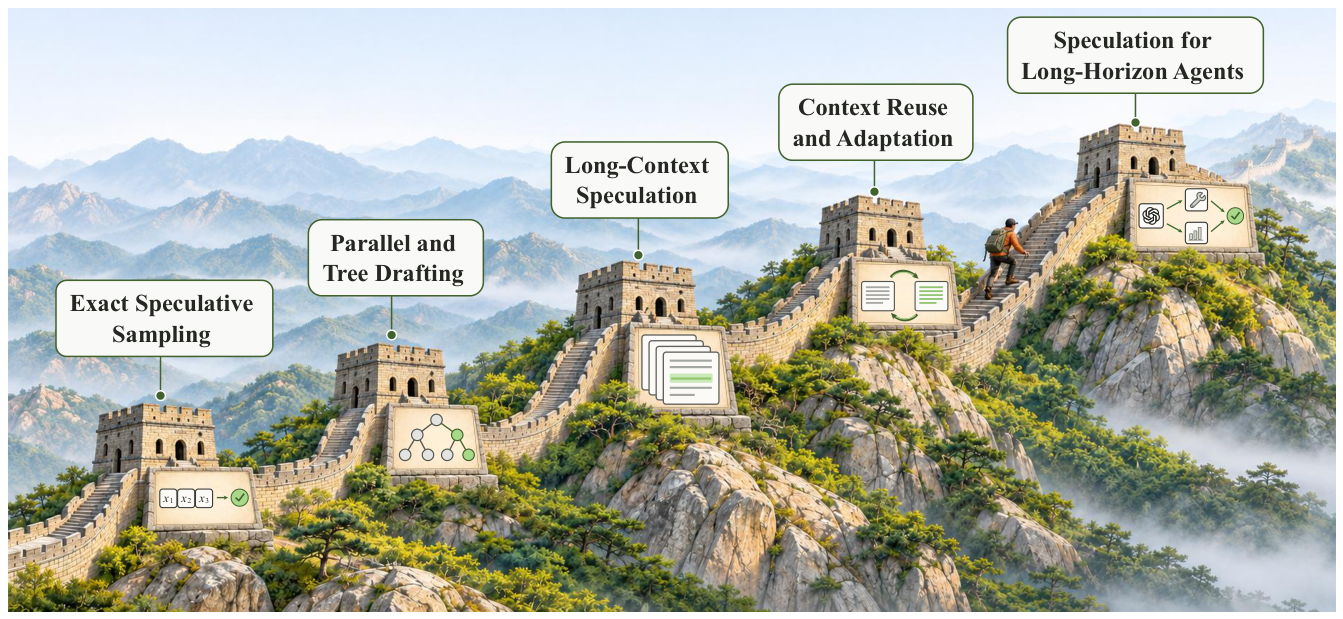
Figure 2.
A timeline of representative speculative-inference research. Method and evaluation studies are distinguished by color. The inset counts the studies displayed in each period, complementing the thematic organization in Figure 3.
Figure 2.
A timeline of representative speculative-inference research. Method and evaluation studies are distinguished by color. The inset counts the studies displayed in each period, complementing the thematic organization in Figure 3.
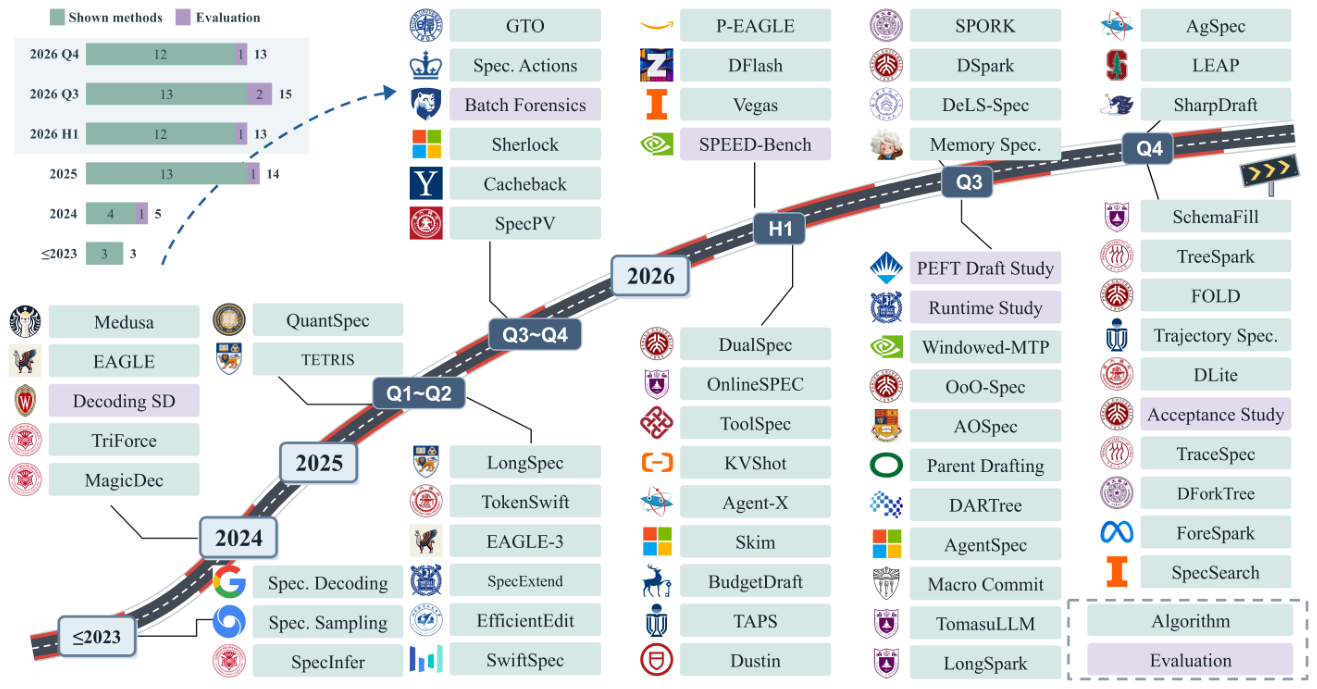
Figure 3.
Literature map of speculative inference. Branches follow the progression from drafting and verification to long contexts, reuse, agent execution, scheduling, and evaluation. Each work appears once under the contribution emphasized here.
Figure 3.
Literature map of speculative inference. Branches follow the progression from drafting and verification to long contexts, reuse, agent execution, scheduling, and evaluation. Each work appears once under the contribution emphasized here.
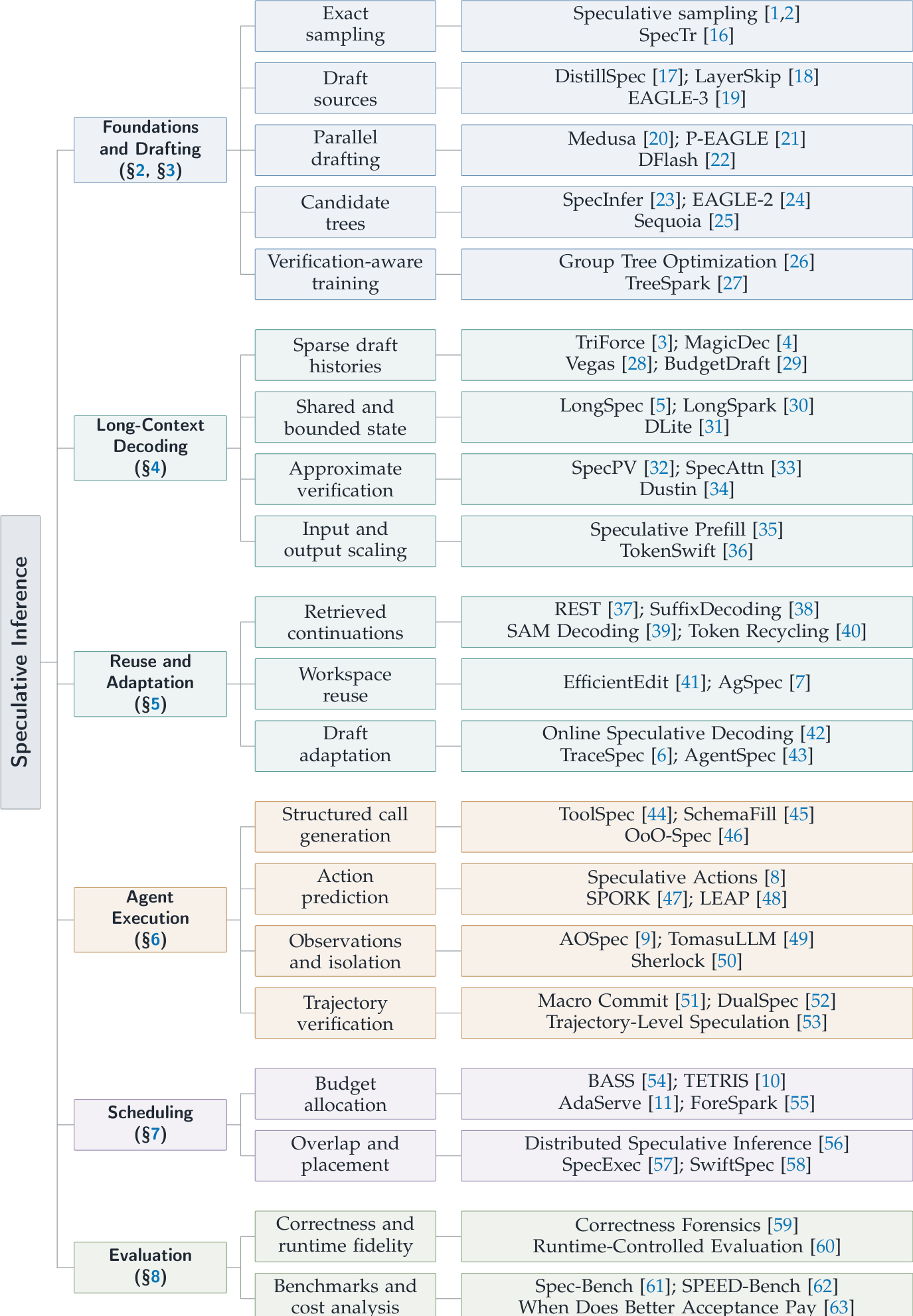
Figure 4.
Context design and verification in long-context speculation. Sparse histories, shared caches, and compact target-derived views reduce different draft costs. Full or approximate target verification determines how proposals are confirmed. The lower panels relate these choices to long inputs, growing outputs, and the balance between memory traffic and computation.
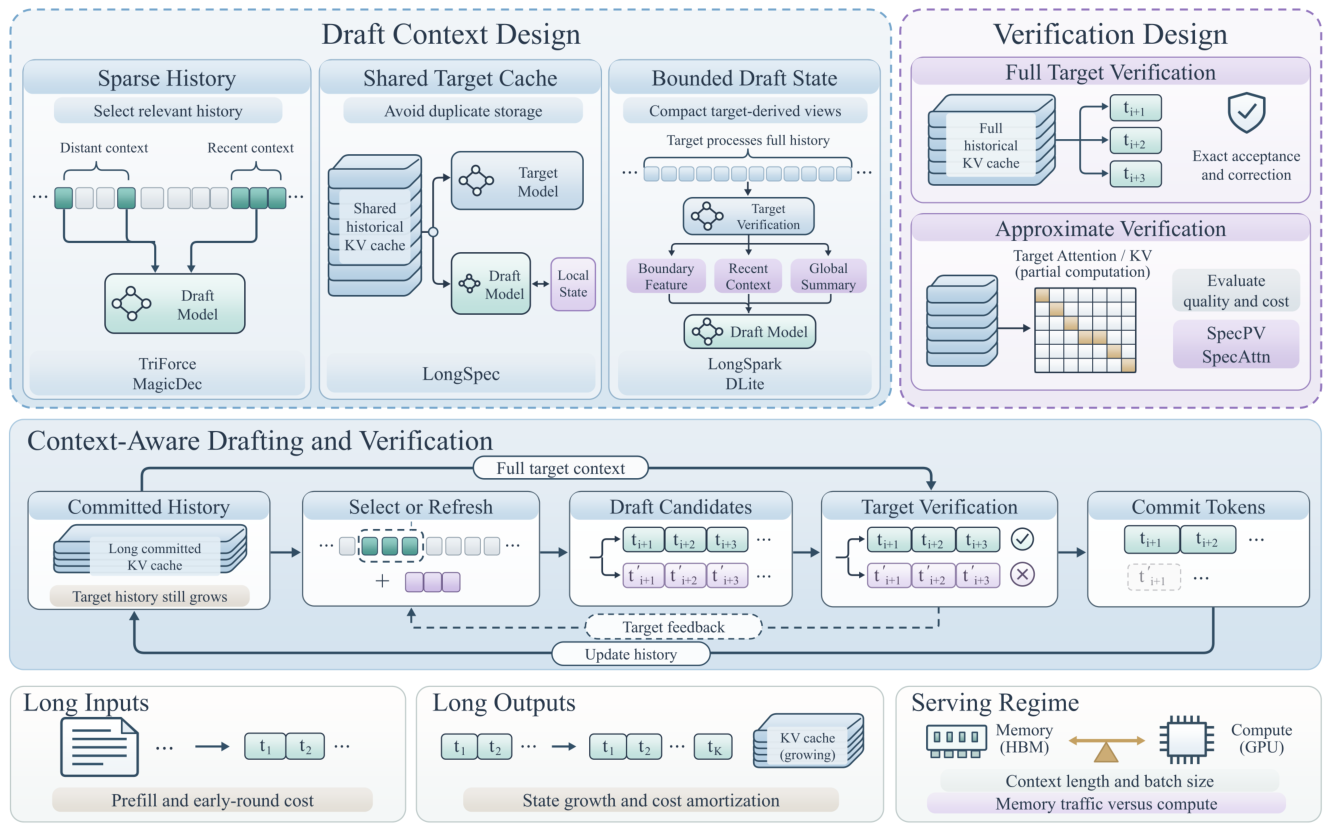
Figure 5.
Complementary routes from interaction history to useful drafts. Retrieval supplies existing continuations, while trajectory-aware adaptation changes the model that proposes them. Target verification confirms candidate tokens. Reuse spans nearby rounds, turns and tasks, and deployment experience, with different validity requirements for text, cached target computation, and external results.
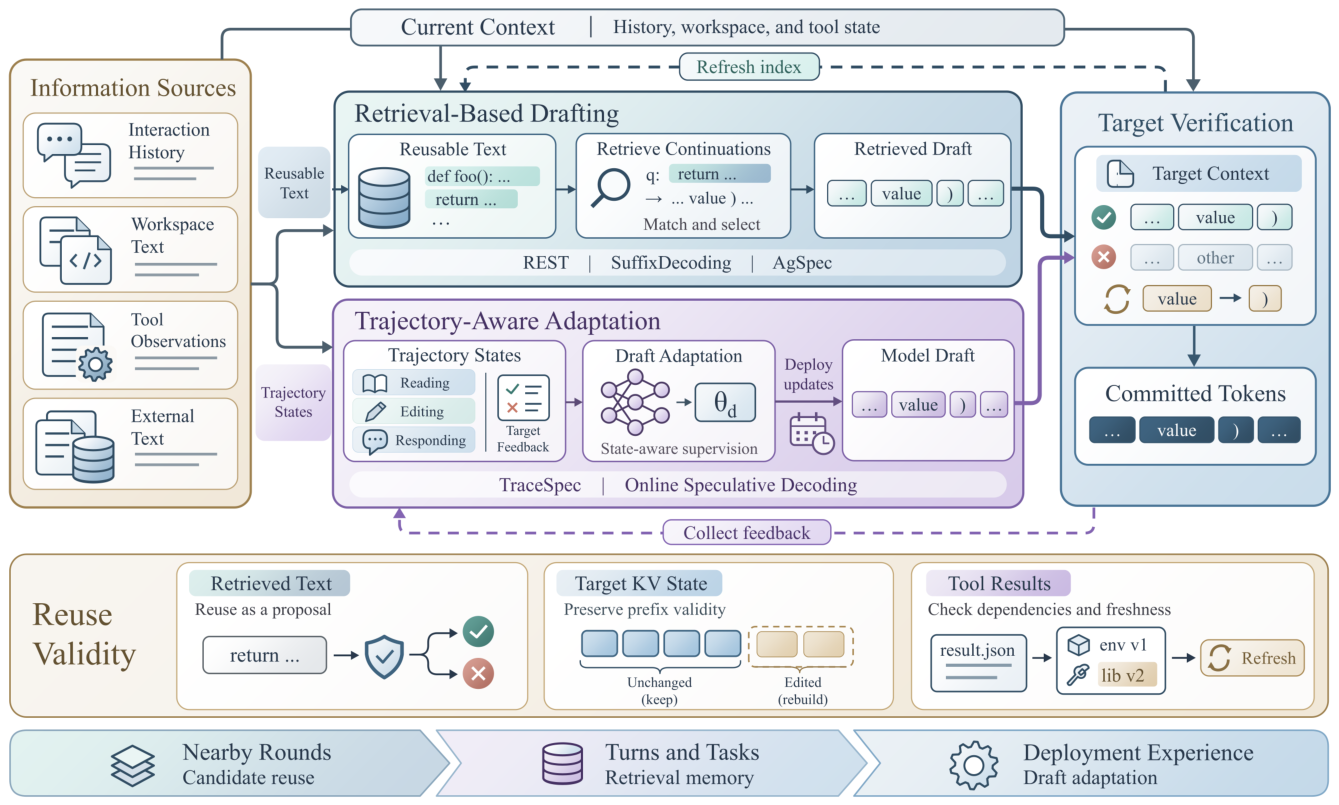
Figure 6.
Speculation within the agent execution loop. Call generation, early actions, observation prediction, and trajectory review act at different points along the task. Their confirmation criteria range from token verification to action and state checks, observation agreement, or segment acceptance. Branch control contains provisional effects and manages commitment or recovery.
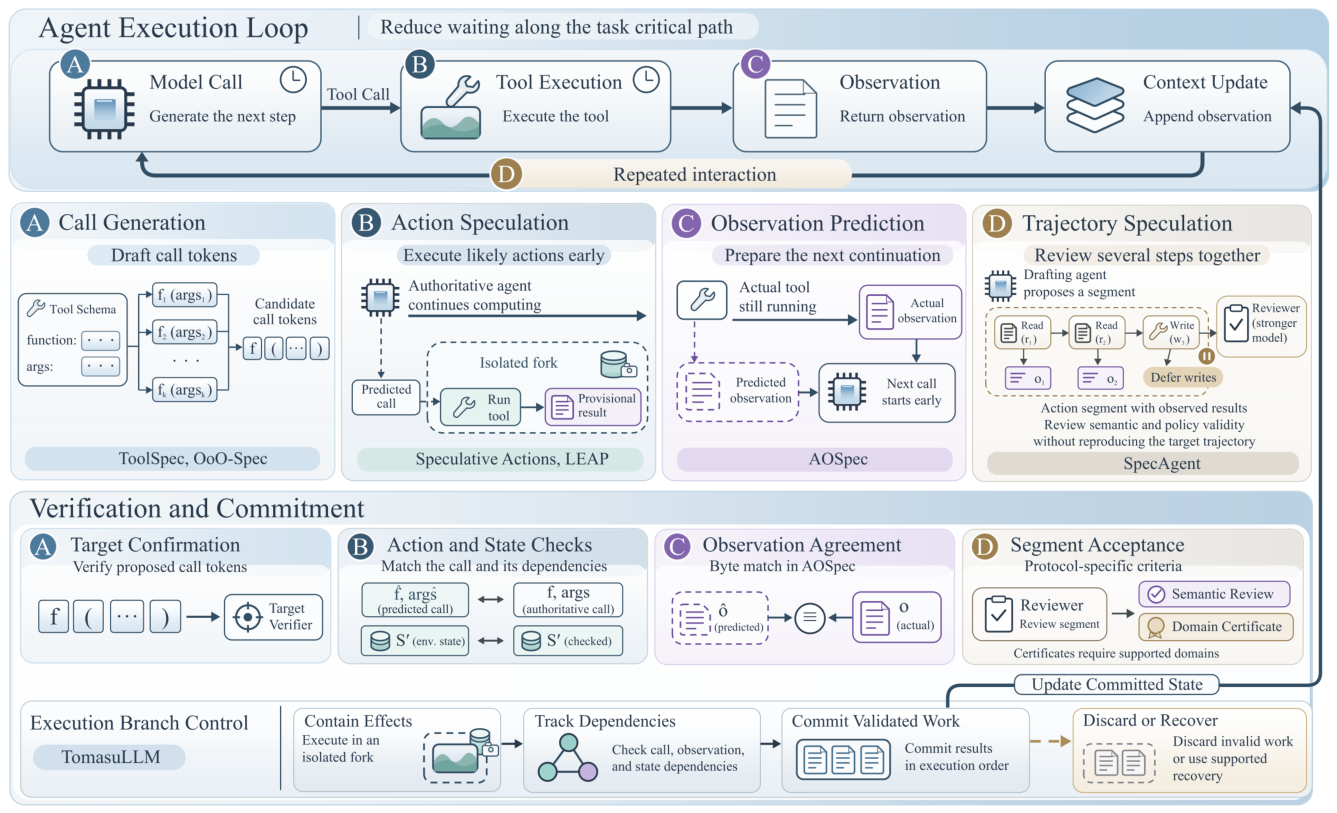
Figure 7.
Application settings for speculative agent execution. Software engineering offers reusable code and predictable tool work. Web navigation exposes recurring interaction structure. Deep research creates opportunities to overlap reasoning with anticipated searches and visits. Each setting combines prediction and preparation with method-specific verification before commitment.
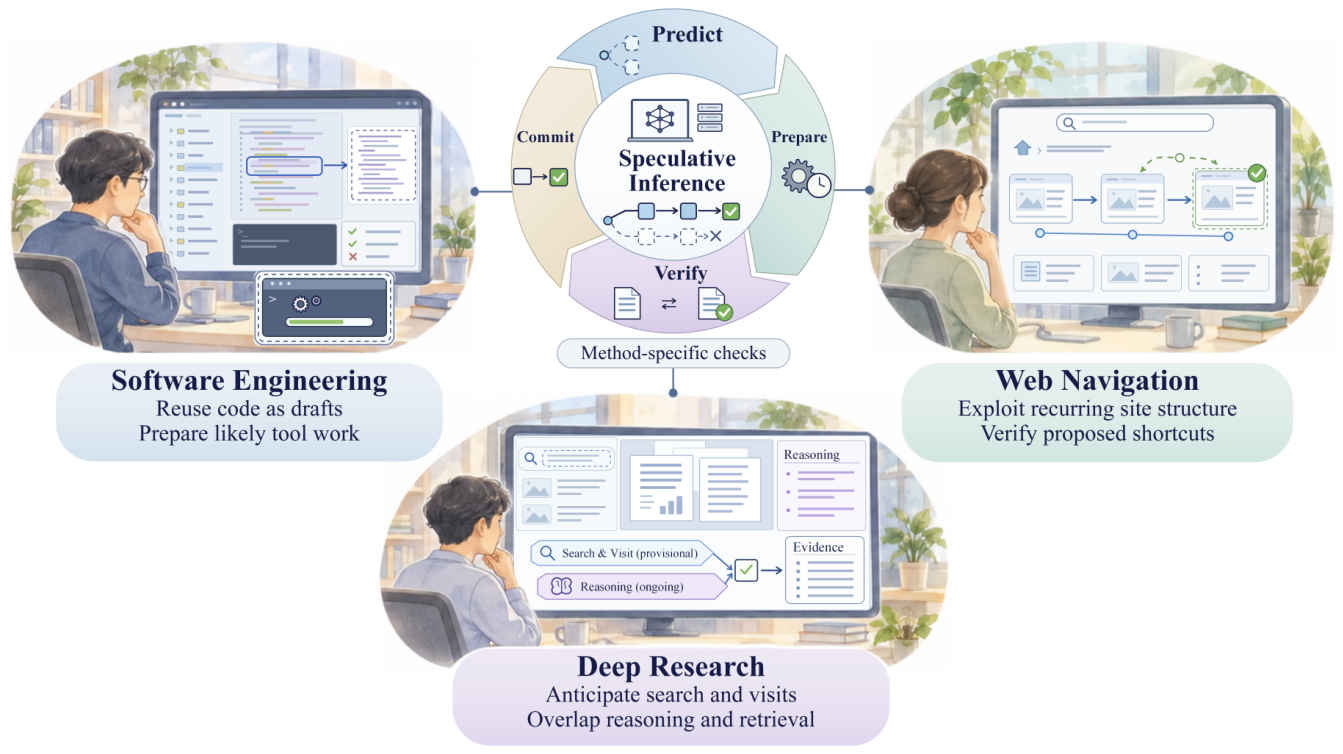
Figure 8.
Scheduling speculative work under shared resource constraints. Budget allocation and placement determine what can overlap, while runtime feedback guides subsequent adjustments. The illustrative timeline compares serial and overlapped execution of two independent requests on the same devices. Committed progress, round time, memory use, and latency compliance describe the resulting operating point.
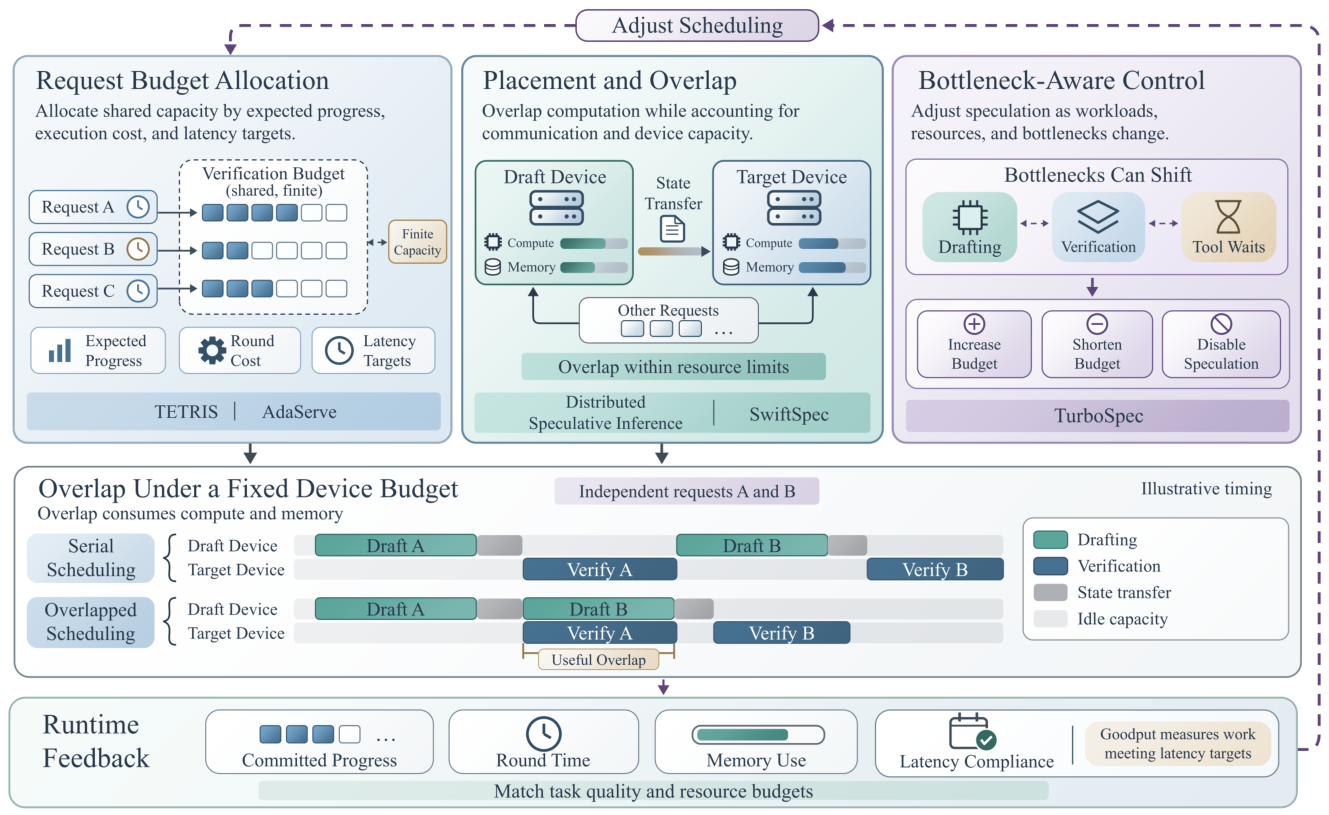
Figure 9.
Evaluation from token execution to completed tasks. Aligned target, workload, runtime, hardware, and timing conditions support comparisons at four levels. Diagnostics connect gains or regressions to supervision, execution cost, and trajectory state. Fixed-prefix replay, dynamic execution, and real tools expose complementary aspects of performance.
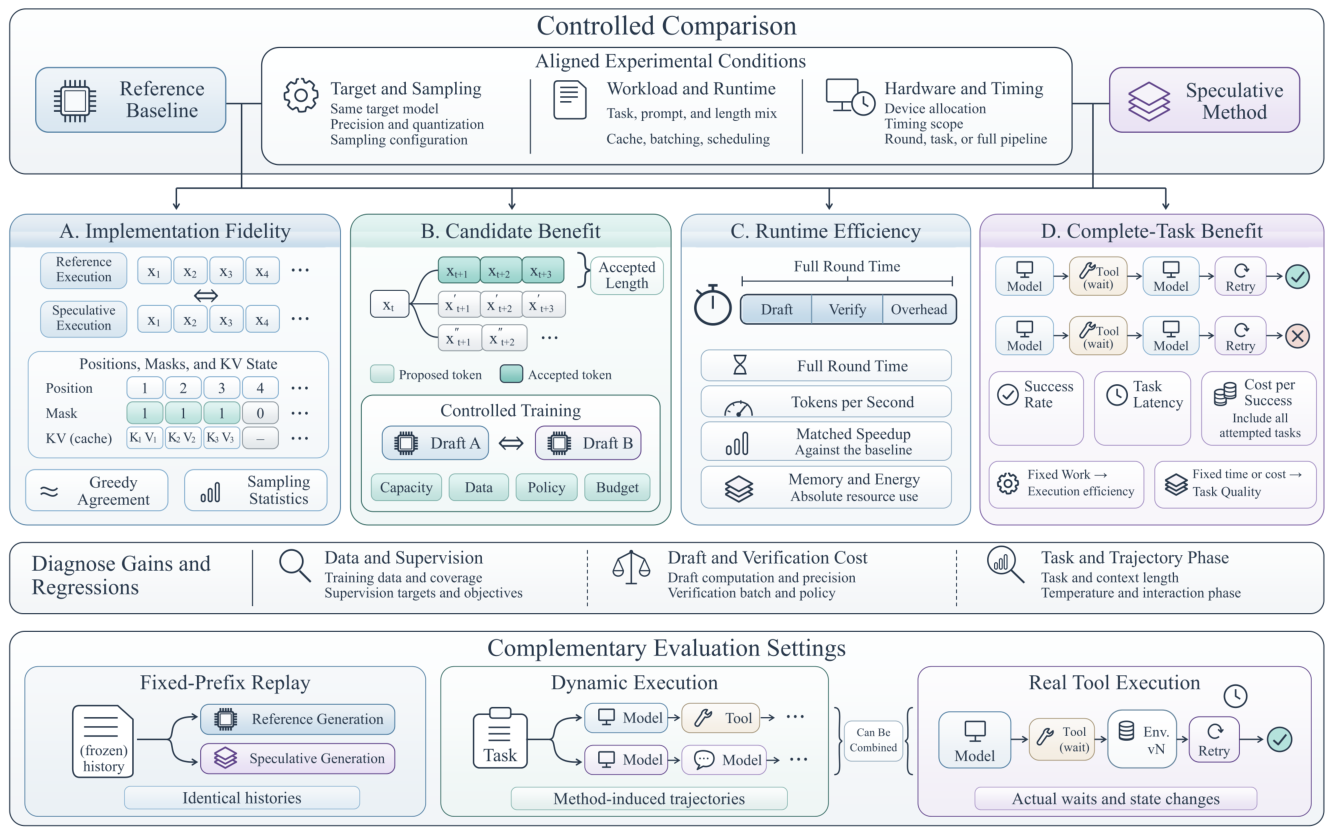
Figure 10.
Research directions for long-context and long-horizon speculation. The six panels connect joint information allocation and selective feedback with adaptation costs, state validity, critical-path scheduling, and the use of saved resources. Together they link local predictive improvements to sustained task-level value.
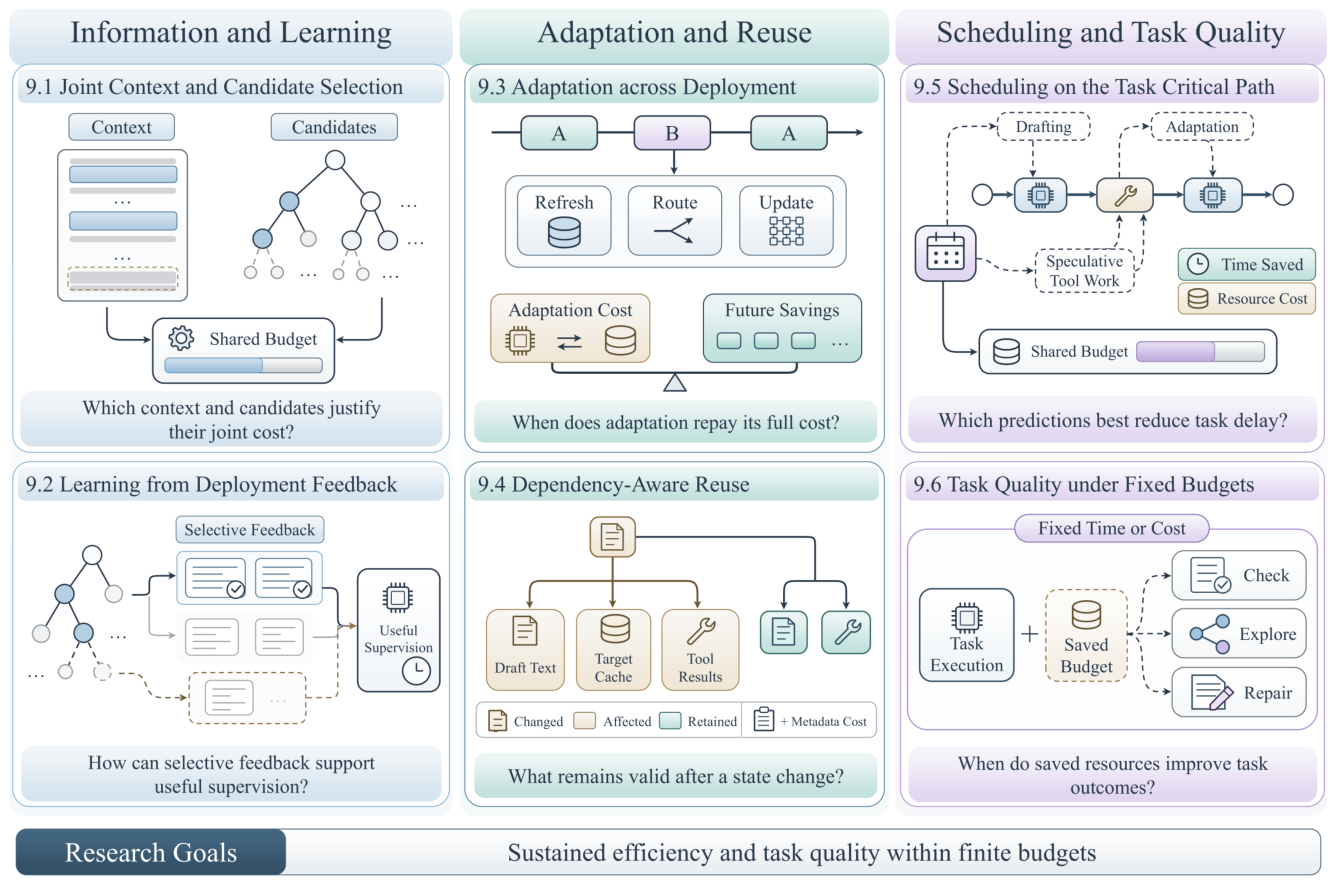

Table 1.
Verification criteria across speculative inference. The predicted object determines the relevant notion of correctness.
Table 1.
Verification criteria across speculative inference. The predicted object determines the relevant notion of correctness.
| Criterion | What is preserved | Verification requirements |
|---|---|---|
| Distribution preservation | Conditional output law of the specified target | Proposal probabilities, residual correction, target context and sampling transforms |
| Greedy agreement | Argmax continuation of the reference execution | Path conditioning, tie rules and numerical behavior |
| Action and state consistency | A permitted action and its effects from the reference state | Arguments, state dependencies, isolation and ordered commit |
| Semantic acceptance | An allowed class of meanings or behaviors | The verifier and its error profile |
| Task quality retention | Measured success or utility on a task population | Task outcomes, uncertainty and the resource budget |
Table 2.
Draft sources and their principal costs. The rows describe mechanisms that can be combined rather than mutually exclusive algorithm families.
Table 2.
Draft sources and their principal costs. The rows describe mechanisms that can be combined rather than mutually exclusive algorithm families.
| Source | Predictive information | Cost or dependency introduced |
|---|---|---|
| Independent model | Its own encoding of the committed history | Additional weights, context processing and adaptation |
| Early exit or skipped layers | A reduced computation through the target architecture | Extra shallow passes and consistency with the full target |
| Target feature head | Hidden states from target verification | Feature transfer and exposure to generated draft states |
| Parallel future positions | Shared context with multiple position predictions | Missing within-block dependencies and repair work |
| Retrieved continuation | Repetition in prompts, histories or external text | Index lookup, candidate construction and cache warmup |
Table 3.
Mechanisms for reducing context cost. Savings depend on which part of drafting or verification is changed.
Table 3.
Mechanisms for reducing context cost. Savings depend on which part of drafting or verification is changed.
| Mechanism | Examples | Effect and scope |
|---|---|---|
| Sparse draft history | TriForce, MagicDec, Vegas | Missing draft information can lower acceptance while full target verification remains available |
| Shared historical storage | LongSpec | Bounded extra cache does not remove access to growing target history |
| Bounded target-derived views | LongSpark, DLite | Bounds draft state rather than total target cost |
| Draft quantization | Quantized draft KV | Storage gains depend on layout and conversion overhead |
| Approximate target verification | SpecPV, SpecAttn, Dustin | Quality retention must be evaluated against the original dense target |
| Modified target context or law | Speculative Prefill, RAPID transfer | The reference behavior changes and must be named |
Table 4.
Context changes and the conditions for reuse. A change can preserve useful proposal text while invalidating target state or external results.
Table 4.
Context changes and the conditions for reuse. A change can preserve useful proposal text while invalidating target state or external results.
| Change | Potentially reusable work | Reuse considerations |
|---|---|---|
| Append a new turn | Stable target prefix and retrieved continuations | New role, task phase and intended output |
| Receive a tool result | Existing text prefix and draft index | Observation-dependent continuation and environment version |
| Edit source material | Unchanged text spans as proposals | File dependencies and validity of previous tool results |
| Compress or reorder history | External retrieval entries | Target position and prefix consistency |
| Switch task or user intent | General draft parameters | Relevance of local memory and proposal calibration |
Table 5.
Speculation boundaries in agents. Similar terminology can refer to different predicted objects and confirmation responsibilities.
Table 5.
Speculation boundaries in agents. Similar terminology can refer to different predicted objects and confirmation responsibilities.
| Predicted object | Examples | Confirmation criterion |
|---|---|---|
| Call text or slots | ToolSpec, SchemaFill, OoO-Spec | Target confirmation of proposed call tokens |
| Future action | Speculative Actions, SPORK, LEAP | Tool and argument agreement on the relevant history |
| Observation | AOSpec | Byte agreement between predicted and actual observations |
| Execution branch | TomasuLLM, Sherlock | Valid dependencies and contained effects, with recovery after failed checks |
| Action segment | Macro Commit, trajectory semantic verification | Acceptance of the segment under the stated semantic criterion |
| Certified decision | Certified Speculative Execution | An accepted certificate for the supported decision problem |
Disclaimer/Publisher’s Note: The statements, opinions and data contained in all publications are solely those of the individual author(s) and contributor(s) and not of MDPI and/or the editor(s). MDPI and/or the editor(s) disclaim responsibility for any injury to people or property resulting from any ideas, methods, instructions or products referred to in the content. |
© 2026 by the authors. Licensee MDPI, Basel, Switzerland. This article is an open access article distributed under the terms and conditions of the Creative Commons Attribution (CC BY) license (http://creativecommons.org/licenses/by/4.0/).
Copyright: This open access article is published under a Creative Commons CC BY 4.0 license, which permit the free download, distribution, and reuse, provided that the author and preprint are cited in any reuse.