
Submitted:
21 November 2026
Posted:
24 November 2026
You are already at the latest version
Abstract
Background/Objectives: Cibinetide (ARA 290) is a nonerythropoietic peptide that acts on the innate repair receptor. It has been tested in small-fiber neuropathy, but to our knowledge it has not been studied in neuropathic pain after spinal cord injury (SCI). We report six-month pain outcomes in people with SCI who were given cibinetide. Methods: This was a prospective, open-label, single-arm, single-center case series. Fifteen adults with SCI were screened, and 10 with severe neuropathic pain that persisted despite a gabapentinoid (gabapentin 900–1200 mg/day or pregabalin 150 mg/day), usually combined with tramadol, amitriptyline or an anticonvulsant, were enrolled. Each participant self-injected cibinetide 1.2 mg subcutaneously once a week, for 25 injections. Pain intensity was rated on a numerical rating scale (NRS, 0–10; primary outcome) and a visual analogue scale (VAS, 0–10; secondary outcome) at baseline and at 1, 3 and 6 months. We used the Friedman test and exact Wilcoxon signed-rank tests with Holm adjustment, and report Hodges–Lehmann estimates and exact binomial 95% confidence intervals (CIs). The Patient Global Impression of Change (PGIC) was recorded at month 6. Results: All 10 participants completed treatment and follow-up. Median NRS scores were 8 (interquartile range [IQR] 7.25–8) at baseline, 5 (5–5) at month 1, 2 (2–2.75) at month 3 and 2 (2–2) at month 6 (Friedman χ²(3) = 29.48, p < 0.001). The median six-month change was −6 points (range −7 to −5; Hodges–Lehmann estimate −5.5, 95% CI −6.0 to −5.0). Every participant had a reduction of at least 50% (95% CI 69.2–100%) and rated themselves “much improved” on the PGIC. VAS results were almost the same (Friedman χ²(3) = 29.32, p < 0.001). From month 3, analgesic medication was reduced in every participant: tramadol (7 participants), oxcarbazepine (1) and carbamazepine (1) were stopped; amitriptyline was stopped in 1 participant and lowered from 75 to 25 mg/day in 2; and gabapentin was lowered from 900–1200 mg/day to 300 mg/day (8 participants) or 100 mg/day (1), with pregabalin lowered from 150 to 50 mg/day (1). No adverse events were seen, and a complete blood count, liver function tests and serum creatinine done after month 3 were normal in all participants. Conclusions: Pain fell steadily over six months of weekly cibinetide in this small open-label series, while background analgesics were reduced. Post-treatment observation is ongoing to assess how long relief lasts after the final dose. Placebo response, expectation, regression to the mean and the natural course of SCI pain could all explain part of this change. The findings generate a hypothesis only and support a randomized, placebo-controlled trial.
Keywords:
case series
; cibinetide
; ARA 290
; innate repair receptor
; spinal cord injury
; neuropathic pain
; numerical rating scale
; Patient Global Impression of Change
1. Introduction
Pain is common after spinal cord injury (SCI). It often persists and can take quite different forms [1,2]. The International Spinal Cord Injury Pain Classification (ISCIP) separates nociceptive from neuropathic pain and divides SCI-related neuropathic pain into two types. At-level pain lies within the dermatome of the neurological level or up to three dermatomes below it, and below-level pain lies further caudally [3]. At-level pain can result from damage to the cord itself or to the nerve roots, including the cauda equina [3]. The CanPain SCI guideline lists pregabalin and gabapentin as first-line drugs, with amitriptyline as a further possibility [4]. In practice these drugs help only modestly on average across neuropathic pain conditions [5], and many people with SCI still have moderate or severe pain while taking them, often in combination with tramadol or an anticonvulsant.
Cibinetide (ARA 290) is an 11-amino-acid peptide based on the helix B surface of erythropoietin. It is thought to act on a tissue-protective innate repair receptor, which is believed to be made up of the erythropoietin receptor and the β-common receptor (CD131), and it does not stimulate red-cell production [6,7,8]. Preclinical evidence for an analgesic effect comes from the spared nerve injury model. In that model, a peripheral nerve injury, cibinetide reduced mechanical allodynia and damped the spinal microglial response [9]. The model does not reproduce central neuropathic pain caused by damage to the spinal cord, so applying these results to SCI pain requires caution.
Clinical data are few and inconsistent. In small, randomized trials in sarcoidosis-associated small-fiber neuropathy, cibinetide given intravenously three times a week, or subcutaneously every day, for 4 weeks was followed by better neuropathic symptom scores [10,11]. A phase 2b trial in 64 participants compared 1, 4 and 8 mg daily for 28 days. Only the 4 mg group improved on the primary corneal nerve-fiber endpoint. Pain scores improved in every group, placebo included, and the placebo-corrected change in Brief Pain Inventory pain severity in the 4 mg group was not significant [12]. In type 2 diabetes, PainDetect scores favored cibinetide, though both arms improved over 28 days [13]. An open-label study in diabetic macular edema showed no benefit on visual or anatomical outcomes [14]. All these studies used doses of 1–8 mg given daily or three times a week. A weekly schedule has not been studied.
Our search of PubMed, Europe PMC, and ClinicalTrials.gov (Section 4.9; Supplementary Table S1) found no published human study and no registered trial of cibinetide in SCI. We therefore describe 10 people with SCI-related neuropathic pain who received weekly subcutaneous cibinetide and were followed prospectively for six months. We set out to describe how pain intensity and patient-rated change evolved over that period. The study was not designed to test efficacy. Its purpose is to help plan a controlled trial.
2. Results
2.1. Participants and Follow-Up
Figure 1 shows participant flow. Of 15 people screened, five did not meet the eligibility criteria and 10 were enrolled. Enrollment ran from February to April 2026, and the last participant received the final injection on 7 November 2026. There were six men and four women, with a median age of 41 years (range 29–52). The neurological level was cervical in one participant, thoracic in six and lumbar (L1–L2) in three. Five were AIS A and five AIS B. Median time since injury was 21 months (range 8–120), and three participants (P4, P6 and P9) were 8–10 months after injury when they enrolled. Four participants described their pain as burning, three as stabbing and three as electric-shock-like (Table 1). Everyone received all 25 planned injections and attended every assessment, so no data were missing.
2.2. Primary Outcome: NRS Pain Intensity
Figure 2 and Table 2 show individual NRS trajectories and visit summaries, and Table A1 lists each participant’s scores. NRS scores differed across the four visits (Friedman χ²(3) = 29.48, p < 0.001; Kendall’s W = 0.98). All 10 participants scored lower at months 1, 3 and 6 than at baseline (Holm-adjusted p = 0.006 for each comparison; Table 3). With 10 participants all changing in the same direction, p = 0.006 is the smallest value the test can give. It reflects how consistent the direction of change was, not how large any treatment effect might be.
Between baseline and month 6, the median change was −6 points (range −7 to −5) and the mean change −5.70 points (95% CI −6.18 to −5.22). The median reduction was 75.0% (range 62.5–77.8%). Most of the fall had happened by month 3. From month 3 to month 6, scores stayed the same in eight participants and dropped by 1 point in two. At month 6, nine participants scored 2 and one (P2) scored 3.
At month 1, 8 of 10 participants had a reduction of at least 30% (95% CI 44.4–97.5%), and 1 of 10 had a reduction of at least 50% (95% CI 0.3–44.5%). At months 3 and 6, all 10 met both thresholds (10/10; 95% CI 69.2–100% for each).
2.3. Secondary Outcome: VAS Pain Intensity
Figure 3 and Table 2 and Table 3 give the VAS results. Median VAS scores were 8 (IQR 7.25–8) at baseline, 5.5 (5–6) at month 1, 2 (2–3) at month 3 and 2 (2–2) at month 6, and they differed across visits (Friedman χ²(3) = 29.32, p < 0.001; Kendall’s W = 0.98). Each participant scored lower at months 1, 3 and 6 than at baseline (Holm-adjusted p = 0.006 for each comparison). The median change from baseline to month 6 was −6 points (range −7 to −5; Hodges–Lehmann estimate −5.5, 95% CI −6.0 to −5.0), a median reduction of 75.0% (range 62.5–77.8%). At month 1, 4 of 10 participants had a reduction of at least 30% (95% CI 12.2–73.8%) and 1 of 10 a reduction of at least 50% (95% CI 0.3–44.5%). All 10 met both thresholds at months 3 and 6 (10/10; 95% CI 69.2–100%).
VAS and NRS scores matched in 35 of the 40 participant-visits: in all 10 at baseline and month 6, in 6 of 10 at month 1 and in 9 of 10 at month 3. Where they differed, the VAS was 1 point higher. Both scales were completed by the same people at the same visits on a 0–10 metric. Their close agreement shows that the ratings were internally consistent, but it is not independent confirmation of the NRS result.
2.4. Patient Global Impression of Change
At month 6, all 10 participants rated their overall condition as “much improved” (category 2 of 7). Nobody chose “very much improved”, “minimally improved”, “no change” or any of the “worse” categories.
2.5. Concomitant Analgesic Medication
At baseline, every participant was taking a gabapentinoid together with at least one other analgesic (Table 1). Nine took gabapentin, at 900 mg/day (seven participants) or 1200 mg/day (two, P2 and P5), and one (P8) took pregabalin 150 mg/day. Seven participants also took tramadol at 80–120 mg/day. Amitriptyline 75 mg/day was used by three participants (P3, P4 and P5), oxcarbazepine 600 mg/day by one (P3) and carbamazepine 600 mg/day by one (P7). Eight participants were therefore on two analgesic drugs and two (P3 and P4) on three.
No analgesic doses were changed before month 3. The month-1 falls in NRS and VAS thus took place on the baseline regimen. From month 3, after pain had already decreased, the treating physician reduced medication in every participant (Table 4; Appendix B, Table A2). Tramadol was stopped in all seven participants who used it, and oxcarbazepine (P3) and carbamazepine (P7) were also stopped. Amitriptyline was stopped in P5 and lowered from 75 to 25 mg/day in P3 and P4. Gabapentin was lowered to 300 mg/day in eight participants and to 100 mg/day in P6, and pregabalin was lowered from 150 to 50 mg/day in P8. No new analgesic was started. The month-3 regimens were kept unchanged until month 6. At month 6, eight participants were taking a low dose gabapentin alone, and two (P3 and P4) were taking gabapentin 300 mg/day with amitriptyline 25 mg/day.
2.6. Safety and Tolerability
All 10 participants received all 25 injections. No adverse events were recorded, including at the injection site, and there were no serious adverse events, treatment discontinuations or withdrawals (Table 5). No withdrawal symptoms were reported after tramadol, oxcarbazepine, carbamazepine, or amitriptyline were stopped or reduced. A complete blood count, liver function tests and serum creatinine were done in every participant after month 3, and all values were within the laboratory reference ranges.
3. Discussion
3.1. Principal Observations
In this prospective open-label series, NRS and VAS pain intensity fell in all 10 participants with SCI-related neuropathic pain over six months of weekly subcutaneous cibinetide. Most of the change had occurred by month 3. At month 6, every participant rated themselves “much improved”, and every participant was taking fewer or lower-dose analgesics than at baseline. These are observations of change over time in a small group. They do not show that cibinetide caused the change, and they cannot estimate the size of a treatment effect.
3.2. Alternative Explanations
Several factors unrelated to cibinetide could account for some or all of what we saw. The first is placebo response, which is large in central neuropathic pain. A meta-analysis of placebo arms in central neuropathic pain trials found clinically relevant falls in pain intensity [15], and an individual participant data analysis in SCI found bigger placebo responses in people with higher baseline pain [16]. All our participants started with NRS scores of 7–9. Open-label use of a new investigational peptide, weekly contact with the clinic and unblinded assessment are all likely to have strengthened placebo and expectation effects here.
Second, people were enrolled when their pain was severe, so some fall at follow-up would be expected from regression to the mean alone [17]. Third, SCI pain changes over time [1,2]. This matters most for the three participants who enrolled 8–10 months after injury (P4, C5; P6, T10; P9, L1), in whom spontaneous change in the early years after injury cannot be ruled out. Their six-month changes (−5, −5 and −6 points) were similar to those of participants with older injuries, but three cases are too few for any comparison.
Fourth, background analgesia went down rather than up. Tramadol, oxcarbazepine, and carbamazepine were stopped, amitriptyline was stopped or reduced, and gabapentinoid doses were lowered in everyone. Added medication is therefore an unlikely reason for the fall in pain, and the reductions began only at month 3, after pain had already decreased. Even so, the reductions were made openly and may have reinforced participants’ belief that they were improving. Stopping tramadol or an anticonvulsant can also change symptoms in either direction, or these effects were not measured systematically. Pain did not rise after the reductions, but this series cannot show whether cibinetide allowed them or whether the earlier regimen was simply more than was needed. No participant received rehabilitation during the study.
Finally, a uniform response in every participant, with nine of 10 reaching the same six-month score, is unusual in neuropathic pain. The course 0–10 integer scale and assessment by unblinded staff may partly explain it, and both point to the need for independent replication.
3.3. Pain Phenotype and Level of Injury
Three participants had injuries at L1 (P9) or L2 (P1 and P7). Lesions at these levels can involve the conus medullaris, the cauda equina or both. ISCIP classifies pain caused by nerve-root or cauda equina damage as at-level neuropathic pain [3], and its mechanisms may partly resemble those of peripheral nerve injury. This is relevant because the preclinical analgesic data for cibinetide come from a peripheral nerve-injury model [9]. The six-month changes in these three participants (−6, −5 and −6 points) were within the range of the whole group. The series cannot tell whether response differs between peripheral-type at-level pain and central below-level pain, and a controlled trial should phenotype pain with ISCIP and stratify by subtype.
3.4. Relation to Previous Evidence and Dosing
The change we saw is far larger than the between-group differences in placebo-controlled studies of cibinetide, in which placebo groups also improved and pain differences were small or not significant [12,13]. Neutral results have also been reported in diabetic macular edema [14]. In the phase 2b sarcoidosis trial, serious adverse events occurred in 2 of 16 participants on 1 mg, 0 of 16 on 4 mg, 1 of 14 on 8 mg and 0 of 16 on placebo [18]. Our weekly 1.2 mg regimen (30 mg in total over 25 weeks) is remarkably different from the daily or thrice-weekly 1–8 mg regimens used before, which delivered 24–224 mg over 4 weeks. It was chosen pragmatically, not from pharmacokinetic or dose-finding data. Reviews have suggested that brief engagement of the innate repair receptor may set off longer-lasting biological effects [6,8]. This idea has not been tested for weekly dosing, and we made no pharmacokinetic or pharmacodynamic measurements.
3.5. Implications for a Controlled Trial
These observations can inform, but not replace, a prospectively registered, randomized, double-blind, placebo-controlled trial. Such a trial should phenotype pain with ISCIP and a validated screening tool and keep background analgesia stable and documented. It should prespecify average NRS pain intensity as the primary outcome and use blinded outcome assessment. If analgesic tapering is part of the design, it should follow a written protocol applied equally in both arms. The trial should also measure pain interference, sleep and function, record rescue medication, watch hemoglobin and other safety parameters, characterize pharmacokinetics, and follow participants after the last dose [4,19]. The time course seen here, with most change by month 3, may help in choosing assessment points. The ongoing post-treatment observation of this cohort will show whether relief persists after dosing stops, which bears directly on how long follow-up in such a trial should be.
3.6. Limitations
The study has important limitations. It was small, single-center and open-label, with no control group, and the outcome assessors were not blinded. Participants entered on different combinations of analgesics, and these were reduced openly by the treating physician rather than by a prespecified tapering protocol. Concomitant treatment and adverse events were taken from clinical records. Pain was recorded in whole numbers, and the NRS and VAS were collected at the same visits and agreed closely. The group mixed different injury levels, completeness grades, and times since injury. Finally, this report ends at month 6, so the durability of relief after treatment stopped is not yet known.
4. Materials and Methods
4.1. Study Design, Setting, and Reporting
This prospective, open-label, single-arm, single-center case series was carried out in the Department of Neuromodulation, EGE Hospital, together with NuRaX Clinic, Baku, Azerbaijan. Participants were enrolled from February to April 2026, and the six-month treatment period ended with the last participant’s final dose on 7 November 2026. Post-treatment observation is ongoing (Section 4.6). Reporting follows Kempen’s recommendations for case series [20] (Supplementary Table S2), and the applicable items of the TREND statement [21] were also considered.
4.2. Ethics, Registration and Regulatory Basis
The study followed the Declaration of Helsinki and was approved by the Ethics Review Board of EGE Hospital and NuRaX Clinic on 26 January 2026 (approval No. NUX-ARA290-PM/298/10-EGE). All injections were given after approval, and the first participant received the first dose on 1 May 2026. Every participant gave written informed consent, which said that cibinetide is an investigational peptide not licensed for any sign. The ARA 290 vials were supplied by Neuraxes Pharmaceutical in collaboration with Fusion Pharmaceutical, which works with a cGMP-verified laboratory to supply specific investigational peptides. The study was not registered in a public clinical trial registry.
4.3. Participants and Pain Classification
Fifteen people with SCI and neuropathic pain attending the Department of Neuromodulation were screened, and the 10 who met all eligibility criteria were enrolled (Figure 1). The eligibility criteria were:
- Inclusion: SCI with severe neuropathic pain that persisted, with less than 50% pain relief, despite a gabapentinoid at a stable dose (gabapentin ≥900 mg/day or pregabalin 150 mg/day), with or without other analgesics (tramadol, amitriptyline, oxcarbazepine or carbamazepine); no active allergic condition; and no current medication for infection, autoimmune symptoms or allergic reactions.
- Exclusion: age over 55 years; heart disease; or any other active disease or infection.
Pain was classified by Prof. Dr. Pritam Majumdar from the history, a pain drawing, and a neurological examination. Musculoskeletal pain was ruled out by Dr. Roya Ismayilzada, neurorehabilitation specialist at EGE Hospital. Neuropathic pain was screened with the DN4 [22]. Pain duration and the distribution of pain compared to the neurological level were recorded.
4.4. Investigational Product, Dosing and Administration
Cibinetide was obtained from Neuraxes Pharmaceutical, in collaboration with Fusion Pharmaceutical, USA, as a ready-to-use solution with a nominal concentration of 6 mg/mL in 5 mL vials (30 mg per vial; Table 6). All vials came from batch 67893. The supplier provided a certificate of analysis covering identity by mass spectrometry, purity by HPLC, peptide content, endotoxin, and sterility, and said that the product was made under GMP. Each 0.20 mL dose (20 units on a U-100 insulin syringe) had a nominal 1.20 mg, and syringe calibration was checked during the study.
Participants injected themselves subcutaneously in the thigh, at home, once a week from week 0 to week 24 (25 injections; nominal cumulative dose 30.0 mg). Vials were stored at 2–8 °C, and each participant had one dedicated 5 mL vial for the whole 25 weeks. Assessments took place at baseline (before the first injection), month 1 (week 4), month 3 (week 13) and month 6 (week 26, about 1 week after the last injection). The weekly schedule was chosen pragmatically (Section 3.4), not from pharmacokinetic or dose-finding data.
4.5. Concomitant Treatment
Baseline analgesics are listed in Table 1. Participants kept their baseline regimen unchanged until month 3. From month 3, as pain improved, the treating physician reduced or stopped analgesics as described in Section 2.5, Table 4 and Appendix B (Table A2). The month-3 regimen was then held constant until month 6. No new analgesic was started, and no participant received rehabilitation during the study. After the final cibinetide dose, analgesics have been kept at the month-6 doses, with no escalation, during post-treatment observation.
4.6. Outcomes and Assessment Procedures
The primary outcome was average pain intensity over the previous 7 days on an 11-point NRS (0 = no pain, 10 = worst pain imaginable) [24]. Scores were recorded at each visit by neurologists at EGE Hospital who were independent of the treating physician. Participants were not blinded. The study had not publicly pre-specified primary outcome. We chose the NRS as the primary outcome for this report because it was the most standardized measure collected; the VAS was the secondary outcome, and all recorded outcomes are reported.
For the VAS, each participant marked their pain on a 0–10 numbered line, and the nearest whole number was recorded at the same visits as the NRS. The PGIC was recorded at month 6 on a seven-point scale (1 = very much improved, 2 = much improved, 3 = minimally improved, 4 = no change, 5 = minimally worse, 6 = much worse, 7 = very much worse) [25,26]. Pain descriptors were taken from the baseline case sheets. All scores were entered on dated paper case sheets, which are kept on file and are available to the editors on request.
After the final dose, all participants entered a post-treatment observation phase that is still ongoing. Its purpose is to find out how long pain relief lasts after cibinetide is stopped while analgesic requirements stay low. NRS and VAS pain intensity and analgesic use are being recorded, with analgesics held at the month-6 doses and not escalated. These data are not part of the present report and will be published separately.
Participants were checked for adverse events throughout the study, including inspection of the injection site. A complete blood count, liver function tests and serum creatinine were done in all participants after month 3 and compared with laboratory reference ranges.
4.7. Statistical Analysis
Because the sample was small and the scores were bounded and discrete, we used non-parametric methods and focused on estimation rather than hypothesis testing. NRS and VAS scores at each visit were summarized as median, IQR and range, with mean and standard deviation added for comparison with earlier reports. Change across the four visits was tested with the Friedman test, with Kendall’s W as the effect size. Changes from baseline to months 1, 3 and 6 (the three prespecified comparisons) were tested with exact two-sided Wilcoxon signed-rank tests, with Holm adjustment. For each interval we report the median change and range, the Hodges–Lehmann estimate with a distribution-free 95% CI, and the mean change with a t-based 95% CI. Changes between successive follow-up visits are descriptive. The NRS and VAS were analyzed separately in the same way, and agreement between them was summarized as the number of identical participant-visits.
Responders were defined as participants with a reduction of at least 30% or at least 50% from baseline on the NRS (and, separately, the VAS) [19,27]. Proportions are given with exact Clopper–Pearson 95% CIs [28]. The PGIC is reported across all seven categories. No data were missing and nothing was imputed. Analyses were run in Python 3.14 with SciPy 1.18 (two-sided α = 0.05). p values are given to three decimal places, or as p < 0.001.
4.8. Data Credibility
Individual participant data are given in Appendix A (Table A1) and individual medication regimens in Appendix B (Table A2). The dated original case sheets, the injection log and the adverse-event log are kept at EGE Hospital and will be made available to the editors on request.
4.9. Literature Search
On 19 November 2026, we searched PubMed for (cibinetide OR “ARA 290” OR ARA290 OR ARA-290 OR “pyroglutamate helix B surface peptide”) in all fields, which returned 89 records. Adding spinal cord injury terms (“spinal cord injuries”[MeSH] OR “spinal cord injur*” OR paraplegi* OR tetraplegi* OR quadripleg*) left one record, a review of erythropoietin-receptor agonism with no human SCI data. Adding neuropathic pain terms gave 21 records, none in SCI. A broader search combining the cibinetide aliases or “helix B surface peptide” with “spinal cord” returned five records, none a human SCI study. A full-text search of Europe PMC for the cibinetide aliases with “spinal cord” returned 69 records, none describing cibinetide in people with SCI. ClinicalTrials.gov listed four cibinetide studies (sarcoidosis, NCT02039687; type 2 diabetes, NCT01933529; depression, NCT02070783; diabetic macular edema, NCT06626971), none in SCI. Embase (Elsevier) was searched before the study was designed. The full search strategies are given in Supplementary Table S1.
5. Conclusions
In this open-label case series of 10 people with SCI-related neuropathic pain, pain intensity fell over six months of weekly cibinetide, mostly by month 3, while analgesic use was reduced in every participant. Without a control group, these results cannot be attributed to cibinetide. Post-treatment observation is ongoing, with analgesics held at current doses, to find out how long relief lasts after the final dose given on 7 November 2026. A randomized, placebo-controlled trial is warranted.
Supplementary Materials
The following supporting information can be downloaded at the website of this paper posted on Preprints.org. Table S1: Literature search strategies; Table S2: Case-series reporting checklist (Kempen).
Author Contributions
Conceptualization, P.M.; methodology, P.M., G.M. and I.L.; investigation, P.M., U.J. and R.I.; data curation, P.M., N.A. and U.J.; formal analysis, P.M. and M.A.; resources, P.M.; project administration, P.M.; supervision, A.J.F., B.K., G.M. and I.L.; validation, M.A. and S.S.; writing—original draft preparation, P.M.; writing—review and editing, G.M., M.A., A.J.F., B.K., N.A., I.L., U.J., R.I. and S.S. All authors meet the ICMJE criteria for authorship, have read and agreed to the published version of the manuscript, and agree to be accountable for all aspects of the work.
Funding
This research received no external funding. The peptide was supplied to the NuRaX team by Neuraxes Pharmaceutical.
Institutional Review Board Statement
The study was conducted in accordance with the Declaration of Helsinki and approved by the Ethics Review Board of EGE Hospital and NuRaX Clinic on 26 January 2026 (approval No. NUX-ARA290-PM/298/10-EGE). All treatment began after approval.
Informed Consent Statement
Written informed consent was obtained from all participants, including consent to publish anonymized data. Participants were told that cibinetide is an unlicensed investigational peptide.
Data Availability Statement
Individual participant data are provided in Appendix A and Appendix B. Dated source documents and further data are available from the corresponding author on reasonable request, subject to ethics requirements and participant confidentiality.
Acknowledgments
The authors thank Dr. Bishoy Sawiris and Dr. Karmen Mirella Alasaad of Fusion Pharmaceutical for external support during the study. Neither Neuraxes Pharmaceutical nor Fusion Pharmaceutical had any role in the design of the study or influenced it in any way. The study was designed and analyzed by the NuRaX team at EGE Hospital.
Conflicts of Interest
P.M. is Director of Functional Neurology and Neuromodulation at NuRaX Clinics; he designed the study and screened all participants. Neuraxes Pharmaceutical, the supplier of the product, has no ownership, employment, consulting or financial relationship with any author, NuRaX Clinics or EGE Hospital. Fusion Pharmaceutical has no ownership, employment or financial relationship of any kind with the authors. The other authors declare no conflicts of interest.
Abbreviations
AIS, American Spinal Injury Association Impairment Scale; CI, confidence interval; DN4, Douleur Neuropathique 4 questionnaire; GMP, good manufacturing practice; HL, Hodges–Lehmann; HPLC, high-performance liquid chromatography; IQR, interquartile range; ISCIP, International Spinal Cord Injury Pain Classification; NRS, numerical rating scale; PGIC, Patient Global Impression of Change; SCI, spinal cord injury; VAS, visual analogue scale.
Appendix A

Table A1.
Individual NRS and VAS scores, six-month change, gabapentinoid dose and PGIC.
| ID | NRS BL / M1 / M3 / M6 | NRS change at M6 (%) | VAS BL / M1 / M3 / M6 | VAS change at M6 (%) | Gabapentinoid at M6, mg/day | PGIC at M6 |
|---|---|---|---|---|---|---|
| P1 | 8/5/3/2 | −6 (75.0) | 8/5/3/2 | −6 (75.0) | Gabapentin 300 | 2 |
| P2 | 8/4/3/3 | −5 (62.5) | 8/4/3/3 | −5 (62.5) | Gabapentin 300 | 2 |
| P3 | 8/5/2/2 | −6 (75.0) | 8/6/2/2 | −6 (75.0) | Gabapentin 300 | 2 |
| P4 | 7/4/3/2 | −5 (71.4) | 7/5/3/2 | −5 (71.4) | Gabapentin 300 | 2 |
| P5 | 9/5/2/2 | −7 (77.8) | 9/5/2/2 | −7 (77.8) | Gabapentin 300 | 2 |
| P6 | 7/6/2/2 | −5 (71.4) | 7/6/2/2 | −5 (71.4) | Gabapentin 100 | 2 |
| P7 | 7/6/2/2 | −5 (71.4) | 7/6/2/2 | −5 (71.4) | Gabapentin 300 | 2 |
| P8 | 8/5/2/2 | −6 (75.0) | 8/5/2/2 | −6 (75.0) | Pregabalin 50 | 2 |
| P9 | 8/5/2/2 | −6 (75.0) | 8/6/3/2 | −6 (75.0) | Gabapentin 300 | 2 |
| P10 | 8/5/2/2 | −6 (75.0) | 8/6/2/2 | −6 (75.0) | Gabapentin 300 | 2 |
Appendix B
Table A2.
Neuropathic pain medication for each participant at baseline, month 3 and month 6 (daily doses).
Table A2.
Neuropathic pain medication for each participant at baseline, month 3 and month 6 (daily doses).
| ID | Baseline | After 3 months | After 6 months |
|---|---|---|---|
| P1 | Gabapentin 900 mg; tramadol 100 mg | Gabapentin 300 mg; tramadol stopped | Gabapentin 300 mg |
| P2 | Gabapentin 1200 mg; tramadol 100 mg | Gabapentin 300 mg; tramadol stopped | Gabapentin 300 mg |
| P3 | Gabapentin 900 mg; amitriptyline 75 mg; oxcarbazepine 600 mg | Gabapentin 300 mg; amitriptyline 25 mg; oxcarbazepine stopped | Gabapentin 300 mg; amitriptyline 25 mg |
| P4 | Gabapentin 900 mg; tramadol 120 mg; amitriptyline 75 mg | Gabapentin 300 mg; amitriptyline 25 mg; tramadol stopped | Gabapentin 300 mg; amitriptyline 25 mg |
| P5 | Gabapentin 1200 mg; amitriptyline 75 mg | Gabapentin 300 mg; amitriptyline stopped | Gabapentin 300 mg |
| P6 | Gabapentin 900 mg; tramadol 100 mg | Gabapentin 100 mg; tramadol stopped | Gabapentin 100 mg |
| P7 | Gabapentin 900 mg; carbamazepine 600 mg | Gabapentin 300 mg; carbamazepine stopped | Gabapentin 300 mg |
| P8 | Pregabalin 150 mg; tramadol 80 mg | Pregabalin 50 mg; tramadol stopped | Pregabalin 50 mg |
| P9 | Gabapentin 900 mg; tramadol 100 mg | Gabapentin 300 mg; tramadol stopped | Gabapentin 300 mg |
| P10 | Gabapentin 900 mg; tramadol 100 mg | Gabapentin 300 mg; tramadol stopped | Gabapentin 300 mg |
All doses are total daily doses (mg/day). “Stopped” means the drug was discontinued. Regimens set at month 3 were unchanged at month 6. No new analgesic was started during the study.
References
- Siddall PJ, McClelland JM, Rutkowski SB, Cousins MJ. A longitudinal study of the prevalence and characteristics of pain in the first 5 years following spinal cord injury. Pain. 2003;103(3):249–257. [CrossRef]
- Warner FM, Cragg JJ, Jutzeler CR, Finnerup NB, Werhagen L, Weidner N; et al. Progression of neuropathic pain after acute spinal cord injury: A meta-analysis and framework for clinical trials. J Neurotrauma. 2019;36(9):1461–1468. [CrossRef]
- Bryce TN, Biering-Sørensen F, Finnerup NB, Cardenas DD, Defrin R, Lundeberg T; et al. International Spinal Cord Injury Pain Classification: Part I. Background and description. Spinal Cord. 2012;50(6):413–417. [CrossRef]
- Loh E, Mirkowski M, Agudelo AR, Allison DJ, Benton B, Bryce TN; et al. The CanPain SCI clinical practice guidelines for rehabilitation management of neuropathic pain after spinal cord injury: 2021 update. Spinal Cord. 2022;60(6):548–566. [CrossRef]
- Finnerup NB, Attal N, Haroutounian S, McNicol E, Baron R, Dworkin RH; et al. Pharmacotherapy for neuropathic pain in adults: A systematic review and meta-analysis. Lancet Neurol. 2015;14(2):162–173. [CrossRef]
- Collino M, Thiemermann C, Cerami A, Brines M. Flipping the molecular switch for innate protection and repair of tissues: Long-lasting effects of a non-erythropoietic small peptide engineered from erythropoietin. Pharmacol Ther. 2015;151:32–40. [CrossRef]
- van Velzen M, Heij L, Niesters M, Cerami A, Dunne A, Dahan A, Brines M. ARA 290 for treatment of small fiber neuropathy in sarcoidosis. Expert Opin Investig Drugs. 2014;23(4):541–550. [CrossRef]
- Dahan A, Brines M, Niesters M, Cerami A, van Velzen M. Targeting the innate repair receptor to treat neuropathy. Pain Rep. 2016;1(1):e566. [CrossRef]
- Swartjes M, van Velzen M, Niesters M, Aarts L, Brines M, Dunne A; et al. ARA 290, a peptide derived from the tertiary structure of erythropoietin, produces long-term relief of neuropathic pain coupled with suppression of the spinal microglia response. Mol Pain. 2014;10:13. [CrossRef]
- Heij L, Niesters M, Swartjes M, Hoitsma E, Drent M, Dunne A; et al. Safety and efficacy of ARA 290 in sarcoidosis patients with symptoms of small fiber neuropathy: A randomized, double-blind pilot study. Mol Med. 2012;18(1):1430–1436. [CrossRef]
- Dahan A, Dunne A, Swartjes M, Proto PL, Heij L, Vogels O; et al. ARA 290 improves symptoms in patients with sarcoidosis-associated small nerve fiber loss and increases corneal nerve fiber density. Mol Med. 2013;19(1):334–345. [CrossRef]
- Culver DA, Dahan A, Bajorunas D, Jeziorska M, van Velzen M, Aarts LPHJ; et al. Cibinetide improves corneal nerve fiber abundance in patients with sarcoidosis-associated small nerve fiber loss and neuropathic pain. Invest Ophthalmol Vis Sci. 2017;58(6):BIO52–BIO60. [CrossRef]
- Brines M, Dunne AN, van Velzen M, Proto PL, Ostenson CG, Kirk RI; et al. ARA 290, a nonerythropoietic peptide engineered from erythropoietin, improves metabolic control and neuropathic symptoms in patients with type 2 diabetes. Mol Med. 2015;20(1):658–666. [CrossRef]
- Lois N, Gardner E, McFarland M, Armstrong D, McNally C, Lavery NJ; et al. A phase 2 clinical trial on the use of cibinetide for the treatment of diabetic macular edema. J Clin Med. 2020;9(7):2225. [CrossRef]
- Cragg JJ, Warner FM, Finnerup NB, Jensen MP, Mercier C, Richards JS; et al. Meta-analysis of placebo responses in central neuropathic pain: Impact of subject, study, and pain characteristics. Pain. 2016;157(3):530– 540. [CrossRef]
- Jutzeler CR, Warner FM, Cragg JJ, Haefeli J, Richards JS, Andresen SR; et al. Placebo response in neuropathic pain after spinal cord injury: A meta-analysis of individual participant data. J Pain Res. 2018;11:901– 912. [CrossRef]
- Barnett AG, van der Pols JC, Dobson AJ. Regression to the mean: What it is and how to deal with it. Int J Epidemiol. 2005;34(1):215–220. [CrossRef]
- Araim Pharmaceuticals, Inc. Study of Efficacy of ARA 290 on Corneal Nerve Fiber Density and Neuropathic Symptoms of Subjects With Sarcoidosis. ClinicalTrials.gov identifier NCT02039687. Available online: https://clinicaltrials.gov/study/NCT02039687 (accessed on 19 November 2026).
- Dworkin RH, Turk DC, Wyrwich KW, Beaton D, Cleeland CS, Farrar JT; et al. Interpreting the clinical importance of treatment outcomes in chronic pain clinical trials: IMMPACT recommendations. J Pain. 2008;9(2):105–121. [CrossRef]
- Kempen JH. Appropriate use and reporting of uncontrolled case series in the medical literature. Am J Ophthalmol. 2011;151(1):7–10.e1. [CrossRef]
- Des Jarlais DC, Lyles C, Crepaz N; TREND Group. Improving the reporting quality of nonrandomized evaluations of behavioral and public health interventions: The TREND statement. Am J Public Health. 2004;94(3):361–366. [CrossRef]
- Bouhassira D, Attal N, Alchaar H, Boureau F, Brochet B, Bruxelle J; et al. Comparison of pain syndromes associated with nervous or somatic lesions and development of a new neuropathic pain diagnostic questionnaire (DN4). Pain. 2005;114(1–2):29–36. [CrossRef]
- Bryce TN, Richards JS, Bombardier CH, Dijkers MP, Fann JR, Brooks L; et al. Screening for neuropathic pain after spinal cord injury with the Spinal Cord Injury Pain Instrument (SCIPI): A preliminary validation study. Spinal Cord. 2014;52(5):407–412. [CrossRef]
- Hjermstad MJ, Fayers PM, Haugen DF, Caraceni A, Hanks GW, Loge JH; et al. Studies comparing numerical rating scales, verbal rating scales, and visual analogue scales for assessment of pain intensity in adults: A systematic literature review. J Pain Symptom Manage. 2011;41(6):1073–1093. [CrossRef]
- Guy W. ECDEU Assessment Manual for Psychopharmacology; Publication ADM 76-338; US Department of Health, Education, and Welfare: Rockville, MD, USA, 1976; pp. 217–222.
- Hurst H, Bolton J. Assessing the clinical significance of change scores recorded on subjective outcome measures. J Manipulative Physiol Ther. 2004;27(1):26–35. [CrossRef]
- Farrar JT, Young JP Jr, LaMoreaux L, Werth JL, Poole RM. Clinical importance of changes in chronic pain intensity measured on an 11-point numerical pain rating scale. Pain. 2001;94(2):149–158. [CrossRef]
- Clopper CJ, Pearson ES. The use of confidence or fiducial limits illustrated in the case of the binomial. Biometrika. 1934;26(4):404–413. [CrossRef]
Figure 1.
Participant flow.
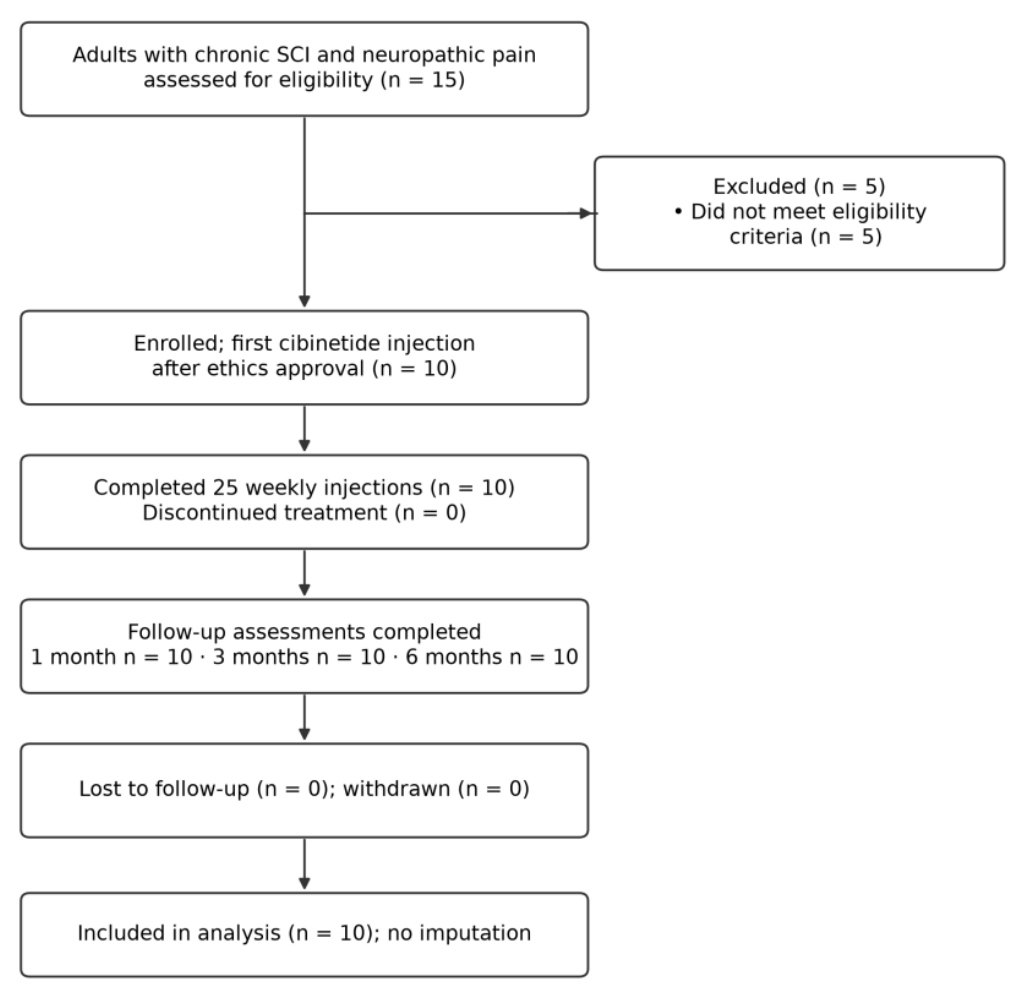
Figure 2.
NRS pain intensity at baseline and at months 1, 3 and 6 (n = 10). Grey lines are individual participants, offset slightly on the horizontal axis because many values overlap. Blue squares and bars show the median and interquartile range, with values labeled. Inferential results are given in Table 3.
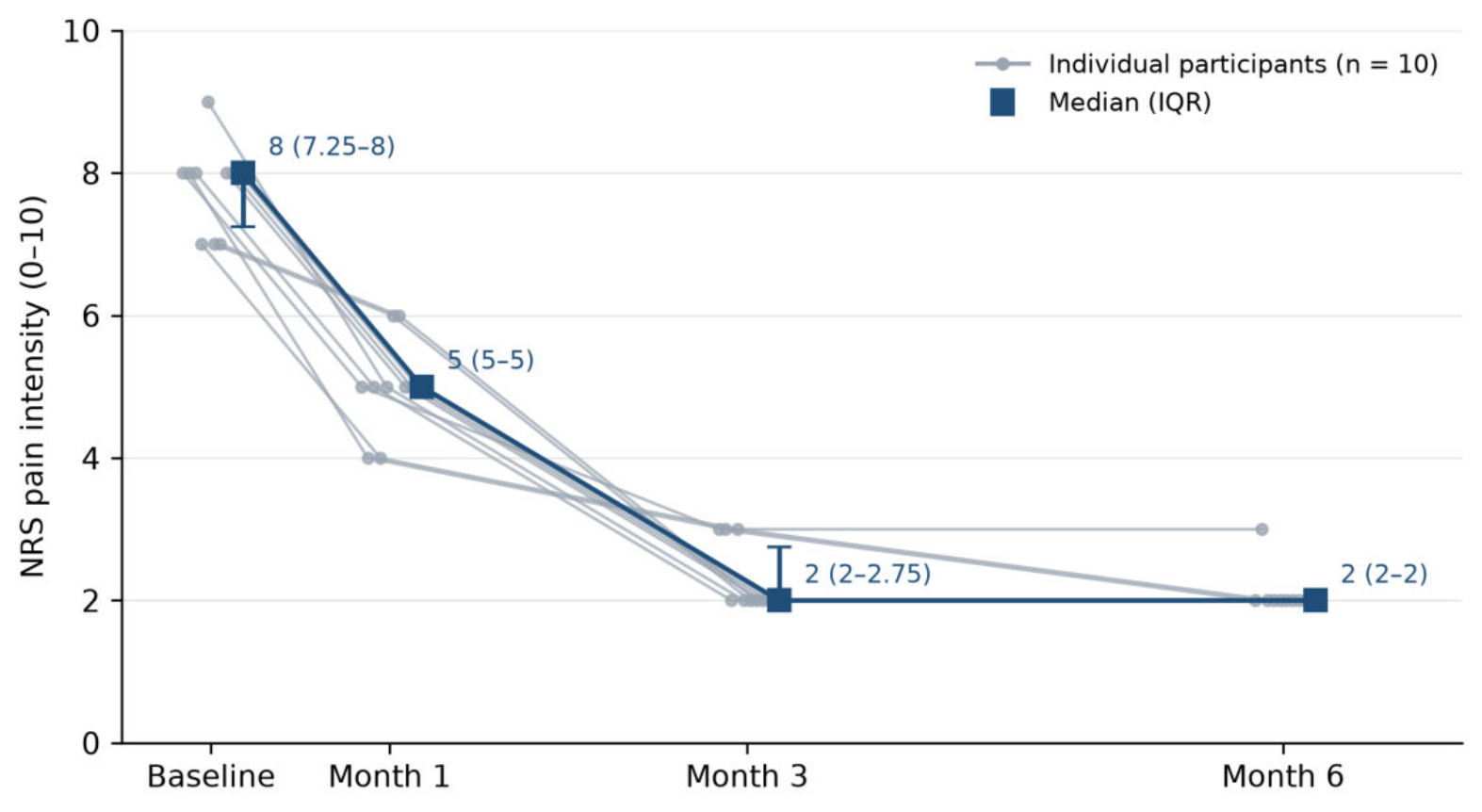
Figure 3.
VAS pain intensity at baseline and at months 1, 3 and 6 (n = 10). Grey lines are individual participants, offset slightly on the horizontal axis because many values overlap. Blue squares and bars show the median and interquartile range, with values labeled.
Figure 3.
VAS pain intensity at baseline and at months 1, 3 and 6 (n = 10). Grey lines are individual participants, offset slightly on the horizontal axis because many values overlap. Blue squares and bars show the median and interquartile range, with values labeled.
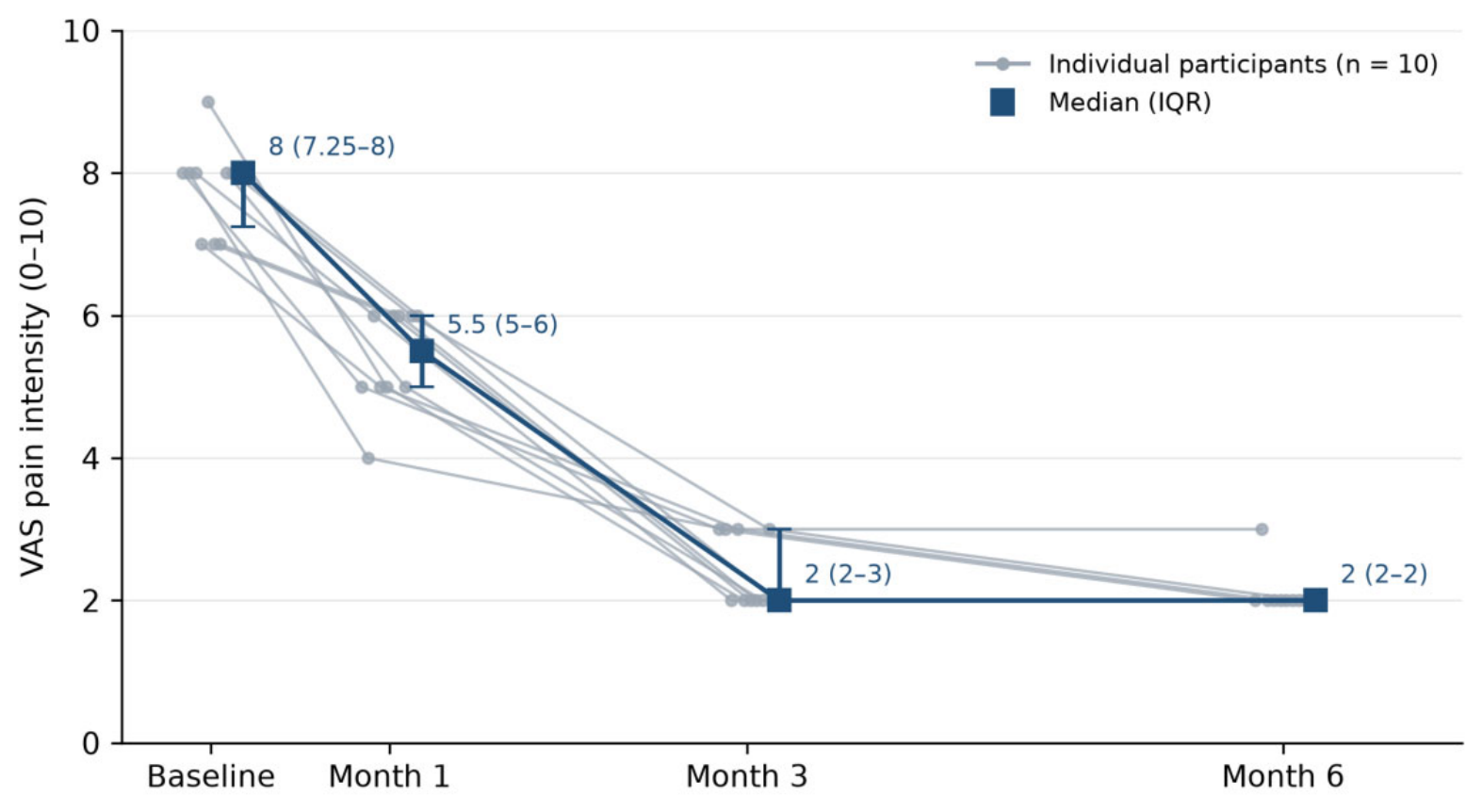
Table 1.
Participant characteristics.
| ID | Age, y / sex | Level; AIS | Time since injury | Pain descriptor | DN4 score | Pain duration | Analgesics at baseline (mg/day) |
|---|---|---|---|---|---|---|---|
| P1 | 34 / M | L2; A | 2 y | Burning | 6 | 2 y | Gabapentin 900; tramadol 100 |
| P2 | 45 / M | T5; A | 5 y | Electric shock | 6 | 4 y | Gabapentin 1200; tramadol 100 |
| P3 | 40 / M | T11; B | 7 y | Stabbing | 7 | 6 mo | Gabapentin 900; amitriptyline 75; oxcarbazepine 600 |
| P4 | 42 / F | C5; A | 9 mo | Stabbing | 5 | 7 mo | Gabapentin 900; tramadol 120; amitriptyline 75 |
| P5 | 38 / M | T12; B | 4 y | Burning | 6 | 3 y | Gabapentin 1200; amitriptyline 75 |
| P6 | 50 / F | T10; A | 10 mo | Burning | 6 | 5 mo | Gabapentin 900; tramadol 100 |
| P7 | 39 / F | L2; B | 18 mo | Burning | 5 | 10 mo | Gabapentin 900; carbamazepine 600 |
| P8 | 44 / M | T8; B | 10 y | Stabbing | 6 | 3 y | Pregabalin 150; tramadol 80 |
| P9 | 52 / M | L1; A | 8 mo | Electric shock | 7 | 6 mo | Gabapentin 900; tramadol 100 |
| P10 | 29 / F | T2; B | 14 mo | Electric shock | 7 | 10 mo | Gabapentin 900; tramadol 100 |
AIS = American Spinal Injury Association Impairment Scale; DN4 = Douleur Neuropathique 4 questionnaire (a score ≥4 suggests neuropathic pain). All doses are total daily doses. Changes in medication during follow-up are summarized in Table 4 and listed for each participant in Appendix B (Table A2).
Table 2.
NRS and VAS pain intensity at baseline and at months 1, 3 and 6 (n = 10 at each visit).
| Visit | NRS median (IQR) | NRS range | NRS mean (SD) | VAS median (IQR) | VAS range | VAS mean (SD) |
|---|---|---|---|---|---|---|
| Baseline | 8 (7.25–8) | 7–9 | 7.80 (0.63) | 8 (7.25–8) | 7–9 | 7.80 (0.63) |
| Month 1 | 5 (5–5) | 4–6 | 5.00 (0.67) | 5.5 (5–6) | 4–6 | 5.40 (0.70) |
| Month 3 | 2 (2–2.75) | 2–3 | 2.30 (0.48) | 2 (2–3) | 2–3 | 2.40 (0.52) |
| Month 6 | 2 (2–2) | 2–3 | 2.10 (0.32) | 2 (2–2) | 2–3 | 2.10 (0.32) |
IQR = interquartile range; NRS = numerical rating scale (0 = no pain, 10 = worst pain imaginable); SD = standard deviation; VAS = visual analogue scale, recorded as a whole number from 0 to 10.
Table 3.
Within-participant changes in NRS and VAS pain intensity.
| Interval | Median change (range) | HL estimate (95% CI) | Mean change (95% CI) | Lower / same / higher, n | Holm-adjusted p |
|---|---|---|---|---|---|
| NRS (primary outcome) | |||||
| Baseline to month 1 | −3 (−4 to −1) | −3.0 (−3.5 to −2.0) | −2.80 (−3.54 to −2.06) | 10 / 0 / 0 | 0.006 |
| Baseline to month 3 | −5.5 (−7 to −4) | −5.5 (−6.0 to −5.0) | −5.50 (−6.11 to −4.89) | 10 / 0 / 0 | 0.006 |
| Baseline to month 6 | −6 (−7 to −5) | −5.5 (−6.0 to −5.0) | −5.70 (−6.18 to −5.22) | 10 / 0 / 0 | 0.006 |
| Month 1 to month 3 | −3 (−4 to −1) | — | −2.70 (−3.46 to −1.94) | 10 / 0 / 0 | Not tested |
| Month 3 to month 6 | 0 (−1 to 0) | — | −0.20 (−0.50 to 0.10) | 2 / 8 / 0 | Not tested |
| VAS (secondary outcome) | |||||
| Baseline to month 1 | −2 (−4 to −1) | −2.5 (−3.0 to −1.5) | −2.40 (−3.17 to −1.63) | 10 / 0 / 0 | 0.006 |
| Baseline to month 3 | −5 (−7 to −4) | −5.5 (−6.0 to −5.0) | −5.40 (−6.00 to −4.80) | 10 / 0 / 0 | 0.006 |
| Baseline to month 6 | −6 (−7 to −5) | −5.5 (−6.0 to −5.0) | −5.70 (−6.18 to −5.22) | 10 / 0 / 0 | 0.006 |
| Month 1 to month 3 | −3 (−4 to −1) | — | −3.00 (−3.75 to −2.25) | 10 / 0 / 0 | Not tested |
| Month 3 to month 6 | 0 (−1 to 0) | — | −0.30 (−0.65 to 0.05) | 3 / 7 / 0 | Not tested |
Changes are the later visit minus the earlier visit, in points. HL = Hodges–Lehmann estimate of the median paired difference, with a distribution-free 95% CI (approximate because of tied values). Mean changes use t-based 95% CIs and are shown for comparison with earlier reports. p values are from exact two-sided Wilcoxon signed-rank tests, Holm-adjusted across the three prespecified comparisons with baseline, separately for each scale. Changes between successive visits are descriptive only.
Table 4.
Analgesic medication at baseline and from month 3 to month 6 (n = 10).
| Medication | Participants at baseline, n | Baseline daily dose | Daily dose from month 3 to month 6 | Participants still taking at month 6, n |
|---|---|---|---|---|
| Gabapentin | 9 | 900 mg (n = 7); 1200 mg (n = 2) | 300 mg (n = 8); 100 mg (n = 1, P6) | 9 |
| Pregabalin | 1 (P8) | 150 mg | 50 mg | 1 |
| Tramadol | 7 (P1, P2, P4, P6, P8, P9, P10) | 80–120 mg | Stopped | 0 |
| Amitriptyline | 3 (P3, P4, P5) | 75 mg | 25 mg (P3, P4); stopped (P5) | 2 |
| Oxcarbazepine | 1 (P3) | 600 mg | Stopped | 0 |
| Carbamazepine | 1 (P7) | 600 mg | Stopped | 0 |
All doses are total daily doses. Reductions were made at month 3 and kept unchanged to month 6. Individual regimens are given in Appendix B (Table A2).
Table 5.
Adverse events and safety assessments over 26 weeks (n = 10).
| Measure | Participants, n (%) |
|---|---|
| Any adverse event | 0 (0) |
| Injection-site reaction (pain, erythema, swelling, induration) | 0 (0) |
| Serious adverse events | 0 (0) |
| Discontinuation or withdrawal due to an adverse event | 0 (0) |
| Completed all 25 injections | 10 (100) |
| Blood investigations after month 3 within normal reference ranges | 10 (100) |
Blood investigations (complete blood count, liver function tests, and serum creatinine) were performed once, after month 3.
Table 6.
Investigational product and administration.
| Item | Details |
|---|---|
| Product | Cibinetide (ARA 290) |
| Supplier | Neuraxes Pharmaceutical |
| Formulation; concentration; vial | Solution; 6 mg/mL; 5 mL (nominal 30 mg) |
| Quality documentation | Certificate of analysis: purity >98%; molecular weight 1257.28 Da; sequence pGlu-EQLERALNSS; GMP-verified laboratory; batch 67893 |
| Storage | 2–8 °C; one vial per participant |
| Route; frequency | Subcutaneous (thigh); once weekly, weeks 0–24 |
| Dose per injection | 0.20 mL (20 units, U-100 insulin syringe) = 1.20 mg |
| Number of injections; cumulative dose | 25; 30.0 mg |
| Administered by | Participant, at home |
Disclaimer/Publisher’s Note: The statements, opinions and data contained in all publications are solely those of the individual author(s) and contributor(s) and not of MDPI and/or the editor(s). MDPI and/or the editor(s) disclaim responsibility for any injury to people or property resulting from any ideas, methods, instructions or products referred to in the content. |
© 2026 by the authors. Licensee MDPI, Basel, Switzerland. This article is an open access article distributed under the terms and conditions of the Creative Commons Attribution (CC BY) license (http://creativecommons.org/licenses/by/4.0/).
Copyright: This open access article is published under a Creative Commons CC BY 4.0 license, which permit the free download, distribution, and reuse, provided that the author and preprint are cited in any reuse.