

Submitted:
21 November 2026
Posted:
24 November 2026
You are already at the latest version
Abstract
Generative virtual patients (VPs) now support medical large language model training, interactive policy optimization, capability benchmarking, safety red-teaming, and clinical education. They are both evaluation objects and measurement instruments: source substrates, demographic distributions, and response policies shape training signals and evaluation conclusions. Their errors are not merely random noise; they may propagate as structured, configuration-dependent bias across the evidence-generation chain. Yet validation studies often assess script fidelity, fluency, inter-rater reliability, or case plausibility without testing how these measurements support downstream decisions. We synthesize evidence along a five-node chain: source substrate, patient information state and response policy, doctor–patient interaction, scoring and outcomes, and downstream decisions. Across this chain, local adequacy alone never licenses cross-setting extrapolation: disclosure policies determine which inquiry capabilities can be elicited, scoring reliability fails to guarantee construct validity, and case-level diagnostic coherence can coexist with population-level epidemiological distortion. Admission-time information loss and public-EHR case recall remain hypotheses requiring targeted audits, while simulated-user performance may fail to predict human interaction outcomes. Increasing the number of independent simulation runs reduces sampling variance but cannot resolve untested discrepancies from target clinical settings. We propose an intended-use validation framework that defines target estimands, tests decision-critical assumptions via paired temporal audits, clinically reviewed perturbations, and task-matched human references, and documents reuse boundaries in an Evaluation Provenance Statement. Before interactive evaluation standards solidify, validating specific simulator configurations for defined inferences—not VP technology in the abstract—is essential for credible medical AI training, benchmarking, governance, and algorithmovigilance.
Keywords:
virtual patient simulation
; argument-based validation
; construct validity
; clinical language models
; interactive benchmarking
; algorithmovigilance
1. Introduction: Rationale and Review Questions
Generative virtual patients (VPs) have evolved from standalone educational tools into core infrastructure across the medical artificial intelligence (AI) lifecycle, functioning as evaluation objects and measurement instruments whose source records, population distributions, and response policies shape upstream alignment signals and downstream evaluation conclusions. Across pipelines, synthetic dialogues expand tuning corpora (NoteChat [1]), dynamic interactions drive self-play reinforcement learning (RL) (AMIE [2]), patient agents expose sequential reasoning and tool use (CRAFT-MD and AgentClinic [3,4]), and autonomous emergency workflows run in HL7 Fast Healthcare Interoperability Resources (FHIR) electronic health record (EHR) sandboxes grounded in histories of present illness (HPIs) (MIRA [5]). Because information boundaries, disclosure rules, and interaction dynamics govern which inquiry strategies a model acquires, which capability differences a benchmark detects, and which hazards remain unobservable, unvalidated simulators can systematically distort medical AI evidence.
Despite this foundational role, existing VP validation practices evaluate isolated simulator properties rather than end-to-end inferential validity, falling into three non-interchangeable categories inherited from Objective Structured Clinical Examinations (OSCEs), psychometrics, Turing testing, and natural language processing (NLP) [6,7,8]. First, content and surface checks—expert review, question-answering (QA) or slot metrics, LLM-as-a-judge ratings, and blinded Turing tests [9,10,11,12]—verify script fidelity or source discriminability [7] rather than behavioural equivalence with real patients or task-appropriate disclosure timing. Second, reliability checks—percent agreement, intraclass correlation coefficients (ICCs), chance-corrected statistics (κ, AC1, α), and human–AI concordance [13,14,15,16]—establish procedural consistency rather than construct validity, neither ruling out evaluator blind spots and rubric-author circularity [17] nor guaranteeing measurement invariance across personas or model families. Third, localized outcome checks—satisfaction, short-term OSCE gains, and static QA gains [18,19,20,21]—show proximal utility in composite packages [20,22], without isolating the VP from feedback scaffolding or licensing LLM certification or population risk estimation.
Compliant clinical content, consistent scoring, and localized task utility do not establish valid interactive measurement when a simulator fails to elicit the target clinical behaviour. Consider two patient agents with identical clinical facts: one volunteers all discriminating symptoms in its opening turn, whereas the other reveals them only after hypothesis-driven questioning. The first allows passive reception and active inquiry to score similarly; the second makes questioning strategy essential to measurement [7,23]. Terminal scoring cannot recover evidence of active inquiry never elicited during interaction.
Consequently, favourable within-simulation metrics frequently coexist with systematic external discrepancies; increasing simulation volume can improve metric precision without correcting those discrepancies. First, interactive benchmarks commonly build VPs from discharge summaries [5,10,24] without auditing whether outcome-guided selection omits admission-time uncertainty, while reusing unperturbed public-EHR parameters may create 'verbatim diagnostic fingerprints' permitting case recall [5]. Second, census and epidemiological audits reveal demographic truncations in default cohorts [25] alongside severity overestimation, attenuated disparities, and classification instability despite diagnostic gating adherence [26]. Third, Bean et al.'s preregistered randomized controlled trial (RCT) found that neither near-ceiling static vignette accuracy nor low-variance simulated-user scores reliably predicted condition identification or triage accuracy when human participants interacted with the models [27].
Here, generative virtual patients (VPs) are systems that generate or enact patient-specific information states and response policies, either through multi-turn patient–clinician or patient–agent interactions or through synthetic consultation dialogues for offline training. We examine their use in medical AI training (including NoteChat [1] and AMIE self-play [2]), interactive capability benchmarking (including CRAFT-MD, AgentClinic, and MIRA [3,4,5]), and safety testing. Health-professions education remains a fourth, distinct intended-use domain because its target examinees and outcomes are human learners rather than AI systems. Static case vignettes and non-conversational text generators are treated as adjacent modalities; studies involving human standardized patients or lay participants provide comparator or external-validity evidence where relevant. Evidentiary directness is assessed at the level of simulator configuration, claim, endpoint, and intended use rather than assigned uniformly to an entire paper.
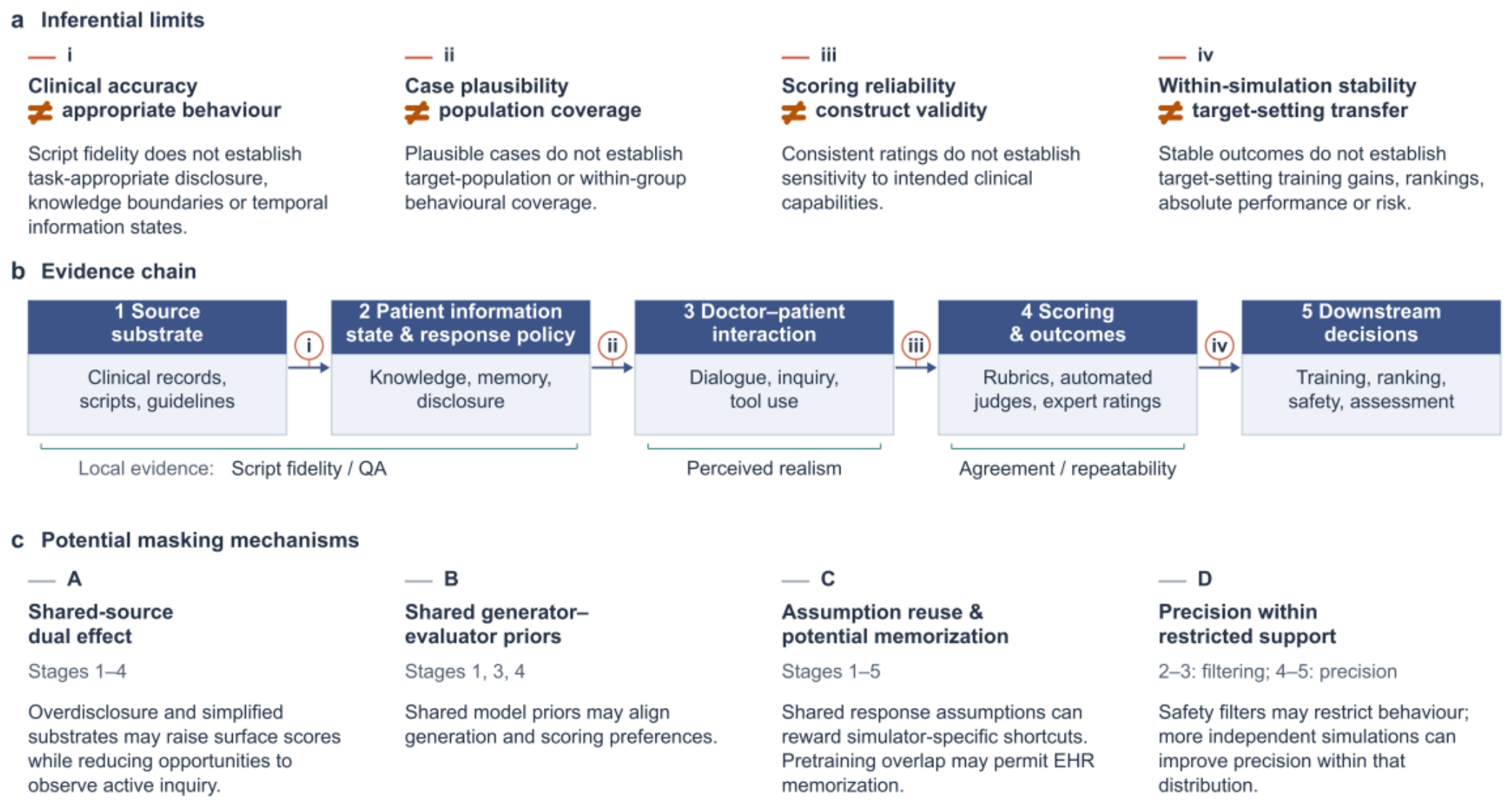
Grounded in unified and argument-based validity theory [28,29,30], this Review examines why local simulator adequacy cannot be assumed to propagate automatically to downstream decisions across a five-node evidence-generation chain: source substrate → patient information state and response policy → doctor–patient interaction → scoring and outcomes → downstream decisions. Whereas recent work addresses readiness-claim governance [31] and robustness-test plausibility [32], we focus upstream on the simulator as a training and measurement instrument. We examine (1) four cross-node inferential breakpoints (Fig. 1a,b); (2) four surface-score masking mechanisms (Fig. 1c); (3) observed versus hypothesized downstream consequences; and (4) an intended-use validation workflow, orthogonal auditing protocol, and Evaluation Provenance Statement.
2. Methods: Evidence Identification and Narrative Synthesis
This critical narrative review used purposive, question-led identification of empirical and foundational sources—mapped to the six quality domains of the Scale for the Assessment of Narrative Review Articles (SANRA) [33] (Supplementary Table S4)—to examine validity inferences across a five-node evidence-generation chain rather than estimate field-wide prevalence or pool heterogeneous effect sizes. Reproducible PubMed Boolean searches executed on 5 November 2026 UTC across six clinical AI queries (Q1–Q6; January 2020–November 2026; 2,829 unique PMIDs) and one foundational validity-theory query (F1; from inception; 1,723 unique PMIDs) yielded 4,550 unique records overall, achieving 100% (20/20) recovery against a diagnostic sentinel set after conceptual query refinement (Supplementary Methods S1; Supplementary Table S1–S3).
Targeted lookups across the ACL Anthology, arXiv, medRxiv, and backward/forward citation tracking supplemented database retrieval. From retrieved and tracked sources, 123 references were purposively selected for relevance to simulator behaviour, construct-sensitive scoring, human comparators, downstream decisions, and foundational validity theory; publication-type distributions are detailed in Supplementary Table S5, with unrefereed preprints explicitly flagged throughout the synthesis so that provisional findings are not conflated with peer-reviewed evidence. Because this review follows a purposive narrative design rather than a systematic review, retrieved records did not undergo duplicate exhaustive eligibility screening or formal primary-study risk-of-bias scoring. Instead, cited studies were appraised across four qualitative dimensions—study-design and comparator credibility, evidentiary directness to the target claim and endpoint, between-study consistency (without treating heterogeneous or overlapping corpora as independent replications), and preprint sensitivity—synthesizing 68 claim–source links across 50 distinct references into eight claim-level evidence profiles (EP01–EP08; Supplementary Table S8).
3. Results: Applications and Validation Requirements
Although generative VPs share overlapping architectures across synthetic corpus construction, interactive policy optimization, capability benchmarking, safety auditing, and clinical education [34,35], their target estimands and downstream decisions differ fundamentally, rendering generic local metrics insufficient to establish cross-node validity (Table 1) [6,8].
3.1. Synthetic Data and Policy Training
In upstream model development, VPs serve as scalable engines for synthetic instruction tuning and self-play policy alignment, yet current validation practices assess internal text quality or static question-answering (QA) gains rather than generalizable interactive competence (Table 1 and Table 2). Patient agents generate notes, knowledge graphs, and dialogues for fine-tuning [1,11,21,36,37,38,39,40], and provide RL and self-play environments (AMIE [2]; Baichuan-M2 [41]). Studies validate these corpora via knowledge-graph fidelity [10], LLM-as-a-judge scoring [36], automated pass rates [37], and uncalibrated clinician authenticity ratings (which cannot establish equivalence without prespecified margins), alongside static MedQA and MMLU gains [21].
However, local note plausibility and static QA gains do not establish dynamic consultation capabilities, and unvalidated simulator distortions risk encoding structural biases into upstream alignment weights. While synthetic corpora need not achieve universal realism for bounded tasks such as summarization, NoteChat [1] illustrates how generating consultations from retrospective clinical notes requires explicit control over conversational information flow: its authors identified unnatural note copying and role-inappropriate information disclosure in baseline generation, and introduced role-specific prompting and dialogue refinement to mitigate these artefacts. Without state–disclosure decoupling, cooperation bias [42,43], demographic collapse [25], and stereotypes [44] can enter supervisory targets and RL rewards [25,36], risking alignment toward passive reception over active inquiry—an untested weight-level pathway. Moreover, AMIE bundles simulators with critic feedback and compute scaling, preventing isolated attribution [2], whereas prompts curbing cooperation bias risk over-correction [45]. Validation thus requires corpus- and compute-matched controls, external transfer benchmarks, and ablations decoupling patient policies from critic feedback.
3.2. Clinical Capability Benchmarking
As static medical QA benchmarks saturate, multi-turn VP benchmarks expose sequential consultation deficits that static QA misses, yet the rankings and readiness inferences they support depend on simulator disclosure and scoring policies (Table 1). Interactive VPs anchor general consultation [3,46,47,48,49], knowledge-graph and multi-agent [50,51,52,53], multimodal [4,54], and partial-observability suites [55,56], plus emergency workflows in FHIR sandboxes (MIRA [5]). Sequential consultation proves far harder than static QA: accuracy can drop below one-tenth of MedQA levels in AgentClinic [4], frontier models complete 60.4% of rubric items in MedSP1000 [46], and active evidence-seeking reduces accuracy by 12.75% and evidence quality by 24.36% [23], with corroborating MIMIC-IV drops [24]. To support rankings or readiness claims [5], benchmarks validate simulators primarily via local checks—script consistency and leakage audits [5,9,10], grading concordance [5,13,16,38,57,58], stability [13], and realism ratings [11,59].
Yet local script fidelity and grading reliability cannot guarantee valid model rankings or readiness conclusions, which remain vulnerable to observed patient-behaviour distortions, untested source-record shortcuts, and dissociations between diagnosis and safe management (Table 2). Interaction audits show that cooperation and positivity bias [42,43,60], leading-prompt acquiescence [61], and unscripted confabulation [62] distort trajectories, while unprompted disclosure of symptoms requiring targeted inquiry induces ceiling compression [63,64]. Public-EHR benchmarks rarely audit whether unchanged parameters may permit case recall or whether discharge HPIs may omit admission-time uncertainty [5]. Furthermore, high diagnostic accuracy can mask unsafe management: >91% inclusion of multiple sclerosis in the differential diagnosis coexisted with unsafe steroid dosing and erroneous thrombolysis (preprint [65]); near-perfect full-history headache diagnosis paired with unsafe sparse-history triage and missed subarachnoid haemorrhage lumbar punctures (preprint [66]); and in 16 simulated postoperative facelift and neck-lift presentations, ChatGPT achieved 88% accuracy (15/17 scored diagnostic items) in identifying the most likely diagnosis after history-taking but only 56% accuracy (9/16 cases) in recommending the appropriate disposition, overestimating urgency in 44% of cases [67]. Because persona shifts [12], disclosure gating [7,68,69,70], and scoring setups [4,49,71] can alter discrimination or rankings, benchmarking requires negative controls [63], parameter-by-disclosure perturbations [5,7,12], variance (σ²) audits [49], and human calibration [5,27].
3.3. Safety and Risk Evaluation
In safety auditing, adversarial VP red-teaming can establish existence proofs of high-severity failure modes without demographic representativeness, whereas conditional failure rates reflect prompt-specific priors rather than clinical injury incidence (Table 1 and Table 2). Stress-testing personas expose vulnerabilities across three fronts: (1) compliance hazards, including psychotherapy delusion reinforcement ('AI psychotic co-rumination') and de-escalation failures [72] alongside bimodal acquiescence (0%–100%) to emergency persuasion (SycoEval-EM [73]); (2) reasoning and safety blind spots, spanning cognitive-bias degradation [74], >60% contradictory-history detection failure [45], missed contraindications (RxSafeBench [75]), and upgrade regressions [76]; and (3) demographic disparities, including anti-LGBTQIA+ bias [77], item response theory (IRT)-verified ethical degradation toward older patients [78], and elevated female headache unsafe triage (OR = 3.2) [66].
By contrast, translating conditional simulation failures into quantitative population risk estimates requires calibrating epidemiological exposure and workflow interception across three structural barriers. Kalinich et al. showed that hazard progression (P₁, 1.1 × 10⁻⁸ to 1.6 × 10⁻⁴) and conditional harm progression (P₂, 4.9 × 10⁻⁵ to 5.1 × 10⁻³) span orders of magnitude depending on exposure and harm-pathway assumptions [79], while related pipelines align with the NIST AI Risk Management Framework [80] or deploy failure detectors (BehvJudge F1 = 0.96) [81]. Extrapolating simulated risk to hospital populations faces three barriers: (1) safety filters and contamination create blind spots—GPT-4o blocking yielded 0% homicidal-risk conformity in bipolar simulations [14], and contamination reduced slot F1 from 0.947 to 0.098 with leakage [9]; (2) DSM-5 gating adherence coexists with severity overestimation and threshold instability [26]; and (3) smooth AI–AI dynamics fail to predict human–AI triage [27,72,82]. Risk estimation thus requires epidemiological calibration [25,26], human controls [27], and workflow modelling [5,24,79].
3.4. Medical Education and Skills Assessment
Across health professions education, VPs provide scalable practice for history-taking, communication, and OSCE preparation [83,84,85], yet empirical evidence remains confined to learner reactions (Kirkpatrick Level 1) and short-term simulation gains (Level 2) rather than workplace behaviour (Level 3) or patient outcomes (Level 4) (Table 1 and Table 2). Single-centre pilots assess Level 1 usability and confidence across medical [18,86,87,88,89,90,91], dental and pharmacy [92,93,94], psychotherapy [95,96], and specialty or culturally adapted training [97,98,99,100,101,102,103]. Small RCTs report Level 2 gains primarily when VPs are bundled with structured feedback [19], GPT practice [20], ophthalmology cases [22], multi-agent scaffolding [104], or SOPHIE feedback [105], while pilot and historical-control evaluations document feasibility [69,106] with reported token expenditures of US$0.51–0.725 per session [61,68] versus ~US$52.95 for human standardized patients (SPs) [68].
However, these short-term composite gains neither isolate the pedagogical effect of the VP from feedback scaffolding nor license summative clinical certification or bedside transfer (Kirkpatrick Levels 3–4). Existing RCTs combine VP practice with feedback or rely on retrospective registration [19,20,22,105], while non-significant OSCE differences against human SPs in small or pilot trials—including a Phase 2 three-arm randomized pilot (n = 58) in which self-efficacy differences also did not survive multiplicity correction [69]—cannot establish equivalence or non-inferiority without prespecified margins [68,69]. Self-assessments do not correlate with observed management [107], and automated grading shows score inflation [8,63], run-to-run rating variability, overly positive feedback omitting deficits [61], and rubric-author circularity [17]. In controlled comparisons, AI VPs trailed actors in perceived gains [108], showed no advantage over video instruction [95], and yielded divergent multi-site OSCE effects (d = 0.75 versus null) [109], while model choice explained far less variance than the learner-skill condition in Phase 1 simulated consultations (η² = 0.06 versus 0.31) [69] alongside usability gaps [110]. Reviews confirm that only 13% (3/23) of user-experience studies used pre-existing validated tools (with three others reviewing self-developed scales) [83], non-verbal and physical cues remain absent [106,111,112,113,114,115,116], no reviewed studies reported Level 3 or 4 outcomes [6,112,117], and cohorts were small (median N = 21) [117]—requiring decoupled human-SP endpoints [20,22,105], factorial separation of practice and feedback [69,95,108], and longitudinal tracking [109,117] (Table 1).

Table 1.
Application landscape, target estimands, current validation practices, and uncorroborated inferential leaps for generative virtual patients.
Table 1.
Application landscape, target estimands, current validation practices, and uncorroborated inferential leaps for generative virtual patients.
| Intended application domain | Downstream decisions & target estimands | Mainstream validation practices (local properties, reliability & surface gains) | Uncorroborated cross-node inferential leaps | Most direct comparative designs to bridge leaps |
| 1. Synthetic data generation and interactive policy training [1,2,21,36,37,41] | • Adopting fine-tuning corpora: Fine-tuning models on synthetic notes or dialogues to estimate generalizable training effects on target clinical tasks [21,38] • Interactive policy alignment: Optimizing active history-taking and sequential decision-making in independent clinical environments via multi-turn self-play or RL [2,41] |
• Named-entity and knowledge-graph construction fidelity (e.g., KG F1 = 0.89) [10] • Textual fluency, blinded clinician authenticity assessment, and expert usability ratings [21,37] • Multidimensional penalty-based internal quality scoring via LLM-as-a-judge [36] • Pre- vs. post-fine-tuning score gains on static QA benchmarks (MedQA/MMLU) [21] |
• Do training gains on static QA or documentation tasks extrapolate to dynamic consultations requiring active evidence-seeking and patient resistance resolution [1,23]? • To what extent are performance gains in composite training pipelines attributable to the patient simulator itself versus automated feedback mechanisms and compute scaling [2]? • Do demographic variance collapse and cooperation bias in synthetic cohorts induce upstream training pollution [25,44,45]? |
• Budget-matched training controls: Fixing data volume and compute token budgets to compare training effects across synthetic corpora with varying disclosure gating and demographic distributions • Independent external transfer evaluation: Measuring generalization on real clinical records or human interactive tasks decoupled from the training simulator's generative priors • Orthogonal training component ablations: Separating patient response policies from automated evaluator feedback, corpus size, and compute scaling |
| 2. Clinical capability benchmarking [3,4,5,46,47,48,49] | • Relative performance ranking: Estimating inter-model performance differences among candidate models to guide model selection [49,71] • Absolute capability assessment: Judging how a model's task-level performance compares with clinician cohorts or expert-defined standards [5,24,46] • Downstream clinical-readiness claim: Determining whether the available evidence supports a specified clinical workflow or deployment decision—a use-specific decision claim rather than a standalone benchmark estimand—requiring additional population-, workflow-, and risk-matched validation beyond benchmark scores |
• Paraphrase response consistency (99.4%) and 0% observed premature diagnostic disclosure in audited MIRA encounters [5], alongside script consistency and slot-filling F1 [9,46] • Concordance between automated graders/LLM juries and clinical expert ratings (ICC/κ/F1) [5,13,16,38] • Cross-session coefficients of variation (CVs) and perceived dialogue naturalness ratings [11,13,59] |
• Do post-diagnostic discharge summaries omit admission-time symptoms and uncertainty, and do exact parameters from public EHRs create memorization shortcuts that inflate scores—requiring paired substrate audits and contamination controls, respectively [5]? • Does ceiling compression from patient over-cooperation attenuate discrimination, and does high diagnostic accuracy mask model-specific unsafe triage downgrades under incomplete history (up to 54.8%) or erroneous thrombolysis in static synthetic cases (6.4%–9.6%) [63,65,66]? • Do shifts in patient disclosure thresholds and communication personas alter between-model variance (σ²) or invert model rankings [7,12]? |
• Paired substrate auditing & clinically reviewed construct-preserving parameter perturbations: Comparing admission-note versus discharge-summary substrates and applying construct-preserving perturbations and boundary-crossing counterfactual flips to continuous physiological parameters [5] • Factorial crossing of inquiry probes & disclosure policies: Manipulating information gating and HEXACO personas to test scoring discrimination across focused, generic, and leading inquiry probes [7,63,68,69] • Independent human reference calibration: Benchmarking diagnostic and management decisions against trained human SPs, real participants, or independent physician cohorts [5,27] |
| 3. Safety testing and risk evaluation [14,26,65,72,73,79,80] | • Qualitative hazard discovery: Identifying plausible high-severity failure modes via red-teaming and estimating conditional failure rates under specific stress conditions [45,72,73] • Quantitative population risk estimation: Estimating expected population risk and subgroup fairness in target clinical populations post-deployment [78,79,80] |
• Guideline-discordant acquiescence and error rates under patient pressure, cognitive bias, or contradictory information [45,73,74] • Expert construct conformity for psychiatric crisis and high-risk personas (Gwet's AC1 / MMASP) [14,72] • Large-scale synthetic screening and automated hazard detectors (e.g., BehvJudge F1 = 0.96) [65,81] |
• Without demographic and epidemiological exposure calibration, how can conditional failure rates under specific prompt priors be extrapolated to real-world hospital population risk [25,26]? • Do commercial safety guardrails blocking high-risk expressions (e.g., 0% homicidal-risk conformity in bipolar simulation) and opposing script-versus-portrayal biases create evaluation blind spots [14,44]? • Do smooth interactions arising from shared linguistic priors in AI–AI simulations mask safety failures occurring in real human–AI interactions [27,72]? |
• High-risk construct expressibility & contamination audits: Quantifying safety-filter blocking rates for crisis constructs and measuring prohibited-information leakage under instructional contamination [9,14] • Stage-decoupled bias auditing & exposure calibration: Separating static script generation from dynamic portrayal biases and calibrating against census and NHANES epidemiological distributions [25,26,44] • Joint modelling of human interaction & workflow interception: Comparing AI–AI versus real human interaction outcomes in parallel and integrating clinician workflow interception rates to calibrate two-stage risk conversion probabilities (P₁ and P₂) [24,27,79] |
| 4. Medical education and clinical skills assessment [19,20,22,68,69,104,105,108,109] | • Tiered educational outcomes: Distinguishing (1) subjective practice satisfaction and self-efficacy [18,86]; (2) short-term objective assessment (OSCE) skill gains and controlled comparisons against human SPs [19,20,22,68,105]; and (3) long-term transfer to bedside behaviour (Level 3) and patient outcomes (Level 4) [117] | • Post-session learner self-report scales (Likert satisfaction, comfort, SUS, TAM, SSE) [18,95] • Within-simulation automated checklist grading and feedback quality ratings [13,61] • Blinded OSCE or standardized communication/history-taking score comparisons in single-centre short-term RCTs [19,20,22,69,105] |
• Why do learners' subjective self-assessments lack statistically significant correlation with observed clinical case management performance [107]? • Do overly positive automated feedback (23.3%), omission of behavioural strengths/weaknesses (22.8%), and closed-loop rubric authoring by the same expert team undermine summative assessment validity [17,61]? • Why do short-term single-centre OSCE gains diverge across institutions, and can learners avoid formulaic checklist adaptation to achieve real bedside transfer (Levels 3/4) [109,112,117]? |
• Multi-arm pedagogical factorial trials: Orthogonally separating the independent effect sizes of 'VP interaction', 'structured instructor feedback', and human actor/video/reading using analyses matched to the intended comparison [69,95,105,108] • Decoupled independently blinded objective endpoints: Replacing subjective self-reports and homologous AI grading with human SP or real-patient consultations evaluated by independent blinded clinicians [17,20,22,105] • Cross-institutional & longitudinal clinical rotation tracking: Evaluating multi-site curricular robustness and long-term bedside behavioural retention during clinical clerkships [109,117] |
4. Critical Synthesis: Where Validity Arguments Fail
Synthesizing the literature across all four intended uses, the reviewed evidence provides stronger support for bounded, task-specific outcomes than for downstream clinical or educational transfer (Table 2; Supplementary Table S8). Synthetic dialogue generation and self-play demonstrate engineering utility in specific training settings, although the independent contribution of the patient simulator remains unresolved in composite pipelines [1,2,21]. Interactive benchmarks expose sharp limitations in sequential clinical inquiry, but local script fidelity and scoring reliability do not alone establish construct validity, human-interaction transfer, or clinical readiness [3,4,5,7,23,27]. Safety simulations effectively uncover conditional failure modes without directly estimating real-world population harm [72,73,79]. In medical education, controlled studies support short-term formative benefits—primarily when paired with structured feedback—whereas evidence for sustained workplace behaviour (Kirkpatrick Level 3) and patient-outcome improvements (Level 4) remains absent in the reviewed syntheses [19,20,22,117]. Overall, evidentiary directness, independent corroboration, and publication maturity vary substantially, particularly where conclusions rely on unrefereed preprints or bundled interventions. These boundaries constrain the downstream claims licensed by current evidence rather than negating the demonstrated utility of VPs for bounded purposes.
Across the four application domains in Section 3, existing studies validate isolated properties within individual nodes of the evidence chain without directly testing cross-node validity propagation; below, we deconstruct the four structural breakpoints where this inferential chain fails (Fig. 1a,b).
4.1. Clinical Accuracy Versus Patient Behaviour
Between source substrates and interactive portrayal (breakpoint i), script-level factual consistency does not guarantee construct-aligned patient behaviour, because default cooperation bias and unscripted confabulation distort clinical inquiry from two opposing directions. History-taking unfolds under partial observability [55], constrained by knowledge boundaries, memory recall, and trust or resistance. Without decoupled state and disclosure controls, oversharing and cooperation bias prompt VPs to volunteer discriminating features early [1,7], exhibit atypical wording or verbosity (51.7% of sessions) and over-agreeableness (31%) [61], generate motivational interviewing change talk nearly twice as often as real patients [42], and converge toward positive valence [43,60]—blunting discrimination between focused inquiry and passive reception [23,56]. Conversely, under unscripted follow-ups or contamination, VPs confabulate: 842/860 answers (97.9%) were rated as plausible, yet 110/195 responses (56.4%) to questions not covered by the case script drew on fictitious information [62], alongside memory gaps [64] and symptom fabrication despite high accuracy [15,100].
At the source-record level, constructing VPs from post-diagnostic clinical narratives may alter action–information dependencies by omitting presentation-time uncertainty—a testable mechanism we term the retrospective substrate bias (RSB) hypothesis. Many benchmarks build VPs from discharge summaries [1,5,10,24,47,70]: for features X and state history S up to time t, admission records represent draws from P(X | S ≤ t), whereas discharge records represent draws from P(X | S ≤ t, D) conditioned on diagnosis D. Audits confirm that discharge summaries omit diagnostic process details and inpatient delirium [118,119]; if an admission-time cue was omitted during retrospective authoring, a masking operator M deleting diagnostic terms cannot recover it. High consistency and zero observed premature diagnostic disclosure in MIRA [5]—or persistent baseline leakage (~0.60 events/episode) under uncontaminated conditions [9]—cannot verify whether source documents preserved admission-time uncertainty, requiring paired pre- and post-diagnostic audits and tiered disclosure controls [7,49,68,69,120].
4.2. Case Plausibility Versus Population Coverage
Between patient state design and population-level inference (breakpoint ii), individual case plausibility cannot establish target population coverage, as realistic single cases can coexist with demographic truncation and symptom-epidemiological distortion (Table 2). Benchmarking default GPT VPs against UK census data revealed deviations across all variables (χ² p < 0.0001), including 0% aged <25 years, 64.7%–92.8% male predominance, and skewed minority proportions [25]. Keough's preprint audit against US NHANES PHQ-8 microdata showed a 'coherence–fidelity dissociation': 97.3% DSM-5 gating adherence among elevated profiles coexisted with PHQ-8 overestimation by 2.8–5.5 points, attenuated or inverted racial disparities, and resampling threshold crossings [26]. EHR-derived benchmarks (MIMIC-III/IV) likewise inherit setting-specific sampling and case-selection constraints, requiring distributional audits against a declared target population [10,84].
Second, neither prompt-level demographic balancing nor post hoc statistical reweighting restores within-group behavioural variation or prevents opposing biases across generation stages from cancelling in aggregate scores [21]. In a factorial pre-exposure prophylaxis (PrEP) preprint audit, demographic prompts triggered stereotypical sexual-history scripts and tightly coupled educational attainment to socioeconomic status (adjusted R² = 0.59), while static script generation and dynamic portrayal produced opposing effects that partially cancelled in composite outputs [44]. PSI-Bench similarly showed compressed emotional variability despite diverse personas [60], whereas persona shifts (anxious versus cursory) altered over-triage by >13 percentage points [12] and VP age or language shifted ethical scores [78]. Coverage validity must therefore be anchored to a reference population's joint demographic, clinical, and behavioural distributions [5,7,25,26].
4.3. Scoring Reliability Versus Construct Validity
Between interaction trajectories and evaluation scores (breakpoint iii), high inter-rater reliability (ICC, κ, AC1, α) or human–AI grading concordance establishes procedural scoring consistency rather than construct validity, and on oversharing simulators merely reproduces scores that fail to measure active inquiry. In OSCEs, checklist validity requires SPs to gate information so items trigger only upon appropriate questioning [8,85]; without gating, clinician and automated graders [13,16,38] assign concordant near-perfect scores to passive reception. Complementary audits illustrate how high local ratings fail to establish construct validity: >96.7% multi-agent SP competence coexisted with a 3.7-fold disparity in misleading outputs and GPT-4o ranking lowest in retrieval despite highest surface consistency [63]; SimSUM paired 4.92/5 mean accuracy ratings with low inter-evaluator prompt-consistency agreement (Krippendorff's α = 0.44) and 41 cumulative penalties across evaluators for violating additional instructions [15]; and PatientsWithPersonality combined personality control with selective disclosure to curb oversharing and improve realism ratings, without establishing population behavioural equivalence (Table 2) [7].
Similarly, uncalibrated LLM-as-a-judge grading is vulnerable to rubric-author circularity, homologous self-preference, and weak integrative discrimination, requiring explicit clinical criteria, paired symmetry testing, and process-sensitive behavioural coding to support bounded validity arguments. Automated judging degrades on integrative reasoning relative to recall [58], shows limited clinician concordance [11,59], and yields inconsistent automated ratings across runs [61], while human benchmarks can be compromised when checklist authors grade dialogues [10,17]. Shared priors also risk self-preference [63], while frontier judges detect AI dialogues at 61.9%–81.9% accuracy versus 55% for humans [12] (reflecting sensitivity to AI statistical signatures rather than direct proof of preferential scoring) alongside feedback positivity inflation [8,61]. Conversely, bounded validity evidence emerges when judges use explicit criteria (BehvJudge F1 = 0.96) [81], paired symmetry testing (no detected asymmetry in a 37-patient MIRA subsample, McNemar p = 1.00, albeit with limited discordant-pair power) [5], or IRT/CFA calibrations [78], and when rubrics target reasoning: voice-VP scoring showed moderate faculty agreement (ICC[1,2] = 0.51; lower for communication) [121], whereas process-sensitive codes (κ ≥ 0.85) linked reasoning more consistently than routine questioning to outcomes (Table 2) [122].
4.4. Within-Simulation Stability Versus Target Transfer
Between simulation scores and downstream decisions (breakpoint iv), statistical stability across thousands of synthetic runs [26,48,65] or low cross-session variation (CV < 1.2% [13]) can improve precision for simulator-specific estimates without reducing structural discrepancies relative to clinical settings. When simulators truncate demographic strata [25], block crisis constructs via safety filters [14], omit non-verbal and physical modalities [83,106,113], or smooth pragmatic friction via shared AI priors [64,72], reducing internal variance cannot establish external accuracy.
Consequently, within-simulation performance cannot be extrapolated without independent verification across four external transfer targets: clinical workflow and bedside behaviour, cross-configuration model rankings, real human-user interactions, and hospital population risk (Table 2). First, transfer to workflows [24] or Kirkpatrick Level 3/4 care cannot be assumed from static QA [21], short-term OSCE studies [19,20,22,105,109], or educational reviews [112,114,115,117]. Second, rankings shift across platforms, personas, and cognitive biases [4,12,49,71,73,74]. Third, simulated-user scores may fail to predict real human interaction outcomes: in Bean et al.'s preregistered general-public health-consultation RCT involving UK adult lay participants (N = 1,298)—evaluating consumer medical-assistant use rather than clinician-facing consultation or learner assessment (Table 2)—standalone vignette testing and 300 simulated-user dialogues across three assistant models and 10 scenarios (10 runs per scenario; mean condition identification 60.7% ± 5.5%, mean disposition accuracy 57.3% ± 5.6%) failed to predict human-assisted performance, yielding condition identification worse than controls using routine resources (<34.5%), disposition accuracy no better than controls (<44.2%), and only a weak scenario-level linear regression slope for disposition in the GPT-4o assistant arm (β = 0.33 ± 0.25; no reliable scenario-level association for condition identification) [27]. Fourth, synthetic error rates [16,65] require calibration against prevalence, exposure [26], and workflow interception [5,24].
5. Why Favourable Evaluations Conceal These Gaps
Favourable local metrics—high QA accuracy and dialogue competence [5,10,63], inter-rater reliability [13,90], perceived realism [61,89], and cross-run stability [48,65]—frequently fail to expose downstream invalidity because, without orthogonal controls, four mechanisms can inflate surface scores, attenuate sensitivity to target clinical constructs, or increase precision without improving target transfer (proposed mechanisms A–D; Fig. 1c).
5.1. Shared-Source Score Inflation and Construct Attenuation
First, under the proposed shared-source score-inflation pathway (mechanism A), cooperation bias, premature symptom volunteering [1,7,43], and potential retrospective substrate simplification can simultaneously inflate surface checklist scores while suppressing active inquiry through four effects: (1) reduced ambiguity and resistance elevate fluency and realism [11,45,61,64]; (2) unprompted volunteering enables checklist completion without hypothesis-driven follow-up [8,46]; (3) premature feature release eliminates sequential evidence-seeking [23,66]; and (4) unconditional disclosure prevents hidden-concern elicitation [55] and resistance resolution [45] from being tested. Observed ceiling compression, poor discrimination, and drops under gated disclosure [23,42,60,61,63,66] are consistent with this pathway, although establishing its joint causal weight requires factorial testing.
5.2. Shared Generator–Evaluator Assumptions
Second, shared generator–evaluator assumptions (mechanism B) may arise in closed-loop pipelines where related models govern case generation, VP portrayal, doctor agents, and judges [16,38,57,63,123]. Within homologous ecosystems, generators and VPs can organize narratives around LLM-favoured logic [61], enabling candidate agents to decode intentions with reduced friction [72] and judges to reward outputs aligned with their own priors. This proposed coupling accords with reported self-preference [63] and weak human–LLM concordance [11,59]—paralleling circular human rubric authoring and grading [10,17]—whereas judge detection of AI dialogues (61.9%–81.9% versus 55% for humans) reflects sensitivity to AI statistical signatures [12]. Breaking this loop requires explicit criteria, paired symmetry testing [5,81], cross-family judging, and independent clinician references.
5.3. Assumption Reuse and Case-Recognition Shortcuts
Third, unexcluded pretraining overlap with public EHRs and reused response assumptions across training and evaluation (mechanism C) may allow models to achieve high benchmark scores via case recall or simulator-specific shortcuts rather than generalizable reasoning. Benchmarks frequently reuse public databases (MIMIC-III/IV) [4,5,10,24] whose pretraining inclusion cannot be ruled out [5]; even under surface perturbations [4,5], unchanged medications or laboratory values returned by FHIR interfaces may form 'verbatim diagnostic fingerprints' [5] permitting case recall—requiring overlap and perturbation audits. Even without overlap, reusing cooperative assumptions across training [1,2,21,41] and evaluation may reward simulator-specific heuristics. Failures under persuasion [73], contradictory histories [45], cognitive biases [74], contraindications [75], incomplete histories [24,66], or human interaction [27] demonstrate interaction and evaluation vulnerabilities without establishing this pathway, requiring matched ablations.
5.4. Simulation Volume Versus External Calibration
Fourth, under an independent-run approximation, increasing simulation sample size N narrows confidence intervals at a rate proportional to 1/√N [13,48] (mechanism D), improving internal precision without reducing discrepancies between a fixed simulator distribution and the target clinical setting. Additional runs under a truncated or skewed configuration (Section 4.2, Section 4.3 and Section 4.4 [14,25,26,27,44,66]) merely increase precision for a simulator-specific estimand that may differ from the target clinical estimand; while large-scale screening expands existence proofs for rare failures [65], volume cannot substitute for epidemiological and workflow calibration.
Figure 1.
Inferential limits and potential masking mechanisms in generative virtual-patient evaluation. (a) Four inferential limits separate local simulator properties from downstream claims: clinical accuracy does not establish appropriate patient behaviour; case plausibility does not establish population coverage; scoring reliability does not establish construct validity; and within-simulation stability does not establish transfer to target settings. (b) Evidence is generated across five stages: source substrate; patient information state and response policy; doctor–patient interaction; scoring and outcomes; and downstream decisions. Teal brackets indicate commonly reported local evidence, and terracotta barriers mark the four inferential limits. (c) Four proposed mechanisms may conceal these limits: overdisclosure and simplified source records (A); shared assumptions between generators and evaluators (B); reuse of response assumptions and possible case recognition (C); and increased precision within a restricted simulated distribution (D). These mechanisms are hypotheses to be tested, not established causal effects.
6. Downstream Consequences by Intended Use
Simulator component deficits cause downstream inferential errors only when unverified simulation outputs enter decision logic for model alignment, selection, safety certification, or educational credentialing; evaluating these consequences requires distinguishing observed measurement distortions from cross-node causal hypotheses awaiting transfer experiments (Table 2).
6.1. Training and Policy Optimization
When VPs generate fine-tuning corpora [1,21,36,38] or drive RL and self-play alignment [2,41], unvalidated disclosure distortions and cohort truncations can enter supervisory and reward signals, generating three testable upstream alignment-pollution hypotheses. First, training on retrospective substrates or oversharing VPs (Section 4.1) [1,7,42,43,61] may reward passive reception over active inquiry [23] and hidden-concern reasoning [55]. Second, closed-loop rewards may reinforce confabulation [62] or positivity convergence [60], encouraging acquiescence under pressure [73]. Third, aligning on truncated or stereotypical cohorts (Section 4.2) [25,26,44] may degrade robustness across diverse or challenging presentations [45,74,84,120], whereas anti-cooperation prompts risk over-correction [45]; because studies evaluate internal quality or static QA gains [10,21,36,37] or bundle self-play with critic feedback and compute scaling [2], weight-level harm propagation remains unverified.
6.2. Model Comparison and Readiness Determination
In comparative benchmarking and clinical readiness determination [3,4,5,46,47,48], uncalibrated simulator configurations can manufacture false impressions of deployment readiness, destabilize relative model rankings, and confound genuine reasoning deficits with simulator artifacts. First, over-cooperation can mask misleading outputs [63,64], surface consistency can coexist with poor retrieval [63], weak human–LLM concordance limits uncalibrated judging [59], and diagnostic accuracy can conceal unsafe management [65,66,67]—requiring human calibration, persona stress-testing, and overlap audits before claiming readiness [5,12,27]. Second, tool scaffolding and compute budgets confound reasoning with wrapper effects [4,71], while configuration shifts can alter or invert rankings [49]. Third, lower consultation scores [4,23,46,74] may reflect confabulation, fabrication penalties, or contamination [9,15,62] alongside partial observability [55,56], requiring gated disclosure and human references to separate construct-relevant difficulty from noise [7,68].
6.3. Safety and Fairness Evaluation
In safety and fairness governance, treating uncalibrated simulation outputs as direct proxies for clinical safety risks overlooking high-acuity hazards, misinterpreting conditional failure rates as hospital injury incidence, and obscuring subgroup disparities. First, guardrail blocking [14], cohort truncation [25,84], and smooth AI–AI dynamics [72] can conceal contraindication [75] or crisis failures. Second, conditional failure rates [16,73] and risk-conversion estimates (P₁/P₂) [79] require exposure [26] and workflow calibration [5,24,80] before informing hospital-harm estimates. Third, aggregate metrics can mask demographic or diagnostic disparities [26,66,77,78,123] and stage-cancelling biases [44]; while red-teaming exposes qualitative hazards [65,72,73,76], uncalibrated failure rates or absent detected hazards do not establish population safety.
6.4. Medical Education and Skills Assessment
In medical education and OSCE assessment, evaluating VP deployment requires separating empirically documented assessment limitations from hypothesized downstream learner adaptations. Empirically, studies show that automated feedback exhibits positivity inflation and weak integrative discrimination (Section 3.4 and Section 4.3) [8,58,61,63], learner self-assessments fail to correlate with observed case management [107], outcomes diverge across sites [109], and reviewed syntheses identify no Kirkpatrick Level 3/4 evidence [6,83,111,112,114,115,116,117]. By contrast, whether simulator behavioural and modality deficits [7,61,110,113] induce rote trainee questioning or long-term clinical competence harm remains a testable downstream hypothesis rather than an established causal effect. Current evidence supports VPs for low-stakes formative rehearsal with structured feedback and tiered disclosure [19,20,22,61,68,69,105], whereas durable educational claims require longitudinal Level 3/4 transfer studies [117], and standalone replacement of human SPs in high-stakes summative licensing requires assessment-specific evidence for construct validity, reliability, fairness, standard setting, and criterion alignment [28,29,30,108].
Table 2.
Direct empirical observations, supported inferences, and unsupported extrapolations across representative virtual patient studies.
Table 2.
Direct empirical observations, supported inferences, and unsupported extrapolations across representative virtual patient studies.
| Application domain & representative studies | Direct observation | Supported inference | Unsupported extension |
|
1. Synthetic data & interactive training NoteChat [1]; Patient-Zero [21]; AMIE [2]; SynthAgent [36] |
• In Patient-Zero, blinded clinician assessment rated authenticity and quality without establishing statistical equivalence between synthetic and human-written notes; Qwen3-8B trained with Patient-Zero data scored 85.0% versus 61.0% on MedQA and 83.0% versus 69.5% on MMLU for the base model [21] • In NoteChat, baseline note-conditioned generation exhibited unnatural note copying and role-inappropriate information disclosure, motivating role-specific prompting and dialogue polishing [1] • AMIE combined self-play with automated feedback to improve standardized text consultation performance [2] |
• Synthetic clinical notes and dialogue corpora can improve performance on specific static medical QA or documentation tasks • Composite training pipelines integrating self-play hold engineering utility in controlled text settings |
• Cannot extrapolate that such synthetic corpora are equally suitable for training active evidence-seeking or patient resistance resolution • Cannot attribute performance gains of integrated systems to the patient simulator component alone (unseparated from feedback mechanisms and compute scaling) • The causal chain from synthetic distributional bias to real-world clinical deployment harm awaits independent transfer experiments |
|
2. Interactive benchmarks & controlled disclosure AgentClinic [4]; MedSP1000 [46]; PatientsWithPersonality [7] |
• Sequential consultation accuracy can drop below one-tenth of static MedQA levels, with tool gains highly dependent on model architecture [4] • Frontier models completed only 60.4% of expert rubric items in the MedSP1000 preprint [46] • PatientsWithPersonality combined HEXACO personality control with selective disclosure, achieving fewer oversharing flags, higher clinician realism ratings, and closer preservation of inter-model performance gaps against static transcripts of recorded real consultations than evaluated baselines [7] |
• Multi-turn interactive information gathering is substantially harder than static QA; static benchmark scores do not reliably extrapolate to dynamic consultations • Explicit disclosure control curbs unprompted information release, while the integrated PWP framework improves alignment with static real-encounter transcripts (though static transcript reading does not substitute for live human interaction) [7] |
• Lower simulation scores demonstrate only increased task difficulty, not automatically improved construct validity or absence of simulator fabrication noise • Turing-style indistinguishability or realism judgments based on static transcripts—even transcripts of recorded real encounters—do not establish behavioural equivalence with real clinical patient populations |
|
3. Sandboxed EHR autonomous agents & substrate auditing MIRA [5]; paired two-timepoint substrate audit (methodological contrast proposed here) |
• MIRA achieved 88.9% diagnostic accuracy across 574 MIMIC-IV emergency cases (87.8% vs. 78.1% for board-certified physicians on a matched subset), 0% observed explicit diagnostic leakage across 933 dialogues and 880 adversarial prompts under its operational criteria for premature diagnostic disclosure, 99.4% response consistency, and robustness to 6 prompt bias perturbations [5] • Testable hypothesis: post-diagnostic discharge summaries may reduce admission-time uncertainty and symptom cues; requires pairing pre- and post-diagnostic records from the same encounter to measure retention of uncertainty markers, differentials, and symptom entities |
• FHIR-based medical agents can execute multi-step workflows from history-taking and ordering to prescribing within controlled sandboxes, and prompt constraints can achieve zero observed premature diagnostic disclosure under the study's operational criteria • The paired audit proposed here can test and quantify information differences between retrospective source documents and admission records; whether retrospective substrate bias (RSB) occurs awaits empirical verification |
• High response consistency and low explicit diagnostic leakage do not directly prove that source documents preserved admission-time information, which requires dedicated paired two-timepoint auditing • Robustness to surface emotional or language prompt perturbations cannot rule out models recalling cases via 'verbatim diagnostic fingerprints' formed by exact MIMIC-IV laboratory values and multi-drug regimens; dependence on case memorization must be tested directly rather than presumed from unexcluded overlap |
|
4. Large-scale synthetic reasoning & triage evaluation (preprints / adjacent static evidence) Auger et al. [65]; Auger & Scott [66]; Matos et al. [12] |
• Static synthetic MS case-summary preprint (adjacent evidence): across 1,000 cases, 4 models included MS in the differential in >91% of cases, but Gemini 3 Flash made safe corticosteroid-management recommendations in only 7.2%, and GPT-5.2 and GPT-5 mini recommended erroneous intravenous thrombolysis in 9.6% and 6.4%, respectively (10,000-case expansion restricted to GPT-5 mini) [65] • 1,000 headache transcript preprint: GPT-5.2 achieved 97.5% full-history diagnostic accuracy, but GPT-5-mini showed up to 54.8% unsafe triage downgrades for emergencies under sparse clinical history, with female unsafe triage OR = 3.2 for GPT-5.2 [66] • Communication persona preprint: fixing clinical facts while varying persona (anxious vs. cursory) shifted over-triage rates by >13% [12] |
• High diagnostic accuracy does not guarantee safe treatment recommendations or safe triage under incomplete history • Completeness of patient information and communication style can substantially alter downstream clinical decisions and subgroup safety performance |
• Conditional error rates in synthetic testing (such as 9.6% or 54.8%) cannot be interpreted directly as actual incident rates in real hospital populations prior to calibration against epidemiological exposure and clinical workflow interception |
|
5. Safety red-teaming & population epidemiological audits Steenstra et al. [72]; SycoEval-EM [73]; Veenhuizen & O'Malley [25]; Keough [26]; Lee et al. [14] |
• 369 psychotherapy red-teaming sessions exposed delusion validation and failure to de-escalate suicide risk, with AI–AI interactions smoother than human–AI [72] • 1,425 emergency pressure simulations showed bimodal (0%–100%) guideline-discordant acquiescence [73] • Default synthetic cohorts had 0% aged <25 years and 64.7%–92.8% male representation [25] • In an arXiv v2 preprint audit of 28,800 simulated responses against survey-weighted US NHANES benchmarks, 97.3% of elevated presentations satisfied DSM-5 gateway rules, but group-level PHQ-8 severity was overestimated by 2.8–5.5 points, population distributions and Black–White/Hispanic–White disparities were distorted (attenuated, flattened, or inverted), and repeated generations showed unstable severity classifications [26] • Safety-filter blocking yielded 0% homicidal-risk construct conformity in bipolar simulation [14] |
• Mechanistically plausible red-teaming can provide existence proofs of severe failure modes (hazard discovery) without demographic representativeness • Case-level rule adherence (97.3% DSM-5 gating adherence among elevated profiles) does not guarantee population epidemiological fidelity or demographic representativeness • Commercial safety guardrails can create evaluation blind spots for high-acuity psychiatric presentations |
• Passing simulation tests that omit specific demographic strata or are truncated by safety filters does not prove system safety for target clinical populations • Post hoc statistical reweighting of demographic labels alone cannot repair within-group communication homogeneity or cross-resampling severity instability |
|
6. Simulated users vs. real human participants Bean et al. [27] |
• In a preregistered general-public health-consultation RCT involving 1,298 UK adult participants across 10 scenarios: standalone models achieved 94.9% condition identification and 56.3% disposition accuracy; simulated-user testing across 300 dialogues (3 assistant models × 10 scenarios × 10 runs per scenario) averaged 60.7% ± 5.5% condition identification and 57.3% ± 5.6% disposition accuracy (± denotes 95% CI half-width; 26/30 model–scenario combinations had 0% or 100% disposition accuracy); UK adult participants using LLMs achieved <34.5% condition identification (worse than controls using routine information resources) and <44.2% disposition accuracy (no significant difference from controls); scenario-level regression of human on simulated-user disposition accuracy showed only a weak linear slope in the GPT-4o assistant arm (β = 0.33 ± 0.25; linear regression slope, not correlation coefficient), with no reliable scenario-level association for condition identification [27] | • When the target inference concerns real public human–AI health-seeking decisions, neither standalone model answering nor the tested simulated-user configuration can substitute for real human participant testing; scaling simulation volume cannot eliminate this external discrepancy | • Cannot generalize this predictive failure in consumer health-seeking to claim that all VPs are uninformative across structured medical education or targeted safety red-teaming |
|
7. Medical education & clinical skills assessment Brügge et al. [19]; Luo et al. [22]; Wang et al. [20]; Haut et al. [105]; B. Zhang et al. [68]; Hicke et al. [109]; Cook et al. [61]; Gao et al. [121]; Chen et al. [122] |
• Small randomized studies showed short-term gains (Brügge et al. incremental feedback partial η² = 0.198; Luo et al. 10.50-point gain, registered after initiation; Wang et al. post-completion registered trial OSCE 86.79 vs. 73.64 for GPT plus feedback; Haut et al. SOPHIE plus feedback β = 0.09 on same-day human-SP communication), no significant difference in a 4-week comparison, and lower operating costs [19,20,22,68,105] • MedSimAI cross-site deployment showed divergent outcomes (d = 0.75 gain vs. no change) [109]; voice-VP automated scoring showed moderate faculty agreement (ICC[1,2] = 0.51, communication 0.29) [121], whereas process-sensitive coding achieved κ ≥ 0.85 [122] • Automated feedback omitted strengths/weaknesses in 22.8% of sessions [61], and reviews found no Kirkpatrick Level 3/4 evaluations [117] |
• In controlled, single-centre, structured history-taking or communication training, VP interventions combined with structured feedback can provide short-term objective skill gains for supplementary practice and lower operating costs (without establishing formal health-economic cost-effectiveness or independent component effects) | • Cannot extrapolate short-term single-centre OSCE gains or learner subjective satisfaction to cross-institutional generalizability or long-term bedside behavioural retention (Levels 3/4) • Effectiveness of a composite educational intervention with pedagogical scaffolding does not prove that the simulator component is valid for high-stakes clinical AI certification |
7. Practice Implications: Intended-Use Validation Framework
Because local node adequacy does not propagate automatically across the evidence chain, evaluating VPs must shift from generic realism certification to intended-use validation [28,29,30], where the unit of analysis is a specific simulator configuration supporting a defined downstream inference.
7.1. Governing Principles and Validation Workflow
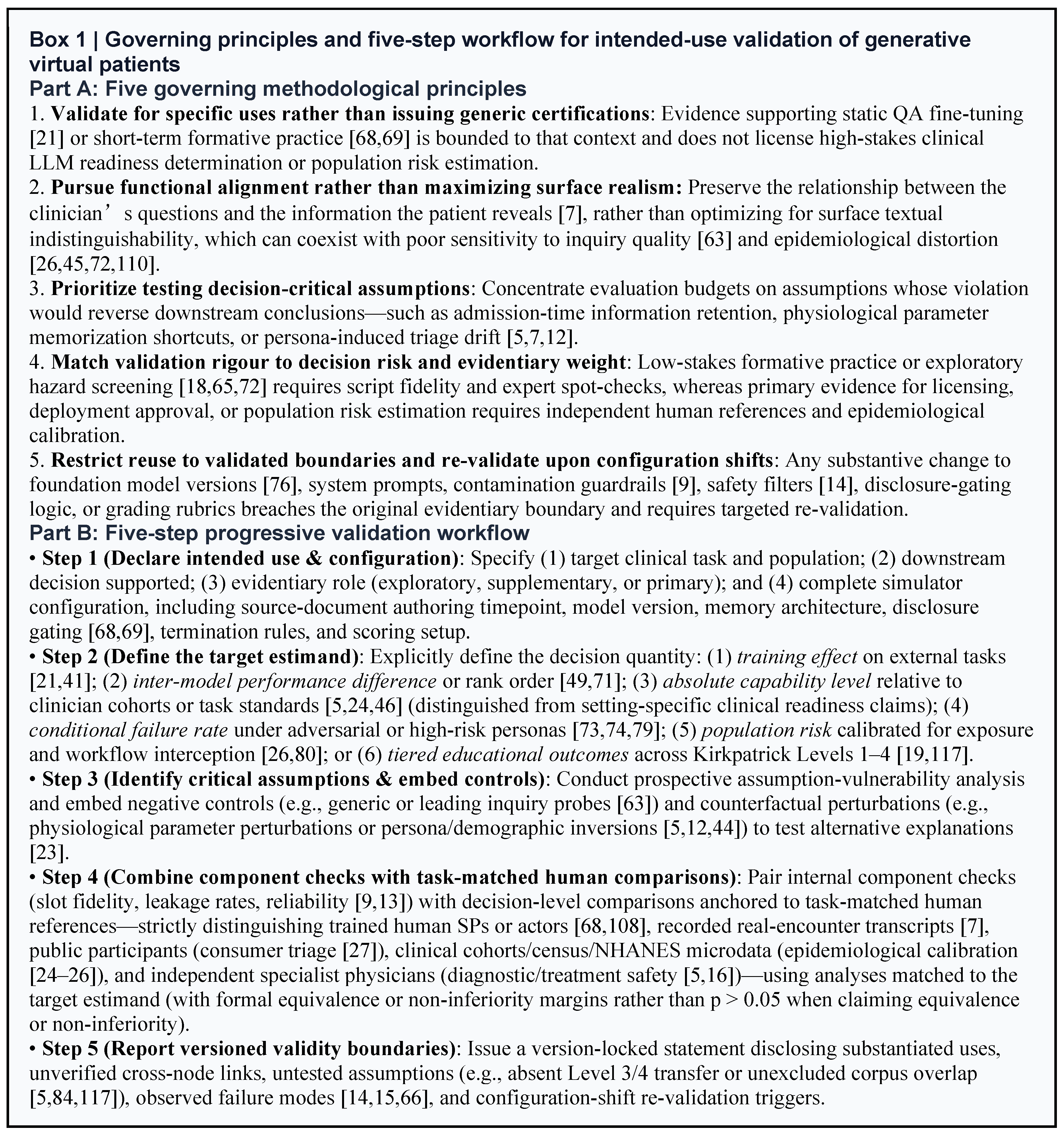
Intended-use validation is anchored by five governing principles aligning evaluation design with clinical decision risk (Box 1, Part A): claims are use-specific [21,68,69], pursue functional action–information alignment over surface indistinguishability [7,26,45,72,110], prioritize testing assumptions whose violation would reverse rankings, training attribution, or triage safety [5,7,12], scale rigour to decision risk [18,65,72], and trigger re-validation whenever model versions, prompts, disclosure gating, or safety filters shift [9,14,76].
Operationalizing these principles requires a five-step backward-reasoning workflow working from the target decision back to simulator controls and human calibration (Box 1, Part B). Investigators declare the task, population, evidentiary role, and configuration (Step 1) [68,69], and define the estimand across training transfer [21,41], rank stability [49,71], clinician- or standard-referenced capability [5,24,46] (distinguished from workflow readiness claims), conditional hazard rates [73,74,79], calibrated population risks [26,80], or Kirkpatrick outcomes (Step 2) [19,117]. Next, negative controls and counterfactual perturbations test substrate simplification, parameter memorization, and evaluator self-preference (Step 3) [5,12,23,44,63]. Finally, internal checks [9,13] are paired with estimand-matched calibration against human references—trained SPs or actors [68,108], recorded-encounter transcripts [7], lay participants [27], epidemiological microdata [24,25,26], and specialist physicians (with prespecified margins when claiming equivalence or non-inferiority; Step 4) [5,16]—followed by version-locked reporting of validity boundaries, untested assumptions, failure modes, and re-validation triggers (Step 5) [5,14,15,66,84,117].
Before inspecting outcomes, intended-use decision owners must prespecify acceptance rules aligned with each target construct, primary unit of inference (preserving case, persona, or learner clustering rather than inflating sample size via repeated turns or attack prompts), independent reference standard, and directional confidence bounds—requiring lower bounds to meet minimum meaningful gains (δ) and upper bounds (U) to remain within maximum tolerable decision loss or risk (τ), rather than applying universal numerical cut-offs across models or hospitals (Supplementary Methods S3 and Supplementary Table S6; nominal independent-event zero-leak bounds do not establish clustered-case safety [5]). Governance must strictly distinguish Unassessed (decision-matched data or margins not yet established) and Insufficient evidence for clearance (wide intervals spanning δ or τ that withhold clearance without proving margin violation) from Criterion not met (statistically demonstrated breach of a prespecified bound): none invalidates substantiated lower-risk uses, whereas unmet criteria trigger remediation, re-validation, or use-specific restriction.
7.2. Retrospective Application of the Validation Workflow to Representative Studies
To demonstrate how the five-step workflow (Box 1) operationalizes claim boundaries in practice beyond descriptive study summaries (Table 2), we applied Steps 1–5 retrospectively to three landmark studies spanning self-play training (AMIE [2]), autonomous EHR benchmarking (MIRA [5]), and clinical safety red-teaming (Steenstra et al. [72]) (Table 3). Seven representative claims were purposively selected from a 41-claim audit log across the three studies (10, 14, and 17 claims, respectively) to illustrate how the framework pairs author-disclosed caveats and local endpoints with substantiated bounded uses, unlicensed stronger extrapolations (without treating unverified extensions as model failures), and decision-matched next validation actions.
Table 3.
Illustrative application of the five-step intended-use validation workflow (Box 1) across three representative studies.
Table 3.
Illustrative application of the five-step intended-use validation workflow (Box 1) across three representative studies.
| Study, audited claims & representative endpoints | Bounded use supported under Box 1 | Unlicensed stronger extrapolations | Key validation gaps & next actions (Steps 3–5) |
|
1. AMIE [2] (Nature 2025; 3 claims: training & adjacent actor OSCE) • Endpoints: Self-play with automated critique generated 11,686 dialogues per fine-tuning iteration alongside mixed supervision, improved AMIE self-rated PACES revision preferences, and exceeded primary care physician (PCP) differential-diagnosis accuracy across 159 human-actor text consultations [2]. • Author caveats: Incomplete persona/motivation coverage; critique bounded by limitations of critic instructions and feedback; text chat unfamiliar to PCPs and unrepresentative of routine care [2]. |
• Substantiates a scalable synthetic-dialogue training workflow and within-pipeline self-rated preference gains on common-condition scripts. • Supports higher differential-diagnosis accuracy than PCPs within the 159-scenario human-actor text OSCE under the study’s scoring rules (unisolated component effects do not imply training inefficacy). |
• Attributing terminal actor-OSCE performance specifically to the virtual patient (VP) simulator rather than critic feedback, reasoning scaffolding, or mixed data. • Treating homologous AMIE self-scoring as independent clinical transfer, or extrapolating human-actor text-OSCE gains to routine care or fully synthetic VP benchmark validity. |
• Gaps: Bundled multi-component training pipeline (Steps 1, 3) and shared generator–evaluator self-scoring (Step 4). • Next actions: Run compute- and data-matched ablations isolating outer-loop VP interaction from critic/reasoning modules; re-grade dialogues with independent clinicians; and evaluate transfer in voice or in-person workflows. |
|
2. MIRA [5] (Nature 2026; 2 claims: agent consistency & prescribing safety) • Endpoints: Physician audit showed 99.4% paraphrase consistency across 622 question–answer pairs and high faithfulness to discharge-summary HPIs (leakage audited separately); across n = 56 patient outputs (6 risk categories), zero events were observed in five specified severe prescribing categories (safe vs. likely safe, alongside 3 clinically reasonable therapeutic duplications) [5]. • Author caveats: Structured discharge HPIs under-represent emergency speech disfluency/omissions; pretraining overlap not fully excluded; likely safe lacked affirmative data and duplicate-therapy instructions needed clearer wording [5]. |
• Establishes high paraphrase consistency and faithfulness to documented discharge HPI text on evaluable items (a clear bounded positive example). • Supports an observational finding of zero detected events across the five specified severe prescribing categories within the 56-patient sandbox review under available chart data. |
• Inferring from HPI faithfulness or leakage controls that retrospective discharge HPIs preserved admission-time diagnostic uncertainty or naturalistic emergency speech, or that overall clinical readiness is established. • Interpreting 0/56 observed severe hazards (including likely safe records lacking affirmative data) as a zero population error rate or clearance of a clinical deployment margin. |
• Gaps: Unaudited admission-to-discharge cue omission and potential public-EHR parameter shortcuts (Step 3), plus small observational safety sample with incomplete chart confirmation (Step 4). • Next actions: Pair admission notes with discharge summaries and apply construct-preserving parameter perturbations (Section 7.3); and expand prospective medication-safety audits with affirmative clinical data and workflow-interception calibration. |
|
3. Steenstra et al. [72] (arXiv v2 preprint, 2026; 2 claims with unresolved boundaries) • Endpoints: Simulated substance-use patients achieved a descriptive composite realism mean of 3.77/5 across 30 initial session vignettes rated by 9 knowledgeable raters (3–4 each)*; severe simulated failures (e.g., Character.AI co-rumination and delusion reinforcement) were argued to justify precluding deployment [72]. • Author caveats: Stage-of-change versus hopeless-affect mismatches, artificial phrasing, 4-session text/AI-judge scope, and harm defined explicitly as a proxy rather than proof of human safety [72]. |
• Supports favourable descriptive composite realism (3.77/5) on sampled vignettes alongside qualitative stage–affect discrepancies. • Identifies candidate high-severity failure modes under the tested simulation conditions; clinically reviewed and reproducible failures may trigger targeted investigation or proportionate, use-specific safety escalation, whereas deployment restrictions require separate risk-based adjudication. |
• Treating nested vignette ratings (30 vignettes across 9 raters) as cluster-verified proof across every individual dimension* or as validation of real-patient harm prediction. • Equating simulated crisis proxies with real-patient injury incidence, or issuing blanket, version-agnostic deployment bans solely from uncalibrated simulation excerpts (deployment rule unresolved; absent proxy harm likewise does not prove safety). |
• Gaps: Unverified rater-level clustering (Step 4), AI–AI proxy-to-human gap (Steps 3–4), and uncalibrated governance rules linking simulated failures to deployment exclusion (Step 5). • Next actions: Apply rater-clustered mixed models with per-dimension estimates; verify failure reproducibility on locked model versions with independent clinical and human–AI checks; and specify use-proportionate escalation versus exclusion criteria. |
7.3. Worked Example: Emergency Consultation Protocol
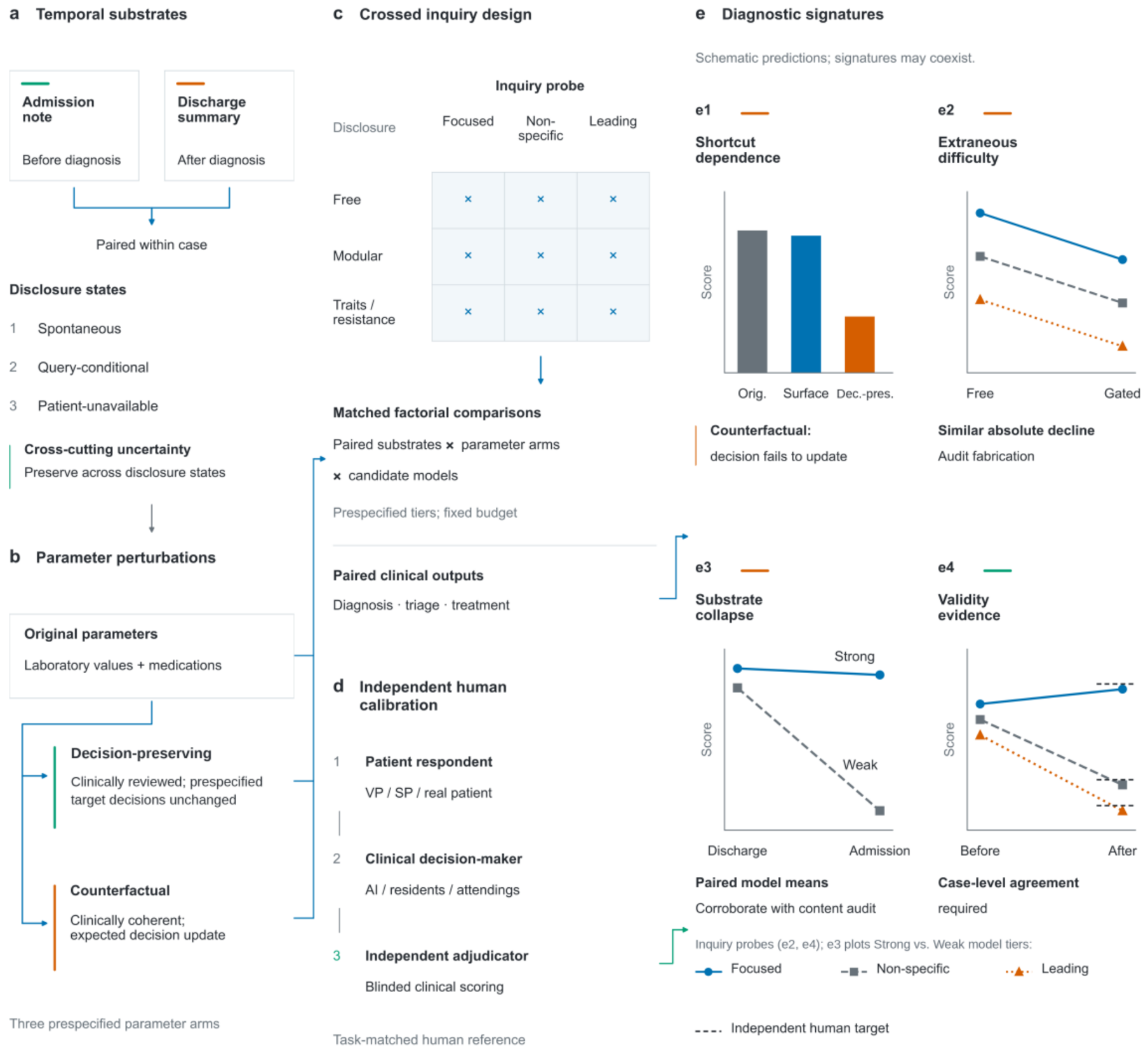
To operationalize intended-use validation, we specify a six-step experimental protocol designed to disentangle construct-relevant clinical inquiry from interactive noise, case-specific parameter dependence, and substrate simplification in autonomous emergency consultations (Section 6.2; MIRA [5] and AgentClinic [4]; Fig. 2 and Supplementary Methods S2). Within each encounter, the protocol pairs pre-diagnostic admission notes against post-diagnostic discharge summaries across three disclosure states to test for temporal information loss (Fig. 2a) [9,55,64]. It then crosses three parameter arms—original EHR values, clinician-adjudicated perturbations preserving prespecified target decisions (diagnosis, triage, and treatment where evaluated, including clinically confirmed interchangeable medications documented via ATC/RxNorm codes), and counterfactual flips (Fig. 2b) [5]—against three composite disclosure configurations (Free, Modular gated, and HEXACO resistance traits; factorially separable in extended designs) and three inquiry probes (Focused, Non-specific, and Leading) (Fig. 2c) [7,45,63,68,69,74], anchored against role-separated human references (Fig. 2d) [5,27]. Jointly analysing perturbation responses, disclosure slopes, mixed-effects substrate-by-tier interactions supplemented by between-model variance contrasts (testing σ²admission > σ²discharge alongside cue restoration), and blinded physician concordance would test predicted patterns for four potentially coexisting signatures: shortcut dependence, extraneous difficulty, substrate collapse, and improved human-reference concordance (Fig. 2e1–e4; Supplementary Methods S2) [5,9,62].
Figure 2.
Worked design for evaluating emergency-consultation virtual patients. (a) Pre-diagnostic admission notes and post-diagnostic discharge summaries are paired within the same encounter, while disclosure is varied across spontaneous, query-conditional, and patient-unavailable states. (b) Three parameter conditions are compared: original values; clinically reviewed decision-preserving perturbations that preserve prespecified target decisions (diagnosis, risk/triage category, and treatment where evaluated); and counterfactual changes that should trigger a prespecified update to the clinical decision. (c) Disclosure configurations and inquiry probes are crossed within paired substrates and parameter conditions, with candidate models evaluated under fixed interaction budgets. Outcomes include diagnosis, triage, and treatment. (d) Human calibration separates the roles of patient respondent, clinical decision-maker, and independent adjudicator. (e) Four schematic diagnostic signatures illustrate shortcut dependence (e1), extraneous difficulty (e2), substrate-related loss of model separation (e3), and improved agreement with task-matched human references after calibration (e4; in e3, solid and dashed lines denote strong and weak model tiers rather than inquiry probes). The signatures may coexist. Lines and bars show predicted patterns rather than empirical results.
7.4. Minimum reporting: Evaluation Provenance Statement
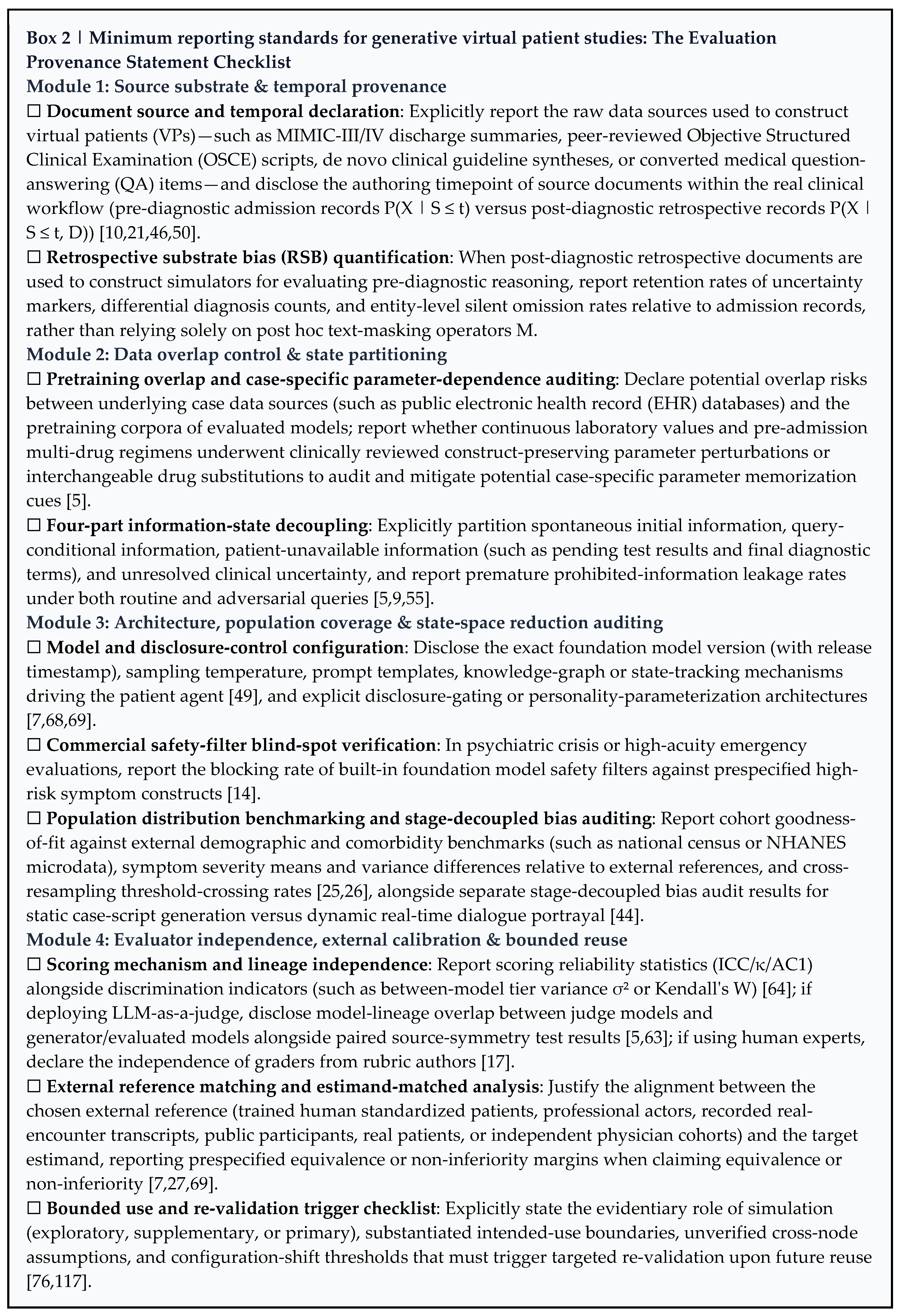
Because opaque simulator reporting obstructs independent auditability and algorithmovigilance [6,83,114], we propose that VP studies incorporate a structured Evaluation Provenance Statement (Box 2) converting implicit assumptions into ten auditable disclosures. Across four modules, it documents source timepoints and omission audits [10,21,46,50]; overlap controls and four-part state partitioning [5,9,55]; disclosure-gating and persona architectures [7,12,45,49,68,69], safety-filter blocking rates [14], and stage-decoupled demographic and epidemiological audits [25,26,44]; alongside evaluator lineage independence [5,17,63], estimand-matched human-reference analyses [7,27,69], and re-validation triggers [76,117]. Role-separated stakeholder responsibilities, risk-tiered feasibility scaling, and operational resource-accounting indicators—preventing partial educational API token fees (US$0.51–0.725 per session [61,68]) from being misread as comprehensive validation budgets—are detailed in Supplementary Methods S4 and Supplementary Table S7.
8. Research Implications: Priority Experimental Agenda
Advancing VP methodology requires shifting research priorities from ad hoc prompt patching and homogeneous sample scaling to four falsifiable experimental agendas targeting parameter dependence, state-space reduction, causal attribution, and framework meta-evaluation (Table 4).
8.1. Parameter-Dependence and Orthogonal Behavioural Audits
First, because surface linguistic or emotional prompt perturbations holding public EHR values constant [4,5] cannot exclude pretraining case recall [5,10,24,47,70], multi-specialty benchmarks must pair clinically reviewed parameter perturbations with orthogonal behavioural stress-testing. Extending the emergency protocol (Section 7.3; Fig. 2b,c; Supplementary Methods S2) across specialties requires stratifying cases by overlap risk and crossing its three parameter arms [5] with orthogonal behavioural axes (disclosure gating [68,69], HEXACO withholding [7], personas [12], health literacy [120], cognitive biases [74], and persuasion [45,73]) under fixed budgets to characterize robustness across prespecified clinical and behavioural perturbations.
8.2. Audits of Lost Demographic and Behavioural Variation
Second, localizing where simulators lose clinical uncertainty, demographic diversity, and behavioural variability requires node-level state-space reduction audits across substrates, cohorts, and interactions (Table 4). This agenda encompasses (1) substrate collapse audits, pairing admission notes and discharge summaries to quantify uncertainty-marker density, differential counts, and silent omissions alongside mixed-effects models testing substrate-by-tier interactions and directional variance predictions (σ²admission > σ²discharge), sensitivity to restored ambiguity cues, and decision concordance; (2) population distortion audits, benchmarking cohorts against census [25] and epidemiological microdata [26] via stage-decoupled analyses separating script from portrayal biases [44]; and (3) dynamic interaction audits, using state-transition entropy, disclosure non-linearity [5], and Kullback–Leibler (KL) valence-transition divergence to diagnose positivity convergence [42,60] and low-variance behaviour [27] across exams [5,13], training [42,60], and red-teaming [72,73].
8.3. Training Attribution and Safety Calibration
Third, establishing external causal links requires budget-matched training ablations to test upstream alignment pollution and three-stage epidemiological calibration to translate conditional simulation failures into hospital risk intervals. Specifically, (1) upstream ablations must fix token and compute budgets to separate VP disclosure and resistance policies from critic feedback [2,21,41] when transferring to non-public cohorts or human participants [5,27], while multicentre educational RCTs separate practice from instructor feedback [69,105,108] and track Kirkpatrick Level 3/4 transfer [112,117]; and (2) three-stage safety calibration must audit safety-filter blocking [14] and contamination leakage [9], compare AI–AI versus human–AI failures under persuasion [73], co-rumination [72], and contraindications [75], and integrate conditional failure rates [5,65,66] with prevalence [26] and workflow interception [24,79,80].
8.4. Meta-Evaluation of the Validation Framework
Fourth, because our workflow (Box 1), substrate audit protocol (Supplementary Methods S2), and Evaluation Provenance Statement (Box 2) are methodological proposals rather than prospectively validated standards, independent teams must meta-evaluate their inter-team reliability, feasibility, and decision-correction utility. Teams operating across sandboxed FHIR benchmarks [5] and multicentre curricula [109,114] should quantify cross-team adjudication concordance (κ/ICC), marginal engineering and clinician-review costs, and the proportion of evaluations yielding independently corroborated corrections to model selection or safety conclusions missed by surface scores.
Table 4.
Priority experimental agenda for advancing intended-use validation of generative virtual patients.
Table 4.
Priority experimental agenda for advancing intended-use validation of generative virtual patients.
| Priority experimental category | Deep methodological threats addressed | Core experimental designs & diagnostic mechanisms | Falsifiable endpoints & decision value |
|
1. Case-specific parameter-dependence auditing & behavioural orthogonal perturbation (Parameter-dependence auditing & orthogonal perturbation) |
• Objective physiological fingerprint shortcuts: When pretraining potentially overlaps with public datasets (such as MIMIC), exact laboratory values and multi-drug lists may form case-memory cues; surface emotional/language perturbations cannot rule out this alternative explanation [5] • Behavioural construct confounding: Uncontrolled cooperativeness distorts model comparisons [12] |
• Clinically reviewed construct-preserving parameter perturbation: Clinicians review physiological and indication coherence case by case to perturb continuous laboratory values while keeping prespecified target decisions (diagnosis, risk/triage tier, and treatment where evaluated) unchanged, substituting clinician-confirmed interchangeable drugs recorded with ATC/RxNorm identifiers • Boundary-crossing counterfactual flips: Shifting a single decisive physiological parameter across a guideline threshold (such as altering eGFR or respiratory rate) • Orthogonal behavioural manipulation: Independently manipulating disclosure gating [68], HEXACO personality traits [7], and cognitive resistance [45,74] on substrates controlled for parameter dependence |
• Parameter-dependence & memorization risk audit: Tolerating surface prompt perturbations while dropping sharply under construct-preserving perturbations, or failing to update prespecified clinical decisions (such as admission triage or dosing) under counterfactual flips, demonstrates perturbation sensitivity or counterfactual updating failure; combining these patterns with independent corpus-overlap evidence tests for case-specific parameter dependence and pretraining memorization risk • Authentic robustness surfaces: Mapping model sensitivity to patient disclosure and communication styles across parameter configurations |
|
2. Detection and localization of lost demographic and behavioural variation (Multi-dimensional state-space reduction detection & localization) |
• Substrate-level temporal semantic collapse hypothesis (RSB): Testing whether discharge summaries omit admission-time contradictions and uncertainty; deleting diagnostic terms alone cannot verify source-document completeness • Loss of demographic and behavioural variation: Demographic truncation, symptom distribution shifts, and cancellation of opposing script-versus-portrayal biases [25,26,44] |
• Paired two-timepoint substrate audits: Pairing admission notes and discharge summaries from the same encounter to measure uncertainty-marker density, differential counts, and entity-level silent omission rates • Paired mixed-effects modelling & variance analysis: Under paired-case repeated-measures designs, testing 'substrate type × model tier' interactions via mixed-effects models, supplemented by between-model variance ratios (σ²) • Stage-decoupled bias & context-specific trajectory-entropy diagnostics: Benchmarking against census/NHANES distributions, separating static-script from dynamic-portrayal biases [44], and evaluating state-transition entropy and KL divergence by intended use (assessment test–retest stability vs. training diversity coverage) [5,27,60] |
• Substrate effect evaluation: Quantifying silent omission rates, reporting mixed-effects interaction confidence intervals and directional variance predictions (H₁: σ²admission > σ²discharge), and combining omitted-cue restoration with external clinical decision concordance to judge substrate impacts on discrimination • Population & dynamic distribution diagnostics: Identifying bias cancellation across script and portrayal layers and defining acceptable cross-resampling stability and behavioural variability bounds by intended use |
|
3. Training attribution ablation & multi-stage safety calibration (Attribution ablation & safety calibration) |
• Upstream training pollution & attribution confounding: Self-play gains cannot be attributed solely to the simulator and may encode cooperation bias [2,21] • Safety blind spots & risk misinterpretation: Safety guardrails block high-risk symptoms; conditional failure rates are misread as population risk [14,79] |
• Budget-matched training ablations & rolling recruitment verification: Fixing token and compute budgets to compare models trained on cooperative versus gated-disclosure simulators when transferred to non-public, prospectively captured rolling recruitment cohorts and real human participants [27] • Three-stage safety calibration: (1) auditing high-risk construct blocking rates and contamination leakage [9,14]; (2) parallel AI–AI versus human pressure comparisons [72,73]; and (3) integrating epidemiological exposure and clinician workflow interception to calibrate two-stage risk conversion probabilities (P₁ and P₂) [24,65,79] |
• Corroborating or refuting the causal chain from 'synthetic distributional bias → degraded inquiry policy → clinical deployment error', and generating longitudinal Kirkpatrick Level 3/4 evidence in medical education [117] • Translating conditional error rates into calibrated real-world clinical risk intervals accounting for demographics and workflow supervision |
|
4. Independent meta-evaluation of the validation framework (Framework meta-evaluation) |
• The validation framework and provenance statement lack empirical verification of cross-team concordance, engineering feasibility, and cost–benefit utility | • Independent multidisciplinary teams executing the five-step workflow, paired two-timepoint substrate audits, and Evaluation Provenance Statement in parallel across FHIR agent benchmarks [5] and multicentre medical school curricula [109] | • Measuring inter-team coding and adjudication concordance (Cohen's κ / ICC), marginal operational costs, and the proportion of evaluations in which applying the framework yields independently corroborated corrections to downstream model selection or safety decisions |
9. Scope and Limitations
As a question-led critical narrative review designed to deconstruct cross-node inferential breakpoints rather than estimate field-wide flaw prevalence or pool heterogeneous effect sizes, our synthesis is bounded by four limitations. First, although Supplementary Table S4 maps this review to the six SANRA narrative-review quality domains [33] and our synthesis integrates systematic reviews (including a 4,609-study clinical LLM corpus [35]) and primary audits, the 123 cited sources were selected purposively rather than through duplicate eligibility screening of all 4,550 retrieved PubMed records, systematic querying of Embase, Scopus, and Web of Science, or formal study-level risk-of-bias scoring (Section 2; Supplementary Methods S1); selection bias and uneven coverage of rapidly evolving preprints therefore cannot be excluded, and quantitative meta-analytic pooling was not undertaken because heterogeneous constructs, simulator configurations, rubrics, and comparators [6,112] do not support a common estimand. Second, local deficits do not negate bounded utility in tasks insensitive to dynamic disclosure [1,19,68,105], and human references are not interchangeable [5,7,24,27,108]: trained SPs differ from unscripted patients [7,85], and even admission notes reflect clinician-filtered documentation rather than raw patient narratives. Third, our workflow (Box 1), orthogonal protocol (Section 7.3; Supplementary Methods S2), and Provenance Statement (Box 2) await prospective meta-evaluation [5]. Fourth, extending validation beyond single-encounter text or voice VPs [83,84,121,122] to mixed- or virtual-reality VPs [89,96,98,99] and longitudinal simulators requires incorporating non-verbal cues [106,113], physical examination, and chronic disease evolution.
10. Conclusion
Generative VPs have evolved from educational practice tools into evidence-generating infrastructure across medical AI training, benchmarking, and algorithmovigilance, where their dual role as evaluation objects and measurement instruments can channel structured bias rather than zero-mean random error into upstream alignment signals and downstream clinical conclusions. Synthesizing evidence along the five-node chain shows that local adequacy does not license cross-node extrapolation: script fidelity does not guarantee disclosure timing or admission-time semantics, case plausibility can coexist with epidemiological distortion, scoring reliability does not anchor the target construct, and within-simulation stability cannot substitute for clinical transfer. While over-cooperation and demographic truncation are empirically documented, shared generator–evaluator priors, case recall via unperturbed public-EHR parameters, and retrospective loss of admission-time uncertainty remain critical hypotheses defining the priority frontier for factorial auditing.
Credible validation must therefore begin with the specific clinical decision a simulation is intended to inform, treating a versioned simulator configuration supporting a defined inference—rather than VP technology in the abstract—as the fundamental unit of validation. Investigators should define the estimand, identify assumptions whose violation would alter decisions, test them using paired temporal audits, clinically reviewed perturbations, and task-matched human comparators, and document inference boundaries and reassessment triggers in an Evaluation Provenance Statement. Establishing this discipline before evaluation standards solidify will preserve the bounded educational and engineering value of VPs while placing clinical AI governance and algorithmovigilance on accountable foundations.
Supplementary Materials
Author Contributions
Jing Yang conceived and designed the study, developed and executed the literature search strategies and programmatic verification scripts, conducted the evidence synthesis and methodological analysis, designed the figures and tables, and wrote the original manuscript. Xiuchan Song, Chen Huang, Zijie Liu, Long R. Jiao, Zongjiu Zhang, and Xiujun Cai critically reviewed the manuscript for important intellectual content and provided clinical and methodological feedback. Zongjiu Zhang and Xiujun Cai supervised the project. All authors read and approved the final manuscript.
Funding
The authors declare that no funds, grants, or other financial support were received during the preparation of this manuscript.
Data Availability Statement
All data analysed or synthesized during this study are included in this published article and its Supplementary Information files (Supplementary Methods S1–S4 and Supplementary Table S1). Complete bibliographic search execution logs (PubMed_Queries_and_Execution.csv), retrieved record metadata (PubMed_Retrieved_Records.csv), sentinel study verification records (Sentinel_Validation.csv), and raw checksummed NCBI E-utilities response logs are archived by the authors and are available from the corresponding authors upon reasonable request.
Conflicts of Interest
The authors have no relevant financial or non-financial interests to disclose.
Ethics approval: Not applicable. This article is a critical narrative review of published and publicly indexed literature and does not involve new studies with human participants or animals performed by any of the authors.
Code and materials availability: The executable PubMed Boolean search queries (Q1–Q6 and F1), orthogonal experimental protocol, and Evaluation Provenance Statement checklist are provided in full within the article and Supplementary Information. The Python query execution script and offline regression test suite (pubmed_search.py) are available from the corresponding authors upon reasonable request.
References
- Wang, J.; et al. NoteChat: a dataset of synthetic patient-physician conversations conditioned on clinical notes. Findings of the Association for Computational Linguistics: ACL 2024 15183–15201; Association for Computational Linguistics. 2024. [Google Scholar] [CrossRef] [PubMed]
- Tu, T.; et al. Towards conversational diagnostic artificial intelligence. Nature 2025, 642, 442–450. [Google Scholar] [CrossRef] [PubMed]
- Johri, S.; et al. An evaluation framework for clinical use of large language models in patient interaction tasks. Nat. Med. 2025, 31, 77–86. [Google Scholar] [CrossRef] [PubMed]
- Schmidgall, S.; et al. AgentClinic: a multimodal benchmark for tool-using clinical AI agents. npj Digit. Med. 2026, 9, 499. [Google Scholar] [CrossRef] [PubMed]
- Ferber, D.; et al. Towards autonomous medical artificial intelligence agents. Nature 2026, 655, 1282–1291. [Google Scholar] [CrossRef] [PubMed]
- Jo, Y.-W.; Lee, M.; Yang, H.-J. Large language model-based virtual patient simulations in medical and nursing education: a review. Appl. Sci. 2025, 15, 11917. [Google Scholar] [CrossRef]
- Schlager, M.; et al. Patients with personality: realistic patient simulation through controlled diversity and selective disclosure. 2026. Available online: https://arxiv.org/abs/2606.17441v3.
- Zhang, W.; Daniels, B. B.; Mita, C.; Nguyen, H.; Duong, D. B. AI for clinical competency assessment: scoping review of methods and applications. JMIR Med. Educ. 2026, 12, e92826. [Google Scholar] [CrossRef] [PubMed]
- Harada, Y. Robustness of a large language model (LLM)-based virtual patient for Japanese history-taking training under direct and indirect instructional contamination. Cureus 2026, 18, e109161. [Google Scholar] [CrossRef] [PubMed]
- Yu, H.; et al. Simulated patient systems powered by large language model-based AI agents offer potential for transforming medical education. Commun. Med. 2026, 6, 27. [Google Scholar] [CrossRef] [PubMed]
- Bonzi, D.; Bourgeade, T.; Lefèvre, F.; Illina, I. A French OSCE dialogue dataset and controllable virtual patient system for clinical training. In Proceedings of the 27th Annual Meeting of the Special Interest Group on Discourse and Dialogue, 2026; Association for Computational Linguistics; pp. 357–374. Available online: https://aclanthology.org/2026.sigdial-1.25/.
- Matos, J.; et al. The complexities of patient-centred conversational artificial intelligence. 2026. Available online: https://arxiv.org/abs/2607.08625v1.
- Liu, Y.; et al. Development and validation of a large language model–based system for medical history-taking training: prospective multicase study on evaluation stability, human-AI consistency, and transparency. JMIR Med. Educ. 2025, 11, e73419. [Google Scholar] [CrossRef] [PubMed]
- Lee, J.; Lim, K.; Jung, Y.-C.; Kim, B.-H. PSYCHE: a multi-faceted patient simulation framework for evaluation of psychiatric assessment conversational agents. 2025. Available online: https://arxiv.org/abs/2501.01594v1.
- Rabaey, P.; Heytens, S.; Demeester, T. SimSUM – simulated benchmark with structured and unstructured medical records. J. Biomed. Semant. 2025, 16, 20. [Google Scholar] [CrossRef] [PubMed]
- Vatanparvar, K.; et al. PatientAgentBench: a benchmark framework for evaluating patient-facing health AI agents. 2026. Available online: https://arxiv.org/abs/2607.25485v1.
- Schiött, J.; Ivegren, W.; Borg, A.; Parodis, I.; Skantze, G. Using LLMs to grade clinical reasoning for medical students in virtual patient dialogues. In Proceedings of the 26th Annual Meeting of the Special Interest Group on Discourse and Dialogue, 2025; Association for Computational Linguistics; pp. 750–763. [Google Scholar] [CrossRef]
- Sheth, U.; et al. Understanding the role of large language model virtual patients in developing communication and clinical skills in undergraduate medical education. Int. Med. Educ. 4 2025, 39. [Google Scholar] [CrossRef]
- Brügge, E.; et al. Large language models improve clinical decision making of medical students through patient simulation and structured feedback: a randomized controlled trial. BMC Med. Educ. 2024, 24, 1391. [Google Scholar] [CrossRef] [PubMed]
- Wang, Z.; Fan, T.-T.; Li, M.-L.; Zhu, N.-J.; Wang, X.-C. Feasibility study of using GPT for history-taking training in medical education: a randomized clinical trial. BMC Med. Educ. 2025, 25, 1030. [Google Scholar] [CrossRef] [PubMed]
- Lai, Y.; Wang, Z.; Ma, W.; Liu, Y. Patient-Zero: scaling synthetic patient agents to real-world distributions without real patient data. In Proceedings of the 2026 Conference on Empirical Methods in Natural Language Processing 26339–26365 (Association for Computational Linguistics, 2026; Available online: https://aclanthology.org/2026.emnlp-main.1149/.
- Luo, M.-J.; et al. A large language model digital patient system enhances ophthalmology history taking skills. npj Digit. Med. 2025, 8, 502. [Google Scholar] [CrossRef] [PubMed]
- Zhan, C.; et al. Active evidence-seeking and diagnostic reasoning in large language models for clinical decision support. 2026. Available online: https://arxiv.org/abs/2605.22047v1.
- Hager, P.; et al. Evaluation and mitigation of the limitations of large language models in clinical decision-making. Nat. Med. 2024, 30, 2613–2622. [Google Scholar] [CrossRef] [PubMed]
- Veenhuizen, M.; O’Malley, A. Demographic biases in AI-generated simulated patient cohorts: a comparative analysis against census benchmarks. Adv. Simul. 2025, 10, 58. [Google Scholar] [CrossRef] [PubMed]
- Keough, P. Plausible patients, impossible populations: auditing epidemiological fidelity in large language model mental health simulations. 2026. Available online: https://arxiv.org/abs/2604.17359v2.
- Bean, A. M.; et al. Reliability of LLMs as medical assistants for the general public: a randomized preregistered study. Nat. Med. 2026, 32, 609–615. [Google Scholar] [CrossRef] [PubMed]
- Messick, S. Meaning and values in test validation: the science and ethics of assessment. Educ. Res. 1989, 18, 5–11. [Google Scholar] [CrossRef]
- Messick, S. Validity of psychological assessment: validation of inferences from persons' responses and performances as scientific inquiry into score meaning. Am. Psychol. 1995, 50, 741–749. [Google Scholar] [CrossRef]
- Kane, M. T. Validation. In Educational Measurement, 4th edn; Brennan, R. L., Ed.; American Council on Education/Praeger, 2006; pp. 17–64. [Google Scholar]
- Dong, Y.; Cheng, J.; Ding, C.; Lu, R. Governing Clinical Readiness Claims Derived from Medical AI Benchmark Results. [Comment]. J. Med. Syst. 2026, 50, 119. [Google Scholar] [CrossRef] [PubMed]
- Chang, Y.; Hsieh, M.-H.; Ju, P.-C.; Liu, Y.-C.; Chang, C.-C. Clinical Plausibility in Large Language Model Robustness Testing for Medicine: A Scoping Review. J. Med. Syst. 2026, 50, 77. [Google Scholar] [CrossRef] [PubMed]
- Baethge, C.; Goldbeck-Wood, S.; Mertens, S. SANRA—a scale for the quality assessment of narrative review articles. Res. Integr. Peer Rev. 2019, 4, 5. [Google Scholar] [CrossRef] [PubMed]
- Xu, X.; Sankar, R. Large language model agents for biomedicine: a comprehensive review of methods, evaluations, challenges, and future directions. Information 2025, 16, 894. [Google Scholar] [CrossRef]
- Chen, S. F.; et al. LLM-assisted systematic review of large language models in clinical medicine. Nat. Med. 2026, 32, 1152–1159. [Google Scholar] [CrossRef] [PubMed]
- Aghaee, A.; Asgarian, S.; Jeon, J. SynthAgent: a multi-agent LLM framework for realistic patient simulation – a case study in obesity with mental health comorbidities. 2026. Available online: https://arxiv.org/abs/2602.08254v1.
- Komolafe, O. O.; Roberts, A. C.; Shelley, J.; Tawiah, A. PhysiCase: development and dual-layer validation of synthetic cases for health professional education: a pilot study leveraging generative AI. 2026. Available online: https://www.medrxiv.org/content/10.64898/2026.06.07.26355114v1.
- Gong, L.; et al. MedDialogRubrics: a comprehensive benchmark and evaluation framework for multi-turn medical consultations in large language models. 2026. Available online: https://arxiv.org/abs/2601.03023v2.
- Kramer, M. A.; Mathur, A.; Adams, C. E.; Walonoski, J. A. Leveraging generative AI to enhance Synthea model development. JAMIA Open 2026, 9, ooaf123. [Google Scholar] [CrossRef] [PubMed]
- Huang, T.; Bourgeade, T.; Illina, I. LLM-based data generation and clinical skills evaluation for low-resource French OSCEs. In Proceedings of the Fifteenth Language Resources and Evaluation Conference 10592–10602, ELRA Language Resource Association, 2026; Available online: https://aclanthology.org/2026.lrec-1.831/.
- Dou, C.; et al. Baichuan-M2: scaling medical capability with large verifier system. 2025. Available online: https://arxiv.org/abs/2509.02208v1.
- Hoang, V.; Rogers, E.; Ross, R. LLMs as standardised patients for motivational interviewing: how faithful are they? In Proceedings of the 11th Workshop on Computational Linguistics and Clinical Psychology (CLPsych 2026), 2026; Association for Computational Linguistics; pp. 258–270. [Google Scholar] [CrossRef]
- Pombal, J.; et al. MindEval: benchmarking language models on multi-turn mental health support. 2025. Available online: https://arxiv.org/abs/2511.18491v3.
- Daniels, B. Auditing large language model–generated digital standardized patients for demographic bias: a simulation study with HIV pre-exposure prophylaxis screening as a tracer condition. 2026. Available online: https://www.medrxiv.org/content/10.64898/2026.09.01.26361928v1.
- Li, Y.; et al. Beyond idealized patients: evaluating LLMs under challenging patient behaviors in medical consultations. 2026. Available online: https://arxiv.org/abs/2603.29373v2.
- Liang, C.; et al. Evaluating large language models in dynamic clinical decision-making with standardized patient cases. 2026. Available online: https://arxiv.org/abs/2606.05112v1.
- Niu, J.; et al. AIPatient Arena: EHR-grounded evaluation of large language models in end-to-end clinical consultation workflows. 2026. Available online: https://arxiv.org/abs/2606.17474v1.
- Fajardo V., D.; Proniakin, O.; Gruber, V.-E.; Marinescu, R. MedPI: evaluating AI systems in medical patient-facing interactions. 2026. Available online: https://arxiv.org/abs/2601.04195v1.
- Liao, Y.; et al. Automatic interactive evaluation for large language models with state aware patient simulator. 2024. Available online: https://arxiv.org/abs/2403.08495v4.
- Oh, G.; Park, S.; Kim, B.-H. AutoMedic: an automated evaluation framework for clinical conversational agents with medical dataset grounding. IEEE J. Biomed. Health Inform. 2026. [Google Scholar] [CrossRef] [PubMed]
- Yu, Y.; et al. MedKGEval: a knowledge graph-based multi-turn evaluation framework for open-ended patient interactions with clinical LLMs. 2025. Available online: https://arxiv.org/abs/2510.12224v1.
- Fan, Z.; et al. AI Hospital: benchmarking large language models in a multi-agent medical interaction simulator. in Proceedings of COLING, Association for Computational Linguistics, 2025; pp. 2025 10183–10213. Available online: https://aclanthology.org/2025.coling-main.680/.
- Gong, L.; Wang, A.; Lai, Y.; Ma, W.; Liu, Y. The dialogue that heals: a comprehensive evaluation of doctor agents' inquiry capability. 2025. Available online: https://arxiv.org/abs/2509.24958v2.
- Liu, H.; et al. Med-PMC: medical personalized multi-modal consultation with a proactive ask-first-observe-next paradigm. 2024. Available online: https://arxiv.org/abs/2408.08693v1.
- Han, Y.; et al. MedConceal: a benchmark for clinical hidden-concern reasoning under partial observability. 2026. Available online: https://arxiv.org/abs/2604.08788v2.
- Ma, H.; et al. Bridging the knowledge-action gap by evaluating LLMs in dynamic dental clinical scenarios. 2026. Available online: https://arxiv.org/abs/2601.12974v1.
- Liu, L.; et al. Towards automatic evaluation for LLMs' clinical capabilities: metric, data, and algorithm. In in Proceedings of the 30th ACM SIGKDD Conference on Knowledge Discovery and Data Mining, 2024; Association for Computing Machinery; pp. 5466–5475. [Google Scholar] [CrossRef]
- Shi, X.; et al. LLM-Mini-CEX: automatic evaluation of large language model for diagnostic conversation. 2023. Available online: https://arxiv.org/abs/2308.07635v1.
- Sabour, S.; et al. PatientAct: theory-grounded mental health client simulation. In Findings of the Association for Computational Linguistics: EMNLP 2026 33483–33506 (Association for Computational Linguistics; 2026; Available online: https://aclanthology.org/2026.findings-emnlp.1572/.
- Khoi Hoang, N.; et al. PSI-Bench: interpretable and clinically meaningful evaluation of depression patient simulators. In Proceedings of the 1st Workshop on Multimodal, Multilingual, and Multicultural Mental Health and Psychotherapy (MultiPsyche), 2026; Association for Computational Linguistics; pp. 118–144. Available online: https://aclanthology.org/2026.multipsyche-1.10/.
- Cook, D. A.; Overgaard, J.; Pankratz, V. S.; Del Fiol, G.; Aakre, C. A. Virtual patients using large language models: scalable, contextualized simulation of clinician-patient dialogue with feedback. J. Med. Internet Res. 2025, 27, e68486. [Google Scholar] [CrossRef] [PubMed]
- Holderried, F.; et al. A generative pretrained transformer (GPT)–powered chatbot as a simulated patient to practice history taking: prospective, mixed methods study. JMIR Med. Educ. 2024, 10, e53961. [Google Scholar] [CrossRef] [PubMed]
- Qu, Y.; et al. A large language model–powered multiagent framework emulating standardized patients in clinical communication skills training: development and evaluation study. J. Med. Internet Res. 2026, 28, e84747. [Google Scholar] [CrossRef] [PubMed]
- Elhilali, A.; Ngo, A. S.-H.; Reichenpfader, D.; Denecke, K. Large language model–based patient simulation to foster communication skills in health care professionals: user-centered development and usability study. JMIR Med. Educ. 2025, 11, e81271. [Google Scholar] [CrossRef] [PubMed]
- Auger, S. D.; Varley, J.; Hargovan, M.; Scott, G. Dissecting clinical reasoning failures in frontier artificial intelligence using 10,000 synthetic cases. 2026. Available online: https://www.medrxiv.org/content/10.64898/2026.04.22.26351488v1.
- Auger, S. D.; Scott, G. Medical errors in large language models revealed using 1,000 synthetic clinical transcripts. 2026. Available online: https://www.medrxiv.org/content/10.64898/2026.03.23.26349082v1.
- Abi-Rafeh, J.; Hanna, S.; Bassiri-Tehrani, B.; Kazan, R.; Nahai, F. Complications following facelift and neck lift: implementation and assessment of large language model and artificial intelligence (ChatGPT) performance across 16 simulated patient presentations. Aesthetic Plast. Surg. 2023, 47, 2407–2414. [Google Scholar] [CrossRef] [PubMed]
- Zhang, B.; et al. Human or LLM as standardized patients? A comparative study in medical education. In Proc. 64th Annu. Meet. Assoc. Comput. Linguist. 2026, Volume 1, 26988–27012. Available online: https://aclanthology.org/2026.acl-long.1243/. [CrossRef]
- Wu, P.; et al. From simulation to pedagogy: multi-model and randomized evaluation of structured AI standardized patients. npj Digit. Med. 2026, 9, 612. [Google Scholar] [CrossRef]
- Kyung, D.; et al. PatientSim: a persona-driven simulator for realistic doctor-patient interactions. Adv. Neural Inf. Process. Syst. 2025, 38, Datasets and Benchmarks Track. [Google Scholar] [CrossRef]
- Liu, Y.; et al. Benchmarking large language model-based agent systems for clinical decision tasks. npj Digit. Med. 2026, 9, 259. [Google Scholar] [CrossRef] [PubMed]
- Steenstra, I.; Pedrelli, P.; Shi, W.; Marsella, S.; Bickmore, T. W. Assessing risks of large language models in mental health support: a framework for automated clinical AI red teaming. 2026. Available online: https://arxiv.org/abs/2602.19948v2.
- Peng, D.; et al. SycoEval-EM: sycophancy evaluation of large language models in simulated clinical encounters for emergency care. 2026. Available online: https://arxiv.org/abs/2601.16529v4.
- Zuo, Y.; Wan, Q.; Wang, S. Patient cognitive bias in large language model–supported health consultations: simulation-based comparative study. J. Med. Internet Res. 2026, 28, e85770. [Google Scholar] [CrossRef] [PubMed]
- Zhao, J.; et al. RxSafeBench: identifying medication safety issues of large language models in simulated consultation. 2025. Available online: https://arxiv.org/abs/2511.04328v1.
- Chang, C. T.; et al. Red teaming ChatGPT in medicine to yield real-world insights on model behavior. npj Digit. Med. 2025, 8, 149. [Google Scholar] [CrossRef] [PubMed]
- Chang, C. T.; et al. Evaluating anti-LGBTQIA+ medical bias in large language models. PLoS Digit. Health 2025, 4, e0001001. [Google Scholar] [CrossRef] [PubMed]
- Ebara, M.; et al. Quantifying ethical response in LLMs for medicine: corpus development, item response theory-based validation, and bias analysis toward patient attributes. AI Ethics 2026, 6, 327. [Google Scholar] [CrossRef]
- Kalinich, M.; Luccarelli, J.; Santa Maria, J., Jr.; Moss, F.; Torous, J. Leveraging simulation to provide a practical framework for estimating the novel scope of risk of large language models in healthcare. BMJ Ment. Health 2026, 29, e302626. [Google Scholar] [CrossRef] [PubMed]
- Shawon, M. T. R.; et al. A patient simulation framework for risk assessment of conversational health care AI: development and evaluation study. JMIR AI 2026, 5, e100772. [Google Scholar] [CrossRef] [PubMed]
- Lim, E.; et al. MATRIX: multi-agent simulation framework for safe interactions and contextual clinical conversational evaluation. 2025. Available online: https://arxiv.org/abs/2508.19163v1.
- Rashidian, S.; et al. AI agents for conversational patient triage: preliminary simulation-based evaluation with real-world EHR data. 2025. Available online: https://arxiv.org/abs/2506.04032v1.
- Zeng, J.; et al. Embracing the future of medical education with large language model–based virtual patients: scoping review. J. Med. Internet Res. 2025, 27, e79091. [Google Scholar] [CrossRef] [PubMed]
- Li, D.; Lebai Lutfi, S. Large language model–based virtual patient systems for history-taking in medical education: comprehensive systematic review. JMIR Med. Inform. 2026, 14, e79039. [Google Scholar] [CrossRef] [PubMed]
- Hamilton, A.; Molzahn, A.; McLemore, K. The evolution from standardized to virtual patients in medical education. Cureus 2024, 16, e71224. [Google Scholar] [CrossRef] [PubMed]
- Lutz, C.; Hobson, L.; Rodgers, D. Revolutionizing OSCE preparation through AI-driven synthetic patients. Proc. IMPRS 2026, 8. [Google Scholar] [CrossRef] [PubMed]
- Stoco, J. B.; Araújo, J. V. A.; Peres, A. T.; Oliveira, G. P.; Peres, G. B. Simulating physician–patient interactions using generative artificial intelligence: an educational tool for medical students. Cureus J. Comput. Sci. 2025, 2, es44389-025-10532-y. [Google Scholar] [CrossRef]
- Hassoulas, A.; et al. A pilot study investigating the efficacy of technology enhanced case based learning (CBL) in small group teaching. Sci. Rep. 2025, 15, 15604. [Google Scholar] [CrossRef] [PubMed]
- Voigt, H.; Sugamiya, Y.; Lawonn, K.; Zarrieß, S.; Takanishi, A. LLM-powered virtual patient agents for interactive clinical skills training with automated feedback. 2025. Available online: https://arxiv.org/abs/2508.13943v1.
- Bossio Botero, V.; Yadav, V.; Ouyang, J.; Abbas, A.; Worthington, M. Voice-enabled virtual patients for interactive training in standardized clinical assessment: mixed methods pilot study. J. Med. Internet Res. 2026, 28, e89066. [Google Scholar] [CrossRef] [PubMed]
- Laverde, N.; Grévisse, C.; Jaramillo, S.; Manrique, R. Integrating large language model-based agents into a virtual patient chatbot for clinical anamnesis training. Comput. Struct. Biotechnol. J. 2025, 27, 2481–2491. [Google Scholar] [CrossRef] [PubMed]
- Suárez, A.; Adanero, A.; Díaz-Flores García, V.; Freire, Y.; Algar, J. Using a virtual patient via an artificial intelligence chatbot to develop dental students’ diagnostic skills. Int. J. Environ. Res. Public Health 2022, 19, 8735. [Google Scholar] [CrossRef] [PubMed]
- Bakhaya, S.; Lehnbom, E. C.; de Carvalho Filho, M. A.; Ma, K. Y.; Svensberg, K. Development and evaluation of AI chatbot tool for written communication training in self-care: experiences of pharmacy students and faculty. Curr. Pharm. Teach. Learn. 2026, 18, 102503. [Google Scholar] [CrossRef] [PubMed]
- Malhotra, A.; Buller, M.; Modi, K.; Pajazetovic, K.; Wijesinghe, D. S. Blueprint for constructing an AI-based patient simulation to enhance the integration of foundational and clinical sciences in didactic immunology in a US doctor of pharmacy program: a step-by-step prompt engineering and coding toolkit. Pharmacy 2025, 13, 36. [Google Scholar] [CrossRef] [PubMed]
- Cecil, J.; et al. The effect of AI-enabled virtual patient simulation on training outcomes and insecurities in psychotherapy education. BMC Med. Educ. 2026, 26, 1156. [Google Scholar] [CrossRef] [PubMed]
- Rizzi, R.; Grecucci, A.; Stella, M. MyMentorLLM: a psychotherapy GenAI environment with multimodal voice/text patients, trainees and experts for deliberate practice. 2026. Available online: https://arxiv.org/abs/2607.25667v1.
- Webb, J. J. Proof of concept: using ChatGPT to teach emergency physicians how to break bad news. Cureus 2023, 15, e38755. [Google Scholar] [CrossRef] [PubMed]
- Gutiérrez Maquilón, R.; Uhl, J.; Schrom-Feiertag, H.; Tscheligi, M. Integrating GPT-based AI into virtual patients to facilitate communication training among medical first responders: usability study of mixed reality simulation. JMIR Form. Res. 2024, 8, e58623. [Google Scholar] [CrossRef] [PubMed]
- Amithasagaran, A.; Dakshit, S.; Suryadevara, B.; Stockton, L. CLiVR: conversational learning system in virtual reality with AI-powered patients. 2025. Available online: https://arxiv.org/abs/2510.19031v1.
- McGrew, H. C.; et al. Telehealth simulations with generative artificial intelligence in midwifery education: practice for person-centered and culturally responsive care. J. Midwifery Womens Health 2025, 70, 932–938. [Google Scholar] [CrossRef] [PubMed]
- Lee, W.-Y.; et al. Gen-SynDi: leveraging knowledge-guided generative AI for dual education of syndrome differentiation and disease diagnosis. Appl. Sci. 2025, 15, 4862. [Google Scholar] [CrossRef]
- Ismail, N. A. S.; et al. Development and expert evaluation of a culturally adapted large language model for Malay clinical history-taking simulation: mixed methods study. Front. Med. 2026, 13, 1895321. [Google Scholar] [CrossRef] [PubMed]
- Rao, A. S.; et al. The digital standardized patient: an artificial intelligence coach for cultural dexterity in surgical care. J. Am. Coll. Surg. 2025, 241, 887–894. [Google Scholar] [CrossRef] [PubMed]
- Yang, L.; et al. Evaluating scaffolding-oriented multi-agent large language model system for clinical interview training. 2026. Available online: https://arxiv.org/abs/2609.10939v1.
- Haut, K. G.; et al. Effects of a generative AI virtual patient on serious illness communication skills: randomized controlled trial. JMIR Med. Educ. 2026, 12, e93034. [Google Scholar] [CrossRef] [PubMed]
- Yamamoto, A.; et al. Enhancing medical interview skills through AI-simulated patient interactions: nonrandomized controlled trial. JMIR Med. Educ. 2024, 10, e58753. [Google Scholar] [CrossRef] [PubMed]
- Öncü, S.; Torun, F.; Ülkü, H. H. AI-powered standardised patients: evaluating ChatGPT-4o’s impact on clinical case management in intern physicians. BMC Med. Educ. 2025, 25, 278. [Google Scholar] [CrossRef] [PubMed]
- Tyrrell, E. G.; et al. Web-based AI-driven virtual patient simulator versus actor-based simulation for teaching consultation skills: multicenter randomized crossover study. JMIR Form. Res. 2025, 9, e71667. [Google Scholar] [CrossRef] [PubMed]
- Hicke, Y.; et al. MedSimAI: simulation and formative feedback generation to enhance deliberate practice in medical education. In in Proceedings of the LAK26: 16th International Learning Analytics and Knowledge Conference, 2026; Association for Computing Machinery; pp. 415–424. [Google Scholar] [CrossRef]
- Gao, Z.; et al. “It talks like a patient, but feels different”: co-designing AI standardized patients with medical learners. CHI EA ’26: Extended Abstracts of the 2026 CHI Conference on Human Factors in Computing Systems, 2026; Article 20, pp. 1–6. [Google Scholar] [CrossRef]
- Jiang, J.; Ye, M. Z.; Kwok, T. T.-O.; Wong, J. Y. H. GenAI-supported virtual patients in health care education: systematic review. J. Med. Internet Res. 2026, 28, e82756. [Google Scholar] [CrossRef] [PubMed]
- Kılınçel, Ş.; et al. Effectiveness of AI-enhanced virtual patients for psychiatric interview training in health professions education: a meta-analysis. Front. Med. 2026, 13, 1834636. [Google Scholar] [CrossRef] [PubMed]
- Cross, J.; et al. Assessing ChatGPT’s capability as a new age standardized patient: qualitative study. JMIR Med. Educ. 2025, 11, e63353. [Google Scholar] [CrossRef] [PubMed]
- Thind, B. S.; Javidi, D.; Schwartz, L. M. Artificial intelligence in undergraduate medical education clinical skills curricula: a scoping review of implementations since 2022. Front. Digit. Health 2026, 8, 1830254. [Google Scholar] [CrossRef] [PubMed]
- Ismail, N. A. S.; Zafira, A. Artificial intelligence for affective-domain development in healthcare professions education: a systematic review. Front. Med. 2026, 13, 1894820. [Google Scholar] [CrossRef] [PubMed]
- Ugwu, C. U. Impact of generative artificial intelligence on healthcare education: a systematic review of learning outcomes and academic integrity. Int. J. Appl. Resil. Sustain. 2026, 2, 1322–1355. [Google Scholar] [CrossRef]
- Gandhi, B.; et al. Large language model-based virtual patients for simulated clinical learning: a scoping review. AI Med. 2026, 1, 7. [Google Scholar] [CrossRef]
- Kripalani, S.; et al. Deficits in communication and information transfer between hospital-based and primary care physicians: implications for patient safety and continuity of care. JAMA 2007, 297, 831–841. [Google Scholar] [CrossRef] [PubMed]
- Ibitoye, T.; et al. Delirium is under-reported in discharge summaries and in hospital administrative systems: a systematic review. Delirium 2023. [Google Scholar] [CrossRef] [PubMed]
- Ma, X.; et al. Enhancing patient-centric communication: leveraging LLMs to simulate patient perspectives. 2025. Available online: https://arxiv.org/abs/2501.06964v1.
- Gao, X.; et al. Evaluating large language model–based automated scoring in a voice-based virtual standardized patient platform for medical students: cross-sectional agreement study. JMIR Med. Educ. 2026, 12, e95578. [Google Scholar] [CrossRef] [PubMed]
- Chen, N.; et al. Developing and validating a coding scheme for clinical reasoning in history taking using generative AI–based virtual patients: systematic text condensation approach. JMIR Med. Educ. 2026, 12, e84347. [Google Scholar] [CrossRef] [PubMed]
- Almansoori, M.; Kumar, K.; Cholakkal, H. MedAgentSim: self-evolving multi-agent simulations for realistic clinical interactions. Med. Image Comput. Comput. Assist. Interv. (MICCAI 2025) 2025, LNCS 15968, 362–372. [Google Scholar] [CrossRef]
Disclaimer/Publisher’s Note: The statements, opinions and data contained in all publications are solely those of the individual author(s) and contributor(s) and not of MDPI and/or the editor(s). MDPI and/or the editor(s) disclaim responsibility for any injury to people or property resulting from any ideas, methods, instructions or products referred to in the content. |
© 2026 by the authors. Licensee MDPI, Basel, Switzerland. This article is an open access article distributed under the terms and conditions of the Creative Commons Attribution (CC BY) license (http://creativecommons.org/licenses/by/4.0/).
Copyright: This open access article is published under a Creative Commons CC BY 4.0 license, which permit the free download, distribution, and reuse, provided that the author and preprint are cited in any reuse.