

Submitted:
21 November 2026
Posted:
23 November 2026
You are already at the latest version
Abstract
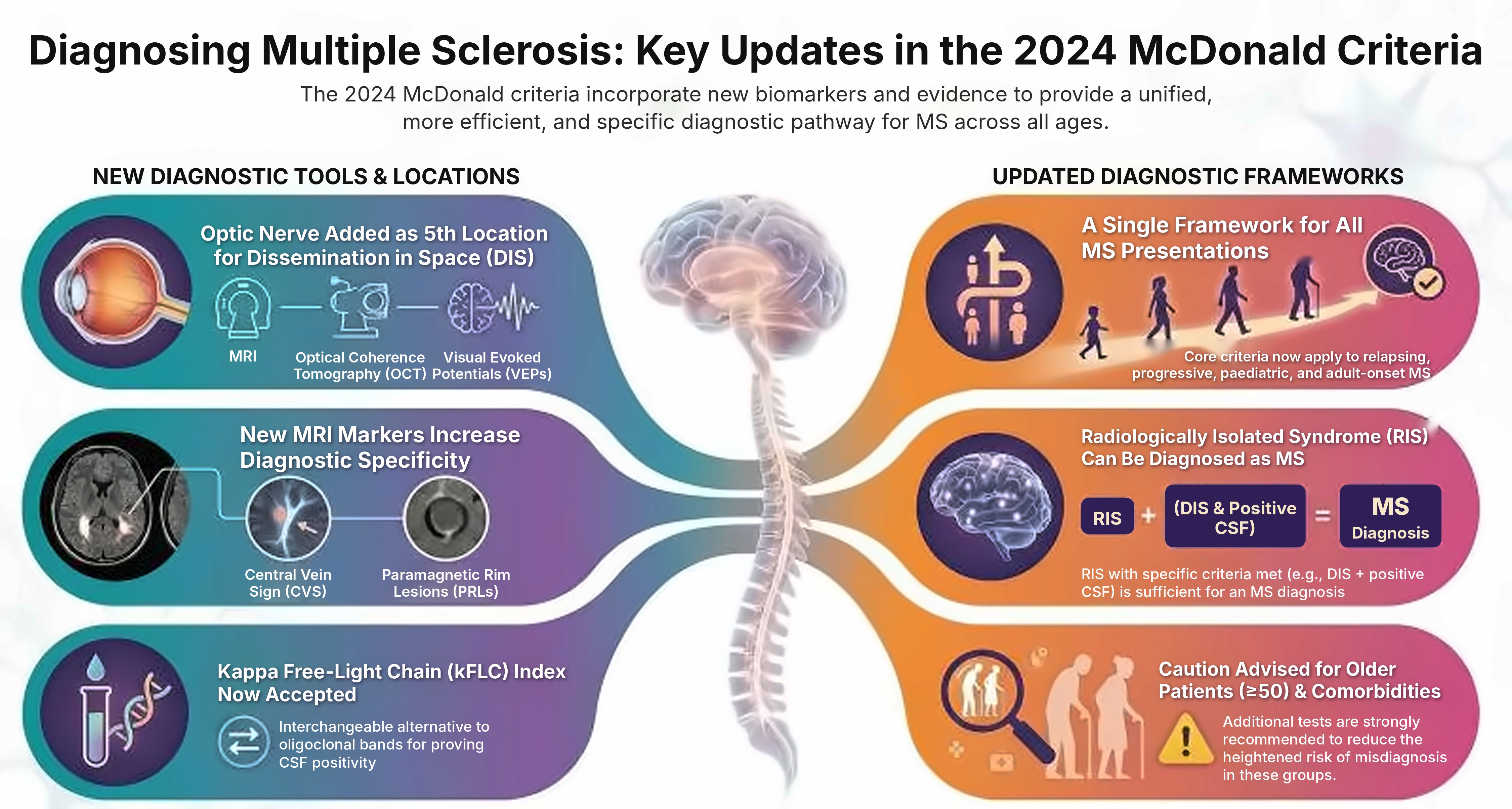
The 2024 McDonald revisions, published in 2025, broaden eligibility for multiple sclerosis (MS) diagnosis through optic-nerve assessment, cerebrospinal fluid kappa free light chains and advanced MRI biomarkers, and allow selected asymptomatic individuals to meet diagnostic criteria. Whether earlier classification improves care without compromising diagnostic accuracy remains uncertain, particularly outside specialist centres. This critical clinical perspective examines implementation across Bahrain, Kuwait, Oman, Qatar, Saudi Arabia and the United Arab Emirates. A targeted narrative update to 16 November 2026 integrates international diagnostic research and directly relevant Gulf evidence. Saudi referral cohorts demonstrate pre-existing diagnostic errors, while regional NMOSD and MOGAD studies underscore the need to exclude inflammatory mimics; neither establishes a GCC-wide error rate or errors caused by the revised criteria. International studies show greater diagnostic yield, although study selection and differing reference standards limit inferences about specificity. We distinguish diagnostic reclassification, misdiagnosis and overdiagnosis, particularly in radiologically isolated syndrome, where selected asymptomatic individuals may now be diagnosed with MS. Such classifications must not automatically trigger disease-modifying therapy: treatment timing and intensity require separate individualised risk–benefit assessment and shared decision-making. We propose a presentation-specific three-gate implementation framework requiring correct pathway selection, reliable evidence and exclusion of better explanations. A GCC audit should capture diagnostic pathway, test availability, diagnostic revision, treatment exposure, patient understanding and access, alongside time to diagnosis. Responsible implementation should be judged by diagnostic stability and patient outcomes, not simply by increasing the number of earlier MS diagnoses.
Keywords:
multiple sclerosis
; 2024 McDonald criteria
; Gulf Cooperation Council
; Bahrain
; diagnostic accuracy
; misdiagnosis
; kappa free light chains
; central vein sign
; paramagnetic rim lesions
; radiologically isolated syndrome
Copyright: This open access article is published under a Creative Commons CC BY 4.0 license, which permit the free download, distribution, and reuse, provided that the author and preprint are cited in any reuse.