
Submitted:
19 November 2026
Posted:
20 November 2026
You are already at the latest version
Abstract
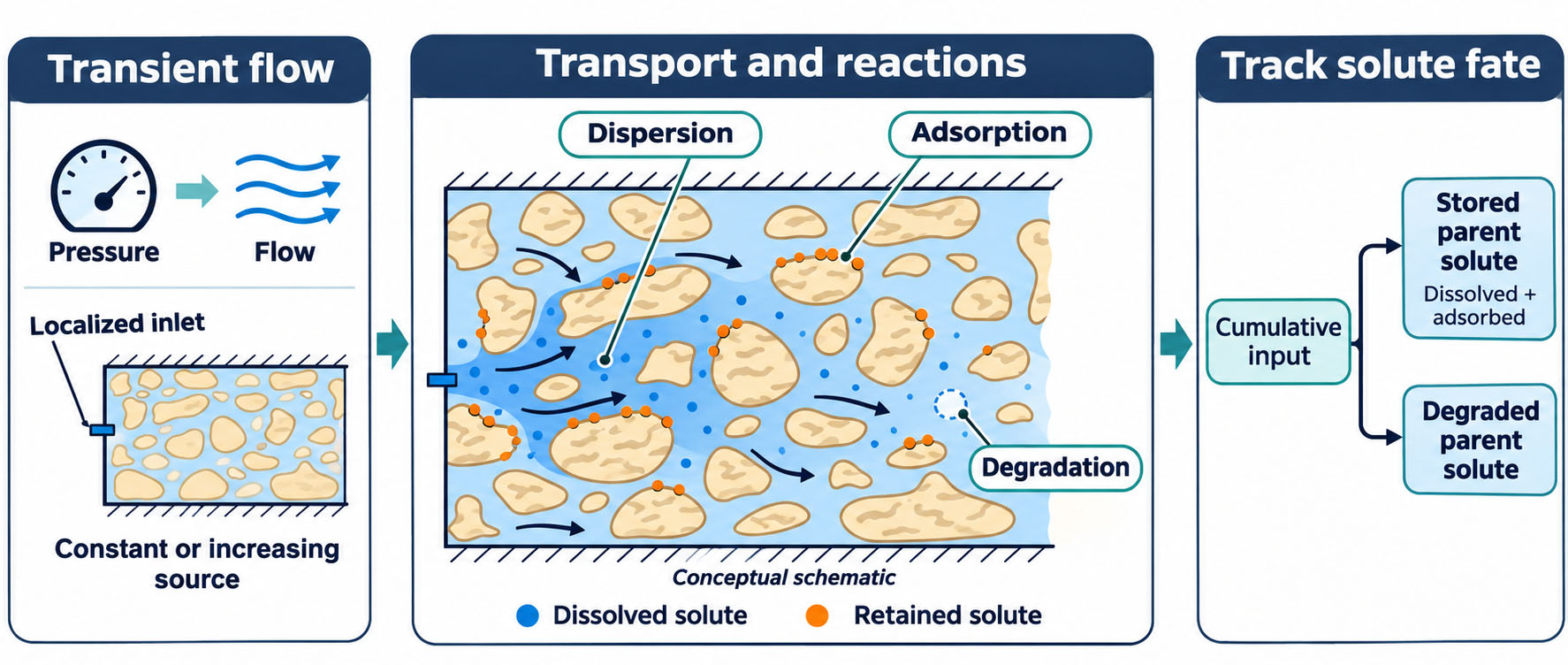
Understanding how contaminants migrate, accumulate, and degrade in porous media is essential for groundwater protection. This study couples a transient pressure-derived Darcy velocity field near a localized inlet with two-dimensional solute transport, multistage adsorption, and first-order degradation in an idealized saturated medium. Simulations compare constant anisotropic and spatially variable scalar dispersion under a constant inlet concentration, together with exponentially increasing inlet concentrations under constant dispersion. A conservative numerical formulation is assessed through independent numerical references, spatial and temporal refinement, and solute mass balances. The results show that dispersion and inlet history influence contaminant spreading, cumulative loading, and partitioning between dissolved and adsorbed phases. Variable dispersion increases cumulative input and stored inventory, without a numerically resolved improvement in the fraction degraded. Greater retention therefore does not by itself indicate improved contaminant removal. Because the dispersion comparison also changes anisotropy and coefficient magnitudes, it does not isolate the effect of spatial variability. These findings demonstrate the importance of interpreting concentration patterns alongside cumulative loading and retained inventories. The model provides a basis for investigating contaminant persistence, although application to groundwater management requires physically justified parameters, sensitivity analysis, and independent observational validation.
Keywords:
first-order degradation
; hydrodynamic dispersion
; mass balance
; multistage adsorption
; numerical convergence
; porous media
; solute transport
Copyright: This open access article is published under a Creative Commons CC BY 4.0 license, which permit the free download, distribution, and reuse, provided that the author and preprint are cited in any reuse.