

Submitted:
18 November 2026
Posted:
19 November 2026
You are already at the latest version
Abstract
Background/Objectives: Food noise refers to persistent, intrusive or distressing food-related cognition. This narrative review examines definitions, measurement, potential mechanisms and interventions while distinguishing direct evidence from evidence on related constructs. Methods: A targeted, non-systematic literature identification through 28 September 2026 considered direct food-noise research, mechanistically adjacent studies of craving and food-related cognition, and contextual work on spirituality and Christian Orthodox practices. Sources were interpreted according to their relevance and design; no exhaustive systematic search or formal risk-of-bias assessment was performed. Results: The Food Noise Questionnaire and Ro Allison Indiana Dhurandhar Food Noise Inventory provide promising measurement tools, but diagnostic thresholds and clinically meaningful change values are not established. Observational findings with semaglutide suggest lower food-noise scores without demonstrating causality. Psychological interventions affect related outcomes, but direct randomized food-noise trials are lacking. Spirituality has not been tested as a food-noise treatment, and fasting may be unsuitable in vulnerable populations. Conclusions: Food noise is a developing clinical research construct, not a diagnosis or synonym for hunger. Mechanism-based, prospectively tested interventions and independent validation remain priorities.
Keywords:
food noise
; food preoccupation
; obesity
; endocrine signaling
; cognitive behavioral therapy
; acceptance and commitment therapy
; mindfulness
; food craving
; emotional eating
; spirituality
1. Introduction
The experience now called “food noise” entered scientific vocabulary from patient narratives rather than from an established diagnostic taxonomy. Individuals describe a recurring internal stream of thoughts about what, when and how much to eat, anticipation of future eating, monitoring of calories or macronutrients, and difficulty disengaging from food-related cognition. The distinguishing feature is not that food is thought about—an ordinary and adaptive process—but that the thoughts become persistent, intrusive, unwanted or dysphoric and may interfere with functioning [1,2,3]. The proposed boundaries remain provisional pending evidence that food noise adds predictive or clinical value beyond established food-related constructs.
An early conceptual model linked food noise to food-cue reactivity in 2023 [4], with measurement development accelerating in 2025–2026. Dhurandhar and colleagues proposed a working definition centered on persistence, cognitive burden, dysphoria and potential harm, while Diktas and colleagues developed the five-item Food Noise Questionnaire (FNQ), and subsequent work validated the longer and short-form Ro Allison Indiana Dhurandhar Food Noise Inventory (RAID-FN) instruments [1,2,3]. The construct nevertheless remains contested because it overlaps with food craving, food preoccupation, hedonic hunger, attentional bias, food addiction, rumination and intrusive cognition [5]. This overlap is not a weakness if treated explicitly; it becomes problematic only when the terms are used interchangeably without measurement. By September 2026, the literature also included qualitative and social-media analyses, psychiatric discussion and a theoretical synthesis proposing homeostatic, cue-reactivity, addiction-like, thought-suppression and memory-inhibition models [6,7,8].
The public prominence of food noise has been tightly linked to reports that glucagon-like peptide-1 receptor agonists (GLP-1 receptor agonists) can “quiet” persistent food thoughts. That association is clinically important but scientifically risky: it may encourage reverse definition of a construct by its response to a marketed treatment. Direct GLP-1-based treatment evidence now exists, including retrospective and cross-sectional observational studies that do not establish causality [9,10]. Meanwhile, psychological science has investigated intrusive thoughts, craving, cue reactivity, emotional eating and cognitive control for decades. A rigorous review must therefore test two competing possibilities rather than assume either one: food noise may primarily reflect biological appetite or reward signaling, or it may emerge from an interaction between signal generation and modifiable cognitive-affective amplification [5,11,12].
This review therefore asks five questions. First, is food noise sufficiently distinct from neighboring constructs to justify separate measurement? Second, which biological, learning, affective and metacognitive mechanisms could generate or maintain it? Third, what interventions have measured food noise directly? Fourth, where direct evidence is absent, which treatments affect the nearest selected mechanistic outcomes, and how strong is that inferential bridge? Fifth, can these findings support a testable phenotype-matched treatment framework rather than a one-treatment model? Particular emphasis is placed on psychological treatment because it offers the clearest test of whether the burden of food-related cognition can be reduced independently of pharmacological appetite suppression.
Figure 1 summarizes the central causal proposition of this review: the frequency with which food representations enter awareness and the degree to which those representations become persistent, distressing or behaviorally dominant may be partly separable processes. This distinction provides the rationale for combining interventions that reduce bottom-up appetite or reward signaling with interventions that modify top-down appraisal, attention, learning and emotional response.
2. Review Approach
2.1. Review Design
This narrative review uses a translational, selectively scoped evidence map. Because food noise is a recent construct while several candidate mechanisms have longer research histories, we discuss direct food-noise studies alongside selected mechanistically related evidence and contextual literature. This is not a systematic review: no prospectively registered protocol, exhaustive database-by-database search, duplicate independent screening or formal study-level risk-of-bias assessment was undertaken. Accordingly, the included publications must not be interpreted as a complete enumeration of eligible studies, and no PRISMA flow diagram or pooled effect estimate is presented. The term “evidence map” is used here descriptively rather than to claim a formal evidence-mapping review with exhaustive study identification.
2.2. Selection Criteria
Table 1 summarizes the selection principles used to define the scope of this narrative review.
2.3. Literature Identification
The literature discussed was identified through targeted searches and citation-led identification up to 28 September 2026. Key direct terms included food noise, Food Noise Questionnaire, Ro Allison Indiana Dhurandhar and RAID-FN. Related concepts included food preoccupation, intrusive food thoughts, craving, hedonic hunger, cue reactivity, eating control and emotional eating; intervention topics included psychological therapies, obesity pharmacotherapy, metabolic-bariatric surgery, exercise, sleep and stress. Contextual topics included spirituality, religious coping, Christian Orthodox practices and fasting. These search concepts describe the review scope rather than a reproducible comprehensive search strategy.
2.4. Evidence Classification
To avoid the most important inferential error in this field, studies were not treated as equivalent merely because their outcomes were food-related. Evidence was classified for synthesis into three levels: (1) direct evidence, when the study explicitly measured food noise with a validated instrument; (2) near-direct evidence, when outcomes measured food preoccupation, craving, hedonic drive, cue reactivity or control of eating; and (3) mechanistically adjacent evidence, when an intervention targeted a process plausibly contributing to food noise, such as emotional eating, intrusive-thought elaboration, cognitive fusion, suppression rebound or conditioned cue reactivity. Causal language throughout the synthesis follows this hierarchy. In particular, improvement in craving is not described as demonstrated improvement in food noise. Figure 2 summarizes these levels of outcome specificity. Conceptual publications inform definitions but are not treated as direct treatment evidence.
2.5. Critical Appraisal and Interpretation
We qualitatively considered study design, comparison groups, prospective versus retrospective ascertainment, outcome validity, sample size, attrition and commercial involvement. For psychometric reports, relevant considerations included reliability, factor structure, construct validity and clinical interpretability. No standardized risk-of-bias instrument, independent dual appraisal or GRADE assessment was applied; consequently, labels of relative evidential strength represent cautious narrative judgments, not formal evidence-certainty ratings. Mechanistic findings from craving or emotional-eating studies should not be taken as evidence of food-noise treatment efficacy.
This hierarchy is a methodological safeguard. It permits the review to use mature psychological and neurobehavioral literatures without collapsing distinct constructs into a single outcome. Throughout the review, the strength of causal language is therefore proportional to the specificity of the measurement used. The three-level classification is an author-defined interpretive device, not a formally validated evidence-certainty system.
3. What Is Food Noise? Construct, Measurement and Boundaries
3.1. A Working Clinical Definition
The most useful current definition is persistent food-related thought that is experienced as unwanted and/or dysphoric and may cause mental, social or physical harm [1]. This definition places subjective unwantedness and burden at the center of the construct. It therefore differs from normal meal planning, professional attention to food, culturally meaningful food anticipation or intentional dietary monitoring that is not distressing.
3.2. Food Noise Is Not Identical to Hunger
Hunger is a physiological and subjective state related to energy need, whereas food noise is a cognitive-affective experience. The two can interact but dissociate. A person may experience repeated food thoughts in the absence of marked physiological hunger, particularly in cue-rich environments, during stress or dietary restraint, or when conditioned reward expectations are strong. Conversely, physiological hunger may occur without intrusive or dysphoric cognition. This distinction explains why interventions that alter reward, attention or acceptance may plausibly reduce food noise even when they have modest effects on caloric need.
3.3. Food Noise Versus Craving, Hedonic Hunger and Rumination
3.4. Measurement
The Food Noise Questionnaire (FNQ) is a five-item unidimensional self-report measure scored from 0 to 20. In its initial validation sample, internal consistency was excellent (Cronbach’s α = 0.93), 7-day test–retest reliability was high (r = 0.79), and convergent correlations with established food-preoccupation measures exceeded 0.78 [2]. These are important strengths. However, the confirmatory model also reported root mean square error of approximation (RMSEA) = 0.20 despite comparative fit index (CFI) = 0.95 and standardized root mean square residual (SRMR) = 0.03, a mixed fit profile that deserves independent replication rather than uncritical acceptance [2]. The instrument currently has no validated diagnostic threshold, minimal clinically important difference or established responsiveness criterion. It should therefore be used dimensionally, not as a diagnostic test. These psychometric findings are promising but do not yet establish a diagnostic threshold or clinical utility across independent populations.
The RAID-FN was developed through multistep psychometric testing and includes long and short forms addressing preoccupation, persistence and dysphoria [3]. Together, the FNQ and RAID-FN offer complementary operationalizations. Direct comparisons, independent replication and evaluation of responsiveness are needed before their scores can be used interchangeably or interpreted as diagnostic thresholds.
4. Why Food Noise May Occur: An Integrated Mechanistic Model
4.1. Homeostatic and Endocrine Signaling
Appetite is regulated by integrated peripheral and central signals including ghrelin, leptin, insulin, glucagon-like peptide-1, peptide YY and nutrient sensing. Obesity may coexist with leptin and insulin resistance and altered coupling between homeostatic signals and reward systems. A stronger or more persistent biological drive to seek energy can increase the probability that food representations repeatedly enter awareness. However, the persistence and unpleasantness of those thoughts likely require additional cognitive and affective processes. These pathways remain hypotheses for food noise, rather than established endocrine biomarkers of the construct [1,4,8].
4.2. Reward Learning and Cue Reactivity
Food cues acquire incentive salience through learning. Visual, olfactory, temporal and contextual signals can trigger anticipatory reward responses, attention and motivation independently of energy need. Neuroimaging studies consistently implicate orbitofrontal, striatal, insular, cingulate and hippocampal systems in food-cue processing, with evidence of altered reward responses in obesity [13,14]. In practical terms, repeated cue-triggered activation can make food cognitively “sticky”: the environment repeatedly refreshes a thought that the individual is trying to disengage from.
4.3. Stress, Negative Affect and Emotional Eating
Chronic stress can impair executive control while altering hypothalamic–pituitary–adrenal axis, dopaminergic and metabolic signaling. Stress also increases the salience and consumption of highly palatable foods in susceptible individuals [13,15]. Food thoughts may therefore function as both reward anticipation and negative reinforcement: imagining or consuming food temporarily reduces distress, strengthening the learned association between negative emotion and food-related cognition.
4.4. Thought Suppression and the Rebound Problem
Attempts to forcibly suppress food-related thoughts may paradoxically increase their accessibility. Observational work links food-thought suppression to binge eating, food cravings and eating-disorder symptoms [16]. This provides an important rationale for acceptance- and mindfulness-based approaches: the treatment target is not necessarily elimination of every food thought, but reduction of elaboration, fusion, distress and automatic behavioral response.
4.5. Cognitive Load, Memory and Attentional Capture
A persistent food representation can be maintained by attentional bias, working-memory rehearsal, prospective planning and repeated retrieval of food-related memories. Recent theoretical work proposes homeostatic drive, cue reactivity, addiction-like learning, thought suppression and memory-inhibition failure as complementary explanations rather than mutually exclusive models [8]. The implication is that food noise may have multiple phenotypes that require different treatment components.
5. Direct Evidence: Can Food Noise Be Reduced?
5.1. Semaglutide and Direct Food-Noise Outcomes
One of the largest direct treatment datasets comes from the INFORM survey of 550 U.S. adults receiving injectable semaglutide for weight management [9]. Among 547 respondents with complete FNQ data, median Food Noise Questionnaire score was 13 (interquartile range 10–16) when participants retrospectively recalled the pretreatment state and 6 (interquartile range 3–10) at survey completion; the median within-person reported change was −5 (interquartile range −10 to −2). The reported change is substantial, but its clinical importance is uncertain because a validated meaningful-change threshold is unavailable. Causal interpretation must remain cautious. INFORM was cross-sectional with retrospective baseline recall, no untreated comparator, no prospective pre-treatment FNQ measurement and no hypothesis-testing framework. Most participants were women (86%) and Caucasians (79%), and the study involved Novo Nordisk employees or consultants. These limitations do not negate the signal; they define the next experiment required: prospective randomized measurement of food noise before, during and after therapy.
A separate observational study by Rutigliani and Mattes compared adults with obesity before GLP-1 receptor agonist use and after different durations of exposure. FNQ scores were lower in six-month users than in pre-use controls (p = 0.026) [10]. Because the groups were compared cross-sectionally, the result does not establish within-person change or exclude treatment-selection effects.
5.2. Semaglutide and Near-Direct Outcomes
Controlled mechanistic trials predate the formal food-noise scales but converge on related outcomes. 12 weeks of once-weekly semaglutide reduced ad libitum energy intake by approximately 24%, decreased hunger and food cravings, improved control of eating and lowered preference for high-fat foods [17]. At 20 weeks, semaglutide 2.4 mg reduced ad libitum energy intake by 35% versus placebo and improved craving and eating-control measures [18]. A 60-week randomized trial published in 2026 additionally found lower energy intake throughout follow-up and greater early reductions in food preoccupation and food reward responsiveness, although some subjective appetite advantages attenuated at later time points [19].
5.3. Tirzepatide
Tirzepatide has not yet accumulated the same direct FNQ evidence, but randomized mechanistic data are strong for neighboring outcomes. In a 6-week phase 1 trial (n=114), tirzepatide reduced energy intake and improved multiple ingestive-behavior measures compared with placebo, including appetite or reward-related constructs [20]. This supports biological plausibility but does not establish a direct food-noise effect. The distinction is essential: a treatment can reduce hunger, craving or cue responsiveness without necessarily reducing the intrusive, unwanted or dysphoric qualities that define food noise.
5.4. Preliminary Comparative Behavioral Evidence
Preliminary findings presented at the 2026 European Congress on Obesity also examined one-month FNQ change in 417 adults receiving digital behavioral weight management, including 92 who initiated a GLP-1 receptor agonist and 325 who did not. Reported adjusted mean changes were −4.05 and −1.15 points, respectively [21]. This nonrandomized conference report provides early comparative longitudinal evidence, but baseline imbalance, short follow-up and commercial funding limit inference. It does not establish the efficacy of a specific psychotherapy or the independent contribution of medication.
Table 3 summarizes the direct measurement and observational literature, with study-specific limits on interpretation.
5.5. What Direct Evidence Can - and Cannot - Establish
At present, the causal evidence hierarchy is asymmetrical. Food-noise measurement science is advancing rapidly, but direct treatment findings remain mainly observational, including a semaglutide survey, a cross-sectional GLP-1 receptor agonist comparison and preliminary longitudinal behavioral-program data [9,10,21]. No randomized trial identified in the literature considered here used FNQ or RAID-FN change as a primary psychotherapy endpoint, and no randomized head-to-head study has tested psychological treatment against GLP-1-based therapy. This asymmetry is itself a major finding of the review. The available observational findings do not establish comparative efficacy or show that psychological treatment is ineffective. Conversely, the extensive craving or emotional-eating literature cannot be used to claim that cognitive behavioral therapy, acceptance and commitment therapy or mindfulness already “treat food noise”. The appropriate conclusion is a prioritized research agenda, not therapeutic equivalence.
6. Psychological Therapies: Can the Mind Be Made Quieter Without Pharmacological Appetite Suppression?
Psychological treatment deserves a central - not peripheral - place in the food-noise research agenda because the construct itself includes persistence, intrusiveness, dysphoria, attentional capture and impaired disengagement. These features are not reducible to caloric need. A psychologically informed model therefore asks two separate questions: what generates the food-related signal, and what makes that signal cognitively “sticky”? Therapy may be clinically meaningful even when it does not abolish physiological hunger if it reduces elaboration, self-referential fusion, conditioned expectancy, affective reinforcement, dwell time, distress or automatic behavioral response. The most plausible mechanisms are summarized in Figure 3 and should be tested prospectively with validated food-noise instruments rather than inferred from weight loss alone.
6.1. Mindfulness and Decentering
Mindfulness-based interventions train present-moment attention, non-reactivity and the ability to notice internal events without automatically elaborating them. For food noise, the most relevant component is decentering: a food-related thought is experienced as a transient mental event rather than as evidence of deprivation, a command to eat or a sign of personal failure. This maps closely onto the elaborated-intrusion model of desire, in which a brief cue becomes a sustained craving when it is repeatedly elaborated through imagery, working memory and anticipated reward [23]. Mindfulness may interrupt that elaboration, improve attentional disengagement and increase interoceptive discrimination between physiological hunger, affective arousal and conditioned wanting. A 2025 meta-analysis of 24 controlled studies including 1.920 participants found a small but significant reduction in craving intensity (Hedges’ g = 0.28; 95% confidence interval 0.07–0.48), and a decentering-specific meta-analysis reported g = 0.38 (95% confidence interval 0.16–0.59), while effects on craving frequency were not reliable [24,25]. This intensity–frequency dissociation is clinically important: treatment may first turn down the salience, urgency or believability of a thought before changing how often it appears. Neurobiologically, mindfulness-related changes have been described in attention, interoceptive and executive-control systems, but no study has yet shown that these neural changes mediate reductions in validated food-noise scores. The strongest current claim is therefore that mindfulness offers a plausible way to reduce cognitive amplification and reactivity, not that it directly suppresses metabolic appetite signaling.
6.2. Cognitive Behavioral Therapy and Enhanced Cognitive Behavioral Therapy
Cognitive behavioral therapy (CBT) is relevant when food-related cognition is maintained by learned rules and appraisals rather than by appetite intensity alone. Common examples include all-or-nothing dietary rules, catastrophizing a craving (“I will not be able to stop”), overvaluation of dietary control, compensatory restriction after perceived lapses, and self-critical interpretations that transform a transient food thought into prolonged rumination. Cognitive restructuring, self-monitoring, planned and nutritionally adequate eating, behavioral experiments, stimulus management, problem solving and relapse prevention target these loops at different points. Regular eating may also reduce the physiological deprivation that feeds cognitive salience, illustrating that psychological and metabolic mechanisms are not mutually exclusive. Meta-analytic obesity evidence supports cognitive behavioral and behavioral therapy for weight-management outcomes [26], while a 2025 meta-analysis around metabolic-bariatric surgery found short-term improvement in uncontrolled and emotional eating, with attenuation by one year [27]. Importantly, neurocognitive data provide a physiological bridge: in a functional magnetic resonance imaging study of adults with overweight or obesity, cognitive strategies altered both subjective craving and food-cue reactivity; focusing on long-term consequences produced the lowest craving ratings and greater dorsolateral prefrontal cortical recruitment, a region central to executive control [28]. These findings do not prove a food-noise mechanism, but they demonstrate that top-down appraisal can measurably change both craving and neural cue processing. Cognitive behavioral therapy is therefore most defensible for rule-driven, self-critical, restraint–rebound or loss-of-control phenotypes, with food-noise change needing direct prospective testing.
6.3. Acceptance and Commitment Therapy
Acceptance and commitment therapy (ACT) is especially relevant when the struggle to eliminate food thoughts becomes part of the maintaining process. Its core therapeutic target is psychological inflexibility rather than appetite itself. Acceptance reduces the secondary struggle with craving or internal discomfort; cognitive defusion weakens literal belief in the thought; present-moment awareness reduces automatic elaboration; values clarification creates a behavioral direction that is not contingent on whether craving is present; and committed action rehearses alternative responses. This framework is physiologically plausible because repeated suppression can produce monitoring and rebound, increasing accessibility of the unwanted cognition [16,29]. In other words, an individual may generate additional food-related mental activity while checking whether the thought has “gone away.” Acceptance replaces this control agenda with willingness to experience the internal cue without completing the habitual response sequence. A neuroimaging experiment in adults with overweight or obesity found that an acceptance-based “allow” strategy produced a distinct pattern of activity across frontal, reward-processing and default-mode regions while reducing craving relative to an immediate-reward condition [28]. This should not be interpreted as an established neural biomarker of acceptance and commitment therapy; it is preliminary evidence that acceptance changes the processing context of food cues. Meta-analytic and review evidence in obesity supports improvements in psychological flexibility, weight-related stigma and selected eating-regulation outcomes, although effects on binge, emotional and external eating are heterogeneous [30,31]. The most defensible role for acceptance and commitment therapy is therefore to reduce cognitive fusion, experiential avoidance, shame and the behavioral authority of food thoughts rather than to claim direct appetite suppression.
6.4. Cue Exposure and Inhibitory Learning
Cue exposure and response prevention treat food-cue reactivity as a learned expectancy rather than simply a failure of willpower. Through repeated exposure to the sight, smell, taste, time of day, place or emotional context that predicts eating - while the expected eating response is delayed or omitted- the patient encounters a prediction error. Contemporary inhibitory-learning models emphasize building a new association (“this cue can occur without the usual eating episode”) rather than waiting for craving to habituate completely. This distinction is important because craving may remain present during a successful exposure session while its predictive meaning and behavioral consequences change. A systematic review of 18 binge-eating cue-exposure studies concluded that the approach can reduce binge eating, while also noting small samples, inconsistent implementation and methodological limitations [32]. Experimental studies in women with overweight or obesity show that food cue exposure can reduce eating of exposed foods and modify cue–outcome expectancies, although generalization to unexposed foods is limited [33]. From a pathophysiological perspective, inhibitory learning is expected to modify prediction-error signaling and the learned coupling between salience or reward systems and action selection rather than directly changing energy need. For food noise, this approach is most plausible when thoughts are strongly context-bound- triggered by food visibility, smell, delivery applications, evening routines or specific environments. Direct trials should therefore measure both validated food-noise scores and ecological cue-triggered episodes, with deliberate variation of foods and contexts to test generalization.
6.5. Emotion Regulation and Emotional-Eating Interventions
Emotion-regulation approaches are most relevant when food noise rises with stress, loneliness, boredom, shame, anxiety or interpersonal distress. In this phenotype, food-related cognition can become negatively reinforcing: anticipating or consuming palatable food temporarily changes emotional state, which strengthens the future association between distress and food. Stress biology provides a plausible physiological substrate through hypothalamic-pituitary-adrenal signaling, cortisol, autonomic arousal, sleep disruption and interactions with dopaminergic reward and appetite pathways [13,15,34]. A 2025 review included 47 studies with 6.729 participants; 42 studies contributed to a pooled reduction in emotional-eating scores (standardized mean difference, −0.99; 95% confidence interval, −1.25 to −0.73), with values/identity work, goal setting, feedback and self-regulatory techniques among the behavior-change components associated with improvement [35]. Self-compassion adds a complementary mechanism by reducing shame, punitive self-monitoring and the abstinence-violation effect after perceived dietary lapses. In a meta-analysis of 59 studies, higher self-compassion was associated with less eating pathology and body-image concern, and self-compassion interventions showed moderate benefits for eating pathology [36]. These data are not direct food-noise trials, but they support a model in which reducing stress reactivity and self-condemnation can weaken the affective amplification of food thoughts. Clinically, emotion identification, distress tolerance, alternative soothing, interpersonal problem solving and self-compassion are therefore most relevant when the temporal pattern of food noise tracks emotional state rather than fasting hunger.
6.6. Executive-Control and Self-Regulation Interventions
Executive-control and self-regulation interventions target the translation of thought into action and the competition between salient food cues and longer-term goals. Techniques include implementation intentions (“if-then” plans), response-inhibition training, attentional redeployment, episodic future thinking, working-memory strategies, delay procedures, environmental restructuring and structured goal review. A systematic review of cognitive and neuromodulation strategies identified response inhibition, implementation intentions and dorsolateral prefrontal cortex-targeted approaches as promising for unhealthy eating and obesity, while emphasizing that many studies were short-term and performed in non-clinical samples [37]. The relevant pathophysiology is not a single lesion or neurotransmitter defect but an imbalance between rapidly triggered motivational or reward processes and slower reflective control. Functional imaging studies show that deliberate cognitive strategies can recruit executive-control regions and change neural food-cue reactivity [28]. This offers an objective bridge between psychotherapy and neurobiology: a psychological instruction can alter the processing of a food cue within seconds. For food noise, however, the clinically meaningful endpoint may be shorter dwell time, lower distress and greater response flexibility rather than complete absence of food-related thoughts. Long-term transfer from laboratory cognitive training to daily life remains uncertain and should be tested with ecological momentary assessment.
6.7. Why Psychological Treatment May Work Even When Food Noise Is Biologically Driven
Biological and psychological explanations are not mutually exclusive and should not be arranged as competing ideologies. Peripheral and central metabolic signals can alter how often food representations are generated, while learning, attention, affect and metacognition determine whether those representations are prolonged, aversive and behaviorally dominant. Gut-derived peptides, vagal input, hypothalamic nutrient sensing and mesolimbic reward pathways can be conceptualized as bottom-up signal generators; prefrontal executive control, insular interoception, memory and self-referential processing can shape amplification and response. Psychological treatment can therefore be mechanistically active even when the initiating signal is biological. The analogy is chronic pain: nociceptive input is real, yet appraisal, attention, avoidance and learning can independently alter suffering and function. A factorial trial combining an intervention that reduces appetite or reward signal generation with an intervention that reduces cognitive amplification would be more informative than asking whether medication or psychotherapy is “the real” treatment. Mediators should include validated food-noise scores, hunger, craving, cue reactivity, affect, cognitive fusion, expectancy and neural or endocrine markers where feasible.
6.8. A Mechanism-Matched Psychological Formulation
A practical psychological formulation should ask which processes make a food thought persistent, distressing or behaviorally influential rather than merely whether it occurs. At least six maintaining processes can be assessed: (1) elaboration, in which a brief cue expands into imagery, anticipated taste and planning; (2) cognitive fusion, in which the thought is treated as literal truth or instruction; (3) experiential avoidance and suppression, in which attempts to force the thought away increase monitoring and rebound; (4) conditioned expectancy, in which a cue predicts eating or relief; (5) negative reinforcement, in which eating terminates distress, loneliness or boredom; and (6) rigid restriction or self-criticism, which increases deprivation, shame and relapse cycles. This process-based formulation is more testable and clinically informative than grouping all non-pharmacological care under the label “lifestyle intervention.”
6.9. Spirituality, Meaning and Christian Orthodox Traditions: A Potential Adjunct, Not an Established Food-Noise Treatment
Spirituality should be included in this review because patients may use religious or existential frameworks to interpret appetite, self-control, shame, suffering and recovery. However, the evidentiary boundary is important: no study identified in the direct food-noise literature tested prayer, spiritual counseling, religious practice or Christian Orthodox spirituality as an intervention using the Food Noise Questionnaire or the Ro Allison Indiana Dhurandhar Food Noise Inventory. The relevant evidence is therefore contextual and mechanistically adjacent. A systematic review of 22 quantitative studies found that stronger internalized religiosity and a secure, satisfying relationship with God were generally associated with lower levels of disordered eating, psychopathology and body-image concern, whereas superficial or conflictual religiosity and an anxious relationship with God were associated with worse outcomes [38]. In a mindfulness-based eating study of 117 adults with moderate-to-severe obesity, including participants with binge-eating disorder, spiritual well-being increased and improvements in meaning and peace were associated with better emotional adjustment and eating regulation [39]. These findings support possible pathways through meaning-making, self-transcendence and regulation, but they do not establish a religion-specific food-noise effect.
Christian Orthodox evidence is distinctive because spirituality, communal life and periodic fasting are often intertwined. Observational research has associated an Orthodox ecclesiastical lifestyle with health-related behaviors including relaxation, life satisfaction, healthier nutrition and physical activity [40]. Studies in Orthodox monks, nuns and lay women have reported higher sense-of-coherence scores-an index of comprehensibility, manageability and meaningfulness-than secular comparison groups, suggesting a possible resilience or stress-regulation pathway [41,42]. Orthodox fasting has also been associated in observational and review literature with changes in dietary pattern, lower energy intake during fasting periods, lipid improvements and, in some cohorts, lower anxiety or depressive symptoms and better cognitive performance [43,44,45]. These effects cannot be attributed uniquely to spirituality because dietary composition, social structure, physical activity, selection effects and lifestyle differ between fasters and non-fasters. They are nonetheless relevant to a food-noise framework because stress burden, routine, meaning, dietary structure and social support are plausible modulators of intrusive food cognition. More recent clinical observations reinforce the need for restraint in interpretation. In 135 adults with metabolic diseases, long-term Christian Orthodox fasters showed several favorable cardiometabolic and lifestyle associations, including lower prevalence of overweight or abdominal obesity and lower blood pressure, but the cross-sectional design cannot separate fasting from education, smoking, activity, or other lifestyle factors [46]. Conversely, a 2025 cross-sectional study of 228 adults with overweight found no significant difference in body composition or overweight or obesity status between long-term fasters and non-fasters, despite lower fasting glucose and several dietary differences among fasters [47]. Together, these studies support a culturally meaningful dietary context but do not establish a direct effect on intrusive food cognition or food-noise burden.
For an Orthodox Christian patient who already values the tradition, several pathways are clinically plausible but remain hypotheses: prayer or contemplative attention may provide attentional anchoring; liturgical and communal rhythms may reduce isolation and unstructured cue exposure; meaning and a collaborative relationship with God may increase tolerance of distress; and a values-based concept of temperance may support deliberate choice rather than impulsive responding. These pathways overlap with established psychological constructs such as decentering, values-guided action, self-regulation, social support and sense of coherence. The clinically important distinction is that spiritual practice should not be instrumentalized as another weight-control technique. Used supportively, it may broaden identity beyond weight and food and reduce self-condemnation; used rigidly or moralistically, it may intensify guilt, scrupulosity, restriction and preoccupation. The scientific claim must therefore remain modest: Christian Orthodox spirituality may be a culturally congruent adjunctive resource for coping and self-regulation in selected patients, but direct efficacy for food noise is untested.
Fasting requires particular caution. The metabolic literature on Orthodox fasting is not evidence that fasting “treats” food noise, and prolonged or restrictive fasting can worsen food preoccupation or destabilize vulnerable individuals, particularly those with active or previous eating disorders [48]. In clinical care, spiritual goals should be coordinated with medical and psychological safety. Adaptation, exemption or temporary suspension of fasting may be appropriate when nutritional restriction, binge–restrict cycles, pregnancy, diabetes treatment, frailty or eating-disorder pathology makes the practice unsafe. A respectful model is collaborative: the patient, clinician and-if the patient wishes-an appropriately informed spiritual advisor distinguish health-promoting spiritual practice from compulsive control, shame or symptom reinforcement.
Figure 4 summarizes the potential contextual resources and clinical boundaries discussed above. Its pathways are hypotheses, not demonstrated treatment effects.
Table 4 summarizes the evidence relevant to psychological approaches and distinguishes adjacent outcomes from direct food-noise efficacy.
7. Pharmacological Alternatives Beyond Incretin-Based Therapy
7.1. Naltrexone and Bupropion
Naltrexone and bupropion influences appetite- and reward-related pathways. Secondary analyses of obesity trials link early improvements in craving control with subsequent weight loss [50], while a small neuroimaging study examined changes in functional connectivity during treatment [51]. A human laboratory investigation in binge-eating disorder assessed energy intake and craving-related outcomes [52]. These studies address potentially relevant processes but do not establish efficacy on FNQ or RAID-FN scores. Medication selection should follow established indications and individual contraindications rather than food-noise severity alone.
7.2. Phentermine and Topiramate
Phentermine and topiramate affects catecholaminergic appetite signaling and topiramate-related inhibitory and excitatory neurotransmission. In a small randomized crossover trial involving binge-eating disorder or bulimia nervosa, objective binge-eating days and body weight improved markedly compared with placebo [53]. These outcomes do not establish food-noise efficacy, but the treatment may be relevant where intrusive food cognition coexists with strong loss-of-control or binge-eating tendencies. Psychiatric, cognitive, cardiovascular and reproductive safety considerations remain essential.
7.3. Other Pharmacological Directions
Future food-noise trials should not be limited to marketed obesity drugs. Candidate pathways include amylin signaling, next-generation incretin combinations, melanocortin pathways and agents targeting reward and stress circuitry. The methodological requirement is straightforward: studies should prospectively include a validated food-noise scale and distinguish reductions in food-noise burden from reductions in hunger, nausea or energy intake.
8. Metabolic and Behavioral Alternatives Beyond Medication
8.1. Bariatric Surgery
Bariatric surgery changes gastrointestinal anatomy, gut-hormone signaling, food reward, preference and learned eating behavior. Systematic reviews show postoperative changes in food preference and reductions in food-addiction and binge-related phenotypes [54,55,56]. Direct evidence is now emerging: a 2026 conference abstract describing a post-bariatric sample using the FNQ found that higher weight self-stigma-particularly self-devaluation-was associated with greater food noise during weight stabilization [22]. The cross-sectional finding suggests that food-noise burden can remain relevant after surgery, but cannot establish the effect of surgery or the direction of the association.
8.2. Exercise
Exercise affects appetite through multiple pathways: acute changes in ghrelin and satiety hormones, altered reward processing, improved insulin sensitivity, mood regulation and executive function. Meta-analytic evidence in adults with overweight and obesity suggests that exercise training may modestly improve disinhibition, satiety and food reward even when average energy intake changes little [57]. A 2025 meta-analysis of acute exercise found reductions in hunger, prospective consumption and energy intake [58], and a 2026 systematic synthesis described cognitive-neural, endocrine and psychological pathways through which exercise may influence food reward [59]. No direct exercise trial using FNQ or RAID-FN was identified in the literature considered here.
8.3. Stress Management and Sleep
Stress-management interventions are mechanistically relevant because stress can increase reward salience, impair prefrontal self-control and alter cortisol, ghrelin and other appetite-related signaling [13,15]. Sleep restriction similarly increases hedonic food valuation and appetite in many experimental settings. These interventions should currently be considered supportive rather than established food-noise treatments, but they are low-risk targets when food noise is temporally linked to stress, fatigue or late-day dysregulation.
8.4. Dietary Pattern, Restriction and the Food Environment
Rigid dietary restriction can increase cognitive focus on forbidden foods in susceptible individuals, whereas adequate protein, fiber, meal regularity and reduced exposure to highly salient food cues may reduce physiological and environmental triggers. Ultra-processed foods may intensify reward and rapid eating through interacting sensory, metabolic and environmental pathways [60]. The practical implication is not that a specific macronutrient ratio “cures” food noise, but that nutritional adequacy and environmental design can reduce the number and intensity of triggers that psychological self-regulation must manage.
9. A Phenotype-Matched Treatment Framework
Table 5 presents proposed clinical formulations based on the dominant reported triggers and maintaining processes. These formulations guide research questions rather than prescribing treatment.
This framework is deliberately provisional. It is intended to generate testable hypotheses, not to create a new diagnosis. The critical research question is whether baseline phenotype predicts differential reduction in validated food-noise scores across treatment classes.
10. Clinical Assessment: What Should Be Asked Now?
Until validated diagnostic thresholds are available, clinicians can use a dimensional assessment. The central questions are: How often do food thoughts occur? How difficult are they to disengage from? Are they unwanted or distressing? Do they interfere with concentration, sleep, social activity or eating decisions? What triggers them-hunger, cues, stress, restriction or fatigue? Do they lead to binge eating or loss of control? How do they change after meals, exercise, sleep, psychotherapy or medication? Screening should also assess eating disorders, depression, anxiety, obsessive-compulsive symptoms, attention-deficit and hyperactivity disorder-related impulsivity, trauma, stress and medication effects when clinically indicated. Food noise should never be used as a euphemism that bypasses a formal eating-disorder assessment.
11. Evidence Gaps and Research Priorities
Table 6 identifies the principal measurement and intervention questions and the study designs needed to address them.
12. Discussion
The literature available by 28 September 2026 supports a deliberately asymmetric conclusion. Food noise is no longer solely a social-media expression: it has competing operational definitions, two validated measurement families and a rapidly expanding peer-reviewed literature [1,2,3,5,11,12,61]. Direct GLP-1 receptor agonist findings include a retrospective semaglutide survey and a cross-sectional comparison, with preliminary longitudinal conference data also available [9,10,21]. These observational findings remain vulnerable to recall, selection and confounding and do not establish comparative efficacy. By contrast, psychological treatments have little direct FNQ/RAID-FN evidence but a much deeper mechanistic literature on craving intensity, emotional eating, cue reactivity, thought suppression, psychological flexibility and inhibitory learning [24,25,26,27,29,30,31,33,35,49]. The correct synthesis is therefore neither “GLP-1 solves food noise” nor “psychotherapy is equivalent to GLP-1”; it is that different evidence streams currently answer different parts of the causal model.
Two additional publications clarify different research questions. A nationally representative US survey reported how often adults endorse the lay label “food noise”, but its single-item outcome must not be interpreted as a validated Food Noise Questionnaire (FNQ) or RAID-FN threshold [62]. A separate perspective reviewed food noise in incretin-based obesity pharmacotherapy without establishing the independent causal efficacy of any psychological intervention [63]. These additions strengthen the distinction between subjective labeling, psychometric severity, and intervention-specific outcomes; the proposed treatment-matching framework remains hypothesis-generating.
12.1. What This Review Adds
This review contributes four elements that are not usually combined in the emerging literature. First, it separates validated food-noise outcomes from neighboring constructs instead of treating craving, hunger and food noise as synonyms. Second, it places psychological treatment on an explicit mechanistic footing and identifies the process each therapy is expected to modify. Third, it introduces a phenotype-matched framework that generates testable treatment-by-phenotype hypotheses rather than assuming uniform response. Fourth, it treats reduction in thought intensity, distress, dwell time and behavioral authority as potentially distinct endpoints from reduction in thought frequency. That last distinction is supported by the decentering literature and may prove essential for defining clinically meaningful change [25].
The psychological literature materially changes the interpretation of the construct. Neighboring literatures show that craving intensity, emotional eating, attentional capture and the consequences of intrusive thoughts can be modified psychologically. Decentering is especially compelling because the 2025 meta-analysis found a stronger signal for craving intensity than frequency. This distinction maps closely onto clinical experience with intrusive cognition: therapeutic success may mean that the thought becomes less compelling and less distressing before it becomes less frequent.
The spirituality literature adds a different but clinically relevant dimension. It does not justify presenting faith as a treatment modality for food noise. Instead, it suggests that meaning, relationship, community, spiritual well-being and sense of coherence can influence the emotional and self-regulatory context in which eating-related thoughts are experienced [38,39,40,41,42,43,44,45,48]. Christian Orthodox traditions are particularly informative because fasting and spiritual practice may be beneficial, neutral or harmful depending on nutritional adequacy, psychological flexibility and the presence of eating-disorder vulnerability. This makes spirituality a candidate moderator and adjunctive coping resource-not a substitute for psychotherapy, medical obesity care or formal eating-disorder treatment.
The most defensible model is therefore interactive. This model predicts heterogeneous treatment response and argues against a one-size-fits-all intervention. Figure 1, Figure 2, Figure 3 and Figure 4 deliberately mirror this layered interpretation: mechanism generation, evidence hierarchy, psychotherapy pathways and culturally sensitive spiritual context are separated so that visual synthesis does not imply equivalent certainty across domains.
12.2. Limitations of the Evidence Base and of This Review
The principal limitations concern both the emerging construct and this review design. Intervention studies frequently measure craving, eating behavior or weight rather than validated food-noise outcomes. Direct treatment findings are mostly nonrandomized; recalled pretreatment ratings and selection effects limit causal interpretation. Diagnostic thresholds, minimal important differences, responsiveness to change and independent cross-cultural validation remain uncertain. Conference reports and commercial communications carry less evidential weight than peer-reviewed controlled studies. Mechanistic pathways, spiritual resources and phenotype-matched care models are hypotheses requiring prospective testing.
Clinically, a multimodal approach is already reasonable when framed around established targets rather than unproven claims. For example, a patient with intense physiological appetite may benefit from evidence-based obesity treatment, whereas cue-associated eating thoughts may warrant environmental modification or appropriately supervised behavioral strategies. Patients experiencing persistent thought suppression or self-criticism may benefit from established acceptance- or mindfulness-informed interventions when clinically indicated, and those with emotional eating may benefit from emotion-regulation approaches. None of these interventions has yet been demonstrated to treat food noise itself in a randomized trial using validated food-noise outcomes. Many patients will have mixed phenotypes.
13. Conclusions
Food noise is an emerging, measurable but not yet diagnostically settled neurocognitive construct. Its most defensible core is not hunger itself but persistent food-related cognition that is difficult to disengage from and is experienced as unwanted, dysphoric or functionally burdensome. Observational GLP-1 receptor agonist studies provide direct food-noise signals, but prospective randomized confirmation is still needed. Psychological evidence is indirect but mechanistically coherent and quantitatively meaningful: decentering reduces craving intensity, CBT targets rigid rules and loss-of-control cycles, ACT targets cognitive fusion and suppression, cue exposure aims to modify conditioned predictions, and emotion-regulation interventions target affective reinforcement. The clinical and scientific opportunity is therefore broader than finding a non-GLP-1 drug that mimics GLP-1 effects. The more consequential question is whether food noise can be decomposed into treatable pathways-and whether combining metabolic signal reduction with psychological reduction of amplification, distress and automatic responding produces more durable benefit than either approach alone. Randomized trials using the Food Noise Questionnaire or the Ro Allison Indiana Dhurandhar Food Noise Inventory outcomes, prospective mediation analyses and treatment-by-phenotype designs should now replace anecdote as the field’s next standard of evidence. Patient-valued spirituality, including Christian Orthodox practices, may offer meaning, community and values-based coping for selected individuals, but it should be studied as an adjunctive moderator and implemented with safeguards against guilt, compulsive restriction and eating-disorder relapse.
Author Contributions
Conceptualization, L.M.G. and A.-D.I.; methodology, A.-D.I. and L.M.G.; investigation, A.-D.I., B.A.T.H., E.C.P.T. and T.G.M.; visualization, A.-D.I.; writing—original draft preparation, A.-D.I.; writing—review and editing, all authors; supervision, L.M.G.
Funding
Institutional publication support from the University of Oradea.
Institutional Review Board Statement
Not applicable. This study is a review of previously published literature and did not involve new human participants, identifiable human data or animal experimentation.
Informed Consent Statement
Not applicable.
Data Availability Statement
No original participant-level dataset was generated or analyzed for this narrative review. All publications discussed are identified in the reference list.
Conflicts of Interest
The authors declare no conflict of interest.
References
- Dhurandhar, E.J.; Maki, K.C.; Dhurandhar, N.V.; Kyle, T.K.; Yurkow, S.; Hawkins, M.A.W.; Agley, J.; Ho, E.H.; Cheskin, L.J.; Sørensen, T.I.A.; et al. Food noise: definition, measurement, and future research directions. Nutr. Diabetes 2025, 15, 30. [Google Scholar] [CrossRef] [PubMed]
- Diktas, H.E.; Cardel, M.I.; Foster, G.D.; LeBlanc, M.M.; Dickinson, S.L.; Ables, E.M.; Chen, X.; Nathan, R.; Shapiro, D.; Martin, C.K. Development and validation of the Food Noise Questionnaire. Obesity 2025, 33, 289–297. [Google Scholar] [CrossRef] [PubMed]
- Dhurandhar, E.J.; Maki, K.C.; Dhurandhar, N.V.; Kyle, T.K.; Yurkow, S.; Hawkins, M.A.W.; Agley, J.; Ho, E.H.; Cheskin, L.J.; Sørensen, T.I.A.; et al. Development and rigorous multistep validation of a psychometric tool to measure food noise. Appetite 2026, 217, 108339. [Google Scholar] [CrossRef] [PubMed]
- Hayashi, D.; Edwards, C.; Emond, J.A.; Gilbert-Diamond, D.; Butt, M.; Rigby, A.; Masterson, T.D. What Is Food Noise? A Conceptual Model of Food Cue Reactivity. Nutrients 2023, 15, 4809. [Google Scholar] [CrossRef] [PubMed]
- Brewis, A.; Hayashi, D.; Gualano, B.; Precinotto, M.L.; Scagliusi, F.B.; Stöckelová, T.; SturtzSreetharan, C.; West, H.; Williams, O.; Masterson, T.D. Food noise: Conceptual, methodological, and ethical considerations. Appetite 2026, 226, 108700. [Google Scholar] [CrossRef] [PubMed]
- Hayashi, D.; Kort, J.; Robles-Martinez, I.M.; Orabueze, D.; Bakhl, K.; Masterson, T.D. “And just like that, quiet”: a content analysis of TikTok videos on food noise. Nutr. Diabetes 2026, 16, 16. [Google Scholar] [CrossRef] [PubMed]
- Fernandes, M.F.; Guimarães, J.L.; Sousa, A.; Pereira, C.N.; Mateus, M.A. Food Noise: Emerging Concept, Neurobiological Mechanisms, and Psychopathological Implications. Eur. Psychiatry (conference abstract). 2026, 69, S315–S316. [Google Scholar] [CrossRef]
- Wylie, F.; Mahmut, M.K.; Francis, H.M.; Davidson, T.; Stevenson, R.J. Food noise: A theoretical review. Appetite published online. 2026, 2027(228), 108791. [Google Scholar] [CrossRef] [PubMed]
- Arnaut, T.; Duncan, S.; Faurby, M.; Hahn-Pedersen, J.H.; Kvist, K.; Steenackers, N.; Buse, J.B. Retrospective Assessment of Food Noise Changes After Initiation of Injectable Semaglutide for Weight Management in the USA: The INFORM Survey. Adv. Ther. 2026, 43, 3649–3659. [Google Scholar] [CrossRef] [PubMed]
- Rutigliani, G.; Mattes, R.D. The effects of glucagon-like peptide-1 receptor agonists on chemosensory function and ingestive behavior. Physiol. Behav. 2026, 316, 115486. [Google Scholar] [CrossRef] [PubMed]
- Prakash, R.; Khan, A. Food noise: integrating experience and evidence. Nutr. Diabetes 2026, 16, 10. [Google Scholar] [CrossRef] [PubMed]
- Rizwan, A.A.M.; Galyean, S. Food noise as a missing piece in obesity treatment: toward an integrated intervention framework. Int. J. Obes. (advance online publication). 2026. [Google Scholar] [CrossRef] [PubMed]
- Sinha, R. Role of addiction and stress neurobiology on food intake and obesity. Biol. Psychol. 2018, 131, 5–13. [Google Scholar] [CrossRef] [PubMed]
- Vartanian, M.; Jahanitabesh, A.; Christensen, J.F.; Staub, H.; Jensen, D.E.A.; Villringer, A.; Witte, A.V. Neural responses to visual food cues according to weight and hunger state: A systematic review and meta-analysis. Neurosci. Biobehav. Rev. 2025, 177, 106301. [Google Scholar] [CrossRef] [PubMed]
- Sinha, R.; Jastreboff, A.M. Stress as a Common Risk Factor for Obesity and Addiction. Biol. Psychiatry 2013, 73, 827–835. [Google Scholar] [CrossRef] [PubMed]
- Barnes, R.D.; Tantleff-Dunn, S. Food for thought: Examining the relationship between food thought suppression and weight-related outcomes. Eat. Behav. 2010, 11, 175–179. [Google Scholar] [CrossRef] [PubMed]
- Blundell, J.; Finlayson, G.; Axelsen, M.; Flint, A.; Gibbons, C.; Kvist, T.; Hjerpsted, J.B. Effects of once-weekly semaglutide on appetite, energy intake, control of eating, food preference and body weight in subjects with obesity. Diabetes Obes. Metab. 2017, 19, 1242–1251. [Google Scholar] [CrossRef] [PubMed]
- Friedrichsen, M.; Breitschaft, A.; Tadayon, S.; Wizert, A.; Skovgaard, D. The effect of semaglutide 2.4 mg once weekly on energy intake, appetite, control of eating, and gastric emptying in adults with obesity. Diabetes Obes. Metab. 2021, 23, 754–762. [Google Scholar] [CrossRef] [PubMed]
- Tronieri, J.S.; Allison, K.C.; DeRouen, K.; Amaro, A.; Collins, K.G.; Roy, A.; Watts, S.; Ananna, T.; Wadden, T.A. Short- and long-term effects of semaglutide 2.4 mg on energy intake, appetite, and food reward: a 60-week, double-blind randomized controlled trial. Am. J. Clin. Nutr. 2026, 124, 101403. [Google Scholar] [CrossRef] [PubMed]
- Martin, C.K.; Carmichael, O.T.; Carnell, S.; Considine, R.V.; Kareken, D.A.; Dydak, U.; Mattes, R.D.; Scott, D.; Shcherbinin, S.; Nishiyama, H.; et al. Tirzepatide on ingestive behavior in adults with overweight or obesity: a randomized 6-week phase 1 trial. Nat. Med. 2025, 31, 3141–3150. [Google Scholar] [CrossRef] [PubMed]
- Pennington Biomedical Research Center. Study Shows Use of Obesity Drugs Alongside Behavioral Intervention is Associated with Reduced “Food Noise”. Institutional report of poster abstract 1276 presented at the 33rd European Congress on Obesity, Istanbul, Türkiye, May 2026. Available online: https://www.pbrc.edu/news/media/2026/food-noise-eco.aspx (accessed on 28 September 2026).
- Bond, D.; Lillis, J.; Wu, Y.; et al. Silencing the food noise? Weight self-stigma and persistent, intrusive thoughts about food during post-metabolic and bariatric surgery weight stabilization. Surg. Obes. Relat. Dis. (conference abstract). 2026, 22, S6. [Google Scholar] [CrossRef]
- Tapper, K. Mindfulness and craving: effects and mechanisms. Clin. Psychol. Rev. 2018, 59, 101–117. [Google Scholar] [CrossRef] [PubMed]
- Allameh, S.A.; Mokhtari, Z.; Hosseini, E.; Askari, G. Effects of mindfulness-based interventions on food craving in adults: a systematic review and meta-analysis of controlled clinical trials. BMC Psychol. 2025, 13, 1022. [Google Scholar] [CrossRef] [PubMed]
- Allameh, S.A.; Mokhtari, Z.; Hosseini, E.; Askari, G. Effects of Decentering on Food Craving in Adults: A Systematic Review and Meta-analysis of Controlled Clinical Trials. Int. J. Behav. Med. (advance online publication). 2025. [Google Scholar] [CrossRef] [PubMed]
- Cha, J.Y.; Kim, S.Y.; Lim, Y.W.; Choi, K.H.; Shin, I.S. Comparative Effectiveness of Cognitive Behavioral Therapy and Behavioral Therapy in Obesity: A Systematic Review and Network Meta-Analysis. J. Clin. Psychol. Med. Settings 2025, 32, 96–110. [Google Scholar] [CrossRef] [PubMed]
- Gao, H.; Wang, G.; Zhang, X.; Guo, H.; Pang, L.; Gu, J. Meta-Analysis of the Effects of Cognitive Behavioral Therapy on Dietary Habits and Emotional Outcomes in Patients With Obesity Undergoing Metabolic and Bariatric Surgery. J. Nutr. Educ. Behav. 2025, 57, 854–868. [Google Scholar] [CrossRef] [PubMed]
- Demos McDermott, K.E.; Lillis, J.; McCaffery, J.M.; Wing, R.R. Effects of Cognitive Strategies on Neural Food Cue Reactivity in Adults with Overweight/Obesity. Obesity 2019, 27, 1577–1583. [Google Scholar] [CrossRef] [PubMed]
- Erskine, J.A.K.; Georgiou, G.J. Effects of thought suppression on eating behaviour in restrained and non-restrained eaters. Appetite 2010, 54, 499–503. [Google Scholar] [CrossRef] [PubMed]
- Chew, H.S.J.; Chng, S.; Rajasegaran, N.N.; Choy, K.H.; Chong, Y.Y. Effectiveness of acceptance and commitment therapy on weight, eating behaviours and psychological outcomes: a systematic review and meta-analysis. Eat. Weight Disord.-Stud. Anorex. Bulim. Obes. 2023, 28, 6. [Google Scholar] [CrossRef] [PubMed]
- Schumacher, L.M.; Miller, N.; Jennings, E.L.; Chabria, R.; Butryn, M.L. Acceptance and Commitment Therapy for Obesity. Curr. Obes. Rep. 2025, 14, 41. [Google Scholar] [CrossRef] [PubMed]
- Magson, N.R.; Handford, C.M.; Norberg, M.M. The Empirical Status of Cue Exposure and Response Prevention Treatment for Binge Eating: A Systematic Review. Behav. Ther. 2021, 52, 442–454. [Google Scholar] [CrossRef] [PubMed]
- Schyns, G.; van den Akker, K.; Roefs, A.; Houben, K.; Jansen, A. Exposure therapy vs lifestyle intervention to reduce food cue reactivity and binge eating in obesity: A pilot study. J. Behav. Ther. Exp. Psychiatry 2020, 67, 101453. [Google Scholar] [CrossRef] [PubMed]
- Tomiyama, A.J. Stress and Obesity. Annu. Rev. Psychol. 2019, 70, 703–718. [Google Scholar] [CrossRef] [PubMed]
- Power, D.; Jones, A.; Keyworth, C.; Dhir, P.; Griffiths, A.; Shepherd, K.; Smith, J.; Traviss-Turner, G.; Matu, J.; Ells, L. Emotional Eating Interventions for Adults Living With Overweight and Obesity: A Systematic Review and Meta-Analysis of Behaviour Change Techniques. J. Hum. Nutr. Diet. 2025, 38, e13410. [Google Scholar] [CrossRef] [PubMed]
- Turk, F.; Waller, G. Is self-compassion relevant to the pathology and treatment of eating and body image concerns? A systematic review and meta-analysis. Clin. Psychol. Rev. 2020, 79, 101856. [Google Scholar] [CrossRef] [PubMed]
- Forcano, L.; Mata, F.; de la Torre, R.; Verdejo-Garcia, A. Cognitive and neuromodulation strategies for unhealthy eating and obesity: Systematic review and discussion of neurocognitive mechanisms. Neurosci. Biobehav. Rev. 2018, 87, 161–191. [Google Scholar] [CrossRef] [PubMed]
- Akrawi, D.; Bartrop, R.; Potter, U.; Touyz, S. Religiosity, spirituality in relation to disordered eating and body image concerns: A systematic review. J. Eat. Disord. 2015, 3, 29. [Google Scholar] [CrossRef] [PubMed]
- Kristeller, J.L.; Jordan, K.D. Mindful Eating: Connecting With the Wise Self, the Spiritual Self. Front. Psychol. 2018, 9, 1271. [Google Scholar] [CrossRef] [PubMed]
- Chliaoutakis, J.E.; Drakou, I.; Gnardellis, C.; Galariotou, S.; Carra, H.; Chliaoutaki, M. Greek Christian Orthodox Ecclesiastical Lifestyle: Could It Become a Pattern of Health-Related Behavior? Prev. Med. 2002, 34, 428–435. [Google Scholar] [CrossRef] [PubMed]
- Merakou, K.; Taki, S.; Barbouni, A.; Antoniadou, E.; Theodoridis, D.; Karageorgos, G.; Kourea-Kremastinou, J. Sense of Coherence (SOC) in Christian Orthodox Monks and Nuns in Greece. J. Relig. Health 2017, 56, 521–529. [Google Scholar] [CrossRef] [PubMed]
- Merakou, K.; Xefteri, E.; Barbouni, A. Sense of Coherence in Religious Christian Orthodox Women in Greece. Community Ment. Health J. 2017, 53, 353–357. [Google Scholar] [CrossRef] [PubMed]
- Spanaki, C.; Rodopaios, N.E.; Koulouri, A.; Pliakas, T.; Papadopoulou, S.K.; Vasara, E.; Skepastianos, P.; Serafeim, T.; Boura, I.; Dermitzakis, E.; et al. The Christian Orthodox Church Fasting Diet Is Associated with Lower Levels of Depression and Anxiety and a Better Cognitive Performance in Middle Life. Nutrients 2021, 13, 627. [Google Scholar] [CrossRef] [PubMed]
- Giaginis, C.; Mantzorou, M.; Papadopoulou, S.K.; Gialeli, M.; Troumbis, A.Y.; Vasios, G.K. Christian Orthodox Fasting as a Traditional Diet with Low Content of Refined Carbohydrates That Promotes Human Health: A Review of the Current Clinical Evidence. Nutrients 2023, 15, 1225. [Google Scholar] [CrossRef] [PubMed]
- Gholampoor, N.; Sharif, A.H.; Mellor, D. The effect of observing religious or faith-based fasting on cardiovascular disease risk factors: A systematic review and meta-analysis. Nutr. Metab. Cardiovasc. Dis. 2024, 34, 1097–1109. [Google Scholar] [CrossRef] [PubMed]
- Rodopaios, N.E.; Poulios, E.; Papadopoulou, S.K.; Alexatou, O.; Koulouri, A.A.; Kafatos, A.G.; Papaliagkas, V.; Psara, E.; Giannakoula, A.; Tsourouflis, G.; et al. Association of Christian Orthodox Fasting with Sociodemographic, Anthropometric and Lifestyle Factors and Serum Biochemical Indices: A Cross-Sectional Study on Patients with Metabolic Diseases. Metabolites 2024, 14, 67. [Google Scholar] [CrossRef] [PubMed]
- Rodopaios, N.E.; Apostolopoulou, A.; Koulouri, A.A.; Papadopoulou, S.K.; Skepastianos, P.; Hassapidou, M.; Tsimtsiou, Z.; Kafatos, A.G. Is There a Difference in Overweight and Obesity Between Christian Orthodox Fasters and Non-Fasters? A Cross-Sectional Study in Northern Greece. Nutrients 2025, 17, 3308. [Google Scholar] [CrossRef] [PubMed]
- Bonaccorsi, V.; Romeo, V.M. Psychological and Psychiatric Consequences of Prolonged Fasting: Neurobiological, Clinical, and Therapeutic Perspectives. Nutrients 2026, 18, 60. [Google Scholar] [CrossRef] [PubMed]
- Wolz, I.; Nannt, J.; Svaldi, J. Laboratory-based interventions targeting food craving: A systematic review and meta-analysis. Obes. Rev. 2020, 21, e12996. [Google Scholar] [CrossRef] [PubMed]
- Dalton, M.; Finlayson, G.; Walsh, B.; Halseth, A.E.; Duarte, C.; Blundell, J.E. Early improvement in food cravings are associated with long-term weight loss success in a large clinical sample. Int. J. Obes. 2017, 41, 1232–1236. [Google Scholar] [CrossRef] [PubMed]
- Wang, G.J.; Zhao, J.; Tomasi, D.; Kojori, E.S.; Wang, R.; Wiers, C.E.; Caparelli, E.C.; Volkow, N.D. Effect of combined naltrexone and bupropion therapy on the brain’s functional connectivity. Int. J. Obes. 2018, 42, 1890–1899. [Google Scholar] [CrossRef] [PubMed]
- McKee, S.A.; Lydecker, J.A.; Pittman, B.; Jastreboff, A.M.; DiLeone, R.J.; Lavery, M.; Grilo, C.M. Naltrexone/bupropion for binge-eating disorder: A human laboratory investigation of mechanisms. Drug Alcohol Depend. Rep. 2026, 19, 100428. [Google Scholar] [CrossRef] [PubMed]
- Safer, D.L.; Adler, S.; Sethi, S.; Bentley, J.P.; Toyama, H.; Pajarito, S.; Najarian, T. A randomized, placebo-controlled crossover trial of phentermine-topiramate ER in patients with binge-eating disorder and bulimia nervosa. Int. J. Eat. Disord. 2020, 53, 266–277. [Google Scholar] [CrossRef] [PubMed]
- Guyot, E.; Dougkas, A.; Nazare, J.A.; Bagot, S.; Disse, E.; Iceta, S. A systematic review and meta-analyses of food preference modifications after bariatric surgery. Obes. Rev. 2021, 22, e13315. [Google Scholar] [CrossRef] [PubMed]
- Ivezaj, V.; Wiedemann, A.A.; Grilo, C.M. Food addiction and bariatric surgery: a systematic review of the literature. Obes. Rev. 2017, 18, 1386–1397. [Google Scholar] [CrossRef] [PubMed]
- Reche-García, C.; Piernas, C.; García-Vizcaíno, E.M.; Lorente-Gallego, A.M.; Piuvezam, G.; Frutos, M.D.; Hernández Morante, J.J. Bariatric-Metabolic Surgery is the Most Effective Intervention in Reducing Food Addiction Symptoms: A Systematic Review and Meta-Analysis. Obes. Surg. 2024, 34, 3475–3492. [Google Scholar] [CrossRef] [PubMed]
- Beaulieu, K.; Blundell, J.E.; van Baak, M.A.; Battista, F.; Busetto, L.; Carraça, E.V.; Dicker, D.; Encantado, J.; Ermolao, A.; Farpour-Lambert, N.; et al. Effect of exercise training interventions on energy intake and appetite control in adults with overweight or obesity: A systematic review and meta-analysis. Obes. Rev. 2021, 22, e13251. [Google Scholar] [CrossRef] [PubMed]
- Li, N.; Wu, M.; Li, Y. Acute Exercise Effects on Appetite and Energy Intake in People Living With Overweight and Obesity: A Systematic Review and Meta-Analysis. Int. J. Sport Nutr. Exerc. Metab. 2025, 35, 540–556. [Google Scholar] [CrossRef] [PubMed]
- Liu, D.; Jiang, Y.; Wang, Z.; Mo, X. Exercise intervention modulates food reward in obesity: efficacy, mechanisms, and prospects. Front. Nutr. 2026, 13, 1895299. [Google Scholar] [CrossRef] [PubMed]
- Louie, J.C.Y. The Gut–brain–adipose Axis in Ultra-processed Food and Obesity: A Mechanistic Synthesis and Its Implications for Food Classification. Curr. Obes. Rep. 2026, 15, 67. [Google Scholar] [CrossRef] [PubMed]
- Umashanker, D.; Mitchell, J.E. Food Noise: Current Knowledge and Future Research Directions. Obesity 2026, 34, 762–764. [Google Scholar] [CrossRef] [PubMed]
- Hayashi, D.; Masterson, T.D. Prevalence and Correlates of Perceived Food Noise Among U.S. Adults in a Nationally Representative Sample. Obes. Sci. Pract. 2026, 12, e70201. [Google Scholar] [CrossRef] [PubMed]
- Patoulias, D.; Popovic, D.S.; Koufakis, T. Food Noise in the Era of Incretin-Based Obesity Pharmacotherapy: Current Evidence, Clinical Implications and Research Priorities. Diabetes Obes. Metab. online ahead of print. 2026. [Google Scholar] [CrossRef] [PubMed]
Figure 1.
Integrated mechanistic model of food noise. Food-related cognitions may be generated by homeostatic and endocrine signaling and repeatedly refreshed by reward learning, food-cue reactivity, stress, attentional capture, memory processes and thought-suppression rebound. The right side separates potentially modifiable treatment targets.
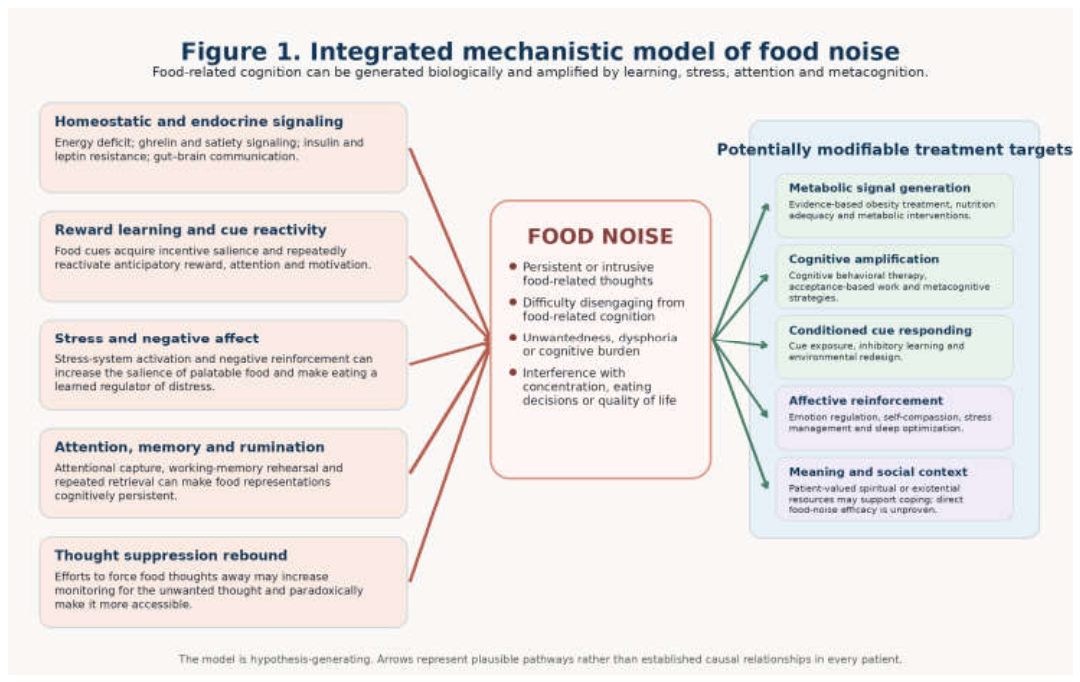
Figure 2.
Evidence hierarchy used to prevent construct substitution. Direct evidence requires a validated food-noise measure. Near-direct evidence captures food preoccupation, craving, hedonic hunger, cue reactivity or control of eating. Mechanistically adjacent evidence addresses processes that may maintain food noise, such as emotional reinforcement, cognitive fusion, attentional capture, suppression rebound or conditioned cue responding. Findings from lower levels support mechanism and hypothesis generation but are not relabeled as demonstrated food-noise efficacy.
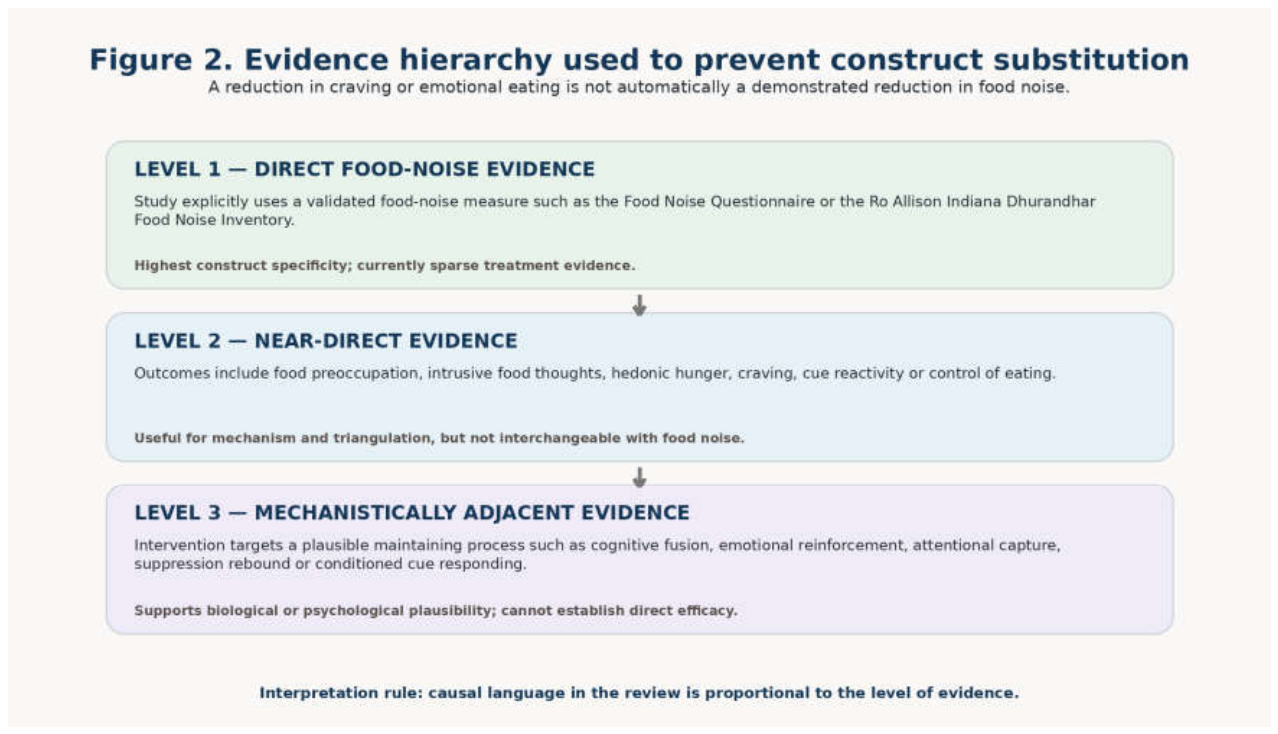
Figure 3.
Mechanism-based model of psychological treatment for food noise. Mindfulness and decentering primarily target attentional capture and elaboration; cognitive behavioral therapy targets rigid rules, catastrophic appraisal and learned relapse cycles; acceptance and commitment therapy targets cognitive fusion and experiential avoidance; cue exposure targets conditioned expectancies through inhibitory learning; and emotion-regulation or self-compassion approaches target stress, shame and negative reinforcement. Proposed physiological bridges are based on adjacent craving, food-cue and eating-behavior research, not on direct neurobiological food-noise trials.
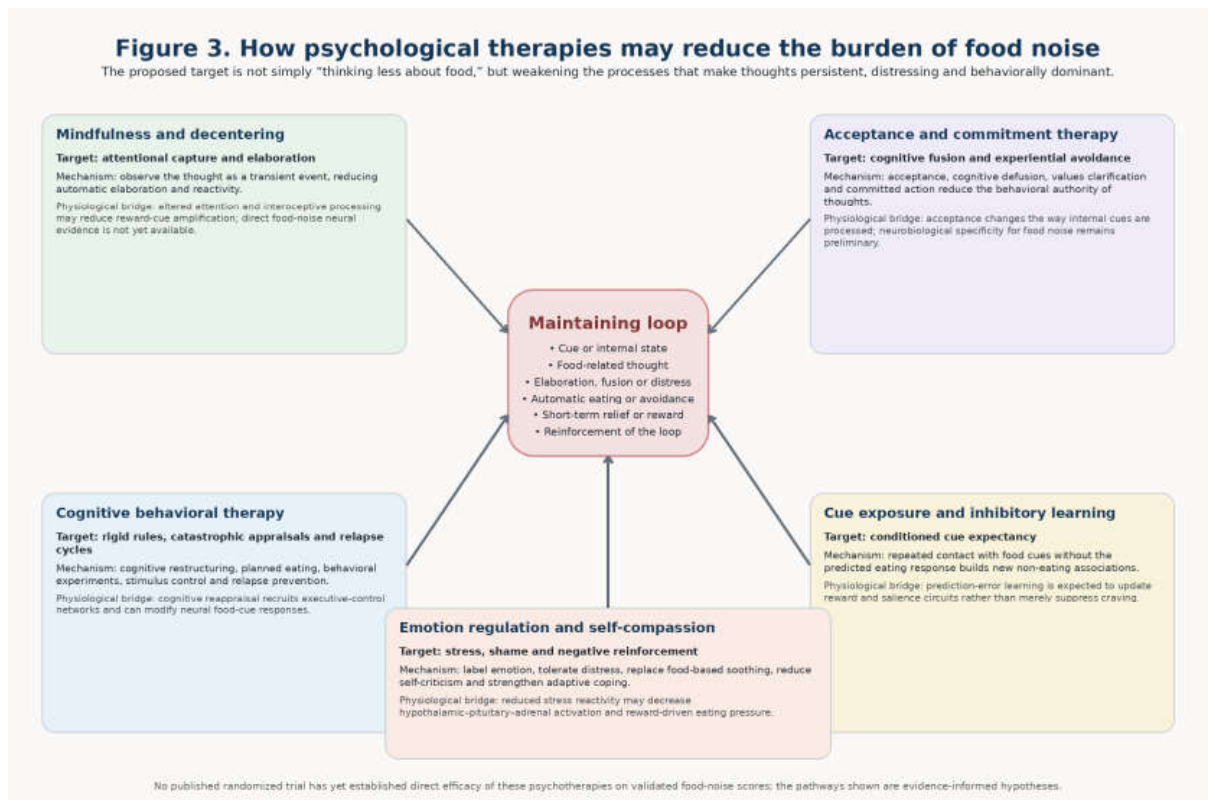
Figure 4.
Spirituality and Christian Orthodox traditions as adjunctive, patient-valued resources. Potential pathways include meaning, prayer or contemplation, community support, sense of coherence, compassion and values-guided self-regulation. Evidence is indirect: no trial has demonstrated a reduction in validated food-noise scores from spiritual or Orthodox interventions. The figure also emphasizes clinical boundaries, including the risks of rigid moralization, scrupulosity and unsafe fasting in patients vulnerable to disordered eating.
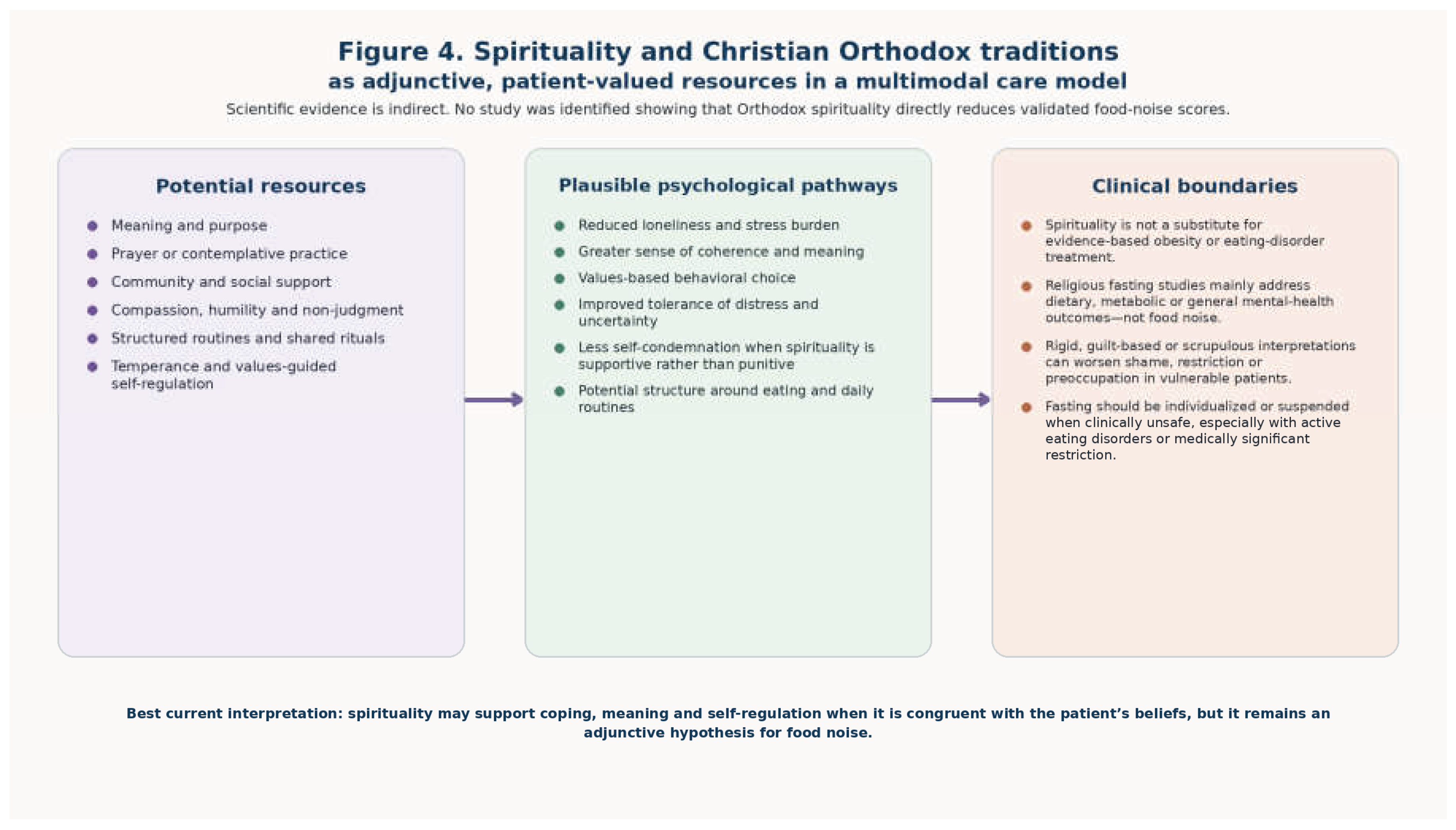

Table 1.
Scope and selection principles.
| Domain | Criterion |
|---|---|
| Population | Humans, primarily adults; obesity and overweight, metabolic disease, eating-disorder populations and general adult samples when relevant to mechanisms. |
| Direct construct | Publications defining or measuring food noise; empirical direct outcomes distinguished from conceptual discussion. |
| Adjacent constructs | Food preoccupation, intrusive food thoughts, food craving, hedonic hunger or Power of Food Scale, cue reactivity, uncontrolled or emotional eating when mechanistically relevant. |
| Interventions | Psychological, behavioral, pharmacological, surgical and metabolic, dietary, exercise, sleep and stress and multimodal interventions. |
| Outcomes | Food-noise scores; food preoccupation; craving intensity and frequency; cue reactivity; reward responsiveness; uncontrolled and emotional eating; control of eating; related quality-of-life outcomes. |
| Exclusions | Sources without a relevant cognitive, appetite, eating or contextual outcome; nonscientific commentary used neither as efficacy evidence nor as a substitute for primary research. |
Table 2.
Conceptual boundaries between food noise and related constructs.
| Construct | Core feature | Primary mechanism emphasis | Relation to food noise |
|---|---|---|---|
| Physiological hunger | Homeostatic drive to eat | Energy deficit, ghrelin, hypothalamic signaling | Can trigger food noise but is not sufficient |
| Food craving | Intense desire for a specific food | Reward expectancy, learning, affect | Often episodic; food noise may be broader and persistent |
| Hedonic hunger | Drive to consume palatable food despite limited energy need | Reward sensitivity, availability | Captures “wanting” but not necessarily intrusive dysphoria |
| Food preoccupation | High frequency of food-related cognition | Attention and cognitive load | Closest historical construct; may lack unwantedness or distress criterion |
| Rumination/intrusive thought | Repetitive, hard-to-disengage cognition | Metacognition, attention, suppression rebound | Strong psychological analogue for persistence and intrusiveness |
| Food noise | Persistent food-related thought perceived as unwanted or dysphoric and potentially harmful | Multifactorial | Provisional transdiagnostic phenotype requiring further validation |
Table 3.
Direct food-noise measurement and observational evidence.
| Study / evidence | Design / sample | Key strength | Critical limitation | Inference for food noise |
|---|---|---|---|---|
| Diktas et al., 2025 [2] | FNQ psychometric validation; N=396 analyzed | Brief validated direct measure; high internal/test–retest reliability | No clinical threshold/minimal clinically important difference; mixed confirmatory factor analysis fit; independent replication needed | Supports reliability; clinical interpretation remains uncertain |
| Dhurandhar et al., 2026 [3] | RAID-FN multistep psychometric validation | Long/short forms; multidimensional preoccupation–persistence–dysphoria model | Independent external/cross-cultural replication and responsiveness still limited | Supports measurement development; further validation needed |
| Arnaut et al., 2026 [9] | Cross-sectional INFORM survey; 550 participants, 547 with complete FNQ scores | Direct FNQ assessment; transparent reporting of recalled and current scores | Retrospective baseline, no control, selected sample, industry involvement | Observed association; causal effect cannot be established |
| Bond et al., 2026 [22] | Post-metabolic-bariatric surgery cross-sectional abstract; n=40 | Direct FNQ use beyond pharmacotherapy; links self-stigma to food noise | Small sample; conference-level evidence; association only | Hypothesis-generating |
| Rutigliani and Mattes, 2026 [10] | Cross-sectional comparison by GLP-1 receptor agonist exposure | Direct FNQ outcome; pre-use comparison group | Nonrandomized groups; duration and selection confounding | Lower scores in six-month users; no causal inference |
| Diktas et al., 2026 [21] | Conference report; observational cohort, n = 417; one month | Prospective FNQ assessment; behavioral-treatment comparison | Baseline imbalance, short follow-up, commercial funding; preliminary report | Association favoring combined care; no randomized comparison |
| Psychotherapy trials | No randomized FNQ/RAID-FN trial of a specific psychotherapy identified | Clear research gap | Specific psychotherapy evidence is adjacent; preliminary behavioral-program data are observational | No direct efficacy claim yet |
Abbreviations: FNQ, Food Noise Questionnaire; RAID-FN, Ro Allison Indiana Dhurandhar Food Noise Inventory; GLP-1, glucagon-like peptide-1. Conference reports are preliminary and are not weighted equivalently to full research articles.
Table 4.
Psychological and contextual approaches relevant to food noise.
| Approach | Most relevant food-noise mechanism | Best adjacent evidence | What can be claimed now | Direct FNQ/RAID-FN trial evidence |
|---|---|---|---|---|
| Mindfulness / decentering | Elaboration; attentional capture; cognitive fusion | 24-study meta-analysis: craving intensity g=0.28; decentering-specific meta-analysis: g=0.38 [23,24,25] | Small reduction in craving intensity; direct food-noise efficacy unproven | No specific trial identified |
| Cognitive behavioral therapy / enhanced cognitive behavioral therapy | Rigid rules; catastrophic appraisal; loss-of-control cycles; relapse reinforcement | Meta-analyses support short-term improvements in uncontrolled/emotional eating in relevant obesity samples [26,27] | Supports established eating and weight targets; food-noise effects untested | No specific trial identified |
| Acceptance and commitment therapy | Cognitive fusion; experiential avoidance; suppression rebound; values conflict | Meta-analytic/review evidence for psychological flexibility, stigma and selected eating-regulation outcomes [30,31] | Plausible for distress/behavioral authority of thoughts; not an appetite suppressant | No specific trial identified |
| Cue exposure / inhibitory learning | Conditioned cue expectancy; stimulus-bound reactivity | 69-study craving intervention meta-analysis plus obesity pilot RCT [32,33,49] | Can reduce cue-driven intake and binge-related outcomes; generalization must be trained | No specific trial identified |
| Emotion regulation / self-compassion | Negative affect; shame; negative reinforcement | Emotional-eating review: 47 studies, n = 6,729; 42 in pooled estimate (SMD −0.99); self-compassion review [35,36] | Indirect support for affect-related mechanisms; heterogeneous interventions | No specific trial identified |
| Executive/self-regulation training | Translation of thought into action; limited inhibitory control | Laboratory meta-analysis supports small effects on craving/intake [37,49] | Potential adjunct; long-term clinical transfer uncertain | No specific trial identified |
| Spiritual or meaning-based adjunctive care | Meaning, sense of coherence, social support, shame/self-condemnation | Systematic review of religiosity/eating pathology; mindful-eating spiritual-well-being data; Christian Orthodox observational literature [38,39,40,41,42,43,44,45,48] | Potentially useful when patient-valued and non-punitive; fasting requires safety screening; direct food-noise efficacy unproven | No specific trial identified |
Abbreviations: FNQ, Food Noise Questionnaire; RAID-FN, Ro Allison Indiana Dhurandhar Food Noise Inventory; SMD, standardized mean difference. Effect estimates concern adjacent outcomes and should not be compared as a ranking of food-noise treatments. Reviews may include overlapping primary studies.
Table 5.
Hypothesis-generating clinical formulations and potential treatment targets.
| Proposed phenotype | Clinical clues | Biological/behavioral emphasis | Psychological emphasis |
|---|---|---|---|
| Homeostatic-dominant | Strong physical hunger, large appetite, meal-related escalation | Assess nutritional adequacy and meal structure; obesity pharmacotherapy only for an established indication | Mindfulness for interoceptive discrimination; CBT for relapse planning |
| Reward/cue-dominant | Food thoughts triggered by visibility, smell, delivery apps, specific environments | Environmental restructuring; supervised exposure when appropriate; medication only for an established indication | Cue-exposure or inhibitory learning; attention retraining; CBT |
| Ruminative/suppression-dominant | Repeated unwanted thoughts intensified by trying not to think about food | Reduce rigid restriction; avoid suppression cycles | acceptance and commitment therapy, mindfulness or decentering, metacognitive strategies |
| Affect-dominant | Food noise increases with stress, anxiety, loneliness or boredom | Stress/sleep treatment; address psychiatric comorbidity | cognitive behavioral therapy, emotion regulation, acceptance and commitment therapy, self-compassion |
| Binge/loss-of-control dominant | Intrusive cognition plus recurrent loss of control or binge episodes | Evidence-based binge-eating-disorder care; selected pharmacotherapy when appropriate | enhanced cognitive behavioral therapy or cognitive behavioral therapy for binge-eating disorder; structured eating; relapse prevention |
| Mixed phenotype | Multiple pathways active | Multimodal individualized plan | Combination psychological + metabolic + environmental treatment |
Abbreviations: CBT, cognitive behavioral therapy; ACT, acceptance and commitment therapy. Proposed patterns may overlap within an individual.
Table 6.
Research priorities for food-noise measurement and treatment.
| Gap | Key question | Priority design |
|---|---|---|
| Definition | Is food noise a distinct construct or a clinically useful combination of existing constructs? | Multi-method construct validation across cultures and weight categories. |
| Thresholds | What score represents clinically meaningful burden? | Anchor-based cutoffs linked to impairment and quality of life. |
| Responsiveness | What constitutes meaningful improvement? | Minimal clinically important difference for FNQ and RAID-FN. |
| Psychotherapy | Can cognitive behavioral therapy, acceptance and commitment therapy, mindfulness or cue exposure reduce food noise directly? | Preregistered randomized controlled trials with food-noise primary or co-primary outcomes. |
| Comparative effectiveness | Are GLP-1 therapies uniquely effective? | Head-to-head and factorial trials: drug, psychotherapy, combination. |
| Durability | Does food noise return after medication discontinuation? | Longitudinal follow-up including withdrawal and maintenance phases. |
| Mechanisms | Which neural or endocrine changes track food-noise reduction? | Ecological momentary assessment + functional magnetic resonance imaging / electroencephalography + gut hormones. |
| Safety/ethics | Could “food noise” pathologize normal food thought or promote unnecessary medication? | Context-sensitive thresholds, shared decision-making, stigma monitoring. |
Abbreviations: FNQ, Food Noise Questionnaire; RAID-FN, Ro Allison Indiana Dhurandhar Food Noise Inventory; GLP-1, glucagon-like peptide-1.
Disclaimer/Publisher’s Note: The statements, opinions and data contained in all publications are solely those of the individual author(s) and contributor(s) and not of MDPI and/or the editor(s). MDPI and/or the editor(s) disclaim responsibility for any injury to people or property resulting from any ideas, methods, instructions or products referred to in the content. |
© 2026 by the authors. Licensee MDPI, Basel, Switzerland. This article is an open access article distributed under the terms and conditions of the Creative Commons Attribution (CC BY) license (http://creativecommons.org/licenses/by/4.0/).
Copyright: This open access article is published under a Creative Commons CC BY 4.0 license, which permit the free download, distribution, and reuse, provided that the author and preprint are cited in any reuse.