
Submitted:
17 November 2026
Posted:
18 November 2026
You are already at the latest version
Abstract
Generative artificial intelligence (GenAI) is increasingly used by students for academic support, but it remains unclear how students value AI-based support compared with other forms of teaching and peer support. This study examined learning-support preferences among 366 second-year computing students at Kaunas University of Technology who were surveyed in 2025 and 2026 using a repeated cross-sectional design. Ten learning-support preferences and GenAI use frequency were analyzed using non-parametric tests, equivalence tests, rank correlations, and ordinal logistic regression. Students rated practical examples, clearly structured information, and peer assistance highest, whereas preference for using AI tools in learning was moderate and social media was rated lowest. Between the 2025 and 2026 Software Systems cohorts, weekly or daily GenAI use increased from 58.1% to 77.1%, yet all ten preferences were statistically equivalent across cohorts and across computing programs. More frequent GenAI use was associated with stronger preference for AI-supported learning (ρ = .284; OR = 1.93, 95% CI [1.58, 2.35]), whereas its associations with peer support, group work, and most other forms of support were negligible. The findings suggest that GenAI currently functions as an additional source of learning support rather than a replacement for teaching and peer support.
Keywords:
generative artificial intelligence
; learning support
; computing students
; student preferences
1. Introduction
In recent years, generative artificial intelligence (GenAI) tools, such as ChatGPT, Gemini, Claude, as well as programming assistants such as GitHub Copilot, have begun to reshape learning and academic support practices in higher education [1,2,3]. As conversational systems provide instant access to explanations, debugging assistance, and code generation, their use among computing students has grown substantially [2]. In computing education, students use these tools for a range of technical tasks, including code explanation, error checking, solution optimization, and conceptual clarification [3].
However, increasing access to and use of GenAI tools should not be taken as direct evidence that students prefer AI-based support over other forms of pedagogical and peer support. According to recent investigations, students value GenAI for its speed, accessibility, and convenience but continue to value human support when they require trusted guidance, deeper conceptual understanding, or social interaction [2,4,5]. This distinction is important because frequent use of GenAI may indicate its accessibility and responsiveness rather than a reduced reliance on human learning support. This raises the broader question of how GenAI is positioned within students’ overall learning-support preferences.
Despite the increasing number of scholarly studies on GenAI adoption, use, perceptions, and academic help-seeking behavior, there is still limited understanding of how AI-based support is positioned within a broader spectrum of pedagogical and peer-to-peer learning-support options. In particular, limited evidence exists on whether learning-support preference patterns remain stable across student cohorts and related computing programs and whether more frequent GenAI use is associated with broader changes in these preferences. Understanding these patterns is important for universities that need to integrate GenAI into teaching while maintaining accessible, high-quality pedagogical and peer support [6]. Decisions about GenAI integration should therefore consider not only how often students use these tools but also how students value them in relation to other forms of learning support.
1.1. Generative AI in Higher Education
Generative artificial intelligence (GenAI) has become increasingly embedded in students’ academic practices in higher education. Large-scale survey evidence indicates that students use GenAI primarily for pragmatic study-related purposes, including information retrieval, summarization, text refinement, idea generation, conceptual clarification, and support with academic tasks. In a survey of 788 undergraduate students, Chatzopoulos et al. found high levels of GenAI engagement, with students using these tools particularly for information searching, understanding difficult concepts, and supporting academic work [7]. Similarly, a multi-institutional survey of more than 8,000 students showed that over 80% had used GenAI for study-related activities, most commonly for editing, summarizing, and idea generation [8].
The role of GenAI is particularly relevant in computing and programming education, where these tools can directly support technical problem solving. Groothuijsen et al. reported that students used ChatGPT for error checking and debugging, explaining code, increasing conceptual understanding, generating and optimizing solution code, and solving mathematical problems [3]. Evidence from computing students also suggests that GenAI is becoming an increasingly established source of academic help. Hou et al. found that the proportion of computing students reporting that they never used ChatGPT for help decreased substantially between 2023 and 2024, with ChatGPT approaching online search as one of the most commonly used help resources [2].
However, frequent use and perceived usefulness do not imply uncritical trust in GenAI. Chung et al. found that students’ engagement was driven primarily by perceived usefulness while trust in the factual accuracy of AI-generated content remained relatively low [8]. Similar findings were reported by Nygren et al., whose dual-institutional study of 1,097 students showed generally positive attitudes towards GenAI but only moderate trust in its outputs. Importantly, students in that study tended to perceive GenAI as a complement to rather than a replacement for traditional teaching [9]. These findings suggest that the educational role of GenAI cannot be understood solely through adoption or frequency of use. It also depends on how students position AI alongside other forms of learning support and how critically they evaluate its outputs.
1.2. Learning Support Sources in Higher Education
Students can draw on several forms of learning support, including instructional approaches, peer-based support, the learning environment, and digital technologies. Previous research provides evidence for the educational value of each of these forms of support.
Meta-analytic evidence indicates that teacher clarity is positively related to both cognitive and affective learning outcomes [10]. Learning can also be supported through approaches that require students to engage actively with knowledge. Cooperative learning has demonstrated positive effects on achievement, attitudes, and perceptions [11], while authentic learning connects academic content with realistic situations and problems that support the application of knowledge in meaningful contexts [12]. Gamification represents another form of instructional support, with meta-analytic evidence indicating positive, although context-dependent, effects on cognitive, motivational, and behavioral learning outcomes [13].
Learning support also extends beyond formal instructional methods. Peer-based support provides opportunities for explanation, knowledge exchange, collaboration, and social integration [14]. A meta-analysis of formal peer-learning approaches in higher education found a positive relationship between peer learning and course performance, supporting its role as an established component of student support [15]. The learning environment itself can also influence how students engage with learning activities. Informal learning spaces, for example, can facilitate individual study, collaboration, social interaction, and flexible learning practices, although students’ use of such spaces depends on their design and functionality [16].
At the same time, digital technologies have expanded the range of learning-support options available to students. Technologies such as augmented and virtual reality can create interactive and experiential learning opportunities. Meta-analytic evidence indicates positive effects of augmented reality on learning gains, particularly in higher education and engineering contexts [17]. GenAI adds a further layer to this support landscape by providing highly accessible, responsive, and individualized forms of assistance. However, the availability of a new technological support source does not necessarily imply that it should replace established pedagogical or human forms of support. The key question is therefore not how much technology is used but how new technologies are combined with effective teaching and peer support. Understanding how students value these different forms of support can help universities use GenAI where it is useful while keeping established forms of support available.
1.3. Students’ Preferences for Learning Support Sources
Students do not necessarily evaluate learning-support sources solely according to their availability or frequency of use. Instead, preferences may reflect different perceived strengths of technological, instructional, and human sources of support. This distinction has become particularly important with the rapid adoption of GenAI. In a large-scale study involving 6,960 university students, Henderson et al. found that students valued GenAI-generated feedback for its accessibility, timeliness, volume, and ease of understanding, whereas teacher feedback was perceived as substantially more trustworthy. The authors therefore concluded that GenAI and teacher feedback fulfil different needs and should be viewed as complementary rather than interchangeable sources of learning support [5].
Similar context-dependent preferences have been identified in computing education. Penney et al. investigated how novice programming students selected between ChatGPT and human tutoring when learning a programming topic. Students valued ChatGPT for its speed, convenience, and low social cost, but concerns about inconsistent accuracy made them reluctant to rely on it when learning unfamiliar material. More trustworthy human sources, such as instructors and tutors, were preferred for higher-stakes or less familiar learning situations, whereas ChatGPT was considered more suitable for introductory, common, or lower-risk questions [4]. These findings indicate that preference for GenAI does not simply replace preference for human support. Instead, students may select different sources according to the nature of the learning need.
The increasing reliance on GenAI may nevertheless alter the broader ecology of student support. In interviews with undergraduate computing students, Hou et al. found that help-seeking interactions were increasingly mediated through GenAI and that students sometimes redirected peers to AI tools rather than providing assistance themselves. Participants also described reduced peer interaction and concerns about weakening learning communities, suggesting that the convenience of GenAI may affect not only individual help-seeking decisions but also the social forms of support available within the learning environment [2]. At the same time, GenAI can itself function as a collaborative learning partner when it is deliberately embedded in structured educational activities. Oppenheimer et al. reported positive student engagement and improvements in argumentative writing and self-efficacy when students repeatedly worked with LLM-generated critique within scaffolded learning activities [1]. Together, these studies suggest that the educational value students assign to GenAI is shaped by how, when, and alongside which other forms of support it is used.
Existing studies therefore provide substantial evidence about students’ use of GenAI, trust in AI-generated support, and choices between GenAI and particular human support sources. However, considerably less is known about how students value AI-supported learning compared with a broader range of learning-support options, including structured instruction, practical learning, peer support, collaborative activities, and other technology-based approaches. It is also unclear whether these preferences are similar across student cohorts and computing programs, and whether students who use GenAI more frequently show different learning-support preferences. Examining these questions can help determine whether GenAI is changing students’ broader learning priorities or is becoming an additional form of support alongside approaches they already value.
1.4. Aim and Research Questions
The aim of this study was to examine how computing students value AI-supported learning in relation to other forms of learning support, whether these preferences are consistent across student cohorts and computing programs, and whether they are associated with the frequency of GenAI use. Unlike previous studies that examined how often students use GenAI or compared GenAI with a single human source of help, this study compares AI-supported learning with ten forms of learning support and uses equivalence tests to determine whether differences across cohorts and associations with GenAI use are negligible. The following research questions were formulated:
Research Question 1 (RQ1). How do computing students prioritize AI-supported learning relative to other forms of learning support?
Research Question 2 (RQ2). How consistent are learning-support preferences between two consecutive Software Systems cohorts?
Research Question 3 (RQ3). How consistent are learning-support preferences between Software Systems students and students from other computing programs?
Research Question 4 (RQ4). How is GenAI use frequency associated with the preference for AI-supported learning and with preferences for other forms of learning support?
The results showed that students rated practical examples, clearly structured information, and peer assistance highest, whereas the preference for using AI tools in learning was moderate. Although weekly or daily GenAI use increased, learning-support preferences were statistically equivalent across cohorts and across computing programs. More frequent GenAI use was associated with a stronger preference for AI-supported learning but not with weaker preferences for peer or teacher-led support. These findings indicate that, in the studied population, GenAI functions as an additional source of learning support rather than a replacement for established forms of support.
2. Materials and Methods
2.1. Research Design and Participants
This study employed a repeated cross-sectional survey design to examine students’ learning-support preferences across cohorts and computing programs. Data were collected in February 2025 and February 2026 at the Faculty of Informatics, Kaunas University of Technology, Lithuania. Participants were second-year bachelor’s students, predominantly aged 19–21 years. The 2025 sample consisted of Software Systems students, while the 2026 data included both Software Systems students and second-year students from the other bachelor’s programs offered by the Faculty of Informatics: Artificial Intelligence, Information Systems, Informatics, Informatics Engineering, and Multimedia Technologies. Gender was not collected in order to reduce the risk of participant re-identification in cohorts with highly uneven gender distributions.
The survey was administered electronically using Microsoft Forms. Participation was voluntary and anonymous. All students in the eligible cohorts completed the survey. Three responses were excluded because the respondents did not consent to the use of their data for research purposes. The final analytical sample therefore comprised 366 respondents: 129 Software Systems students surveyed in 2025, 109 Software Systems students surveyed in 2026, and 128 students from other computing programs surveyed in 2026.
The study design enabled two complementary comparisons. First, the 2025 and 2026 Software Systems samples were compared to examine the temporal consistency of learning-support preferences across consecutive cohorts. Second, the 2026 Software Systems sample was compared with students from other computing programs to assess whether the observed preference patterns were specific to Software Systems students or were also evident among students from other computing programs within the same faculty.
The study was approved by the Research Ethics Commission of Kaunas University of Technology on 18 November 2024 (Protocol No. M4-2024-18).
2.2. Survey Instrument and Measures
The data were collected using a broader questionnaire designed to examine students’ perspectives on teaching and learning. For the purposes of the present study, a subset of items directly related to learning-support preferences and GenAI use was selected for analysis. The selected items represent pedagogical, technological, environmental, and peer-based forms of learning support that have been widely examined in previous educational research.
The ten learning-support items were presented as a single block introduced by the question “What would encourage you to participate more actively in lectures?” and were rated on a five-point scale ranging from 1 (not important at all) to 5 (very important). The questionnaire was administered in Lithuanian, and the English item wordings in Table 1 are translations by the authors.
Learning-support preferences were assessed using ten individual items. Each item represented a distinct form of learning support and was rated on a five-point Likert-type scale, with higher scores indicating a stronger preference for the respective approach. The items were analyzed separately rather than combined into a composite score because they were intended to capture different learning-support alternatives rather than indicators of a single underlying construct. This approach also enabled direct comparison of students’ relative preferences for AI-supported learning and other pedagogical, technological, and peer-based forms of support.
GenAI use frequency was assessed using a separate item asking students how often they used AI tools, such as ChatGPT, Gemini, or Microsoft Copilot, for study-related purposes. Five ordered response categories were provided: never, once a month or less, several times a month, several times a week, and daily or almost daily. For statistical analysis, these responses were coded ordinally from 0 to 4, with higher values indicating more frequent GenAI use.
The same learning-support preference items and GenAI use-frequency item were used in all three analyzed samples. This ensured comparability between the 2025 and 2026 Software Systems cohorts and between Software Systems students and students from other computing programs in 2026.
2.3. Statistical Analysis
Statistical analyses were conducted in Python within the Google Colab environment using the pandas, SciPy, and statsmodels libraries. The ten learning-support preference items were treated as individual Likert-type variables rather than as a composite scale. Because the response categories were ordinal and the analyses primarily concerned relative rankings, paired comparisons, and monotonic associations, non-parametric procedures were used for inferential analyses. This approach avoids requiring normally distributed interval-level measurements and is appropriate for rank-based analysis of Likert-type responses [25,26]. Descriptive statistics were nevertheless reported as both mean and standard deviation and median and interquartile range to facilitate interpretation while retaining information appropriate to the ordinal response format.
For RQ1, descriptive statistics were first calculated for each of the ten learning-support preferences across the full analytical sample. Differences in the relative prioritization of the ten approaches were then examined using the Friedman test because all ten preference ratings were obtained from the same respondents and therefore represented related samples. The Friedman test provides a rank-based alternative for comparing more than two related conditions without assuming normally distributed outcomes [25]. Kendall’s coefficient of concordance (W) was reported as an effect-size measure for the overall Friedman test, indicating the degree to which respondents differentiated among the ranked learning-support approaches [27].
To determine the specific position of AI-supported learning within the broader set of learning-support preferences, the rating for the use of AI tools in the learning process was compared separately with each of the other nine preference items using Wilcoxon signed-rank tests. This procedure was selected because each comparison involved two related ordinal measurements obtained from the same respondents [28]. Rank-biserial correlation (r) was reported as the corresponding effect-size measure, as it quantifies the direction and magnitude of differences between paired ranked observations [29]. Because nine pairwise tests were conducted, p values were adjusted using the Holm sequential procedure to control the family-wise Type I error rate while retaining greater power than a simple Bonferroni correction [30].
For RQ2, the 2025 and 2026 Software Systems cohorts were treated as independent samples because individual students were not linked across survey waves. Differences in each learning-support preference between the two cohorts were therefore assessed using Mann–Whitney U tests, a rank-based procedure for comparing two independent groups [31]. Cliff’s delta (δ) was reported as an ordinal effect-size measure because it expresses the degree of stochastic dominance between two independent groups without requiring interval-level measurement or distributional assumptions [32]. Holm adjustment was applied across the ten item-level comparisons. In addition to item-level comparisons, Spearman’s rank correlation coefficient (ρ) was calculated between the mean preference profiles of the 2025 and 2026 cohorts to evaluate the similarity of the relative ordering of the ten learning-support approaches. Spearman’s coefficient was selected because it measures monotonic correspondence between ranked variables and is appropriate when the focus is on rank-order similarity rather than linear association [33].
The same analytical strategy was used for RQ3 to examine cross-program consistency in 2026. Software Systems students and students from other computing programs were treated as independent groups and compared on each learning-support preference using Mann–Whitney U tests with Cliff’s δ as the effect-size measure. Holm-adjusted p values were calculated across the ten comparisons. Spearman’s rank correlation was additionally used to assess the similarity of the overall ordering of the ten preference means between the two student groups.
Because non-significant difference tests do not by themselves demonstrate the absence of meaningful differences, the consistency of preferences across cohorts and programs (RQ2 and RQ3) was additionally evaluated using equivalence testing based on the two one-sided tests (TOST) procedure [34,35]. Equivalence was concluded when the 90% confidence interval of Cliff’s δ, estimated from 5000 bootstrap resamples, lay entirely within the bounds of ±.33, which correspond to the upper limit of a small ordinal effect [36]. This is equivalent to rejecting both one-sided null hypotheses at α = .05. In addition, GenAI use frequency was compared across the three samples using the Kruskal–Wallis test and, for the two planned comparisons (PS 2026 vs. PS 2025 and other computing programs vs. PS 2026), Mann–Whitney U tests with Cliff’s δ, 95% bootstrap confidence intervals, and Holm adjustment.
For RQ4, Spearman’s rank correlation coefficient was used to examine associations between the ordinal frequency of GenAI use and each of the ten learning-support preference ratings. Spearman’s correlation was appropriate because both GenAI use frequency and the preference ratings were ordinal and the analysis concerned monotonic rather than necessarily linear associations [33]. Ten correlations were calculated, and the resulting p values were adjusted using the Holm procedure. This allowed the analysis to determine whether more frequent GenAI use was associated specifically with greater preference for AI-supported learning or with a broader pattern of learning-support preferences. To determine whether non-significant associations could be interpreted as negligible, 90% confidence intervals for Spearman’s ρ were calculated using the Fisher z transformation with the Bonett–Wright standard error [37], and associations were considered equivalent to zero when the interval lay within ±.20. As an additional robustness check, a relative AI preference score was calculated for each respondent as the rating for AI tools minus the respondent’s mean rating of the other nine items. This score removes individual differences in the general tendency to rate all forms of support highly and was correlated with GenAI use frequency.
As an additional robustness analysis for RQ4, ordinal logistic regression was used to examine whether the association between GenAI use frequency and preference for the use of AI tools in learning persisted after accounting for differences between the three study samples. Preference for AI tools was treated as an ordinal outcome, GenAI use frequency as an ordinal predictor, and study sample as a categorical covariate, with the 2025 Software Systems sample used as the reference category. Odds ratios (ORs) with 95% confidence intervals were reported to facilitate interpretation of the magnitude of associations. A second model included interaction terms between GenAI use frequency and study sample to assess whether the strength of the association varied across samples. The interaction model was compared with the sample-adjusted model using a likelihood-ratio test. Sample-specific GenAI effects were subsequently estimated from the interaction model and are reported as ORs with 95% confidence intervals. The proportional-odds assumption was assessed by testing the equality of predictor effects across cumulative outcome thresholds. No evidence of a global violation was detected (Wald χ²(9) = 10.26, p = .330). Predictor-specific tests were also non-significant for GenAI use frequency (p = .067), the 2026 Software Systems sample (p = .694), and the 2026 other-computing-programs sample (p = .392).
All inferential tests were two-tailed, and statistical significance was evaluated at α = .05. Adjusted p values are reported for families of multiple comparisons. Effect sizes were reported alongside significance tests to distinguish the magnitude of observed differences or associations from statistical significance alone.
3. Results
3.1. Overall Learning-Support Preferences
Table 2 presents descriptive statistics for students’ preferences regarding different forms of learning support across the three study samples. Overall, the highest-rated approaches were the analysis of real-life situations and practical examples (M = 4.48, SD = 0.79) and clearly and structurally presented information (M = 4.42, SD = 0.80), followed by peer assistance and consultation (M = 3.98, SD = 1.02). In contrast, the use of AI tools in the learning process received a moderate overall rating (M = 3.17, SD = 1.26), while the use of social media was rated lowest (M = 2.43, SD = 1.30). As illustrated in Figure 1, the overall preference profile shows a clear separation between the highest-rated approaches, particularly practical examples and structured information, and lower-rated approaches such as AI tools and social media.
The overall prioritization of learning-support approaches differed significantly, Friedman’s χ²(9) = 907.87, p < .001, Kendall’s W = .276, indicating that students did not evaluate the ten forms of learning support uniformly. To determine how AI-supported learning was positioned relative to the other support approaches, pairwise comparisons were subsequently performed using Wilcoxon signed-rank tests with Holm adjustment for multiple comparisons.
In Table 3 mean difference was calculated as the mean rating for AI-supported learning minus the mean rating for the comparison approach. Negative values indicate lower ratings for AI-supported learning. Pairwise comparisons were conducted using Wilcoxon signed-rank tests. p values were adjusted for multiple comparisons using the Holm method. Rank-biserial r represents the effect size.
As shown in Table 3, AI-supported learning was rated significantly lower than all other learning-support approaches except social media. The largest differences were observed between AI-supported learning and practical examples (ΔM = −1.31, rank-biserial r = −.918, adjusted p < .001) and structured information (ΔM = −1.25, r = −.914, adjusted p < .001). AI-supported learning was also rated substantially lower than peer assistance and consultation (ΔM = −0.81, r = −.677, adjusted p < .001). Smaller but statistically significant differences were observed for informal learning environments, gamification, interactive quizzes, VR/AR and virtual laboratories, and group work. In contrast, AI-supported learning was rated significantly higher than the use of social media (ΔM = 0.74, r = .702, adjusted p < .001).
3.2. Stability of Learning-Support Preferences Across Cohorts and Programs
Before examining the stability of learning-support preferences, the frequency of GenAI use was compared across the three samples (Table 4, Figure 2). GenAI use frequency differed across samples, Kruskal–Wallis H(2) = 8.42, p = .015. The 2026 Software Systems cohort reported more frequent use than the 2025 cohort: the proportion of students using GenAI weekly or daily increased from 58.1% to 77.1%, and daily or almost daily use increased from 20.2% to 34.9% (Cliff’s δ = .208, 95% CI [.068, .343], Holm-adjusted p = .007). In 2026, students from other computing programs reported slightly less frequent use than Software Systems students, but this difference was not statistically significant (δ = −.124, 95% CI [−.263, .017], Holm-adjusted p = .084). The comparison of learning-support preferences between the two Software Systems cohorts was therefore made in a period of clearly increased GenAI use.
The overall ordering of learning-support preferences was broadly similar across the 2025 and 2026 Software Systems samples and between Software Systems students and students from other computing programs in 2026. Table 5 presents the temporal and cross-program differences for each learning-support preference, together with effect sizes and Holm-adjusted p values.
In Table 5, ΔM represents the difference in mean ratings. Positive temporal differences indicate higher ratings among PS students in 2026 than in 2025. Positive cross-program differences indicate higher ratings among other IF students than among PS students in 2026. Group differences were tested using Mann–Whitney U tests with Holm adjustment for multiple comparisons. The 90% confidence intervals for Cliff’s δ were estimated from 5000 bootstrap resamples. All 20 intervals lie within the equivalence bounds of ±.33.
No statistically significant differences in individual learning-support preferences were detected between the 2025 and 2026 Software Systems cohorts after Holm correction. Equivalence tests further showed that all ten temporal differences were statistically equivalent within the bounds of a small effect (|δ| < .33). The largest difference was observed for social media use (ΔM = 0.30, δ = .139, 90% CI [.023, .259]), and the preference for AI tools remained stable (ΔM = 0.16, δ = .086, 90% CI [−.037, .205]) despite the increase in GenAI use between the two cohorts. The rank ordering of the ten learning-support preferences was also highly similar across cohorts (Spearman’s ρ = .964).
A similarly consistent pattern was observed across computing programs in 2026. None of the item-level differences between Software Systems students and students from other computing programs was statistically significant after Holm correction, and all ten differences were statistically equivalent within ±.33. The largest differences were found for peer support (ΔM = 0.28, δ = .156, 90% CI [.042, .271]) and VR/AR tools and virtual laboratories (ΔM = 0.25, δ = .139, 90% CI [.021, .256]). These effects were small and remained within the equivalence bounds. The overall rank ordering of preferences was likewise highly similar between the two groups (Spearman’s ρ = .964).
3.3. Associations Between GenAI Use and Learning-Support Preferences
To examine whether the frequency of GenAI use was associated with students’ learning-support preferences, Spearman correlations were calculated between GenAI use frequency and ratings of the ten learning-support approaches. The resulting associations are presented in Figure 3.
GenAI use frequency was positively associated with students’ preference for integrating AI tools into the learning process (ρ = .284, 90% CI [.201, .363], Holm-adjusted p < .001). None of the associations with the remaining nine preferences remained statistically significant after correction for multiple comparisons. Equivalence tests showed that for seven of these nine preferences, including peer assistance and consultation (ρ = −.036, 90% CI [−.122, .050]) and group work (ρ = −.026, 90% CI [−.112, .060]), the association was statistically equivalent to zero within ±.20 (Table A2). For clearly structured information (ρ = .128, 90% CI [.042, .213]) and social media (ρ = .127, 90% CI [.041, .211]), the upper confidence limits slightly exceeded the equivalence bound. Therefore, small positive associations could not be ruled out. None of the associations with teaching-related or peer-based forms of support was negative beyond the equivalence bound, indicating that more frequent GenAI use was not accompanied by weaker preferences for peer or instructor-led support.
The association with AI-supported learning was not explained by a general tendency of frequent GenAI users to rate all forms of support more highly. GenAI use frequency was not associated with the respondents’ mean rating of the other nine items (ρ = .046, p = .380), whereas it was positively associated with the relative AI preference score (ρ = .295, p < .001). On average, AI tools were rated 0.48 points (SD = 1.07) lower than the respondent’s mean rating of the other items.
To examine whether the association between GenAI use frequency and preference for AI-supported learning could be explained by differences between the three study samples, an ordinal logistic regression model was estimated with AI-learning preference as the outcome and study sample as a covariate. More frequent GenAI use remained strongly associated with a higher preference for the use of AI tools in learning after adjustment for sample membership (OR = 1.93, 95% CI [1.58, 2.35], p < .001). Neither the 2026 Software Systems sample (OR = 1.04, 95% CI [0.66, 1.64], p = .862) nor the 2026 sample of students from other computing programs (OR = 1.03, 95% CI [0.66, 1.60], p = .896) differed significantly from the 2025 Software Systems reference sample in their overall level of AI-learning preference.
Allowing the association between GenAI use frequency and AI-learning preference to vary across study samples modestly improved model fit, χ²(2) = 6.07, p = .048 (see Appendix A Table A1). The association was positive and statistically significant within all three samples: PS 2025 (OR = 1.57, 95% CI [1.12, 2.21], p = .009), PS 2026 (OR = 2.67, 95% CI [1.91, 3.74], p < .001), and other computing programs in 2026 (OR = 1.68, 95% CI [1.21, 2.34], p = .002). The association was strongest in the PS 2026 sample. However, given the borderline significance of the overall interaction test, differences in association strength across samples should be interpreted cautiously.
4. Discussion
The findings of this study indicate that the growing use of GenAI does not translate into a general preference for AI-based learning support over established pedagogical and human forms of support. Across the full sample, students expressed the strongest preferences for the analysis of real-life situations and practical examples, clearly and structurally presented information, and peer assistance and consultation. Preference for the use of AI tools in learning was moderate and significantly lower than most of the other learning-support approaches examined, although it was rated more positively than the use of social media. This pattern suggests that GenAI is becoming part of students’ learning-support landscape without displacing the value attached to established instructional and social forms of support.
The strong preference for practical examples and structured information is consistent with previous educational research showing the importance of instructional clarity and authentic learning. Teacher clarity has been positively associated with both cognitive and affective learning outcomes [10], while authentic learning activities can strengthen the connection between academic knowledge and meaningful real-world problems [12]. The relatively high rating of peer assistance further demonstrates that students continue to value interpersonal forms of learning support. This is consistent with evidence that peer learning can contribute positively to academic performance and engagement [15]. Importantly, these findings support the view that AI and human or pedagogical support should not necessarily be treated as competing alternatives. Henderson et al. found that students valued GenAI feedback for its accessibility and timeliness but considered teacher feedback substantially more trustworthy, suggesting that the two sources fulfil different learning needs [5]. Similarly, programming students in the study by Penney et al. valued ChatGPT for its speed and convenience but preferred more trustworthy human sources when learning unfamiliar material [4].
A second important finding concerns the stability of the preference structure. All ten learning-support preferences were statistically equivalent between the 2025 and 2026 Software Systems cohorts, and the overall ranking of the ten approaches was highly similar across the two cohorts. A similarly stable pattern was found when Software Systems students were compared with students from other computing programs in 2026. These results suggest that, within the context examined, the relative hierarchy of learning-support preferences was not substantially altered either across consecutive cohorts or across closely related computing programs. This stability is important because it coincided with a clear increase in GenAI use: the proportion of Software Systems students using GenAI weekly or daily increased from 58.1% in 2025 to 77.1% in 2026, yet preferences for all ten forms of learning support, including AI tools, remained statistically equivalent. Recent studies indicate that GenAI is becoming increasingly embedded in students’ academic practices, while students nevertheless continue to perceive it primarily as a complement to rather than a replacement for traditional teaching [9]. The present findings extend this perspective by suggesting that increasing availability of GenAI can coexist with considerable stability in students’ broader learning-support priorities.
At the same time, students who used GenAI more frequently expressed a stronger preference for the use of AI tools in learning. This association was modest at the bivariate level but remained robust after accounting for differences between the three study samples. In the ordinal regression model, each one-category increase in GenAI use frequency was associated with approximately 93% higher odds of reporting a higher level of preference for AI-supported learning. Importantly, GenAI use frequency was not significantly associated with the other nine learning-support preferences after correction for multiple comparisons. Equivalence tests supported this interpretation: the associations between GenAI use frequency and preferences for peer assistance, group work, gamification, informal learning environments, interactive quizzes, VR/AR tools, and practical examples were all negligible. Thus, the data provide evidence against the assumption that frequent GenAI users value peer or teacher-led support less. This suggests that frequent GenAI use was associated primarily with greater acceptance of AI itself rather than with a broader reorientation of students’ learning-support preferences. The direction of this relationship cannot be determined from the present data. More frequent use may increase familiarity, perceived usefulness, and confidence in AI-supported learning, but students who already prefer AI-based support may also be more likely to use such tools frequently.
The sample-specific analyses add a further nuance. The positive association between GenAI use and AI-learning preference was observed in all three samples, but it was strongest among Software Systems students surveyed in 2026. The overall interaction test only narrowly reached statistical significance, however, and the observed variation should therefore be interpreted cautiously. Nevertheless, the result raises the possibility that the relationship between GenAI use and preference may differ across cohorts as GenAI becomes more embedded in computing education. Such an interpretation would be consistent with evidence from computing education showing that GenAI is increasingly becoming a routine help-seeking resource [2]. Future longitudinal evidence is needed to determine whether this represents a genuine temporal change or sample-specific variation.
The findings argue against interpreting successful GenAI integration simply as maximizing the use of AI tools. Instead, GenAI should be integrated where it provides additional benefits, while the forms of support that students continue to value are preserved. The consistently high ratings of structured instruction, authentic practical learning, and peer assistance suggest that these elements should remain central even as AI-supported learning becomes more widely available. This is particularly relevant because increased reliance on GenAI may also affect the social environment of learning. Hou et al. reported that computing students sometimes redirected peer questions to GenAI rather than engaging in peer assistance, with participants describing reduced social interaction and weakening learning communities [2]. At the same time, appropriately structured use of LLMs can support active learning and collaborative forms of engagement, as demonstrated by Oppenheimer et al. in scaffolded LLM-supported learning activities [1].
These findings support a complementary rather than substitution-based model of GenAI integration. Educational technologies should improve learning without weakening access to teacher support, peer interaction, or practical learning activities. This is consistent with reviews emphasizing that AI in higher education should be evaluated in terms of educational quality and equal access, not only adoption and efficiency [6]. The practical implication is that universities should not assume that growing GenAI use signals declining demand for other forms of learning support. GenAI can be integrated as an additional source of support, while structured instruction, practical examples, and opportunities for peer interaction remain central to teaching.
4.1. Limitations
This study has several limitations. First, all participants were drawn from a single faculty at one Lithuanian university and represented computing-related study programs; consequently, the findings should not be generalized directly to other disciplines, institutions, or national contexts. Second, the study used a repeated cross-sectional rather than longitudinal design, and individual students were not followed across survey waves. The observed temporal consistency therefore reflects similarity between cohorts rather than stability within the same individuals. Third, the analyses relied on self-reported preferences and GenAI use frequency rather than observed learning behavior or learning outcomes. The preference for AI-supported learning was also assessed using a broader item referring to AI tools, whereas the frequency item explicitly referred to commonly used GenAI tools. These constructs are closely related but not identical. The ten preference items represent selected forms of learning support rather than an exhaustive taxonomy, and the observed sample differences in the strength of the GenAI-use association were modest and should be interpreted cautiously given the borderline interaction result. In addition, the preference items asked what would encourage students to participate more actively in lectures. They therefore reflect preferences in a lecture context rather than general help-seeking behavior. Finally, the equivalence bounds (|δ| < .33 and |ρ| < .20) were chosen to represent at most small effects, and stricter bounds would require larger samples to establish equivalence.
4.2. Future Research
Longitudinal designs following the same students over time would help determine whether increasing exposure to GenAI changes individual learning-support preferences or whether students with stronger initial preferences for AI simply become more frequent users. Further research should also distinguish between different forms and purposes of AI-supported learning, as preferences may vary depending on whether GenAI is used for conceptual explanation, feedback, programming assistance, idea generation, or assessment-related tasks. Combining self-reported preferences with behavioral measures and learning outcomes would provide stronger evidence about how preferred support sources are actually used and whether they contribute to effective learning. Finally, the stronger association observed in the 2026 Software Systems cohort warrants further investigation to determine whether it reflects a developing temporal trend, discipline-specific practices, or sample variation. Future studies should also examine how GenAI integration affects peer interaction and equal access to learning support.
5. Conclusions
This study shows that the increasing use of GenAI in higher education does not necessarily imply a corresponding shift away from established forms of learning support. Computing students continued to place the highest value on practical examples, clearly structured information, and peer assistance, while preference for AI-supported learning remained moderate. These preference patterns were statistically equivalent across consecutive Software Systems cohorts and across related computing programs, even though GenAI use increased between the two cohorts.
More frequent GenAI use was associated with a stronger preference for AI-supported learning, but not with broader changes in other learning-support preferences. This suggests that GenAI is currently functioning primarily as an additional support option rather than replacing established pedagogical and human forms of support. GenAI integration in higher education should therefore focus on complementarity: using AI where it adds value while preserving structured instruction, practical learning activities, and opportunities for peer interaction.
Author Contributions
Conceptualization, E.B. and A.B.; methodology, E.B.; software, E.B. and G.Š.; validation, A.B., G.Š. and L.A.; formal analysis, A.B.; investigation, E.B.; resources, A.B.; data curation, E.B.; writing—original draft preparation, E.B. and A.B.; writing—review and editing, G.Š. and L.A.; visualization, E.B.; supervision, A.B.; project administration, E.B.; funding acquisition, E.B. All authors have read and agreed to the published version of the manuscript.
Funding
This research received no external funding.
Institutional Review Board Statement
The study was conducted in accordance with the Declaration of Helsinki and approved by the Research Ethics Commission of Kaunas University of Technology (Protocol No. M4-2024-18, 18 November 2024).
Informed Consent Statement
Informed consent was obtained from all subjects involved in the study.
Data Availability Statement
The data used in this study are publicly available on GitHub at https://github.com/EgleBut/questionnaire_data/blob/main/analysis_data.csv.
Conflicts of Interest
The authors declare no conflicts of interest.
Abbreviations
The following abbreviations are used in this manuscript:
| AI | Artificial Intelligence |
| AR | Augmented Reality |
| CI | Confidence Interval |
| GenAI | Generative Artificial Intelligence |
| IF | Faculty of Informatics |
| LLM | Large Language Model |
| Mdn | Median |
| OR | Odds Ratio |
| PS | Software Systems (study program) |
| RQ | Research Question |
| TOST | Two one-sided tests |
| VR | Virtual Reality |
Appendix A

Table A1.
Sample-Specific Ordinal Logistic Regression Estimates for the Association Between GenAI Use and AI-Learning Preference.
Table A1.
Sample-Specific Ordinal Logistic Regression Estimates for the Association Between GenAI Use and AI-Learning Preference.
| Sample | OR | 95% CI | p |
|---|---|---|---|
| PS 2025 | 1.57 | 1.12–2.21 | .009 |
| PS 2026 | 2.67 | 1.91–3.74 | <.001 |
| Other computing programs 2026 | 1.68 | 1.21–2.34 | .002 |
Table A2.
Spearman Correlations Between GenAI Use Frequency and Learning-Support Preferences (n = 366).
Table A2.
Spearman Correlations Between GenAI Use Frequency and Learning-Support Preferences (n = 366).
| Learning-support preference | Spearman ρ | 90% CI | Holm-adjusted p | Equivalence (|ρ| < .20) |
|---|---|---|---|---|
| AI tools | .284 | [.201, .363] | <.001 | Not equivalent |
| Structured information | .128 | [.042, .213] | .125 | Not equivalent |
| Social media | .127 | [.041, .211] | .125 | Not equivalent |
| Practical examples | .094 | [.008, .179] | .503 | Equivalent |
| VR/AR and virtual laboratories | .068 | [−.019, .153] | 1.000 | Equivalent |
| Interactive quizzes | .020 | [−.066, .106] | 1.000 | Equivalent |
| Informal learning environment | −.009 | [−.095, .078] | 1.000 | Equivalent |
| Gamification | −.019 | [−.105, .067] | 1.000 | Equivalent |
| Group work | −.026 | [−.112, .060] | 1.000 | Equivalent |
| Peer support | −.036 | [−.122, .050] | 1.000 | Equivalent |
The 90% confidence intervals were based on the Fisher z transformation with the Bonett–Wright standard error. Equivalent: the entire 90% confidence interval lies within ±.20. Holm adjustment was applied across the ten correlations.
References
- Oppenheimer, D.M.; Cash, T.N.; Connell Pensky, A.E. You’ve Got AI Friend in Me: LLMs as Collaborative Learning Partners. Int. J. Artif. Intell. Educ. 2025, 35, 3896–3921. [Google Scholar] [CrossRef]
- Hou, I.; Nguyen, H.V.; Man, O.; MacNeil, S. The Evolving Usage of GenAI by Computing Students. In Proceedings of the 56th ACM Technical Symposium on Computer Science Education V. 2, New York, NY, USA, February 18 2025; ACM; pp. 1481–1482. [Google Scholar]
- Groothuijsen, S.; van den Beemt, A.; Remmers, J.C.; van Meeuwen, L.W. AI Chatbots in Programming Education: Students’ Use in a Scientific Computing Course and Consequences for Learning. Comput. Educ. Artif. Intell. 2024, 7, 100290. [Google Scholar] [CrossRef]
- Penney, J.; Acharya, P.; Hilbert, P.; Parekh, P.; Sarma, A.; Steinmacher, I.; Gerosa, M. Understanding Programming Students’ Help-Seeking Preferences in the Era of Generative AI. Proc. ACM Glob. Comput. Educ. Conf. 2025 - 2025, Volume 1, 15–21. [Google Scholar] [CrossRef]
- Henderson, M.; Bearman, M.; Chung, J.; Fawns, T.; Buckingham Shum, S.; Matthews, K.E.; de Mello Heredia, J. Comparing Generative AI and Teacher Feedback: Student Perceptions of Usefulness and Trustworthiness. Assess. Eval. High. Educ. 2026, 51, 863–878. [Google Scholar] [CrossRef]
- Apata, O.E.; Ajose, S.T.; Apata, B.O.; Olaitan, G.I.; Oyewole, P.O.; Ogunwale, O.M.; Oladipo, E.T.; Oyeniran, D.O.; Awoyemi, I.D.; Ajobiewe, J.O.; et al. Artificial Intelligence in Higher Education: A Systematic Review of Contributions to SDG 4 (Quality Education) and SDG 10 (Reduced Inequality). Int. J. Educ. Manag. 2026, 40, 336–353. [Google Scholar] [CrossRef]
- Chatzopoulos, A.; Zacharia, P.; Kantaros, A. Generative AI in Higher Education: A Large-Scale Study of Student Usage Patterns, Applications and Motivations. Appl. Sci. 2026, 16, 5972. [Google Scholar] [CrossRef]
- Chung, J.; Henderson, M.; Slade, C.; Liang, Y.; Pepperell, N.; Corbin, T.; Walton, J.; Yu, A.S.; Bearman, M.; Buckingham Shum, S.; et al. The Use and Usefulness of GenAI in Higher Education: Student Experience and Perspectives. Comput. Educ. Open 2026, 10, 100347. [Google Scholar] [CrossRef]
- Nygren, Å.; Eriksson, A.; Sjöberg, J.; Alégroth, E. Exploring Student Use of Generative AI in Higher Education: A Dual-Institutional Study. In Educ. Inf. Technol. (Dordr).; 2026. [Google Scholar] [CrossRef]
- Titsworth, S.; Mazer, J.P.; Goodboy, A.K.; Bolkan, S.; Myers, S.A. Two Meta-Analyses Exploring the Relationship between Teacher Clarity and Student Learning. Commun. Educ. 2015, 64, 385–418. [Google Scholar] [CrossRef]
- Kyndt, E.; Raes, E.; Lismont, B.; Timmers, F.; Cascallar, E.; Dochy, F. A Meta-Analysis of the Effects of Face-to-Face Cooperative Learning. Do Recent Studies Falsify or Verify Earlier Findings? Educ. Res. Rev. 2013, 10, 133–149. [Google Scholar] [CrossRef]
- Nachtigall, V.; Shaffer, D.W.; Rummel, N. Stirring a Secret Sauce: A Literature Review on the Conditions and Effects of Authentic Learning. Educ. Psychol. Rev. 2022, 34, 1479–1516. [Google Scholar] [CrossRef]
- Sailer, M.; Homner, L. The Gamification of Learning: A Meta-Analysis. Educ. Psychol. Rev. 2020, 32, 77–112. [Google Scholar] [CrossRef]
- Butkevičiūtė, E.; Juškevičiūtė, A.; Gadeikytė, A. Uncovering Diverse Digital Motivational Patterns in Computer Science Students to Enhance Educational Practice. Educ. Inf. Technol. (Dordr) . 2026, 31, 3703–3741. [Google Scholar] [CrossRef]
- Bengesai, A.V.; Amusa, L.B.; Dhunpath, R. A Meta-Analysis on the Effect of Formal Peer Learning Approaches on Course Performance in Higher Education. Cogent Educ. 2023, 10. [Google Scholar] [CrossRef]
- Wu, X.; Kou, Z.; Oldfield, P.; Heath, T.; Borsi, K. Informal Learning Spaces in Higher Education: Student Preferences and Activities. Buildings 2021, 11, 252. [Google Scholar] [CrossRef]
- Garzón, J.; Acevedo, J. Meta-Analysis of the Impact of Augmented Reality on Students’ Learning Gains. Educ. Res. Rev. 2019, 27, 244–260. [Google Scholar] [CrossRef]
- Sweller, J.; van Merriënboer, J.J.G.; Paas, F. Cognitive Architecture and Instructional Design: 20 Years Later. Educ. Psychol. Rev. 2019, 31, 261–292. [Google Scholar] [CrossRef]
- Yang, C.; Luo, L.; Vadillo, M.A.; Yu, R.; Shanks, D.R. Testing (Quizzing) Boosts Classroom Learning: A Systematic and Meta-Analytic Review. Psychol. Bull. 2021, 147, 399–435. [Google Scholar] [CrossRef]
- Perez, E.; Manca, S.; Fernández-Pascual, R.; Mc Guckin, C. A Systematic Review of Social Media as a Teaching and Learning Tool in Higher Education: A Theoretical Grounding Perspective. Educ. Inf. Technol. (Dordr) . 2023, 28, 11921–11950. [Google Scholar] [CrossRef]
- Deng, R.; Jiang, M.; Yu, X.; Lu, Y.; Liu, S. Does ChatGPT Enhance Student Learning? A Systematic Review and Meta-Analysis of Experimental Studies. Comput. Educ. 2025, 227, 105224. [Google Scholar] [CrossRef]
- Li, J.; Liang, W. Effectiveness of Virtual Laboratory in Engineering Education: A Meta-Analysis. PLoS ONE 2024, 19, e0316269. [Google Scholar] [CrossRef]
- Coban, M.; Bolat, Y.I.; Goksu, I. The Potential of Immersive Virtual Reality to Enhance Learning: A Meta-Analysis. Educ. Res. Rev. 2022, 36, 100452. [Google Scholar] [CrossRef]
- Mikkonen, K.; Butkeviciute, E.; Armalis, P.; Aluzaite, E.; Baranauskaite, R.; Paulauskas, L.; Spirgiene, L.; Subocius, A.; Blazauskas, T.; Riklikiene, O. Designing Safe Hybrid AI–XR Simulations for Healthcare Communication and Interaction Training. Digital Health and Wireless Solutions: Towards Trustworthy and Person-Centric Digital Health Communications in Computer and Information Science 2026, 3009, 289–299. [Google Scholar] [CrossRef]
- Friedman, M. The Use of Ranks to Avoid the Assumption of Normality Implicit in the Analysis of Variance. J. Am. Stat. Assoc. 1937, 32, 675–701. [Google Scholar] [CrossRef]
- Sullivan, G.M.; Artino, A.R. Analyzing and Interpreting Data From Likert-Type Scales. J. Grad. Med. Educ. 2013, 5, 541–542. [Google Scholar] [CrossRef]
- Field, A.P. Kendall’s Coefficient of Concordance. In Wiley StatsRef: Statistics Reference Online; Wiley, 2014. [Google Scholar]
- Wilcoxon, F. Individual Comparisons by Ranking Methods. Biom. Bull. 1945, 1, 80. [Google Scholar] [CrossRef]
- Kerby, D.S. The Simple Difference Formula: An Approach to Teaching Nonparametric Correlation. Compr. Psychol. 2014, 3, 11.IT.3.1. [Google Scholar] [CrossRef]
- Holm, S. A Simple Sequentially Rejective Multiple Test Procedure. Scand. J. Stat. 1979, 6, 65–70. [Google Scholar]
- Mann, H.B.; Whitney, D.R. On a Test of Whether One of Two Random Variables Is Stochastically Larger than the Other. Ann. Math. Stat. 1947, 18, 50–60. [Google Scholar] [CrossRef]
- Cliff, N. Dominance Statistics: Ordinal Analyses to Answer Ordinal Questions. Psychol. Bull. 1993, 114, 494–509. [Google Scholar] [CrossRef]
- Schober, P.; Boer, C.; Schwarte, L.A. Correlation Coefficients: Appropriate Use and Interpretation. Anesth. Analg. 2018, 126, 1763–1768. [Google Scholar] [CrossRef]
- Lakens, D.; Scheel, A.M.; Isager, P.M. Equivalence Testing for Psychological Research: A Tutorial. Adv. Methods Pract. Psychol. Sci. 2018, 1, 259–269. [Google Scholar] [CrossRef]
- Lakens, D. Equivalence Tests: A Practical Primer for t Tests, Correlations, and Meta-Analyses. Soc. Psychol. Personal. Sci. 2017, 8, 355–362. [Google Scholar] [CrossRef]
- Romano, J.; Kromrey, J.D.; Coraggio, J.; Skowronek, J. Appropriate Statistics for Ordinal Level Data: Should We Really Be Using t-Test and Cohen’s d for Evaluating Group Differences on the NSSE and Other Surveys? In Proceedings of the Proceedings of the Annual Meeting of the Florida Association of Institutional Research, FL, USA, February 2006. [Google Scholar]
- Bonett, D.G.; Wright, T.A. Sample Size Requirements for Estimating Pearson, Kendall and Spearman Correlations. Psychometrika 2000, 65, 23–28. [Google Scholar] [CrossRef]
Figure 1.
Overall Learning-Support Preferences.
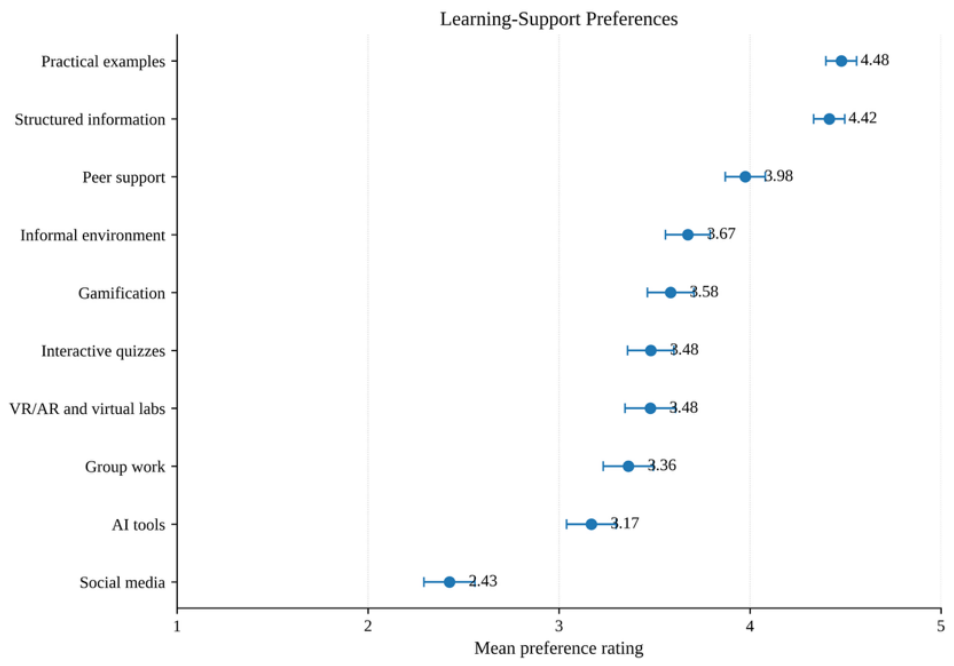
Figure 2.
Distribution of GenAI Use Frequency Across Student Groups.
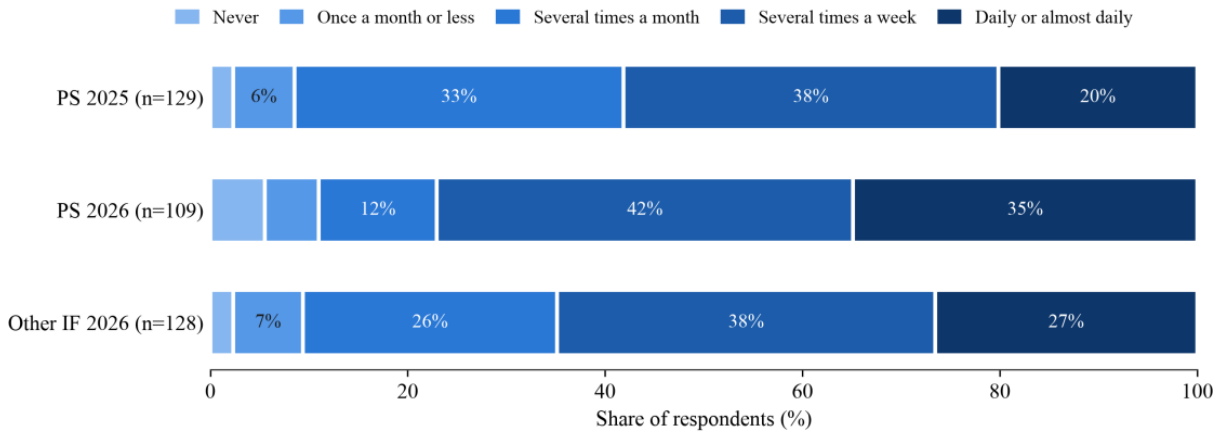
Figure 3.
Associations Between GenAI Use Frequency and Learning-Support Preferences. Points show Spearman’s ρ and horizontal lines show 90% confidence intervals. The shaded area marks the equivalence bounds (|ρ| < .20). *** Holm-adjusted p < .001.
Figure 3.
Associations Between GenAI Use Frequency and Learning-Support Preferences. Points show Spearman’s ρ and horizontal lines show 90% confidence intervals. The shaded area marks the equivalence bounds (|ρ| < .20). *** Holm-adjusted p < .001.
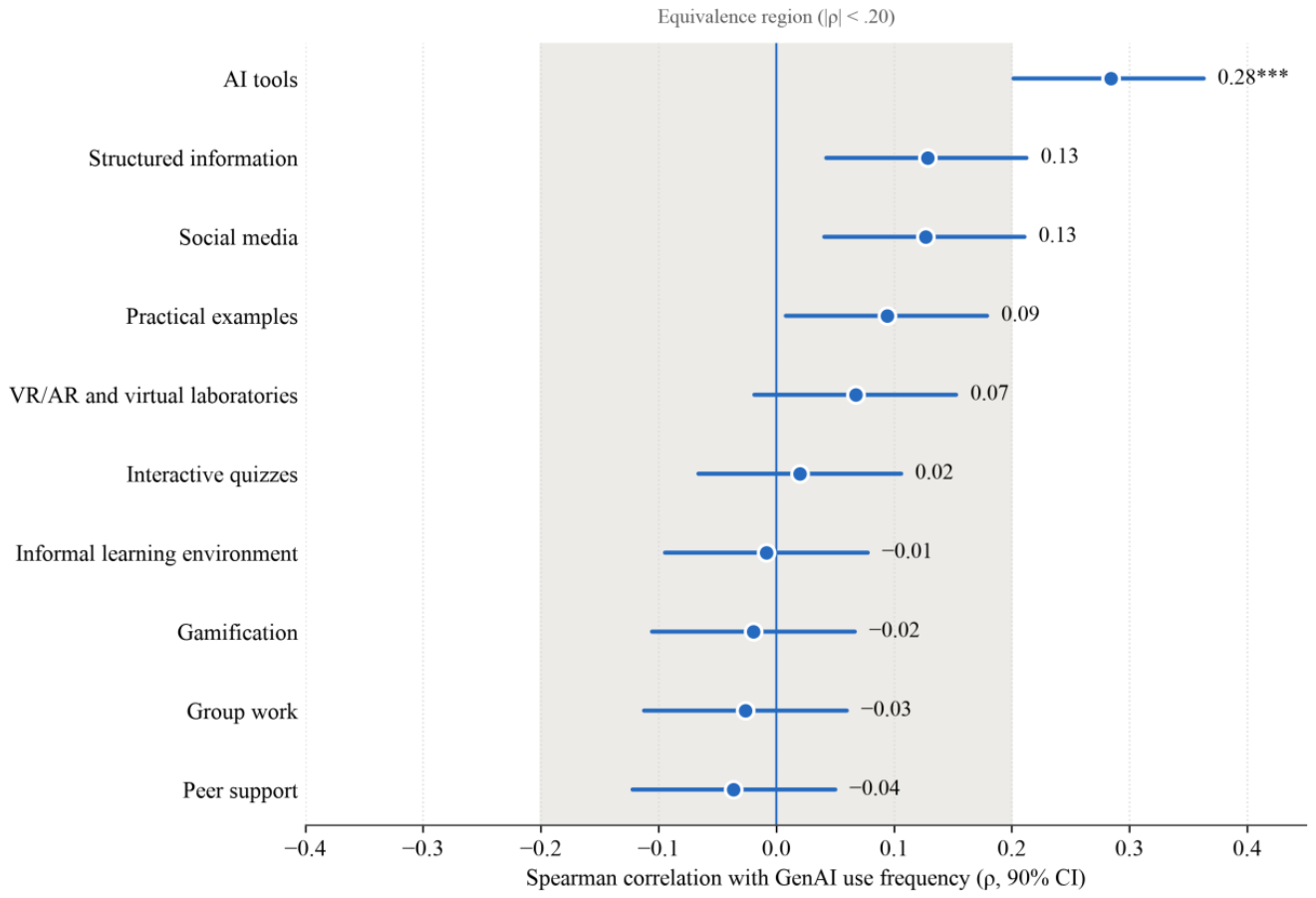
Table 1.
Survey Items, Response Formats, and Literature-Based Rationale.
| Item | Survey item | Response format | Content supporting literature |
|---|---|---|---|
| 1 | Clearly and structurally presented information | 5-point Likert-type scale (1–5) | Clear and well-structured instruction facilitates comprehension and learning, while appropriate organization of information can reduce unnecessary cognitive load [10,18]. |
| 2 | Interactive questionnaires and short quizzes | 5-point Likert-type scale (1–5) | Low-stakes testing and retrieval practice can strengthen retention and improve learning outcomes. Meta-analytic evidence demonstrates positive effects of classroom quizzing across educational settings [19]. |
| 3 | Group work | 5-point Likert-type scale (1–5) | Cooperative learning promotes interaction, explanation, joint problem solving, and active engagement. Meta-analytic evidence indicates positive effects on achievement, attitudes, and perceptions [11]. |
| 4 | Gamification elements | 5-point Likert-type scale (1–5) | Gamification is used to promote engagement and motivation through game-related elements. Meta-analytic evidence indicates positive effects on cognitive, motivational, and behavioral learning outcomes, although effects vary across contexts [13]. |
| 5 | Informal learning environment | 5-point Likert-type scale (1–5) | Informal learning spaces can support individual study, collaboration, social interaction, and flexible learning activities. Their design characteristics influence how students use and perceive such environments [16]. |
| 6 | Use of social media in the learning process | 5-point Likert-type scale (1–5) | Social media has been investigated as a teaching and learning environment that can facilitate communication, interaction, knowledge sharing, and collaborative learning, although educational outcomes depend on how these tools are pedagogically integrated [20]. |
| 7 | Use of AI tools in the learning process | 5-point Likert-type scale (1–5) | AI and GenAI tools can provide explanations, feedback, idea generation, and other forms of learning assistance. Experimental evidence suggests potential benefits for academic performance, affective-motivational outcomes, and higher-order thinking, while highlighting the importance of educational context and implementation [21]. |
| 8 | Analysis of real-life situations and practical examples | 5-point Likert-type scale (1–5) | Authentic learning connects academic knowledge with realistic situations and problems and is associated with cognitive and motivational learning outcomes [12]. |
| 9 | Use of VR/AR tools and virtual laboratories | 5-point Likert-type scale (1–5) | Immersive and virtual technologies provide interactive and experiential learning opportunities. Meta-analytic evidence supports positive learning effects of immersive VR, augmented reality, and virtual laboratory environments, although outcomes depend on instructional design and context [17,22,23]. Such technologies are also increasingly combined with AI in simulation-based training [24]. |
| 10 | Peer assistance and consultation | 5-point Likert-type scale (1–5) | Peer learning represents an established form of academic and social support in higher education. Meta-analytic evidence indicates that formal peer-learning approaches can contribute positively to course performance [15]. |
| 11 | How often do you use AI tools (e.g., ChatGPT, Gemini, Microsoft Copilot) for your studies? | Five ordered categories: never; once a month or less; several times a month; several times a week; daily or almost daily | Frequency of GenAI use provides a behavioral indicator of students’ adoption and exposure to these tools. Repeated cross-sectional research with computing students has used frequency of GenAI use to examine changes in its role as an academic support resource [2]. |
Table 2.
Learning-Support Preferences Across Student Groups.
| Learning-support preference | PS 2025 (n=129) | PS 2026 (n=109) | Other IF 2026 (n=128) | Overall (n=366) | |
|---|---|---|---|---|---|
| 1 | Clearly and structurally presented information | 4.33 (0.83); 5 [4,5] | 4.49 (0.73); 5 [4,5] | 4.44 (0.81); 5 [4,5] | 4.42 (0.80); 5 [4,5] |
| 2 | Interactive questionnaires and short quizzes | 3.45 (1.15); 4 [3,4] | 3.52 (1.14); 3 [3,4] | 3.48 (1.27); 4 [3,4,5] | 3.48 (1.19); 3 [3,4] |
| 3 | Group work | 3.48 (1.22); 4 [3,4] | 3.32 (1.25); 3 [3,4] | 3.28 (1.37); 3 [2,3,4] | 3.36 (1.28); 3 [2,3,4] |
| 4 | Gamification elements | 3.51 (1.15); 3 [3,4,5] | 3.64 (1.13); 4 [3,4,5] | 3.61 (1.28); 4 [3,4,5] | 3.58 (1.19); 4 [3,4,5] |
| 5 | Informal learning environment | 3.69 (1.14); 4 [3,4,5] | 3.69 (1.09); 4 [3,4,5] | 3.65 (1.19); 4 [3,4,5] | 3.67 (1.14); 4 [3,4,5] |
| 6 | Use of social media in the learning process | 2.21 (1.21); 2 [1,2,3] | 2.50 (1.26); 2 [1,2,3] | 2.58 (1.40); 2 [1,2,3] | 2.43 (1.30); 2 [1,2,3] |
| 7 | Use of AI tools in the learning process | 3.09 (1.20); 3 [2,3,4] | 3.25 (1.28); 3 [3,4] | 3.19 (1.31); 3 [2,3,4] | 3.17 (1.26); 3 [2,3,4] |
| 8 | Analysis of real-life situations and practical examples | 4.43 (0.91); 5 [4,5] | 4.51 (0.68); 5 [4,5] | 4.50 (0.74); 5 [4,5] | 4.48 (0.79); 5 [4,5] |
| 9 | VR/AR tools and virtual laboratories | 3.43 (1.29); 3 [3,4,5] | 3.37 (1.17); 3 [3,4] | 3.62 (1.38); 4 [3,4,5] | 3.48 (1.29); 4 [3,4,5] |
| 10 | Peer assistance and consultation | 3.88 (0.96); 4 [3,4,5] | 3.88 (1.08); 4 [3,4,5] | 4.16 (1.01); 4 [4,5] | 3.98 (1.02); 4 [3,4,5] |
Values are M (SD); Mdn [Q1–Q3]. PS = Software Systems study program; Other IF = other bachelor’s programs of the Faculty of Informatics.
Table 3.
Preference for AI Tools Compared with Other Learning-Support Preferences.
| Comparison | AI M | Comparison M | Mean difference | Rank-biserial r | Holm-adjusted p |
|---|---|---|---|---|---|
| AI vs. practical examples | 3.17 | 4.48 | −1.31 | −0.918 | <.001 |
| AI vs. structured information | 3.17 | 4.42 | −1.25 | −0.914 | <.001 |
| AI vs. peer support | 3.17 | 3.98 | −0.81 | −0.677 | <.001 |
| AI vs. informal learning environment | 3.17 | 3.67 | −0.51 | −0.466 | <.001 |
| AI vs. gamification | 3.17 | 3.58 | −0.42 | −0.368 | <.001 |
| AI vs. interactive quizzes | 3.17 | 3.48 | −0.31 | −0.284 | <.001 |
| AI vs. VR/AR and virtual laboratories | 3.17 | 3.48 | −0.31 | −0.299 | <.001 |
| AI vs. group work | 3.17 | 3.36 | −0.19 | −0.171 | .017 |
| AI vs. social media | 3.17 | 2.43 | 0.74 | 0.702 | <.001 |
Table 4.
GenAI Use Frequency Across Student Groups, n (%).
| GenAI use frequency | PS 2025 | PS 2026 | Other IF 2026 | Overall |
|---|---|---|---|---|
| Never | 3 (2.3%) | 6 (5.5%) | 3 (2.3%) | 12 (3.3%) |
| Once a month or less | 8 (6.2%) | 6 (5.5%) | 9 (7.0%) | 23 (6.3%) |
| Several times a month | 43 (33.3%) | 13 (11.9%) | 33 (25.8%) | 89 (24.3%) |
| Several times a week | 49 (38.0%) | 46 (42.2%) | 49 (38.3%) | 144 (39.3%) |
| Daily or almost daily | 26 (20.2%) | 38 (34.9%) | 34 (26.6%) | 98 (26.8%) |
| Weekly or daily use | 75 (58.1%) | 84 (77.1%) | 83 (64.8%) | 242 (66.1%) |
| Median [Q1–Q3] (0–4) | 3 [2,3] | 3 [3,4] | 3 [2,3,4] | 3 [2,3,4] |
Table 5.
Temporal and Cross-Program Differences and Equivalence of Learning-Support Preferences.
| Learning-support preference | 2026−2025 PS ΔM | Cliff’s δ [90% CI] | Holm-adjusted p | Other IF−PS 2026 ΔM | Cliff’s δ [90% CI] | Holm-adjusted p |
|---|---|---|---|---|---|---|
| Structured information | 0.15 | .089 [−.022, .195] | 1.000 | −0.05 | −.018 [−.128, .089] | 1.000 |
| Interactive quizzes | 0.07 | .035 [−.084, .154] | 1.000 | −0.05 | −.005 [−.124, .110] | 1.000 |
| Group work | −0.16 | −.077 [−.201, .042] | 1.000 | −0.04 | −.008 [−.130, .112] | 1.000 |
| Gamification | 0.13 | .065 [−.047, .184] | 1.000 | −0.03 | .011 [−.108, .131] | 1.000 |
| Informal learning environment | 0.00 | −.014 [−.133, .108] | 1.000 | −0.04 | −.002 [−.117, .117] | 1.000 |
| Social media | 0.30 | .139 [.023, .259] | .555 | 0.07 | .017 [−.105, .135] | 1.000 |
| AI tools | 0.16 | .086 [−.037, .205] | 1.000 | −0.06 | −.031 [−.149, .087] | 1.000 |
| Practical examples | 0.09 | .009 [−.101, .113] | 1.000 | −0.01 | .007 [−.100, .114] | 1.000 |
| VR/AR and virtual laboratories | −0.07 | −.042 [−.161, .077] | 1.000 | 0.25 | .139 [.021, .256] | .515 |
| Peer support | 0.00 | .028 [−.093, .146] | 1.000 | 0.28 | .156 [.042, .271] | .283 |
Disclaimer/Publisher’s Note: The statements, opinions and data contained in all publications are solely those of the individual author(s) and contributor(s) and not of MDPI and/or the editor(s). MDPI and/or the editor(s) disclaim responsibility for any injury to people or property resulting from any ideas, methods, instructions or products referred to in the content. |
© 2026 by the authors. Licensee MDPI, Basel, Switzerland. This article is an open access article distributed under the terms and conditions of the Creative Commons Attribution (CC BY) license.
Copyright: This open access article is published under a Creative Commons CC BY 4.0 license, which permit the free download, distribution, and reuse, provided that the author and preprint are cited in any reuse.