

Submitted:
16 November 2026
Posted:
18 November 2026
You are already at the latest version
Abstract
General practice asks ordinary practitioners to combine breadth across all health problems, depth in the field and in the continuing care of persons, and integration within the single consultation. Drawing on a recent triadic model of polymathy, in which breadth, depth and integration are jointly necessary and the term can refer to any system that displays them, this hypothesis paper proposes to describe the general practitioner as an institutional polymath: a role, rather than a person, whose defining documents require all three dimensions and whose training is designed to produce them in ordinary practitioners. In the author's reading of the twelve characteristics of the European Definition of General Practice/Family Medicine, breadth and integration are primary in several characteristics, depth is required both in the field and in the person, and no characteristic refers to digital or artificial intelligence (AI) tools. Drawing on evidence from general practice and from research on reliance on automated advice, the paper hypothesises that AI currently lowers the cost of stored breadth but not of integration or of checking, that the ability to detect wrong outputs depends on the practitioner's depth of medical knowledge, and that this depth may weaken with use of the tool. Studies in which AI systems matched or exceeded physicians, and a meta-analysis in which human-AI combinations performed, on average, worse than the better of the two, are discussed as counter-evidence. The central hypothesis is that competence for AI use in general practice is better described as maintaining the triad under new conditions than as a set of digital skills alone. The paper derives a specific prediction from the conjunctive model, an interaction between practitioner knowledge, AI support and the correctness of the suggestion, specifies five observations that would refute or narrow the hypothesis, and states eleven hypothesised competencies, each paired with an observation that would count against it. It makes no clinical recommendations and outlines a Delphi study and empirical tests.
Keywords:
general practice
; family medicine
; generalism
; polymathy
; artificial intelligence
; competencies
; medical education
; automation bias
1. Introduction
Artificial intelligence has reached general practice before its training has. In a national survey of family medicine residents in the United States, 71.1% reported using AI in the previous month, while “only 36.3% reported receiving any education about using AI in the last 6 months” (Barr et al., 2026). Proposals for what primary care clinicians should learn already exist. Liaw and colleagues (2022) proposed six domains of competency, from foundational knowledge to awareness of unintended consequences, and curriculum frameworks for postgraduate family medicine have followed (Tolentino et al., 2025). A qualitative study with general practice trainees in Germany found that their AI-related skills had been acquired largely informally and identified the competencies they considered necessary (Dreher et al., 2026). Yet the developers of one such framework note that “how much a family physician should know about AI remains undetermined” (Tolentino et al., 2025).
This paper argues that the question cannot be answered from the side of the tools alone. What a general practitioner needs to know and do about AI depends on what kind of expertise general practice is. That question has a long history in the discipline, and the answers are not settled. A recent systematic review found that generalism is “more often constructed as a deficit rather than a distinct, skilled practice” (Kelly et al., 2026). If general practice is understood as broad but shallow knowledge, a tool that supplies knowledge on demand would appear to fill the deficit, and AI competence would be a matter of using the tool well. If general practice is understood as a distinct form of expertise, the tool changes the conditions of that expertise, and AI competence becomes part of the expertise itself.
Recent research on polymathy offers a way to state the second view precisely. Araki, Berg, Ivcevic and Maertz (2026) propose a model in which polymathy is the conjunction of breadth, depth and integration, with all three “jointly necessary”, and list among the referents of polymathic “any system that can display breadth, depth, and integration to different degrees”. The word polymath has been used for physicians, for generalists and for organisations before. Piko and Stempsey (2002) argued that the physician “needs to become a sort of `neo-polymath’ in a `new Renaissance’ ”. Devakumar, Russell and Wolfe (2019), writing about research rather than clinical practice, observed that “generalists, or polymaths, in research and academia are rare”. In an interview study on rural careers, a medical student described the rural generalist clinician with the words “The word that comes to mind is polymath” (Charter et al., 2021). Outside medicine, Mirchandani (2010) applied the term to enterprises that combine several strands of technology. Within general practice, without using the word, Lynch and colleagues (2021) described generalism as sharing with transdisciplinary research the task of integrating knowledge across disciplines. None of these sources reads the defining documents of general practice against an explicit model of polymathy.
This paper does so, and asks three questions. First, can general practice be described as a discipline that has institutionalised the polymathic triad, so that the triad becomes a requirement of a role rather than a rare disposition? Section 2 proposes the term institutional polymath for this configuration and maps the European Definition of General Practice/Family Medicine onto the triad. Second, what does AI change in each of the three dimensions? Section 3 reviews evidence from general practice and from research on reliance on automated advice, including evidence that points the other way. Third, what follows for what general practitioners need to know and do? Section 3 ends with a set of hypothesised competencies, each paired with an observation that would count against it. The paper is a hypothesis paper. It makes no clinical recommendations, and its central claim is stated in Section 4.1 together with the conditions under which it would fail.
2. The General Practitioner as an Institutional Polymath
2.1. A Triad for Persons, and a Door Left Open
Araki, Berg, Ivcevic and Maertz (2026) propose that polymathy “refers to an expansive approach to the pursuit, development, and application of knowledge characterized by the conjunction of breadth, depth, and integration” (section 5.3). The three dimensions are conjunctive: “all three dimensions are jointly necessary, and a high level in one cannot compensate for absence of another” (section 5). Depth concerns “the substance of engagement within multiple areas”, is recognised through investment, competence and accomplishment, and carries a developmental constraint, because “every additional pursuit competes for finite time and attention” (section 5.2). The framework is built around persons, but it does not restrict the adjective to them. The authors list among the referents of polymathic “any system that can display breadth, depth, and integration to different degrees” (section 6.1).
This paper takes up that opening for one specific system: a medical discipline that has written breadth, depth and integration into its own definition, its training agenda and its mandate of care. The claim is not that every general practitioner is a polymath in the biographical sense in which the term is used for exceptional individuals. The claim is that general practice has institutionalised a polymathic requirement, so that the triad becomes a property of a role that ordinary practitioners are trained to fill, rather than a rare disposition that a few people happen to have. This paper proposes the term institutional polymath for this configuration.
Araki et al. ask authors to “specify what exactly is being qualified as polymathic” (section 6.2) and prefer “the adjective polymathic rather than the label polymath” (section 6.1). Accordingly, the unit of analysis here is the role, not the individual practitioner, and the noun is used only as the name of a role. An institutional polymath, in the sense of this paper, is a professional role whose defining documents require breadth across a stated range, depth in more than one area and the integration of both in the individual case, and whose training is designed to produce all three in ordinary practitioners. Araki et al. point in the same direction when they relate polymathic development to “person-environment dynamics and opportunity structures” (section 6.8) and end by asking “how to build societal structures that allow for the pursuit, development, and application of knowledge in a way it reflects the polymathic qualities of breadth, depth, and integration?” Whether an individual general practitioner meets this requirement is a separate, empirical question.
Several roles require breadth, among them emergency medicine, hospital medicine, palliative care and, outside medicine, primary school teaching. On the definitions used here, general practice is distinguished by the combination of access that is not limited by age, sex or diagnosis, responsibility for continuity with the same persons over time, and a mandate to integrate physical, psychological, social, cultural and existential dimensions (Section 2.2). These features correspond closely to what Starfield, Shi and Macinko (2005) describe as the main features of primary care: first-contact access, long-term person-focused care, comprehensive care and coordination. Emergency medicine, for example, shares the breadth of first contact but not the continuity; palliative care shares continuity and integration within a defined population. The claim of this paper is limited to general practice, and whether other roles meet the definition is left open.
The idea that medicine asks for a renewed polymathy is not new. Piko and Stempsey (2002) argued that “the physician needs to become a sort of `neo-polymath’ in a `new Renaissance’ ”, guided by “the appropriate selection of information” rather than its accumulation. Within general practice, Lynch and colleagues (2021) described generalism as sharing with transdisciplinary research “the task of integrating and discerning the value of knowledge across disciplinary and sectoral knowledge cultures”, and as valuing “whole person care that uses integrative and interpretive wisdom to include both biomedical and biographical forms of knowledge”. Reeve (2010) described the expertise of general practice as interpretive medicine, and Woods and colleagues (2021) as the adaptive expertise of a “specialist generalist”. What the present reading adds to these accounts is a conjunctive rule, under which the absence of one dimension cannot be compensated by the others, together with named degraded forms of the role (Section 2.5).
2.2. Breadth Written into the Definition
The European Definition of General Practice/Family Medicine, revised in 2023, describes a discipline that “is normally the point of first medical contact within the health care system, providing open and unlimited access to its users, dealing with all health problems regardless of the age, sex, or any other characteristic of the person concerned” and that “deals with health problems in their physical, psychological, social, cultural, environmental and existential dimensions” (WONCA Europe, 2023, p. 7). The general practitioner is described as “primarily responsible for the provision of comprehensive and continuing care to every individual seeking medical care irrespective of age, sex and illness” (p. 7), and one of the core competencies requires the ability “to cover the full range of health conditions” (p. 22). Breadth in the sense of Araki et al., the range and diversity of areas a pursuit spans (section 5.1), is therefore not an aspiration of individual practitioners but a definitional feature of the discipline. The earlier WONCA definition of 1991, reproduced in the 2023 edition, draws the contrast directly: the general practitioner “accepts everyone seeking care, whereas other health providers limit access to their services on the basis of age, sex or diagnosis” (WONCA Europe, 2023, p. 30).
2.3. Depth in the Field and Depth in the Person
Depth is the dimension where the transfer from persons to the discipline requires the most care. Araki et al. locate depth “within multiple areas”, and the European Definition requires it in two forms. The first is depth in the field. Among the features essential to applying the core competencies, the definition lists “a thorough knowledge of the scientific backgrounds of pathology, symptoms and diagnosis, therapy and prognosis, epidemiology, decision theory, theories of the forming of hypotheses and problem-solving, preventive health care” (WONCA Europe, 2023, p. 24), and it groups two characteristics under the core competency “Specific problem solving skills (g,h)” (p. 8). This depth is specific to the setting. Because serious disease is less common in primary care and the positive predictive value of symptoms, signs and tests is, for a number of important conditions, “lower than in the hospital setting” (WONCA Europe, 2023, pp. 19 to 20), “it is important to know when to stop investigating whilst continuing to care” and to protect patients “from the damage of over-medicalisation” (p. 20), and the working principles include “incremental investigation, using time as a tool and to tolerate uncertainty” (p. 23). Family medicine scholarship claims such depth for generalist practice itself, framing generalism “as a mode of expertise grounded in inductive reasoning, contextual understanding, relational continuity, and holistic care” (Kelly et al., 2026).
The second form is depth in the person, and the reading of it as depth is the author’s interpretation rather than a statement found in the sources. The definition describes a consultation process “which establishes a relationship over time” and a responsibility “for the provision of longitudinal continuity of care as determined by the needs of the patient” (WONCA Europe, 2023, p. 7). In negotiating management plans, general practitioners “integrate physical, psychological, social, cultural, existential and planetary health-related factors, utilising the knowledge and trust engendered by repeated contacts” (p. 7). Two things accumulate here and should be kept apart. One is information about a particular life, which corresponds to what Haggerty and colleagues (2003) call informational continuity and which can, in part, be recorded. The other is the relationship and the skill of using it, which corresponds to relational continuity and cannot be transferred with a record. This paper treats the second as depth in the person: developed skill in knowing and caring for particular persons and communities over time. Both forms of depth are needed in the role, and Section 3 argues that AI affects them differently.
2.4. Integration as the Core of the Discipline
Integration is the dimension that the teaching agenda of the discipline places at its centre. The EURACT Educational Agenda devotes a closing chapter to “Synthesis and integration, the unique combination” and states: “The added value is in the synthesis. The whole is more than the parts. General Practice is more than a summing up of all subspecialties” (Heyrman, 2005, p. 38). It continues that “synthesis and integration, together with personal continuity is the crux and the added value of General Practice/Family medicine within the healthcare system”, and that synthesis “is not an additional feature when all the sub-elements and parts are covered” (p. 39). The same chapter describes general practice as a “high context discipline”, in contrast to specialties that limit decision making “to objective facts, measurable quantitative information and visual diagnostic techniques” (p. 38).
The agenda also names the limit of this integration in terms close to the developmental constraint of the triad: “Integration sets limitations to the human capacity. Because a GP works within the limits of the integration capacity of the human being, diversity of concepts, models, content, attitudes and techniques should be limited” (Heyrman, 2005, p. 39). Here the institution itself limits the diversity of concepts, models and techniques it asks a practitioner to hold, so that the role remains within the reach of an ordinary practitioner. This is what distinguishes an institutional polymath from a biographical one: the discipline defines the span, sets the limit and trains for the synthesis.
2.5. The Four Archetypes of Generalism
Kelly and colleagues (2026), in a mixed-studies systematic review of empirical work published between 1999 and 2022, identified “4 archetypes of generalist practice: broad-based knowledge, generalism as adaptive expertise, generalism as integrative expertise, and generalism as interpretive expertise”. The broad-based knowledge archetype, the most prevalent overall and especially in studies from the United States, associated mainly with general internal medicine, paediatrics, surgery and generalists within subspecialties, treated generalism as the presence or absence of knowledge, so that “perceived deficits could be addressed by filling knowledge gaps”. In the adaptive archetype, generalists “were often family physicians or physicians working in primary care with additional procedural or clinical expertise”, acquired “to meet population needs”. The integrative archetype was “primarily associated with family medicine (North America), general practice (UK, Australia), hospitalists, geriatrics, and palliative care”, with emphasis on “the synthesis of specialist input within a broader biopsychosocial framework”, and the interpretive archetype treated generalist care as “inherently interpretive and context-sensitive”. The authors note that generalism is “more often constructed as a deficit rather than a distinct, skilled practice”.
Kelly and colleagues offer the archetypes “rather than reduce generalism into components”, and the reading that follows goes beyond their intention; it is offered as a complementary lens. Read against the triad, the archetypes weight the three dimensions differently. Broad-based knowledge foregrounds breadth. Adaptive expertise adds depth in further areas to a broad base, which is the closest of the four to depth “within multiple areas”. Integrative expertise foregrounds integration, and interpretive expertise foregrounds integration grounded in depth in the person. The polymathic reading adds what the archetypes, by design, do not claim: that the dimensions are jointly necessary, so that a role with one of them missing is a degraded form rather than a variant. Araki et al. name such forms. Breadth “without substantial depth or integration” is the dilettante, and integration without depth or breadth is the apophenist, “integration without an adequately developed knowledge base, producing connections that may be weakly grounded or spurious” (section 5.4). Section 3 argues that the use of AI tools changes the risk of both.
2.6. Mapping the Definition onto the Triad
Table 1 and Figure 1 map the twelve characteristics of the European Definition onto the three dimensions and onto the archetypes of Kelly et al. The mapping is the author’s and is offered for discussion; the characteristics are quoted in abbreviated form from WONCA Europe (2023, p. 7). The depth column distinguishes depth in the field from depth in the person.
Three observations follow from the table. First, breadth and integration are each primary in several characteristics, and integration is never absent where breadth is demanded across dimensions of one person (h, l). Second, depth appears in both forms: as depth in the field in the problem-solving characteristics (g, h, i), supported by the scientific knowledge the definition requires (p. 24), and as depth in the person and the community (c, d, e, f, k). Third, none of the twelve characteristics, and none of the six core competencies built on them, refers to digital or artificial intelligence tools; the only reference to information tools in the definition is the observation that patients are better informed “due to the wide variety of information systems now becoming available to them, for example the Internet” (WONCA Europe, 2023, p. 19). The institutional polymath, as defined today, is defined without its instruments.
3. What AI Changes for the Institutional Polymath
Section 2 described a role in which breadth is set by definition, depth is required in the field and in the person, and integration is the trained synthesis, all within the integration capacity of an ordinary practitioner. This section asks what may happen to each of the three dimensions when general practitioners work with AI tools, and in particular with large language models. The evidence is uneven. Studies from general practice itself are recent, small or descriptive, and the strongest experimental evidence on reliance on automated advice comes from other fields. The section therefore states its conclusions as hypotheses, collected in Table 2, and Section 3.6 sets out the evidence that points the other way.
The two forms of depth from Section 2.3 are kept apart throughout. Depth of medical knowledge, which corresponds to depth in the field in Section 2.3 and includes the problem-solving depth specific to general practice, is what a practitioner needs in order to check whether an output is correct. Depth in the person, developed through relational continuity, is what a practitioner needs in order to judge whether a correct output fits this patient. Table 2 names which one each item concerns.
3.1. Stored Breadth Becomes Cheaper
The first change concerns the kind of breadth that consists of stored knowledge. In a benchmark built for general practice, Li and colleagues (2026) evaluated ten large language models and found that “on the MCQ Test Set, LLMs generally outperformed human participants in terms of accuracy”, whereas on open-ended analysis of 70 real outpatient cases “LLMs performed worse than human physicians overall”. The authors summarise that the models “have matched or even surpassed human physicians in assessments of static knowledge” but “still lag significantly behind in interactive and reasoning-intensive clinical tasks”. The cases were drawn from hospital outpatient records in China and presented in written form, the models were those released up to early 2025 and were tested with standard prompting, the human comparison group was small (six general practitioners, two in each experience group), and all material was in Chinese. The result is therefore an indication rather than a measurement of general practice as such.
Use is already widespread among trainees. In a national survey of 15,259 family medicine residents in the United States, 71.1% reported using AI in the previous month; 40.7% of all respondents reported using it “for medical reference” and 31.9% for “clinical decision support”, while “only 36.3% reported receiving any education about using AI in the last 6 months” (Barr et al., 2026). In interviews with 17 general practice trainees in Germany, the most frequent application was “generating differential diagnoses or exploring diagnostic possibilities in clinically ambiguous cases” (Dreher et al., 2026).
Read against the archetypes of Section 2.5, this is the archetype of broad-based knowledge, in which generalism is a matter of the presence or absence of knowledge and “perceived deficits could be addressed by filling knowledge gaps” (Kelly et al., 2026). A tool that fills knowledge gaps on demand lowers the cost of exactly this form of breadth. If general practice were only broad-based knowledge, the tool would substitute for a large part of the role. Some of the trainees interviewed by Dreher and colleagues described “a potential shift in the physician’s role from being primarily a holder of knowledge towards becoming a navigator and evaluator of medical information”, and the authors conclude that “while access to information becomes increasingly effortless, the ability to evaluate relevance, recognise limitations and integrate information within the clinical context becomes more important”.
3.2. Integration and Problem-Solving Depth May Remain Scarce
In the same benchmark, the models fell short on tasks that draw on integration and on the problem-solving depth of general practice. Most models “failed to construct a complete chain of diagnostic reasoning”, and “LLMs exhibited significant deficiencies in medical history taking” (Li et al., 2026). Screening for comorbidities and complications was deficient in between 8 and 31 of 45 applicable cases, depending on the model. Some of the failures concern the application of knowledge rather than integration, such as invented disease staging and risks in pharmacotherapy. The authors characterise reasoning in general practice as one that “considers the interplay among multiple physiological systems rather than focusing solely on organ-specific pathologies, and requires a holistic application of the biopsychosocial model”, which this paper reads as close to characteristics h and l of the European Definition. Their own explanation of the deficiencies is technical, naming among other causes hallucination and the lack of modelling of human physiology.
The setting adds a specific risk. The cases in this benchmark came from hospital outpatient records, and it is plausible, although not shown by the sources reviewed here, that much of the medical text from which such tools draw reflects specialist and hospital settings. The European Definition asks general practitioners to reason from the low incidence of serious disease and the different predictive value of findings in primary care, “to know when to stop investigating whilst continuing to care” and to protect patients “from the damage of over-medicalisation” (WONCA Europe, 2023, p. 20). This paper proposes that a tool reflecting a hospital case-mix may widen the differential in the direction that the discipline asks its practitioners to resist. Trainees described a related concern, “a potential broadening of diagnostic possibilities through LLMs, which could contribute to excessive investigations or a `shotgun’ approach to diagnostics” (Dreher et al., 2026).
Cheaper breadth can also add to the load on integration. The EURACT agenda names the “integration capacity of the human being” as the limit of the role and draws from it a conclusion for the design of the discipline (Heyrman, 2005, p. 39). Read at the level of the single consultation, which goes beyond the agenda’s own scope, a tool that offers more possibilities does not raise this capacity; it raises the number of items that have to pass through it. One internist interviewed by Mache and colleagues (2025) described a related burden from automated alerts: “Sometimes the AI throws up alerts that don’t make sense in the context of the patient. I spend more time dismissing pop-ups than focusing on care.” Another physician in the same study valued the opposite effect, saying that AI “helps me consider diagnoses I might not have thought of”. Additional possibilities are therefore a gain and a cost at once.
3.3. Depth in the Person May Gain Value
Section 2.3 distinguished depth in the person, developed through relational continuity, from information about the person, which can be recorded. The trainees interviewed by Dreher and colleagues (2026) named competencies they perceived as difficult to replace: “relationship-building, trust, empathy, contextual understanding, family knowledge and non-verbal communication”. One of them put it in terms of general practice: “The whole family history and the psychosocial component, which is so extremely important in general practice.” Much of this knowledge is not written down in general form, and what is recorded is selective.
Ahn (2026) argues in a letter that the family physician becomes “a context engineer who structures and enriches the clinical context for the benefit of patients”, and that skills already taught, “such as thorough history taking, biopsychosocial assessment, and longitudinal relationship building, should be recognized as context engineering competencies in their own right”. Ahn frames the generalist’s advantage as breadth of context and notes that “context breadth alone does not guarantee context quality”. This paper reads the longitudinal component of the same skills as depth in the person. The letter is explicitly a conceptual proposal and supports the direction of the argument rather than its strength.
Supplying such context to a tool has a limit that the argument must respect. In the same interview study, data protection was the most frequently mentioned ethical concern, and most participants treated the avoidance of patient-identifiable information as part of their professional duty of care (Dreher et al., 2026). How much context about a person can be given to a tool therefore depends on the tool, the setting and the rules that apply to it; where little can be given, depth in the person is applied by the practitioner to the tool’s output rather than supplied to the tool.
The hypothesis that follows can be stated in the terms of the triad. Stored breadth becomes cheaper. Depth of medical knowledge remains necessary, because it is the condition for checking. Depth in the person is proposed to gain in relative value, because it decides whether an output fits this patient; the sources show that practitioners regard it as hard to replace, not yet that its value has risen. Integration remains, on this hypothesis, the human task in which these are joined.
3.4. Checking as a Standing Task, and Its Dependence on Depth of Medical Knowledge
This paper proposes that, where a tool supplies answers, a growing part of the practitioner’s work consists of checking them. Bainbridge (1983) described the resulting position in industrial process control: “the automatic control system has been put in because it can do the job better than the operator, but yet the operator is being asked to monitor that it is working effectively”. Of knowledge, as distinct from manual skill, she wrote that it “develops only through use and feedback about its effectiveness”.
The ability to check depends on depth of medical knowledge. One trainee put it directly: “In order for me to notice that it’s wrong, I have to have a certain amount of knowledge” (Dreher et al., 2026). The participants “described verification as dependent on their own prior knowledge and clinical expertise”, and the benchmark authors recommend that models “should only be used under the supervision of medical personnel capable of evaluating the correctness of the output” (Li et al., 2026). The trainees did not describe automation bias as a current major problem, although some acknowledged that plausible and convincing responses could influence judgement (Dreher et al., 2026).
Experimental evidence from other fields suggests that experience reduces this influence without removing it. In an experiment with 27 radiologists reading mammograms with a purported AI system, the percentage of correctly rated mammograms among very experienced readers was 82.3% when the AI suggestion was correct and 45.5% when it was incorrect, and among inexperienced readers 79.7% and 19.8% (Dratsch et al., 2023). Experience was observed rather than manipulated, and the comparison is between cases with correct and incorrect suggestions, not between assisted and unaided reading. In dermatology, Tschandl and colleagues (2020) found that “good quality AI-based support of clinical decision-making improves diagnostic accuracy over that of either AI or physicians alone, and that the least experienced clinicians gain the most from AI-based support”, but also “that faulty AI can mislead the entire spectrum of clinicians, including experts”. In a review of the human factors literature, Parasuraman and Manzey (2010) concluded that automation bias “occurs in both naive and expert participants, cannot be prevented by training or instructions, and can affect decision making in individuals as well as in teams”. They take their definition from Mosier and Skitka (1996, p. 205, as cited in Parasuraman & Manzey, 2010), who described the output of a decision aid being used “as a heuristic replacement for vigilant information seeking and processing”. The same review reports that participants made accountable for overall performance “committed significantly less omission and commission errors”, a result the authors regard as not fully conclusive, and that operators who had experienced failures of a diagnostic aid during training were less complacent than those only told that it could fail, although no group verified the aid fully. In an experiment on AI-supported decisions outside medicine, cognitive forcing designs “significantly reduced overreliance” compared with simple explanations, although participants rated them least favourably (Buçinca et al., 2021).
A further finding concerns what remains when the tool is absent. In a retrospective observational study of colonoscopy at four centres, Budzyń and colleagues (2025) reported that the adenoma detection rate of standard, non-AI-assisted colonoscopy was lower in the three months after AI was introduced than in the three months before. The study concerns a perceptual and procedural skill outside general practice. Together with Bainbridge, it is consistent with the possibility that the skills needed for checking can weaken with use of the tool that makes checking necessary. A different effect was shown in simulated classification tasks with fictitious patients: online volunteers who had worked with a biased AI system went on to make “the same errors as the AI had made” when they performed the task without it within the same session (Vicente & Matute, 2023). This is a carry-over of the tool’s errors rather than a loss of skill, and it shows that the influence of a tool can outlast its use.
For trainees the risk comes earlier. Barr and colleagues (2026), drawing on earlier work, describe “never-skilling”, “when a learner substitutes AI-generated outputs for the cognitive effort needed to develop foundational clinical reasoning skills”, and “mis-skilling”, when a learner “accepts AI errors as facts”. Bainbridge anticipated the same pattern: automated systems “monitored by former manual operators, are riding on their skills, which later generations of operators cannot be expected to have”.
3.5. The Dilettante and the Apophenist Under AI
Section 2.5 introduced two degraded forms from Araki et al. (2026, section 5.4): the dilettante, breadth “without substantial depth or integration”, and the apophenist, “integration without an adequately developed knowledge base, producing connections that may be weakly grounded or spurious”. Araki and colleagues present their configurations as “conceptual prototypes rather than fixed person-types”, and note that individuals “may move across `profiles’ over time”. This paper proposes that a language model makes movements towards both forms easier, because in such cases the breadth belongs to the tool rather than to the person. A practitioner who accepts the tool’s breadth without checking it moves towards the dilettante; a practitioner who also joins the connections the tool supplies, without the depth of medical knowledge to check them, integrates without a knowledge base of their own. The mechanism in the second case is mainly the acceptance of connections made by the tool, which is the automation bias of Section 3.4, rather than the generation of spurious connections by the person. The judgement concerns the practitioner, and only in the areas where the practitioner relies on the tool. Judged as a system of practitioner and tool, which Section 2.1 allows, the same configuration resembles what Araki et al. call the boundary spanner, breadth combined with integration but limited depth; the risk is the same, because the depth that is missing is the depth needed to check.
The sources describe parts of this risk. Trainees described responses “with high apparent certainty” that “only reveal limitations when actively challenged”, and “the risk that increased confidence may not necessarily reflect increased accuracy”; one participant raised confirmation bias, “as suggestive prompts may reinforce existing hypotheses” (Dreher et al., 2026).
For the institutional polymath this means that the balance of the triad, which the role was designed to secure, can shift without any change in the definition of the role. If, as Section 3.4 suggests, the depth needed for checking can itself weaken through use of the tool, the institutional protection of the triad cannot be taken for granted. Section 4.4 turns to the questions this raises for training and for the definition of the discipline.
3.6. Evidence Pointing the Other Way
The claim that integration remains the human task rests largely on one benchmark of models released up to early 2025. In that benchmark, the best model reached a level the authors describe as “comparable to that of Group C human physicians”, the least experienced group, on the clinical cases (Li et al., 2026). Other studies point in the opposite direction on steps used here as evidence of human scarcity. In a randomised, double-blind crossover study of text-based consultations with patient-actors, a conversational system compared with 20 primary care physicians “demonstrated greater diagnostic accuracy and superior performance on 30 out of 32 axes according to the specialist physicians”, on an evaluation framework that covered history-taking, diagnostic accuracy, management, communication and empathy; the authors note that text chat “is unfamiliar in clinical practice” (Tu et al., 2025). In a randomised trial with 50 physicians working on clinical vignettes, access to a language model “did not significantly improve clinical reasoning compared with conventional resources”, while “the LLM alone demonstrated higher performance than both physician groups” (Goh et al., 2024). Across 106 experiments, a meta-analysis found that “human-AI combinations performed significantly worse than the best of humans or AI alone”, with losses in decision tasks; “when humans outperformed AI alone, we found performance gains in the combination, but when AI outperformed humans alone, we found losses” (Vaccaro et al., 2024).
These findings do not settle the question. The studies by Tu et al. and Goh et al. used simulated or written cases rather than continuing care, which is also true of the benchmark by Li et al. on which the opposite claim rests. Together they show that the division of labour described in this section is a claim about the present, not a structural feature, and that the value of combining a practitioner with a tool depends on how the two compare. A second counter-case concerns depth in the person: if ambient documentation and longitudinal records come to capture more of the information about a person, that information becomes retrievable by the tool as well, although the relationship itself does not. Among the residents surveyed by Barr et al. (2026), 21.9% reported having used AI for ambient documentation of clinical encounters in the previous month. The hypothesis of this section would be weakened if tools reached the level of general practitioners in history taking and in reasoning about multimorbidity in independent evaluations in general practice, or if recorded context made depth in the person available to them.
3.7. Hypothesised Competencies
Table 2 collects the consequences as hypotheses. They are derived from the sources above and are not tested. Several overlap with existing competency proposals. Liaw and colleagues (2022) proposed six domains of competency for primary care, from “foundational knowledge (what is this tool?)” to “awareness of unintended consequences (what are the `side effects’ of this tool?)”, including “patient communication (how should I communicate with patients regarding the use of this tool?)”. Trainees interviewed by Dreher and colleagues (2026) most often named critical evaluation, prompting and application competence, and the authors derive three core domains: “the practical clinical application of AI tools”, “the critical appraisal of AI-generated information” and “ethical and professional responsibility in AI-assisted clinical practice”. Tolentino and colleagues (2025) note that “how much a family physician should know about AI remains undetermined”.
Table 2 has three parts. The first (K1 to K3) states preconditions for the rest that are supported by evidence from other fields but have not been tested in general practice. The second (D1 to D6) contains hypotheses specific to general practice, derived from the triad. The third (T1 and T2) contains tool-specific competencies named in the existing frameworks, prompting and technical use, and data protection; they are not part of the triad and are included so that the central hypothesis of Section 4.1 can be tested against them. Each item is paired with an observation that would count against it. Communication with patients about the use of a tool (D6) is included on conceptual grounds rather than on evidence reviewed in this section.
The items are not a curriculum. They describe what the triad implies for practice when part of the breadth is supplied by a tool, and they are stated so that each can fail. Section 4 turns to how they could be tested, and to the strongest objections against the reading as a whole.
4. Discussion
4.1. The Central Hypothesis and How It Could Fail
The central hypothesis of this paper is that AI currently lowers the cost of stored breadth in general practice, but not the cost of integration or of checking, and that competence for AI use in general practice is therefore better described as maintaining the polymathic triad under new conditions than as a set of digital skills alone. The cost claim is itself part of the hypothesis; this paper does not measure cost. In concrete terms, the hypothesis predicts that the quality of AI-assisted work in general practice, measured for example as diagnostic accuracy, detection of incorrect suggestions and fit of the plan to the patient, depends on the practitioner’s depth of medical knowledge, on depth in the person and on integration, each more strongly than on AI-specific competence such as prompting and technical use (Table 2, T1). It does not deny that such competence matters.
What distinguishes the polymathic reading from an additive account of expertise is the conjunctive rule, under which one dimension cannot compensate for the absence of another. The rule predicts an interaction rather than separate effects. With correct suggestions, practitioners with less depth may gain most from a tool, as Tschandl et al. (2020) found in dermatology. With incorrect suggestions, depth of medical knowledge should protect against error, as the gradient by experience in Dratsch et al. (2023) suggests, although Tschandl et al. found that faulty AI misled clinicians at all levels of expertise. The quality of AI-assisted decisions should therefore depend on the interaction of the practitioner’s knowledge, the presence of AI support and the correctness of the suggestion, and the combination of practitioner and tool should gain where the practitioner’s own performance exceeds the tool’s, as Vaccaro et al. (2024) found across many tasks. This prediction does not follow from an account in which knowledge and tool skill simply add up.
Five observations would bear on the hypothesis, and they do not bear on it equally. The first would refute it: that the quality of AI-assisted decisions turns out to be independent of the practitioner’s depth of medical knowledge, so that practitioners with little knowledge of an area detect and correct AI errors in it as reliably as those with more. The second would refute it as well: that measured AI-specific competence predicts the quality of AI-assisted work as strongly as, or more strongly than, depth of medical knowledge, depth in the person and integration. The third would refute the conjunctive reading specifically: that, across correct and incorrect suggestions, AI support improves the work of practitioners with little knowledge of an area as much as that of practitioners with more, with no interaction between knowledge and the correctness of the suggestion. The fourth would refute the premise about cost and thereby narrow the hypothesis to checking: that tools reach the level of experienced general practitioners in history taking and in reasoning about multimorbidity in independent evaluations of continuing care, rather than of single simulated encounters (Section 3.6); checking would then still depend on depth, but integration would no longer be a human task by default. Because Section 3.6 already treats the present division of labour as provisional, this observation narrows rather than refutes. The fifth would refute the part of the hypothesis that concerns depth in the person: that records of continuing care make this depth available to tools, so that outputs fit the individual patient equally well with or without the practitioner’s own knowledge of the person.
Each observation can be pursued with designs that already exist. The first three call for experiments in which practitioners work on general practice cases with and without AI support and with correct and incorrect suggestions, as in Dratsch et al. (2023), with depth of medical knowledge measured independently of the study cases rather than inferred from years of experience, with AI-specific competence measured alongside, and with an analysis of the interaction between knowledge, AI support and correctness of the suggestion that is able to show that one predictor is not stronger than another rather than merely failing to find a difference. The fourth calls for evaluations of tools on longitudinal records from general practice. The fifth calls for comparisons of outputs with and without the practitioner’s knowledge of the person, with fit to the patient rated by assessors other than the practitioner.
The triad itself is not under test here. It is the framework within which the claims about AI are made, and the paper treats it as such. It would lose its use for general practice, however, if the predictions derived from it failed, in particular the interaction in the third observation, which is the one prediction that an additive account of expertise does not make. Research on automation bias predicts the same interaction without reference to the triad; what the triad adds is the claim that the interaction concerns every dimension it names, so that integration without depth, the apophenist configuration of Section 3.5, should perform worse than either alone.
4.2. Relation to Existing Competency Frameworks
The hypothesised competencies in Table 2 overlap with the domains proposed by Liaw et al. (2022) and with the competencies named by trainees and authors in Dreher et al. (2026). The polymathic reading does not replace these frameworks. It adds two things. The first is a structure: each competency is assigned to the dimension of the triad that it concerns, and the tool-specific competencies of existing frameworks are kept as a separate group (T1, T2), so that their weight relative to depth and integration becomes an empirical question rather than a matter of classification. The second is a way of reading a difficulty that Liaw and colleagues name: “Integrating these competencies will not be straightforward because of the breadth of knowledge already incorporated into family medicine training and the constantly changing technological landscape”. The first of these causes corresponds to the integration capacity that the EURACT agenda names as the limit of the role (Heyrman, 2005, p. 39); the second is the reason why Section 3.6 treats the present division of labour as provisional. Ahn (2026) argues that skills already taught, such as history taking and longitudinal relationship building, should be recognised as AI-relevant competencies. The checking competencies in Table 2 are not among them. In the interview study by Dreher et al. (2026), AI-related skills had been acquired largely informally, and in the survey by Barr et al. (2026) most residents reported no education about AI in the previous six months.
4.3. The Counter-Position from Specialism
The strongest objection to the reading offered here does not come from the AI literature. Akhtar and Camporota (2026), writing about specialist training and the role of hospital generalists and without reference to AI, caution that “expecting individual clinicians to maintain up-to-date expertise across multiple rapidly advancing fields risks superficial decision-making”, and conclude that the future NHS “will succeed not by asking all doctors to know a little about everything, but by ensuring that patients consistently receive the right expertise, at the right time, from the right doctor”. They describe generalists and specialists as complementary and call true generalists, among them general practitioners, indispensable.
Their argument about multimorbidity challenges this paper more directly. For Akhtar and Camporota, multimorbidity “often involves interacting, high-risk disease states requiring deep pathophysiological understanding and nuanced decision-making”, and in such cases “harm can result not from excessive specialisation, but, on the contrary, from delayed or insufficient specialist input”. Table 1 treats the simultaneous management of several problems as an integration task of general practice, and Table 2 (D3) builds on it. On the scope of the role the two positions are compatible, since the institutional polymath does not claim specialist depth across fields. On multimorbidity they differ in where the decisive depth lies. The polymathic reading can accommodate the objection only if integration includes knowing when it requires specialist depth that the role does not hold. Akhtar and Camporota themselves count “knowing when and how to involve specialist teams” among the core skills of general practitioners, and the European Definition places the interface with other specialities in characteristic b, which Table 1 assigns to integration. Whether the timing of specialist input is part of the integration that general practitioners provide, or a point at which it fails, is an empirical question that the evaluations proposed in Section 4.1 could include.
The two positions also meet in a shared risk. AI makes it easier to appear to know a little about everything, which is the superficiality that Akhtar and Camporota warn against and close to what Araki et al. (2026) call the dilettante, breadth without depth or integration. Where the practitioner also joins the connections supplied by the tool without checking them, the result, judged at the level of the practitioner, is the apophenist of Section 3.5. The conjunctive requirement of the triad is the polymathic answer to both: breadth supplied by a tool counts only where the practitioner can check it and integrate it.
A related reading comes from within family medicine. Ahn (2026) argues that the family physician’s advantage with AI lies in the breadth of clinical context and proposes the role of a “context engineer”. In Ahn’s model, depth of context is the specialist’s contribution, while continuity of care appears as “temporal context accumulation: progressive enrichment of patient context over time”. The present paper reads this temporal component as depth in the person and gives it more weight. Ahn declares roles in companies that develop clinical AI tools.
4.4. Questions for the Institution
If the triad is a property of the role rather than of exceptional individuals, the question arises whether its protection under AI falls to the institution as well as to the practitioner. Section 2.6 found that none of the characteristics and core competencies in the European Definition refers to digital or AI tools, and Section 3.4 found evidence consistent with the possibility that the depth needed for checking can weaken with use of the tool. Two questions follow for those who set the definition and the training of the discipline, and this paper leaves them open. The first is whether a future revision of the definition should describe how the core competencies are exercised with digital and AI tools, rather than adding a separate competency. The second is how training can secure depth of medical knowledge in a generation of trainees who use AI from the start, a risk that Barr et al. (2026) describe as never-skilling and that Bainbridge (1983) anticipated for later generations of operators.
The literature on reliance on automated advice also points to institutional responses that have shown partial effects in other fields and could be studied, such as making practitioners accountable for the overall result and exposing trainees to failures of the tool during training (Parasuraman & Manzey, 2010), or designs that force users to engage with the decision before accepting a suggestion (Buçinca et al., 2021).
The individual dimension of the problem is harder to observe. In a survey of 319 knowledge workers, Lee et al. (2025) found that, in the tasks the participants reported, “higher confidence in GenAI is associated with less critical thinking, while higher self-confidence is associated with more critical thinking”, critical thinking being measured as its self-reported enaction, and that generative AI “shifts the nature of critical thinking toward information verification, response integration, and task stewardship”. Self-report of this kind cannot by itself show whether a change has occurred. In general practice, a study could ask practitioners to record their working hypotheses before and after consulting a tool and compare these records with the assessments of trainers or peers. The author has argued in a preprint on polymathy that, because external data on such effects are missing, their investigation should begin from the first-person perspective, collected over time and mirrored in the experience of others (Stummer, 2026); first-person records of this kind are themselves self-report and need the external comparison proposed here.
5. Limitations
This paper has several limitations. It is conceptual and makes no empirical claim of its own. Its framework rests on a model of polymathy that has so far been published as a preprint (Araki et al., 2026) and that cites earlier work by the author (see Competing interests). The mapping of the European Definition onto the triad (Table 1) and the assignment of competencies to dimensions (Table 2) are the work of a single author without a second rater and could be drawn differently by others. The selection of sources was narrative rather than systematic; an exact-phrase search for prior uses of the term institutional polymath was carried out in Europe PMC, supplemented by a bibliographic search in Crossref, while a search in OpenAlex could not be completed, so statements about the absence of prior work are provisional. The analysis rests on the European Definition and on the 2005 edition of the EURACT Educational Agenda, while much of the evidence comes from the United States, China and Germany; definitions and training documents from other regions were not examined, and no later edition of the agenda was identified. The evidence on AI in Section 3 is uneven: the studies from general practice are qualitative, small, descriptive or limited to one setting, two of the sources discussed are a letter and a brief report rather than empirical studies, the benchmark evidence covers few tools at one point in time, and the strongest evidence on reliance on automated advice comes from radiology, colonoscopy, industrial process control and simulated tasks with non-clinicians. Some sources could be consulted only in abstract form. Because the tools change faster than the literature, the division of labour described in Section 3 may already be out of date in parts; Section 3.6 and 4.1 state the conditions under which this would matter. Several of the studies on both sides of the argument, including the benchmark on which the claim of human scarcity rests, used written or simulated cases rather than continuing care. The reading was developed from documents and published studies by an author who is not a clinician, and it has not been checked against the judgement of practising general practitioners, which the Delphi study proposed in Section 6 is designed to prepare. The hypothesised competencies in Table 2 are derived, not tested, and are not recommendations for practice.
6. Outlook
The hypotheses in Table 2 can be examined in three steps. A Delphi study with general practitioners, general practice trainers and trainees could establish consensus on which of the hypothesised competencies are considered relevant, how they should be worded for training and which observable indicators could show them; agreement among experts would prepare the tests but would not itself test the hypotheses. Experimental and observational studies of AI-assisted work in general practice could then examine whether the practitioner’s depth of medical knowledge and depth in the person predict the quality of the result, and whether the interaction predicted in Section 4.1 appears. Studies of training formats could test whether periods of unaided practice and the formation of a working hypothesis before consulting a tool make a measurable difference. Each step would test the reading as well as the competencies: if the triad does not predict what matters in AI-assisted general practice, the institutional polymath is a description without consequences.
7. Conclusion
General practice asks ordinary practitioners to combine breadth, depth and integration and, on the reading offered here, has written this requirement into its definition and its training. This paper has proposed to call such a role an institutional polymath. It has put forward the hypothesis that AI currently lowers the cost of one part of the triad, stored breadth, and leaves the others to the practitioner, and studies from other fields are consistent with the possibility that the depth needed to check the tool can weaken through its use. On this reading, what general practitioners need to know and do about AI is largely contained in what general practice already asks of them, breadth, depth and integration, together with competencies for checking the tool that are not yet taught systematically. Table 2 states these as hypotheses that can fail.
Not applicable; this paper reports no research with human participants.
Author Contributions
The author works in health services research and in the development of environments for testing clinical artificial intelligence, and is not a clinician.
Funding
None.
Data Availability Statement
Not applicable. This paper reports no new data.
Conflicts of Interest
F.O.S. has published on polymathy in organisational settings, and this work is cited by Araki et al. (2026). F.O.S. is affiliated with Apsley Business School, London, whose MBA in Polymathy and Transdisciplinary Innovation is also cited by Araki et al. (2026). F.O.S. is the author of a preprint on polymathy and cognitive tools that is cited in this paper (Stummer, 2026). F.O.S. is the founder of oDIX8 Ltd, which develops software for clinical artificial intelligence, including environments for testing it; the company did not fund or influence the present paper. No other competing interests.
Use of Artificial Intelligence
See Appendix A.
Appendix A. Methods: Sources, Search and Use of AI
The sources were identified on 16 November 2026 by narrative, targeted searches; the search is not a systematic review. In PubMed, a search for polymath, polymathy or polymaths in title or abstract, combined with physician, medicine, doctor, “general practice” or “family medicine”, returned 93 records, most of them biographical or historical. A further PubMed search on competencies for the use of AI in primary care and general practice education yielded 20 records, and a Consensus search 25 records; the most relevant were screened and read. The European Definition was obtained from WONCA Europe; the EURACT Educational Agenda was obtained as an Internet Archive capture of its former official address, dated 5 June 2017. Studies on reliance on automated advice and on deskilling were taken from a previous literature search by the author and rechecked against their sources. Further studies, including studies with results contrary to the central hypothesis (Goh et al., 2024; Tu et al., 2025; Vaccaro et al., 2024) and work on generalism and continuity of care, were added after independent reviews pointed to them. Prior uses of the term were searched as exact phrases in Europe PMC (“institutional polymath”, “institutionalised polymath”, “institutionalized polymath”, “organisational polymath”, “organizational polymath”, “general practitioner polymath”, “generalist polymath”; no records) and through bibliographic searches in Crossref; a search in OpenAlex could not be completed because of access limits. Relevant work outside these databases or published after the search date may exist.
Use of AI. During the preparation of this manuscript, the author used Claude (Anthropic; Claude Opus 5.5) for literature retrieval and verification, for structuring, and for drafting and editing the text section by section; the author directed the argument, revised the drafts and approved the final text. References with a DOI were checked against Crossref or PubMed, and the two organisational documents against the issuing organisation’s text or its archived copy. Verbatim quotations were checked against the saved source texts, by script where the text was machine-readable and by direct reading otherwise. Each section was reviewed in independent AI-assisted checks, and the complete manuscript was reviewed by a panel of four independent AI-assisted reviews with different disciplinary perspectives before posting. The author takes full responsibility for the content.
References
- Ahn, S. H. The generalist’s context advantage: why family physicians may be uniquely positioned for artificial intelligence-augmented clinical practice. Korean J. Fam. Med. 2026, 474383–385. [Google Scholar] [CrossRef]
- Akhtar, W.; Camporota, L. Generalism and specialism: Reasserting the value of specialist knowledge in an era of multimorbidity. Future Healthcare Journal133100548. 2026. [Google Scholar] [CrossRef]
- Araki, M.; Berg, D. J.; Ivcevic, Z.; Maertz, C. P. 202610. Toward a Modern Science of Polymathy: From Historical Traditions of Wide-Ranging Learning to a Consolidated Breadth–Depth–Integration Triadic Approach. Toward a modern science of polymathy: From historical traditions of wide-ranging learning to a consolidated breadth–depth–integration triadic approach. Preprints.org, version 1, not peer reviewed. MDPI AG. [CrossRef]
- Bainbridge, L. 198311. Ironies of automation. Automatica196775–779. [CrossRef]
- Barr, W. B.; Peterson, L. E.; Owens, S.; Lin, S.; Bazemore, A. W. 202610. Artificial Intelligence Use and Training in Residency: Results of a National Family Medicine Survey. Family Medicine. [CrossRef]
- Budzyń, K.; Romańczyk, M.; Kitala, D.; Kołodziej, P.; Bugajski, M.; Adami, H. O.; Blom, J.; Buszkiewicz, M.; Halvorsen, N.; Hassan, C.; Romańczyk, T.; Holme, Ø.; Jarus, K.; Fielding, S.; Kunar, M.; Pellise, M.; Pilonis, N.; Kamiński, M. F.; Kalager, M.; Mori, Y. Endoscopist deskilling risk after exposure to artificial intelligence in colonoscopy: a multicentre, observational study. Lancet Gastroenterol. Hepatol. 2025, 1010896–903. [Google Scholar] [CrossRef]
- Buçinca, Z.; Malaya, M. B.; Gajos, K. Z. 202104. To Trust or to Think: Cognitive Forcing Functions Can Reduce Overreliance on AI in AI-assisted Decision-making. Proceedings of the ACM on Human-Computer Interaction5CSCW11–21. [CrossRef]
- Charter, L.; Scully, R.; Laidlaw, A. The word that comes to mind is polymath’: Medical students’ perceptions of rural postgraduate careers. 2021, 2136750. [Google Scholar] [CrossRef]
- Devakumar, D.; Russell, N.; Wolfe, I. A renaissance for polymaths. J. R. Soc. Med. 2019, 11212514–515. [Google Scholar] [CrossRef]
- Dratsch, T.; Chen, X.; Rezazade Mehrizi, M.; Kloeckner, R.; Mähringer-Kunz, A.; Püsken, M.; Baeßler, B.; Sauer, S.; Maintz, D.; Pinto dos Santos, D. 202305. Automation Bias in Mammography: The Impact of Artificial Intelligence BI-RADS Suggestions on Reader Performance. Radiology3074e222176. [CrossRef]
- Dreher, A. C.; Sauer, H.; Altiner, A.; Schwill, S. Artificial intelligence and clinical reasoning - a qualitative study with general practice trainees in Germany. BMC Med. Educ. 2026, 2611862. [Google Scholar] [CrossRef]
- Goh, E.; Gallo, R.; Hom, J.; Strong, E.; Weng, Y.; Kerman, H.; Cool, J. A.; Kanjee, Z.; Parsons, A. S.; Ahuja, N.; Horvitz, E.; Yang, D.; Milstein, A.; Olson, A. P. J.; Rodman, A.; Chen, J. H. 202410. Large Language Model Influence on Diagnostic Reasoning: A Randomized Clinical Trial. JAMA Network Open710e2440969. [CrossRef]
- Haggerty, J. L.; Reid, R. J.; Freeman, G. K.; Starfield, B. H.; Adair, C. E.; McKendry, R. 200311. Continuity of care: a multidisciplinary review. BMJ32774251219–1221. [CrossRef]
- Heyrman, J. The EURACT Educational Agenda of General Practice/Family Medicine The euract educational agenda of general practice/family medicine; European Academy of Teachers in General Practice (EURACT), 2005. [Google Scholar]
- Kelly, M. A.; Cheung, S.; Ramanathan, A.; Stevenson, A.; Singh, S.; Park, S. Generalism as a cross-disciplinary practice in medicine: Mixed-studies systematic review. Can. Fam. Physician 2026, 72142–50. [Google Scholar] [CrossRef]
- Lee, H.-P.; Sarkar, A.; Tankelevitch, L.; Drosos, I.; Rintel, S.; Banks, R.; Wilson, N. The Impact of Generative AI on Critical Thinking: Self-Reported Reductions in Cognitive Effort and Confidence Effects From a Survey of Knowledge Workers. In Proceedings of the 2025 CHI Conference on Human Factors in Computing Systems Proceedings of the 2025 chi conference on human factors in computing systems ( 1–22), 202504; ACM. [Google Scholar] [CrossRef]
- Li, Z.; Yang, Y.; Lang, J.; Jiang, W.; Chen, J.; Zhao, Y.; Li, S.; Wang, D.; Lin, Z.; Li, X.; Tang, Y.; Qiu, J.; Lu, X.; Yu, H.; Chen, S.; Bi, Y.; Zeng, X.; Chen, Y.; Yao, L. 202604. Evaluating clinical competencies of large language models with a general practice benchmark. Nature Communications1715302. [CrossRef]
- Liaw, W.; Kueper, J. K.; Lin, S.; Bazemore, A.; Kakadiaris, I. Competencies for the Use of Artificial Intelligence in Primary Care. Ann. Fam. Med. 2022, 206559–563. [Google Scholar] [CrossRef]
- Lynch, J. M.; Dowrick, C.; Meredith, P.; McGregor, S. L. T.; van Driel, M. Transdisciplinary Generalism: Naming the epistemology and philosophy of the generalist. J. Eval. Clin. Pract. 2021, 273638–647. [Google Scholar] [CrossRef]
- Mache, S.; Bernburg, M.; Würtenberger, A.; Groneberg, D. A. 2025. Artificial Intelligence in Primary Care: Support or Additional Burden on Physicians’ Healthcare Work? A Qualitative Study. Clinics and Practice158138. [CrossRef]
- Mirchandani, V. The New Polymath: Profiles in Compound-Technology Innovations The new polymath: Profiles in compound-technology innovations; Wiley, 2010. [Google Scholar] [CrossRef]
- Parasuraman, R.; Manzey, D. H. Complacency and Bias in Human Use of Automation: An Attentional Integration. Hum. Factors J. Hum. Factors Ergon. Soc. 2010, 523381–410. [Google Scholar] [CrossRef]
- Piko, B. F.; Stempsey, W. E. 200212. Physicians of the future: Renaissance of polymaths? Journal of the Royal Society for the Promotion of Health1224233–237. [CrossRef]
- Reeve, J. 2010. Interpretive Medicine: Supporting Generalism in a Changing Primary Care World. 881–20.
- Starfield, B.; Shi, L.; Macinko, J. 2005. Contribution of Primary Care to Health Systems and Health. The Milbank Quarterly833457–502. [CrossRef]
- Stummer, F. O. 202611. Polymathy When the Instruments of Thought Change: Tool Coupling and the First-Person Problem. Polymathy when the instruments of thought change: Tool coupling and the first-person problem. Preprints.org, version 1, not peer reviewed. MDPI AG. [CrossRef]
- Tolentino, R.; Hersson-Edery, F.; Yaffe, M.; Abbasgholizadeh-Rahimi, S. 202504. AIFM-ed Curriculum Framework for Postgraduate Family Medicine Education on Artificial Intelligence: Mixed Methods Study. JMIR Medical Education11e66828. [CrossRef]
- Tschandl, P.; Rinner, C.; Apalla, Z.; Argenziano, G.; Codella, N.; Halpern, A.; Janda, M.; Lallas, A.; Longo, C.; Malvehy, J.; Paoli, J.; Puig, S.; Rosendahl, C.; Soyer, H. P.; Zalaudek, I.; Kittler, H. 2020. Human–computer collaboration for skin cancer recognition. Nature Medicine2681229–1234. [CrossRef]
- Tu, T.; Schaekermann, M.; Palepu, A.; Saab, K.; Freyberg, J.; Tanno, R.; Wang, A.; Li, B.; Amin, M.; Cheng, Y.; Vedadi, E.; Tomasev, N.; Azizi, S.; Singhal, K.; Hou, L.; Webson, A.; Kulkarni, K.; Mahdavi, S. S.; Semturs, C.; Natarajan, V. 202504. Towards conversational diagnostic artificial intelligence. Nature6428067442–450. [CrossRef]
- Vaccaro, M.; Almaatouq, A.; Malone, T. 202410. When combinations of humans and AI are useful: A systematic review and meta-analysis. Nature Human Behaviour8122293–2303. [CrossRef]
- Vicente, L.; Matute, H. 202310. Humans inherit artificial intelligence biases. Scientific Reports13115737. [CrossRef]
- WONCA Europe. The European Definition of General Practice/Family Medicine The european definition of general practice/family medicine (2023 ). 2023. Available online: https://www.woncaeurope.org/file/41f61fb9-47d5-4721-884e-603f4afa6588/WONCA_European_Definitions_2_v7.pdf.
- Woods, N. N.; Mylopoulos, M.; Nutik, M.; Freeman, R. Defining the specialist generalist: The imperative for adaptive expertise in family medicine. Can. Fam. Physician 2021, 675321–322. [Google Scholar] [CrossRef]
Figure 1.
Left: the polymathic triad as a property of a person (Araki et al., 2026). Right: the institutional polymath, where breadth is set by the definition (for example characteristics a, j, l), depth is required in the field (g, h, i) and in the person and community over time (c, e, f), and integration is the trained synthesis (for example b, h, l; Heyrman, 2005, chapter 8); Table 1 gives the full assignment, with the limit “integration capacity of the human being” drawn as the boundary of the role. An open slot marks digital and AI tools, which the definition does not name.
Figure 1.
Left: the polymathic triad as a property of a person (Araki et al., 2026). Right: the institutional polymath, where breadth is set by the definition (for example characteristics a, j, l), depth is required in the field (g, h, i) and in the person and community over time (c, e, f), and integration is the trained synthesis (for example b, h, l; Heyrman, 2005, chapter 8); Table 1 gives the full assignment, with the limit “integration capacity of the human being” drawn as the boundary of the role. An open slot marks digital and AI tools, which the definition does not name.
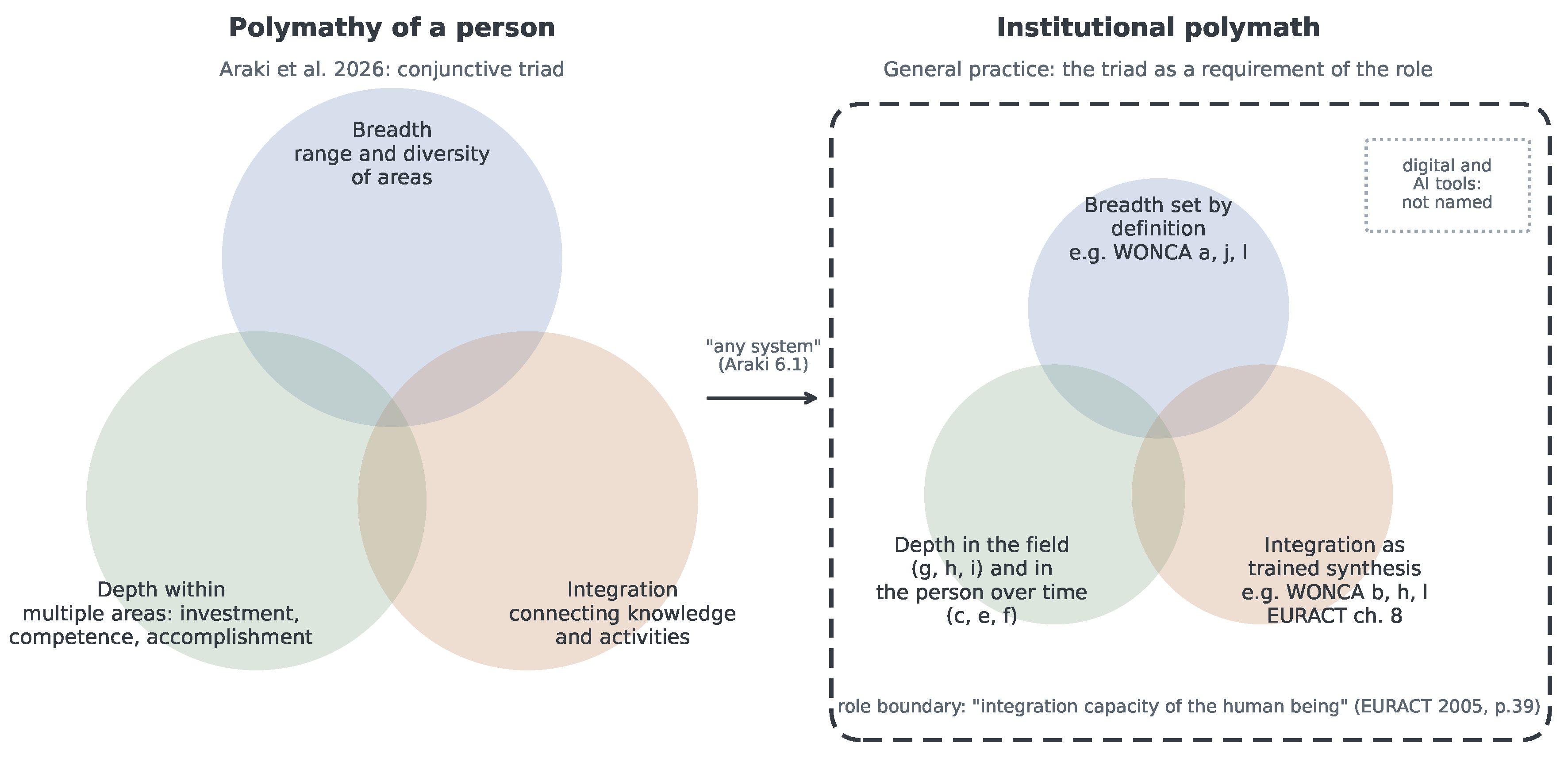

Table 1.
The twelve characteristics of general practice/family medicine (WONCA Europe, 2023) read against the polymathic triad (Araki et al., 2026) and the archetypes of generalism (Kelly et al., 2026). Author’s mapping.
Table 1.
The twelve characteristics of general practice/family medicine (WONCA Europe, 2023) read against the polymathic triad (Araki et al., 2026) and the archetypes of generalism (Kelly et al., 2026). Author’s mapping.
| Characteristic (abbreviated) | Breadth | Depth | Integration | Closest archetype |
| a. First contact, all health problems regardless of age, sex or other characteristic | primary | broad-based knowledge | ||
| b. Efficient use of resources through co-ordinating care and managing the interface with other specialities | primary (across services) | integrative | ||
| c. Person-centred approach to the individual, family and community | primary (in the person) | secondary | interpretive | |
| d. Patient empowerment | secondary (in the person) | primary (with the patient) | interpretive | |
| e. Consultation that establishes a relationship over time | primary (in the person) | interpretive | ||
| f. Longitudinal continuity of care | primary (in the person) | interpretive | ||
| g. Decision making determined by prevalence and incidence in the community | secondary | primary (in the field: problem solving at low prevalence) | secondary | integrative |
| h. Simultaneous management of acute and chronic problems | secondary | secondary (in the field: problem solving) | primary (within the person) | integrative |
| i. Illness presenting early and undifferentiated | secondary | primary (in the field: incremental investigation, time as a tool) | secondary (tolerating uncertainty) | interpretive |
| j. Health and wellbeing of patients and their ecosystems | primary (beyond the individual) | secondary | integrative | |
| k. Responsibility for the health of the community and environment | primary (population) | secondary (in the community) | adaptive | |
| l. Physical, psychological, social, cultural, environmental and existential dimensions | primary | primary | integrative, interpretive |
Table 2.
Hypothesised competencies of general practitioners as institutional polymaths working with AI, derived from Section 3. Author’s synthesis; not empirically tested.
Table 2.
Hypothesised competencies of general practitioners as institutional polymaths working with AI, derived from Section 3. Author’s synthesis; not empirically tested.
| # | Hypothesised competency | Dimension concerned | Grounding | Observation that would count against it |
| K1 | The ability to detect a wrong output in an area depends on the practitioner’s own depth of medical knowledge in that area | depth (medical knowledge) | Dreher et al. 2026; Li et al. 2026; Dratsch et al. 2023 | Practitioners with little knowledge of an area detect AI errors in it as reliably as those with more |
| K2 | Reliance on automated advice affects experienced users too, and instruction alone does not remove it | depth (medical knowledge); integration | Parasuraman & Manzey 2010; Dratsch et al. 2023; Tschandl et al. 2020 | Experienced general practitioners, after brief instruction, are no less accurate on clinical cases with incorrect AI suggestions than on the same cases read without AI |
| K3 | Weaknesses of a tool have to be established for each tool and version; in one benchmark they included history taking, comorbidities, drug risks and invented staging | integration | Li et al. 2026; Tu et al. 2025 | The weaknesses found for one tool or version predict those of other tools and versions so well that evaluation per tool adds nothing |
| D1 | Forming one’s own working hypothesis before consulting the tool, and using the tool to challenge it, reduces anchoring on the tool’s suggestions | integration | Dreher et al. 2026 (“I let myself be inspired, but I don’t let myself be persuaded”); Buçinca et al. 2021 | Consulting the tool first produces no more anchoring on its suggestions than consulting it second |
| D2 | Where a tool is approved for patient data, supplying context about the person gathered over time improves the fit of its output to the individual patient | depth (in the person) | Ahn 2026; Dreher et al. 2026 | Outputs given with and without such context do not differ in fit to the individual patient, as rated by assessors other than the practitioner |
| D3 | Weighing an output against the whole person, including other conditions and medicines, before acting on it reduces errors arising from multimorbidity | integration | WONCA Europe 2023 (h, l); Li et al. 2026 | Errors arising from comorbidity and polypharmacy are no less frequent when this step is taken |
| D4 | In conditions of low prevalence, taking up additional possibilities supplied by the tool increases investigations without a corresponding gain in diagnostic accuracy | depth (in the field: problem solving at low prevalence); breadth within the integration limit | WONCA Europe 2023, p. 20; Heyrman 2005, p. 39; Dreher et al. 2026 | In AI-supported consultations in general practice, possibilities taken up from the tool do not increase investigations, or the increase is accompanied by a gain in diagnostic accuracy of a size specified in advance as clinically relevant |
| D5 | Regular practice without the tool, during training and after it, protects the depth of medical knowledge needed for checking | depth (medical knowledge) | Bainbridge 1983; Budzyń et al. 2025; Barr et al. 2026 | Practitioners who keep regular unaided practice show no better unaided performance than those who do not |
| D6 | Explaining to patients when and how a tool was used supports their participation in the decision | integration (with the patient) | Liaw et al. 2022; Tolentino et al. 2025; WONCA Europe 2023 (d) | Explaining tool use does not change patients’ understanding of, or participation in, the decision |
| T1 | Competence in formulating queries and operating tools improves the quality of AI-assisted work | tool-specific (outside the triad) | Dreher et al. 2026; Liaw et al. 2022 | Measured prompting and technical competence does not predict the quality of AI-assisted work once depth of medical knowledge is taken into account |
| T2 | Competence in data protection determines which context can be supplied to a tool | tool-specific (outside the triad) | Dreher et al. 2026 | Practitioners with and without such competence supply the same kind and amount of patient context to tools |
Disclaimer/Publisher’s Note: The statements, opinions and data contained in all publications are solely those of the individual author(s) and contributor(s) and not of MDPI and/or the editor(s). MDPI and/or the editor(s) disclaim responsibility for any injury to people or property resulting from any ideas, methods, instructions or products referred to in the content. |
© 2026 by the authors. Licensee MDPI, Basel, Switzerland. This article is an open access article distributed under the terms and conditions of the Creative Commons Attribution (CC BY) license (http://creativecommons.org/licenses/by/4.0/).
Copyright: This open access article is published under a Creative Commons CC BY 4.0 license, which permit the free download, distribution, and reuse, provided that the author and preprint are cited in any reuse.