

Submitted:
16 November 2026
Posted:
18 November 2026
You are already at the latest version
Abstract
This paper continues a study of packings of unit cubes of arbitrary orientation in a cube of non-integer side. The companion paper [3] introduced the algorithmic three-band construction for sides just below an integer, and reported isolated packings of side k + 1/√2 for k = 4, 5, 6 found by exact integer programming. Here we give a rigorous proof that such packings form an infinite, highly symmetric family. For every integer k ≥ 3 the cube of side k + 1/√2 contains k³ + 6(k − 2) unit cubes: k³ axis-parallel cubes and 6(k − 2) cubes rotated by π/4 about a coordinate axis, arranged in six chains along a closed hexagon of edges of the container. Consequently s₃(n) ≤ k + 1/√2 for all n ≤ k³ + 6(k − 2), which improves on the lattice bound k + 1 for the 6(k − 2) values k³ < n ≤ k³ + 6(k − 2). For k = 4,…,9 it is the best value recorded on Friedman's Packing Center for n = 69–76, 131–143, 231–240, 358–373, 529–548 and 748–771; on the rest of each window smaller sides are already recorded. The positions of the axis-parallel cubes are given by a closed-form rule. The proof is by hand except for two finite computer verifications. We also show that at most k³ axis-parallel unit cubes fit in a cube of side less than k + 1, so the chains account for the entire gain.
Keywords:
cube packing
; unit cubes
; rotated cubes
; chain construction
; Chain Window Theorem
MSC: 52C17; 05B40
1. Introduction
Let denote the least side of a cube that contains n unit cubes of arbitrary orientation with pairwise disjoint interiors. The lattice packing gives for and only for . Improving on these bounds requires tilted cubes, and far fewer such packings are known than in the planar problem of unit squares in a square; the recorded values are collected in [1,2].
This paper continues the study begun in the companion paper [3], which treated sides just below an integer K. It introduced the three-band construction: the cube of side is cut into an axis-parallel core, three tilted slabs of independent widths placed cyclically along three faces, and a corner box, so that no layer of cubes is lost. That paper is algorithmic in nature: the band parameters are selected by search, and the resulting packings are certified in exact rational arithmetic. It also reported packings of side for , obtained by integer programming on a structured lattice, without a general rule.
The present paper supplies that rule and its proof. The packings of side are instances of a second pattern, the chain construction, in which all axis-parallel cubes are retained and cubes rotated by are inserted as six chains that follow a closed hexagon of six edges of the container. Our main result, Theorem 1, shows that this construction exists for every integer and yields the bound (1). In contrast with the companion paper, the construction is explicit and uniform in k: the axis-parallel cubes are placed by a closed-form coordinate rule, and no search is involved.
The proof separates three kinds of contact: between two chains, between a chain and the axis-parallel cubes bordering its channel, and among the axis-parallel cubes themselves. The first two are treated by hand. The third reduces, for , to a finite table of block pairs that does not depend on k; this table is verified by exhaustive enumeration, and the cases and are checked directly. We state these computer-assisted steps explicitly where they occur.
Two limits of the result should be noted. First, the theorem is an upper bound for and makes no claim of optimality; for some n in the window smaller sides are known. Second, the two papers are complementary rather than overlapping: the companion paper concerns sides and many tilted cubes at small angles, whereas the present paper concerns the single side and few cubes at the angle .
The paper is organized as follows. We first state the theorem and the maximality of the axis-parallel part. We then define the chain geometry, the coordinate classes and the shift function, prove the lemmas that give the main result, state the closed-form rule, describe the verification, and finally relate the bound to previously recorded values.
2. Statement of the Theorem
A packing of n unit cubes in a cube Q is a family of n closed unit cubes of arbitrary orientation, contained in Q, with pairwise disjoint interiors. Let denote the least side of a cube that admits a packing of n unit cubes. Throughout,
Theorem 1
(Chain Window Theorem). For every integer the cube admits a packing of
unit cubes, of which are axis-parallel and are rotated by about a coordinate axis. Consequently
Remark 1
(The window). For the lattice packing gives only , and for it gives . Hence (1) improves on the lattice bound exactly on the window
which contains consecutive values of n.
The axis-parallel part of the packing cannot be enlarged:
Proposition 1.
Let . Any family of axis-parallel unit cubes with pairwise disjoint interiors contained in has at most members.
Proof.
Choose t with and let . Replace each cube by the half-open cube . Two axis-parallel unit cubes with disjoint interiors differ by at least 1 in some coordinate, so the half-open cubes are pairwise disjoint, and each contains exactly one point of . Such a point has coordinates with , which forces because and . There are such points. □
Thus the rotated cubes account for the whole excess over the lattice packing, and the content of Theorem 1 is that six chains of rotated cubes can be inserted without the loss of a single axis-parallel cube.
3. Definitions and Preliminaries
Fix an integer and put
so that . Two sets are interior-disjoint if their interiors do not meet.
3.1. Chains
For let
Since the image of under a rotation by is , the set is a unit cube rotated by about the x-direction; similarly for the other axes. Let
Definition 1
(Chains). The six chains are the prisms
Each chain is the union of rotated unit cubes, consecutive ones sharing a face.
Remark 2
(Symmetry). The point reflection exchanges , , . The six chains run along the closed circuit of edges of Q
in the order , each starting at the initial vertex of its edge and stopping at distance from the terminal vertex.
Figure 1 shows the resulting packings for () and ().
3.2. Flats, Thresholds and Shifts
Let .
Definition 2
(Flats). Let be three threshold functions. For define the shift by
where is the Iverson bracket, and the flat
Every flat lies in Q, since its coordinates range in . Geometrically, each of the axis-parallel lines of the array carries k unit cubes and a single gap of length h; the threshold is the number of cubes preceding the gap.
3.3. Index Classes
Definition 3
(Classes). For let
For let , , , , , and let be the map with . The classes are non-empty consecutive intervals of .
4. Lemmas
Lemma 1
(Chain–chain). For the six chains are contained in Q and are pairwise interior-disjoint.
Proof.
Put and . Both intervals lie in because , and ; hence the chains lie in the boxes
which are contained in Q. We use the two inequalities
For two chains with different axes the boxes are separated in the following coordinate:
For two chains with the same axis, the centres of the two cross-sections are at -distance , so the cross-sections are disjoint. □
| x | y | z | x | y | x | x | z | z | y | y | z |
| F1 | F2 | F1 | F1 | F1 | F2 | F2 | F2 | F1 | F1 | F2 | F2 |
Lemma 2
(Shear criterion). Let and be distinct elements of with shifts . The flats and are interior-disjoint if and only if there is a coordinate i such that either , or and, with the labelling , .
Proof.
The projections of the two flats to the i-th axis are the unit intervals starting at and ; their interiors meet if and only if , where . This holds for (as ), fails for (as ), and for holds exactly when . Two axis-parallel cubes are interior-disjoint if and only if their projections are interior-disjoint in some coordinate. □
Lemma 3
(Channel, normal form). Let and suppose that for every
Then no flat meets the interior of .
Proof.
A flat with lies in and does not meet . Let and let be a point of the projection of the flat. It suffices to show .
Case . By hypothesis and , so or , and likewise for y. Since , both and are at least .
Case , . Then , so and . The case , is symmetric.
Case . Then and . □
Figure 2.
Cross-section of the channel of in a layer (Lemma 3). The diamond has -radius h; the projections of the flats with are the four unit squares. Each square touches the diamond at the midpoint of one of its edges (red points) and never enters its interior.
Figure 2.
Cross-section of the channel of in a layer (Lemma 3). The diamond has -radius h; the projections of the flats with are the four unit squares. Each square touches the diamond at the midpoint of one of its edges (red points) and never enters its interior.
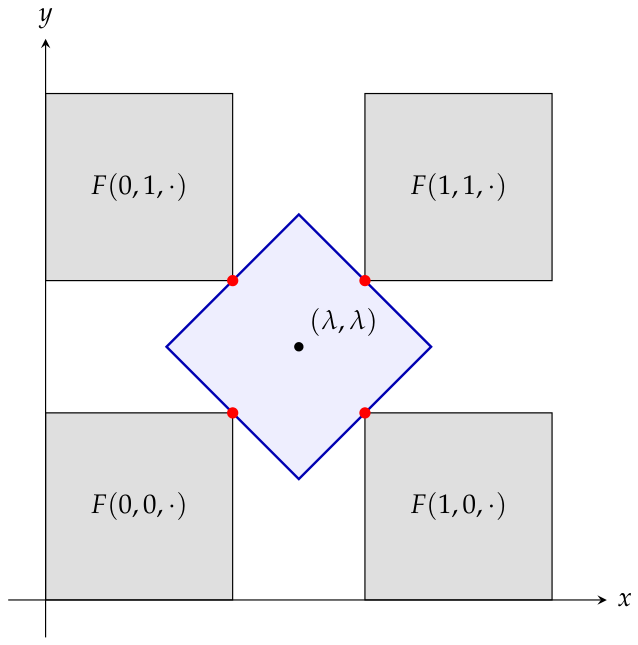
Remark 3
(Minimality of the gap). In the first case the four flats touch the cross-section at the midpoints of its edges. If the gaps had width w instead of h, the four inner corners would be at -distance w from the centre; the argument therefore requires , and the side cannot be lowered within this template.
Lemma 4
(Channel, general form). Let , and write , . If the threshold functions satisfy row j of Table 1 for all indicated indices, then no flat meets the interior of .
Proof.
The reflection in one coordinate maps a family of flats to a family of flats in which the index i of that coordinate is replaced by , the shift by , and the threshold m by ; indeed . It exchanges , , , the values , and the layer conditions . Each row of Table 1 is the image of the hypothesis of Lemma 3 under the coordinate permutation carrying the axis of to the z-axis, composed with the reflections in those coordinates in which the cross-section of is centred at or its axial range is . The conclusion is the image of that of Lemma 3. □
Lemma 5
(Block reduction). Let . Assume that the threshold functions take values in and that each value , , depends on its two arguments only through their classes among . Then:
- 1.
- there is a map such that ; it is determined by the assignment of the symbols 1, , to pairs of classes and does not otherwise depend on k;
- 2.
- if Σ satisfies condition (T) below, the flats are pairwise interior-disjoint.
(T) For all distinct there is a coordinate i with such that either , or, with the labelling , .
Proof. (1) Let , , . For and we have . Since the classes are unions of the classes , the right-hand sides of (2) depend only on , through a rule that does not involve k.
(2) Let in , , (componentwise). If then , the two flats are translates of each other by a non-zero integer vector, and they are interior-disjoint. Otherwise let i be the coordinate given by (T), labelled so that ; then . If , a non-empty class lies strictly between and , so . If , then either , or and . In every case Lemma 2 applies. □
5. The Closed-Form Rule and the Proof of the Theorem
Definition 5
(Rule for ).
Proposition 2.
The rule (R) for , and the rule (R3) for , satisfy all six rows of Table 1.
Proof.
For (R) each entry is read off directly. For instance, in the row of we have : if then , and if and then again ; moreover excludes both special cases of , so . The remaining rows are analogous and use only . For (R3) the twelve conditions are checked in the same way with , . □
Proposition 3
(computer-assisted). Let . The rule (R) satisfies the hypotheses of Lemma 5, and its map Σ satisfies condition (T).
Proof.
The hypotheses hold by inspection of (R). Condition (T) is a statement about the unordered pairs of elements of and a fixed map ; it was verified by exhaustive enumeration (Section 6). □
Proof
(Proof of Theorem 1). Let and take the flats of Definition 4 together with the rotated cubes forming the chains of Definition 1. All cubes lie in Q (Definition 2 and Lemma 1). The rotated cubes are pairwise interior-disjoint: within a chain by construction, and between chains by Lemma 1. No flat meets the interior of a chain, by Proposition 2 and Lemma 4. The flats are pairwise interior-disjoint by Proposition 3 and Lemma 5. This gives a packing of unit cubes in Q.
For the rule (R) is used with , and for the rule (R3). Lemmas 1 and 4 and Proposition 2 apply without change. Lemma 5 does not apply, because the classes are no longer separated; instead the criterion of Lemma 2 was checked directly for all pairs among the 64, respectively 27, flats (Section 6).
Finally, removing cubes from a packing leaves a packing, which gives (1) for every . □
6. Verification
The proof is computer-assisted only in two finite, k-independent places: condition (T) of Proposition 3, and the flat–flat check for . The following computations were carried out.
Class table.
The map of Lemma 5 was tabulated from (R) and condition (T) was tested on all 7750 pairs. No pair fails.
Exact arithmetic.
All coordinates of the construction lie in . The sign of is decided exactly: it is the common sign of p and q when these agree, and otherwise it is determined by comparing with . With this arithmetic the flats were tested for (rule (R3)) and for (rule (R)): flat–flat pairs by the criterion of Lemma 2, and flat–chain pairs by the inequality
for every flat whose axial projection meets the interior of the axial range of the chain, where is the lower corner of the transverse projection of the flat and the centre of the cross-section. No violation occurs.
Independent separating-axis test.
For (that is, ) the cubes were generated as oriented boxes in floating point, and the separating-axis test with the 15 standard axes was applied to all pairs whose centres are at Chebyshev distance less than (pairs farther apart cannot meet). The minimum separation over all pairs and the minimum distance to the walls are zero up to rounding error (below ): the configuration has contacts but no overlaps, and the cube counts equal .
Positive clearance.
A dilation of the centres about the centre of Q by the factor yields a packing in a cube of side with strictly positive clearances, suitable for registries that require them. Exact-rational certificates of this kind, with , were produced for (that is, ) by the rationalisation procedure of the companion paper [3]. The exact coordinates and the author’s MATLAB scripts are deposited at Zenodo [4].
7. Relation to Previously Recorded Bounds
Table 2 compares the window of Theorem 1 with the values recorded on Erich Friedman’s Packing Center [1] (read in November 2026). The Packing Center credits to the author the packings of side for –76, 131–143, 231–240, 358–373, 529–548 and 748–771 (). For the same side for –33 is a record of E. Friedman (1998); it is attained here by the case and is not claimed as new. In the remaining part of each window the Packing Center lists a smaller side, labelled “Trivial”; there Theorem 1 improves the lattice bound but not the recorded value. The contribution of the present paper is the uniform construction for every and its proof.
Data Availability Statement
Exact coordinates of the chain packings for and the author’s MATLAB scripts are available at Zenodo [4] under the CC BY 4.0 licence.
References
- E. Friedman, Cubes in Cubes, Erich’s Packing Center, https://erich-friedman.github.io/packing/cubincub/ (accessed November 2026).
- platonic-packing: catalogue of packings of n ≤ 100 unit cubes in a cube, GitHub repository alejandrozu/platonic-packing.
- M. Karimi, Packing Unit Cubes in a Cube of Side Just Below an Integer Preprints.org (2026). [CrossRef]
- M. Karimi, Master Dataset: Exact Rational Certificates for Packing Unit Cubes in a Cube for n. [CrossRef]
Figure 1.
The packings of Theorem 1 for (, left) and (, right). Axis-parallel cubes are blue; cubes of the chains, rotated by , are coloured. Chain cubes lying inside the container are partly hidden by the axis-parallel cubes in front of them.
Figure 1.
The packings of Theorem 1 for (, left) and (, right). Axis-parallel cubes are blue; cubes of the chains, rotated by , are coloured. Chain cubes lying inside the container are partly hidden by the axis-parallel cubes in front of them.
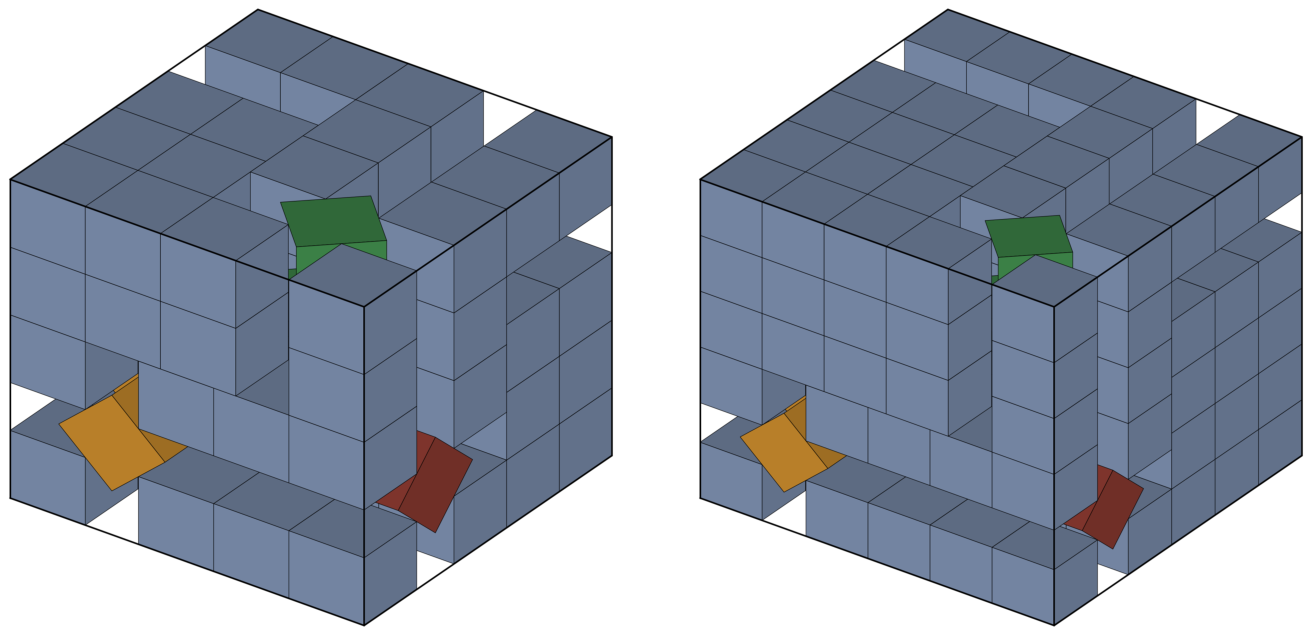

Table 1.
Channel conditions for the six chains.
| Chain | Layers | First condition | Second condition |
| for | for | ||
| for | for | ||
| for | for | ||
| for | for | ||
| for | for | ||
| for | for |
Table 2.
The windows of Theorem 1 against the values recorded on the Packing Center. The side of the theorem is for ; the lattice side is . By monotonicity the theorem also gives for –230.
Table 2.
The windows of Theorem 1 against the values recorded on the Packing Center. The side of the theorem is for ; the lattice side is . By monotonicity the theorem also gives for –230.
| k | window | recorded side on the Packing Center (sub-ranges of the window) | |
| 3 | 33 | 28–33 | 28: (H. Nakano); 29–33: (E. Friedman) |
| 4 | 76 | 65–76 | 65–68: (“Trivial”); 69–76: (M. Karimi) |
| 5 | 143 | 126–143 | 126–130: (“Trivial”); 131–143: (M. Karimi) |
| 6 | 240 | 217–240 | 217–222: (“Trivial”); 223–230: not listed; 231–240: (M. Karimi) |
| 7 | 373 | 344–373 | 344–350: (“Trivial”); 351–357: (“Trivial”); 358–373: (M. Karimi) |
| 8 | 548 | 513–548 | 513–520: (“Trivial”); 521–528: (“Trivial”); 529–548: (M. Karimi) |
| 9 | 771 | 730–771 | 730–738: (“Trivial”); 739–747: (“Trivial”); 748–771: (M. Karimi) |
Disclaimer/Publisher’s Note: The statements, opinions and data contained in all publications are solely those of the individual author(s) and contributor(s) and not of MDPI and/or the editor(s). MDPI and/or the editor(s) disclaim responsibility for any injury to people or property resulting from any ideas, methods, instructions or products referred to in the content. |
© 2026 by the authors. Licensee MDPI, Basel, Switzerland. This article is an open access article distributed under the terms and conditions of the Creative Commons Attribution (CC BY) license (http://creativecommons.org/licenses/by/4.0/).
Copyright: This open access article is published under a Creative Commons CC BY 4.0 license, which permit the free download, distribution, and reuse, provided that the author and preprint are cited in any reuse.