
Submitted:
16 November 2026
Posted:
18 November 2026
You are already at the latest version
Abstract
Background/Objectives: Provider affect, preparedness and empathy may influence behaviour guidance in paediatric dentistry, but their measurement alongside observed clinical behaviour and child-level responses has not been systematically mapped. Methods: A protocol-registered scoping review followed JBI guidance and PRISMA-ScR. Nine databases and complementary sources were searched, and eligible primary reports were charted by study family. Measurement domains were coded as clinician-reported, physiological, independently observed, child-level or caregiver-level. Results: Thirty-three reports representing 32 study families met the criteria. Principal constructs were stress/anxiety/coping (n = 19), confidence/preparedness (n = 9) and empathy (n = 4). Twenty-five families (78.1%) used provider self-report alone; five included child-level measures or treatment-related endpoints, and one independently assessed clinician behaviour. No study family co-measured a provider construct, observed clinical behaviour and a child-level measure. Conclusions: Existing studies describe clinician experiences much more frequently than the actions taken during treatment. Integrating provider-state measures, observed chairside conduct and child responses within the same encounters is the clearest next step for understanding behaviour guidance and evaluating educational transfer.
Keywords:
paediatric dentistry
; behaviour guidance
; clinician stress
; self-confidence
; empathy
; clinical observation
; evidence mapping
; scoping review
1. Introduction
Behaviour guidance is central to paediatric dental care because completing a procedure depends not only on technical competence but also on how a clinician recognises and responds to a child’s distress. Developmental stage, fear, previous experience and caregiver involvement may alter the course of the encounter even when the planned treatment is routine. Dental teams therefore make continuous decisions about explanation, pacing, reassurance, participation and whether a procedure should be modified or deferred. Professional guidelines describe these as clinical judgements rather than interchangeable techniques [1]. Yet the behaviour of the dental team and the child’s experience are not necessarily captured by the same measures.
Observational work has established that staff communication and child behaviour can be recorded and examined systematically [2]. A systematic review by Zhou and colleagues considered links between dental staff behaviour and children’s anxiety or cooperation [3], while subsequent encounter-level research showed that apparently supportive actions, including reassurance, may accompany greater distress rather than consistently reduce it [4]. These findings matter because the intention behind an action does not establish its effect. Studies of dentist–child–caregiver interaction likewise demonstrate the potential value of coding the exchanges that actually occur during treatment [5,6]. This literature describes observable interaction, however, without necessarily measuring the clinician’s affective state or perceived preparedness.
A different line of research examines what dental professionals experience or believe they can manage. Stress and anticipatory anxiety refer to affective responses; confidence and preparedness concern perceived capability; empathy addresses understanding of another person’s perspective. These constructs may coexist but should not be treated as the same psychological variable. Some are momentary states tied to a particular procedure; others are retrospective evaluations or relatively general professional characteristics. In medical and dental education, self-assessment has proved an imperfect substitute for external assessment of performance [7,8]. Perceived confidence, therefore, answers a different question from whether the clinician’s actual behaviour was appropriate in a challenging appointment.
The distance from belief to behaviour is especially relevant in paediatric practice. Questionnaires can capture stress during local anaesthesia, sedation or treatment of an uncooperative child, while vignettes can elicit the management approach a student says would be appropriate. Retrospective accounts of techniques used in practice add clinical experience but remain dependent on recall. None of these necessarily documents what the clinician did when the child became distressed. A useful evidence hierarchy separates intended responses, recalled actions and independently observed conduct; each level requires different interpretation. Caregiver participation and the possibility that child behaviour changes clinician state, rather than simply responding to it, make this distinction still more important.
Professional education presents a related problem of inference. An intervention may improve confidence or empathy scores without showing that a learner communicates differently at the chairside. Miller’s framework distinguishes knowledge and simulated demonstration from performance in practice [9]. Constructive video feedback has shown that independent evaluation of student behaviour in paediatric encounters is feasible [10]. To establish whether training transfers beyond confidence or intention, studies must measure observable actions alongside appropriately timed provider measures and, where relevant, separately defined child-level responses.
Because the relevant literature crosses provider populations, research designs, measurement instruments and clinical or educational contexts, a scoping review is suited to characterising its coverage and methodological boundaries. This review mapped affective, interpersonal and preparedness constructs among dental learners and practitioners involved in paediatric care; identified the sources from which these constructs and downstream variables were measured; and examined whether study families co-measured provider constructs, clinician-reported practice, independently observed behaviour, caregiver variables and child-level measures. The principal question was whether the full provider construct–observed clinician behaviour–child-level pathway had been measured within the same investigation.
2. Materials and Methods
2.1. Design, Protocol and Reporting
The protocol was registered on the Open Science Framework (DOI: 10.17605/OSF.IO/SH4M5) [11]. This scoping review followed the Joanna Briggs Institute (JBI) approach [12] and was reported in accordance with the PRISMA extension for scoping reviews (PRISMA-ScR) [13]. Search reporting was informed by PRISMA-S [14]. The review question, eligibility criteria and evidence-linkage domains were structured using the Population–Concept–Context framework. An independent study family, rather than an individual publication, was the unit of synthesis. OpenAI ChatGPT (GPT-6, November 2026) and Anthropic Claude (November 2026) assisted with draft wording, language and structural editing, bibliographic checking and figure preparation. The authors independently verified the scientific content and retain responsibility for all interpretations, inclusion decisions and methodological ratings; these tools did not independently perform eligibility decisions or reviewer-level MMAT assessments.
The review mapped provider affective, interpersonal and preparedness constructs in paediatric dentistry and examined whether these were co-measured with self-reported actual or intended practice, independent observation of clinician behaviour, caregiver measures, and child-level measures or treatment-related endpoints.
2.2. Eligibility Criteria
Eligible populations comprised undergraduate dental or dental-hygiene learners, postgraduate residents or specialty trainees, general dentists, paediatric dentists, and other dental clinicians providing or preparing to provide paediatric care. Mixed samples were eligible when paediatric-provider data were separable or the study question explicitly concerned paediatric care.
The eligible concept was a provider-level affective, interpersonal or preparedness construct related to paediatric dental care or behaviour guidance. Constructs included stress, anxiety, fear, emotional response, coping, emotional regulation, confidence, comfort, preparedness, self-efficacy, empathy and emotional intelligence. Every included study family was required to measure at least one eligible provider-level construct. Potential downstream domains—self-reported practice, independently observed clinician behaviour, child-level measures or treatment-related endpoints, and caregiver-level measures—were charted when present but were not required for inclusion.
Eligible contexts included routine or behaviourally challenging paediatric dental care, invasive and non-invasive procedures, sedation or anaesthesia, clinical education, paediatric simulation, and paediatric-specific scenarios or vignettes. Primary quantitative, qualitative and mixed-methods research was eligible. Reviews, guidelines, editorials, commentaries, non-primary publications, adult-only dentistry, child- or caregiver-only studies, generic academic stress, generic burnout not linked to paediatric encounters, and technical competence without an affective, interpersonal or preparedness component were excluded. No date or language restrictions were applied.
2.3. Information Sources and Search Strategy
The literature search covered nine databases: MEDLINE via PubMed, Scopus, ERIC, Web of Science Core Collection, CINAHL, Dentistry & Oral Sciences Source, Embase, APA PsycINFO and ProQuest Dissertations & Theses Global. Electronic database searching was performed in July 2026, alongside complementary information-source searches, grey-literature checking and reference-list verification. Full electronic search strategies and information-source dates are supplied in Supplementary Methods and Table SM1.
2.4. Selection of Sources of Evidence
Database records were deduplicated by bibliographic identifiers and manual verification. Two reviewers independently screened titles and abstracts and examined potentially eligible full texts, resolving differences by consensus against the predefined population, concept and context criteria. Records identified through complementary sources and reference checks were assessed against the same eligibility criteria and checked for overlap. Reports from a single underlying investigation were combined into one study family on the basis of setting, recruitment, participants, investigators, intervention and outcomes; they remained distinct reports in selection counts.
2.5. Data Charting
Two reviewers independently charted data from eligible reports using a structured form based on JBI guidance [15]. Extracted domains included publication and study design, participants, paediatric context, measured provider constructs, instruments and timing, reported or independently observed clinical behaviour, child- and caregiver-level measures, and principal findings. Independently completed charts were compared and reconciled by consensus. The study-family characteristics and evidence-linkage codes appear in Supplementary Table S1–S2.
2.6. Evidence-Linkage Coding and Synthesis
Each study family was assigned one mutually exclusive principal-construct category: stress/anxiety/coping, confidence/preparedness, or empathy. When more than one eligible construct was measured, the principal category followed the stated primary aim and primary provider-level outcome; where neither was explicit, reviewers resolved classification by consensus. Secondary eligible constructs were charted but did not contribute to more than one principal category.
Measurement architecture was classified as provider self-report only or multiple measurement sources. Self-reported actual practice denoted recalled or reported use of a clinical technique; intended practice denoted responses proposed for hypothetical situations. Independent observation required an assessor to rate direct or recorded clinical conduct. Provider physiology comprised objective physiological measurements, such as operator pulse or cortisol, and was counted as an additional measurement source, not a measure of clinical effectiveness. Child-level measures or treatment-related endpoints and caregiver-level measures were charted separately. The six additional domains were not mutually exclusive.
A complete measurement chain required, within the same study family, an eligible provider construct, independently observed clinician behaviour, and a child-level measure or treatment-related endpoint. Linkage represented same-study co-measurement and did not imply temporal mediation or causality. Descriptive counts and percentages used study-family denominators; report-level denominators were used only for study selection. Because constructs, designs, instruments, contexts and outcome levels were heterogeneous, no meta-analysis was undertaken. Findings were summarised descriptively by principal construct, measurement architecture and same-study linkage. The complete evidence-linkage matrix is provided in Supplementary Table S2.
2.7. Methodological Appraisal
Methodological appraisal was conducted independently by two reviewers using the Mixed Methods Appraisal Tool (MMAT), version 2018 [16,17], with the five criteria applicable to each study design. The two screening questions and five design-specific judgements were recorded as Yes, No or Can’t tell. Discrepant ratings were resolved by reviewer consensus. Appraisal was used to describe methodological characteristics and did not determine study eligibility or statistical weighting. Reviewer-level and consensus ratings for all 32 study families are provided in Supplementary Table S4–S5.
3. Results
3.1. Study Selection
Nine databases yielded 2,537 records. Following the removal of 1,073 duplicates, 1,464 records underwent title and abstract screening, and 77 reports were assessed in full text. Forty-eight full-text reports were excluded because they did not meet the eligibility criteria. Across database and complementary information sources, 33 eligible reports representing 32 independent study families were included (Figure 1).
3.2. Evidence Base and Measurement Architecture
The 32 study families, published from 2003 to 2026, encompassed undergraduate dental and dental-hygiene learners, postgraduate trainees, general practitioners and paediatric dental specialists. Nineteen families primarily examined stress, anxiety or coping (59.4%); nine examined confidence or preparedness (28.1%); and four examined empathy (12.5%). Twenty-five families (78.1%) relied exclusively on provider self-report, whereas seven (21.9%) included at least one other measurement source. Study designs comprised 20 quantitative descriptive studies, eight non-randomised investigations and four randomised interventions, counting the cluster-randomised trial by Kenny et al. as randomised [18]. Across all families, five measured self-reported actual practice, two examined responses to hypothetical clinical scenarios, three incorporated provider physiology, five included a child-level measure or treatment-related endpoint, two measured caregivers and one independently rated clinician behaviour (Table 1 and Table 2; Figure 2; Supplementary Table S2).
3.3. Construct-Level Findings and Co-Measurement
The 19 stress/anxiety/coping families included encounter-specific studies of local anaesthesia, rubber-dam placement and sedation as well as surveys of trainees and practising providers. Reported stress varied with procedure demands, children’s age or cooperation, and operator experience [22,23,24,25,26,28,30,32,33,34,35,37]. Simulation elicited broadly similar emotions to clinical encounters, but these comparisons did not establish differences in behaviour during treatment [35]. Studies combining provider measures with child-level observations addressed related clinical processes. Operator stress was examined alongside child behaviour during sedation [30], and other clinical studies recorded provider and child measures within the same procedural context [20,21,22,33]. These studies did not independently code the clinician’s behaviour as the intermediate pathway.
Confidence and preparedness were examined in nine study families. Questionnaire surveys addressed perceived readiness for paediatric care and reported use of behaviour-guidance approaches [39,40,41,43,44], while scenario-based work recorded the responses students considered appropriate for non-cooperative children [38,42]. Such elicited choices provide evidence about anticipated or stated management, not what happens during an encounter. A cluster-randomised video intervention improved student-reported confidence [18], whereas constructive faculty feedback was associated with improvements in independently rated behaviour-guidance performance [10]. These two educational outcomes are complementary but cannot be treated as equivalent indicators of clinical transfer.
Four families assessed empathy in educational or clinical contexts [45,46,47,48,49]. Empathy measures changed after instructional, simulation or clinical exposure, although direction and durability differed across studies. Across all constructs, the measurement domains did not converge within a single study family: independent clinician behaviour was rated in one, child-level measures or treatment-related endpoints occurred in five, and no study combined a provider construct, independently observed behaviour and a child-level measure in the same investigation (Figure 2; Supplementary Table S2).
3.4. Methodological Appraisal
All 32 study families underwent two independent, design-specific MMAT assessments, followed by reconciliation of discrepant judgements (Supplementary Table S4–S5). Reviewers agreed on 204/224 item ratings (91.1%; Cohen’s κ = 0.765) across the two screening questions and five methodological criteria, and on 142/160 design-specific ratings (88.8%; κ = 0.763). Twenty disagreements were resolved by consensus. Four studies, including the cluster-randomised trial by Kenny et al. [18], were assessed using randomised-trial criteria; eight were assessed using non-randomised criteria and twenty using quantitative descriptive criteria.
4. Discussion
Across 32 study families, the evidence concerning clinician affect, preparedness and empathy in paediatric dentistry is principally an account of what providers report experiencing rather than what they do during care. Twenty-five families relied exclusively on provider self-report; only one included independently observed clinician behaviour; and none co-measured a provider construct, observed behaviour and a child-level measure. This describes the organisation of the evidence, not the size or direction of an association. The existing literature cannot establish that provider stress, confidence or empathy shapes children’s experiences of treatment, but it cannot exclude such relationships either.
The self-report findings nonetheless identify recognisable clinical demands. Surveys and educational studies repeatedly locate stress around local anaesthesia, invasive treatment, sedation, younger or resistant children and limited operator experience [22,23,24,25,26,28,30,32,33,34,35,37]. In several confidence and preparedness families, reported confidence or preparedness varied with task difficulty and clinical context [38,41,42,43]. Such convergence is useful for designing studies that sample encounters in which provider state may plausibly vary. It does not imply that higher stress denotes poorer practice: anxiety when treating a distressed child may reflect awareness of a demanding procedure rather than ineffective guidance. Neither do the instruments justify treating situational stress, occupational strain and perceived readiness as interchangeable.
Self-report has genuine strengths. Affective states are not directly observable, questionnaires can cover large groups, and educational or clinical services can administer them without filming children or altering appointments. Recorded encounters require consent, privacy safeguards, coding frameworks and assessor training. The interpretive problem begins when a clinician’s perception of stress or confidence is used to infer an unmeasured action. Where provider constructs and reported practices are supplied by the same respondent [24,39,40,44,46], recall, social desirability and shared-method variance may influence apparent associations. Reviews of professional self-assessment in medicine and dentistry caution against treating subjective confidence as a direct measure of performance [7,8]. Programme directors and entering residents have also rated readiness differently, although their judgements were not paired at the individual level [41].
The evidence spans a gradient from hypothetical decisions to actual chairside conduct. Vignettes ask learners to indicate how they would respond to a child’s behaviour [38,42]; practitioner surveys ask about techniques they recall using [24,39,40,44,46]; and one educational study rated conduct in recorded clinical encounters [10]. These are distinct outcomes. A vignette reveals a stated management decision under conditions unlike an appointment with real distress, caregiver involvement and time pressure; it cannot establish that the decision will be enacted. Recalled practice is closer to experience but remains subject to memory and personal interpretation. Miller’s framework provides an educational parallel: knowing how, demonstrating and performing in practice are related but different evidential levels [9].
The five families that collected both provider and child-level measures are particularly informative because they approach the clinical encounter from a different direction [20,21,22,30,33]. In the sedation study by Anabuki and colleagues, greater behavioural resistance by children accompanied higher clinician-reported stress [30]. This raises the possibility that a child’s response changes the clinician’s state as well as the reverse, although the study does not identify causal direction. Peretz and colleagues found an association between parental and child anxiety but not between student and child anxiety [21], underscoring the caregiver’s part in the clinical interaction. Other studies considered operator stress with child measures in the same procedural setting [20,22,33]; they do not isolate whether any observed child response arose from the clinician’s state, from behaviour during care, or from a procedure influencing both. A trait measure of child anxiety is not interchangeable with an outcome recorded during that encounter.
Read together, the evidence map reveals a specific division in research practice. Child-level measures appear in clinical studies of operator stress, whereas independently observed clinician behaviour appears in a study of teaching and video feedback [10,20,21,22,30,33]. The missing link therefore does not require inventing an entirely new field of measurement. Clinical studies that already measure provider state and child response could code the intervening clinician behaviour; educational studies that already assess recorded performance could incorporate child-level responses from the same appointments. Research focused on dental staff–child interaction outside our provider-construct eligibility criterion shows that such behavioural coding is feasible [2,3,4], but those studies alone cannot explain how the clinician’s internal state relates to the actions being coded.
Timing further complicates these relationships. Anticipatory anxiety, intraprocedural pulse, post-treatment cortisol and retrospective accounts of stress represent different moments and, in some cases, different constructs. In one sedation investigation, perceived stress did not correspond closely to cortisol; in another, biological and self-reported measures varied across treatment conditions [22,30,32]. Subjective and physiological indices may diverge even when collected in the same setting [50]. These measures should neither be collapsed into a single clinician-state score nor mistaken for evidence of clinical effectiveness. Empathy studies illustrate a related problem of transfer and persistence: scores shifted after perspective-taking or other teaching interventions and clinical placements, but the size, direction and duration of change differed [45,46,47,48,49]. None establishes whether a change in empathy score was reflected in communication with children.
For clinical education, the implication is to assess the outcome one claims to improve. Confidence and empathy are legitimate educational outcomes, but improvement in either does not by itself demonstrate a change in behaviour guidance. Where transfer to practice is the question, time-anchored provider measures could be paired with blinded assessment of recorded encounters or structured workplace observation. Observable codes might include the timing and content of explanation, responsiveness to distress, opportunities for caregiver participation, and adjustment when an initial approach fails. Child anxiety, cooperation, distress, pain and treatment completion should be analysed separately. The same principle is applicable to continuing professional development: a self-reported increase in confidence with a technique is not direct evidence of how that technique is delivered.
An informative next study would follow the encounter rather than rely on a broader retrospective survey. Provider state could be assessed before and immediately after treatment, clinical actions coded in prespecified time windows, and child responses recorded with baseline child anxiety taken into account. Sampling situations associated with greater perceived stress would improve the opportunity to observe meaningful variation. Repeated appointments and children treated by the same clinician would require analysis appropriate to the actual clustering structure; time-ordered coding could examine child-to-clinician as well as clinician-to-child sequences. Such designs would allow more specific tests of temporal associations, whereas causal claims would require stronger identification strategies, potentially including experimental interventions assessed with observed behaviour and child endpoints.
This evidence map describes the presence and co-measurement of domains, rather than the magnitude or direction of relationships between them. Assigning one principal construct per study family simplifies investigations that addressed more than one provider characteristic. Eligibility required a provider-level construct, so studies examining clinician behaviour and child outcomes without such a measure were outside the review by design. Heterogeneity in measurement timing, instruments and clinical contexts limited comparability. Despite complementary identification routes, relevant reports may have escaped retrieval, particularly from regionally indexed sources.
5. Conclusions
Across 32 study families, investigation of stress, confidence, preparedness and empathy among paediatric dental providers has relied predominantly on self-report. Twenty-five families used no other measurement source; one independently rated clinician behaviour; and none assessed a provider construct, observed behaviour and child-level response within the same study family. The evidence is divided across complementary research approaches: clinical investigations have sometimes measured provider state alongside children’s responses without observing intervening actions, while the study that assessed recorded performance did not measure child outcomes. The central finding is therefore a specific gap in co-measurement, not evidence for or against a causal effect of clinicians’ psychological states on children.
Provider stress is reported in identifiable clinical situations, and educational interventions can change perceived confidence or empathy. Whether these measures correspond to observable behaviour during care remains largely unknown. Confidence ratings, proposed responses to scenarios and recalled technique use should consequently be interpreted as outcomes in their own right, rather than as substitutes for demonstrated behaviour guidance. Encounter-level studies that integrate appropriately timed provider measures, independently assessed clinical actions and distinct child outcomes would provide a firmer basis for evaluating both practitioner-related influences and the clinical transfer of behaviour-guidance education.
Supplementary Materials
The following supporting information can be downloaded at the website of this paper posted on Preprints.org, Table SM1, database platforms and search dates; Table SM2, other identification routes and source-level accounting; Table S1, study-family characteristics and findings; Table S2, evidence-linkage matrix; Table S3–S5, MMAT criteria, reviewer-level assessments and agreement statistics; Table S6, PRISMA-ScR checklist.
Author Contributions
Conceptualization, D.S.; methodology, D.S., F.A.A., P.M.N., F.A. and B.S.M.S.; formal analysis and evidence mapping, D.S.; investigation and data curation, D.S. and F.A.; literature verification and critical analysis, F.A.A. and P.M.N.; writing—original draft preparation, D.S.; writing—review and editing, all authors; supervision, D.S. All authors have read and agreed to the published version of the manuscript.
Funding
This research received no external funding.
Institutional Review Board Statement
Not applicable. This scoping review synthesised published and publicly accessible literature and recruited no participants.
Informed Consent Statement
Not applicable.
Data Availability Statement
Study-level characteristics, evidence-linkage classifications, reviewer-specific and consensus MMAT assessments, and numerical source-selection information are provided in the Supplementary Information. The review protocol is accessible at https://doi.org/10.17605/OSF.IO/SH4M5.
Acknowledgments
OpenAI ChatGPT (GPT-6, November 2026) and Anthropic Claude (November 2026) assisted with draft wording, language and structural editing, bibliographic checking and figure preparation. All scientific statements, literature selection and interpretations were reviewed by the authors, who retain full responsibility for the work.
Conflicts of Interest
The authors declare no conflicts of interest.
Abbreviations
JBI, Joanna Briggs Institute; MMAT, Mixed Methods Appraisal Tool; OSF, Open Science Framework; PRISMA-ScR, Preferred Reporting Items for Systematic Reviews and Meta-Analyses extension for Scoping Reviews.
References
- American Academy of Pediatric Dentistry. Behavior guidance for the pediatric dental patient. In The Reference Manual of Pediatric Dentistry; American Academy of Pediatric Dentistry: Chicago, Ill.; Volume 2024, pp. 358–378.
- Ter Horst, G.; Prins, P.; Veerkamp, J.; Verhey, H. Interactions between dentists and anxious child patients: a behavioral analysis. Community Dent. Oral Epidemiol. 1987, 15, 249–252. [Google Scholar] [CrossRef] [PubMed]
- Zhou, Y.; Cameron, E.; Forbes, G.; Humphris, G. Systematic review of the effect of dental staff behaviour on child dental patient anxiety and behaviour. Patient Educ. Couns. 2011, 85, 4–13. [Google Scholar] [CrossRef] [PubMed]
- Zhou, Y.; Humphris, G.M. Reassurance and distress behavior in preschool children undergoing dental preventive care procedures in a community setting: a multilevel observational study. Ann. Behav. Med. 2014, 48, 100–111. [Google Scholar] [CrossRef] [PubMed]
- Yuan, S.; Humphris, G.; Macpherson, L.M.D.; Ross, A.; Freeman, R. Communication strategies to encourage child participation in an oral health promotion session: an exemplar video observational study. Health Expect. 2021, 24, 700–708. [Google Scholar] [CrossRef] [PubMed]
- Yuan, S.; Humphris, G.; Macpherson, L.M.D.; Ross, A.; Freeman, R. Development of an interaction coding scheme (PaeD-TrICS) to record triadic communication behaviours in preventive dental consultations with preschool child patients and families: a video-based observational study. BMC Oral Health 2019, 19, 162. [Google Scholar] [CrossRef] [PubMed]
- Davis, D.A.; Mazmanian, P.E.; Fordis, M.; Van Harrison, R.; Thorpe, K.E.; Perrier, L. Accuracy of physician self-assessment compared with observed measures of competence: a systematic review. JAMA 2006, 296, 1094–1102. [Google Scholar] [CrossRef] [PubMed]
- Mays, K.A.; Branch-Mays, G.L. A systematic review of the use of self-assessment in preclinical and clinical dental education. J. Dent. Educ. 2016, 80, 902–913. [Google Scholar] [CrossRef]
- Miller, G.E. The assessment of clinical skills/competence/performance. Acad. Med. 1990, 65, S63–S67. [Google Scholar] [CrossRef] [PubMed]
- Hu, S.; Mok, B.Y.Y.; Tok, W.W.; Wong, M.L.; Hong, C.H.L. Teaching pediatric behavior management in student dentists with constructive video feedback from faculty. J. Dent. Educ. 2021, 85, 1870–1878. [Google Scholar] [CrossRef] [PubMed]
- Surdilovic, D.; Azim, S.A.; Awadalkreem, F.; Siriwardena, B.S.M.S. Beyond the Anxious Child: Clinician Affect and Preparedness, Chairside Behaviour and Child Outcomes in Paediatric Dentistry—A Scoping Review [registered protocol]. Open Sci. Framew. [CrossRef]
- Peters, M.D.J.; Godfrey, C.; McInerney, P.; Munn, Z.; Tricco, A.C.; Khalil, H. Scoping reviews. In JBI Manual for Evidence Synthesis. JBI; Aromataris, E., Lockwood, C., Porritt, K., Pilla, B., Jordan, Z., Eds.; 2024. [Google Scholar] [CrossRef]
- Tricco, A.C.; Lillie, E.; Zarin, W.; O’Brien, K.K.; Colquhoun, H.; Levac, D.; et al. PRISMA Extension for Scoping Reviews (PRISMA-ScR): checklist and explanation. Ann. Intern Med. 2018, 169, 467–473. [Google Scholar] [CrossRef] [PubMed]
- Rethlefsen, M.L.; Kirtley, S.; Waffenschmidt, S.; Ayala, A.P.; Moher, D.; Page, M.J.; et al. PRISMA-S: an extension to the PRISMA Statement for reporting literature searches in systematic reviews. Syst. Rev. 2021, 10, 39. [Google Scholar] [CrossRef]
- Pollock, D.; Peters, M.D.J.; Khalil, H.; McInerney, P.; Alexander, L.; Tricco, A.C.; et al. Recommendations for the extraction, analysis, and presentation of results in scoping reviews. JBI Evid. Synth. 2023, 21, 520–532. [Google Scholar] [CrossRef] [PubMed]
- Hong, Q.N.; Fàbregues, S.; Bartlett, G.; Boardman, F.; Cargo, M.; Dagenais, P.; et al. The Mixed Methods Appraisal Tool (MMAT) version 2018 for information professionals and researchers. Educ. Inf. 2018, 34, 285–291. [Google Scholar] [CrossRef]
- Hong, Q.N.; Pluye, P.; Fàbregues, S.; Bartlett, G.; Boardman, F.; Cargo, M.; et al. Mixed Methods Appraisal Tool (MMAT), version 2018: user guide; McGill University: Montreal, 2018. [Google Scholar]
- Kenny, K.P.; Alkazme, A.M.; Day, P.F. The effect of viewing video clips of paediatric local anaesthetic administration on the confidence of undergraduate dental students. Eur. J. Dent. Educ. 2018, 22, e57–e62. [Google Scholar] [CrossRef] [PubMed]
- Piazza-Waggoner, C.A.; Cohen, L.L.; Kohli, K.; Taylor, B.K. Stress management for dental students performing their first pediatric restorative procedure. J. Dent. Educ. 2003, 67, 542–548. [Google Scholar] [CrossRef]
- Cardoso, C.L.; Loureiro, S.R.; Nelson-Filho, P. Pediatric dental treatment: manifestations of stress in patients, mothers and dental school students. Braz. Oral Res. 2004, 18, 150–155. [Google Scholar] [CrossRef] [PubMed]
- Peretz, B.; Nazarian, Y.; Bimstein, E. Dental anxiety in a students’ paediatric dental clinic: children, parents and students. Int. J. Paediatr. Dent. 2004, 14, 192–198. [Google Scholar] [CrossRef] [PubMed]
- Ammann, P.; Kolb, A.; Lussi, A.; Seemann, R. Influence of rubber dam on objective and subjective parameters of stress during dental treatment of children and adolescents: a randomized controlled clinical pilot study. Int. J. Paediatr. Dent. 2013, 23, 110–115. [Google Scholar] [CrossRef] [PubMed]
- Davidovich, E.; Pessov, Y.; Baniel, A.; Ram, D. Levels of stress among general practitioners, students and specialists in pediatric dentistry during dental treatment. J. Clin. Pediatr. Dent. 2015, 39, 419–422. [Google Scholar] [CrossRef] [PubMed]
- Rønneberg, A.; Strøm, K.; Skaare, A.B.; Willumsen, T.; Espelid, I. Dentists’ self-perceived stress and difficulties when performing restorative treatment in children. Eur. Arch. Paediatr. Dent. 2015, 16, 341–347. [Google Scholar] [CrossRef] [PubMed]
- Almalik, M.; Alnowaiser, A.; El Meligy, O.; Sallam, J.; Balkheyour, Y. Clinical anxiety among Saudi postgraduate pediatric dentistry students in Jeddah city. Int. J. Dent. 2018, 2018, 5863869. [Google Scholar] [CrossRef] [PubMed]
- Farokh-Gisour, E.; Hatamvand, M. Investigation of stress level among dentistry students, general dentists, and pediatric dental specialists during performing pediatric dentistry in Kerman, Iran, in 2017. Open Dent. J. 2018, 12, 631–637. [Google Scholar] [CrossRef] [PubMed]
- Antanavičienė, G.; Zaleckytė, M.; Narbutaitė, J. Stress and associated factors among dentists. Stomatologija 2020, 22, 44–48. [Google Scholar] [CrossRef] [PubMed]
- Blumer, S.; Peretz, B.; Yukler, N.; Nissan, S. Dental anxiety, fear and anxiety of performing dental treatments among dental students during clinical studies. J. Clin. Pediatr. Dent. 2020, 44, 407–411. [Google Scholar] [CrossRef] [PubMed]
- Silverstein, S.T.; Tanbonliong, T.; Kritz-Silverstein, D. Stress and coping strategies in pediatric dental residents. J. Dent. Educ. 2020, 84, 1064–1073. [Google Scholar] [CrossRef] [PubMed]
- Anabuki, A.A.; Corrêa-Faria, P.; Batista, A.C.; Costa, L.R. Paediatric dentists’ stress during dental care for children under sedation: a cross-sectional study. Eur. Arch. Paediatr. Dent. 2021, 22, 301–306. [Google Scholar] [CrossRef] [PubMed]
- Reis, D.; Fricke, O.; Schulte, A.G.; Schmidt, P. Is examining children and adolescents with autism spectrum disorders a challenge?—Measurement of Stress Appraisal (SAM) in German dentists with key expertise in paediatric dentistry PLoS One. 2022, 17, e0271406. [Google Scholar] [CrossRef] [PubMed]
- Kızılcı, E.; Kızılay, F.; Mahyaddinova, T.; Muhtaroğlu, S.; Kolçakoğlu, K. Stress levels of a group of dentists while providing dental care under clinical, deep sedation, and general anesthesia. Clin. Oral Investig. 2023, 27, 3601–3609. [Google Scholar] [CrossRef] [PubMed]
- Aggarwal, P.; Mathur, S.; Chopra, R. Assessment of medical clowning in influencing the anxiety and behavior scores of children undergoing various dental treatments and the stress levels of the operator. Int. J. Clin. Pediatr. Dent. 2024, 17, 59–66. [Google Scholar] [CrossRef] [PubMed]
- Kakti, A.; Albalawi, S.A.; Fallatah, F.A.; Almalki, M.T.; Alzahrani, A.A.; Alsaif, A.A.; et al. A comparative study of stress amongst different hierarchies of paediatric dental providers. J. Clin. Pediatr. Dent. 2024, 48, 59–68. [Google Scholar] [CrossRef] [PubMed]
- Strub, M. Do we feel the same emotions in simulation as with a real patient? A pilot study among dental students. BMC Med. Educ. 2024, 24, 1561. [Google Scholar] [CrossRef] [PubMed]
- Tokgöz Kaplan, T. Stress levels amongst Turkish dental students, general dentists and paediatric dentists during performing paediatric dentistry: a questionnaire-based cross-sectional study. Eur. Arch. Paediatr. Dent. 2024, 25, 811–820. [Google Scholar] [CrossRef] [PubMed]
- Gonzalez, C.D.; Okunseri, C.E.; Okunseri, E.; Teng, H.; Szabo, A. Anxiety levels in dental students managing pediatric patients. J. Dent. Educ. Published online. 2026. [Google Scholar] [CrossRef] [PubMed]
- Batista, C.G.; Nascimento, C.L.; Rolim, G.S.; Rocha, R.A.S.S.; Rodrigues, A.F.; Ambrosano, G.M.B.; Moraes, A.B.A. Student self-confidence in coping with uncooperative behaviours in paediatric dentistry. Eur. J. Dent. Educ. 2011, 15, 199–204. [Google Scholar] [CrossRef] [PubMed]
- Diercke, K.; Ollinger, I.; Bermejo, J.L.; Stucke, K.; Lux, C.J.; Brunner, M. Dental fear in children and adolescents: a comparison of forms of anxiety management practised by general and paediatric dentists. Int. J. Paediatr. Dent. 2012, 22, 60–67. [Google Scholar] [CrossRef] [PubMed]
- Juntgen, L.M.; Sanders, B.J.; Walker, L.A.; Jones, J.E.; Weddell, J.A.; Tomlin, A.M.; et al. Factors influencing behavior guidance: a survey of practicing pediatric dentists. Pediatr. Dent. 2013, 35, 539–545. [Google Scholar] [PubMed]
- Rutkauskas, J.; Seale, N.S.; Casamassimo, P. Preparedness of entering pediatric dentistry residents: advanced pediatric program directors’ and first-year residents’ perspectives. J. Dent. Educ. 2015, 79, 1265–1271. [Google Scholar] [CrossRef]
- Jafarzade, M.; Tahririan, D.; Bonyadian, A.H.; Habibi, M. A comparative study of Shahid Beheshti and Isfahan Universities dental students’ self confidence in managing uncooperative pediatric dental patients: a cross-sectional study. Asian J. Dent. Sci. 2018, 1, 1–8. Available online: https://journalajds.com/index.php/AJDS/article/view/11 (accessed on 7 November 2026).
- Claiborne, D.M. Dental hygiene students’ clinical self-confidence and management of pediatric clients: pilot study. Can. J. Dent. Hyg. 2019, 53, 43–52. [Google Scholar] [PubMed] [PubMed Central]
- Nazzal, H.; El Shahawy, O.I.; Al-Jundi, S.; Hussein, I.; Tahmassebi, J.F. The use of behaviour management techniques amongst paediatric dentists working in the Arabian region: a cross-sectional survey study. Eur. Arch. Paediatr. Dent. 2021, 22, 375–385. [Google Scholar] [CrossRef] [PubMed]
- Souror, Y.R.; Aljehani, D.K.; Alshaikh, M.H. Empathy of dental students towards children after behaviour guidance lectures and clinical experience. Eur. J. Dent. Educ. 2020, 24, 458–464. [Google Scholar] [CrossRef] [PubMed]
- Abushanan, A.; Alyahyawi, A. The effect of parenthood on the clinician’s empathy and behavior guidance technique preferences among pediatric dentists. Eur. Arch. Paediatr. Dent. 2022, 23, 641–646. [Google Scholar] [CrossRef] [PubMed]
- Arslan, G.; Hazar Bodrumlu, E. Evaluation of empathy levels of dentistry students in pediatric dentistry clinical practice education process. J. Dent. Educ. 2025, 89, 467–475. [Google Scholar] [CrossRef] [PubMed]
- Hu, S.; Lai, B.W.P. Increasing empathy for children in dental students using virtual reality. Int. J. Paediatr. Dent. 2022, 32, 793–800. [Google Scholar] [CrossRef] [PubMed]
- Hu, S.; Lai, B.W.P. Teaching dental students paediatric behaviour guidance with virtual reality: a three-year study. Eur. J. Dent. Educ. 2026, 30(3), 937–944. [Google Scholar] [CrossRef] [PubMed]
- Campbell, J.; Ehlert, U. Acute psychosocial stress: does the emotional stress response correspond with physiological responses? Psychoneuroendocrinology 2012, 37, 1111–1134. [Google Scholar] [CrossRef] [PubMed]
Figure 1.
Identification, screening and selection of reports through database searching and complementary information sources. Counts are presented at report level; the final synthesis comprised 32 independent study families.
Figure 1.
Identification, screening and selection of reports through database searching and complementary information sources. Counts are presented at report level; the final synthesis comprised 32 independent study families.
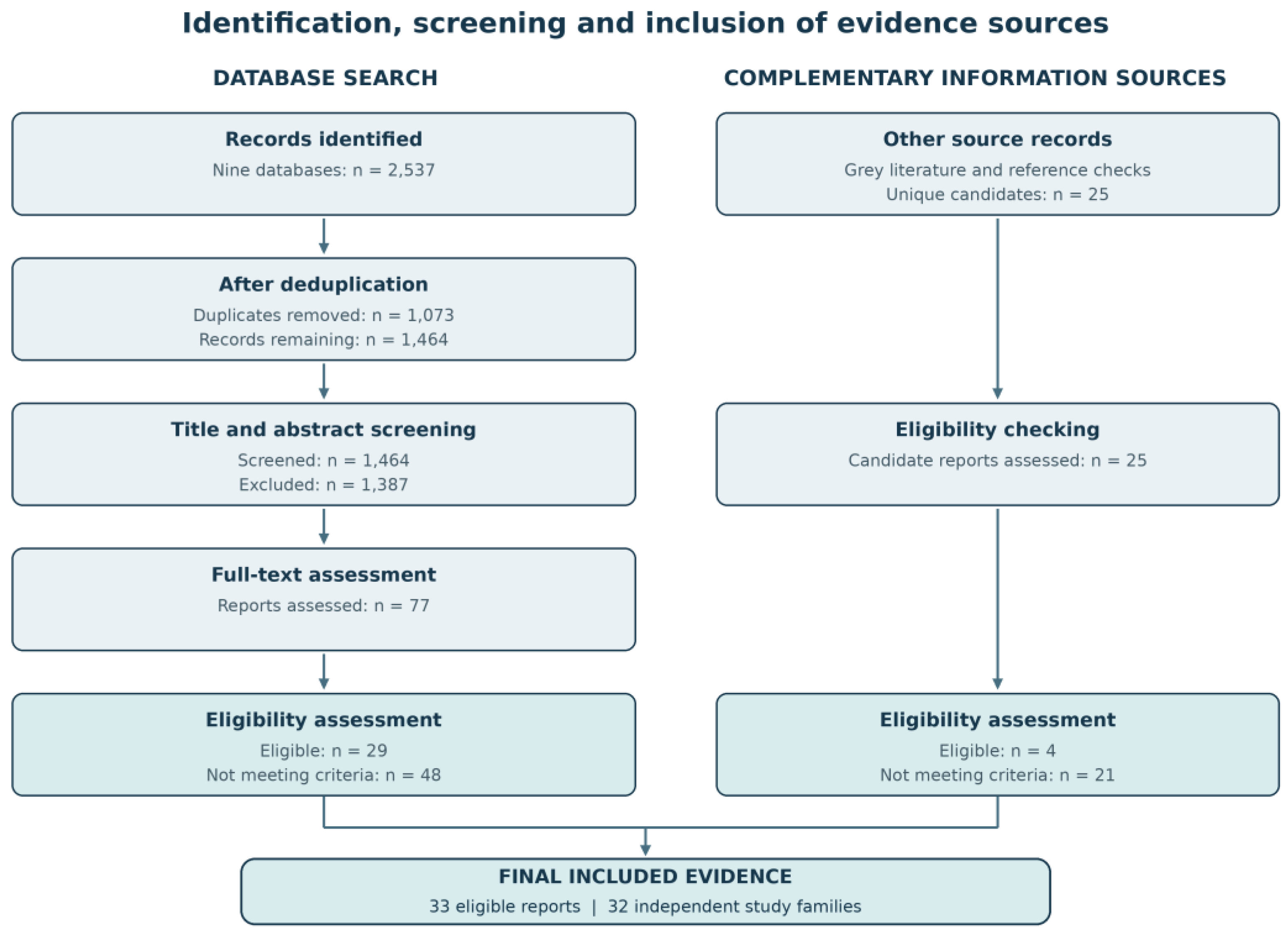
Figure 2.
Study-family evidence map (n = 32), ordered by principal construct and publication year (stress/anxiety/coping, n = 19; confidence/preparedness, n = 9; empathy, n = 4). Filled cells indicate measured domains; self-reported or intended practice is distinct from independent clinical observation.
Figure 2.
Study-family evidence map (n = 32), ordered by principal construct and publication year (stress/anxiety/coping, n = 19; confidence/preparedness, n = 9; empathy, n = 4). Filled cells indicate measured domains; self-reported or intended practice is distinct from independent clinical observation.
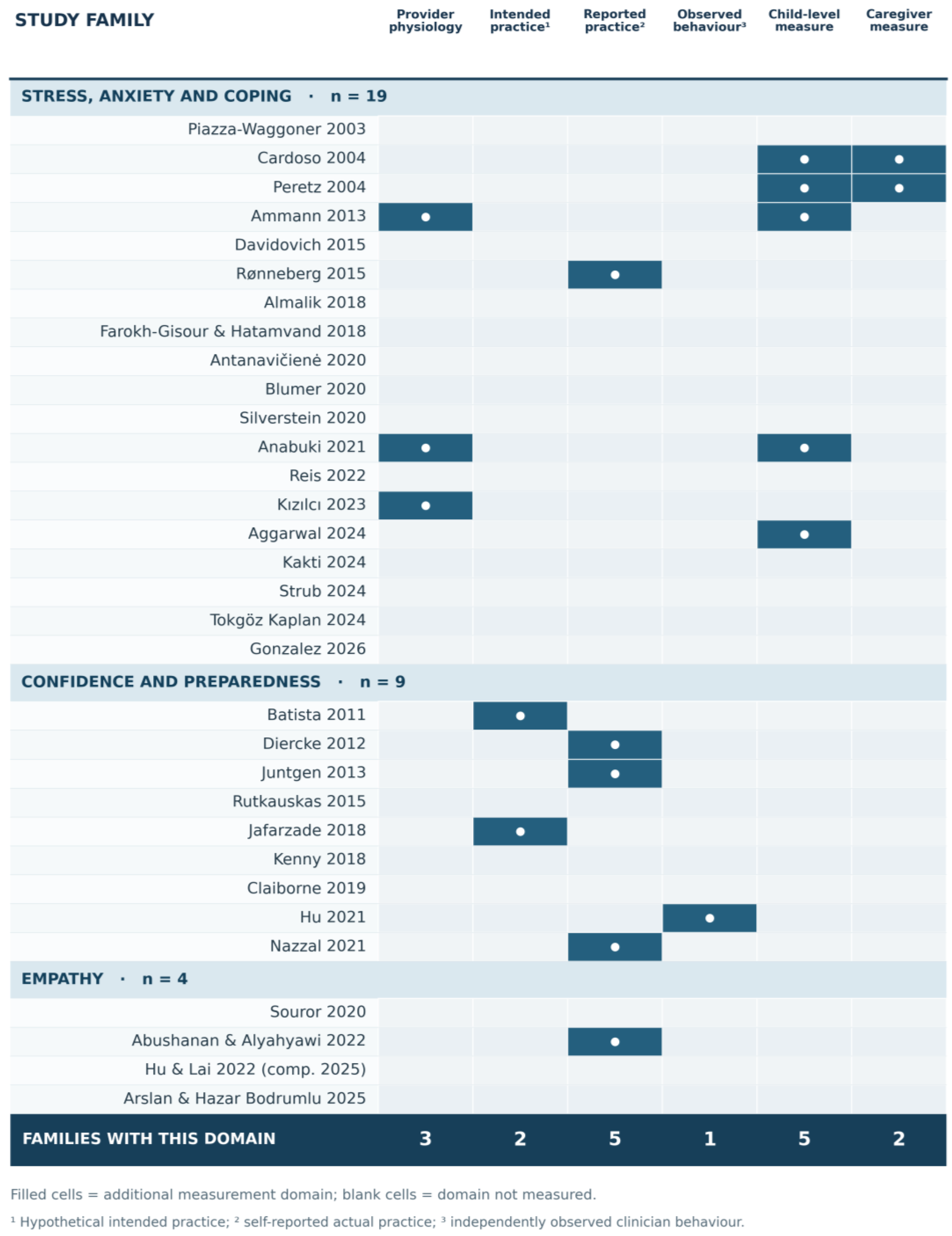

Table 1.
Summary of the 32 study families and the measurement domains recorded.
| Domain | Category or measurement | Study families, n (%) |
| Principal construct | Stress, anxiety or coping | 19 (59.4%) |
| Principal construct | Confidence or preparedness | 9 (28.1%) |
| Principal construct | Empathy | 4 (12.5%) |
| Measurement architecture | Provider self-report only | 25 (78.1%) |
| Measurement architecture | More than provider self-report | 7 (21.9%) |
| Additional recorded domain | Self-reported actual practice | 5 (15.6%) |
| Additional recorded domain | Self-reported intended practice | 2 (6.3%) |
| Additional recorded domain | Child-level measure or treatment endpoint | 5 (15.6%) |
| Additional recorded domain | Provider physiology | 3 (9.4%) |
| Additional recorded domain | Caregiver-level measure | 2 (6.3%) |
| Additional recorded domain | Independently observed clinician behaviour | 1 (3.1%) |
| Complete co-measurement | Provider construct + observed behaviour + child measure | 0 (0%) |
Note: Principal-construct and measurement-source categories are mutually exclusive; additional domains overlap. The unit is the study family (n = 32).
Table 2.
Included study families, ordered by principal provider construct and publication year; the citations link each family to the main reference list.
Table 2.
Included study families, ordered by principal provider construct and publication year; the citations link each family to the main reference list.
| Study family / source | Principal construct |
| Piazza-Waggoner et al. (2003) [19] | Stress/anxiety/coping |
| Cardoso et al. (2004) [20] | Stress/anxiety/coping |
| Peretz et al. (2004) [21] | Stress/anxiety/coping |
| Ammann et al. (2013) [22] | Stress/anxiety/coping |
| Davidovich et al. (2015) [23] | Stress/anxiety/coping |
| Rønneberg et al. (2015) [24] | Stress/anxiety/coping |
| Almalik et al. (2018) [25] | Stress/anxiety/coping |
| Farokh-Gisour and Hatamvand (2018) [26] | Stress/anxiety/coping |
| Antanavičienė et al. (2020) [27] | Stress/anxiety/coping |
| Blumer et al. (2020) [28] | Stress/anxiety/coping |
| Silverstein et al. (2020) [29] | Stress/anxiety/coping |
| Anabuki et al. (2021) [30] | Stress/anxiety/coping |
| Reis et al. (2022) [31] | Stress/anxiety/coping |
| Kızılcı et al. (2023) [32] | Stress/anxiety/coping |
| Aggarwal et al. (2024) [33] | Stress/anxiety/coping |
| Kakti et al. (2024) [34] | Stress/anxiety/coping |
| Strub (2024) [35] | Stress/anxiety/coping |
| Tokgöz Kaplan (2024) [36] | Stress/anxiety/coping |
| Gonzalez et al. (2026) [37] | Stress/anxiety/coping |
| Batista et al. (2011) [38] | Confidence/preparedness |
| Diercke et al. (2012) [39] | Confidence/preparedness |
| Juntgen et al. (2013) [40] | Confidence/preparedness |
| Rutkauskas et al. (2015) [41] | Confidence/preparedness |
| Jafarzade et al. (2018) [42] | Confidence/preparedness |
| Kenny et al. (2018) [18] | Confidence/preparedness |
| Claiborne (2019) [43] | Confidence/preparedness |
| Hu et al. (2021) [10] | Confidence/preparedness |
| Nazzal et al. (2021) [44] | Confidence/preparedness |
| Souror et al. (2020) [45] | Empathy |
| Abushanan & Alyahyawi (2022) [46] | Empathy |
| Arslan & Hazar Bodrumlu (2025) [47] | Empathy |
| Hu & Lai (2022; companion 2025) [48,49] | Empathy |
Disclaimer/Publisher’s Note: The statements, opinions and data contained in all publications are solely those of the individual author(s) and contributor(s) and not of MDPI and/or the editor(s). MDPI and/or the editor(s) disclaim responsibility for any injury to people or property resulting from any ideas, methods, instructions or products referred to in the content. |
© 2026 by the authors. Licensee MDPI, Basel, Switzerland. This article is an open access article distributed under the terms and conditions of the Creative Commons Attribution (CC BY) license (http://creativecommons.org/licenses/by/4.0/).
Copyright: This open access article is published under a Creative Commons CC BY 4.0 license, which permit the free download, distribution, and reuse, provided that the author and preprint are cited in any reuse.