
Submitted:
15 November 2026
Posted:
18 November 2026
You are already at the latest version
Abstract
Column governance requires both accurate sensitivity labels and reliable enforcement as data products are published and shared. This article presents a contract-based reference implementation on Snowflake and a controlled empirical study using TPC-H-derived products. The study distinguishes classification accuracy, publication-time enforcement, sharing behavior, and compute allocation. Across 40-400 products with a modeled 20% column-renaming probability, a name-pattern sweep achieved 0.782-0.803 enforcement recall; contracts with ground-truth labels achieved 1.000, and contracts with a 5% injected omission rate achieved 0.923-0.948. The ideal-contract condition verifies the enforcement path under correct labels. Its publication time was approximately 41%-51% higher than the sweep. On separately generated classification workloads, Llama 3.1 70B given names, label definitions, and five sample values achieved 0.99-1.00 sensitivity recall with 0.04-0.05 over-masking. The native default classifier achieved 0.40-0.46 recall under the study's business-specific sensitivity policy; unequal category coverage limits that comparison. A set-union analysis characterizes the recall gain and unavoidable masking cost of combining contract and LLM flags, and a conditional loss model relates those trade-offs to sensitivity prevalence and error costs. Supporting experiments expose the latency-throughput trade-off of dedicated warehouses and the role-dependent behavior of copies, clones, and views. The findings characterize the implementation under specified label, data-generation, and role assumptions and provide a basis for weighing classification coverage against additional masking restrictions.
Keywords:
data contracts
; column governance
; Snowflake
; data mesh
; sensitive-data classification
; large language models
; masking policies
1. Introduction
Shared analytical platforms make it straightforward for teams to derive, rename, and redistribute datasets. Correctly protecting a source column does not, by itself, establish how each downstream representation will be protected. A column may be missing a sensitivity label, have an incorrect label, lose its policy association along a sharing path, or be queried under an unexpectedly privileged session. These failure modes require different controls and different forms of evidence.
Lakehouse architectures and disaggregated warehouses provide the storage and compute substrate for these workflows [1,2]. Data mesh adds an organizational model of domain ownership, data products, a shared platform, and federated governance [3,4]. Domain ownership can supply business context for classification, but it is not an enforcement mechanism. Conversely, a technically complete enforcement path cannot correct a column that a contract incorrectly declares non-sensitive. An empirical evaluation should distinguish these responsibilities before attributing an observed benefit to an organizational architecture.
This study examines a concrete pattern: contracts record column classifications; a publication procedure checks classification completeness, records the contract, and applies tags; tag-based masking enforces the resulting labels for analyst sessions. The reference implementation organizes products into domain schemas and includes dedicated compute and cross-domain sharing. The experiments evaluate selected components of that implementation, rather than the effectiveness of a deployed organizational transformation.
The article addresses three research questions. RQ1: What enforcement coverage and publication overhead are observed when a name-pattern sweep is compared with contract-supplied labels under generated naming drift? RQ2: How do classification signals behave on the same generated products, and what follows analytically when contract and LLM sensitivity flags are combined? RQ3: What compute and sharing trade-offs accompany the implementation in the evaluated configuration?
The contributions are: (i) an implementable mapping from column contracts to Snowflake tags and role-dependent masking; (ii) a controlled characterization of enforcement coverage and classification behavior, with ideal labels, injected omissions, and information asymmetry made explicit; and (iii) an analytical interpretation of combined sensitivity flags and their conditional error-cost trade-off. Workload and sharing measurements provide operational context. The study does not introduce a new classifier, claim that domain ownership causes higher accuracy, or establish regulatory compliance.
The work extends an earlier architectural treatment of domain-driven data and AI platforms [9] by examining column-level mechanisms and measured trade-offs. The incremental contribution is the implementation and bounded evaluation described here; the underlying ownership principles and governance architecture are established ideas.
2. Background and Related Work
2.1. Data Products, Contracts, and Computational Governance
Data mesh research distinguishes the organizational, development, and runtime aspects of decentralized data management [4]. Industry interviews identify governance responsibilities and organizational transitions as important implementation difficulties [5]. A review of data contracts describes their role in specifying producer-consumer agreements [6]. More recent work provides architectural governance decisions [7] and models contract-aware data products in an industrial setting [8]. These studies establish that ownership, contracts, and automated governance are existing research topics.
Governance concerns decision rights as well as technical controls [10]. Platform-mediated governance and automated constraint checking have been investigated in data mesh settings [11,12]. The present article concentrates on a narrower question: what can be established by measuring column classification and masking in one implementation? Its experiments do not observe teams, organizational lead time, adoption, or decision quality.
2.2. Classification and LLM Assistance
LLM-based column annotation predates this work [13]. Applying an LLM to column names and values is therefore an evaluated component, not the source of algorithmic novelty. Dietz et al. examine LLM assistance for policy-based data-access decisions [14]. Their task concerns access requests; this study concerns column sensitivity. Both settings require attention to additional warnings or restrictions introduced by conservative assistance.
Snowflake provides native classification and custom categories [17,18]. Semantic type detection and an organization's masking decision are related but distinct tasks. A name, balance, or clerk identifier can require different treatment under different business policies. Comparing a model prompted with business-specific label definitions against an uncustomized classifier mixes detection quality with category and context coverage. We retain that comparison as a description of the tested configurations and avoid a general ranking of classifier quality.
2.3. Native Enforcement and Propagation
Tag-based masking is an existing Snowflake capability [15]. Current documentation also describes automatic tag propagation through dependencies and data movement, including CTAS, together with conflict-handling options [16]. The evaluated benchmark does not provide a native-propagation treatment. Consequently, its results support conclusions about the tested sweep and publication paths; they do not establish an advantage over automatic propagation. The documentation describes current capability and does not retrospectively establish the exact service configuration used on the experiment dates.
3. Reference Implementation and Analytical Framing
3.1. Scope and Responsibilities
A data product is a table or view published with ownership metadata and a column contract. The contract records domain, product, version, schema, and each column's sensitivity class. The controlled vocabulary is name, address, phone, balance, clerk, or an explicit none. These labels implement the benchmark's sensitivity policy, not a universal legal taxonomy.
The implementation separates domain schemas and owner roles from platform-owned tags, masking policies, and a contract registry. Publication validates classification completeness, records a VARIANT contract, and assigns the classification tags. One tag can invoke the associated masking policy on many tagged columns [15]. The study exercises schema and classification fields. Retention, freshness commitments, and quality thresholds may be recorded in the contract but are not evaluated controls.

Table 1.
Responsibilities and evidence in the reference implementation.
| Responsibility | Implementation | What is evaluated |
| Business classification | Column contract with an explicit sensitivity label or none | Ideal and injected-error labels; generated classifier decisions. No organizational or human-authoring outcome. |
| Publication enforcement | Contract registry, publication procedure, classification tag, masking policies | Post-publication analyst probes and elapsed publication work. No concurrent-reader or failure-recovery proof. |
| Access and sharing | Reader/analyst roles; copy, clone, secure view | Role-specific masking and freshness in the tested configuration. |
| Compute allocation | Shared MEDIUM or four domain XSMALL warehouses | Selected workload performance and credits. Independent of label ownership. |
Contract retention, freshness, and quality fields are recorded but are not evaluated as governance controls.
3.2. Completeness Is Different from Correctness
Let C be a product's actual column set and L its declared classification map. A structural completeness condition is that every c in C has an entry L(c) in the permitted vocabulary. A declaration of none satisfies this condition even when the column is truly sensitive. Structural validation therefore makes an omission visible only when the classification entry is absent; it cannot establish semantic correctness.
We distinguish classification recall, the share of sensitive columns flagged by a classifier, from enforcement recall, the share returned masked to the tested analyst role. E1 measures the latter, while E4 measures classification decisions. A successful E1 probe provides evidence about the tested tag-to-mask path. It is insufficient to prove that every E4-generated contract would be enforced correctly under all roles and sharing paths.
An analyst's effective session privileges matter. The masking policies use IS_ROLE_IN_SESSION to permit clear values for entitled readers and otherwise return a masked string or NULL. Analyst probes disable secondary roles to avoid an entitled secondary role changing the test outcome. This controls the measured session; it is not a general proof about a deployed role hierarchy.
3.3. Interpretation of the Baseline
The name-pattern sweep searches for NAME, ADDRESS, PHONE, ACCTBAL, and CLERK. The generator independently renames columns with probability 0.2. Under the simplifying assumptions that original sensitive names match and renamed sensitive names do not, expected sweep recall is approximately 1 - 0.2 = 0.8. The observed recall near 0.8 is thus consistent with the modeled failure mechanism. It should not be interpreted as an estimate of centralized-governance effectiveness in general.
A centralized team could also maintain contracts, use tag-based policies, and gate publication. The benchmark changes several mechanisms together: label source, policy binding, and timing. These choices are not factorially separated. We use the descriptive names name-pattern sweep and contract publication to make the comparison's actual scope explicit.
Publication before all relevant policies are applied can create an exposure window. A gate eliminates that window only if reader visibility is withheld until the intended enforcement state is reached. The measurements probe published products and newly introduced products at designated checkpoints; they do not test concurrent readers during publication, rollback, or failure recovery. No atomic-publication guarantee is inferred.
3.4. What Combining Sensitivity Flags Guarantees
Let S be the ground-truth sensitive set, H the contract's sensitive set, and M the LLM's sensitive set. The evaluated review rule masks a column whenever either source flags it, giving U = H union M. Its recall satisfies:
RU = RH + |(M ∩ S) \ H| / |S|.
Thus RU is at least max(RH, RM), with an upper bound min(1, RH + RM). These are set identities and bounds, not a learned improvement or an independence assumption. Additional recall is determined by complementary detections: the LLM must identify sensitive columns that the contract misses.
For the non-sensitive set N, the same union rule gives:
FU = FH + |(M ∩ N) \ H| / |N|.
Here F is the over-masking rate, equivalent to a false-positive rate over columns under the benchmark policy. Union cannot reduce it. When injected contract errors only remove sensitive labels and introduce no false positives, FH = 0 and FU = FM. The combined system inherits the LLM's false positives exactly. This explains why high union recall alone is insufficient to establish effective expert review.
4. Evaluation Design
4.1. Environment and Datasets
E1-E3 were conducted on 15 October 2026 and E4 on 5 November 2026, on a Snowflake Enterprise trial account on AWS us-east-1. The study uses the SNOWFLAKE_SAMPLE_DATA TPC-H schemas [21,22]. SF1 supplies the derived products in E1 and E4; SF10 supplies workloads and the shared product in E2 and E3. The evaluation uses TPC-H-derived data and selected queries, rather than a complete official TPC-H performance benchmark.
Customer, Sales, Supply, and Finance are modeled domains. Ground-truth sensitive source attributes are customer name, address, phone, and balance; supplier address, phone, and balance; and order clerk. Supplier names and other attributes outside this defined policy are non-sensitive for scoring. The choice is a benchmark policy, not a claim that an attribute is always sensitive or non-sensitive in practice.
4.2. E1: Publication Coverage and Overhead
The generator creates 10, 30, or 100 derived products per domain, producing 40, 120, or 400 tables. Each selected column is renamed with probability 0.2. Identical products are instantiated for the sweep and contract treatments. The sweep discovers columns by name and attaches policies individually. Contract publication obtains classification labels from a registry-bound contract and assigns tags. The ideal-contract treatment uses ground truth. A second treatment injects a 5% omission rate into sensitive classifications to model label errors; this is not a human-participant study.
A further 20% of products is introduced after rollout to model newly arriving work. Reported outcomes are enforcement recall, over-masking, wall time, and selected statement counts, across three seeds. Wall times include client round trips. Statement counts include discovery and policy/tagging statements but exclude contract-registry writes. Because the two paths perform different work, these durations characterize the evaluated operations and are not measurements of end-to-end human publication effort.
4.3. E4: Classification and Combined Flags
E4 uses separately generated sets of 40 and 120 products, with the same modeled domains and renaming probability. Customer names, addresses, and phone numbers and supplier addresses and phone numbers are replaced with deterministic, realistic-format synthetic values. For example, phone values use a recognizable telephone format. Reuse of base attributes across generated products limits the semantic diversity represented by the product count.
Six configurations are examined: name patterns; native default SYSTEM$CLASSIFY; an LLM given column names; an LLM given names plus five sample values; contracts with injected omission rates from 0% to 20%; and the union of contract and LLM flags. The native configuration counts IDENTIFIER or SENSITIVE privacy categories as positive. Custom native classifiers and native LLM-assisted classification modes are not evaluated. Results are therefore conditional on that configuration and category mapping.
The LLM is Llama 3.1 70B, invoked through Snowflake Cortex AI_COMPLETE at temperature 0. Its output schema restricts labels to the contract vocabulary. The prompt defines each label in one line and provides no demonstrations. Requests for a seed are issued through a parallel SQL statement. Unparseable responses are scored as none for all columns. Three seeds are reported. The tested combined rule performs set union; it does not include measured human adjudication, reviewer time, or acceptance of suggested changes.
4.4. Supporting E2 and E3
E2 compares a shared MEDIUM warehouse with four domain-specific XSMALL warehouses. Both are nominally four credits per hour. Supply runs eight clients, while each other domain runs two, for 14 concurrent clients. Query mixes are Customer: a segment summary and Q10; Sales: Q1 and Q3; Finance: Q5 and Q14; Supply: Q9 and Q18. A MEDIUM configuration with up to three clusters provides a higher-cost reference. Each run lasts 180 seconds, with five repetitions, rotated configuration order, warehouses suspended before runs, and the result cache disabled. Outputs are completed queries, per-domain latency, queueing, and credits. Short fixed-duration runs can favor workloads that finish within the observation window.
E3 shares an orders product joined to customer phone numbers, with about 14.85 million rows and approximately 307 MB of data. Clerk and phone are tagged sensitive. A privileged engineer creates the copy; a clone and secure view are the alternative paths. Five repetitions measure creation time, owned-storage metrics, analyst visibility, and whether consumers see 150,000 subsequent source inserts. This is a configuration-specific sharing test at one size.
4.5. Reporting and Secondary Analysis
Tables retain reported means and t-based 95% confidence-interval half-widths over three seeds or five runs. Ratios below are descriptive calculations from displayed aggregate means. They are not means of paired run-level ratios, and no additional confidence intervals, significance tests, or sample counts are inferred. Some t intervals for bounded rates extend outside [0,1]; a value displayed as 1.00 or a zero half-width at reported precision does not establish zero population error.
E1 and E4 use different product realizations and are not pooled. Table entries are seed- or run-level summaries; hundreds of generated products do not represent hundreds of independent organizational or semantic cases. E1-E3 consumed 15.6 credits in the reported accounting. E4 inference cost and human authoring cost are not quantified, so a total-cost comparison is outside the evidence.
5. Results for Classification and Enforcement
5.1. E1: Coverage and Publication Cost
The sweep's enforcement recall was 0.782-0.803, while its over-masking was 0.168-0.173. Renamed sensitive attributes escaped the chosen patterns, while some non-sensitive names matched them. Ideal contracts achieved full observed coverage without over-masking. That condition verifies correct propagation from supplied labels to the measured masking outcome; the labels themselves are correct by construction.
Table 2.
E1 rollout results: reported means and 95% CI half-widths over three seeds.
| N | Approach | Recall | Over-mask | Time (s) | Statements* |
| 40 | Name sweep | 0.795 ± 0.067 | 0.171 ± 0.014 | 23.9 ± 6.1 | 87 ± 9 |
| 40 | Contract (0%) | 1.000 | 0.000 | 33.8 ± 12.0 | 73 ± 9 |
| 40 | Contract (5%) | 0.923 ± 0.029 | 0.000 | 33.1 ± 12.0 | 67 ± 6 |
| 120 | Name sweep | 0.782 ± 0.051 | 0.173 ± 0.021 | 67.1 ± 9.6 | 262 ± 42 |
| 120 | Contract (0%) | 1.000 | 0.000 | 98.0 ± 15.0 | 232 ± 30 |
| 120 | Contract (5%) | 0.936 ± 0.039 | 0.000 | 93.6 ± 14.0 | 218 ± 35 |
| 400 | Name sweep | 0.803 ± 0.014 | 0.168 ± 0.017 | 206.0 ± 28.0 | 843 ± 79 |
| 400 | Contract (0%) | 1.000 | 0.000 | 310.0 ± 64.0 | 742 ± 67 |
| 400 | Contract (5%) | 0.948 ± 0.011 | 0.000 | 309.0 ± 55.0 | 704 ± 56 |
N is the number of products. Contract percentages are injected omission rates. *Counts cover discovery and policy/tag statements; contract-registry writes are excluded. An additional registry row is written for each product.
With 5% injected omissions, enforcement recall was 0.923-0.948. The imperfect-contract treatment protected a higher share of sensitive columns than the tested sweep in each displayed mean, but these errors were simulated. The results cannot establish that real domain authors maintain that error rate, or that they outperform centralized authors supplied with equal context.
For newly introduced products, the sweep treatment returned sensitive data before the next sweep at the measured checkpoint; its enforcement recall there was 0.00. After scanning, reported recall was 0.77-0.82. Contract publication returned those products masked at the post-publication checkpoint, with recall 1.00 under ideal labels and 0.93-0.95 with injected omissions. This demonstrates the consequence of the tested timing choices, without establishing resilience to concurrent reads or interrupted publication.
Using the displayed means, ideal-contract publication was 41.4%, 46.1%, and 50.5% slower at 40, 120, and 400 products. The extra elapsed time was approximately 0.25-0.26 seconds per product. The contract path additionally performs registry writes; their isolated cost is not measured. The smaller reported policy/tag statement count does not establish fewer total database statements, because registry writes are excluded.
5.2. E4: Classification Behavior
With names alone, the LLM achieved 0.94 mean recall at both scales. With five sample values, displayed recall increased to 1.00 and 0.99, with 0.05 and 0.04 over-masking. These configurations illustrate the usefulness of values in the generated naming-drift setting. The tested model, prompt, data formats, and few seed repetitions limit generalization.
Table 3.
E4 classification: reported means and 95% CI half-widths over three seeds.
| Configuration | 40 products: recall | 40 products: over-mask | 120 products: recall | 120 products: over-mask |
| Name patterns | 0.78 ± 0.19 | 0.04 ± 0.08 | 0.78 ± 0.09 | 0.06 ± 0.02 |
| Native default classification | 0.46 ± 0.26 | 0.00 | 0.40 ± 0.18 | 0.00 |
| LLM: names | 0.94 ± 0.14 | 0.05 ± 0.08 | 0.94 ± 0.05 | 0.06 ± 0.01 |
| LLM: names + values | 1.00 ± 0.00 | 0.05 ± 0.06 | 0.99 ± 0.03 | 0.04 ± 0.03 |
| Contract: 5% injected error | 0.97 ± 0.07 | 0.00 | 0.96 ± 0.03 | 0.00 |
| Contract: 20% injected error | 0.76 ± 0.34 | 0.00 | 0.82 ± 0.07 | 0.00 |
| Contract 20% OR LLM | 1.00 ± 0.00 | 0.05 ± 0.06 | 1.00 ± 0.02 | 0.04 ± 0.03 |
LLM: Llama 3.1 70B. Native default: SYSTEM$CLASSIFY with the reported privacy-category scoring. Contract errors are injected; OR is set union. Displayed t intervals are retained without clipping and can extend outside [0,1]. A rounded 1.00 is not proof of no errors.
Native default classification achieved 0.46 and 0.40 recall and zero reported over-masking under the selected scoring rule. This aggregate combines native-supported types with business-specific labels such as balance and clerk. The LLM was explicitly told those label meanings. Without category-matched per-class results or a customized native treatment, the gap cannot be attributed solely to better classification ability. It also reflects unequal task definitions and information.
Name-pattern over-masking in E4 was 0.04-0.06, compared with about 0.17 in E1. These figures come from different product sets with different mixes of columns; the change is not an improvement produced by the classifier. E1 enforcement probes and E4 classification scores answer different questions.
5.3. Combined Contract and LLM Flags
At a 20% injected omission rate, displayed contract recall was 0.76 and 0.82. Combining contract and LLM flags raised displayed recall to 1.00 at both scales and retained 0.05 and 0.04 over-masking. The two-decimal display includes a nonzero interval for the 120-product combined condition; 1.00 must not be read as proof that every prediction was correct.
Equations (1)-(2) explain both the gain and the cost. The union catches complementary positives and retains all false positives. Since this error simulation does not introduce contract false positives, equal LLM and union over-masking follows directly from the rule. No expert corrected those flags in the measured pipeline. The findings support conservative automated flag aggregation in this controlled setting, while leaving the effectiveness and cost of human review unmeasured.
6. Conditional Analysis of the Masking Trade-Off
An additional masked column can obstruct a legitimate analytical use case. Its cost depends on context, just as the cost of an unmasked sensitive column does. Neither error should be assigned a universal consequence from a column-count metric alone.
Let p be the fraction of evaluated columns that are sensitive, cFN the cost assigned to a missed sensitive column, and cFP the cost assigned to an unnecessarily masked non-sensitive column. A simple expected error loss per evaluated column is:
L = cFN p(1 - R) + cFP(1 - p)F.
For a change with higher recall by dR and higher over-masking by dF, the change reduces this modeled loss when:
cFN / cFP > ((1 - p)dF) / (p dR), for dR > 0.
This is a conditional decision model, not a measurement of actual breach loss, business utility, review effort, or the prevalence in an enterprise estate. It also assumes additive equal costs within each error type and does not account for variation in column importance, row counts, query frequency, or correlated downstream exposure.
Table 4.
Illustrative relative error-cost thresholds calculated from rounded E4 means.
| Comparison | N | dR | dF | Threshold at p = 0.10 | Threshold at p = 0.50 |
| Union vs 20%-error contract | 40 | 0.24 | 0.05 | 1.88 | 0.21 |
| LLM vs 5%-error contract | 40 | 0.03 | 0.05 | 15.00 | 1.67 |
| Union vs 20%-error contract | 120 | 0.18 | 0.04 | 2.00 | 0.22 |
| LLM vs 5%-error contract | 120 | 0.03 | 0.04 | 12.00 | 1.33 |
N is the number of products. The higher-recall option reduces modeled loss only when cFN/cFP exceeds the stated threshold. Prevalences are hypothetical assumptions. Thresholds use rounded inputs; no uncertainty on these ratios is inferred.
Using the rounded E4 means, adding LLM flags to 20%-error contracts gains about 0.24 recall at 40 products and 0.18 at 120 products, while adding 0.05 and 0.04 over-masking. At a hypothetical sensitive-column prevalence of 10%, the break-even relative miss costs are about 1.9 and 2.0. Comparing names-plus-values LLM classification with 5%-error contracts gives a smaller displayed recall difference of about 0.03 and thresholds of about 15 and 12. These latter ratios are especially sensitive to rounding and should be interpreted as illustrations.
Figure 1.
Conditional break-even error-cost ratios from Equation (4), using rounded E4 means. The curves vary an assumed sensitive-column prevalence; they are analytical scenarios, not additional measurements. The higher-recall option has lower modeled loss above its curve.
Figure 1.
Conditional break-even error-cost ratios from Equation (4), using rounded E4 means. The curves vary an assumed sensitive-column prevalence; they are analytical scenarios, not additional measurements. The higher-recall option has lower modeled loss above its curve.
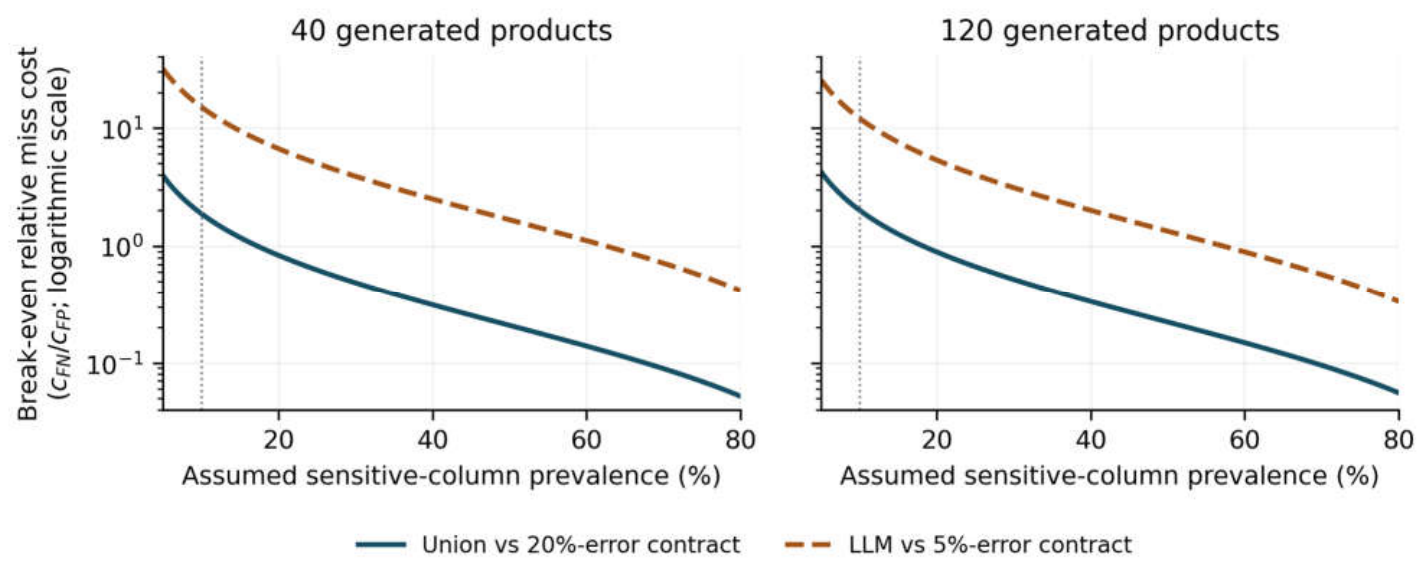
The analysis changes the interpretation of near-complete recall: its practical value depends on the starting contract quality, prevalence, and the cost of restrictions. The experiment does not establish these decision inputs. Equations (3)-(4) provide a way to express the conditions under which the reported trade-off would be favorable, rather than asserting that maximum recall is always the preferred operating point.
7. Supporting Operational Results
7.1. E2: Dedicated Compute Redistributes Performance
For Customer, Finance, and Sales, dedicated warehouses reduced mean reported p95 latency by approximately 30.5%, 32.3%, and 24.9%, respectively, using ratios of aggregate means. Their completed-query counts increased by 46.6%, 58.7%, and 33.2%. Supply's completed queries decreased by 39.0%, and its p95 increased by approximately 65.4%. The heavy domain therefore bears the cost of protecting the lighter ones in this configuration.
Table 5.
E2 workload results: reported means and 95% CI half-widths over five 180-second runs.
| Domain | Compute | Completed queries | p95 (s) | Mean queued (s) |
| Customer | Shared | 189 ± 11 | 3.44 ± 0.22 | 0.35 ± 0.06 |
| Customer | Isolated | 277 ± 16 | 2.39 ± 0.26 | 0.00 |
| Finance | Shared | 189 ± 8 | 3.68 ± 0.21 | 0.36 ± 0.06 |
| Finance | Isolated | 300 ± 25 | 2.49 ± 0.32 | 0.00 |
| Sales | Shared | 208 ± 3 | 3.17 ± 0.19 | 0.34 ± 0.09 |
| Sales | Isolated | 277 ± 16 | 2.38 ± 0.25 | 0.00 |
| Supply | Shared | 510 ± 7 | 3.53 ± 0.15 | 0.64 ± 0.15 |
| Supply | Isolated | 311 ± 10 | 5.84 ± 0.40 | 1.11 ± 0.12 |
Shared: one MEDIUM warehouse. Isolated: four XSMALL warehouses. Both nominally 4 credits/hour; aggregate measured credits were 2.42 and 2.47. Supply is the heavy domain.
Summed completed-query means were 1,096 for shared compute and 1,165 for dedicated compute, a 6.3% increase. Across all repetitions, measured credits were 2.42 and 2.47: near-equal, with dedicated compute using about 2.1% more. Normalizing total completed queries by those aggregate credits gives an approximate 4.1% improvement. This descriptive normalization has no run-level uncertainty estimate and is not a general cost-performance result.
The higher-cost multi-cluster reference consumed 5.55 credits, approximately 2.3 times the shared configuration, and completed 858 Supply queries per run. These observations support a resource-allocation trade-off at the tested client mix. They do not identify an optimal allocation, separate caching and workload-shape effects, or demonstrate that dedicated compute is necessary for contract governance.
7.2. E3: Sharing Retains or Changes Enforcement Context
The secure view and clone were created faster than the privileged copy at the tested size. Owned-storage metrics attributed approximately 305 MB to the copy and zero additional owned storage to the clone and view at observation. This does not imply that clones have no storage consequences after future divergence or retention. Consumer latency was reported as approximately 0.2 seconds for each method; the summaries do not establish performance equivalence.
Table 6.
E3 sharing results: reported means and 95% CI half-widths over five repetitions.
| Path | Creation (s) | Owned storage (MB) | Clear to analyst | Sees new rows |
| Privileged copy | 3.36 ± 0.95 | 305 | clerk, phone | No |
| Clone | 1.61 ± 0.13 | 0 | none | No |
| Secure view | 0.40 ± 0.03 | 0 | none | Yes |
The copy is created by a role entitled to read sensitive data. Storage is the owned-storage metric at observation, not lifetime storage cost. Subsequent inserts: 150,000 rows.
The analyst could read clerk and phone in clear text in the privileged copy, while both were masked through the tested clone and view. This outcome depends on a role entitled to read clear values materializing data into an object without equivalent protection. It should not be generalized to every copy operation or a configuration with automatic tag propagation. Snowflake documents role-dependent CTAS masking, clone policy associations, and separately configured tag propagation [16,19].
Only the view reflected the subsequent source inserts automatically. The tested copy and clone required refreshes, reported as 3.1 and 1.3 seconds. Thus freshness, snapshot semantics, storage ownership, and enforcement context are separate reasons for selecting a sharing path. No access-control mechanism should be inferred to certify data-use purpose, external export protection, or application-level behavior from these probes alone.
8. Implications and Threats to Validity
8.1. What the Evidence Supports
The practical result is a separation of responsibilities. A contract provides an explicit place to state business-sensitive meaning; a completeness gate checks that a declaration exists; tag-based masking applies the corresponding runtime rule; and sharing and role configuration determine the effective access path. Each can fail independently. An explicit declaration of none is still a decision that can be wrong.
In the evaluated generated workloads, supplying accurate labels improves coverage over deliberately drift-sensitive name matching, at an observed publication-time cost. LLM flags can recover omissions in those supplied labels, while adding masking restrictions. The conditional analysis makes this trade-off explicit. The operational measurements show that isolation and sharing decisions have consequences beyond classification, but they are not evidence of a new domain-governance mechanism.
8.2. Internal and Construct Validity
Label knowledge, timing, and enforcement machinery vary together in E1. An equal-information, equal-gate central treatment is absent, so organizational causality cannot be identified. Ideal contracts contain the answers by construction. Injected omissions do not reproduce systematic human misunderstandings, label disagreements, malicious classifications, or false-positive human labels. E4 has no human participants; claims about review accuracy, accountability, or authoring effort are outside its design.
The native classifier and prompted LLM do not receive equal category definitions or business context. Scoring IDENTIFIER and SENSITIVE as positive operationalizes the study's masking policy but is not a complete evaluation of native classification capability. Fine-grained category results, invalid-output counts, and native customization effects cannot be inferred from the aggregate table.
Enforcement recall is a binary column metric in one analyst session. It does not weight the number of exposed rows, the severity of an attribute, repeated accesses, or combinations of otherwise innocuous columns. Masking is also not a complete compliance framework: retention, lineage, row-level policies, and permitted-use controls are not evaluated.
8.3. Statistical and External Validity
Three seeds and five short runs provide limited precision. The reported t intervals can be unstable for bounded rates, especially near zero and one. Reuse of source semantics and fixed query templates makes product and query counts poor substitutes for independent domain diversity. Ratios of summary means preserve arithmetic traceability but cannot recover paired comparisons, per-class error distributions, or uncertainty on derived ratios. No significance claim is made from those ratios.
TPC-H data and deterministic realistic-format values permit a controlled test but do not constitute production or regulated customer observations. The schema and renaming choices may favor particular methods. Single-account, single-region measurements cannot establish portability to other Snowflake environments or other platforms. The study does not evaluate Iceberg governance, cross-platform propagation, or lakehouse architecture generally. E1-E3 and E4 were conducted on different dates and datasets.
8.4. Platform Evolution and Untested Failure Modes
Native automatic propagation is a material untested comparator. Documentation of that capability limits the scope of the comparison; it is not additional experimental evidence. The study cannot rank the contract pattern against native propagation, custom classifiers, or newer native AI modes. Their interactions with contract metadata also remain unmeasured.
The publication sequence is not tested under partial failure, concurrent schema changes, role changes, or concurrent reader access. Post-publication probes demonstrate the observed steady state, not continuous protection. E3 examines one size and one role configuration; E2 examines one warehouse-size pairing and client mix. Inference credits, expert effort, review latency, and organizational operating costs are outside the cost evidence. These boundaries qualify the results without changing the reported measurements.
9. Conclusion
This article characterizes a contract-based column-governance implementation on Snowflake using controlled TPC-H-derived workloads. Accurate supplied classifications reached full observed enforcement coverage, while a modeled name-pattern sweep missed renamed attributes. Injected contract omissions reduced coverage, and LLM sensitivity flags recovered many omissions while adding over-masking. The union analysis explains why this combination improves recall and why its false positives persist. A conditional loss model connects the measured operating points to explicit prevalence and error-cost assumptions.
Supporting measurements show a redistribution of latency and throughput under dedicated compute and configuration-dependent differences among privileged copies, clones, and views. Together, the results provide empirical guidance about the tested implementation and a clearer account of its assumptions. Claims about domain-team effectiveness, human review, production safety, regulatory compliance, and superiority over native propagation require evidence beyond this study.
Data: and Code Availability
The datasets originate from Snowflake's public TPC-H sample schemas [21]. The supplemental summary-analysis package contains machine-readable aggregates from the reported result tables and deterministic code for the secondary calculations and analytical figure. These summaries reproduce the arithmetic in this article, not the original Snowflake executions. They do not reconstruct query histories, per-seed observations, prompts, or raw model outputs. No proprietary customer data are included.
Funding
This work received no specific grant from public, commercial, or not-for-profit funding agencies.
Conflicts of Interest
The author is employed by Salesforce. The views expressed are personal and do not represent any current or former employer. The experiments use public benchmark data and a Snowflake trial account, as described in Section 4.
AI Assistance
Claude (Anthropic) assisted with benchmark coding, language editing, and figures in the original study. ChatGPT (OpenAI) assisted with restructuring the manuscript, checking aggregate arithmetic, and preparing the secondary analysis and presentation in this revision. No new Snowflake measurements or human annotations are introduced by that editorial assistance. The author is responsible for verifying the final content and results.
References
- Armbrust, M.; Ghodsi, A.; Xin, R.; Zaharia, M. Lakehouse: A new generation of open platforms that unify data warehousing and advanced analytics. Conference on Innovative Data Systems Research (CIDR), 2021. [Google Scholar]
- Dageville, B.; Cruanes, T.; Zukowski, M.; Antonov, V.; Avanes, A.; Bock, J.; Claybaugh, J.; Engovatov, D.; Hentschel, M.; Huang, J.; et al. The Snowflake Elastic Data Warehouse. ACM SIGMOD International Conference on Management of Data, 2016; pp. 215–226. [Google Scholar]
- Dehghani, Z. Data Mesh: Delivering Data-Driven Value at Scale; O'Reilly Media, 2022. [Google Scholar]
- Goedegebuure, A.; Kumara, I.; Driessen, S.; Heuvel, W.-J.V.D.; Monsieur, G.; Tamburri, D.A.; Di Nucci, D. Data Mesh: A Systematic Gray Literature Review. ACM Comput. Surv. 2024, 57, 1–36. [Google Scholar] [CrossRef]
- Bode, J.; Kühl, N.; Kreuzberger, D.; Holtmann, C. Toward Avoiding the Data Mess: Industry Insights From Data Mesh Implementations. IEEE Access 2024, 12, 95402–95416. [Google Scholar] [CrossRef]
- Wasser, J.; Kumara, I.; Monsieur, G.; Heuvel, W.-J.V.D.; Tamburri, D.A. Data Contracts in Data Mesh: A Systematic Gray Literature Review; Springer Nature, 2025; pp. 21–38. [Google Scholar] [CrossRef]
- Tonnarelli, M.; Van Eijk, T.; Kumara, I.; Di Nucci, D.; Tamburri, D.A.; Heuvel, W.-J.V.D. Architectural Design Decisions for Federated Computational Governance in Data Meshes. 2026 IEEE 23rd International Conference on Software Architecture (ICSA), LOCATION OF CONFERENCE, NetherlandsDATE OF CONFERENCE; pp. 143–154.
- Wasser, J.; Tonnarelli, M.; Kumara, I.; Monsieur, G.; Tamburri, D.A.; Heuvel, W.-J.v.D. Modeling Contract-Aware Data Products: a Design Science Research at a Semiconductors Firm. 2026 IEEE International Conference on Web Services (ICWS); LOCATION OF CONFERENCE, AustraliaDATE OF CONFERENCE; pp. 1351–1361.
- Sharma, A. Domain-Driven Data and AI Platforms: Governing Analytics and Machine Learning Pipelines at Scale. IET Softw. 2026, 2026. [Google Scholar] [CrossRef]
- Khatri, V.; Brown, C.V. Designing data governance. Commun. ACM 2010, 53, 148–152. [Google Scholar] [CrossRef]
- Wider, A.; Verma, S.; Akhtar, A. Decentralized Data Governance as Part of a Data Mesh Platform: Concepts and Approaches. 2023 IEEE International Conference on Web Services (ICWS), LOCATION OF CONFERENCE, United StatesDATE OF CONFERENCE; pp. 746–754.
- Wider, A.; Jarmul, K.; Akhtar, A. Towards Automating Federated Data Governance. 2024 IEEE International Conference on Web Services (ICWS); LOCATION OF CONFERENCE, ChinaDATE OF CONFERENCE; pp. 10–19.
- Korini, K.; Bizer, C. Column type annotation using ChatGPT. Workshop on Tabular Data Analysis (TaDA), CEUR Workshop Proceedings, 2023; vol. 3462. Available online: https://ceur-ws.org/Vol-3462/TADA1.pdf.
- Dietz, L.W.; Wider, A.; Harrer, S. Automating Data Governance with Generative AI. Proc. AAAI/ACM Conf. AI Ethics Soc. 2025, 8, 760–771. [Google Scholar] [CrossRef]
- Snowflake. Tag-based masking policies. Documentation. Available online: https://docs.snowflake.com/en/user-guide/tag-based-masking-policies (accessed on 14 November 2026).
- Snowflake. Automatic tag propagation with user-defined tags. Documentation. Available online: https://docs.snowflake.com/en/user-guide/object-tagging/propagation (accessed on 14 November 2026).
- Snowflake. Introduction to sensitive data classification. Documentation. Available online: https://docs.snowflake.com/en/user-guide/classify-intro (accessed on 14 November 2026).
- Snowflake. Create custom categories for sensitive data. Documentation. Available online: https://docs.snowflake.com/en/user-guide/classify-custom (accessed on 14 November 2026).
- Snowflake. Understanding column-level security. Documentation. Available online: https://docs.snowflake.com/en/user-guide/security-column-intro (accessed on 14 November 2026).
- Snowflake. Multi-cluster warehouses. Documentation. Available online: https://docs.snowflake.com/en/user-guide/warehouses-multicluster (accessed on 14 November 2026).
- Snowflake. Sample data: TPC-H. Documentation. Available online: https://docs.snowflake.com/en/user-guide/sample-data-tpch (accessed on 14 November 2026).
- Transaction Processing Performance Council. TPC Benchmark H (decision support) standard specification. Available online: https://www.tpc.org/tpch/.
Disclaimer/Publisher’s Note: The statements, opinions and data contained in all publications are solely those of the individual author(s) and contributor(s) and not of MDPI and/or the editor(s). MDPI and/or the editor(s) disclaim responsibility for any injury to people or property resulting from any ideas, methods, instructions or products referred to in the content. |
© 2026 by the authors. Licensee MDPI, Basel, Switzerland. This article is an open access article distributed under the terms and conditions of the Creative Commons Attribution (CC BY) license (http://creativecommons.org/licenses/by/4.0/).
Copyright: This open access article is published under a Creative Commons CC BY 4.0 license, which permit the free download, distribution, and reuse, provided that the author and preprint are cited in any reuse.