

Submitted:
14 November 2026
Posted:
17 November 2026
You are already at the latest version
Abstract
Digital public infrastructure (DPI) is promoted as a route to inclusive enterprise formalisation, but little is known about how its layers combine with each other and with local conditions. This study examines how India's DPI relates to two outcomes for micro, small and medium enterprises (MSMEs): the scale of formalisation and the inclusion of women owners. Using official secondary data for 29 Indian states, it combines regression, fuzzy-set qualitative comparative analysis (fsQCA) and a five-year panel. High formalisation density occurs where digital adoption and higher income coincide, together with intensive merchant payments for total and assisted registrations. Bank-account coverage is not sufficient for it and is high mainly in states with low formalisation. These conditions do not form a recipe for women's ownership. Women's share of registrations is instead higher where the assisted channel for informal micro enterprises, in which most registrants are women, accounts for more registrations. Within states, payment intensity is not a significant predictor of later registrations, although the estimate is imprecise. The findings suggest that DPI's contribution to inclusive formalisation is associated with complementary use and with the design of onboarding channels, not with the scale of platforms alone.
Keywords:
digital public infrastructure
; MSME formalisation
; inclusive formalisation
; women entrepreneurship
; entrepreneurial ecosystems
; fsQCA
; India
1. Introduction
Research on sustainable entrepreneurship asks how entrepreneurial action can create economic value while sustaining or developing social and natural systems (Hall et al., 2010; Shepherd & Patzelt, 2011). In emerging economies, a central part of this agenda concerns the very large number of micro enterprises that operate outside formal registries, credit markets and public support. Target 8.3 of the 2030 Agenda calls for the formalisation and growth of micro, small and medium enterprises (MSMEs), and Target 5.5 for women's full participation in economic life (United Nations, 2015). Informality and the exclusion of women owners are thus two sides of the same sustainability problem.
Digital infrastructures are often presented as a way to address both, because they change how opportunities are recognised, how resources are mobilised and how entrepreneurial ecosystems work (Nambisan, 2017; Sussan & Acs, 2017; Autio et al., 2018; George et al., 2021; Ssekitoleko & Dhliwayo, 2023). India is a prominent case. Since 2014 it has built digital public infrastructure (DPI), that is, shared digital systems for identity, payments and data on which public and private actors can build (D'Silva et al., 2019; Alonso et al., 2023). By July 2026 its Pradhan Mantri Jan Dhan Yojana (PMJDY) had opened 58.7 crore basic bank accounts nationally (1 crore = 10 million), the Unified Payments Interface (UPI) processed about 18,590 crore transactions in 2024-25, and 9.5 crore enterprises in the 29 states studied here were registered on the online Udyam system or its assisted platform.
Whether this scale translates into sustainable entrepreneurship is less clear. Research on digital payments and fintech in India documents effects on consumption, payment adoption and lending (Chodorow-Reich et al., 2020; Crouzet et al., 2023; Agarwal et al., 2024; Ghosh et al., 2026), but rarely examines the formalisation and inclusion of enterprises. Most studies also estimate the net effect of one technology at a time, while ecosystem research holds that elements work through interdependence (Stam, 2015; Acs et al., 2017; Stam & van de Ven, 2021). Evidence on whether digital channels include or bypass women entrepreneurs remains thin outside randomised studies of individual products (Suri & Jack, 2016; Field et al., 2021).
This study asks two questions. Which combinations of DPI layers and economic context are associated with a high density of formal MSME registration across Indian states? And are the same combinations associated with inclusive formalisation, measured by women's share of registered enterprises? Using official secondary data for 29 states, it combines ordinary least squares (OLS) regression, fuzzy-set qualitative comparative analysis (fsQCA) (Ragin, 2008; Fiss, 2011) and a five-year state panel.
The study makes three contributions. It distinguishes the provision of DPI from its use and shows that formalisation density is associated with the conjunction of use-based layers and economic context, while account provision is not sufficient for it. It introduces the onboarding channel, self-service or assisted, as a link between digital infrastructure and inclusion, and shows that women's ownership is associated with the channel mix rather than with digital intensity. And it defines the transformation under way as a change in the channels through which enterprises become visible to formal institutions. Section 2 develops the context, theory and propositions; Section 3 presents the data and methods; Section 4 and Section 5 report and discuss the results; and Section 6 concludes.
2. Theoretical Framework
2.1. Institutional Context: India's DPI and Two Registration Channels
India's DPI was built in layers. PMJDY, launched in August 2014, opened bank accounts for unbanked households and linked them to Aadhaar identity; because it targeted the unbanked, account coverage is now highest in poorer states. UPI, launched in 2016, allows instant payments between bank accounts through mobile applications, and person-to-merchant (P2M) payments became a growing share of its volume. MSME registration changed in two steps. In July 2020 the Udyam Registration Portal introduced a free, paperless and self-declared registration based on Aadhaar and linked to income-tax and Goods and Services Tax (GST) databases. Udyam is a self-service channel. In January 2023 the Ministry of MSME and the Small Industries Development Bank of India launched the Udyam Assist Platform, through which designated agencies register informal micro enterprises (IMEs) that lack a Permanent Account Number (PAN) or GST registration. This is an assisted channel aimed at the informal segment.
The channels reshaped the registry quickly. By October 2026 the assisted platform accounted for 44.6% of the 9.54 crore registrations in the 29 states. They also differ in who uses them: women owned about 40% of all registrations in November 2024 (Ministry of MSME, 2024), but more than 60% of enterprises registered on the assisted platform (more than 63% in July 2024 and more than 62% in August 2025; Lok Sabha, 2024, 2025b).
2.2. Inclusive Formalisation as a Sustainability Outcome
Sustainable entrepreneurship has been defined as the pursuit of opportunities that sustain nature, life support or community while developing economic and non-economic gains (Shepherd & Patzelt, 2011). Early work emphasised environmental market failures (Cohen & Winn, 2007; Dean & McMullen, 2007), but the concept also covers the economic and social pillars of the triple bottom line (Elkington, 1997). In emerging economies these pillars are tied to informality: informal firms are small, less productive and excluded from credit and public support (La Porta & Shleifer, 2014), and informality persists where formal institutions are costly to access (Webb et al., 2009).
This study therefore treats inclusive formalisation as a sustainability-relevant outcome with two dimensions. Scale, the economic dimension, is the extent to which enterprises are formally registered, which gives them a verifiable identity and access to credit and support schemes (Bruhn & McKenzie, 2014). Inclusion, the social dimension, is the extent to which formalisation reaches women, whose enterprises face constraints in finance, networks and mobility (Brush et al., 2009; Ghani et al., 2014). Registration is a first step and does not by itself change how firms operate (De Mel et al., 2013), and the environmental pillar is not measured.
2.3. DPI Layers: Provision and Use
DPI lowers the costs of interacting with formal institutions (North, 1990), but layers that are provided differ from layers that are used. Account provision gives individuals a bank account and a verified identity and improved the delivery of public transfers in India (Muralidharan et al., 2016), yet many accounts opened in inclusion drives remain little used (Demirgüç-Kunt et al., 2022), and mobile money improved outcomes where it was used intensively (Suri & Jack, 2016). Use-based layers, such as merchant payments and the adoption of payment applications, create records of economic activity that can substitute for collateral and credit history (Berger & Udell, 2006; Frost et al., 2019; Gambacorta et al., 2023); in India, cashless payments have been linked with fintech lending to small borrowers (Ghosh et al., 2026). Payment adoption spreads through networks of merchants and consumers (Crouzet et al., 2023; Higgins, 2024). Use therefore makes enterprises visible and raises the expected benefits of registration, while provision alone does not.
2.4. Channels of Formalisation and Complementarities
Digital infrastructure reaches enterprises through channels, and channel design shapes who is reached. Self-service channels require devices, skills, documents and time, and are used first by entrepreneurs who already have these resources. Assisted channels, in which an agency completes registration on the entrepreneur's behalf, lower these barriers. How financial services are delivered affects women's use of them (Field et al., 2021), and women entrepreneurs are over-represented in informal and home-based micro activities and less likely to hold tax identifiers (Brush et al., 2009). An assisted channel for informal micro enterprises is therefore expected to draw in more women owners than a self-service channel linked to tax identifiers.
The entrepreneurial ecosystem approach treats entrepreneurship as the outcome of interdependent factors in a territory (Stam, 2015; Acs et al., 2017; Audretsch & Belitski, 2017), with digital infrastructure as one element (Sussan & Acs, 2017). Because elements reinforce one another, their effects are conjunctural (Stam & van de Ven, 2021), and the returns to one institution depend on the presence of others (Hall & Soskice, 2001). Payment records, for example, are valuable for formalisation where markets are large enough to make registration worthwhile. Set-theoretic methods capture such reasoning by allowing for conjunction, equifinality (several combinations leading to one outcome) and causal asymmetry (different conditions for the absence of an outcome) (Fiss, 2011; Misangyi et al., 2017).
2.5. Propositions
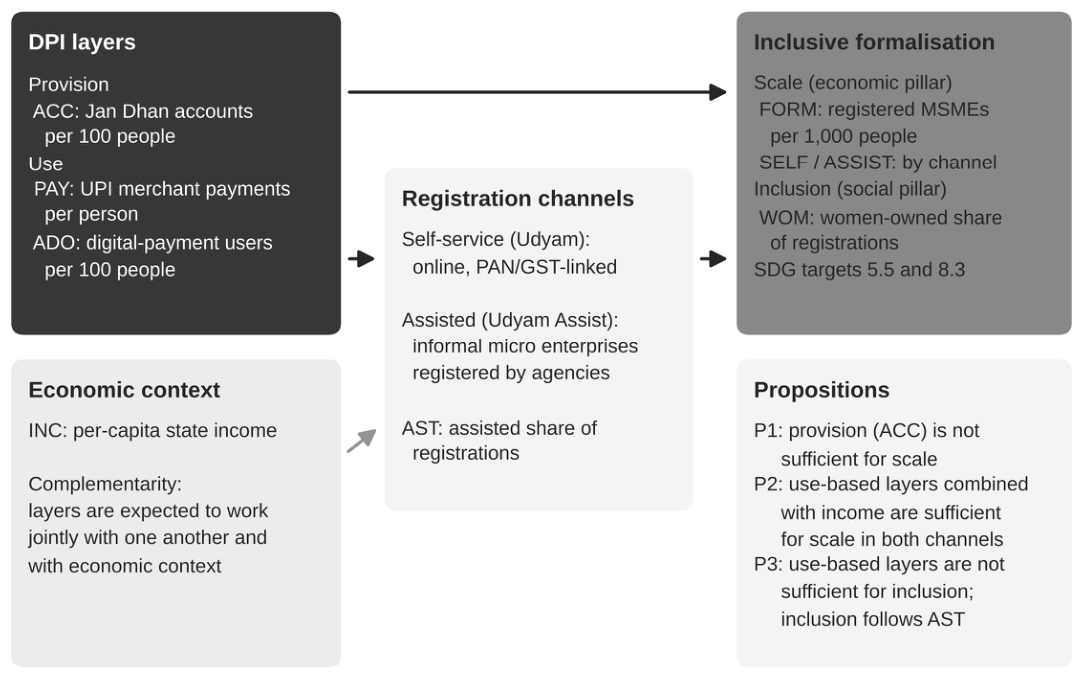
Proposition 1 (provision). High account coverage is not sufficient for high formalisation density; where account coverage is high but use-based layers and economic context are weak, formalisation density is low.
Proposition 2 (complementarity). High formalisation density in both the self-service and the assisted channel is associated with the conjunction of use-based DPI layers (payment intensity, digital adoption or both) and higher income, and no single condition is necessary for it.
Proposition 3 (channel). Use-based DPI layers and income are not sufficient for high women's ownership; women's share of registrations is associated with the importance of the assisted channel.
Figure 1.
Conceptual framework: DPI layers, registration channels and inclusive formalisation. Source: the author.
Figure 1.
Conceptual framework: DPI layers, registration channels and inclusive formalisation. Source: the author.
3. Materials and Methods
3.1. Sample, Data and Measures
The unit of analysis is the state, because DPI programmes, registration drives and designated agencies are organised largely by state. The sample comprises the 28 states and Jammu and Kashmir, for which the Reserve Bank of India (RBI) publishes consistent income data; the results therefore describe states, not firms. All data are official or openly published (Table 1; the full dataset is provided as Supplementary Material). Population is net state domestic product (NSDP) divided by per-capita NSDP (Reserve Bank of India, 2025); for six states, 2024-25 income was extrapolated from the two preceding years, and all results are checked without them.
Formalisation density (FORM) is the number of MSMEs registered on Udyam and the Udyam Assist Platform per 1,000 people, as on 4 October 2026 (Ministry of MSME, 2026), split into self-service (SELF) and assisted (ASSIST) density. Registration counts are stocks since July 2020 and may include re-registered and inactive units. Women's ownership (WOM) is the percentage of registrations owned by women on 30 November 2024 (Ministry of MSME, 2024), and the assisted share (AST) is the percentage of registrations made through the assisted platform. The DPI conditions are account provision (ACC, PMJDY accounts per 100 people; Department of Financial Services, 2026), payment intensity (PAY, UPI person-to-merchant transactions per person in 2024) and digital adoption (ADO, payment-application users per 100 people at the end of 2024); economic context (INC) is per-capita NSDP in 2024-25. Because state-level UPI data are not published, PAY and ADO come from PhonePe Pulse, the open dataset of a leading UPI application (PhonePe, 2025). PhonePe's merchant transactions were about 55% of all UPI merchant transactions in the first half of 2024 (Worldline, 2024), and its per-person transactions are closely ranked with NPCI's state values for the eight states with published figures (Spearman ρ = 0.88, p = 0.004; Dataful, 2025), although coverage ranges from about 18% (Manipur) to 95% (Telangana). PAY and ADO are therefore treated as measures of relative intensity.
3.2. Analytical Strategy
OLS regressions estimate net associations with HC3 robust standard errors, suited to small samples (n = 29; maximum variance inflation factor 2.5). fsQCA identifies combinations of conditions that are necessary or sufficient for each outcome (Ragin, 2008; Schneider & Wagemann, 2012). Values are calibrated with the direct method (Table 2): the crossover is the national, population-weighted value of each variable, so that sets distinguish states above and below the national benchmark, and full membership and non-membership are set at the 95th and 5th percentiles; for WOM, full membership is gender parity (50%) and the crossover the national share (40%). Necessity uses a consistency threshold of 0.90; sufficiency uses a frequency threshold of one case, raw consistency of 0.80 and PRI (proportional reduction in inconsistency) of 0.70. Intermediate solutions assume that PAY, ADO, INC and AST contribute to the presence of the outcomes and their absence to the absence of the outcomes; for WOM, expectations are set only for AST. Core conditions are those in every minimal parsimonious solution (Fiss, 2011; Schneider & Wagemann, 2012). The same four conditions (ACC, PAY, ADO, INC) are used for all outcomes, and AST is added for WOM as a test of composition, since most assisted registrants are women.
The panel regresses the log of annual registrations per 1,000 people for 2020-21 to 2024-25 (Lok Sabha, 2025a) on the log of per-person merchant payments in the preceding financial year, with state and year fixed effects, cluster-robust standard errors and wild cluster bootstrap p-values. A lead of payment intensity serves as a placebo test: if future payments predict current registrations, the association is unlikely to reflect an effect of payments on formalisation.
4. Results
4.1. Descriptive Patterns
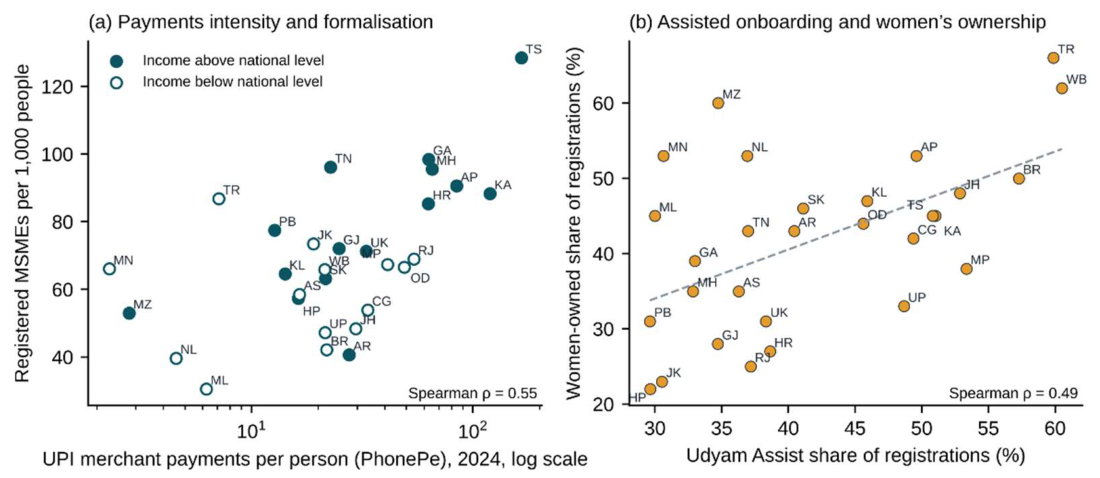
New registrations rose from 28.2 lakh (1 lakh = 100,000) in 2020-21 to 85.2 lakh in 2022-23, jumped to 248.7 lakh in 2023-24, the first full year of the assisted platform, and eased to 206.2 lakh in 2024-25 (Lok Sabha, 2025a). States differ widely (Table 3). Formalisation density ranges from 30.5 per 1,000 people in Meghalaya to 128.4 in Telangana, women's share from 22% in Himachal Pradesh to 66% in Tripura, and merchant payments per person by a factor of more than seventy. Formalisation density is correlated with payment intensity (ρ = 0.55), adoption (ρ = 0.66) and income (ρ = 0.61), but not with account coverage (ρ = −0.20), which is highest in poorer states (ρ = −0.51 with income). Women's share is correlated with the assisted share (ρ = 0.49) but not significantly with any DPI layer (full correlations in Table S1).
4.2. Net Associations
In Table 4, formalisation density rises with income (b = 0.32, p = 0.04) and, more weakly, with payment intensity (b = 0.11, p = 0.10; bootstrap 95% CI −0.03 to 0.24), while account coverage shows no association (Model 1). The payment coefficient is not robust: it is insignificant when Telangana or the six states with extrapolated income are excluded and in most leave-one-out runs (Table S4). Self-service density tracks income (Model 2), whereas assisted density is associated with both payment intensity (b = 0.19, p < 0.01; CI 0.03 to 0.34) and income (Model 3); the payment association loses significance when the six states with extrapolated income are excluded (p = 0.21, n = 23). For women's ownership, the DPI layers and income explain little (Model 4, R² = 0.15). When the assisted share is added (Model 5), a ten-point higher assisted share goes with a women's share about 10.6 points higher (p < 0.01; CI 7.9 to 14.0), which largely reflects the composition of the assisted channel. For a given channel mix, payment intensity is negatively associated with women's share (b = −8.5, p < 0.01); because the assisted share is itself related to payment intensity, this conditional coefficient describes a pattern in the data and should not be read as an effect of payments. With n = 29 and several models, p-values near 0.05 should be read with caution.
Figure 2.
(a) Merchant payments per person and formalisation density; (b) assisted share and women's share of registrations, by state. Source: Table 1 sources; author calculations. State codes are listed in Table S3.
Figure 2.
(a) Merchant payments per person and formalisation density; (b) assisted share and women's share of registrations, by state. Source: Table 1 sources; author calculations. State codes are listed in Table S3.
4.3. Configurations for Formalisation
No single condition is necessary for high formalisation density (Table 5). Account coverage is far from sufficient (consistency 0.51 as a single condition), while payment intensity and adoption come closer on their own (0.88 and 0.86). The absence of payment intensity is necessary for low formalisation density (consistency 0.92).
One configuration is sufficient for high formalisation density (Table 6): ~ACC*PAY*ADO*INC (consistency 0.97, coverage 0.47), covering Andhra Pradesh, Goa, Haryana, Karnataka, Maharashtra and Telangana. Payment intensity is a core condition in every parsimonious solution; the second core condition is either income or below-national account coverage, because two parsimonious solutions fit equally well. Tamil Nadu, with high density but below-national payment intensity, is not covered. The same configuration is sufficient for assisted density (consistency 0.89, coverage 0.53), and ~ACC*ADO*INC, with adoption as the core condition, for self-service density (consistency 0.91, coverage 0.63). Below-national account coverage in these configurations reflects the negative correlation between coverage and income rather than any adverse effect of accounts. These results support Proposition 2, although the evidence for complementarity is moderate: single use-based conditions already reach consistencies above 0.85, and combining them with income raises consistency at the cost of coverage.
Low formalisation density follows a different path, ACC*~ADO*~INC (consistency 0.94, coverage 0.55), found in Assam, Bihar, Chhattisgarh, Jharkhand, Madhya Pradesh, Odisha, Uttar Pradesh and West Bengal, where PMJDY created many accounts but adoption and income remain below national levels. Together with the low sufficiency of ACC, this supports Proposition 1 and illustrates causal asymmetry. The truth table is provided as Table S2.
4.4. Configurations for Inclusion
With the four DPI and income conditions, no configuration meets the thresholds for high or low women's ownership, which supports the first part of Proposition 3. When the assisted share is added, the parsimonious solution for high women's ownership is AST alone, and the intermediate solution has three paths, each with AST as the only core condition (consistency 0.91, coverage 0.57). The assisted channel thus goes with high women's shares in very different contexts: account-rich, low-income states (Bihar, Chhattisgarh, Jharkhand, Odisha and West Bengal), states with low digital activity (Kerala and Tripura) and digitally intensive, higher-income states (Andhra Pradesh, Karnataka and Telangana). Madhya Pradesh and Uttar Pradesh are deviant cases. Low women's ownership is associated with ~ACC*PAY*ADO*~AST*INC (consistency 0.87, coverage 0.39) in Goa, Haryana and Maharashtra, payment-intensive states where the assisted channel is small. These results support the second part of Proposition 3, with the caveat that the link between AST and WOM partly reflects composition.
4.5. Within-State Dynamics and Robustness
Within states, merchant payments in the previous year are not significantly associated with new registrations (Table 7; b = 0.13, wild bootstrap p = 0.33), also when income is added, when 2020-21 is dropped and when the six extrapolated states are excluded. The estimates are imprecise: the 95% confidence interval for the baseline coefficient runs from −0.16 to 0.41, so a modest positive effect cannot be ruled out, and the result is an absence of evidence rather than evidence of no effect. Payments in the following year have a larger coefficient (0.50, wild bootstrap p = 0.06), a pattern more consistent with common trends or reverse causation than with an effect of payments on registration. The cross-sectional results should therefore be read as structural associations between state ecosystems.
The configurations for high and low formalisation density are stable (Table 8): they are recovered in 29 and 28 of the 29 leave-one-out runs, and under alternative anchors and thresholds; with median crossovers the high-density solution becomes PAY*ADO*INC. The inclusion results are less robust: the assisted share is a core condition in every leave-one-out run, but with median crossovers no configuration for high women's ownership meets the thresholds. In the regressions, replacing payment intensity with adoption gives similar results, and the women's ownership coefficients remain significant without Telangana or the extrapolated states; the payment coefficient for total density, however, loses significance in both subsamples.
5. Discussion
5.1. Transformation Through Channels
The clearest transformation in the Indian case is not the scale of digital platforms but a change in the channels through which enterprises become visible to formal institutions. In less than four years, the assisted platform produced 44.6% of all registrations, most of them owned by women. Scale and inclusion behave as distinct outcomes: formalisation is dense where adoption and income, and especially payment intensity, are high, and sparse where accounts exist without use and income, whereas women's share follows the channel mix and, for a given mix, is lower where payment intensity is high.
5.2. Theoretical Contributions
For research on entrepreneurial ecosystems and digital entrepreneurship (Nambisan, 2017; Sussan & Acs, 2017; Stam & van de Ven, 2021), the study shows that one national infrastructure is associated with different outcomes depending on use and economic context, and that account provision is neither necessary nor sufficient for formalisation; the evidence for complementarity is moderate rather than strong. For research on sustainable entrepreneurship (Hall et al., 2010; Shepherd & Patzelt, 2011), it shows that the economic and social dimensions of formalisation can diverge, so that treating sustainable entrepreneurship as a single outcome could hide trade-offs. For research on informality and women's entrepreneurship (Webb et al., 2009; Brush et al., 2009), the channel concept offers an explanation, to be tested with firm-level data, of how institutions can lower the cost of formalisation for those most excluded, consistent with evidence that delivery design shapes women's use of financial services (Field et al., 2021).
5.3. Policy Implications
Because account provision is not sufficient for formalisation and is high in low-formalisation states, DPI programmes there should prioritise use, such as merchant acceptance, payment adoption and links to markets, and measure success by enterprises formalised rather than accounts opened. Because women's inclusion is associated with the assisted channel, the reach and quality of assisted onboarding deserve attention, particularly in payment-intensive states where the assisted share and women's share are lowest, and assisted registration should be linked to credit, training and market access (De Mel et al., 2013). Because payments are not a significant predictor of later registrations within states, and the estimate is imprecise, there is no evidence that payment growth alone raises formalisation. Lenders using payment-based credit models should check whether such models under-serve women-owned enterprises.
5.4. Limitations and Future Research
The data are state-level and largely cross-sectional, so the results are associations, not causal effects, and do not describe individual firms. With 29 states, regression estimates are sensitive to single cases and the payment effect on total density is not robust; the five-year panel has low power, and its confidence intervals do not exclude a modest effect of payments on registrations. Fuzzy-set results depend on calibration, and the inclusion results are less stable than the formalisation results. Payment data come from one application whose coverage varies by state. Registration counts include re-registered and possibly inactive enterprises. The women's share and the assisted share are measured at different dates and are partly linked by composition, population is derived from income data, and the environmental pillar is not measured. Future research could use district- or firm-level registration data, the staggered expansion of designated agencies, and survival, credit and green-practice outcomes of registered enterprises.
6. Conclusions
Using official data for 29 Indian states and combining regression, fsQCA and panel analysis, this study finds that high MSME formalisation density is associated with digital adoption and higher income, together with payment intensity for total and assisted registrations, while account provision is not sufficient and is high mainly where formalisation is low. These conditions do not form a recipe for women's ownership, which is associated instead with the importance of the assisted channel. Within states, payment intensity is not a significant predictor of later registrations, although the estimate is imprecise. For emerging economies building similar infrastructures, inclusive formalisation requires attention to use and to the design of onboarding channels, not only to the scale of platforms.
Funding
This research received no external funding.
Institutional Review Board Statement
Not applicable.
Informed Consent Statement
Not applicable.
Acknowledgments
During the preparation of this manuscript, the authors used Claude (Anthropic) for language editing and for checking statistical computations. The authors have reviewed and edited the output and takes full responsibility for the content of this publication.
Conflicts of Interest
The author declares no conflicts of interest.
References
- Acs, Z. J.; Stam, E.; Audretsch, D. B.; O'Connor, A. The lineages of the entrepreneurial ecosystem approach. Small Bus. Econ. 2017, 49(1), 1–10. [Google Scholar] [CrossRef]
- Agarwal, S.; Ghosh, P.; Li, J.; Ruan, T. Digital payments and consumption: Evidence from the 2016 demonetization in India. Rev. Financ. Stud. 2024, 37(8), 2550–2585. [Google Scholar] [CrossRef]
- Alonso, C.; Bhojwani, T.; Hanedar, E.; Prihardini, D.; Uña, G.; Zhabska, K. Stacking up the benefits: Lessons from India's digital journey; (IMF Working Paper WP/23/78); International Monetary Fund, 2023. [Google Scholar]
- Audretsch, D. B.; Belitski, M. Entrepreneurial ecosystems in cities: Establishing the framework conditions. J. Technol. Transf. 2017, 42(5), 1030–1051. [Google Scholar] [CrossRef]
- Autio, E.; Nambisan, S.; Thomas, L. D. W.; Wright, M. Digital affordances, spatial affordances, and the genesis of entrepreneurial ecosystems. Strateg. Entrep. J. 2018, 12(1), 72–95. [Google Scholar] [CrossRef]
- Berger, A. N.; Udell, G. F. A more complete conceptual framework for SME finance. J. Bank. Financ. 2006, 30(11), 2945–2966. [Google Scholar] [CrossRef]
- Bruhn, M.; McKenzie, D. Entry regulation and the formalization of microenterprises in developing countries. World Bank. Res. Obs. 2014, 29(2), 186–201. [Google Scholar] [CrossRef]
- Brush, C. G.; de Bruin, A.; Welter, F. A gender-aware framework for women's entrepreneurship. Int. J. Gend. Entrep. 2009, 1(1), 8–24. [Google Scholar] [CrossRef]
- Chodorow-Reich, G.; Gopinath, G.; Mishra, P.; Narayanan, A. Cash and the economy: Evidence from India's demonetization. Q. J. Econ. 2020, 135(1), 57–103. [Google Scholar] [CrossRef]
- Cohen, B.; Winn, M. I. Market imperfections, opportunity and sustainable entrepreneurship. J. Bus. Ventur. 2007, 22(1), 29–49. [Google Scholar] [CrossRef]
- Crouzet, N.; Gupta, A.; Mezzanotti, F. Shocks and technology adoption: Evidence from electronic payment systems. J. Political Econ. 2023, 131(11), 3003–3065. [Google Scholar] [CrossRef] [PubMed]
- Dataful. Here is how UPI usage differs across Indian states. Factly Media & Research. 2025. Available online: https://insights.dataful.in/articles/here-is-how-upi-usage-differs-across-indian-states (accessed on 4 October 2026).
- Dean, T. J.; McMullen, J. S. Toward a theory of sustainable entrepreneurship: Reducing environmental degradation through entrepreneurial action. J. Bus. Ventur. 2007, 22(1), 50–76. [Google Scholar] [CrossRef]
- De Mel, S.; McKenzie, D.; Woodruff, C. The demand for, and consequences of, formalization among informal firms in Sri Lanka. Am. Econ. J. Appl. Econ. 2013, 5(2), 122–150. [Google Scholar] [CrossRef]
- Demirgüç-Kunt, A.; Klapper, L.; Singer, D.; Ansar, S. The Global Findex Database 2021: Financial inclusion, digital payments, and resilience in the age of COVID-19; World Bank, 2022. [Google Scholar] [CrossRef]
- Department of Financial Services. Pradhan Mantri Jan Dhan Yojana: Statewise account opening report as on 08/07/2026. Ministry of Finance, Government of India. 2026. Available online: https://www.pmjdy.gov.in/statewise-statistics (accessed on 19 October 2026).
- D'Silva, D.; Filková, Z.; Packer, F.; Tiwari, S. 2019. The design of digital financial infrastructure: Lessons from India (BIS Papers No. 106). Bank for International Settlements. Available online: https://www.bis.org/publ/bppdf/bispap106.htm.
- Elkington, J. Cannibals with forks: The triple bottom line of 21st century business; Capstone, 1997. [Google Scholar]
- Field, E.; Pande, R.; Rigol, N.; Schaner, S.; Troyer Moore, C. On her own account: How strengthening women's financial control impacts labor supply and gender norms. Am. Econ. Rev. 2021, 111(7), 2342–2375. [Google Scholar] [CrossRef] [PubMed]
- Fiss, P. C. Building better causal theories: A fuzzy set approach to typologies in organization research. Acad. Manag. J. 2011, 54(2), 393–420. [Google Scholar] [CrossRef]
- Frost, J.; Gambacorta, L.; Huang, Y.; Shin, H. S.; Zbinden, P. BigTech and the changing structure of financial intermediation. Econ. Policy 2019, 34(100), 761–799. [Google Scholar] [CrossRef]
- Gambacorta, L.; Huang, Y.; Li, Z.; Qiu, H.; Chen, S. Data versus collateral. Rev. Financ. 2023, 27(2), 369–398. [Google Scholar] [CrossRef]
- George, G.; Merrill, R. K.; Schillebeeckx, S. J. D. Digital sustainability and entrepreneurship: How digital innovations are helping tackle climate change and sustainable development. Entrep. Theory Pract. 2021, 45(5), 999–1027. [Google Scholar] [CrossRef]
- Ghani, E.; Kerr, W. R.; O'Connell, S. D. Political reservations and women's entrepreneurship in India. J. Dev. Econ. 108 2014, 138–153. [Google Scholar] [CrossRef]
- Ghosh, P.; Vallee, B.; Zeng, Y. FinTech lending and cashless payments. J. Financ. 2026, 81(2), 1053–1101. [Google Scholar] [CrossRef]
- Hall, J. K.; Daneke, G. A.; Lenox, M. J. Sustainable development and entrepreneurship: Past contributions and future directions. J. Bus. Ventur. 2010, 25(5), 439–448. [Google Scholar] [CrossRef]
- Hall, P. A.; Soskice, D. (Eds.) Varieties of capitalism: The institutional foundations of comparative advantage; Oxford University Press, 2001. [Google Scholar] [CrossRef]
- Higgins, S. Financial technology adoption: Network externalities of cashless payments in Mexico. Am. Econ. Rev. 2024, 114(11), 3469–3512. [Google Scholar] [CrossRef]
- La Porta, R.; Shleifer, A. Informality and development. J. Econ. Perspect. 2014, 28(3), 109–126. [Google Scholar] [CrossRef]
- Sabha, Lok. Starred question no. 45: Participation of women in MSMEs, answered on 25 July 2024. Ministry of Micro, Small and Medium Enterprises . 2024. Available online: https://eparlib.nic.in/bitstream/123456789/2980641/1/AS45_myqEN4.pdf (accessed on 19 October 2026).
- Sabha, Lok. Unstarred question no. 1883: MSMEs registered on Udyam portal, answered on 11 December 2025. Ministry of Micro, Small and Medium Enterprises . 2025a. Available online: https://eparlib.sansad.in/bitstream/123456789/3017323/1/AU1883_goP9ZQ.pdf (accessed on 19 October 2026).
- Sabha, Lok. Unstarred question no. 4662: Credit gap faced by micro enterprises, answered on 21 August 2025. Ministry of Micro, Small and Medium Enterprises . 2025b. Available online: https://eparlib.sansad.in/bitstream/123456789/2996638/1/AU4662_idgGA5.pdf (accessed on 19 October 2026).
- Ministry of MSME. Women owned MSMEs [Press release]. Press Information Bureau. 12 December 2024. Available online: https://www.pib.gov.in/PressReleasePage.aspx?PRID=2083806 (accessed on 19 October 2026).
- Ministry of MSME. MSME performance smartboard: Udyam state-wise registrations [Data set]. 2026. Available online: https://dashboard.msme.gov.in/Udyam_Statewise.aspx (accessed on 4 October 2026).
- Misangyi, V. F.; Greckhamer, T.; Furnari, S.; Fiss, P. C.; Crilly, D.; Aguilera, R. Embracing causal complexity: The emergence of a neo-configurational perspective. J. Manag. 2017, 43(1), 255–282. [Google Scholar] [CrossRef]
- Muralidharan, K.; Niehaus, P.; Sukhtankar, S. Building state capacity: Evidence from biometric smartcards in India. Am. Econ. Rev. 2016, 106(10), 2895–2929. [Google Scholar] [CrossRef]
- Nambisan, S. Digital entrepreneurship: Toward a digital technology perspective of entrepreneurship. Entrep. Theory Pract. 2017, 41(6), 1029–1055. [Google Scholar] [CrossRef]
- North, D. C. Institutions, institutional change and economic performance; Cambridge University Press, 1990. [Google Scholar] [CrossRef]
- PhonePe. PhonePe Pulse: Open data on digital payments in India. Data set . 2025. Available online: https://github.com/PhonePe/pulse (accessed on 4 October 2026).
- Ragin, C. C. Redesigning social inquiry: Fuzzy sets and beyond; University of Chicago Press, 2008. [Google Scholar] [CrossRef]
- Reserve Bank of India. Handbook of statistics on Indian states 2024-25. Reserve Bank of India . 2025. Available online: https://rbi.org.in/Scripts/AnnualPublications.aspx?head=Handbook%20of%20Statistics%20on%20Indian%20States.
- Schneider, C. Q.; Wagemann, C. Set-theoretic methods for the social sciences: A guide to qualitative comparative analysis; Cambridge University Press, 2012. [Google Scholar] [CrossRef]
- Shepherd, D. A.; Patzelt, H. The new field of sustainable entrepreneurship: Studying entrepreneurial action linking “what is to be sustained” with “what is to be developed”. Entrep. Theory Pract. 2011, 35(1), 137–163. [Google Scholar] [CrossRef]
- Ssekitoleko, P.; Dhliwayo, S. Elevating South Africa's entrepreneurial activity in the fourth industrial revolution era. Adm. Sci. 2023, 13(9), 195. [Google Scholar] [CrossRef]
- Stam, E. Entrepreneurial ecosystems and regional policy: A sympathetic critique. Eur. Plan. Stud. 2015, 23(9), 1759–1769. [Google Scholar] [CrossRef]
- Stam, E.; van de Ven, A. Entrepreneurial ecosystem elements. Small Bus. Econ. 2021, 56(2), 809–832. [Google Scholar] [CrossRef]
- Suri, T.; Jack, W. The long-run poverty and gender impacts of mobile money. Science 2016, 354(6317), 1288–1292. [Google Scholar] [CrossRef] [PubMed]
- Sussan, F.; Acs, Z. J. The digital entrepreneurial ecosystem. Small Bus. Econ. 2017, 49(1), 55–73. [Google Scholar] [CrossRef]
- United Nations. Transforming our world: The 2030 Agenda for Sustainable Development (A/RES/70/1); United Nations, 2015; Available online: https://sdgs.un.org/2030agenda.
- Webb, J. W.; Tihanyi, L.; Ireland, R. D.; Sirmon, D. G. You say illegal, I say legitimate: Entrepreneurship in the informal economy. Acad. Manag. Rev. 2009, 34(3), 492–510. [Google Scholar] [CrossRef]
- Worldline. India digital payments report 1H 2024. Worldline India . 2024. Available online: https://worldline.com/en-in/home/main-navigation/resources/reports-and-insights/2024/worldline-india-digital-payments-report-1h-2024.

Table 1.
Variables, measures and sources.
| Code | Measure | Source | Reference date |
|---|---|---|---|
| FORM | MSMEs registered on Udyam and Udyam Assist per 1,000 people | Ministry of MSME, MSME Performance Smartboard | 4 Oct 2026 |
| SELF | MSMEs registered on the Udyam (self-service) portal per 1,000 people | Ministry of MSME, MSME Performance Smartboard | 4 Oct 2026 |
| ASSIST | Informal micro enterprises registered on Udyam Assist per 1,000 people | Ministry of MSME, MSME Performance Smartboard | 4 Oct 2026 |
| WOM | Women-owned share of Udyam and Udyam Assist registrations (%) | Ministry of MSME, PIB release of 12 Dec 2024 | 30 Nov 2024 |
| AST | Udyam Assist registrations as % of all registrations | Ministry of MSME, MSME Performance Smartboard | 4 Oct 2026 |
| ACC | PMJDY accounts per 100 people | Department of Financial Services, PMJDY statewise report | 8 Jul 2026 |
| PAY | UPI person-to-merchant transactions per person on PhonePe | PhonePe Pulse open data | Calendar 2024 |
| ADO | Registered PhonePe users per 100 people | PhonePe Pulse open data | Dec 2024 |
| INC | Per-capita net state domestic product (₹ thousand, current prices) | RBI, Handbook of Statistics on Indian States 2024-25 | 2024-25 |
| REG | New Udyam and Udyam Assist registrations per 1,000 people (panel) | Lok Sabha Unstarred Question 1883 (11 Dec 2025), Annexure I | 2020-21 to 2024-25 |
Note: Population is net state domestic product divided by per-capita income (RBI). PMJDY = Pradhan Mantri Jan Dhan Yojana; UPI = Unified Payments Interface; PIB = Press Information Bureau.
Table 2.
Calibration anchors for fuzzy sets.
| Set | Full membership | Crossover | Full non-membership | Basis |
|---|---|---|---|---|
| FORM | 97.5 | 69.0 | 40.0 | 95th pct. / national value / 5th pct. |
| SELF | 63.8 | 38.2 | 22.0 | 95th pct. / national value / 5th pct. |
| ASSIST | 49.2 | 30.8 | 15.3 | 95th pct. / national value / 5th pct. |
| WOM | 50.0 | 40.0 | 23.8 | Parity / national share / 5th pct. |
| ACC | 59.6 | 41.9 | 16.6 | 95th pct. / national value / 5th pct. |
| PAY | 105.4 | 42.0 | 3.5 | 95th pct. / national value / 5th pct. |
| ADO | 70.1 | 40.9 | 18.8 | 95th pct. / national value / 5th pct. |
| AST | 58.8 | 44.6 | 29.8 | 95th pct. / national value / 5th pct. |
| INC | 542 | 211 | 112 | 95th pct. / national value / 5th pct. |
Note: Units as in Table 3. National values are population-weighted aggregates for the 29 states, so no case lies exactly at the crossover.
Table 3.
Descriptive statistics.
| Variable | Unit | Mean | SD | Min | Max | National |
|---|---|---|---|---|---|---|
| FORM | per 1,000 | 68.9 | 21.5 | 30.5 | 128.4 | 69.0 |
| SELF | per 1,000 | 39.9 | 13.7 | 18.0 | 66.0 | 38.2 |
| ASSIST | per 1,000 | 29.0 | 11.9 | 9.2 | 65.3 | 30.8 |
| WOM | % | 41.8 | 11.6 | 22.0 | 66.0 | 40.0 |
| AST | % | 41.9 | 9.6 | 29.6 | 60.5 | 44.6 |
| ACC | per 100 | 35.9 | 14.6 | 14.8 | 71.7 | 41.9 |
| PAY | per person | 36.7 | 36.4 | 2.3 | 165.3 | 42.0 |
| ADO | per 100 | 40.2 | 16.5 | 16.7 | 82.7 | 40.9 |
| INC | ₹ thousand | 254.4 | 141.1 | 69.3 | 663.7 | 211.3 |
Note: National = aggregate value for the 29 states (population-weighted); for WOM, the all-India share reported by the Ministry of MSME.
Table 4.
OLS estimates: DPI layers, formalisation and women’s ownership.
| (1) ln FORM |
(2) ln SELF |
(3) ln ASSIST |
(4) WOM |
(5) WOM |
|
|---|---|---|---|---|---|
| ln ACC | 0.07 (0.19) |
-0.03 (0.28) |
0.22 (0.16) |
6.35 (10.62) |
0.13 (4.75) |
| ln PAY | 0.11* (0.07) |
0.05 (0.08) |
0.19*** (0.07) |
-4.99* (2.87) |
-8.52*** (2.04) |
| ln INC | 0.32** (0.16) |
0.42* (0.24) |
0.23** (0.10) |
3.77 (8.21) |
8.92** (4.47) |
| AST | 1.06*** (0.15) |
||||
| Constant | -0.39 (2.46) |
-1.59 (3.62) |
-0.88 (1.73) |
-11.15 (129.34) |
-86.09 (65.93) |
| R² | 0.48 | 0.47 | 0.43 | 0.15 | 0.69 |
| Adjusted R² | 0.42 | 0.41 | 0.36 | 0.04 | 0.64 |
| Maximum VIF | 2.4 | 2.4 | 2.4 | 2.4 | 2.5 |
| N | 29 | 29 | 29 | 29 | 29 |
Note: HC3 heteroskedasticity-robust standard errors in parentheses. * p < 0.10, ** p < 0.05, *** p < 0.01. Replacing ln PAY with ln ADO gives similar results (Section 4.5).
Table 5.
Necessary conditions for formalisation density and women’s ownership.
| Condition | FORM Cons. |
FORM Cov. |
~FORM Cons. |
~FORM Cov. |
WOM Cons. |
WOM Cov. |
~WOM Cons. |
~WOM Cov. |
|---|---|---|---|---|---|---|---|---|
| ACC | 0.40 | 0.51 | 0.58 | 0.77 | 0.47 | 0.71 | 0.48 | 0.51 |
| ~ACC | 0.82 | 0.64 | 0.63 | 0.53 | 0.68 | 0.66 | 0.73 | 0.49 |
| PAY | 0.62 | 0.88 | 0.33 | 0.51 | 0.41 | 0.71 | 0.52 | 0.62 |
| ~PAY | 0.65 | 0.47 | 0.92 | 0.72 | 0.78 | 0.70 | 0.76 | 0.47 |
| ADO | 0.78 | 0.86 | 0.46 | 0.54 | 0.49 | 0.66 | 0.64 | 0.59 |
| ~ADO | 0.58 | 0.50 | 0.88 | 0.81 | 0.70 | 0.73 | 0.64 | 0.46 |
| INC | 0.74 | 0.78 | 0.46 | 0.51 | 0.52 | 0.67 | 0.61 | 0.55 |
| ~INC | 0.54 | 0.48 | 0.80 | 0.77 | 0.65 | 0.71 | 0.64 | 0.48 |
| AST | – | – | – | – | 0.61 | 0.88 | 0.37 | 0.37 |
| ~AST | – | – | – | – | 0.56 | 0.56 | 0.88 | 0.61 |
Note: ~ denotes absence. Consistency of 0.90 or more (in bold) indicates a necessary condition. AST is examined for women’s ownership only (Section 3.2); – = not included.
Table 6.
Configurations sufficient for formalisation density and women’s ownership.
| Condition | FORM | ~FORM | SELF | ASSIST | WOM 1 | WOM 2 | WOM 3 | ~WOM |
|---|---|---|---|---|---|---|---|---|
| ACC | ⊘ | ● | ⊘ | ⊘ | • | ⊘ | ⊘ | ⊘ |
| PAY | ● | ● | ⊘ | • | ● | |||
| ADO | • | ⊗ | ● | • | ⊘ | ⊘ | • | • |
| INC | • | ⊘ | • | • | ⊘ | • | • | |
| AST | n.a. | n.a. | n.a. | n.a. | ● | ● | ● | ⊗ |
| Consistency | 0.97 | 0.94 | 0.91 | 0.89 | 0.87 | 0.90 | 0.92 | 0.87 |
| Raw coverage | 0.47 | 0.55 | 0.63 | 0.53 | 0.35 | 0.25 | 0.25 | 0.39 |
| Unique coverage | 0.47 | 0.55 | 0.63 | 0.53 | 0.20 | 0.09 | 0.11 | 0.39 |
| Solution consistency | 0.97 | 0.94 | 0.91 | 0.89 | 0.91 | 0.87 | ||
| Solution coverage | 0.47 | 0.55 | 0.63 | 0.53 | 0.57 | 0.39 | ||
| Cases | AP, GA, HR, KA, MH, TS | AS, BR, CG, JH, MP, OD, UP, WB | AP, GA, GJ, HR, KA, MH, TN, TS, UK | AP, GA, HR, KA, MH, TS | BR, CG, JH, OD, WB | KL, TR | AP, KA, TS | GA, HR, MH |
| Deviant cases | – | – | AR, SK | – | MP, UP | – | – | – |
Note: ● = core condition present; • = peripheral condition present; ⊗ = core condition absent; ⊘ = peripheral condition absent; blank = present or absent; n.a. = not in the model. Core conditions are those in every minimal parsimonious solution; the parsimonious solutions show model ambiguity for FORM and ASSIST (PAY*INC or ~ACC*PAY), SELF (ADO*INC or ~ACC*ADO) and ~WOM (PAY*~AST*INC or ~ACC*PAY*~AST). Thresholds: frequency 1, raw consistency 0.80, PRI 0.70. With the four DPI and income conditions, no configuration is sufficient for high or low WOM; columns WOM 1–3 and ~WOM add AST, with directional expectations set only for AST. Cases = membership above 0.5 in both the configuration and the outcome; deviant cases = above 0.5 in the configuration but below 0.5 in the outcome. State codes are listed in Table S3 (Supplementary Materials).
Table 7.
Panel estimates: new registrations and merchant-payment intensity within states.
| (1) Baseline |
(2) With income |
(3) From 2021-22 |
(4) Excl. imputed |
(5) Lead test |
|
|---|---|---|---|---|---|
| ln PAY, previous year | 0.13 (0.14) [0.33] | 0.11 (0.15) [0.45] | 0.13 (0.09) [0.12] | 0.23 (0.17) [0.18] | -0.01 (0.20) [0.97] |
| ln PAY, following year | 0.50* (0.27) [0.06] |
||||
| ln INC | -1.20 (1.51) [0.39] |
-2.23 (1.73) [0.16] | |||
| State and year FE | Yes | Yes | Yes | Yes | Yes |
| Registration years | 2020-21 to 2024-25 |
2020-21 to 2024-25 |
2021-22 to 2024-25 |
2020-21 to 2024-25 |
2020-21 to 2022-23 |
| Within R² | 0.01 | 0.03 | 0.01 | 0.04 | 0.29 |
| Observations | 145 | 145 | 116 | 115 | 87 |
| States | 29 | 29 | 29 | 23 | 29 |
Note: Dependent variable: ln(new Udyam and Udyam Assist registrations per 1,000 people). Standard errors clustered by state in parentheses; wild cluster bootstrap p-values (Webb weights, 4,999 replications) in brackets. * p < 0.10, ** p < 0.05, *** p < 0.01 (cluster-robust). Column 4 excludes six states with extrapolated 2024-25 income. Columns 3 and 4 include no income control.
Table 8.
Robustness of the configurational results.
| Test | FORM | ~FORM | SELF | ASSIST | WOM (with AST) | ~WOM (with AST) |
|---|---|---|---|---|---|---|
| Main specification | ~ACC*PAY*ADO*INC (0.97; 0.47) | ACC*~ADO*~INC (0.94; 0.55) | ~ACC*ADO*INC (0.91; 0.63) | ~ACC*PAY*ADO*INC (0.89; 0.53) | ~ACC*~PAY*~ADO*AST + ~ACC*PAY*ADO*AST*INC + ACC*~ADO*AST*~INC (0.91; 0.57) | ~ACC*PAY*ADO*~AST*INC (0.87; 0.39) |
| Percentile anchors (95/50/5) | PAY*ADO*INC (0.94; 0.60) | ACC*~ADO*~INC (0.91; 0.62) | PAY*ADO*INC + ~ACC*ADO*INC (0.90; 0.67) | PAY*ADO*INC (0.89; 0.58) | none | PAY*ADO*~AST*INC + ~ACC*~PAY*~AST*INC + ACC*PAY*ADO*~AST (0.93; 0.55) |
| Anchors 90th / national / 10th | ~ACC*PAY*ADO*INC (0.97; 0.47) | ACC*~ADO*~INC (0.95; 0.53) | ~ACC*PAY*ADO*INC (0.95; 0.46) | ~ACC*PAY*ADO*INC (0.86; 0.50) | ~ACC*~PAY*~ADO*AST*INC + ~ACC*PAY*ADO*AST*INC + ACC*~PAY*~ADO*AST*~INC (0.88; 0.55) | ~ACC*PAY*ADO*~AST*INC + ACC*PAY*ADO*~AST*~INC (0.89; 0.41) |
| Consistency 0.85, PRI 0.75 | ~ACC*PAY*ADO*INC | ACC*~ADO*~INC | ~ACC*PAY*ADO*INC | ~ACC*PAY*ADO*INC | ~ACC*~PAY*~ADO*AST + ~ACC*PAY*ADO*AST*INC + ACC*~ADO*AST*~INC | none |
| Leave one state out: main term retained | 29/29 | 28/29 | 22/29 | 27/29 | AST in all paths: 29/29 | 26/29 |
Note: Entries are intermediate solutions with solution consistency and coverage in parentheses; none = no configuration meets the thresholds. The solution for low assisted density (~PAY*~ADO*~INC + ~ACC*~PAY; consistency 0.86, coverage 0.90) is not shown.
Disclaimer/Publisher’s Note: The statements, opinions and data contained in all publications are solely those of the individual author(s) and contributor(s) and not of MDPI and/or the editor(s). MDPI and/or the editor(s) disclaim responsibility for any injury to people or property resulting from any ideas, methods, instructions or products referred to in the content. |
© 2026 by the authors. Licensee MDPI, Basel, Switzerland. This article is an open access article distributed under the terms and conditions of the Creative Commons Attribution (CC BY) license (http://creativecommons.org/licenses/by/4.0/).
Copyright: This open access article is published under a Creative Commons CC BY 4.0 license, which permit the free download, distribution, and reuse, provided that the author and preprint are cited in any reuse.