

Submitted:
15 November 2026
Posted:
17 November 2026
You are already at the latest version
Abstract
Security operations capabilities are commonly distributed across security operations centres (SOCs), security information and event management (SIEM), vulnerability assessment and penetration testing (VAPT), security awareness training (SAT), secure software development life-cycle (SDLC) practices, continuous integration and delivery (CI/CD) controls, and AI security testing. Although enterprise platforms increasingly integrate telemetry, detection, response, cloud and identity capabilities, evidence and workflows across these seven capability areas are not necessarily connected through a shared, auditable operating model. This paper proposes a Unified Agentic Security Operations Platform (UASP), a conceptual architecture for coordinating the seven capabilities through specialist agents, a shared telemetry and evidence substrate, risk-context orchestration, and policy-governed human oversight. The framework specifies six illustrative feedback loops, including VAPT findings informing development and pipeline controls, deployment provenance enriching SOC investigations, security incidents informing targeted awareness interventions, and AI security testing events becoming correlated SIEM/SOC telemetry. It distinguishes the operational roles of the SOC and SIEM, and of secure SDLC and CI/CD, while allowing them to be implemented through coordinated agents. The design uses the Open Cybersecurity Schema Framework (OCSF) for event normalization and treats entity, temporal and provenance modelling as a complementary semantic layer. It also defines bounded autonomy, risk-graded approvals, and an evaluation agenda. The paper is a narrative conceptual synthesis of selected standards, research and public vendor materials; it does not report a deployed implementation, original empirical dataset, or measured performance results. Its contribution is therefore a structured architecture and a set of testable design propositions for subsequent implementation and evaluation.
Keywords:
agentic AI
; cybersecurity operations
; SOC
; SIEM
; VAPT
; security awareness training
; secure SDLC
; CI/CD
; AI security
; OCSF
1. Introduction
Enterprise cybersecurity has evolved from collections of discrete monitoring and protection products toward broader platforms that combine security information and event management, extended detection and response, security orchestration and automation, endpoint protection, cloud security and identity capabilities. Major vendors now describe increasingly integrated security operations environments, including AI-assisted investigation and agentic workflows [14,15,16,17,18,19,20]. These developments can reduce fragmentation within the detection-and-response stack, but they do not by themselves ensure that security evidence and decisions move consistently across the wider software and organisational life cycle.
Several capability areas remain operationally distinct. VAPT produces findings through scheduled or continuous offensive validation; secure SDLC practices translate security objectives into requirements and engineering controls; CI/CD pipelines enforce checks at build and deployment time; SAT addresses human behaviour; and AI security testing examines model- and agent-specific attack surfaces. SOC teams investigate and respond to incidents, while SIEM platforms ingest, normalize and correlate telemetry. These functions are complementary, but they often operate with different data models, identifiers, time horizons, owners and escalation paths.
The resulting problem is not simply the number of tools. It is the potential loss of context between stages. A VAPT finding may not become a durable pipeline control; a runtime alert may not carry the relevant commit, build or model provenance; an incident involving a user may not inform a timely and proportionate learning intervention; and an AI red-team finding may not be represented in the same investigation workflow as conventional security events. The absence of a dependable evidence path can weaken prevention, detection, remediation verification and organisational learning.
This paper proposes a Unified Agentic Security Operations Platform (UASP) as a conceptual architecture for coordinating seven capability domains: SOC operations, SIEM, VAPT, SAT, secure SDLC, secure CI/CD, and AI security testing. The proposal is not that every function should be replaced by an autonomous agent. Rather, specialist agents should coordinate existing tools and teams through standardized evidence, explicit authorization boundaries and human-governed decision processes.
The paper makes four contributions: (1) a precise distinction between the seven capability domains; (2) a layered architecture for telemetry, specialist agents, orchestration and governance; (3) a set of cross-domain feedback-loop designs; and (4) a bounded-autonomy model and evaluation agenda for future implementation.
2. Scope, Definitions and Conceptual Method
2.1. Seven Capability Domains
The seven domains are treated as capability areas rather than seven mutually exclusive products. Two pairs are closely related but are deliberately distinguished. SOC denotes the people, processes and operational workflows for detection, investigation and response; SIEM denotes the technology and data services used to ingest, normalize, search and correlate security events. Secure SDLC denotes the broader engineering life-cycle practices [1], while secure CI/CD denotes the automated build, test, release and deployment controls through which some of those practices are enforced.
| Capability domain | Operational scope | Representative evidence and outputs |
| SOC operations | Human-led monitoring, triage, investigation, incident coordination and response. | Cases, decisions, response actions, incident timelines and lessons learned. |
| SIEM | Ingestion, parsing, normalization, correlation, retention and search of security telemetry. | Normalized events, alerts, correlation results and event provenance. |
| VAPT | Authorized vulnerability assessment, penetration testing and adversarial validation of systems and controls. | Findings, affected assets, reproducible evidence, exploitability context and retest status. |
| Security awareness training (SAT) | Role- and context-sensitive learning, phishing simulation and human-risk interventions. | Training assignments, completion and assessment outcomes, simulation results and privacy-aware behaviour signals. |
| Secure SDLC | Security requirements, threat modelling, secure design, code review and remediation practices across development. | Requirements, design decisions, code findings, risk acceptances and remediation records. |
| Secure CI/CD | Automated security checks, policy gates, artifact integrity, release controls and deployment provenance. | Build attestations, test results, policy outcomes, artifact identifiers and deployment records. |
| AI security testing | Evaluation and red teaming of models, prompts, agents, tools, memory, data and AI supply-chain components. | Adversarial test cases, model/agent findings, guardrail results, drift indicators and provenance. |
The distinctions matter to the architecture. A SOC case is not interchangeable with a SIEM event; similarly, a secure-SDLC requirement is not the same artefact as a CI/CD job result. A UASP should preserve the original artefact and its source context while allowing related records to be linked. This avoids false equivalence and supports traceability when evidence is transformed or summarized.
2.2. Conceptual Synthesis Approach
This is a conceptual architecture paper supported by a purposive narrative synthesis of selected public materials. The source set includes cybersecurity and AI risk-management standards, technical frameworks, academic papers and preprints on agentic-system security, and public documentation or announcements from selected platform vendors. Sources were selected for their relevance to the seven capability domains, telemetry interoperability, agentic threats and governance. Vendor descriptions are treated as vendor-reported capability statements, not as independent performance evaluations.
The review is not systematic: no exhaustive database search, formal screening protocol, quantitative meta-analysis, complete vendor census or independent product benchmark was performed. The paper reports no original penetration tests, SOC telemetry analysis, user-training experiment, implementation trial or human-subject study. The architecture and workflow loops are design proposals. Any claims about likely benefits are therefore hypotheses for future validation, not measured findings.
3. Platform Landscape and Agentic Threat Motivation
3.1. Convergence Within Security Operations
Public materials from Microsoft, Palo Alto Networks, CrowdStrike and other vendors describe convergence across combinations of SIEM, XDR, SOAR, endpoint, cloud, identity, threat-intelligence and AI-assisted security operations capabilities [14,15,16,17,18,19,20]. Such convergence is important because common telemetry and shared case context can improve investigation and response. However, product boundaries and integration depth vary, and public feature descriptions do not establish that all seven domains in this paper are natively connected through end-to-end, bidirectional workflows.
For this reason, the proposed gap is stated narrowly. The reviewed materials demonstrate increasing platform-level integration, but do not provide sufficient evidence to conclude that a broadly deployed product has implemented and independently validated the full set of feedback loops specified here across SOC, SIEM, VAPT, SAT, secure SDLC, secure CI/CD and AI security testing. This is a bounded observation about the selected source set, not a claim that no vendor or research group has ever attempted any individual integration.
3.2. Agentic-System Attack Surfaces
AI-enabled systems introduce risks that can cross conventional security boundaries. The OWASP GenAI Security Project’s 2026 materials identify evolving risks for large-language-model applications and agentic systems, while MITRE ATLAS provides a living knowledge base of adversary tactics and techniques involving AI-enabled systems [5,6]. A commonly discussed high-risk combination arises when an agent can access private data, process untrusted content and communicate externally [21]. Relevant attack surfaces include prompt and context manipulation, excessive tool permissions, unsafe external actions, compromised extensions or skills, model and data supply-chain compromise, memory manipulation and trust propagation between agents [7,8,9,10,11].
Research on multi-agent trust describes a tension between collaboration and over-exposure: increasing trust and delegated access can improve coordination while also expanding the consequences of compromised or over-authorized agents [8]. Large-scale analysis of third-party agent skills has also reported malicious or vulnerable skills in public ecosystems, while the BadSkill study examines backdoors embedded in model-bearing skills [9,10]. MetaBackdoor illustrates a different class of model backdoor in which positional information can act as a trigger even when the visible input text appears benign [11]. These works do not imply that all agent systems are compromised; they demonstrate why provenance, least privilege, runtime controls and supply-chain review should be part of the architecture.
Conventional SOC tooling remains necessary, but it may not expose the semantic and execution context needed to understand every AI-specific event. An effective integration model should therefore record not only that a model or agent generated an event, but also which agent identity was active, what tools were available, what input sources were involved, what policy permitted the action, and which downstream systems or data were affected. This information can then be correlated with conventional user, endpoint, network, application and deployment telemetry.
3.3. Derived Design Requirements
- R1 — Evidence lineage: retain source identifiers, timestamps, provenance and links to original records as events move between domains.
- R2 — Semantic interoperability: normalize common event fields while preserving source-specific detail and domain-native scores.
- R3 — Bidirectional workflow: support feedback from runtime incidents to engineering, testing and training, and from pre-production findings to runtime detection.
- R4 — Least privilege: give each agent task-scoped identities, minimum necessary permissions and explicit tool allow-lists.
- R5 — Risk-graded autonomy: classify actions by impact, reversibility, uncertainty and blast radius; require approval for consequential actions.
- R6 — Human accountability: make recommendations explainable, attributable and reviewable, with defined escalation and override paths.
- R7 — Privacy and fairness: apply purpose limitation, data minimization and safeguards against punitive or discriminatory use of human-risk signals.
- R8 — Measurability: expose metrics that allow the architecture to be evaluated against a siloed baseline.
4. Proposed UASP Architecture
The UASP is organized as five logical layers: (1) domain systems and specialist agents; (2) a shared telemetry and evidence substrate; (3) agentic orchestration and risk context; (4) governance and policy enforcement; and (5) human oversight. These are logical components and may be deployed as distributed services or integrated into existing security platforms. The architecture does not assume that a single vendor must provide every capability.
4.1. Domain Specialist Agents
Each specialist agent is responsible for a bounded set of tasks and operates through approved connectors to existing tools and systems. The SOC agent supports case triage, investigation planning, evidence summarization and response coordination. The SIEM agent supports event normalization, correlation searches, rule lifecycle and evidence retrieval. The VAPT agent manages authorized test scheduling, scope enforcement, finding validation and retest evidence. The SAT agent maps incident patterns to proportionate learning interventions and measures outcomes without treating a single user signal as a complete risk profile.
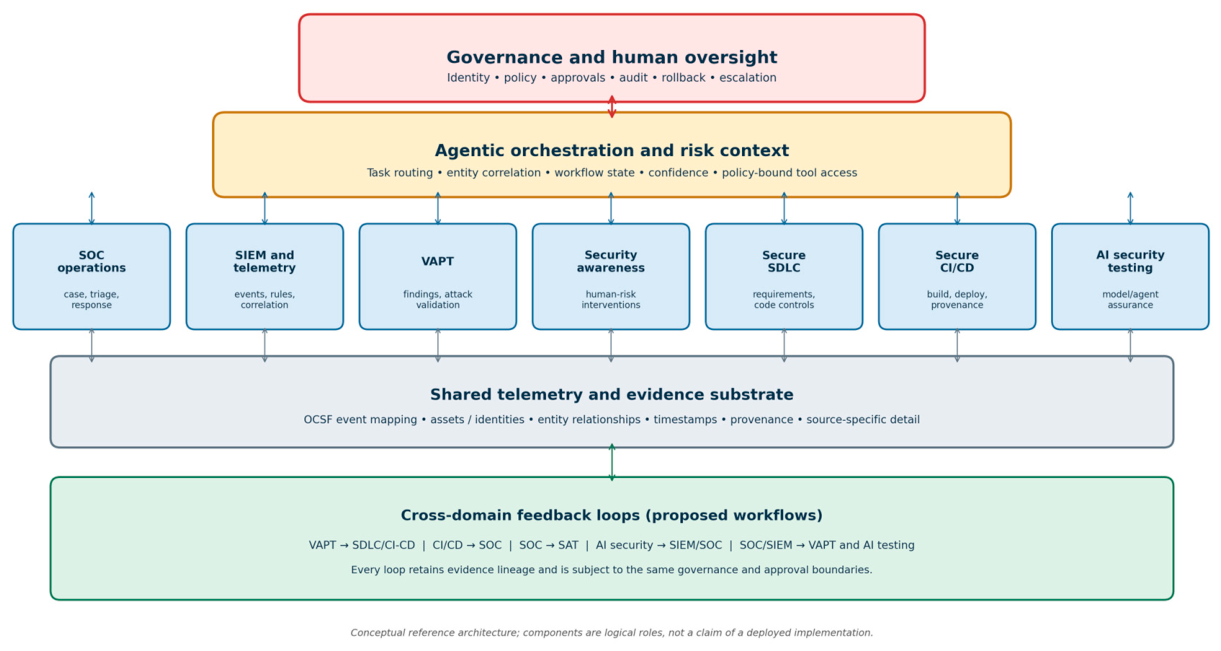
Figure 1.
Conceptual UASP architecture showing seven domain capabilities, shared telemetry and evidence, orchestration, governance and proposed feedback loops.
Figure 1.
Conceptual UASP architecture showing seven domain capabilities, shared telemetry and evidence, orchestration, governance and proposed feedback loops.
The secure-SDLC agent maintains security requirements, threat models, code findings and remediation lineage. The CI/CD agent evaluates build and deployment evidence, executes policy checks and records artifact provenance. The AI-security agent coordinates evaluations of prompts, models, agent tools, memory, retrieved content and model/skill supply chains. Agents may exchange structured findings, but they should not silently replace the source system of record or make unsupported claims about evidence quality.
4.2. Shared Telemetry and Evidence Substrate
The Open Cybersecurity Schema Framework (OCSF) provides an extensible, vendor-agnostic schema for cybersecurity events and can support normalization across heterogeneous producers [3]. OCSF should be used as an event interoperability layer rather than treated as a complete enterprise knowledge graph. The architecture should additionally maintain durable identifiers for assets, users, applications, repositories, build artifacts, models, agents, tools, vulnerabilities, incidents and policy decisions.
A semantic layer can link those entities through typed relationships, temporal state and provenance. The Canonical Security Telemetry Substrate (CSTS) is one emerging research proposal for representing persistent entities, typed relations, events, temporal state and provenance in support of AI-native cyber detection [4]. In this paper, CSTS is treated as a candidate design direction rather than an established or universally adopted standard. An implementation could use OCSF-compatible event records alongside an entity graph or equivalent relationship store, with explicit mappings between the two.
Every cross-domain event should carry, where applicable, a stable event identifier, event time and ingestion time, source system, affected entity identifiers, environment, severity or native score, confidence, evidence pointer, producer identity, applicable policy version and transformation history. Sensitive fields should be minimized, tokenized or access-controlled. These requirements help prevent an orchestration agent from treating a summary or derived score as if it were the original evidence.
4.3. Orchestration and Risk Context
The orchestrator routes tasks to domain agents, manages workflow state, resolves entity references, checks policy constraints and coordinates escalation. It should not be a universal super-agent with unrestricted access. Each task should be declared with an objective, permitted tools, data boundary, expected outputs, time limit, confidence threshold and permitted action tier. Conflicting agent conclusions should be represented explicitly, not hidden by selecting a single answer without explanation.
A risk-context service supplies business criticality, asset exposure, threat activity, software lineage, human context and AI-system posture to investigations. A meta-cognitive governance mechanism can evaluate uncertainty, evidence sufficiency, disagreement and action impact before a workflow proceeds. This is consistent with recent proposals for meta-cognitive agentic cybersecurity architectures, but the UASP design does not assume that such mechanisms are already proven at enterprise scale [12].
5. Cross-Domain Feedback Loops
The central proposition is that integration value arises when evidence from one domain changes a controlled decision or workflow in another domain. The following loops are design patterns. They require authorization, evidence linkage and measurable outcomes; they should not be interpreted as claims that every capability is absent from existing products.
| Loop | Workflow objective | Evidence exchanged | Guardrail |
| L1. VAPT → SDLC/CI/CD | A validated finding creates or updates an engineering requirement, remediation ticket and testable pipeline control. The finding is linked to affected code, dependencies and environments. | Finding ID, affected component, exploit evidence, severity vector, commit/build IDs, retest result. | A pipeline gate may be proposed automatically; merge blocking or production release exceptions follow the organization’s change policy. |
| L2. SDLC/CI/CD → SOC | Build, release and deployment context enriches runtime alerts and incident timelines. A detected exploit can be traced to the deployed artifact and relevant source revision. | Repository, commit, build attestation, artifact digest, deployment identity, workload and runtime event IDs. | Provenance enriches investigation; source attribution is evidence, not automatic proof of individual fault. |
| L3. SOC → SAT | A confirmed incident or repeated attack pattern triggers a targeted, proportionate learning intervention for the relevant role or cohort. | Incident technique, affected workflow, training assignment, simulation outcome and privacy-safe cohort identifier. | Avoid public shaming and punitive scoring; use minimised data, role context and human review for sensitive interventions. |
| L4. AI security testing → SIEM/SOC | Prompt-injection attempts, tool-abuse tests, model anomalies and agent-policy violations are represented as structured security events and correlated with identity and environment context. | Agent/model ID, test case, prompt or payload reference, tool invocation, policy result, environment and timestamp. | Separate controlled red-team activity from production attacks; mark test provenance and prevent test traffic from triggering destructive response. |
| L5. SOC/SIEM → VAPT | Incident evidence and threat intelligence prioritize new validation scenarios against exposed assets and controls. | Incident technique, affected asset, exploit path, control gap, test authorization and scope. | Tests remain explicitly authorized, scoped and scheduled; production testing requires a separate approval boundary. |
| L6. SOC/SIEM → AI security testing | AI-related incidents and detections feed regression tests, adversarial scenarios and guardrail evaluations for models and agents. | Incident-linked test case, model/agent version, tool permissions, retrieved-data class and expected safe behaviour. | Use a segregated test environment and versioned test corpus; do not replay sensitive production data without approval. |
These loops should be implemented as explicit state transitions. For example, a VAPT finding should not be considered remediated merely because a code change was merged. The workflow should require a test result or other verification evidence, link the result to the original finding and preserve an exception record where remediation is deferred. Similarly, a SOC-triggered training assignment should not be counted as risk reduction solely because a learner completed a module; evaluation should consider subsequent behaviour and the possibility of confounding factors.
6. Unified Risk Context Without Score Collapse
A cross-domain risk view is useful, but the underlying measurements are not interchangeable. CVSS communicates characteristics and severity of software vulnerabilities, with base, threat, environmental and supplemental metric groups [13]. SOC alert severity, asset criticality, human-risk indicators, secure-pipeline results and AI model evaluations have different semantics, scales and confidence properties. A naïve weighted average of these scores could create false precision or hide critical evidence.
The UASP should therefore maintain a multidimensional risk vector for each relevant entity or workflow. An illustrative vector is R = (V, E, B, T, H, S, P), where V represents vulnerability and control findings; E, exposure and exploitability context; B, business criticality; T, threat activity and incident context; H, privacy-aware human-risk evidence; S, software and deployment state; and P, AI model/agent posture. Each dimension retains its native scale, source, timestamp, confidence and provenance. The orchestrator may derive an organization-specific priority class or ranking, but the derivation and weights must be documented and configurable.
The risk view should distinguish missing data from low risk, stale data from current data, and a low-confidence model inference from a validated finding. Human-risk signals should be used as contextual indicators rather than deterministic labels about individuals. AI security results should identify the model, agent configuration, tool permissions, test conditions and evaluation date. The objective is decision support with traceable uncertainty, not a single universal score.
7. Governance and Bounded Autonomy
Agentic orchestration increases the importance of identity, authorization, runtime monitoring and action boundaries. NIST’s AI Risk Management Framework Generative AI Profile provides risk-management guidance across the AI life cycle, while OWASP’s 2026 GenAI materials and MITRE ATLAS provide complementary threat and control references [2,5,6]. The UASP should implement least privilege at the level of each agent task, not merely at the level of the platform account.
Each agent should have a verifiable identity, task-scoped credentials, explicit data access, an allow-list of tools and destinations, a bounded execution context and an audit trail. Agent-to-agent messages should be authenticated and treated as inputs that may be incomplete or compromised. Untrusted retrieved content must not acquire authority to change permissions or bypass policy. Tool outputs should be validated before they are used to trigger downstream actions. High-impact operations should include approval, separation of duties and rollback planning.
| Autonomy tier | Illustrative actions | Minimum control |
| Tier 0 — Observe | Read, normalize, correlate, monitor and summarize evidence. | May run autonomously within read-only data and privacy boundaries. |
| Tier 1 — Recommend | Draft a case, propose a detection rule, create a remediation ticket, suggest a training intervention or prepare a test plan. | May generate drafts; a designated human or deterministic policy approves external execution. |
| Tier 2 — Bounded execution | Perform low-impact, reversible actions in an explicitly authorized scope, such as running a sandbox test or updating a non-production workflow state. | Allowed only under pre-approved policy, task-scoped credentials, logging, rate limits and tested rollback. |
| Tier 3 — Approval required | Disable identities, isolate production assets, change production controls, block critical traffic, modify production models, deploy code or initiate broad user communications. | Require explicit human approval; high-impact changes may require dual authorization and change-management controls. |
The tier assigned to an action should depend on impact, reversibility, blast radius, uncertainty and the criticality of the affected system. The same action may be Tier 2 in a test environment and Tier 3 in production. Governance should also include a kill switch, an emergency stop procedure, periodic permission review, prompt and tool-injection testing, model and policy versioning, audit retention, and a process for investigating agent errors. Human oversight is risk-graded: low-impact evidence handling may be automated, whereas consequential decisions remain explicitly accountable to authorized personnel.
8. Implementation Roadmap and Evaluation Agenda
8.1. Phased Implementation
- Phase 1 — Foundation and observability (illustrative months 0–6): inventory the seven capability areas; define entity identifiers and event contracts; map priority sources to OCSF; establish provenance, access control and audit requirements; baseline current response and remediation workflows. Begin with read-only agents.
- Phase 2 — Controlled cross-domain workflows (illustrative months 6–18): implement VAPT-to-SDLC/CI/CD traceability, deployment-to-SOC enrichment, incident-to-SAT routing and AI-security-to-SIEM event handling. Run agents initially in recommendation mode and require approval for state-changing actions.
- Phase 3 — Governed multi-agent orchestration (illustrative months 18–36): introduce cross-domain task routing, risk-context services and selected bounded execution; evaluate entity-graph or CSTS-inspired semantic capabilities where justified; expand autonomy only after safety, auditability and operational performance meet predefined thresholds.
The durations are planning examples, not empirically established implementation estimates. Organizations should sequence work according to the maturity of their telemetry, asset inventory, change-management processes, identity controls and existing security platforms.
8.2. Evaluation Questions and Measures
A meaningful evaluation should compare the proposed workflows against the organization’s existing baseline. Suitable measures include the proportion of alerts with complete asset, identity and deployment context; time to assemble investigation context; percentage of VAPT findings linked to verified remediation; time from confirmed incident to relevant SAT intervention; coverage of AI-specific attack scenarios; and the percentage of automated actions with complete policy and evidence records.
Safety and quality measures should include false-positive and false-negative rates for domain-specific detection, incorrect entity-link rates, agent policy-violation rate, unsafe-action rate, approval override rate, rollback frequency, evidence-provenance completeness, confidence calibration, and analyst workload. SAT outcomes should be evaluated through appropriate longitudinal measures rather than course completion alone. Comparisons should control for changes in asset exposure, staffing, attack volume, model versions and other confounders.
The architecture yields several testable propositions for future work:
- P1: A shared evidence model with stable entity identifiers and provenance will improve the completeness of cross-domain incident context relative to disconnected integrations.
- P2: Linking validated VAPT findings to CI/CD controls and retesting will increase the proportion of findings with verified remediation.
- P3: Incident-informed, role-appropriate SAT interventions will produce different behavioural outcomes from scheduled generic training, when assessed with suitable longitudinal measures.
- P4: Risk-graded autonomy with task-scoped permissions and approval gates will reduce unsafe agent actions compared with unconstrained orchestration, while introducing measurable latency and approval overhead.
These propositions are hypotheses, not results. They require a documented implementation, reproducible test scenarios, baselines, defined outcome measures and independent evaluation. In particular, the effect of orchestration should be separated from the effect of better telemetry, additional staffing or changes to underlying security products.
9. Discussion and Limitations
The UASP framework positions agentic AI as a coordination layer across established security capabilities rather than as a replacement for deterministic controls, specialist teams or existing systems of record. Its distinctive emphasis is on explicit cross-domain evidence paths and governed feedback loops. The architecture could be implemented incrementally, beginning with event and entity interoperability before introducing agents that can change system state.
Several limitations remain. First, the market review is purposive and does not establish comprehensive product coverage or prove that a particular integration is unavailable. Vendor capabilities evolve quickly, and public descriptions may omit private integrations or customer-specific deployments. Second, the proposal has not been implemented or empirically validated. No latency, accuracy, cost, risk-reduction or productivity improvement is claimed. Third, the proposed risk vector is a design aid; the choice of dimensions, aggregation method and thresholds requires domain and organizational validation. Fourth, the use of human-risk data raises privacy, employment and fairness concerns that cannot be solved by technical controls alone.
Fifth, OCSF and CSTS serve different conceptual purposes. OCSF offers an event-schema framework, whereas CSTS is an emerging research proposal for a broader semantic telemetry substrate. Interoperability, implementation maturity and operational cost need to be assessed before either is adopted as the sole canonical representation. Finally, multi-agent security introduces risks of delegated authority, trust propagation and tool misuse; adding agents can increase system complexity unless the value of each agent is demonstrated and its permissions are constrained.
The next research step is an instrumented prototype covering a small number of loops, followed by controlled evaluation in a representative environment. A staged proof of concept should begin with read-only correlation, then add approved workflow updates, and only later test bounded actions. Results should include failure cases and unintended consequences, not only successful demonstrations.
10. Conclusion
This paper has proposed a conceptual Unified Agentic Security Operations Platform that connects SOC operations, SIEM, VAPT, SAT, secure SDLC, secure CI/CD and AI security testing through shared evidence, specialist agents, orchestration and bounded autonomy. The framework distinguishes related but non-identical capabilities, specifies cross-domain feedback loops, preserves native risk measures and emphasizes traceability, privacy, least privilege and human accountability. The proposal is not a report of a completed product or validated performance result. Its value lies in providing an explicit architecture and evaluation agenda that can be tested incrementally, with security outcomes and governance quality measured against a documented baseline.
Author Contributions
Johnson Ang Dong Sheng: conceptualization, investigation, methodology, visualization, writing — original draft, and writing — review and editing.
Funding
No external funding was reported for the preparation of this conceptual manuscript.
Data availability
No new datasets were generated or analyzed for this conceptual paper. The discussion is based on the public materials cited in the references.
Ethics approval and consent to participate
Not applicable. The work does not report research involving human participants, animals or identifiable personal data.
Conflicts of interest
No competing interest are declared.
Use of AI-assisted tools
The authors declare that no generative artificial intelligence (GenAI) tools were used.
Institutional disclaimer
The affiliations are provided for author identification. The views expressed are those of the author and do not necessarily represent the views of the affiliated institutions.
References
- Souppaya, M.; Scarfone, K.; Dodson, D. Secure Software Development Framework (SSDF) Version 1.1: Recommendations for Mitigating the Risk of Software Vulnerabilities; NIST Special Publication 800-218; National Institute of Standards and Technology, 2022. [Google Scholar] [CrossRef]
- Autio, C.; Schwartz, R.; Dunietz, J.; Jain, S.; Stanley, M.; Tabassi, E.; Hall, P.; Roberts, K. Artificial Intelligence Risk Management Framework: Generative Artificial Intelligence Profile. NIST AI; National Institute of Standards and Technology, 2024; pp. 600–1. [Google Scholar] [CrossRef]
- Open Cybersecurity Schema Framework Project Welcome to OCSF: Open Cybersecurity Schema Framework. Available online: https://ocsf.io/ (accessed on 15 November 2026).
- Rahman, A. CSTS: A Canonical Security Telemetry Substrate for AI-Native Cyber Detection. arXiv:2603.23459. 2026. Available online: https://arxiv.org/abs/2603.23459.
- OWASP GenAI Security Project. OWASP GenAI Security Project unveils 2026 Top 10 for LLM Applications and a new Agent Control Standard. 1 September 2026. Available online: https://genai.owasp.org/2026/09/01/owasp-genai-security-project-unveils-2026-top-10-for-llm-applications-new-agent-control-standard-and-sponsors-as-community-tops-30000-members/.
- MITRE. MITRE ATLAS: Adversarial Threat Landscape for Artificial-Intelligence Systems. n.d. Available online: https://atlas.mitre.org/ (accessed on 15 November 2026).
- Jiang, X.; Yang, S.; Yang, W.; Liu, Y.; Ji, C. SOK: A Taxonomy of Attack Vectors and Defense Strategies for Agentic Supply Chain Runtime. arXiv. 2026. Available online: https://arxiv.org/abs/2602.19555.
- Xu, Z.; Qi, M.; Wu, S.; Zhang, L.; Wei, Q.; He, H.; Li, N. The Trust Paradox in LLM-Based Multi-Agent Systems: When Collaboration Becomes a Security Vulnerability. arXiv. 2025. Available online: https://arxiv.org/abs/2510.18563.
- Liu, Y.; Chen, Z.; Zhang, Y.; Deng, G.; Li, Y.; Ning, J.; Zhang, L.Y. Malicious Agent Skills in the Wild: A Large-Scale Security Empirical Study. arXiv. 2026. Available online: https://arxiv.org/abs/2602.06547.
- Tie, G.; Shi, J.; Zhou, P.; Sun, L. BadSkill: Backdoor Attacks on Agent Skills via Model-in-Skill Poisoning. arXiv. 2026. Available online: https://arxiv.org/abs/2604.09378.
- Wen, R.; Russinovich, M.; Paverd, A.; Sakuma, J.; Salem, A. MetaBackdoor: Exploiting Positional Encoding as a Backdoor Attack Surface in LLMs. arXiv. 2026. Available online: https://arxiv.org/abs/2605.15172.
- Kojukhov, A.; Bovshover, A. Agentic AI for Cybersecurity: A Meta-Cognitive Architecture for Governable Autonomy. arXiv. 2026. Available online: https://arxiv.org/abs/2602.11897.
- FIRST. Common Vulnerability Scoring System Version 4.0: User Guide, Document Version 1.2. Forum of Incident Response and Security Teams. 2025. Available online: https://www.first.org/cvss/v4.0/user-guide.html.
- Microsoft. The Agentic SOC: Rethinking SecOps for the Next Decade. 9 April 2026. Available online: https://www.microsoft.com/en-us/security/blog/2026/04/09/the-agentic-soc-rethinking-secops-for-the-next-decade/.
- KnowBe4. KnowBe4 Launches AIDA Orchestration as the First Fully Autonomous Agent for Human Risk Management. 24 February 2026. Available online: https://www.knowbe4.com/press/knowbe4-launches-aida-orchestration-as-the-first-fully-autonomous-agent-for-human-risk-management.
- Microsoft. Transforming Public Sector Security Operations in the AI Era. 1 April 2025. Available online: https://microsoft.com/en-us/security/blog/2025/04/01/transforming-public-sector-security-operations-in-the-ai-era.
- Palo Alto Networks. Introducing Cortex XSIAM 3.0. 2025. Available online: https://www.paloaltonetworks.com/blog/2025/04/introducing-cortex-xsiam-3-dot-0/.
- CrowdStrike. Architecture of Agentic Defense: Inside the Falcon Platform. n.d. Available online: https://www.crowdstrike.com/en-us/blog/architecture-of-agentic-defense-inside-the-falcon-platform/ (accessed on 15 November 2026).
- Cisco. Cisco AI Defense. n.d. Available online: https://www.cisco.com/site/uk/en/products/security/ai-defense/index.html (accessed on 15 November 2026).
- HiddenLayer AI Security Platform. n.d. Available online: https://hiddenlayer.com/aisec-platform/ (accessed on 15 November 2026).
- Willison, S. The Lethal Trifecta for AI Agents: Private Data, Untrusted Content, and External Communication. 16 June 2025. Available online: https://simonwillison.net/2025/jun/16/the-lethal-trifecta/.
Disclaimer/Publisher’s Note: The statements, opinions and data contained in all publications are solely those of the individual author(s) and contributor(s) and not of MDPI and/or the editor(s). MDPI and/or the editor(s) disclaim responsibility for any injury to people or property resulting from any ideas, methods, instructions or products referred to in the content. |
© 2026 by the authors. Licensee MDPI, Basel, Switzerland. This article is an open access article distributed under the terms and conditions of the Creative Commons Attribution (CC BY) license (http://creativecommons.org/licenses/by/4.0/).
Copyright: This open access article is published under a Creative Commons CC BY 4.0 license, which permit the free download, distribution, and reuse, provided that the author and preprint are cited in any reuse.