

Submitted:
14 November 2026
Posted:
17 November 2026
You are already at the latest version
Abstract
We study neutral discrete substrates in R3 using only structural assumptions: discreteness, single-scale uniformity, and coherence under infinite extension. Our guiding motif is maximal coherent local stacking of equal-scale domains: in three dimensions the maximal "kissing" coordination is 12, and any substrate that saturates this bound at every site realizes the largest possible local coordination compatible with equal-scale exclusion. We introduce a concrete near-closure functional that separates (i) deviation from continuum isotropy (measured by low-order spherical-harmonic content of the neighbor-direction measure) from (ii) extension inconsistency (defect density under repeated patch extension). Within an axiom class that enforces periodic global extension, maximal coordination 12, cubic neutrality (no distinguished axis at the symmetry level), and a monohedral Voronoi partition, we prove a rigidity theorem: up to Euclidean similarity, the only admissible substrate is the face-centered cubic (FCC) Delone set. Equivalently, the unique admissible Voronoi (Wigner–Seitz) cell is the rhombic dodecahedron, yielding the rhombic dodecahedral tiling of R3 [12]. Simple cubic and body-centered cubic are excluded by non-maximal coordination, and hexagonal close packing is excluded by axial bias under the cubic-neutrality axiom. No dynamics, energetics, or empirical claims are made; the result is purely structural.
Keywords:
discrete substrate
; near-closure
; neutrality
; Voronoi-Delone duality
; rhombic dodecahedron
; FCC lattice
1. Introduction and Scope
This paper is strictly structural and self-contained. It does not introduce dynamics, physical interaction laws, operator structure, or empirical claims. Its objective is to constrain the admissible class of neutral discrete substrates and to determine which candidates remain admissible once all constraints are enforced simultaneously.
Context and Aim
We address a purely geometric selection problem: identify which periodic unit-scale Delone sets in can simultaneously support (i) maximal local coordination (12 nearest neighbors), (ii) cubic neutrality (no distinguished axis at the symmetry level), and (iii) a monohedral space-filling Voronoi partition. These constraints arise naturally in the classical theory of lattices, Voronoi/Delone duality, and dense packings [1,4,5,8,13].
The axiom class used below is intentionally strong: the result is a rigidity statement within that class, not a claim that FCC is uniquely “optimal” under every conceivable criterion. What is new here is the clean packaging of the neutrality/extendibility assumptions into a referee-checkable axiom set and the explicit separation between local isotropy (via a low-order spherical-harmonic defect) and global closure (via periodic monohedral tilings). No dynamics or physical interpretation is asserted in this paper.
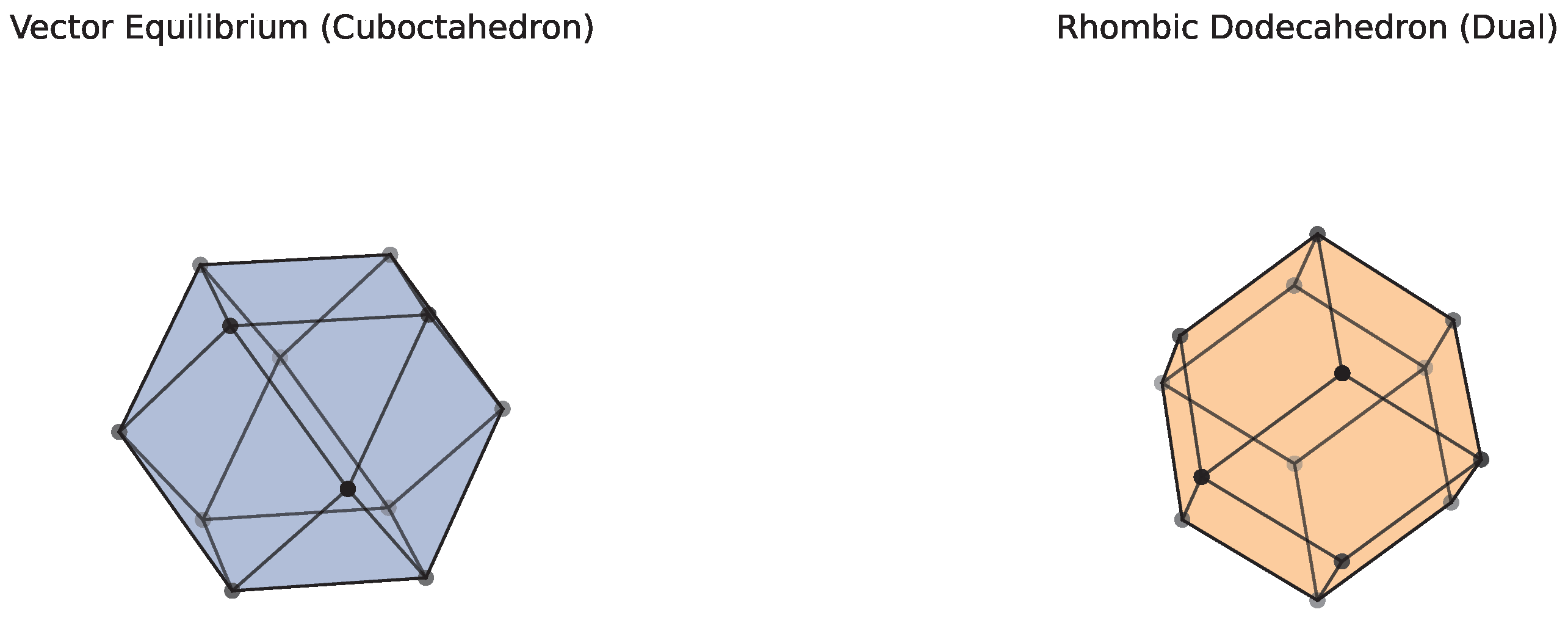
Figure 1.
Vector equilibrium and its dual Voronoi cell. (Left) The vector equilibrium (cuboctahedron), exhibiting twelve equivalent vertices corresponding to the nearest-neighbor coordination shell of the face-centered cubic (FCC) lattice. (Right) The rhombic dodecahedron, obtained as the dual polyhedron of the cuboctahedron and equivalently as the Voronoi (Wigner–Seitz) cell of the FCC lattice. This dual pair encodes maximal coordination, cubic neutrality, and exact space-filling in three dimensions. For visual comparison, the right panel is scaled to match the left panel’s circumradius.
Main Contributions (Mathematical Content)
Within an explicit axiom class of periodic Delone sets in , we:
- formalize a neutral, single-scale admissibility class via Axioms A1–A7 (Section 3);
- prove a rigidity/classification theorem identifying the unique maximally coordinated cubic Bravais substrate (Theorem 1);
- record elimination lemmas excluding common alternative lattices (SC, BCC, HCP) under the same axioms (Section 6);
- isolate which axioms are responsible for uniqueness and which relaxations admit families (Section 8).
The central output is the forced appearance of the FCC lattice and its rhombic dodecahedral Voronoi tiling as the unique solution in this admissible class.
The analysis proceeds by elimination rather than construction. Substrates are excluded when they violate one or more structural axioms or when they fail to admit bounded closure defect under infinite extension.
2. Terminology and Atom Definitions
Basic Definitions and Notation
Definition 1
(Delone set). A set is a Delone set if it is uniformly discrete and relatively dense: there exist such that (i) for all distinct , and (ii) every ball of radius R meets X. In Axiom A1 we normalize .
Definition 2
Definition 3
(Bravais lattice, point group, similarity). A Bravais lattice is a full-rank discrete subgroup with compact quotient . The point group of X is . Two sets are similar if for some , , .
Throughout, denotes the full octahedral group (rotations and reflections preserving the cube/octahedron), and denotes the unit neighbor shell at x.
Ambient Setting
Throughout, we work in Euclidean three-space only as a geometric stage. No dynamics, forces, or field equations are assumed.
Atoms (Canonical Terms)
To keep later elimination arguments readable, we fix the following “Atoms” (terminology units). These are definitions, not assumptions.
- (Atom A-01) Discrete substrate. A substrate is a set of sites that is uniformly discrete and relatively dense (a Delone set): there exist such that distinct points are r-separated and every ball of radius R meets X.
- (Atom A-02) Single scale. We normalize the minimal inter-site distance to 1 (the “cell diameter”).
- (Atom A-03) Contact graph and coordination. The contact graph has vertex set X and an edge between iff . The degree of x is its coordination number.
- (Atom A-04) Voronoi and Delone (Delaunay). The Voronoi (Wigner–Seitz) cell is the set of points closer to x than to any other site. The Delone/Delaunay complex is the dual cell complex; in particular, x and y share a Voronoi face iff they are joined by a Delaunay edge.
- (Atom A-05) Point group (symmetry). The point group of X is the finite subgroup of that preserves X up to translation. “No distinguished axis” will be formalized as a cubic (octahedral) point group condition.
- (Atom A-06) Cuboctahedral neighbor shell. A set of 12 unit vectors on is called cuboctahedral if it is congruent tothe vertex set of a cuboctahedron (equivalently the root system directions).
- (Atom A-07) Rhombic dodecahedron. The rhombic dodecahedron is the 12-faced zonohedron dual to the cuboctahedron. It is the Voronoi (Wigner–Seitz) cell of the FCC lattice.
Remark 1
(Clarification on “all distances equal”). In a 12-kissing configuration, each neighbor is at the same distance from the central sphere, but neighbor–neighbor distances are not all equal; the induced contact graph on the 12 neighbors is cuboctahedral, not complete.
3. Structural Axioms for Neutral Discrete Substrates
This paper is intentionally structural: we assume only geometric consistency conditions on an infinite discrete set of sites . The axioms below define the admissible class. They are chosen to encode three themes:
- single-scale uniformity (no built-in hierarchy),
- maximal coherent local stacking (coordination saturates the 3-D kissing bound),
- neutrality (no distinguished axis or label).
Axiom A1 (Delone Single-Scale)
(Atom A-01, A-02).
The substrate is a Delone set with minimal inter-site distance normalized to 1.
Axiom A2 (Periodic Global Extension)
(Atom A-04).
X is crystallographic: there exists a full-rank lattice of translations such that X is a finite union of -cosets. Equivalently, X admits a compact fundamental domain under translations and extends without defect by repetition.
Axiom A3 (Maximal Local Coordination)
(Atom A-03).
Every site has coordination number 12 in the contact graph, i.e. each has exactly 12 neighbors at distance 1.
Remark 2.
The upper bound 12 is the classical kissing number in three dimensions; Axiom A3 selects substrates that saturate this bound at every site.
Axiom A4 (No Distinguished Axis: Cubic Point Symmetry)
(Atom A-05, A-06).
The point group of X contains the full octahedral group . This axiom enforces cubic neutrality: no distinguished axis may appear in the local neighbor shell. The concrete orbit classification is stated as Lemma 1.
Axiom A5 (Voronoi–Delone Dual Consistency)
(Atom A-04).
Adjacency is given by the Delone/Delaunay dual: two sites are adjacent iff their Voronoi (Wigner–Seitz) cells share a 2-face. (Equivalently, contact edges appear as a subset of Delaunay edges.)
Axiom A6 (Neutrality)
All sites are equivalent under translations: X is a Bravais substrate (one site per unit cell). Equivalently, there exists a full-rank lattice of translations and a vector such that
This is the formal sense in which the substrate is neutral/uncolored: it excludes “crystals with basis” (multiple translation orbits), parity classes, or alternating species at the kinematic level. Any such differentiation must arise from later dynamics (not modeled here).
Axiom A7 (Monohedral Voronoi Partition)
All Voronoi (Wigner–Seitz) cells are congruent convex polyhedra, so the substrate admits a monohedral partition without layered hierarchy or stacking faults. For a Bravais lattice this congruence is automatic by translation, but we keep it explicit because it is the geometric object ultimately selected (the rhombic dodecahedron) and because relaxing it admits polytypic/stacking variants.
Remark 3
(Scope of the axioms). Axioms A1–A7 are strong by design: they deliberately restrict attention to maximally coordinated, cubically neutral, periodic candidates. The payoff is that the admissible class becomes rigid enough to permit a clean structural classification.
Axiom Map (What Each Axiom Enforces)
For clarity (and to keep downstream citations clean), Table 1 records the operational role of each axiom and the primary classes of candidates it excludes.
4. Closure, Defect, and the Near-Closure Regime
The word “closure” is used here in a purely structural sense. There are two independent issues:
- Extension closure: can local adjacency rules extend indefinitely without accumulating inconsistencies?
- Isotropy closure: how close can a discrete neighbor shell come to the rotational invariance of the continuum?
Under Axiom A2 the first issue is forced to be exact (periodic extension). The second issue is necessarily imperfect: a discrete neighbor shell can never equal the uniform measure on , so “isotropy” must be interpreted as approximate or maximal among discrete candidates.
4.1. A Concrete Isotropy-Defect Functional
Fix and write for the unit direction vectors to the 12 nearest neighbors (Axiom A3). Define the neighbor-shell measure
and let denote normalized surface measure on . For an integer cutoff , define
where is orthogonal projection onto spherical harmonics of degrees [9]. Then exactly when every neighbor shell is a spherical L-design. This provides an explicit, scale-free measure of “how isotropic” the local shell is at low harmonic orders.
4.2. Extension Defect
For completeness, one may also define an extension defect as the asymptotic density of adjacency mismatches under gluing of finite patches. In the present axiomatic class (Axiom A2), we set .
4.3. Near-Closure Regime
We say that a substrate lies in the near-closure regime if
for a chosen low-order cutoff L (e.g. ) and a small tolerance . Exact closure is the endpoint case .
Remark 4
(Why this definition is fit-for-purpose). The functional above makes explicit what the program needs: a way to compare candidate discrete substrates by how well their local neighbor shells approximate continuum rotational symmetry. It is independent of dynamics and is compatible with elimination-by-axioms.
Numerical reference values.
For the cuboctahedral shell U (Lemma 1), direct spherical-harmonic evaluation gives and . For comparison, the regular icosahedral 12-point shell has much smaller low-order defect (e.g. ) but is incompatible with periodic lattice symmetry and is therefore excluded by Axiom A2 (see Section 6). Details and reproducible point coordinates are recorded in Appendix A.
5. Main Structural Result
We now state (and prove) the central classification statement within the admissible axiom class.
Lemma 1
(–invariant 12-point shell is cuboctahedral). Let be a set of 12 points invariant under the full octahedral group . Then N is, up to rotation, the cuboctahedral orbit
Proof.
The finite -orbits on are classified by stabilizer subgroups of points: axis points (size 6), face normals (size 8), and edge-midpoint directions (size 12). The only orbit of size 12 is the edge-midpoint orbit, yielding the cuboctahedral vertex set (see, e.g., [11]). □
Proposition 1
(Index/determinant comparison for lattices). If are full-rank lattices in , then the index is finite and
Proof.
Choose a basis matrix B for and a basis matrix for . Since , there exists an integer matrix with , and . Taking determinants gives the claim. □
Theorem 1
(RD/FCC classification in the maximally coordinated cubic class). Let satisfy Axioms A1–A7. Then, up to Euclidean similarity, X is the face-centered cubic (FCC) lattice, and its Voronoi (Wigner–Seitz) cells form the rhombic dodecahedral tiling.
Proof.
Translate so that . By Axiom A3 the nearest-neighbor set
has cardinality . By Axiom A4 the point group contains the full octahedral group , hence N is –invariant.
Step 1 (local orbit). By Lemma 1, the unique –invariant configuration of 12 unit vectors is the cuboctahedral orbit
(Equivalently: these are the minimal vectors of the root lattice .) Thus the first coordination shell is cuboctahedral.
Step 2 (generated lattice). Let . The above generators produce, up to similarity, the face-centered cubic lattice (the root lattice), and the set of minimal vectors of is exactly N; see [1].
Step 3 (global identification). By Axiom A6 (Bravais neutrality), for some full-rank translation lattice . Since , we have .
Because the minimal distance in X is 1 (Axiom A3), the lattice has minimal vector length 1 as well. But among three-dimensional lattices with fixed minimal vector length, the face-centered cubic lattice is extremal: it maximizes lattice packing density (equivalently, minimizes covolume ); this is the classical theorem of Gauss (see [1] or [13]). Therefore
On the other hand, implies by Proposition 1. Hence and thus . Consequently X is a translate of the FCC lattice.
Step 4 (Voronoi (Wigner–Seitz) cell). The Voronoi (Wigner–Seitz) cell of the FCC lattice is the rhombic dodecahedron [1], which tiles monohedrally by translation. This proves the claim. □
Remark 5
(Interpretation). The theorem is not a claim about physical energetics or dynamical stability. It is a rigidity statement: within a periodic, maximally coordinated (12), cubically neutral, monohedral Voronoi class, the RD/FCC pair is forced.
6. Candidate Substrate Elimination
Although Theorem 1 already classifies the admissible class, it is useful (for intuition and referee sanity-checking) to record how familiar candidates fail the axioms.
6.1. Simple Cubic (SC)
SC has coordination number 6 (nearest neighbors along coordinate axes). It violates Axiom A3 (maximal coordination).
6.2. Body-Centered Cubic (BCC)
BCC has coordination number 8 (nearest neighbors toward cube corners). It violates Axiom A3.
6.3. Hexagonal Close Packing (HCP) and the Close-Packed Family
HCP (and more generally the Barlow close-packed stackings [10]) attain coordination 12, so they satisfy Axiom A3. However, they have a distinguished stacking axis and hence only hexagonal point symmetry (), violating the cubic neutrality imposed by Axiom A4. In the present framework, HCP remains an important nearby competitor: if Axiom A4 is weakened from “cubic” to “no strong anisotropy,” the close-packed family re-enters the admissible set and FCC/HCP degeneracy must be treated explicitly.
6.4. Icosahedral Local Order and Aperiodic Candidates
Regular icosahedral neighbor shells also have 12 neighbors but are incompatible with monohedral periodic extension in ; such candidates fail Axioms A2 and/or A7. [1,3] Quasicrystalline packings similarly fail the strict periodicity requirement A2 in the present paper.
Remark 6.
The elimination here is axiomatic: changing the axioms changes the answer. The point is to make the dependence explicit so that later papers can relax (or replace) individual axioms while tracking what structure survives.
7. Emergence of the Rhombic Dodecahedral Substrate
Theorem 1 forces the RD/FCC pair within the axioms. Here we record the concrete geometric features that motivate calling it “neutral” and “near-closed” in the sense of Section 4.
7.1. Voronoi Characterization
For the FCC lattice, each site has 12 equidistant nearest neighbors and the Voronoi (Wigner–Seitz) cell is a rhombic dodecahedron. The resulting Voronoi tessellation tiles by congruent rhombic dodecahedra, giving a monohedral partition (Axiom A7) with no gaps or overlaps.
7.2. Cubic Neutrality (No Distinguished Axis)
The FCC point group is cubic (octahedral). In particular, there is no singled-out axis of extension. This is the symmetry-theoretic meaning of “neutral” used in Axiom A4.
7.3. Low-Order Isotropy of the Neighbor Shell
Let be the unit neighbor directions in the cuboctahedral shell (Atom A-06). A direct computation shows that the second moment tensor is isotropic:
Equivalently, the neighbor-shell measure has vanishing degree-2 anisotropy. In the notation of Section 4, this implies for FCC.
7.4. Near-Closure
No discrete shell can equal the uniform measure on , so for sufficiently large L. The RD/FCC substrate therefore lies naturally in a near-closure regime: it matches continuum isotropy at low harmonic order while retaining inevitable higher-order discrete anisotropy of cubic type. The framework records this as a small-but-nonzero isotropy defect for moderate L (e.g. ) once a tolerance is chosen.
Remark 7
(Platonic/Archimedean motifs (bridge to Paper I)). The “12–around–1” fact used in Axiom A3 is the three-dimensional kissing number: at most 12 unit spheres can touch a given unit sphere [7]. This fixes the central-to-neighbor distance, but it does not mean that all outer spheres are mutually equidistant (they are not). What matters for neutrality is instead the angular organization of the neighbor directions.
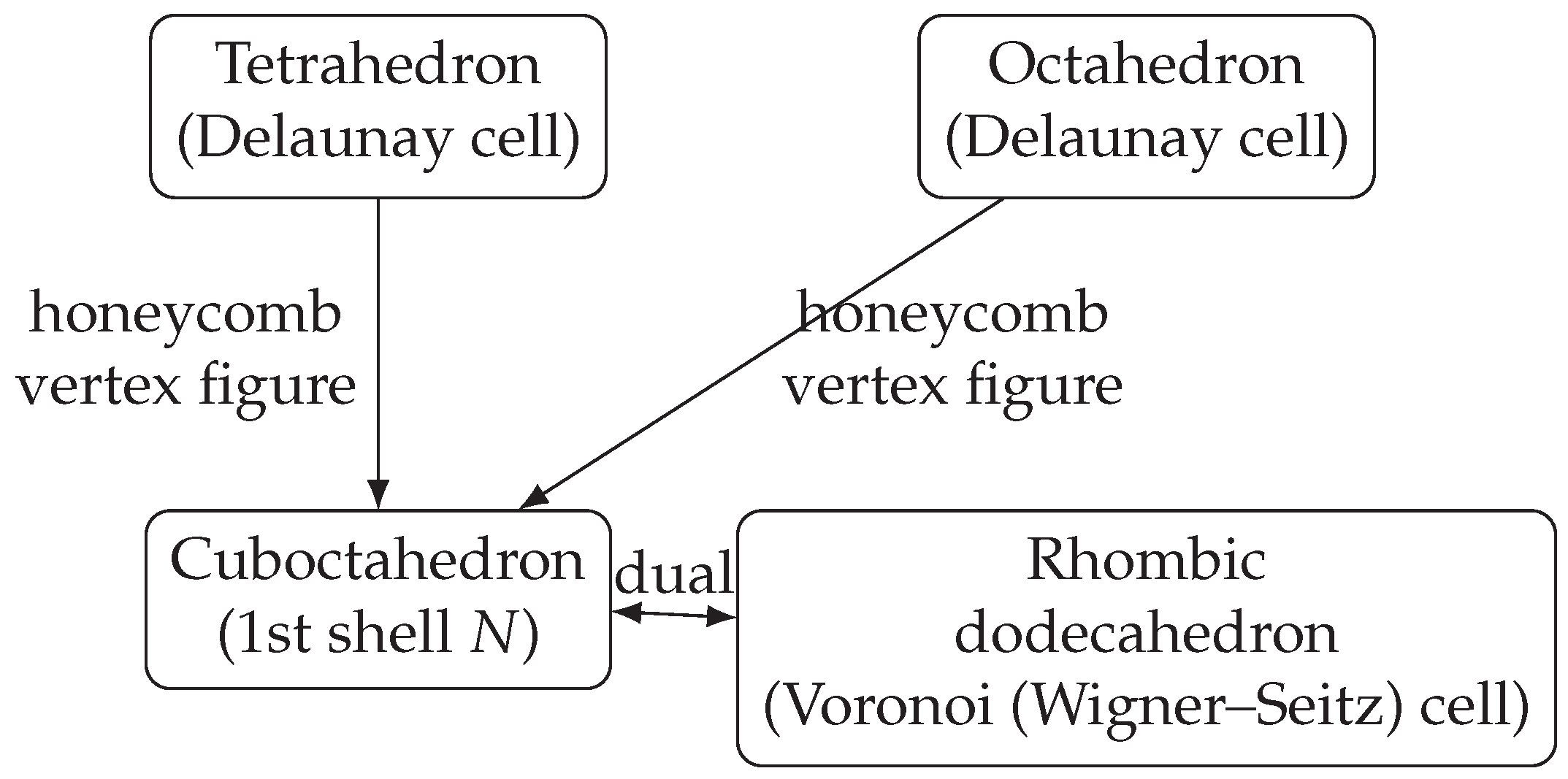
For the FCC lattice, the Delaunay (Delone) decomposition is the classical tetrahedral–octahedral honeycomb: space is tiled by regular tetrahedra and regular octahedra in a face-to-face fashion [11,14]. The vertex figure of this honeycomb is the cuboctahedron (the first-shell orbit N), and the Voronoi (Wigner–Seitz) cell is its dual, the rhombic dodecahedron. In this way, the Platonic solids (tetrahedron, octahedron) and their Archimedean companion (cuboctahedron) appear as the local combinatorial “scaffold” for the globally selected neutral partition (rhombic dodecahedron).
Figure 2.
Platonic/Archimedean motifs naturally associated with the FCC lattice: tetrahedra and octahedra appear as Delaunay cells; their vertex figure is the cuboctahedral neighbor shell; the dual Voronoi (Wigner–Seitz) cell is the rhombic dodecahedron.
Figure 2.
Platonic/Archimedean motifs naturally associated with the FCC lattice: tetrahedra and octahedra appear as Delaunay cells; their vertex figure is the cuboctahedral neighbor shell; the dual Voronoi (Wigner–Seitz) cell is the rhombic dodecahedron.
8. Axiom Sensitivity and Variants
The axioms of Section 3 are intentionally strong. This section records how the conclusion changes when particular hypotheses are relaxed. The goal is not to exhaust alternatives, but to make clear which assumptions are load-bearing for the FCC/rhombic-dodecahedral selection and which are merely convenient normalizations.
For a detailed classification of periodic close packings and the Barlow polytype family, see [10].
Table 2 may be read as a sensitivity summary: relaxing a specific assumption enlarges the admissible class (e.g. Barlow polytypes when cubic neutrality is weakened) while retaining the Voronoi–Delone framework as a reference.
9. Relation to Prior Work and Scope Delimitation
Discrete spatial substrates arise in many contexts, including crystallography, lattice field theory, random graph models, heterogeneous materials, and discrete approaches to geometry and gravity [2]. The present work is not situated within any of these programs. Our use of lattice and tiling language is strictly structural: we impose no background continuum to be discretized, no dynamics to be simulated, and no physical claims to be inferred from the existence of a particular discrete substrate.
The Voronoi–Delone framework is classical; here it is used solely as a consistency test ensuring that adjacency relations admit a compatible dual cell complex without contradiction. Similarly, statistical isotropy is enforced as an asymptotic structural constraint rather than derived from probability measures or physical symmetries.
Explicit Non-Claims
For clarity, we emphasize that this paper does not claim:
- that the identified substrate is physically realized,
- that it describes spacetime, matter, or fields,
- that it minimizes energy or action,
- that it implies emergent dynamics or dimensionality.
The role of the present work is foundational: it identifies a structurally admissible neutral discrete substrate that may serve as a domain for later analyses. Physical interpretation is explicitly deferred.
10. Outlook
The present paper establishes a structural classification within a fixed axiom class: maximal coordination, cubic neutrality, periodic extendibility, and monohedral Voronoi tiling force the FCC lattice and rhombic dodecahedral cell complex. One may study operators or dynamics on the resulting primal/dual complex, but no such claims are made here.
11. Limitations
Explicitly, this paper introduces:
- no dynamics,
- no time evolution laws,
- no field equations,
- no operator spectra,
- and no empirical claims.
Its role is purely structural: to constrain the admissible class of globally extensible neutral substrates and to identify a canonical representative within the near-closure regime. One may study operator-based spectral geometry on the resulting complex, but those developments are outside the scope of the present paper.
Axiom Sensitivity (minimality Map)
Theorem 1 is a rigidity statement within the present axiom class. To clarify what drives uniqueness, note the following sensitivities.
- If A2 (periodic/global extension) is dropped, highly isotropic but aperiodic shells (e.g. icosahedral/quasicrystalline local order) re-enter the admissible set.
- If A4 (full cubic point symmetry) is weakened to a softer “no strong anisotropy” condition, the close-packed family becomes admissible and the FCC/HCP degeneracy must be treated explicitly.
- If A6 (Bravais property) is relaxed to allow multi-atom bases, many additional periodic complexes arise even at fixed neighbor number.
- If the 12-neighbor constraint A3 is relaxed, other classical candidates (e.g. BCC-like or simple-cubic-like first shells) appear and the classification problem changes character.
Accordingly, the novelty here is not a claim that FCC is “the” outcome of isotropy alone, but that neutral near-closure plus global extensibility inside this strong symmetry class rigidly selects the FCC/rhombic-dodecahedral substrate.
Appendix A. Second-Moment Isotropy of the Cuboctahedral Shell
Let
the 12 neighbor directions appearing in Theorem 1.
Lemma A1
(Isotropic quadratic moment). The uniform second moment of U is isotropic:
Equivalently, U has vanishing degree-2 anisotropy in the spherical-harmonic sense (it is a spherical 2-design).
Proof.
Write . By symmetry it suffices to compute diagonal and off-diagonal entries of the sum .
Diagonal terms. Fix coordinate . In U, the ith coordinate is nonzero in exactly 8 of the 12 vectors, and for those vectors . Hence for each i.
Off-diagonal terms. Fix . The only vectors contributing to are those with both coordinates i and j nonzero; there are exactly 4 such vectors, with products occurring with equal multiplicity. These cancel, so .
Thus , and dividing by gives . The equivalence with degree-2 isotropy is standard [9]. □
Appendix Low-Order Isotropy Defect Values (Illustrative)
For a finite shell , the definition of Section 4 can be evaluated in the spherical-harmonic basis as
where is any orthonormal spherical-harmonic basis on (the value is basis-independent).
Alongside the cuboctahedral shell U, it is convenient to record the regular icosahedral 12-point shell
For contrast, consider also the dihedral 12-point shell
which has visible low-degree anisotropy (nonzero ) despite having the same neighbor count.
The values below were computed using the standard complex spherical harmonics (normalized to unit -mass). They are included only as concrete reference points: V is extremely isotropic at low degrees but is excluded by periodicity/tiling constraints (Section 6), while W illustrates that generic 12-shells need not be close to spherical designs even at low degrees.
| L | |||
| 2 | 0 | 0 | 0.0788 |
| 3 | 0 | 0 | 0.0788 |
| 4 | 0.1616 | 0 | 0.2570 |
| 5 | 0.1616 | 0 | 0.2570 |
| 6 | 0.6063 | 0.6747 | 0.4173 |
References
- Conway, J. H.; Sloane, N. J. A. Sphere Packings, Lattices and Groups, 3rd ed.; Springer, 1999. [Google Scholar]
- Torquato, S. Random Heterogeneous Materials: Microstructure and Macroscopic Properties; Springer, 2002. [Google Scholar]
- Sadoc, J.-F.; Mosseri, R. Geometrical Frustration; Cambridge University Press, 1999. [Google Scholar]
- Voronoi, G. Nouvelles applications des paramètres continus à la théorie des formes quadratiques. Deuxième mémoire. Recherches sur les parallélloèdres primitifs. J. Für Die Reine Und Angew. Math. 1908, 134, 198–287. [Google Scholar] [CrossRef]
- Delaunay, B. Sur la sphère vide. Bull. Acad. Sci. USSR 1934, 793–800. [Google Scholar]
- Schütte, K.; van der Waerden, B. L. Das Problem der dreizehn Kugeln. Math. Ann. 1953, 125, 325–334. [Google Scholar] [CrossRef]
- Musin, O. R. The kissing number in three dimensions. Discret. Comput. Geom. 2006, 35, 375–384. [Google Scholar] [CrossRef]
- Hales, T. C. A proof of the Kepler conjecture. Ann. Math. 2005, 162, 1065–1185. [Google Scholar] [CrossRef]
- Delsarte, P.; Goethals, J. M.; Seidel, J. J. Spherical codes and designs. Geom. Dedicata 1977, 6, 363–388. [Google Scholar] [CrossRef]
- Cooper, S.; Robles-Navarro, A.; Smits, O. R.; Schwerdtfeger, P. The theory of Barlow packings: Basic properties and cohesive energies from exact lattice summations within the sticky hard-sphere model. J. Chem. Phys. 2025, 162, 014105. [Google Scholar] [CrossRef] [PubMed]
- H. S. M. Coxeter, Regular Polytopes, 3rd ed.; Dover Publications, 1973.
- Grünbaum, B. G. C. Shephard, Tilings and Patterns; W. H. Freeman, 1986. [Google Scholar]
- Gruber, P. M.; Lekkerkerker, C. G. Geometry of Numbers, 2nd ed.; North-Holland, 1987. [Google Scholar]
- Conway, J. H.; Jiao, Y.; Torquato, S. A new family of tilings of three-dimensional space by tetrahedra and octahedra. Proc. Natl. Acad. Sci. USA 2011, 108, 11009–11014. [Google Scholar] [CrossRef] [PubMed]

Table 1.
Axiom dependency map. The present paper is a selection statement: changing axioms changes the admissible class.
Table 1.
Axiom dependency map. The present paper is a selection statement: changing axioms changes the admissible class.
| Axiom | Enforces / primary exclusions |
| A1 (Delone, single scale) | Uniform discreteness and bounded density (rules out clustered/hierarchical sets). |
| A2 (Periodic extension) | Defect-free global extension by repetition (rules out quasicrystals/aperiodic substrates here). |
| A3 (Coordination 12) | Saturates the 3D kissing bound (excludes SC (6), BCC (8), low-z lattices). |
| A4 (Cubic neutrality) | No distinguished axis (excludes HCP/Barlow stackings under this paper’s scope). |
| A5 (Voronoi–Delone duality) | Consistent primal/dual adjacency (rules out ad hoc neighbor prescriptions). |
| A6 (Single type) | No alternating species/parity classes (prevents multi-orbit “colored” crystals). |
| A7 (Monohedral Voronoi) | One convex cell tiling (rules out layered or mixed-cell partitions). |
Table 2.
Axiom sensitivity. The FCC/rhombic-dodecahedral conclusion is driven by the combined demand of maximal local coordination and cubic neutrality within a Bravais, monohedral periodic class.
Table 2.
Axiom sensitivity. The FCC/rhombic-dodecahedral conclusion is driven by the combined demand of maximal local coordination and cubic neutrality within a Bravais, monohedral periodic class.
| Relaxed ingredient | Typical consequence / enlarged admissible class |
| A3 (maximal coordination 12) | Allows lower-coordination Bravais lattices (SC with 6, BCC with 8) and non-Bravais networks (e.g. tetrahedral coordination 4). |
| A4 (cubic neutrality) | Restores the close-packed degeneracy: the Barlow family (including HCP and polytypic stackings) shares the same local kissing configuration but introduces a distinguished stacking axis. |
| A6 (Bravais neutrality) | Admits periodic crystals with basis (multiple translation orbits) in which different site classes may coexist even when the first-shell coordination is fixed. |
| A7 (monohedral Voronoi partition) | Permits polytypic/defected partitions in which the Voronoi (Wigner–Seitz) cells are not all congruent (stacking faults, mixed-cell tilings). |
| A2 (global periodicity) | Opens the door to quasicrystals and statistically homogeneous but nonperiodic Delone sets, where “long-range isotropy” must be imposed probabilistically rather than by a space group. |
Disclaimer/Publisher’s Note: The statements, opinions and data contained in all publications are solely those of the individual author(s) and contributor(s) and not of MDPI and/or the editor(s). MDPI and/or the editor(s) disclaim responsibility for any injury to people or property resulting from any ideas, methods, instructions or products referred to in the content. |
© 2026 by the authors. Licensee MDPI, Basel, Switzerland. This article is an open access article distributed under the terms and conditions of the Creative Commons Attribution (CC BY) license (http://creativecommons.org/licenses/by/4.0/).
Copyright: This open access article is published under a Creative Commons CC BY 4.0 license, which permit the free download, distribution, and reuse, provided that the author and preprint are cited in any reuse.