
Submitted:
13 November 2026
Posted:
16 November 2026
You are already at the latest version
Abstract
Background/Objectives: We compared functional outcomes and device survival at one and five years in men who received a ZSI 375 or AMS 800 artificial urinary sphincter (AUS) for stress urinary incontinence. Methods: We matched 36 ZSI 375 recipients to 36 AMS 800 recipients in a retrospective cohort of men undergoing implantation for stress urinary incontinence. Preoperative incontinence was severe in 70 men and moderate in two. The primary surgical outcome was time to first revision, including surgery on a single component. Device survival ended at complete removal or replacement. Social continence required use of 0–1 pad per day with the implanted sphincter in place and functioning. Results: During follow-up, 12/36 AMS 800 recipients and 14/36 ZSI 375 recipients underwent revision (hazard ratio for ZSI 375 vs. AMS 800, 0.64, 95% confidence interval 0.25–1.64). Estimated device survival was 86.0% versus 91.7% at one year and 71.0% versus 79.9% at five years (AMS 800 vs. ZSI 375). Social continence with a functioning device was achieved by 23/29 versus 13/29 men at one year (p = 0.013) and 12/16 versus 5/16 at five years (p = 0.039). When any surgical revision counted as failure, the one-year comparison was 21/29 versus 13/29 (p = 0.077). Conclusions: More men with an AMS 800 achieved social continence with a functioning sphincter at both assessments. The study could not establish which device was less likely to require revision. Nonrandom device selection and differences in implantation year limit attribution to device choice.
Keywords:
artificial urinary sphincter
; AMS 800
; ZSI 375
; device survival
; surgical revision
; continence
1. Introduction
Urinary incontinence can be bothersome and impair quality of life [1]. An artificial urinary sphincter (AUS) is an established surgical treatment for men with persistent moderate-to-severe stress urinary incontinence (SUI) after prostate surgery [2,3].
The AMS 800 is a three-component sphincter with extensive long-term follow-up [4,5,6]. The ZSI 375 is a one-piece device that allows cuff pressure to be adjusted in the outpatient clinic [7,8,9,10]. For a man choosing a sphincter, the chance of needing another operation and the amount of leakage he can expect after implantation are both important.
We compared continence and device survival at one and five years after ZSI 375 or AMS 800 implantation. Over the full follow-up period, we also examined when men underwent their first revision and why it was needed.
2. Materials and Methods
2.1. Patients and Implantation
We studied men who underwent AMS 800 or ZSI 375 implantation for SUI at a referral center for reconstructive urology in Warsaw, Poland. Men entered the cohort at their first AUS implantation or when a new sphincter was implanted after a previous device had been removed in a separate operation. Each man contributed one implantation. Immediate exchanges, component revisions, sling procedures and implantation of other AUS models were ineligible for cohort entry.
We included all 36 men who received a ZSI 375 between 2016 and 2022. Of 172 AMS 800 procedures performed between 2014 and 2025, 132 procedures in 129 men were eligible for matching (Table S1). Patients chose the device in consultation with their surgeon. Both devices were implanted with standard bulbar or transcorporal cuff placement. We used a single perineal incision for the ZSI 375.
AMS 800 cuff size ranged from 4.0 to 5.5 cm. The standard pressure-regulating balloon had a nominal pressure range of 61–70 cm H₂O and was filled with 24 mL of 0.9% sodium chloride solution. One patient received a 71–80 cm H₂O balloon. Fill volumes ranged from 23 to 25 mL (Table 1).
Eight men received a third-generation ZSI 375 with a suture-fixed cuff and 28 received a fourth-generation device with an integrated cuff fastener. The cuff is left deactivated during postoperative healing. Published protocols describe outpatient activation at six to eight weeks [7,9,11]. Individual activation dates were unavailable in this cohort. After activation, persistent leakage could be managed in the clinic by percutaneous injection of saline through the septum into the compensation pouch to increase cuff pressure [9].
The Bioethics Committee of the Centre of Postgraduate Medical Education approved the study (No. 44/2025, 14 May 2025) and waived individual informed consent.
2.2. Matching
During the years when both devices were in use, men with prior urethral procedures more often received a ZSI 375. We therefore selected AMS 800 recipients from a longer period. We matched each ZSI 375 recipient to one AMS 800 recipient without replacement.
We matched exactly on previous urethral reconstruction. We also required equal numbers in each group for reimplantation after prior explantation, pelvic radiotherapy, urethrotomy, cardiovascular disease and diabetes. Within pairs, priority was given to implantation category, radiotherapy and calendar period. For age and BMI (kg/m²), we required absolute standardized mean differences (SMDs) of 0.10 or less, using the eligible unmatched groups as the reference [12]. Table S1 gives the full matching criteria.
2.3. Outcomes and Follow-Up
Follow-up began on the day of implantation and ended no later than 30 April 2026. Device survival was the time until the entire sphincter was removed or replaced, including replacement with the same model. A device was considered retained after surgery on an individual component. For men who retained their device, follow-up ended at the last contact confirming that it was still in place.
The primary surgical outcome was time to first revision. We defined revision as any subsequent operation on the implanted AUS, including surgery on an individual component, complete device replacement or explantation. We recorded the indication and date of the first revision and any further operations on the same device. For men without a revision, follow-up ended at the last contact for which the operative history was known, including procedures performed elsewhere. We recorded outpatient ZSI 375 pressure adjustments separately.
We assessed continence at one and five years in pairs in which both men had reached the respective anniversary by study closure. We selected the visit nearest to 12 months within a window of 9–15 months and nearest to 60 months within a window of 54–66 months. If two visits were equally close, we used the earlier one.
Social continence required use of 0–1 pad per day with a functioning AUS at assessment. Complete removal or replacement by the anniversary counted as failure, as did a deactivated or nonfunctioning device at the visit. A man whose sphincter functioned after a component revision could meet the endpoint. In a sensitivity analysis, any surgical revision by the anniversary counted as failure. Men could meet either definition after an outpatient pressure adjustment. The same device criteria applied to pad-free continence, defined as use of zero pads. If neither an eligible visit nor definitive device loss was documented, the outcome was missing.
Before implantation, the treating surgeon assessed stress urinary incontinence as clinically severe in all men. For the study classification, a measured 24-hour pad weight took precedence over the clinical assessment. We classified measured weights of 100–400 g/24 h as moderate and those above 400 g/24 h as severe [13]. At follow-up we recorded daily pad use and 24-hour pad weight. A value of zero grams required an explicit test result.
2.4. Statistical Analysis
We estimated device survival and revision-free survival by the Kaplan–Meier method, with Greenwood log–log 95% confidence intervals (CIs). Cox models stratified by matched pair estimated hazard ratios (HRs) for ZSI 375 relative to AMS 800. Sensitivity analyses examined censoring dates and marginal models with pair-clustered variance [14]. We estimated potential follow-up by reverse Kaplan–Meier analysis [15]. In a sensitivity analysis, we used the date of a late cuff erosion as a proxy for surgery when the explantation date was unavailable (Table S4). We also estimated the hazard ratio for first revision in the matched pairs in which both men received their sphincter during 2016–2022, the calendar years when both devices were used (Table S4).
For the continence endpoints, we report group percentages in complete pairs and used two-sided exact McNemar tests and paired score CIs for absolute differences [16]. We also describe observed pad use as 0, 1 or ≥2 pads/day among men in anniversary-eligible pairs who had a recorded count, regardless of whether their partner had one. These descriptive percentages use the number assessed in each group as the denominator. Pad weights are summarized as medians and interquartile ranges (IQRs). Exact Wilcoxon signed-rank and sign tests excluded zero differences, with midranks for tied absolute differences in the signed-rank test. Secondary comparisons were exploratory, without adjustment for multiplicity. Among matched pairs in which both men had known outcomes at both assessments, we also described how many men who met the continence endpoint at one year met it again at five years.
We used Python 3.12.14, NumPy 2.3.5 and SciPy 1.17.0. ChatGPT (OpenAI, GPT-6 Astra Pro) assisted with statistical programming, manuscript drafting and English-language editing. The analysis code is provided in the Supplementary Materials.
3. Results
3.1. Study Cohort
Each group included 32 men receiving their first AUS and four receiving a new AUS after a previous device had been removed. In each group, eight men had undergone urethral reconstruction, 15 urethrotomy and 13 pelvic radiotherapy. Ten men in each group had transcorporal cuff placement (Table 1). AMS 800 devices were implanted later on average (mean year 2020.6 vs. 2018.8). Median potential follow-up for revision was 50.2 months for AMS 800 and 81.8 months for ZSI 375.
Preoperative SUI was severe in all 36 AMS 800 recipients and in 34 of 36 ZSI 375 recipients (94.4%). The two ZSI 375 recipients with moderate SUI had preoperative pad weights of 250 and 400 g/24 h (Table 1).
Values are mean ± standard deviation, median (IQR) or n/N (%). SMDs use standard deviations from the eligible unmatched groups. Preoperative SUI severity is reported for all 36 men in each group. When measured, 24-hour pad weight determined the category (moderate, 100–400 g/24 h, and severe, >400 g/24 h). Categories of previous surgery are mutually exclusive. Two men per group had undergone both radical prostatectomy and surgery for benign prostatic hyperplasia (BPH) and are counted under radical prostatectomy. BPH surgery includes adenomectomy. The 24-mL category includes one patient for whom the standard fill volume applies.
3.2. Device Survival and Revision
Eleven AMS 800 and 14 ZSI 375 devices were removed or replaced during follow-up. Nine AMS 800 devices were removed without immediate replacement and two were exchanged. Among ZSI 375 devices, seven were removed and seven exchanged. Estimated device survival was 86.0% versus 91.7% at one year and 71.0% versus 79.9% at five years (Figure 1A, Table S4). The HR for removal or replacement with ZSI 375 versus AMS 800 was 0.70 (95% CI 0.27–1.84).
Twelve of 36 men with an AMS 800 and 14 of 36 with a ZSI 375 underwent revision (HR 0.64, 95% CI 0.25–1.64). Revision-free survival was 80.4% versus 91.7% at one year and 68.2% versus 79.2% at five years (Figure 1B). Among men who underwent revision (Table 2), the median interval from implantation to first revision was 10.0 months for AMS 800 (IQR 2.6–24.4, range 0.8–82.1) and 60.0 months for ZSI 375 (IQR 23.4–65.5, range 0.4–86.7).
Time to first revision is given in months as median (range), or as the observed time for one patient. Each man contributes once to panel A. Outpatient pressure adjustment and subsequent surgical revision could occur in the same patient.
Cuff erosion was recorded in seven men in each group (19.4%). Seven AMS 800 and six ZSI 375 recipients had a dated explantation for erosion as their first revision, at median intervals of 17.1 and 15.9 months, respectively (Table 2). In the seventh ZSI 375 recipient, erosion was documented 105.6 months after implantation. The date of explantation could not be established. One AMS 800 was exchanged for mechanical dysfunction at 23.5 months as the first revision. All seven men had persistent incontinence at the time their ZSI 375 was exchanged for an AMS 800. Median time to exchange was 61.1 months (range 30.8–86.7).
Two men with an AMS 800 first underwent revision of a single component. One needed balloon replacement followed by cuff downsizing and retained his sphincter. The other had his cuff removed for urinary retention. He subsequently underwent cuff reimplantation and later complete device replacement. Including repeat procedures, we identified at least 15 revisions in the AMS 800 group and 14 in the ZSI 375 group.
At least 14/36 ZSI 375 recipients (38.9%) underwent outpatient cuff-pressure adjustment, with at least 21 sessions in total. This count includes procedures recorded as addition of fluid to increase cuff pressure.
3.3. Continence at One and Five Years
At one year, the composite continence outcome could be assessed in 29 of 34 eligible pairs. With the implanted sphincter still in place and functioning, 23/29 AMS 800 recipients and 13/29 ZSI 375 recipients used 0–1 pad/day (79.3% vs. 44.8%, p = 0.013). When any surgical revision counted as failure, the one-year result was 21/29 (72.4%) for AMS 800 and 13/29 (44.8%) for ZSI 375 (exact McNemar p = 0.077, Table S3). Fourteen and seven men, respectively, met the pad-free endpoint under the main definition. Among the 28 men per group with a recorded pad count at the visit, 16 (57.1%) and seven (25.0%), respectively, reported using no pads (Table 3).
At five years, 12/16 AMS 800 and 5/16 ZSI 375 recipients met the social continence endpoint (75.0% vs. 31.3%, p = 0.039). Eight and two, respectively, met the pad-free endpoint. Visit-based pad use was recorded in 12 AMS 800 and 13 ZSI 375 recipients in the 16 eligible pairs. All 12 AMS 800 recipients and 5/13 ZSI 375 recipients used at most one pad/day (Table 3). Among 14 matched pairs with known continence outcomes at both assessments, 10 of the 13 AMS 800 recipients and three of the seven ZSI 375 recipients who met the endpoint at one year also met it at five years (Table S3).
Panel A reports paired continence endpoints. Complete device removal or replacement by the anniversary counted as failure. Men could meet the endpoint after component revision. Differences are in percentage points (pp), with paired score CIs and exact McNemar p values. Panel B gives observed daily pad use, n (%), among anniversary-eligible pairs. Denominators are the men assessed in each group. The 0–1 column combines the first two categories. Panel C gives median (IQR) for pairs with two 24-hour pad weights. Paired differences are AMS 800 minus ZSI 375. Exact two-sided Wilcoxon signed-rank tests excluded equal weights. Only three pairs differed at five years.
At one year, both men in 18 pairs had a recorded 24-hour pad test. Median urine loss was 7.5 g/24 h with AMS 800 and 30 g/24 h with ZSI 375 (p = 0.033). The median paired difference was −10 g/24 h (IQR −87.5 to 15). At five years, paired measurements were available for only five pairs, with median weights of 0 and 60 g/24 h, respectively.
4. Discussion
To our knowledge, this is the first matched comparison of the AMS 800 and ZSI 375 to assess continence at both one and five years alongside device survival and time to first revision. Most men retained their sphincter at five years. At each assessment, more men in the AMS 800 group used at most one pad per day with their implanted sphincter functioning. Among one-year responders with outcomes available in both members of a pair at both time points, 10/13 AMS 800 and 3/7 ZSI 375 recipients also met the endpoint at five years. These observations describe continence at the two visits. They cannot establish whether an individual remained continent throughout the interval.
Ripert and Pierrevelcin studied 27 men with an AMS 800 and 28 with a ZSI 375 who had already achieved social continence [17]. They found broadly similar urodynamic profiles with the two devices. Their selection of men with a good functional result was appropriate for comparing urethral pressures, but it did not address how often men achieve that result after implantation. In our cohort, persistent incontinence, device deactivation, explantation and complete replacement all contributed to the functional comparison.
Direct comparisons of other devices illustrate the same distinction. Haab et al. compared urethral pressure profiles after FlowSecure or AMS 800 implantation in four men per group [18]. In the prospective SATURN registry, 684 men received an AMS 800 and five received a ZSI 375. For the one-year patient-reported cure rate, the registry grouped ZSI 375 recipients with recipients of other non-AMS sphincters [19]. The randomized MASTER trial compared an AUS with a male sling after prostate surgery and reported patient-reported leakage separately from further surgery [20]. Our study links these outcomes by asking whether a man achieved continence with the sphincter implanted at study entry still in place.
The one-piece construction of the ZSI 375 avoids the need to connect separate components at implantation. Fewer connections might reduce mechanical failure, but an intact device may still be exchanged because continence is unsatisfactory. Published ZSI 375 series differ in device generation, length of follow-up and definitions of success [7,8,9,10,11,21,22]. In our cohort, all seven men whose ZSI 375 was exchanged for an AMS 800 had persistent incontinence at the time of exchange. The data did not establish a durability advantage for either design.
The adjustable ZSI 375 cuff offers a practical way to treat persistent leakage. Cuff pressure can be increased by adding saline in the outpatient clinic. In the European multicenter series of Ostrowski et al., 17 of 109 recipients needed a further increase in pressure after activation [9]. At least 14 men underwent adjustment in our cohort. Six of the seven men who later had their ZSI 375 exchanged had previously undergone adjustment. Trying an adjustment first may have postponed exchange in some men. The longer follow-up after ZSI 375 implantation also needs to be considered when interpreting the time to revision.
For men with an AMS 800 who have persistent or recurrent leakage despite a mechanically functioning device, an alternative is to replace the cuff with a smaller one. Skrzypczyk et al. reviewed six retrospective series of cuff downsizing, three of which assessed downsizing alone [23]. In a series by Weis et al., 13 of 25 men reduced their daily pad use by at least half after downsizing [24]. One man in our cohort retained his AMS 800 after balloon replacement and subsequent cuff downsizing. The evidence supports downsizing as an option for selected men. A single case and the absence of comparable measurements before and after ZSI 375 adjustments preclude a direct comparison of their effects on continence.
The 24-hour pad test provided a second measure of leakage [25]. In the 18 pairs tested at one year, pad weight was lower with AMS 800 in nine pairs, lower with ZSI 375 in five and equal in four. Some of the largest differences favored AMS 800 (signed-rank p = 0.033, sign test p = 0.424). Only five pairs had pad weights at five years.
The frequency of cuff erosion in both groups should be interpreted in the context of this referral population. In each group, 8/36 men had undergone urethral reconstruction, 15/36 urethrotomy and 13/36 pelvic radiotherapy. These histories could overlap. Previous urethral reconstruction has been associated with cuff erosion, and a prospective multicenter study found higher explantation rates after pelvic radiotherapy [26,27]. This case mix may have contributed to the erosions observed here. The small number of events precludes attribution to any one factor.
4.1. Strengths and Limitations
Matching balanced previous urethral reconstruction and pelvic radiotherapy. Device choice was nonrandom, and AMS 800 implantation occurred later on average. The severe category includes men with a wide range of urine loss. Differences in severity within this category may therefore have influenced the continence results. We compared continence at each follow-up visit. Individual weighing records were unavailable to verify the recorded postoperative 0-g results.
Few events informed the comparisons of device loss and first revision. In six men, a later visit confirmed that the device remained in place after the last date covered by the operative history. Restricting device follow-up to the latter date gave five-year survival estimates of 71.0% for AMS 800 and 79.2% for ZSI 375 (Table S4). Mortality was not systematically ascertained, and only 16 pairs were available for the five-year continence comparison. Using the late ZSI 375 erosion date as a proxy for surgery gave the same one- and five-year estimates for device survival and revision-free survival (Table S4).
5. Conclusions
At one and five years, more men treated with an AMS 800 used no more than one pad per day with their implanted sphincter still in place and functioning. Most men in both groups retained their device at five years. The cohort did not establish which sphincter was less likely to require revision. Nonrandom device selection and differences in implantation year limit attribution of the continence findings to device choice.
Supplementary Materials
The following supporting information can be downloaded at the website of this paper posted on Preprints.org. Supplementary Methods and Table S1–S4 (Supplementary Materials), statistical analysis code (Analysis Code) and the STROBE checklist.
Author Contributions
Conceptualization, M.A.S. and Ł.B.; methodology, M.A.S. and Ł.B.; formal analysis, M.A.S. and Ł.B.; investigation and data curation, M.A.S., Ł.B., M.R., and A.P.; writing—original draft preparation, M.A.S.; writing—review and editing, all authors; supervision, M.P.
Funding
This research received no external funding.
Institutional Review Board Statement
The study was approved by the Bioethics Committee of the Centre of Postgraduate Medical Education, Warsaw, Poland (approval No. 44/2025; 14 May 2025).
Informed Consent Statement
The Bioethics Committee waived the requirement for individual informed consent for this retrospective study.
Data Availability Statement
The matching and statistical analysis code is available in the Supplementary Materials. Access to individual-level clinical data is subject to institutional approval and applicable data protection requirements. Requests may be addressed to the corresponding author.
Acknowledgments
ChatGPT (OpenAI, GPT-6 Astra Pro for the present manuscript) assisted with statistical programming, drafting and English-language editing. The authors take responsibility for the analyses, their interpretation and the final text.
Conflicts of Interest
M.A. Skrzypczyk reports honoraria for proctoring and training in implantation of AMS 800 and ZSI 375 outside the submitted work. The remuneration was unrelated to the patients included in this study.
Abbreviations
AUS, artificial urinary sphincter. BMI, weight in kilograms divided by height in meters squared. BPH, benign prostatic hyperplasia. CI, confidence interval. HR, hazard ratio. IQR, interquartile range. SMD, standardized mean difference. SUI, stress urinary incontinence.
References
- Przydacz, M.; Chlosta, M.; Chlosta, P. Population-level prevalence, bother, and treatment behavior for urinary incontinence in an Eastern European country: Findings from the LUTS POLAND study. J. Clin. Med. 2021, 10, 2314. [CrossRef]
- Gacci, M.; Sakalis, V.I.; Karavitakis, M.; Cornu, J.-N.; Gratzke, C.; Herrmann, T.R.W.; Kyriazis, I.; Malde, S.; Mamoulakis, C.; Rieken, M.; et al. European Association of Urology guidelines on male urinary incontinence. Eur. Urol. 2022, 82, 387–398. [CrossRef]
- Breyer, B.N.; Kim, S.K.; Kirkby, E.; Marianes, A.; Vanni, A.J.; Westney, O.L. Updates to incontinence after prostate treatment: AUA/GURS/SUFU guideline (2024). J. Urol. 2024, 212, 531–538. [CrossRef]
- Biardeau, X.; Aharony, S.; AUS Consensus Group; Campeau, L.; Corcos, J. Artificial urinary sphincter: Report of the 2015 consensus conference. Neurourol. Urodyn. 2016, 35 (Suppl. 2), S8–S24. [CrossRef]
- Van der Aa, F.; Drake, M.J.; Kasyan, G.R.; Petrolekas, A.; Cornu, J.-N.; Young Academic Urologists Functional Urology Group. The artificial urinary sphincter after a quarter of a century: A critical systematic review of its use in male non-neurogenic incontinence. Eur. Urol. 2013, 63, 681–689. [CrossRef]
- Viers, B.R.; Linder, B.J.; Rivera, M.E.; Rangel, L.J.; Ziegelmann, M.J.; Elliott, D.S. Long-term quality of life and functional outcomes among primary and secondary artificial urinary sphincter implantations in men with stress urinary incontinence. J. Urol. 2016, 196, 838–843. [CrossRef]
- Ostrowski, I.; Blewniewski, M.; Neugart, F.; von Heyden, B.; Selvaggio, O.; Iori, F.; Foley, S.; Fernández Arjona, M.; Carvajal Obando, A.; Pottek, T. Multicentre experience with ZSI 375 artificial urinary sphincter for the treatment of stress urinary incontinence in men. Urologia 2017, 84, 148–152. [CrossRef]
- Ostrowski, I.; Ciechan, J.; Sledz, E.; Dys, W.; Golabek, T.; Chłosta, P.L. Four-year follow-up on a Zephyr Surgical Implants 375 artificial urinary sphincter for male urinary incontinence from one urological centre in Poland. Cent. European J. Urol. 2018, 71, 320–325. [CrossRef]
- Ostrowski, I.; Golabek, T.; Ciechan, J.; Śledź, E.; Przydacz, M.; Dyś, W.; Blewniewski, M.; von Heyden, B.; Pottek, T.; Neugart, F.; et al. Preliminary outcomes of the European multicentre experience with the ZSI 375 artificial urinary sphincter for treatment of stress urinary incontinence in men. Cent. European J. Urol. 2019, 72, 263–269. [CrossRef]
- Llorens, C.; Pottek, T. Urinary artificial sphincter ZSI 375 for treatment of stress urinary incontinence in men: 5 and 7 years follow-up report. Urologia 2017, 84, 263–266. [CrossRef]
- Aragão Vital, J.; Marques Monteiro, M.; Lobão Teixeira, B.; Grilo Mendes, G.; Rocha, A.; Madanelo, M.; Mesquita, S.; Vinagre, N.; Oliveira, B.; Magalhães, M.; et al. Single-component artificial urinary sphincter: Outcomes from one centre in Portugal. Arch. Ital. Urol. Androl. 2024, 96, 12661. [CrossRef]
- Austin, P.C. Balance diagnostics for comparing the distribution of baseline covariates between treatment groups in propensity-score matched samples. Stat. Med. 2009, 28, 3083–3107. [CrossRef]
- Domínguez Argomedo, R.; de Pablos-Rodríguez, P.; Palop Moscardó, A.; Gómez-Ferrer Lozano, Á.; Calvo Bernasconi, I.; Casanova Ramón-Borja, J.L.; Collado Serra, A. The 24-h pad test in the assessment of post-prostatectomy incontinence: Is there still a role for counting pads per day? BJU Int. 2026, 137, 1040–1046. [CrossRef]
- Austin, P.C. The use of propensity score methods with survival or time-to-event outcomes: Reporting measures of effect similar to those used in randomized experiments. Stat. Med. 2014, 33, 1242–1258. [CrossRef]
- Schemper, M.; Smith, T.L. A note on quantifying follow-up in studies of failure time. Control. Clin. Trials 1996, 17, 343–346. [CrossRef]
- Newcombe, R.G. Improved confidence intervals for the difference between binomial proportions based on paired data. Stat. Med. 1998, 17, 2635–2650. [CrossRef]
- Ripert, T.; Pierrevelcin, J. Comparative study of urodynamic tests after AMS 800 and ZSI 375 insertion. Urologia 2018, 85, 15–18. [CrossRef]
- Haab, A.C.; Tornic, J.; John, H.A. Urethral pressure profile assessment after artificial urinary sphincter implantation (FlowSecure™ and AMS-800™): A case series. SAGE Open Med. Case Rep. 2019, 7, 2050313X19851379. [CrossRef]
- Heesakkers, J.; Martens, F.; Thiruchelvam, N.; Witjes, W.; Caris, C.; Kats, J.; Hamid, R.; Van der Aa, F.; on behalf of the EAU Research Foundation SATURN Study Group. Results at 1 year from SATURN, a European, prospective, multicenter registry for male stress urinary incontinence surgery. Eur. Urol. Focus 2024, 10, 818–825. [CrossRef]
- Constable, L.; Drake, M.J.; Cooper, D.; MacLennan, G.; Harding, C.; Mundy, A.; McCormack, K.; Norrie, J.; Ramsay, C.; Smith, R.; et al., on behalf of the MASTER trial team. The 24-mo outcomes from the noninferiority randomised controlled trial of surgery for men with urodynamic stress incontinence after prostate surgery (MASTER). Eur. Urol. Focus 2026, 12, 636–643. [CrossRef]
- Kretschmer, A.; Hüsch, T.; Thomsen, F.; Kronlachner, D.; Pottek, T.; Obaje, A.; Anding, R.; Rose, A.; Olianas, R.; Friedl, A.; et al.; Debates On Male Incontinence (DOMINO)-Project. Efficacy and safety of the ZSI375 artificial urinary sphincter for male stress urinary incontinence: Lessons learned. World J. Urol. 2016, 34, 1457–1463. [CrossRef]
- Molina Escudero, R.; Crespo Martínez, L.; Ripalda Ferreti, E.; Álvarez Ardura, M.; Muñoz Rivas, A. Mid-term follow-up of the Zephyr 375 artificial urinary sphincter implanted via a single perineal incision. Arch. Esp. Urol. 2026, 79, 31–35. [CrossRef]
- Skrzypczyk, M.; Białek, Ł.; Mytsyk, Y.; Dubois, A.; Dobruch, J.; Peyronnet, B. Cuff downsizing in the treatment of non-mechanical persistent or recurrent stress urinary incontinence: Narrative review. Cent. European J. Urol. 2025, 78, 413–418. [CrossRef]
- Weis, S.; Ludwig, T.A.; Bahassan, O.; Gild, P.; Vetterlein, M.W.; Fisch, M.; Dahlem, R.; Maurer, V. Outcomes and complication rates of cuff downsizing in the treatment of worsening or persistent incontinence after artificial urinary sphincter implantation. Int. Neurourol. J. 2023, 27, 139–145. [CrossRef]
- Nitti, V.W.; Mourtzinos, A.; Brucker, B.M.; SUFU Pad Test Study Group. Correlation of patient perception of pad use with objective degree of incontinence measured by pad test in men with post-prostatectomy incontinence: The SUFU Pad Test Study. J. Urol. 2014, 192, 836–842. [CrossRef]
- Sayedahmed, K.; Olianas, R.; Kaftan, B.; Omar, M.; El Shazly, M.; Burger, M.; Mayr, R.; Rosenhammer, B. Impact of previous urethroplasty on the outcome after artificial urinary sphincter implantation: A prospective evaluation. World J. Urol. 2020, 38, 183–191. [CrossRef]
- Brant, W.O.; Erickson, B.A.; Elliott, S.P.; Powell, C.; Alsikafi, N.; McClung, C.; Myers, J.B.; Voelzke, B.B.; Smith, T.G., III; Broghammer, J.A. Risk factors for erosion of artificial urinary sphincters: A multicenter prospective study. Urology 2014, 84, 934–938. [CrossRef]
Figure 1.
Kaplan–Meier estimates of (A) device survival until complete removal or replacement and (B) revision-free survival, including revisions of individual components. Shading indicates 95% CIs, tick marks indicate censoring, and the numbers below each panel give the men at risk.
Figure 1.
Kaplan–Meier estimates of (A) device survival until complete removal or replacement and (B) revision-free survival, including revisions of individual components. Shading indicates 95% CIs, tick marks indicate censoring, and the numbers below each panel give the men at risk.
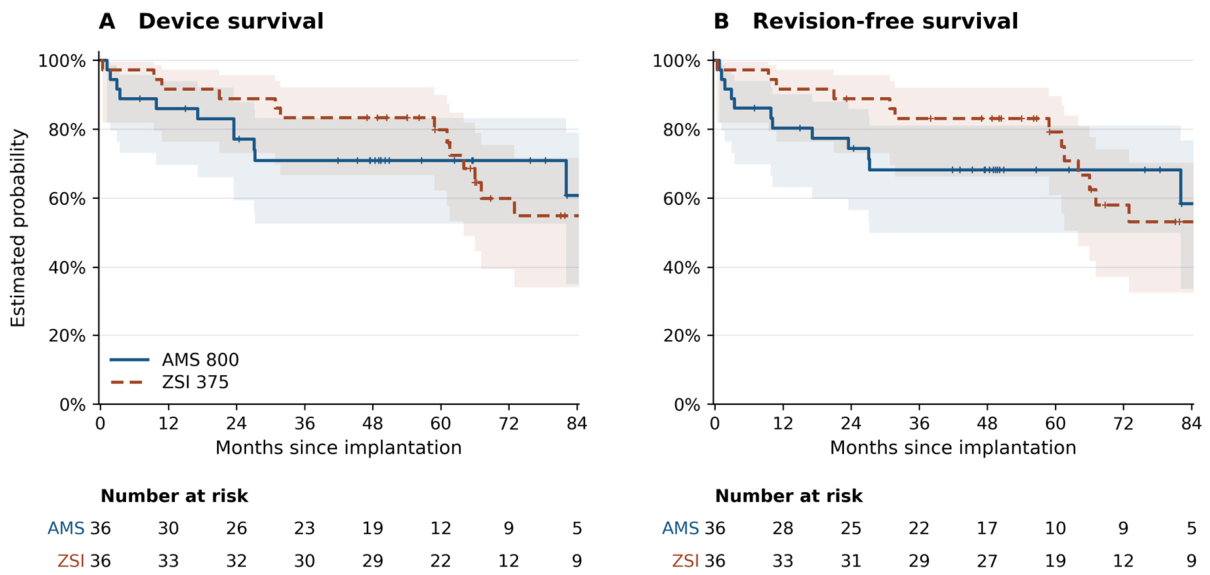

Table 1.
Baseline characteristics, cuff placement and AMS 800 components at implantation.
| Characteristic |
AMS 800 (n = 36) |
ZSI 375 (n = 36) |
Absolute SMD |
| Age, years | 68.6 ± 6.8 | 69.1 ± 7.0 | 0.073 |
| BMI, kg/m² | 28.7 ± 3.2 | 29.1 ± 4.1 | 0.096 |
| Implantation year | 2020.6 ± 2.7 | 2018.8 ± 1.7 | 0.726 |
| Reimplantation after explantation | 4/36 (11.1%) | 4/36 (11.1%) | 0.000 |
| Previous urethral reconstruction | 8/36 (22.2%) | 8/36 (22.2%) | 0.000 |
| Previous urethrotomy | 15/36 (41.7%) | 15/36 (41.7%) | 0.000 |
| Pelvic radiotherapy | 13/36 (36.1%) | 13/36 (36.1%) | 0.000 |
| Transcorporal cuff placement | 10/36 (27.8%) | 10/36 (27.8%) | 0.000 |
| Cardiovascular disease | 11/36 (30.6%) | 11/36 (30.6%) | 0.000 |
| Diabetes mellitus | 8/36 (22.2%) | 8/36 (22.2%) | 0.000 |
| Preoperative pad count available | 19/36 (52.8%) | 14/36 (38.9%) | — |
| Preoperative pads/day when available | 6 (5–6.5) | 5 (4–6) | — |
| Previous surgery relevant to SUI | AMS 800 | ZSI 375 | |
| Radical prostatectomy | 29/36 (80.6%) | 30/36 (83.3%) | — |
| BPH surgery without radical prostatectomy | 6/36 (16.7%) | 4/36 (11.1%) | — |
| Radical cystoprostatectomy with orthotopic neobladder | 0/36 (0%) | 1/36 (2.8%) | — |
| SUI after urethral reconstruction | 1/36 (2.8%) | 1/36 (2.8%) | — |
| Preoperative SUI severity | AMS 800 | ZSI 375 | |
| Moderate | 0/36 (0%) | 2/36 (5.6%) | — |
| Severe | 36/36 (100%) | 34/36 (94.4%) | — |
| AMS 800 components at implantation (36 recipients) | |||
| Cuff size | 4.0 cm (n = 14), 4.5 cm (n = 7), 5.0 cm (n = 9), 5.5 cm (n = 6) | ||
| Nominal balloon pressure range | 61–70 cm H₂O (n = 34), 71–80 cm H₂O (n = 1), unspecified (n = 1) | ||
| Balloon fill, 0.9% sodium chloride | 23 mL (n = 1), 24 mL (n = 26), 25 mL (n = 9) | ||
Table 2.
First surgical revision by procedure, indication and time since implantation, with outpatient ZSI 375 pressure adjustments shown separately.
Table 2.
First surgical revision by procedure, indication and time since implantation, with outpatient ZSI 375 pressure adjustments shown separately.
| A. First revision | AMS 800 (36 recipients) | ZSI 375 (36 recipients) | ||
| Procedure or indication | Patients, n |
Time, months Median (range) |
Patients, n |
Time, months Median (range) |
| Any first revision | 12 | 10.0 (0.8–82.1) | 14 | 60.0 (0.4–86.7) |
| Explantation for urethral erosion | 7 | 17.1 (1.1–82.1) | 6 | 15.9 (0.4–66.0) |
| Explantation for infection | 2 | 6.6 (3.4–9.8) | 0 | — |
| Explantation for other or unspecified indication | 0 | — | 1 | 64.0 |
| Complete device replacement | 1 | 23.5 | 7 | 61.1 (30.8–86.7) |
| Pressure-regulating balloon replacement | 1 | 10.1 | 0 | — |
| Cuff removal for urinary retention | 1 | 0.8 | 0 | — |
| B. Outpatient ZSI 375 adjustments | ||||
| At least 14/36 recipients (38.9%) underwent outpatient cuff-pressure adjustment (including fluid addition), accounting for at least 21 sessions. | ||||
Table 3.
Continence with a functioning sphincter, daily pad use and 24-hour pad weight at one and five years.
Table 3.
Continence with a functioning sphincter, daily pad use and 24-hour pad weight at one and five years.
| A. Continence with the implanted sphincter in place and functioning | ||||
| Time and continence outcome | AMS 800 | ZSI 375 |
Difference, pp (95% CI) |
Paired p |
| 12 months, ≤1 pad/day | 23/29 (79.3%) | 13/29 (44.8%) | 34.5 (9.9 to 53.9) | 0.013 |
| 12 months, zero pads | 14/29 (48.3%) | 7/29 (24.1%) | 24.1 (1.8 to 43.3) | 0.065 |
| 60 months, ≤1 pad/day | 12/16 (75.0%) | 5/16 (31.3%) | 43.8 (9.2 to 66.4) | 0.039 |
| 60 months, zero pads | 8/16 (50.0%) | 2/16 (12.5%) | 37.5 (8.5 to 59.6) | 0.031 |
| B. Recorded daily pad use at the follow-up visit | ||||
| Visit and device | 0 pads/day | 1 pad/day | ≥2 pads/day | 0–1/day |
| 1 year, AMS 800 (n = 28) | 16 (57.1) | 10 (35.7) | 2 (7.1) | 26 (92.9) |
| 1 year, ZSI 375 (n = 28) | 7 (25.0) | 7 (25.0) | 14 (50.0) | 14 (50.0) |
| 5 years, AMS 800 (n = 12) | 8 (66.7) | 4 (33.3) | 0 (0) | 12 (100) |
| 5 years, ZSI 375 (n = 13) | 2 (15.4) | 3 (23.1) | 8 (61.5) | 5 (38.5) |
| C. Urine loss on the 24-hour pad test in complete pairs | ||||
| Time (pairs) |
AMS 800 g/24 h |
ZSI 375 g/24 h |
Paired difference g/24 h |
Paired p |
| 12 months (18) | 7.5 (0–30) | 30 (0–100) | −10 (−87.5 to 15) | 0.033 |
| 60 months (5) | 0 (0–0) | 60 (0–70) | −60 (−65 to 0) | 0.250 |
Disclaimer/Publisher’s Note: The statements, opinions and data contained in all publications are solely those of the individual author(s) and contributor(s) and not of MDPI and/or the editor(s). MDPI and/or the editor(s) disclaim responsibility for any injury to people or property resulting from any ideas, methods, instructions or products referred to in the content. |
© 2026 by the authors. Licensee MDPI, Basel, Switzerland. This article is an open access article distributed under the terms and conditions of the Creative Commons Attribution (CC BY) license (http://creativecommons.org/licenses/by/4.0/).
Copyright: This open access article is published under a Creative Commons CC BY 4.0 license, which permit the free download, distribution, and reuse, provided that the author and preprint are cited in any reuse.