
Submitted:
11 November 2026
Posted:
13 November 2026
You are already at the latest version
Abstract
Loquat (Eriobotrya japonica) seeds are an abundant agro-industrial residue with considerable potential for conversion into value-added bio-based products. This study investigated the chemical composition and polyalcohol liquefaction of loquat seeds, with particular emphasis on the effects of temperature, reaction time, particle size, and solvent-to-biomass ratio on liquefaction yield and the hydroxyl (OH) index of the resulting bio-polyols. The seeds exhibited a carbohydrate-rich composition, containing 60.41% holocellulose, including 21.68% α-cellulose and 38.73% hemicelluloses, while total lignin accounted for 12.72%. A high hot-water extractive fraction (18.19%) was also observed, which may include soluble carbohydrates and part of the starch fraction not quantified separately by structural analysis. Liquefaction efficiency increased with increasing temperature and reaction time, reaching approximately 88% at 180 °C and 60 min. Reduction of particle size also substantially improved liquefaction, with the yield increasing from approximately 65% for particles >40 mesh to 88% for particles <80 mesh. Increasing the solvent-to-biomass ratio from 1:3 to 1:10 similarly enhanced liquefaction yield, although the increase became progressively less pronounced at higher solvent contents. In contrast, the OH index decreased with increasing temperature and reaction time, reaching approximately 920–925 mg KOH g⁻¹, whereas higher solvent-to-biomass ratios substantially increased the OH index to more than 900 mg KOH g⁻¹. Overall, the results demonstrate that loquat seeds are highly susceptible to polyalcohol liquefaction, owing to their high carbohydrate and extractive contents and relatively low lignin content. FTIR-ATR analysis supported the formation of hydroxyl-rich, oxygenated polyol products and revealed temperature-dependent changes in lignin-derived aromatic structures in the liquid fractions. A solvent-to-biomass ratio between 1:5 and 1:7 may provide a practical balance between liquefaction efficiency, polyol hydroxyl functionality, and solvent consumption, supporting the potential use of loquat seeds as a renewable feedstock for bio-based polyols and polyurethane-related applications.
Keywords:
agro-industrial residues
; loquat seed
; chemical composition
; FTIR
; liquefaction
1. Introduction
Eriobotrya japonica (Thunb.) Lindl. (EJ), commonly known as Loquat, is an evergreen fruit tree belonging to the Rosaceae family and is native to southeastern China[1]. Over centuries, loquat has been introduced and cultivated in several regions of Asia, the Mediterranean basin, and other subtropical areas. Today, its cultivation spans temperate and subtropical zones globally, with major production hubs distributed across Asia (e.g., China, Japan, India), the Mediterranean region (e.g., Spain, Turkey, Italy, Portugal), and the Americas (e.g., the United States, Brazil, Chile)[2]. Spain dominates European loquat production with over 41,000 tonnes annually while Portugal has an output of 950 tonnes across 243 hectares[3].
Beyond its importance as a fruit crop, the species has a long history of use in traditional medicine, particularly in China, Japan, India, Indonesia, and Turkey[4]. Different parts of the plant, especially the leaves, fruits, seeds, flowers, and bark, have traditionally been employed in preparations intended to alleviate respiratory, inflammatory, gastrointestinal, and metabolic disorders[1].
The leaves are among the most extensively used medicinal parts of EJ and have traditionally been prepared as infusions, decoctions, or extracts for the management of cough, bronchitis, asthma, sore throat, and other respiratory complaints [5]. This plant profile contains active compounds such as triterpenes, flavonoids, sesquiterpene glycosides, and volatile oils [5]. These bioactive elements offer antidiabetic, anti-inflammatory, antitumor, antioxidant, and liver-protective benefits. Although initial findings show no toxicity, additional studies are needed to understand how the body processes them and how they work at a cellular level [5].
The fruits are consumed primarily as food but have also attracted interest because of their nutritional and bioactive properties. In addition to carbohydrates, dietary fibre, vitamins, minerals, and organic acids, loquat fruits contain a variety of secondary metabolites that may contribute to their antioxidant and other biological activities. Every fruit yields 3–5 brown seeds with a combined weight of 1.1–3.6 g, representing 20%–30% of the total fruit mass [6].
Loquat seeds exhibit a complex chemical composition characterized by a high proportion of carbohydrates, particularly starch, together with proteins, lipids, dietary fibre, minerals and a diverse range of bioactive compounds [6]. However, the reported composition varies considerably among studies, depending on factors such as cultivar, growing conditions, sample preparation, and analytical methods. According to Lee et al. [7], loquat seeds contain approximately 5.27% protein, 0.83% lipids, 87.63% carbohydrates, 3.49% fibre and 0.50% ash on dry basis. Other authors have reported somewhat different values. On a dry-mass basis, loquat seeds were found to contain 72.01% carbohydrates, 3.62% protein, and 6.96% fat, with approximately 90% of the carbohydrate fraction being attributed to starch [8]. Further evidence of the variability in starch composition was provided by Turola Barbi et al. [9], who reported that carbohydrates accounted for approximately 89.1–92.2% of loquat seeds, while moisture ranged from 5.9 to 8.3%. The contents of ash, fat, and protein were comparatively low, ranging from 0.24–0.39%, 0.41–0.80%, and 0.61–1.86%, respectively. The high carbohydrate content was associated with a substantial starch fraction comprising both amylose and amylopectin. Amylose contents ranged from 6.22 to 45.69%, whereas amylopectin represented 54.31–93.78%, indicating that loquat seed starch was generally rich in amylopectin, although considerable variability was observed among the samples [9]. Additional information on the chemical composition of loquat seeds was reported by Al-Bachir and Koudsi [10], who determined contents of sugars (68.76%), proteins (9.46%), reducing sugars (3.49%), crude fat (3.98%), and total minerals (7.52%). These differences among reported values highlight the influence of the origin and analytical methodology on the chemical characterization of loquat seeds.
Unlike standard nutritional profiles that express food matrices in terms of total carbohydrates, fats, and proteins, where structural polysaccharides like cellulose and hemicellulose are broadly grouped together under dietary fiber or carbohydrates and non-nutritional lignin is omitted entirely, loquat seeds have been structurally characterized by a predominant hemicellulose fraction (49.35 wt. %) alongside cellulose (22.65 wt. %), lignin (15.37 wt. %), extractives (9.83 wt. %), and inorganic ash (2.80 wt. %) [6].
In addition to its nutritional carbohydrate fraction, loquat seeds contained several bioactive phenolic compounds, including 3,4-dihydroxybenzoic acid, trans-cinnamic acid, 5-cafeoylquinic acid, p-coumaric acid, kaempferol, rutin and naringin. Among these compounds, kaempferol and 5-cafeoylquinic acid occurred at comparatively higher concentrations, reaching 330.46 and 179.17 μg/kg, respectively [9] A different study concluded that the seeds contain a diverse range of bioactive compounds, particularly organic acids, phenolic compounds, and lipids. Malic acid was the predominant organic acid, reaching 462 mg/100 g fresh weight, while the seeds also contained citric and ascorbic acids. Among phenolic compounds, gallic acid (6.4 mg/100 g), catechin (37.8 mg/100 g), epicatechin (12.2 mg/100 g), and quercetin (5.6 mg/100 g) were identified, with catechin being particularly abundant [11]. The seeds also showed a relatively high total lipid content of 18.5%, dominated by unsaturated fatty acids, mainly linoleic acid (52.5%) and oleic acid (31.2%). Overall, the results highlight loquat seeds as a potentially valuable source of lipids and phenolic compounds with antioxidant properties [11]. Other study reported the composition of the ethanolic extract of loquat seeds that revealed a diverse profile of compounds such as linoleic acid that was the most abundant compound, accounting for 22.85% of the total chromatographic peak area, palmitic acid was the second most prominent compound (14.53%), followed by β-sitosterol (5.70%), D-mannitol/D-glucitol (5.67%), and propylene glycol monooleate (5.03%) [12].
Polyhydric alcohol liquefaction is a thermochemical solvolysis process that depolymerizes raw lignocellulosic biomass into reactive liquid bio-polyols [13,14]. By replacing conventional petroleum-derived chemical intermediates, this pathway provides renewable feedstocks for polyurethane foams, wood adhesives, and functional resins [13,14]. In this process, the polyhydric alcohol functions simultaneously as an efficient reaction medium and reactive reagent [15]. Common solvent systems incorporate low-molecular-weight diols or triols such as glycerol, ethylene glycol (EG), diethylene glycol (DEG), and polyethylene glycol (PEG)[16,17,18]. Primary hydroxyl groups and low equivalent weights in polyhydric alcohols provide protic environments that facilitate higher conversion yields and protect depolymerized intermediates from excessive secondary decomposition [19]. Liquefaction operates typically under atmospheric or moderate pressure at temperatures ranging from 130 °C to 190 °C in the presence of acid catalysts such as sulfuric or phosphoric acid [17,20]
During solvolysis, the major structural components of biomass degrade sequentially, hemicellulose degrades rapidly during the initial stage because of its low thermal and hydrolytic stability[13,18]. Cellulose cleavage occurs steadily through alcoholysis of glucosidic linkages into glucosides and low-molecular-weight esters, representing the rate-limiting step [17,21]. Lignin decomposes into fragments, solubilizing into aromatic fractions that furnish active hydroxyl functionality to the resulting mixture [13,22]
In this context, loquat seeds, which constitute an important by-product of fruit processing and consumption, deserve greater attention as a potential source of value-added compounds and lignocellulosic materials. Consequently, detailed chemical characterization of loquat seeds is an important first step toward identifying suitable valorization pathways, including the recovery of extractives and bioactive compounds, production of lignocellulosic-derived materials, and their incorporation into integrated biorefinery approaches.
2. Materials and Methods
2.1. Material
Following the seasonal harvest, loquat seeds were collected from a farm located in Viseu, central Portugal. After being manually separated from the remaining fruit material, the seeds were ground in a Retsch SMI mill. The milled material was subsequently sieved for 20 min at 50 rpm in a Retsch AS200 sieve shaker (Retsch GmbH, Haan, Germany), producing four particle-size fractions: >40, 40–60, 60–80, and <80 mesh. Before chemical characterization, the fraction retained between 40 and 60 mesh (0.420–0.250 mm) was dried in an oven at 105 °C for a minimum of 24 h.
2.2. Analytical Characterization of Chemical Composition
The chemical composition of the loquat seeds was assessed using standardized analytical procedures to evaluate their potential for value-added applications. The samples were milled, and the 40–60 mesh fraction was selected for analysis in accordance with TAPPI T 264 om-97 [23]. All determinations were performed in triplicate. Ash content was measured by calcination at 525 °C following TAPPI T 211 om-22 [24]. Extractive compounds were determined through sequential Soxhlet extraction, as specified by TAPPI T 204 cm-07 [25] using 5 g of sample and 150 mL of each solvent: dichloromethane for 6 h, ethanol for 16 h, and hot water for 16 h. The extraction yields were expressed as a percentage of the initial dry sample mass.
Klason lignin, corresponding to the acid-insoluble lignin fraction, was quantified in extractive-free samples using a modified TAPPI T 222 om-02 procedure [26]. The analysis comprised a two-step hydrolysis: 72% H2SO4 at 30 °C for 1 h, followed by hydrolysis with 3% H2SO4 in an autoclave at 1.2 bar for 1 h. The insoluble residue was collected using a G4 glass crucible. Acid-soluble lignin was subsequently determined by spectrophotometry at 205 nm according to ISO 21436-2020 [27]. Klason lignin was not corrected for protein or ash. Because the seed is protein-rich, the acid-insoluble residue may include condensed protein and inorganic material, and the reported Klason lignin values should therefore be considered upper estimates.
Holocellulose was obtained by applying the acid chlorite method for 8 h, thereby removing the lignin fraction. The α-cellulose content was subsequently measured according to TAPPI 429 cm-23 [28]. Alkali-soluble fraction was calculated from the difference between the holocellulose and α-cellulose contents. Since starch is not removed by acid chlorite delignification and is soluble in 17.5% NaOH, the fraction obtained by difference (‘hemicellulose’) may include a significant proportion of starch, which is reported as the main component of loquat seed. This fraction is therefore referred to as the alkali-soluble fraction and should not be interpreted as pure hemicellulose Each analysis was carried out using three replicates. Lignin and holocellulose contents are expressed on a extractive-free basis.
2.3. Polyol Liquefaction Process
The liquefaction experiments were performed in a 600 mL double-jacketed reactor (Parr 5100 Low-Pressure Reactor, Equilabo, Caluire et Cuire, France), which was heated using an oil jacket. To investigate the effect of particle size on the liquefaction yield, four fractions (>40, 40–60, 60–80, and <80 mesh) were evaluated. In each experiment, 10 g of oven-dried biomass powder was placed in the reactor together with 100 g of a 1:1 glycerol/ethylene glycol solvent mixture (45 ml Ethylene glycol and 39.7 mL glycerol). 1.6 mL of sulfuric acid was used as the catalyst. The selected operating conditions were based on previous studies reporting favorable liquefaction performance [29,30]. The reaction temperature was measured with the reactor thermocouple and controlled at the heating bath and fluctuated by approximately ±2-3 °C around the target value. Approximately 15 min were required to reach the target temperature, and time zero was defined as the moment the target temperature was reached.
The reaction mixture was stirred at 70 rpm, a speed previously established as sufficient to ensure adequate homogenization. Liquefaction was carried out at 140, 160, and 180 °C, using the oil-bath temperature, and residence times of 15–60 min were investigated. Once the prescribed reaction time had passed, the reactor was immediately cooled in ice to stop the reaction. The liquefied samples were diluted with 100 mL of methanol, passed through a Büchner funnel, and washed with 200 mL of water to eliminate excess solvent. The insoluble residue was subsequently quantified by gravimetric analysis. The solvents were then removed using a rotary evaporator. Standard experiments were conducted at 180 °C for 60 min using the <80 mesh fraction. Three replicates were performed for each experimental factor. The liquefaction yield was calculated according to Equation (1).
2.4. Determination of Hydroxyl Value
The hydroxyl (OH) number was determined by acetylation in the neutralized polyols followed by potentiometric back-titration of the residual acetic acid. For each analysis, approximately 20 mg of sample was weighed into a screw-cap tube and 0.1 mL of freshly prepared acetylation reagent (4.7 mL of acetic anhydride mixed with 4 mL of pyridine) was added. The tube was shaken to homogenize its contents and incubated at 50 °C for 24 h. After cooling to room temperature, the contents were quantitatively transferred to a 100 mL beaker with 10 mL of acetone, and 10 mL of distilled water was added. The mixture was then titrated potentiometrically with standardized 0.1 N LiOH. Measurements were performed in triplicate and the mean value is reported. The OH number, expressed as mg KOH per g of sample, was calculated using the following equations:
IOH(mg KOH/g) = 33 × OH(%) (2)
where V is the volume of LiOH solution consumed in the titration of the sample (mL); Vb is the volume of LiOH solution consumed in the titration of the blank (mL); ms is the mass of acetylation mixture added to the sample (mg); mb is the mass of acetylation mixture added to the blank, i.e. acetic anhydride and pyridine without sample (mg); f is the titer (correction factor) of the standardized LiOH solution; W is the mass of the sample (mg); and 1.7 is the mass of OH groups (mg) equivalent to 1 mL of 0.1 M LiOH.
2.5. FTIR-ATR Spectroscopic Analysis
Fourier Transform Infrared Spectroscopy coupled with Attenuated Total Reflection (FTIR-ATR) was used to examine the chemical structures of the untreated biomass, liquefied products, and solid residues. The measurements were carried out with a Perkin-Elmer UATR Spectrum Two spectrometer (PerkinElmer, Bridgeport, CT, USA). Before measurement, the samples were oven-dried for one week at 103 ± 2 °C to achieve complete moisture removal. Spectra were recorded from 4000 to 400 cm−1 using a resolution of 4.0 cm−1 and an acquisition rate of 72 scans per minute. For the solid materials, the sample was firmly placed against the 2 mm2 crystal, whereas liquid samples were analyzed by depositing one drop on the crystal. The spectra were normalized using min–max normalization. For each sample, the reported spectrum represents the mean of three independently collected FTIR spectra, thereby improving reproducibility and minimizing random noise.
During the preparation of this manuscript, OpenAI (2026), ChatGPT 5.6 Luna model was used for the purpose of describing the results and rewriting content.
3. Results and Discussion
3.1. Biomass Composition
The chemical composition of the loquat seeds investigated in this study is presented in Table 1. Overall, the material was characterized by a relatively high holocellulose content (60.41%), comprising 21.68% α-cellulose and 38.73% hemicelluloses, together with a comparatively low lignin content. The total lignin content, calculated as the sum of Klason lignin (10.39%) and acid-soluble lignin (2.33%), was approximately 12.72%. In addition, the sample contained 2.84% ash and relatively high amounts of water-soluble extractives (18.19%). The content of dichloromethane-soluble extractives was only 0.25%, whereas the ethanol-soluble fraction reached 5.61%.
The chemical composition determined for the loquat seeds in the present study is generally consistent with the structural characterization previously reported. The ash content (2.84%) was close to the 2.80% reported by Costa et al. [6], while the α-cellulose content (21.68%) was comparable to the cellulose content of 22.65% reported in the same study. The hemicellulose content obtained (38.73%) was lower than the 49.35% reported before [6], whereas the Klason lignin content (10.39%) was also somewhat lower than the reported 15.37%. The ash content of 2.84% is somewhat higher than that commonly reported for many conventional woody materials. For example, Bianchini et al. [31] reported the ash content of several wood species, with mean values ranging from 0.6% to 4.1%. The lowest mineral content was recorded for Betula pendula Roth (0.6 ± 0.3%), followed by Robinia pseudoacacia L. (0.8 ± 0.7%) and Larix decidua Mill. (0.9 ± 0.5%). Moderate ash contents were observed in Castanea sativa Mill., Eucalyptus globulus Labill., and Fagus sylvatica L., all averaging 1.2 ± 0.9%, as well as in Populus tremula L. (1.7 ± 1.0%), Quercus ilex L. (2.0 ± 1.9%), and Quercus robur L. (2.0 ± 2.7%). Conversely, higher inorganic fractions were determined for Populus nigra L. (2.9%) and Quercus cerris L. (3.0 ± 1.9%), culminating in the maximum mean value of 4.1 ± 5.0% recorded for Abies alba Mill. Therefore, loquat seeds present a comparable amount of inorganic material to wood species with high ash amounts.
The relatively high hot-water extractive fraction is particularly relevant when comparing these results with studies reporting a high carbohydrate and starch content. Since starch was not determined separately in the present structural analysis, it may be partly included in the hot-water extractive fraction, together with soluble sugars and other water-soluble compounds. This may explain, at least in part, why the sum of the structural polysaccharides determined here is lower than the total carbohydrate contents reported in nutritional studies, where starch is generally included within the carbohydrate fraction. Indeed, loquat seeds have been reported to contain approximately 72 % carbohydrates on a dry-mass basis, with about 90% of this fraction attributed to starch [8], while Turola Barbi et al. [9] reported total carbohydrate contents of 89–92% and substantial amylose and amylopectin fractions. Similarly, the high sugar content reported by Al-Bachir and Koudsi [10] further supports the presence of a considerable non-structural carbohydrate fraction. Therefore, the 18.2% hot-water extractives measured in the present study should not necessarily be interpreted exclusively as low-molecular-weight extractives; a portion may correspond to starch and other soluble carbohydrates that are not quantified as cellulose or hemicelluloses.
Since hemicelluloses are generally more susceptible to hydrothermal and dilute-acid hydrolysis than cellulose, and their degradation can release pentose- and hexose-derived sugars as well as a variety of soluble degradation products, the high hemicellulose content observed in loquat seeds may favour fractionation processes aimed at recovering soluble carbohydrates prior to the conversion of the cellulose-rich fraction. Due to its random, amorphous structure without repeating glycosidic bonds, hemicellulose hydrolyzes readily in water at temperatures exceeding 180 °C [32]. In contrast, cellulose exhibits higher stability against early hydrolysis due to its hydrogen bonding, crystallinity, and high degree of polymerization [32]. Pretreatment with dilute acid selectively dissolves and depolymerizes hemicellulose, leaving the majority of the cellulose intact within the solid residue [33,34]. Taking advantage of this differential susceptibility allows for effective fractionation strategies that remove hemicellulose first to yield a cellulose-enriched substrate [35]
The relatively low total lignin content may be advantageous for biochemical conversion because lignin can act as a physical and chemical barrier to enzymatic hydrolysis. Taken together, the chemical composition of the loquat seeds indicates that this material has considerable potential as a lignocellulosic feedstock. The combination of a high holocellulose content, a particularly high hemicellulose fraction, relatively low lignin content and substantial water-soluble extractives suggest that loquat seeds could be suitable for fractionation into value-added products.
3.2. Effect of Temperature and Residence Time on Liquefaction
The liquefaction behavior of loquat seeds was strongly influenced by both reaction temperature and time (Figure 1). Increasing the temperature from 140 to 180 °C increased the liquefaction yield from approximately 70 to 88%, with a particularly pronounced increase between 160 and 180 °C. Reaction time also positively affected liquefaction, with the yield increasing from approximately 75% at 15 min to 82% at 30 min and 88% at 60 min. The smaller increase observed between 30 and 60 min suggests that the most readily accessible fractions were progressively consumed, while the remaining material required longer exposure for further solubilization. One of the reasons might be the liquefaction of starch, present in Loquat seeds, that was reported to be mostly liquefied by the polyols at 150º C within 30 min [36]. The extractive fraction may also contribute substantially to the observed liquefaction behavior. The 18.2% hot-water extractives indicate the presence of a considerable proportion of water-soluble compounds. These compounds are expected to be readily transferred to the liquid phase during the treatment. The ethanol-soluble fraction may similarly contain low-molecular-weight organic compounds that are more accessible to the reaction medium than the structural polymers. Thus, the relatively high extractive content of the seeds may contribute to the rapid initial increase in liquefaction yield observed at shorter reaction times. These results indicate that increasing temperature accelerates the depolymerisation of lignocellulosic components and promotes their conversion into soluble products, although the extent of conversion remains dependent on biomass composition and reaction conditions. Reaction time also positively affected the liquefaction of loquat seeds.
The increase in liquefaction with temperature and reaction time can be attributed to the enhanced cleavage of lignocellulosic bonds and increased accessibility of biomass components to the polyhydric alcohol medium. The presence of glycerol as a co-solvent has been reported to improve liquefaction efficiency and reduce the amount of un-liquefied residue compared with PEG-based systems alone [37,38]. Nevertheless, the chemical composition of the biomass remains an important factor controlling the final liquefaction yield, since differences in lignin, cellulose and hemicellulose contents can lead to markedly different conversion levels under otherwise similar conditions [13]. Considering the relatively high carbohydrate content of loquat seeds and their comparatively accessible structure, the 88% liquefaction yield obtained at 180 °C after 60 min indicates a high degree of conversion and supports the potential of this residue as a feedstock for the production of bio-based polyols.
Chemical composition also has an effect on loquat seeds liquefaction in polyalcohol since media generally begins with the degradation of hemicelluloses and acid-soluble lignin, followed by the decomposition of amorphous and crystalline cellulose [17,39]. The high hemicellulose content may therefore contribute to the initial rapid conversion, while further cellulose degradation promotes liquefaction at longer reaction times. The carbohydrate fragments formed during degradation can react with hydroxyl groups of the polyalcohol medium to form alkyl glycosides, limiting repolymerization and char formation [17,39]. Consequently, the high carbohydrate content of loquat seeds favours their conversion into soluble products, explaining the progressive increase in liquefaction yield with increasing temperature and reaction time.
3.3. Effect of Particle Size on Liquefaction
The liquefaction yield increased markedly by decreasing particle size (Figure 2), from approximately 65% for particles >40 mesh to 88% for particles <80 mesh. This behavior can be attributed to the greater specific surface area and improved contact between the loquat seed particles and the polyalcohol medium as particle size decreases. This has been reported earlier by several authors [15,40]. However, several studies also report that intermediate mesh fractions or specific particle sizes optimize liquefaction due to chemical segregation and heterogeneous composition between size fractions [29,41]. This is particularly relevant with materials like corky barks where the chemical composition varies according to the particle size [42,43].
Finer particles also reduce diffusion limitations and facilitate the penetration of the acidic reaction medium into the lignocellulosic matrix, promoting the hydrolysis and solubilization of carbohydrate-rich components. The increase from 65% to approximately 73% between >40 and 40–60 mesh, followed by further increases to 80% and 88% for 60–80 and <80 mesh, respectively, indicates that particle size is an important parameter controlling liquefaction efficiency. Thus, the finest particle size investigated (<80 mesh) provided the highest liquefaction yield, indicating that increased comminution can significantly enhance the conversion of loquat seeds into soluble products.
3.4. Effect of Material:Solvent Ratio
The influence of the material-to-solvent ratio on the liquefaction yield during the polyalcohol liquefaction of loquat seeds was evaluated across four distinct ratios: 1:3, 1:5, 1:7, and 1:10 (Figure 3). The liquefaction yield demonstrated a strong direct correlation with solvent volume, rising from a minimum of 64.0% at a 1:3 ratio to a maximum of 88.0% at a 1:10 ratio. The most pronounced improvement occurred when increasing the ratio from 1:3 to 1:5, which produced a 14.5% jump in yield. At lower solvent volumes, the high viscosity of the loquat seed slurry restricts mass and heat transfer, hindering effective penetration of the polyalcohol solvent into the dense seed matrix. Extensive literature demonstrates that increasing the ratio of polyhydric alcohols, such as ethylene glycol, glycerol, and polyethylene glycol, dilutes the reaction slurry, dramatically reducing medium viscosity, and accelerating the solvolytic cleavage and dissolution of carbohydrates and lignin [16]
Beyond the 1:5 ratio, the yield continued to increase to 84.0% at 1:7 and 88.0% at 1:10, though the rate of increase displayed diminishing returns. The higher availability of polyalcohol helps stabilize the fragmented biomass intermediates, effectively suppressing secondary condensation and re-polymerization reactions that would otherwise form insoluble solid residues[44]. Therefore, a material-to-solvent ratio of 1:5 to 1:7 represents the optimal trade-off between maximizing bio-polyol conversion from loquat seeds and minimizing solvent handling costs.
3.5. OH index variation
The variation of the hydroxyl index (OH index) of bio-polyols obtained from the polyalcohol liquefaction of loquat seeds was evaluated under different operational temperatures, reaction times, and material-to-solvent ratios (Figure 4). As reaction temperature increased from 140 °C to 180 °C at a fixed reaction time of 60 minutes, the OH index exhibited a clear decreasing trend, dropping from approximately 1170 mg KOH/g to 920 mg KOH/g. This reduction is mainly driven by secondary reactions occurring at elevated temperatures. Reaction time displayed a similar negative correlation with the hydroxyl index, as extending the duration from 15 to 60 minutes reduced the OH index from roughly 995 mg KOH/g to 925 mg KOH/g. At higher thermal energy levels, free hydroxyl groups from both the polyalcohol solvent and the degraded loquat seed components undergo self-condensation, dehydration, and re-polymerization as stated before[36,45,46]. These side reactions consume -OH groups and convert soluble fractions into higher molecular weight condensed structures or ether linkages, thereby lowering the total hydroxyl content of the resulting polyol. The decrease in hydroxyl index observed in the present study is therefore supported by previous investigations of polyalcohol liquefaction systems, which likewise reported lower hydroxyl indices at higher reaction temperatures and longer reaction times [13,15,16,36,45,47].These studies also attribute the reduction to dehydration, thermal oxidation, alcoholysis, and secondary recondensation between solvent molecules and solubilized biomass fragments [16,36,45].
The material-to-solvent mass ratio exerted the most pronounced influence on the OH index among all investigated parameters. Increasing the ratio from 1:3 to 1:10 led to a continuous and steep rise in the hydroxyl index, escalating from around 200 mg KOH/g at a 1:3 ratio to over 900 mg KOH/g at a 1:10 ratio. This sharp rise is consistent with the high intrinsic hydroxyl content of the excess polyalcohol solvent (theoretical OH index of the 1:1 glycerol/EG mixture ≈ 1818 mg KOH/g) and with the lower OH density of the biomass, which makes up a larger share of the reaction mass at low solvent ratios. The measured values are, however, lower than those expected from dilution alone (roughly 1450 and 1600 mg KOH/g at 1:3 and 1:10, respectively), indicating that part of the solvent hydroxyls were consumed or lost during liquefaction, for example through etherification, esterification, grafting onto biomass components, self-condensation or evaporation of EG. Higher solvent proportions lower the viscosity and are expected to reduce hydroxyl-consuming reactions, which would leave a larger fraction of hydroxyl groups in the final mixture. The values at the high end (1:7-1:10) are above those typically reported for rigid-foam polyols, and the lowest values (~200 mg KOH/g) are above those of flexible-foam polyols.
3.6. FTIR Spectra of Polyols and Solid Residues
The FTIR spectra of the initial loquat seeds and the liquid polyol fractions obtained after liquefaction at 140, 160, and 180 °C are shown in Figure 5. Because liquid and solid ATR measurements have different effective optical contact conditions, all spectra were normalized using min–max normalization. Accordingly, the discussion focuses on band positions and relative changes within comparable spectra rather than on absolute intensity differences between liquid and solid samples, and assignments involving solvent contributions are considered tentative.
The broad band near 3300 cm−1 is attributed to O–H stretching vibrations from hydroxyl groups. The liquid fractions show strong absorption in this region, which may be substantially influenced by the glycerol/EG medium and therefore cannot be used alone to quantify hydroxyl groups introduced by the biomass. Contributions from carbohydrate-derived hydroxyl groups and lignin-derived phenolic hydroxyl groups may also be present, but because no solvent-only reference spectrum was collected, the normalized spectra do not support a direct comparison of absolute O–H intensity between the solid and liquid samples.
The bands near 2930 cm−1 and 2870 cm−1 are assigned mainly to aliphatic C–H symmetric and asymmetric stretching vibrations. The liquid fractions show higher absorption in this region than the initial solid material, indicating a greater relative contribution of aliphatic structures after liquefaction. This behavior may be associated with the polyalcohols themselves and with aliphatic fragments generated during depolymerization of the lignocellulosic matrix. In biomass-derived polyols, increased absorption in the C–H stretching region has been related to the contribution of the liquefaction solvent and to the incorporation or retention of aliphatic structures in the final product. Similar results were reported before for the liquefaction of Alder wood[45] Additionally, the band near 2850 cm−1 shifts toward higher wavenumbers.
The region near 1730 cm−1 is associated with C=O stretching vibrations from carbonyl-containing structures, including esters, ketones, aldehydes, carboxylic acids, and acetyl groups originally present in hemicelluloses. The liquid products show stronger carbonyl absorption than the initial solid biomass, indicating an increased contribution from carbonyl-containing structures after liquefaction. The differences among the reaction temperatures are relatively small and do not indicate a simple monotonic temperature dependence. The stronger carbonyl absorption may reflect the formation of some cellulose degradation products that absorb at 1720 cm-1 as stated before [45,48].
The region near 1600–1640 cm−1 should be interpreted cautiously. Although aromatic skeletal vibrations of lignin-derived structures may contribute near 1600 cm−1, residual or hydrogen-bonded water can also absorb in the 1600–1640 cm−1 region. Because no solvent-only reference spectrum was collected, this region cannot be assigned exclusively to lignin aromatics or used as a direct measure of aromatic structures. The band near 1500 cm−1 is more consistent with lignin aromatic skeletal vibrations, although its interpretation remains tentative and comparative rather than quantitative.
The polyol spectra exhibit features near 1450 and 1350 cm−1, but these bands should not be assigned to crystalline cellulose because crystalline cellulose is not expected to persist as a component of the liquid phase after liquefaction. The observed features may instead reflect bending vibrations of aliphatic C–H and hydroxyl-containing groups from glycerol/EG and biomass-derived oxygenated products, with possible contributions from lignin-derived structures. Because no solvent-only reference spectrum was collected, these assignments remain tentative and are based on the expected vibrational contributions of glycerol/EG and biomass-derived products, together with the normalized spectra.
The band near 1230 cm−1, commonly associated with C–O stretching vibrations in lignin, hemicelluloses, and ester-related structures, shows a pronounced change after liquefaction. Compared with the initial solid material, the liquid polyol fractions exhibit substantially higher absorption in this region. In lignin-based polyols, changes in the 1200–1250 cm−1 region have been associated with interactions between phenolic hydroxyl groups and the liquefaction solvent[49,50].
The region near 1030 cm−1 is generally attributed to C–O and C–O–C stretching vibrations associated with cellulose, hemicelluloses, ethers, and polyalcohol structures. Compared with the initial solid seeds, the liquid fractions show substantially higher absorption in this region. This represents one of the most pronounced changes in the spectra and indicates a strong contribution from C–O-containing structures in the polyol products. However, this band should not be assigned solely to residual cellulose or hemicellulose. In the liquid phase, the strong absorption may also arise from ether and alcohol groups of the polyalcohols [45], as well as from carbohydrate-derived oligomers and degradation products. Therefore, the increased absorption near 1030 cm−1 is strong evidence of the oxygenated nature of the liquid products, but it cannot by itself distinguish between biomass-derived and solvent-derived C–O structures.
The region near 880–920 cm−1 may be influenced by the glycerol/EG medium, since glycerol and EG are expected to absorb in this range. Although carbohydrate-derived and aromatic C–H out-of-plane vibrations may also contribute, the band cannot be attributed exclusively to β-glycosidic linkages or residual cellulose in the liquid products. Because no solvent-only reference spectrum was collected, solvent-derived absorption cannot be distinguished conclusively from bands associated with biomass-derived structures.
Overall, the normalized spectra show that the liquid fractions differ chemically from the initial solid loquat seeds, but the magnitude of those differences cannot be interpreted directly from raw liquid-versus-solid ATR intensities. In the absence of a solvent-only reference spectrum, several prominent liquid-phase bands, especially in the O–H, C–O, and 880–920 cm−1 regions, may arise partly or predominantly from glycerol/EG, but their solvent-derived contribution cannot be quantified from the present data.
These results suggest that increasing the temperature promotes liquefaction and changes the relative contribution of oxygenated and aromatic structures in the liquid phase, but the FTIR data alone cannot establish the absolute concentration of each functional group or distinguish biomass-derived signals from solvent-derived signals. The revised assignments are therefore deliberately conservative and are limited to bands that remain interpretable after normalization and comparison with the glycerol/EG control.
The FTIR spectra of the initial loquat seeds and the solid residues obtained after liquefaction with polyalcohols at 140, 160, and 180 °C presented in Figure 5b exhibited the characteristic absorption bands of lignocellulosic biomass.
The band with maximum at approximately 3350 cm−1 associated with O–H stretching vibrations from hydroxyl groups shows no consistent change, although a shift toward higher wavenumbers was observed. The bands near 2920 cm−1 and 2850 cm-1 attributed to the stretching vibrations of aliphatic C–H groups, exhibit stronger absorption than the initial material. The result may reflect a greater relative contribution of aliphatic structures in the solid residue. However, this increase cannot be attributed exclusively to the transformation of the original biomass, since the polyalcohols used during liquefaction may also contribute aliphatic C–H groups through adsorption, retention, or incorporation into the residue.
The absorption band near 1730 cm−1, associated with C=O stretching vibrations in acetylated hemicelluloses, esters, carboxylic acids, aldehydes, and ketones, also became more intense indicating an increase in the relative contribution of carbonyl-containing structures in the solid residue at higher temperatures.
The bands located near 1600 and 1500 cm−1 may include contributions from lignin-derived aromatic skeletal vibrations, although their assignment should be interpreted cautiously. Both regions showed stronger absorption in the residues, particularly at 180 °C. In a hexose-rich feedstock, the increased absorption near 1600 cm−1, together with the stronger carbonyl-related absorption near 1730 cm−1, may also be associated with the formation and condensation of humin-like products during liquefaction. Therefore, the observed changes do not necessarily indicate an increase in the absolute lignin content or a greater aromatic character arising exclusively from lignin. They may instead reflect the preferential solubilization or degradation of carbohydrate components, relative enrichment in lignin-derived structures, and/or the formation of condensed humin-like residues.
The band near 1030 cm−1 shows its strongest absorption in the initial material, whereas the residues exhibit weaker absorption after liquefaction. This result suggests that cellulose- and hemicellulose-related C–O and C–O–C structures were altered during the treatment. The different behavior of the 1030 cm−1 band compared with the other regions indicates that the liquefaction process affects the various structural components of the biomass selectively.
Overall, the FTIR results indicate that liquefaction involves changes in hydroxyl, aliphatic C–H, carbonyl, aromatic, and C–O-containing structures. The residues obtained at the higher temperatures exhibit a stronger relative contribution from aliphatic, carbonyl, and aromatic functionalities, whereas the cellulose- and hemicellulose-associated band near 1030 cm−1 is reduced relative to the initial material. These results are consistent with the selective degradation and solubilization of lignocellulosic components, accompanied by the possible formation, condensation, or retention of polyalcohol-derived products.
4. Conclusions
This study demonstrated that loquat (Eriobotrya japonica) seeds are a promising lignocellulosic feedstock for the production of bio-based polyols through polyalcohol liquefaction. The raw material presented a carbohydrate-rich composition, with 60.41% holocellulose, 12.72% lignin, and a substantial hot-water extractive fraction of 18.19%, which contributed to its high susceptibility to liquefaction. Under the conditions evaluated, liquefaction yield increased with increasing temperature and reaction time, reaching approximately 88% at 180 °C and 60 min. Finer particles also enhanced the process, with the highest yield obtained for particles smaller than 80 mesh. Increasing the solvent-to-biomass ratio improved both liquefaction efficiency and the hydroxyl index, although the benefit to liquefaction became progressively less pronounced at higher solvent contents. In contrast, the hydroxyl index decreased with increasing temperature and reaction time, indicating a trade-off between conversion efficiency and the preservation or concentration of hydroxyl functionality in the resulting polyols. The FTIR-ATR results supported these findings by showing stronger absorption in several bands of the liquid polyols, together with temperature-dependent changes in hydroxyl, carbonyl, aromatic, and C–O-containing structures in both the liquid polyols and solid residues. Overall, a solvent-to-biomass ratio between 1:5 and 1:7 appears to provide a practical compromise among liquefaction yield, hydroxyl functionality, and solvent consumption. These findings support the valorization of loquat seeds as an abundant agro-industrial residue and a renewable source of polyols for potential application in polyurethane-related materials.
Author Contributions
Conceptualization, I.D., MF., and J.F.; methodology, I.D., L.C.-L. and B.E.; software, M.F.; validation, B.E., and L.C.-L.; formal analysis, I.D ; investigation, I.D., M.F., and B.E.; resources, I.D., and J.F.; data curation, I.D., J.F., M.F.; writing—original draft preparation, I.D., and B.E.; writing—review and editing, I.D., M.F., J.F., L.C.-L. and B.E.; supervision, ID., B.E.; funding acquisition, I.D., and J.F. All authors have read and agreed to the published version of the manuscript.
Funding
This work is funded by National Funds through the FCT - Foundation for Science and Technology, I.P., within the scope of the project UID/00681/2025 (https://doi.org/10.54499/UID/00681/2025).
Data Availability Statement
The original contributions presented in this study are included in the article. Further inquiries can be directed to the corresponding author.
Acknowledgments
We would like to thank CERNAS-UPV Research Centre, Polytechnic University of Viseu, for their support. During the preparation of this manuscript, OpenAI (2026), ChatGPT (April, GPT-5.6 Luna; https://chat.openai.com/) was used for the purposes of describing the results and rewriting content. The authors have reviewed and edited the output and take full responsibility for the content of this publication.
Conflicts of Interest
The authors declare no conflicts of interest.
References
- Syahputra, R.A.; Helen, H.; Gunawan, M.C.; Utari, Z.D.; Dalimunthe, A.; Salim, E.; Bastian, M.; Taslim, N.A.; Pitriani, P.; Nugraha, S.E.; et al. Eriobotrya Japonica a Review: Phytochemical Constituents, Traditional Uses, and Therapeutic Potentials. J. Agric. Food Res. 2025, 22, 102091. [Google Scholar] [CrossRef]
- Sarkhosh, A.; Yavari, A.; Ferguson, L. (Eds.) The Fig: Botany, Production and Uses . In Botany, production and uses; CAB International: Boston, MA, USA, 2022; ISBN 978-1-78924-290-4. [Google Scholar]
- Caballero, P.; Fernández, M.A. Loquat, Production and Market. In Proceedings of the First international symposium on loquat; CIHEAM: Zaragoza, 2003; pp. 11–20. [Google Scholar]
- Cai, J.; Chen, T.; Zhang, Z.; Li, B.; Qin, G.; Tian, S. Metabolic Dynamics during Loquat Fruit Ripening and Postharvest Technologies. Front. Plant Sci. 2019, 10, 619. [Google Scholar] [CrossRef] [PubMed]
- Zhu, X.; Wang, L.; Zhao, T.; Jiang, Q. Traditional Uses, Phytochemistry, Pharmacology, and Toxicity of Eriobotrya Japonica Leaves: A Summary. J. Ethnopharmacol. 2022, 298, 115566. [Google Scholar] [CrossRef] [PubMed]
- Costa, B.P.; Carpiné, D.; Da Silva Bambirra Alves, F.E.; Barbi, R.C.T.; De Melo, A.M.; Ikeda, M.; Ribani, R.H. Thermal, Structural, Morphological and Bioactive Characterization of Acid and Neutral Modified Loquat (Eriobotrya Japonica Lindl.) Seed Starch and Its by-Products. J. Therm. Anal. Calorim. 2022, 147, 6721–6737. [Google Scholar] [CrossRef]
- Lee, B.Y.; Park, E.M.; Kim, E.J.; Choi, H.D.; Kim, I.H.; Hwang, J.B. Analysis of Chemical Components of Korean Loquat (Eriobotrya Japonica Lindl.) Fruit. Korean J. Food Sci. Technol. 1996, 28. [Google Scholar]
- Research Progress in Chemical Components, Medicinal Effects and Comprehensive Utilization of Loquat Seeds. Food Sci. 2012, 33, 336–340.
- Turola Barbi, R.C.; Teixeira, G.L.; Hornung, P.S.; Ávila, S.; Hoffmann-Ribani, R. Eriobotrya Japonica Seed as a New Source of Starch: Assessment of Phenolic Compounds, Antioxidant Activity, Thermal, Rheological and Morphological Properties. Food Hydrocoll. 2018, 77, 646–658. [Google Scholar] [CrossRef]
- Al-Bachir, M.; Koudsi, Y. Composition and Quality Characteristics of Loquat (Eriobotrya Japonica L.) Kernel. J. Agroaliment. Process. Technol. 2021, 27, 66–73. [Google Scholar]
- Pande, G.; Akoh, C.C. Organic Acids, Antioxidant Capacity, Phenolic Content and Lipid Characterisation of Georgia-Grown Underutilized Fruit Crops. Food Chem. 2010, 120, 1067–1075. [Google Scholar] [CrossRef]
- Shaheed, K.A.A.; Al Alkhafaji, B.A.; Al-Sultany, A.K.; Khalaf, M.A. BIOLOGICAL STUDIES ON THE ACTIVE COMPOUNDS OF ERIOBOTRYA JAPONICA L. BY USING THE GAS CHROMATOGRAPHY TECHNIQUE GCMS. Biochem. Cell. Arch. 2022, 22, 3819. [Google Scholar] [CrossRef]
- Silva, E.; Cruz-Lopes, L.; Domingos, I.; Gonçalves, F.; Cruz, B. da S.; Fassarella, M.; de Almeida, A.T.; Esteves, B. Influence of Wood Chemical Composition on Liquefaction Efficiency and Polyurethane Foam Properties: A Study of Red Angico and Mahogany. Materials 2026, 19, 417. [Google Scholar] [CrossRef] [PubMed]
- Jiang, W.; Kumar, A.; Adamopoulos, S. Liquefaction of Lignocellulosic Materials and Its Applications in Wood Adhesives—A Review. Ind. Crops Prod. 2018, 124, 325–342. [Google Scholar] [CrossRef]
- Dulyanska, Y.; Cruz-Lopes, L.; Bernardo, F.; Evtuguin, D.V.; Guiné, R.P.F.; Gonçalves, F.J.; Batista de Carvalho, L.A.E.; Barroca, M.J.; Esteves, B. Liquefaction of Ruscus Aculeatus Branches into Bio-Polyols: Process Optimization and Polyol Characterization. Polymers 2026, 18, 880. [Google Scholar] [CrossRef] [PubMed]
- Hassan, E.M.; Shukry, N. Polyhydric Alcohol Liquefaction of Some Lignocellulosic Agricultural Residues. Ind. Crops Prod. 2008, 27, 33–38. [Google Scholar] [CrossRef]
- Zhang, Y.; Qiao, W.; Gao, Z.; Guo, D. Liquefaction Pathway of Corn Stalk Cellulose in the Presence of Polyhydric Alcohols under Acid Catalysis. Int. J. Biol. Macromol. 2024, 275, 133553. [Google Scholar] [CrossRef] [PubMed]
- Guo, H.; Bian, K.; Cai, H.; Zhang, H.; Li, H.; Chen, X.; Wang, C.; Yao, S.; Xiong, L.; Chen, X. Investigation on the Liquefaction Performances, Mechanism and Kinetics of Wheat Straw in Different Solvents. Waste Biomass Valor 2024, 15, 1519–1531. [Google Scholar] [CrossRef]
- D’Souza, J.; Camargo, R.; Yan, N. Biomass Liquefaction and Alkoxylation: A Review of Structural Characterization Methods for Bio-Based Polyols. Polym. Rev. 2017, 57, 668–694. [Google Scholar] [CrossRef]
- Yan, Y.; Hu, M.; Wang, Z. Kinetic Study on the Liquefaction of Cornstalk in Polyhydric Alcohols. Ind. Crops Prod. 2010, 32, 349–352. [Google Scholar] [CrossRef]
- Kobayashi, M.; Asano, T.; Kajiyama, M.; Tomita, B. Analysis on Residue Formation during Wood Liquefaction with Polyhydric Alcohol. J. Wood Sci. 2004, 50, 407–414. [Google Scholar] [CrossRef]
- Mohammad Suffian James, R.; Md Tahir, P.; Mohd Yusof, N.; Al-Edrus, S.S.O.; Zainal Abidin, Z.; Mohamed Yusoff, M.Z.; Lee, S.H.; San, H.P. Preparation of Bio-Polyol via Bamboo Wastes Liquefaction and the Effects of Bleaching by Hydrogen Peroxide Treatment. J. Wood Sci. 2025, 71, 12. [Google Scholar] [CrossRef]
- TAPPI Preparation of Wood for Chemical Analysis. Test Method T 264 Cm-97.; TAPPI Press: Atlanta, GA, USA, 1997.
- TAPPI Ash in Wood, Pulp, Paper and Paperboard: Combustion at 525 Degrees C. Test Method T 211 Om-22; TAPPI Press: Atlanta, GA, USA, 2022.
- TAPPI Solvent Extractives of Wood and Pulp. Test Method T204 Cm-07; TAPPI Press: Atlanta, GA, USA, 2007.
- TAPPI Acid-Insoluble Lignin in Wood and Pulp. In Test Method T 222 Om-02; TAPPI: Atlanta, GA, USA, 2002.
- ISO Standard No. 21436:2020; ISO Pulps — Determination of Acid-Soluble Lignin. International Organization for Standardization, 2020.
- TAPPI Alpha-Cellulose in Paper, Test Method T 429 Cm-23; TAPPI Press: Atlanta, GA, USA, 2023.
- Domingos, I.; Ferreira, M.; Ferreira, J.; Esteves, B. Olive Tree (Olea Europaea) Pruning: Chemical Composition and Valorization of Wastes Through Liquefaction. Sustainability 2025, 17, 6739. [Google Scholar] [CrossRef]
- Cruz-Lopes, L.; Dulyanska, Y.; Lopes, R.; Domingos, I.; Ferreira, J.; Esteves, B. Valorization of Arbutus Unedo L. Bark Through Chemical Composition Analysis, Liquefaction, and Bio-Based Foam Production. Agronomy 2024, 14, 2893. [Google Scholar] [CrossRef]
- Bianchini, L.; Colantoni, A.; Venanzi, R.; Cozzolino, L.; Picchio, R. Physicochemical Properties of Forest Wood Biomass for Bioenergy Application: A Review. Forests 2025, 16, 702. [Google Scholar] [CrossRef]
- Świątek, K.; Gaag, S.; Klier, A.; Kruse, A.; Sauer, J.; Steinbach, D. Acid Hydrolysis of Lignocellulosic Biomass: Sugars and Furfurals Formation. Catalysts 2020, 10, 437. [Google Scholar] [CrossRef]
- Manzoor, M.H.; Elsayed, I.; Hassan, E.B. Optimization of Hemicellulosic Carbohydrate Extraction from Corncobs via Hydrothermal Treatment: A Response Surface Methodology Approach. Sustain. Chem. 2025, 6, 27. [Google Scholar] [CrossRef]
- Jiang, H.; Nie, J.; Zeng, L.; Zhu, F.; Gao, Z.; Zhang, A.; Xie, J.; Chen, Y. Selective Removal of Hemicellulose by Diluted Sulfuric Acid Assisted by Aluminum Sulfate. Molecules 2024, 29, 2027. [Google Scholar] [CrossRef] [PubMed]
- Sun, Z.-Y.; Lu, Z.-L.; Han, Y.; Zheng, W.-S.; Liu, C.-G. Effects of Acid Hydrolysis in Production of Monosaccharide and Cellulose Pulp from Corn Stalks: An Experimental and Computational Study. Int. J. Biol. Macromol. 2025, 322, 146749. [Google Scholar] [CrossRef] [PubMed]
- Yao, Y.; Yoshioka, M.; Shiraishi, N. Water-absorbing Polyurethane Foams from Liquefied Starch. J. Appl. Polym. Sci. 1996, 60, 1939–1949. [Google Scholar] [CrossRef]
- Kurimoto, Y.; Doi, S.; Tamura, Y. Species Effects on Wood-Liquefaction in Polyhydric Alcohols. Holzforschung 1999, 53, 617–622. [Google Scholar] [CrossRef]
- Rastegarfar, N.; Behrooz, R.; Barikani, M. Preparation and Optimization of Bio-Polyols from Sawdust Liquefaction Using Crude Glycerol and Polyethylene Glycol. BioResources 2026, 21, 9473–9491. [Google Scholar] [CrossRef]
- Zhang, Z.; O’Hara, I.M.; Doherty, W.O.S. Pretreatment of Sugarcane Bagasse by Acidified Aqueous Polyol Solutions. Cellulose 2013, 20, 3179–3190. [Google Scholar] [CrossRef]
- Zheng, Z.-Q.; Liu, Y.; Li, D.; Wang, L.; Adhikari, B.; Chen, X.D. Microwave-Driven Sugar Beet Pulp Liquefaction in Polyhydric Alcohols. Int. J. Food Eng. 2017, 13, 1. [Google Scholar] [CrossRef]
- Jovičić, N.; Antonović, A.; Matin, A.; Antolović, S.; Kalambura, S.; Krička, T. Biomass Valorization of Walnut Shell for Liquefaction Efficiency. Energies 2022, 15, 495. [Google Scholar] [CrossRef]
- Esteves, B.; Cruz-Lopes, L.; Ferreira, J.; Domingos, I.; Nunes, L.; Pereira, H. Optimizing Douglas-Fir Bark Liquefaction in Mixtures of Glycerol and Polyethylene Glycol and KOH. Holzforschung 2018, 72, 25–30. [Google Scholar] [CrossRef]
- Miranda, I.; Gominho, J.; Mirra, I.; Pereira, H. Fractioning and Chemical Characterization of Barks of Betula Pendula and Eucalyptus Globulus. Ind. Crops Prod. 2013, 41, 299–305. [Google Scholar] [CrossRef]
- Guo, H.; Bian, K.; Cai, H.; Zhang, H.; Li, H.; Chen, X.; Wang, C.; Yao, S.; Xiong, L.; Chen, X. Investigation on the Liquefaction Performances, Mechanism and Kinetics of Wheat Straw in Different Solvents. Waste Biomass Valor 2024, 15, 1519–1531. [Google Scholar] [CrossRef]
- Gosz, K.; Kowalkowska-Zedler, D.; Haponiuk, J.; Piszczyk, Ł. Liquefaction of Alder Wood as the Source of Renewable and Sustainable Polyols for Preparation of Polyurethane Resins. Wood Sci. Technol. 2020, 54, 103–121. [Google Scholar] [CrossRef]
- Lee, S.-H.; Yoshioka, M.; Shiraishi, N. Liquefaction of Corn Bran (CB) in the Presence of Alcohols and Preparation of Polyurethane Foam from Its Liquefied Polyol. J. Appl. Polym. Sci. 2000, 78, 319–325. [Google Scholar] [CrossRef]
- Kunaver, M.; Medved, S.; Cuk, N. Application of Liquefied Wood as a New Particle Board Adhesive System. Bioresour. Technol. 2010, 1361–1368. [Google Scholar] [CrossRef] [PubMed]
- Budarin, V.L.; Clark, J.H.; Lanigan, B.A.; Shuttleworth, P.; Macquarrie, D.J. Microwave Assisted Decomposition of Cellulose: A New Thermochemical Route for Biomass Exploitation. Bioresour. Technol. 2010, 101, 3776–3779. [Google Scholar] [CrossRef] [PubMed]
- Jin, Y.; Ruan, X.; Cheng, X.; Lü, Q. Liquefaction of Lignin by Polyethyleneglycol and Glycerol. Bioresour. Technol. 2011, 102, 3581–3583. [Google Scholar] [CrossRef] [PubMed]
- Sequeiros, A.; Serrano, L.; Briones, R.; Labidi, J. Lignin Liquefaction under Microwave Heating. J. Appl. Polym. Sci. 2013, 130, 3292–3298. [Google Scholar] [CrossRef]
Figure 1.
Liquefaction yield variation with temperature (a) and time (b) for loquat seeds. The process parameters kept constant were: (a) reaction time of 60 min, solvent:biomass ratio of 1:10, and particle size 40–60 mesh; (b) temperature of 180 °C, solvent:biomass ratio of 1:10, and particle size 40–60 mesh.
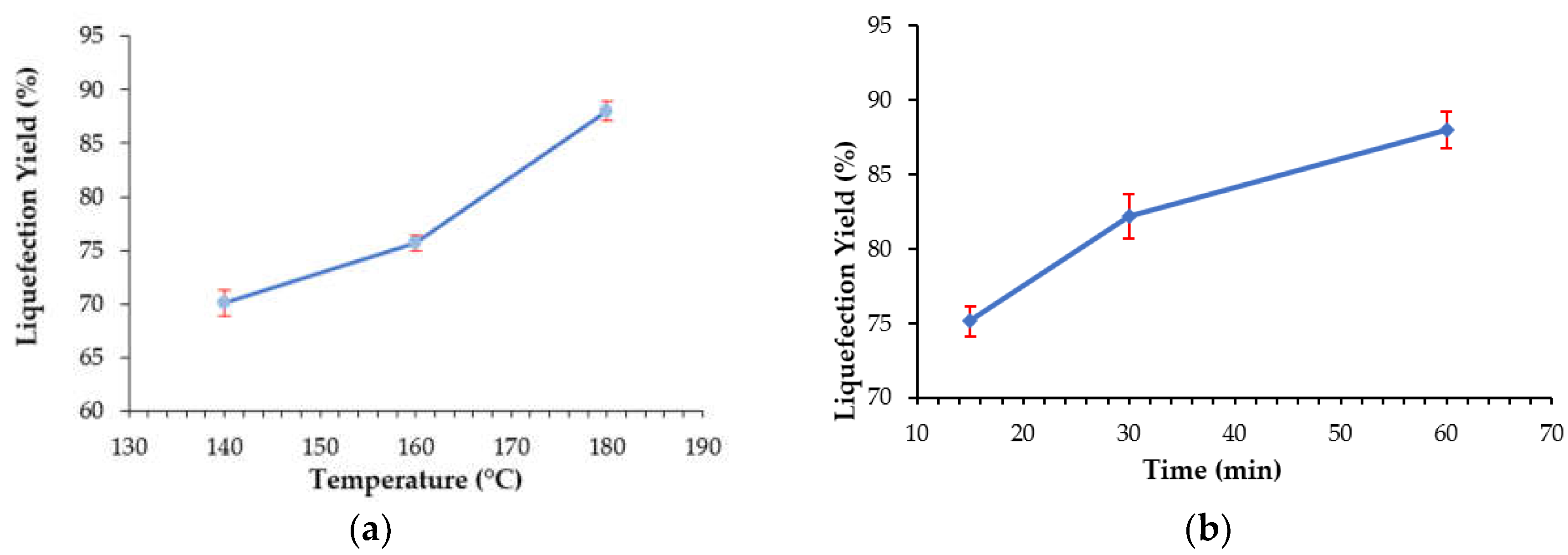
Figure 2.
Liquefaction yield variation with granulometry for loquat seeds. The process parameters kept constant were reaction time of 60 min, biomass:solvent ratio of 1:10, and temperature of 180 °C.
Figure 2.
Liquefaction yield variation with granulometry for loquat seeds. The process parameters kept constant were reaction time of 60 min, biomass:solvent ratio of 1:10, and temperature of 180 °C.
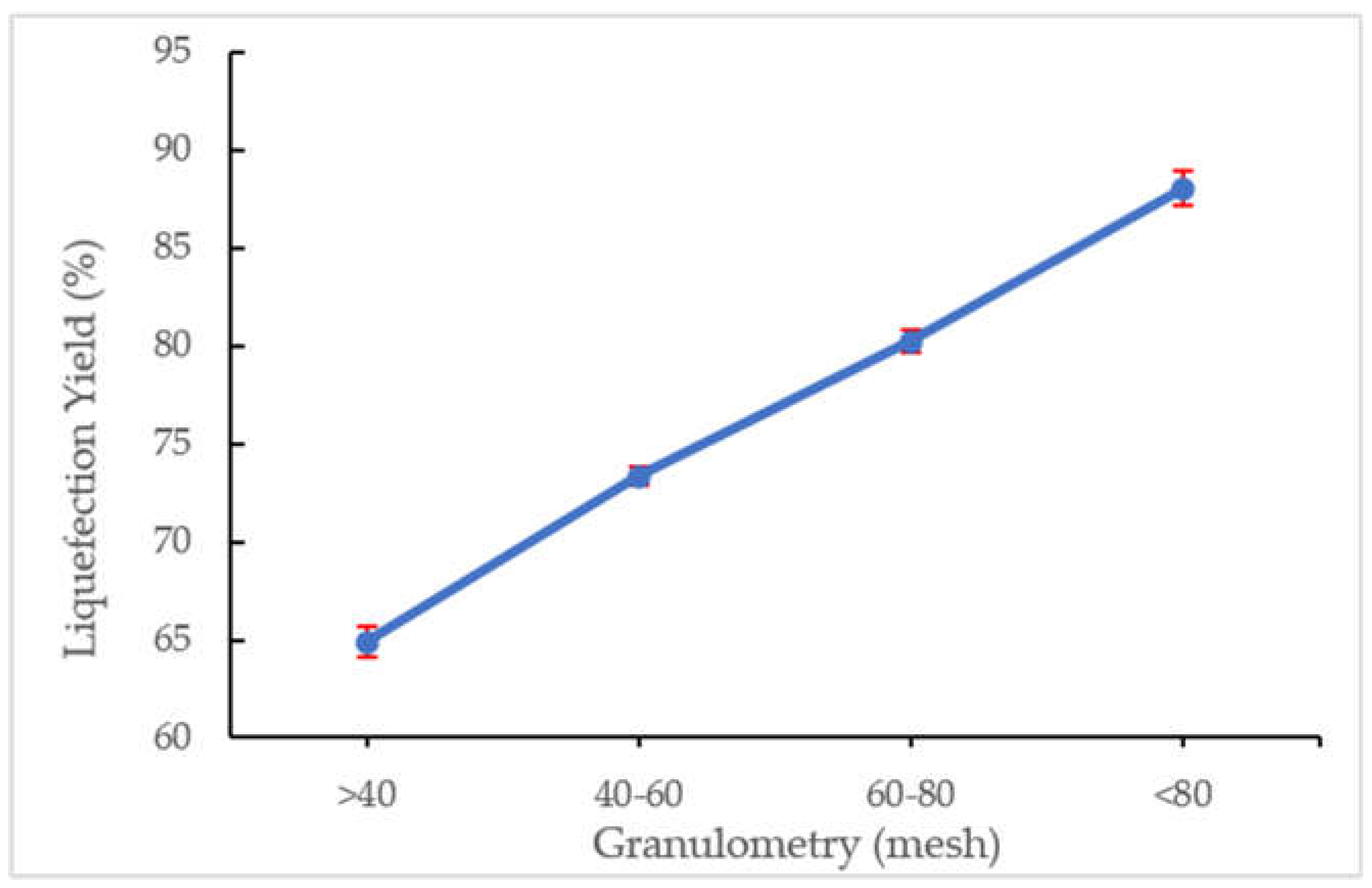
Figure 3.
Liquefaction yield variation with material-to-solvent ratio for loquat seeds.
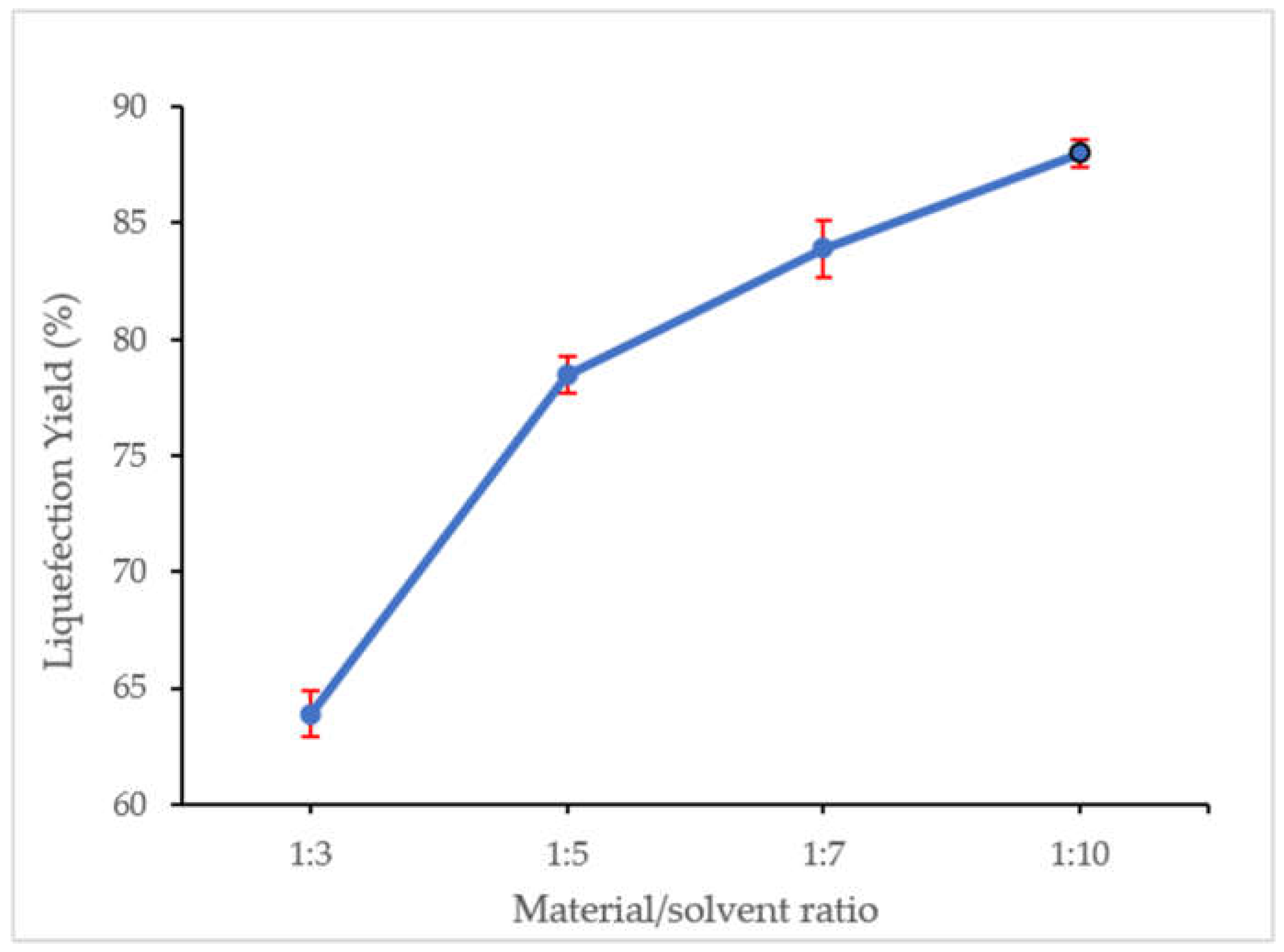
Figure 4.
OH index of loquat-seed polyols as a function of temperature (a), reaction time (b), and material-to-solvent ratio (c).
Figure 4.
OH index of loquat-seed polyols as a function of temperature (a), reaction time (b), and material-to-solvent ratio (c).
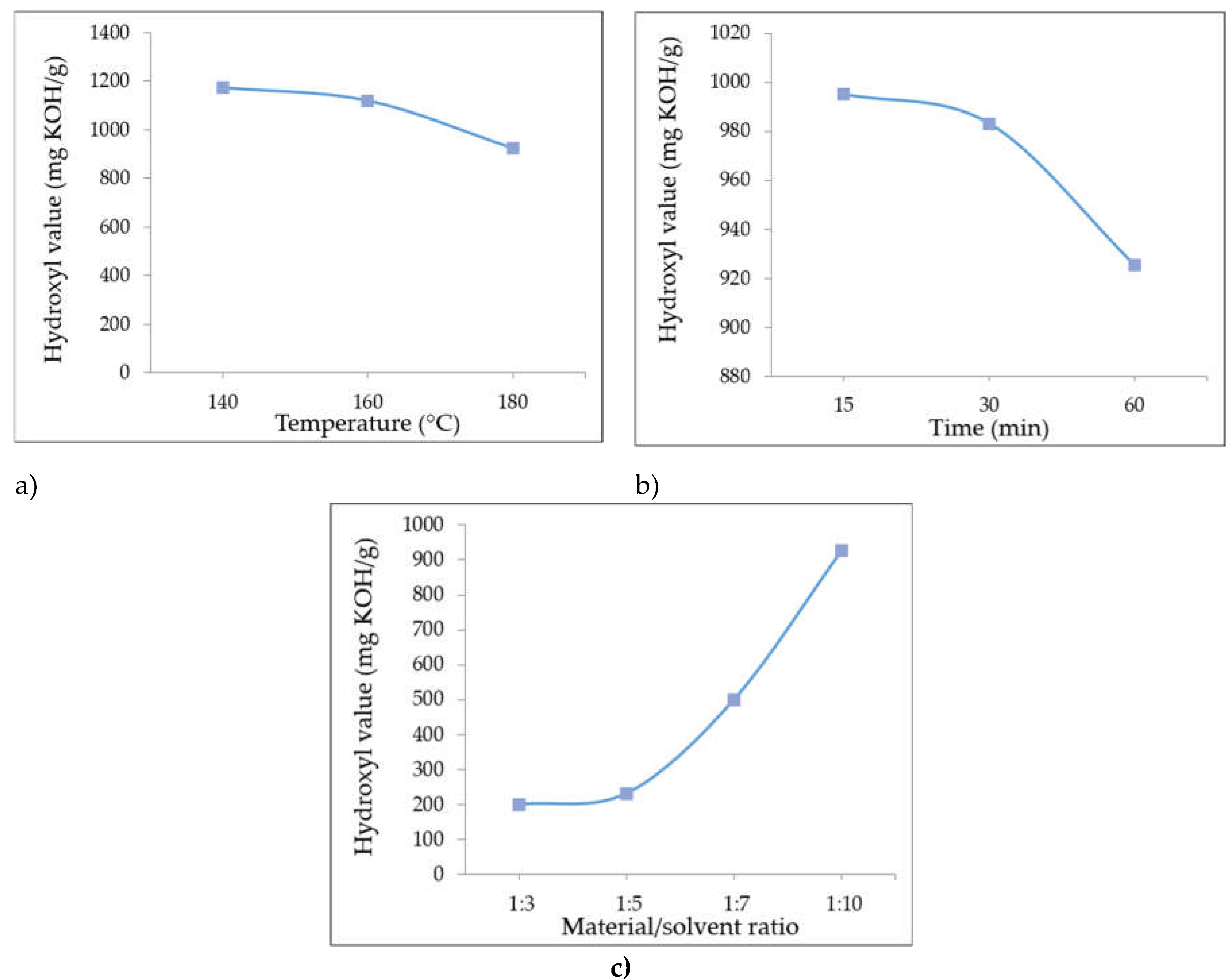
Figure 5.
FTIR-ATR spectra of loquat-seed polyols (a) and the solid residue (b) obtained by liquefaction at different temperatures with min-máx normalization
Figure 5.
FTIR-ATR spectra of loquat-seed polyols (a) and the solid residue (b) obtained by liquefaction at different temperatures with min-máx normalization
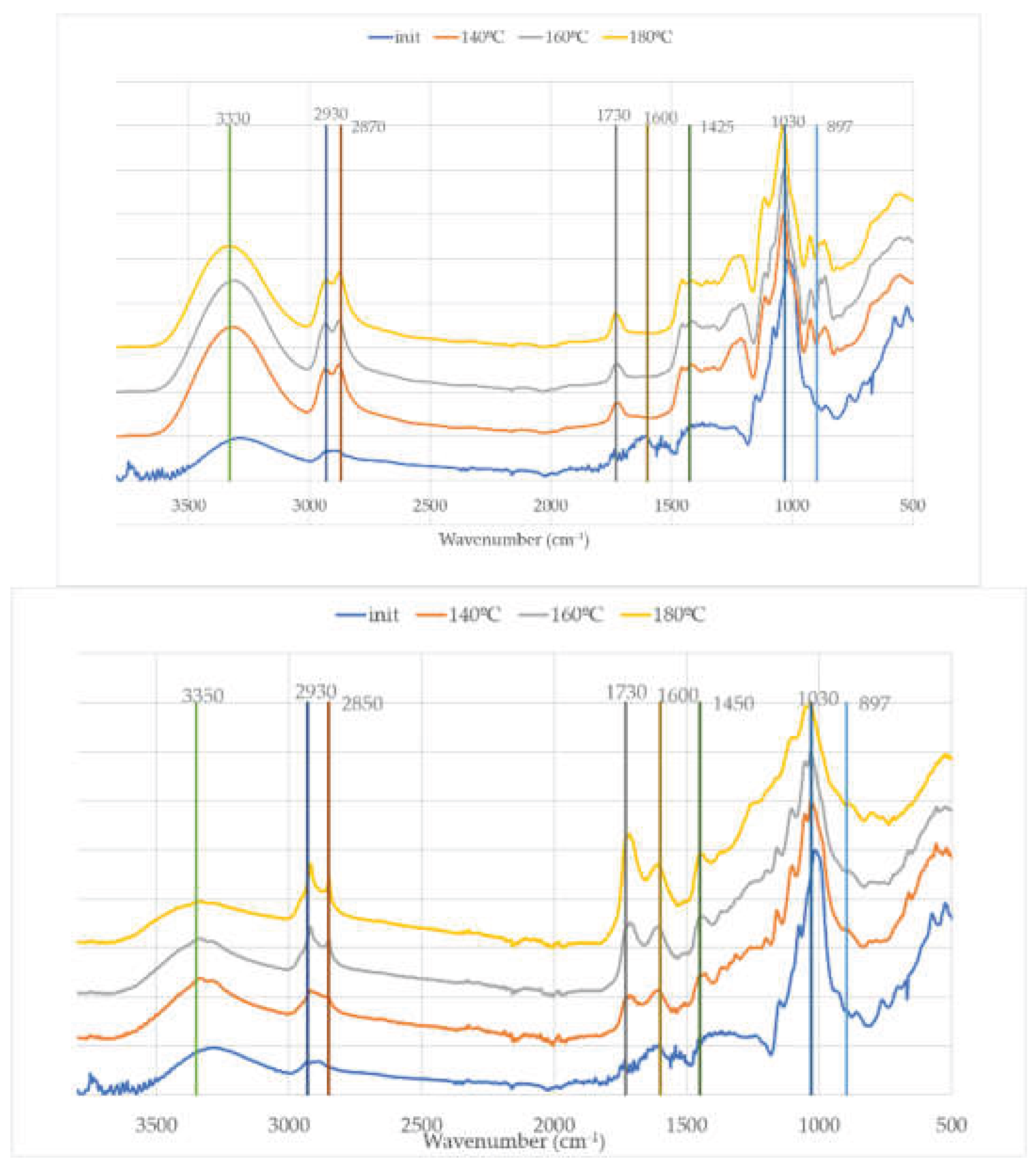

Table 1.
Chemical compositions of loquat seed.
| Parameter | Loquat seed |
| Ash wt. (%) | 2.84± 0.03 |
| Dichloromethane wt. (%) | 0.25 ± 0.03 |
| Ethanol wt. (%) | 5.61 ± 0.95 |
| Hot water wt. (%) | 18.19 ± 1.80 |
| Klason lignin wt. (%) | 10.39 ± 0.58 |
| Acid soluble lignin wt. (%) | 2.33 ± 0.12 |
| α-Cellulose wt. (%) | 21.68 ± 0.82 |
| Alkali-soluble fraction wt. (%) | 38.73 ± 0.98 |
Disclaimer/Publisher’s Note: The statements, opinions and data contained in all publications are solely those of the individual author(s) and contributor(s) and not of MDPI and/or the editor(s). MDPI and/or the editor(s) disclaim responsibility for any injury to people or property resulting from any ideas, methods, instructions or products referred to in the content. |
© 2026 by the authors. Licensee MDPI, Basel, Switzerland. This article is an open access article distributed under the terms and conditions of the Creative Commons Attribution (CC BY) license (http://creativecommons.org/licenses/by/4.0/).
Copyright: This open access article is published under a Creative Commons CC BY 4.0 license, which permit the free download, distribution, and reuse, provided that the author and preprint are cited in any reuse.