
Submitted:
10 November 2026
Posted:
12 November 2026
You are already at the latest version
Abstract
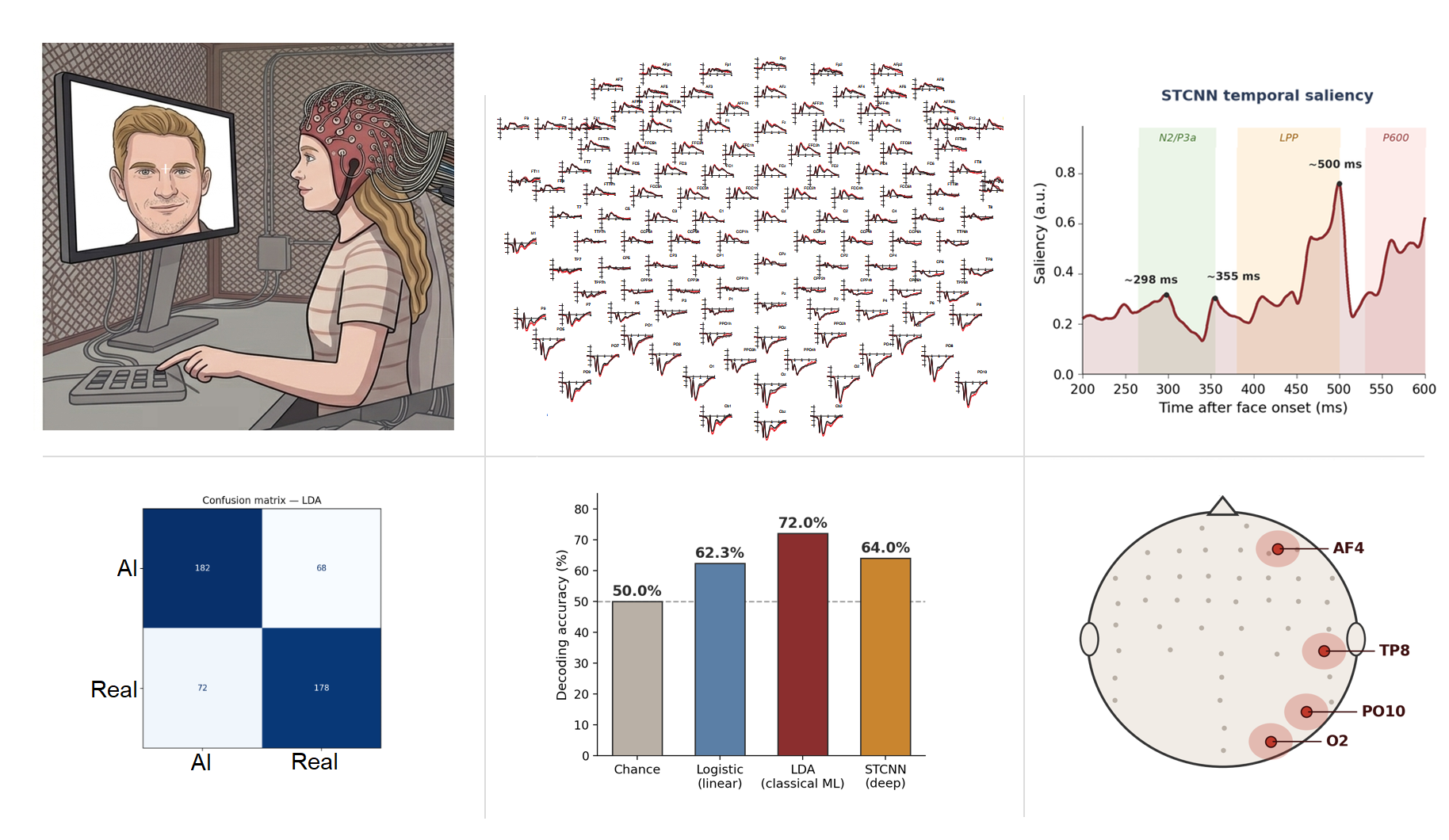
Hyperrealistic artificial intelligence (AI) generated faces are often misclassified as real, although spontaneous neural activity may still encode their artificial origin. We performed a secondary multivariate reanalysis of electroencephalography (EEG) data acquired from 26 participants viewing real and StyleGAN2-generated faces during an orthogonal target-detection task. Condition-averaged Event-Related Potentials (ERPs) from 14 selected channels and four regional Principal Component Analysis (PCA) features within 200–600 ms were analyzed using mass-univariate mapping, ridge encoding, group-aware logistic decoding, classical machine learning, a spatiotemporal Convolutional Neural Network (STCNN), and explainable-AI methods. Linear encoding was weak, whereas logistic decoding reached 0.623 ± 0.106 accuracy. In a 25-fold classical machine-learning benchmark, Linear Discriminant Analysis achieved 0.700 accuracy, increasing to 0.720 after optimization (Receiver Operating Characteristic Area Under the Curve (ROC-AUC) = 0.780), with permutation testing confirming above-chance classification (p = .001). The optimized STCNN achieved 64.0% ± 5.8% accuracy and AUC = 0.670, with significant held-out classification performance (p = .0028). Explainability analyses revealed a predominantly right-lateralized posterior occipito-temporal/temporo-parietal pattern with frontal involvement, with saliency peaks around 298, 355, and 500 ms. These findings provide preliminary evidence that late, distributed ERP activity contains decodable information distinguishing AI-generated from real faces.
Keywords:
EEG
; event-related potentials
; synthetic faces
; neural decoding
; machine learning
Copyright: This open access article is published under a Creative Commons CC BY 4.0 license, which permit the free download, distribution, and reuse, provided that the author and preprint are cited in any reuse.