

Submitted:
08 November 2026
Posted:
12 November 2026
You are already at the latest version
Abstract
The eight units modulo 30 form the vertices of a four-dimensional cross-polytope, the 16-cell. A quadratic character modulo 5 splits them into two great squares U₊ = {1, 11, 19, 29} and U₋ = {7, 13, 17, 23}. We follow this single split through a chain of classical objects and show that it organises each of them in the same way. On the golden ring ℤ[φ], primes on U₊ split into two prime ideals and primes on U₋ stay prime. On the icosian E₈ lattice the number of vectors of norm p is 120(1 + p)² on U₊ and 120(1 + p²) on U₋: two waves versus one. On the icosian Leech lattice the Hilbert theta series is the sum of exactly two Hecke eigenforms, an Eisenstein wave and a cusp wave. The cusp wave is the Doi–Naganuma lift of the newform of weight 6, level 5 and character χ₅ with coefficient field \( \)ℚ\( (\sqrt{-11}) \). Its contribution has a fixed sign on U₊ and oscillates on U₋. Restricted to the diagonal, the two waves become E₁₂ and Δ, and Ramanujan's τ(n) is half the sum of Hilbert eigenvalues along a trace line. The quotient of the Leech theta series by Δ is j − 720, where j is the modular j-function; this links the chain to Klein's icosahedral formula for j and to the moonshine module. Before counting, we show that the wheel itself carries the icosian E₈: every self-dual trace lattice on ℤ[ζ₃₀] is E₈, the turn of the wheel is a Coxeter element, \( \sqrt5 \) cuts the roots into two golden 600-cells, and over ℤ[φ] the lattice is the icosian one; doubling the wheel to 60 forces E₈ ⊕ E₈. Two genuinely arithmetic findings appear along the way. First, a Lucas rule: in all 51 weights tested (23 of them preregistered, up to k = 204), the norm of the second Hecke eigenvalue of Sk(Γ₀(5), χ₅) lies in the square class of the Lucas number Lk−1. We prove one direction for large primes and isolate the primes where the standard methods fail. These are exactly the primes q ≡ 3 (mod 4) that have a Fibonacci primitive root. Second, the prime 11 = L₅ can be followed along the whole chain: as the discriminant of the coefficient field, as a node of the golden unit, as a group of fixed points of the golden torus map on the Leech lattice, as the level of X₀(11) after restriction, and as the class 11A whose McKay–Thompson series is congruent to j − 744 modulo 11. Every statement carries a status label, and we keep proved, cited and numerically observed results apart. A final section looks back along the chain: it separates the forced steps from the two chosen ones, follows the primes 7 and 11 through every station, and explains why the chain ends in rank 24, where a lattice and its 24 oscillators first give a modular function, and how the Leech lattice sits as a null slice in the 26-dimensional even unimodular Lorentzian lattice.
Keywords:
units modulo 30
; 16-cell
; golden field
; icosians
; E8
; Leech lattice
; Hilbert modular forms
; Doi–Naganuma lift
; Lucas numbers
; Ramanujan \( \tau \)
; j-function
; moonshine
MSC: 11F41; 11H06; 11F11; 11B39; 11F80; 11F22
How to Read This Paper
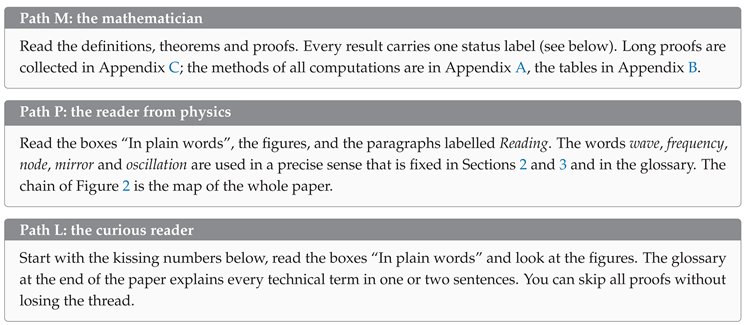
The paper is written for three kinds of readers at once. Every section has the same three layers, and each reader can follow one of them.
Status labels.
[proved]: proved here, possibly using cited standard theorems. [classical]: well known; we give a proof or a precise reference. [cited]: taken from the literature, not reproved. [observation, preregistered]: computed, with the prediction fixed in writing before the run. [descriptive]: computed or noticed afterwards, not preregistered. [conjecture]: a precise statement supported by data but not proved. [reading]: an interpretation; it is not a mathematical claim and nothing depends on it. Numerical runs were always done twice, once at 50 digits with random seed 1 and once at 100 digits with seed 2.
1. Introduction
1.1. Six Numbers
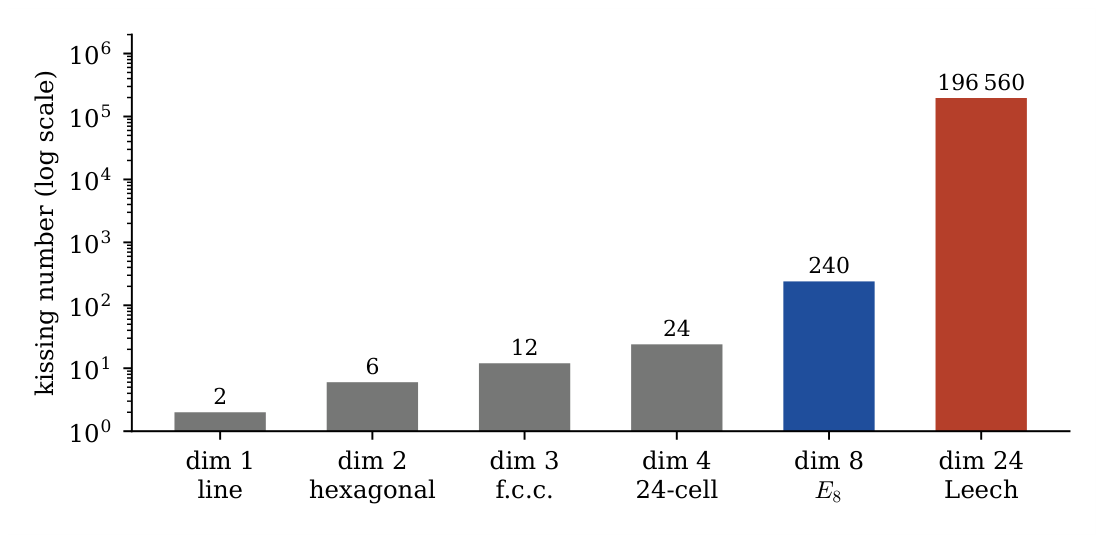
How many equal balls can touch one ball of the same size? On a line the answer is 2, in the plane it is 6, in space it is 12. In four dimensions the answer is 24, realised by the vertices of the 24-cell. Then the sequence becomes strange: in dimension 8 the answer is 240 and in dimension 24 it is . These two values are not just records. They are attained by two lattices of extraordinary symmetry, the root lattice and the Leech lattice , and in these two dimensions the answers are known to be optimal [11,38,46].
Figure 1.
Kissing numbers in dimensions (logarithmic scale). The two coloured bars belong to the lattices and that this paper builds from the units modulo 30.
Figure 1.
Kissing numbers in dimensions (logarithmic scale). The two coloured bars belong to the lattices and that this paper builds from the units modulo 30.
The Leech lattice carries even more. Its theta series, the generating function that counts lattice vectors by length, is
(with counting vectors of squared length ). Divided by Ramanujan’s discriminant function , it gives
where j is Klein’s modular invariant. The coefficient is the dimension of the smallest faithful representation of the Monster group plus one, the observation by McKay that started the theory of monstrous moonshine [6,10,21].
1.2. The Question
This paper starts much lower, with the eight residues modulo 30 that a prime larger than 5 can have,
In an earlier paper [34] we showed that these eight residues are naturally the vertices of a four-dimensional cross-polytope, the 16-cell, with the antipodal pairs as its four axes. The question of the present paper is:
Can one walk from the 16-cell of the units modulo 30 to the Leech lattice and the j-function
such that every step is forced by arithmetic,
and what does a prime “look like” at each step?
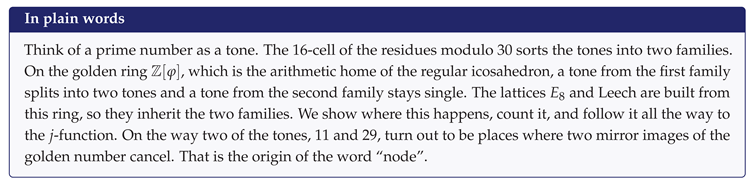
The answer is yes, and the walk is short. Every step uses classical mathematics. What is new is the observation that a single split of the 16-cell into two great squares controls every step, and two arithmetic results that appear along the way: a Lucas rule for coefficient fields and a complete trace of the prime 11.
One qualification belongs at the start. Not every step of the walk is forced in the same sense. Some steps are forced in the strict sense: there is only one object with the required property, and we prove or cite that. Other steps are a choice of route among several that lead to the same place. An example is the way from to the Leech lattice, which we take through the icosians rather than through the Golay code. We say at every step which kind it is, and Section 9 collects the answer for the whole chain.
1.3. The Chain
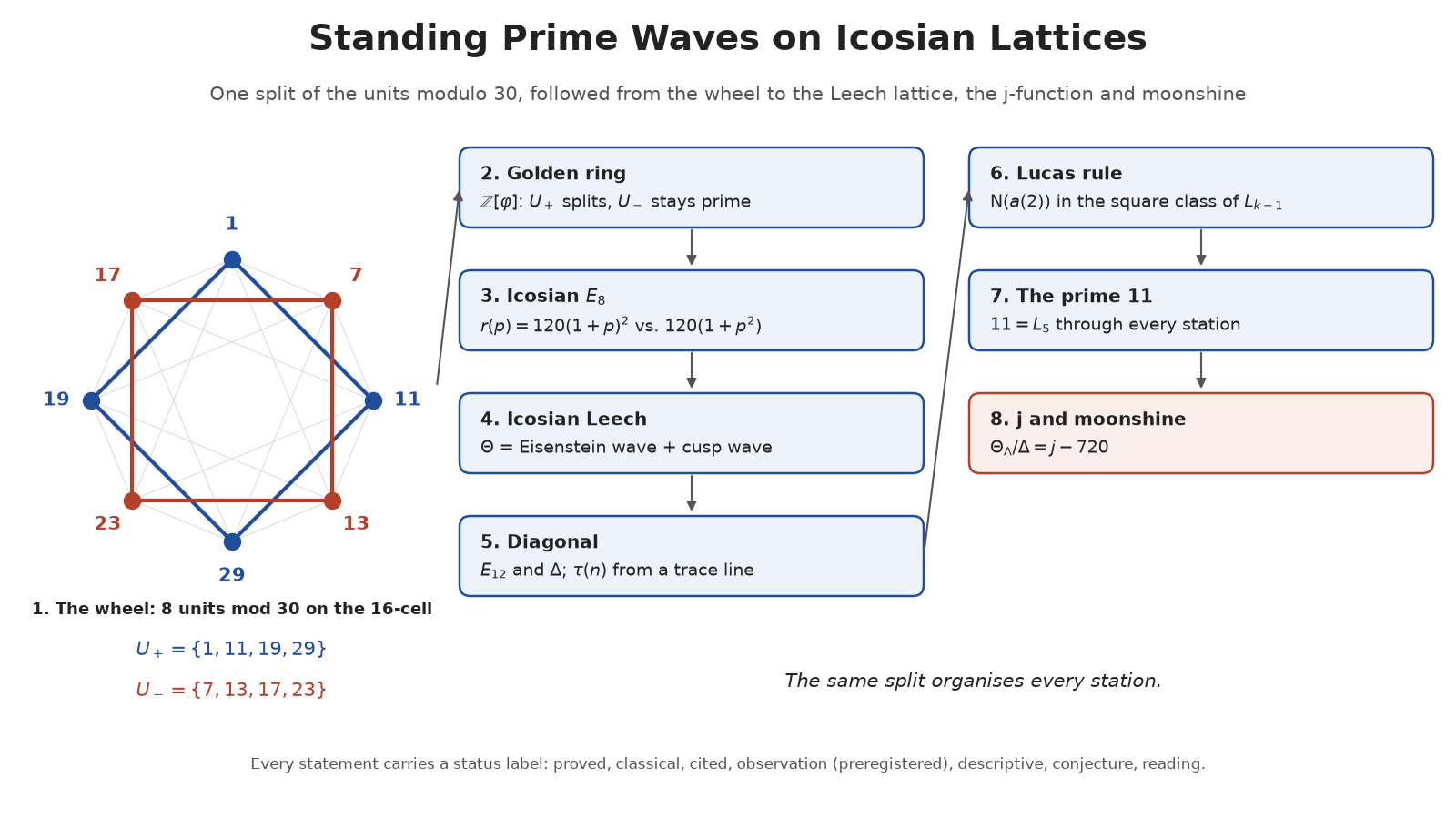
Figure 2 is the map of the paper. Each box is a section. The arrows are not a table of contents: each arrow is a mathematical map or construction, and the object at its head is built from the object at its tail. Read from top to bottom, the figure says that a prime enters on the left as a residue modulo 30 and leaves at the bottom as a contribution to the j-function.
1.4. Standing Prime Waves
The organising notion is made precise in Definition 4. Informally, a standing prime wave is a lattice theta series, or a Hecke eigencomponent of one, with three properties.
- It is a Hecke eigenform, so its L-function is an Euler product over primes. Each prime contributes a factor, a “wave” with frequency .
- Its Euler product, sorted by the residue of p modulo 30, splits along the eight characters of ; the great squares and give two waves per prime and one wave per prime, respectively.
- It is standing: it is invariant under the mirror , equivalently its completed L-function satisfies .
In the language of an applied scientist: the theta series is a superposition of plane waves on the lattice; the Euler product says that these waves are built from prime frequencies; the functional equation says that the superposition is symmetric under a reflection, so that it does not travel. This is why we call it standing. The phrase is a description, not a theorem.
1.5. Main Results
Table 1 lists the main statements with their status. The proofs that rely only on classical ingredients are given in full.
1.6. What Is New and What Is Not
All objects in this paper are classical: the 16-cell modulo 30 [34], the icosians and their [11,57], the icosian Leech lattice [11,53], its place in the genus of golden lattices [12,17,45], Hilbert modular forms over [7,42], the Doi–Naganuma lift [15], the Leech theta series and moonshine [6,10,21,32]. We do not claim new properties of these objects. Our contributions are:
- (i)
- the observation that the great-square split of the 16-cell controls every link of the chain, with exact formulas at each link (Section );
- (ii)
- the Lucas rule (Conjecture 16), which we have not found in the literature, its partial proof (Theorem 19) and the identification of the exceptional nodes (Theorems 23, 24, 26);
- (iii)
- the complete trace of the prime 11 from the coefficient field of a weight-6 form over to the class 11A and the j-function (Section 7);
- (iv)
- the golden torus map on and Leech and its fixed points (Theorem 29).
In addition, Section 3 derives from the wheel itself: every self-dual trace lattice on is with the turn as Coxeter element, the number cuts its roots into two golden 600-cells, and over it is the icosian lattice (Theorems 3, 5, 8); doubling the wheel to 60 forces (Theorem 7). Every single step there is classical in substance, and we claim only the route. A literature check is summarised at the end of each section.
1.7. How the Walk Is Organised
The chain has eight stations. A reader who walks it should know at every moment where she is, why the next station is the next one, and why each step of a proof is the step it is. We use four devices for this.
- (a)
- Each section opens with a small route map. The station treated in the section is highlighted, as in the map below for the whole paper.
- (b)
- Each section begins with a paragraph Why this step. It says what we carry with us from the previous station, what question it leaves open, and why the next object is the natural place to answer it.
- (c)
- Longer proofs are preceded by an Idea of the proof, set off by a blue rule on the left. Inside the proofs, short remarks in grey italics say why a step is needed. A reader in a hurry can skip both; the proofs are complete without them.
- (d)
- Each section ends with a paragraph What we have seen. At the end of the paper, Section 9 turns around and looks at the whole chain at once.

The boxes “In plain words” repeat the content of a section without formulas. Nothing in them is needed for the proofs.
2. The Wheel Modulo 30 and the Golden Field

Why this step.
We start where the earlier paper [34] ended: with the eight residues that a prime larger than 5 can have modulo 30, arranged as a four-dimensional polytope. At this point a prime is nothing but a residue. To get further we have to ask which structure on these eight residues arithmetic can actually see. The answer of this section is: exactly one split into two halves of four, and exactly one number field behind it, the golden field . Everything later is built on this field. So this section has two stations, the wheel and the golden ring, and its main job is to show that the passage from the first to the second is not a choice.
2.1. The 16-Cell of the Units Modulo 30
Every prime has one of eight residues modulo . We call them the spokes of the wheel modulo 30. In [34] the spokes were arranged as the vertices of the 16-cell, the four-dimensional cross-polytope . We recall the construction.
Definition 1
([34]). The fouraxesare the antipodal pairs
that is, . The smaller element of is placed at and the larger at in . Two spokes are joined by an edge unless they are antipodal.
The result is the 16-cell with f-vector : 8 vertices, 24 edges, 32 triangles and 16 tetrahedral cells. Its symmetry group is the hyperoctahedral group of order 384. Inside it sit two great squares,
each spanned by two axes. Figure 3 shows a projection.
2.2. The Great Squares as a Character
The 16-cell is a picture. To work with it we need an algebraic handle, and the natural one is multiplication: the product of two residues prime to 30 is again such a residue. A split of the eight spokes that arithmetic can see should therefore be compatible with multiplication. Such splits are given by characters, and that is where the great squares come from.
The spokes form a group under multiplication modulo 30. It is , generated for example by 11 (order 2) and 7 (order 4: , , ). Let be the Legendre symbol modulo 5, viewed as a character of .
Proposition 1 ([proved], elementary)
- 1.
- The kernel of is the great square , and is the subgroup . We write and .
- 2.
- is even: . The antipodal map is multiplication by and preserves both squares.
- 3.
- For every the norm is congruent to 0 or modulo 5. In particular, every norm of an element or ideal of that is prime to 30 lies on the square modulo 30.
Proof.(We check the three claims by hand; nothing more than arithmetic modulo 5 and 30 is needed.) (1) Modulo 5 the residues of are , all squares; those of are , non-squares. The squares of the eight spokes are 1 for and 19 for (for instance and ). (2) follows from (1). (3) (The trick is to complete the square modulo 5, where and .) Modulo 5 one has , a square. The squares modulo 5 are . Ideal norms are products of norms of prime ideals, which are p for split p, for inert p and 5 for the ramified prime; by (1) and the next proposition all of them that are prime to 30 lie in . □
Why exactly this split, and not another one into two halves of four? The next proposition answers this. It is the first place where the geometry of the 16-cell, namely its axes , decides an arithmetic question.
Proposition 2 ([proved], elementary)
- 1.
- has exactly three subgroups of index two, namely the kernels of the three quadratic characters , and .
- 2.
- Exactly one of them contains the antipodal element , that is, is a union of axes of the 16-cell. It is .
- 3.
- The quadratic fields in which the splitting of every prime depends only on are , and . Exactly one of them is real, namely , and it belongs to .

Proof. (1) A subgroup H of index two is the kernel of the character , and conversely. The characters of order two of form the subgroup of elements of order at most two of the dual group, which is ; so there are three of them. In terms of they are , and their product. (2) (An index-two subgroup is a union of axes exactly when it contains , because then it contains together with every r.) We have , and . So only contains , and by Proposition 1 it is . (3) A prime splits in the quadratic field of discriminant D iff the Kronecker symbol equals 1. This symbol is a primitive character of conductor , so it factors through iff divides 30. The fundamental discriminants with are , 5 and (a fundamental discriminant is or divisible by 4, and ). The field is real iff , which leaves , with character . □
So the split is forced twice: it is the only multiplicative split that respects the axes of the 16-cell, and it is the only split that comes from a real quadratic field. The second statement is the reason why the golden field appears. We shall need a real field because the lattices of the later sections are positive definite over it, and positivity needs real embeddings.
The eight characters of are the products of the two characters modulo 3 and the four characters modulo 5. Let be the non-trivial character modulo 3 (odd) and a character of order 4 modulo 5 (odd), so that is even. Then
In [35] the parity of these eight characters was shown to decide the gamma factor of the associated L-function. In this paper only matters.
The product towers.
The 16-cell is the Cayley graph of with connection set . Its adjacency operator is diagonalised by the characters, and the eigenvalue at is , which is 6 for , for every other even character, and 0 for every odd character. In [36] the 16-cell was lifted through the primorials by commuting product towers, and the eigenvalues were used to read off conductors. For the present paper one fact from there is essential: is even, so the great-square split is visible to the spectrum of the 16-cell, with eigenvalue . The odd characters are invisible to every product tower [36]; the split we follow is not of that kind.
2.3. The Golden Ring
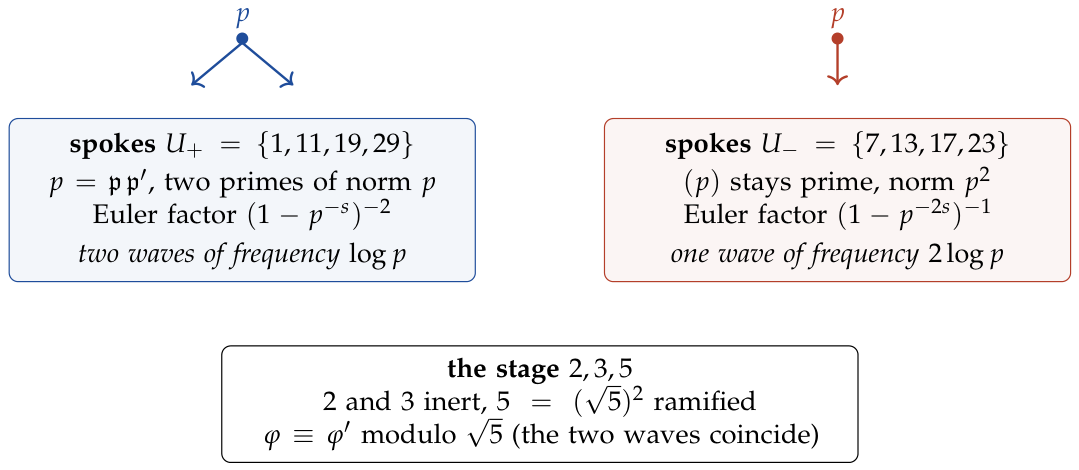
Proposition 2 has handed us a field. The next step is to look at its integers, because primes live in rings, not in fields. In the ring of the golden field a prime from the blue square will break into two pieces and a prime from the red square will not. This is the first place where the split becomes visible as an event that happens to a single prime.
Let and , with conjugate . The ring of integers is ; it has class number one, and its unit group is , with . The totally positive units are exactly the squares . We use for the golden ratio throughout. (Some of our sources write ; we reserve for Ramanujan’s function.)
Proposition 3 ([classical]) Let p be a prime.
- 1.
- ramifies: .
- 2.
- For , p splits as with if , and stays prime with if .
- 3.
- For : p splits ⇔; p is inert ⇔ . The primes 2 and 3 are inert.
Consequently , and the Euler factor of at is
Proof.(Dedekind’s criterion turns the question “does p split?” into the question “does have a root modulo p?”.) and the discriminant of is 5. By Dedekind’s criterion, splits iff has a root modulo p, that is iff 5 is a square modulo p, and by quadratic reciprocity iff . For example, with , while has no root modulo 7, so 7 stays prime. The statement about spokes is Proposition 1(1), and . The Euler factor is . □
Figure 4.
How a prime enters the golden ring , sorted by its spoke modulo 30.

2.4. The Group Modulo 30 and the Mirror
So far the icosahedron has been in the background: is the ring in which the coordinates of the icosahedron live. Before we use it to build lattices, we check that the icosahedral group is really attached to the wheel modulo 30, and not only to the number 5. The bridge is the group of matrices modulo 30. Its determinant is a spoke, and its part modulo 5 is the binary icosahedral group. This gives a second, group-theoretic view of the same split.
Theorem 1 ([proved]from classical pieces)
- 1.
- By the Chinese remainder theorem,of order , where and are the binary tetrahedral and binary icosahedral groups.
- 2.
- is surjective, so .
- 3.
- Let . Conjugation by preserves . On the factor it is an inner automorphism if and an outer automorphism if . In the latter case it exchanges the two conjugacy classes of elements of order 5 (twelve elements each).
- 4.
- There is no non-trivial homomorphism .

Proof. (1) as rings, and commutes with products. The isomorphisms , and are classical [11]. (2) . (3) (The claim concerns only the factor , so we may reduce modulo 5.) Only the residue matters on the third factor. If is a square, then is a scalar times an element of , and conjugation by a scalar is trivial; so the automorphism is inner. If is not a square, conjugation by maps to and changes the square class of b. The two -classes of non-trivial unipotent elements are distinguished by the square class of b, so the automorphism exchanges them and is not inner. Multiplying by carries this over to the elements of order 5 (the classes of ± unipotents), each of size 12. By Proposition 1, is a square iff . (4) is perfect and is abelian. □
The two classes of elements of order 5 in correspond to the two Galois positions of , that is, to the two embeddings and ; geometrically to the two inscribed 600-cells that one obtains from the 120 units of by the two choices of sign of . So the outer automorphism for is the Galois conjugation of the golden field, seen inside the group.
Reading 2 ([reading]) The diagonal matrix is a “mirror” in the space of matrices. Theorem 1 says that a mirror with determinant on the blue square acts on the icosahedral group as a rotation would, while a mirror with determinant on the red square interchanges the two golden worlds and . Part (4) says that the group of the icosahedron cannot be “seen” by the wheel directly; it enters only through the field . This is the reason why the passage from the wheel to goes through the golden ring.
2.5. Klein’s Icosahedral Formula for j
Before we leave the first station we look ahead to the last one. The reason is that the end point of the chain, the j-function, is already attached to the icosahedron by a classical formula of Klein. This tells us that a road from the golden field to j exists. What it does not tell us is how a single prime travels along it. That is the question of the rest of the paper.
The icosahedral group enters the theory of the j-function directly. Let be the Rogers–Ramanujan continued fraction, a Hauptmodul for , and the quotient is the rotation group of the icosahedron. Then [16,30]
The denominator is the fifth power of Klein’s vertex form , whose twelve roots on the Riemann sphere (including ∞) are the twelve vertices of the icosahedron [30]. The numerator is the cube of the face form, of degree 20. Equation (1) is the classical shortcut from the icosahedron to j. Our chain is the long way round, through the lattices, and it ends at the same j (Section 8).
What we have seen.
A prime larger than 5 is a spoke of the wheel modulo 30. Of all ways to cut the eight spokes into two halves, arithmetic sees exactly one that respects the axes of the 16-cell, and it is cut out by the character (Proposition 2). Behind there is exactly one real quadratic field, . In its ring a blue prime becomes two prime ideals and a red prime stays one (Proposition 3). The same split decides whether a diagonal matrix acts on the icosahedral group as a rotation or as the Galois mirror (Theorem 1). We now have a ring and a group. The next step uses both to build a lattice.
Literature.
The 16-cell structure and the great squares are from [34]; the characters and their parity from [35,36]; Proposition 3, Proposition 2(1),(3) and Theorem 1(1),(2),(4) are textbook facts. We have not seen Theorem 1(3) phrased as a statement about spokes modulo 30, but it is an immediate consequence of the structure of .
3. The Icosian : One Wave or Two per Prime

Why this step.
From Section 2 we carry two things: the golden ring , in which every prime is either one ideal or two, and the binary icosahedral group , the part of the matrix group modulo 30 that the wheel cannot see directly. The question left open is how to count with them. A split of a prime into two ideals is a yes-or-no event. To turn it into a number that can be compared, added and multiplied, we need a lattice: a lattice has a theta series, and the theta series counts vectors of each length. The natural lattice is forced on us, and it can be reached by two roads. The first road starts from the wheel itself: its eight spokes are the eight embeddings of the ring , and the single demand that this ring carry a self-dual lattice produces , with the turn of the wheel as its most symmetric rotation and with cutting its roots into two golden 600-cells (Section ). The second road starts from the group: the ring and the group live in the same place, the quaternions with golden coordinates, and the smallest ring that contains both is the icosian ring. Its lattice is again . In Section 3.6 we show that the two roads end in the same lattice over . The first road explains where and its 600-cells come from; the second is the one with which we can count.
3.1. The Wheel as a Ring
In Section 2 the spokes were residues. To build a lattice from them we need more than residues: we need a ring in which the spokes are directions of a space. There is exactly one ring that is made from the wheel and nothing else, the ring generated by a primitive 30-th root of unity.
Let , and , the ring of integers of C. (We keep the letter K for the golden field , which is a subfield of C.) The field C has degree 8 over , one dimension per spoke. Its embeddings into are
so the spokes are the embeddings. The maps and are complex conjugate, so the eight spokes give four complex coordinates, one for each axis of the 16-cell. We write
where is the plane of the coordinate .
Definition 2.
Theturn of the wheelis the map , . In the plane it is the rotation by the angle .
The characteristic polynomial of on is the cyclotomic polynomial , and its eigenvalues are with . In the language of reflection groups, the exponents of are exactly the eight spokes. Nothing has been chosen here: the ring treats all spokes alike.
Figure 5.
The wheel modulo 30 as a ring. The eight spokes are the eight embeddings of . The colours are the two great squares of Figure 3; they will decide on which half of the number is positive (Section 3.4).
Figure 5.
The wheel modulo 30 as a ring. The eight spokes are the eight embeddings of . The colours are the two great squares of Figure 3; they will decide on which half of the number is positive (Section 3.4).
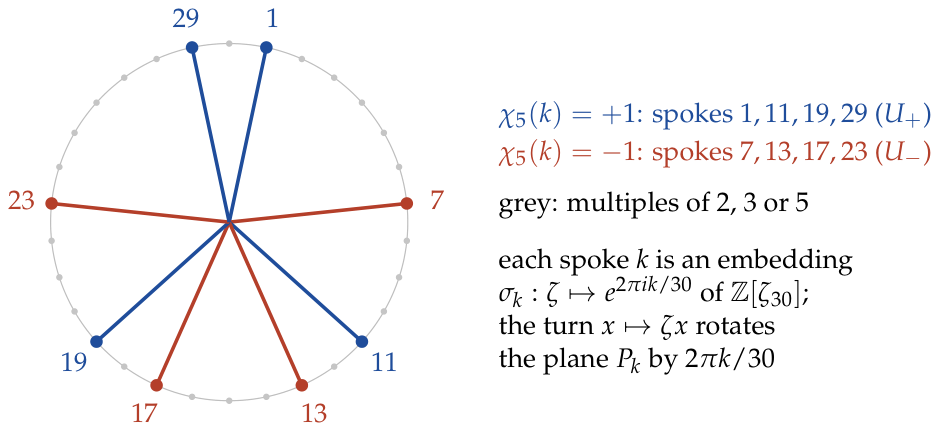
3.2. Self-Duality Forces
A lattice needs a ruler. On the natural rulers are trace forms:
where lies in the real subfield and is totally positive. We call a trace lattice on the wheel. In coordinates,
so the vector is the orthogonal projection of x to the plane of spoke k, and . Since , the turn is an isometry for every . We impose a single condition: the lattice shall be its own dual, .
Lemma 1 ([proved]; special case of [3]) If is integral, then is even for all .
Proof.(Evenness comes from complex conjugation: every value is a trace over a field twice as large as the real subfield.) Since 30 is not a prime power, is unramified at all finite primes, so the different satisfies . Integrality of means , hence and . □
Lemma 2 ([classical]) is unimodular if and only if . Such α exist: with , m the minimal polynomial of θ, and a unit ε of chosen to make α totally positive.
Whether such a unit exists depends on the signs of under the four real embeddings and is not automatic. For 30 it exists: is an ideal lattice of trace type over [3], and we found the unit explicitly (Observation 4).
Theorem 3 ([proved]with cited ingredients) Every positive definite unimodular trace lattice on is isometric to , and the turn is a Coxeter element of the Weyl group .

Proof.
By Lemma 1 the lattice is even. An even unimodular positive definite lattice of rank 8 is [11]. The turn is an isometry, so it lies in . Its eigenvectors are dual to the embeddings , and for every root ( is a field embedding, hence injective). So the eigenvector for lies on no reflecting hyperplane; it is regular in Springer’s sense. A regular element of order , the Coxeter number of , is a Coxeter element [51]. □
So the statement “the exponents of are ” is, seen from the wheel, not a coincidence: once the wheel carries a self-dual lattice, the lattice is and its exponents are the spokes. The facts are classical [3,33,48]; we claim no novelty for Theorem 3.
Observation 4 ([observation, preregistered]) With as in Lemma 2 the Gram matrix , , is integral, even, of determinant 1, with exactly 240 vectors of norm 2; the turn has characteristic polynomial and splits the roots into 8 orbits of 30. Checked at 50 and 100 digits with two random changes of basis.
The choice of is a gauge.
Lemma 2 leaves the unit free. This freedom changes nothing.
Proposition 4 ([proved], one computed input) Any two admissible weights are related by with a unit , and is an isometry from to that commutes with the turn. In each plane it acts as a rotation by an angle in , so radii, shells and the assignment of rings to shells below do not depend on α.
Proof.
Two admissible weights generate the same ideal , so with a totally positive unit of . The computed input (PARI) is that every totally positive unit of is a norm from C. Then . By Kummer’s lemma is a root of unity in C, so is a 60-th root of unity. □
3.3. The Coxeter Plane: Eight Rings of Thirty
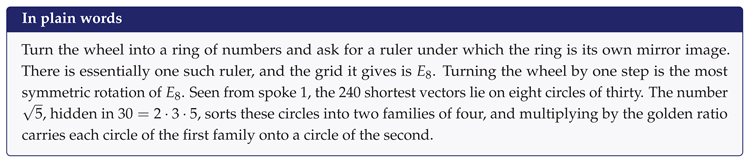
The plane is the eigenplane of the Coxeter element for the eigenvalue , the Coxeter plane. The projection of a root r to it is just the complex number : the reading of the root on spoke 1. The turn rotates and preserves , so the 240 roots lie on circles (Figure 6).
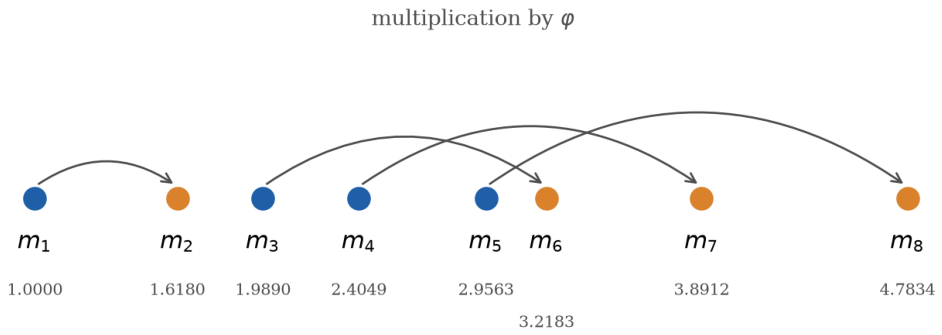
Proposition 5 ([classical]; [20,31,33]) The 240 roots lie on 8 rings of 30 in the Coxeter plane. The radii are proportional to the Perron–Frobenius vector of the Dynkin graph, that is, to the masses of the affine Toda theory [4,59]. Normalised by :
Among them , , , .
The values were confirmed on the explicit lattice of Observation 4 to 100 digits ([observation, preregistered]). The four golden pairs reappear in Theorem 5, where we show that they are not a coincidence of numbers but the shadow of a single multiplication.
3.4. Where Lives: Two Golden Shells
Because , the field C contains , and so it contains the golden field K. The Galois group of C is itself (the automorphism sends to ), and it acts on through the character of Proposition 1:
So the great squares of the 16-cell reappear as the two halves of on which is positive or negative.
Proposition 6 ([proved]) with and . The subgroup preserves both halves; every exchanges them and acts on K as .
Proof.
Extend -linearly to . Then and , so maps the coordinates of to those of , which is or according to . □
The map is a ring automorphism but in general not an isometry of ; the proposition is about subspaces, not about lengths. Spoke 11 is the -partner of spoke 1.
For a root r put
the squared lengths of the projections of r to . Figure 7 shows the outcome before we prove it: only two values occur.
Theorem 5 ([proved]) Let be any positive definite unimodular trace lattice on . Then:
- 1.
- For every root r, with . There are exactly two shells, the small shell () and the big shell ().
- 2.
- Multiplication by φ is a bijection with inverse multiplication by . In particular , and the ratio of the two radii in is φ.
- 3.
- Every ring of the Coxeter plane lies in one shell, and multiplication by φ maps each ring of , of radius ρ, onto a ring of , of radius .
- 4.
- The small shell consists of the rings , the big one of the rings , , , .
The proof of (1) and (2) uses only three facts about the wheel: , , and evenness. It uses no coordinates and does not depend on . Parts (3) and (4) use in addition the eight distinct radii of Proposition 5. The golden number lies on the wheel: , since .
Lemma 3 ([proved]) For put . Then for the two real embeddings of K (with ), and .
Proof.
, and are the complex conjugates of . Hence , and likewise for . For , . So lies in the trace dual of , the inverse different . □

Proof
(Proof of Theorem 5). Step 1 (a window of five values). Every element of has the form with , and its trace to is n. For a root, , so , is even, and with . Both are positive, so and .
Step 2 (evenness removes three of them).( is again a lattice vector, so its norm must be even.) Since ,
using and . By Lemma 1 this is even, so is odd: . This proves (1).
Step 3 (the golden bijection). If , then , so is a root, and , so . In the same way, for one gets and . With 240 roots in total, . Since , the radius in grows by the factor . This proves (2).
Step 4 (rings)., so is constant on orbits of the turn. Every orbit of a root has exactly 30 elements ( with forces in the domain ); so there are 8 orbits, and as the eight radii of Proposition 5 are distinct, the rings are exactly these orbits. Multiplication by commutes with the turn and multiplies by . This proves (3).
Step 5 (which masses). By (3) the set M of the eight radii is a disjoint union with . The smallest radius is not times another, so and . Next, , and are not in M, so , and their images are . This proves (4). □
Figure 8.
The proof of Theorem 5 on one line. The arithmetic of the wheel allows five values of ; positivity keeps them, evenness keeps only . Multiplication by moves a root from the small to the big shell.
Figure 8.
The proof of Theorem 5 on one line. The arithmetic of the wheel allows five values of ; positivity keeps them, evenness keeps only . Multiplication by moves a root from the small to the big shell.
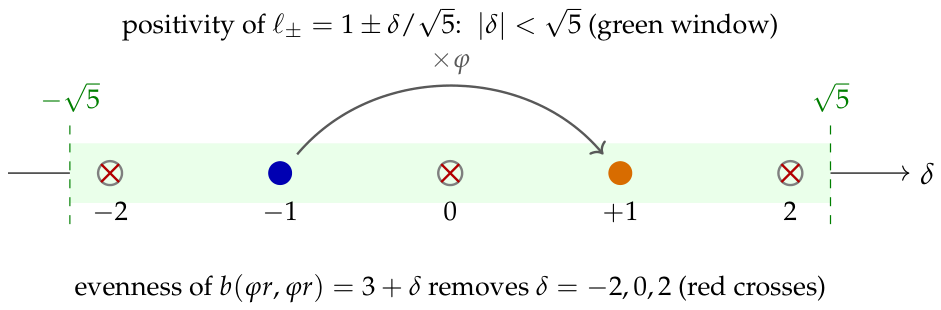
Figure 9.
The eight radii of the Coxeter plane. Blue: small shell, orange: big shell. Each arrow is multiplication by on the lattice (Theorem 5(3)); it sends a whole ring of 30 roots to another ring.
Figure 9.
The eight radii of the Coxeter plane. Blue: small shell, orange: big shell. Each arrow is multiplication by on the lattice (Theorem 5(3)); it sends a whole ring of 30 roots to another ring.
Remark 1
(status of Theorem 5). All four parts are classical in substance. Parts (1)–(2) are the folding of onto two copies of the root system, scaled by φ [2,11,19,41]; in the Coxeter plane the roots form two copies of the projection with relative factor φ [14]. Part (4) is stated by Koca and Koca [31]; for the Toda masses see also [23]. The -structure of coming from an element of with centraliser is in [48]. What the proof above does differently is only the route: it starts from the cyclotomic trace form, passes to K by Lemma 3 and excludes by evenness of , for every admissible α. We found it nowhere in this form, but we claim no novelty for it.
Observation 6 ([observation, preregistered]) For and two further admissible weights the following hold exactly or to : for all 240 roots; ; and with 120 each; the ring map under is , , , . The same holds on with roots.
3.5. The ICOSIANS
We now take the second road, from the group side. Hamilton’s quaternions with have the norm . The 120 unit quaternions
form the binary icosahedral group , and as points of they are the vertices of the 600-cell [11]. Their coordinates lie in the golden field .
I is a free -module of rank 4 (so a free -module of rank 8) and a maximal order in the definite quaternion algebra , which is unramified at every finite prime of K. Its reduced norm takes totally positive values on . Every left ideal of I is principal [55]. The units of I with norm 1 are exactly the 120 elements of .
The reduced norm takes values in , not in . To get an ordinary lattice we need a ruler that turns golden numbers into integers. A trace does this, but the plain trace gives a lattice of determinant , not 1. The correction is to multiply by a generator of the inverse different, the smallest fractional ideal on which the trace is still integral. This is the only choice that can make the lattice unimodular, and every totally positive generator gives an isometric lattice (two such generators differ by a totally positive unit , which is absorbed by ).
Let . Then is totally positive and generates the inverse different of , and
since . For we put
Why should the answer be , and not some other lattice of rank 8? Because there is no other: is the only even unimodular positive definite lattice in dimension 8. So once we know that the ruler E makes I even and unimodular, the name of the lattice is forced.
Proof
(Sketch). The form is even, integral and unimodular [11], and an even unimodular positive definite lattice of rank 8 is isometric to . For the roots: means for , and by Lemma 4 below the only totally positive with are and . The elements of norm are the with . □
Lemma 4 ([proved], elementary) Let be totally positive with .
- 1.
- For : .
- 2.
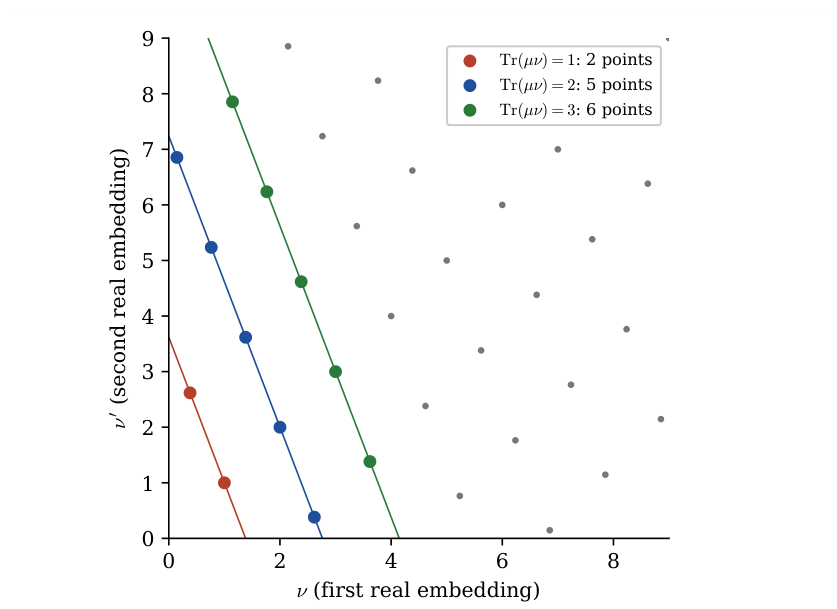
- for all , where F is the Fibonacci sequence. Hence a totally positive unit lies on the line only if n is an odd-indexed Fibonacci number , and then there are exactly two of them, and (for : 1 and ).
- 3.
- The number of totally positive ν on the line is finite; it is for .

Proof. (1) Write with . Then and . Both are positive iff , that is , giving and . (2) (Powers of φ have Fibonacci coefficients, and the trace adds the two coefficients.) , and by (2). The identity gives . (3) In the coordinates the line is the segment in the positive quadrant, which contains finitely many lattice points. The counts are obtained as in (1). □
Figure 10.
Totally positive elements of in the plane of the two real embeddings . The trace lines for are drawn; they carry 2, 5 and 6 points. The lattice vectors of the icosian (and later of the Leech lattice) of half-norm n are spread over the points on the n-th line. The line contains only the units 1 and .

3.6. Two Roads, One Lattice
We now have two copies of : the trace lattice on the wheel (Theorem 3) and the icosian lattice (Proposition 7). As lattices over they are trivially the same, because there is only one . The question that matters is finer. Both carry a multiplication by , that is, a structure of -module: on the wheel because , on the icosians because I is an -module by construction. Are the golden shells of Theorem 5 the icosians of norm 1 and of Proposition 7? Only if the two -structures agree can we pass from the wheel to the icosians without losing the golden multiplication. They do.
Proposition 8 ([proved]with a cited ingredient) Let be a positive definite unimodular trace lattice on , let H be as in Lemma 3, and as in (2).
- 1.
- is a free -module of rank 4, and is a totally positive quadratic form whose polar form is unimodular over .
- 2.
- There is an -linear bijection with for all x. It is an isometry from onto the icosian .
- 3.
- Ψ maps the big shell onto the 120 units and the small shell onto .

Proof. (1) is a principal ideal domain and is torsion-free of -rank 8, so it is free of rank 4. (First we sharpen Lemma 3 from to , using evenness.) For we have by Lemma 1. Every is congruent to a square modulo , because and squaring is bijective on ; and for , by Lemma 3. Hence for all , that is , and . Let . Then and . Since generates , an -submodule satisfies iff . So the -dual of under is its -dual under , and unimodularity over is unimodularity of over . Finally for , since is totally positive.
(2) By (1), is a positive definite even unimodular -lattice of rank 4. The icosian ring with its reduced norm is another one: N is -valued and totally positive, and its polar form, the reduced trace of , is unimodular because I is a maximal order in a quaternion algebra unramified at all finite primes. By Maass [40] (see [45]) such a lattice is unique up to -linear isometry. This gives . Since and , is an isometry of -lattices as well.
(3) For a root r, by Theorem 5. For , , so . For , , so . By Proposition 7 these are exactly and . □
The scaling is not adjusted to make this work: it is the same constant that Section 3 needed for the icosians, now forced from the wheel side by evenness. The proof of (1) uses no computation.
The golden 600-cells.
With Proposition 8 the shells of Theorem 5 become concrete polytopes.
Proposition 9 ([proved]; the count of 16-cells is[classical]) Projected to , the big shell is the vertex set of a regular 600-cell and the small shell that of a second 600-cell, smaller by the factor φ. On the roles are exchanged. Each 600-cell contains exactly 75 inscribed 16-cells [13].
Proof.
Under , the space becomes , the real quaternions, and
So projects to the 120 unit quaternions of , scaled by : the vertices of a 600-cell [11]. The shell projects to times the same set. On the conjugation is applied to all coordinates; goes to its Galois conjugate, again the vertex set of a 600-cell, and , so now is the bigger one. The 600-cell has 25 inscribed 24-cells, each containing 3 inscribed 16-cells [13]. □
On the explicit lattice we checked ([observation, preregistered]) that the normalised inner products within each shell take only the values , that every point has 12 nearest neighbours (an icosahedron), and that each shell contains exactly 75 sets of four mutually orthogonal antipodal pairs.
Corollary 1 ([proved]; classical in substance) Under Ψ the turn becomes an -linear automorphism of of order 30. On it is a Coxeter element of , the symmetry group of the 600-cell, and its exponents are
the blue great square of the 16-cell.
Proof.
The turn commutes with (the ring is commutative) and preserves H, hence q. So lies in , which acts faithfully on and preserves the 600-cell ; so it lies in its symmetry group [27]. On it rotates by and , so its eigenvalues are with . An eigenvector for pairs with every vertex of the 600-cell to a multiple of , so it lies on no mirror of . By Springer’s criterion [51], with Coxeter number 30 for , it is a Coxeter element. □
So the two squares of the wheel have now acquired a second meaning. All eight spokes are the exponents of (Theorem 3). The four spokes of the blue square, on which is positive, are the exponents of , the group of the 600-cell. The list of exponents of is in every table [27]; what the corollary adds is the reason seen from the wheel: it is the kernel of .
Figure 11.
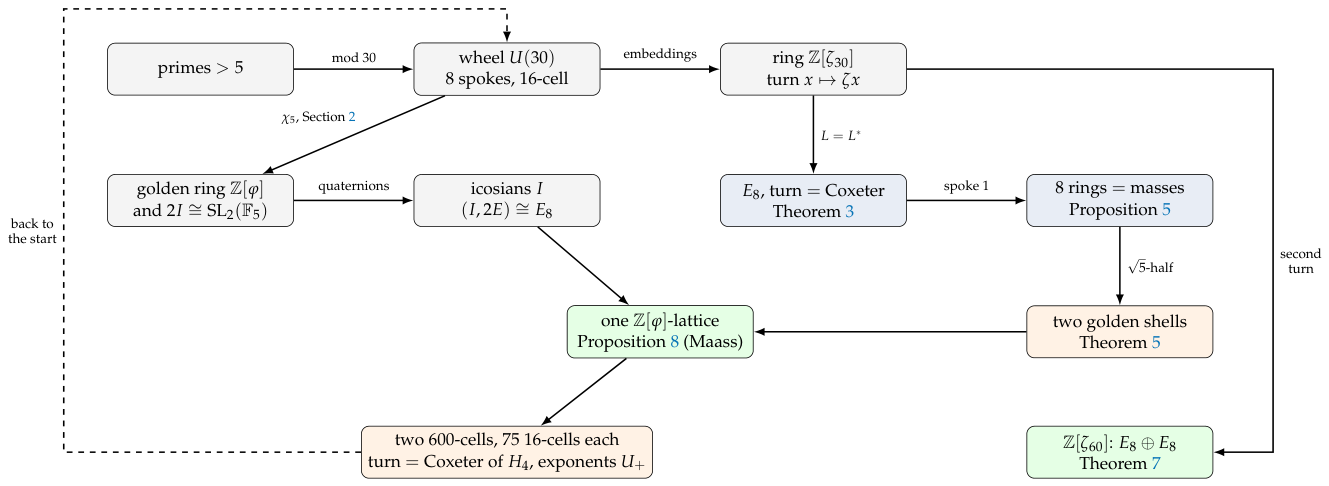
Two roads to one lattice. Upper road: the wheel becomes a ring, self-duality gives , the Coxeter plane gives the masses, gives two golden shells. Lower road: the golden field and the icosahedral group give the icosians. The two roads meet in one -lattice (Proposition 8). The dashed arrow closes a loop: the 16-cell of the start reappears 75 times inside each 600-cell.
The second turn: forces .
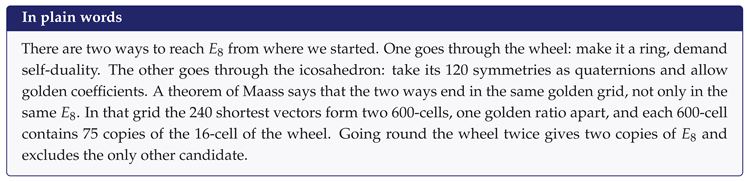
Going twice around the wheel means passing from 30 to 60. The spokes become , sixteen of them, and has rank 16. In rank 16 there are exactly two even unimodular lattices, and , with the same theta series. The doubled wheel decides between them.
Theorem 7 ([proved]; classical in substance, cf. [44]) Every positive definite unimodular trace lattice on is isometric to , never to . The turn exchanges the two components, and acts on each of them as a Coxeter element.


Proof.
The lattice is even (as in Lemma 1; 60 is not a prime power), unimodular and of rank 16. Every automorphism of preserves the 480 roots of , hence is a signed permutation. Its characteristic polynomial is a product of factors with . If the irreducible polynomial divided it, it would divide one factor, which forces , so . Hence the lattice is . If fixed each component, would split into two factors of degree 8 over ; so exchanges them. The characteristic polynomial of is , hence on each component D. Since generates and preserves D, the component is a torsion-free -module of rank one, hence isomorphic to an ideal, and since has class number one, to itself. An invariant symmetric form on C satisfies , so for a unique . Thus D is a positive unimodular trace lattice on , and Theorem 3 applies. □
Nebe uses the same argument for [44]. Bayer-Fluckiger and Taelman [5] decide which polynomials occur as characteristic polynomials of automorphisms of even unimodular lattices; that gives existence, not the exclusion. For 40 and 48 the same count excludes , but there the square of the turn has resp. on each component and is not a Coxeter element. Only 60 gives two copies of the wheel modulo 30, each with its two golden 600-cells (Observation 6). A second, independent way to separate the two rank-16 lattices is the harmonic test of Appendix C.
3.7. Counting Icosians of a Given Norm
Now we can ask the question for which we built the lattice: how many icosians have a given norm? For a prime this is the place where the split of Section 2 turns from a yes-or-no event into a number.
For totally positive let and let be the divisor sum over integral ideals of .
Theorem 8 ([classical];[observation, preregistered]to ) For every totally positive ,
In particular, for a rational prime p and :
We give two proofs. The first is arithmetic and explains the number 120 as the order of . The second is modular and explains it as .


(ideals)).Proof (First proof (Step 1: count ideals locally.) Since I is a maximal order in a quaternion algebra unramified at all finite primes, the local completions are isomorphic to . In the number of integral left ideals of reduced norm is , the number of sublattices of index in a rank-two lattice that are not contained in , summed over all levels. (Step 2: multiply over all primes.) Multiplying the local counts, the number of integral left ideals of I of reduced norm is [55]. (Step 3: count generators.) Every such ideal is principal, , with for a totally positive unit ; replacing x by we may assume . The generators of with norm exactly are the with , , that is . So each ideal contributes exactly 120 elements. □
The second proof explains the same number from the other side. It does not count anything. It uses the fact that the space of possible generating functions is so small that the answer has nowhere else to go. This style of argument, “the space is small, so the form is determined by one or two coefficients”, will carry the whole chain up to the j-function.
(modular forms)).Proof (Second proof The Hilbert theta series is a Hilbert modular form of parallel weight 2 for the full group , because I is unimodular with respect to and has rank 4 over [7]. The space of such forms is one-dimensional and spanned by the Eisenstein series
so and . □
The value is classical (Siegel). It is worth noting that the modulus of the wheel appears here once more: .
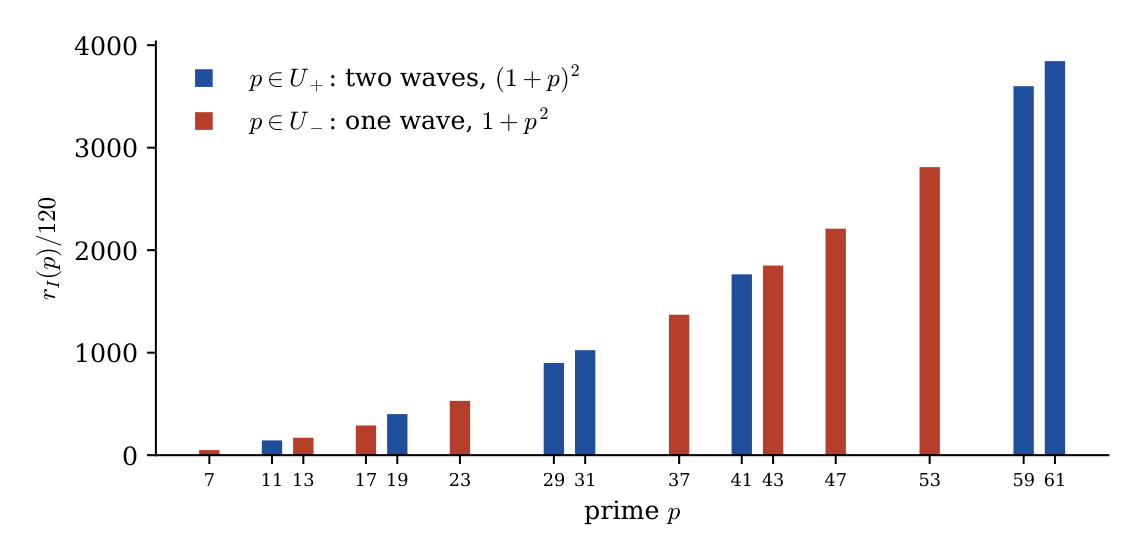
Observation 9 ([observation, preregistered]) Before computing, we fixed in writing that holds for all with , that the prime values sort by spoke as in Theorem 8, and that the coefficients of the diagonal theta series satisfy the Hecke relations for . We enumerated all non-zero icosians with . They fall on 1039 distinct totally positive norms; all 1039 counts, all prime values and all 111 Hecke relations in this range agree with the prediction (two runs, Appendix A).
Figure 12.
The number of icosians of norm p, divided by 120, for the primes . Blue: spokes , where p splits and the count is . Red: spokes , where p is inert and the count is . A blue prime always has more icosians than a red prime of similar size: the difference is , the contribution of the two prime ideals .
3.8. Euler Factors per Spoke
The Dirichlet series of the counts is
where by Proposition 3
On the spokes the local factor is a square: two identical factors, one for and one for . On the spokes there is one factor in the variable .
3.9. Standing Prime Waves
We have now seen two features of the icosian count. It is built prime by prime (the Euler product), and each prime contributes one factor or two according to its spoke. A third feature is hidden in the second proof of Theorem 8: the theta series is a modular form, so it is symmetric under the mirror . These three features together are what we shall meet at every later station. It is time to give them a name.
Definition 4.
Let be even. Astanding prime wave of weight k over Kis a Hilbert modular form F of parallel weight k for such that
- (a)
- F is an eigenform of all Hecke operators , with eigenvalues and after normalisation;
- (b)
- F occurs as a component of the Hilbert theta series of an even unimodular totally positive -lattice (with respect to ).
Its L-function is . For a Dirichlet character χ modulo 30 we call
thecharacter waveof F in the direction χ.
Such an F has an Euler product. Its completed L-function
satisfies , because the level is one and the sign of the functional equation over a real quadratic field is for even k [7]. This symmetry under , which comes from the mirror , is what “standing” refers to. The examples in this paper are (weight 2, from ), and the cusp form (weight 6, from the Leech lattice).
Lemma 5 ([proved]) For every character χ modulo 30, . Hence a standing prime wave over K has at most four distinct character waves, one for each character of the great square .
Proof.(The golden ring only produces norms on the blue square, so cannot distinguish anything.) If is prime to 30 then by Proposition 1(3), so . Otherwise both sides vanish at . Restriction to maps the eight characters modulo 30 onto the four characters of , with kernel ; so the fibres are exactly the pairs . □

What we have seen.
The wheel, read as the ring and made self-dual, is ; its turn is a Coxeter element, its eight rings in the Coxeter plane are the masses, and sorts its roots into two golden 600-cells (Theorem 3, 5). The ring and the group of Section 2 combine into the icosian ring, and with the only ruler that makes it unimodular it becomes as well. By a theorem of Maass the two are one and the same lattice over (Proposition 8); under this identification the blue square is the set of exponents of (Corollary 1). Counting its vectors by norm turns the split into numbers: a blue prime p is carried by icosians, a red prime by (Theorem 8). In the language of L-functions, a blue prime gives two equal waves and a red prime one wave of double frequency. The three features of this count, Euler product, spoke split and mirror symmetry, define a standing prime wave. The icosian carries exactly one of them, the Eisenstein wave . To see a second, genuinely new wave we need a larger lattice. A lattice of rank r over has a theta series of parallel weight , and the first weight in which a cusp form for exists is 6 [42]. So we need rank 12 over , three times the rank of I. The next section builds such a lattice from three copies of I.
Literature.
The trace lattices on and their evenness are in [3]; the Coxeter plane, the rings and the masses in [31,33,48]; the golden folding in [11,14,19,41]; the uniqueness of the rank-4 lattice over in [40,45]; the exclusion of by a cyclotomic polynomial in [44]. The route from the wheel, Theorem 5 in the form given and Proposition 8, assembles these pieces; we claim no novelty for them. Proposition 7 and the counting formula are classical [11,55,57]. The sorting of the counts by spokes modulo 30 and Lemma 5 are elementary consequences that we have not seen stated in this form.
4. The Leech Lattice from Two Points of

Why this step.
Section 3 ended with a requirement: to carry a second wave, a lattice over must have rank 12, three times the rank of the icosians. The obvious candidate is , but it is too simple. Its theta series is the cube of that of I, so it carries no new wave, and it has 720 vectors of the smallest length. To get something new we must change a little: pass to a sublattice and rescale, so that it stays even and unimodular but loses its short vectors. Such a change is called gluing, and it has to happen at a prime. We glue at the smallest prime of , the prime 2. This is a choice of route, due to Tits; there are other constructions of the Leech lattice. But once this route is taken, everything else is forced, and the gluing data turn out to be the five points of a projective line.
4.1. The Construction
The Leech lattice can be built from three copies of the icosian glued along the prime 2 [11,53,57]. The prime 2 is inert in (it lies on the stage of Figure 4), with residue field , and the residue ring of the icosians is
because the quaternion algebra is unramified at 2. The left ideals of I of reduced norm correspond to the left ideals of of dimension two, that is, to the lines in . There are five of them: they are the points of the projective line . This is also the count of Theorem 8, and the icosians of norm 2 are the generators of these five ideals.
Definition 5.
For two left ideals of reduced norm let
with the quadratic form
The classical choice is , with , [11].
Lemma 6 ([classical]) For all the lattice has index in and, with the form of Definition 5, determinant 1.
Proof.(We need to know that gluing does not destroy unimodularity: the index exactly compensates the rescaling of the form by .). The map , , is surjective (take and solve), and its kernel is ; so the index is . The lattice has determinant 1 for the form , hence has determinant for and determinant for E. □
Theorem 10 ([proved]from [11,53];[observation, preregistered]) Let be left ideals of I of reduced norm .
- 1.
- If , then is isometric to the Leech lattice . All 20 ordered pairs of distinct points of give the same lattice up to isometry.
- 2.
- If , then , and it is isometric to .

Proof. (1) For the map is a ring automorphism of I that preserves N, hence E. It maps a left ideal P to the left ideal , and is an isometry . The group acts on the five ideals as acts on , and this action is 2-transitive. So all ordered pairs of distinct ideals give isometric lattices, and the classical pair gives the Leech lattice [11,53]. (Alternatively: by Conway’s theorem the Leech lattice is the only even unimodular lattice of rank 24 without vectors of norm 2 [11], and Observation 11 checks these properties for every pair.)
(2) (The idea is to isolate x by combining the conditions with coefficients 3 and 2.) Let . Then , and because for any generator h of P. Hence , and likewise . So , and the reverse inclusion is clear. Write with . Then maps I onto P with , so and . □
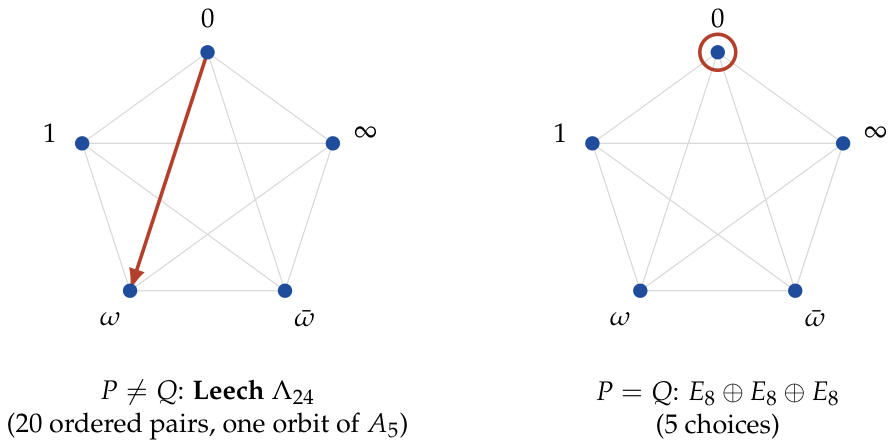
Observation 11 ([observation, preregistered]) We fixed in writing beforehand that all 20 pairs give an even unimodular lattice without vectors of norm 2, with , and vectors of norms , and that the 5 pairs give the theta series . Both runs confirmed all of this, and the conjugation action of on the five ideals was found to have order 60 with a single orbit of length 20 on ordered pairs.
Figure 13.
The five left ideals of norm 2 in the icosians are the five points of the projective line over . An arrow from P to Q (left) gives the Leech lattice; a loop (right) gives three orthogonal copies of . The only choice in the construction is “two points or one”.
Figure 13.
The five left ideals of norm 2 in the icosians are the five points of the projective line over . An arrow from P to Q (left) gives the Leech lattice; a loop (right) gives three orthogonal copies of . The only choice in the construction is “two points or one”.
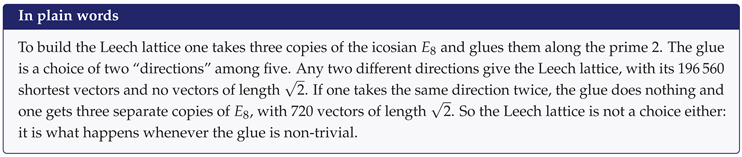
The difference between one point and two points can be measured exactly. It is a single modular form, and it is the first appearance of Ramanujan’s in this paper.
Proposition 10 ([classical]) Let and . Then
Equivalently, and .
Proof.
Both theta series are modular forms of weight 12 for with constant term 1 (because both lattices are even unimodular of rank 24). Their difference has constant term 0, so it is a cusp form of weight 12, hence a multiple of , the only such form up to scalars. The coefficient of q is the number of vectors of norm 2: 720 for and 0 for Leech. So the difference is . Finally by definition. □
So the glue removes exactly the 720 shortest vectors of , and in the language of the j-function it removes exactly the number 720 from j. We shall meet the quotient again at the end of the chain (Section 8).
4.2. The Golden Structure
The trace form forgets that the Leech lattice was built over . For the waves of the next section we need to keep this structure, because the character and the split of the primes live there.
Put for . On the Leech lattice h takes values in , it is totally positive, and the Leech norm is . With this -valued form is an even unimodular totally positive definite -lattice of rank 12 [17,45]. Such lattices form a single genus, which has 15 classes [12,17]. The icosian Leech lattice is the class called golden in [45]: its trace form is the Leech lattice and it has no roots. Its -linear automorphism group is
where is the Hall–Janko group [26,45].
Observation 12 ([observation, preregistered]) For all 20 pairs we verified that is closed under multiplication by , that the -valued form is integral and even, that the -Gram determinant is a totally positive unit, and that the form is totally positive definite. So each lies in the genus of Costello–Hsia and Dummigan–Fretwell. A smoke test of the Kneser 2-neighbour code of Appendix A reproduced and the number of 2-neighbours.
What we have seen.
Three copies of the icosian , glued at the prime 2, give the Leech lattice. The gluing data are two points of the projective line over , and there is no freedom left: any two distinct points give Leech, a single point gives (Theorem 10). The difference between the two outcomes is the form (Proposition 10). Over the Leech lattice keeps its golden structure; it is the golden class in a genus of 15. We now have a lattice of the right rank, and we can look at the waves it carries.
Literature.
5. The Two Waves of the Leech Lattice

Why this step.
We now have the Leech lattice as a lattice of rank 12 over . In Section 3 the icosians carried exactly one standing prime wave, and we went to rank 12 because that is the first rank in which a second one can exist. The question of this section is whether it does, and what it is. The answer again comes from the smallness of a space of modular forms: in weight 6 there is room for exactly two waves, and the Leech lattice uses both. After that we make two moves. We ask where the new wave comes from, and find the character of the wheel once more, now as the character of a form of level 5. And we return from the golden field to the rational numbers, because the j-function at the end of the chain lives over .
5.1. The Hilbert Theta Series of the Leech Lattice
For totally positive let , where with and h is the -valued form of Section 4. The Hilbert theta series
is a Hilbert modular form of parallel weight 6 for , since is even unimodular of rank 12 over [7]. Setting recovers the ordinary theta series, because :
We call this restriction the diagonal and write ; it maps Hilbert modular forms of parallel weight k to elliptic modular forms of weight for , and cusp forms to cusp forms.
The space of Hilbert modular forms of parallel weight 6 has dimension 2 [7,42]. It is spanned by the Eisenstein series
with , and by the normalised cusp form
which is a Hecke eigenform; is its Hecke eigenvalue at .
Proof.(This is the same argument as the second proof of Theorem 8, one dimension higher: a two-dimensional space needs two conditions, the constant term and one more coefficient.) Since , for some constant c (the constant terms are both 1). The coefficient at counts the with ; these have , and the Leech lattice has no vectors of norm 2. So . □
So the Leech lattice, read over the golden field, is the superposition of exactly two standing prime waves in the sense of Definition 4: the Eisenstein wave , whose eigenvalues are the divisor sums , and the cusp wave . The second has the weight , which is fixed by the single condition “no roots”.
Example 1.
Remark 2 ([cited]) In the language of [17], the Kneser 2-neighbour operator on the 15 classes of the genus has eigenvectors ; only (Eisenstein) and have Siegel theta series of degree , and the degree-one theta series of is the Doi–Naganuma lift of the form f below [17]. Writing the Leech class as , Theorem 13 shows . The components are open (Section 10).
5.2. The Cusp Wave Comes from Level 5
The Eisenstein wave is completely explicit: its eigenvalues are divisor sums. The cusp wave is not, and its eigenvalues carry all the fine structure. To understand them we look for a simpler object that produces them. Over a real quadratic field there is a classical source of such forms, the Doi–Naganuma lift: it takes an elliptic modular form whose level is the discriminant of the field and whose character is the character of the field, and produces a Hilbert modular form. For the discriminant is 5 and the character is , the character that cut the wheel into its two squares. So the wheel modulo 30 returns here, one level down, as the character of a form of level 5.
The cusp wave is not new: it is the Doi–Naganuma lift of an elliptic newform of level 5 [15]. Let
be a newform in , a space of dimension 2 spanned by f and its Galois conjugate . Its coefficient field is . For a form with character, for , so is real on the spokes and purely imaginary on the spokes . The Fricke involution maps f to a multiple of [1]: the single form f does not satisfy a functional equation by itself, only the pair does. The Doi–Naganuma lift merges the pair into one form of level 1 over K, and that form is standing.
Proposition 11 ([cited][15];[observation, preregistered]) is the Doi–Naganuma lift of f. Its eigenvalues are
We verified this independently (two runs, Appendix A): once from products of Eisenstein series of level 5 over , once by counting the icosian Leech lattice over K and solving (3) for . For split p the eigenvalue at is .
Theorem 14 (Spoke rule,[proved]from Proposition 11) For ,
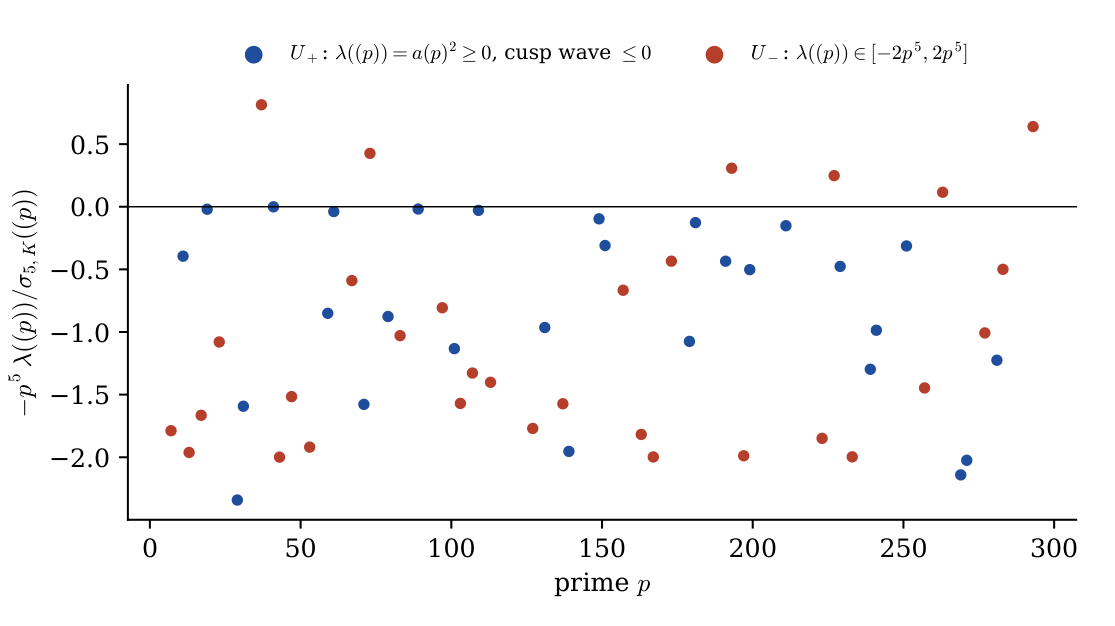
Hence in (3) the cusp contribution is for every prime on the spokes , while on the spokes it oscillates and can take both signs.
Proof.(Everything is in Proposition 11; we only have to read off signs.) The formula is Proposition 11 with by Proposition 3. On , so , and Deligne’s bound gives . □

Table 2.
The prime p in both lattices. : icosians of norm p (Theorem 8). : coefficient of the level-5 form f. : eigenvalue of the cusp wave at the ideal (for : at , where ). : vectors of the icosian Leech lattice with , by (3). On the spokes () is an integer and ; on the spokes .
Table 2.
The prime p in both lattices. : icosians of norm p (Theorem 8). : coefficient of the level-5 form f. : eigenvalue of the cusp wave at the ideal (for : at , where ). : vectors of the icosian Leech lattice with , by (3). On the spokes () is an integer and ; on the spokes .
| p | spoke | in | ||||
|---|---|---|---|---|---|---|
| 2 | – | inert | 600 | 20 | 37 800 | |
| 3 | – | inert | 1 200 | 90 | 2 217 600 | |
| 5 | – | ram. | 3 720 | 4 975 | 367 234 560 | |
| 7 | 7 | inert | 6 000 | 30 050 | 10 623 312 000 | |
| 11 | 11 | split | 17 280 | 252 | 63 504 | 975 566 592 000 |
| 13 | 13 | inert | 20 400 | 728 330 | 5 185 097 971 200 | |
| 17 | 17 | inert | 34 800 | 2 363 810 | 75 825 353 318 400 | |
| 19 | 19 | split | 48 000 | 48 400 | 230 601 482 496 000 | |
| 23 | 23 | inert | 63 600 | 6 946 370 | 1 558 131 205 276 800 | |
| 29 | 29 | split | 108 000 | 48 024 900 | 15 823 615 078 656 000 | |
| 31 | 1 | split | 122 880 | 6752 | 45 589 504 | 30 827 810 635 776 000 |
| 37 | 7 | inert | 164 400 | 180 860 190 459 379 200 | ||
| 41 | 11 | split | 211 680 | 39 204 | 504 852 269 334 336 000 |
Figure 14.
The cusp wave of the Leech lattice, sorted by spokes. Plotted is , the share of the cusp wave relative to the Eisenstein wave, rescaled by , for . Blue: spokes , always . Red: spokes , both signs. Up to 59 the red values are negative except at (Table 2).
Figure 14.
The cusp wave of the Leech lattice, sorted by spokes. Plotted is , the share of the cusp wave relative to the Eisenstein wave, rescaled by , for . Blue: spokes , always . Red: spokes , both signs. Up to 59 the red values are negative except at (Table 2).
5.3. The Diagonal: , and Ramanujan’s
The waves of the golden field are functions of two variables , one for each real embedding of K. The j-function has one variable. To move towards it we set . This is the simplest way back from K to , and it is not an arbitrary one: on the theta series it gives back the ordinary theta series of the Leech lattice, as we saw above. On the waves it gives forms of weight 12 for , and that space is again two-dimensional, spanned by and . So the two golden waves become the two classical waves of weight 12.
Theorem 15 ([classical];[proved])
- 1.
- , where .
- 2.
- For every ,
- 3.
- , and .

Proof. (1) is a cusp form of weight 12 for , hence a multiple of . Its coefficient at is the sum of over the points of the trace line , which by Lemma 4 are the units 1 and ; so it is . (2) is the coefficient of in (1). (3) Apply D to Theorem 13: . The classical formula then gives . □
Example 2.
For the trace line carries six points:
The sum is 504, so . For the five points of Example 1 give .

Remark 3 ([descriptive]) The values and cancel in the example. We checked whether is structural. It is not: in weights it holds for none of the Hecke eigenforms.
What we have seen.
Over the golden field the Leech lattice is the sum of exactly two standing prime waves, and the only reason is that the space in weight 6 is two-dimensional (Theorem 13). The cusp wave is the Doi–Naganuma lift of a form of level 5 with character . Its sign is fixed on the blue square and oscillates on the red square (Theorem 14). On the diagonal the two waves become and , and Ramanujan’s becomes a sum along a golden trace line (Theorem 15). We could now go straight to the j-function, along the dashed arrow of Figure 2. But the form of level 5 has left a question behind: why is its coefficient field ? The next two sections answer it, and the answer will lead us back to the golden unit.
Literature.
Theorem 13 for the Leech lattice over is implicit in the theory of the golden genus [17,26,45]; the Doi–Naganuma identification is classical [15]. The spoke rule Theorem 14 is a two-line consequence that we have not seen stated. The trace formula Theorem 15(2) is the standard restriction of a Hilbert form to the diagonal, applied to ; the unit lemma explains the factor 2.
6. Lucas Interference: Primes as Nodes of the Golden Unit

Why this step.
The cusp wave of the Leech lattice comes from a form of level 5 whose coefficient field is (Section 5). Why 11? This section answers the question for all weights at once. The answer is a mechanism, not a coincidence: the prime 11 is the first place where the golden unit and its Galois conjugate cancel.
The detour is not optional. In Section 5 the form f was the source of the cusp wave, so any arithmetic of f is arithmetic of the Leech lattice over . The field is generated by , and 2 is the prime at which we glued. We therefore study in all weights at once and look for the rule behind it. The route through this section is: first the Lucas numbers as two conjugate waves and their nodes (elementary), then the coefficient fields of the forms of level 5 (observed in 51 weights), then one direction of the rule as a theorem, and finally the converse under hypotheses that fail exactly at 11. That failure is the reason for Section 7.
6.1. Two Conjugate Waves
Definition 6.
For put and , the Lucas and Fibonacci numbers: , , , so
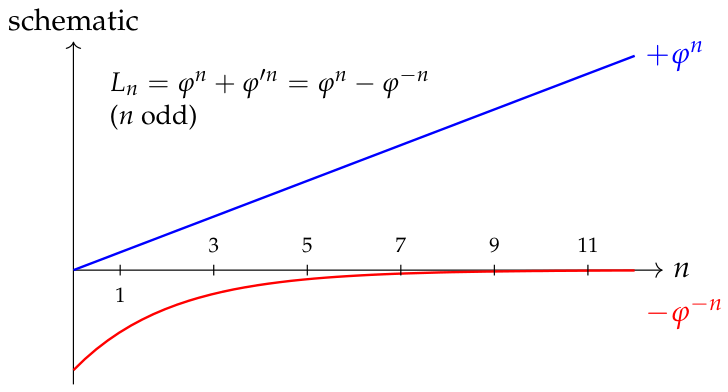
For odd n we have , hence
So is the sum of two waves with the same rate , one growing and one decaying, with opposite signs (Figure 15). Over the sum never vanishes. A cancellation can only happen after reduction modulo a prime, that is, on a finite circle.
Figure 15.
Schematic picture of the two Galois waves whose sum is for odd n. Over they never cancel; modulo a prime q they may.
Figure 15.
Schematic picture of the two Galois waves whose sum is for odd n. Over they never cancel; modulo a prime q they may.
Definition 7.
A prime q is anodeat the odd index n if . Equivalently, modulo a prime ideal of : the two waves are equal and opposite modulo .
Lemma 7 ([classical]) For odd n, . For all n, ; in particular for odd n, and
Proof.(Everything follows from ; this is the only property of the golden unit we use.). Next, . Finally , so for odd m. □
Proposition 12 ([classical]: only split primes are nodes) Let n be odd and let q be an odd prime with . Then and ; that is, q splits in K, and for it lies on a spoke of .
Proof.
Modulo 5 the sequence has period 4 with values , so for odd n, and . By Lemma 7, ; in particular is invertible modulo q and is a square modulo q. By quadratic reciprocity , and Proposition 1 gives the spoke. □
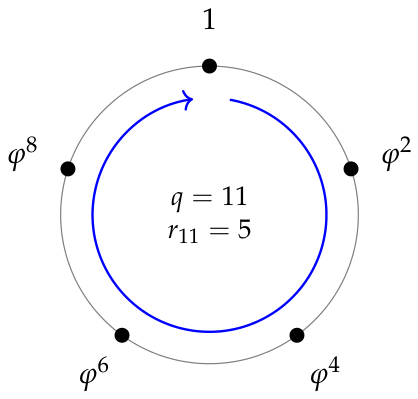
Proposition 13 ([classical]: resonance condition) Let be prime and , so . Let be the multiplicative order of in . For odd n,
In particular q is a node for some odd n if and only if is odd, and then the nodes are exactly the odd multiples of . Moreover .
Proof.(A node is a cancellation ; multiplying by turns it into a return on a finite clock.) For odd n, . As is a unit and , iff iff iff . The conjugate prime replaces by , which has the same order. Finally is a square in , so its order divides . □
Figure 16.
The resonance condition on the finite circle . The power walks around the circle and returns after steps; q is a node exactly at odd multiples of .
Figure 16.
The resonance condition on the finite circle . The power walks around the circle and returns after steps; q is a node exactly at odd multiples of .
Proposition 14 ([classical]: multiplicities) Let q be an odd prime with odd and let n be an odd multiple of . Then .
This is the lifting-the-exponent law for Lucas numbers; it follows from Lengyel’s formula [37] (note that because ); the analogous law for Lucas sequences of the first kind is in [49]. If q divides both and the index n, the multiplicity of q rises by one: , , .
Proposition 15 ([classical]: why 2, 3 and 5 are never nodes) Let n be odd. Then and ; and iff , in which case .
Proof.
5: see Proposition 12. Modulo 3 the sequence has period 8: ; the zeros sit at . Modulo 8 it has period 12: ; at odd n the value is even exactly for , and then it is . □
So 2, 3 and 5 never occur in the square-free kernel of for odd n: the primes that build the wheel modulo 30 are exactly the primes that can never be nodes.
6.2. The Coefficient Fields of
For even let f be a newform in with coefficient field and totally real subfield . Since , , so is totally positive and . Put
For , f is the form of Section 5, , and . For one finds .
Conjecture 16
(Lucas rule). For every even and every newform ,
Equivalently, is the square-free kernel of .
By Lemma 7 the rule can be written as
Observation 17 ([observation, preregistered]for 23 weights;[descriptive]for 28 weights) For every even k with and for (in total 51 weights), consists of a single Galois orbit and Conjecture 16 holds. For and the statement was fixed in writing before the computation, including the sharp predictions that at , at and at (Table 4). The weights (Table 3) were computed first and are descriptive.
Table 3.
The Lucas rule in the weights ([descriptive]). In every row the space has one Galois orbit of the given degree and is the square-free kernel of . *: at , , and the square drops out, as predicted by Proposition 14.
Table 3.
The Lucas rule in the weights ([descriptive]). In every row the space has one Galois orbit of the given degree and is the square-free kernel of . *: at , , and the square drops out, as predicted by Proposition 14.
| k | dim | k | dim | ||
|---|---|---|---|---|---|
| 6 | 2 | 11 | 34 | 16 | |
| 8 | 2 | 29 | 36 | 16 | |
| 10 | 4 | 19 | 38 | 18 | 54018521 |
| 12 | 4 | 199 | 40 | 18 | |
| 14 | 6 | 521 | 42 | 20 | 370248451 |
| 16 | 6 | 44 | 20 | ||
| 18 | 8 | 3571 | 46 | 22 | |
| 20 | 8 | 9349 | 48 | 22 | 6643838879 |
| 22 | 10 | 50 | 24 | ||
| 24 | 10 | 52 | 24 | ||
| 26 | 12 | 54 | 26 | 119218851371 | |
| 28 | 12 | 56 | 26 | * | |
| 30 | 14 | 58 | 28 | ||
| 32 | 14 | 3010349 | 60 | 28 |
Table 4.
Preregistered test of Observation 17. In every row equals the square-free kernel of . The factor of for and the squares , , drop out.
Table 4.
Preregistered test of Observation 17. In every row equals the square-free kernel of . The factor of for and the squares , , drop out.
| k | prime factors of (all ) | |
|---|---|---|
| 62 | 30 | 5600748293801 |
| 64 | 30 | 19, 29, 211, 1009, 31249 |
| 66 | 32 | 11, 131, 521, 2081, 24571 |
| 68 | 32 | 4021, 24994118449 |
| 70 | 34 | 139, 461, 691, 1485571 |
| 72 | 34 | 688846502588399 |
| 74 | 36 | 151549, 11899937029 |
| 76 | 36 | 11, 31, 101, 151, 12301, 18451 |
| 78 | 38 | 29, 199, 229769, 9321929 |
| 80 | 38 | 32361122672259149 |
| 82 | 40 | 19, 3079, 5779, 62650261 |
| 84 | 40 | 35761381, 6202401259 |
| 86 | 42 | 11, 3571, 1158551, 12760031 |
| 88 | 42 | 59, 349, 19489, 947104099 |
| 90 | 44 | 179, 22235502640988369 |
| 92 | 44 | 29, 521, 689667151970161 |
| 94 | 46 | 63799, 3010349, 35510749 |
| 96 | 46 | 11, 191, 9349, 41611, 87382901 |
| 98 | 48 | 3299, 56678557502141579 |
| 100 | 48 | 19, 199, 991, 2179, 9901, 1513909 |
| 166 | 82 | 31, 199, 331, 9901, 39161, 51164521, 1550853481 () |
| 172 | 84 | 229, 9349, 95419, 162451, 1617661, 7038398989 () |
| 204 | 100 | 59, 19489, 2748232098283374889444289976282269 () |
Remark 4 ([cited]) The qualitative part is known. For forms with real quadratic nebentypus, Hida [24] shows that the odd primes at which the residual Galois representation becomes dihedral are split in the quadratic field and divide , here . His Conjecture 2.2 predicts that the Hecke algebra is obtained from its real part by adjoining ; a cyclicity result in this direction is proved under extra hypotheses in [25]. Equation (5) is a global, explicit instance of that conjecture, including the prime 2 and the sign. We have not found it stated in the literature.
Combining Observation 17 with Proposition 13, 14 explains the whole pattern of primes in Table : a prime q enters first at , returns whenever is an odd multiple of , and drops out when is even. Figure 17 shows this for four primes.
Figure 17.
Node chart: filled dots mark in weight k (period in k: 10, 18, 14, 30). Open circles mark the weights where q divides both and , so that and q is absent from ( for ; for ; for ).
Figure 17.
Node chart: filled dots mark in weight k (period in k: 10, 18, 14, 30). Open circles mark the weights where q divides both and , so that and q is absent from ( for ; for ; for ).

Observation 18 ([observation, preregistered]: explicit dihedral congruence) For each of the 122 pairs with , and , the space of Hecke eigensystems modulo q with
is exactly one-dimensional (tested with all , resp. ). It is zero for all 144 control pairs with q split but , and for all 96 control pairs with inert. At , where and , the congruence still exists: the drop-out is a parity effect, not the absence of a dihedral form.
The congruence is the reduction of the Hecke character of K: the same two Galois waves, and , now closed modulo q. Its existence is [24]; the explicit form and the uniqueness are our computation.
Remark 5 ([descriptive]: the prime 691)The prime 691 divides at . It is an ordinary node with . There is no Eisenstein congruence modulo 691 at , and ; so this 691 is not Ramanujan’s. (negative)
Remark 6 ([observation, preregistered]: other real quadratic fields) We tested the analogous rule for with in all even weights : an odd prime should divide the product of the non-zero eigenvalues of to odd order iff it divides the unit trace to odd order. The rule held without exception for . For it failed in 19 of 28 weights, always and only at the prime , which divides for every odd n. The direction “odd order in the Hecke norm ⇒ divides the unit trace” held in all five fields.
6.3. One Direction Is a Theorem
Theorem 19 ([proved], using cited standard theorems) Let be even and let be a prime, . If is odd, then and .
Proof.
Let c denote complex conjugation on .
Step 1 (ramification). Since , and . Then . If its q-valuation is odd, some prime of has odd . Primes of that are unramified in contribute even valuations (a split pair contributes twice the same amount, an inert prime contributes ), so ramifies in ; let be the prime above it.
Step 2 (inert coefficients vanish). Since is ramified, c lies in its inertia group, so for all integral x. For p with we have , hence and .
Step 3 (dihedral). Let be the residual representation of f modulo . By Step 2, Chebotarev and Brauer–Nesbitt, . If were reducible, with , where is the mod-q cyclotomic character. Every character of unramified outside is with of conductor dividing 5, so , impossible because is odd and even. So is irreducible with , hence for a character of .
Step 4 (conductor). The prime-to-q Serre conductor of divides 5 [8,39]. The conductor of is with the prime-to-q part of the conductor of . So , and is unramified outside .
Step 5 (q is not inert). Suppose q is inert in K. Since , Fontaine–Laffaille theory applies [22]. If is reducible, both inertia characters equal (Frobenius swaps and ), but Fontaine–Laffaille requires , impossible as . If it is irreducible, or with the level-two fundamental character , and local class field theory gives (or its q-th power) for . The global unit satisfies , so in . Applying the norm , which for inert q is the Galois norm, gives on the left and 1 on the right; a contradiction.
Step 6 (q splits; the unit condition). So splits, and is reducible. By Fontaine–Laffaille f is ordinary at q with inertia characters , so is unramified at one of and acts by on the inertia of the other. Triviality of on the global unit gives (this is [24] in our setting), hence , , and by Proposition 13. □
Step 5 replaces the ordinarity hypothesis in Hida’s argument: for the supersingular case is excluded. The hypothesis is not cosmetic: in the prime 3 violates the analogue of the rule.
6.4. The Converse, Conditionally
Hida [25] proves, under hypotheses (h1)–(h6), that the connected component of the ordinary Hecke algebra belonging to satisfies with , and that . In our situation the level is , the class number is one, and restricts to on the inertia at .
(h6); .Theorem 20 (conditional on (h4),[cited][25]) Let and assume Hida’s hypotheses (h4) and (h6) for . Then .
Proof
(Sketch). At weight k the specialisation of for has -valuation . From one gets , so the norm of has q-valuation . As , lies in the square class of . By Step 1 of Theorem 19 the other components contribute even valuations, and by Observation 18 there is exactly one dihedral component. □
Hypothesis (h1) always holds at a node. Hypothesis (h4) requires the order of to be at least 3; this order is , and it is 2 exactly when and . Hypothesis (h6) is a class number condition that we cannot verify in general.
| q | 11 | 19 | 29 | 31 | 59 | 199 | 211 | 229 | 521 |
| 5 | 9 | 7 | 15 | 29 | 11 | 21 | 19 | 13 | |
| 5 | 9 | 14 | 15 | 29 | 99 | 105 | 114 | 260 | |
| (h4) fails at every node weight | yes | yes | no | yes | yes | no | no | no | no |
At the four nodes below 60 with and , (h4) fails at every weight where q is a node, yet Observation 17 holds there, including the drop-outs of 11 at and of 19 at . These exceptional nodes are the subject of Section 7. The drop-out of 29 at lies within the scope of Theorem 20.
6.5. Stage and Pattern
We step back and separate what was built from what was found.
Figure 18.
Stage and pattern. The stage is generated by ; the pattern of primes appears as nodes of the interference of the golden unit with its conjugate.
Figure 18.
Stage and pattern. The stage is generated by ; the pattern of primes appears as nodes of the interference of the golden unit with its conjugate.
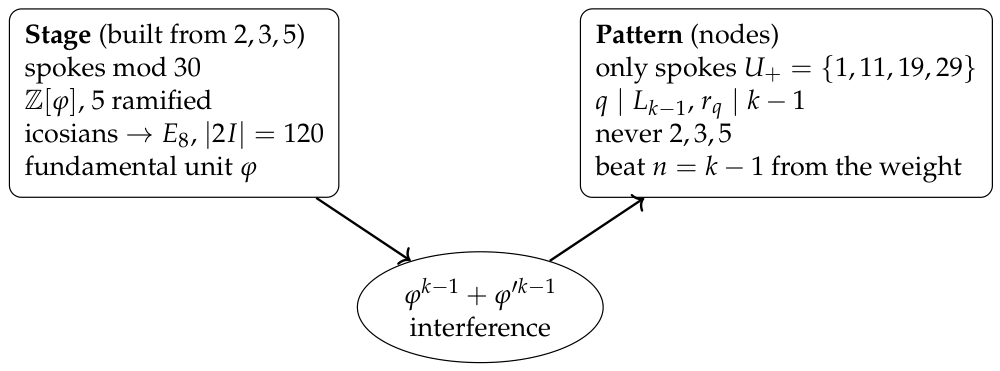
Reading 21 ([reading]) The primes build the stage: the spokes modulo 30, the ring in which 5 ramifies, the icosians, and the binary icosahedral group of order . By Propositions 12, 15 none of them is ever a node, and every node lies on the blue square . Read in this way, the coefficient fields of show the node pattern of the interference : the stage supplies the wave , the weight supplies the beat , and the primes appear where the two Galois waves cancel. In the theta series the primes act as frequencies; here they act as nodes of a single wave. Both roles together are what we mean by a standing wave.
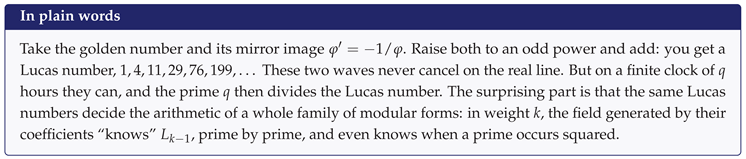
What we have seen.
The Lucas number is the sum of two conjugate waves and ; a prime is a node where they cancel modulo q. Only primes on the blue square can be nodes, and never 2, 3 or 5 (Propositions 12, 15). In every weight we computed, the coefficient field of the forms of level 5 is governed by (Observation 17), and one direction of this rule is a theorem (Theorem 19). In weight 6 the rule gives , the answer to the question we started with. But the converse direction fails to be covered by Hida’s hypotheses exactly at 11, 19, 31, 59. So the prime 11 is special twice: it is the first node, and it is exceptional. The next section asks what is special about it inside the Leech lattice.
Literature.
Lemma 7, Propositions 12, 13, 14, 15 are classical [37,49]. The qualitative link between dihedral primes and is due to Hida [24,25]. We have not found Conjecture 16, Theorem 19 in this form, or the explicit congruence of Observation 18 in the literature (searches in MathSciNet-indexed journals, arXiv and the LMFDB documentation, Appendix A).
7. The Number 11: From Symmetry to Level

Why this step.
The prime 11 has appeared three times: as the first Lucas node (Section 6), as the discriminant of the coefficient field of the cusp wave f (Section 5), and, as we shall see, as an order of symmetry of the Leech lattice. This section shows that these are the same 11, and follows it from the golden field down to the j-function.
Nothing in this section is a choice of the number 11. It is handed to us by the weight: the Leech lattice over lives in weight 6, the Lucas rule turns the weight into , and 11 is the first exceptional node. What we do choose is the order in which we look at it. We visit five “sides”: the golden field, where 11 is a symmetry of the wave; the diagonal, where it becomes a level; the Leech lattice, where it is an automorphism; the torus, where it is a closed orbit; and the genus, where it is a congruence. The third side is the one that reaches the j-function.
7.1. The Building Side: 11 as a Symmetry
Proposition 16 ([proved]) Let be the newform of Section 5, with coefficients in , , . For every prime p on the spokes (and for ), . Consequently
Proof.(On the red square complex conjugation negates ; an element of negated by conjugation is a multiple of .), so with , that is . Then . □
For instance . The prime 11 is the place where complex conjugation on the coefficients becomes the identity, because it is ramified in . This is Step 2 of Theorem 19, at the smallest weight.
Observation 22 ([descriptive]) For all 166 primes , , we have if and only if p splits both in and in , and then .
This is exactly what the next theorem predicts. Recall from Section 6 that a node q is exceptional if and ; these are the nodes at which Hida’s hypothesis (h4) fails.
Theorem 23 ([proved]; standard lemma) Let q be an exceptional node for the weight k, and let be the dihedral residual representation of Theorem 19. Then:
- 1.
- the projective image of is the Klein four-group ;
- 2.
- the corresponding biquadratic field is , and is induced simultaneously from , and ;
- 3.
- is reducible; so the Taylor–Wiles condition fails, over and over K.
Proof.(The whole point is that at an exceptional node the ratio character has order only 2; everything else follows from that.) On , , so the projective image of is the image of . By Step 6 of Theorem 19, restricts to on inertia at q, and its order is . An element outside swaps the two summands, so the projective image is dihedral of order , that is . A character of order 2 that is a power of is the Legendre symbol , which for is the character of . This gives (1) and (2). For (3): when . □
At , we have : the first exceptional node, and Observation 22 is Theorem 23 made visible. Note that . For level one the analogous primes are classical: 23 for and 31 for the form of weight 16 [52].
Theorem 24 ([proved]: no auxiliary prime) Let be absolutely irreducible with projective image , let and . There is no prime that splits in F, satisfies , and for which has eigenvalue ratio .
Proof.
With projective image every eigenvalue ratio satisfies . A ratio thus forces , hence . But ℓ splits in F iff by quadratic reciprocity, while for . □
Such an auxiliary prime is exactly the extra hypothesis of the automorphy theorem for residually dihedral representations in [29]; Theorem 24 shows that this route is closed at every exceptional node.
Observation 25 ([observation, preregistered]) For the pairs , , , , we found no auxiliary prime , and every ℓ with the eigenvalue condition is . For the control node , , there are exactly 11 auxiliary primes below 3000, the first being 173, 347, 463, 521, 811. (For the second run had to fall back on a 59-adic factorisation, since 59 divides the index of the orbit polynomial; see Appendix A.)
Theorem 26 ([proved]; elementary)Let and . Then if and only if q has aFibonacci primitive root, that is, a primitive root g with . In that case q is an exceptional node at every weight at which it is a node, and its first node weight is .
Proof.
The roots of in are and , and is odd. If one root is primitive, its square has order m, and so has the square of the other. Conversely, if , then ; if it is m, then has order . For the second claim, is odd, so the nodes are , all of which are divisible by . □
The primes with a Fibonacci primitive root are tabulated as [47]; those start
Remark 7 ([descriptive]) The numbers of vertices, faces, edges and rotations of the icosahedron, minus one, are , and all four are Lucas nodes; are exceptional, 29 is not. Since are all divisible by 5 or , the numbers are a priori in the split classes, and we draw no conclusion. We also note, without drawing a conclusion, that are supersingular primes in Ogg’s sense (prime divisors of the order of the Monster), while 79 and 131 are not.
7.2. The Restricted Side: 11 as a Level
The j-function lives over , so we must follow the 11 through the diagonal restriction D of Section 5. One might expect it to disappear, because has rational coefficients. It does disappear as a symmetry, but it returns in a different role.
Apply the diagonal D of Section 5. By Theorem 15, . The coefficient field drops from to , and the residual representation of modulo 11 is as large as possible: its image contains , since the exceptional primes of are [52]. The 11 disappears as a symmetry. It reappears as a level, through Wilton’s congruence [58]:
where is the newform of the elliptic curve . With and this gives, for primes ,
where is the number of Leech vectors of norm ([classical]).
Figure 19.
The prime 11 on the two sides of the diagonal restriction D. On the left it is built into the representation; on the right it survives only as the level of . The lattice side, bottom, carries the same 11 as a group of fixed points.
Figure 19.
The prime 11 on the two sides of the diagonal restriction D. On the left it is built into the representation; on the right it survives only as the level of . The lattice side, bottom, carries the same 11 as a group of fixed points.
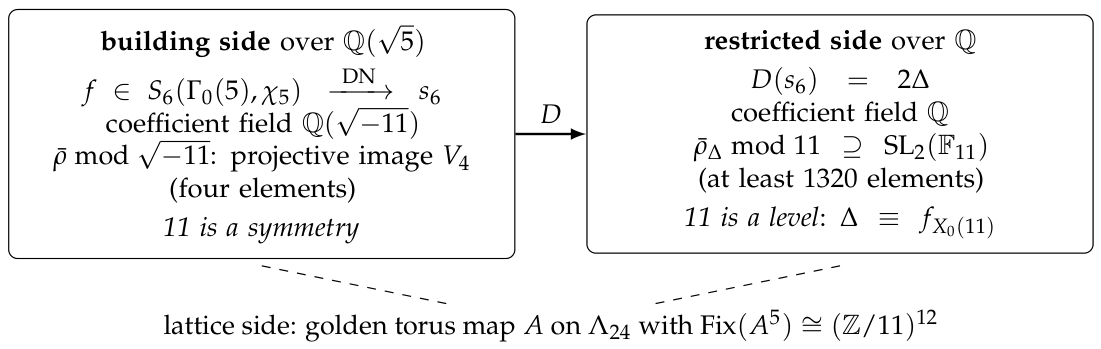
7.3. The Leech Side: 11 as an Automorphism
The restricted side showed that the Leech lattice “knows” the curve modulo 11. Is there a structure inside the lattice that explains this? The natural place to look is the automorphism group: the Conway group has elements of order 11, and the vectors fixed by such an element form a small lattice whose theta series has level 11. This is the step at which the Monster enters, and it enters through a quotient of two theta-like series.
The conjugacy class 11A of the Conway group contains elements g of order 11 with frame shape . Let be the fixed lattice and . Put , the Eisenstein series of weight 2 and level 11 with constant term 1.
- 1.
- For every prime p with and , . In particular .
- 2.
- is an even lattice of rank 4, determinant 121 and level 11, and .
- 3.
- is invariant under , and minus 2 it is the Monster McKay–Thompson series .
- 4.
- , coefficient by coefficient.
- 5.
- The congruence (7) is the reduction modulo 11 of (2).
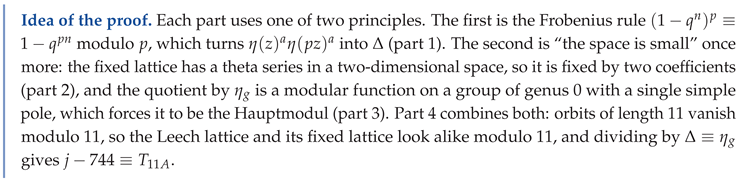
Proof. (1) In , , so .
(2) Let be the projection onto . Since is unimodular and primitive, , and for we have , so ; also is even, so is even. Hence is even of level 11. Its rank 4 and determinant 121 (computed from an explicit model, Appendix A) give trivial character, so , a space of dimension 2 with basis . The constant term is 1 and the coefficient of q is 0 because has no vectors of norm 2; this fixes the coefficients 1 and .
(3) Numerator and denominator have weight 2 on and has no zeros in the upper half plane, so the quotient is a modular function holomorphic on . From one gets , and from the transformation law of one gets ; so the quotient is Fricke-invariant. Its only pole is at ∞ (the cusps ∞ and 0 are swapped by ). Since has genus 0, the quotient is the Hauptmodul up to a constant, and is the normalised Hauptmodul [6,10].
(4) The vectors of fall into orbits of length 11, so (the degree-one case of [50]). Now , , and by (1); both are q times a unit of , so we may cancel: , and .
(5) By (2), the n-th coefficient of is , and . □
The coefficients agree with [18] (there with constant term 5). The general statement that is a Monster Hauptmodul for the classes with frame shape is due to Kondo and Tasaka [32]. Part (1) holds exactly for , which are the primes whose -elements have cycle shape .
Observation 28 ([observation, preregistered]) We built directly from the extended binary Golay code with the automorphism and verified (2), (3) and (4) up to ; the controls modulo 7 and 13 fail, as they must. The Fricke invariance in (3) holds to resp. numerically.
7.4. The Torus Side: 11 as a Closed Orbit
The Lucas numbers were defined by powers of . On a lattice over , multiplication by is a linear map, so it acts on the torus . Its periodic points are counted by Lucas numbers, and this gives the node 11 a geometric meaning.
Theorem 29 ([proved]; elementary) Let A be multiplication by φ on the torus , where I is the icosian , and on . Then A is volume-preserving and hyperbolic but not an isometry, on and on Λ, and
In particular resp. for odd n, and resp. for even n. The group has q-torsion for an odd prime q and odd n if and only if q is a node at n. For , on the Leech torus.
Proof.
I and are free -modules of rank 4 and 12, and the fixed points of on are . The order is , and Lemma 7 gives . The characteristic polynomial of A on is , so and . For , , so is a prime of norm 11. □
| n | on the torus | |
| 3 | ||
| 5 | ||
| 7 | ||
| 9 | ||
| 11 | ||
| 15 |
So the same prime 11 is the smallest period of a closed golden orbit with odd torsion. Whether the group carries an action of an element of class 11A of is open (Section 10).
7.5. The Genus Side: 11 and 29 as Hecke Congruences
Finally, the Leech lattice over is one of 15 classes in its genus (Section 4). The Hecke operators on the genus see the same nodes.
Dummigan and Fretwell [17] compute the Kneser 2-neighbour operator on the 15 classes of the genus of over K. Its eigenvalues on are 7200 and , whose difference is ; they prove a congruence , and they also find a congruence modulo 29. Their Remark 7.4 explains both by a condition of the form . By Lemma 7, for odd m, so this condition is exactly : the two moduli are and , the first two Lucas nodes.
Figure 20.
Eigenvalues of the Kneser 2-neighbour operator on the 15 eigenvectors of the genus of the Leech lattice over [17], on a signed logarithmic scale. Black: Eisenstein vector , eigenvalue (the number of neighbours). Blue: , whose theta series is the Doi–Naganuma lift of f; the Leech class has a non-zero component here (Section 5). Red: , congruent modulo 11. Whether the Leech class has components on them is open (Section 10).
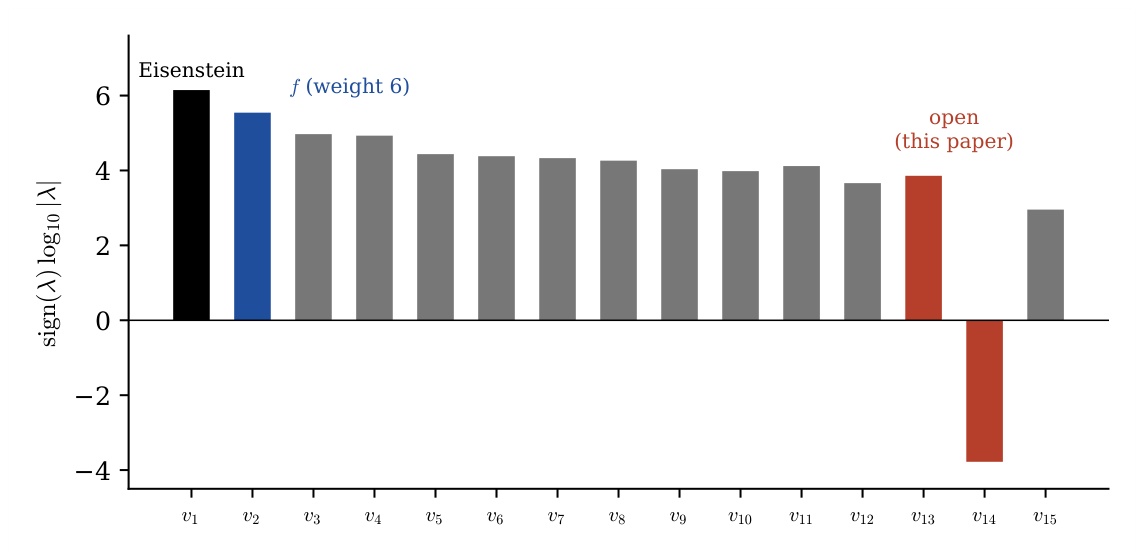
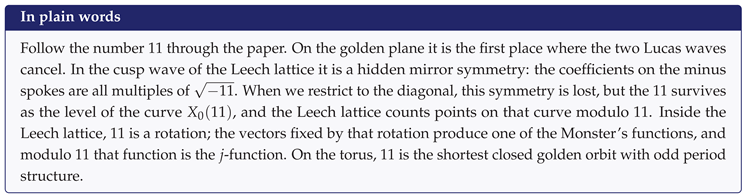
Reading 30 ([reading]) On the building side the 11 is a symmetry of the wave; on the restricted side it is a place where the wave is measured. The seam lies at the weight , which is the weight of the Leech lattice over the golden field.
What we have seen.
The prime 11 is forced by the weight 6 through the Lucas rule. On the golden side it makes the coefficients on the red square multiples of (Proposition 16) and reduces the projective image to (Theorem 23). On the diagonal it survives as the level of ((7)). Inside the Leech lattice it is an automorphism whose fixed lattice gives the Monster function , and modulo 11 this function is (Theorem 27). On the torus it is the first closed golden orbit with odd torsion (Theorem 29). So we have reached the j-function, but only modulo 11. The last section removes the “modulo 11”.
Literature.
Proposition 16, Theorems 23, 24, 26 are short arguments from standard facts; we do not claim novelty for them individually. Wilton’s congruence, the image of modulo 11, the fixed-lattice theta series and the Hauptmodul property are classical [6,10,32,52,58]. The congruences in the genus are from [17]. What we have not found in the literature is the identification of all these elevens with one another through the single form f of weight 6.
8. The Endpoint: The j-Function and the Moonshine Module

Why this step.
Section 7 reached the j-function, but only modulo 11, through a symmetry of order 11. We now drop the “modulo” and look at the Leech lattice over once more. Its theta series is a modular form of weight 12, and j has weight 0. To pass from one to the other we must divide by a form of weight 12. This division is not a free choice either: a modular form of weight 12 for has exactly one zero in a fundamental domain, counted with weight, so the only one without zeros in the upper half plane is the form whose zero sits at the cusp, . Dividing by is the only way to get a modular function that is holomorphic on . The factor has a meaning of its own, as a count of 24 independent oscillators, and this is where the chain of Figure 2 ends.
Theorem 31 ([classical]) Let , so that , and let . Then
Moreover:
- 1.
- The constant term 24 equals the number of independent oscillation modes of weight one, i.e. the coefficient of in , because Λ has no vectors of norm 2.
- 2.
- The exponent of the leading term is .
- 3.
- .
- 4.
- The coefficients of are not multiplicative: .
- 5.
- .
Proof.(The main identity is Proposition 10 divided by Δ; the five items read off its pieces.) (the only modular form of weight 12 with constant term 1 and no term) and . (1) In the constant term is . (2) is the zeta regularisation , applied to in each of the 24 directions; it reproduces the factor coming from in . (3) and . (4) is a computation. (5) 196560 is the kissing number, , and 196883 is the dimension of the smallest non-trivial irreducible representation of the Monster. □
Remark 8 ([cited]) The function is the character of the lattice vertex operator algebra , whose weight-one space has dimension 24. Frenkel, Lepowsky and Meurman [21] constructed from , by a -orbifold, the moonshine module , whose character is J: the 24 states of weight one are removed. Borcherds [6] proved that the graded traces of the Monster on are the Hauptmoduln of Conway and Norton [10]. For the class 11A this trace is the series of Theorem 27.
8.1. Two Kinds of Waves, Once More
Recall the distinction of Definition 4: a standing prime wave is a modular form with an Euler product and a functional equation. The two waves of the Leech lattice over K, and , are standing prime waves; so is . The oscillation factor is not: by (4) its coefficients are not multiplicative, and by (3) its logarithm is a sum over all integers n with weight , not a sum over primes. In the quotient the prime waves of the lattice and the oscillations of 24 independent directions are superposed, and the result is .
Figure 21.
One prime through the whole chain. The prime 7 lies on a minus spoke modulo 30, stays prime in the golden ring, is counted by the icosian and by the Leech lattice over , enters Ramanujan’s through the diagonal, and ends in the Leech theta series and the j-function.
Figure 21.
One prime through the whole chain. The prime 7 lies on a minus spoke modulo 30, stays prime in the golden ring, is counted by the icosian and by the Leech lattice over , enters Ramanujan’s through the diagonal, and ends in the Leech theta series and the j-function.
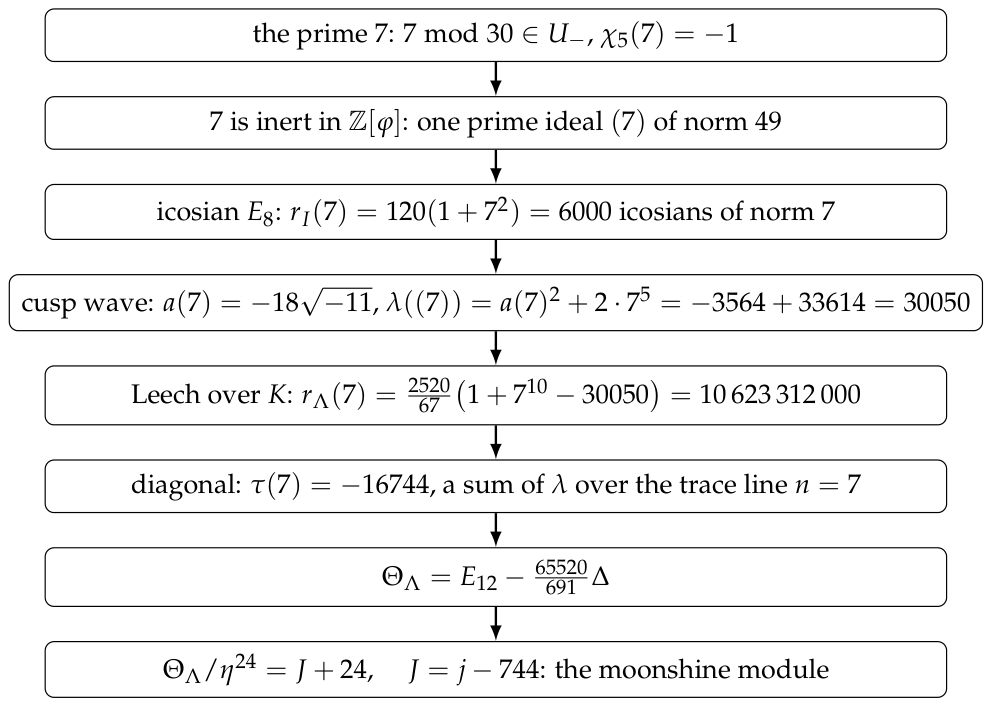

Reading 32 ([reading]) Read along Figure 21, a prime becomes a frequency of a lattice wave, the lattice waves become two standing prime waves over the golden field, and those waves, combined with 24 independent oscillations, give the j-function. In this sense the j-function is the spectrum of standing prime waves on the icosian Leech lattice, dressed with 24 oscillators. We leave it to the reader to decide which other theories use exactly these ingredients.
What we have seen.
The Leech lattice divided by its oscillator factor is , and the J is the character of the moonshine module (Theorem 31). The chain is complete. Before we list what remains open, we turn around once and look at the whole path.
9. Looking Back

We have walked from a wheel of eight residues to the j-function. On the way we looked at one station at a time. Now we look at the path as a whole: first by following two primes through every station, then by separating what was forced from what was chosen, and finally by asking why the walk ended in rank 24 and what one sees from there.
9.1. Two Primes Through the Whole Chain
The primes 7 and 11 sit on different squares of the wheel. Table 5 follows both through every station of the paper. Every entry has been derived in the text.
9.2. What Was Forced and What Was Chosen
A path through a forest can be the only path, or one of several. We have tried to say at each station which kind it was. Collected:
- 1.
- The wheel modulo 30. Chosen: it is the starting point of the geometry of [34]. Forced inside it: the split into two squares is the only index-two split by axes (Proposition 2).
- 2.
- The golden ring. Forced: is the only real quadratic field whose discriminant divides 30 (Proposition 2).
- 3.
- The icosian . Forced, and from two sides. From the wheel: the only condition imposed on is self-duality, and it leaves exactly , with the turn as Coxeter element, the spokes as exponents and two golden 600-cells as the two halves of the roots (Theorem 3, 5). From the group: the icosians are the maximal order, the scaling is fixed by unimodularity, and is the only even unimodular lattice of rank 8. Over both are the same lattice (Proposition 8), so no choice is made between them. Not even the weight is a choice; it is a gauge (Proposition 4).
- 4.
- The Leech lattice. The route is chosen: Tits’s gluing at the prime 2; the Golay code would be another. The outcome is forced: every pair of distinct points gives Leech (Theorem 10).
- 5.
- Two waves. Forced: (Theorem 13).
- 6.
- Lucas nodes. The number is forced by the weight 6. The rule behind it is observed in 51 weights and proved in one direction (Conjecture 16, Theorem 19).
- 7.
- The prime 11. Forced. The five “sides” are viewpoints we chose; the identities on each side are not.
- 8.
- The j-function. Forced: lies in a two-dimensional space, and is the only weight-12 form without zeros in (Section 8).
So there are two places where we chose: where to start, and how to build Leech. Between the start and nothing was chosen. Everything else was determined by small spaces of modular forms and by the unit .
9.3. The Chain in One Line
Divide the theta series of each lattice on the path by :
The first is a cube root, not a function on . The second is j itself, built from one point of used twice. The third is built from two different points, and the glue removes exactly the roots of (Proposition 10). What is left is J plus the 24 oscillators of weight one.
9.4. Why the Walk Ends in Rank 24
Proposition 17 ([classical]) Let L be an even unimodular lattice of rank r, and let be its number of vectors of norm 2. Then has weight 0, and it is invariant under if and only if . For ,

Proof.
Since L is even unimodular, , and [11]. For one has and . So the quotient is S-invariant and changes by under T; this is 1 iff . For , by the argument of Proposition 10, and . □
So rank 8 gives and rank 16 gives , both with a non-trivial multiplier. Rank 24 is the first rank in which a lattice and its oscillators together give an honest modular function. In rank 24 there are 24 even unimodular lattices, the Niemeier lattices, and by Proposition 17 their functions differ only by the constant . The Leech lattice is the one with : it has the smallest constant, 24, and that constant is the number of oscillators. This is why the path, having started at rank 8, could not stop before rank 24, and why among all lattices of rank 24 it had to arrive at Leech: the gluing of Section 4 is precisely the step that sets to 0.
Remark 9 ([classical];[cited];[proved]) Rank 16 has exactly two even unimodular lattices, and . Both give , because they have the same theta series, so the theta series cannot tell them apart. The doubled wheel can: a self-dual trace lattice on is always and never (Theorem 7), and the degree-four test of Appendix C separates them independently. Why the doubled wheel, and not another ring of rank 16, should be the relevant object is not answered in this paper (Section 10).
9.5. Two More Numbers: and 26
The lowest term of is . By Theorem 31(2) its exponent is : each of the 24 oscillators contributes . The state of lowest weight therefore lies one unit below zero, and the first states above zero, at weight 1, are exactly the 24 oscillators. Removing those 24 states by the -orbifold of Frenkel, Lepowsky and Meurman leaves the moonshine module with character J and symmetry group the Monster [6,21].
The last number comes from a different direction. Let be the even unimodular lattice in with the form ; it is unique, and it exists because .
The first part is Conway’s theorem: w is the Weyl vector of the reflection group of , and the Leech lattice is the null slice through it [9,11]. The second part is the cannonball problem: a square pyramid of cannonballs can be rearranged into a square only for 24 layers (4900 balls). It was posed in 1875 by Édouard Lucas, the same Lucas whose numbers governed Section 6, and proved by Watson [56]. So the Leech lattice sits inside an even unimodular lattice of dimension , as the shadow of a single light-like vector. Borcherds [6] used exactly this extension by a hyperbolic plane: the monster Lie algebra is built from and the lattice , by a theorem that works only when the first factor has central charge 24, so that the total is 26.
Figure 22.
The view back along the path. Top row: what was built from the primes 2, 3, 5 and the golden unit. Bottom row: what one finds when the rank-24 lattice is combined with its 24 oscillators.
Figure 22.
The view back along the path. Top row: what was built from the primes 2, 3, 5 and the golden unit. Bottom row: what one finds when the rank-24 lattice is combined with its 24 oscillators.
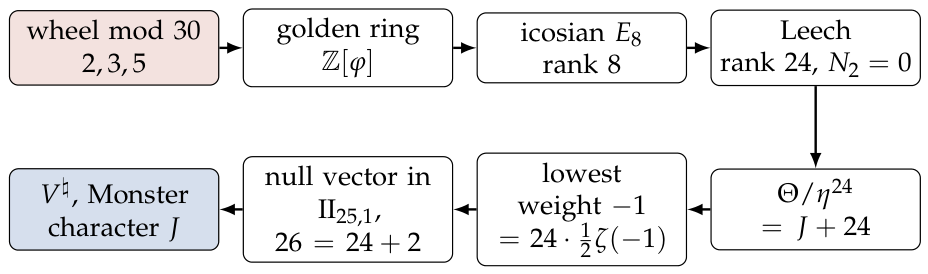
9.6. What the Forest Looks Like From the Far Side
Reading 33 ([reading]) Look at the end of the path once more, and describe it without names. There is a lattice of rank 24, built from the primes on the golden ring. On its torus there are standing prime waves, two of them over the golden field, and they are the frequencies of the lattice. Together with them there are 24 independent oscillators, one for each direction. The lowest state lies at weight , and the value is 24 copies of . At weight 1 there are exactly 24 states, the oscillators themselves. The generating function of all states is , and after the 24 states of weight one are removed it is J, whose coefficients are the dimensions of representations of the Monster. The whole picture fits into an even lattice of dimension , in which the Leech lattice is the slice orthogonal to one light-like vector.
None of these numbers was put in by hand. The 24 is the first rank in which lattice and oscillators close up into a modular function (Proposition 17). The is a value of the Riemann zeta function. The 26 is the dimension in which Lucas’s cannonballs form a square. What we chose was where to start, at the primes modulo 30, and how to build Leech, by gluing three golden copies of at the prime 2. A reader who knows where else a closed object with 24 transverse oscillations, a lowest state at and a total dimension of 26 appears, and in which theory the partition function appears together with the two rank-16 lattices and of the remark above, will recognise the place at which this path has arrived. We do not name it. The paper ends where the mathematics ends.
10. Open Problems
Open problem 34 (The doubled wheel) Theorem 7 shows that the ring admits only . Is there an intrinsic reason, inside the arithmetic of the wheel, why the passage from 30 to 60 (the sixteen units , the 16-cell traversed twice) is the relevant one, rather than another even unimodular lattice of rank 16 with a different automorphism?
Open problem 35 (Lucas rule in general) Prove Conjecture 16. By Theorems 19, 20, what remains is the parity of at the exceptional nodes of Theorem 26, the small primes , the prime 2, and the sign.
Open problem 36 (Exceptional nodes) At the residual image is (Theorem 23) and no auxiliary prime exists (Theorem 24). Find a modularity-lifting argument, or a direct comparison of congruence modules through theta lifts of Hecke characters, that applies to projective image with imaginary quadratic subfield.
Open problem 37 (Components ) Compute the components of the Leech class on the eigenvectors of [17]. This needs the Kneser 2-neighbour matrix on the 15 classes: neighbours per class, each requiring an isometry test in rank 24. Our implementation needs about ms per neighbour and process, about 27 core-hours in total. We did not run it; the script is described in Appendix A.
Open problem 38 (Torus and class 11A) Does the group of Theorem 29 carry, or arise from, an element of class 11A of , for instance through its action on ?
Open problem 39 (Other primes) The congruence holds for by the same argument as Theorem 27. Does the golden side see these primes as symmetries, as it sees 11?
Open problem 40 (Fixed lattice) Identify the Gram matrix of (rank 4, determinant 121) with one of the three classes of quaternary forms of discriminant in [43].
Glossary
...
16-cell modulo 30
The eight residues prime to 30, , placed on the vertices of the four-dimensional cross-polytope; opposite vertices are u and .
Spokes ,
The two great squares and of the 16-cell. Primes on split in , primes on stay prime.
Golden ratio, golden ring
, and , the integers of .
Trace lattice on the wheel
The ring with the form ; if it is self-dual, it is (Theorem 3).
Coxeter element, exponents
The most symmetric rotation of a root system (order 30 for and ); its eigenvalues are , and the k are the exponents: all of for , the square for .
600-cell
The regular four-dimensional polytope with 120 vertices, the unit quaternions of ; its symmetry group is of order 14400.
Icosians
The -span of the 120 unit quaternions of the binary icosahedral group ; with a suitable integer form it is the lattice .
Lattice, theta series
A lattice is a discrete grid in . Its theta series counts lattice vectors by length.
Kissing number
The number of balls that touch a central ball in a lattice packing; 240 for , 196560 for Leech.
Modular form
A function on the upper half plane with a prescribed symmetry under . Hilbert modular forms have two variables, one for each real embedding of K.
Eisenstein wave, cusp wave
The two parts of a theta series. The Eisenstein part is the “average” over the genus; the cusp part is the deviation.
Hecke eigenform, Euler product
A form whose coefficients factor over primes.
Standing prime wave
A modular form with an Euler product and a functional equation (Definition 4).
Lucas numbers, node
. A prime q is a node at n if .
Residual representation
The reduction modulo a prime of the Galois representation attached to an eigenform. Dihedral means induced from a character of a quadratic field.
Leech lattice
The unique even unimodular lattice in dimension 24 without vectors of norm 2.
,
, Ramanujan’s cusp form.
j-function
, the basic modular function.
Monster, moonshine
The largest sporadic simple group; “moonshine” is the theorem that its representations are encoded in j and related functions.
Hauptmodul
A generator of the field of modular functions of a genus-zero group.
Oscillator factor
; its coefficients count the ways in which r independent oscillators share n quanta.
Lorentzian lattice
A lattice with a form of signature , such as ; it has non-zero vectors of norm 0 (light-like or null vectors).
Weyl vector
For the null vector ; the Leech lattice is (Proposition 18).
Supplementary Materials
The following supporting information can be downloaded at the website of this paper posted on Preprints.org.
Funding
This research received no external funding.
Data Availability Statement
All programs, logs and preregistration documents of the numerical checks are provided as supplementary material (Standing_Prime_Waves_companion_code.zip), see Appendix A.
Acknowledgments
AI tools were used for literature search, programming of the numerical checks and language editing; the author checked all statements, proofs and computations.
Conflicts of Interest
The author declares no conflicts of interest.
Appendix A. Methods and Data
Software.
All computations used PARI/GP (through cypari2), sympy and numpy. Every numerical check was run twice: run 1 at 50 significant digits with random seed 1, run 2 at 100 digits with seed 2, in most cases with independent methods (for instance PARI modular symbols in run 1 and products of Eisenstein series in run 2). For each preregistered observation the prediction, the bound and the evaluation rule were fixed in a dated document before the computation; we never changed a prediction afterwards.
The wheel as a lattice.
For Observations 4, 6 and the checks in Section 3 the Gram matrices on and were computed exactly from the cyclotomic trace, roots were enumerated by Fincke–Pohst, and projections to the planes were evaluated at 50 and 100 digits; the unit index in Proposition 4 was computed with PARI. Each check was preregistered with a hash before it was run.
Lattices.
The icosians, the icosian and the lattices were built explicitly as -modules with integer Gram matrices; vectors were counted by Fincke–Pohst enumeration. For in Theorem 27 we used the extended binary Golay code of length 24 with generator polynomial and the automorphism .
Modular forms.
Spaces were computed with PARI’s mf package; the norms were taken exactly from the Hecke polynomial of . The Hilbert eigenvalues of were obtained both from the Doi–Naganuma formula and by solving (3) from lattice counts.
Deviations, disclosed.
(i) In the check of Theorem 27, the first attempt of run 2 stopped because a q-expansion of j was one term too short; it was lengthened, nothing else changed. (ii) In Observation 25, run 2 could not reduce the orbit polynomial modulo 59 at because 59 divides its index; a non-preregistered 59-adic factorisation confirmed run 1. (iii) In the check of Observation 12, run 2 lowered one bound from to because truncated Eisenstein products were reliable only to ; run 1 covers .
Kneser script.
The file kneser_t2.py enumerates the isotropic lines of over , forms the 2-neighbours, tests evenness and unimodularity, and classifies them by invariants and an isometry test; it is parallel and resumable. A smoke test with 2000 random neighbours reproduced and found 5 classes with roots. The full run is left open (Section 10).
Availability.
The code, the logs of both runs and the dated preregistration and evaluation documents (in German, each with its SHA-256 hash) are provided as supplementary material in the companion archive Standing_Prime_Waves_companion_code.zip; its README maps every preregistered observation to its files.
Appendix B. Tables
The two tables below support Section 6: Table A1 lists the Lucas numbers themselves, Table A2 the resonance orders of the split primes.
Table A1.
Factorisations of for odd . Every odd prime factor is (Proposition 12); the factor 2 occurs exactly as when (Proposition 15).
Table A1.
Factorisations of for odd . Every odd prime factor is (Proposition 12); the factor 2 occurs exactly as when (Proposition 15).
| n | n | ||
|---|---|---|---|
| 1 | 1 | 33 | |
| 3 | 35 | ||
| 5 | 11 | 37 | 54018521 |
| 7 | 29 | 39 | |
| 9 | 41 | 370248451 | |
| 11 | 199 | 43 | |
| 13 | 521 | 45 | |
| 15 | 47 | 6643838879 | |
| 17 | 3571 | 49 | |
| 19 | 9349 | 51 | |
| 21 | 53 | 119218851371 | |
| 23 | 55 | ||
| 25 | 57 | ||
| 27 | 59 | ||
| 29 | 61 | 5600748293801 | |
| 31 | 3010349 |
Table A2.
Split primes , their spoke modulo 30, the order of modulo q, and whether q is a node for some odd index ( odd, Proposition 13).
Table A2.
Split primes , their spoke modulo 30, the order of modulo q, and whether q is a node for some odd index ( odd, Proposition 13).
| q | mod 30 | node | q | mod 30 | node | q | mod 30 | node | |||
|---|---|---|---|---|---|---|---|---|---|---|---|
| 11 | 11 | 5 | yes | 131 | 11 | 65 | yes | 251 | 11 | 125 | yes |
| 19 | 19 | 9 | yes | 139 | 19 | 23 | yes | 269 | 29 | 134 | no |
| 29 | 29 | 7 | yes | 149 | 29 | 74 | no | 271 | 1 | 135 | yes |
| 31 | 1 | 15 | yes | 151 | 1 | 25 | yes | 281 | 11 | 28 | no |
| 41 | 11 | 20 | no | 179 | 29 | 89 | yes | 311 | 11 | 155 | yes |
| 59 | 29 | 29 | yes | 181 | 1 | 45 | yes | 331 | 1 | 55 | yes |
| 61 | 1 | 30 | no | 191 | 11 | 95 | yes | 349 | 19 | 87 | yes |
| 71 | 11 | 35 | yes | 199 | 19 | 11 | yes | 359 | 29 | 179 | yes |
| 79 | 19 | 39 | yes | 211 | 1 | 21 | yes | 379 | 19 | 189 | yes |
| 89 | 29 | 22 | no | 229 | 19 | 57 | yes | 389 | 29 | 194 | no |
| 101 | 11 | 25 | yes | 239 | 29 | 119 | yes | ||||
| 109 | 19 | 54 | no | 241 | 1 | 120 | no |
Appendix C. A Degree-Four Test That Separates E 8 ⊕E 8 from D 16 +
The lattices and have the same theta series. They are separated by harmonic theta series, a classical fact that goes back to the Schottky form in genus four [28]. We record an elementary version in directions with entries in , the values of characters modulo 60.
Proposition A1 ([proved]; elementary) Let have eight entries in and eight in , so that , and let k be the number of real entries among the first eight coordinates. Then is harmonic and
In particular vanishes only for and .
Proof.
, so is a cusp form of weight [54], hence with R the sum of over the roots. For the roots are , and ; with and this is . Each root system is a spherical 7-design, so for a block , with . The second block has , so the total is . □
References
- Atkin, A. O. L.; Li, W.-C. W. Twists of newforms and pseudo-eigenvalues of W-operators. Invent. Math. 1978, 48, 221–243. [Google Scholar] [CrossRef]
- Baez, J. C. From the icosahedron to E8. London Math. Soc. Newsletter, 2018; 476. Available online: https://math.ucr.edu/home/baez/icosidodecahedron.pdf.
- Bayer-Fluckiger, E. Cyclotomic modular lattices. J. Théor Nr. Bordx. 2000, 12, 273–280. Available online: https://www.numdam.org/article/JTNB_2000__12_2_273_0.pdf. [CrossRef]
- Braden, H. W.; Corrigan, E.; Dorey, P. E.; Sasaki, R. Affine Toda field theory and exact S-matrices. Nucl. Phys. B 1990, 338, 689–746. [Google Scholar] [CrossRef]
- Bayer-Fluckiger, E.; Taelman, L. Automorphisms of even unimodular lattices and equivariant Witt groups. J. Eur. Math. Soc. 2020, 22, 3467–3490. Available online: https://arxiv.org/abs/1708.05540. [CrossRef]
- Borcherds, R. E. Monstrous moonshine and monstrous Lie superalgebras. Invent. Math. 1992, 109, 405–444. Available online: https://math.berkeley.edu/~reb/papers/monster/monster.pdf. [CrossRef]
- Bruinier, J. H. Hilbert modular forms and their applications, in: The 1-2-3 of Modular Forms; Springer, 2008; pp. 105–179. Available online: https://arxiv.org/abs/math/0609763.
- Carayol, H. Sur les représentations galoisiennes modulo ℓ attachées aux formes modulaires. Duke Math. J. 1989, 59, 785–801. [Google Scholar] [CrossRef]
- Conway, J. H.; The automorphism group of the 26-dimensional even unimodular Lorentzian lattice. J. reprinted as Ch. 27 of [11]. Algebra 1983, 80, 159–163. Available online: https://link.springer.com/chapter/10.1007/978-1-4757-6568-7_27.
- Conway, J. H.; Norton, S. P. Monstrous moonshine. Bull. Lond. Math. Soc. 1979, 11, 308–339. [Google Scholar] [CrossRef]
- Conway, J. H.; Sloane, N. J. A. Sphere Packings, Lattices and Groups, 3rd ed.; Springer, 1999. [Google Scholar] [CrossRef]
- Costello, P. J.; Hsia, J. S. Even unimodular 12-dimensional quadratic forms over Q(5). Adv. Math. 1987, 64, 241–278. [Google Scholar] [CrossRef]
- H. S. M. Coxeter, Regular Polytopes, 3rd ed.; Dover: New York, 1973.
- Dechant, P.-P. The E8 geometry from a Clifford perspective. Adv. Appl. Clifford Algebr. 2017, 27, 397–421. Available online: https://arxiv.org/abs/1603.04805. [CrossRef]
- Doi, K.; Naganuma, H. On the functional equation of certain Dirichlet series. Invent. Math. 1969, 9, 1–14. [Google Scholar] [CrossRef]
- . Duke, Continued fractions and modular functions. Bull. Amer. Math. Soc. 2005, 42, 137–162. Available online: https://www.math.ucla.edu/~wdduke/preprints/bams4.pdf. [CrossRef]
- Dummigan, N.; Fretwell, D. Automorphic forms for some even unimodular lattices, preprint. Available online: https://arxiv.org/abs/2003.08703.
- Elkies, N. D. Elliptic and modular curves over finite fields and related computational issues. In Computational Perspectives on Number Theory; AMS/IP, 1998; pp. 21–76. Available online: https://people.math.harvard.edu/~elkies/modular.pdf.
- Elser, V.; Sloane, N. J. A. A highly symmetric four-dimensional quasicrystal. J. Phys. A 1987, 20, 6161–6168. [Google Scholar] [CrossRef]
- The Exceptional Atlas, 240 roots, Gosset polytope and Coxeter plane. Available online: https://syntagmatic.github.io/moonshine/exceptional-atlas/08-240-roots-gosset-coxeter.html.
- Frenkel, I.; Lepowsky, J.; Meurman, A. Vertex Operator Algebras and the Monster; Academic Press, 1988. [Google Scholar]
- Fontaine, J.-M.; Laffaille, G. Construction de représentations p-adiques. Ann. Sci. Éc. Norm. Sup. 1982, 15, 547–608. [Google Scholar] [CrossRef]
- Fring, A.; Korff, C. Affine Toda field theories related to Coxeter groups of non-crystallographic type. Nucl. Phys. B 2005, 729, 361–386. Available online: https://arxiv.org/abs/hep-th/0506226. [CrossRef]
- Hida, H. Global quadratic units and Hecke algebras. Doc. Math. 1998, 3, 273–284. [Google Scholar] [CrossRef] [PubMed]
- . Hida, Cyclicity of adjoint Selmer groups and fundamental units, preprint. Available online: https://www.math.ucla.edu/~hida/TWrealv8.pdf.
- . Höhn, The Hall–Janko simple group and the icosian Leech lattice, preprint. Available online: https://arxiv.org/abs/2609.22842.
- Humphreys, J. E. Reflection Groups and Coxeter Groups; Cambridge Univ. Press, 1990. [Google Scholar]
- Igusa, J.-I. Schottky’s invariant and quadratic forms. In E. B. Christoffel Int. Symp.;The non-existence of stable Schottky forms; Codogni, G., Shepherd-Barron, N. I., Eds.; Birkhäuser, 1981; pp. 352–362. Available online: https://ar5iv.labs.arxiv.org/html/1112.6137.
- Kalyanswamy, S. Remarks on automorphy of residually dihedral representations. Math. Res. Lett. 2018, 25, 1285–1304. Available online: https://arxiv.org/abs/1607.04750. [CrossRef]
- F. Klein, Vorlesungen über das Ikosaeder und die Auflösung der Gleichungen vom fünften Grade; Teubner: Leipzig, 1884.
- Koca, M.; Koca, N. O. Radii of the E. 8 Gosset circles as the mass excitations in the Ising model, preprint. 2012. Available online: https://arxiv.org/abs/1204.4567.
- Kondo, T.; Tasaka, T. The theta functions of sublattices of the Leech lattice. Nagoya Math. J. 1986, 101, 151–179. Available online: https://www.cambridge.org/core/services/aop-cambridge-core/content/view/6E13CFA3FAACDB3D6BB0736114F0231C/S0027763000000374a.pdf/the-theta-functions-of-sublattices-of-the-leech-lattice.pdf. [CrossRef]
- Kostant, B. Experimental evidence for the occurrence of E8 in nature and the radii of the Gosset circles. Sel. Math. 2010, 16, 419–438. Available online: https://arxiv.org/abs/1003.0046. [CrossRef]
- Krause, T. A cross-polytope geometry of the primes: orbit minima, exact residue counts, and singular series; Preprints.org, 2026. [Google Scholar] [CrossRef]
- Krause, T. The mirror decides the gamma factor: a parity dictionary from the 16-cell modulo 30. Preprints.org accepted. 2026. [Google Scholar]
- Krause, T. Reading conductors from spectra: product towers over the 16-cell. Preprints.org accepted. 2026. [Google Scholar]
- . Lengyel, The order of the Fibonacci and Lucas numbers. Fibonacci Quart. 1995, 33, 234–239. Available online: https://www.fq.math.ca/Scanned/33-3/lengyel.pdf. [CrossRef]
- Levenshtein, V. I. On bounds for packings in n-dimensional Euclidean space. Sov. Math. Dokl. 1979, 20, 417–421. [Google Scholar]
- Livné, R. On the conductors of mod ℓ Galois representations coming from modular forms. J. Number Theory 1989, 31, 133–141. [Google Scholar] [CrossRef]
- . Maass, Modulformen und quadratische Formen über dem quadratischen Zahlkörper R(5). Math. Ann. 1941, 118, 65–84. [CrossRef]
- Moody, R. V.; Patera, J. Quasicrystals and icosians. J. Phys. A 1993, 26, 2829–2853. [Google Scholar] [CrossRef]
- Nagaoka, S. On the ring of Hilbert modular forms over Z. J. Math. Soc. Jpn. 1983, 35, 589–608. Available online: https://projecteuclid.org/journals/journal-of-the-mathematical-society-of-japan/volume-35/issue-4/On-the-ring-of-Hilbert-modular-forms-over-Z/10.2969/jmsj/03540589.pdf. [CrossRef]
- Nagaoka, S. Notes on theta series for Niemeier lattices II, preprint. Available online: https://ar5iv.labs.arxiv.org/html/1907.04056.
- Nebe, G. On automorphisms of extremal even unimodular lattices. 2012. Available online: https://arxiv.org/abs/1212.0865.
- . Nebe, Golden lattices, in: Diophantine Methods, Lattices, and Arithmetic Theory of Quadratic Forms. In Contemp. Math. 587, AMS; 2013; Available online: http://www.math.rwth-aachen.de/~Gabriele.Nebe/papers/golden.pdf.
- Odlyzko, A. M.; Sloane, N. J. A. New bounds on the number of unit spheres that can touch a unit sphere in n dimensions. J. Comb. Theory Ser. A 1979, 26, 210–214. [Google Scholar] [CrossRef]
- OEIS Foundation, Sequence A003147: primes with a Fibonacci primitive root. Available online: https://oeis.org/A003147.
- Reeder, M. Cyclotomic root lattices, preprint. 2008. Available online: http://www.math.utah.edu/~ptrapa/math-library/reeder/reeder-cyclotomic-root-lattices-2008.pdf.
- Sanna, C. The p-adic valuation of Lucas sequences. Fibonacci Quart. 2016, 54, 118–124. Available online: https://www.fq.math.ca/Papers1/54-2/Sanna02242016.pdf. [CrossRef]
- Schulze-Pillot, R. Some congruences for Siegel theta series, Abh. Math. Semin. Univ. Hambg. to appear. Available online: https://ar5iv.labs.arxiv.org/html/1412.7473.
- Springer, T. A. Regular elements of finite reflection groups. Invent. Math. 1974, 25, 159–198. [Google Scholar] [CrossRef]
- Swinnerton-Dyer, H. P. F. On ℓ-adic representations and congruences for coefficients of modular forms, in: Modular Functions of One Variable III, LNM 350; Springer, 1973; pp. 1–55. Available online: http://gaetan.chenevier.perso.math.cnrs.fr/GT/swinnerton_dyer.pdf.
- . Tits, Quaternions over Q(5), Leech’s lattice and the sporadic group of Hall–Janko, J. Algebra 1980, 63, 56–75. [CrossRef]
- Nebe, G. Boris Venkov’s theory of lattices and spherical designs, in: Diophantine Methods, Lattices, and Arithmetic Theory of Quadratic Forms. Contemp. Math. 587, AMS 2013, 1–19. Available online: https://ar5iv.labs.arxiv.org/html/1201.1834.
- . Voight, Quaternion Algebras. In Graduate Texts in Math. 288; Springer, 2021. [CrossRef]
- Watson, G. N. The problem of the square pyramid. Messenger Math. Problem posed by É. Lucas, Nouv. Ann. Math. (2) 14 (1875), 336.). 48(1918), 1–22.
- Wilson, R. A. The Finite Simple Groups. In Graduate Texts in Math. 251; Springer, 2009. [Google Scholar] [CrossRef]
- Wilton, J. R. Congruence properties of Ramanujan’s function τ(n) for a modern account see S. Euler–Kronecker constants of modular forms: beyond Dirichlet L-series. In Proc. London Math. Soc. (2); Charlton, Medvedovsky, A., Moree, P., Eds.; 1930; Volume 31, pp. 1–10. Available online: https://arxiv.org/abs/2412.01803.
- Zamolodchikov, A. B. Integrals of motion and S-matrix of the (scaled) T=Tc Ising model with magnetic field. Int. J. Mod. Phys. A 1989, 4, 4235–4248. [Google Scholar] [CrossRef]
Figure 2.
The chain of the paper. Solid arrows follow the sections; the dashed arrow is the direct route from the two Leech waves to the j-function.
Figure 2.
The chain of the paper. Solid arrows follow the sections; the dashed arrow is the direct route from the two Leech waves to the j-function.
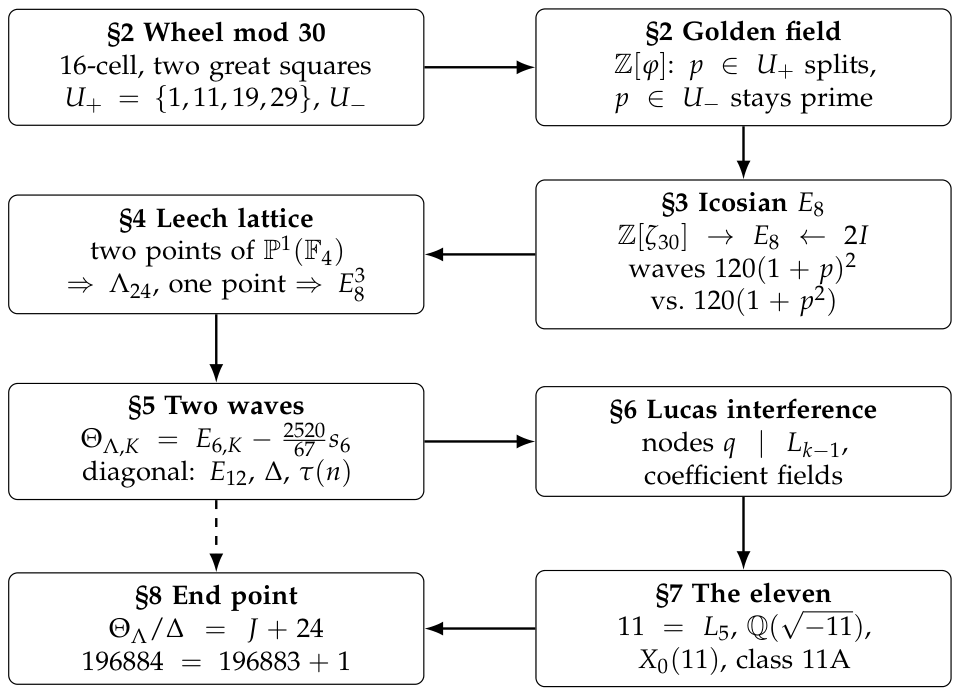
Figure 3.
The 16-cell of the units modulo 30 (projection onto a plane in which antipodes are opposite). Grey: the 24 edges. Blue and red: the two great squares and . The blue square is the subgroup of elements of order at most two, and it is the kernel of the quadratic character modulo 5 (Proposition 1).
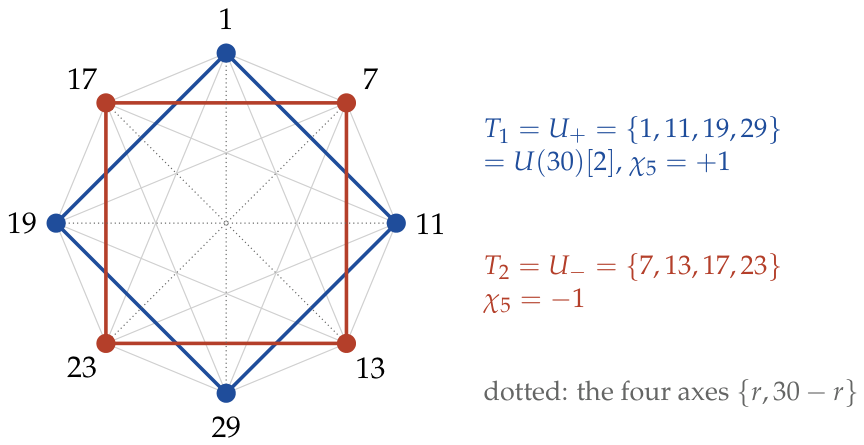
Figure 6.
The 240 roots of the trace lattice on , projected to the plane of spoke 1. They lie on eight rings of 30 points with radii . Colour: the two shells of Theorem 5. The rings are blue, the rings orange.
Figure 6.
The 240 roots of the trace lattice on , projected to the plane of spoke 1. They lie on eight rings of 30 points with radii . Colour: the two shells of Theorem 5. The rings are blue, the rings orange.
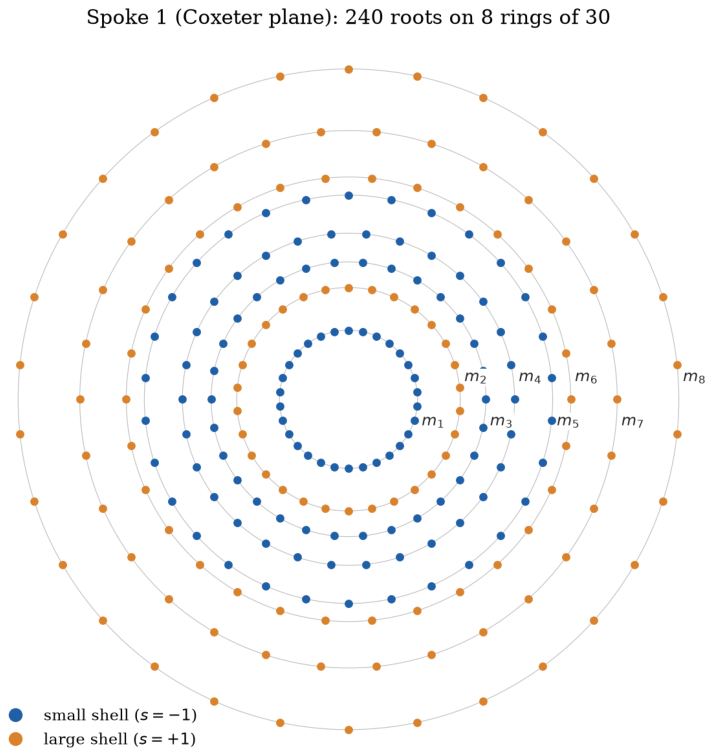
Figure 7.
Each root r as the point . All 240 points lie on the two lines (blue, orange). The four points on each line are the four rings of that shell; each point carries 30 roots.
Figure 7.
Each root r as the point . All 240 points lie on the two lines (blue, orange). The four points on each line are the four rings of that shell; each point carries 30 roots.
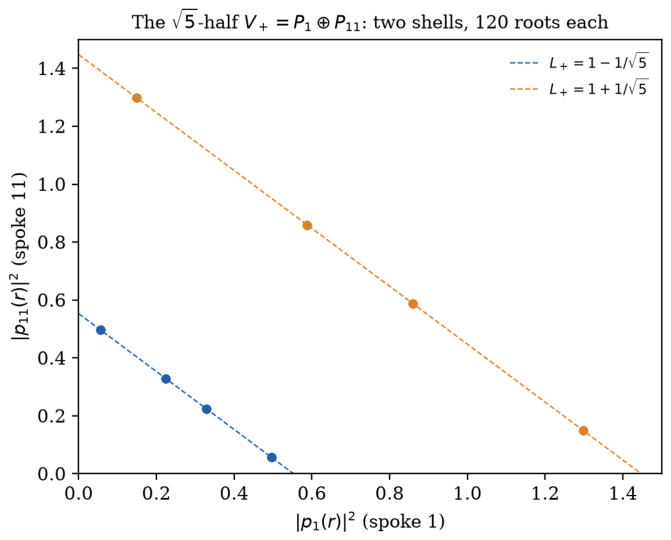
Table 1.
Main statements and their status. Numbers refer to the theorems in the text.
| Statement | Status | |
|---|---|---|
| 1 | The quadratic character mod 5 is trivial exactly on the great square of the 16-cell; norms from prime to 30 lie on . | [proved] (elementary) |
| 2 | is the only index-two subgroup of that is a union of axes; is the only real quadratic field with discriminant dividing 30. | [proved] (elementary) |
| 1 | ; the diagonal mirror acts on by an inner automorphism for and by an outer one for . | [proved] (classical pieces) |
| 8 | ; per prime: on , on . | [classical]; [observation, preregistered] to |
| 10 | Every ordered pair of distinct points of gives the Leech lattice; equal points give . | [proved] (Tits, Conway) |
| 10 | , so the glue turns j into . | [classical] |
| 13 | , with a proof from and the absence of roots. | [proved]; [cited] |
| 14 | Spoke rule for the cusp wave: fixed sign on , oscillation in on . | [proved] (from Doi–Naganuma) |
| 15 | ; units on trace lines only at odd Fibonacci n. | [classical]; [proved] |
| 16 | Lucas rule in 51 weights. | [conjecture]; [observation, preregistered] (23 weights) |
| 19 | One direction of the Lucas rule for . | [proved] (with cited theorems) |
| 23, 24 | At the exceptional nodes the residual image is and no Taylor–Wiles auxiliary prime exists. | [proved] |
| 26 | The exceptional nodes are the primes with a Fibonacci primitive root. | [proved] (elementary) |
| 27 | The prime 11 from to , class 11A and . | [classical] links, [proved] chain |
| 29 | Golden torus map: on , on (n odd). | [proved] (elementary) |
| 31 | ; the 24 is the dimension of the weight-one space. | [classical] |
| 17 | is -invariant iff ; for it equals . | [classical] (short proof) |
| 18 | is a null vector of with . | [cited] (Conway, Watson) |
Table 5.
The primes 7 and 11 through every station. On the red square a prime stays whole, its cusp coefficients are multiples of , and it never becomes a node. On the blue square a prime splits, its cusp coefficients are integers, and it can become a node; the first one, 11, carries the chain to the Monster.
| station | ||
|---|---|---|
| wheel mod 30 (Section 2) | red square , | blue square , |
| golden ring | inert: one prime of norm 49 | splits: |
| icosian (Theorem 8) | ||
| cusp wave, level 5 (Proposition 11) | ||
| golden Leech wave | ||
| Leech over K (3) | ||
| Lucas nodes (Section 6) | never a node (Proposition 12) | , first node, exceptional |
| golden torus (Theorem 29) | no 7-torsion in , n odd | on |
| Leech symmetry (Theorem 27) | same congruence mod 7; no golden symmetry known | class 11A, |
Disclaimer/Publisher’s Note: The statements, opinions and data contained in all publications are solely those of the individual author(s) and contributor(s) and not of MDPI and/or the editor(s). MDPI and/or the editor(s) disclaim responsibility for any injury to people or property resulting from any ideas, methods, instructions or products referred to in the content. |
© 2026 by the author. Licensee MDPI, Basel, Switzerland. This article is an open access article distributed under the terms and conditions of the Creative Commons Attribution (CC BY) license.
Copyright: This open access article is published under a Creative Commons CC BY 4.0 license, which permit the free download, distribution, and reuse, provided that the author and preprint are cited in any reuse.