

Submitted:
11 November 2026
Posted:
12 November 2026
You are already at the latest version
Abstract
Hand-landmark recognition can be disrupted when a tracking system briefly loses sight of a hand, especially during fast movements or occlusion. This study examines practical ways to handle those missing observations using a lightweight bidirectional LSTM and a 30-class subset of KArSL-502 (1,928 sequences from three signers). We sampled 24 frames per sequence and simulated the removal of 10–40% of previously detected hand-frame observations, either at random or in consecutive bursts. We then compared three approaches: zero filling, non-causal temporal interpolation, and mask-aware learning. In the original training run, the classifier achieved 92.58% accuracy on unmodified test sequences. With 40% random removal, accuracy dropped to 74.68% using zero filling, but reached 91.90% with interpolation and 90.34% with mask-aware learning. Under burst removal, the corresponding results were 72.25%, 89.65%, and 86.31%. A separate evaluation across three training seeds showed the same overall pattern: at 40% removal, mean accuracy was 73.09%, 93.25%, and 90.69% for random gaps, and 70.27%, 90.57%, and 88.16% for burst gaps, respectively. Paired bootstrap analyses with a fixed test mask also indicated improvements over zero filling for both recovery methods. These findings show that relatively simple handling of missing landmarks can substantially improve robustness in this controlled setting. They do not, however, establish signer-independent performance or unrestricted real-time operation.
Keywords:
arabic sign language
; KArSL
; missing hand detections
; hand landmarks
; robustness
; temporal interpolation
; mask-aware learning
; bidirectional LSTM
; missing data
1. Introduction
Automatic sign language recognition can help bridge communication between deaf and hearing communities. In Arabic Sign Language (ArSL), research has progressed from relatively small datasets to word-level resources such as KArSL (Sidig et al., 2021), alongside a shift from handcrafted features toward deep models trained on videos and skeletal representations (Rastgoo et al., 2021). Our earlier work on real-time ArSL translation (Abdelrahman, 2026) focused primarily on recognition from RGB video. Yet strong accuracy on clean recordings does not guarantee that a system will remain reliable when part of its input is missing.
A practical alternative to processing full video frames is to extract hand landmarks with a tracker such as MediaPipe (Lugaresi et al., 2019; Zhang et al., 2020) and classify the resulting motion sequence. This makes the recognition model compact: each frame is represented by a small set of coordinates rather than a full image, reducing the computational burden and dependence on appearance. The drawback is that the classifier also depends on the tracker. During signing, hands may move quickly, overlap, pass in front of the face, or leave the camera view. When a hand is not detected, the model receives a sequence with missing observations instead of a continuous trajectory.
Previous studies have already demonstrated the value of keypoint preprocessing and interpolation for sign language tasks (Kim and Baek, 2023; Roh et al., 2024). We therefore do not present interpolation as a new technique. Instead, we examine how different patterns and levels of missing detections affect recognition, and compare straightforward interpolation with a model trained to interpret observation masks. Our questions are: How quickly does accuracy decline as detected hands are removed? How much of that decline can simple recovery methods prevent? And do those methods behave differently when gaps occur individually rather than in bursts?
This study makes four focused contributions:
- A controlled protocol that removes whole hand detections at fixed rates (10–40%) under two patterns, random and burst, applied to hand-frames that the detector had actually found.
- A matched comparison of zero filling, temporal linear interpolation and mask-aware learning at all four missingness rates and both missingness patterns, using shared evaluation masks.
- Measured accuracy and macro-F1 degradation for missing hand detections, with an additional three-training-seed evaluation at 40% removal and paired bootstrap intervals for improvements over zero filling.
- A description of naturally empty hand slots, with an explicit distinction between non-active hands and detector failures, together with a reproducible experiment protocol and disclosed scope limitations.
2. Related Work
2.1. Arabic Sign Language Recognition
KArSL contains 502 Arabic Sign Language classes recorded by three signers, with RGB, depth, and skeleton modalities (Sidig et al., 2021). Recognition studies using Arabic sign data have examined both signer-dependent and signer-independent settings; for example, Podder et al. (2023) evaluated held-out signers. Our earlier MobileNetV2–LSTM study (Abdelrahman, 2026) addressed RGB-based recognition rather than deliberate loss of hand detections. In the present work, all three signers appear in both training and test partitions. The resulting scores should therefore be interpreted as signer-dependent and not compared directly with held-out-signer benchmarks. As broader reviews emphasize, temporal modeling and evaluation design both matter when interpreting sign recognition results (Rastgoo et al., 2021).
2.2. Landmark Extraction
MediaPipe Hands estimates 21 landmarks for each detected hand using a palm detector and a landmark-regression model (Zhang et al., 2020). A missing detection is different from a detected hand whose coordinates are noisy: in the former case, an entire hand-frame observation is absent. Research on keypoint preprocessing (Kim and Baek, 2023) and feature importance (Holmes et al., 2024) underscores the need to distinguish missing observations from meaningful coordinate values. This is why our pipeline records an explicit observation mask alongside the landmarks.
2.3. Learning from Sequences with Missing Values
Sequence models have long been studied in settings where some input values are missing. Lipton et al. (2016) examined recurrent models for incomplete clinical time series, while Che et al. (2018) proposed a recurrent approach that uses patterns of missingness. These studies provide a useful motivation for treating missing observations explicitly rather than relying on a single placeholder value. Our experiments apply this general idea to missing hand detections in sign language sequences, without claiming a new missing-data architecture.
2.4. Research Positioning and Evaluation Boundaries
Our aim is to isolate the effect of handling missing hand observations, rather than introduce a new imputation method or claim a state-of-the-art recognition system. Linear interpolation needs observations on both sides of a gap, which may introduce delay when video arrives in real time. Mask-aware learning does not require that future observation, but it involves training a separate classifier. We test these trade-offs on 30 KArSL classes with a signer-dependent split. The main question is whether the benefit of explicit gap handling remains visible across different gap patterns and model initializations.
3. Methodology
The workflow consists of five stages: sampling frames from KArSL-502, extracting hand landmarks, simulating missing detections, applying a recovery strategy, and classifying each sequence with a compact recurrent network. The experiments were implemented in one Google Colab notebook.
3.1. Dataset
We used the KArSL-502 release available on Kaggle. Each recording is stored as a folder of JPEG frames, organized by signer, data split, and sign class. The indexed release contains 75,515 samples covering 502 classes and three signers: 63,469 training samples and 12,046 test samples. To make landmark extraction feasible within a Colab session, we selected the first 30 classes by identifier and retained no more than 40 recordings per class in each split. This produced 1,928 sequences. We kept the official test split and set aside a stratified 10% of the training portion for validation (Table 1). Because all three signers are represented in training and testing, the results are signer-dependent.
3.2. Landmark Extraction and Normalisation
From each sample, 24 frames are selected at uniform intervals. Each frame is processed independently by the MediaPipe Hand Landmarker with a maximum of two hands. A sample is therefore represented by a tensor X of shape 24 × 2 × 63 and a binary observation mask M of shape 24 × 2, where an entry of M is 1 if the detector returned that hand in that frame. Detections are assigned to one of two slots according to the handedness label reported by MediaPipe; if two detections carry the same label, the second is placed in the free slot.
Raw image coordinates make the classifier sensitive to where the signer stands and how far they are from the camera. Each detected hand is therefore normalised: all landmarks are expressed relative to the wrist and divided by the hand size, defined as the image-plane distance from the wrist to the base of the middle finger. To preserve the location of the hand, which is itself informative in signing, the wrist position in the image (centred at the middle of the frame) is stored in the slot of the wrist landmark. Undetected hands are represented by zeros.
3.3. Simulating Missing Hand Landmarks
We simulate tracking failures by removing complete hand detections from individual frames. For each removal rate r ∈ {10%, 20%, 30%, 40%}, we consider two patterns. Random removal independently drops each observed hand-frame with probability r. Burst removal drops one contiguous block, covering a fraction r of the sequence, from each hand at a randomly selected position. The procedure is applied only to hand-frames that were originally detected. Thus, the stated removal rate describes additional loss on top of naturally missing observations, resulting in a new mask M′.
3.4. Recovery Methods
- Zero filling. Removed hand-frames are set to zero. This is what a pipeline does implicitly when it ignores the problem, and the classifier is the one trained on unmodified data.
- Temporal interpolation. Each removed hand-frame is replaced by a linear interpolation between the nearest earlier and later frames in which the same hand remains observed; at the ends of a sequence the nearest observed frame is held. Only simulated gaps are filled, so natural gaps are treated exactly as in training. The same classifier as for zero filling is used.
- Mask-aware training. Removed hand-frames are zero-filled, and the mask M′ is appended to the input as two additional channels (128 values per frame). A separate classifier is trained for this input; in every training batch a rate drawn uniformly from 10–40% and one of the two patterns are applied, so that the network learns to read the mask.
An important practical difference is that interpolation is non-causal: to fill a missing interval, it may need a frame that has not yet arrived. A streaming implementation would have to wait until the hand becomes visible again. The mask-aware approach does not have this look-ahead requirement.
3.5. Classifier and Training
The classifier is a two-layer bidirectional LSTM with 128 hidden units per direction and dropout of 0.3 between layers. The outputs are averaged over time, passed through dropout and mapped to the 30 classes by one linear layer. The network has approximately 0.67 million parameters. Both classifiers are trained with the Adam optimiser (Kingma & Ba, 2015), a learning rate of 0.001, a batch size of 64 and cross-entropy loss, for at most 150 epochs with early stopping after 25 epochs without improvement in validation accuracy; the weights with the best validation accuracy are kept. The standard model is validated on unmodified data and the mask-aware model on data with 25% random loss. The standard model stopped at epoch 72 (best validation accuracy 92.5% at epoch 47) and the mask-aware model at epoch 83 (90.8% at epoch 58).
3.6. Evaluation Protocol
We evaluated all three methods on the same 728 test recordings, using removal rates of 10%, 20%, 30%, and 40% under both random and burst patterns. For each setting, we generated three test masks independently and applied the same masks to each method, allowing direct comparison. Accuracy and macro F1 were averaged across these masks. Because the recordings are shared, these masks are repeated evaluations rather than independent test datasets. The full severity grid uses models trained with seed 42; the additional three-training-seed experiment covers only 40% removal.
3.7. Additional Reproducibility and Paired Uncertainty Analysis
To assess dependence on weight initialization and training stochasticity, we evaluated training seeds 42, 123 and 2026. The previously trained seed-42 models were reused; the conventional and mask-aware classifiers were retrained for the two other seeds under the existing training procedure. Each trained model was tested on three fixed simulated-removal masks (seeds 1000, 1001 and 1002) under random and burst loss at 40%. First, accuracies and macro F1 were averaged within each training seed over its three test masks; then mean and sample standard deviation were calculated across the three independent model training seeds. No full 10–40% retraining grid was run for seeds 123 and 2026.
Separately, for the original seed-42 models and mask seed 1000, 3,000 paired nonparametric bootstrap resamples of the 728 test recordings were used to estimate percentile 95% intervals for accuracy-point gains of interpolation and mask-aware learning over zero filling. These conditional intervals preserve the pairing of predictions on the same test videos but do not incorporate retraining or signer-population uncertainty. The analysis is descriptive and exploratory, without a multiple-comparison adjustment.
4. Results
4.1. Natural Missingness and Baseline Accuracy
Even before simulating detection failures, 47.9% of hand-frame slots were empty: 35.7% in MediaPipe’s left-labelled slot and 60.1% in its right-labelled slot. Many of these empty slots are expected because some signs use only one hand. The handedness labels also follow MediaPipe’s convention and do not necessarily correspond to the signer’s anatomical left and right. Still, 2.7% of frames had no detected hand, and one of the 1,928 recordings contained no hand detections at all. Missing observations are therefore a routine feature of the extracted data, not simply an artificial stress test.
On the unchanged test sequences, the standard classifier achieved 92.58% accuracy and 92.72% macro F1. The mask-aware model reached 91.21% accuracy and 91.12% macro F1, about 1.4 accuracy points lower despite the absence of simulated gaps.
4.2. Robustness to Simulated Missing Hands
Without recovery, performance falls increasingly quickly as more hand detections are removed. Under random removal, accuracy decreases by 1.7 points at 10% loss, 4.7 at 20%, 9.5 at 30%, and 17.9 at 40%. Burst removal is slightly more damaging at the highest rate, reducing accuracy by 20.3 points. A model trained on unmodified trajectories has no reliable way to tell whether an all-zero hand slot indicates a missing observation, which helps explain the sharp decline.
Temporal interpolation largely prevents this decline. With randomly scattered gaps, accuracy remains within 0.7 points of the clean baseline at every tested rate, including 91.90% at 40% removal. Longer, consecutive gaps are harder: accuracy reaches 91.16% at 30% burst removal and 89.65% at 40%, a 2.9-point decrease from the baseline. This difference is plausible because isolated missing frames usually have nearby observations, whereas a long gap may span a curved or otherwise complex movement that a straight line cannot reconstruct.
Mask-aware learning also remains fairly stable, and it does so without waiting for later frames. Starting from 91.21% on clean input, it reaches 90.34% under 40% random removal and 86.31% under 40% burst removal. Relative to zero filling at the same removal rate, these represent gains of 15.7 and 14.1 points. Interpolation performs better in every tested condition, however, and the mask-aware model sacrifices about 1.4 points of clean-input accuracy.
Macro F1 tracks accuracy closely across the settings in Table 2, suggesting that errors are not limited to a small number of classes.
4.3. Planned Experiments E1–E5
Table 3 retains the five experiments from the original plan. Taken on its own, it might suggest that interpolation under 30–40% loss performs better than zero filling under only 10–20% loss. The full method-by-rate comparison in Table 2 makes the reason clearer: this difference reflects the recovery approach, not simply which removal rate was assigned to each planned experiment.
4.4. Reproducibility Across Training Seeds and Paired Uncertainty
At 40% simulated loss, both recovery approaches were substantially more accurate than zero filling across all three model training seeds. Table 4 reports accuracy and macro F1, first averaged across three fixed test masks within each seed and then summarized across training seeds. The standard deviations describe variation among these three trained models, not uncertainty about all potential signers or deployments.
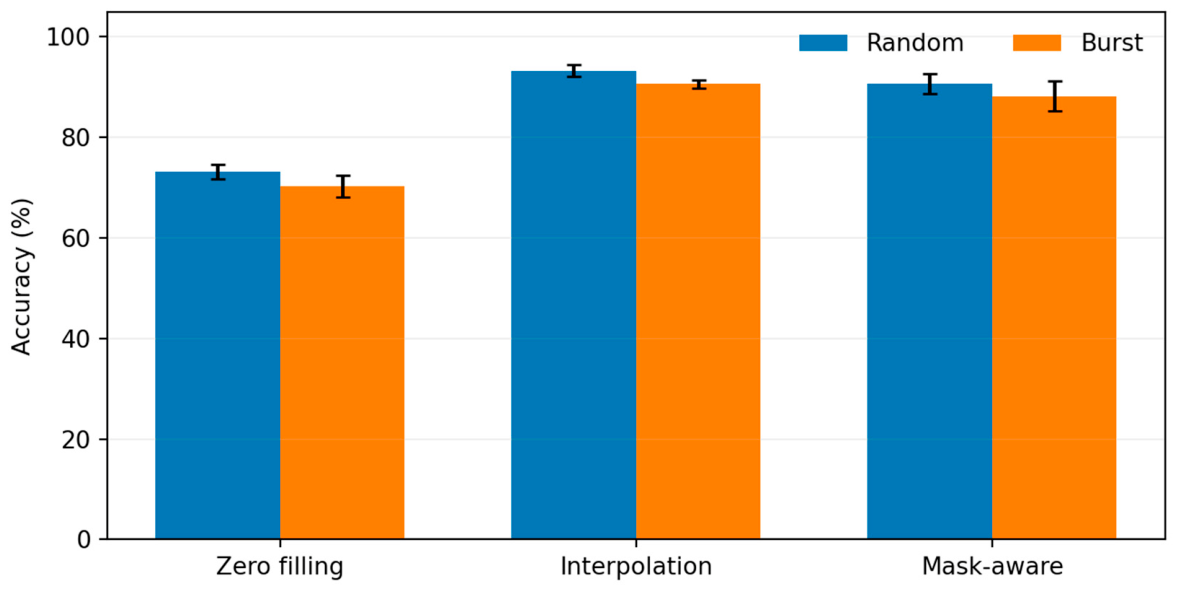
Across the training seeds, interpolation improved mean accuracy over zero filling by 20.16 percentage points under random removal (93.25% versus 73.09%) and 20.30 points under burst removal (90.57% versus 70.27%). Mask-aware learning also improved accuracy, by 17.60 and 17.89 points, respectively. Although interpolation produced the higher mean in both settings, three training runs are not enough to establish that it will always outperform mask-aware learning.
All four paired bootstrap intervals in Table 5 are above zero for the seed-42 models evaluated with mask seed 1000. This supports the conclusion that both recovery methods outperform zero filling for those particular predictions. The intervals do not describe uncertainty in the three-training-seed averages of Table 4 and should not be interpreted as evidence of an effect on previously unseen signers.
Figure 2.
Accuracy (mean ± sample SD across three training seeds) for the three methods at 40% simulated removal. Three fixed masks were averaged within each seed.
Figure 2.
Accuracy (mean ± sample SD across three training seeds) for the three methods at 40% simulated removal. Three fixed masks were averaged within each seed.
5. Discussion
The central finding is straightforward: explicitly handling missing hand detections makes this landmark-based recognizer considerably more resilient than leaving missing frames as zeros. At 40% simulated removal, the original seed-42 experiments showed roughly a 17-point advantage for interpolation; across three training seeds, the mean advantage was about 20 points. Both recovery approaches are relatively simple, but we did not separately measure their computational cost or total deployment latency.
The choice between recovery methods depends on how the recognizer will be used. Interpolation achieved the best accuracy throughout our tests, making it attractive for recorded clips where both sides of a gap are available. In a live translator, however, the same method may have to wait until a missing hand is detected again. Mask-aware learning can work with observations already received, but its clean-input accuracy is about 1.4 points lower, and it is more affected by long gaps. A possible hybrid, not evaluated here, would interpolate short gaps within a limited look-ahead window and use the mask for longer interruptions.
The pattern of missingness also changes the conclusion. Randomly missing frames are comparatively easy to interpolate, so results under random removal alone could make the problem appear nearly solved. Consecutive gaps are more challenging and may better resemble some real occlusions. Robustness studies should therefore test both patterns rather than relying only on independent frame dropping.
Repeating training with three seeds provides additional support for the advantage of both recovery methods over zero filling at severe simulated missingness. It does not settle the ordering between interpolation and mask-aware learning: interpolation has a higher overall mean, while the mask-aware model performs better in one burst-loss seed. The bootstrap intervals apply only to the original seed-42 predictions with one fixed mask. They do not capture variation across signers or across independent training runs, and should not be presented as population-level significance tests.
Our contribution should also be understood in relation to earlier work. Keypoint reconstruction and interpolation have already been studied for sign language recognition, including by Roh et al. (2024). What this paper adds is a focused Arabic Sign Language experiment with severity curves for both random and burst losses, a direct comparison with mask-aware learning, and repeated training at the highest tested loss rate. It is an empirical robustness study, not a claim to have invented interpolation.
Finally, the natural gaps in the landmark data matter. Nearly half of hand-frame slots were empty before any synthetic removal, largely because many signs use only one hand. The additional 10–40% removal was imposed on top of that existing sparsity. Recordings made in less controlled environments may be even harder to track, but that possibility remains to be tested.
6. Limitations
- Scale. The study uses 30 of 502 classes and 36 training samples per class. Absolute accuracies will differ on the full vocabulary, where classes are more easily confused and missing frames may be more costly.
- Signer dependence. The same three signers appear in training and test data. Robustness for unseen signers was not measured.
- Limited training repetition. Three training seeds were evaluated at 40% removal, but the complete 10–40% severity grid was produced with seed 42 only. Three seeds do not fully characterize optimization variance; paired bootstrap intervals were computed for a single model seed and simulated mask.
- Simulated missingness. Hand-frames were removed independently of image content. Real failures correlate with fast motion and hand-over-hand or hand-over-face configurations, which may be exactly the frames that carry the most information. Partial failures, in which a hand is detected with inaccurate landmarks, were not modelled.
- Model family. Only a bidirectional LSTM was evaluated. The notebook also supports a GRU, but that comparison was not run.
7. Conclusion
This pilot study tested how missing MediaPipe hand detections affect recognition of 30 KArSL sign classes. On the signer-dependent test split, the standard classifier achieved 92.58% accuracy without simulated loss. When 40% of previously detected hand observations were removed, zero filling reduced accuracy to 74.68% for random gaps and 72.25% for burst gaps. Both temporal interpolation and mask-aware learning substantially limited this decline. Across three training seeds, interpolation reached mean accuracies of 93.25% under random removal and 90.57% under burst removal, compared with 73.09% and 70.27% for zero filling. Mask-aware learning also provided large gains, with the practical advantage of not requiring future observations to fill a gap. These results support explicit treatment of missing detections in the tested setting, but they do not demonstrate signer-independent recognition or robustness to naturally occurring failures in real-world video.
Future research should include more KArSL classes, leave-one-signer-out evaluation, additional training seeds at every removal rate, and real tracking failures in unconstrained recordings. For live use, it will also be important to measure total processing latency, especially any delay introduced by interpolation, and to assess causal buffering or hybrid recovery methods.
Data and Code Availability
The underlying KArSL-502 image data can be obtained at https://www.kaggle.com/datasets/yousefdotpy/karsl-502 (subject to the dataset host’s terms). The experiments were run in a Google Colab notebook. The additional three-seed outputs comprise CSV files of all mask-specific runs, per-seed summaries, three-seed aggregate statistics, and conditional paired bootstrap intervals. At manuscript preparation, these files and the executable notebook are available from the author on request; no public code repository is claimed.
References
- Abdelrahman, A. (2026). Enhancing real-time Arabic sign language translation. Midocean Journal for Research and Studies, 2(2). [CrossRef]
- Che, Z., Purushotham, S., Cho, K., Sontag, D., & Liu, Y. (2018). Recurrent neural networks for multivariate time series with missing values. Scientific Reports, 8, 6085. [CrossRef]
- Cho, K., van Merriënboer, B., Gulcehre, C., Bahdanau, D., Bougares, F., Schwenk, H., & Bengio, Y. (2014). Learning phrase representations using RNN encoder–decoder for statistical machine translation. In Proceedings of the 2014 Conference on Empirical Methods in Natural Language Processing (pp. 1724–1734).
- Hochreiter, S., & Schmidhuber, J. (1997). Long short-term memory. Neural Computation, 9(8), 1735–1780.
- Jiang, S., Sun, B., Wang, L., Bai, Y., Li, K., & Fu, Y. (2021). Skeleton aware multi-modal sign language recognition. In Proceedings of the IEEE/CVF Conference on Computer Vision and Pattern Recognition Workshops.
- Kingma, D. P., & Ba, J. (2015). Adam: A method for stochastic optimization. In Proceedings of the 3rd International Conference on Learning Representations.
- Lipton, Z. C., Kale, D. C., & Wetzel, R. (2016). Directly modeling missing data in sequences with RNNs: Improved classification of clinical time series. In Proceedings of the 1st Machine Learning for Healthcare Conference (PMLR 56, pp. 253–270).
- Lugaresi, C., Tang, J., Nash, H., McClanahan, C., Uboweja, E., Hays, M., Zhang, F., Chang, C.-L., Yong, M. G., Lee, J., Chang, W.-T., Hua, W., Georg, M., & Grundmann, M. (2019). MediaPipe: A framework for building perception pipelines. arXiv:1906.08172.
- Luqman, H., & El-Alfy, E.-S. M. (2021). Towards hybrid multimodal manual and non-manual Arabic sign language recognition: mArSL database and pilot study. Electronics, 10(14), 1739.
- Rastgoo, R., Kiani, K., & Escalera, S. (2021). Sign language recognition: A deep survey. Expert Systems with Applications, 164, 113794.
- Rubin, D. B. (1976). Inference and missing data. Biometrika, 63(3), 581–592.
- Sidig, A. A. I., Luqman, H., Mahmoud, S., & Mohandes, M. (2021). KArSL: Arabic sign language database. ACM Transactions on Asian and Low-Resource Language Information Processing, 20(1), 1–19. [CrossRef]
- Zhang, F., Bazarevsky, V., Vakunov, A., Tkachenka, A., Sung, G., Chang, C.-L., & Grundmann, M. (2020). MediaPipe Hands: On-device real-time hand tracking. arXiv:2006.10214.
- Holmes, R. M., Rushe, E., & Ventresque, A. (2024). The key points: Using feature importance to identify shortcomings in sign language recognition models. Proceedings of LREC-COLING 2024, 15970–15975. https://aclanthology.org/2024.lrec-main.1387/.
- Kim, Y., & Baek, H. (2023). Preprocessing for keypoint-based sign language translation without glosses. Sensors, 23(6), 3231. [CrossRef]
- Podder, K. K., Ezeddin, M., Chowdhury, M. E. H., et al. (2023). Signer-independent Arabic sign language recognition system using deep learning model. Sensors, 23(16), 7156. [CrossRef]
- Roh, K., Lee, H., Hwang, E. J., Cho, S., & Park, J. C. (2024). Preprocessing Mediapipe keypoints with keypoint reconstruction and anchors for isolated sign language recognition. Proceedings of the LREC-COLING 2024 11th Workshop on the Representation and Processing of Sign Languages, 323–334. https://aclanthology.org/2024.signlang-1.36/.
Figure 1.
Test accuracy against the proportion of removed hand-frames for the three recovery methods under (a) random and (b) burst missing patterns.
Figure 1.
Test accuracy against the proportion of removed hand-frames for the three recovery methods under (a) random and (b) burst missing patterns.
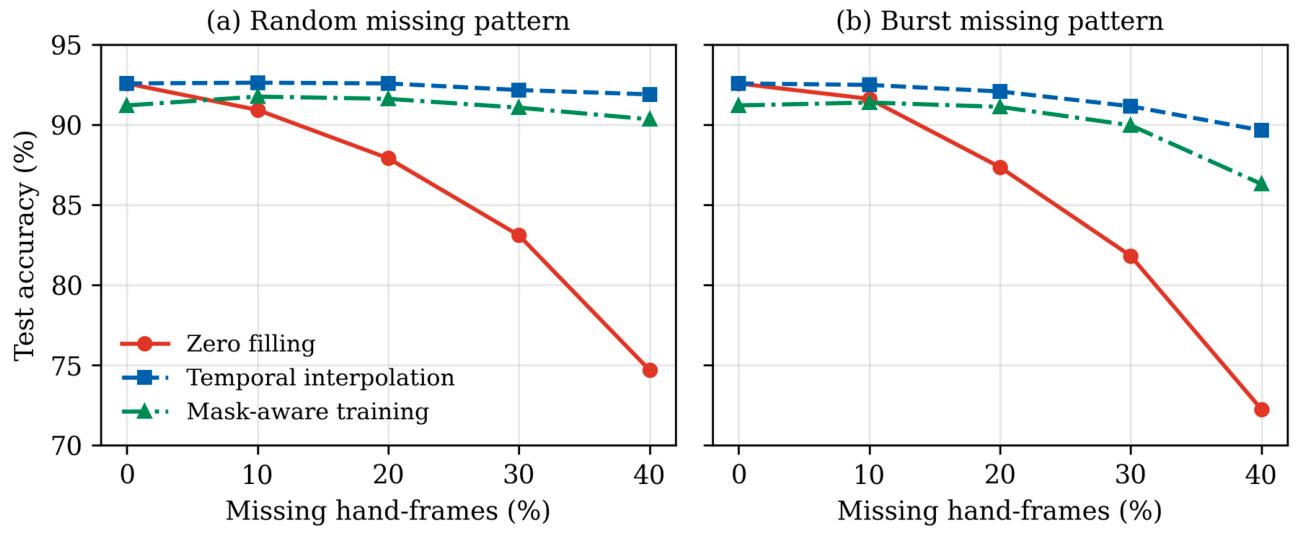

Table 1.
Data used in this study.
| Item | Value |
| Full release: samples / classes / signers | 75,515 / 502 / 3 |
| Classes used | 30 |
| Samples used | 1,928 |
| Training / validation / test samples | 1,080 / 120 / 728 |
| Frames per sample | 24 |
| Features per frame | 126 (2 hands × 21 landmarks × 3) |
Table 2.
Test accuracy and macro F1 (%) by missing rate, pattern and recovery method (mean of three masks; 728 test samples). The best value in each row is in bold.
Table 2.
Test accuracy and macro F1 (%) by missing rate, pattern and recovery method (mean of three masks; 728 test samples). The best value in each row is in bold.
| Pattern | Missing | Zero fill Acc. | Zero fill F1 | Interp. Acc. | Interp. F1 | Mask-aware Acc. | Mask-aware F1 |
| None | 0% | 92.58 | 92.72 | 92.58 | 92.72 | 91.21 | 91.12 |
| Random | 10% | 90.93 | 91.22 | 92.63 | 92.79 | 91.76 | 91.70 |
| Random | 20% | 87.91 | 88.19 | 92.58 | 92.70 | 91.62 | 91.51 |
| Random | 30% | 83.10 | 83.39 | 92.17 | 92.30 | 91.07 | 91.02 |
| Random | 40% | 74.68 | 74.56 | 91.90 | 92.00 | 90.34 | 90.28 |
| Burst | 10% | 91.62 | 91.87 | 92.49 | 92.63 | 91.39 | 91.32 |
| Burst | 20% | 87.36 | 87.64 | 92.08 | 92.21 | 91.12 | 91.02 |
| Burst | 30% | 81.82 | 82.11 | 91.16 | 91.33 | 89.97 | 89.81 |
| Burst | 40% | 72.25 | 72.37 | 89.65 | 89.73 | 86.31 | 86.13 |
Table 3.
Planned experiments (accuracy / macro F1, %). E5 is the mean over the four rates.
| Experiment | Missing | Recovery method | Random pattern | Burst pattern |
| Baseline | 0% | None | 92.58 / 92.72 | 92.58 / 92.72 |
| E1 | 10% | Zero filling | 90.93 / 91.22 | 91.62 / 91.87 |
| E2 | 20% | Zero filling | 87.91 / 88.19 | 87.36 / 87.64 |
| E3 | 30% | Temporal interpolation | 92.17 / 92.30 | 91.16 / 91.33 |
| E4 | 40% | Temporal interpolation | 91.90 / 92.00 | 89.65 / 89.73 |
| E5 | 10–40% | Mask-aware training | 91.20 / 91.13 | 89.70 / 89.57 |
Table 4.
Performance at 40% simulated removal across three model training seeds; mean ± sample standard deviation (%).
Table 4.
Performance at 40% simulated removal across three model training seeds; mean ± sample standard deviation (%).
| Pattern | Method | Accuracy (%) | Macro F1 (%) |
| Random | Zero filling | 73.09 ± 1.42 | 72.77 ± 1.67 |
| Random | Temporal interpolation | 93.25 ± 1.19 | 93.31 ± 1.14 |
| Random | Mask-aware training | 90.69 ± 2.01 | 90.66 ± 2.03 |
| Burst | Zero filling | 70.27 ± 2.12 | 69.91 ± 2.39 |
| Burst | Temporal interpolation | 90.57 ± 0.79 | 90.60 ± 0.75 |
| Burst | Mask-aware training | 88.16 ± 2.96 | 87.98 ± 3.07 |
Table 5.
Seed-42, mask-1000 paired bootstrap accuracy gains versus zero filling (3,000 resamples; percentage points; conditional 95% percentile intervals).
Table 5.
Seed-42, mask-1000 paired bootstrap accuracy gains versus zero filling (3,000 resamples; percentage points; conditional 95% percentile intervals).
| Pattern | Method | Gain (pp) | 95% bootstrap CI (pp) |
| Random | Temporal interpolation | +17.86 | [14.70, 21.15] |
| Random | Mask-aware training | +16.07 | [12.64, 19.64] |
| Burst | Temporal interpolation | +17.17 | [13.87, 20.47] |
| Burst | Mask-aware training | +13.05 | [9.48, 16.76] |
Disclaimer/Publisher’s Note: The statements, opinions and data contained in all publications are solely those of the individual author(s) and contributor(s) and not of MDPI and/or the editor(s). MDPI and/or the editor(s) disclaim responsibility for any injury to people or property resulting from any ideas, methods, instructions or products referred to in the content. |
© 2026 by the authors. Licensee MDPI, Basel, Switzerland. This article is an open access article distributed under the terms and conditions of the Creative Commons Attribution (CC BY) license (http://creativecommons.org/licenses/by/4.0/).
Copyright: This open access article is published under a Creative Commons CC BY 4.0 license, which permit the free download, distribution, and reuse, provided that the author and preprint are cited in any reuse.