

Submitted:
09 November 2026
Posted:
11 November 2026
You are already at the latest version
Abstract
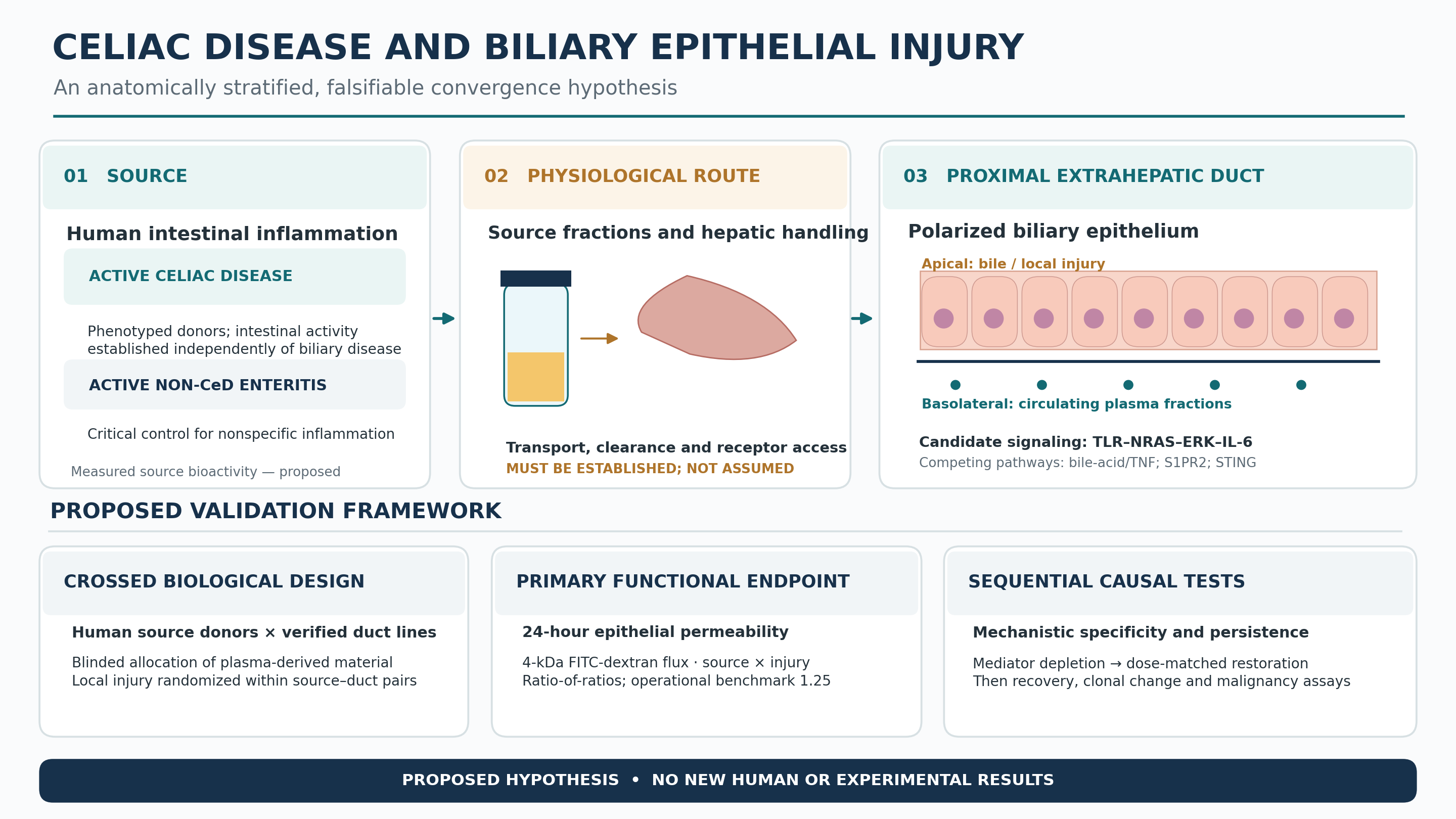
Across anatomically distinct biliary territories, neoplastic development takes place against a changing background of epithelial injury, disturbed bile flow, stromal adaptation and immune signaling. Celiac disease (CeD), whose intestinal activity can be established independently of a hepatobiliary outcome, offers a tractable human source condition for examining whether an upstream inflammatory exposure modifies the biological response of an already injured duct. The relevant causal problem is therefore not the coincidence of two diagnoses but the demonstration of a transferable, quantitatively characterized source signal, a physiologically plausible route to the biliary epithelium and an interaction that persists after competing inflammatory explanations have been examined.In the proposed source-conditioned convergence model, plasma-derived fractions from patients with objectively active CeD are compared with fractions from independently characterized active non-CeD enteritis. The recipient mechanism prioritizes microbial-ligand-responsive TLR-NRAS-ERK-IL-6 signaling, examined alongside bile-acid/TNF-alpha-associated injury and the S1PR2 pathway, without assuming disease exclusivity for either mechanism. Source enrichment, functional transfer, receptor dependence, recovery after withdrawal and later neoplastic progression occupy different evidentiary levels, each with an experimentally identifiable contrast.Human pathology, population studies and anatomically annotated molecular atlases inform a prospective donor-crossed factorial experiment. Blinded source fractions are allocated across authenticated proximal extrahepatic cholangiocyte lines, while local injury is randomized within source-recipient pairs. The primary endpoint is polarized epithelial permeability at 24 hours, quantified using 4-kDa FITC-dextran and analyzed as a log2-transformed permeability ratio; its interaction is reported on the original scale as a ratio of ratios, with 1.25 defined as an operational benchmark rather than a clinical threshold. Inference across source donors is conditional on the registered duct panel, while broader recipient-population inference is reserved for an independently calibrated design.Discriminating a CeD-associated source effect from a generic inflammatory response requires comparisons with active non-CeD intestinal disease, quantitative characterization of receptor-active material and molecular depletion followed by dose-matched restoration. Alongside functional barrier measurements, orthogonal integrity assays and post-exposure studies distinguish transient injury from persistent damage, clonal progression and malignant behavior. The archived junctional biliary adenocarcinoma provides a narrowly defined anatomical motivation, while the CeD exposure is established prospectively in unrelated, phenotyped source donors. In this sequence, the study tests a precise interaction between human-derived source material and duct injury without allowing the historical clinical observation to substitute for mechanistic evidence.
Keywords:
celiac disease
; extrahepatic cholangiocarcinoma
; cholangiocytes
; bile acids
; TLR4
; NRAS
; interleukin-6
; organoids
; causal interaction
; multiomics
Copyright: This open access article is published under a Creative Commons CC BY 4.0 license, which permit the free download, distribution, and reuse, provided that the author and preprint are cited in any reuse.