
Submitted:
09 November 2026
Posted:
11 November 2026
You are already at the latest version
Abstract
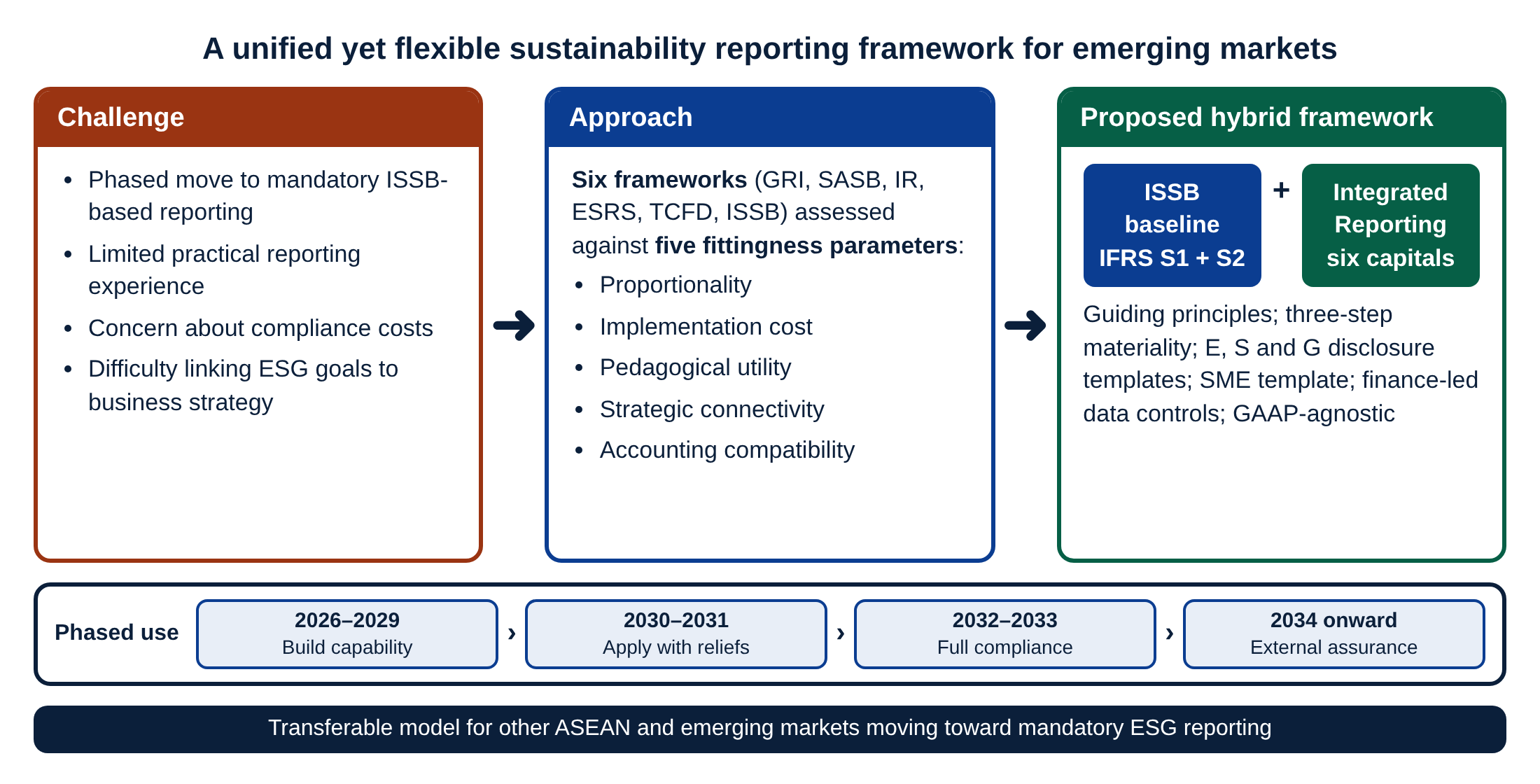
Emerging markets adopting the International Sustainability Standards Board (ISSB) standards face a practical problem: global requirements assume reporting capabilities that local preparers often lack. This paper develops a unified yet flexible sustainability reporting framework, using as its context Cambodia, which is moving from voluntary environmental, social and governance (ESG) disclosure to mandatory reporting. Prior studies and a survey of 118 professionals revealed limited reporting experience, cost concerns and difficulty aligning ESG goals with business objectives. Six international frameworks were compared against five fittingness parameters: proportionality, implementation cost, pedagogical utility, strategic connectivity and compatibility with accounting frameworks. No single framework met all five. The ISSB standards performed best on proportionality, cost and compatibility, and Integrated Reporting on strategic connectivity and pedagogical utility. The proposed hybrid uses IFRS S1 and IFRS S2 as its technical baseline and the six capitals as its strategic architecture, supported by a three-step materiality process, ESG disclosure templates and proportionate measures, including a template for small and medium-sized enterprises. The fittingness parameters and hybrid architecture offer a potentially transferable model for other Association of Southeast Asian Nations (ASEAN) and emerging markets, such as Lao PDR, Myanmar and Viet Nam, as they move toward mandatory ESG reporting.
Keywords:
sustainability reporting framework
; IFRS S1
; IFRS S2
; integrated reporting
; six capitals
; proportionality
; ESG disclosure
; emerging markets
; SMEs
; Cambodia
Copyright: This open access article is published under a Creative Commons CC BY 4.0 license, which permit the free download, distribution, and reuse, provided that the author and preprint are cited in any reuse.