

Submitted:
09 November 2026
Posted:
10 November 2026
You are already at the latest version
Abstract
Background/Objectives: Periodontitis has been linked to ischemic stroke through systemic inflammation, but the evidence remains inconsistent. We examined whether C-reactive protein (CRP), the neutrophil-to-lymphocyte ratio (NLR) and periodontal status are associated with a history of ischemic stroke. Methods: This retrospective cross-sectional study included 346 adults aged 30–82 years who underwent a full-mouth periodontal examination at a military hospital in Sibiu, Romania, between May 2022 and October 2024. Associations were estimated with Firth penalized logistic regression adjusted for age and sex, and discrimination was described with receiver operating characteristic curves. Results: Twenty-four patients (6.9%) had a history of ischemic stroke and 215 (62.1%) had periodontitis. CRP and NLR were higher in patients with prior stroke (median 13.5 vs. 5.0 mg/L and 11.6 vs. 4.6) and remained associated with stroke after adjustment (NLR: odds ratio [OR] 1.62 per unit, 95% confidence interval [CI] 1.40–1.96; CRP: OR 1.43 per mg/L, 95% CI 1.28–1.64). Periodontitis was not significantly associated with stroke (adjusted OR 1.74, 95% CI 0.71–4.83), CRP or NLR. CRP and NLR were strongly correlated (ρ = 0.94), and their separate contributions could not be distinguished. Conclusions: A history of ischemic stroke was associated with higher CRP and NLR but not with periodontal status. Because of the cross-sectional design and the small number of events, these markers may reflect the consequences of stroke and should not be interpreted as predictors of stroke risk.
Keywords:
ischemic stroke
; periodontitis
; C-reactive protein
; neutrophil-to-lymphocyte ratio
; systemic inflammation
; cross-sectional study
; Firth logistic regression
1. Introduction
Periodontitis is a chronic, microbially associated inflammatory disease that destroys the tooth-supporting tissues and, if untreated, leads to attachment loss, alveolar bone loss and tooth loss. The 2017 World Workshop classification defines a periodontitis case by detectable interdental clinical attachment loss (CAL) at two or more non-adjacent teeth, or by buccal or oral CAL of at least 3 mm with probing depths greater than 3 mm at two or more teeth, and describes each case by stage (severity and complexity) and grade (rate of progression) [1,2]. Beyond its oral consequences, periodontitis is associated with low-grade systemic inflammation and with atherosclerotic cardiovascular disease [3].
Atherosclerosis is a chronic inflammatory disease of the arterial wall, and inflammation is involved in every stage of atherogenesis and atherothrombosis [4,5]. C-reactive protein (CRP), an evolutionarily conserved acute-phase reactant [6], is higher in patients with periodontitis than in periodontally healthy individuals and falls after periodontal treatment [3,7,8]; it has also been proposed as a marker linking chronic inflammation to atherothrombotic risk [9]. The neutrophil-to-lymphocyte ratio (NLR), derived from a routine complete blood count, is an inexpensive marker of systemic inflammation associated with cardiovascular disease [10]. In healthy adults the NLR usually lies below approximately 3.5 [11], whereas after acute stroke it rises and is associated with mortality and poor functional outcome [12]. More generally, inflammatory pathways contribute both to the risk of ischemic stroke and to the tissue response after it [13], and peripheral immune activation can affect the brain through blood–brain barrier disruption and microglial activation, although no single circulating biomarker is specific enough to capture these processes [14].
Cohort [15,16] and case-control [17] studies, as well as a meta-analysis [18], have reported an association between periodontitis and ischemic stroke. In the Atherosclerosis Risk in Communities study, periodontal disease was associated with incident ischemic stroke, and regular dental care was associated with a lower risk [16]. However, periodontitis and stroke share risk factors such as smoking, diabetes and socioeconomic disadvantage, and the American Heart Association concluded that the available evidence did not establish an independent causal association [19,20]. The European Federation of Periodontology and the World Heart Federation reached a similarly cautious conclusion while recognizing consistent epidemiological associations [3].
It therefore remains unclear whether systemic inflammatory markers are associated with a history of ischemic stroke in patients with and without periodontitis, and whether periodontitis itself is associated with stroke in hospital-based populations. The primary objective of this study was to evaluate the association of CRP and NLR with a history of ischemic stroke in patients who underwent periodontal examination. The secondary objectives were to assess whether periodontal status was associated with a history of stroke and with CRP and NLR, to examine the correlation between CRP and NLR and to describe the ability of these markers and of age to discriminate patients with and without a history of stroke.
2. Materials and Methods
2.1. Study Design and Setting
We conducted a retrospective, single-centre, cross-sectional study at the “Alexandru Augustin” Military Emergency Hospital in Sibiu, Romania, including patients evaluated between May 2022 and October 2024. Inflammatory markers, periodontal status and history of ischemic stroke were ascertained at a single time point; associations are therefore expressed as odds ratios, and no temporal or causal inference is drawn. The study is reported according to the STROBE statement for cross-sectional studies [21]. Patients were seen at the hospital for periodontal evaluation, both civilians and military personnel.
2.2. Participants
Data were obtained from the institutional database. Eligible participants were aged 30–82 years, had complete clinical and laboratory records and had undergone a full-mouth periodontal examination by a calibrated periodontist. CRP and NLR had to be measured within 7 days of the periodontal examination. Exclusion criteria were immunosuppressive treatment, autoimmune disease, pregnancy, active infection (ruled out by chest radiography, urinalysis and pharyngeal swab), history of malignancy, surgery within the previous 30 days and missing data for key variables. Of 450 patients screened, 104 were excluded and 346 were included in the analysis (Figure 1).
2.3. Variables and Measurements
The following variables were extracted: age (years), sex, history of ischemic stroke, periodontal status, CRP (mg/L) and NLR. A history of ischemic stroke was defined as a previous ischemic stroke confirmed by computed tomography or magnetic resonance imaging and documented in the medical record.
Periodontal status was assessed by a calibrated periodontist, using www.Periodontalchart-online.com, examiner was blinded to stroke history. Probing depth and CAL were measured at six sites per tooth (mesiobuccal, midbuccal, distobuccal, mesiolingual, midlingual and distolingual) on all erupted teeth with a UNC-15 periodontal probe. Periodontitis was defined according to the 2017 World Workshop case definition [1] and analyzed as a binary variable (periodontitis vs. no periodontitis). The staging and grading framework is described by Tonetti et al. [2].
CRP was measured in serum. The NLR was calculated as the absolute neutrophil count divided by the absolute lymphocyte count from the same complete blood count.
2.4. Data Management
Data were imported directly from the Excel database to avoid transcription errors. Completeness was verified (no missing values among the analyzed records and no duplicate identifiers), and the distribution of each continuous variable was examined graphically and with the Shapiro–Wilk test.
2.5. Statistical Analysis
Age, CRP and NLR were not normally distributed (Shapiro–Wilk p < 0.001 for each; Figure 2) and are reported as median (interquartile range, IQR); categorical variables are reported as n (%). Continuous variables were compared between two groups with the Wilcoxon rank-sum test with continuity correction, and the effect size is given as the rank-biserial correlation (r). Categorical variables were compared with the χ² test with Yates’ continuity correction. Comparisons across the four groups defined by stroke and periodontal status used the Kruskal–Wallis test followed by Dunn’s pairwise tests with Holm adjustment (six comparisons per marker). Associations between continuous variables were assessed with Spearman’s rank correlation coefficient (ρ) with a 95% bootstrap percentile confidence interval (2000 resamples).
The association of CRP, NLR, periodontitis, age and sex with a history of stroke was estimated with logistic regression. Because only 24 patients had a history of stroke (eight events per predictor in Models A–C and six in Model D), conventional maximum-likelihood estimates are prone to small-sample bias and separation; we therefore used Firth’s penalized-likelihood logistic regression [22,23], an approach suited to routinely collected clinical datasets with few events [24]. Confidence intervals were obtained from the profile penalized likelihood and p values from likelihood-ratio tests. Because CRP and NLR were strongly correlated (ρ = 0.94; variance inflation factor 6.7 for each when entered together), they were examined in separate models adjusted for age (per 10 years) and sex (Models A and B). Model C evaluated periodontitis with the same adjustment, and Model D entered CRP and NLR together to illustrate the effect of collinearity; Model D was also fitted by conventional maximum likelihood as a sensitivity analysis. Odds ratios (ORs) refer to a 1-unit increase in NLR, a 1 mg/L increase in CRP and a 10-year increase in age.
The ability of NLR, CRP and age to discriminate patients with and without a history of stroke was described with receiver operating characteristic (ROC) curves. Apparent areas under the curve (AUCs), estimated in the same sample, are given with 95% CIs and compared with DeLong’s test for correlated ROC curves [25]. Youden-optimal thresholds are reported with exact (Clopper–Pearson) 95% CIs for sensitivity and specificity for descriptive purposes only. For combinations of age and inflammatory markers, the linear predictor of a Firth model was used, and the AUC was corrected for optimism with 1000 bootstrap resamples. Given the small number of events and the cross-sectional design, the ROC analysis describes discrimination in this sample and does not provide a prediction rule.
All tests were two-sided with a significance level of 0.05. Apart from the Holm adjustment of pairwise comparisons, no correction for multiple testing was applied, and all analyses should be regarded as exploratory. Statistical analyses and figures were produced in Python 3 (Python Software Foundation)[26] using NumPy[27], SciPy[28], pandas[29], scikit-learn[29] and Matplotlib[30]. Firth’s penalised-likelihood logistic regression[31,32] with profile-likelihood confidence intervals, DeLong’s test for correlated ROC curves[33], Dunn’s post-hoc test[34] with Holm adjustment[35], and bootstrap correction for optimism[36] were implemented from the original publications.
3. Results
3.1. Study Population
The analysis included 346 patients (186 women, 53.8%; 160 men) with a median age of 41 years (IQR 35–51; range 30–82). A history of ischemic stroke was recorded in 24 patients (6.9%) and periodontitis in 215 (62.1%). Characteristics according to stroke status are shown in Table 1. Age, CRP and NLR were not normally distributed (Figure 2).
Because the distributions of age, CRP and NLR were right-skewed, with long upper tails for both inflammatory markers (Figure 2), medians and IQRs are used throughout and all group comparisons are non-parametric.
3.2. Age, Sex, CRP and NLR According to History of Stroke
Patients with a history of stroke were older than those without (median 58 vs. 40 years; p < 0.001). CRP (median 13.5 vs. 5.0 mg/L) and NLR (median 11.6 vs. 4.6) were also higher in the stroke group (both p < 0.001). These crude differences were large (r = 0.74 for CRP and 0.73 for NLR) but do not account for age. The proportion of patients with a history of stroke was similar in women and men (12/186, 6.5% vs. 12/160, 7.5%; χ² = 0.029, p = 0.865); with 24 events, the study had limited power to detect modest differences.
3.3. Periodontal Status and Inflammatory Markers
Patients with and without periodontitis did not differ significantly in age (p = 0.144), sex (p = 0.669), CRP (median 6.0 vs. 5.0 mg/L; p = 0.146) or NLR (median 4.7 vs. 4.6; p = 0.317) (Table 2). A history of stroke was recorded in 18 patients with periodontitis (8.4%) and 6 without (4.6%), a difference that was not statistically significant (χ² = 1.27, p = 0.259; Fisher’s exact p = 0.198).
When patients were classified by stroke and periodontal status (Table 3 and Table 4), CRP and NLR differed across the four groups (Kruskal–Wallis p < 0.001 for both). In pairwise comparisons, both markers were higher in each stroke group than in each non-stroke group (Holm-adjusted p ≤ 0.009). Within the non-stroke and within the stroke patients, periodontal status was not associated with differences in CRP or NLR (all adjusted p ≥ 0.54). Only six patients had a history of stroke without periodontitis, so comparisons involving this group are imprecise.
Table 3 shows that, within each stroke stratum, CRP and NLR were not higher in patients with periodontitis; among patients with stroke, the medians were in fact slightly higher in those without periodontitis, although this group included only six patients. In contrast, the differences between the stroke and non-stroke strata were large. The corresponding pairwise tests are given in Table 4.
All four comparisons between a stroke group and a non-stroke group were significant for both markers, whereas neither comparison within the same stroke stratum was significant (Table 4).
3.4. Correlation between CRP and NLR
CRP and NLR were very strongly and positively correlated (Spearman ρ = 0.94, 95% CI 0.91–0.95; p < 0.001; Figure 3). The relationship was monotonic but not linear, flattening at higher CRP values. Neither marker was meaningfully correlated with age (CRP: ρ = 0.08, p = 0.153; NLR: ρ = 0.09, p = 0.099). The two markers therefore carried largely overlapping information in this sample.
3.5. Factors Associated with a History of Stroke
In univariable Firth logistic regression, older age, higher CRP and higher NLR were associated with a history of stroke, whereas sex and periodontitis were not (Table 5). After adjustment for age and sex, each 1-unit increase in NLR was associated with higher odds of prior stroke (Model A: OR 1.62, 95% CI 1.40–1.96; p < 0.001), as was each 1 mg/L increase in CRP (Model B: OR 1.43, 95% CI 1.28–1.64; p < 0.001). Age remained independently associated in all models (e.g., OR 2.09, 95% CI 1.45–3.12 per 10 years in Model A). Periodontitis was not significantly associated with stroke after adjustment (Model C: OR 1.74, 95% CI 0.71–4.83; p = 0.234); this wide interval is compatible with both no association and a clinically relevant one.
When CRP and NLR were entered together (Model D), both estimates were attenuated and their confidence intervals included 1 (CRP: OR 1.23, 95% CI 0.98–1.54, p = 0.070; NLR: OR 1.27, 95% CI 0.95–1.74, p = 0.112), whereas age remained associated (OR 2.11, 95% CI 1.45–3.18 per 10 years). This pattern reflects the collinearity of the two markers rather than evidence that either is unrelated to stroke: with 24 events, the model cannot separate their individual contributions. Conventional maximum-likelihood estimates for Model D were similar (Table 5, footnote).
Across Models A–C, the estimates for age were consistent (OR 1.81–2.13 per 10 years), whereas the estimate for female sex was imprecise in every model, with confidence intervals compatible with both lower and higher odds (Table 5).
3.6. Exploratory Discrimination of Stroke Status
In this exploratory analysis, NLR and CRP showed almost identical apparent AUCs for discriminating patients with and without a history of stroke (0.87, 95% CI 0.79–0.94 for both; difference 0.003, p = 0.801; Table 6, Figure 4). Both showed higher apparent discrimination than age alone (apparent AUC 0.71, 95% CI 0.59–0.83; NLR vs. age p = 0.046; CRP vs. age p = 0.034), although these comparisons were not adjusted for multiplicity. Sensitivity estimates at the Youden-optimal thresholds were imprecise because of the small number of events. Combining age with an inflammatory marker increased the optimism-corrected AUC to 0.90 (age + NLR) and 0.91 (age + CRP and age + CRP + NLR); adding the second marker gave no further gain. These estimates were obtained in the same sample used to fit the models and require confirmation in an independent cohort.
4. Discussion
4.1. Main Findings
In this cross-sectional study of 346 patients who underwent periodontal examination, higher CRP, higher NLR and older age were associated with a history of ischemic stroke, whereas periodontitis and sex were not. The associations of CRP and NLR persisted after adjustment for age and sex, and the two markers performed almost identically in discriminating stroke status. Periodontitis was not significantly associated with stroke (adjusted OR 1.74, 95% CI 0.71–4.83), and CRP and NLR did not differ by periodontal status. These data therefore neither confirm nor exclude a link between periodontitis and stroke, and they do not support the hypothesis that the inflammatory profile of stroke patients in this sample originated from periodontal disease.
Importantly, the hypothesis that motivated this study—that periodontitis would be associated with systemic inflammation and, in turn, with stroke—was not supported: periodontitis was not associated with stroke, and CRP and NLR did not differ between patients with and without periodontitis. The study therefore provides no evidence for a periodontitis → systemic inflammation → stroke pathway in this sample; it shows only that systemic inflammation and age are associated with a history of stroke in patients evaluated for periodontal disease.
4.2. Comparison with Previous Studies
The association between higher CRP and a history of stroke is consistent with the established role of inflammation in atherosclerosis and ischemic stroke [5,13]. Previous studies have linked periodontitis with higher CRP and other inflammatory biomarkers [3,7,8], and cohort, case-control and meta-analytic data have reported an association between periodontitis and ischemic stroke [15,16,17,18]. We did not reproduce these associations. Several explanations are possible. First, with only 24 stroke cases, six of them without periodontitis, the study had limited power to detect a moderate association. Second, periodontitis was highly prevalent (62.1%), which reduces the contrast between groups. Third, a binary definition does not capture severity or extent, whereas systemic inflammation is thought to depend on the periodontal inflammatory burden [3]; studies that used graded measures, such as the ARIC cohort, found stronger associations with more severe disease [16]. Fourth, previous periodontal treatment, which lowers CRP and other systemic inflammatory markers [3], was not taken into account. Finally, smoking, diabetes and other shared risk factors could not be included in the models.
Our findings are compatible with the cautious position of the American Heart Association and the European consensus, which recognize consistent associations but no established independent causal link between periodontitis and atherosclerotic vascular disease [3,19,20]. The NLR has been proposed as a low-cost marker of cardiovascular risk [10] and is associated with outcomes after acute stroke [12]. Our results add that NLR was associated with a history of stroke in a non-acute setting, but they do not show that it predicts future stroke.
4.3. Reverse Causation and Interpretation of Inflammatory Markers
The most important alternative explanation is reverse causation. Ischemic stroke triggers a systemic inflammatory and immune response, and the NLR rises after stroke in proportion to its severity [12,13]. Higher CRP and NLR in patients with a past stroke may therefore reflect the event itself or its sequelae, such as disability, immobility or subclinical infection, rather than a pre-existing risk factor. In addition, CRP and NLR are non-specific: they integrate signals from many sources, and in critically ill neurological patients routinely measured inflammatory markers vary across physiological phenotypes while age remains a dominant determinant of outcome [24]. Reviews of neuroimmune interactions similarly conclude that no single circulating marker captures the link between peripheral inflammation and brain injury, and that multimodal biomarker panels are needed [14].
The NLR values observed in patients without stroke (median 4.6) were higher than reference values reported in healthy adults [11], and the correlation between CRP and NLR (ρ = 0.94) was stronger than generally expected for two markers that reflect partly different biological processes. These features indicate that the study population, although free of active infection by the predefined criteria, was not a healthy population, and they limit the generalizability of the absolute values and thresholds reported here. The reason for evaluation was routine exam, associated with inflammation of the periodontal tissue.
4.4. Biological Plausibility
Periodontitis could contribute to systemic inflammation through repeated bacteremia and the release of pro-inflammatory mediators such as interleukin-6, tumor necrosis factor-α and CRP, which are also implicated in atherothrombosis [3,9]. Our data do not test these mechanisms: we did not measure cytokines, periodontal pathogens or markers of endothelial function, and CRP and NLR did not differ between patients with and without periodontitis.
4.5. Clinical Implications
Given the cross-sectional design, our findings should not be used to support CRP or NLR as predictors of stroke. They show that patients with a history of stroke had a distinct inflammatory profile that can be obtained from routine blood tests. Whether these markers identify patients at higher risk of a first or recurrent stroke can only be determined in prospective studies. Prevention and treatment of periodontitis remain important for oral health regardless of these results.
4.6. Strengths and Limitations
The strengths of this study include the full-mouth periodontal examination by a calibrated periodontist, the measurement of CRP and NLR within 7 days of this examination, complete data for all analyzed patients and the use of penalized-likelihood regression appropriate for a small number of events.
This study has several limitations. First, the cross-sectional design precludes temporal or causal inference, and inflammation may be a consequence of stroke. Second, only 24 patients had a history of stroke (eight events per predictor in Models A–C and six in Model D, below the conventional threshold of ten), which limits statistical power, yields imprecise estimates and restricts the number of covariates; the ROC results were obtained in the same sample and require external validation. Third, CRP and NLR were very strongly correlated, so their independent contributions could not be separated. Fourth, important confounders were not available, including smoking, diabetes, hypertension, dyslipidemia, body mass index, statin and antiplatelet therapy and the time since stroke. Fifth, periodontitis was analyzed as a binary variable, without stage, grade or extent, and previous periodontal treatment was not analyzed. Sixth, the single-centre, hospital-based sample, with a median age of 41 years, a high prevalence of periodontitis and NLR values above those reported in healthy adults, limits generalizability; in addition, the pathway by which young patients with stroke were referred for periodontal evaluation is not fully described. Seventh, CRP and NLR were measured only once. Finally, no correction for multiple testing was applied beyond the pairwise comparisons, so the analyses are exploratory.
4.7. Future Directions
Prospective cohort studies with larger samples, repeated measurements of CRP and NLR, adjustment for shared risk factors and graded measures of periodontal severity are needed. Interventional studies assessing the effect of periodontal therapy on systemic inflammatory markers and cerebrovascular outcomes are also warranted, and causal inference methods such as Mendelian randomization could help clarify the direction of the associations.
5. Conclusions
In this cross-sectional study, higher CRP, higher NLR and older age were associated with a history of ischemic stroke in patients who underwent periodontal examination, whereas periodontitis and sex were not. CRP and NLR were strongly correlated, performed similarly in discriminating stroke status and could not be separated when modeled together. Because of the cross-sectional design and the small number of stroke cases, no conclusions about causality, temporal order or prediction of future stroke can be drawn, and the inflammatory profile may partly reflect the consequences of stroke. Prospective studies with repeated measurements and adjustment for key confounders are needed to determine whether inflammatory markers identify patients at higher risk of stroke and whether periodontal treatment modifies this risk.
Supplementary Materials
The following supporting information can be downloaded at the website of this paper posted on Preprints.org. STROBE checklist for cross-sectional studies [38]; Table S1: Characteristics of included versus excluded patients.
Author Contributions
Conceptualization R.F.C.C., F.A.M. T.T; methodology T.T, S.M; formal analysis M.C.M, T.T; investigation T.T; data curation T.T, M.D.F.C.; writing—original draft preparation S.A., C.A.C., B.B.A. ; writing—review and editing S.A., C.A.C., B.B.A.,; supervision R.F.C.C., F.A.M., M.D.F.C., S.M. All authors have read and agreed to the published version of the manuscript.
Funding
This research received no external funding.
Institutional Review Board Statement
The study was conducted in accordance with the Declaration of Helsinki and approved by the Ethics Committee of the “Alexandru Augustin” Military Emergency Hospital, Sibiu (approval no. 66, date 15.10.2026).
Informed Consent Statement
Patient consent was waived because the study was a retrospective analysis of anonymized routinely collected data.
Data Availability Statement
The anonymized dataset is available from the corresponding author upon reasonable request, subject to institutional restrictions.
Conflicts of Interest
The authors declare no conflicts of interest.
Abbreviations
The following abbreviations are used in this manuscript:
| AUC | area under the curve |
| CAL | clinical attachment loss |
| CI | confidence interval |
| CRP | C-reactive protein |
| IQR | interquartile range |
| NLR | neutrophil-to-lymphocyte ratio |
| OR | odds ratio |
| ROC | receiver operating characteristic |
| STROBE | Strengthening the Reporting of Observational Studies in Epidemiology |
References
- Papapanou, P.N.; Sanz, M.; Buduneli, N.; Dietrich, T.; Feres, M.; Fine, D.H.; Flemmig, T.F.; Garcia, R.; Giannobile, W.V.; Graziani, F.; et al. Periodontitis: Consensus report of workgroup 2 of the 2017 World Workshop on the Classification of Periodontal and Peri-Implant Diseases and Conditions. J. Periodontol. 2018, 89, S173–S182. [Google Scholar] [CrossRef] [PubMed]
- Tonetti, M.S.; Greenwell, H.; Kornman, K.S. Staging and grading of periodontitis: Framework and proposal of a new classification and case definition. J. Periodontol. 2018, 89, S159–S172. [Google Scholar] [CrossRef] [PubMed]
- Sanz, M.; del Castillo, A.M.; Jepsen, S.; Gonzalez-Juanatey, J.R.; D’aiuto, F.; Bouchard, P.; Chapple, I.; Dietrich, T.; Gotsman, I.; Graziani, F.; et al. Periodontitis and cardiovascular diseases: Consensus report. J. Clin. Periodontol. 2020, 47, 268–288. [Google Scholar] [CrossRef] [PubMed]
- Ross, R. Atherosclerosis as an inflammatory disease. N. Engl. J. Med. 1999, 340, 115–126. [Google Scholar] [CrossRef] [PubMed]
- Libby, P. Inflammation in Atherosclerosis. Arterioscler. Thromb. Vasc. Biol. 2012, 32, 2045–2051. [Google Scholar] [CrossRef] [PubMed]
- Pathak, A.; Agrawal, A. Evolution of C-Reactive Protein. Front. Immunol. 2019, 10, 943. [Google Scholar] [CrossRef] [PubMed]
- D'AIuto, F.; Ready, D.; Tonetti, M.S. Periodontal disease and C-reactive protein-associated cardiovascular risk. J. Periodontal Res. 2004, 39, 236–241. [Google Scholar] [CrossRef] [PubMed]
- Joshipura, K.; Wand, H.; Merchant, A.; Rimm, E. Periodontal Disease and Biomarkers Related to Cardiovascular Disease. J. Dent. Res. 2004, 83, 151–155. [Google Scholar] [CrossRef] [PubMed]
- Ridker, P.M.; Silvertown, J.D. Inflammation, C-Reactive Protein, and Atherothrombosis. J. Periodontol. 2008, 79, 1544–1551. [Google Scholar] [CrossRef] [PubMed]
- Afari, M.E.; Bhat, T. Md Neutrophil to lymphocyte ratio (NLR) and cardiovascular diseases: an update. Expert Rev. Cardiovasc. Ther. 2016, 14, 573–577. [Google Scholar] [CrossRef] [PubMed]
- Forget, P.; Khalifa, C.; Defour, J.-P.; Latinne, D.; Van Pel, M.-C.; De Kock, M. What is the normal value of the neutrophil-to-lymphocyte ratio? BMC Res. Notes 2017, 10, 12. [Google Scholar] [CrossRef] [PubMed]
- Li, W.; Hou, M.; Ding, Z.; Liu, X.; Shao, Y.; Li, X. Prognostic Value of Neutrophil-to-Lymphocyte Ratio in Stroke: A Systematic Review and Meta-Analysis. Front. Neurol. 2021, 12, 686983. [Google Scholar] [CrossRef] [PubMed]
- Esenwa, C.C.; Elkind, M.S. Inflammatory risk factors, biomarkers and associated therapy in ischaemic stroke. Nat. Rev. Neurol. 2016, 12, 594–604. [Google Scholar] [CrossRef] [PubMed]
- Arbune, M.; Nicolcescu, P.; Ciubara, A.; Bogdan, P.M.; Vlase, C.-M.; Arbune, A.-A. Toward a Unified Neuroimmune Framework for Infection-Associated Psychiatric Disorders. Diseases 2026, 14, 290. [Google Scholar] [CrossRef] [PubMed]
- Jimenez, M.; Krall, E.A.; Garcia, R.I.; Vokonas, P.S.; Dietrich, T. Periodontitis and incidence of cerebrovascular disease in men. Ann. Neurol. 2009, 66, 505–512. [Google Scholar] [CrossRef] [PubMed]
- Sen, S.; Giamberardino, L.D.; Moss, K.; Morelli, T.; Rosamond, W.D.; Gottesman, R.F.; Beck, J.; Offenbacher, S. Periodontal Disease, Regular Dental Care Use, and Incident Ischemic Stroke. Stroke 2018, 49, 355–362. [Google Scholar] [CrossRef] [PubMed]
- Lafon, A.; Tala, S.; Ahossi, V.; Perrin, D.; Giroud, M.; Béjot, Y. Association between periodontal disease and non-fatal ischemic stroke: a case-control study. Acta Odontol. Scand. 2014, 72, 687–693. [Google Scholar] [CrossRef] [PubMed]
- Leira, Y.; Seoane, J.; Blanco, M.; Rodríguez-Yáñez, M.; Takkouche, B.; Blanco, J.; Castillo, J. Association between periodontitis and ischemic stroke: a systematic review and meta-analysis. Eur. J. Epidemiol. 2016, 32, 43–53. [Google Scholar] [CrossRef] [PubMed]
- Lockhart, P.B.; Bolger, A.F.; Papapanou, P.N.; Osinbowale, O.; Trevisan, M.; Levison, M.E.; Taubert, K.A.; Newburger, J.W.; Gornik, H.L.; Gewitz, M.H.; et al. Periodontal Disease and Atherosclerotic Vascular Disease: Does the Evidence Support an Independent Association? Circulation 2012, 125, 2520–2544. [Google Scholar] [CrossRef] [PubMed]
- Aarabi, G.; Eberhard, J.; Reissmann, D.R.; Heydecke, G.; Seedorf, U. Interaction between periodontal disease and atherosclerotic vascular disease – Fact or fiction? Atherosclerosis 2015, 241, 555–560. [Google Scholar] [CrossRef] [PubMed]
- Von Elm, E.; Altman, D.G.; Egger, M.; Pocock, S.J.; Gøtzsche, P.C.; Vandenbroucke, J.P.; Initiative, S. The Strengthening the Reporting of Observational Studies in Epidemiology (STROBE) statement: Guidelines for reporting observational studies. Lancet 2007, 370, 1453–1457. [Google Scholar] [CrossRef] [PubMed]
- Firth, D. Bias reduction of maximum likelihood estimates. Biometrika 1993, 80, 27–38. [Google Scholar] [CrossRef]
- Heinze, G.; Schemper, M. A solution to the problem of separation in logistic regression. Stat. Med. 2002, 21, 2409–2419. [Google Scholar] [CrossRef] [PubMed]
- Bogdan, P.M.; PleșEa-Condratovici, A.; Bogdan-Goroftei, R.E.; Duceac, L.D.; Armencia, A.O.; Dabija, M.G.; Salim, C.; Dabija, V.-A.; Nicolcescu, P.; Cristescu-Budală, C.L.; et al. Physiological Phenotypes in Comatose ICU Patients: A Retrospective Multidimensional Analysis. Diagnostics 2026, 16, 2876. [Google Scholar] [CrossRef] [PubMed]
- Delong, E.R.; Delong, D.M.; Clarke-Pearson, D.L. Comparing the Areas under Two or More Correlated Receiver Operating Characteristic Curves: A Nonparametric Approach. Biometrics 1988, 44, 837–845. [Google Scholar] [CrossRef] [PubMed]
- Van Rossum, G.; Drake, F.L. Python 3 Reference Manual; CreateSpace: Scotts Valley (CA), 2009. [Google Scholar]
- Harris, C.R.; Millman, K.J.; van der Walt, S.J.; Gommers, R.; Virtanen, P.; Cournapeau, D.; Wieser, E.; Taylor, J.; Berg, S.; Smith, N.J.; et al. Array programming with NumPy. Nature 2020, 585, 357–362. [Google Scholar] [CrossRef] [PubMed]
- Virtanen, P.; Gommers, R.; Oliphant, T.E.; Haberland, M.; Reddy, T.; Cournapeau, D.; Burovski, E.; Peterson, P.; Weckesser, W.; Bright, J.; et al. SciPy 1.0 Contributors. SciPy 1.0 Fundamental Algorithms for Scientific Computing in Python. Nat. Methods 2020, 17, 261–272. [Google Scholar] [PubMed]
- McKinney, W. Data structures for statistical computing in python. In Proceedings of the 9th Python in Science Conference, Austin, TX, USA, 28 June–3 July 2010; Volume 445, pp. 51–56. [Google Scholar]
- Pedregosa, F.; Varoquaux, G.; Gramfort, A.; Michel, V.; Thirion, B.; Grisel, O.; et al. Scikit-learn: machine learning in Python. J. Mach. Learn Res. 2011, 12, 2825–30. [Google Scholar]
- Hunter, J.D. Matplotlib: A 2D graphics environment. Comput. Sci. Eng. 2007, 9, 90–95. [Google Scholar] [CrossRef]
- Firth, D. Bias reduction of maximum likelihood estimates. Biometrika 1993, 80(1), 27–38. [Google Scholar] [CrossRef]
- Heinze, G.; Schemper, M. A solution to the problem of separation in logistic regression. Stat. Med. 2002, 21, 2409–2419. [Google Scholar] [CrossRef] [PubMed]
- DeLong, E.R.; DeLong, D.M.; Clarke-Pearson, D.L. Comparing the Areas under Two or More Correlated Receiver Operating Characteristic Curves: A Nonparametric Approach. Biometrics 1988, 44, 837–845. [Google Scholar] [CrossRef] [PubMed]
- Dunn, O.J. Multiple Comparisons Using Rank Sums. Technometrics 1964, 6, 241. [Google Scholar] [CrossRef]
- Holm, S. A simple sequentially rejective multiple test procedure. Scand. J. Stat. 1979, 6(2), 65–70. [Google Scholar]
- Harrell, F.E., Jr.; Lee, K.L.; Mark, D.B. Multivariable prognostic models: issues in developing models, evaluating assumptions and adequacy, and measuring and reducing errors. Stat. Med. 1996, 15(4), 361–87. [Google Scholar] [CrossRef]
- Von Elm, E.; Altman, D.G.; Egger, M.; Pocock, S.J.; Gøtzsche, P.C.; Vandenbroucke, J.P.; Initiative, S. The Strengthening the Reporting of Observational Studies in Epidemiology (STROBE) statement: Guidelines for reporting observational studies. Lancet 2007, 370, 1453–1457. [Google Scholar] [CrossRef] [PubMed]
Figure 1.
Flow diagram of patient selection.
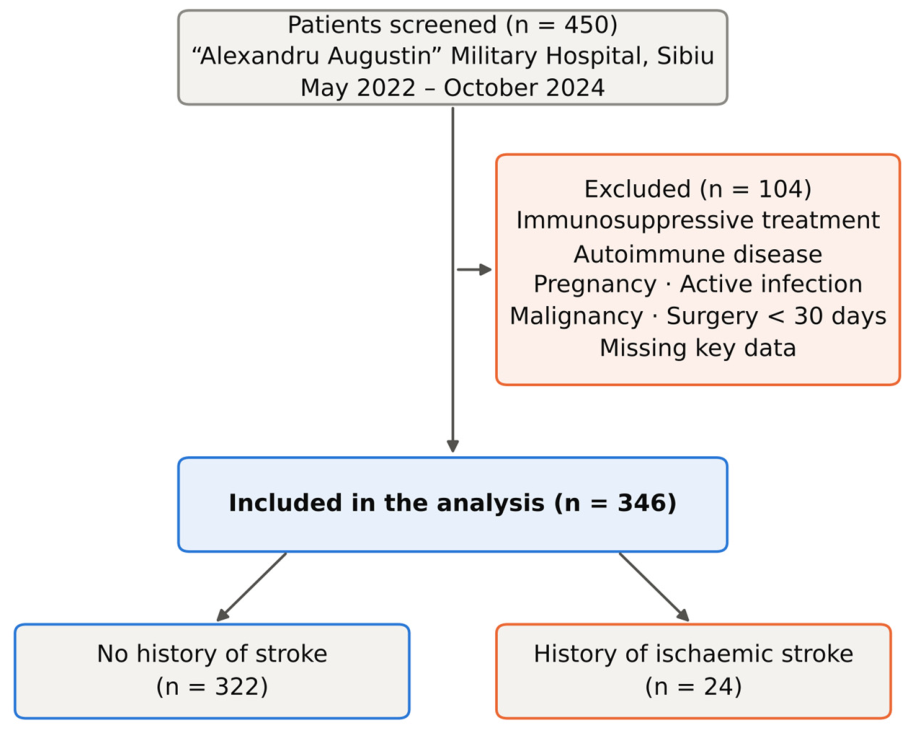
Figure 2.
Distribution of age, CRP and NLR in the whole sample (n = 346). The Shapiro–Wilk statistic is shown above each panel.
Figure 2.
Distribution of age, CRP and NLR in the whole sample (n = 346). The Shapiro–Wilk statistic is shown above each panel.
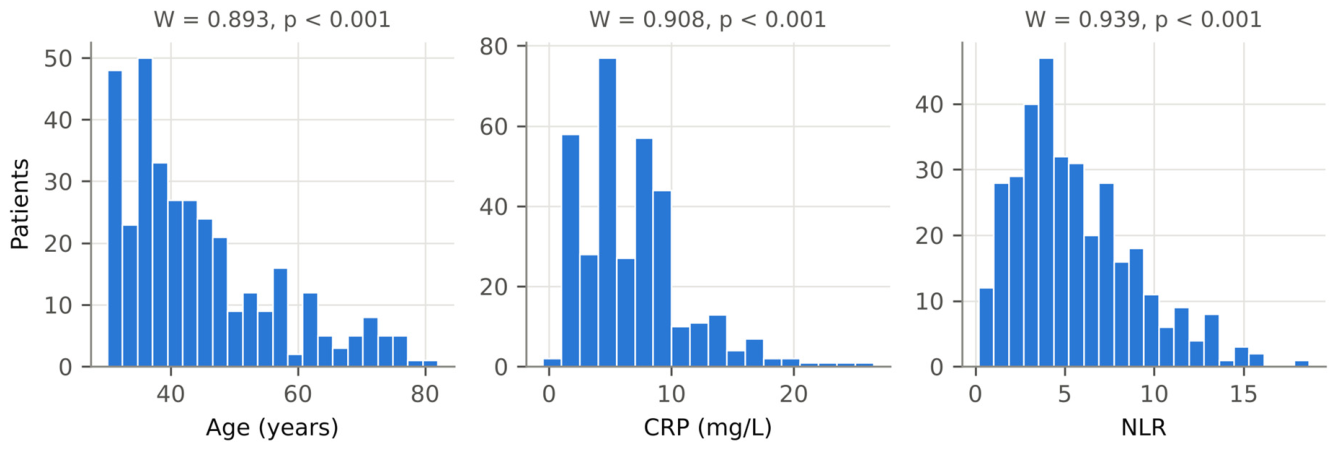
Figure 3.
Relationship between CRP and NLR (n = 346). Points represent individual patients (CRP values jittered horizontally for display); the line is a LOWESS smoother.
Figure 3.
Relationship between CRP and NLR (n = 346). Points represent individual patients (CRP values jittered horizontally for display); the line is a LOWESS smoother.
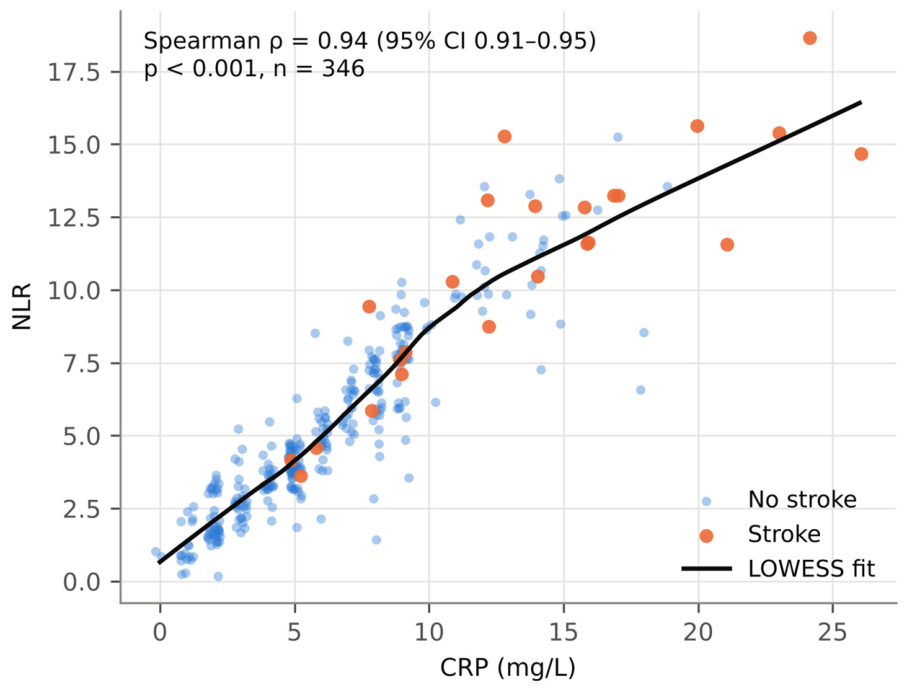
Figure 4.
ROC curves for NLR, CRP and age in discriminating patients with and without a history of stroke. Dots mark the Youden-optimal thresholds; the dotted line is the line of no discrimination.
Figure 4.
ROC curves for NLR, CRP and age in discriminating patients with and without a history of stroke. Dots mark the Youden-optimal thresholds; the dotted line is the line of no discrimination.
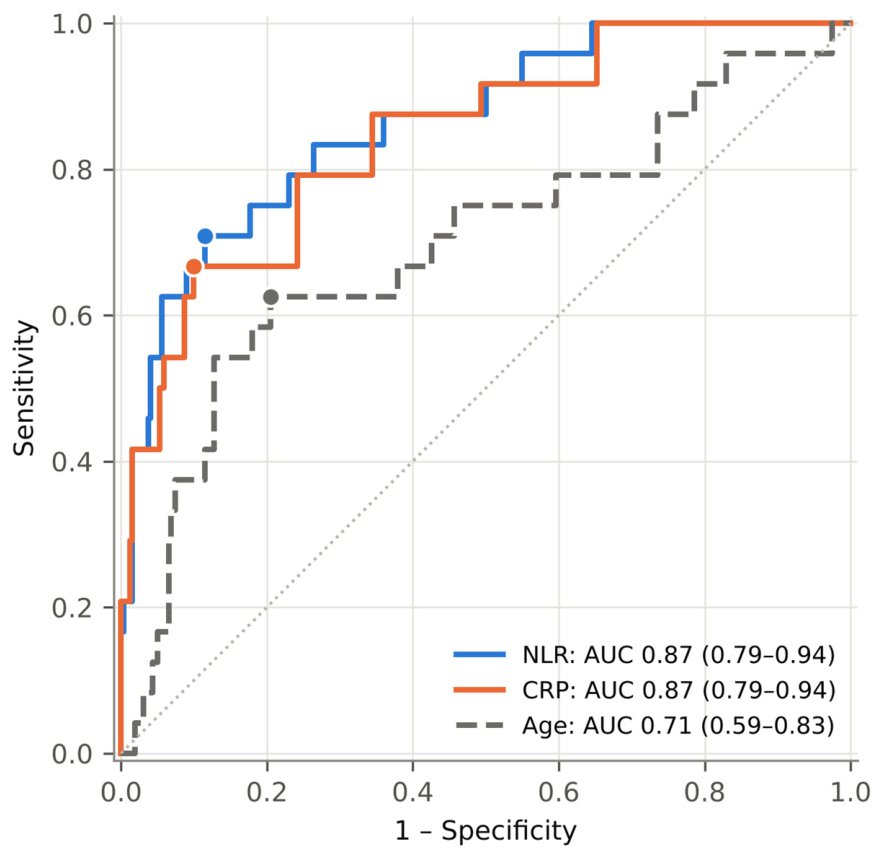

Table 1.
Characteristics of the study population according to history of ischemic stroke.
| Characteristic | No Stroke (n = 322) | Stroke (n = 24) | p | Effect Size (r) |
| Age, years | 40 (35–48) | 58 (41–66) | <0.001 | 0.42 |
| Female sex, n (%) | 174 (54.0) | 12 (50.0) | 0.865 | — |
| Periodontitis, n (%) | 197 (61.2) | 18 (75.0) | 0.259 | — |
| CRP, mg/L | 5.0 (3.0–8.0) | 13.5 (9.0–17.0) | <0.001 | 0.74 |
| NLR | 4.6 (3.1–7.3) | 11.6 (7.8–13.2) | <0.001 | 0.73 |
Continuous variables: median (IQR), Wilcoxon rank-sum test; r, rank-biserial correlation (positive values indicate higher values in the stroke group). Categorical variables: n (%), χ² test with Yates’ correction. CRP, C-reactive protein; NLR, neutrophil-to-lymphocyte ratio.
Table 2.
Characteristics of the study population according to periodontal status.
| Characteristic | No Periodontitis (n = 131) | Periodontitis (n = 215) | p |
| Age, years | 40 (34–49) | 42 (36–52) | 0.144 |
| Female sex, n (%) | 68 (51.9) | 118 (54.9) | 0.669 |
| CRP, mg/L | 5.0 (3.0–8.0) | 6.0 (4.0–9.0) | 0.146 |
| NLR | 4.6 (2.9–7.6) | 4.7 (3.2–7.6) | 0.317 |
| History of stroke, n (%) | 6 (4.6) | 18 (8.4) | 0.259 |
Median (IQR) with Wilcoxon rank-sum test for continuous variables; n (%) with χ² test (Yates’ correction) for categorical variables.
Table 3.
CRP and NLR according to stroke and periodontal status.
| Group | n | CRP, mg/L | NLR |
| No stroke, no periodontitis | 125 | 5.0 (3.0–8.0) | 4.5 (2.7–7.3) |
| No stroke, periodontitis | 197 | 6.0 (4.0–9.0) | 4.7 (3.1–7.2) |
| Stroke, no periodontitis | 6 | 16.0 (10.8–16.8) | 11.6 (8.6–12.8) |
| Stroke, periodontitis | 18 | 12.5 (9.0–16.8) | 11.0 (8.1–13.2) |
Median (IQR). Kruskal–Wallis test: CRP, H = 37.9, p < 0.001; NLR, H = 36.0, p < 0.001.
Table 4.
Pairwise comparisons of CRP and NLR between stroke/periodontal groups (Dunn’s test, Holm-adjusted p values).
Table 4.
Pairwise comparisons of CRP and NLR between stroke/periodontal groups (Dunn’s test, Holm-adjusted p values).
| Comparison | CRP | NLR |
| No stroke, no periodontitis vs. no stroke, periodontitis | 0.540 | 1.000 |
| No stroke, no periodontitis vs. stroke, no periodontitis | 0.002 | 0.008 |
| No stroke, no periodontitis vs. stroke, periodontitis | <0.001 | <0.001 |
| No stroke, periodontitis vs. stroke, no periodontitis | 0.005 | 0.009 |
| No stroke, periodontitis vs. stroke, periodontitis | <0.001 | <0.001 |
| Stroke, no periodontitis vs. stroke, periodontitis | 0.820 | 1.000 |
Table 5.
Firth logistic regression for a history of ischemic stroke (24 events in 346 patients).
| Model | Predictor | OR (95% CI) | p |
| Univariable | Age (per 10 years) | 1.81 (1.35–2.45) | <0.001 |
| Female sex | 0.85 (0.37–1.94) | 0.698 | |
| CRP (per 1 mg/L) | 1.38 (1.25–1.55) | <0.001 | |
| NLR (per 1 unit) | 1.54 (1.35–1.79) | <0.001 | |
| Periodontitis | 1.81 (0.75–4.91) | 0.191 | |
| Model A | NLR (per 1 unit) | 1.62 (1.40–1.96) | <0.001 |
| Age (per 10 years) | 2.09 (1.45–3.12) | <0.001 | |
| Female sex | 1.42 (0.51–4.12) | 0.503 | |
| Model B | CRP (per 1 mg/L) | 1.43 (1.28–1.64) | <0.001 |
| Age (per 10 years) | 2.13 (1.46–3.22) | <0.001 | |
| Female sex | 1.14 (0.41–3.26) | 0.797 | |
| Model C | Periodontitis | 1.74 (0.71–4.83) | 0.234 |
| Age (per 10 years) | 1.81 (1.34–2.45) | <0.001 | |
| Female sex | 0.76 (0.32–1.77) | 0.515 | |
| Model D | CRP (per 1 mg/L) | 1.23 (0.98–1.54) | 0.070 |
| NLR (per 1 unit) | 1.27 (0.95–1.74) | 0.112 | |
| Age (per 10 years) | 2.11 (1.45–3.18) | <0.001 | |
| Female sex | 1.37 (0.48–4.03) | 0.558 |
ORs with profile penalized-likelihood 95% CIs; p values from likelihood-ratio tests. Model A: NLR + age + sex; Model B: CRP + age + sex; Model C: periodontitis + age + sex; Model D: CRP + NLR + age + sex. Sensitivity analysis, Model D by conventional maximum likelihood (Wald): CRP OR 1.24 (0.99–1.58), p = 0.064; NLR OR 1.29 (0.95–1.79), p = 0.111; age (per 10 years) OR 2.21 (1.49–3.40), p < 0.001.
Table 6.
Exploratory discrimination of a history of stroke by NLR, CRP and age.
| Marker | Apparent AUC (95% CI) | Youden Threshold | Sensitivity, % (95% CI) | Specificity, % (95% CI) |
| NLR | 0.87 (0.79–0.94) | ≥8.75 | 70.8 (48.9–87.4) | 88.5 (84.5–91.8) |
| CRP | 0.87 (0.79–0.94) | ≥11 mg/L | 66.7 (44.7–84.4) | 90.1 (86.3–93.1) |
| Age | 0.71 (0.59–0.83) | ≥53 years | 62.5 (40.6–81.2) | 79.5 (74.7–83.8) |
AUC by the DeLong method; sensitivity and specificity with exact (Clopper–Pearson) 95% CIs. These apparent AUCs are likely optimistic and have not been externally validated; thresholds are sample-specific and no clinical cut-off is proposed.
Disclaimer/Publisher’s Note: The statements, opinions and data contained in all publications are solely those of the individual author(s) and contributor(s) and not of MDPI and/or the editor(s). MDPI and/or the editor(s) disclaim responsibility for any injury to people or property resulting from any ideas, methods, instructions or products referred to in the content. |
© 2026 by the authors. Licensee MDPI, Basel, Switzerland. This article is an open access article distributed under the terms and conditions of the Creative Commons Attribution (CC BY) license (http://creativecommons.org/licenses/by/4.0/).
Copyright: This open access article is published under a Creative Commons CC BY 4.0 license, which permit the free download, distribution, and reuse, provided that the author and preprint are cited in any reuse.