
Submitted:
08 November 2026
Posted:
10 November 2026
You are already at the latest version
Abstract
Whole-room indirect calorimeters and direct mass balance chambers are constrained by gas-analyzer baseline drift, calibration intervals, and confinement burden to continuous measurement windows of approximately 1 to 7 days. A fundamental methodological confound arises when these short-window instruments are used to evaluate dietary or pharmacological interventions with slow biological adaptation kinetics (ͳadapt ≈ 3–8 weeks). When an intervention is initiated upon or immediately prior to chamber entry, the calorimeter captures a non-stationary transitional perturbation – characterized by acute labile glycogen-water pool depletion, elevated gluconeogenic proteolysis, and incomplete enzymatic remodeling – rather than stationary steady-state physiology. This manuscript formally quantifies this timescale mismatch using open-system mass balance equations, demonstrating that unadapted transients can generate a non-adipose mass efflux of 250–430 g/day, swamping the steady-state daily substrate oxidation signal. To resolve this, I propose a criterion-based, tiered run-in protocol. Participants undergo a controlled 3–6 week ward-based or hybrid outpatient stabilization phase, with strict biomarker gatekeeping (urinary nitrogen plateau, RQ-to-FQ convergence, β-hydroxybutyrate stationarity) required to verify physiological readiness before entering the chamber. I also address the ward-to-chamber confinement artifact and outline a multi-system adaptation matrix generalizing this framework to slow-adapting interventions beyond ketogenic diets.
Keywords:
mass balance model
; whole-room calorimetry
; timescale separation
; keto-adaptation
; study design
; metabolic ward
; mass flux
; protein leverage
Key Points
- − Whole-room indirect calorimeters (WRICs) and direct mass balance chambers are precision instruments limited to continuous measurement windows of 1 to 7 days due to gas analyzer drift and participant confinement.
- − A fundamental methodological confound occurs when these short-window instruments are used to evaluate interventions with slow adaptation kinetics (ͳadapt ≈ 3–8 weeks).
- − Attempting to measure an unadapted state captures non-stationary transients (glycogen/water washout, acute proteolysis) that corrupt mass flux accounting by an order of magnitude.
- − The proposed protocol resolves this by enforcing a multi-week run-in phase, gated by objective physiological biomarkers (urinary nitrogen, RQ-to-FQ convergence, β-hydroxybutyrate), prior to continuous chamber measurement.
- − This framework generalizes beyond ketogenic diets to any intervention where ͳadapt > ͳchamber, including microbiome remodeling, protein transitions, and anti-obesity pharmacotherapy.
1. Introduction: The Timescale Mismatch
The evaluation of human metabolic interventions relies on two primary instruments: whole-room indirect calorimetry (WRIC) and direct mass balance chambers. Both are subject to strict operational ceilings. WRIC systems, operating at high fresh-air washout flow rates, suffer from gas analyzer baseline drift over continuous multi-day runs [1]. Furthermore, continuous confinement inside a sealed metabolic chamber imposes significant psychological burden and suppresses spontaneous physical activity [2]. Consequently, continuous measurement windows are practically constrained to 1 to 7 days.
However, many dietary interventions require biological adaptation kinetics (ͳadapt) that vastly exceed this measurement window. The transition to a ketogenic diet is the archetypal example. Upon carbohydrate restriction, acute hepatic and skeletal muscle glycogen depletion, coupled with obligate intracellular water release and insulin-mediated renal natriuresis, produces rapid non-adipose mass loss [3]. Concurrently, the central nervous system's reliance on glucose before ketolytic upregulation drives hepatic gluconeogenesis from amino acids, causing transient spikes in urinary nitrogen excretion [4]. This multi-system remodeling process requires weeks to stabilize.
When a 7-day chamber window is placed at the initiation of such an intervention, it captures the steepest, non-stationary slopes of these transients. The instrument measures a transitional state, not the adapted steady state the investigator intends to study. This manuscript formalizes this methodological confound and proposes a criterion-based run-in protocol to resolve it, ensuring that the chamber isolates stationary metabolic signals.
2. Physiological Adaptation Kinetics: A Multi-Phase Schedule
To resolve the confounding effect of adaptation, we must first disaggregate the physiological timeline. The adaptation to a ketogenic diet is not a single event but a multi-phasic process driven by distinct rate-limiting steps.
2.1. Phase I: Acute Washout and Allosteric Shift (Days 1–7)
During the first week, the body undergoes massive compartmental shifts. Hepatic and skeletal muscle glycogen stores (totaling 400–800 g) are depleted, releasing 3–4 g of bound water per gram of glycogen [3]. This is accompanied by natriuresis and extracellular fluid contraction, producing 1.5–3.0 kg of non-adipose mass loss. Rapid upregulation of pyruvate dehydrogenase kinase 4 (PDK4) inhibits carbohydrate oxidation, driving whole-body fat oxidation near maximal rates within 5–7 days [5]. However, cerebral ketolysis is not yet saturated. Obligatory cerebral glucose demand drives elevated hepatic gluconeogenesis from skeletal muscle amino acids, causing a transient spike in urinary urea/nitrogen mass excretion (10–14 g N/d) [4]. In a chamber, this phase yields highly confounded mass flux data, dominated by water and protein mobilization rather than steady-state lipid oxidation.
2.2. Phase II: CNS Ketolysis and Nitrogen Sparing (Weeks 2–4)
As blood-brain barrier monocarboxylate transporters and ketolytic enzymes upregulate, β-hydroxybutyrate and acetoacetate supply 60–70% of cerebral energy [6]. Consequently, hepatic gluconeogenic demand from skeletal muscle subsides. Urinary nitrogen excretion returns to baseline equilibrium by weeks 2–4 [4,7], and the transient chamber energy expenditure perturbations decay toward a steady plateau [8]. By the end of week 4, the fundamental stoichiometric shifts are complete, and the participant is in an adapted metabolic state with respect to whole-body mass flux.
2.3. Phase III: Myocellular Remodeling (Weeks 6–12+)
Deeper peripheral adaptations, including PPARα/δ-mediated mitochondrial biogenesis and intramuscular triglyceride reconfiguration, occur over 6–12+ weeks [9]. These adaptations primarily affect high-intensity athletic performance and exercise economy rather than resting 24-hour chamber mass fluxes.
Protocol Implication: The Run-In phase requires 3–6 weeks to bridge Phase I and Phase II, with 4–6 weeks providing a conservative buffer to ensure nitrogen balance stabilization prior to chamber entry.
3. The Stoichiometric Confound
To understand why unadapted transitions corrupt direct mass accounting, we must express daily net body mass change (∆Mbody) via open-system mass conservation:

where MIWL is insensible water loss. This mass change is the sum of steady-state metabolic tissue oxidation/accretion and transient non-stationary reservoir shifts:

The stoichiometric mismatch is severe. Lipid oxidation produces a net respiratory gas mass loss (MCO2 – MO2) of approximately -0.08 g/g, while carbohydrate oxidation produces a net gain of +0.40 g/g. During Phase I, the transient mobilization of 1.2–2.0 kg of water, 0.5–1.0 kg of extracellular fluid, and elevated urinary urea mass generates a transient mass efflux of 250–430 g/day. This transient noise swamps the steady-state daily substrate oxidation mass differential (15–60 g/day) by nearly an order of magnitude. A Run-In phase holds the participant under clamped conditions until the rates of change of these labile pools approach zero (i.e., dM_glykogen/dt ≈ 0 and dM_urea,trans/dt ≈ 0), restoring the signal-to-noise ratio before the 7-day chamber block begins.
4. The Ward-to-Chamber Confinement Artifact
Transitioning from an ambulatory metabolic ward (where physical activity level [PAL] is ~1.45–1.60) into a confined whole-room calorimeter (PAL ~1.15–1.30) causes an abrupt reduction in non-exercise activity thermogenesis (NEAT) and 24-hour energy expenditure (~150–400 kcal/d). If dietary mass and energy intake remain clamped identically to the Phase 1 ward diet, participants will shift into acute positive mass and energy balance upon chamber entry, perturbing the very fluxes being measured.
Protocol Implication: To maintain mass balance continuity, physical activity must be mechanically clamped. Participants should be transitioned to standardized, scheduled low-intensity cycle ergometry inside the chamber, calibrated to match their Phase 1 ward mechanical work and PAL. A brief (24-hour) chamber acclimatization step-down during the final week of Phase 1 is required to titrate dietary mass intake and ergometer workload.
5. Protocol Architecture and Gatekeeping Criteria
To elevate this from a scheduling suggestion to a rigorous methodological standard, the Run-In phase must be governed by objective, quantitative decision rules rather than arbitrary calendar days.
5.1. Tiered Run-In Architecture
Tier 1 (Inpatient Metabolic Ward): Full residential confinement with 100% observed weighed food intake and standardized activity. The gold standard for small-N mechanistic trials.
Tier 2 (Pragmatic Hybrid): A 3–5 week outpatient controlled-feeding phase (using a metabolic kitchen and remote telemetry: continuous glucose monitors to detect covert carbohydrate ingestion, twice-daily capillary β-hydroxybutyrate uploads, and daily Bluetooth scale weigh-ins), followed immediately by a mandatory 4–7 day inpatient ward equilibration phase prior to chamber entry.
5.2. Biomarker Gatekeeping Criteria for Chamber Entry
Participants must satisfy the following stationarity conditions over a rolling 5-day pre-chamber window:
- − Nitrogen Balance Equilibration: 24-hour urinary nitrogen excretion must return from the acute gluconeogenic spike to a stable asymptote. This is confirmed when the linear regression slope of daily urinary nitrogen is close to zero (less than 0.15 g N per day squared), the coefficient of variation remains below 10%, and the net nitrogen balance is within ±1.0 g N per day.
- − Ketone Stationarity: Fasting capillary β-hydroxybutyrate must exceed the nutritional ketosis threshold while stabilizing. This is confirmed when the blood ketone level is at least 1.0 mmol/L, the daily change is minimal (less than 0.05 mmol/L per day), and the coefficient of variation is below 15%.
- − Substrate Oxidation Convergence: Resting respiratory quotient (RQ), measured via bedside ventilated-hood calorimetry, must converge to the dietary food quotient (FQ). This is confirmed when the RQ is within ±0.02 units of the FQ and the day-to-day drift is negligible (less than 0.005 units per day).
- − Fluid Compartment Equilibration: Extracellular water shifts must terminate. This is confirmed when the post-void morning body mass slope is minimal (less than 15–25 g per day), the multifrequency bioelectrical impedance ECW/ICW ratio is stable, and the urinary sodium/potassium ratio has stabilized.
6. Comparative Trial Designs
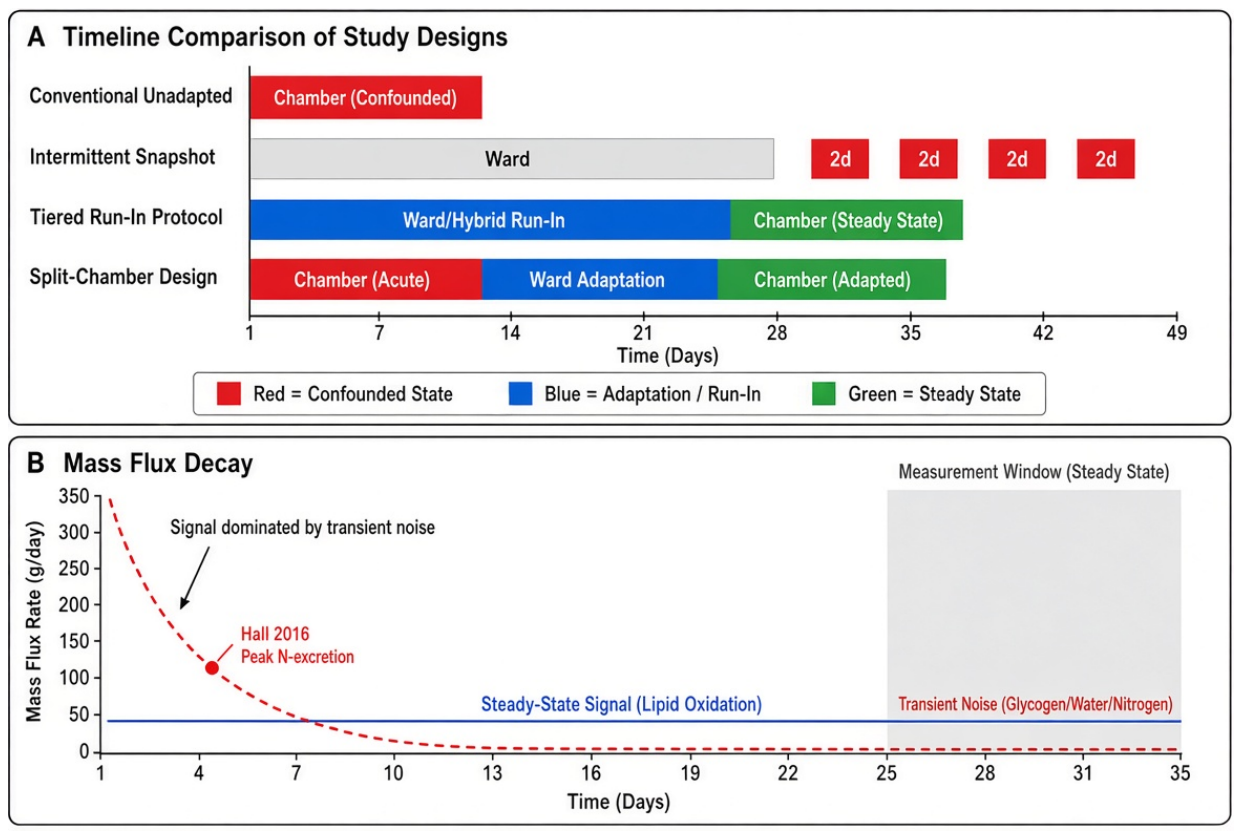
The Run-In protocol is not the only way to resolve the timescale mismatch. Investigators may also employ a Split-Chamber Repeated-Measures Protocol: Chamber Phase A (Days 1–7) quantifies the acute transitional mass fluxes; followed by a 3–5 week Ward Adaptation Phase; followed by Chamber Phase B (Days 29–35) to quantify the adapted steady state. This allows direct computation of the within-subject adaptation delta (∆adaptation) without multi-week continuous chamber confinement, though it incurs higher total facility costs. The comparative architectures of these study designs, alongside the signal-to-noise decay of unadapted mass fluxes, are illustrated in Figure 1.
7. Generalizing the Framework: Beyond Ketogenic Diets
The fundamental principle of timescale separation – where physiological adaptation takes significantly longer than the measurement window of the instrument – applies to any intervention. The following list summarizes its application to other slow-adapting interventions:
- − Ketogenic Diet: Rate-limited by central nervous system ketolysis and nitrogen sparing. Adaptation time: 3 to 6 weeks. Corrupted flux: Water/glycogen, urinary urea. Gatekeeper criteria: Urinary nitrogen plateau, BHB (beta-hydroxybutyrate) stationarity.
- − Microbiome Remodeling (Fiber): Rate-limited by colonic microbial succession and short-chain fatty acid (SCFA) stabilization. Adaptation time: 2 to 4 weeks. Corrupted flux: Fecal wet/dry mass, colonic gas. Gatekeeper criteria: Breath hydrogen and methane plateau, fecal mass stability.
- − Protein Transitions: Rate-limited by hepatic urea-cycle enzyme renormalization. Adaptation time: 1 to 3 weeks. Corrupted flux: Urinary urea mass. Gatekeeper criteria: Urinary nitrogen zero-slope stationarity.
- − Sodium/Fluid Shifts: Rate-limited by the renin-angiotensin-aldosterone system (RAAS) and interstitial equilibration. Adaptation time: 1 to 3 weeks. Corrupted flux: Gravimetric water balance. Gatekeeper criteria: 24-hour urinary sodium matching intake.
- − Pharmacotherapy (GLP-1): Rate-limited by dose titration and delayed gastric emptying adaptation. Adaptation time: 4 to 12 weeks. Corrupted flux: Net Mass Inflow (NMI) and gastric transit mass. Gatekeeper criteria: Plasma trough levels, stable daily mass intake.
8. Feasibility and Conclusion
The primary limitation of the Run-In protocol is logistical. Extended inpatient confinement incurs significant per-diem costs, metabolic kitchen staffing, and high dropout rates. The Tier 2 Hybrid Architecture mitigates this by utilizing outpatient metabolic kitchens and remote biomarker telemetry, reserving inpatient beds only for the final 4–7 day stabilization and 7-day chamber block.
In conclusion, measuring a non-stationary transition as if it were a steady state is a fundamental methodological error in metabolic research. By formalizing the timescale separation, integrating open-system mass balance equations, and imposing objective gatekeeping criteria, the Run-In protocol ensures that the precision of whole-room calorimetry is applied to the adapted physiological state. The chamber measures the mass; the Run-In phase ensures we are measuring the right mass.
Author Contributions
This is a single-authored paper.
Data Availability Statement
All data generated or analyzed during this study are contained in the sources cited.
Acknowledgments
I would like to thank my family for their unwavering support and care, as well as my colleagues for many stimulating discussions.
Conflicts of Interest
The author declares no conflict of interest.
References
- Chen, K.Y.; Smith, S.; Ravussin, E.; et al. Room Indirect Calorimetry Operating and Reporting Standards (RICORS 1.0): A Guide to Conducting and Reporting Human Whole-Room Calorimeter Studies. Obes. 2020, 28(9), 1613–1625. [Google Scholar] [CrossRef] [PubMed] [PubMed Central]
- Hall, K.D.; Guo, J.; Courville, A.B.; et al. Effect of a plant-based, low-fat diet versus an animal-based, ketogenic diet on ad libitum energy intake. Nat. Med. 2021, 27(2), 344–353. [Google Scholar] [CrossRef] [PubMed]
- Hall, K.D.; Bemis, T.; Brychta, R.; et al. Calorie for Calorie, Dietary Fat Restriction Results in More Body Fat Loss than Carbohydrate Restriction in People with Obesity. Cell Metab. 2015, 22(3), 427–36. [Google Scholar] [CrossRef] [PubMed] [PubMed Central]
- Hall, K.D.; Chen, K.Y.; Guo, J.; et al. Energy expenditure and body composition changes after an isocaloric ketogenic diet in overweight and obese men. Am. J. Clin. Nutr. 2016, 104(2), 324–33. [Google Scholar] [CrossRef] [PubMed] [PubMed Central]
- Burke, L.M.; Sharma, A.P.; Heikura, I.A.; et al. Crisis of confidence averted: Impairment of exercise economy and performance in elite race walkers by ketogenic low carbohydrate, high fat (LCHF) diet is reproducible. PLoS ONE Erratum in: PLoS One. 2020 Jun 26;15(6):e0235592. https://doi.org/10.1371/journal.pone.0235592. PMID: 32497061; PMCID: PMC7272074.. 2020, 15(6), e0234027. [Google Scholar] [CrossRef] [PubMed]
- Owen, O.E.; Morgan, A.P.; Kemp, H.G.; et al. Brain metabolism during fasting. J. Clin. Invest 1967, 46(10), 1589–95. [Google Scholar] [CrossRef] [PubMed] [PubMed Central]
- Phinney, S.D.; Horton, E.S.; Sims, E.A.; et al. Capacity for moderate exercise in obese subjects after adaptation to a hypocaloric, ketogenic diet. J. Clin. Invest. 1980, 66(5), 1152–61. [Google Scholar] [CrossRef] [PubMed] [PubMed Central]
- Ludwig, D.S.; Dickinson, S.L.; Henschel, B.; et al. Do Lower-Carbohydrate Diets Increase Total Energy Expenditure? An Updated and Reanalyzed Meta-Analysis of 29 Controlled-Feeding Studies. J. Nutr. 2021, 151(3), 482–490. [Google Scholar] [CrossRef] [PubMed] [PubMed Central]
- Volek, J.S.; Freidenreich, D.J.; Saenz, C.; Kunces, L.J.; Creighton, B.C.; Bartley, J.M.; Davitt, P.M.; Munoz, C.X.; Anderson, J.M.; Maresh, C.M.; Lee, E.C.; Schuenke, M.D.; Aerni, G.; Kraemer, W.J.; Phinney, S.D.; et al. Metabolic characteristics of keto-adapted ultra-endurance runners. Metabolism 2016, 65(3), 100–10. [Google Scholar] [CrossRef] [PubMed]
- Manninen, A.H. The Eagle Project: Breaking the Metabolic Stalemate with Next-Generation Mass Flux Measurement. Preprints 2026, 2026103053. [Google Scholar] [CrossRef]
Figure 1.
Comparative Protocol Architectures for Whole-Room Calorimetry. (A) Timeline comparison across four study designs: Conventional Unadapted (Days 1–7 in chamber), Intermittent Snapshot (2 days/week in chamber), Eagle Run-In Protocol (3–6 week Ward/Hybrid Run-In + Terminal 7-Day Chamber), and Split-Chamber (Days 1–7 Acute Chamber + Ward Adaptation + Days 29–35 Adapted Chamber). (B) Theoretical mass flux decay curves illustrating the signal-to-noise ratio: transient glycogen/water washout and gluconeogenic nitrogen loss (high amplitude, Days 1–7) versus steady-state lipid oxidation (low amplitude, stable).
Disclaimer/Publisher’s Note: The statements, opinions and data contained in all publications are solely those of the individual author(s) and contributor(s) and not of MDPI and/or the editor(s). MDPI and/or the editor(s) disclaim responsibility for any injury to people or property resulting from any ideas, methods, instructions or products referred to in the content. |
© 2026 by the authors. Licensee MDPI, Basel, Switzerland. This article is an open access article distributed under the terms and conditions of the Creative Commons Attribution (CC BY) license (http://creativecommons.org/licenses/by/4.0/).
Copyright: This open access article is published under a Creative Commons CC BY 4.0 license, which permit the free download, distribution, and reuse, provided that the author and preprint are cited in any reuse.