
Submitted:
09 November 2026
Posted:
10 November 2026
You are already at the latest version
Abstract
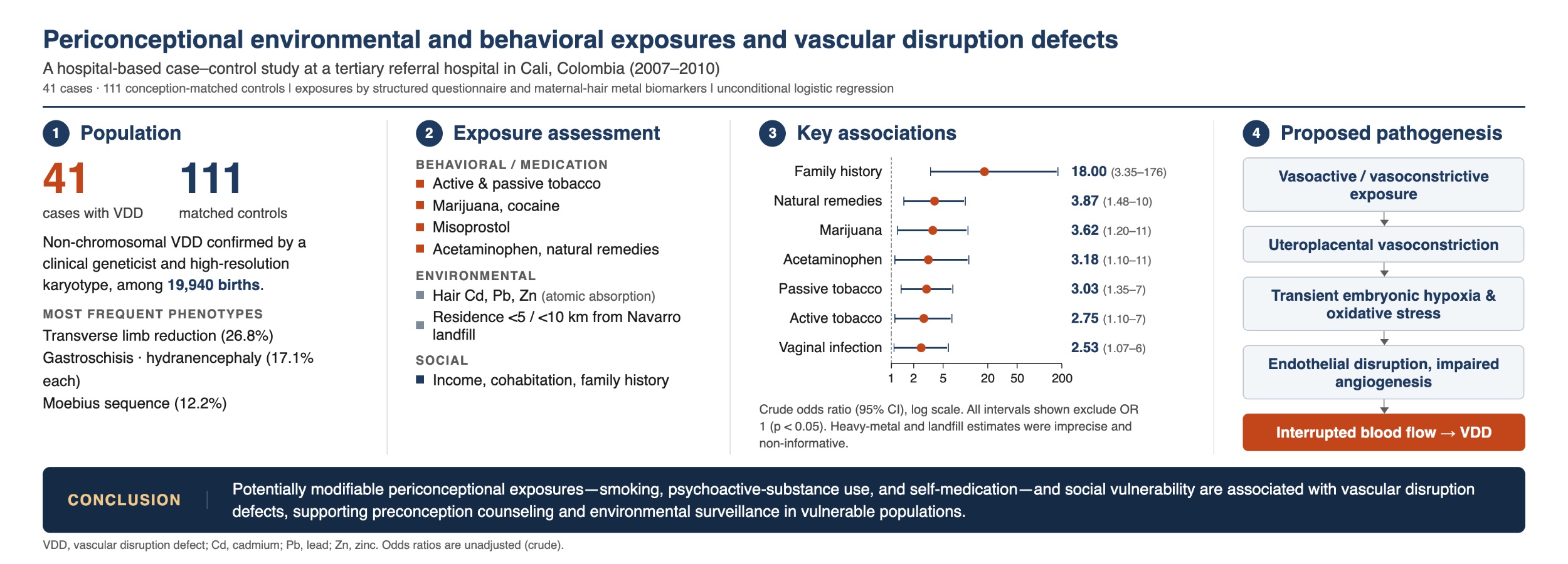
Vascular disruption defects (VDD) are congenital anomalies arising from the interruption of embryonic blood flow, and their environmental and behavioral determinants remain poorly characterized in low- and middle-income settings. We conducted a hospital-based case–control study at a tertiary referral center in Cali, Colombia, between April 2007 and March 2010 to evaluate associations between VDD and periconceptional environmental, behavioral, and social exposures. Forty-one newborns with clinically confirmed, non-chromosomal VDD and 111 controls matched by estimated date of conception were included. Exposures were ascertained by structured questionnaire; cadmium, lead, and zinc were measured by atomic absorption spectrophotometry in the periconceptional maternal-hair segment; and residential proximity to a municipal landfill was georeferenced. Crude and adjusted odds ratios (ORs) were estimated by logistic regression, with penalized and exact methods for sparse data. Increased odds of VDD were observed with maternal acetaminophen use (OR 3.18, 95% CI 1.10–11.20), marijuana (3.62, 1.20–11.00), natural remedies (3.87, 1.48–10.06), active (2.75, 1.10–6.74) and passive (3.03, 1.35–6.83) tobacco exposure, family history of congenital defects (18.0, 3.35–176.13), and vaginal infection (2.53, 1.07–5.94). Heavy-metal and landfill-proximity estimates were imprecise and non-informative. Potentially modifiable periconceptional exposures and social vulnerability were associated with VDD, supporting preconception counseling and environmental surveillance in vulnerable populations.
Keywords:
congenital abnormalities
; vascular disruption defects
; environmental exposure
; heavy metals
; tobacco
; prenatal exposure
; case-control studies
; environmental health
; Colombia
Copyright: This open access article is published under a Creative Commons CC BY 4.0 license, which permit the free download, distribution, and reuse, provided that the author and preprint are cited in any reuse.