
Submitted:
08 November 2026
Posted:
10 November 2026
You are already at the latest version
Abstract
The genetic architecture of obesity is highly polygenic. Recent genomic analyses have demonstrated that the heritability of Body Mass Index (BMI) is largely recovered when the full spectrum of common and rare variants is considered. Therefore, the challenge for the field is no longer a "missing heritability" gap. The challenge is a lack of mechanistic resolution: mapping genetic variants to specific physiological pathways. This paper proposes that supplementing BMI with mass-flux endophenotypes can achieve this resolution. I introduce three endophenotypes grounded in the Mass Balance Model (MBM). The primary endophenotypes are 24-hour urinary nitrogen excretion (nitrogen mass balance) and the respiratory quotient (substrate oxidation). The mass-clearance parameter k is introduced as an exploratory, biophysical measure of clearance efficiency. Reinterpreting canonical obesity genes (FTO, MC4R, leptin) through this framework reveals that they likely govern specific aspects of macronutrient partitioning. I acknowledge the dominant functional genomics at the FTO locus (IRX3/IRX5 enhancers) and the primary role of leptin in human appetite regulation (NMI). I outline a targeted research program using metabolic chamber studies, integrated with biobank data, to test these endophenotypes.
Keywords:
mass balance model
; energy balance model
; genetics
; FTO
; MC4R
; leptin
; endophenotypes
; macronutrient partitioning
1. Introduction: Beyond the Composite Trait
Body Mass Index (BMI) has been the workhorse phenotype of obesity genetics for decades. It is inexpensive, easily measured, and highly heritable, with twin and family studies estimating narrow-sense heritability (h2) between 40% and 70% [1].
However, genome-wide association studies (GWAS) of BMI have revealed a highly polygenic architecture. While the most recent GWAS have identified hundreds of loci, the per-variant effect sizes are small [2,3]. A decade ago, this gap between twin heritability and GWAS variance explained was termed "missing heritability." Today, advanced statistical genetics methods – including genome-wide restricted maximum likelihood (GREML) on imputed variants and whole-genome sequencing analyses – have demonstrated that the vast majority of this variance is captured by thousands of common variants with small effects, plus rare variants in low linkage disequilibrium [4,5]. The heritability of BMI is not missing; it is simply highly distributed.
The challenge for obesity genetics is therefore not to find missing variants, but to achieve mechanistic resolution. BMI aggregates fat mass, lean mass, and body water into a single number. A variant that increases muscle mass and a variant that increases fat mass have opposite effects on metabolic health, yet they may have identical associations with BMI.
The Mass Balance Model (MBM) offers a framework to move beyond this coarse composite. It is important to clarify that the MBM is not a replacement for the Energy Balance Model (EBM); rather, it is a complementary physical framework that tracks the specific mass fluxes of carbon, hydrogen, oxygen, and nitrogen. By doing so, it allows for the definition of physiological endophenotypes that map directly onto specific biological pathways. This paper proposes three such endophenotypes and reinterprets three canonical obesity genes (FTO, MC4R, leptin) through this lens.
2. Mass-Flux Endophenotypes
The MBM treats body mass change as the difference between mass inflow and mass outflow: dM/dt = NMI − NMO. While BMI is a static snapshot, mass flux is a dynamic rate. I propose three measurable endophenotypes, ordered by their practical tractability.
2.1. 24-Hour Urinary Nitrogen Excretion (Primary)
Protein mass is unique among macronutrients because it contains nitrogen. In a steady-state individual, 24-hour urinary nitrogen excretion tightly reflects recent dietary protein intake, serving as a biomarker for protein turnover and nitrogen balance. At a fixed intake, variations in urinary nitrogen can indicate differences in net protein retention or oxidative disposal. It is important to note that this steady-state relationship requires several days to equilibrate after a dietary change, due to the slow turnover of the body urea pool. Therefore, urinary nitrogen is most informative when measured under clamped, isonitrogenous conditions after an adequate run-in period. This provides a direct measure of the protein mass balance axis.
2.2. Substrate Oxidation (Respiratory Quotient) (Primary)
The respiratory quotient (RQ), derived from whole-room indirect calorimetry, indicates the ratio of carbon dioxide produced to oxygen consumed. An RQ near 0.70 indicates predominantly fat oxidation; an RQ near 1.0 indicates carbohydrate oxidation. A sustained RQ > 1.0 indicates net de novo lipogenesis (conversion of carbohydrate carbon to fat carbon). This provides a direct measure of the carbon partitioning axis.
2.3. The Mass-Clearance Coefficient (k) (Exploratory)
In the MBM, the rate of mass outflow decelerates as body mass declines. This relationship is modeled phenomenologically via a square-root scaling law, drawing on an analogy to Torricelli's law of fluid dynamics:
where NMO is net mass outflow (kg/day) and M is total body mass (kg). The parameter k is the mass clearance coefficient, with units of kg0.5/day. It is calculated directly from measured data as:
A higher k indicates a more efficient mass clearance capacity. Because the square-root scaling is a phenomenological observation rather than a derived physical constant, k serves as an exploratory endophenotype. It may capture composite effects of metabolic rate, substrate availability, and tissue composition, but it requires rigorous validation in controlled weight-loss studies.
NMO = k · M0.5
3. Reinterpreting Canonical Obesity Genes
Using these endophenotypes, I can reinterpret the roles of three canonical genes. The goal is not to refute existing biology, but to propose testable, mass-specific hypotheses.
3.1. FTO: Nitrogen Sensing and the IRX3 Circuit
The FTO gene was the first locus robustly associated with obesity. Its GWAS signal is driven by intronic variants. Extensive functional genomics has shown that these variants act as long-range enhancers for the neighboring IRX3 and IRX5 genes, which regulate adipocyte browning and lipid storage [6,7]. This IRX3/IRX5 pathway is currently considered the dominant mechanism for the FTO GWAS signal.
However, the FTO protein itself is an intracellular enzyme that senses amino acids and regulates the mTORC1 pathway [8]. While this pathway may be secondary to IRX3/IRX5 in adipose tissue, it may also contribute to systemic nitrogen sensing.
Hypothesis: The FTO risk allele may shift the protein set-point, predisposing individuals to overconsume non-protein mass (carbohydrates and fats) to reach a genetically elevated nitrogen target. This is a genetic application of the Protein Leverage Hypothesis [9]. The IRX3 pathway may concurrently impair lipid efflux.
3.2. MC4R: The Mass Partitioning Gatekeeper
The melanocortin-4 receptor (MC4R) is a key regulator of energy homeostasis. Human monogenic mutations in MC4R cause severe hyperphagia and obesity.
Importantly, clinical studies of MC4R deficiency show that these patients also exhibit increased lean body mass, bone mineral density, and linear growth [10]. This indicates that MC4R signaling is not merely a carbohydrate sensor. It is a central regulator of mass partitioning, directing both nitrogen retention (lean mass) and carbon storage (fat mass). Autonomic studies further show that central melanocortin signaling directly regulates lipolysis and lipid mobilization in peripheral tissues [11].
Hypothesis: MC4R functions as a master gatekeeper of macronutrient partitioning, balancing the deposition of both protein and lipid mass. Its dysfunction leads to indiscriminate mass accumulation.
3.3. Leptin: The NMI Regulator
Leptin is secreted by adipocytes and signals the brain to regulate energy balance. Preclinical rodent studies have shown that leptin can acutely stimulate fatty-acid oxidation in skeletal muscle [12,13].
However, human clinical trials of congenital leptin deficiency have demonstrated that the primary physiological effect of leptin replacement is a profound, rapid suppression of appetite, leading to massive reductions in food intake (NMI) [14,15]. While leptin may have peripheral effects on lipid clearance, its dominant human phenotype is the regulation of mass inflow.
Hypothesis: In humans, leptin primarily regulates the mass balance equation by controlling NMI (food intake). Its role in enhancing NMO (lipid clearance) is secondary and context-dependent.
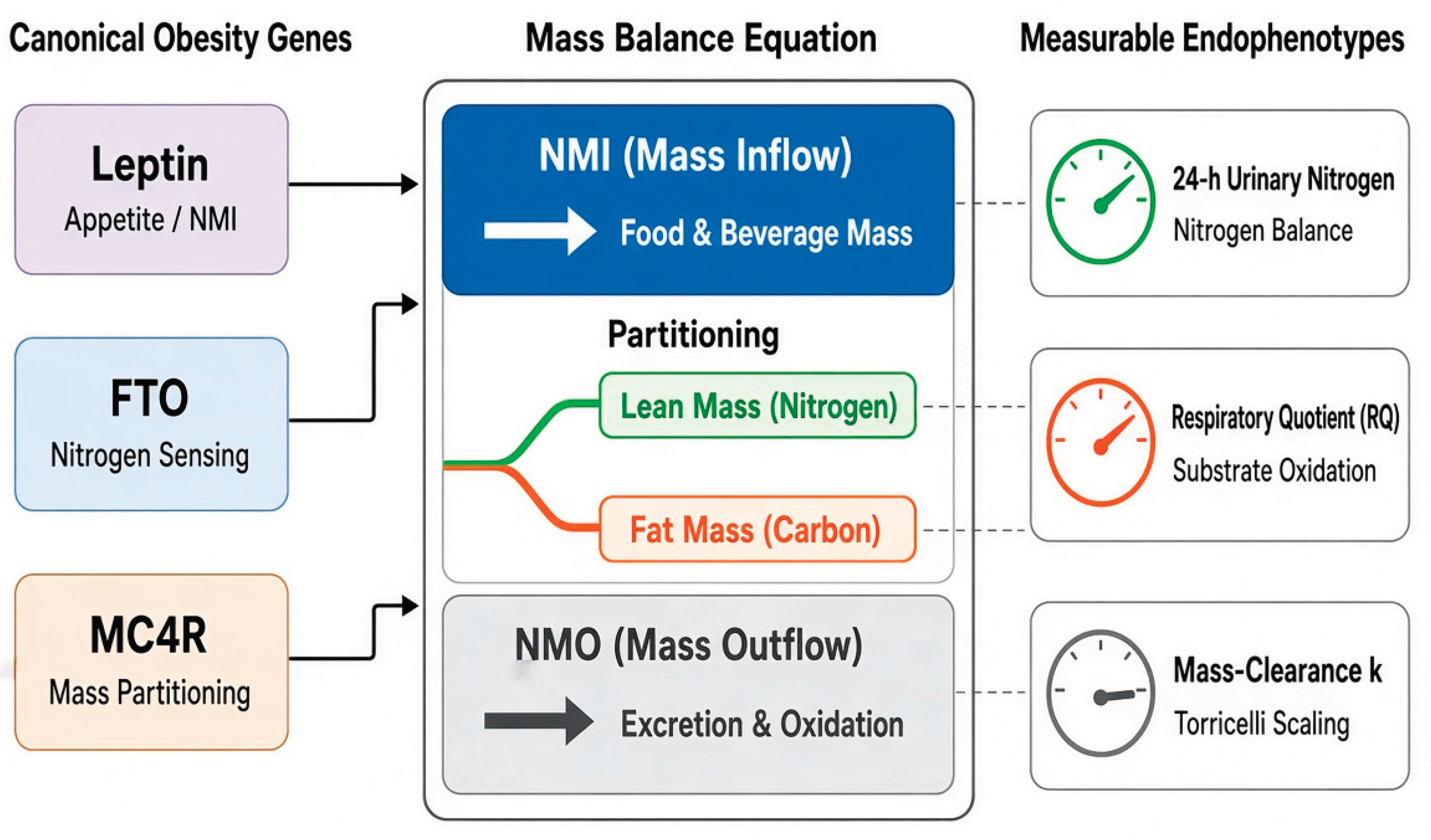
Figure 1.
Mass-Flux Genetics: Mapping Obesity Genes to Macronutrient Partitioning. The Mass Balance Model conceptualizes body weight regulation as a dynamic flux. Left: Canonical obesity genes (FTO, MC4R, leptin) mapped to specific physiological roles within the mass balance equation. Right: The corresponding measurable endophenotypes (urinary nitrogen, respiratory quotient, and mass-clearance coefficient k. This framework moves beyond static BMI to capture the dynamic stoichiometric processes underlying genetic susceptibility.
4. A Realistic GWAS and Phenotyping Strategy
The ultimate goal is to use these endophenotypes to improve genetic discovery. However, deep metabolic phenotyping requires inpatient metabolic chambers, limiting sample sizes to the hundreds. This creates a statistical power bottleneck for agnostic genome-wide discovery.
Strategy: Instead of attempting mega-GWAS, I propose a dual approach.
1. Targeted Metabolic Chamber Cohorts: Recruit 200–500 individuals stratified by genotype (e.g., FTO risk carriers vs. non-carriers) for deep phenotyping.
2. Integration with Biobank Data: Use the chamber data to calibrate physiological models, and then apply these models to large-scale body composition GWAS (e.g., UK Biobank DXA/BIA data) via Mendelian Randomization to assess population-level effects.
3. Clamped Feeding Protocols: Measure urinary nitrogen and RQ under strictly controlled, isonitrogenous, and isocaloric conditions to isolate genetic effects from environmental dietary variance (VE).
5. Falsifiable Predictions
This framework generates specific predictions that can be tested in controlled metabolic settings:
Prediction 1: Under clamped isonitrogenous diets, FTO risk allele carriers will show differences in 24-hour urinary nitrogen excretion compared to non-carriers, indicating altered nitrogen retention.
Prediction 2: MC4R deficiency will be associated with a distinct mass-partitioning signature in response to overfeeding (blunted fat mass gain, enhanced lean mass gain), rather than a pure carbohydrate-handling deficit.
Prediction 3: In leptin-deficient individuals, leptin replacement will acutely reduce ad libitum food intake (NMI) before producing measurable increases in basal lipid oxidation (NMO).
Prediction 4: The mass-clearance coefficient k will show heritable variation in twin cohorts undergoing controlled weight loss, correlating with differences in mitochondrial efficiency and metabolic adaptation.
6. Limitations and Conclusion
This framework has clear limitations. The MBM is a physical model that complements, but does not replace, the EBM. The k parameter is phenomenological and exploratory. The logistical challenges of deep metabolic phenotyping constrain sample sizes, necessitating integration with large-scale biobank data.
Despite these limitations, the "missing heritability" of BMI is a statistical artifact of polygenicity, not a failure of phenotype resolution. BMI remains a blunt instrument for understanding mechanism. By shifting to mass-flux endophenotypes – urinary nitrogen, RQ, and k – I can move from finding genetic variants that associate with body size to finding variants that regulate specific physiological processes.
The Mass Balance Model [16] provides the physical and conceptual foundation for this shift. It acknowledges that the body is not a simple energy ledger, but a complex stoichiometric reactor. By measuring the fluxes of matter, rather than the abstraction of energy, I can achieve a finer resolution in genetic mapping.
Author Contributions
This is a single-authored paper.
Ethics Approval and Consent to Participate
Not applicable.
Consent for Publication
Not applicable.
Availability of Data
All data generated or analyzed during this study are contained in the sources cited.
Acknowledgments
I would like to thank my family for their unwavering support and care, as well as my colleagues for many stimulating discussions. I also extend my gratitude to the authors of the foundational studies cited in this paper. Their rigorous empirical work in statistical genetics, functional genomics, and metabolic physiology provided the essential foundation upon which this synthesis was built.
Conflicts of Interest
The author declares no conflict of interest.
References
- Elks, C.E.; den Hoed, M.; Zhao, J.H.; et al. Variability in the heritability of body mass index: a systematic review and meta-regression. Front Endocrinol. 2012, 3, 29. [Google Scholar] [CrossRef] [PubMed] [PubMed Central]
- Locke, A.E.; Kahali, B.; Berndt, S.I.; et al. Genetic studies of body mass index yield new insights for obesity biology. Nature 2015, 518(7538), 197–206. [Google Scholar] [CrossRef] [PubMed] [PubMed Central]
- Yengo, L.; Sidorenko, J.; Kemper, K.E.; et al. Meta-analysis of genome-wide association studies for height and body mass index in ∼700000 individuals of European ancestry. Hum. Mol. Genet. 27(20), 3641–3649. [CrossRef] [PubMed] [PubMed Central]
- Yang, J.; Bakshi, A.; Zhu, Z.; et al. Genetic variance estimation with imputed variants finds negligible missing heritability for human height and body mass index. Nat. Genet. 2015, 47(10), 1114–20. [Google Scholar] [CrossRef] [PubMed] [PubMed Central]
- Wainschtein, P.; Jain, D.; Zheng, Z.; et al. Assessing the contribution of rare variants to complex trait heritability from whole-genome sequence data. Nat. Genet. 2022, 54(3), 263–273. [Google Scholar] [CrossRef] [PubMed] [PubMed Central]
- Smemo, S.; Tena, J.J.; Kim, K.H.; et al. Obesity-associated variants within FTO form long-range functional connections with IRX3. Nature 2014, 507(7492), 371–5. [Google Scholar] [CrossRef] [PubMed] [PubMed Central]
- Claussnitzer, M.; Dankel, S.N.; Kim, K.H.; et al. FTO Obesity Variant Circuitry and Adipocyte Browning in Humans. N Engl. J. Med. 2015, 373(10), 895–907. [Google Scholar] [CrossRef] [PubMed] [PubMed Central]
- Gulati, P.; Cheung, M.K.; Antrobus, R.; et al. Role for the obesity-related FTO gene in the cellular sensing of amino acids. Proc. Natl. Acad. Sci. U S A 2013, 110(7), 2557–62. [Google Scholar] [CrossRef] [PubMed] [PubMed Central]
- Simpson, S.J.; Raubenheimer, D. Obesity: the protein leverage hypothesis. Obes. Rev. 2005, 6(2), 133–42. [Google Scholar] [CrossRef] [PubMed]
- Farooqi, I.S.; Keogh, J.M.; Yeo, G.S.; et al. Clinical spectrum of obesity and mutations in the melanocortin 4 receptor gene. N Engl. J. Med. 2003, 348(12), 1085–95. [Google Scholar] [CrossRef] [PubMed]
- Nogueiras, R.; Wiedmer, P.; Perez-Tilve, D.; et al. The central melanocortin system directly controls peripheral lipid metabolism. J. Clin. Invest. 2007, 117(11), 3475–88. [Google Scholar] [CrossRef] [PubMed] [PubMed Central]
- Minokoshi, Y.; Kim, Y.B.; Peroni, O.D.; et al. Leptin stimulates fatty-acid oxidation by activating AMP-activated protein kinase. Nature 2002, 415(6869), 339–43. [Google Scholar] [CrossRef] [PubMed]
- Momken, I.; Chabowski, A.; Dirkx, E.; et al. A new leptin-mediated mechanism for stimulating fatty acid oxidation: a pivotal role for sarcolemmal FAT/CD36. Biochem J. 2017, 474(1), 149–162. [Google Scholar] [CrossRef] [PubMed]
- Farooqi, I.S.; Jebb, S.A.; Langmack, G.; et al. Effects of recombinant leptin therapy in a child with congenital leptin deficiency. N Engl. J. Med. 1999, 341(12), 879–84. [Google Scholar] [CrossRef] [PubMed]
- Galgani, J.E.; Greenway, F.L.; Caglayan, S.; et al. Leptin replacement prevents weight loss-induced metabolic adaptation in congenital leptin-deficient patients. J. Clin. Endocrinol. Metab. 2010, 95(2), 851–5. [Google Scholar] [CrossRef] [PubMed] [PubMed Central]
- Manninen, A.H. The MBM Reference Framework (v1): A Living Document for the Mass Balance Model of Human Body Weight Regulation. Preprints 2026, 2026102526. [Google Scholar] [CrossRef]
Disclaimer/Publisher’s Note: The statements, opinions and data contained in all publications are solely those of the individual author(s) and contributor(s) and not of MDPI and/or the editor(s). MDPI and/or the editor(s) disclaim responsibility for any injury to people or property resulting from any ideas, methods, instructions or products referred to in the content. |
© 2026 by the author. Licensee MDPI, Basel, Switzerland. This article is an open access article distributed under the terms and conditions of the Creative Commons Attribution (CC BY) license.
Copyright: This open access article is published under a Creative Commons CC BY 4.0 license, which permit the free download, distribution, and reuse, provided that the author and preprint are cited in any reuse.