

Submitted:
05 November 2026
Posted:
09 November 2026
You are already at the latest version
Abstract
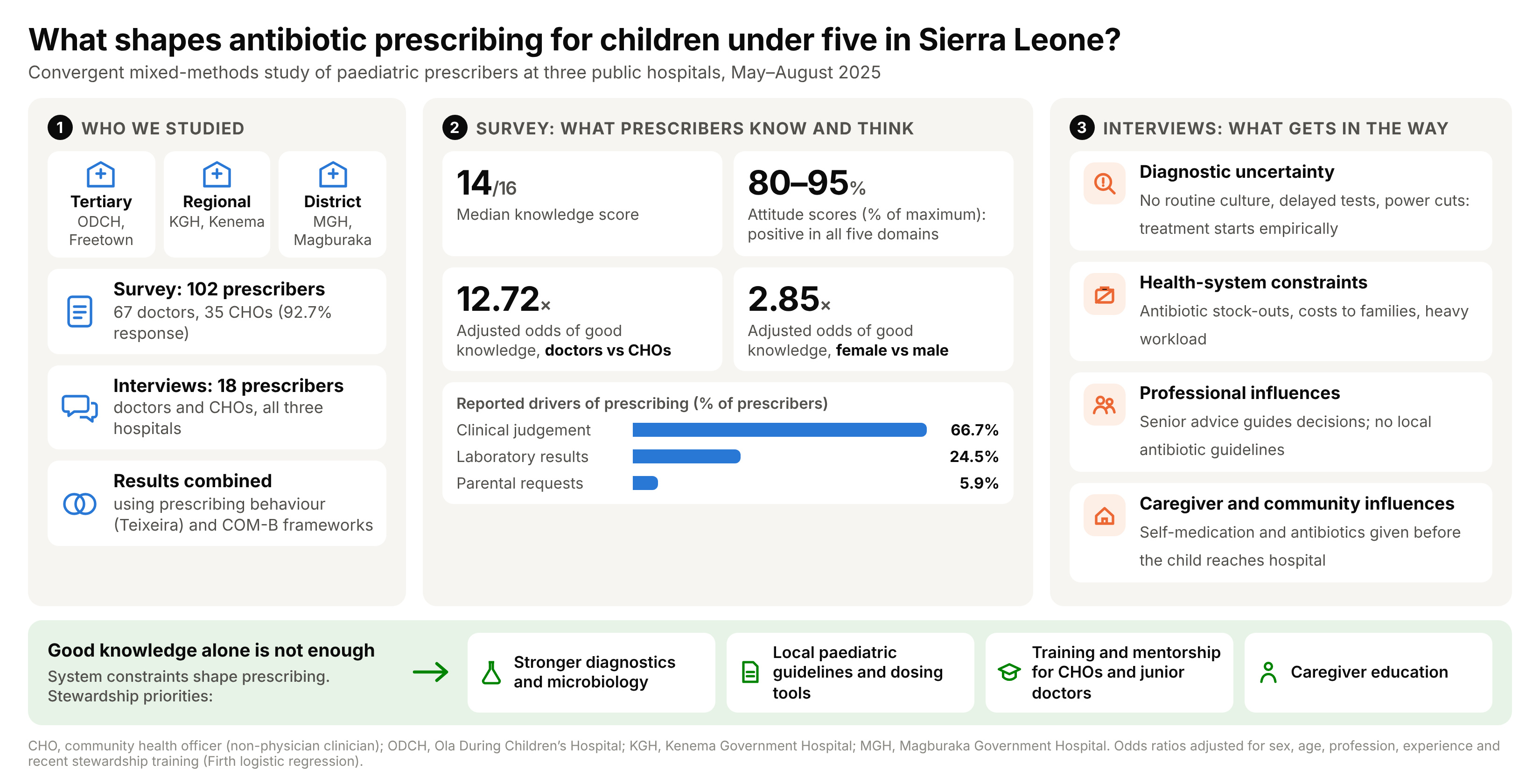
Background/Objectives: Children under five years of age in Sierra Leone are frequently exposed to antibiotics, yet little is known about the prescribers who make these decisions. We assessed the knowledge, attitudes, and determinants of antibiotic prescribing among paediatric prescribers in three Sierra Leonean hospitals. Methods: In a convergent mixed-methods study at three hospitals (May–August 2025), 102 doctors and community health officers (CHOs) completed a questionnaire, and 18 participated in in-depth interviews. Quantitative data were analysed using non-parametric tests, correlation, and Firth logistic regression, and qualitative interviews with Braun and Clarke Reflexive thematic analysis guided by the Teixeira prescribing behaviour framework and the capability, opportunity, motivation–behaviour (COM-B) model. The two strands were integrated at interpretation. Results: The median knowledge score was 14/16 (IQR 12.25–15.00), and attitude domain scores were positive (80.0–95.0% of maximum). Doctors (AOR 12.72; 95% CI 4.05–46.98) and female prescribers (AOR 2.85; 95% CI 1.10–8.10) had higher odds of good knowledge; among the attitude domains, profession was associated only with ignorance. Clinical judgement (66.7%) was the most frequently reported determinant, and laboratory results (24.5%) and parental requests (5.9%) were among the least. Qualitative interviews identified five themes: diagnostic uncertainty and limitations, health-system and resource constraints, professional influences, and caregiver and community influences, as well as participants’ suggestions for stewardship. Conclusions: Prescribers had good knowledge and positive attitudes but described diagnostic, supply, and affordability constraints that may limit appropriate prescribing. Stewardship in Sierra Leone should combine diagnostic strengthening, local guidelines, cadre-specific training and mentorship, and caregiver education.
Keywords:
antibiotic prescribing
; antimicrobial resistance
; knowledge
; attitudes
; community health officers
; medical doctors
; children under five
; antimicrobial stewardship
; Sierra Leone
1. Introduction
Antimicrobial resistance (AMR) is one of the leading threats to global health. In 2021, bacterial AMR was directly responsible for an estimated 1.14 million deaths worldwide and was associated with 4.71 million deaths, a total that includes those directly attributable to resistance [1]. The burden is greatest in sub-Saharan Africa, where the World Health Organisation (WHO) African region had the highest AMR-attributable mortality rate in 2019, with 250,000 deaths directly attributable to resistance [2]. Children under five years of age are especially exposed because they experience the highest incidence of bacterial infections, receive antibiotics regularly, and face high case fatality when first-line treatment fails [3,4].
The under-five mortality rate in Sierra Leone was about 95 per 1,000 live births in 2024 among the top in the world, and malaria, pneumonia, diarrhoea, and sepsis remain the foremost causes of childhood death [5,6,7]. In 2019, an estimated 2,200 deaths in the country were directly attributable to AMR, and 9,700 deaths were associated with it [8]. Though a national strategic plan for AMR was adopted in 2018 [9] and a new National Action Plan for 2026–2030 is being developed [10], hospital stewardship programmes remain nascent and are constrained by limited microbiology, local standard treatment guidelines, and surveillance [11,12,13]. Antibiotic exposure among children is correspondingly high with 87.3% of outpatient prescriptions for children under-five years of age in public hospitals containing an antibiotic [14], and antibiotic use among admitted children is also high [12]. Because physicians are scarce, much paediatric care is provided by community health officers (CHOs) who are mid-level clinicians with diploma-level clinical training who diagnose and prescribe and who, unlike community health workers in many countries, are not lay workers, and other non-physician clinicians trained under a task-shifting model [15,16,17].
Prescribing behaviour is commonly informed by intrinsic determinants, namely knowledge and attitudes (complacency, fear, ignorance, indifference, and the belief that resistance is the responsibility of others), and extrinsic determinants, such as patient demand, institutional culture, and resources [18,19,20]. Studies of paediatric prescribers’ report differences in knowledge, from a median of 8/8 among paediatricians in China [21] and 81.5% with good knowledge in Tanzania [22] to 46% of correct responses in the Democratic Republic of the Congo (DRC) and a median of 54/100 in Mozambique [23,24]. Medical doctors usually outperform nurses and other health professional cadres, and stewardship training is associated with better knowledge [24,25,26]. Attitudes towards AMR are generally favourable, although the obligation for resistance is often externalised [24,27].
Having significant knowledge does not inevitably translate into appropriate prescribing practices. In countries such as Egypt, China, and Tanzania, even prescribers with good knowledge have been recognised to prescribe antibiotics inappropriately [21,22,27]. Qualitative studies have recognised factors such as diagnostic limitations and uncertainty, limited microbiological capacity, shortages of medicines, high costs, workload, and actual or perceived caregiver pressure as causes for this incongruity, especially in resource-limited settings [28,29,30,31,32].
Previous studies in Sierra Leone on knowledge, attitudes, and practices have mainly focused on doctors in outpatient settings or health workers [14,33], while investigations on hospital antibiotic use have generally focused on adults [13,34]. No specific study has examined paediatric prescribers, including CHOs, who also assume prescribing duties, and no study has combined quantitative and qualitative approaches to explore why knowledge might not translate into practice. Without this understanding, stewardship interventions risk concentrating on knowledge gaps while missing the professional, health system, and community contexts that influence prescribing decisions.
Therefore, a convergent mixed-methods study was conducted with paediatric prescribers across three hospitals at the tertiary, regional, and district care levels. By combining quantitative and qualitative data within the Teixeira antibiotic prescribing behaviour framework (TAPBF) and the Capability, Opportunity, Motivation–Behaviour (COM-B) model, we aimed to elucidate how professional, health-system, and community factors influence antibiotic prescribing for children and guide context-specific antimicrobial stewardship (AMS).
2. Materials and Methods
2.1. Study Design and Setting
This convergent parallel mixed-methods study formed the first part of a larger study on antibiotic use among children under five years of age in Sierra Leone [35]. Quantitative survey and qualitative interview data were collected concurrently between May and August 2025, analysed separately, and integrated during interpretation [36]. The Good Reporting of a Mixed Methods Study (GRAMMS) guidance and the Consolidated Criteria for Reporting Qualitative Research (COREQ) were used to report this study [37,38].
Three public hospitals were purposively selected to represent different levels of care and regions: Ola During Children’s Hospital (ODCH) in Freetown, the country’s only tertiary paediatric referral and teaching hospital; Kenema Government Hospital (KGH), the regional referral hospital for the country’s Eastern Region; and Magburaka Government Hospital (MGH), a district hospital in the Tonkolili District in the Northern Region. All three provide inpatient and outpatient paediatric services, and under the Free Health Care Initiative (FHCI), a government program launched in 2010, services and essential medicines are provided free of charge to children under five years of age [39].
2.2. Theoretical Frameworks
The TAPBF, which conceptualises prescribing as the product of intrinsic (knowledge and five attitude domains) and extrinsic determinants [18,40], informed the questionnaire, interview guide, and deductive coding. The COM-B model [41] was used analytically to map integrated findings onto capability, physical and social opportunities, and reflective and automatic motivation.
2.3. Participants and Sampling
Participants eligible for inclusion in this study included medical doctors and CHOs responsible for diagnosing and prescribing antibiotics for children under five years of age at the study hospitals. The exclusion criteria were: persons not directly involved in prescribing, unavailable during collection of data, and those who declined informed consent. As the eligible population was small, a census approach was used in which all 110 eligible prescribers (70 doctors and 40 CHOs) were invited, and 102 completed the survey (response rate 92.7%).
Prescribers were purposively sampled for qualitative in-depth interviews (IDI) to ensure diversity in cadre, experience, and hospital, supplemented by snowball sampling. Code saturation, the point at which no new codes are recognised [42], was reached by the 16 interviews, with two additional interviews confirming that no new codes occurred, ending in a total of 18 interviews.
2.4. Data Collection
The interviewer-administered questionnaire, adapted from prior studies [20,27,40], consisted of four sections: (A) sociodemographic and professional characteristics; (B) 16 knowledge items, with 10 pertaining to antibiotic use and six to resistance, evaluated as correct, incorrect, or unknown; (C) 27 attitude items distributed across five TAPBF domains: ignorance (seven items), responsibility of others (four items), indifference (three items), complacency (eight items), and fear (five items), rated on a five-point Likert scale; and (D) determinants of prescribing, allowing for multiple responses. Content validity was confirmed through a literature review and expert evaluation by paediatricians, pharmacists, pharmacologists, and public health specialists [43], while face validity was assessed with approximately 15 prescribers at a non-study hospital. Internal consistency was ranked acceptable to good for the five attitude domains (Cronbach’s α 0.707–0.850: ignorance 0.745, responsibility 0.791, indifference 0.707, complacency 0.850, and fear 0.733), and the 16-item knowledge scale also revealed acceptable internal consistency (α = 0.71). Data collection was conducted face-to-face by the principal investigator and four trained enumerators using Epicollect5.
The semi-structured interview guide, adapted from previous studies [44,45] and informed by the TAPBF, was piloted with five prescribers at a non-study hospital. Interviews were conducted face-to-face by OTA and two trained qualitative researchers, ACO and GMT, at convenient hospital locations, in either English or Krio based on participant preference, lasting 30–60 minutes, and were audio-recorded with accompanying field notes. The recordings were then transcribed verbatim. Krio interviews were translated into English during transcription by the bilingual principal investigator, with ambiguous terms clarified through team discussions and respondent validation. Prescribers were approached face-to-face or by telephone; one declined to participate in the interviews, citing lack of interest and unwillingness to be recorded. Interviews were conducted in private, with only the participant and interviewer present, and no repeat interviews were conducted. All transcripts were returned to the participants for checking, verification, or correction, with no comments or corrections being received.
2.5. Variables and Scoring
A score of 1 was given to each correct response in the knowledge assessment, while incorrect or "do not know" responses received a score of 0, resulting in a possible range of 0–16. Reverse coding was applied to attitude items that were negatively worded to ensure that higher scores in the domain indicated more positive attitudes, that is, less ignorance, indifference, complacency, and fear, and greater acceptance of personal responsibility for resistance. Specifically, these attitudes included: 1) ignorance, defined as a lack of concern for antibiotic resistance due to over-prescribing; 2) responsibility of others, reflecting the belief that others are accountable for antibiotic resistance; 3) indifference, indicating a lack of motivation to alter prescribing; 4) complacency, prescribing to meet caregiver or patient demands; and 5) fear, prescribing due to apprehension about losing patients or facing disputes.
Knowledge and attitude domain scores were dichotomised at the median, with scores at or above the median representing good knowledge or a positive attitude [35]. The independent variables were sex, age group, profession, years of experience, AMS training in the previous 12 months, and hospital; cadre was used in a sensitivity analysis, and qualification was recorded but not modelled.
2.6. Quantitative Analysis
Data analyses were conducted using R (version 4.5.1). Given that the Kolmogorov–Smirnov test revealed non-normal distributions, scores were presented as medians accompanied by interquartile ranges (IQR) and compared between doctors and CHOs using the Mann–Whitney U test, with effect sizes (r = |Z|/√N) and Holm adjustment across the five attitude domains. The relationships between knowledge and each attitude domain were assessed using Spearman’s rank correlation coefficient (rs). Firth logistic regression was employed to identify factors associated with good knowledge and with a positive score in each of the attitude domains, as it reduces small sample bias and gives finite estimates when categories are sparse or completely separated [46,47]. Each characteristic was first assessed in bivariable models. Sex, age group, profession, work experience, and AMS training were specified in advance and entered together in the multivariable models, rather than being selected by a significance threshold [48]. Results are reported as odds ratios with 95% profile penalised-likelihood confidence intervals and penalised likelihood-ratio p-values. Qualification was not modelled because it completely overlapped with profession. In two sensitivity analyses, hospitals were added to the multivariable models, and cadre groups (CHO, house officer, medical officer, registrar or above) replaced profession and work experience to account for seniority. Statistical significance was set at p < 0.05 (two-tailed).
2.7. Qualitative Analysis and Reflexivity
Within a constructivist paradigm, anonymised transcripts were managed in NVivo 15.5 and analysed using Braun and Clarke ’sreflexive thematic analysis following the six phases [49,50], combining deductive coding informed by the TAPBF and COM-B frameworks with inductive coding. Four researchers (OTA, ACO, GMT, and AJB) independently coded the first four transcripts to develop a codebook. A coding comparison showed substantial agreement (mean Cohen’s κ 0.79, range 0.72–0.85; mean percentage agreement 83.7%, range 78.1–89.2%) and was used to refine code definitions rather than as a test of validity. Themes were developed through regular team meetings, analytic memos, reflexive journaling, and an audit trail. OTA is a pharmacist and pharmacologist and also works as a national medicine authority regulator, ACO is a pharmacist and qualitative researcher, GMT is a medical doctor and also a qualitative researcher, and AJB is a postdoctoral qualitative researcher; none had a prior relationship with participants, who were informed of the study objectives, the researchers’ backgrounds, and the purpose of the interviews before data collection.
2.8. Integration
Integration occurred during interpretation using a joint display that aligned the survey results with qualitative themes. Each comparison was classified as confirmation, expansion or discordance [36]. For each domain, a meta-inference (the overall interpretation drawn from both strands) was stated, and the integrated findings were mapped onto the COM-B components [41].
3. Results
3.1. Participant Characteristics
Of 110 eligible prescribers across the three study hospital, 102 (92.7%) completed the survey (doctors 67/70, 95.7%; CHOs 35/40, 87.5%), with no missing data. Their median age was 31 years (28.0–37.3), 63.7% were male, 57.8% worked at the ODCH, and 65.7% were medical doctors, most commonly house officers (36.3%). Almost two-thirds (64.7%) had received no AMS training in the preceding 12 months. The 18 IDI interviewees comprised 12 doctors, from consultants to house officers, and six CHOs, also recruited from across the three study hospitals (Table 1).
3.2. Knowledge of Antibiotic Use and Resistance
The median knowledge score was 14/16 (87.5%; IQR 12.25–15.00) and was higher among doctors than CHOs (14 vs. 13; p < 0.001) (Figure 1). Nearly all respondents recognised that antibiotics treat bacterial infections, that bacteria can become resistant, that correct use reduces this risk (99.0% each), and that non-adherence contributes to resistance (96.1%). Most respondents knew that antibiotics are ineffective against viral (90.2%) and fungal (92.2%) infections and are not indicated for every fever or every case of diarrhoea (88.2% each) (Figure 2). Scores were lowest for three items: 46.1% disagreed that antibiotics should be stopped as soon as the patient improves, 46.1% disagreed that antibiotics administered to very ill children prevent deterioration, and 55.9% disagreed with the preference for broad-spectrum agents for upper respiratory tract infections (URTI). In addition, one in four (25.5%) believed that antibiotics speed up recovery when added to malaria treatment.
3.3. Attitudes and Their Correlation with Knowledge
Median scores indicated largely positive attitudes towards appropriate antibiotic use across all five domains: complacency 38/40 (95.0%), responsibility 18/20 (90.0%), ignorance 30/35 (85.7%), fear 21/25 (84.0%), and indifference 12/15 (80.0%). No domain differed significantly between doctors and CHOs, although doctors scored slightly higher on questions in the ignorance domain (31 vs. 29; p = 0.100) (Figure 3). The effect sizes were small for all attitude domains (r = 0.01–0.16), and no difference remained significant after Holm ’sadjustment. Knowledge correlated positively with ignorance (rs = 0.415; p < 0.001) and responsibility (rs = 0.302; p = 0.002) domains, but not with indifference (rs = −0.085; p = 0.394), complacency (rs = −0.151; p = 0.131), or fear (rs = −0.093; p = 0.351). Because the attitude domains are reverse-coded, these positive correlations mean that prescribers with higher knowledge scores reported less ignorance and greater acceptance of personal responsibility.
3.4. Predictors of Knowledge and Attitudes
In bivariable analysis (Table S3), doctors had higher odds of good knowledge than CHOs (OR 6.54; 95% CI 2.70–17.24), and prescribers at KGH (OR 0.23; 0.08–0.61) and MGH (OR 0.20; 0.06–0.58) had lower odds than those at ODCH. Age 31 years or older was associated with positive ignorance (OR 3.32; 1.50–7.57) and responsibility (OR 2.74; 1.23–6.28) scores, more than five years of experience with positive responsibility (OR 2.98; 1.14–8.11) and indifference (OR 2.67; 1.05–7.00) scores, and recent AMS training (OR 2.38; 1.03–5.80) and working at KGH (OR 3.15; 1.14–9.99) with a positive responsibility score. In the multivariable models (Table 2), doctors had higher odds of good knowledge than CHOs (AOR 12.72; 95% CI 4.05–46.98), and female prescribers had higher odds than male prescribers (AOR 2.85; 95% CI 1.10–8.10). Profession was also associated with a positive ignorance score after adjustment (AOR 4.92; 95% CI 1.53–20.34), although not in the unadjusted analysis (OR 2.06; 95% CI 0.91–4.75). No characteristic was independently associated with responsibility, indifference, complacency, or fear, and AMS training was not associated with any outcome.
In sensitivity analyses (Table S4), adding hospital left the knowledge results unchanged (doctors: AOR 9.34; 1.82–56.49; female: AOR 3.06; 1.16–8.92), and hospital was no longer associated with knowledge (KGH: AOR 0.85; 0.14–5.60; MGH: AOR 0.42; 0.07–2.73). The lower crude odds at KGH and MGH therefore reflected the staff mix: all ODCH respondents were doctors, whereas 35 of 43 respondents at KGH and MGH were CHOs. Because the hospital and profession overlapped so closely, some attitude estimates in these models were imprecise. When cadre group replaced profession and work experience, the association between female sex and good knowledge remained unchanged (AOR 2.97; 1.14–8.36); therefore, it was not explained by seniority.
3.5. Self-Reported Determinants of Prescribing
Clinical judgement (66.7%), consultation with senior colleagues (55.9%), and treatment guidelines (54.9%) were the most frequently reported determinants, followed by drug availability (42.2%) and cost to the patient (35.3%). Laboratory results were stated by only 24.5% of prescribers, and pharmaceutical promotion (9.8%) and parental requests (5.9%) were rarely reported (Figure 4).
3.6. Qualitative Findings
Five themes and 28 subthemes were identified (Table 3). The findings are organised by theme, with illustrative quotations for selected subthemes.
Theme 2: Health-System and Resource Constraints Shaping Prescribing Decisions
The constraints on prescribing practices were influenced by factors such as limited medicine supply, cost, staffing, and infrastructure. Families must independently purchase medicines not covered by the FHCI. Additionally, hospitals depended on non-governmental organisations to address supply shortages, a situation that participants deemed unsustainable.
Subtheme 2.1: Antibiotic availability and stock-outs
First-line agents, such as ampicillin and gentamicin, were usually available; however, second-line antibiotics were frequently out of stock, forcing substitutions with whatever could be obtained:
“We wanted to use cefotaxime, but it was not available, so we had to prescribe vancomycin, which was what we could access.” (Senior Registrar 1, male)
Subtheme 2.3: Human resource constraints
Staff shortages and congested wards create pressure to prescribe:
“Sometimes, congested wards and high patient load influence decisions. When a child has persistent fever after malaria treatment and many patients are waiting, antibiotics may be prescribed to help the child recover quickly.” (Senior Registrar 2, female)
Theme 3: Professional Influences on Prescribing Behaviour
Clinical judgement, experience, and consultation with senior colleagues guided most prescribing decisions.
Subtheme 3.3: Prescribing competence
Paediatric dose calculation was a recurring weakness among newer staff:
“Most of the new staff have challenges calculating paediatric doses. Even though there are available guidelines, some either overdose or underdose the patients.” (CHO 1, male)
Subtheme 3.4: Guideline use and adherence
Participants relied on WHO and international guidelines but noted the absence of guidance adapted to their settings:
“There are dosage guidelines, but we do not have local antibiotic prescribing guidelines that specifically reflect our setting.” (House Officer 1, male)
Subtheme 3.5: Supervision and mentorship
CHOs and junior doctors routinely referred uncertain or complicated cases to more experienced doctors:
“If we are not certain, we will call other senior colleagues such as medical doctors to review again before making a decision.” (CHO 2, male)
“For complicated cases, we usually discuss with the registrar or consultant before making changes.” (House Officer 2, male)
Theme 4: Caregiver and Community Influences on Antibiotic Use
Caregivers frequently anticipated the prescription of antibiotics for symptoms such as fever or acute coryza (runny or congested nose) and often requested medications that had been administered for previous illnesses. These expectations commonly influenced treatment decisions prior to the children’s arrival at the hospital.
Subtheme 4.2: Self-medication
Prior to presentation, numerous children had been administered antibiotics either through self-medication or at referring facilities, complicating the assessment of treatment failure:
“When a child has already received antibiotics before arriving, it becomes difficult to know whether treatment failure is due to resistance, poor adherence, or an incorrect diagnosis.” (Consultant 2, male)
Subtheme 4.5: Community access to antibiotics
Antibiotics were readily obtained without a prescription:
“People can access antibiotics relatively easily, and many use them before seeking professional advice.” (CHO 3, male)
Theme 5: Antimicrobial Stewardship Opportunities for Optimising Antibiotic Prescribing
Participants described AMR as an emerging clinical reality, noting that antibiotics that previously yielded effective results now fail to produce the anticipated therapeutic responses.
Subtheme 5.2: Existing stewardship practices
Informal stewardship already existed through supervision and ward-round reviews:
“There are discussions during ward rounds where antibiotic decisions can be reviewed and adjusted when necessary.” (Registrar 2, male)
Subtheme 5.3: Diagnostic strengthening
Routine microbiology was identified as the most needed improvement:
“The biggest improvement would be having reliable culture and sensitivity testing available because it would help us prescribe more accurately.” (Consultant 1, female)
Additional priorities included the formulation of locally developed guidelines, provision of continuous professional development, especially concerning dosing for junior staff and CHOs, and the implementation of community education initiatives aimed at reducing self-medication.
3.7. Integrated Findings
Table 4 illustrates the joint display. The findings from the quantitative survey and qualitative interviews corroborated each other regarding diagnostic constraints and professional influences. Furthermore, the interviews provided additional insights into the survey findings related to knowledge, attitudes, and resources. The primary discrepancy pertains to caregivers: while parental requests were infrequently indicated as a determinant, the interviews uncovered significant caregiver and community influences that occurred prior to the clinical encounter.
4. Discussion
This study showed that paediatric prescribers in three Sierra Leonean hospitals had good knowledge and positive attitudes towards antibiotic use and AMR; however, prescribing was shaped mainly by conditions outside individual knowledge, including limited microbiology laboratory capacity, stock-outs, affordability, workload, and caregiver behaviour. These findings suggest that opportunity, rather than capability or motivation, may be the primary constraint on rational antibiotic prescribing.
The median knowledge score of 87.5% exceeded the levels reported among prescribers in the DRC and Mozambique and was comparable to those in China, Tanzania, and Egypt [21,22,23,24,27]. Two of the three lowest-scoring items require cautious interpretation. Agreeing that antibiotics given to very ill children prevent deterioration is consistent with WHO guidance to start empirical antibiotics promptly in children with danger signs or suspected sepsis [51,52], and agreeing that antibiotics can be stopped once a patient improves partly reflects growing support for shorter, response-guided courses [52]. Therefore, these responses reflect guideline-concordant reasoning rather than misconceptions. The gaps were the preference for broad-spectrum antibiotics in URTI and the belief, held by one in four respondents, that antibiotics speed recovery when added to malaria treatment. Similar gaps have been reported in Egypt, Tanzania, Niger, and Uganda [22,27,30], and both concerns account for much avoidable antibiotic use in children.
Profession was the strongest predictor of knowledge, consistent with studies in South Africa, Nigeria, and Mozambique [24,25,26]. However, among the attitude domains, it was associated only with ignorance, and only after adjustment for age and experience; in unadjusted comparisons, no attitude domain differed between doctors and CHOs. This finding is important in Sierra Leone, where physician shortages make CHOs indispensable for paediatric care [16,53,54]. Qualitative data revealed that CHOs sought medical consultation when faced with uncertainty, and dose calculation was a noted deficiency among newer staff members. This suggests that task shifting, in the absence of structured supervision and decision support, could potentially undermine the quality of prescriptions.
Attitudes were uniformly positive across all domains. Higher knowledge scores were associated with less ignorance (rs = 0.42) and greater acceptance of personal responsibility (rs = 0.30), but not with indifference, complacency, or fear; part of the association with ignorance may reflect overlapping content between the knowledge and ignorance items. Indifference, complacency, and fear represent situational responses to patients and risk, which are not easily influenced by knowledge alone [20,29]. Older and more experienced prescribers had more positive responsibility and indifference scores in the bivariable analysis, but not after adjustment, and the sample was too small to separate the effects of age, experience, and profession. Survey responses suggested little fear-driven prescribing, in contrast with Nigeria, where 60.3% of healthcare workers reported prescribing antibiotics just to be on the safe side, and Jakarta, Indonesia, where 35.0% of hospital physicians reported prescribing more freely for fear of clinical failure [26,55]. In the interviews, starting antibiotics immediately in unstable children was described as routine, which is consistent with guidance for children with danger signs [51], but participants also described prescribing for less clear reasons, such as persistent fever on congested wards. In COM-B terms, favourable reflective motivation may coexist with automatic responses to uncertainty and workload that an attitude questionnaire is unlikely to capture [41].
Diagnostic limitations and uncertainty were the most regularly reported influences on prescribing across all cadres and hospitals, and were revealed in the predominance of clinical judgement over laboratory results in the quantitative study. In Uganda, Tanzania, Ethiopia, and the DRC, prescribers commonly resort to empirical decision-making regarding therapy because microbiological testing is unavailable, delayed, or limited [31,56,57,58]. Even in high-income settings, uncertainty persists despite the availability of testing, mostly because of clinical complexity and risk perceptions [59,60]. In our context, this uncertainty was primarily structural. The absence of culture results often precludes de-escalation, necessitating that stewardship efforts be supported by investments in laboratory capacity, reliable power, and point-of-care tests appropriate for children [32,61].
Resource limitations influenced not only the decision to prescribe antibiotics but also the choice of agents. Medicine stock-outs usually resulted in the substitution of available alternatives, sometimes with an agent of a different spectrum, as when vancomycin, a Watch antibiotic with no activity against gram-negative bacteria, was used because cefotaxime was unavailable [52], and medicines outside the FHCI shifted costs to families [39]. Similar supply driven prescribing patterns have been observed in Tanzania, Niger and Uganda [22,30]. Therefore, stewardship in Sierra Leone must be integrated with efforts to strengthen medicine supply chains, financing, and the workforce, as reliance on external partners for second-line antibiotics poses a sustainability risk.
The nuance regarding the influence of caregivers is noteworthy in this study. Few prescribers recognised parental requests as a determinant; however, qualitative findings highlighted caregiver expectations, self-medication, previous antibiotic exposure, referral after antibiotic initiation, and unregulated community access to antibiotics as determinants of paediatric antibiotic use. These data suggest that caregiver influence occurs mostly upstream of the consultation, shaping the clinical scenario before the prescriber evaluates the child. Similar patterns have been documented in rural China, Niger, Uganda, and the DRC [30,31,62], whereas in high-income settings, caregiver influence is mainly exerted through expectations during consultations, which clinicians often overestimate [63,64,65]. Therefore, stewardship should encompass caregiver education, referral communication, and enforcement of prescription-only sales.
Together, these findings indicate that interventions solely based on knowledge are unlikely to achieve success. Sierra Leone has national standard treatment guidelines [66]; however, participants described an absence of local antibiotic guidance, which suggests that their paediatric antibiotic content or adaptation to hospital resistance patterns needs strengthening. Guided by the COM-B, priorities include environmental restructuring through diagnostic strengthening and reliable antibiotic supply; enablement through locally adapted paediatric guidelines and dosing tools; training and mentorship for CHOs and junior doctors that builds on the established practice of seeking guidance from senior clinicians; and community-wide education. Paediatric stewardship programmes in low- and middle-income countries that combine such components have reduced inappropriate antibiotic use [67], and the hospital AMS programmes that are now emerging in Sierra Leone will offer a platform for implementation [11,12].
This study had several strengths. To our knowledge, this is the first mixed-methods study of paediatric prescribers in Sierra Leone. It achieved a 92.7% response rate across three levels of care (tertiary, regional, and district hospitals), included both doctors and CHOs, and applied two behavioural frameworks with formal integration. This study has several limitations that must be acknowledged. First, the cross-sectional design restricted our ability to infer causality. Self-reported knowledge and attitudes are prone to social desirability bias, and qualitative interviews reflect reported practices rather than observed practices. Prescribing practice itself was not measured in this component; therefore, links between knowledge, attitudes, and actual prescribing rest on participants’ accounts. Additionally, findings from secondary and tertiary public hospitals may not be generalisable to primary care or private facilities. Small subgroups produced imprecise estimates, qualification could not be separated from profession, and hospital and profession overlapped so closely that their effects could not be fully separated. Finally, the principal investigator’s regulatory role may have influenced how some participants responded, although interviews were also conducted by researchers without regulatory roles, and reflexive journals were used throughout.
5. Conclusions
In Sierra Leone, paediatric prescribers demonstrated good knowledge and positive attitudes toward antibiotic use and AMR, with doctors performing better than CHOs. Nonetheless, prescribing was constrained by diagnostic limitations and uncertainties, health systems, and resource constraints, as well as caregiver and community influences. Consequently, knowledge and positive attitudes alone do not assure optimum prescribing. It is imperative to prioritise the enhancement of microbiological diagnostics, improve antibiotic supply chains, develop local paediatric prescribing guidelines, provide structured AMS training and mentorship for CHOs and junior doctors, and improve caregiver education. Future research should target the evaluation of these interventions and the expansion of the scope of this study to include primary care and private healthcare facilities.
Supplementary Materials
The following supporting information can be downloaded at the website of this paper posted on Preprints.org. Codebook S1: Qualitative codebook; Checklist S2: COREQ checklist; Table S3: Bivariable Firth logistic regression of knowledge and attitudes; Table S4: Sensitivity analyses of the multivariable models.
Author Contributions
Conceptualisation, O.T.A., T.D.M., J.S.S., C.A.A., I.W., B.D., A.J.B., N.B., I.O.S., F.C., A.B. and M.S.; methodology, O.T.A., T.D.M., J.S.S., C.A.A., M.S., A.J.B., I.O.S., I.W., B.D., A.B., N.B. and F.C.; validation, O.T.A., T.D.M., J.S.S., C.A.A., B.D., A.B., N.B., F.C., A.J.B. and M.S.; formal analysis, O.T.A., I.O.S. and A.J.B.; investigation, O.T.A., I.O.S. and A.J.B.; resources, T.D.M., J.S.S., I.W., B.D., A.J.B., A.B., I.O.S., N.B., F.C. and M.S.; writing original draft preparation, O.T.A.; writing review and editing, all authors.; visualization, O.T.A. and T.D.M.; supervision, M.S., T.D.M., J.S.S. and C.A.A.; funding acquisition, T.D.M., J.S.S., I.W. and M.S. All authors have read and agreed to the published version of the manuscript.
Funding
This research was funded by the Fogarty International Center of the National Institutes of Health (NIH) under Grant Number D43TW011248. The content is solely the responsibility of the authors and does not necessarily represent the official views of the National Institutes of Health.
Institutional Review Board Statement
This study was conducted in accordance with the Declaration of Helsinki and approved by the Sierra Leone Ethics and Scientific Review Committee (protocol number: 019/10/2024; date of approval: 24/10/2024). Permission was obtained from the management of each hospital.
Informed Consent Statement
Written informed consent was obtained from all participants, including consent for audio recording and the publication of anonymised quotations.
Data Availability Statement
The anonymised survey dataset is available from the corresponding author upon reasonable request. Interview transcripts are not publicly available to protect participant confidentiality. You can also access information from, https://doi.org/10.5281/zenodo.23950057.
Acknowledgments
We thank the management of Ola During Children’s, Kenema Government Hospital, and Magburaka Government Hospital. We gratefully acknowledge the Partnership for Research in Emerging Viral Infections – Sierra Leone (PREVSL) project team for the institutional, technical, and academic support provided and particularly extend our sincere appreciation to Harriett Myers and Kathryn Kampa. We also thank Pharm. Alice C. Odoh and Dr. Gabriel Tommy, who conducted and coded the interviews. Claude was used set the manuscript in the journal Word template and to improve grammatical consistency.
Conflicts of Interest
The authors declare no conflicts of interest.
Abbreviations
The following abbreviations are used in this manuscript:
| AMR | antimicrobial resistance |
| AMS | antimicrobial stewardship |
| AOR | adjusted odds ratio |
| CHO | community health officer |
| CI | confidence interval |
| COM-B | Capability, Opportunity, Motivation–Behaviour |
| DRC | Democratic Republic of the Congo |
| FHCI | Free Health Care Initiative |
| IDI | in-depth interview |
| IQR | interquartile range |
| KGH | Kenema Government Hospital |
| MGH | Magburaka Government Hospital |
| NGO | non-governmental organisation |
| ODCH | Ola During Children’s Hospital |
| TAPBF | Teixeira antibiotic prescribing behaviour framework |
| URTI | upper respiratory tract infection |
References
- Naghavi, M.; Vollset, S.E.; Ikuta, K.S.; Swetschinski, L.R.; Gray, A.P.; Wool, E.E.; et al. Global burden of bacterial antimicrobial resistance 1990–2021: A systematic analysis with forecasts to 2050. Lancet 2024, 404, 1199–1226. [Google Scholar] [CrossRef] [PubMed]
- Sartorius, B.; Gray, A.P.; Weaver, N.D.; Aguilar, G.R.; Swetschinski, L.R.; Ikuta, K.S.; et al. The burden of bacterial antimicrobial resistance in the WHO African region in 2019: A cross-country systematic analysis. Lancet Glob. Health 2024, 12, e201–e216. [Google Scholar] [CrossRef] [PubMed]
- Williams, P.C.M.; Isaacs, D.; Berkley, J.A. Antimicrobial resistance among children in sub-Saharan Africa. Lancet Infect. Dis. 2018, 18, e33–e44. [Google Scholar] [CrossRef] [PubMed]
- Dame, J.A.; Bockarie, Y.M.; Enimil, A.K. Impact of antimicrobial resistance on infections in children in Africa. Curr. Opin. Pediatr. 2025, 37, 145–152. [Google Scholar] [CrossRef] [PubMed]
- United Nations Inter-agency Group for Child Mortality Estimation (UN IGME). Levels & Trends in Child Mortality: Report 2024; United Nations Children’s Fund: New York, NY, USA, 2025; Available online: https://data.unicef.org/country/sle/ (accessed on 24 November 2024).
- Koroma, M.M.; Kabba, J.A.; Wanda, J.; Yu, J.; Zhou, F.; Liang, Z.; et al. Under-five mortality in Sierra Leone and possible associated factors: Evidence from the 2019 Demographic and Health Survey. Health Policy Plan. 2022, 37, 1210–1220. [Google Scholar] [CrossRef] [PubMed]
- Carshon-Marsh, R.; Aimone, A.; Ansumana, R.; Swaray, I.B.; Assalif, A.; Musa, A.; et al. Child, maternal, and adult mortality in Sierra Leone: Nationally representative mortality survey 2018–20. Lancet Glob. Health 2022, 10, e114–e123. [Google Scholar] [CrossRef] [PubMed]
- Institute for Health Metrics and Evaluation (IHME). The Burden of Antimicrobial Resistance (AMR) in Sierra Leone. Available online: https://www.healthdata.org/sites/default/files/2023-09/Sierra_Leone.pdf (accessed on 12 January 2025).
- Ministry of Health and Sanitation. National Strategic Plan for Combating Antimicrobial Resistance in Sierra Leone, 2018–2022. Available online: https://www.who.int/publications/m/item/sierra-leone-national-strategic-plan-for-combating-antimicrobial-resistance (accessed on 20 December 2025).
- World Health Organization Regional Office for Africa. Sierra Leone Secures High Level Commitments to Accelerate Action against Antimicrobial Resistance. Available online: https://www.afro.who.int/countries/sierra-leone/news/sierra-leone-secures-high-level-commitments-accelerate-action-against-antimicrobial-resistance (accessed on 31 October 2025).
- Lakoh, S.; Bawoh, M.; Lewis, H.; Jalloh, I.; Thomas, C.; Barlatt, S.; et al. Establishing an antimicrobial stewardship program in Sierra Leone: A report of the experience of a low-income country in West Africa. Antibiotics 2023, 12, 424. [Google Scholar] [CrossRef] [PubMed]
- Kamara, I.F.; Fofanah, B.D.; Nuwagira, I.; Kamara, K.N.; Tengbe, S.M.; Abiri, O.; et al. Assessment of antimicrobial stewardship programmes and antibiotic use among children admitted to two hospitals in Sierra Leone: A cross-sectional study. Antimicrob. Resist. Infect. Control 2024, 13, 1–11. [Google Scholar] [CrossRef] [PubMed]
- Lakoh, S.; Adekanmbi, O.; Jiba, D.F.; Deen, G.F.; Gashau, W.; Sevalie, S.; et al. Antibiotic use among hospitalized adult patients in a setting with limited laboratory infrastructure in Freetown Sierra Leone, 2017–2018. Int. J. Infect. Dis. 2020, 90, 71–76. [Google Scholar] [CrossRef] [PubMed]
- Kabba, J.A.; Tadesse, N.; James, P.B.; Kallon, H.; Kitchen, C.; Atif, N.; et al. Knowledge, attitude and antibiotic prescribing patterns of medical doctors providing free healthcare in the outpatient departments of public hospitals in Sierra Leone: A national cross-sectional study. Trans. R. Soc. Trop. Med. Hyg. 2020, 114, 448–458. [Google Scholar] [CrossRef] [PubMed]
- Kargbo, L.; Sillah, M. Sierra Leone and the community health officer. Soc. Innov. J. 2021, 8. [Google Scholar]
- Raven, J.; Wurie, H.; Idriss, A.; Bah, A.J.; Baba, A.; Nallo, G.; et al. How should community health workers in fragile contexts be supported: Qualitative evidence from Sierra Leone, Liberia and Democratic Republic of Congo. Hum. Resour. Health 2020, 18, 58. [Google Scholar] [CrossRef] [PubMed]
- Boom, E.W. Implementing a National Bachelor Degree in Paediatrics for Clinical Officers in Sierra Leone. Available online: https://globalhealthperspectives.com/article/implementing-a-national-bachelor-degree-in-paediatrics-for-clinical-officers-in-sierra-leone (accessed on 1 November 2024).
- Teixeira Rodrigues, A.; Roque, F.; Falcão, A.; Figueiras, A.; Herdeiro, M.T. Understanding physician antibiotic prescribing behaviour: A systematic review of qualitative studies. Int. J. Antimicrob. Agents 2013, 41, 203–212. [Google Scholar] [CrossRef] [PubMed]
- López-Vázquez, P.; Vázquez-Lago, J.M.; Figueiras, A. Misprescription of antibiotics in primary care: A critical systematic review of its determinants. J. Eval. Clin. Pract. 2012, 18, 473–484. [Google Scholar] [CrossRef] [PubMed]
- Liu, C.; Liu, C.; Wang, D.; Zhang, X. Knowledge, attitudes and intentions to prescribe antibiotics: A structural equation modeling study of primary care institutions in Hubei, China. Int. J. Environ. Res. Public Health 2019, 16, 2385. [Google Scholar] [CrossRef] [PubMed]
- Ye, D.; Yan, K.; Zhang, H.; Liu, S.; Yang, C.; Jiang, M.; et al. A survey of knowledge, attitudes and practices concerning antibiotic prescription for upper respiratory tract infections among pediatricians in 2018 in Shaanxi Province, China. Expert Rev. Anti Infect. Ther. 2020, 18, 927–936. [Google Scholar] [CrossRef] [PubMed]
- Nkinda, L.; Kilonzi, M.; Felix, F.F.; Mutagonda, R.; Myemba, D.T.; Mwakawanga, D.L.; et al. Drivers of irrational use of antibiotics among children: A mixed-method study among prescribers and dispensers in Tanzania. BMC Health Serv. Res. 2022, 22, 1–12. [Google Scholar] [CrossRef] [PubMed]
- Kasongo, A.N.W.; Mukuku, O.; Gray, A.; Kanteng, W.; Shongo, M.Y.-P.; Mutombo, A.K.; et al. General practitioners’ knowledge, attitudes and practices on antibiotic prescribing for acute respiratory infections in children in Lubumbashi, Democratic Republic of Congo. J. Pulmonol. Respir. Res. 2020, 4, 11–17. [Google Scholar] [CrossRef]
- Kenga, D.B.; Sacarlal, J.; Sidat, M.; Chicamba, V.; Kenga, A.N.; Manjate, Y.; et al. Knowledge, attitudes, and practices of antimicrobial resistance and stewardship among pediatric health professionals in Maputo, Mozambique. Antimicrob. Resist. Infect. Control 2026, 15, 60. [Google Scholar] [CrossRef] [PubMed]
- Balliram, R.; Sibanda, W.; Essack, S.Y. The knowledge, attitudes and practices of doctors, pharmacists and nurses on antimicrobials, antimicrobial resistance and antimicrobial stewardship in South Africa. South. Afr. J. Infect. Dis. 2021, 36, 262. [Google Scholar] [CrossRef] [PubMed]
- Chukwu, E.E.; Oladele, D.A.; Enwuru, C.A.; Gogwan, P.L.; Abuh, D.; Audu, R.A.; et al. Antimicrobial resistance awareness and antibiotic prescribing behavior among healthcare workers in Nigeria: A national survey. BMC Infect. Dis. 2021, 21, 1–12. [Google Scholar] [CrossRef] [PubMed]
- Amin, M.T.; Abd El Aty, M.A.; Ahmed, S.M.; Elsedfy, G.O.; Hassanin, E.S.; El-Gazzar, A.F. Over prescription of antibiotics in children with acute upper respiratory tract infections: A study on the knowledge, attitude and practices of non-specialized physicians in Egypt. PLoS ONE 2022, 17, 1–20. [Google Scholar] [CrossRef] [PubMed]
- Reali, S.; Kwang, Y.C.; Cho, J.G.; Alffenaar, J.W.; Aslani, P. Factors influencing physicians’ antimicrobial prescribing decisions: A systematic review of qualitative studies. Br. J. Clin. Pharmacol. 2025, 91, 1330–1351. [Google Scholar] [CrossRef] [PubMed]
- Chan, O.S.K.; Lam, W.; Zhao, S.; Tun, H.; Liu, P.; Wu, P. Why prescribe antibiotics? A systematic review of knowledge, tension, and motivation among clinicians in low-, middle- and high-income countries. Soc. Sci. Med. 2024, 345. [Google Scholar] [CrossRef] [PubMed]
- Mambula, G.; Nanjebe, D.; Munene, A.; Guindo, O.; Salifou, A.; Mamaty, A.-A.; et al. Practices and challenges related to antibiotic use in paediatric treatment in hospitals and health centres in Niger and Uganda: A mixed methods study. Antimicrob. Resist. Infect. Control 2023, 12, 1–12. [Google Scholar] [CrossRef] [PubMed]
- Manegabe, J.T.; Mwangi, R.; Mulindwa, J.; Sumaili, D.; Kapalata, G.M.; Andersson, R.; et al. Healthcare workers’ perspectives on antibiotic utilization in children under five years of age in the Eastern Democratic Republic of the Congo. Antimicrob. Resist. Infect. Control 2025, 14, 93. [Google Scholar] [CrossRef] [PubMed]
- Gres, E.; Brigadoi, G.; Zamperetti, E.; Dramowski, A.; Dahourou, D.; Mavoko, H.M.; et al. Antibiotic stewardship and point-of-care testing for children in 25 low-income and lower-middle-income countries: A systematic review and meta-analysis. EClinicalMedicine 2025, 90. [Google Scholar] [CrossRef] [PubMed]
- Koroma, A.T.; Bundu, P.M.; Sheriff, M.; Baryon, B.; Gamaga, B.; Sillah, F.; et al. Behavioral practices towards antibiotic use among health care workers—Sierra Leone, 2021: A facility-based cross-sectional study. Pan Afr. Med. J. 2024, 47. [Google Scholar] [CrossRef] [PubMed]
- Lakoh, S.; John-Cole, V.; Luke, R.D.; Bell, N.; Russell, J.B.; Mustapha, A.; et al. Antibiotic use and consumption in Freetown, Sierra Leone: A baseline report of prescription stewardship in outpatient clinics of three tertiary hospitals. IJID Reg. 2023, 7, 43–51. [Google Scholar] [CrossRef] [PubMed]
- Abiri, O.T.; Moon, T.D.; Schieffelin, J.S.; Adinortey, C.A.; Amorim, G.; Wurie, I.; Grant, D.S.; Duduyemi, B.; Samai, M. A study protocol for the assessment of antibiotic use and bacterial antimicrobial resistance among children under five years of age: Implications for a resource-limited setting. PLoS ONE 2025, 20, e0330402. [Google Scholar] [CrossRef] [PubMed]
- Fetters, M.D.; Curry, L.A.; Creswell, J.W. Achieving integration in mixed methods designs—Principles and practices. Health Serv. Res. 2013, 48, 2134–2156. [Google Scholar] [CrossRef] [PubMed]
- O’Cathain, A.; Murphy, E.; Nicholl, J. The quality of mixed methods studies in health services research. J. Health Serv. Res. Policy 2008, 13, 92–98. [Google Scholar] [CrossRef] [PubMed]
- Tong, A.; Sainsbury, P.; Craig, J. Consolidated criteria for reporting qualitative research (COREQ): A 32-item checklist for interviews and focus groups. Int. J. Qual. Health Care 2007, 19, 349–357. [Google Scholar] [CrossRef] [PubMed]
- Witter, S.; Brikci, N.; Harris, T.; Williams, R.; Keen, S.; Mujica, A.; et al. The free healthcare initiative in Sierra Leone: Evaluating a health system reform, 2010–2015. Int. J. Health Plan. Manag. 2018, 33, 434–448. [Google Scholar] [CrossRef] [PubMed]
- Teixeira Rodrigues, A.; Ferreira, M.; Piñeiro-Lamas, M.; Falcão, A.; Figueiras, A.; Herdeiro, M.T. Determinants of physician antibiotic prescribing behavior: A 3 year cohort study in Portugal. Curr. Med. Res. Opin. 2016, 32, 949–957. [Google Scholar] [CrossRef] [PubMed]
- Michie, S.; van Stralen, M.M.; West, R. The behaviour change wheel: A new method for characterising and designing behaviour change interventions. Implement. Sci. 2011, 6, 42. [Google Scholar] [CrossRef] [PubMed]
- Hennink, M.M.; Kaiser, B.N.; Marconi, V.C. Code saturation versus meaning saturation: How many interviews are enough? Qual. Health Res. 2017, 27, 591–608. [Google Scholar] [PubMed]
- Alumran, A.; Hou, X.-Y.; Hurst, C. Validity and reliability of instruments designed to measure factors influencing the overuse of antibiotics. J. Infect. Public Health 2012, 5, 221–232. [Google Scholar] [CrossRef] [PubMed]
- Abd El-Aty, M.A.; Amin, M.T.; Ahmed, S.M.; Elsedfy, G.O.; El-Gazzar, A.F. Exploring factors for antibiotic over-prescription in children with acute upper respiratory tract infections in Assiut, Egypt: A qualitative study. Antimicrob. Resist. Infect. Control 2024, 13, 2. [Google Scholar] [CrossRef] [PubMed]
- Arnau-Sánchez, J.; Jiménez-Guillén, C.; Alcaraz-Quiñonero, M.; Vigueras-Abellán, J.J.; Garnica-Martínez, B.; Soriano-Ibarra, J.F.; et al. Factors influencing inappropriate use of antibiotics in infants under 3 years of age in primary care: A qualitative study of the paediatricians’ perceptions. Antibiotics 2023, 12, 727. [Google Scholar] [CrossRef] [PubMed]
- Firth, D. Bias reduction of maximum likelihood estimates. Biometrika 1993, 80, 27–38. [Google Scholar] [CrossRef]
- Heinze, G.; Schemper, M. A solution to the problem of separation in logistic regression. Stat. Med. 2002, 21, 2409–2419. [Google Scholar] [CrossRef] [PubMed]
- Hosmer, D.W.; Lemeshow, S. Applied Logistic Regression, 2nd ed.; Wiley: New York, NY, USA, 2000. [Google Scholar]
- Braun, V.; Clarke, V. Using thematic analysis in psychology. Qual. Res. Psychol. 2006, 3, 77–101. [Google Scholar] [CrossRef]
- Braun, V.; Clarke, V. One size fits all? What counts as quality practice in (reflexive) thematic analysis? Qual. Res. Psychol. 2021, 18, 328–352. [Google Scholar] [CrossRef]
- World Health Organization. Pocket Book of Hospital Care for Children: Guidelines for the Management of Common Childhood Illnesses, 2nd ed.; World Health Organization: Geneva, Switzerland, 2013. [Google Scholar]
- World Health Organization. The WHO AWaRe (Access, Watch, Reserve) Antibiotic Book; World Health Organization: Geneva, Switzerland, 2022. [Google Scholar]
- Wurie, H.R.; Samai, M.; Witter, S. Retention of health workers in rural Sierra Leone: Findings from life histories. Hum. Resour. Health 2016, 14, 3. [Google Scholar] [CrossRef] [PubMed]
- Pieterse, P.; Saracini, F. Improving Sierra Leone’s skilled health-worker-to-population ratio: How unsalaried and auxiliary health workers are barriers in its path to universal health coverage. BMJ Glob. Health 2025, 10. [Google Scholar] [CrossRef] [PubMed]
- Limato, R.; Nelwan, E.J.; Mudia, M.; Alamanda, M.; Manurung, E.R.; Mauleti, I.Y.; et al. Perceptions, views and practices regarding antibiotic prescribing and stewardship among hospital physicians in Jakarta, Indonesia: A questionnaire-based survey. BMJ Open 2022, 12, e054768. [Google Scholar] [CrossRef] [PubMed]
- Kagoya, E.K.; Van Royen, K.; Waako, P.; Van Royen, P.; Iramiot, J.S.; Obakiro, S.B.; et al. Experiences and views of healthcare professionals on the prescription of antibiotics in Eastern Uganda: A qualitative study. J. Glob. Antimicrob. Resist. 2021, 25, 66–71. [Google Scholar] [CrossRef] [PubMed]
- Emgård, M.; Mwangi, R.; Mayo, C.; Mshana, E.; Nkini, G.; Andersson, R.; et al. Tanzanian primary healthcare workers’ experiences of antibiotic prescription and understanding of antibiotic resistance in common childhood infections: A qualitative phenomenographic study. Antimicrob. Resist. Infect. Control 2021, 10, 94. [Google Scholar] [CrossRef] [PubMed]
- Altaye, F.W.; Thupayagale-Tshweneagae, G.; Mfidi, F.H. Qualitative enquiry on factors affecting antibiotic prescribing at primary healthcare facilities in Addis Ababa, Ethiopia. Front. Med. 2024, 11, 1308699. [Google Scholar] [CrossRef] [PubMed]
- Hampton, T.; Ogden, J.; Higgins, H.M. Understanding doctors’ emergency department antibiotic prescribing decisions in children with respiratory symptoms in the UK: A qualitative study. BMJ Open 2021, 11, e051561. [Google Scholar] [CrossRef] [PubMed]
- Horwood, J.; Cabral, C.; Hay, A.D.; Ingram, J. Primary care clinician antibiotic prescribing decisions in consultations for children with RTIs: A qualitative interview study. Br. J. Gen. Pract. 2016, 66, e207–e213. [Google Scholar] [CrossRef] [PubMed]
- Villanueva, P.; Coffin, S.E.; Mekasha, A.; McMullan, B.; Cotton, M.F.; Bryant, P.A. Comparison of antimicrobial stewardship and infection prevention and control activities and resources between low-/middle- and high-income countries. Pediatr. Infect. Dis. J. 2022, 41, S3–S9. [Google Scholar] [CrossRef] [PubMed]
- Zhang, Z.; Zhan, X.; Zhou, H.; Sun, F.; Zhang, H.; Zwarenstein, M.; et al. Antibiotic prescribing of village doctors for children under 15 years with upper respiratory tract infections in rural China: A qualitative study. Medicine 2016, 95, e3803. [Google Scholar] [CrossRef] [PubMed]
- Moro, M.L.; Marchi, M.; Gagliotti, C.; Di Mario, S.; Resi, D. Why do paediatricians prescribe antibiotics? Results of an Italian regional project. BMC Pediatr. 2009, 9, 69. [Google Scholar] [CrossRef] [PubMed]
- Cabral, C.; Lucas, P.J.; Ingram, J.; Hay, A.D.; Horwood, J. “It’s safer to …” parent consulting and clinician antibiotic prescribing decisions for children with respiratory tract infections: An analysis across four qualitative studies. Soc. Sci. Med. 2015, 136, 156–164. [Google Scholar] [CrossRef] [PubMed]
- Shamim, M.A.; Padhi, B.K.; Satapathy, P.; Siddiq, A.; Manna, S.; Aggarwal, A.K.; et al. Parents’ expectation of antibiotic prescriptions for respiratory infections in children: A systematic review and meta-analysis. Ther. Adv. Infect. Dis. 2023, 10, 20499361231169429. [Google Scholar] [CrossRef] [PubMed]
- Ministry of Health and Sanitation. Sierra Leone National Standard Treatment Guidelines; Ministry of Health and Sanitation: Freetown, Sierra Leone, 2021. [Google Scholar]
- Abo, Y.-N.; Freyne, B.; Kululanga, D.; Bryant, P.A. The impact of antimicrobial stewardship in children in low- and middle-income countries: A systematic review. Pediatr. Infect. Dis. J. 2022, 41, S10–S17. [Google Scholar] [CrossRef] [PubMed]
Figure 1.
Knowledge scores on antibiotic use and resistance among community health officers (CHO), medical doctors, and all prescribers (n = 102). Boxes show the median and interquartile range, whiskers the range excluding outliers (dots), and the bracket the Mann–Whitney U test.
Figure 1.
Knowledge scores on antibiotic use and resistance among community health officers (CHO), medical doctors, and all prescribers (n = 102). Boxes show the median and interquartile range, whiskers the range excluding outliers (dots), and the bracket the Mann–Whitney U test.
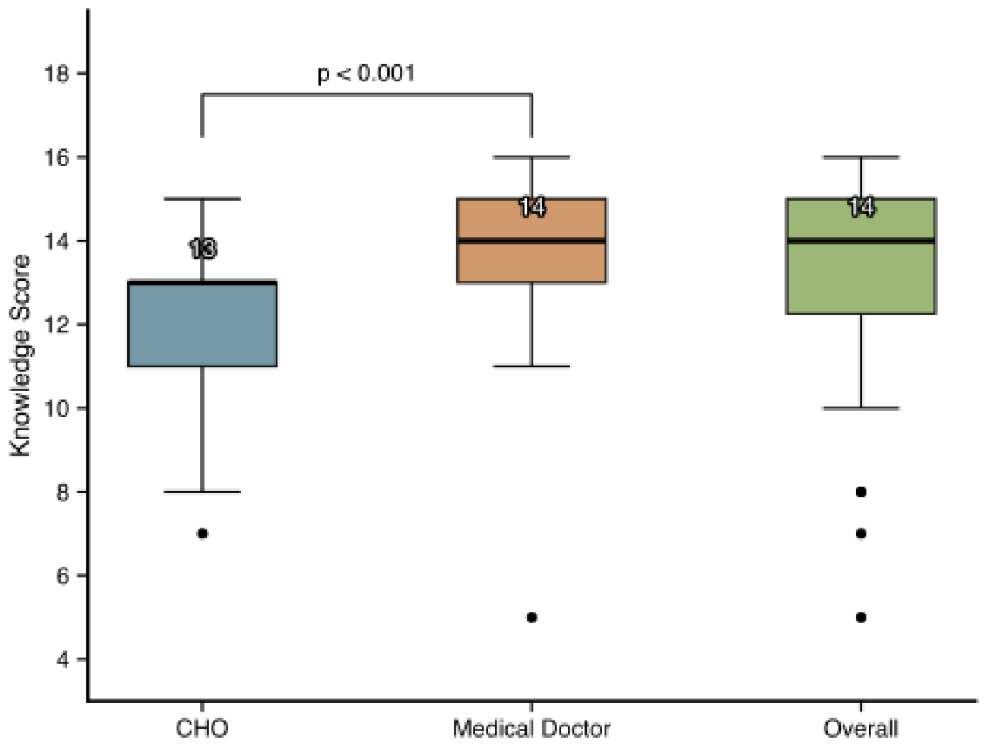
Figure 2.
Responses to the 16 knowledge items on antibiotic use and resistance (n = 102). The bars show the percentage of correct answers; the keyed answer to each statement is shown in parentheses (T, true; F, false). Incorrect and don’t know responses were combined. URTI: upper respiratory tract infection.
Figure 2.
Responses to the 16 knowledge items on antibiotic use and resistance (n = 102). The bars show the percentage of correct answers; the keyed answer to each statement is shown in parentheses (T, true; F, false). Incorrect and don’t know responses were combined. URTI: upper respiratory tract infection.
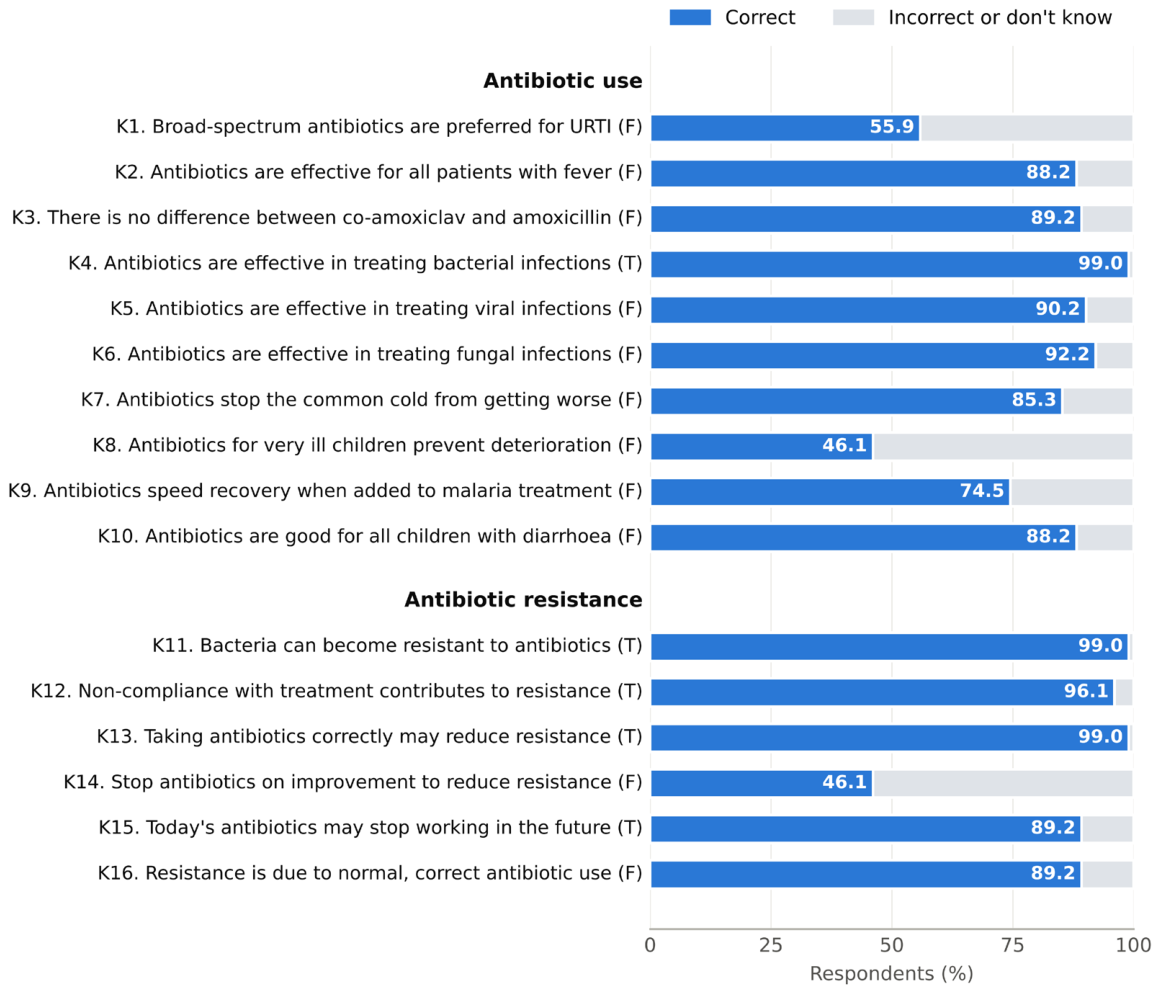
Figure 3.
Attitude-domain scores categorised by profession. High scores indicate more positive attitudes following reverse coding. The boxes represent the median (indicated) and interquartile range, while the brackets illustrate the results of the Mann–Whitney U tests comparing community health officers (CHO) with medical doctors.
Figure 3.
Attitude-domain scores categorised by profession. High scores indicate more positive attitudes following reverse coding. The boxes represent the median (indicated) and interquartile range, while the brackets illustrate the results of the Mann–Whitney U tests comparing community health officers (CHO) with medical doctors.
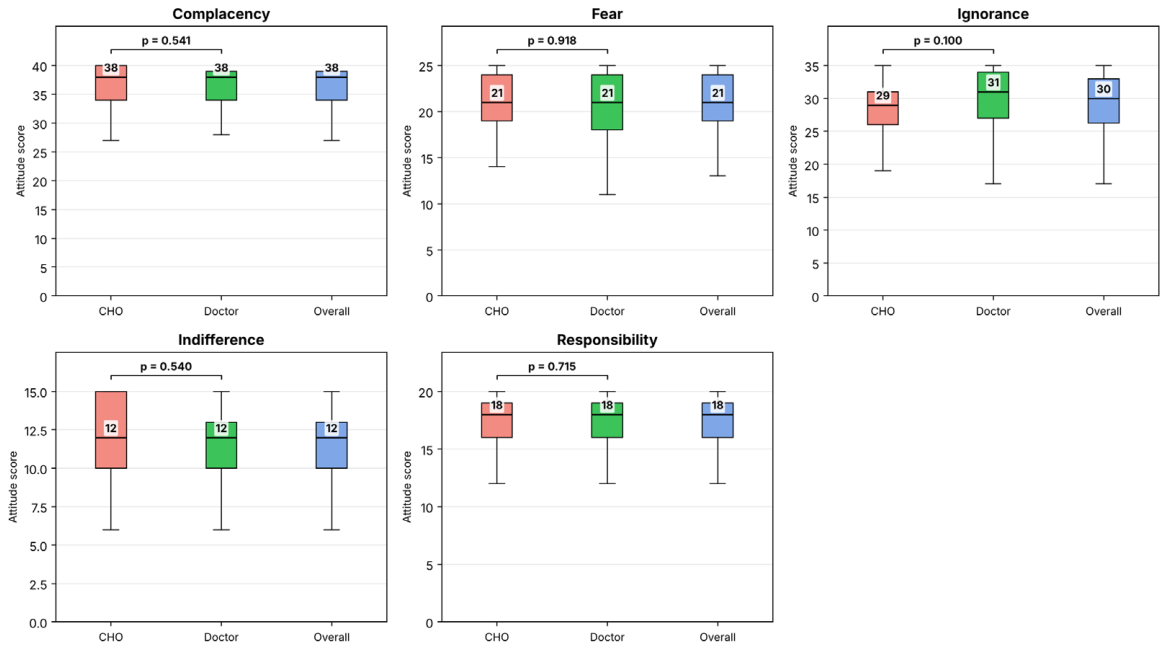
Figure 4.
Self-reported determinants of antibiotic prescribing among paediatric prescribers (n = 102) were grouped as clinical or professional, resource-related, diagnostic support, and external pressure. Multiple responses were allowed.
Figure 4.
Self-reported determinants of antibiotic prescribing among paediatric prescribers (n = 102) were grouped as clinical or professional, resource-related, diagnostic support, and external pressure. Multiple responses were allowed.
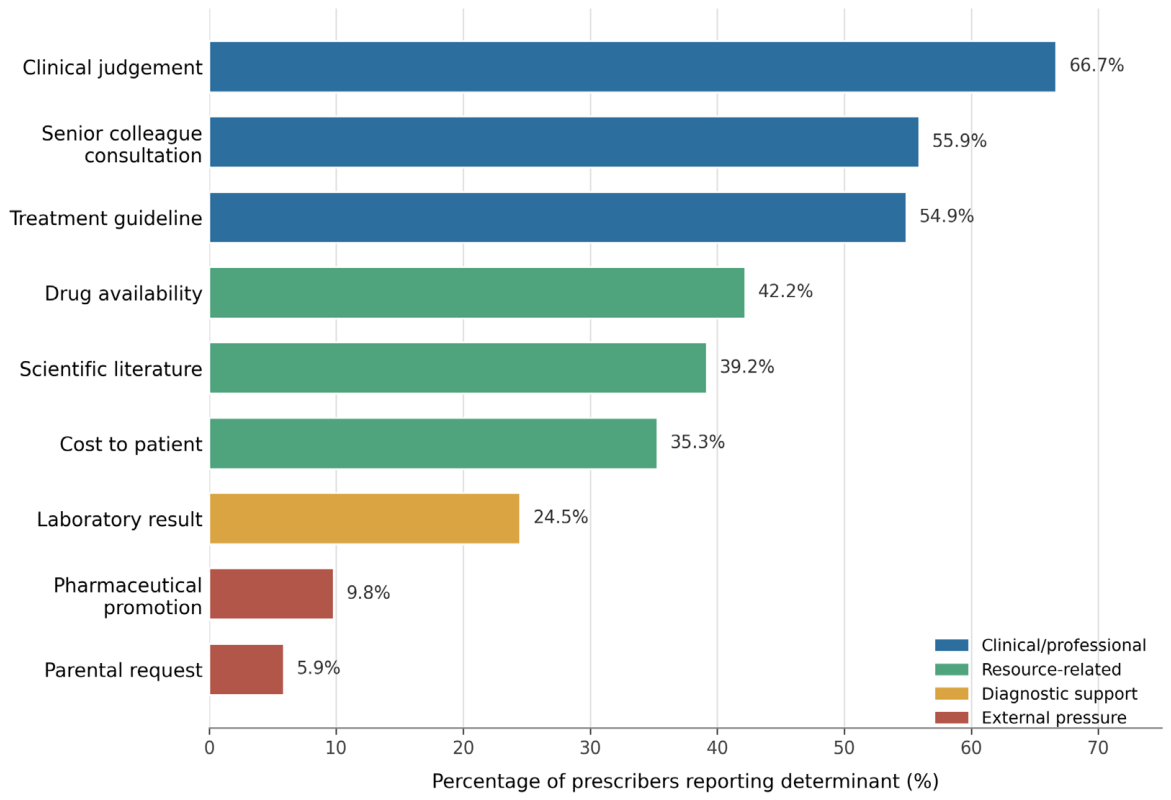

Table 1.
Characteristics of survey respondents and interview participants.
| Characteristic | Survey, n (%) (n = 102) | Interviews, n (%) (n = 18) |
|---|---|---|
| Sex | ||
| Male | 65 (63.7) | 12 (66.7) |
| Female | 37 (36.3) | 6 (33.3) |
| Age, years | ||
| ≤31 | 53 (52.0) | – |
| >31 | 49 (48.0) | – |
| Median (IQR) | 31 (28.0–37.3) | – |
| Hospital | ||
| ODCH (tertiary) | 59 (57.8) | 8 (44.4) |
| KGH (regional) | 25 (24.5) | 5 (27.8) |
| MGH (district) | 18 (17.6) | 5 (27.8) |
| Professional cadre | ||
| Consultant | 5 (4.9) | 2 (11.1) |
| Senior registrar | 4 (3.9) | 3 (16.7) |
| Registrar | 4 (3.9) | 4 (22.2) |
| Medical officer | 17 (16.7) | 1 (5.6) |
| House officer | 37 (36.3) | 2 (11.1) |
| Community health officer | 35 (34.3) | 6 (33.3) |
| Highest qualification | ||
| Diploma | 35 (34.3) | – |
| Bachelor’s degree | 58 (56.9) | – |
| Postgraduate degree | 9 (8.8) | – |
| Work experience, survey | ||
| <1 year | 33 (32.4) | – |
| 1–5 years | 30 (29.4) | – |
| >5 years | 39 (38.2) | – |
| Work experience, interviews | ||
| <5 years | – | 4 (22.2) |
| 5–10 years | – | 8 (44.4) |
| >10 years | – | 6 (33.3) |
| AMS training in previous 12 months | ||
| Yes | 36 (35.3) | – |
| No | 66 (64.7) | – |
AMS, antimicrobial stewardship; IQR, interquartile range; KGH, Kenema Government Hospital; MGH, Magburaka Government Hospital; ODCH, Ola During Children’s Hospital. –, not collected. House officers are doctors in their two-year pre-registration internship; registrars and senior registrars are in specialist training, and community health officers are non-physician clinicians.
Table 2.
Multivariable Firth logistic regression of prescriber characteristics associated with good knowledge and positive attitude scores (n = 102).
Table 2.
Multivariable Firth logistic regression of prescriber characteristics associated with good knowledge and positive attitude scores (n = 102).
| Characteristic (comparison) | Good knowledge | Ignorance | Responsibility | Indifference | Complacency | Fear |
|---|---|---|---|---|---|---|
| Sex: female vs. male |
2.85 * (1.10–8.10) |
0.99 (0.40–2.45) |
0.61 (0.26–1.44) |
0.67 (0.29–1.55) |
0.86 (0.38–1.96) |
0.72 (0.31–1.65) |
| Age: ≥31 vs. <31 years | 0.51 (0.17–1.48) |
2.12 (0.78–5.99) |
1.79 (0.65–5.01) |
1.31 (0.49–3.52) |
1.53 (0.58–4.33) |
2.74 (0.98–8.72) |
| Profession: doctor vs. CHO |
12.72 *** (4.05–46.98) |
4.92 ** (1.53–20.34) |
0.91 (0.32–2.64) |
2.05 (0.76–5.86) |
0.59 (0.21–1.57) |
0.88 (0.33–2.36) |
| Experience: 1–5 years vs. <1 year | 1.54 (0.50–4.92) |
0.82 (0.28–2.42) |
1.01 (0.35–2.94) |
2.22 (0.78–6.54) |
0.81 (0.29–2.31) |
0.97 (0.33–2.85) |
| Experience: >5 years vs. <1 year | 3.70 (0.88–17.29) |
3.34 (0.74–17.52) |
1.73 (0.43–7.01) |
3.46 (0.92–13.86) |
0.30 (0.08–1.13) |
0.44 (0.10–1.71) |
| AMS training: yes vs. no | 1.06 (0.40–2.81) |
1.21 (0.47–3.11) |
1.60 (0.65–4.06) |
1.14 (0.47–2.76) |
0.95 (0.40–2.29) |
0.91 (0.38–2.21) |
Values are adjusted odds ratios (AOR) with 95% profile penalised-likelihood confidence intervals for a good knowledge score or a positive attitude score (score at or above the median), from Firth logistic regression with all six terms in each model. Reference categories: male; <31 years; CHO; <1 year of experience; no AMS training. Bold, p < 0.05; * p < 0.05; ** p < 0.01; *** p < 0.001 (penalised likelihood ratio test). AMS, antimicrobial stewardship; CHO, community health officer.
Table 3.
Themes and subthemes of factors influencing antibiotic prescribing among paediatric prescribers (n = 18).
Table 3.
Themes and subthemes of factors influencing antibiotic prescribing among paediatric prescribers (n = 18).
| Theme | Subthemes |
|---|---|
| 1. Navigating diagnostic limitations and uncertainty in antibiotic prescribing | 1.1 Empirical prescribing in the absence of microbiological confirmation 1.2 Diagnostic limitations and delayed investigations 1.3 Balancing clinical risk and diagnostic uncertainty 1.4 Escalation and de-escalation of therapy |
| 2. Health-system and resource constraints shaping prescribing decisions | 2.1 Antibiotic availability and stock-outs 2.2 Financial barriers and affordability 2.3 Human resource constraints 2.4 Infrastructure limitations 2.5 Dependence on external support systems |
| 3. Professional influences on prescribing behaviour | 3.1 Clinical judgement 3.2 Professional experience 3.3 Prescribing competence 3.4 Guideline use and adherence 3.5 Supervision and mentorship 3.6 Multidisciplinary collaboration 3.7 Prescribing culture and established practice |
| 4. Caregiver and community influences on antibiotic use | 4.1 Caregiver expectations 4.2 Self-medication 4.3 Previous prescribing experiences 4.4 Referral practices 4.5 Community access to antibiotics 4.6 Caregiver antibiotic literacy |
| 5. Antimicrobial stewardship opportunities for optimising antibiotic prescribing | 5.1 Awareness of AMR 5.2 Existing stewardship practices 5.3 Diagnostic strengthening 5.4 Development of local guidelines 5.5 Continuous professional development 5.6 Community education |
AMR: antimicrobial resistance.
Table 4.
Joint display integrating survey and interview findings, mapped to the COM-B model.
| Domain (COM-B) | Quantitative findings | Qualitative findings | Meta-inference |
|---|---|---|---|
| Knowledge (psychological capability) | Median 14/16; doctors > CHOs; female > male; lowest scores on URTI, very-ill-child, and stopping-on-improvement items | AMR widely recognised; dosing errors among new staff; CHOs consult doctors | Expansion: capability gaps concentrated among CHOs and junior staff and extend to dosing |
| Attitudes (reflective and automatic motivation) | Positive scores; knowledge unrelated to complacency or fear | Concern about AMR; immediate treatment of unstable children; antibiotics when wards are congested | Expansion: prompt empirical treatment of unstable children, coexists with concern about AMR; prescribing under workload pressure is the less defensible response |
| Diagnostics (physical opportunity) | Clinical judgement 66.7%; laboratory results 24.5% | No routine culture; delayed tests; power failures; little de-escalation | Confirmation |
| Resources (physical opportunity) | Drug availability 42.2%; cost 35.3% | Second-line stock-outs; costs outside FHCI; workload; NGO dependence | Confirmation and expansion |
| Professional norms (social opportunity) | Senior colleagues 55.9%; guidelines 54.9% | Supervision and ward rounds; international rather than local guidelines; entrenched habits | Confirmation and expansion |
| Caregivers and community (social opportunity) | Parental request 5.9% | Expectations, self-medication, prior exposure, referral after antibiotics, unregulated access | Discordance: influence operates mainly before the consultation |
AMR, antimicrobial resistance; CHO, community health officer; COM-B, Capability, Opportunity, Motivation–Behaviour; FHCI, Free Health Care Initiative; NGO, non-governmental organisation; URTI, upper respiratory tract infection. Confirmation: both strands agree; expansion: one strand adds insight that the other could not provide; and discordance: the strands disagree.
Disclaimer/Publisher’s Note: The statements, opinions and data contained in all publications are solely those of the individual author(s) and contributor(s) and not of MDPI and/or the editor(s). MDPI and/or the editor(s) disclaim responsibility for any injury to people or property resulting from any ideas, methods, instructions or products referred to in the content. |
© 2026 by the authors. Licensee MDPI, Basel, Switzerland. This article is an open access article distributed under the terms and conditions of the Creative Commons Attribution (CC BY) license.
Copyright: This open access article is published under a Creative Commons CC BY 4.0 license, which permit the free download, distribution, and reuse, provided that the author and preprint are cited in any reuse.