
Submitted:
05 November 2026
Posted:
09 November 2026
You are already at the latest version
Abstract
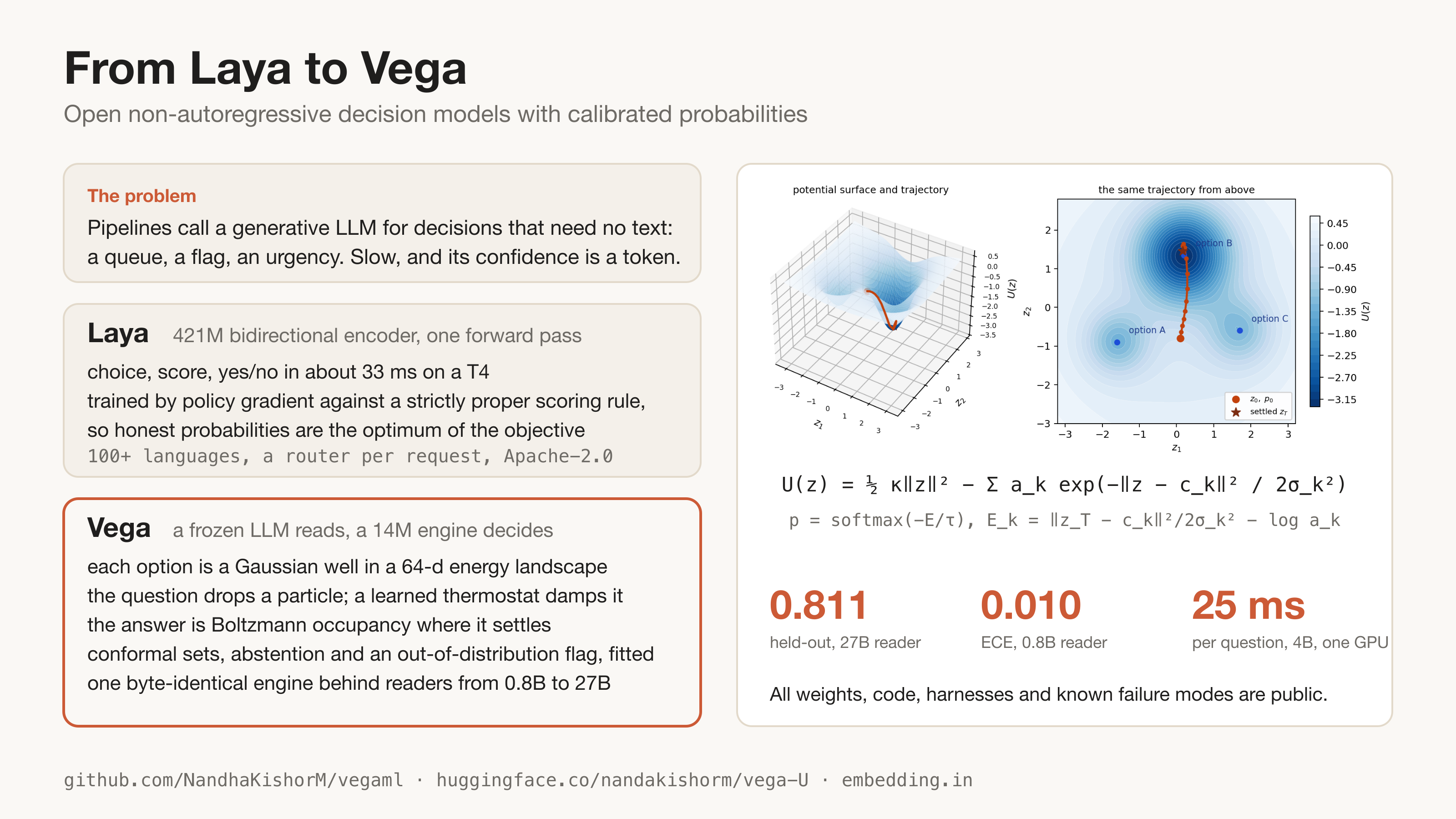
Many production AI pipelines call a generative language model for decisions that need no text at all: which queue a ticket belongs to, whether a prompt is a jailbreak attempt, how urgent an email is. The answer arrives after hundreds of milliseconds of token sampling, with a confidence value that is a predicted token rather than a measurement. This paper documents the design, mathematics and measured record of two open alternatives. Laya is a 421M parameter bidirectional decision model that answers typed questions (choice, score, boolean) about a state in one forward pass of roughly 33 ms on a Tesla T4, trained with policy-gradient reinforcement learning whose reward is a strictly proper scoring rule, so that honest probability reporting is the optimum of the objective; it went from plan to public checkpoints and benchmarks in under two days in September 2026. I cover its architecture, training recipe and a compact results record, including an ablation in which a supervised baseline matches the RL objective on single-step questions. The larger share of the paper belongs to Vega, the architecture that followed. Vega freezes an instruction-tuned language model as a reader and trains a dynamical decision engine of 14M to 31M parameters on its hidden states: each option becomes a Gaussian well in a learned 64-dimensional energy landscape, the question drops a particle with an initial position and momentum, a state-space thermostat sets step size and damping, and the answer is read from Boltzmann occupancy along a damped symplectic trajectory. The engine trains in minutes on one GPU, carries conformal sets, abstention and an out-of-distribution flag as fitted artifacts, and in the vega-U form one byte-identical engine serves four readers from 0.8B to 27B, with new readers attached by a closed-form port fit on unlabelled text. All weights, code, harnesses and known failure modes are public.
Keywords:
decision models
; non-autoregressive inference
; calibrated probabilities
; reinforcement learning
; proper scoring rules
; conformal prediction
; frozen language models
; energy-based readout
; model routing
; open weights
Copyright: This open access article is published under a Creative Commons CC BY 4.0 license, which permit the free download, distribution, and reuse, provided that the author and preprint are cited in any reuse.