

Submitted:
04 November 2026
Posted:
06 November 2026
You are already at the latest version
Abstract
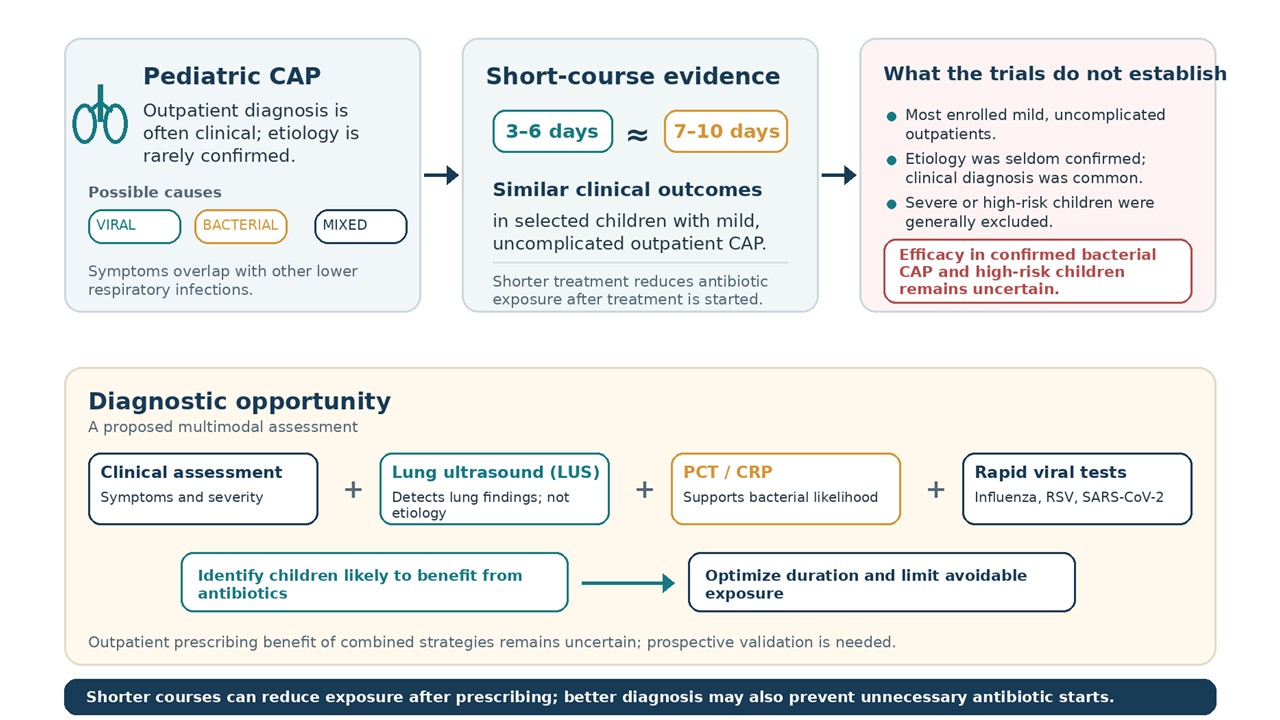
Background: Short-course antibiotic therapy is increasingly recommended for children with uncomplicated community-acquired pneumonia (CAP), but uncertainty remains about its applicability to bacterial disease and whether antibiotics are needed in routine pediatric outpatient care settings. Methods: We conducted a narrative review of literature published from January 2010 through September 2026. PubMed/MEDLINE, Google Scholar, ClinicalTrials.gov, agency websites, and reference lists were searched. Evidence was synthesized descriptively; no formal risk-of-bias assessment or meta-analysis was performed. Results: Systematic reviews and randomized trials indicate that three- to six-day courses can achieve outcomes comparable to longer regimens in children, mainly outpatients with mild, uncomplicated CAP. However, many trials relied on clinical diagnosis, rarely established etiology, and excluded children with severe disease or major comorbidities. Inclusion of children without bacterial infection may have contributed to similar outcomes across treatment durations; evidence is insufficient to establish efficacy in confirmed bacterial CAP or higher-risk populations. Shorter courses reduce antibiotic exposure among treated children but do not determine who needs antibiotics. Lung ultrasound offers a radiation-free point-of-care approach to identifying pneumonia, while procalcitonin and rapid viral testing may refine etiological assessment. Yet evidence for combined diagnostic strategies largely concerns accuracy rather than outpatient prescribing outcomes. Conclusions: Short courses are supported for carefully selected children with uncomplicated CAP, but their generalizability is limited. Improving diagnosis and identifying children likely to benefit from antibiotics may reduce unnecessary use beyond what shortening treatment alone can achieve. Prospective outpatient studies should evaluate whether integrated imaging, biomarkers, and microbiological tests improve prescribing and clinical outcomes.
Keywords:
community-acquired pneumonia
; children
; antibiotic duration
; short-course therapy
; antimicrobial stewardship
; lung ultrasound
1. Introduction
Community-acquired pneumonia (CAP) remains one of the most common infections in childhood. The availability of effective and safe antibiotics [1], advances in the prevention and treatment of viral infections [2], and widespread vaccination against Haemophilus influenzae type b [3] and Streptococcus pneumoniae [4] have substantially reduced its incidence and mortality. Nevertheless, CAP continues to be an important cause of pediatric morbidity, hospitalization, and death [5,6].
For decades, guidelines recommended antibiotic therapy for nearly all children diagnosed with CAP, regardless of the presumed etiology. In uncomplicated cases, treatment courses of 7–10 days—most commonly with amoxicillin—became standard practice [6]. This approach reflected the difficulty of reliably distinguishing bacterial from viral pneumonia in routine clinical settings, particularly in primary care, where microbiological testing is seldom available and clinical manifestations alone have limited ability to identify the cause. Consequently, clinicians generally favored antibiotic treatment, even when a viral etiology was suspected, accepting some overtreatment to reduce the risk of undertreating potentially severe bacterial infections.
Evidence that the emergence and spread of antimicrobial resistance (AMR) are driven by inappropriate and excessive antimicrobial use in human medicine, animal husbandry, and agriculture, as well as by prolonged antibiotic exposure [7,8], has led to the development of antimicrobial stewardship programs that include the use of shorter antibiotic courses. Optimizing treatment duration is now a cornerstone of antimicrobial stewardship, particularly as randomized clinical trials have shown that shorter courses are often non-inferior to longer regimens for many bacterial infections, while reducing unnecessary antimicrobial exposure and potentially limiting the selection of resistant organisms [9,10].
In children with CAP, 3–5 days of antibiotic therapy can achieve clinical outcomes comparable to those of conventional 7–10-day courses, thereby minimizing antibiotic exposure and the potential for resistance selection [5,11,12,13,14]. Because CAP accounts for a substantial proportion of antibiotic prescriptions in children, these findings have important implications for antimicrobial stewardship. Shorter courses have consequently been incorporated into recent consensus recommendations and clinical pathways for carefully selected children with uncomplicated CAP [15,16]. However, the strength of these recommendations remains influenced by limitations in the available evidence and by uncertainties regarding diagnosis, etiology, and antibiotic selection. Several limitations of the clinical trials supporting shorter treatment courses warrant consideration. This narrative review critically examines the findings of these studies.
2. Methods
A narrative literature review was conducted to examine evidence on antibiotic treatment duration for CAP in children, including the clinical evidence for shorter courses and the limitations that may affect its interpretation and application. Literature searches were performed in PubMed/MEDLINE, Google Scholar, and ClinicalTrials.gov for the period from 1 January 2010 to 30 September 2026. Relevant documents and guidance were also retrieved from the websites of international and national public health and regulatory authorities, including the World Health Organization (WHO), the Centers for Disease Control and Prevention (CDC), the European Centre for Disease Prevention and Control, the European Medicines Agency, the US Food and Drug Administration, and national regulatory and surveillance agencies.
Search terms were used individually and in combination to identify publications addressing pediatric CAP, its etiology, and antibiotic treatment duration. Terms included “pneumonia,” “community-acquired pneumonia,” “child,” “children,” “adolescent,” “antibiotic therapy,” “duration,” “short-term,” “short course,” “safety,” “tolerability,” “etiology,” “virus,” “bacteria,” Streptococcus pneumoniae, Haemophilus influenzae, and Mycoplasma pneumoniae. Additional publications were identified by manually screening the reference lists of relevant original studies, reviews, consensus statements, and public health guidance documents.
Priority was given to peer-reviewed original research, including randomized controlled trials, long-term follow-up studies, observational effectiveness studies, immunogenicity and safety studies, and human challenge studies. ClinicalTrials.gov records and guidance documents from relevant public health and regulatory authorities were also considered where they informed the review’s scope.
As this was a narrative review rather than a systematic review, study identification and selection did not follow a prespecified systematic-review protocol. No formal risk-of-bias assessment, quantitative evidence grading, or meta-analysis was performed. Findings were synthesized descriptively and interpreted in light of their biological plausibility, methodological robustness, clinical relevance, and implications for antibiotic treatment policy and practice.
3. Evidence Supporting Shorter Antibiotic Courses
The conclusion that shorter antibiotic courses can achieve clinical outcomes comparable to those of conventional 7–10-day regimens in children with community-acquired pneumonia (CAP) is supported by several systematic reviews and meta-analyses. A 2023 meta-analysis of 16 randomized trials involving 12,774 children treated as outpatients with oral antibiotics found no clinically meaningful differences between courses of ≤5 days and longer courses in clinical cure, treatment failure, relapse, hospitalization, mortality, or serious adverse events. The certainty of evidence for the main outcomes was moderate [17].
Similar findings were reported in a 2025 systematic review and meta-analysis of 17 studies involving 155,944 children, including 15 randomized trials. The analysis found no significant differences between short-course (≤6 days) and longer (>7 days) therapy in clinical cure, treatment failure, or overall adverse events. Shorter courses were also associated with fewer serious adverse events [18]. In addition, a systematic review of randomized trials found that a 3-day course of amoxicillin was non-inferior to longer regimens in young children with clinically diagnosed, non-severe CAP treated as outpatients, and was associated with fewer non-serious adverse events [19].
Key systematic reviews and randomized trials comparing shorter and conventional antibiotic regimens for pediatric CAP are summarized in Table 1.
4. Methodological Limitations of the Studies
The eligibility criteria used in studies comparing shorter with conventional antibiotic courses for pediatric CAP reveal several limitations that affect how their findings should be interpreted and applied. Most studies enrolled outpatients with presumed mild CAP diagnosed on clinical grounds, without radiological confirmation. Disease severity was generally assessed at enrollment, and laboratory investigations to determine etiology were rarely performed. As a result, it is difficult to establish which children had bacterial CAP or were likely to benefit from antibiotics. Nevertheless, all enrolled children received antibiotic treatment.
This approach should be considered in the context of clinical practice and existing guidance. Several international guidelines recommend antibiotic treatment for children diagnosed with CAP in outpatient settings [8,9]. More definitive diagnosis may require lung ultrasound or chest radiography, which may not be readily available in primary care; chest radiography also involves exposure to ionizing radiation. Similarly, tests to distinguish bacterial from viral infections or to stratify disease severity may be difficult to obtain, and many currently available investigations have limited diagnostic value.
At the same time, the lack of reliable tools to confirm CAP, identify bacterial causes, predict disease progression, and determine who is likely to benefit from antibiotics creates substantial diagnostic uncertainty. In practice, this uncertainty has contributed to a treatment approach that favors avoiding undertreatment, even though it can result in antibiotics being prescribed to children who may not need them. Thus, a proportion of antibiotic use in pediatric CAP may reflect the difficulty of making accurate diagnoses in routine clinical settings.
The evidence for shorter antibiotic courses should also be interpreted in light of this context. It does not establish that every case of pediatric CAP can be safely treated with an abbreviated regimen. Rather, the studies show that antibiotic exposure can be reduced in the populations enrolled, which may include children who would not have required antibiotic treatment. Shorter courses can therefore support antimicrobial stewardship by reducing antibiotic exposure, but they do not resolve the underlying question of which children with suspected CAP need antibiotics. More accurate diagnostic strategies are needed to identify those most likely to benefit from antibacterial therapy.
5. Limitations of Studies Evaluating Short-Course Therapy
5.1. Disease Diagnosis
In most studies evaluating short-course antibiotic therapy for CAP, diagnosis was based on clinical manifestations alone. Features commonly used to diagnose CAP—including fever, cough, tachypnea, respiratory distress, chest retractions, crackles, reduced breath sounds, and hypoxemia—are nonspecific and overlap substantially with those of other lower respiratory tract infections, such as bronchiolitis, viral-induced wheezing, and acute bronchitis, which typically do not benefit from antibiotics. Systematic reviews have found that neither individual symptoms nor combinations of clinical findings reliably distinguish CAP from other respiratory illnesses [19]. Consequently, some children enrolled in CAP trials may not have had CAP, resulting in diagnostic misclassification.
Several prognostic models have been developed to assess disease severity, including the Respiratory Index of Severity in Children (RISC), modified RISC (mRISC), RISC-Malawi, and PREPARE [20]. However, these tools were designed primarily to predict mortality, rather than to guide decisions about hospitalization, antibiotic duration, or eligibility for abbreviated therapy. RISC was derived in South African children with lower respiratory tract infections, mRISC in hospitalized Kenyan children, and RISC-Malawi in hospitalized Malawian children. PREPARE used multinational datasets from low- and middle-income countries to develop models for predicting in-hospital mortality [21,22,23,24,25]. Adult severity scores, such as CURB-65 and the Pneumonia Severity Index, were developed in adult populations and have not been adequately validated for routine use in pediatric CAP [27,28]. Thus, no severity score has demonstrated sufficient accuracy to reliably identify children who are suitable for abbreviated antibiotic regimens. Assessment of CAP severity continues to rely largely on clinical judgment and guideline-based criteria.
Factors such as respiratory distress, hypoxemia, inability to maintain hydration, altered mental status, complications, and the need for hospitalization are widely used to guide management [8,9]. However, these markers were not developed to determine optimal treatment duration. Their definitions vary across studies and guidelines, interobserver agreement is often suboptimal, and hospitalization decisions are influenced by multiple clinical and nonclinical factors.
A further limitation is the absence of etiological confirmation in most studies. Children with viral, bacterial, and mixed infections were generally analyzed together, in part because diagnostic methods are difficult to use or unavailable in outpatient settings. Multiplex respiratory PCR assays are highly sensitive but may not distinguish active infection from asymptomatic carriage or prolonged viral shedding [9,13]. Blood cultures are highly specific but have low sensitivity. Chest radiography can confirm the presence of pneumonia but provides limited information about its etiology, while inflammatory biomarkers, including C-reactive protein and procalcitonin, cannot reliably distinguish bacterial from viral infections [9,13,30,31,34].
This limitation is especially relevant because respiratory viruses are detected more often than bacterial pathogens in pediatric CAP, particularly among preschool-aged children. In the EPIC study, a pathogen was detected in 81% of children hospitalized with radiographically confirmed CAP. Viruses were identified in 66% of cases, pyogenic and atypical bacteria in 8% each, and viral–bacterial coinfections in 7% [30]. Juven et al. similarly detected viruses in 62% of hospitalized children with CAP, bacteria in 53%, and mixed viral–bacterial infections in 30% [32]. Studies of ambulatory children—the population represented in most short-course antibiotic trials—suggest an even greater predominance of viral pathogens, particularly among children younger than 5 years [31,33].
Taken together, these findings suggest that some children enrolled in trials of antibiotic duration may have had viral or mixed infections and may have derived little or no benefit from antibacterial therapy. If treatment effects are assessed without accounting for this etiological heterogeneity, outcomes among children who do not benefit from antibiotics may make cure rates appear higher and reduce observable differences between treatment groups. This may contribute to findings of non-inferiority for abbreviated regimens.
These diagnostic and population limitations affect how the apparent success of short-course regimens should be interpreted. Some enrolled children may not have had CAP, may have had non-bacterial CAP, or may have differed from children with severe or microbiologically confirmed bacterial pneumonia encountered in clinical practice. Because antibacterial therapy is indicated for bacterial CAP, including children without documented bacterial disease may have increased apparent cure rates, attenuated differences between treatment groups, and contributed to non-inferiority findings. The available evidence supports shorter courses for carefully selected children with clinically diagnosed mild CAP; however, it does not establish the efficacy of short-course therapy for confirmed bacterial CAP.
5.2. Antibiotic Treatment Regimens
Early studies of abbreviated therapy were conducted primarily in low- and middle-income countries. They enrolled children with WHO-defined non-severe pneumonia and compared different β-lactam agents, doses, and treatment durations, including 3- and 5-day courses of amoxicillin or cotrimoxazole [34,35]. More recent studies have generally standardized treatment to amoxicillin, although important differences remain. In the SAFER trial, outpatients with radiographically confirmed CAP received high-dose amoxicillin (75–100 mg/kg/day) for either 5 or 10 days; clinical cure rates were comparable between the groups [11]. The CAP-IT trial used a factorial design to evaluate treatment duration (3 vs. 7 days) and dosage (35–50 vs. 70–90 mg/kg/day) and found no significant differences in clinical outcomes across these regimens [12].
Interpreting these findings is further complicated by the relationship between the antibiotics studied and the bacterial causes of pediatric CAP. High-dose amoxicillin is active against susceptible Streptococcus pneumoniae, a principal bacterial target of current guidelines, but it is not active against other potential causes of CAP, such as Mycoplasma pneumoniae and Chlamydia pneumoniae. It may also be less reliable against β-lactamase-producing Haemophilus influenzae. None of the major treatment-duration trials stratified outcomes by microbiologically confirmed etiology. It therefore remains unclear whether abbreviated regimens are equally effective for bacterial CAP.
One possible explanation for the similar clinical outcomes observed across substantially different regimens is that many enrolled cases were viral and would have improved without antibacterial treatment. Alternatively, some bacterial infections may have resolved without active antimicrobial therapy. This may be relevant to infections caused by atypical bacteria, including M. pneumoniae, a substantial proportion of which are reported to be self-limiting and to resolve without specific antimicrobial treatment.
Several features of the duration trials limit the interpretation and generalizability of their findings (Table 2).
6. Conclusions
Taken together, the evidence suggests that shorter antibiotic courses can be used for selected children with uncomplicated CAP. Reducing treatment duration is a practical way to limit antibiotic exposure among children who are prescribed antibiotics, but it does not address whether antibiotics are needed in the first place. Greater reductions in antibiotic use will likely depend on improving the diagnosis of CAP and identifying its etiology more accurately.
Lung ultrasound (LUS) is a promising diagnostic tool because it is rapid, radiation-free, relatively inexpensive, and available at the point of care. Systematic reviews and meta-analyses have reported high diagnostic accuracy, with sensitivity and specificity frequently exceeding 90% and performance that often matches or surpasses chest radiography. LUS can detect small subpleural consolidations, pleural effusions, and dynamic air bronchograms that may be missed on radiographs, leading investigators to propose it as a first-line imaging tool for pediatric CAP [36]. Evidence in outpatient populations has added support: in a study of 246 ambulatory children with suspected CAP who underwent both LUS and computed tomography, LUS had higher sensitivity than chest radiography (91.3% vs. 75.0%), with comparable specificity and predictive values [37]. Other prospective studies have found associations between ultrasound findings, disease severity, and clinical outcomes, suggesting that LUS may also help with risk stratification and follow-up [38].
However, LUS cannot reliably determine the cause of pneumonia. Sonographic findings overlap across etiologies, and no ultrasound feature can establish the etiology in an individual patient [39]. Findings therefore need to be interpreted alongside clinical, laboratory, and microbiological information. Point-of-care C-reactive protein (CRP) and procalcitonin (PCT) are potential adjuncts because they can be relatively inexpensive and provide results quickly from small-volume blood samples [40]. PCT has shown greater ability than CRP to distinguish typical bacterial CAP from other causes [41]. In the EPIC study, children with microbiologically confirmed typical bacterial pneumonia had substantially higher PCT concentrations than those with viral or atypical infections. No child with PCT below 0.1 ng/mL had evidence of typical bacterial infection, and concentrations below 0.25 ng/mL were associated with a 96% negative predictive value for typical bacterial CAP [42]. Diagnostic approaches may help identify pneumonia and refine etiological assessment, although each has important limitations (Table 3).
Microbiological testing may further inform clinical decisions. Rapid antigen or molecular assays for influenza, respiratory syncytial virus (RSV), and SARS-CoV-2 are increasingly available in outpatient pediatric settings and can return actionable results within minutes. Studies combining LUS with other diagnostic tools, particularly PCT, have reported improved diagnostic performance and the potential to reduce unnecessary imaging and antibiotic exposure [43,44,45]. However, most studies have involved hospitalized or critically ill patients, assessed diagnostic accuracy rather than antibiotic stewardship outcomes, or have not established thresholds validated for ambulatory children. The effect of integrated LUS, biomarker, antigen, and molecular testing strategies on outpatient antibiotic prescribing therefore remains uncertain. Large prospective studies in ambulatory children are needed to determine whether these approaches can improve prescribing and clarify the role of shorter antibiotic courses in pediatric CAP.
Author Contributions
S.E. designed the project, supervised the literature review, wrote the first draft of the manuscript, and made a substantial scientific contribution; L.R. and M.F. contributed to write the first draft of the manuscript; G.G.A.. and V.M. performed the literature review; V.F. and N.P. revised the manuscript and made a substantial scientific contribution. All authors have read and agreed to the published version of the manuscript.
Funding
This research received no external funding.
Institutional Review Board Statement
Not applicable for a review article.
Informed Consent Statement
Not applicable for a review article.
Data Availability Statement
No new data were created or analyzed in this study. Data sharing is not applicable to this article.
Conflicts of Interest
The authors declare no conflicts of interest.
References
- Ma, Y.; Fan, S.; Xi, J. Recent updates regarding the management and treatment of pneumonia in pediatric patients: a comprehensive review. Infection 2025, 53, 2341–2359. [Google Scholar] [CrossRef] [PubMed]
- Esposito, S.; Abu-Raya, B.; Eley, B.; Halasa, N.; Martinon-Torres, F.; Mejias, A.; Spoulou, V.; Tenenbaum, T.; Torres, J.P.; Osterhaus, A. Beyond Efficacy: Policy, Delivery, and Equity Determinants of Long-Acting Monoclonal Antibody Uptake for Infant RSV Prevention-A WAidid Consensus Document. Vaccines 2026, 14, 739, Gilsdorf JR. Hib Vaccines: Their Impact on Haemophilus influenzae Type b Disease. J Infect Dis. 2021;224:S321-S330. [Google Scholar]
- Esposito, S.; Principi, N. Pneumococcal vaccines and the prevention of community-acquired pneumonia. Pulm. Pharmacol. Ther. 2015, 32, 124–129. [Google Scholar] [CrossRef] [PubMed]
- Esposito, S.; Cohen, R.; Domingo, J.D.; Pecurariu, O.F.; Greenberg, D.; Heininger, U.; Knuf, M.; Lutsar, I.; Principi, N.; Rodrigues, F.; et al. Antibiotic therapy for pediatric community-acquired pneumonia: do we know when, what and for how long to treat? Pediatr. Infect. Dis. J. 2012, 31(6). [Google Scholar] [CrossRef] [PubMed]
- Waites, K.B.; Talkington, D.F. Mycoplasma pneumoniae and its role as a human pathogen. Clin. Microbiol. Rev. 2004, 17(4), 697–728. [Google Scholar] [CrossRef] [PubMed]
- Clark, J.E.; Hammal, D.; Hampton, F.; Spencer, D.; Parker, L. Epidemiology of community-acquired pneumonia in children seen in hospital. Epidemiol. Infect. 2007, 135(2), 262–269. [Google Scholar] [CrossRef] [PubMed]
- World Health Organization. Revised WHO classification and treatment of childhood pneumonia at health facilities; World Health Organization: Geneva, 2014. [Google Scholar]
- Bradley, J.S.; Byington, C.L.; Shah, S.S.; Alverson, B.; Carter, E.R.; Harrison, C.; Kaplan, S.L.; Mace, S.E.; McCracken, G.H., Jr.; Moore, M.R.; et al. The management of community-acquired pneumonia in infants and children older than 3 months of age: clinical practice guidelines by the Pediatric Infectious Diseases Society and the Infectious Diseases Society of America. Clin. Infect. Dis. 2011, 53(7). [Google Scholar] [CrossRef] [PubMed]
- Harris, M.; Clark, J.; Coote, N.; Fletcher, P.; Harnden, A.; McKean, M.; Thomson, A. British Thoracic Society guidelines for the management of community acquired pneumonia in children: update 2011. Thorax 2011, 66. [Google Scholar] [CrossRef] [PubMed]
- Tsay, S.V.; Hersh, A.L.; Fleming-Dutra, K.E. Rightsizing treatment for pneumonia in children. JAMA Pediatr. 2021, 175(5), 462–463. [Google Scholar] [CrossRef] [PubMed]
- Pernica, J.M.; Harman, S.; Kam, A.J.; Carciumaru, R.; Vanniyasingam, T.; Crawford, T.; Dalgleish, D.; Khan, S.; Slinger, R.S.; Fulford, M.; et al. Short-course antimicrobial therapy for pediatric community-acquired pneumonia: the SAFER randomized clinical trial. JAMA Pediatr. 2021, 175(5), 475–482. [Google Scholar] [CrossRef] [PubMed]
- Bielicki, J.A.; Stöhr, W.; Barratt, S.; Dunn, D.; Naufal, N.; Roland, D.; Sturgeon, K.; Finn, A.; Rodriguez-Ruiz, J.P.; Malhotra-Kumar, S.; et al. Effect of amoxicillin dose and treatment duration on the need for antibiotic re-treatment in children with community-acquired pneumonia: the CAP-IT randomized clinical trial. JAMA 2021, 326(17), 1713–1724. [Google Scholar] [CrossRef] [PubMed]
- Donà, D.; Brigadoi, G.; Grandinetti, R.; Pedretti, L.; Boscarino, G.; Barbieri, E.; Matera, L.; Mancino, E.; Bergamini, M.; Castelli Gattinara, G.; et al. Treatment of mild to moderate community-acquired pneumonia in previously healthy children: an Italian intersociety consensus (SIPPS-SIP-SITIP-FIMP-SIAIP-SIMRI-FIMMG-SIMG). Ital. J. Pediatr. 2024, 50, 217. [Google Scholar] [CrossRef] [PubMed]
- Penta ESPID Clinical Practice Guideline: Management of paediatric community-acquired pneumonia. Available online: https://penta-id.org/publications/espid-clinical-practice-guideline-management-of-paediatric-community-acquired-pneumonia/ (accessed on 25 October 2026).
- Kang, C. Short-course antibiotics can be just as effective for community-acquired pneumonia in children. Drugs Ther. Perspect. 2026, 42, 89–92. [Google Scholar] [CrossRef]
- Bolormaa, E.; Kang, C.R.; Choe, Y.J.; Yoo, Y.; Lee, J.S.; Park, J.Y.; Choe, S.A.; Tansarli, G.S.; Mylonakis, E. Evaluating short-course antibiotic therapy for pediatric community-acquired pneumonia: a systematic review and meta-analysis. Pediatr. Infect. Dis. J. 2025, 44(7), 637–644. [Google Scholar] [CrossRef] [PubMed]
- Kumar, C.S.; Subramanian, S.; Murki, S.; Rao, J.V.; Bai, M.; Penagaram, S.; Singh, H.; Bondili, N.P.; Madireddy, A.; Lingaldinna, S.; et al. Predictors of mortality in neonatal pneumonia: an INCLEN Childhood Pneumonia Study. Indian Pediatr. 2021, 58(11), 1040–1045. [Google Scholar] [CrossRef]
- Principi, N.; Esposito, S. Biomarkers in pediatric community-acquired pneumonia. Int. J. Mol. Sci. 2017, 18(2), 448. [Google Scholar] [CrossRef] [PubMed]
- Lynch, T.; Platt, R.; Gouin, S.; Larson, C.; Patenaude, Y. Can we predict which children with clinically suspected pneumonia will have the presence of focal infiltrates on chest radiographs? Pediatrics 2004, 113. [Google Scholar] [CrossRef] [PubMed]
- Rambaud-Althaus, C.; Althaus, F.; Genton, B.; D’Acremont, V. Clinical features for diagnosis of pneumonia in children younger than 5 years: a systematic review and meta-analysis. Lancet Infect. Dis. 2015, 15, 439–450. [Google Scholar] [CrossRef] [PubMed]
- Rees, C.A.; Haggie, S.; Florin, T.A. Narrative review of clinical prediction models for paediatric community acquired pneumonia. Paediatr. Respir. Rev. 2025, 54, 19–27. [Google Scholar] [CrossRef] [PubMed]
- Emukule, G.O.; McMorrow, M.; Ulloa, C.; Montgomery, J.M.; Muthoka, P.; Katz, M.A.; Breiman, R.F.; et al. Predicting mortality among hospitalized children with respiratory illness in Western Kenya, 2009-2012. PLoS ONE 2014, 9. [Google Scholar] [CrossRef] [PubMed]
- Hooli, S.; Colbourn, T.; Lufesi, N.; Costello, A.; Nambiar, B.; Thammasitboon, S.; Makwenda, C.; Mwansambo, C.; McCollum, E.D.; King, C. Predicting Hospitalised Paediatric Pneumonia Mortality Risk: An External Validation of RISC and mRISC, and Local Tool Development (RISC-Malawi) from Malawi. PLoS ONE 2016, 11. [Google Scholar] [CrossRef] [PubMed]
- Hooli, S.; King, C.; McCollum, E.D.; Colbourn, T.; Lufesi, N.; Mwansambo, C.; Gregory, C.J.; Thamthitiwat, S.; Cutland, C.; Madhi, S.A.; et al. In-hospital mortality risk stratification in children aged under 5 years with pneumonia with or without pulse oximetry: A secondary analysis of the Pneumonia REsearch Partnership to Assess WHO REcommendations (PREPARE) dataset. Int. J. Infect. Dis. 2023, 129, 240–250. [Google Scholar] [CrossRef] [PubMed]
- Awasthi, S.; Pandey, A.K.; Mishra, S.; CAP Study Group. Identifying risk of death in children hospitalized with community-acquired pneumonia. Bull. World Health Organ. 2023, 101, 281–289. [Google Scholar] [CrossRef] [PubMed]
- Lim, W.S.; van der Eerden, M.M.; Laing, R.; Boersma, W.G.; Karalus, N.; Town, G.I.; Lewis, S.A.; Macfarlane, J.T. Defining community-acquired pneumonia severity on presentation to hospital: an international derivation and validation study. Thorax 2003, 58, 377–382. [Google Scholar] [CrossRef] [PubMed]
- Fine, M.J.; Auble, T.E.; Yealy, D.M.; Hanusa, B.H.; Weissfeld, L.A.; Singer, D.E.; Coley, C.M.; Marrie, T.J.; Kapoor, W.N. A prediction rule to identify low-risk patients with community-acquired pneumonia. N Engl. J. Med. 1997, 336, 243–250. [Google Scholar] [CrossRef] [PubMed]
- Same, R.G.; Amoah, J.; Hsu, A.J.; Hersh, A.L.; Sklansky, D.J.; Cosgrove, S.E.; Tamma, P.D. The association of antibiotic duration with successful treatment of community-acquired pneumonia in children. J. Pediatr. Infect. Dis. Soc. 2021, 10(3), 267–273. [Google Scholar] [CrossRef] [PubMed]
- Juvén, T.; Mertsola, J.; Waris, M.; Leinonen, M.; Meurman, O.; Roivainen, M.; Eskola, J.; Saikku, P.; Ruuskanen, O. Etiology of community-acquired pneumonia in 254 hospitalized children. Pediatr. Infect. Dis. J. 2000, 19(4), 293–298. [Google Scholar] [CrossRef] [PubMed]
- Gao, Y.; Liu, M.; Yang, K.; Zhao, Y.; Tian, J.; Pernica, J.M.; Guyatt, G. Shorter versus longer-term antibiotic treatments for community-acquired pneumonia in children: a meta-analysis. Pediatrics 2023, 151(6). [Google Scholar] [CrossRef] [PubMed]
- Jain, S.; Williams, D.J.; Arnold, S.R.; Ampofo, K.; Bramley, A.M.; Reed, C.; Stockmann, C.; Anderson, E.J.; Grijalva, C.G.; Self, W.H.; et al. Community-acquired pneumonia requiring hospitalization among U.S. children. N Engl. J. Med. 2015, 372, 835–845. [Google Scholar] [CrossRef] [PubMed]
- Principi, N.; Esposito, S. Management of severe community-acquired pneumonia of children in developing and developed countries. Thorax 2011, 66(9), 815–822. [Google Scholar] [CrossRef] [PubMed]
- Lipsett, S.C.; Hall, M.; Ambroggio, L.; Hersh, A.L.; Shah, S.S.; Brogan, T.V.; Gerber, J.S.; Williams, D.J.; Grijalva, C.G.; Blaschke, A.J.; et al. Antibiotic Choice and Clinical Outcomes in Ambulatory Children with Community-Acquired Pneumonia. J. Pediatr. 2021, 229, 207–215. [Google Scholar] [CrossRef] [PubMed]
- Hazir, T.; Qazi, S.A.; Nisar, Y.B.; Maqbool, S.; Asghar, R.; Baig, I.; Khalid, S.; Randhawa, S.; Aslam, S.; Riaz, S.; et al. Can WHO therapy failure criteria for non-severe pneumonia be improved in children aged 2-59 months? Lancet 2002, 360, 835–841. [Google Scholar]
- Agarwal, G.; Awasthi, S.; Kabra, S.K.; Kaul, A.; Singhi, S.; Walter, S.D. Three day versus five day treatment with amoxicillin for non-severe pneumonia in young children: a multicentre randomised controlled trial. BMJ 2004, 328, 791. [Google Scholar] [CrossRef]
- Principi, N.; Esposito, A.; Giannitto, C.; Esposito, S. Lung ultrasonography to diagnose community-acquired pneumonia in children. BMC Pulm. Med. 2017, 17, 212. [Google Scholar] [CrossRef] [PubMed]
- Qin, T.; Huang, Z.; Lan, Q.; Nie, Y.; Luo, G.; Cheng, L.; Li, L.; Tang, Z.; Ma, Z. Evaluation of the application value of ultrasound in the diagnosis of community-acquired pneumonia in children: a preliminary study based on large-scale outpatient cases. Front Pediatr. 2025, 13, 1582647. [Google Scholar] [CrossRef] [PubMed]
- Francavilla, M.; Scarlato, L.; Camporesi, A.; Orlandi, A.; Cafagno, C.; Raguseo, C.L.; Santoiemma, V.; Russo, R.; Sacco, A.; Musolino, A.M.; et al. Lung ultrasound for the diagnosis and monitoring of community-acquired pneumonia in children: a prospective observational study. Front Pediatr. 2025, 13, 1702388. [Google Scholar] [CrossRef] [PubMed]
- Di Sarno, L.; Francavilla, M.; Orlandi, A.; Morello, R.; De Rose, C.; Tagliaferri, L.; Clemente, A.; Supino, M.C.; Musolino, A.M.; Buonsenso, D. An international standardization to study the clinical use of lung ultrasound to discriminate viral, bacterial and atypical pneumonia in children with community-acquired pneumonia. Ital. J. Pediatr. 2025, 51, 269. [Google Scholar] [CrossRef] [PubMed]
- Principi, N.; Esposito, S. Biomarkers in Pediatric Community-Acquired Pneumonia. Int. J. Mol. Sci. 2017, 18, 447. [Google Scholar] [CrossRef] [PubMed]
- Esposito, S.; Tagliabue, C.; Picciolli, I.; Semino, M.; Sabatini, C.; Consolo, S.; Bosis, S.; Pinzani, R.; Principi, N. Procalcitonin measurements for guiding antibiotic treatment in pediatric pneumonia. Respir. Med. 2011, 105, 1939–1945. [Google Scholar] [CrossRef] [PubMed]
- Stockmann, C.; Ampofo, K.; Killpack, J.; Williams, D.J.; Edwards, K.M.; Grijalva, C.G.; Arnold, S.R.; McCullers, J.A.; Anderson, E.J.; Wunderink, R.G.; et al. Procalcitonin accurately identifies hospitalized children with low risk of bacterial community-acquired pneumonia. J. Pediatr. Infect. Dis. Soc. 2018, 7, 46–53. [Google Scholar] [CrossRef] [PubMed]
- Guitart, C.; Bobillo-Perez, S.; Rodríguez-Fanjul, J.; Carrasco, J.L.; Brotons, P.; López-Ramos, M.G.; Cambra, F.J.; Balaguer, M.; Jordan, I. Lung ultrasound and procalcitonin, improving antibiotic management and avoiding radiation exposure in pediatric critical patients with bacterial pneumonia: a randomized clinical trial. Eur. J. Med. Res. 2024, 29, 222. [Google Scholar] [CrossRef] [PubMed]
- Rodríguez-Fanjul, J.; Guitart, C.; Bobillo-Perez, S.; Balaguer, M.; Jordan, I. Procalcitonin and lung ultrasound algorithm to diagnose severe pneumonia in critical paediatric patients (PROLUSP study). Respir. Res. 2020, 21, 255. [Google Scholar] [CrossRef] [PubMed]
- Bessat, C.; Boillat-Blanco, N.; Albrich, W.C. The potential clinical value of pairing procalcitonin and lung ultrasonography to guide antibiotic therapy in patients with community-acquired pneumonia: a narrative review. Expert Rev. Respir. Med. 2023, 17, 919–927. [Google Scholar] [CrossRef] [PubMed]

Table 1.
Evidence from key studies of shorter antibiotic courses in children with community-acquired pneumonia (CAP).
Table 1.
Evidence from key studies of shorter antibiotic courses in children with community-acquired pneumonia (CAP).
| Evidence source | Population and design | Comparison | Main findings |
|---|---|---|---|
| 2023 meta-analysis [15] | 16 randomized trials; 12,774 outpatient children receiving oral antibiotics. | Courses of ≤5 days versus longer regimens. | No clinically meaningful differences in cure, failure, relapse, hospitalization, mortality, or serious adverse events; moderate certainty for main outcomes. |
| 2025 systematic review and meta-analysis [16] | 17 studies; 155,944 children, including 15 randomized trials. | Short course (≤6 days) versus longer course (>7 days). | No significant differences in cure, treatment failure, or overall adverse events; short courses were associated with fewer serious adverse events. |
| Systematic review of 3-day amoxicillin [17] | Young children with clinically diagnosed, non-severe outpatient CAP. | Three days versus longer antibiotic regimens. | Three-day amoxicillin was non-inferior for clinical outcomes and associated with fewer non-serious adverse events. |
| SAFER randomized trial [11] | Outpatient children with radiographically confirmed CAP. | High-dose amoxicillin (75–100 mg/kg/day) for 5 versus 10 days. | Clinical cure rates were comparable between treatment groups. |
| CAP-IT randomized trial [12] | Children with CAP; factorial evaluation of dose and duration. | 3 versus 7 days; 35–50 versus 70–90 mg/kg/day. | No significant differences in clinical outcomes across the evaluated duration and dose groups. |
Table 2.
Design limitations and their implications of studies on shorter antibiotic courses in children with community-acquired pneumonia (CAP).
Table 2.
Design limitations and their implications of studies on shorter antibiotic courses in children with community-acquired pneumonia (CAP).
| Limitation | How it appears in the evidence | Interpretive implication |
|---|---|---|
| Clinical diagnosis | CAP was often diagnosed from nonspecific clinical findings without radiological confirmation [20]. | Some enrolled children may have had other respiratory illnesses, creating diagnostic misclassification. |
| Etiology not established | Viral, bacterial, and mixed infections were commonly analyzed together; outpatient microbiological testing was limited [9,29,30,31,32,33,34]. | Treatment effects in confirmed bacterial CAP cannot be isolated; children unlikely to benefit from antibiotics may dilute differences between durations. |
| Selected study populations | Trials mainly enrolled otherwise healthy outpatients with mild disease; severe, complicated, or high-risk cases were generally excluded [9,11,12,13]. | Findings should not be assumed to apply to hospitalized children or those with severe disease, major comorbidities, or confirmed bacterial pneumonia. |
| Severity assessed at enrollment | Clinical status may change after enrollment; some participants received additional antibiotics after the assigned short course [11,12,13,15]. | A single baseline assessment may not fully capture progression or the need for retreatment. |
| Antibiotics given to all participants | Duration trials compared antibiotic regimens in children selected for treatment; they did not test whether antibiotics could be withheld. | Evidence on shorter duration does not identify which children with suspected CAP need antibacterial therapy. |
| Variation in drugs, doses, and durations | Earlier studies used different agents and regimens; more recent trials standardized around amoxicillin but still tested different doses and durations [13,35,36]. | Results are not interchangeable across regimens, pathogens, and settings; trial-specific comparisons should be retained. |
Table 3.
Diagnostic approaches and their potential contribution in children with community-acquired pneumonia (CAP).
Table 3.
Diagnostic approaches and their potential contribution in children with community-acquired pneumonia (CAP).
| Approach | Potential contribution | Key limitation or evidence gap |
|---|---|---|
| Clinical assessment | Provides the initial assessment of symptoms, respiratory effort, oxygenation, hydration, and overall severity. | Clinical features overlap across CAP and other lower respiratory illnesses and cannot reliably establish etiology [19]. |
| Chest radiography | Can support confirmation of pneumonia when imaging is indicated [8,9]. | Involves ionizing radiation, may not be readily available in primary care, and provides limited etiological information [9,13,30,33]. |
| Lung ultrasound (LUS) | Point-of-care, radiation-free imaging; can detect consolidations and pleural findings. Studies report high diagnostic accuracy and potential value for monitoring [36,37,38]. | Ultrasound findings overlap across etiologies and cannot reliably determine the cause of pneumonia in an individual child [39]. |
| CRP and procalcitonin (PCT) | Point-of-care biomarkers may support assessment of bacterial likelihood; PCT has shown greater discriminatory ability than CRP for typical bacterial CAP [12,41]. | Neither biomarker establishes etiology alone. In EPIC, PCT <0.1 ng/mL was not observed with typical bacterial infection; <0.25 ng/mL had a 96% negative predictive value [42]. |
| Rapid viral antigen or molecular tests | Rapid testing for influenza, RSV, and SARS-CoV-2 can provide actionable results in outpatient settings. | A positive viral result must be interpreted in the clinical context; impact on antibiotic prescribing in ambulatory CAP needs further evaluation. |
| Severity prediction tools | RISC, mRISC, RISC-Malawi, and PREPARE estimate mortality risk in studied populations [19,20,21,22,23,24,25]. | They were not designed to select children for short-course therapy; adult scores are not adequately validated for routine pediatric CAP [26,27]. |
Abbreviations: CAP, community-acquired pneumonia; CRP, C-reactive protein; EPIC, Etiology of Pneumonia in the Community; LUS, lung ultrasound; mRISC, modified Respiratory Index of Severity in Children; PCT, procalcitonin; PREPARE, Pneumonia Research Partnership to Assess WHO Recommendations; RISC, Respiratory Index of Severity in Children; RISC-Malawi, Malawi-specific RISC model; RSV, respiratory syncytial virus; SARS-CoV-2, severe acute respiratory syndrome coronavirus 2.
Disclaimer/Publisher’s Note: The statements, opinions and data contained in all publications are solely those of the individual author(s) and contributor(s) and not of MDPI and/or the editor(s). MDPI and/or the editor(s) disclaim responsibility for any injury to people or property resulting from any ideas, methods, instructions or products referred to in the content. |
© 2026 by the authors. Licensee MDPI, Basel, Switzerland. This article is an open access article distributed under the terms and conditions of the Creative Commons Attribution (CC BY) license.
Copyright: This open access article is published under a Creative Commons CC BY 4.0 license, which permit the free download, distribution, and reuse, provided that the author and preprint are cited in any reuse.