

Submitted:
04 November 2026
Posted:
05 November 2026
You are already at the latest version
Abstract
Let \(p>3\), \(k=\overline{\mathbb{F}}_p\), and \(K=\mathbf{Q}_p\). For the reduced symplectic Emerton--Gee component indexed by the regular non-Steinberg Serre weight \(\sigma_{p,d,c}=F(p-2+d,p-2;c)\), where \(1\le d\le p-2\) and \(c\) is an arbitrary central-weight representative, we establish a geometric restriction injection \[ \Gamma(\mathcal{C}_{\sigma_{p,d,c}},\mathcal{O})\hookrightarrow k[D^{\pm1},q^{\pm1}]. \] The corresponding spherical mod-\(p\) Hecke algebra is \(k[U,V,Z^{\pm1}]\). Consequently the global-function ring has transcendence degree at most two, whereas the Hecke algebra has transcendence degree three; the two are not isomorphic even as abstract \(k\)-algebras. The proof uses the full, non-split \(\mathrm{GL}\) source in Lee's construction of symplectic components, invariance of unframed Siegel extensions under scalar contraction, extension of the split Levi map from a schematically dense open, and the repeated-inertia symmetry combined with Lee's non-Steinberg \(\mathrm{GL}\) Satake injection. We make explicit why the endpoint \(d=p-2\) is permitted. No exact presentation of the symplectic global-function ring, and no categorical Hecke action, is asserted.
Keywords:
Emerton–Gee stacks
; symplectic Galois representations
; Serre weights
; mod-p Satake
; non-generic boundary
; global functions
MSC: 11F80; 11F85; 14D23
1. Introduction and Main Results
1.1. The Comparison Problem
The mod-p Satake isomorphism identifies the spherical Hecke algebra of a Serre weight with an explicitly described monoid algebra. A different construction attaches a component of a moduli stack of Galois representations, or of étale -modules, to the same weight. The comparison between the Hecke algebra and global regular functions on that component is a geometric precursor to questions in the categorical p-adic Langlands program. It is important to distinguish three logically different statements: the construction of a comparison homomorphism, the existence of an abstract algebra isomorphism, and the construction of a categorical action. This paper excludes the second possibility for a concrete infinite family without requiring the first or the third.
Lee established an injection from the global functions on a non-Steinberg component to the spherical Hecke algebra, and proved surjectivity for sufficiently deep weights [2]. In the rank-two boundary example of ([2], Example 5.3.6(2)), equal adjacent inertial characters force different ordered Frobenius coordinates to represent points with identical semisimplification. An ordered coordinate that is regular on an auxiliary torus therefore need not extend globally. Lee also explicitly credits Kansal and Savoie with an earlier proof, by a different argument, that the rank-two boundary global-function ring and Hecke algebra are not abstractly isomorphic. We do not claim this rank-two mismatch as new. Our contribution is the geometric transfer to the symplectic family in Theorem 1, with a precise Laurent upper bound and verification of its full parameter interval.
For , the situation is subtler: the relevant component is not the entire stack, and a restriction to a convenient split or non-split locus is not automatically faithful. Lee’s explicit construction of symplectic Emerton–Gee components ([1], Proposition 4.1.13 and its proof) supplies a suitable schematically dense Siegel family. We exploit this geometric input before applying the rank-two repeated-inertia calculation. In particular, the complete non-split base, and not the codimension-one fixed-unramified-parameter slice, is essential.
1.2. A Systematic Non-Generic Boundary
Write for a symplectic Serre weight in the conventions of [1], and let be the corresponding reduced irreducible component over k. Our family is
As always, the central integer c is interpreted modulo the appropriate central-weight equivalence; writing it as an integer is a convenient choice of representative. Both simple-root gaps d and lie strictly between 0 and , so these are regular, p-restricted, non-Steinberg weights. They are not strongly generic: the second gap is at the boundary.
Theorem 1
(Uniform strict Hecke mismatch). Let , , , and let be as in (1). Let be the reduced symplectic Emerton–Gee component constructed in ([1], Proposition 4.1.13). There is an injective k-algebra homomorphism, induced by restriction to a split Siegel Levi family,
where D is the unramified determinant parameter on the corresponding component and q is the independent common unramified twisting parameter. Moreover
Here is the spherical mod-p Hecke algebra. We do not claim that D or q individually descends to a regular function on .
The proof has the following architecture. The weight dictionary produces an auxiliary rank-two weight of highest-weight gap . On its non-split locus Lee’s Siegel extensions form a vector bundle, and their unramified twists have schematically dense image in . Conjugation by the scalar Siegel Levi element contracts extension parameters without changing their moduli-stack isomorphism class. Thus functions on are detected by the split zero section. This zero section extends over the reduced rank-two component, and Lee’s rank-two spectral injection places its global functions inside a one-sided Laurent cone. Repeated inertia requires invariance under transposition of the two ordered parameters; the intersection of that cone with its reflection is just the determinant Laurent line. The remaining variable is the common unramified twist.
1.3. The Endpoint and the Original Numerical Example
The upper endpoint in Theorem 1 deserves notice. A historical uniform calculation used ; the extra case makes both simple-root gaps equal to . It does not enter the très-ramifiée branch, which is controlled by the condition . Nor does it introduce the cyclotomic Siegel obstruction: its obstruction inertial character becomes , not . The full external hypotheses relevant to this endpoint are recorded in Section 2 and Section 4; the endpoint is not included simply by extrapolation from numerical experiments.
Corollary 1
(An explicit prime-83 component). At and one obtains
This is the original single-component mismatch, now a special case of Theorem 1.
1.4. Relation with Existing Work and Limits
The strongly generic ordinary comparison investigated in [8] concerns weights with different gap conditions. Its global-function computation and its conditional completed-local comparison have different hypotheses and should not be conflated. The present argument works at an explicit non-generic edge by a geometric obstruction rather than by constructing all would-be Hecke generators. We require neither global automorphic patching nor a generic Satake theorem. Related quotient presentations of components are developed in [5]; our use of rank-two global functions rests instead on the precise non-Steinberg theorem of [2]. In particular, the auxiliary highest-weight gap equals , exactly the boundary excluded by hypothesis (2) of ([5], Theorem 5.0.1). That theorem does not determine this boundary component’s global functions; the restriction and symmetry argument below provides the result we need. Kansal–Savoie ([6], Theorem 1.1) study the singularities of these extremely non-generic rank-two components, including the all- family. Their geometric results provide further context; they are not an additional hypothesis in our symplectic argument.
Several tempting stronger claims are deliberately omitted. We do not determine the exact image of (2), and in particular do not assert equality with the two-variable Laurent algebra. A conjectural refinement from a Laurent upper bound to a polynomial–Laurent upper bound involving a separate Klingen wall needs an independent geometric factorization, not furnished by the Siegel argument. Likewise, resonance and Yoneda-obstruction calculations address a different non-generic phenomenon. These questions are separated in Section 9.
2. Weight Conventions and the Repeated-Inertia Dictionary
2.1. Serre Weights and the Ordered Inertial Exponents
Fix with , and write for the mod-p cyclotomic character of , normalized to have inertial order . Write for an unramified character whose chosen Frobenius value is ; choosing geometric versus arithmetic Frobenius everywhere only replaces the parameters by their inverses. All formulas below use one consistent choice.
The weight coordinates are the integer triple of ([1], §2 and §4.1). The two simple-root gaps are and b. The p-restricted chamber is
Strict inequalities give the regular range. For weights (1) the gaps are d and , so both inequalities are strict. This excludes both Steinberg gaps , while deliberately retaining the repeated-inertia boundary .
The ordered four-dimensional inertial exponents in the standard representation are
They satisfy , which is precisely the inertial similitude relation. Inserting and gives
Thus the first pair and last pair agree on inertia, but their unramified Frobenius parameters need not agree. The distinction between equality of inertial restrictions and equality of full characters is essential for both the extension calculation and the semisimplification argument.
Lemma 1
(Character and similitude bookkeeping). Let be as in (5) for . Then
and the common similitude inertial exponent is . The symplectic Siegel radical attached to the first pair has three Jordan–Hölder inertial characters, all equal to .
Proof.
The first assertion follows by subtraction in (5). The value of the similitude exponent follows from modulo . On the split rank-two diagonal, the Siegel radical is , with having diagonal inertial characters and . Its three graded inertial exponents are , , and , where . Their common residue is . □
2.2. The Auxiliary Rank-Two Weight
Lee associates to the rank-two weight
For the family (1) its coordinates are
Writing its ordered rank-two inertial characters as and shows
In particular, every weight in this family produces a non-Steinberg rank-two weight with repeated inertial characters. The fact that d disappears from the highest-weight difference of explains the uniformity of the rank-two part of the proof.
Remark 1
(Why the two different gaps matter). The condition ensures the repeated inertia in the auxiliary representation, while selects the full rank-two source in Lee’s Siegel construction. These are independent structural requirements. Confusing them would lead to using the wrong slice as a dense family.
2.3. Siegel Cohomology and the Extra Endpoint
The relevant obstruction group is
By local Tate duality its dual is a space of cyclotomic-twisted invariants. A sufficient vanishing criterion, on the rank-two family in question, is that the Jordan–Hölder inertial constituents of are distinct from . In the present family these constituents are . Equality would require , excluded by . Hence
For the left side is the trivial inertia character, so it is still distinct from because . The external relative construction that turns this cohomological input into a Siegel vector bundle is recalled in Section 4. The numerical congruence alone is not being used as a replacement for that construction.
Remark 2
(A non-admissible endpoint). At , and the gap is not regular. Thus the same argument does not automatically extend to . At , the gap enters Lee’s très-ramifiée branch with a different source, and our use of the full base no longer follows. These exclusions are mathematical, not cosmetic.
3. The Mod-P Satake Algebra and Central Normalization
3.1. A Concrete Antidominant Cocharacter Monoid
We record the rank calculation explicitly to avoid treating the Hecke transcendence degree as an unexplained dimension count. Choose cocharacter coordinates adapted to the diagonal torus of . In the convention used here the antidominant conditions are
The central cocharacter lattice has rank one, generated by . Put
Lemma 2
(Unimodular Satake coordinates). Every integral antidominant cocharacter is uniquely expressed as
The coefficients of and are nonnegative integers, while the central coefficient is an arbitrary integer. Consequently the antidominant monoid is isomorphic to and its monoid algebra is .
Proof.
The column matrix has determinant . It is therefore a basis of the complete integral cocharacter lattice. Direct multiplication yields (12). The inequalities (11) say exactly that and ; is unrestricted. Uniqueness follows from unimodularity, and the monoid algebra is the tensor product of two polynomial and one Laurent polynomial algebra. □
Herzig’s Satake isomorphism [3] identifies the spherical Hecke algebra of the regular Serre weight with this monoid algebra. We only use its structure as a ring, not any assertion about global functions on a symplectic component. In particular
The identity holds throughout the regular family (1). A change of choice of central generator replaces Z by but does not change either the algebra or its dimension.
3.2. Why the Central Variable Matters
An unramified scalar twist by multiplies all four standard Frobenius eigenvalues by q and multiplies the similitude Frobenius parameter by . Suppressing the similitude parameter would incorrectly identify points whose line data differ. That mistaken identification can produce a spurious bound of transcendence degree one. Our argument retains q as an independent invertible parameter and therefore proves only the robust bound (3).
In a fixed set of ordered split-torus variables , with the standard pairing of the four symplectic eigenvalues, the scalar twist is
For the root-datum matrix P of Lemma 2, the normalized exponent vector in the character (dual) basis is , rather than the cocharacter-basis coefficient vector . Since the central column of P is , the dual-basis identity gives . Hence the corresponding Laurent character transforms by a power , with the sign set by the Satake evaluation convention. The common-twist variable cannot simply be set equal to one without changing the moduli problem.
Remark 3
(Independence of the rank-two determinant). The symbol D in our target algebra belongs to the defining rank-two Levi base, not to a separately constructed symplectic Hecke operator. Likewise q is a parameter on the source of a family. Injection into does not supply a reverse map or prove that either generator extends from the family to .
4. Lee’s Siegel Extension Family and Schematic Density
4.1. The Precise External Geometric Input
We isolate the geometric statement used in the proof. This is a specialization of the construction in ([1], proof of Proposition 4.1.13, §4.1.15), not an original theorem about all symplectic deformation spaces. For the rank-two label is (7). Let denote its reduced irreducible component and let be Lee’s non-split open locus.
Lee introduces a fixed-parameter codimension-one substack defined by fixing one unramified diagonal parameter. The source of the symplectic family is a smooth cover of this fixed locus only in the très-ramifiée branch . The non-regular wall also requires the open excision in Lee’s construction ([1], §4.1.15). In the otherwise branch with it is a smooth cover of all without that excision. Since and , we are always in the full-source branch.
Choose a smooth surjective cover carrying the universal rank-two family . Let denote the fixed tame similitude character prescribed by the weight. In our range the obstruction group vanishes, and the construction supplies a vector bundle of symplectic Siegel cocycles/extension data . The immediate input is Lee’s Siegel extension-bundle construction ([1], §4.1.15, construction preceding Lemma 4.1.17), which permits both Siegel terms to vary. Its underlying relative Herr-complex machinery is ([4], Corollary 5.1.25, Remark 5.1.30, §5.1.33, Lemma 5.3.2, and the discussion preceding Proposition 5.4.4); the fixed-representation statement of that proposition alone is not being applied to two varying terms. Its family points have the form
Taking the common unramified twists gives a map
By the Definition of Lee’s component in the proof of Proposition 4.1.13, the scheme-theoretic image of this family is . Thus h is schematically dense. The strong conclusion of schematic density, rather than merely a set-theoretic statement for closed points, is what will make pullback on global sections injective.
4.2. Compatibility with the Uniform Weights
Proposition 1
(Verification of the Siegel branch). For every , every , and every allowed central representative c, the weight satisfies the following properties in Lee’s construction:
- (i)
- is a non-Steinberg rank-two weight with highest-weight gap ;
- (ii)
- the symplectic source belongs to the otherwise branch and therefore covers the full non-split ;
- (iii)
- the Siegel obstruction has no cyclotomic inertial constituent, including at ;
- (iv)
- the unramified twisting family has scheme-theoretically dense image in .
Proof.
Part (i) is (8). Since , Lee’s explicit case distinction gives (ii). Part (iii) follows from Lemma 1 and the non-equality (10); the existence of the relative bundle, rather than just its pointwise obstruction calculation, uses Lee’s construction. Finally (iv) is exactly the scheme-theoretic-image assertion for the corresponding unramified twists in ([1], proof of Proposition 4.1.13). Each criterion holds verbatim when : the otherwise branch condition is still satisfied and . □
Remark 4
(Relative versus pointwise cohomology). On a fixed k-point, gives a familiar unobstructedness calculation for extension classes. A family over a base requires a cohomology-and-base-change statement to produce a vector bundle and a morphism to a stack. We invoke the bundle explicitly constructed in Lee’s proof; we do not manufacture a universal continuous Galois character over a discrete polynomial ring. This distinction avoids replacing a moduli-stack statement by a collection of unrelated numerical fibers. At the new endpoint , the Siegel radical has trivial inertial character, so , and consequently , may jump along special unramified fibers. This does not affect the required vector bundle: Lee constructs from the sheaf of 1-cocycles , not from . Cohomology and base change identify the fibers of the coherent relative obstruction sheaf with ; their vanishing makes that sheaf zero by Nakayama’s lemma. Thus the relative obstruction sheaf has constant rank zero, so the cocycle module remains locally free of constant rank by the relative construction in ([4], Proposition 5.4.4) and ([1], §4.1.15). No vanishing or constancy assumption on is used. More concretely, in a local perfect Herr representative , the vanishing of the relative implies that is surjective; since both terms are finite locally free, its kernel is finite locally free and compatible with base change. This is a statement about actual cocycles, not the quotient .
4.3. What the Dense Family Does and Does Not Assert
The family need not be a dense open immersion. Its source may have nontrivial automorphisms, and extension classes can have different presentations. The only property needed below is that if a global regular function on pulls back to zero along h, then that function vanishes identically. Schematic density supplies precisely this implication. We do not infer a presentation of as a polynomial ring on extension coordinates, nor do we use a fixed- slice as a surrogate for T.
For the reader’s convenience, the dependencies can be summarized by the sequence
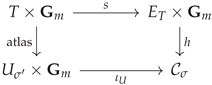 where the lower horizontal arrow is the intrinsic split Levi construction of Section 6. The diagram commutes up to the canonical 2-isomorphism of the zero-section family. The next section explains why every global function pulled back by h is constant along the vertical vector-bundle fibers.
5. Contraction Along the Siegel Radical
5.1. A General Lemma for Stacks
Lemma 3
(Contraction of a schematically dense vector-bundle family). Let k be an infinite field, B an algebraic stack over k, a vector bundle, and X an algebraic stack. Suppose is schematically dense and, for each , is 2-isomorphic to h, where multiplies vectors by r. Then the map on global sections induced by the zero section ,
is injective. The assertion remains valid for when scaling fixes the last factor.
Proof.
Schematic density means that the morphism of structure sheaves is injective. Passing to global sections therefore makes injective. A 2-isomorphism between maps of stacks induces equality of pullbacks of functions, so is invariant under every scalar .
To prove fiberwise constancy, pull back along a smooth affine chart on which the bundle is trivial, say . A regular function on this chart has a finite decomposition into homogeneous terms in . If with homogeneous of total degree j, invariance gives for every . Because k is infinite, polynomial identity in r forces for . Thus F is the pullback of and has no fiber dependence. The same identity holds on overlapping charts, hence globally . If , then , so . The product statement follows by repeating the argument with as base. □
Remark 5
(What the lemma does not require). No quotient-stack presentation of X is assumed, and we do not require h to be representable or injective on geometric points. The argument uses invariance of global functions, not freeness of the scalar action. Even when the extension family is highly redundant as a moduli parameterization, its schematic image can detect functions.
5.2. Symplectic Conjugation Supplies the Required Invariance
Lemma 4
(Scalar Siegel extensions are isomorphic). For the map (16), let scale the cocycle coordinate e by and leave q fixed. Then and h are 2-isomorphic as maps to the unframed symplectic Emerton–Gee stack, including the similitude line.
Proof.
Locally on T write the four-dimensional representation as a Siegel-block matrix
where the cocycle satisfies the appropriate symplectic relations. Let
A direct calculation gives
Thus with multiplier r. The moduli object records a symplectic pairing valued in a rank-one similitude module. In the groupoid of ([1], Definition 4.1.1), an isomorphism is a compatible pair of maps on the rank-four module and on the pairing-valued line. Here that pair is , with . It is defined intrinsically on the global direct sum ; no local basis of is needed. Multiplication by r on the line is the accompanying isomorphism; it does not replace the Galois character by a different one. The same pair of maps gives an isomorphism after tensoring the standard module by , with similitude module . Since scalar matrices in the two Levi blocks commute with changes of trivialization, the construction glues over T and is natural in the family. The resulting natural isomorphism is the required 2-isomorphism. □
This is the point where working on the unframed stack is essential. On a framed deformation space conjugation need not identify points with different frames, and the same argument cannot be copied verbatim. The scalar multiplier r on the similitude line also explains why it would be incorrect to replace by a strict gauge transformation without further work.
Proposition 2
(Detection by the Siegel zero section). Let be the zero section. The composite
is injective for every weight (1).
Proof.
By Proposition 1, h is schematically dense and is a vector bundle. By Lemma 4, pullback of any global function is invariant under all fiber scalings. Lemma 3, applied after adjoining the unramified twist parameter, gives the result. □
6. The Split Levi Map and Descent from the Atlas
6.1. The Zero Section Is Intrinsically Defined
The split extension of (15) is not tied to a choice of cocycles or a basis of . Given an object of the rank-two étale stack and the fixed similitude character , there is a canonical symplectic object
where is the perfect alternating pairing between the two summands. It is functorial in isomorphisms of and in base change. Consequently it defines a morphism of stacks without first choosing a smooth atlas.
Lemma 5
(Descent along the rank-two atlas). The zero-section map in Proposition 2 descends to a morphism
Pullback along is injective on global functions.
Proof.
Formula (18) makes sense for the universal object over any test scheme of . Its pullback to T is exactly in the family (16), so it factors through on this open. Functoriality supplies the descent isomorphisms on with the cocycle condition. As a closed-target factorization, this also follows by faithfully flat descent along the smooth atlas (cf. [7], Lemma 101.38.2). The resulting map is . If a global function restricts to zero on , then its restriction on is zero. Injectivity from Proposition 2 gives the claim. □
6.2. Extension from the Open to the Whole Rank-Two Component
We need an upper bound involving , not merely functions on an open subset. The reverse direction from the algebra of functions on an open to that on a closed component is generally false, so an explicit map of stacks on the entire component is required.
Lemma 6
(A reduced-source closed-target principle). Let Y be a reduced algebraic stack, a schematically dense open substack, and a closed immersion of algebraic stacks. If is a morphism whose restriction to W factors through Z, then f factors through Z.
Proof.
The factorization is equivalent to the vanishing of the image of the defining quasi-coherent ideal under . This ideal vanishes on W. To check that it vanishes on Y, work locally on a smooth affine cover of Y with reduced coordinate rings. On each component, a regular function vanishing on a schematically dense open is zero, so the ideal image vanishes identically. The conclusion descends along the cover. See also the scheme-theoretic image and smooth descent formalism of ([7], Section 101.38). Equivalently, the restriction map is injective and detects the ideal. □
Proposition 3
(Split Levi factorization through the selected component). The functor (18) defines a morphism of reduced stacks
whose restriction to is . In particular
Proof.
The split construction (18) first gives a map into the ambient reduced symplectic stack, without imposing any relative extension obstruction. On it is the zero section of Lee’s defining extension family and therefore factors through the closed substack . Since is reduced and its non-split open is schematically dense (see [4], Theorems 5.5.12 and 6.5.1 and [2], §5.1), so is , and Lemma 6 makes the map factor globally through . The induced pullback on global sections is injective, because its further restriction to is injective by Lemma 5. □
Remark 6
(Two independent uses of density). We have used schematic density twice and for different purposes. Density of the extension family in makes the zero section detect every global function on the target. Density of in the rank-two component allows the split map to factor through the chosen closed symplectic component on the entire rank-two base. Neither inference follows merely from knowing that the split points belong to the right component individually.
6.3. Products with a Torus and Global Sections
Lemma 7
(An affine-flat product formula). Let Y be a quasi-compact quasi-separated algebraic stack over a field k, and let A be a flat k-algebra. There is a natural isomorphism
In particular, it applies to and the finite-type reduced rank-two Emerton–Gee component.
Proof.
Choose a finite disjoint union of affine schemes giving a smooth surjective presentation of Y; its relation algebraic space is quasi-compact and quasi-separated and has a finite affine étale cover. Degree-zero descent expresses global sections as an equalizer. Flat tensor product commutes with these finite products and equalizers, both on the relation space and on the presentation. This gives the formula. The rank-two component is of finite presentation over k by ([4], Theorem 5.5.12), so these hypotheses apply; is flat over k. □
7. Repeated-inertia Geometry and Laurent Support
7.1. The non-Steinberg Spectral Injection
For the rank-two weight in (8), put . The mod-p Satake map of ([2], Proposition 5.3.3), combined with the rank-two torus coordinates and the corresponding antidominant monoid, gives an injection
Here are ordered unramified Frobenius parameters on the diagonal semisimple locus. Set . Only an injection is used; Lee’s stronger isomorphism theorem in sufficiently deep weight range does not apply at the boundary.
The cone in (21) is conveniently described by lattice support. A Laurent monomial can be written as
It belongs to if and only if . Thus the spectral image has support in the closed half-space .
7.2. Why Global Functions Cannot Distinguish the Two Orders
The diagonal inertia in (9) has two identical characters, even though its two unramified factors are free. Lee’s repeated-inertia example ([2], Example 5.3.6(2)) observes that a non-split representation with ordered Frobenius parameters can be paired with a non-split representation in the same component with ordered parameters . The two representations have the same semisimplification. In the reduced Emerton–Gee stack, semisimplification lies in the closure of the point by ([4], Theorem 6.6.3(3)); regular functions have the same value on that specialization. Hence a global function has identical Laurent restrictions at the two ordered points.
There is also a direct stack-level explanation which works on the entire split torus, not just on the locus of distinct Frobenius eigenvalues. By ([2], Definition 5.3.2), the map in (21) is the pullback along the split sum map , up to Lee’s standard cyclotomic normalization. Its two rank-one summands have the same tame inertial character since . Let exchange their unramified parameters . On every test scheme, the isomorphism exchanging the two direct-sum factors defines a functorial 2-isomorphism
The map on global functions is therefore -invariant as an identity of Laurent functions on . This argument strengthens, rather than replaces, the non-split semisimplification explanation of ([2], Example 5.3.6(2)).
Because the ordered non-split parameter locus is dense, the preceding equality is an equality of Laurent polynomials:
This is a necessary symmetry of global functions; it does not assert that the component itself is a categorical quotient by .
Lemma 8
(Reflection of a one-sided Laurent cone). Let k be any field and . Then
More generally, the intersection of a Laurent monoid algebra with the subring invariant under a reflection is supported on the intersection of the monoid and its reflected monoid, provided the Laurent monomials are linearly independent.
Proof.
Write with finite support. Applying the transposition sends to , so symmetry gives
On the left, has only nonnegative powers, while on the right it has only nonpositive powers. Algebraic independence of and D and linear independence of their Laurent monomials force all coefficients with to vanish. Thus . The reverse inclusion is immediate because is symmetric and invertible.
For the geometric support formulation, a monomial in the first ring satisfies , and its reflection requires . The intersection is the diagonal , generated by . □
Proposition 4
(The determinant is the only possible Laurent direction). For every auxiliary rank-two weight (8), the global-function ring satisfies
In fact, with the standard determinant morphism on the rank-two stack, this upper bound is an equality.
Proof.
The injection (21) places the global functions in . Equality on semisimplifications gives the symmetry (23). Lemma 8 proves the injection (25). For the equality assertion, the determinant of a rank-two étale family is functorial. On the reduced irreducible component in question, the determinant morphism factors through the rank-one reduced component with the prescribed tame character. This rank-one component has presentation with trivial action and Laurent coordinate given by the unramified Frobenius value ([2], §5.2). Its pullback is D up to a fixed nonzero scalar depending only on the chosen normalization. This gives a global invertible function whose restriction is D up to that scalar; its inverse is global as well. Thus under the injection. Only the upper bound will be used for the symplectic theorem. □
Remark 7
(A stronger rank-two conclusion, not a stronger symplectic conclusion). The equality in Proposition 4 concerns the auxiliary component. The map need not be surjective on global functions after pullback, so it does not imply . The direction of the ring map is crucial.
7.3. Negative Controls for the Support Argument
The mechanism is specific to the coexistence of a one-sided cone and a transposition forced by repeated inertia. If the inertial characters are distinct, the reflection symmetry is not justified by the same geometric argument. If one replaces the one-sided cone by the entire Laurent ring, symmetric Laurent functions include and have two algebraically independent directions. Finally, replacing the full rank-two component by a fixed- slice changes the function ring and invalidates the density input. These observations make clear which hypotheses are structural and which are merely notational.
8. Proof of the Uniform Theorem and Numerical Illustrations
Proof of Theorem 1
Fix , , and c as in the statement, and let be given by (8). Proposition 1 supplies Lee’s defining vector bundle over the full non-split rank-two source and its schematically dense unramified twisting family. The contraction Lemmas 3 and 4 show that global functions on are detected by its split zero section. Proposition 3 extends this section to the reduced rank-two component and yields an injection
By Lemma 7 and Proposition 4, the target embeds into
This proves (2). Since a subalgebra of a Laurent polynomial algebra in two variables has transcendence degree at most two, the first inequality in (3) follows. The spherical Hecke algebra has the form (13) by Herzig’s Satake theorem and Lemma 2, so it has transcendence degree three. Transcendence degree is invariant under k-algebra isomorphism, proving the abstract non-isomorphism. □
8.1. The Initial Prime-83 Example
For , , and , the full values are
Reduction modulo 82 gives . The auxiliary rank-two weight is
The three Siegel radical graded inertial characters have exponent , different from the cyclotomic exponent 1. There are two noncentral antidominant directions and a central invertible direction in the Hecke algebra. These observations establish the input conditions of Theorem 1 in the original numerical case without any special computation in characteristic 83 beyond modular arithmetic.
8.2. Further Instances and the Endpoint
The table records several points in the family. The entries are exact modular calculations, not independent proofs of the stack geometry.
| p | d | c | |||
| 5 | 1 | 0 | (4,3) | ||
| 7 | 5 | 0 | (10,5) | 1 | |
| 11 | 9 | 2 | (18,9) | 1 | |
| 83 | 25 | 0 | (106,81) | ||
| 83 | 81 | 0 | (162,81) | 1 | |
| 101 | 99 | 7 | (198,99) | 1 |
The endpoint examples include some with all four inertial characters identical. This does not invalidate the argument: Lee’s chosen Siegel component and the role of its complete defining extension family are what select the relevant geometry, not the distinctness of the four inertial characters. At , the Siegel obstruction is trivial on inertia, but the cyclotomic character remains nontrivial and the cohomological obstruction vanishes on the specified family.
Corollary 2
(An infinite collection of counterexamples). There are infinitely many regular non-Steinberg symplectic Serre-weight components over varying residual characteristics for which the global-function ring is not abstractly isomorphic to the associated spherical mod-p Hecke algebra.
Proof.
For every prime choose and . Theorem 1 applies, and there are infinitely many such primes. □
8.3. Interpretation of the Dimension Drop
The dimension of Lee’s symplectic component itself is four for , as stated in ([1], Proposition 4.1.13). The number four is a dimension of an algebraic stack, not the transcendence degree of its global regular-function ring. The comparison in this paper is between a global-function algebra of transcendence degree at most two and a spherical Hecke algebra of transcendence degree three. There is no contradiction in a four-dimensional stack having far fewer globally detectable parameters.
Geometrically, the extension coordinates are invisible to global functions because the unframed group action contracts them to zero, while repeated-inertia symmetry together with the one-sided Satake support constraint leaves only the rank-two determinant direction. This gives a conceptual two-stage loss of possible global parameters. We stress that the argument is an upper bound: it does not show that both D and q survive as independent symplectic global functions.
9. Boundaries, Alternative Mechanisms, and Open Questions
9.1. The Exact Symplectic Ring
The first open problem is to determine the image of (2). It is tempting to guess that some elementary Laurent combinations of D and q descend, but the split Levi source may identify points or meet additional boundary strata imposing further equations. The injection alone proves neither finite generation nor a particular normality property for the image. An exact answer would require an independent extension theorem or a sufficiently complete geometric description of the component’s boundary.
Nevertheless, the similitude character supplies a genuine invertible global function. The similitude morphism from the reduced irreducible component factors through the rank-one reduced component with its prescribed tame character. The presentation with trivial action ([2], §5.2) makes the remaining unramified Frobenius coordinate u and its inverse global regular functions. Along the dense twisting family (16), its pullback is for a fixed , so the map is injective. Consequently
This improves only the lower bound, not the unknown exact presentation of the symplectic ring.
9.2. A Possible Stronger Bound and a Missing Wall
A historical exploratory calculation suggested an inclusion into a ring of the form , with only one freely invertible direction, via a middle Klingen wall. Its W is a specified torus monomial in a different coordinate normalization; it should not be identified with the rank-two determinant D without checking the normalizations. This proposed improvement is not a consequence of the Siegel proof. Establishing it would require a genuine morphism from the entire reduced wall source to the selected component, with the correct relative family, ordered labels and similitude line, and a compatible pullback to a second Laurent cone. The corresponding geometric factorization is not certified here. Consequently no stronger theorem is stated.
9.3. Cyclotomic Resonance Is a Different Phenomenon
Other non-generic weights can have cyclotomic resonance in adjacent extension characters. Prescribed successive extensions may then face a nontrivial Yoneda cup-product obstruction, with local existence equations such as in appropriate models. Even when such equations are rigorously derived for fixed-character cohomology functors, they do not automatically describe the global functions of a real Emerton–Gee component. Our mechanism is instead a repeated-inertia permutation of ordered Frobenius data, coupled with a one-sided Satake cone. Both themes deserve study, but they should not be merged without a theorem connecting their moduli problems.
9.4. What This Work Does Not Construct
There is no categorical action of on an automorphic representation category in this paper. The formal action of global functions on quasi-coherent sheaves on a stack is a different and much weaker statement. Nor is there an assertion about all non-generic weights, about a canonical comparison morphism in the symplectic setting, or about patched local spectral coordinates. The abstract inequality of transcendence degrees is already sufficient for the main result.
9.5. A Criterion for Other Groups
The proof suggests a reusable sufficient mechanism. Suppose an irreducible component admits a schematically dense parabolic-extension family; suppose the unframed Levi scales the extension coordinates so that global functions restrict injectively to the Levi base; and suppose a repeated-inertia permutation preserves the semisimplified objects while the Levi Satake image is confined to a proper polyhedral cone. Then the algebra of global functions may be confined to the monoid algebra of the intersection of that cone with its permutation images. When this invariant intersection has smaller rank than the spherical Hecke monoid, an abstract Satake mismatch follows. The geometric hypotheses must be verified anew for each group and parabolic; this observation is a strategy, not an additional blanket theorem.
Acknowledgments
AI systems were used for literature research, mathematical derivation, computation, proof auditing, and manuscript drafting and revision. Internal AI audits are not external human peer review. The author takes responsibility for the submitted manuscript.
Conflicts of Interest
The author declares no conflicts of interest.
Appendix A. Exact Arithmetic and the Weight Table
Here are checks that can be performed without invoking a theorem about algebraic stacks. Substituting and in (5) gives
Thus the equalities are exact in , even when the residues are represented by integers outside . The symplectic relation is an identity over :
Therefore the radical exponent calculation is
and similarly for the other two graded pieces. The excluded cyclotomic equality is , or . None of the positive integers satisfies this congruence.
The auxiliary highest-weight gap is identically, without a condition on c. Finally the matrix
has determinant . Its inverse coordinates are
This proves that the Satake monoid computation uses the entire integral lattice, with no hidden finite-index sublattice.
Appendix B. Laurent Supports, Examples, and a General Intersection Principle
Let and let . Define the automorphism . The Laurent monoid algebra is , and . The intersection is
In a group algebra , distinct monomials form a k-basis. If a polynomial is supported in and fixed by w, its support must be w-stable and therefore contained in . This gives the equality (24). In particular, the argument works in any characteristic, including characteristic two; no division by the order of the Weyl group is used.
A useful negative control is , which is invariant under w but not in (because the monomial has ). Another is , which lies in but is not invariant. The monomial for satisfies both constraints. These examples separate the cone condition from the symmetry condition: neither one alone forces the one-dimensional answer.
Lemma A1
(Finite permutation-cone support principle). Let M be a free abelian group, let be a submonoid, and let a finite group W act on M. Inside ,
Equality with the W-invariant part of the right-hand ring holds if one retains the invariance condition. In particular, if W acts trivially on , the displayed inclusion is equality.
Proof.
For , the support is contained in P and is W-stable. Thus every monomial exponent m in the support belongs to for all w. Hence it lies in the intersection. Conversely any W-invariant element of the intersection monoid algebra lies in both of the rings on the left. The last assertion follows if W fixes each exponent in that intersection. □
The special case used in this paper has , , and W fixes the diagonal lattice pointwise. The principle is purely combinatorial. To apply it to an actual component, one must independently prove both the spectral-cone injection and the geometric reason for the permutation symmetry.
Appendix C. Four Failure Modes of Shortcut Arguments
This appendix records concrete algebraic counterexamples to plausible but invalid shortenings of the main proof. They are included because every one of these shortcuts appeared as a potential obstruction when passing from numerical or formal models to a genuine stack component.
Appendix C.1. A Divisor Is Not a Dense Source
Set . The restriction to the “fixed parameter” hypersurface is the quotient map
It has nonzero kernel . In particular, a function may vanish on the whole fixed slice without vanishing on the two-parameter torus. This gives an elementary model of the danger of replacing Lee’s full non-split by his codimension-one locus in the otherwise branch. The extra unramified twisting parameter of the Siegel family does not repair the missing injectivity by itself: one must know the actual scheme-theoretic image of the chosen source.
Appendix C.2. Set-theoretic Density Is Too Weak on Nonreduced Targets
Consider and the unique reduced closed subscheme . The map is surjective on underlying topological spaces, but its pullback on functions kills the nonzero nilpotent . Hence it is not schematically dense. In contrast, the component used in this paper is reduced, and more importantly the chosen defining Siegel family is known to have the component itself as its scheme-theoretic image. This guarantees injectivity even before one uses contraction. For general nonreduced deformation stacks the same argument needs the stronger schematic-image hypothesis.
Appendix C.3. Regularity on an Open Need Not Extend to Its Closure
The regular function on does not extend to . Thus an injection into would not imply an injection into merely because is dense. The split Levi map (19), combined with the closed-target principle, is the additional geometric ingredient that justifies replacing functions on the open by functions on the complete reduced rank-two component.
Appendix C.4. An Upper Bound Never Gives Descent of Its Generators
The inclusion
shows that a two-variable polynomial–Laurent upper bound can have a proper subalgebra with the same transcendence degree. Likewise has strictly smaller transcendence degree. Neither ring-theoretic possibility is excluded by an injection alone. More delicate normality and fraction-field arguments can sometimes distinguish such subrings, but they require input about the actual global-function image. Consequently one cannot conclude either the exact image of (2) or the existence of named global symplectic generators from the present theorem.
Appendix C.5. The Cyclotomic and Tr Ès-Ramifi Ée Endpoints Are Distinct
Two ways to leave our family should not be conflated. At , the Siegel graded inertial character becomes , so the easy exclusion fails, even though the weight label is still in the same broad p-restricted chamber. At the graded character becomes again, but an independent geometric change also occurs: Lee’s source switches from the full to a fixed-parameter locus. Both endpoints are excluded from our uniform theorem. At the included endpoint , by contrast, and the full source remains available. This triage explains why the precise interval is the natural one for the argument.
Appendix D. Proof Interfaces and Computational Reproducibility
The weight congruences, symplectic scaling identity, cocharacter-lattice decomposition, and Laurent support calculations in the appendices can be checked by exact arithmetic. The supplementary file verify_arithmetic.py uses Python 3 with no additional packages. It checks the displayed numerical examples, a declared finite sample of weights including upper endpoints, matrix identities, and positive and negative Laurent-support controls, and emits a machine-readable report. The finite sample provides an implementation check of the formulas; the uniform assertions follow from the proofs in the text.
These checks do not certify Lee’s relative extension bundle, schematic images of stacks, local Tate duality, or the rank-two spectral injection. Those are mathematical inputs applied at the cited locations. No numerical experiment substitutes for those inputs, and the supplementary file makes no such claim.
References
- H. Lee, Emerton–Gee stacks, Serre weights, and Breuil–Mézard conjectures for GSp4, arXiv:2304.13879v3 (July 29, 2026), Proposition 4.1.13 and §4.1.15. https://arxiv.org/html/2304.13879v3.
- H. Lee, Spectral mod p Satake isomorphism for GLn, arXiv:2402.14011v2 (October 21, 2026), Proposition 5.3.3 and Example 5.3.6(2). https://arxiv.org/html/2402.14011v2.
- F. Herzig, A Satake isomorphism in characteristic p, Compositio Math. 147 (2011), no. 1, 263–283. [CrossRef]
- M. Emerton and T. Gee, Moduli stacks of étale (φ,Γ)-modules and the existence of crystalline lifts, Annals of Mathematics Studies 215, Princeton University Press (2023).
- A. Guzman, K. Kansal, I. Kountouridis, B. Savoie, and X. Wang, Smoothness of components of the Emerton–Gee stack for GL2, arXiv:2209.09439. https://arxiv.org/abs/2209.09439.
- K. Kansal and B. Savoie, Non-generic components of the Emerton–Gee stack for GL2, arXiv:2407.07883v3 (March 24, 2025). https://arxiv.org/abs/2407.07883v3.
- The Stacks Project Authors, The Stacks Project, Section 101.38, “Scheme theoretic image” (Tag 0CMH), Lemma 101.38.2 (Tag 0CMJ), Lemma 101.38.5 (Tag 0CMK), and Section 67.17, “Scheme theoretic closure and density” (Tag 0831). https://stacks.math.columbia.edu/tag/0CMH.
- L. Tao, Global Functions and Nonextendable Spectral Germs on Ordinary GSp4 Components, Preprints.org (posted October 27, 2026), https://www.preprints.org/manuscript/202610.2592.
Disclaimer/Publisher’s Note: The statements, opinions and data contained in all publications are solely those of the individual author(s) and contributor(s) and not of MDPI and/or the editor(s). MDPI and/or the editor(s) disclaim responsibility for any injury to people or property resulting from any ideas, methods, instructions or products referred to in the content. |
© 2026 by the author. Licensee MDPI, Basel, Switzerland. This article is an open access article distributed under the terms and conditions of the Creative Commons Attribution (CC BY) license.
Copyright: This open access article is published under a Creative Commons CC BY 4.0 license, which permit the free download, distribution, and reuse, provided that the author and preprint are cited in any reuse.