

Submitted:
04 November 2026
Posted:
05 November 2026
You are already at the latest version
Abstract
An increasing number of older adults are undergoing major surgery. Frailty, multimorbidity and sarcopenia, over and above chronological age, are major determinants of postoperative complications, loss of independence and mortality. Comprehensive geriatric assessment (CGA) and multimodal prehabilitation can mitigate this risk, but hospital-based pathways are constrained by workforce, transport and geography, and these barriers often exclude the frailest patients. This narrative review examines how digital technologies can support preoperative assessment, optimisation, and prehabilitation in older surgical patients. We outline the biological rationale for repeated, dynamic assessment of resilience; review electronic frailty indices, digital CGA, remote functional testing and wearable-derived measures; and appraise remotely delivered exercise, nutritional, psychological, cognitive and medical optimisation. Digital tools appear feasible and can stratify risk in older adults; however, there is not yet evidence that they improve clinical outcomes on their own, and the largest trial of home-based prehabilitation in frail older adults found no benefit, with low adherence. We describe two real-world models from the UK: a remotely delivered multidisciplinary service at University College London Hospitals (UCLH) and PreActiv, a rule-based, individualised digital platform. In 274 patients treated at UCLH, sit-to-stand performance and health-related quality of life improved after prehabilitation and remained above baseline after surgery. Finally, we discuss sensor validity, digital inclusion, governance, health economics and the potential role of artificial intelligence.
Keywords:
frailty
; prehabilitation
; perioperative medicine
; comprehensive geriatric assessment
; digital health
; wearable sensors
; remote monitoring
; telehealth
; older adults
; artificial intelligence
1. Introduction
Population ageing is one of the major challenges facing healthcare systems: the proportion of the global population aged 65 years and over is projected to rise from 5% in 1950 to 16% by 2050 [1]. This demographic change is already evident in surgical practice. Older adults account for approximately half of all surgical procedures in the United States [2], and procedures in patients aged 75 and over in the United Kingdom almost doubled between 1999 and 2015, to over one million a year [3]. In England, one in five people over 75 is predicted to undergo surgery annually by 2030 [4].
Advances in operative technique and anaesthesia have widened eligibility for major surgery, but chronological age correlates poorly with physiological reserve. Older surgical candidates form a markedly heterogeneous group, with varying degrees of multimorbidity, cognitive impairment, polypharmacy, and sarcopenia [5]. Frailty, characterised by diminished physiological reserve and increased vulnerability to stressors, is a more robust predictor of postoperative morbidity, prolonged hospitalisation, loss of independence, and 30-day mortality than chronological age [2]. Comprehensive geriatric assessment (CGA) and multimodal prehabilitation may mitigate this risk; however, hospital-based pathways are limited by patients’ physical capacity, transport, geography and workforce availability, and these constraints often exclude the frailest patients, who stand to benefit most.
Digital technologies may help to overcome some of these barriers. Remote monitoring, wearable devices, asynchronous assessment and app-based programmes can extend optimisation into the home, support self-management, and enable reminders and early contact with the clinical team, which may help to prevent readmission [4].
This narrative review examines how digital tools can support assessment, optimisation and prehabilitation in older adults undergoing major surgery. We first outline the biological rationale for repeated assessment and review digital assessment tools. We then summarise the evidence for prehabilitation and digital delivery in older adults and consider sensor validity and digital inclusion. Two real-world UK models are described, the prehabilitation service at University College London Hospitals (UCLH) and the PreActiv platform, followed by a discussion of implementation, artificial intelligence and future directions.
2. Reserve, Resilience, and the Surgical Stress Response
2.1. Defining Reserve, Functional Capacity, and Resilience
Adverse postoperative outcomes are more closely related to an individual’s capacity to tolerate and adapt to perioperative stress than to chronological age [6]. This capacity can be described by three related concepts:
- Organ reserve: The resting physiological ceiling of an individual organ system (e.g., estimated glomerular filtration rate, left ventricular ejection fraction, or forced expiratory volume in 1 s).
- Functional capacity: The integrated performance of the cardiovascular, respiratory, and musculoskeletal systems during physical work (e.g., peak oxygen uptake (VO₂peak) measured by cardiopulmonary exercise testing (CPET)).
- Biological resilience: The dynamic capacity to resist, buffer, and restore homeostasis after a discrete stressor, such as major surgery or systemic anticancer treatment [7].
In perioperative clinical practice, fitness is usually described in terms of aerobic fitness, which can be quantified by CPET and predicts perioperative outcomes [8]. CPET provides an objective, multisystem evaluation that avoids the inaccuracy and recall bias of questionnaires [9], and cardiorespiratory fitness reflects the integrated function of several organ systems [10]. In older adults, it depends on cardiovascular oxygen delivery, pulmonary gas exchange and mitochondrial function [11], as well as on autonomic, immunometabolic and psychological factors [7]. Fitness can therefore be regarded as an index of the overall capacity to buffer stress [12]. It informs shared decision-making and risk stratification [13], helps to identify patients who require medical optimisation [11] or planned postoperative critical care [14], and allows prehabilitation to be directed at the predominant limitation, whether cardiac, ventilatory or peripheral.
2.2. What Depletes Reserve in Older Surgical Patients?
Loss of reserve is rarely due to a single mechanism. Biological age is frequently accelerated by modifiable lifestyle factors such as sedentary behaviours, tobacco, and poor nutrition [15,16], and the combination of multimorbidity and frailty reduces survival more than would be expected from their individual effects [17,18]. Cancer adds systemic inflammation, tumour-induced catabolism, and treatment-related loss of aerobic capacity [19,20].
These processes converge on skeletal muscle. Primary sarcopenia and cancer cachexia differ in mechanism [21,22], but both involve mitochondrial dysfunction and myosteatosis that impair muscle quality [23]. Because muscle also signals to the immune system through myokines [24], muscle loss, chronic low-grade inflammation (“inflammaging”) and immune dysfunction can reinforce one another [25,26]. As a result, many older patients present for surgery with simultaneous depletion of metabolic, muscular and immune reserve.
2.3. The Surgical Stress Response in Older Adults and the Case for Repeated Assessment
Major surgery activates the hypothalamic–pituitary–adrenal axis and sympathetic nervous system, producing a catabolic state with insulin resistance and muscle proteolysis [27,28]. In older adults with metabolic dysfunction, this response may lead to hyperinflammation and immune exhaustion, increasing the risk of infection [29]. In the preoperative period, treatments such as neo-adjuvant chemotherapy and the consequences of underlying disease such as carcinoma can affect resilience over time.
Although the stress response is broadly similar across patients, its consequences vary considerably. In people with high allostatic load, regulatory networks lose connectivity and autonomic, metabolic and inflammatory markers take longer to return to baseline [30]. Resilience is therefore a dynamic property that is unlikely to be captured by a single preoperative assessment. This supports repeated, dynamic assessment [6], for which digital tools are well suited.
3. Digital Pre-Assessment and Risk Stratification
Preoperative assessment should be repeatable, objective and feasible outside the clinic. Machine learning models, electronic health record (EHR)-based tools, wearable sensors and large language models (LLMs) are being developed with these aims; their common purpose is prediction, to support risk stratification, screening, monitoring and decision support [31]. Machine learning does not require predefined assumptions about relationships between variables and can outperform traditional regression with nonlinear, high-dimensional data, and EHR-based models could convert a static risk estimate into a dynamic risk trajectory [31]. A machine learning model using routine preoperative data, for example, has been developed and validated to identify patients at high risk of postoperative adverse events [32]. Table 1 summarises the tools evaluated in older adults.
3.1. Frailty Frameworks and Electronic Frailty Indices
Digital frailty tools share the strengths and limitations of the models on which they are based. Three approaches predominate: the frailty phenotype, which emphasises physical characteristics; the deficit-accumulation model, which estimates frailty from the proportion of health deficits present; and CGA, a multidimensional, interdisciplinary evaluation of medical, functional and psychosocial domains [33]. CGA is considered the reference standard in geriatric medicine [34], but the time and staff it requires limit its use in surgical pathways. Digitisation has consequently followed two approaches: automating the deficit-accumulation model from routine records and delivering parts of CGA electronically.
The electronic Frailty Index (eFI) sums deficits recorded in the EHR. The original eFI generates scores automatically from 36 deficits mapped to over 2000 diagnostic codes and has been validated in millions of community-dwelling older adults [35]. It is low-cost and standardised, suits population screening, and predicts hospitalisation and mortality [33]. However, because it relies on coded diagnoses, it reflects what has been recorded rather than the patient’s current level of function. It lacks physical performance measures and patient-reported fatigue, mood and function, and deficit selection varies between countries [33]. AI-based preoperative frailty indices derived from routine data are now being externally validated in real-world cohorts [36].
3.2. Digital Comprehensive Geriatric Assessment
Digital CGA has been tested most directly in surgical oncology. The web-based electronic Rapid Fitness Assessment (eRFA) was completed by 636 geriatric surgical oncology patients with a median age of 80 in a median of 11 min; only 13% needed help, and 88% of 50 patients surveyed found it easy to use [34]. In primary care, an electronic CGA with an automated frailty index (eFI-CGA) agreed closely with a geriatrician reference standard, and both it and the Clinical Frailty Scale (CFS) discriminated adverse outcomes [37]. The Fit-Frailty App, a guided mobile tool for non-specialists, showed moderate-to-good agreement with the Frailty Index based on CGA (FI-CGA) in 75 older adults (mean age 79.2; 73% frail or severely frail), with 100% completion and no safety events [38].
These studies support the feasibility and acceptable validity of digital CGA, but sample sizes are small, settings vary and none has evaluated digital CGA as a triage tool within a remote prehabilitation pathway. Most also rely largely on self-report and brief in-person measures.
3.3. Remote Functional Testing and Wearable-Derived Measures
Remote functional testing is attractive since it is personalized to the patient and has the potential to obviate the need to attend in person for testing, increasing convenience for the patient and potentially reducing clinical time and resources, as well as costs for the healthcare organization.
For the Timed Up and Go test, a pocket-worn smartphone app agreed closely with a validated belt-worn inertial sensor in 52 community-dwelling adults over 67 (r = 0.99), with good test–retest reliability (intraclass correlation coefficient (ICC) 0.79, 95% confidence interval (CI) 0.53–0.90) [39]. In a randomised trial of 239 healthy older adults, balance, flexibility and strength were recorded with smartphone sensors and analysed with machine learning to tailor exercise, showing that remote assessment and personalised delivery can be combined [40]. At UCLH, the 30s sit-to-stand test is delivered remotely to track functional change (Section 7.1).
Commercial activity trackers can lose accuracy in older, slower-walking people [41], which is an important limitation because slow gait is itself a marker of risk. Nevertheless, carefully selected measures collected over several days may still be informative, and wearable sensors are increasingly studied as a preoperative assessment tool [42]. In older adults scheduled for surgery, seven days of continuous wear produced daily step count and estimated maximal oxygen uptake that correlated with six-minute walk distance and a clinical assessment scale; in the UK Biobank, wrist-worn digital gait biomarkers performed comparably to the Fried phenotype as a frailty tool [31]. Interpretable models can also predict preoperative cardiorespiratory fitness from wearable data [43]. To date most studies of wearable sensors have looked at correlation with reference standards and not at relationship to clinical outcomes, and most validation involved community-dwelling or healthy participants. Wearable data are best regarded as a source of repeated, objective information between clinical visits that currently complements, but does not replace, clinic-based testing.
3.4. Digital Cognitive Screening
Postoperative delirium is a common and serious complication in older surgical patients, and digital technologies are increasingly applied to its prediction and management [31]. A tablet-based digital clock drawing test was accepted by 99% of 102 adults aged 65 or over before elective surgery and correlated with the 4 A’s Test (4AT) [44]. In older patients with hip fracture, a simple clock drawing score independently predicted postoperative delirium [45]. Digital capture of drawing time and stroke data may add sensitivity, but evidence for remote, unsupervised cognitive screening before surgery is lacking.

Table 1.
Digital assessment tools evaluated in older adults.
| Source | Tool or measure | Main findings | Reference standard | Population and setting |
|---|---|---|---|---|
| [34] | eRFA (web-based) | Median 11 min; 13% needed help; 88% found it easy | Feasibility, usability | 636 surgical oncology patients, median age 80 |
| [37] | eFI-CGA | Close agreement; discriminated adverse outcomes | Geriatrician assessment | Older adults in primary care |
| [38] | Fit-Frailty App | ICC 0.65, r = 0.74; 100% completion | FI-CGA | 75 older adults, mean age 79.2, 73% frail |
| [39] | Smartphone TUG app | r = 0.99; test–retest ICC 0.79 | Belt-worn inertial sensor | 52 community-dwelling adults >67 years |
| [40] | Smartphone sensors + machine learning | Tailored exercise improved balance and arm strength | Control groups | 239 healthy adults ≥65 years (RCT) |
| [31] | 7-day wrist-worn device | Steps and estimated VO₂max correlated with both | 6MWT, clinical scale | Older adults before surgery |
| [31] | Wrist-worn gait biomarkers | Comparable frailty discrimination | Fried phenotype | UK Biobank, middle-aged and older adults |
| [44] | Digital clock drawing test (tablet) | 99% acceptance; convergent validity | 4AT | 102 adults ≥65 years before elective surgery |
3.5. Frailty Phenotypes and Triage
To plan preoperative interventions, clinicians need to understand why a patient is vulnerable, as well as the degree of vulnerability. Using self-reported functional, emotional, and social as well as physical items, Sadiq et al. [46] identified three frailty phenotypes that differed in composition and in their relationship to surgical outcomes. If confirmed, this would suggest that optimisation could be matched to the dominant deficit; a patient whose frailty is driven by poor mobility and one whose frailty is driven by low mood or isolation need different interventions. Digital CGA combined with objective functional data may be most valuable in this context, by directing patients to targeted interventions in addition to identifying risk.
3.6. Strengths and Limitations of Digital Assessment
Digital methods can provide remote, continuous, objective and automated data collection where traditional assessments are intermittent [31]. They complement, but do not replace, clinical judgement. Most studies show that digital tools can stratify and quantify risk; none has yet shown that these tools alone can reduce complications, guide intervention or improve long-term outcomes [31]. Digital assessment can help to identify where intervention is needed, but any benefit depends on the effectiveness of the interventions discussed in the following sections.
4. Prehabilitation in Older Adults
4.1. Definition and Components
Prehabilitation is a multimodal strategy that uses the waiting period before surgery to improve physiological reserve through physical, nutritional, psychological, and medical optimisation, with the aim of reducing the frequency and severity of postoperative complications. It is part of UK national guidance on perioperative care, including for people living with frailty [47,48]. Its components usually include exercise, nutritional support, psychological support, and cognitive training [49]. Access remains inconsistent, and implementation is one of the main challenges [50].
Programmes have traditionally been delivered in person over 2 to 6 weeks or longer [51]. Face-to-face programmes depend on a stretched specialist workforce and repeated travel, and costs range from approximately £50 to £1400 per patient, with an average programme of three weekly sessions for five weeks costing £525 [52]. Remote delivery through telehealth, apps, or virtual reality, supported by wearables, is increasingly common [53].
4.2. Effectiveness, Including in Frail Older Adults
Reported benefits vary because programmes differ in content, intensity and duration. A network meta-analysis across surgical specialties found moderate effects on complications, with potentially meaningful improvements in length of stay, quality of life, and physical recovery [49]. A US systematic review also reported potential improvements in physical function and length of stay, although results were heterogeneous and no single protocol emerged as superior [54].
Evidence specific to frail older adults receiving home-based prehabilitation is less encouraging. An earlier randomised trial of home-based exercise prehabilitation in older adults with frailty having cancer surgery did not improve postoperative recovery [55]. A subsequent larger pragmatic multicentre trial across 13 Canadian centres randomised 847 adults aged 60 or over with frailty (mean age 71.7) to home-based prehabilitation or usual care before elective non-cardiac surgery; 705 proceeded to surgery [50]. Participants received a median of 4 weeks (interquartile range 3–7) of prehabilitation. Preoperative safety outcomes, postoperative disability scores (23.5 vs. 24.7; adjusted mean difference −1.4, 97.5% CI −4.9 to 2.0), and complications (50.1% vs. 47.7%; adjusted odds ratio (OR) 1.05, 97.5% CI 0.73 to 1.49) did not differ [50].
Secondary analyses suggest that the limiting factor may have been delivery, not the concept itself. Participants who completed more than 75% of prescribed exercise reported lower disability (mean difference −4.9, 97.5% CI −9.8 to −0.01), although complications did not differ [50]. With low overall adherence, it is not possible to say whether the neutral result reflects true ineffectiveness or the difficulty of delivering home-based prehabilitation at scale to frail older adults. These findings suggest that the mode of delivery may be as important as programme content.
4.3. In-Person, Remote, and Hybrid Prehabilitation
Direct comparisons of delivery modes in older adults are limited. In-person sessions allow supervision and progression but involve barriers related to transport, appointment burden and workforce capacity [56], which fall hardest on the frailest patients. Remote prehabilitation has been reported to be feasible, with reduced length of stay and improvements in selected patient-reported outcomes [57], but is associated with technical problems, lack of supervision and non-adherence. Wearables provide objective monitoring with their own adherence problems, whereas videoconferencing provides supervision and may reduce non-adherence [53]. Hybrid models may combine the advantages of both approaches, although they have not been formally compared in older adults.
4.4. Adherence and Selection
In a systematic review of adherence to prehabilitation, age was the only factor significantly associated with adherence, which fell with each additional year (OR 0.95 per year) [58]. In the Canadian trial, the main barriers were competing priorities and lack of motivation despite theory-informed, coach-led support [50], suggesting that coaching alone may not overcome adherence problems and that programmes need closer tailoring. Adherence may be partly predictable: a model has been developed to predict the level of adherence to prehabilitation in older adults with frailty having cancer surgery [59], which could allow support to be targeted at those most likely to disengage.
A related issue is participant selection. Many studies recruit through websites or online advertisements, and require Wi-Fi and a smartphone or tablet [60]. Participants in remote prehabilitation studies may therefore be the most digitally capable and least frail older adults, which limits generalisation to those with the least reserve (Section 6.2).
4.5. Outcomes That Matter to Older Adults
Most trials report complications and length of stay, but few have asked older patients which outcomes they value. In a survey of 101 adults aged 65 or over one year after major elective non-cardiac surgery, complications and discharge location were rated most important and days at home and length of stay least important, although all six outcomes scored at least 7.7 out of 10 [61]. In focus groups, older adults and surgeons both prioritised independence and quality of life, but when faced with an acute choice, many older adults framed surgery as a choice between life and death [62].
Recovery also often takes longer than patients expect. Among 204 older adults with mild frailty, 64% needed help with at least one instrumental activity of daily living at one to two months after major elective non-cardiac surgery, and 42% still did at six months; for basic activities, the figures were 33% and 19% [63]. Patients and caregivers described inadequate preparation, loss of independence, and a need for postoperative support, and few had been offered prehabilitation [63.
Prehabilitation in older adults should be evaluated on independence post-discharge and discharge destination, and on indicators of preparedness such as education, caregiver involvement, and early post-discharge contact [63]. Repeated remote measurement is well suited to tracking function throughout the months of recovery, beyond the day of surgery.
5. Digital Delivery of Multimodal Optimisation and Prehabilitation
Whether prehabilitation helps frail older adults depends largely on adherence, access and how well the programme fits the individual. Digital tools may address each of these by tailoring content, supporting patients between visits, and monitoring response remotely.
5.1. Exercise
The neutral results of standardised home programmes suggest that a uniform approach is unlikely to suit a heterogeneous older population. Just-in-time adaptive interventions deliver real-time behavioural support matched to a user’s changing needs, although evidence so far comes from physical activity programmes in older adults rather than surgical cohorts [64]. In the trial of 239 healthy older adults described above (mean age 72.6), an 8-week programme tailored with smartphone sensors and machine learning improved balance, arm flexion, extension and strength compared with both control groups, with gains from as few as 1.5 sessions per week and often within four weeks; torso rotation and sit-to-stand performance did not improve [40]. Simpler self-monitoring may also be effective: a systematic review of 26 studies (2767 participants) found that pedometer use increased physical activity by about 27% over baseline [65]. These findings come from healthy older adults, not frail or surgical populations.
5.2. Nutrition
Nutrition is well suited to digital delivery because patients often struggle to meet protein targets without support [66], which is particularly relevant given the anabolic resistance of ageing muscle. A systematic review of digital tools in elective surgery (17 studies, 4923 patients, mainly bariatric and cancer surgery) found that they can support changes in diet, activity and weight with high retention, and that delivery method, timing and behaviour-change theory all appeared important [67]. The review excluded abdominal and cardiac surgery, so evidence for older adults having major surgery is indirect. Purpose-built tools have shown good usability: a WeChat mini-programme for nutritional risk screening scored 72.77 on the System Usability Scale (SUS) [68], and the OPRAH app, combining the app with remote dietitian and physiotherapist coaching, scored 86.2 in patients with a mean age of 64 [66]. Patients valued feeling supported but wanted more tailoring and a more detailed nutrition component [66].
5.3. Psychological Support
Psychological support is the least studied component, despite low mood and social isolation being dominant drivers of frailty in some patients. We found no study of a digital psychological module in older surgical patients. In general practice, unassisted internet-delivered cognitive behavioural therapy (iCBT) was completed by 70.2% of patients over 60, more than most younger groups, with similar reductions in distress [69]. A review of iCBT for late-life depression (nine studies, mean age 66) reported large within-group effects (1.27) and completion between 55% and 92%; effects were smaller with increasing age, study quality was low, and most participants were “young-old” [70]. These studies concerned mild to moderate depression or anxiety, not preoperative distress, frailty or cognitive impairment.
5.4. Remote Coaching and Behavioural Support
Health coaching is distinct from psychological therapy and may be particularly important in remotely delivered prehabilitation, where patients are expected to undertake exercise and other behavioural changes with limited direct supervision. Coaching can provide goal setting, motivational support, problem-solving and adaptation of interventions in response to symptoms or changing circumstances.
Moorthy et al. evaluated a digital prehabilitation service for patients undergoing treatment for oesophago-gastric cancer, delivered by behaviour-change coaches with backgrounds in physiotherapy, dietetics and nursing [71]. Of 41 patients offered the service, 31 accepted, with 86% attendance at weekly coaching contacts. Improvements in functional performance and psychological distress were observed, although the study was small and non-randomised [71]. A subsequent Canadian pilot trial of virtually supported multimodal prehabilitation reported high adherence with structured, theory-informed coaching, but was designed to establish feasibility and not clinical effectiveness [72].
These findings suggest that digital delivery need not mean unsupported self-management. However, the additional benefit of coaching over digital content alone remains uncertain, particularly in frail older surgical patients. Future studies should examine the intensity, timing and professional expertise required for effective coaching, and whether support can be targeted to patients at greatest risk of disengagement.
5.5. Cognitive Prehabilitation
Cognitive training is the component with the most direct evidence of digital delivery in older surgical patients. In the Neurobics randomised trial, adults aged 60 or over awaiting major non-cardiac surgery were given a tablet-based cognitive exercise programme and asked to complete about one hour a day before surgery [73]. Among 251 patients analysed, postoperative delirium occurred in 14.4% of the intervention group and 23.0% of controls. Benefit was concentrated in patients who engaged with the programme and increased with hours played, and the app logged use objectively [73]. As with exercise, adherence appears to determine benefit, and replication in frail and cognitively impaired patients is needed.
5.6. Medical Optimisation
Digital tools can also support optimisation of risk factors and comorbidities. Text-message smoking cessation support is well accepted by surgical patients, but engagement in one randomised study was low (median engagement index about 23%), and tailoring messages to short-term perioperative abstinence did not improve engagement or abstinence [74]. A multicentre factorial trial is testing cytisine and video messaging for perioperative smoking cessation [75]. Continuous glucose monitoring can reveal perioperative glycaemic variability and metabolic dysfunction that intermittent point-of-care testing misses [76]. A fingertip home sleep apnoea test analysed with deep learning has been validated [77], which could simplify detection of obstructive sleep apnoea before surgery. We found no evaluation of digital deprescribing support or anaemia management within a preoperative pathway for older adults, despite polypharmacy being a core CGA domain.
5.7. Sensors and Remote Monitoring
Wearable and remote sensors could integrate these components by providing a continuous, high-resolution picture of each patient’s response [78] (Table 2). They non-invasively measure cardiovascular signals, temperature, biochemical markers and metabolic indicators across the perioperative pathway, including response to anticancer treatment and prehabilitation [79]. For exercise, photoplethysmography-derived heart rate variability (HRV) and heart rate reserve can support safe titration of aerobic training [80]. For nutrition, metabolic gas-exchange measurement can estimate energy expenditure and substrate use, although accuracy varies between systems [81].
Combining signals from several sensors may be more informative than any single measure. Wearable data analysed with machine learning have been used to predict outcomes after pancreatectomy [82], and remote monitoring data have been reported to improve prediction of postoperative complications [79] and survival [11]. Simultaneous changes across sensors, such as higher resting heart rate, lower HRV, erratic glucose, and fewer steps, could prompt early intervention, adjustment of prehabilitation intensity, or deferral of treatment. However, continuous monitoring has drawbacks: high rates of non-actionable alarms cause alarm fatigue [83], although wireless continuous monitoring without alarms has proved feasible on a surgical ward [84]. Remote pathways will need clear rules for which signals trigger a response. Such an approach would extend the repeated assessment of resilience proposed in Section 2 into the intervention period itself, provided that the limitations discussed in Section 6 can be addressed.
6. Sensor Validity and Digital Inclusion
The tools described above share two groups of limitations in older surgical patients: whether the technology measures accurately in older bodies, and whether older people can access and use it.
6.1. Validity of Sensors in Older Adults
Most commercial wearables and proprietary algorithms are developed in young, healthy, or athletic populations, so their accuracy in older adults or surgical oncology patients cannot be assumed and requires validation against clinical gold standards [85]. Reduced microvascular perfusion, epidermal thinning, and a high prevalence of arrhythmia may degrade signal quality. Consumer trackers are already less accurate for step count, distance, and heart rate in healthy older people walking slowly [41], and performance in frail or hospitalised patients is likely to be worse and remains largely untested. When combined with the absence of outcome evidence [31], we suggest that sensor data should inform clinical judgement and should not drive decisions automatically.
6.2. Digital Exclusion and Selection Bias
Usability and acceptability depend heavily on each person’s experience and capabilities [86]. Digital exclusion (limited access, affordability, or ability) is distinct from limited digital skills or confidence, and both are linked with older age, comorbidity, lower educational attainment, and social vulnerability [4]. This situation is changing rapidly: about two-thirds of people aged 65 and over now use a smartphone [87], internet use among people aged 75 and over nearly doubled between 2013 and 2020 [88], and each cohort reaching later life brings more digital experience.
Nevertheless, a substantial digital divide remains. Around 29% of people over 75 use the internet rarely or not at all [60], almost half lack the full set of foundational digital skills [89], with the commonest reasons among older non-users for non-usage being low confidence, distrust and a perceived lack of need [60]. These barriers relate to confidence and perceived relevance as much as to access and can be addressed through design and support. Older surgical patients also face sensory impairment, reduced dexterity, mild cognitive impairment, multimorbidity, pain and mobility limitation from their presenting condition, and reliance on family members for a device. Lack of interest is not the main barrier: over a third of US adults aged 50 and over already use technology for health or independence, but equity also requires reliable internet, set-up support and adaptable programmes [90].
These issues have implications for interpretation of the evidence. Feasibility studies often require participants’ own device or internet access and recruit online, so participants are likely to be more digitally confident and motivated than the wider surgical population. Even then, engagement is incomplete: overall utilisation in one cardiac surgery app study was 75% [91]. Favourable usability and adherence results may therefore overestimate what is achievable in frail, digitally excluded patients. Inclusive design, and evaluation in unselected older surgical populations, should therefore be considered essential.
7. Real-World Experience: The UCLH Prehabilitation Service and PreActiv
This section describes two complementary UK models. The first is a hospital-based, mainly remote multimodal service at University College London Hospital (UCLH), in which clinicians deliver a standardised programme by telephone and video-conferencing. The second is PreActiv, a digital platform that delivers individualised, unsupervised programmes across several National Health Service (NHS) organisations.
7.1. The UCLH Prehabilitation Service
7.1.1. Service Model
The service was established in 2022 after a 2021 pilot and is integrated into existing perioperative pathways. It mainly serves surgical oncology patients, with most referrals from urology, gynaecological, and upper gastrointestinal (GI) surgery and smaller numbers from lower GI, head and neck, and thoracic surgery. As a tertiary and quaternary centre, UCLH treats many patients who live at a distance from the hospital or face socioeconomic or illness-related barriers to travel, so the service is designed to be remote by default. The core team comprises a consultant anaesthetist, a rotating perioperative medicine fellow, physiotherapists and a dietitian, with pain nurses and a geriatrician joining the weekly multidisciplinary meeting. The service works with drug and alcohol cessation services, general practitioners, pharmacists and surgical teams.
Surgical teams refer through the electronic health record (EHR), and every referral is discussed at the weekly meeting (Figure 1). The meeting decides suitability, identifies conditions that could interfere with prehabilitation or need optimisation elsewhere, and agrees whether there is enough time before surgery (target at least six weeks, minimum four). It also selects patients for a mostly in-person perioperative medicine clinic (POMED), a geriatrician-led clinic (although teleconsultation has been used in selected cases), where patients see a geriatrician, dietitian, perioperative physician and physiotherapist. Patients are referred to POMED for individualised decisions about proceeding with surgery, for medical optimisation, or to confirm whether mobility and falls risk preclude unsupervised exercise at home. In this way, the intensity of assessment is matched to individual risk.
To take part remotely, patients must have no symptomatic cardiovascular disease, no severe physical or cognitive limitation that would make unsupervised exercise unsafe, and at least four weeks before surgery. Care is organised in four stages called “Miles” (Figure 1). Patients follow a standardised home programme of aerobic, resistance and respiratory exercise, three to five sessions of 30–45 min per week, with intensity prescribed by the Borg Rating of Perceived Exertion. Live group classes run three times a week on Microsoft Teams®, and patients who cannot or prefer not to join receive one-to-one physiotherapy where appropriate, referral to community services including Physiotherapy and personalised goals, including step-count targets. Nutritional support is standardised advice, with dietitian referral for poor intake or weight loss. Coaching is via MILE 2 follow-up calls and psychology input is on a referral basis only.
7.1.2. Implementation
Setting up the service depended on motivated surgical and anaesthetic colleagues. The first pathways were integrated into existing multidisciplinary pre-assessment clinics, each pathway was mapped before launch, the perioperative medicine fellowship embedded prehabilitation in routine practice, and an innovation fund paid for physiotherapy and dietetic time. Although this was not formally measured, the team observed that the weekly meeting identified high-risk patients needing optimisation elsewhere, prompted shared decisions about whether to proceed, and improved communication between surgeons and the perioperative team.
The barriers reflected those described in Section 4 and Section 6. Many patients were referred too close to surgery, prompting discussions about proceeding with little prehabilitation or delaying surgery. Referring teams needed repeated reminders. Video sessions required a laptop or tablet, although telephone appointments suited most patients. There was no systematic remote monitoring, so the team relied largely on patient report. Chemotherapy symptoms prevented some patients from progressing exercise, and telephone follow-up proved a practical way to support them. Only a minority joined group classes (Section 7.1.3), with some preferring individual sessions or fitting exercise into their routine.
7.1.3. Service Outcomes
The service records the CFS, the 30 s sit-to-stand test (STS), the Malnutrition Universal Screening Tool, the Patient-Generated Subjective Global Assessment, EuroQol 5-dimension (EQ-5D) index, and a visual analogue fatigue scale, before the programme, before surgery (after prehabilitation) and after surgery; length of stay, intensive care stay and complications, and we run periodic analyses to assess the impact of the programme.
As an example, an analysis of 274 patients who underwent major cancer surgery after prehabilitation between June 2022 and May 2025 (mean age 66.6 years; range 34–93), showed an improvement in STS and EQ-5D after prehabilitation. The mean STS performance increased from 13.1 ± 5.9 repetitions at baseline to 15.0 ± 5.6 after prehabilitation and remained above baseline at postoperative follow-up (14.4 ± 6.2). The EQ-5D index increased from 0.793 ± 0.227 at baseline to 0.850 ± 0.172 after prehabilitation and also remained above baseline after surgery.
Patient feedback has also been positive. In a survey of 27 patients who completed the pathway between November 2023 and March 2024, over 90% felt more engaged, less anxious, and more motivated, and over 95% felt better informed and prepared [92]. Twenty said that frequent contact with clinicians helped them engage. Reported barriers were fatigue (n = 8), chemotherapy or cancer-related symptoms (n = 6), appointment burden (n = 2), technology access (n = 2), and low mood or motivation (n = 2).
7.1.4. Impact in Older Adults
Older adults account for most of the service’s caseload. Between June 2023 and June 2025, about 70% of patients referred were over 60 years old, and the outcomes cohort included patients up to 93 years of age. Three observations suggest that age did not limit benefit or engagement. First, in the analysis described above, age did not significantly modify the STS trajectory, so functional gains were seen across the age range. Second, older age was associated with higher EQ-5D scores, although this may partly reflect selection of fitter older patients. Third, uptake of group classes was low overall (18%) but similar in those under 60 (20%) and over 60 (17%), suggesting that the remote format itself did not exclude older patients.
Several features of the pathway were designed with older adults in mind: telephone appointments that need no computer or tablet, one-to-one remote sessions for those who prefer them to group classes, the digital literacy check at baseline, and the geriatrician-led POMED clinic for patients whose frailty or falls risk needs face-to-face assessment. Patients who were unable to take part in exercise still underwent medical optimisation before surgery, which helped the anaesthetic and postoperative teams to plan their care.
7.1.5. Limitations
The outcomes analysis is retrospective and uncontrolled, and referral was at clinicians’ discretion. Adherence to home exercise was not objectively measured, and the STS was sometimes patient-reported rather than supervised. We do not know who was excluded or dropped out. The experience survey was small, unfunded and limited to completers, which may overstate satisfaction. The service does not yet measure independence or discharge destination, the outcomes older patients value most (Section 4.5).
7.2. PreActiv: Individualised Digital Prehabilitation
7.2.1. Platform and Individualisation
PreActiv is a browser-based digital prehabilitation and rehabilitation platform, founded in 2020, that runs on computers, tablets and smartphones and is used in NHS surgical and cancer pathways. Programmes combine structured exercise, nutritional guidance, psychological wellbeing activities, smoking cessation and alcohol moderation support, sleep optimisation and treatment-specific education.
Programmes are individualised through clinician-authored branching logic that responds to diagnosis, planned treatment, comorbidities, lifestyle risk factors, frailty, mobility, exercise capacity, symptom burden and ongoing patient feedback. Exercise selection and progression can therefore be adapted, for example, for a frail patient at risk of falls or a patient with painful osteoarthritis awaiting joint replacement. The logic is developed by physicians, physiotherapists, exercise physiologists, dietitians, occupational therapists and mental health professionals from current evidence and guidance. Unlike the machine learning and just-in-time adaptive approaches described in Section 5.1, the logic is rule-based and safety-assessed, so every pathway a patient can follow is defined and reviewed in advance.
7.2.2. Design for Older Adults
The platform addresses the barriers in Section 6 using the capability, opportunity, motivation–behaviour (COM-B) model [93]:
- Capability: compliance with Web Content Accessibility Guidelines (WCAG) 2.2 Level AA [94], with screen-reader compatibility, subtitled videos, screen-by-screen navigation and lay language; assisted onboarding by telephone and a helpdesk throughout.
- Opportunity: device loan schemes, exercises using simple household equipment, and encouragement for family members and carers to help with registration, set-up and sessions.
- Motivation: exercise videos featuring age-appropriate models, individually tailored programmes, and regular fitness testing so that patients can see their progress.
Structured onboarding, referral guides and support are provided to clinical teams.
7.2.3. Feasibility and Engagement
In the version evaluated in a single-arm feasibility study of adults aged 50 years and over, each programme contained 18 sessions of 35 min, recommended three times a week for six weeks [95]. Feasibility research and early real-world implementation show a consistent pattern among older adults: once onboarded, most engage actively, complete most recommended sessions, and train at meaningful intensities [96]. Where adherence to specific exercises was lower, typically in patients with painful osteoarthritis awaiting arthroplasty, findings informed later versions with more granular tailoring and improved onboarding [96]. Most attrition occurs between referral and onboarding, and assisted onboarding, carer involvement and clinician endorsement are intended to address this.
7.2.4. Regulation and Clinical Safety
PreActiv is registered with the Medicines and Healthcare products Regulatory Agency (MHRA) as a Class I medical device under the UK Medical Devices Regulations 2002. It maintains a hazard log, clinical risk management plan and clinical safety case under the oversight of a Clinical Safety Officer, in line with the DCB0129 standard for manufacturers. Clinical content and logic pass through formal change control, and findings from service evaluation and research feed into development. Clinical responsibility remains with the referring team, and adverse events are managed through the partner Trust’s incident processes.
7.3. Lessons Across Both Models
The two models address different constraints (Table 3). The UCLH service shows that a clinician-delivered remote pathway with risk-matched triage can reach older, multimorbid patients, but it depends on specialist time and lacks objective monitoring. PreActiv shows that individualisation and monitoring can be built into software and scaled without a proportional increase in workforce, but its main losses occur before onboarding. In both models, timely referral and clinician endorsement appear critical, and neither yet reports outcomes stratified by age band or frailty.
8. Implementation
8.1. Regulation, Safety, and Governance
Software intended for a medical purpose is regulated as a medical device in most jurisdictions; in the UK it must be registered with the MHRA, and NHS deployment additionally requires clinical risk management by both manufacturer and deploying organisation, information governance (a data protection impact assessment and data sharing agreement), procurement and staff training. These steps are repeated in each organisation even when a product already meets national standards, so a national “assure once, adopt many” approach could shorten the time to patient benefit.
Supervised prehabilitation has a good safety record [97]. When programmes move to unsupervised home delivery, there must be an evidence base for setting difficulty and progression. Progression that is too cautious may give insufficient training stimulus; progression that is too rapid may expose older and frail patients to injury, falls or cardiovascular events. Safeguards relevant to older adults include screening for contraindications before exercise, monitoring of exertion and symptoms, red-flag symptom reporting that triggers escalation, and adaptation for frailty, falls risk and limited mobility.
The same principles apply to AI-enabled tools. Models must perform well in groups often under-represented in training data, such as frail and multimorbid older adults. Regulators are developing AI-specific approaches to risk management, change control and post-market surveillance [98], and AI functions should be supported by evidence and assurance proportionate to their risk, with ongoing monitoring of performance in older populations.
Ethical considerations extend beyond regulatory compliance. Continuous remote monitoring raises questions of privacy, data ownership and the boundary between support and surveillance in the patient’s home, and consent processes need to be accessible to people with sensory or mild cognitive impairment [90]. Programmes that rely on family members for set-up or supervision may shift workload to carers, and digital delivery should complement, not replace, in-person options for those who are unable or unwilling to use technology [90].
8.2. Integration with Electronic Patient Records
Integration with electronic health records (EHRs) would allow automated referral at the point of listing; programmes anchored to confirmed surgery dates, which often change for older patients; clinician visibility of engagement and fitness data; and routine outcome capture. Most NHS Trusts now have an EHR [99], but supplier architectures and open interfaces vary, and third-party integration often requires bespoke work for each supplier and Trust. National commitments to a single patient record and interoperability standards are therefore relevant [100].
8.3. Commissioning and Clinician Endorsement
The Centre for Perioperative Care has called for prehabilitation to be explicitly endorsed as part of an optimised surgical pathway [48]. Commissioning models are still evolving, and many services begin with pilot or transformation funding, as at UCLH; clear commissioning frameworks would help successful pilots become routine provision. Clinician endorsement also strongly influences uptake: patients identify a recommendation from a trusted healthcare professional as a key facilitator of participation [101].
8.4. Health-Economic Considerations
Postoperative complications are the main driver of excess perioperative cost. UK data show that admission costs roughly triple when a complication occurs (£3100 vs. £1038) [102], largely through prolonged length of stay [103]. Around 1.5 million major procedures are performed in the NHS each year [104], with a complication rate of about 27% [105]. On these figures, a 10% relative reduction in complications would avoid about 40,500 complications and save about £83 million a year.
This estimate applies an all-age complication rate, assumes an effect size consistent with meta-analytic estimates across surgical populations [49], and does not include programme costs. The largest trial in frail older adults found no reduction in complications [50], so any benefit in this group depends on improving delivery and adherence. Digital delivery may scale without a proportional increase in workforce, but formal cost-effectiveness analyses in older adults are needed.
9. Artificial Intelligence and Future Directions
9.1. Artificial Intelligence
AI may make digital pathways more responsive in four areas relevant to older surgical patients, although the evidence is preliminary and has largely been generated outside older populations.
Risk and resilience. Machine learning models can identify patients at high risk of adverse events before surgery [32], derive frailty indices from routine data [36], and model CPET-derived cardiorespiratory fitness in mixed older surgical populations [106]. Beyond risk scores, AI may learn representations of physiological resilience itself [6], the dynamic property that, as argued in Section 2, single assessments fail to capture.
Opportunistic imaging. Automated segmentation of routine preoperative computed tomography can quantify anatomical structures and body composition without additional tests [107], and methods are being refined for visceral adipose tissue in patients awaiting cystectomy [108]. This could add an objective measure of muscle and fat to digital frailty assessment.
Engagement. Sensor data and machine learning can forecast dropout from home-based rehabilitation [109]. Combined with adherence prediction [59], this could allow support to be offered before patients disengage, the main weakness of home-based prehabilitation in frail older adults (Section 4.2).
Large language models. LLM performance on physician reasoning tasks has been evaluated [110], and retrieval-augmented generation has been tested across 10 LLMs for assessing medical fitness for surgery [111]. However, high-risk cases were under-represented in an evaluation of LLM-assigned ASA physical status [112], and older, multimorbid patients are those in whom performance is least tested. LLMs can also show algorithmic bias in clinical resource allocation [113], their stated reasoning does not always reflect how they reached an answer [114,115], and medical LLMs are vulnerable to adversarial prompt and fine-tuning attacks [116].
AI tools should therefore be validated in older surgical populations, used as adjuncts to clinical judgement, and governed as described in Section 8.1.
9.2. Future Directions
Perhaps the most important enabler is cultural change, where prehabilitation is regarded as an integral part of surgical preparation, comparable to preoperative assessment, and not as an optional adjunct. Digital prehabilitation also needs to move from siloed projects to embedded pathways, with automatic referral at listing, commissioning as standard perioperative care and routine outcome capture.
Digital platforms capture longitudinal data on adherence, exertion, symptoms, and function on a scale that face-to-face programmes cannot achieve, and integrated wearables add heart rate recovery, HRV, activity, and sleep [117]. Linked to outcomes, these data could address key questions: the optimal dose of prehabilitation, how dose should vary with age, frailty and procedure, which markers best reflect training response, and how to identify early the patients who are not responding so that programmes can be adapted.
For older adults specifically, priorities include trials in unselected frail populations rather than digitally confident volunteers; outcomes that older patients value, including independence, discharge destination and preparedness; comparison of remote, hybrid and in-person delivery; and co-design with older people and their carers.
10. Conclusions
Digital tools can make preoperative assessment of older adults repeated, objective and practical outside the clinic, and can extend multimodal prehabilitation to patients who cannot attend hospital-based programmes. Current evidence supports their feasibility and their ability to stratify risk, but it has not yet been shown that they improve clinical outcomes on their own, and the largest trial of home-based prehabilitation in frail older adults was neutral, with adherence the likely limiting factor. Real-world experience at UCLH and with PreActiv suggests that older adults can engage with remote and digital prehabilitation when supported to start, and that functional and quality-of-life gains are achievable. The next steps are to design for inclusion, measure the outcomes older people value, report results by age and frailty, and test these pathways in unselected older surgical populations.
Author Contributions
Conceptualisation, N.C.R. and J.W.; writing—original draft preparation, N.T., T.B., A.S., R.A., A.E., N.C.R., and J.W.; writing—review and editing, N.C.R. and J.W.; supervision, J.W. All authors have read and agreed to the published version of the manuscript.
Funding
This research received no external funding.
Institutional Review Board Statement
The study was conducted in accordance with the Declaration of Helsinki. The UCLH data reported in Section 7.1 were derived from a sub-analysis of the study Impact of Prehabilitation on Outcomes after Major Surgery for Cancer (IPOMS) (Study ID: 20250909B), which was approved by the Data Trust Committee and the Joint Research Office (JRO) Research Data and Information Department (R&D reference: 205010; Integrated Research Application System (IRAS) ID: 299136). Access to the data was approved by Information Governance and the JRO and facilitated by the Secure Anonymised Fair Electronic Health Records (SAFEHR) service.
Informed Consent Statement
Patient consent was waived because the analysis used routinely collected clinical data that were anonymised before analysis. Records of patients who had registered a National Data Opt-Out were removed before the data were transferred to the research database.
Data Availability Statement
The data analysed in Section 7.1 are not publicly available, to protect patient confidentiality. Access is subject to approval through the UCLH Information Governance and Joint Research Office processes via the SAFEHR service.
Acknowledgments
During the preparation of this manuscript, the authors used Claude Opus 5.5 (Anthropic) to support language editing, restructuring of the manuscript, and formatting of references and tables. The authors have reviewed and edited the output and take full responsibility for the content of this publication.
Conflicts of Interest
A.S. and R.A. are co-founders of PreActiv and hold an ownership interest in the company. PreActiv is one of the two services described in Section 7 of this review. The other authors declare no conflicts of interest.
Abbreviations
The following abbreviations are used in this manuscript:
| AI | Artificial Intelligence |
| ASA | American Society of Anesthetists classification |
| CFS | Clinical Frailty Scale |
| CGA | Comprehensive geriatric assessment |
| CI | Confidence interval |
| COM-B | Capability, opportunity, motivation–behaviour |
| CPET | Cardiopulmonary exercise testing |
| CT | Computed Tomography |
| ECG | Electrocardiogram |
| eFI | Electronic Frailty Index |
| eFI-CGA | Electronic Frailty Index based on comprehensive geriatric assessment |
| EHR | Electronic health record |
| EPR | Electronic patient record |
| EQ-5D | EuroQol 5-dimension |
| eRFA | Electronic Rapid Fitness Assessment |
| FI-CGA | Frailty Index based on comprehensive geriatric assessment |
| GI | Gastrointestinal |
| HRV | Heart rate variability |
| ICC | Intraclass correlation coefficient |
| iCBT | Internet-delivered cognitive behavioural therapy |
| LLM | Large language model |
| MDT | Multidisciplinary team |
| MHRA | Medicines and Healthcare products Regulatory Agency |
| NHS | National Health Service |
| NIRS | Near-infrared Spectroscopy |
| OR | Odds ratio |
| POMED | Perioperative Medicine clinic |
| RCT | Randomised controlled trial |
| RPE | Rating of Perceived Exertion |
| STS | 30 s sit-to-stand test |
| SUS | System Usability Scale |
| TUG | Timed Up and Go |
| UCLH | University College London Hospitals |
| VO₂ | Oxygen uptake |
| WCAG | Web Content Accessibility Guidelines |
References
- GBD 2019 Ageing Collaborators. Global, regional, and national burden of diseases and injuries for adults 70 years and older: Systematic analysis for the Global Burden of Disease 2019 Study. BMJ 2022, 376. [Google Scholar] [CrossRef] [PubMed]
- Kennedy, C.A.; Shipway, D.; Barry, K. Frailty and emergency abdominal surgery: A systematic review and meta-analysis. Surgeon 2022, 20, e307–14. [Google Scholar] [CrossRef] [PubMed]
- Fowler, A.J.; Abbott, T.E.F.; Prowle, J.; Pearse, R.M. Age of patients undergoing surgery. Br. J. Surg. 2019, 106, 1012–8. [Google Scholar] [CrossRef] [PubMed]
- Paveley, A.M.; Hall, H.M.; Partridge, J.S.L.; Dhesi, J.K. What is known about digital literacy, digital inclusion and attitudes to digital health tools among older adults undergoing surgery? A systematic review and narrative synthesis. Age Ageing 2026, 55. [Google Scholar] [CrossRef] [PubMed]
- Khan, H.T.A.; Addo, K.M.; Findlay, H. Public Health Challenges and Responses to the Growing Ageing Populations. Public Health Chall. 2024, 3. [Google Scholar] [CrossRef] [PubMed]
- Whittle, J.; Mazomenos, E. Beyond risk scores: artificial intelligence representations of physiological resilience in surgical patients. Br. J. Anaesth. 2026. [Google Scholar] [CrossRef] [PubMed]
- Cudnik, R.; Barone, M.; Marano, L.; Gargarella, S.; Duka, R.; Molchanov, R.; et al. Frailty, physiological reserve, and surgical resilience: toward a dynamic stress–recovery model. Aging Clin. Exp. Res. 2026. [Google Scholar] [CrossRef] [PubMed]
- Steffens, D.; Ismail, H.; Denehy, L.; Beckenkamp, P.R.; Solomon, M.; Koh, C.; et al. Preoperative Cardiopulmonary Exercise Test Associated with Postoperative Outcomes in Patients Undergoing Cancer Surgery: A Systematic Review and Meta-Analyses. Ann. Surg. Oncol. 2021, 28, 7120–46. [Google Scholar] [CrossRef]
- Dewar, A.; Tetlow, N.; Stephens, R.; Whittle, J. The Duke Activity Status Index compared with cardiopulmonary exercise testing in patients undergoing pre-operative assessment for cancer surgery. Anaesthesia 2023, 78, 1505–6. [Google Scholar] [CrossRef] [PubMed]
- Roxburgh, B.H.; Cotter, J.D.; Campbell, H.A.; Reymann, U.; Wilson, L.C.; Gwynne-Jones, D.; et al. Physiological relationship between cardiorespiratory fitness and fitness for surgery: a narrative review. Br. J. Anaesth. 2023, 130, 122–32. [Google Scholar] [CrossRef] [PubMed]
- Tetlow, N.; Whittle, J. Prehabilitation: Do We Need Metabolic Flexibility? Ann. Nutr. Metab. 2025, 81, 223–33. [Google Scholar] [CrossRef] [PubMed]
- Older, P.; Hall, A.; Hader, R. Cardiopulmonary Exercise Testing as a Screening Test for Perioperative Management of Major Surgery in the Elderly. Chest 1999, 116, 355–62. [Google Scholar] [CrossRef] [PubMed]
- Levett, D.Z.H.; Jack, S.; Swart, M.; Carlisle, J.; Wilson, J.; Snowden, C.; et al. Perioperative cardiopulmonary exercise testing (CPET): consensus clinical guidelines on indications, organization, conduct, and physiological interpretation. Br. J. Anaesth. 2018, 120, 484–500. [Google Scholar] [CrossRef] [PubMed]
- Swart, M.; Carlisle, J.B. Case-controlled study of critical care or surgical ward care after elective open colorectal surgery. Br. J. Surg. 2012, 99, 295–9. [Google Scholar] [CrossRef] [PubMed]
- Liu, C.; Yang, Z.; He, L.; Xiao, Y.; Zhao, H.; Zhang, L.; et al. Optimal lifestyle patterns for delaying ageing and reducing all-cause mortality: insights from the UK Biobank. Eur. Rev. Aging Phys. Act. 2024, 21. [Google Scholar] [CrossRef] [PubMed]
- Partridge, L.; Deelen, J.; Slagboom, P.E. Facing up to the global challenges of ageing. Nature 2018, 561, 45–56. [Google Scholar] [CrossRef] [PubMed]
- Hui, Y.; Van Walraven, C.; Mcisaac, D.I. How Do Common Comorbidities Modify the Association of Frailty With Survival After Elective Noncardiac Surgery? A Population-Based Cohort Study. Anesth. Analg. 2019, 129, 1699–706. [Google Scholar] [CrossRef] [PubMed]
- Nicholson, K.; Liu, W.; Fitzpatrick, D.; Hardacre, K.A.; Roberts, S.; Salerno, J.; et al. Prevalence of multimorbidity and polypharmacy among adults and older adults: a systematic review. Lancet Healthy Longev. 2024, 5, e287–96. [Google Scholar] [CrossRef] [PubMed]
- Altea-Manzano, P.; Decker-Farrell, A.; Janowitz, T.; Erez, A. Metabolic interplays between the tumour and the host shape the tumour macroenvironment. Nat. Rev. Cancer 2025, 25, 274–92. [Google Scholar] [CrossRef] [PubMed]
- West, M.A.; Loughney, L.; Lythgoe, D.; Barben, C.P.; Adams, V.L.; Bimson, W.E.; et al. The effect of neoadjuvant chemoradiotherapy on whole-body physical fitness and skeletal muscle mitochondrial oxidative phosphorylation in vivo in locally advanced rectal cancer patients - An observational pilot study. PLoS ONE 2014, 9. [Google Scholar] [CrossRef] [PubMed]
- Ali, S.; Garcia, J.M. Sarcopenia, cachexia and aging: Diagnosis, mechanisms and therapeutic options - A mini-review. Gerontology 2014, 60, 294–305. [Google Scholar] [CrossRef] [PubMed]
- Ferrer, M.; Anthony, T.G.; Ayres, J.S.; Biffi, G.; Brown, J.C.; Caan, B.J.; et al. Cachexia: A systemic consequence of progressive, unresolved disease. Cell 2023, 186, 1824–45. [Google Scholar] [CrossRef] [PubMed]
- Yang, M.; Zhou, F.; Wang, C.; Sun, T.; Zhao, W.; Liu, L.; et al. The important role of fatty infiltration of skeletal muscle in aging: skeletal muscle function, pathological mechanisms, and intervention. Am. J. Physiol. Endocrinol. Metab. 2026, 330, E309–45. [Google Scholar] [CrossRef] [PubMed]
- Severinsen, M.C.K.; Pedersen, B.K. Muscle–Organ Crosstalk: The Emerging Roles of Myokines. Endocr. Rev. 2020, 41, 594–609. [Google Scholar] [CrossRef] [PubMed]
- Goyani, P.; Christodoulou, R.; Vassiliou, E. Immunosenescence: Aging and Immune System Decline. Vaccines 2024, 12. [Google Scholar] [CrossRef] [PubMed]
- Lee, K.A.; Robbins, P.D.; Camell, C.D. Intersection of immunometabolism and immunosenescence during aging. Curr. Opin. Pharmacol. 2021, 57, 107–16. [Google Scholar] [CrossRef] [PubMed]
- Desborough, J.P. The stress response to trauma and surgery. Br. J. Anaesth. 2000, 85, 109–17. [Google Scholar] [CrossRef] [PubMed]
- Manou-Stathopoulou, V.; Korbonits, M.; Ackland, G.L. Redefining the perioperative stress response: a narrative review. Br. J. Anaesth. 2019, 123, 570–83. [Google Scholar] [CrossRef] [PubMed]
- Nessel, I.; Tsang, V.S.K.; Schroth, J.; Janssen, H. Immunometabolism, an emerging field in perioperative and critical care medicine: a narrative review. Br. J. Anaesth. 2026, 136, 1202–16. [Google Scholar] [CrossRef] [PubMed]
- Varadhan, R.; Walston, J.D.; Bandeen-Roche, K. Can a Link Be Found Between Physical Resilience and Frailty in Older Adults by Studying Dynamical Systems? J Am Geriatr Soc 2018, 66, 1455–8. [CrossRef] [PubMed]
- Lin, Y.; Lu, T.; Liu, C.; Wu, X.; Jiang, H.; Zhu, M.; et al. Progress of Digital Technologies in the Perioperative Management of Postoperative Delirium Among Older Adults. Ann. Ital. Chir. 2026, 97, 1561–74. [Google Scholar] [CrossRef] [PubMed]
- Mahajan, A.; Esper, S.; Oo, T.H.; McKibben, J.; Garver, M.; Artman, J.; et al. Development and validation of a machine learning model to identify patients before surgery at high risk for postoperative adverse events. JAMA Netw. Open 2023, 6, e2322285. [Google Scholar] [CrossRef] [PubMed]
- Wang, I. From Code to Care and Digital Detection of Frailty: A Scoping Review of electronic Frailty Index (eFI) Applications Using Electronic Health Records. J. Clin. Med. Res. 2025. [Google Scholar] [CrossRef]
- Shahrokni, A.; Alexander, K. What will perioperative geriatric assessment for older cancer patients look like in 2025? Advantages and limitations of new technologies in geriatric assessment. Eur. J. Surg. Oncol. 2020, 46, 305–9. [Google Scholar] [CrossRef] [PubMed]
- Clegg, A.; Bates, C.; Young, J.; Ryan, R.; Nichols, L.; Ann Teale, E.; et al. Development and validation of an electronic frailty index using routine primary care electronic health record data. Age Ageing 2016, 45, 353–60. [Google Scholar] [CrossRef] [PubMed]
- Bai, C.; Xiao, F.; Al-Ani, M.; Price, C.C.; Manini, T.M.; Mardini, M.T. External validation of an AI-based preoperative frailty index using real-world data. J. Gerontol. Ser. A Biol. Sci. Med. Sci. 2025, 80, glaf119. [Google Scholar] [CrossRef] [PubMed]
- Song, X.; Park, G.; Clarke, B.; Searle, S.D.; Robinson, B.; Low, H.; et al. Electronic frailty index based on comprehensive geriatric assessment in primary care: feasibility, validity, and reliability. BMC Geriatr. 2026, 26. [Google Scholar] [CrossRef] [PubMed]
- Kennedy, C.C.; Ioannidis, G.; Rockwood, K.; Relan, A.; Adachi, J.; Papaioannou, A. Clinical validation of a frailty management mHealth tool in a cohort of community-dwelling older adults: the Geras Fit-Frailty App. BMJ Open 2025, 15. [Google Scholar] [CrossRef] [PubMed]
- Böttinger, M.J.; Mellone, S.; Klenk, J.; Jansen, C.P.; Stefanakis, M.; Litz, E.; et al. A Smartphone-Based Timed Up and Go Test Self-Assessment for Older Adults: Validity and Reliability Study. JMIR Aging 2025, 8. [Google Scholar] [CrossRef] [PubMed]
- Netz, Y.; Bar-Shalom, S.; Argov, E.; Arnon, M.; Benmoha, E.; Yekutieli, Z.; et al. A Smartphone Platform for Remote Motor Fitness Assessment and AI-Generated Personalized Exercise Programs for Older Adults: Randomized Controlled Trial. J. Med. Internet Res. 2025, 27. [Google Scholar] [CrossRef] [PubMed]
- Tedesco, S.; Sica, M.; Ancillao, A.; Timmons, S.; Barton, J.; O’Flynn, B. Accuracy of consumer-level and research-grade activity trackers in ambulatory settings in older adults. PLoS ONE 2019, 14. [Google Scholar] [CrossRef] [PubMed]
- Syversen, A.; Dosis, A.; Jayne, D.; Zhang, Z. Wearable sensors as a preoperative assessment tool: a review. Sensors 2024, 24, 482. [Google Scholar] [CrossRef] [PubMed]
- Hussain, I.; Zeepvat, J.; Reid, M.C.; Czaja, S.; Pryor, K.O.; Boyer, R. Interpretable framework for predicting preoperative cardiorespiratory fitness using wearable data. Comput Methods Programs BioMed 2025, 271, 108980. [Google Scholar] [CrossRef] [PubMed]
- Buckley, R.A.; Atkins, K.J.; Fortunato, E.; Silbert, B.; Scott, D.A.; Evered, L. A novel digital clock drawing test as a screening tool for perioperative neurocognitive disorders: A feasibility study. Acta Anaesthesiol. Scand. 2021, 65, 473–80. [Google Scholar] [CrossRef] [PubMed]
- Um Din, N.; Maronnat, F.; Pariel, S.; Badra, F.; Belmin, J. A Digital Clock Drawing Test on Tablet for the Diagnosis of Neurocognitive Disorders in Older Adults. 2024. [Google Scholar] [CrossRef] [PubMed]
- Sadiq, F.; Kronzer, V.L.; Wildes, T.S.; McKinnon, S.L.; Sharma, A.; Helsten, D.L.; et al. Frailty phenotypes and relations with surgical outcomes: A latent class analysis. Anesth. Analg. 2018, 127, 1017–27. [Google Scholar] [CrossRef] [PubMed]
- Centre for Perioperative Care; British Geriatrics Society. Guideline for perioperative care for people living with frailty undergoing elective and emergency surgery; CPOC: London, 2021; Sep [cited 2026 Oct 26]; Available online: https://cpoc.org.uk/sites/cpoc/files/documents/2021-09/CPOC-BGS-Frailty-Guideline-2021.pdf.
- Centre for Perioperative Care. Preoperative assessment and optimisation for adult surgery, including consideration of COVID-19 and its implications; CPOC: London, 2021; [cited 2026 Oct 26]; Available online: https://cpoc.org.uk/guidance-preoperative-assessment-and-optimisation-adult-surgery-published.
- McIsaac, D.; Kidd, G.; Gillis, C.; Branje, K.; Al-Bajati, M.; Baxi, A.; et al. Relative efficacy of prehabilitation interventions and their components: systematic review with network and component network meta-analyses of randomised controlled trials. BMJ 2025. [Google Scholar] [CrossRef] [PubMed]
- McIsaac, D.I.; Lee, S.; Fergusson, D.; Gillis, C.; Khadaroo, R.G.; Meliambro, A.; et al. Home-Based Prehabilitation for Older Surgical Patients With Frailty A Randomized Clinical Trial. JAMA Surg. 2025, 161, 113–23. [Google Scholar] [CrossRef] [PubMed]
- Leong, Y.H.; Tay, V.Y.J.; Yang, X.Y.; Tan, C.J.; Au-Yong, P.S.; Sim, J.L.X.; et al. Prehabilitation of frail elderly PAtients undergoing majoR surgEry at HOME (PREPARE-HOME): a superiority parallel-group randomised controlled trial protocol evaluating smart wearable enhanced prehabilitation versus usual care. BMJ Open 2025, 15. [Google Scholar] [CrossRef] [PubMed]
- Rombey, T.; Eckhardt, H.; Kiselev, J.; Silzle, J.; Mathes, T.; Quentin, W. Cost-effectiveness of prehabilitation prior to elective surgery: a systematic review of economic evaluations. BMC Med. 2023, 21, 265. [Google Scholar] [CrossRef] [PubMed]
- Tay, S.S.; Zhang, F.; Neo, E.J.R. The use of technology in cancer prehabilitation: a systematic review. Front Oncol. 2024, 14. [Google Scholar] [CrossRef] [PubMed]
- Kann, M.R.; Estes, E.; Pugazenthi, S.; Barpujari, A.; Mohan, V.; Rogers, J.L.; et al. The Impact of Surgical Prehabilitation on Postoperative Patient Outcomes: A Systematic Review. J. Surg. Res. 2025, 306, 165–81. [Google Scholar] [CrossRef] [PubMed]
- McIsaac, D.I.; Hladkowicz, E.; Bryson, G.L.; Forster, A.J.; Gagne, S.; Huang, A.; et al. Home-based prehabilitation with exercise to improve postoperative recovery for older adults with frailty having cancer surgery: the PREHAB randomised clinical trial. Br. J. Anaesth. 2022, 129, 41–8. [Google Scholar] [CrossRef] [PubMed]
- Driessens, H.; Wijma, A.G.; Buis, C.I.; Nijkamp, M.W.; Nieuwenhuijs-Moeke, G.J.; Klaase, J.M. Prehabilitation: tertiary prevention matters. Br. J. Surg. 2024, 111. [Google Scholar] [CrossRef] [PubMed]
- Drager, L.D.; van den Heuvel, B.; Strijker, D.; van Laarhoven, C.J.H.M.; Buffart, L.M.; Verlaan, S. Changes in Functional Capacity and Body Composition After a Multimodal Prehabilitation Program in Patients with Cancer undergoing Abdominal Surgery. Ann. Surg. Oncol. 2026. [Google Scholar] [CrossRef] [PubMed]
- Berrio-Valencia, M.I.; Al-Bayati, M.; Baxi, A.; Branje, K.; Chitiva-Martinez, I.; Hladkowicz, E.; et al. Adherence to prehabilitation in adult surgical patients: a systematic review, meta-analysis, meta-regression, and qualitative synthesis. Br. J. Anaesth. 2025, 135, 582–93. [Google Scholar] [CrossRef] [PubMed]
- Shaw, J.F.; Hladkowicz, E.; McCartney, C.J.L.; Bryson, G.L.; McIsaac, D.I. A model to predict level of adherence to prehabilitation in older adults with frailty having cancer surgery. Can. J. Anesth. 2023, 70, 1950–6. [Google Scholar] [CrossRef] [PubMed]
- Age, U.K. Facts and figures about digital inclusion and older people; Age UK: London, 2025; Jul [cited 2026 Oct 26]; Available online: https://www.ageuk.org.uk/siteassets/documents/reports-and-publications/reports-and-briefings/active-communities/internet-use-statistics-july-2025-1.pdf.
- Abdellatif, S.; Hladkowicz, E.; Lalu, M.M.; Boet, S.; Gagne, S.; McIsaac, D.I. Patient prioritization of routine and patient-reported postoperative outcome measures: a prospective, nested cross-sectional study. n.d. [CrossRef]
- Nabozny, M.J.; Kruser, J.M.; Steffens, N.M.; Brasel, K.J.; Campbell, T.C.; Gaines, M.E.; et al. Constructing high-stakes surgical decisions: It’s better to die trying. Ann. Surg. 2016, 263, 64–70. [Google Scholar] [CrossRef] [PubMed]
- Toledano, N.; Legacy, N.; Wijeysundera, D.N.; Ku, N.W.; Haase, K.R.; Pitters, E.; et al. Recovery Experiences of Older Adults and Their Caregivers After Major Elective Noncardiac Surgery. JAMA Netw. Open 2026, 9. [Google Scholar] [CrossRef] [PubMed]
- Mair, J.L.; Hayes, L.D.; Campbell, A.K.; Buchan, D.S.; Easton, C.; Sculthorpe, N. A Personalized Smartphone-Delivered Just-in-time Adaptive Intervention (JitaBug) to Increase Physical Activity in Older Adults: Mixed Methods Feasibility Study. JMIR Form. Res. 2022, 6. [Google Scholar] [CrossRef] [PubMed]
- Bravata, D.M.; Smith-Spangler, C.; Sundaram, V.; Gienger, A.L.; Lin, N.; Lewis, R.; et al. Using Pedometers to Increase Physical Activity and Improve Health. JAMA 2007, 298, 2296. [Google Scholar] [CrossRef] [PubMed]
- Van Westerhuis, C.; de Leeuwerk, M.E.; van der Werf, E.W.J.; Kruizenga, H.M.; de Groot, V.; Geleijn, E.; et al. Promising patient experiences with a smartphone app and remote coaching for improving physical activity and protein intake to enhance recovery after oncological surgery: a multi-methods study. Support. Care Cancer 2025, 33. [Google Scholar] [CrossRef] [PubMed]
- Robinson, A.; Husband, A.K.; Slight, R.D.; Slight, S.P. Digital technology to support lifestyle and health behaviour changes in surgical patients: Systematic review. BJS Open 2021, 5. [Google Scholar] [CrossRef] [PubMed]
- Wu, Y.J.; Wang, X.; Gao, F.; Liao, J.R.; Zeng, J.; Fan, L. Mobile nutrition and health management platform for perioperative recovery: an interdisciplinary research achievement using WeChat Applet. Front Med. 2023, 10. [Google Scholar] [CrossRef] [PubMed]
- Mewton, L.; Sachdev, P.S.; Andrews, G. A Naturalistic Study of the Acceptability and Effectiveness of Internet-Delivered Cognitive Behavioural Therapy for Psychiatric Disorders in Older Australians. PLoS ONE 2013, 8. [Google Scholar] [CrossRef] [PubMed]
- Xiang, X.; Wu, S.; Zuverink, A.; Tomasino, K.N.; An, R.; Himle, J.A. Internet-delivered cognitive behavioral therapies for late-life depressive symptoms: a systematic review and meta-analysis. Aging Ment. Health 2020, 24, 1196–206. [Google Scholar] [CrossRef] [PubMed]
- Moorthy, K.; Halliday, L.J.; Noor, N.; et al. Feasibility of Implementation and the Impact of a Digital Prehabilitation Service in Patients Undergoing Treatment for Oesophago-Gastric Cancer. Curr. Oncol. 2023, 30, 1673–82. [Google Scholar] [CrossRef] [PubMed]
- STRIVE Before Surgery investigators. Home-based, virtually supported multimodal prehabilitation compared with usual care prior to major surgery: a multicentre, pragmatic pilot randomised trial. BJA Open 2026, 18, 100550. [Google Scholar] [CrossRef] [PubMed]
- Humeidan, M.L.; Reyes, J.-P.C.; Mavarez-Martinez, A.; Roeth, C.; Nguyen, C.M.; Sheridan, E.; et al. Effect of Cognitive Prehabilitation on the Incidence of Postoperative Delirium Among Older Adults Undergoing Major Noncardiac Surgery. JAMA Surg. 2021, 156, 148. [Google Scholar] [CrossRef] [PubMed]
- Jose, T.; Cha, S.; Graham, A.L.; Amato, M.S.; Schroeder, D.R.; Warner, D.O. Effect of Messaging Content on Engagement With a Short Messaging Service for Perioperative Smoking Cessation. Nicotine Tob. Res. 2023, 25, 1465–73. [Google Scholar] [CrossRef] [PubMed]
- PREVENT. Perioperative Smoking Cessation Trial. Available online: https://www.phri.ca/research/prevent/.
- Janssen, H.; Jhanji, S.; Oliver, N.S.; Ackland, G.L.; Korbonits, M.; Henson, S.; et al. Ward monitoring 4.0: real-time metabolic insights from continuous glucose monitoring into perioperative organ dysfunction. Br. J. Anaesth. 2024, 132, 843–8. [Google Scholar] [CrossRef] [PubMed]
- Chen, K.W.; Tseng, C.H.; Lee, H.C.; Liu, W Te; Chou, K.T.; Wu, H.T. Validation of a fingertip home sleep apnea testing system using deep learning AI and a temporal event localization analysis. Sleep 2025, 48. [Google Scholar] [CrossRef] [PubMed]
- Abreu, C.; Bédard, C.; Lourme, J.C.; Piro, B. Wearable Sensors for Health Monitoring. Biosensors 2026, 16. [Google Scholar] [CrossRef] [PubMed]
- Li, B.; Mahajan, A.; Powell, D. Advancing perioperative care with digital applications and wearables. npj Digit Med. 2025, 8. [Google Scholar] [CrossRef] [PubMed]
- Faqar-Uz-Zaman, S.F.; Sliwinski, S.; Detemble, C.; Filmann, N.; Zmuc, D.; Mohr, L.; et al. Study protocol for a pilot trial analysing the usability, validity and safety of an interventional health app programme for the structured prehabilitation of patients before major surgical interventions: The PROTEGO MAXIMA trial. BMJ Open 2023, 13. [Google Scholar] [CrossRef] [PubMed]
- Van Hooren, B.; Souren, T.; Bongers, B.C. Accuracy of respiratory gas variables, substrate, and energy use from 15 CPET systems during simulated and human exercise. Scand. J. Med. Sci. Sports 2024, 34. [Google Scholar] [CrossRef] [PubMed]
- Cos, H.; Li, D.; Williams, G.; Chininis, J.; Dai, R.; Zhang, J.; et al. Predicting outcomes in patients undergoing pancreatectomy using wearable technology and machine learning: Prospective cohort study. J. Med. Internet Res. 2021, 23. [Google Scholar] [CrossRef] [PubMed]
- Drew, B.J.; Harris, P.; Zègre-Hemsey, J.K.; Mammone, T.; Schindler, D.; Salas-Boni, R.; et al. Insights into the problem of alarm fatigue with physiologic monitor devices: a comprehensive observational study of consecutive intensive care unit patients. PLoS ONE 2014, 9, e110274. [Google Scholar] [CrossRef] [PubMed]
- Leenen, J.P.L.; Rasing, H.J.M.; van Dijk, J.D.; Kalkman, C.J.; Schoonhoven, L.; Patijn, G.A. Feasibility of wireless continuous monitoring of vital signs without using alarms on a general surgical ward: a mixed methods study. PLoS ONE 2022, 17, e0265435. [Google Scholar] [CrossRef] [PubMed]
- Simeth, L.; Devereaux, P.J.; McGillion, M.; Muehlschlegel, J.D.; Wollborn, J. Potential of Remote Patient Monitoring in Perioperative Care: A Narrative Review. Anesthesiology 2026. [Google Scholar] [CrossRef] [PubMed]
- Toft, B.S.; Rodkjær, L.Ø.; Sørensen, L.; Saugbjerg, M.R.; Bekker, H.L.; Modrau, I.S. Feasibility of early digital health rehabilitation after cardiac surgery in the elderly: a qualitative study. BMC Health Serv. Res. 2024, 24. [Google Scholar] [CrossRef] [PubMed]
- Ofcom. Adults’ media use and attitudes report 2025; Ofcom: London, 2025; May [cited 2026 Oct 26]; Available online: https://www.ofcom.org.uk/siteassets/resources/documents/research-and-data/media-literacy-research/adults/adults-media-use-and-attitudes-2025/adults-media-use-and-attitudes-report-2025.pdf.
- Office for National Statistics. Internet users, UK: 2020; ONS: Newport, 2021; Apr [cited 2026 Oct 26]; Available online: https://www.ons.gov.uk/businessindustryandtrade/itandinternetindustry/bulletins/internetusers/2020.
- Lloyds Bank. UK Consumer Digital Index 2024; Lloyds Bank: London, 2024; [cited 2026 Oct 26]; Available online: https://www.lloydsbank.com/assets/media/pdfs/banking_with_us/whats-happening/lb-consumer-digital-index-2024-report.pdf.
- Finco, M.G.; Mir, N.; Gresham, G.; Huisingh-Scheetz, M. Ethical considerations of digital health technology in older adult care. Lancet Healthy Longev. 2024, 5, e12–3. [Google Scholar] [CrossRef] [PubMed]
- Ragheb, S.M.; Chudyk, A.; Kent, D.; Dave, M.G.; Hiebert, B.; Schultz, A.S.H.; et al. Use of a mobile health application by adult non-congenital cardiac surgery patients: A feasibility study. PLoS Digit. Health 2022, 1. [Google Scholar] [CrossRef] [PubMed]
- Tait, S.; Lamb, O.; Lipman, J.; Whittle, J.; Lim, R. Prehabilitation: transforming the surgical patient experience. Physiotherapy 2025, 126. [Google Scholar] [CrossRef]
- Michie, S.; van Stralen, M.M.; West, R. The behaviour change wheel: A new method for characterising and designing behaviour change interventions. Implement. Sci. 2011, 6. [Google Scholar] [CrossRef] [PubMed]
- Web Content Accessibility Guidelines (WCAG) 2.2. Available online: https://www.w3.org/TR/WCAG22/.
- Snow, A.; Emery, A.; Allam, R.; Quinn, D.; Sims, H.; Liang, I.-J.; et al. The feasibility of personalised digital prehabilitation (‘PreActiv’) prior to major elective surgery for adults aged ≥50 years: a single-arm study. Adv. Perioper. Care 2026, 1. [Google Scholar] [CrossRef]
- Emery, A.; Allam, R.; Quinn, D.; Sims, H.; Liang, I.-J.; Spellanzon, B.; et al. The feasibility of implementing and evaluating individualised digital prehabilitation prior to major elective surgery in adults aged ≥ 50 years: the PreActiv intervention. Perioper. Med. 2026, 15. [Google Scholar] [CrossRef] [PubMed]
- Michael, C.M.; Lehrer, E.J.; Schmitz, K.H.; Zaorsky, N.G. Prehabilitation exercise therapy for cancer: A systematic review and meta-analysis. Cancer Med. 2021, 10, 4195–205. [Google Scholar] [CrossRef] [PubMed]
- MHRA. AI Airlock: the regulatory sandbox for AI as a medical device [Internet]; MHRA: London, 2026; [cited 2026 Oct 26]; Available online: https://www.gov.uk/government/collections/ai-airlock-the-regulatory-sandbox-for-aiamd.
- NHS England. Digitising the frontline; NHS England: London, 2025; [cited 2026 Oct 26]; Available online: https://www.england.nhs.uk/digital-transformation/digitising-the-frontline/.
- Department of Health and Social Care. Fit for the future: 10 Year Health Plan for England; DHSC: London, 2025; Jul [cited 2026 Oct 26]; Available online: https://assets.publishing.service.gov.uk/media/6888a0b1a11f859994409147/fit-for-the-future-10-year-health-plan-for-england.pdf.
- van der Velde, M.; van der Leeden, M.; Geleijn, E.; Veenhof, C.; Valkenet, K. What moves patients to participate in prehabilitation before major surgery? A mixed methods systematic review. Int. J. Behav. Nutr. Phys. Act. 2023, 20, 75. [Google Scholar] [CrossRef] [PubMed]
- Watson, S.-L.; Fowler, A.J.; Pearse, R.M.; Abbott, T.E.F. The financial cost of postoperative complications: a prospective cohort study with linked health systems data. Br. J. Anaesth. 2025, 135, 1753–60. [Google Scholar] [CrossRef] [PubMed]
- Hedou, J.; Mendes, G.; Bellan, G.; El Khoury, D.; Verdonk, F. Impact of postoperative complications on cost and length of stay: multicentre prospective clinical study. Br. J. Surg. 2026, 113. [Google Scholar] [CrossRef] [PubMed]
- Abbott, T.E.F.; Fowler, A.J.; Dobbs, T.D.; Harrison, E.M.; Gillies, M.A.; Pearse, R.M. Frequency of surgical treatment and related hospital procedures in the UK: A national ecological study using hospital episode statistics. Br. J. Anaesth. 2017, 119, 249–57. [Google Scholar] [CrossRef] [PubMed]
- International Surgical Outcomes Study group. Global patient outcomes after elective surgery: prospective cohort study in 27 low-, middle- and high-income countries. Br. J. Anaesth. 2016, 117, 601–9. [Google Scholar] [CrossRef] [PubMed]
- Arina, P.; Ferrari, D.; Kaczorek, M.R.; Tetlow, N.; Dewar, A.; Stephens, R.; et al. Assessing perioperative risks in a mixed elderly surgical population using machine learning: a multi-objective symbolic regression approach to cardiorespiratory fitness derived from cardiopulmonary exercise testing. PLoS Digit. Health 2025, 4, e0000851. [Google Scholar] [CrossRef] [PubMed]
- Wasserthal, J.; Breit, H.-C.; Meyer, M.T.; Pradella, M.; Hinck, D.; Sauter, A.W.; et al. TotalSegmentator: robust segmentation of 104 anatomic structures in CT images. Radiol. Artif. Intell. 2023, 5, e230024. [Google Scholar] [CrossRef] [PubMed]
- Boucher, T.; Tetlow, N.; Fung, A.; Dewar, A.; Arina, P.; Kerneis, S.; et al. KEVS: enhancing segmentation of visceral adipose tissue in pre-cystectomy CT with Gaussian kernel density estimation. Int. J. Comput Assist Radiol. Surg. 2025, 20, 1335–44. [Google Scholar] [CrossRef] [PubMed]
- Kim, S.J.; Collier, G.H.; Cartwright, J.; Zondervan, D.K.; Reinkensmeyer, D.J. Forecasting dropout in home-based movement rehabilitation after stroke with sensors and machine learning. IEEE Trans. Neural Syst. Rehabil. Eng. 2026, 34, 2438–46. [Google Scholar] [CrossRef] [PubMed]
- Brodeur, P.G.; Buckley, T.A.; Kanjee, Z.; Goh, E.; Bin, Ling E; Jain, P.; et al. Performance of a large language model on the reasoning tasks of a physician. Science 2026, 392, 524–7. [Google Scholar] [CrossRef] [PubMed]
- Ke, Y.H.; Jin, L.; Elangovan, K.; Abdullah, H.R.; Liu, N.; Sia, A.T.H.; et al. Retrieval augmented generation for 10 large language models and its generalizability in assessing medical fitness. npj Digit Med. 2025, 8, 187. [Google Scholar] [CrossRef] [PubMed]
- Menegoni, F.; Trotti, C.; Pagani, M.B.; Pisano, P. Improving ASA-PS classification accuracy using private-deployment-compatible large language models: a multilingual evaluation. Inf. Med. Unlocked 2026, 65, 101796. [Google Scholar] [CrossRef]
- Gandhi, S.; Balas, M. Algorithmic bias in clinical resource allocation by a large language model: a cross-sectional in-silico evaluation of 13,608 decisions. BMC Med. Ethics 2026, 27, 136. [Google Scholar] [CrossRef] [PubMed]
- Turpin, M.; Michael, J.; Perez, E.; Bowman, S.R. Language models don’t always say what they think: unfaithful explanations in chain-of-thought prompting. Adv. Neural Inf. Process Syst. 2023, 36, 74952–65. [Google Scholar] [CrossRef]
- Chen, Y.; Benton, J.; Radhakrishnan, A.; Uesato, J.; Denison, C.; Schulman, J.; et al. Reasoning models don’t always say what they think. ArXiv 2025. [Google Scholar] [CrossRef]
- Yang, Y.; Jin, Q.; Huang, F.; Lu, Z. Adversarial prompt and fine-tuning attacks threaten medical large language models. Nat. Commun. 2025, 16, 9011. [Google Scholar] [CrossRef] [PubMed]
- Hunter, A. Integrating wearable devices into perioperative medicine: The potential, and future challenges. Future Healthc. J. 2024, 11, 100169. [Google Scholar] [CrossRef] [PubMed]
Figure 1.
The UCLH prehabilitation pathway. Surgical teams refer patients through the EHR, and referrals are reviewed at the weekly MDT meeting. Patients accepted for remote prehabilitation progress through four stages (“Miles”): baseline assessment (Mile 1), weekly follow-up (Mile 2), pre-surgery/post-prehabilitation evaluation (Mile 3), and follow-up 6–8 weeks after surgery (Mile 4). EHR, electronic health record; EQ-5D, EuroQol 5-dimension; MDT, multidisciplinary team; STS, sit-to-stand test.
Figure 1.
The UCLH prehabilitation pathway. Surgical teams refer patients through the EHR, and referrals are reviewed at the weekly MDT meeting. Patients accepted for remote prehabilitation progress through four stages (“Miles”): baseline assessment (Mile 1), weekly follow-up (Mile 2), pre-surgery/post-prehabilitation evaluation (Mile 3), and follow-up 6–8 weeks after surgery (Mile 4). EHR, electronic health record; EQ-5D, EuroQol 5-dimension; MDT, multidisciplinary team; STS, sit-to-stand test.
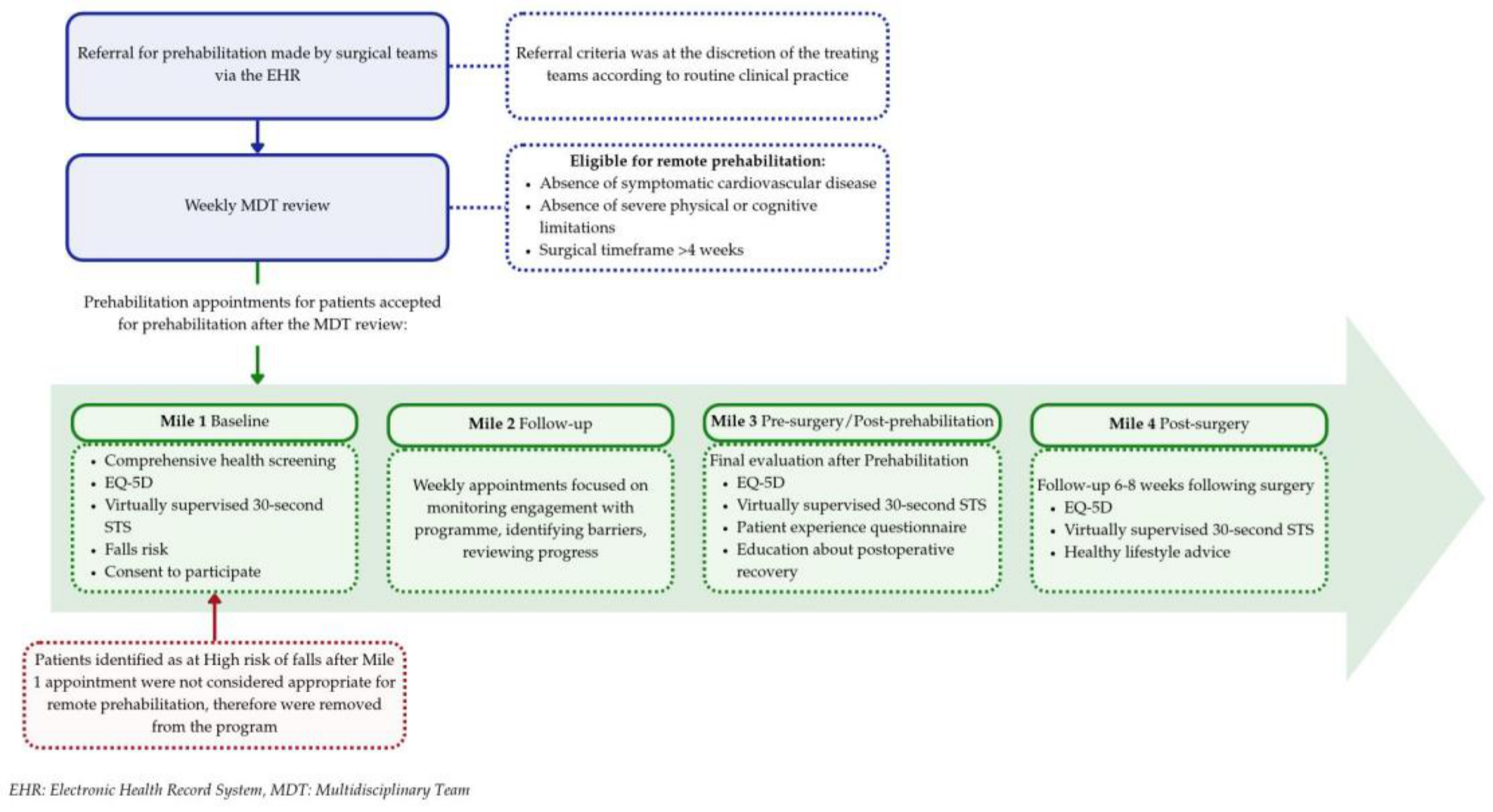
Table 2.
Wearable and remote sensing technologies by physiological domain and their application to perioperative prehabilitation.
Table 2.
Wearable and remote sensing technologies by physiological domain and their application to perioperative prehabilitation.
| Prehabilitation application | Primary metrics | Key technology | Physiological domain |
|---|---|---|---|
| Titration of exercise intensity; tracking of autonomic function and recovery; early identification of cardiac dysfunction | Resting heart rate; heart rate variability; heart rate reserve; arrhythmia detection | Patch ECG or photoplethysmography | Cardiovascular |
| Identification of poorly controlled glycaemia and infection risk; optimisation of metabolic prehabilitation through personalised nutrition and/or pharmacotherapy | Mean glucose; glycaemic variability; time in, below or above range | Interstitial continuous glucose monitors | Glycaemic control |
| Individualised nutrition and caloric dosing | Resting energy expenditure; resting substrate utilisation | Indirect calorimetry or metabolic breath analysers | Energy expenditure and metabolism |
| Detection of sleep apnoea for optimisation; tracking of local oxidative capacity and microvascular reactivity | Average oxygen saturation; time below thresholds; skeletal muscle oxygen tension; microvascular reactivity | Spectrophotometry (NIRS) | Tissue oxygenation and perfusion |
| Dosing and titration of home-based prehabilitation; passive functional phenotyping; early deterioration alerts | Daily step count; active minutes (moderate-to-vigorous physical activity); sedentary bout duration; sleep metrics | Wearable accelerometry | Activity and function |
| Identification of individual circadian temperature rhythms; early detection of anomalies or infection; tracking of core temperature thresholds to prevent overexertion during conditioning | Core body temperature and variability; skin surface temperature; heat loss rate | Surface thermistors or core heat-flux sensors | Thermoregulation |
ECG, electrocardiography; NIRS, near-infrared spectroscopy. Source: authors’ synthesis.
Table 3.
Comparison of the UCLH prehabilitation service and PreActiv.
| PreActiv | UCLH prehabilitation service | Feature |
|---|---|---|
| Browser-based digital platform delivering unsupervised home programmes across several NHS organisations | Hospital-based, clinician-delivered remote service by telephone or video | Model of care |
| Adults in NHS surgical and cancer pathways; feasibility studies in adults aged ≥50 years having major elective surgery | Adults in NHS having major cancer surgery (urology, gynaecological oncology, upper GI); about 70% aged over 60 | Population |
| Clinician referral; eligibility, and programme content set by rule-based logic using diagnosis, treatment, comorbidities, frailty, mobility and exercise capacity | Weekly MDT review against eligibility criteria; geriatrician-led POMED clinic for selected patients; falls risk screening at Mile 1 | Assessment and triage |
| Clinician-authored branching logic adapts exercise selection and progression, updated with ongoing patient feedback | Standardised programme; one-to-one physiotherapy and personalised goals, including step counts, when needed | Personalisation |
| Structured video-guided sessions using household equipment (18 sessions of 35 min, three times a week for six weeks, in the feasibility version) | Aerobic, resistance and respiratory exercise; 3–5 sessions of 30–45 min per week; intensity by Borg RPE; optional live group classes | Exercise |
| Nutrition guidance; psychological wellbeing; smoking cessation and alcohol moderation; sleep optimisation; treatment-specific education | Standardised nutrition advice with dietitian referral; medical optimisation by team doctors; psychological support by referral | Other components |
| WCAG 2.2 AA accessibility; assisted telephone onboarding; helpdesk; device loans; carer involvement; age-appropriate exercise videos | Telephone appointments; one-to-one sessions; baseline digital literacy check; face-to-face POMED clinic | Support for older adults |
| Platform-recorded engagement; repeated in-programme fitness tests | Weekly follow-up calls based on patient report; STS and EQ-5D at each Mile; wearables used by some patients | Monitoring |
| Scales without a proportional increase in workforce; clinical responsibility remains with the referring team | Depends on specialist clinician time | Workforce and scale |
| MHRA-registered Class I medical device; DCB0129 clinical safety case | NHS Trust clinical service | Governance |
| Attrition between referral and onboarding; lower adherence to some exercises in painful osteoarthritis | Late referral; awareness among referring teams; no systematic monitoring; treatment-related symptoms | Main barriers |
Sources: UCLH service data; [95,96]. EQ-5D, EuroQol 5-dimension; GI, gastrointestinal; MDT, multidisciplinary team; MHRA, Medicines and Healthcare products Regulatory Agency; NHS, National Health Service; POMED, perioperative medicine clinic; RPE, Rating of Perceived Exertion; STS, 30 s sit-to-stand test; UCLH, University College London Hospitals; WCAG, Web Content Accessibility Guidelines.
Disclaimer/Publisher’s Note: The statements, opinions and data contained in all publications are solely those of the individual author(s) and contributor(s) and not of MDPI and/or the editor(s). MDPI and/or the editor(s) disclaim responsibility for any injury to people or property resulting from any ideas, methods, instructions or products referred to in the content. |
© 2026 by the authors. Licensee MDPI, Basel, Switzerland. This article is an open access article distributed under the terms and conditions of the Creative Commons Attribution (CC BY) license (http://creativecommons.org/licenses/by/4.0/).
Copyright: This open access article is published under a Creative Commons CC BY 4.0 license, which permit the free download, distribution, and reuse, provided that the author and preprint are cited in any reuse.