

Submitted:
03 November 2026
Posted:
05 November 2026
You are already at the latest version
Abstract
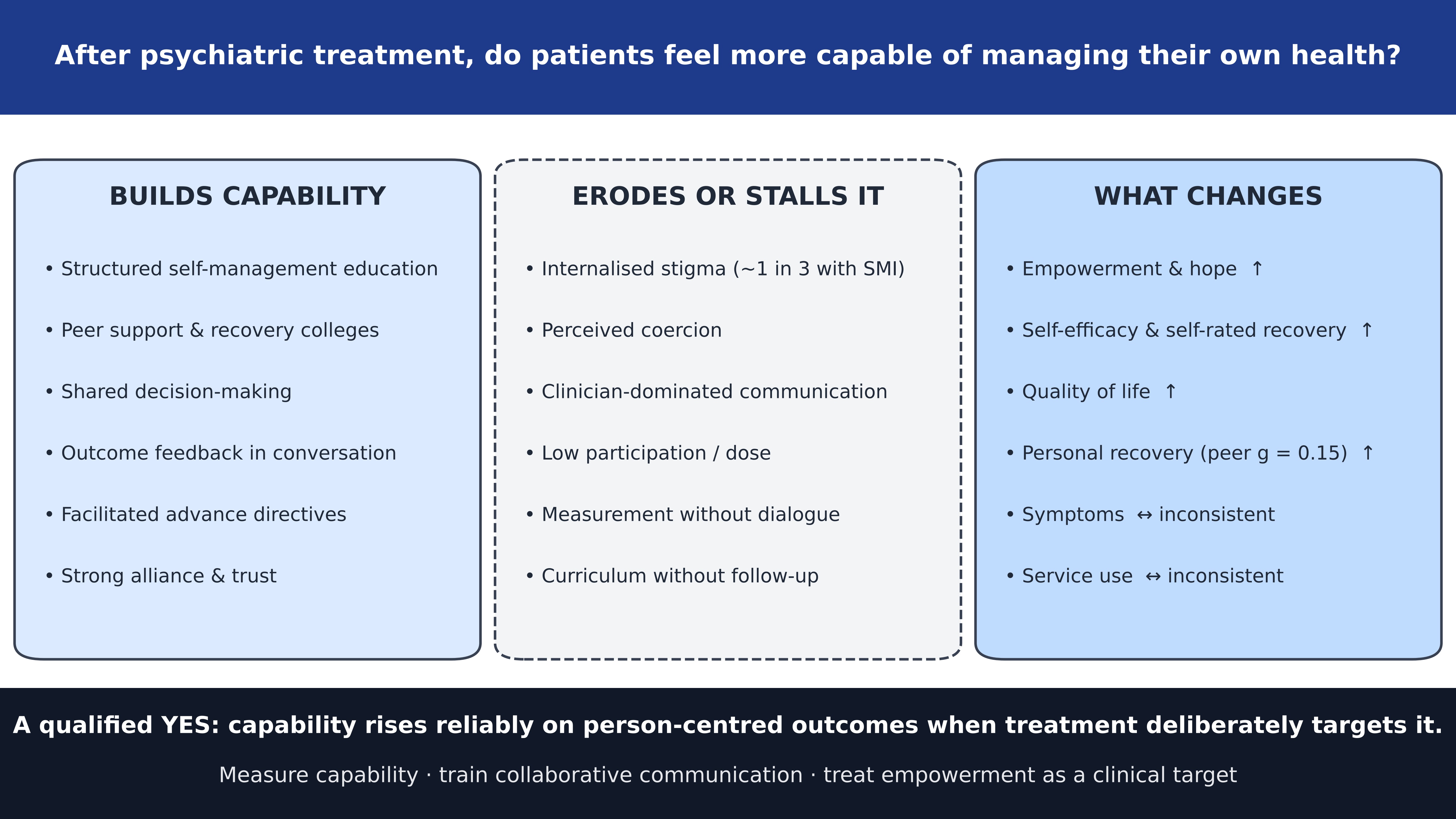
Psychiatric treatment is conventionally judged by symptom reduction and service use, yet recovery-oriented policy asks a different question: does treatment leave people more capable of managing their own health? This narrative review synthesises evidence on patient activation, empowerment, self-efficacy, illness self-management and personal recovery to determine whether, and under what conditions, people report greater capability after mental health care. Capability proved measurable, mutable and clinically meaningful: activation predicts self-management, medication adherence, quality of life and readmission, and is largely independent of sociodemographic characteristics. Self-management interventions in severe mental illness improve hope, empowerment, self-efficacy and self-rated recovery. Peer support yields small but consistent gains in empowerment and personal recovery (g = 0.15) without reliable effects on symptoms or service use; recovery colleges improve self-confidence and self-understanding but lack randomised evidence; and Illness Management and Recovery shows inconsistent effects that track participation. Shared decision-making, conversational feedback of patient-reported outcomes and facilitated psychiatric advance directives strengthen autonomy, the last roughly halving the likelihood of coercive crisis intervention. Internalised stigma, perceived coercion and clinician-dominated communication erode capability. The answer to the review question is a qualified yes: capability gains are reliable on person-centred outcomes when treatment deliberately targets them, but they are not an automatic by-product of symptom-focused care. Community mental health services should measure capability directly, train clinicians in collaborative communication and treat empowerment as an explicit clinical target.
Keywords:
patient activation
; empowerment
; self-management
; shared decision-making
; personal recovery
; severe mental illness
Introduction
Psychiatry has long judged its treatments by what happens to symptoms. Remission, relapse, readmission and functioning dominate trial endpoints and service metrics. A different question has become increasingly insistent in policy, service design and the accounts of people who use mental health services: after treatment, does the person feel more able to manage their own health? The question is not sentimental. It maps onto measurable constructs, it is empirically tractable, and it predicts outcomes that matter to patients and health systems alike.
The question has a clear intellectual pedigree. The Chronic Care Model holds that improvement in long-term illness depends on productive interactions between informed, activated patients and prepared, proactive practice teams, with self-management support as one of six interdependent system components (Bodenheimer et al., 2002; McCorkle et al., 2011). Systematic review confirms that these components can deliver self-management support that prioritises patients' confidence and skills so that patients become the ultimate managers of their own illnesses (Yeoh et al., 2018).
Psychiatry arrived at this framework later than other specialties, and not for administrative reasons alone. Mental health care includes decisions taken in a person's best interest that override stated preferences; capacity and motivation to participate fluctuate; and negative symptoms are associated with less involvement in decision-making (McCabe, 2017). The specialty also differs in its forms of coercion and in questions of insight and disempowerment (Morant et al., 2016), and its historical emphasis on compliance was rooted in medical paternalism at odds with person-centred, evidence-based care (Deegan & Drake, 2006). Asking whether patients feel more capable after treatment is therefore also asking whether the discipline has moved from compliance to collaboration.
This review addresses that question directly. It clarifies the relevant constructs, examines how they are measured, synthesises evidence on whether treatment changes them, identifies the mechanisms and moderators that determine when it does, and draws implications for community mental health practice and research.
Methods
A narrative design was chosen because the question spans distinct literatures (patient activation, empowerment, self-efficacy, illness self-management, shared decision-making, recovery-oriented practice, peer support, outcome measurement, advance planning and therapeutic alliance) whose endpoints and instruments are not commensurable enough for meaningful pooled estimation, and because the purpose was conceptual synthesis as much as effect estimation. Reporting follows the Scale for the Assessment of Narrative Review Articles (SANRA; Baethge et al., 2019).
Bibliographic databases indexing journals, conference proceedings and preprints were searched with combinations of terms for patient activation, empowerment, self-efficacy, illness self-management, shared decision-making, psychiatric medication management, recovery colleges, peer support, psychiatric advance directives, patient-reported outcome measures and therapeutic alliance. Searches were supplemented by retrieval of foundational measurement papers and of trials identified within retrieved reviews. Studies were eligible if they concerned people receiving mental health care, measured at least one capability-related construct (activation, empowerment, self-efficacy, illness self-management or personal recovery), and reported associations with that construct or the effect of an intervention on it. Systematic reviews, meta-analyses, randomised controlled trials (RCTs) and large observational studies were prioritised. Evidence from low- and middle-income and collectivist settings was deliberately sought, because most primary evidence originates in high-income, individualist settings (Slade et al., 2014).
Findings were charted by construct, instrument, population, design, intervention and direction of effect, and are reported narratively. No formal risk-of-bias assessment or meta-analysis was undertaken, and conclusions should be read as an interpretive synthesis rather than a pooled estimate. A generative artificial intelligence tool (Claude, Anthropic) assisted with condensing, language editing and reference formatting of the author-written draft and with rendering the figures; the author verified all content against the cited sources and takes full responsibility for the manuscript. A generative AI tool (Claude, Anthropic) assisted with condensing, language editing and reference formatting of the draft and with rendering the figures; all content, citations and figures were checked against the source literature for accuracy.
The Conceptual Terrain: Five Constructs and One Question
Patient Activation
Patient activation is an individual's knowledge, skills and confidence for managing their health and healthcare (Rademakers et al., 2016). It was operationalised through expert consensus, patient focus groups and Rasch modelling in a national probability sample, producing a unidimensional, Guttman-like scale that reflects a developmental model of activation (Hibbard et al., 2004). Four levels describe a progression from not yet understanding that the patient's role is important (level 1), through lacking the confidence and knowledge to act (level 2) and beginning to engage in recommended behaviours (level 3), to proactive self-management (level 4) (Miller et al., 2020). The clinical implication is that no single intervention fits all levels. Activation is also broader than locus of control, self-efficacy or readiness to change, which typically concern one behaviour, and it is associated with a wider range of outcomes (Greene et al., 2015).
Empowerment
Empowerment in mental health was formalised by service users themselves. A 28-item consumer-constructed scale tested in 271 members of self-help programmes yielded five factors: self-efficacy–self-esteem, power–powerlessness, community activism, righteous anger, and optimism–control over the future (Rogers et al., 1997). Empowerment was related to quality of life and income but not to age, gender, ethnicity, education or employment, and it was inversely related to use of traditional mental health services (Rogers et al., 1997). That last finding is instructive: empowerment is not the same as engagement, and services should not assume that the two rise together. Empowerment is also the obverse of self-stigma; some people internalise stigmatising messages and lose self-esteem and self-efficacy, whereas others are energised by them and take a more active role in treatment (Corrigan et al., 2009).
Self-Management and Self-Efficacy
Self-management is the behavioural repertoire of monitoring symptoms, recognising early warning signs, managing medication, sleep and activity, and navigating services. Self-efficacy, the belief that one can execute the behaviour required to produce an outcome, governs whether coping is initiated, how much effort is expended and how long it is sustained in the face of obstacles (Bandura, 1977), and it predicts disease-management behaviour in chronic illness (Clark & Dodge, 1999). Activation and self-management overlap but differ: self-management builds confidence in managing illness, whereas activation also captures communicative behaviours such as asking questions in clinical encounters (Alegría et al., 2014).
Personal Recovery
Personal recovery reframes the outcome. A systematic review of 97 conceptualisations of recovery identified five recovery processes, namely connectedness, hope and optimism, identity, meaning in life and empowerment (CHIME; Leamy et al., 2011), a framework since applied widely (Stuart et al., 2017). Empowerment in CHIME explicitly includes a sense of control over one's treatment (Gabrielsson et al., 2024); it describes a person's position in the clinical relationship as well as an inner state.
Measuring Whether Patients Feel More Capable
The Patient Activation Measure (PAM) exists in 22- and 13-item forms; the short form retains precision and is reliable and valid (Hibbard et al., 2005), with validated Dutch, Danish and pan-European versions that permit cross-national comparison (Maindal et al., 2009; Rademakers et al., 2012, 2016). A mental-health version (PAM-MH) was developed for people with serious mental illness (Green et al., 2010). In one small sample (n = 136), PAM-MH scores were highest in bipolar disorder, intermediate in schizophrenia and lowest in major depressive disorder, and were inversely correlated with healthcare costs (Forma et al., 2021), illustrating that activation is not uniform across diagnoses.
The Empowerment Scale remains dominant, but its factor structure is unstable. Confirmatory analyses in Swedish primary care and psychiatric samples found that no previously proposed solution fitted adequately (Nissling et al., 2025), whereas a French validation supported a four-factor, 18-item model (Desvignes et al., 2025). Two studies using "the Empowerment Scale" may therefore not measure the same latent structure. Population-specific instruments exist, such as the Youth Empowerment Scale–Mental Health (Walker et al., 2010). Personal recovery measures are numerous but psychometrically uneven, and clinicians struggle to use them routinely (Felix et al., 2024).
Whether measurement itself changes capability is a separate question. Cochrane reviews found insufficient evidence that routine outcome monitoring with patient-reported outcome measures (PROMs) improves outcomes in common mental disorders (Kendrick et al., 2016), although feedback probably yields small to moderate improvements in clinician–patient communication and small improvements in quality of life (Sidey-Gibbons et al., 2021). Effects are more consistent when feedback is formalised and structured (Krägeloh et al., 2015) and when scores are discussed collaboratively within SDM rather than simply reported to patients (Barkham et al., 2023). Measuring capability does not by itself increase it; the effect depends on what is done with the measurement.
Does Treatment Change How Capable Patients Feel?
Observational Evidence
The most consistent evidence is associational. In adults with chronic conditions, the most activated patients were far more likely to perform self-management behaviours and report high medication adherence, and were ten times more likely to report high satisfaction (Mosen et al., 2007). In mental health populations, greater activation was associated with higher personal recovery, better perceived quality of care, better physical and mental health, fewer symptoms, better self-care, greater medication adherence and better quality of life (Green et al., 2010). Critically, sociodemographic characteristics were generally unrelated to activation, indicating that modifiable factors matter more than fixed traits (Green et al., 2010): capability is not demographic destiny. Less activated patients are almost twice as likely to be readmitted within 30 days of discharge (Greene et al., 2015). In psychiatric visits, however, self-reported activation was related to illness self-management but only weakly to observed in-visit behaviour (Salyers et al., 2009), so clinicians cannot infer one from the other. An integrative review of 29 studies concluded that interventions, most notably educational programmes, can increase activation in people with mental health disorders (Keen et al., 2021).
Is Activation Mutable?
Hibbard et al. (2007) used the Chronic Disease Self-Management Program to show that activation is changeable and that its change predicts subsequent change in self-management behaviour. In serious mental illness, an 80-participant RCT of a peer-led adaptation of that programme found significantly greater improvement in activation at six months than usual care (Druss et al., 2010). Individual change scores are more sensitive to such change than shifts in activation level or group means (Struwe et al., 2020).
Self-Management and Recovery-Oriented Interventions
The most directly relevant synthesis, a meta-analysis of self-management interventions in severe mental illness (SMI), found significant effects over control on hope and empowerment at follow-up and on self-rated recovery and self-efficacy at both post-treatment and follow-up, with less consistent effects on symptoms and service use; the authors recommended that such interventions form part of standard care (Lean et al., 2019). A meta-analysis of seven studies (1,739 participants) likewise found greater gains in person-oriented recovery with recovery-oriented treatment than with usual or other care, sustained at least in the short term (Thomas et al., 2018). This is the clearest affirmative answer to the review question, and a carefully bounded one: the reliable effects were on subjective, person-centred outcomes.
Illness Management and Recovery
Illness Management and Recovery (IMR), a curriculum for setting recovery goals and acquiring illness-management skills, is the most rigorously tested structured self-management programme in psychiatry, and its results are mixed. A Swedish RCT (n = 41) found greater improvement in self- and clinician-rated illness management, symptoms and psychosocial functioning than treatment as usual at 21 months (Färdig et al., 2011). An RCT against an active problem-solving control (n = 118) found improvement over time in both arms with no between-group differences, and participation was low in both (Salyers et al., 2014). A methodologically rigorous Danish trial (n = 198) found no differences in functioning, symptoms, admissions or personal recovery at one-year follow-up (Dalum et al., 2018; Jensen et al., 2019). The plausible reading is not that self-management education is ineffective, but that its effects depend on the dose actually received; capability is not built by curriculum alone.
Peer Support and Consumer-Operated Services
Peer support shows the most consistent, if modest, effects on capability. A meta-analysis of one-to-one peer support (19 trials, 3,329 participants) found a modest positive impact on self-reported recovery and empowerment and no impact on symptoms or service use (White et al., 2020). An earlier meta-analysis (18 trials, 5,597 participants) found little evidence of effects on hospitalisation or symptoms but some evidence of benefit for hope, recovery and empowerment (Lloyd-Evans et al., 2014). A later meta-analysis reported small post-test effects for clinical recovery (g = 0.19, 95% CI 0.11–0.27) and personal recovery (g = 0.15, 95% CI 0.04–0.27) but not functional recovery (g = 0.08, 95% CI −0.02 to 0.18) (Smit et al., 2023), and an umbrella review confirmed more consistent effects on recovery than on clinical outcomes (Cooper et al., 2024). In a multisite RCT, consumer-operated services increased perceived personal empowerment, although pooled effects were very modest and varied with programme intensity (Rogers et al., 2007). The pattern across syntheses deserves plain statement: peer support changes how capable people feel and how they rate their recovery, without reliably changing symptoms or service use. Capability is a dissociable, independently measurable target.
Recovery Colleges
Recovery colleges are the clearest institutional expression of the proposition that capability can be taught. Their defining features are an educational rather than therapeutic base, a curriculum students tailor to their own circumstances, and co-production with people with lived experience; they now operate in more than 20 countries (Whitley et al., 2019). Attendance is consistently perceived as helping people progress towards recovery goals, with some evidence of reduced service use and of reduced power differences between professionals and patients (Meddings et al., 2015). A co-produced change model identified three mechanisms (an empowering environment, enabling relationships and facilitation of personal growth) and outcomes including greater self-understanding and self-confidence (Toney et al., 2018), with effects extending to staff and services (Crowther et al., 2019). The absence of RCTs is the central limitation, acknowledged by the field itself (Whitley et al., 2019).
Structured Outcome Feedback: DIALOG+
The value of measurement for capability lies in structured, conversation-based feedback. In DIALOG+, patients rate satisfaction with eight life domains and three treatment aspects on a tablet, and clinicians then use a four-step solution-focused approach to agree actions (Omer et al., 2016). In a cluster-randomised trial (49 clinicians, 179 patients), DIALOG+ improved subjective quality of life at 3, 6 and 12 months (Cohen's d = 0.29–0.34), reduced unmet needs and general psychopathology, and lowered overall care costs, despite averaging fewer than two sessions per quarter (Priebe et al., 2015). Notably, it did not improve self-efficacy or treatment satisfaction, suggesting that the quality-of-life effect was not a generalised positive appraisal (Priebe et al., 2017). A trial in Southeast European low- and middle-income settings replicated a small quality-of-life benefit (Jovanović et al., 2022). Capability, quality of life and symptom burden respond to different interventions; treating them as interchangeable misreads the evidence.
Digital Self-Management
Technology-enabled self-management is feasible and acceptable but has limited durability. In bipolar disorder, a mobile intervention linking self-reported mood to personalised strategies reduced depressive symptoms more than paper monitoring (d = 0.48; Depp et al., 2015), whereas trials of web-based self-monitoring were inconsistent (Faurholt-Jepsen et al., 2016) and gains may fade once support stops (Miziou et al., 2015). Group psychoeducation matched individual cognitive behavioural therapy on symptom burden and relapse (Parikh et al., 2012), and facilitated psychoeducation increased illness knowledge, which in turn predicted more weeks well (Bilderbeck et al., 2016). Knowledge and self-management behaviour improve more readily than symptoms, and gains decay without support.
Psychiatric Advance Directives
Psychiatric advance directives (PADs) record a person's treatment preferences, often with a proxy, for periods of lost capacity; they are available in several jurisdictions, including India (Swartz & Swanson, 2026), and were advocated to increase autonomy and reduce coercion (Swanson et al., 2000). PADs instantiate capability directly: people who complete them endorse self-determination, autonomy and empowerment, and the process improves therapeutic relationships (Zelle et al., 2015). Facilitation increases completion almost 30-fold, and people with facilitated PADs were about half as likely to require coercive intervention during crises over 24 months (Zelle et al., 2015). Although 66–77% of outpatients express interest, completion remains low, and a Cochrane review found no strong evidence for effects on admissions, compliance or self-harm (Swartz & Swanson, 2026). Barriers are largely operational (completion support, retrieval infrastructure, clinician knowledge and proxy training) and therefore fixable.
The Counterforce: Perceived Coercion
Coercion acts precisely on the sense of control that empowerment comprises. Among 778 involuntary inpatients in England, satisfaction was associated with perceived coercion rather than with coercive measures documented in records (Katsakou et al., 2010). Even voluntary patients feel coerced; inclusion in decisions and feeling respected reduce perceived coercion, which declines as satisfaction with treatment rises (Katsakou et al., 2011). The "coercive shadow", in which people accept treatment for fear that refusal will bring compulsion, can damage the therapeutic relationship, engagement and adherence (Silva et al., 2023), and greater perceived coercion has been linked to post-traumatic stress (Herrera-Imbroda et al., 2025). A treatment episode can therefore reduce symptoms and simultaneously reduce capability if it is experienced as done to the patient rather than with them.
Mechanisms: What Turns Treatment into Capability
Reversing Self-Stigma
Internalised stigma is the principal inhibitor. About a third of people with SMI experience high internalised stigma, which is associated with low self-esteem, empowerment, hope, adherence and quality of life (Mashiach-Eizenberg et al., 2013). In the "why try" model, stigma erodes self-esteem and self-efficacy and so deters pursuit of life goals (Corrigan et al., 2009); path analysis shows that its effects on avoidant coping, social avoidance and depression are mediated by hope and self-esteem (Yanos et al., 2008). Eroded empowerment explains much of the depression and reduced quality of life seen in schizophrenia, and helping people reduce internalised stigma is as important as helping them gain insight (Warner, 2010). Interventions that reduce self-stigma are, in effect, interventions that build capability.
The Therapeutic Alliance
The alliance is a robust but modest predictor of outcome and the relational substrate of capability. A synthesis of 295 studies with more than 30,000 patients found an alliance–outcome correlation of r = 0.278 (d = 0.58), consistent across perspectives, measures, treatments and countries (Flückiger et al., 2018; see also Martin et al., 2000), corresponding to roughly 7.5% of outcome variance (Cuijpers et al., 2019). An umbrella review of 1,981 effect sizes found larger process–outcome associations for therapist (r = 0.291) and relational (r = 0.267) processes than for technical processes (r = 0.102) (Penedo & Flückiger, 2026). Patient-rated alliance is related to adherence, satisfaction, quality of life and self-efficacy for health behaviour change, and therapist warmth, confidence and flexibility foster strong alliances (Arnow & Steidtmann, 2014). The clinician behaviours that build capability are relational rather than technical.
Communication Behaviour
If clinician style explains most variance in involvement, communication is a mechanism of capability rather than etiquette. Question design matters: "Any questions?" discourages further discussion, whereas "What questions do you have?" invites it, and "No problems with the medication?" makes it hard for patients to raise concerns (McCabe, 2017). Eliciting the patient's experience and reaching a shared understanding of concerns is the starting point for identifying which decisions need to be made, and training clinicians in these subtleties improves communication and the therapeutic relationship (McCabe, 2017).
Trust and Information
In 310 Taiwanese adults with SMI, self-efficacy and trust directly predicted subjective quality of life, empowerment acted indirectly through self-efficacy, and trust, empowerment and information about care choices predicted satisfaction with services (Wu et al., 2021). The authors cautioned that recovery-promoting models in Asian contexts must account for traditional deference to authority figures, a reminder that mechanisms may not operate identically across cultures. At system level, the same logic underpins patient-centred delivery: people ask for better communication and information, help with self-care and inclusion of patients and carers in decisions (Dineen-Griffin et al., 2019; Mirzaei et al., 2013).
Moderators: For Whom and Where
Diagnosis and Severity
Activation differs across diagnoses (Forma et al., 2021), and PAM-MH was validated in serious rather than common mental disorders (Green et al., 2010). Peer support and recovery college evidence derives predominantly from SMI populations (Lloyd-Evans et al., 2014; Whitley et al., 2019). The evidence for common mental disorders is thinner, and this asymmetry should temper generalisation.
Culture and the Individualist Assumption
Recovery concepts may be monocultural; collectivist cultures emphasise interdependence among family members over the independence promoted in Western models, and many low- and middle-income countries lack the community infrastructure that recovery approaches presuppose (Slade et al., 2014). In India, critics argue that professionals must choose between importing a Euro-American recovery model and reconfiguring it for the majority population (Bayetti et al., 2016), and participatory work has co-produced a pictorial recovery tool grounded in local concepts (Mathias et al., 2020). A phenomenological study from southern India found that many professionals still prioritise clinical recovery, within a context of collectivist values, diverse socioeconomic conditions, low literacy and stigma (Hegde et al., 2025). Recovery orientation is nonetheless embedded in national policy in India and elsewhere, with social inclusion as an explicit rationale, because facility-based care alone cannot meet needs such as poverty and isolation (Henderson et al., 2026).
Health Literacy, Equity and Participation
Capability is largely, but not wholly, independent of demography: activation was unrelated to sociodemographic factors (Green et al., 2010), and empowerment was unrelated to age, gender, ethnicity or education but was related to income (Rogers et al., 1997). Involvement may be particularly important for minority patients, who may hold role expectations against participation and leave treatment when services do not meet their needs (Alegría et al., 2014). The most consistent moderator, however, is participation itself. The negative IMR trials had low participation and retention (Dalum et al., 2018; Salyers et al., 2014), whereas DIALOG+ produced benefit at low dose, prompting the suggestion that it be used once or twice, rested once solutions are identified, and revisited when circumstances change (Priebe et al., 2015, 2017).
An Integrated Model
The evidence supports a model in which capability is an outcome of treatment only when treatment is deliberately designed to produce it (Fig. 1). Service context, including recovery orientation, community resources and policy, shapes the clinical encounter. Within the encounter, clinician communication style drives SDM, information exchange, alliance and trust. These relational processes, together with structured self-management education, peer and co-produced support, conversational outcome feedback and advance planning, build activation: knowledge, skills and confidence. Activation feeds two pathways: illness self-management behaviour (adherence, self-care and service navigation) and person-centred outcomes (empowerment, hope, self-efficacy and self-rated recovery), which in turn lead to quality of life, social outcomes and, more variably, clinical and service outcomes. Internalised stigma and perceived coercion act as inhibitors throughout.
Read against the review question, the model makes four claims. First, capability is a legitimate, measurable outcome distinct from symptoms and service use. Second, it is produced by identifiable practices rather than by treatment in general. Third, it is actively inhibited by internalised stigma and perceived coercion, both amenable to service-level change. Fourth, its most reliable downstream correlates are person-centred outcomes, with effects on symptoms and service use less consistent and probably mediated through adherence and self-care. Table 1 summarises the direction of evidence by intervention class, Fig. 2 maps evidence strength across outcome domains, and Table 2 summarises the principal measurement instruments.
Implications for Practice and Service Design
Measure capability directly. Activation and empowerment are measurable with brief validated instruments, and the PAM identifies a person's stage of activation to guide economical, targeted support (Hibbard et al., 2007); a person at level 1 needs a different conversation from a person at level 4 (Miller et al., 2020).
Feed measurement back in conversation. Scores should be discussed collaboratively within SDM rather than reported (Barkham et al., 2023), using structured, solution-focused formats such as DIALOG+ that improve quality of life and reduce costs (Priebe et al., 2015).
Train clinicians in collaborative communication. Because clinician style explains most variance in involvement, independent of consultation length (McCabe, 2017; McCabe et al., 2013), and relational processes outweigh technical ones (Penedo & Flückiger, 2026), communication training is an outcome intervention rather than a courtesy.
Take medication management out of the compliance frame. Medication decisions require partnership between two experts (Deegan & Drake, 2006); clinicians should not assume that because they consult, they share (Matthias et al., 2012).
Invest in peer-delivered and co-produced provision. Peer support and recovery colleges yield consistent gains in empowerment and self-rated recovery (Smit et al., 2023; Toney et al., 2018; White et al., 2020), and improving activation can be included in the role of peer workers (Shalaby & Agyapong, 2020).
Support advance planning and remove its barriers. Facilitated PADs halve the likelihood of coercive crisis intervention (Zelle et al., 2015), and their barriers are operational (Swartz & Swanson, 2026).
Reduce perceived, not only documented, coercion, and treat self-stigma as a clinical target. Inclusion in decisions and respectful care reduce perceived coercion (Katsakou et al., 2010, 2011), and reducing internalised stigma is as important as building insight (Warner, 2010).
Adapt rather than import. In collectivist and resource-constrained settings, including India, services should build on local concepts of recovery, families and community resources (Bayetti et al., 2016; Hegde et al., 2025; Mathias et al., 2020).
Research Agenda
Six gaps follow from this synthesis. First, trials with capability as the primary outcome are scarce; recovery colleges, the intervention most explicitly designed to build capability, lack RCTs (Whitley et al., 2019), and implementation research on self-management in routine care is needed (Lean et al., 2019). Second, the dissociation between self-reported and observed activation (Salyers et al., 2009) requires explanation. Third, measurement invariance of empowerment instruments across cultures is unresolved (Desvignes et al., 2025; Nissling et al., 2025), making validation in South Asian and other collectivist settings a priority. Fourth, the inverse relationship between empowerment and use of traditional services (Rogers et al., 1997) deserves explicit study. Fifth, implementation research is needed on coercion reduction, PAD infrastructure and proxy training (Swartz & Swanson, 2026). Sixth, the role of families and carers in three-way decision-making remains under-specified (McCabe, 2017).
Strengths and Limitations
This review integrates literatures usually examined separately and answers a specific question rather than surveying a field. It deliberately includes dissenting positions and null findings, including critiques of SDM (Priebe, 2017), negative IMR trials (Jensen et al., 2019; Salyers et al., 2014), the absence of peer-support effects on symptoms (White et al., 2020) and the null self-efficacy finding for DIALOG+ (Priebe et al., 2017), and it incorporates non-Western perspectives (Bayetti et al., 2016; Slade et al., 2014). Limitations are substantial. As a narrative review without a registered protocol, formal risk-of-bias assessment or meta-analysis, source selection involved judgement. Much underlying evidence is at high risk of bias (Lloyd-Evans et al., 2014; Sidey-Gibbons et al., 2021). Several key findings rest on small samples (Depp et al., 2015; Färdig et al., 2011; Forma et al., 2021) and require replication. The association between activation and outcomes is predominantly cross-sectional (Greene et al., 2015), so activation may mark other advantages as much as cause better outcomes.
Conclusions
Do patients feel more capable of managing their own health after psychiatric treatment? On the evidence reviewed, the answer is a qualified yes: conditionally, and more clearly for how people appraise themselves and their lives than for what happens to their symptoms. Self-management interventions, recovery-oriented treatment, peer support, recovery colleges, SDM and facilitated advance directives reliably improve empowerment, hope, self-efficacy and self-rated recovery. Yet capability is not an automatic by-product of clinical care. It is suppressed by internalised stigma and perceived coercion, it is not produced by curriculum or measurement alone, and it does not simply track symptom change. Services that want people to leave treatment more able to manage their health must measure, target and train for that outcome through collaborative communication, adequately dosed self-management support, peer and co-produced provision, conversational outcome feedback and advance planning. Capability is not something psychiatry gives to patients; it is something psychiatry can make room for or obstruct, and when services deliberately make room for it, patients notice.
References
- Alegría, M., N. Carson, M. Flores, X. Li, P. Shi, A. S. Lessios, A. Polo, M. Allen, M. Fierro, A. Interian, A. Jimenez, M. La Roche, C. Lee, R. Lewis-Fernández, G. Livas-Stein, L. Safar, C. Schuman, J. Storey, and P. E. Shrout. 2014. Activation, self-management, engagement, and retention in behavioral health care: A randomized clinical trial of the DECIDE intervention. JAMA Psychiatry 71, 5: 557–565. [Google Scholar] [CrossRef] [PubMed]
- Arnow, B. A., and D. Steidtmann. 2014. Harnessing the potential of the therapeutic alliance. World Psychiatry 13, 3: 238–240. [Google Scholar] [CrossRef] [PubMed]
- Baethge, C., S. Goldbeck-Wood, and S. Mertens. 2019. SANRA—a scale for the quality assessment of narrative review articles. Research Integrity and Peer Review 4, 5. [Google Scholar] [CrossRef] [PubMed]
- Bandura, A. 1977. Self-efficacy: Toward a unifying theory of behavioral change. Psychological Review 84, 2: 191–215. [Google Scholar] [CrossRef] [PubMed]
- Barkham, M., K. De Jong, J. Delgadillo, and W. Lutz. 2023. Routine outcome monitoring (ROM) and feedback: Research review and recommendations. Psychotherapy Research 33, 7: 841–855. [Google Scholar] [CrossRef] [PubMed]
- Bayetti, C., S. Jadhav, and S. Jain. 2016. The re-covering self: A critique of the recovery-based approach in India's mental health care. Disability and the Global South 3, 1: 889–909. Available online: https://www.research.ed.ac.uk/en/publications/91a3257f-2104-4399-8f2c-45984ee61dab.
- Bilderbeck, A. C., L. Z. Atkinson, H. C. McMahon, M. Voysey, J. Simon, J. Price, J. Rendell, C. Hinds, J. R. Geddes, E. Holmes, D. J. Miklowitz, and G. M. Goodwin. 2016. Psychoeducation and online mood tracking for patients with bipolar disorder: A randomised controlled trial. Journal of Affective Disorders 205, 245–251. [Google Scholar] [CrossRef] [PubMed]
- Bodenheimer, T., E. H. Wagner, and K. Grumbach. 2002. Improving primary care for patients with chronic illness. JAMA 288, 14: 1775–1779. [Google Scholar] [CrossRef] [PubMed]
- Clark, N. M., and J. A. Dodge. 1999. Exploring self-efficacy as a predictor of disease management. Health Education & Behavior 26, 1: 72–89. [Google Scholar] [CrossRef] [PubMed]
- Cooper, R. E., K. R. K. Saunders, A. Greenburgh, P. Shah, R. Appleton, K. Machin, T. Jeynes, P. Barnett, S. M. Allan, J. Griffiths, R. Stuart, L. Mitchell, B. Chipp, S. Jeffreys, B. Lloyd-Evans, A. Simpson, and S. Johnson. 2024. The effectiveness, implementation, and experiences of peer support approaches for mental health: A systematic umbrella review. BMC Medicine 22, 1: 72. [Google Scholar] [CrossRef] [PubMed]
- Corrigan, P. W., J. E. Larson, and N. Rüsch. 2009. Self-stigma and the "why try" effect: Impact on life goals and evidence-based practices. World Psychiatry 8, 2: 75–81. [Google Scholar] [CrossRef]
- Crowther, A., A. Taylor, R. Toney, S. Meddings, T. Whale, H. Jennings, K. Pollock, P. Bates, C. Henderson, J. Waring, and M. Slade. 2019. The impact of Recovery Colleges on mental health staff, services and society. Epidemiology and Psychiatric Sciences 28, 5: 481–488. [Google Scholar] [CrossRef] [PubMed]
- Cuijpers, P., M. Reijnders, and M. J. H. Huibers. 2019. The role of common factors in psychotherapy outcomes. Annual Review of Clinical Psychology 15, 207–231. [Google Scholar] [CrossRef] [PubMed]
- Dalum, H. S., A. K. Waldemar, L. Korsbek, C. Hjorthøj, J. H. Mikkelsen, K. Thomsen, K. Kistrup, M. Olander, J. Lindschou, M. Nordentoft, and L. F. Eplov. 2018. Illness management and recovery: Clinical outcomes of a randomized clinical trial in community mental health centers. PLoS ONE 13, 4: e0194027. [Google Scholar] [CrossRef] [PubMed]
- Deegan, P. E., and R. E. Drake. 2006. Shared decision making and medication management in the recovery process. Psychiatric Services 57, 11: 1636–1639. [Google Scholar] [CrossRef]
- Depp, C. A., J. Ceglowski, V. C. Wang, F. Yaghouti, B. T. Mausbach, W. K. Thompson, and E. L. Granholm. 2015. Augmenting psychoeducation with a mobile intervention for bipolar disorder: A randomized controlled trial. Journal of Affective Disorders 174, 23–30. [Google Scholar] [CrossRef] [PubMed]
- Desvignes, S., M. Boucekine, S. Loubière, L. Leclerc, P. Auquier, and A. Tinland. 2025. Validation of a French version of the empowerment scale for mental health service users. BMC Psychiatry 25, 1: 207. [Google Scholar] [CrossRef] [PubMed]
- Dineen-Griffin, S., V. Garcia-Cardenas, K. Williams, and S. I. Benrimoj. 2019. Helping patients help themselves: A systematic review of self-management support strategies in primary health care practice. PLoS ONE 14, 8: e0220116. [Google Scholar] [CrossRef] [PubMed]
- Druss, B. G., L. Zhao, S. A. von Esenwein, J. R. Bona, L. Fricks, S. Jenkins-Tucker, E. Sterling, R. DiClemente, and K. Lorig. 2010. The Health and Recovery Peer (HARP) Program: A peer-led intervention to improve medical self-management for persons with serious mental illness. Schizophrenia Research 118, 1–3: 264–270. [Google Scholar] [CrossRef] [PubMed]
- Elwyn, G., M. A. Durand, J. Song, J. Aarts, P. J. Barr, Z. Berger, N. Cochran, D. Frosch, D. Galasiński, P. Gulbrandsen, P. K. J. Han, M. Härter, P. Kinnersley, A. Lloyd, M. Mishra, L. Perestelo-Perez, I. Scholl, K. Tomori, L. Trevena, and T. Van der Weijden. 2017. A three-talk model for shared decision making: Multistage consultation process. BMJ 359, j4891. [Google Scholar] [CrossRef] [PubMed]
- Elwyn, G., D. Frosch, R. Thomson, N. Joseph-Williams, A. Lloyd, P. Kinnersley, E. Cording, D. Tomson, C. Dodd, S. Rollnick, A. Edwards, and M. Barry. 2012. Shared decision making: A model for clinical practice. Journal of General Internal Medicine 27, 10: 1361–1367. [Google Scholar] [CrossRef] [PubMed]
- Färdig, R., T. Lewander, L. Melin, F. Folke, and A. Fredriksson. 2011. A randomized controlled trial of the Illness Management and Recovery program for persons with schizophrenia. Psychiatric Services 62, 6: 606–612. [Google Scholar] [CrossRef] [PubMed]
- Faurholt-Jepsen, M., K. Munkholm, M. Frost, J. E. Bardram, and L. V. Kessing. 2016. Electronic self-monitoring of mood using IT platforms in adult patients with bipolar disorder: A systematic review of the validity and evidence. BMC Psychiatry 16, 7. [Google Scholar] [CrossRef] [PubMed]
- Felix, S., K.-M. Valery, M. Caiada, S. Guionnet, J. Bonilla-Guerrero, J.-M. Destaillats, and A. Prouteau. 2024. Personal recovery self-report outcome measures in serious mental illness: A systematic review of measurement properties. Clinical Psychology Review 112, 102459. [Google Scholar] [CrossRef] [PubMed]
- Flückiger, C., A. C. Del Re, B. E. Wampold, and A. O. Horvath. 2018. The alliance in adult psychotherapy: A meta-analytic synthesis. Psychotherapy 55, 4: 316–340. [Google Scholar] [CrossRef] [PubMed]
- Forma, F., J. Clerie, T. Davis, K. Clovie, and C. Ruetsch. 2021. The association between patient activation and outcomes among severely mentally ill patients. The Journal of Behavioral Health Services & Research 48, 3: 382–399. [Google Scholar] [CrossRef] [PubMed]
- Gabrielsson, S., N. Wolpher, E. Zammata, L. Fagerström, and B.-M. Lindgren. 2024. When the time is right: Men's experiences of recovery in self-harm. International Journal of Mental Health Nursing 33, 4: 1110–1118. [Google Scholar] [CrossRef] [PubMed]
- Goss, C., F. Moretti, M. A. Mazzi, L. Del Piccolo, M. Rimondini, and C. Zimmermann. 2008. Involving patients in decisions during psychiatric consultations. The British Journal of Psychiatry 193, 5: 416–421. [Google Scholar] [CrossRef] [PubMed]
- Green, C. A., N. A. Perrin, M. R. Polen, M. C. Leo, J. H. Hibbard, and M. Tusler. 2010. Development of the Patient Activation Measure for mental health. Administration and Policy in Mental Health and Mental Health Services Research 37, 4: 327–333. [Google Scholar] [CrossRef] [PubMed]
- Greene, J., J. H. Hibbard, R. Sacks, V. Overton, and C. D. Parrotta. 2015. When patient activation levels change, health outcomes and costs change, too. Health Affairs 34, 3: 431–437. [Google Scholar] [CrossRef] [PubMed]
- Happell, B., E. Manias, and C. Roper. 2004. Wanting to be heard: Mental health consumers' experiences of information about medication. International Journal of Mental Health Nursing 13, 4: 242–248. [Google Scholar] [CrossRef] [PubMed]
- Hegde, S., S. Quadros, R. Appaji, and V. Acharya. 2025. 'Life minus illness = recovery': A phenomenological study about experiences and meanings of recovery among individuals with serious mental illness from southern India. Community Mental Health Journal 61, 2: 281–292. [Google Scholar] [CrossRef] [PubMed]
- Henderson, C., Y. Kotera, B. Lloyd-Evans, G. Jordan, M. Gorner, A. Salla, J. Kalha, P. A. Coventry, L. Bojke, S. Hinde, and M. Slade. 2026. Social inclusion of people with severe mental illness: A review of current practices, evidence and unmet needs, and future directions. World Psychiatry 25, 1: 56–82. [Google Scholar] [CrossRef] [PubMed]
- Herrera-Imbroda, J., V. Carbonell-Aranda, Y. García-Illanes, C. Aguilera-Serrano, A. Bordallo-Aragón, E. García-Spínola, D. Torres-Campos, J. M. Villagrán Moreno, J. A. García-Sánchez, F. Mayoral-Cleries, and J. Guzmán-Parra. 2025. An exploratory study about factors and outcomes associated with the experience of coercive measures in mental health settings. Psychiatric Quarterly 96, 1: 133–144. [Google Scholar] [CrossRef] [PubMed]
- Hibbard, J. H., E. R. Mahoney, R. Stock, and M. Tusler. 2007. Do increases in patient activation result in improved self-management behaviors? Health Services Research 42, 4: 1443–1463. [Google Scholar] [CrossRef] [PubMed]
- Hibbard, J. H., E. R. Mahoney, J. Stockard, and M. Tusler. 2005. Development and testing of a short form of the Patient Activation Measure. Health Services Research 40, 6 Pt 1: 1918–1930. [Google Scholar] [CrossRef] [PubMed]
- Hibbard, J. H., J. Stockard, E. R. Mahoney, and M. Tusler. 2004. Development of the Patient Activation Measure (PAM): Conceptualizing and measuring activation in patients and consumers. Health Services Research 39, 4 Pt 1: 1005–1026. [Google Scholar] [CrossRef] [PubMed]
- Jensen, S. B., H. S. Dalum, L. Korsbek, C. Hjorthøj, J. H. Mikkelsen, K. Thomsen, K. Kistrup, M. Olander, J. Lindschou, K. T. Mueser, M. Nordentoft, and L. F. Eplov. 2019. Illness management and recovery: One-year follow-up of a randomized controlled trial in Danish community mental health centers: Long-term effects on clinical and personal recovery. BMC Psychiatry 19, 1: 65. [Google Scholar] [CrossRef] [PubMed]
- Jovanović, N., M. Russo, T. Pemovska, J. J. Francis, A. Arënliu, S. Bajraktarov, A. Džubur Kulenović, L. Injac Stevović, A. Novotni, S. A. Petrović, T. Radojičić, E. Ribić, J. Konjufca, and N. P. Marić. 2022. Improving treatment of patients with psychosis in low-and-middle-income countries in Southeast Europe: Results from a hybrid effectiveness-implementation, pragmatic, cluster-randomized clinical trial (IMPULSE). European Psychiatry 65, 1: e83. [Google Scholar] [CrossRef] [PubMed]
- Katsakou, C., L. Bowers, T. Amos, R. Morriss, D. Rose, T. Wykes, and S. Priebe. 2010. Coercion and treatment satisfaction among involuntary patients. Psychiatric Services 61, 3: 286–292. [Google Scholar] [CrossRef] [PubMed]
- Katsakou, C., S. Marougka, J. Garabette, F. Rost, K. Yeeles, and S. Priebe. 2011. Why do some voluntary patients feel coerced into hospitalisation? A mixed-methods study. Psychiatry Research 187, 1–2: 275–282. [Google Scholar] [CrossRef] [PubMed]
- Keen, A., Y. Lu, U. M. Oruche, O. Mazurenko, and C. B. Draucker. 2021. Activation in persons with mental health disorders: An integrative review. Journal of Psychiatric and Mental Health Nursing 28, 5: 873–899. [Google Scholar] [CrossRef] [PubMed]
- Kendrick, T., M. El-Gohary, B. Stuart, S. Gilbody, R. Churchill, L. Aiken, A. Bhattacharya, A. Gimson, A. L. Brütt, K. de Jong, and M. Moore. 2016. Routine use of patient reported outcome measures (PROMs) for improving treatment of common mental health disorders in adults. Cochrane Database of Systematic Reviews 2016, 7: CD011119. [Google Scholar] [CrossRef] [PubMed]
- Krägeloh, C. U., K. J. Czuba, D. R. Billington, P. Kersten, and R. J. Siegert. 2015. Using feedback from patient-reported outcome measures in mental health services: A scoping study and typology. Psychiatric Services 66, 3: 224–241. [Google Scholar] [CrossRef] [PubMed]
- Leamy, M., V. Bird, C. Le Boutillier, J. Williams, and M. Slade. 2011. Conceptual framework for personal recovery in mental health: Systematic review and narrative synthesis. The British Journal of Psychiatry 199, 6: 445–452. [Google Scholar] [CrossRef] [PubMed]
- Lean, M., M. Fornells-Ambrojo, A. Milton, B. Lloyd-Evans, B. Harrison-Stewart, A. Yesufu-Udechuku, T. Kendall, and S. Johnson. 2019. Self-management interventions for people with severe mental illness: Systematic review and meta-analysis. The British Journal of Psychiatry 214, 5: 260–268. [Google Scholar] [CrossRef] [PubMed]
- Lloyd-Evans, B., E. Mayo-Wilson, B. Harrison, H. Istead, E. Brown, S. Pilling, S. Johnson, and T. Kendall. 2014. A systematic review and meta-analysis of randomised controlled trials of peer support for people with severe mental illness. BMC Psychiatry 14, 39. [Google Scholar] [CrossRef] [PubMed]
- Maindal, H. T., I. Sokolowski, and P. Vedsted. 2009. Translation, adaptation and validation of the American short form Patient Activation Measure (PAM13) in a Danish version. BMC Public Health 9, 209. [Google Scholar] [CrossRef] [PubMed]
- Martin, D. J., J. P. Garske, and M. K. Davis. 2000. Relation of the therapeutic alliance with outcome and other variables: A meta-analytic review. Journal of Consulting and Clinical Psychology 68, 3: 438–450. [Google Scholar] [CrossRef]
- Mashiach-Eizenberg, M., I. Hasson-Ohayon, P. T. Yanos, P. H. Lysaker, and D. Roe. 2013. Internalized stigma and quality of life among persons with severe mental illness: The mediating roles of self-esteem and hope. Psychiatry Research 208, 1: 15–20. [Google Scholar] [CrossRef] [PubMed]
- Mathias, K., P. Pillai, R. Gaitonde, K. Shelly, and S. Jain. 2020. Co-production of a pictorial recovery tool for people with psycho-social disability informed by a participatory action research approach—A qualitative study set in India. Health Promotion International 35, 3: 486–499. [Google Scholar] [CrossRef] [PubMed]
- Matthias, M. S., M. P. Salyers, A. L. Rollins, and R. M. Frankel. 2012. Decision making in recovery-oriented mental health care. Psychiatric Rehabilitation Journal 35, 4: 305–314. [Google Scholar] [CrossRef] [PubMed]
- McCabe, R. 2017. Involvement in decision making: The devil is in the detail. World Psychiatry 16, 2: 155–156. [Google Scholar] [CrossRef] [PubMed]
- McCabe, R., H. Khanom, P. Bailey, and S. Priebe. 2013. Shared decision-making in ongoing outpatient psychiatric treatment. Patient Education and Counseling 91, 3: 326–328. [Google Scholar] [CrossRef] [PubMed]
- McCorkle, R., E. Ercolano, M. Lazenby, D. Schulman-Green, L. S. Schilling, K. Lorig, and E. H. Wagner. 2011. Self-management: Enabling and empowering patients living with cancer as a chronic illness. CA: A Cancer Journal for Clinicians 61, 1: 50–62. [Google Scholar] [CrossRef] [PubMed]
- Meddings, S., J. McGregor, W. Roeg, and G. Shepherd. 2015. Recovery colleges: Quality and outcomes. Mental Health and Social Inclusion 19, 4: 212–221. [Google Scholar] [CrossRef]
- Miller, V. M., M. J. Davies, C. Etherton-Beer, S. McGough, D. Schofield, J. F. Jensen, and N. Watson. 2020. Increasing patient activation through diabetes self-management education: Outcomes of DESMOND in regional Western Australia. Patient Education and Counseling 103, 4: 848–853. [Google Scholar] [CrossRef] [PubMed]
- Mirzaei, M., C. Aspin, B. Essue, Y.-H. Jeon, P. Dugdale, T. Usherwood, and S. Leeder. 2013. A patient-centred approach to health service delivery: Improving health outcomes for people with chronic illness. BMC Health Services Research 13, 251. [Google Scholar] [CrossRef] [PubMed]
- Miziou, S., E. Tsitsipa, S. Moysidou, V. Karavelas, D. Dimelis, V. Polyzoidou, and K. N. Fountoulakis. 2015. Psychosocial treatment and interventions for bipolar disorder: A systematic review. Annals of General Psychiatry 14, 19. [Google Scholar] [CrossRef] [PubMed]
- Morant, N., E. Kaminskiy, and S. Ramon. 2016. Shared decision making for psychiatric medication management: Beyond the micro-social. Health Expectations 19, 5: 1002–1014. [Google Scholar] [CrossRef] [PubMed]
- Mosen, D. M., J. Schmittdiel, J. Hibbard, D. Sobel, C. Remmers, and J. Bellows. 2007. Is patient activation associated with outcomes of care for adults with chronic conditions? Journal of Ambulatory Care Management 30, 1: 21–29. [Google Scholar] [CrossRef] [PubMed]
- Nissling, L., M. Lindwall, V. Kaldo, P. Larsman, L. Hansson, S. Fröjd, M. Bendix, and S. Weineland. 2025. Empowerment in primary care and psychiatric settings: A psychometric evaluation of the Swedish version of the empowerment scale. BMC Psychology 13, 1: 909. [Google Scholar] [CrossRef] [PubMed]
- Omer, S., E. Golden, and S. Priebe. 2016. Exploring the mechanisms of a patient-centred assessment with a solution focused approach (DIALOG+) in the community treatment of patients with psychosis: A process evaluation within a cluster-randomised controlled trial. PLoS ONE 11, 2: e0148415. [Google Scholar] [CrossRef] [PubMed]
- Parikh, S. V., A. Zaretsky, S. Beaulieu, L. N. Yatham, L. T. Young, I. Patelis-Siotis, G. M. MacQueen, A. Levitt, T. Arenovich, P. Cervantes, V. Velyvis, S. H. Kennedy, and D. L. Streiner. 2012. A randomized controlled trial of psychoeducation or cognitive-behavioral therapy in bipolar disorder: A Canadian Network for Mood and Anxiety Treatments (CANMAT) study. The Journal of Clinical Psychiatry 73, 6: 803–810. [Google Scholar] [CrossRef] [PubMed]
- Penedo, J. M. G., and C. Flückiger. 2026. Process-outcome effects in psychotherapy research: An umbrella systematic review and meta-analysis. World Psychiatry 25, 1: 151–152. [Google Scholar] [CrossRef] [PubMed]
- Priebe, S. 2017. Common sense alone is not enough. World Psychiatry 16, 2: 157–158. [Google Scholar] [CrossRef] [PubMed]
- Priebe, S., E. Golden, D. Kingdon, S. Omer, S. Walsh, K. Katevas, P. McCrone, S. Eldridge, and R. McCabe. 2017. Effective patient–clinician interaction to improve treatment outcomes for patients with psychosis: A mixed-methods design. Programme Grants for Applied Research 5, 6: 1–160. [Google Scholar] [CrossRef] [PubMed]
- Priebe, S., E. Golden, R. McCabe, and U. Reininghaus. 2012. Patient-reported outcome data generated in a clinical intervention in community mental health care—Psychometric properties. BMC Psychiatry 12, 113. [Google Scholar] [CrossRef] [PubMed]
- Priebe, S., L. Kelley, S. Omer, E. Golden, S. Walsh, H. Khanom, D. Kingdon, C. Rutterford, P. McCrone, and R. McCabe. 2015. The effectiveness of a patient-centred assessment with a solution-focused approach (DIALOG+) for patients with psychosis: A pragmatic cluster-randomised controlled trial in community care. Psychotherapy and Psychosomatics 84, 5: 304–313. [Google Scholar] [CrossRef] [PubMed]
- Rademakers, J., H. T. Maindal, A. Steinsbekk, J. Gensichen, K. Brenk-Franz, and M. Hendriks. 2016. Patient activation in Europe: An international comparison of psychometric properties and patients' scores on the short form Patient Activation Measure (PAM-13). BMC Health Services Research 16, 1: 570. [Google Scholar] [CrossRef] [PubMed]
- Rademakers, J., J. Nijman, L. van der Hoek, M. Heijmans, and M. Rijken. 2012. Measuring patient activation in the Netherlands: Translation and validation of the American short form Patient Activation Measure (PAM13). BMC Public Health 12, 577. [Google Scholar] [CrossRef] [PubMed]
- Rogers, E. S., J. Chamberlin, M. L. Ellison, and T. Crean. 1997. A consumer-constructed scale to measure empowerment among users of mental health services. Psychiatric Services 48, 8: 1042–1047. [Google Scholar] [CrossRef] [PubMed]
- Rogers, E. S., G. B. Teague, C. Lichenstein, J. Campbell, A. Lyass, R. Chen, and S. Banks. 2007. Effects of participation in consumer-operated service programs on both personal and organizationally mediated empowerment: Results of multisite study. Journal of Rehabilitation Research and Development 44, 6: 785–799. [Google Scholar] [CrossRef] [PubMed]
- Salyers, M. P., M. S. Matthias, C. L. Spann, J. Lydick, A. L. Rollins, and R. M. Frankel. 2009. The role of patient activation in psychiatric visits. Psychiatric Services 60, 11: 1535–1539. [Google Scholar] [CrossRef] [PubMed]
- Salyers, M. P., A. B. McGuire, M. Kukla, S. Fukui, P. H. Lysaker, and K. T. Mueser. 2014. A randomized controlled trial of illness management and recovery with an active control group. Psychiatric Services 65, 8: 1005–1011. [Google Scholar] [CrossRef] [PubMed]
- Shalaby, R. A. H., and V. I. O. Agyapong. 2020. Peer support in mental health: Literature review. JMIR Mental Health 7, 6: e15572. [Google Scholar] [CrossRef] [PubMed]
- Sidey-Gibbons, C., I. Porter, D. C. Gonçalves-Bradley, S. Stoilov, I. Ricci-Cabello, E. Tsangaris, J. Gangannagaripalli, A. Davey, E. J. Gibbons, A. Kotzeva, J. Evans, P. J. van der Wees, E. Kontopantelis, J. Greenhalgh, P. Bower, J. Alonso, and J. M. Valderas. 2021. Routine provision of feedback from patient-reported outcome measurements to healthcare providers and patients in clinical practice. Cochrane Database of Systematic Reviews 2021, 10: Article CD011589. [Google Scholar] [CrossRef] [PubMed]
- Silva, B., M. Bachelard, J. R. Amoussou, D. Martinez, C. Bonalumi, C. Bonsack, P. Golay, and S. Morandi. 2023. Feeling coerced during voluntary and involuntary psychiatric hospitalisation: A review and meta-aggregation of qualitative studies. Heliyon 9, 2: e13420. [Google Scholar] [CrossRef] [PubMed]
- Simmons, M. B., and P. M. Gooding. 2017. Spot the difference: Shared decision-making and supported decision-making in mental health. Irish Journal of Psychological Medicine 34, 4: 275–286. [Google Scholar] [CrossRef]
- Slade, M., M. Amering, M. Farkas, B. Hamilton, M. O'Hagan, G. Panther, R. Perkins, G. Shepherd, S. Tse, and R. Whitley. 2014. Uses and abuses of recovery: Implementing recovery-oriented practices in mental health systems. World Psychiatry 13, 1: 12–20. [Google Scholar] [CrossRef] [PubMed]
- Smit, D., C. Miguel, J. N. Vrijsen, B. Groeneweg, J. Spijker, and P. Cuijpers. 2023. The effectiveness of peer support for individuals with mental illness: Systematic review and meta-analysis. Psychological Medicine 53, 11: 5332–5341. [Google Scholar] [CrossRef] [PubMed]
- Struwe, L., M. Schmaderer, and L. Zimmerman. 2020. Changes in patient activation in a self-management intervention. Western Journal of Nursing Research 42, 3: 194–200. [Google Scholar] [CrossRef] [PubMed]
- Stuart, S. R., L. Tansey, and E. Quayle. 2017. What we talk about when we talk about recovery: A systematic review and best-fit framework synthesis of qualitative literature. Journal of Mental Health 26, 3: 291–304. [Google Scholar] [CrossRef] [PubMed]
- Swanson, J. W., M. C. Tepper, P. Backlar, and M. S. Swartz. 2000. Psychiatric advance directives: An alternative to coercive treatment? Psychiatry 63, 2: 160–172. [Google Scholar] [CrossRef] [PubMed]
- Swartz, M. S., and J. W. Swanson. 2026. Psychiatric advance directives: Challenges emerging from implementation and possible steps forward. World Psychiatry 25, 1: 145–146. [Google Scholar] [CrossRef] [PubMed]
- Thomas, E. C., K. E. Despeaux, A. L. Drapalski, and M. Bennett. 2018. Person-oriented recovery of individuals with serious mental illnesses: A review and meta-analysis of longitudinal findings. Psychiatric Services 69, 3: 259–267. [Google Scholar] [CrossRef] [PubMed]
- Toney, R., D. Elton, E. Munday, K. Hamill, A. Crowther, S. Meddings, A. Taylor, C. Henderson, H. Jennings, J. Waring, K. Pollock, P. Bates, and M. Slade. 2018. Mechanisms of action and outcomes for students in Recovery Colleges. Psychiatric Services 69, 12: 1222–1229. [Google Scholar] [CrossRef] [PubMed]
- Walker, J. S., E. K. Thorne, L. E. Powers, and R. Gaonkar. 2010. Development of a scale to measure the empowerment of youth consumers of mental health services. Journal of Emotional and Behavioral Disorders 18, 1: 51–59. [Google Scholar] [CrossRef]
- Warner, R. 2010. Does the scientific evidence support the recovery model? The Psychiatrist 34, 1: 3–5. [Google Scholar] [CrossRef]
- White, S., R. Foster, J. Marks, R. Morshead, L. Goldsmith, S. Barlow, J. Sin, and S. Gillard. 2020. The effectiveness of one-to-one peer support in mental health services: A systematic review and meta-analysis. BMC Psychiatry 20, 1: 534. [Google Scholar] [CrossRef] [PubMed]
- Whitley, R., G. Shepherd, and M. Slade. 2019. Recovery colleges as a mental health innovation. World Psychiatry 18, 2: 141–142. [Google Scholar] [CrossRef] [PubMed]
- Wu, H.-C., C.-Y. Yang, and Y.-C. Chen. 2021. The role of self-efficacy in the recovery trajectory of mental health consumers. The British Journal of Social Work 51, 3: 907–926. [Google Scholar] [CrossRef]
- Yanos, P. T., D. Roe, K. Markus, and P. H. Lysaker. 2008. Pathways between internalized stigma and outcomes related to recovery in schizophrenia spectrum disorders. Psychiatric Services 59, 12: 1437–1442. [Google Scholar] [CrossRef]
- Yeoh, E. K., M. C. S. Wong, E. L. Y. Wong, C. Yam, C. M. Poon, R. Y. Chung, M. Chong, Y. Fang, H. H. X. Wang, M. Liang, W. W. L. Cheung, C. H. Chan, B. Zee, and A. J. S. Coats. 2018. Benefits and limitations of implementing Chronic Care Model (CCM) in primary care programs: A systematic review. International Journal of Cardiology 258, 279–288. [Google Scholar] [CrossRef] [PubMed]
- Zelle, H., K. Kemp, and R. J. Bonnie. 2015. Advance directives in mental health care: Evidence, challenges and promise. World Psychiatry 14, 3: 278–280. [Google Scholar] [CrossRef] [PubMed]
- Zisman-Ilani, Y., R. M. Roth, and L. A. Mistler. 2021. Time to support extensive implementation of shared decision making in psychiatry. JAMA Psychiatry 78, 11: 1183–1184. [Google Scholar] [CrossRef] [PubMed]
Figure 1.
Integrated model of how psychiatric treatment builds, or fails to build, patients' capability to manage their own health. Solid arrows indicate supported pathways; dashed boxes and arrows indicate inhibitors (internalised stigma and perceived coercion). Evidence is strongest for person-centred outcomes and weaker and more indirect for clinical and service outcomes.
Figure 1.
Integrated model of how psychiatric treatment builds, or fails to build, patients' capability to manage their own health. Solid arrows indicate supported pathways; dashed boxes and arrows indicate inhibitors (internalised stigma and perceived coercion). Evidence is strongest for person-centred outcomes and weaker and more indirect for clinical and service outcomes.
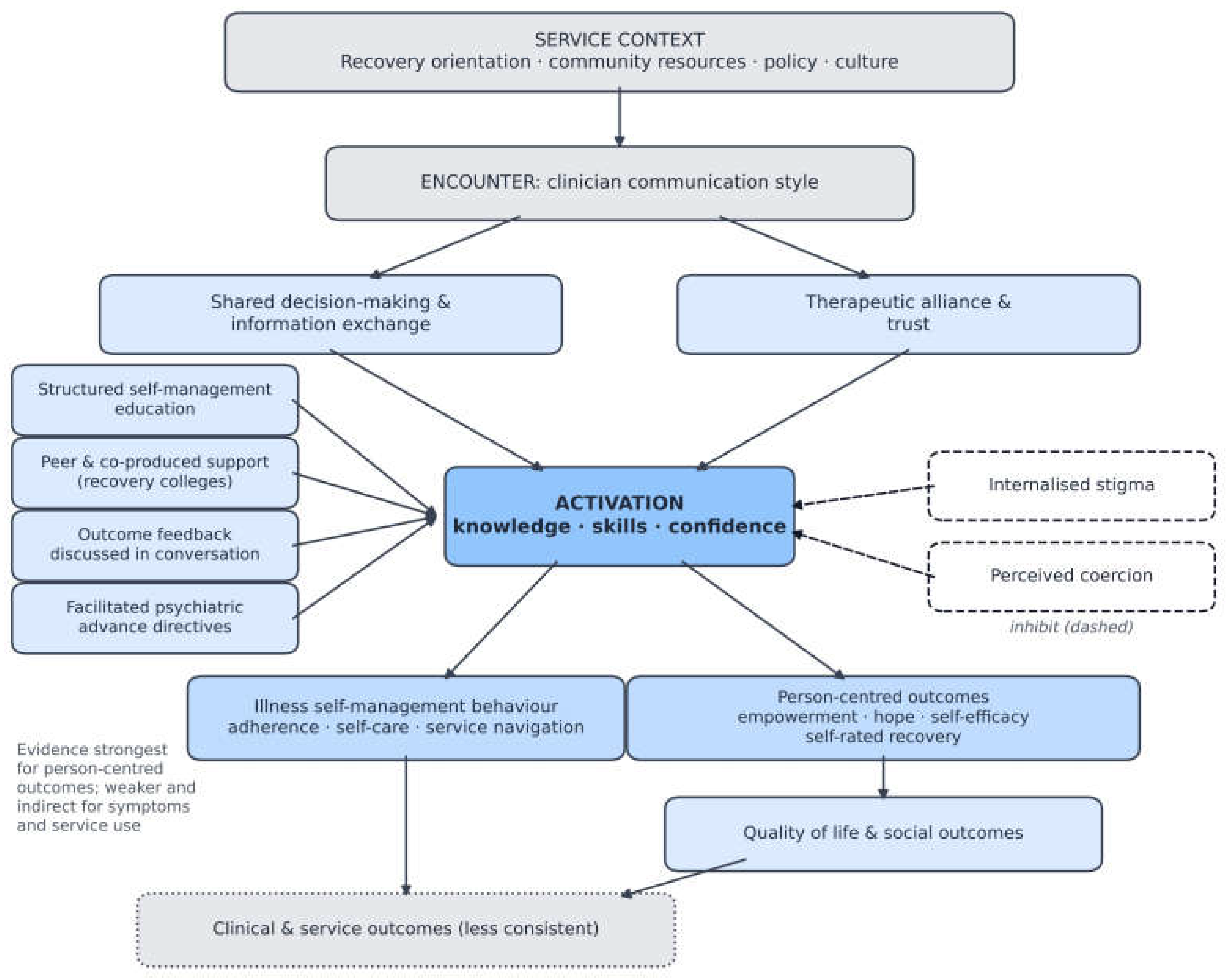
Figure 2.
Evidence map of intervention classes against four outcome domains, synthesised narratively from the reviewed systematic reviews, meta-analyses and trials (see Table 1). Darker shading indicates more consistent benefit; hatched cells indicate outcomes not tested or with insufficient evidence. Cell labels carry the same information as shading for greyscale reproduction.
Figure 2.
Evidence map of intervention classes against four outcome domains, synthesised narratively from the reviewed systematic reviews, meta-analyses and trials (see Table 1). Darker shading indicates more consistent benefit; hatched cells indicate outcomes not tested or with insufficient evidence. Cell labels carry the same information as shading for greyscale reproduction.
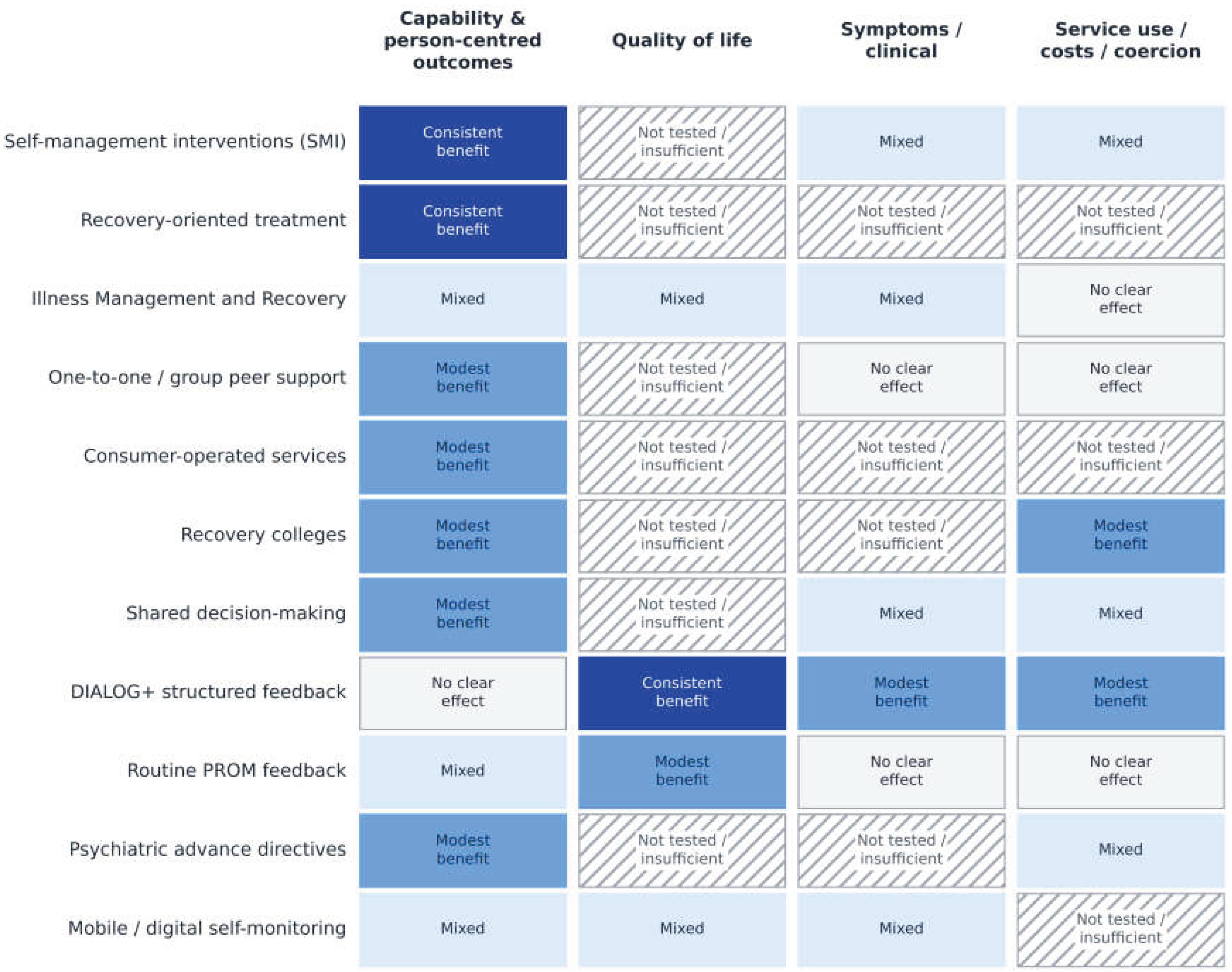

Table 1.
Direction of evidence for capability-related outcomes, by intervention class.
| Intervention class | Effect on capability-related outcomes | Effect on symptoms / service use | Key sources |
| Peer-led chronic disease self-management (SMI) | Significantly greater improvement in patient activation than usual care at 6 months (RCT, n = 80) | Not primary outcomes | Druss et al. (2010) |
| Self-management interventions in SMI (meta-analysis) | Significant effects on hope and empowerment at follow-up; self-rated recovery and self-efficacy at post-treatment and follow-up | Inconsistent | Lean et al. (2019) |
| Recovery-oriented treatment (meta-analysis, 7 studies, 1,739 participants) | Greater improvement in person-oriented recovery than usual or other care | Not synthesised | Thomas et al. (2018) |
| Illness Management and Recovery | Improved illness management in one trial; no effect on personal recovery at 1 year in a 198-participant trial | Mixed; null in active-controlled and low-retention trials | Färdig et al. (2011); Salyers et al. (2014); Jensen et al. (2019) |
| One-to-one peer support (meta-analysis, 19 trials, 3,329 participants) | Modest positive effect on self-reported recovery and empowerment | No effect on symptoms or service use | White et al. (2020) |
| Peer support (meta-analysis) | Personal recovery g = 0.15 (95% CI 0.04–0.27); clinical recovery g = 0.19 (0.11–0.27); functional recovery not significant | Small clinical-recovery effect | Smit et al. (2023) |
| Consumer-operated services (multisite RCT) | Higher perceived personal empowerment; very modest pooled effects | Not primary outcomes | Rogers et al. (2007) |
| Recovery colleges | Self-reported gains in self-understanding, self-confidence and self-esteem | Reduced service use (non-randomised); no RCTs | Meddings et al. (2015); Toney et al. (2018); Whitley et al. (2019) |
| Shared decision-making | Patients feel better informed and more satisfied | Improved depression and reduced hospitalisation in schizophrenia reported | Goss et al. (2008); McCabe et al. (2013) |
| DIALOG+ structured feedback (cluster RCT) | Better subjective quality of life (d = 0.29–0.34); fewer unmet needs; no effect on self-efficacy | Fewer general symptoms; lower care costs | Priebe et al. (2015, 2017) |
| Routine PROM feedback (Cochrane) | Small–moderate gains in communication; small gains in quality of life | Insufficient evidence for improved outcomes | Kendrick et al. (2016); Sidey-Gibbons et al. (2021) |
| Facilitated psychiatric advance directives | Self-determination, autonomy and empowerment endorsed | About half as likely to need coercive crisis intervention over 24 months; no strong RCT evidence on admissions | Zelle et al. (2015); Swartz & Swanson (2026) |
| Mobile self-monitoring (bipolar disorder) | Feasible and acceptable | Greater reduction in depressive symptoms (d = 0.48); gains may not persist | Depp et al. (2015); Miziou et al. (2015) |
Note. CI = confidence interval; PROM = patient-reported outcome measure; RCT = randomised controlled trial; SMI = severe mental illness. Direction of evidence is summarised narratively and does not represent pooled estimates.
Table 2.
Principal instruments for measuring patients' capability.
| Construct | Instrument | Structure and performance |
| Activation | Patient Activation Measure (PAM-22 / PAM-13) | Unidimensional, Guttman-like scale reflecting a developmental model; short form reliable and valid; cross-nationally validated (Hibbard et al., 2004, 2005; Rademakers et al., 2016) |
| Activation | PAM levels 1–4 | Level 1 (0.0–47.0) to level 4 (72.5–100) guide tailored support (Miller et al., 2020) |
| Activation (mental health) | PAM-MH | Developed for serious mental illness; related to recovery, quality of care, symptoms, self-care and adherence (Green et al., 2010) |
| Empowerment | Empowerment Scale (28 items) | Five factors: self-efficacy–self-esteem, power–powerlessness, community activism, righteous anger, optimism–control (Rogers et al., 1997) |
| Empowerment | Empowerment Scale (revised versions) | French four-factor, 18-item model fits well (CFI = 0.97, RMSEA = 0.07); prior solutions fit poorly in Swedish samples (Desvignes et al., 2025; Nissling et al., 2025) |
| Empowerment (youth) | Youth Empowerment Scale–Mental Health | Developed for young people with serious mental health difficulties (Walker et al., 2010) |
| Personal recovery | Recovery self-report measures (e.g., QPR) | Numerous but psychometrically uneven; seldom used routinely (Felix et al., 2024) |
| Routine outcomes | DIALOG quality-of-life and treatment-satisfaction items | Strong psychometric properties for quality-of-life scores; acceptable for treatment items (Priebe et al., 2012) |
Note. CFI = comparative fit index; QPR = Questionnaire about the Process of Recovery; RMSEA = root mean square error of approximation.
Disclaimer/Publisher’s Note: The statements, opinions and data contained in all publications are solely those of the individual author(s) and contributor(s) and not of MDPI and/or the editor(s). MDPI and/or the editor(s) disclaim responsibility for any injury to people or property resulting from any ideas, methods, instructions or products referred to in the content. |
© 2026 by the authors. Licensee MDPI, Basel, Switzerland. This article is an open access article distributed under the terms and conditions of the Creative Commons Attribution (CC BY) license (http://creativecommons.org/licenses/by/4.0/).
Copyright: This open access article is published under a Creative Commons CC BY 4.0 license, which permit the free download, distribution, and reuse, provided that the author and preprint are cited in any reuse.