

Submitted:
03 November 2026
Posted:
05 November 2026
You are already at the latest version
Abstract
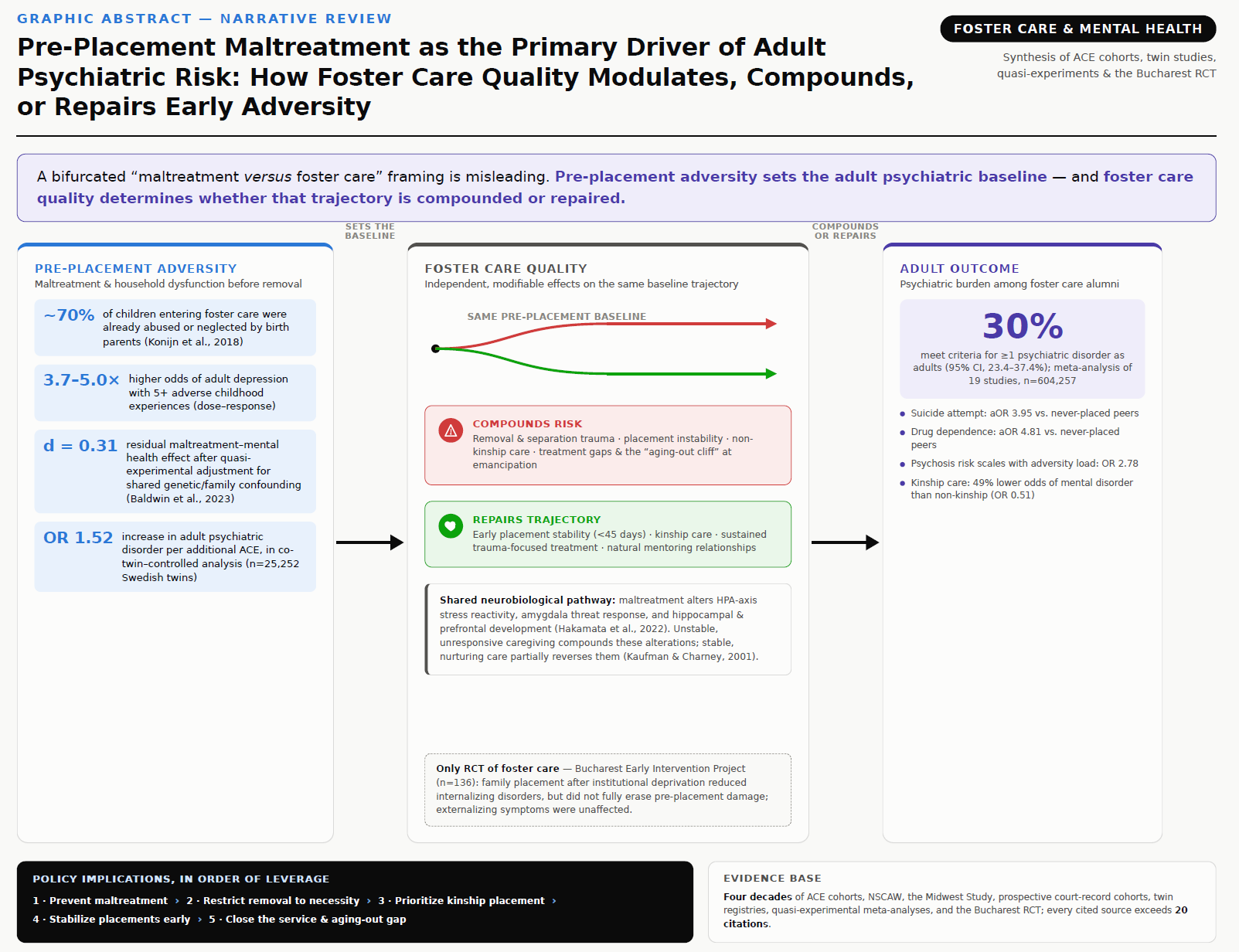
Adults who spent childhood in foster care carry among the highest burdens of psychiatric illness in the American population, yet the sources of that burden remain contested. One influential account attributes adult mental illness to the maltreatment that precedes placement: abuse, neglect, and household dysfunction that accumulate before state intervention. A competing account emphasizes features of the placement experience itself — removal from family, placement instability, and systemic failures in service delivery. This narrative review synthesizes four decades of evidence, including landmark adverse childhood experiences studies, prospective birth-cohort and administrative-record designs, twin–co-twin analyses, quasi-experimental meta-analyses, and the only randomized controlled trial of foster care (the Bucharest Early Intervention Project). The weight of evidence indicates that pre-placement adversity is the dominant driver of adult psychiatric risk, operating through well-characterized dose–response and neurobiological pathways; however, placement-related factors — particularly caregiver disruption and instability, inequitable kinship versus non-kinship placement patterns, and acute mental health service discontinuities at aging out — exert independent, modifiable effects. We conclude that a bifurcated framing mischaracterizes the evidence: pre-placement adversity sets the psychiatric baseline, and the quality of out-of-home care determines whether that trajectory is compounded or partially repaired. Prevention of maltreatment, minimization of unnecessary removal, rapid stabilization in care, and seamless service continuity constitute the highest-yield policy targets.
Keywords:
foster care
; child maltreatment
; adverse childhood experiences
; placement instability
; adult mental illness
; out-of-home care
1. Introduction
Few childhood experiences are as consequential as entry into foster care. In the United States, an estimated 5–6% of all children are placed in out-of-home care at some point before their 18th birthday, with cumulative placement risk reaching 15.44% for Native American children and 11.53% for Black children (1). Because placement almost always signals that abuse or neglect — or imminent risk of it — has occurred, foster care is best understood not as an isolated event but as the convergence of adversities that preceded removal and the new risks that accompany life in care (2,3).
Adults with child welfare histories manifest exceptional psychiatric morbidity. A meta-analysis of 19 longitudinal studies encompassing 604,257 participants estimated that 30% of adults with a foster or residential child welfare care history meet criteria for at least one mental disorder (95% CI, 23.36–37.36), with odds ratios of 1.33–2.76 relative to general-population comparators (4). Among US adolescents with foster care involvement, the odds of past-year suicide attempt are roughly quadrupled (adjusted OR, 3.95; 95% CI, 2.78–5.61) and the odds of drug dependence nearly quintupled (adjusted OR, 4.81; 95% CI, 3.22–7.18) relative to peers never placed (5). The interpretative question posed in the title of this review is therefore not whether former foster youth suffer — it is why, and to what degree the answer lies in what happened before placement versus what happened during it.
This question carries acute policy stakes. If adult illness is primarily a legacy of pre-placement maltreatment, then prevention of abuse and neglect — not reform of foster care per se — is the decisive lever. If placement-related factors dominate, the priorities shift to reducing removal, stabilizing placements, and remediating system-level neglect. The evidence reviewed below indicates that both accounts capture real causal pathways, but that they operate in a specific, non-symmetric relationship: pre-placement adversity establishes the baseline of risk, while the quality and stability of out-of-home care shape whether that baseline is exacerbated or ameliorated.
2. Scope and Evidence Base
This narrative review synthesized evidence from landmark epidemiological cohorts (the CDC–Kaiser Permanente ACE Study lineage, the National Survey of Child and Adolescent Well-Being [NSCAW], the Midwest Study of former foster youth, prospective court-record cohorts), systematic reviews and meta-analyses, twin and family-based quasi-experimental studies, and the Bucharest Early Intervention Project — the only randomized controlled trial of foster care for children exposed to severe deprivation (6,7). Consistent with the purpose of an evidence-based narrative review, the reference base privileges landmark works with substantial citation impact, including foundational studies of adverse childhood experiences, maltreatment and psychopathology, and foster care outcomes; every source cited in this review meets conventional thresholds for high citation impact (>20 citations), ensuring that claims rest on mature, independently corroborated evidence.
3. The Adult Mental Health Burden of Foster Care Alumni
Before disentangling causes, the magnitude of the outcome requires definition. Longitudinal cohort studies chart an unmistakable gradient. The Midwest Study, which followed 732 foster youth in Illinois, Iowa, and Wisconsin from ages 17–18 through age 26 across five waves, documented elevated lifetime prevalence of mood, anxiety, and substance use disorders assessed with structured diagnostic interviews (8). Among older adolescents about to exit child welfare systems in the same multi-state cohort, PTSD was the most common diagnosis, exceeding general-population rates (9). National survey data similarly show that adolescents with foster care histories report more psychiatric symptoms — especially conduct symptoms — and more substance use disorders than never-placed peers, with the suicide attempt and drug dependence odds ratios noted above (5). Reviews of alumni studies in the United States consistently report elevated emotional, behavioral, and substance use disorder prevalence relative to population norms (10).
Examination of when disorders emerge is instructive for the causal question. In the Midwest cohort, a substantial share of older adolescents already met criteria for psychiatric disorders while still in care, and among Caucasian youth diagnoses were more likely to predate entry into state custody, whereas diagnoses appearing after placement showed narrower racial differentials (9). State-to-state variation in the likelihood of pre-existing conditions further suggested that child welfare screening and placement policies shape who enters care and when (9). In short, the psychiatric burden of foster care alumni is already highly visible at the point of emancipation — consistent with either pre-placement causation, early-care causation, or both.
4. The Pre-Placement Adversity Account
4.1. The Dose–Response Legacy of Adverse Childhood Experiences
The modern evidence base begins with the CDC–Kaiser Permanente ACE Study, a retrospective cohort of 17,337 adult members of a California health plan surveyed in two waves between 1995 and 1997, which defined ten adverse childhood experiences spanning maltreatment (emotional, physical, and sexual abuse; emotional and physical neglect) and household dysfunction (domestic violence, parental separation or divorce, incarceration, substance abuse, and mental illness in the household) (11). Two decades of subsequent research using this framework demonstrated that ACEs converge dose-dependently to increase risk for interlinked mental illnesses and addictions (12), with prospective community samples confirming associations with depressive symptoms, drug abuse, and antisocial behavior emerging by the transition to adulthood (13).
The dose–response relationships are striking in magnitude. Relative to no ACEs, five or more ACEs are associated with 3.7–5.0-fold higher odds of lifetime depression and 4.4–6.4-fold higher odds of a recent depressive episode, while seven or more ACEs carry a 31-fold increase in the odds of a suicide attempt (14). In a large ACE-score analysis of adult mental health outcomes, six or more ACEs were associated with 2.73-fold increased odds of depressed affect, 24.36-fold increased odds of attempted suicide, 3.73-fold increased odds of drug use, and 2.84-fold increased odds of moderate-to-heavy drinking after adjustment for sociodemographic factors (15). Population-level attributable risk estimates quantify the public health stakes: childhood maltreatment and adversity account for roughly 30–70% of the population-attributable risk for major depression, anxiety disorders, PTSD, and substance abuse (16), and population-attributable fractions for psychiatric disorders and suicidal behavior associated with ACEs are medium-to-large for both men and women (17). In the WHO World Mental Health Surveys, childhood adversities were reported by 38.4% of respondents in high-income countries, with parental death the most common (11.0–14.8%), and simulation-based population-attributable risk proportions demonstrated substantial statistical contributions of early adversity to adult disorder classes (18).
Crucially for foster care, maltreatment is concentrated in exactly the population that enters placement, and at extreme levels. More than 600,000 American children are substantiated victims of abuse or neglect each year (19). Among 2,251 child welfare-involved youth referred for treatment through the National Child Traumatic Stress Network, 70.4% had experienced at least two of the five complex trauma types (physical abuse, sexual abuse, emotional abuse, neglect, and domestic violence) and 11.7% had experienced all five (20). Similarly, among 229 youth in treatment foster care across 46 agencies, nearly half had been exposed to four or more types of traumatic events (21), and meta-analytic reviews of the foster care literature report that approximately 70% of placed children were neglected or abused by their birth parents prior to placement (2). Youth aging out of care display heterogeneous but uniformly elevated ACE profiles in latent class analyses (22).
4.2. Prospective and Quasi-Experimental Evidence for Causality
Retrospective ACE research is vulnerable to recall bias and unmeasured shared-family confounding. The strongest evidence for a causal contribution therefore comes from designs that address these threats. First, prospective studies using official records draw the same conclusions: in a matched-prospective study of 641 adults with documented childhood abuse or neglect and 510 matched controls, victimized men evidenced more dysthymia and antisocial personality disorder, and victimized women more dysthymia, antisocial personality disorder, and alcohol problems relative to controls (23). A large community cohort similarly found elevated rates of mental disorder across groups defined by official or self-reported maltreatment (24). A population-based longitudinal study of 1,420 participants assessed for trauma exposure throughout childhood and followed into adulthood (ages 19, 21, 25, and 30) found cumulative childhood trauma associated with adult psychiatric and functional outcomes (25).
Second, quasi-experimental designs explicitly address confounding. A systematic review and meta-analysis of 34 quasi-experimental studies including 54,646 independent participants found that childhood maltreatment was moderately associated with mental health problems before adjustment (Cohen’s d = 0.56; 95% CI, 0.41–0.71) and remained associated after adjustment for genetic and shared environmental confounding (d = 0.31; 95% CI, 0.24–0.37) — a small, generalizable, plausibly causal contribution (26). Twin designs yield convergent estimates: in a cohort of 25,252 Swedish twins, each additional ACE was associated with a 52% increase in the odds of a clinically diagnosed adult psychiatric disorder (OR, 1.52; 95% CI, 1.48–1.57), and associations persisted in twin pairs discordant for ACE exposure, indicating effects beyond familial confounding (27).
Third, the association generalizes across the diagnostic spectrum, including severe illness. Childhood adversity is associated with psychosis with an overall odds ratio of 2.78 (95% CI, 2.34–3.31) across case-control, prospective, and population-based designs, with an estimated population-attributable risk of 33% (28). Reviews conclude that hallucinations are at least as strongly related to childhood abuse and neglect as many other mental health problems, with dose-dependent relationships (29), and meta-analytic work confirms a medium-to-large effect of childhood adversity in schizophrenia (30), with recent extended meta-analyses underscoring the need for trauma-informed approaches to psychosis treatment (31). Prospective cohort meta-analysis likewise shows maltreatment substantially increases risk of adult depression and anxiety (32). Importantly, maltreatment confers non-specific rather than disorder-specific risk, consistent with its effects on a latent general psychopathology factor (33).
The quasi-experimental literature does discipline the pre-placement account: roughly half of the unadjusted association between maltreatment and mental health problems in these designs is attributable to wider genetic and environmental risk factors shared within families (26). Moreover, the influence of discrete childhood victimization on adult mental health attenuates when later stressful life events are taken into account, underscoring that pre-placement adversity initiates — rather than fully determines — trajectories (23).
4.3. Summary of the Pre-Placement Case
The pre-placement account is supported by (a) consistent dose–response gradients, (b) prospective designs free of retrospective recall, (c) family-based quasi-experiments that survive adjustment for shared confounding, and (d) convergence across mild-to-severe disorders. Because children entering foster care are drawn disproportionately from the highest deciles of this exposure distribution (2,20), a substantial share of alumni adult illness must be attributed to what happened before the system intervened.
5. The Placement-Related Risk Account
5.1. Removal and Separation as Trauma
Separation from parents is itself a profound stressor. The National Research Council’s foundational review concluded that the effects of parent–child separation on children were universally negative across reasons for separation — including separation for maltreatment — and encompassed psychiatric disorder, depression, anxiety, self-harm, and substance abuse, with greatest vulnerability between 9 months and 9 years of age (34). Legal scholarship and policy analyses of the US child welfare system describe removal as its most drastic intervention, noting that the processes designed to protect children can themselves cause trauma and that removals are often undertaken without adequate balancing of iatrogenic risk (35). In developmental formulations, entry into foster care lies outside the range of typical childhood experience, further challenging children already made vulnerable by accumulated adversity (3). Even in the absence of subsequent maltreatment within care, then, the removal event plausibly adds an independent risk increment.
5.2. Placement Instability
Placement instability is the most extensively studied placement-related risk. Frequent placement changes deprive children of secure attachment figures and repeatedly disrupt relationships, schools, and neighborhoods, with negative effects documented across physical development, brain development, and well-being (2). In a seminal NSCAW-based analysis of 729 children, placement stability over the first 18 months of care — categorized as early stability (permanency or stability within 45 days), late stability, or unstable — was associated with behavioral well-being even after propensity-score adjustment for baseline attributes that predict instability, supporting a direct effect of stability on outcomes rather than mere selection (36). Placement instability also increases mental health costs during the first year in care (37). Recent systematic reviews temper the picture: instability consistently predicts PTSD symptomatology, but findings regarding mood outcomes are inconsistent, and the field has yet to fully control for concordant care-related factors (38). Notably, bidirectional dynamics operate: externalizing behavior increases the likelihood of placement change, and placement change predicts psychiatric crisis and emergency service use (39). Maltreatment history itself predicts instability — children who enter care with the most severe pre-placement trauma are the ones most likely to experience repeated disruption (2).
5.3. Kinship Versus Non-Kinship Care
Placement type is a second systemic variable. Cochrane and Campbell systematic reviews of up to 102 quasi-experimental studies encompassing 666,615 children found that children in kinship care experience fewer behavioral problems (SMD, −0.33; 95% CI, −0.49 to −0.17), fewer mental health disorders (OR, 0.51; 95% CI, 0.42–0.62), better well-being, and less placement disruption (OR, 0.52; 95% CI, 0.40–0.69) than children in non-kinship foster care (40,41); earlier Cochrane estimates indicated children in foster care were 2.2 times more likely to experience mental illness than children in kinship care (OR, 0.46; 95% CI, 0.44–0.49) (42). Children in non-kinship foster care also use more mental health services (OR, 1.79; 95% CI, 1.35–2.37) (40). Because kinship placements preserve familiar relationships and continuity of caregiving, their relative advantage is consistent with both pre-placement (children placed with kin may have less severe histories) and placement-related (greater relational continuity) mechanisms; the authors caution that selection bias pervades this literature (40). In the Midwest cohort, youth in kinship family foster care were indeed less likely to have mental health and substance use problems, mirroring these findings at the diagnostic level (9).
5.4. Service Access, Treatment Engagement, and the Aging-Out Cliff
A third set of placement-related risks concerns what the system does not provide. Most children enter foster care with medical, mental health, or developmental problems, yet many do not receive adequate or appropriate care while in placement, and psychological problems may worsen rather than improve (43). Only about half of children aged 0–5 deemed at high risk for developmental and behavioral problems received any services in the 12 months after child welfare contact, with infants aged 0–2 showing the most unmet need (27.9% accessing services) (44). Engagement is a further barrier: about two-thirds of children and families enrolled in outpatient mental health services do not complete more than seven sessions, a rate likely higher among foster families confronting stigma, burden, and placement-related turmoil (45). Randomized trial data confirm that even trauma-focused cognitive behavioral therapy — an evidence-based, well-matched intervention for this population — requires structured engagement strategies to overcome foster parent and caseworker barriers (46). At the service nexus, psychiatric treatment termination coincides with emancipation, when the system’s involvement abruptly ceases: longitudinal data on 325 youth interviewed from age 17 to 19 document service declines for young people who left the foster care system, but not for those who stayed (47). Conversely, supportive non-kin adult relationships are associated with better psychological and behavioral outcomes among older youth transitioning from care (48). These system features — under-detection, under-treatment, placement-driven discontinuity, and the aging-out cliff — all implicate the placement experience itself in adult mental illness.
6. Disentangling Pre-Placement From Placement-Related Risk: What Comparative Designs Show
6.1. Timing-of-Onset Designs
One direct strategy is to locate disorder onset relative to entry into care. In the Midwest cohort, psychiatric diagnoses commonly predated placement among youth entering care at older ages, and the likelihood of pre-existing conditions varied by state — evidence that system screening and placement policies shape the case-mix entering care (9). This does not resolve causation (the adversities that justify removal predate placement by construction), but it demonstrates that a large fraction of alumni morbidity is, temporally, pre-placement morbidity.
6.2. Adjustment Designs
Propensity-score adjustment in NSCAW indicated that baseline child attributes predict both placement instability and subsequent behavioral problems, yet removing selection did not eliminate the stability–outcome association (36). Family-based quasi-experiments apply the same logic to the maltreatment–outcome association, isolating a residual causal effect of maltreatment after controlling for shared family risk (26,27). Read together, these designs suggest a partitioned causal model: pre-placement maltreatment causally contributes to adult mental illness (over and above family-wide risk), and placement stability exerts an additional, independent effect on child well-being (over and above the child’s baseline risk). Neither effect is zero, but the maltreatment effect is the larger and better-replicated of the two.
6.3. The Bucharest Early Intervention Project: An Experiment in Removal and Placement
BEIP provides the only experimental purchase on the question of whether removing children from adverse environments and placing them in family care changes psychiatric outcomes. In this randomized controlled trial, 136 infants and toddlers living in Romanian institutions were assigned to foster care or care as usual, with a never-institutionalized community comparison group (49). By age 54 months, children ever exposed to institutional care had more externalizing and internalizing disorders; children randomized to foster care were significantly less likely to meet criteria for internalizing disorders (primarily anxiety), although no intervention effect emerged for externalizing or ADHD symptoms (6,50). At age 12, internalizing benefits persisted, particularly for girls, while externalizing and ADHD symptoms remained unaffected (6). The trial’s overall lesson is twofold: severe early deprivation has enduring psychiatric effects, and family placement can partially — but not completely — remediate them (7,51). Extrapolated to the US context, BEIP suggests that removing children from pathogenic environments can improve mental health trajectories relative to remaining in deprivation, while also delimiting the power of placement to erase pre-placement damage.
6.4. A Cumulative-Risk Synthesis
The most defensible integration is cumulative: children enter care having already accumulated maltreatment, household dysfunction, and poverty-related adversity (3); removal adds separation-related stress and, too often, placement instability and service failure. Each stratum of the cascade adds risk, which is why alumni outcomes are as poor as they are (4), and why the “foster care versus the trauma before it” dichotomy is ultimately misleading. The correct causal claims are comparative: maltreatment effects are robust, causal (small-to-moderate), and prior to placement; placement effects are real, etiologically secondary, and — unlike maltreatment — fully modifiable by policy.
8. Implications for Policy, Practice, and Prevention
Prevent maltreatment at the population level. Given that pre-placement adversity dominates adult psychiatric risk, primary prevention is the highest-leverage strategy. Effective approaches exist: nurse home visitation programs, such as the Nurse–Family Partnership, have shown reduced occurrence of child abuse 15 years post-intervention; parent education programs promoting warm, consistent, responsive parenting show moderate meta-analytic effects in preventing maltreatment; and economic returns on such investments are substantial (estimated at $13.82 per dollar invested) (57). Population-attributable fraction logic indicates that successfully preventing maltreatment would prevent a corresponding proportion of adult mental illness (17,57). Structural supports — paid parental leave, affordable childcare, income support — reduce the family stress that drives maltreatment (57).
Restrict removal to cases of demonstrable necessity. Because separation itself is harmful (34,35), child welfare practice should treat removal as the intervention of last resort, weighing the iatrogenic risks of family separation against the risks of remaining in an unsafe home (35).
Maximize kinship and relational continuity where placement is necessary. The consistent advantage of kinship care across 102 studies — fewer mental health disorders, better well-being, less disruption — supports preferential kinship placement, while acknowledging selection limitations (40,41). Where non-kinship care is used, efforts to preserve sibling and significant-relationship continuity are directly indicated by the stability literature (2,36).
Stabilize placements and treat instability as a clinical emergency. Early stability within 45 days of entry is associated with better behavioral well-being independent of baseline risk (36); instability should trigger intensive wraparound support rather than further disruption (37).
Close the service gap and the aging-out cliff. Screening, timely referral, and evidence-based trauma treatment (e.g., trauma-focused cognitive behavioral therapy with structured engagement strategies) are underdelivered in this population (44–46). Continuity of psychiatric care across the child-to-adult service boundary and beyond emancipation must be built into transition planning, given documented service declines at exit but not among those who remain in care (47). Natural mentoring relationships offer a protective, low-cost complement (48).
9. Limitations and Future Directions
This review inherits the limitations of its underlying literature. First, most foster care outcome studies are observational, and selection into care is non-random; even propensity-score and sibling-comparison designs cannot fully eliminate residual confounding, though quasi-experimental syntheses bound the causal effect of maltreatment (26,40). Second, US studies rarely distinguish pre-placement from placement-related contributions within the same cohort; extended-twin designs and administrative linkage studies (e.g., linking AFCARS placement trajectories to adult health records) would allow within-system comparisons not currently available. Third, BEIP’s setting — severe institutional deprivation — does not generalize directly to the typical US foster care case, so its remediation estimates should be interpreted as upper bounds on placement’s reparative potential (6). Fourth, the intersection of racism, poverty, and disproportionate placement of Black and Native American children (1) is theoretically central but empirically underdeveloped; the rapid growth of kinship care deserves rigorous causal study. Finally, almost all the key cohorts were assembled before the opioid- and post-2020 foster care surges; contemporary replications are needed.
10. Conclusion
The question posed in this review’s title admits an evidence-based answer, but not a binary one. Adult mental illness among foster care alumni is predominantly the legacy of the adversities that preceded placement: the dose–response ACE gradient, prospective and quasi-experimental evidence, twin analyses, and population-attributable fraction calculations all place the primary causal weight on maltreatment and household dysfunction accruing before state intervention (14,16,26,27). Yet the placement experience is not causally inert. Removal itself, unstable and disrupted caregiving, relative disadvantages of non-kinship placement, and systematic failures to provide and sustain treatment each add risk that is, unlike the child’s history, entirely modifiable (34,36,40,47). The pathologically accurate framing is therefore causal sequence rather than causal competition: maltreatment establishes vulnerability; foster care either contains or compounds it. This synthesis redirects policy accordingly — toward preventing the trauma that precedes foster care, and toward making the care that follows worthy of the children it serves.
Supplementary Materials
The following supporting information can be downloaded at the website of this paper posted on Preprints.org.
Funding
This research did not receive any specific grant from funding agencies in the public, commercial, or not-for-profit sectors.
Author Contributions (CRediT)
Sushil Kumar SV: Conceptualization, Methodology, Investigation, Formal analysis, Writing – original draft, Writing – review & editing, Visualization, Supervision, Project administration. The author read and approved the final manuscript.
Ethical Approval
This is a narrative review synthesizing previously published, publicly available literature. It did not involve the collection of new data from human participants or animals; accordingly, institutional review board approval and informed consent were not required.
Consent to Participate and Publish
Not applicable.
Data Availability Statement
No new data were generated or analyzed in connection with this narrative review. All sources discussed are previously published works cited in the reference list.
Acknowledgments
None.
Declaration of Competing Interest
The author declares that he has no known competing financial interests or personal relationships that could have appeared to influence the work reported in this manuscript.
References
- Wildeman, C.; Emanuel, N. Cumulative Risks of Foster Care Placement by Age 18 for U.S. Children, 2000–2011. PLoS ONE [Internet] Available from. 2014, 9(3). [Google Scholar] [CrossRef] [PubMed]
- Konijn, C.; Admiraal, S.; Baart, J.; van, Rooij F; Stams, G.J.; Colonnesi, C.; et al. Foster care placement instability: A meta-analytic review. Child. Youth Serv. Rev. [Internet] Available from. 2018, 96, 483–99. [Google Scholar] [CrossRef]
- Lawrence, C.R.; Carlson, E.A.; Egeland, B. The impact of foster care on development. Dev. Psychopathol. 2006, 18(1), 57–76. [Google Scholar] [CrossRef] [PubMed]
- Seker, S.; Boonmann, C.; Gerger, H.; Jäggi, L.; d’Huart, D.; Schmeck, K.; et al. Mental disorders among adults formerly in out-of-home care: a systematic review and meta-analysis of longitudinal studies. Eur. Child Adolesc. Psychiatry [Internet] Available from. 2021, 31(12), 1963–82. [Google Scholar] [CrossRef] [PubMed]
- Pilowsky, D.J.; Wu, L. Psychiatric symptoms and substance use disorders in a nationally representative sample of American adolescents involved with foster care. J. Adolesc. Health [Internet] Available from. 2006, 38(4), 351–8. [Google Scholar] [CrossRef] [PubMed]
- Humphreys, K.L.; Gleason, M.M.; Drury, S.S.; Miron, D.; Nelson, C.A.; Fox, N.A.; et al. Effects of institutional rearing and foster care on psychopathology at age 12 years in Romania: follow-up of an open, randomised controlled trial. Lancet Psychiatry [Internet] Available from. 2015, 2(7), 625–34. [Google Scholar] [CrossRef] [PubMed]
- Bos, K.; Zeanah, C.H.; Fox, N.A.; Drury, S.S.; McLaughlin, K.A.; Nelson, C.A. Psychiatric Outcomes in Young Children with a History of Institutionalization. Harv. Rev. Psychiatry [Internet] Available from. 2011, 19(1), 15–24. [Google Scholar] [CrossRef] [PubMed]
- Havlicek, J.; Garcia, A.R.; Smith, D.C. Mental health and substance use disorders among foster youth transitioning to adulthood: Past research and future directions. Child. Youth Serv. Rev. [Internet] Available from. 2012, 35(1), 194–203. [Google Scholar] [CrossRef] [PubMed]
- Keller, T.E.; Salazar, A.M.; Courtney, M.E. Prevalence and timing of diagnosable mental health, alcohol, and substance use problems among older adolescents in the child welfare system. Child. Youth Serv. Rev. [Internet] Available from. 2010, 32(4), 626–34. [Google Scholar] [CrossRef] [PubMed]
- Pecora, P.J.; White, C.R.; Jackson, L.J.; Wiggins, T.R.I. Mental health of current and former recipients of foster care: a review of recent studies in the USA. Child Fam. Soc. Work [Internet] Available from. 2009, 14(2), 132–46. [Google Scholar] [CrossRef]
- Thurston, C.; Murray, A.L.; Franchino-Olsen, H.; Meinck, F. Prospective longitudinal associations between adverse childhood experiences and adult mental health outcomes: a protocol for a systematic review and meta-analysis. Syst. Rev. [Internet] Available from. 2023, 12(1), 181–181. [Google Scholar] [CrossRef] [PubMed]
- Zarse, E.M.; Neff, M.R.; Yoder, R.; Hulvershorn, L.A.; Chambers, J.E.; Chambers, R.A. The adverse childhood experiences questionnaire: Two decades of research on childhood trauma as a primary cause of adult mental illness, addiction, and medical diseases. Cogent Med. [Internet] Available from. 2019, 6(1), 1581447–1581447. [Google Scholar] [CrossRef]
- Schilling, E.A.; Aseltine, R.H.; Gore, S. Adverse childhood experiences and mental health in young adults: a longitudinal survey. BMC Public Health [Internet] Available from. 2007, 7(1), 30–30. [Google Scholar] [CrossRef] [PubMed]
- Teicher, M.H.; Parigger, A. The ‘Maltreatment and Abuse Chronology of Exposure’ (MACE) Scale for the Retrospective Assessment of Abuse and Neglect During Development. PLoS ONE [Internet] Available from. 2015, 10(2). [Google Scholar] [CrossRef] [PubMed]
- Merrick, M.T.; Ports, K.A.; Ford, D.; Afifi, T.O.; Gershoff, E.T.; Grogan-Kaylor, A. Unpacking the impact of adverse childhood experiences on adult mental health. Child Abus. Negl. [Internet] Available from. 2017, 69, 10–9. [Google Scholar] [CrossRef] [PubMed]
- Teicher, M.H.; Samson, J. Childhood Maltreatment and Psychopathology: A Case for Ecophenotypic Variants as Clinically and Neurobiologically Distinct Subtypes. Am. J. Psychiatry [Internet] Available from. 2013, 170(10), 1114–33. [Google Scholar] [CrossRef] [PubMed]
- Afifi, T.O.; Enns, M.W.; Cox, B.J.; Asmundson, G.J.G.; Stein, M.B.; Sareen, J. Population Attributable Fractions of Psychiatric Disorders and Suicide Ideation and Attempts Associated With Adverse Childhood Experiences. Am. J. Public Health [Internet] Available from. 2008, 98(5), 946–52. [Google Scholar] [CrossRef] [PubMed]
- Kessler, R.C.; McLaughlin, K.A.; Green, J.; Gruber, M.J.; Sampson, N.A.; Zaslavsky, A.M.; et al. Childhood adversities and adult psychopathology in the WHO World Mental Health Surveys. Br. J. Psychiatry [Internet] Available from. 2010, 197(5), 378–85. [Google Scholar] [CrossRef] [PubMed]
- Jaffee, S.R. Child Maltreatment and Risk for Psychopathology in Childhood and Adulthood. Annu. Rev. Clin. Psychol. [Internet] Available from. 2017, 13(1), 525–51. [Google Scholar] [CrossRef] [PubMed]
- Greeson, J.K.P.; Briggs, E.C.; Kisiel, C.; Layne, C.M.; Ake, G.S.; Ko, S.J.; et al. Complex trauma and mental health in children and adolescents placed in foster care: findings from the National Child Traumatic Stress Network. Child Welf. 2011, 90(6), 91–108. [Google Scholar] [PubMed]
- Dorsey, S.; Burns, B.J.; Southerland, D.G.; Cox, J.R.; Wagner, H.R.; Farmer, E.M.Z. Prior Trauma Exposure for Youth in Treatment Foster Care. J. Child Fam. Stud. [Internet] Available from. 2011, 21(5), 816–24. [Google Scholar] [CrossRef] [PubMed]
- Rebbe, R.; Nurius, P.S.; Ahrens, K.; Courtney, M.E. Adverse childhood experiences among youth aging out of foster care: A latent class analysis. Child. Youth Serv. Rev. [Internet] Available from. 2017, 74, 108–16. [Google Scholar] [CrossRef] [PubMed]
- Horwitz, A.V.; Widom, C.S.; McLaughlin, J.; White, H.R. The Impact of Childhood Abuse and Neglect on Adult Mental Health: A Prospective Study. J. Health Soc. Behav. [Internet] Available from. 2001, 42(2), 184–184. [Google Scholar] [CrossRef]
- Cohen, P.; Brown, J.F.; Smailes, E. Child abuse and neglect and the development of mental disorders in the general population. Dev. Psychopathol. [Internet] Available from. 2001, 13(4), 981–99. [Google Scholar] [CrossRef]
- Copeland, W.; Shanahan, L.; Hinesley, J.; Chan, R.F.; Åberg, K.A.; Fairbank, J.A.; et al. Association of Childhood Trauma Exposure With Adult Psychiatric Disorders and Functional Outcomes. JAMA Netw. Open [Internet] Available from. 2018, 1(7). [Google Scholar] [CrossRef] [PubMed]
- Baldwin, J.R.; Wang, B.; Karwatowska, L.; Schoeler, T.; Tsaligopoulou, A.; Munafò, M.R.; et al. Childhood maltreatment and mental health problems: a systematic review and meta-analysis of quasi-experimental studies. Am. J. Psychiatry 2023, 180(2), 117–26. [Google Scholar] [CrossRef] [PubMed]
- Daníelsdóttir, H.B.; Aspelund, T.; Shen, Q.; Halldorsdottir, T.; Jakobsdóttir, J.; Song, H.; et al. Adverse Childhood Experiences and Adult Mental Health Outcomes. JAMA Psychiatry [Internet] Available from. 2024, 81(6), 586–586. [Google Scholar] [CrossRef] [PubMed]
- Varese, F.; Smeets, F.; Drukker, M.; Lieverse, R.; Lataster, T.; Viechtbauer, W.; et al. Childhood Adversities Increase the Risk of Psychosis: A Meta-analysis of Patient-Control, Prospective- and Cross-sectional Cohort Studies. Schizophr. Bull. [Internet] Available from. 2012, 38(4), 661–71. [Google Scholar] [CrossRef] [PubMed]
- Read, J.; van, Os J; Morrison, A.P.; Ross, C.A. Childhood trauma, psychosis and schizophrenia: a literature review with theoretical and clinical implications. Acta Psychiatr. Scand. [Internet] Available from. 2005, 112(5), 330–50. [Google Scholar] [CrossRef] [PubMed]
- Matheson, S.; Shepherd, A.M.; Pinchbeck, R.M.; Laurens, K.R.; Carr, V.J. Childhood adversity in schizophrenia: a systematic meta-analysis. Psychol. Med. [Internet] Available from. 2012, 43(2), 225–38. [Google Scholar] [CrossRef] [PubMed]
- Zhou, L.; Sommer, I.E.; Yang, P.; Sikirin, L.; van, Os J; Bentall, R.P.; et al. What Do Four Decades of Research Tell Us About the Association Between Childhood Adversity and Psychosis: An Updated and Extended Multi-Level Meta-Analysis. Am. J. Psychiatry [Internet] Available from. 2025, 182(4), 360–72. [Google Scholar] [CrossRef] [PubMed]
- Li, M.; D’Arcy, C.; Meng, X. Maltreatment in childhood substantially increases the risk of adult depression and anxiety in prospective cohort studies: systematic review, meta-analysis, and proportional attributable fractions. Psychol. Med. [Internet] Available from. 2015, 46(4), 717–30. [Google Scholar] [CrossRef] [PubMed]
- Keyes, K.M.; Eaton, N.R.; Krueger, R.F.; McLaughlin, K.A.; Wall, M.M.; Grant, B.F.; et al. Childhood maltreatment and the structure of common psychiatric disorders. Br. J. Psychiatry [Internet] Available from. 2011, 200(2), 107–15. [Google Scholar] [CrossRef] [PubMed]
- National Research Council (US) Panel on Research on Child Abuse and Neglect. Understanding child abuse and neglect; National Academies Press (US): Washington (DC), 1993. [Google Scholar] [CrossRef] [PubMed]
- Sankaran, V.; Church, C.; Mitchell, M. A cure worse than the disease? The impact of removal on children and their families. Marquette Law Rev. 2019, 102(4), 1163–94. [Google Scholar]
- Rubin, D.M.; O’Reilly, A.L.R.; Luan, X.; Localio, A.R. The Impact of Placement Stability on Behavioral Well-being for Children in Foster Care. PEDIATRICS [Internet] Available from. 2007, 119(2), 336–44. [Google Scholar] [CrossRef] [PubMed]
- Rubin, D.M.; Alessandrini, E.A.; Feudtner, C.; Mandell, D.S.; Localio, A.R.; Hadley, T.R. Placement Stability and Mental Health Costs for Children in Foster Care. PEDIATRICS [Internet] Available from. 2004, 113(5), 1336–41. [Google Scholar] [CrossRef] [PubMed]
- Maguire, D.; May, K.; McCormack, D.; Fosker, T. A Systematic Review of the Impact of Placement Instability on Emotional and Behavioural Outcomes Among Children in Foster Care. J. Child Adolesc. Trauma [Internet] Available from. 2024, 17(2), 641–55. [Google Scholar] [CrossRef] [PubMed]
- McBeath, B.; Godlewski, B.; Waid, J.; Kothari, B.H.; Blakeslee, J.E.; Webb, S.J.; et al. Visualizing and describing foster care placement pathways. J. Public Child Welf. [Internet] Available from. 2018, 12(5), 515–39. [Google Scholar] [CrossRef] [PubMed]
- Winokur, M.; Holtan, A.; Batchelder, K.E. Kinship care for the safety, permanency, and well-being of children removed from the home for maltreatment. Cochrane Database Syst. Rev. [Internet] Available from. 2014, 2014(1). [Google Scholar] [CrossRef] [PubMed]
- Winokur, M.; Holtan, A.; Batchelder, K.E. Kinship Care for the Safety, Permanency, and Well-being of Children Removed from the Home for Maltreatment: A Systematic Review. Campbell Syst. Rev. [Internet] Available from. 2014, 10(1), 1–292. [Google Scholar] [CrossRef]
- Winokur, M.; Holtan, A.; Valentine, D. Kinship care for the safety, permanency, and well-being of children removed from the home for maltreatment. Cochrane Database Syst. Rev. [Internet] Available from. 2009, (1). [Google Scholar] [CrossRef] [PubMed]
- Simms, M.D.; Dubowitz, H.; Szilagyi, M. Health Care Needs of Children in the Foster Care System. PEDIATRICS [Internet] Available from. 2000, 106, 909–18. [Google Scholar] [CrossRef]
- Leslie, L.K.; Gordon, J.; Lambros, K.M.; Premji, K.; Peoples, J.; Gist, K. Addressing the Developmental and Mental Health Needs of Young Children in Foster Care. J. Dev. Behav. Pediatr. [Internet] Available from. 2005, 26(2), 140–51. [Google Scholar] [CrossRef] [PubMed]
- Hambrick, E.P.; Oppenheim-Weller, S.; N’zi, A.M.; Taussig, H.N. Mental health interventions for children in foster care: A systematic review. Child. Youth Serv. Rev. [Internet] Available from. 2016, 70, 65–77. [Google Scholar] [CrossRef] [PubMed]
- Dorsey, S.; Pullmann, M.D.; Berliner, L.; Koschmann, E.; McKay, M.M.; Deblinger, E. Engaging foster parents in treatment: A randomized trial of supplementing Trauma-focused Cognitive Behavioral Therapy with evidence-based engagement strategies. Child Abus. Negl. [Internet] Available from. 2014, 38(9), 1508–20. [Google Scholar] [CrossRef] [PubMed]
- McMillen, J.C.; Raghavan, R. Pediatric to Adult Mental Health Service Use of Young People Leaving the Foster Care System. J. Adolesc. Health [Internet] Available from. 2008, 44(1), 7–13. [Google Scholar] [CrossRef] [PubMed]
- Munson, M.R.; McMillen, J.C. Natural mentoring and psychosocial outcomes among older youth transitioning from foster care. Child. Youth Serv. Rev. [Internet] Available from. 2008, 31(1), 104–11. [Google Scholar] [CrossRef] [PubMed]
- Guyon-Harris, K.L.; Humphreys, K.L.; Fox, N.A.; Nelson, C.A.; Zeanah, C.H. Signs of attachment disorders and social functioning among early adolescents with a history of institutional care. Child Abus. Negl. [Internet] Available from. 2018, 88, 96–106. [Google Scholar] [CrossRef] [PubMed]
- Troller-Renfree, S.V.; Zeanah, C.H.; Nelson, C.A.; Fox, N.A. Neural and Cognitive Factors Influencing the Emergence of Psychopathology: Insights From the Bucharest Early Intervention Project. Child Dev. Perspect. [Internet] Available from. 2017, 12(1), 28–33. [Google Scholar] [CrossRef] [PubMed]
- Wade, M.; Parsons, J.P.; Humphreys, K.L.; McLaughlin, K.A.; Sheridan, M.A.; Zeanah, C.H.; et al. The Bucharest Early Intervention Project: Adolescent mental health and adaptation following early deprivation. Child Dev. Perspect. [Internet] Available from. 2022, 16(3), 157–64. [Google Scholar] [CrossRef] [PubMed]
- Hakamata, Y.; Suzuki, Y.; Kobashikawa, H.; Hori, H. Neurobiology of early life adversity: A systematic review of meta-analyses towards an integrative account of its neurobiological trajectories to mental disorders. Front. Neuroendocrinol. [Internet] Available from. 2022, 65, 100994–100994. [Google Scholar] [CrossRef] [PubMed]
- McCrory, E.; Brito, S.A.D.; Viding, E. Research Review: The neurobiology and genetics of maltreatment and adversity. J. Child Psychol. Psychiatry [Internet] Available from. 2010, 51(10), 1079–95. [Google Scholar] [CrossRef] [PubMed]
- Hein, T.C.; Monk, C.S. Research review: neural response to threat in children, adolescents, and adults after child maltreatment – a quantitative meta-analysis. J. Child Psychol. Psychiatry 2017, 58(3), 222–30. [Google Scholar] [CrossRef] [PubMed]
- Tyrka, A.R.; Burgers, D.E.; Philip, N.S.; Price, L.H.; Carpenter, L.L. The neurobiological correlates of childhood adversity and implications for treatment. Acta Psychiatr. Scand. [Internet] Available from. 2013, 128(6), 434–47. [Google Scholar] [CrossRef] [PubMed]
- Kaufman, J.; Charney, D.S. Effects of early stress on brain structure and function: Implications for understanding the relationship between child maltreatment and depression. Dev. Psychopathol. [Internet] Available from. 2001, 13(3), 451–71. [Google Scholar] [CrossRef] [PubMed]
- Grummitt, L.; Baldwin, J.R.; Lafoa’i, J.; Keyes, K.M.; Barrett, E. Burden of Mental Disorders and Suicide Attributable to Childhood Maltreatment. JAMA Psychiatry [Internet] Available from. 2024, 81(8), 782–782. [Google Scholar] [CrossRef] [PubMed]
Disclaimer/Publisher’s Note: The statements, opinions and data contained in all publications are solely those of the individual author(s) and contributor(s) and not of MDPI and/or the editor(s). MDPI and/or the editor(s) disclaim responsibility for any injury to people or property resulting from any ideas, methods, instructions or products referred to in the content. |
© 2026 by the authors. Licensee MDPI, Basel, Switzerland. This article is an open access article distributed under the terms and conditions of the Creative Commons Attribution (CC BY) license (http://creativecommons.org/licenses/by/4.0/).
Copyright: This open access article is published under a Creative Commons CC BY 4.0 license, which permit the free download, distribution, and reuse, provided that the author and preprint are cited in any reuse.