
Submitted:
02 November 2026
Posted:
04 November 2026
You are already at the latest version
Abstract
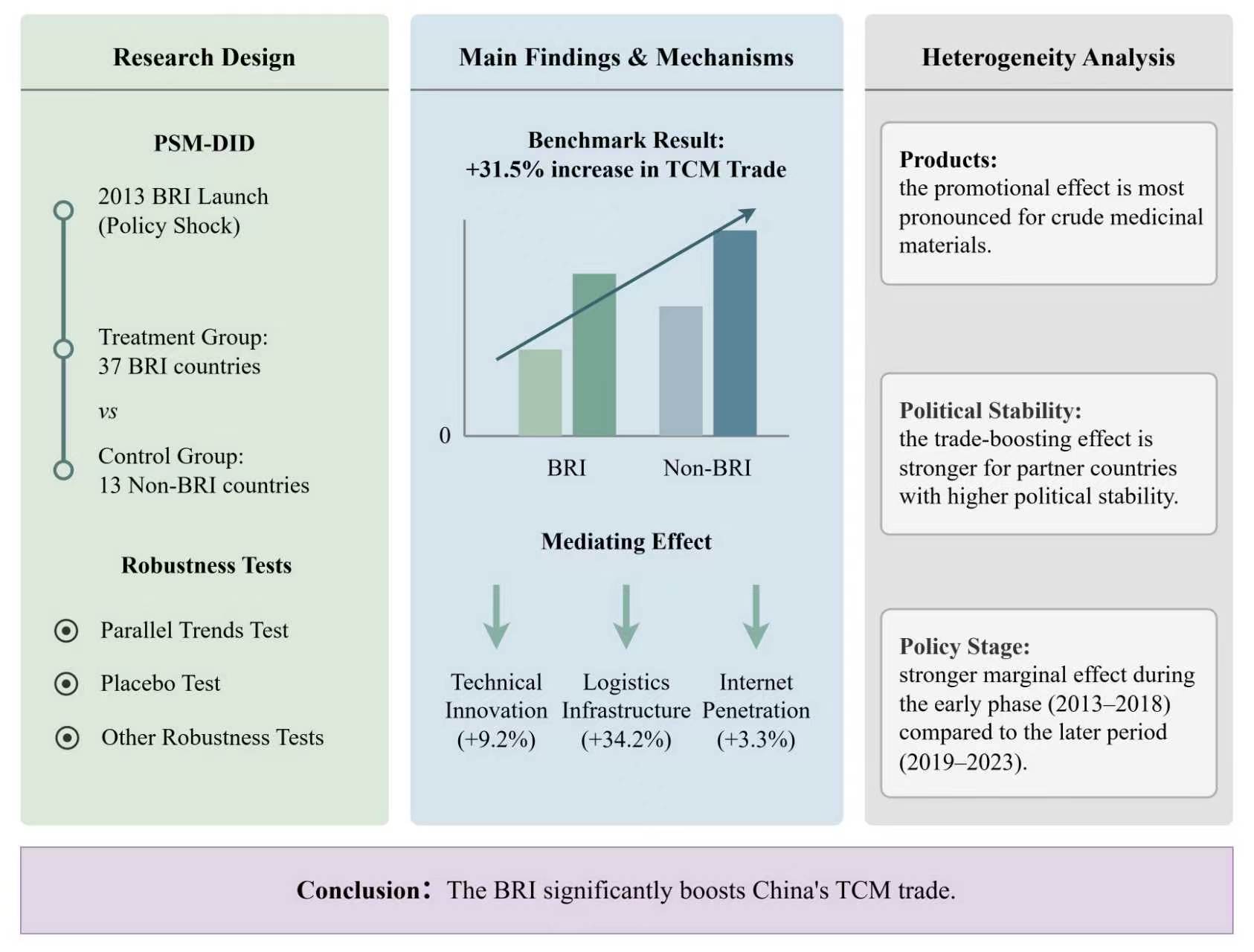
The Belt and Road Initiative (BRI) has strengthened economic cooperation between China and its partner countries. This study examines its estimated policy effect on China’s traditional Chinese medicine (TCM) trade and the conditions shaping that effect. Using balanced panel data on China’s TCM trade with 50 partners from 2005 to 2023, we applied a difference-in-differences model and multiple robustness tests. The BRI had a significant positive estimated effect on TCM trade, which remained robust to parallel-trends, placebo, and PSM-DID tests. The trade-promoting effect was stronger at higher levels of technological innovation, logistics infrastructure, and Internet penetration. It was also strongest for crude medicinal materials, more pronounced among politically stable partners, and greater during 2013–2018 than during 2019–2023. The results identify technological innovation, logistics, and digital infrastructure as relevant facilitating factors. The estimated gains were concentrated in less-processed products, particularly Chinese medicinal materials and herbal extracts. These findings quantify the response of medical-product trade to a large-scale international cooperation policy and provide mechanism-consistent evidence relevant to sustainable resource allocation and international health cooperation.
Keywords:
belt and road initiative
; traditional Chinese medicine trade
; difference-in-differences model
; policy impact
; mechanism analysis
Copyright: This open access article is published under a Creative Commons CC BY 4.0 license, which permit the free download, distribution, and reuse, provided that the author and preprint are cited in any reuse.