
Submitted:
31 October 2026
Posted:
04 November 2026
You are already at the latest version
Abstract
The economic value of artificial intelligence (AI)-supported cancer detection in the Philippines remains uncertain. This study evaluated opportunistic AI reading and AI-supported screening programmes for breast, lung, colorectal and cervical cancer from the public-payer perspective. A decision-analytic model integrated stage shift, precursor-lesion prevention, budget impact and value-of-information analyses using published inputs, 7% discounting and 10,000 probabilistic draws. At PHP 250 per read, opportunistic AI reading would avert approximately 270 deaths per annual cohort at a net cost of PHP 0.93 billion and PHP 628,000 per quality-adjusted life-year (QALY). Only computer-aided colonoscopy approached the benchmark of one gross domestic product per capita (PHP 220,000 per QALY). Combined opportunistic reading met this benchmark at AI prices of PHP 50 or less. Increasing screening uptake from 1% to 20% would avert approximately 4750 deaths per annual cohort at PHP 14.0 billion annually, with a five-year budget impact of PHP 56 billion. Further research had greatest value for lung and breast screening programmes and opportunistic colonoscopy. Auto-contouring could expand annual radiotherapy capacity to 19,100–23,900 courses. Cost-effectiveness depends on software pricing, prevention benefits and affordable acquisition; conditional reimbursement should prioritise Philippine evidence on incremental detection and prevalence. AI-supported cancer detection offers substantial health gains but requires affordable implementation to achieve cost-effectiveness. This study identifies actionable pricing thresholds and research priorities to guide evidence-based reimbursement and equitable cancer screening in the Philippines.
Keywords:
artificial intelligence
; cancer screening
; cost-effectiveness analysis
; value of information
; Philippines
; stage shift
; radiotherapy
; low- and middle-income countries
; health technology assessment
; public health
; Asia
1. Introduction
The Philippines carries a high and late-presenting cancer burden. The Global Cancer Observatory estimates about 149,852 new cancers and 86,338 cancer deaths in 2024, with breast (28,124 cases), colorectal (17,462), lung (15,312) and cervical cancer (7,829) among the leading sites and lung cancer the leading cause of cancer death [1,2]. In a regional comparison of 2022 estimates, the Philippines recorded the highest breast-cancer mortality rate in south-east Asia and the highest male lung-cancer incidence and mortality [3]. Population-based registry data from Metro Manila and Rizal show that most cancers are diagnosed with regional or distant spread [4,5], and five-year relative survival for Philippine residents in 1998–2002 was 58.6% for breast, 12.0% for lung, 40.2% for colorectal and 45.4% for cervical cancer, far below the survival of Filipino-Americans with the same cancers [6]. Screening participation remains low: in the 2022 National Demographic and Health Survey, 10% of women aged 15–49 reported ever having a provider examination for breast cancer and 9% ever having a cervical screening test [7,8], and a 2023 analysis summarised that about 1% of eligible Filipino women, some 540,000 of 54 million, had been screened for breast or cervical cancer [9]. Treatment capacity is also thin: a 2022 survey counted 53 linear accelerators and 125 radiation oncologists [10], radiotherapy utilisation is about 4.5% of incident cases against an optimal 53% [11], and oncology specialists are concentrated in a few regions [12,13].
Policy has moved. The National Integrated Cancer Control Act (Republic Act No. 11215) mandates organised screening, a population-based cancer registry and expanded PhilHealth benefits [14]. In 2025 PhilHealth introduced outpatient benefit packages for mammography (PHP 2,610), breast ultrasound (PHP 1,350), low-dose chest computed tomography (PHP 7,220) and screening colonoscopy (PHP 23,640), with quality standards for lung and breast screening [15,16,17], and the Health Technology Assessment Council (HTAC) recommended public financing of high-risk HPV DNA testing for women aged 30–65 every five years [18]. A modelled scale-up of a navigated clinical-breast-examination programme has already been found cost-effective, at PHP 60,711 per disability-adjusted life-year averted [19].
Software that interprets screening examinations is a candidate for addressing the reading bottleneck rather than the acquisition bottleneck. Randomised evidence now exists for several relevant tests. In the Swedish MASAI trial, AI-supported mammography screening reduced screen-reading workload by 44%, increased cancer detection by 29% without increasing false positives, and achieved higher sensitivity (80.5% versus 73.8%) with identical specificity (98.5%) and a non-inferior interval-cancer rate [20,21,22]. A pragmatic randomised trial of AI-assisted chest radiography in a health-check population more than doubled the detection of actionable nodules without raising the false-referral rate [23]. Meta-analyses of randomised trials show that computer-aided detection during colonoscopy increases the adenoma detection rate from about 36% to 44–45% and advanced colorectal neoplasia detection by a relative 16%, at the cost of additional non-neoplastic polypectomies [24,25]. AI-assisted cervical cytology raised sensitivity for cervical intraepithelial neoplasia grade 2 or worse (CIN2+) by 5.8 percentage points in a 703,103-woman programme in China [26], and automated visual evaluation of cervical images has been validated prospectively in Africa [27]. In radiotherapy, deep-learning auto-contouring reduces physician delineation time by 30–76% [28,29,30].
Philippine evidence is much thinner. A structured review of applications documented between 2020 and 2026 identified only two retrospective peer-reviewed studies with Philippine patient data, a multinational mammography reader study that included Philippine-affiliated radiologists, commercial chest-radiograph deployments without published local performance, and a cancer-society programme reported only in the press; it found no prospective diagnostic-accuracy or outcome study in Filipino screening participants and no Philippine economic evaluation of interpretive screening software [31,32,33,34,35]. The same review noted that the only Philippine price benchmark, about PHP 50 per AI-read chest radiograph quoted by the Philippine Cancer Society [36], cannot by itself establish value because it concerns a different stage of care from the confirmatory tests it triggers. International economic evaluations are mixed: AI-supported mammography was cost-saving in Singapore [37] and cost-effective in Iran and Korea [38,39], but in the United Kingdom and Norway it was cost-effective only at low per-examination prices [40,41], and the international readiness review for the Philippines cautioned that fragmented information systems and unvalidated models may limit transferability [42].
Two distinct propositions are often conflated under the label “AI screening”: (i) applying an algorithm to examinations that the health system already acquires for other reasons, where the only new costs are the software and the work-up of additional positives, and (ii) building new screening programmes with AI-supported reading, where acquisition dominates the budget. This study separates them. Its objectives were to estimate, for breast, lung, colorectal and cervical cancer and from the perspective of the Philippine public payer: (1) the annual health gains, costs and incremental cost-effectiveness ratios (ICERs) of opportunistic AI reading and of an AI-supported screening programme; (2) the AI prices, specificities and acquisition costs at which each would meet Philippine cost-effectiveness benchmarks; (3) the five-year budget impact; (4) the expected value of further research, by parameter; and (5) the radiotherapy courses that auto-contouring could add within present staffing. All inputs are traceable to published sources or explicitly labelled as assumptions, and the code and data accompany the article so that the analysis can be updated as Philippine data accrue.
2. Materials and Methods
2.1. Study Design and Reporting
A deterministic and probabilistic decision-analytic model was built in Python 3.12 (NumPy 2.5, pandas 3.0, Matplotlib 3.11). Reporting follows the Consolidated Health Economic Evaluation Reporting Standards 2022 [43]; the completed checklist is provided as Supplementary Article S1. The reference case follows the Philippine HTA Methods Guide: a publicly funded health-care payer perspective (PhilHealth and the Department of Health), costs and outcomes discounted at 7% per year, and cost–utility analysis as the primary form of evaluation [44]. Because the Philippines has no explicit cost-effectiveness threshold [45], results are compared with 0.5× and 1× gross domestic product (GDP) per capita, the benchmarks used in recent HTAC assessments [18], and with the supply-side estimates of PHP 84,317 (mean) and PHP 209,411 (median) per QALY recently derived for the Philippines [46]. GDP per capita in 2024 was PHP 228,320 [47], giving thresholds of PHP 114,160 and PHP 228,320 per QALY. All costs are in 2024 Philippine pesos (PHP 57.29 = USD 1; [48]). The model takes an annual steady-state view: it estimates the costs and health gains attributable to one year of operation of each strategy, with life-years accruing over the remaining life expectancy of people whose deaths are averted. The study used only published aggregate data and required no ethical approval.
2.2. Model Structure
Figure 1 shows the model. For each cancer, incident cases are distributed across three summary stages, localized, regional and distant, the classification in which Philippine registry stage and survival data are reported. Two deployment routes feed a common stage-shift and prevention module and a budget and outcome module.
Route A, opportunistic AI reading. AI is applied to examinations already acquired for other reasons: chest radiographs taken in tuberculosis case-finding and for employment or clinical indications, diagnostic and opportunistic mammograms, cervical cytology, and colonoscopies. Each examination is already read by a human, so the AI pathway is credited only with the increment in sensitivity over human reading, ΔSn, and charged only with the increment in the false-positive rate, ΔFPR. The number of additional cancers detected in the year is
where EA is the number of examinations routed through AI (annual volume × 80% coverage) and qA the prevalence of detectable cancer per examination. Additional false positives are EA(1 − qA) ΔFPR. The only new cost per examination is the AI read.
Route B, AI-supported screening programme. Participation among the eligible population rises from the current 1% to 20%, and the newly screened are examined at the interval set by PhilHealth and HTAC rules (mammography every two years, low-dose or radiographic lung screening annually, colonoscopy every ten years, cervical cytology every three years). Annual examinations are EB = Nelig(0.20 − 0.01)/I, where I is the screening interval in years. Because these people are otherwise unscreened, the full AI-supported sensitivity Sn applies, DB = EB qB Sn, false positives are EB(1 − qB)(1 − Sp), and the payer bears the PhilHealth benefit rate for acquisition and reading plus the AI read.
Stage shift. Cancers detected through the AI pathway, D, capped at annual incidence N, follow a screen-detected stage distribution d concentrated in localized disease, while the remainder follow the status-quo distribution p: p' = (1 − s)p + sd with s = D/N. Expected treatment cost per case is p ⋅ c, where c is the stage-specific cost vector; deaths within five years are N p ⋅ (1 − S), where S is stage-specific five-year survival. Treatment cost avoided and deaths averted are the differences between the status quo and the shifted distribution. This interception logic is the one used in modelled evaluations of early-detection tests [49].
Prevention pathway. For colorectal and cervical cancer, most of the benefit of better reading arises from detecting precursor lesions, advanced adenomas and CIN2+, rather than invasive cancer. Additional precursors detected, P = E qpre Sneff, are treated at a unit cost, and a proportion π would otherwise have progressed to invasive cancer after a mean lag L. Each prevented cancer saves the status-quo expected treatment cost and averts p ⋅ (1 − S) deaths, discounted by (1 + r)−L.
Outcomes. Each averted death is credited with the discounted life-years from the mean time of death within the five-year window (2.5 years) to the remaining life expectancy at the mean Philippine age at diagnosis, taken from WHO life tables [50]. Life-years are weighted by a health-state utility of 0.80 to give QALYs. The ICER is incremental cost divided by incremental QALYs.
Radiotherapy module. Deliverable radiotherapy courses per year are the lesser of physician planning capacity (radiation oncologists × planning hours per year ÷ hours per course) and machine capacity (accelerators × courses per accelerator-year). Auto-contouring reduces the contouring share of planning time by 30% (conservative) or 76% (upper bound). Need is 53% of incident cancers, the optimal utilisation benchmark cited for the Philippines [11].
2.3. Parameters and Sources
Table 1 lists site-specific inputs and Table 2 global inputs; the full parameter file with provenance is provided as Supplementary Data S1 and the raw extracted inputs as Supplementary Data S2.
Incidence and mortality are GLOBOCAN 2024 estimates [1].
Stage at diagnosis. For breast cancer, the extent-of-disease distributions of the Metro Manila (1994–1995, n = 415) and Rizal (1996–1997, n = 1,299) registries were pooled after proportional redistribution of cases of unknown extent, giving 28% localized, 58% regional and 14% distant [4,51]; this is consistent with the 53% late-stage presentation reported for Philippine women in the ACTION cohort [19] and with the 5% stage I share in Metro Manila incident cases of 1993–2002 [76]. Colorectal cancer used the Manila and Rizal distribution of 1993–2002 (30% localized, 46% regional, 24% distant; [5]), and cervical cancer the Manila 1994–1995 distribution after redistribution of unknowns (34%, 49%, 17%; [4]). No population-based stage distribution exists for lung cancer; the Lung Center of the Philippines registry reported 66% stage IV among 3,969 patients in 2009–2017 [77] and 76% stage IIIB or higher in earlier admissions [78], and the residual was split between localized (12%) and regional (22%) disease in the proportions observed among Filipino-Americans in SEER [79]; this split is an assumption.
Screen-detected stage distribution. For breast cancer, 78% of cancers in the MASAI AI arm were stage 0–I and 22% stage II or higher [21], and in a Taiwanese series 67% of screen-detected cancers were stage 0–I and 8% stage III–IV, against 47% and 19% of non-screen-detected cancers [52]; a localized/regional/distant mix of 0.75/0.23/0.02 was used. Distributions for the other sites are assumptions.
Stage-specific survival. The reference case uses Philippine five-year survival by extent of disease from the Manila and Rizal registries: breast 68%/37%/10% (pooled), colorectal 64%/31% for localized and regional disease (colon and rectum pooled), and cervix 63%/30%/7% [4,51]. These are absolute survival proportions from the 1990s and therefore conservative. Distant colorectal survival, printed as 0% for colon and missing for rectum, was set to 11% by scaling SEER distant survival to the Philippine/US ratio of overall survival [5]. Lung cancer, not covered by the registry chapters, used SEER 2016–2022 stage-specific relative survival (65.5%/38.2%/10.5%) scaled to the Philippine/US ratio of overall relative survival, 12.0/17.3 [6,53], giving 45%/26%/7%. A scenario replaced all sites with contemporary SEER stage-specific relative survival.
AI accuracy. Breast: sensitivity 80.5% (95% CI 76.4–84.2) and specificity 98.5% for AI-supported reading, with an increment of 6.7 percentage points over double reading and 0.1 percentage point in the false-positive rate [21,22]. Lung: stand-alone sensitivity of 72% for lung cancer on radiographs [59,60,65]; programme-level specificity of 98%, consistent with a 1.3% flag rate in a 135,998-radiograph tuberculosis-programme pilot [64] and a 2.3% positive-report rate in the Korean trial [23]; an incremental detection of 30 percentage points over human reading of radiographs not read for nodules, from the doubling of actionable-nodule detection in that trial and reader-study gains of 11 points [23,65,66]; and an incremental positive rate of 0.4 points [23]. Colorectal: computer-aided detection raises advanced colorectal neoplasia detection by a relative 16% [25], applied to a baseline colonoscopy sensitivity of 0.90 (incremental 14 points), with 0.18 additional non-neoplastic polypectomies per colonoscopy [24] and per-polyp sensitivity 95% and specificity 88% [61]. Cervical: AI cytology sensitivity 90% and specificity 85% for primary screening [62,63], an incremental sensitivity of 5.8 points (95% CI 3.0–8.6) over manual reading [26], and an assumed 1 point increase in the false-positive rate.
Detectable prevalence. Lung cancer per opportunistic radiograph was 1.0 per 1,000, the yield in the Vietnamese tuberculosis-programme pilot [64], and 4 per 1,000 in a high-risk programme population (assumption). Breast cancer per examination was 6 per 1,000 (opportunistic) and 5 per 1,000 (programme), within the range of Asian programme detection rates of 2.7–6.4 per 1,000 [21,67,68,80]. Colorectal cancer per colonoscopy was 5 per 1,000 (opportunistic) and 8 per 1,000 (programme, reflecting the ten-year interval), with advanced neoplasia at 3.0% [69]. Invasive cervical cancer per cytology was 2 per 1,000 (opportunistic) and 1.5 per 1,000 (programme), with CIN2+ at 6 and 5 per 1,000, bracketed by 1.9 per 1,000 in a 1.47-million-woman Chinese programme, 4 per 1,000 in Thai primary HPV screening and 2.9% in African clinic populations [27,70,71]. Progression to invasive cancer was 30% for advanced adenomas over a five-year lag, between the 25% and 43% ten-year cumulative risks estimated from 840,149 screening colonoscopies [72], and 20% for CIN2+ over a ten-year lag, below the 31% thirty-year risk observed for untreated CIN3 because CIN2 frequently regresses [73].
Volumes and populations. No national counts of radiographs, mammograms, cytology tests or colonoscopies are published. Opportunistic volumes were therefore assumptions, bracketed by programme information: 3 million chest radiographs per year (Department of Health tuberculosis case-finding targets of one to twelve million people screened; Philippine Cancer Society programme of 25,000 [36]), 400,000 mammograms, 400,000 cytology tests and 150,000 colonoscopies, each varied from 50% to 150% in probabilistic analysis. Eligible populations were taken from the Philippine Statistics Authority 2024 projections: 14.79 million women aged 40–69 (mammography), 21.44 million women aged 30–64 (cervical), 18.35 million adults aged 50–74 (colorectal) and 25% of 19.48 million adults aged 50–79 assumed to meet smoking-history criteria (lung) [81].
Costs. Acquisition costs in the programme route are PhilHealth benefit rates: mammogram PHP 2,610 and screening colonoscopy PHP 23,640 [15]; chest radiograph PHP 370 from a bottom-up hospital costing [54]; and cytology PHP 800 (assumption). The AI read was PHP 250 per examination in the base case, between the PHP 50 quoted in the Philippines [36] and the PHP 270–610 implied by UK and Norwegian prices of GBP 4.72–10.62 and EUR 3 per examination [40,41]; it was varied between PHP 50 and 750 in sensitivity analyses. False-positive work-up used PhilHealth rates: core biopsy (PHP 3,640 adjusted by the 30% case-rate increase of 2024) plus breast ultrasound for breast (PHP 6,100), low-dose CT for lung (PHP 7,220), and assumptions of PHP 5,000 for polypectomy and histology and PHP 4,000 for colposcopy and biopsy [15,75,82]. Treatment cost of localized disease was anchored to published Philippine figures: PHP 350,000 for early breast cancer [54], the Z Benefit rates of PHP 150,000 for stage I–II colon cancer and PHP 175,000 for stage IA1–IIA1 cervical cancer [83,84], and an assumed PHP 400,000 for lung cancer. Stage-cost gradients relative to localized disease were 1.68 and 1.80 for breast, from the systematic review of Sun et al. [55] collapsed to summary stage; 2.00 and 2.05 for colorectal, from the Z Benefit tier for high-risk stage II–III disease (PHP 300,000) and a Malaysian stage IV:I ratio of 2.05 [56]; 2.20 and 2.80 for cervical cancer, from Chinese stage-specific costs [57]; and 1.30 and 1.10 for lung cancer, reflecting the near-flat gradient observed in China [58] and the Philippine pattern in which 57% of lung-cancer patients receive supportive care only [77]. A steep gradient of 1 : 2.57 : 4.00 (from stage I–IV ratios of 1 : 1.8 : 3.6 : 5.6) was examined as a scenario representing fuller treatment of advanced disease under the expanded breast-cancer Z Benefit package [85]. Radiotherapy course cost was 25 sessions at the adjusted case rate of PHP 3,900 plus PHP 18,000 planning (PHP 115,500) [74,75].
Life expectancy and utility. Remaining life expectancy at the mean Philippine age at diagnosis (51.4 years for breast, 59.9 lung, 58.8 colorectal, 49.8 cervix; [6]) was taken from WHO life tables for the Philippines, 2021 (24.1 years for women aged 51, 14.9 at 60 for both sexes, 15.6 at 59, 24.9 for women aged 50) [50]. No Philippine utility weights for cancer survivors were identified; the utility of 0.80 is an assumption varied between 0.70 and 0.90, and life-years are reported alongside QALYs.
Radiotherapy. Inputs were 125 radiation oncologists and 53 accelerators [10], 450 courses per accelerator-year (mid-point of 200–900 patients per centre; [11]), 500 planning hours per oncologist-year, four hours of physician time per course of which 60% is contouring (assumptions), and auto-contouring time savings of 30% [30] and 76% [28], with intermediate values reported by Radici et al. [29], Doolan et al. [86] and Moran, Poole & Barrett [87].
2.4. Analyses
Deterministic results were computed for both routes and for scenarios with a 3% discount rate, the steep cost gradient, SEER stage-specific survival and an AI price of PHP 50. Probabilistic sensitivity analysis drew 10,000 parameter sets per cancer and route with distributions chosen according to ISPOR-SMDM guidance [88]: beta for sensitivities, specificities, stage-specific survival (standard deviations 0.05, 0.05 and 0.03 for localized, regional and distant disease) and progression probabilities (standard deviation 0.06); normal distributions truncated at zero for the incremental sensitivity and incremental false-positive rate of the opportunistic route; Dirichlet for stage vectors (concentration equal to 60 times the point estimates); log-normal for costs (coefficients of variation 10–25%) and for cancer and precursor prevalence (35%); uniform for examination volumes (±50% opportunistic, ±20% programme) and utility (0.70–0.90); and, for the AI price, uniform between PHP 50 and 750 in the opportunistic route and log-normal around PHP 250 (standard deviation 0.4 on the log scale) in the programme route. Cost-effectiveness planes, acceptability curves [89] and probabilities of cost-effectiveness at both benchmarks were computed from net monetary benefit. One-way sensitivity analyses varied each parameter across its plausible range and ranked them by swing in the ICER. Threshold analyses identified the AI price and incremental false-positive rate at which opportunistic reading meets each benchmark and the maximum all-in cost per screening examination at which the programme meets them. Five-year budget impact was computed undiscounted with linear ramp-up to full coverage in year three [90]. The expected value of perfect information (EVPI) was calculated from the probabilistic sample for each site and route, and the expected value of partial perfect information (EVPPI) for individual parameters by the nonparametric regression method [91,92], expressed per year of national decision-making. The radiotherapy module was evaluated deterministically.
3. Results
3.1. Opportunistic AI Reading
At the base-case AI price of PHP 250, routing about 3.16 million already-acquired examinations through AI reading would detect about 970 additional cancers at an earlier stage, detect about 615 precursor lesions and thereby prevent about 173 cancers, and avert about 272 deaths within five years (161 through stage shift and 111 through prevention), gaining 1,845 discounted life-years and 1,476 QALYs per year (Table 3). The stage distributions move only slightly because the incremental detection reaches 0.5–5% of incident cases (Figure 2A). Net annual cost to the payer would be PHP 0.93 billion: PHP 0.79 billion for AI reads, PHP 0.19 billion for work-up of about 34,600 additional positives, offset by PHP 0.06 billion of treatment cost avoided (Figure 3A). The ICER for the four sites combined was PHP 628,000 per QALY, 2.8 times GDP per capita.
Results differed sharply by site. Computer-aided colonoscopy had the most favourable ratio, PHP 220,000 per QALY, because the prevention pathway contributes 97 of its 108 averted deaths and because the examinations already carry most of the cost; its probability of cost-effectiveness was 0.42 at 1× GDP and 0.17 at 0.5× GDP per capita (Table 4, Figure 4 and Figure 5A). Opportunistic AI mammography cost PHP 378,000 per QALY (probability 0.19 at 1× GDP): with incremental sensitivity of 6.7 points and a detectable prevalence of 6 per 1,000, 320,000 reads yield about 129 earlier diagnoses and 23 averted deaths. Chest-radiograph reading, despite the largest absolute gains (720 earlier diagnoses, 122 deaths averted), cost PHP 936,000 per QALY, because 2.4 million reads at PHP 250 cost PHP 0.60 billion and a near-flat stage-cost gradient leaves little treatment cost to recoup. AI cytology cost PHP 873,000 per QALY because invasive cancer and CIN2+ prevalence per cytology test are low. Across the probabilistic sample the four-site net cost ranged from PHP 0.50 to 2.74 billion (95% interval), and the probability that all four together met the 1× GDP benchmark was 0.01.
3.2. AI-Supported Screening Programme
Raising participation from 1% to 20% would generate about 4.04 million screening examinations per year once intervals are respected (1.41 million mammograms, 0.93 million lung examinations, 0.35 million colonoscopies and 1.36 million cytology tests), detect about 12,800 cancers (reaching 15–23% of incident cases, Figure 2B), detect about 16,000 precursor lesions and prevent about 4,200 cancers, and avert about 4,750 deaths per year, about 17 times the gain of opportunistic reading (Table 3). Net annual cost would be PHP 14.0 billion (95% interval 11.1–17.3 billion): PHP 14.5 billion of acquisition, reading and precursor treatment, PHP 1.3 billion of work-up for 284,000 false positives, and PHP 1.7 billion of treatment cost avoided (Figure 3B). The combined ICER was PHP 538,000 per QALY and the five-year budget impact PHP 56 billion (Figure S1); because the model is linear in uptake, deaths averted and net cost scale proportionally (1,000 deaths and PHP 3.0 billion at 5% uptake; 12,260 deaths and PHP 36.2 billion at 50%) while the ICER is unchanged.
Lung screening of the high-risk population by AI-read radiography was closest to the benchmark (PHP 264,000 per QALY; probability 0.36 at 1× GDP), owing to low acquisition cost (PHP 370) and high distant-stage mortality in the status quo. Cervical cytology with AI reading cost PHP 373,000 per QALY (probability 0.14), AI-supported mammography PHP 448,000 (probability 0.10) and screening colonoscopy PHP 758,000 (probability 0.004), the last because the PHP 23,640 benefit rate dominates (Table 4; Figure 5B and Figure S2). No site had a material probability of being cost-saving in either route.
3.3. Scenario, One-Way and Threshold Analyses
Table 5 summarises the scenarios. Discounting at 3% instead of 7% reduced the four-site ICERs to PHP 408,000 (opportunistic) and PHP 320,000 (programme) per QALY. The steep stage-cost gradient reduced them to PHP 341,000 and PHP 421,000, and the opportunistic net cost from PHP 0.93 to 0.50 billion, because down-staging then recoups more treatment expenditure. Contemporary SEER stage-specific survival changed the opportunistic ICER little (PHP 608,000) but worsened the programme ICER (PHP 706,000), because the survival advantage of localized over regional disease is narrower in modern series than in the Philippine registries of the 1990s. An AI price of PHP 50 reduced the opportunistic ICER to PHP 200,000 per QALY, below the 1× GDP benchmark, while leaving the programme ICER almost unchanged (PHP 507,000).
One-way analyses (Figure 6; Figure S3) rank AI price first for opportunistic chest-radiograph reading, with the ICER spanning PHP 261,000 to 2.62 million per QALY between PHP 50 and 750 per read, followed by incremental sensitivity (PHP 609,000 to 2.01 million), detectable prevalence, the stage-cost gradient and stage-specific survival; examination volume does not change the ratio because costs and benefits scale together. For the mammography programme, detectable prevalence (PHP 270,000 to 980,000 per QALY), acquisition cost (PHP 306,000 to 589,000), survival, the discount rate and the cost gradient dominate, while AI sensitivity and specificity matter little once acquisition is paid for.
Threshold analyses (Figure 7) locate the conditions for cost-effectiveness. Opportunistic reading of all four examination types together meets 1× GDP per capita only at an AI price of PHP 50 or less per read; AI mammography meets it at PHP 150 or less (PHP 100 at 0.5× GDP), computer-aided colonoscopy at PHP 275 or less, and chest-radiograph and cytology reading only at PHP 25 or less. For chest radiographs the incremental false-positive rate is a secondary lever: every additional percentage point of positives adds about PHP 240,000 per QALY to the ICER at current CT costs. For the programme, the maximum all-in cost per examination (acquisition plus AI read) consistent with 1× GDP per capita is PHP 1,645 for mammography against a current PHP 2,860, PHP 519 for a lung radiograph against PHP 620, PHP 8,060 for colonoscopy against PHP 23,890, and PHP 489 for cytology against PHP 1,050; at 0.5× GDP the limits fall to PHP 1,013, 195, 4,648 and 48.
3.4. Value of Information
At 1× GDP per capita the EVPI per year of decision-making was PHP 37.7 million for computer-aided colonoscopy, PHP 7.1 million for opportunistic AI mammography and under PHP 2.1 million for radiograph and cytology reading, where the decision is not close (Figure 8A). For the programme (not shown in Figure 8), EVPI was PHP 110 million for lung screening, PHP 96 million for mammography, PHP 69 million for cervical screening and PHP 4.6 million for colonoscopy. Among opportunistic uses, the parameters of greatest partial value were incremental sensitivity over human reading (PHP 25.6 million per year, almost entirely for colonoscopy), precursor prevalence per examination (PHP 15.3 million), AI price (PHP 10.6 million), precursor progression probability, false-positive work-up cost and the incremental false-positive rate (PHP 6.3–7.4 million each) (Figure 8B). For the programme, detectable prevalence per screening examination dominated (PHP 115 million per year), followed by the distant-stage cost gradient (PHP 29 million) and AI price (PHP 10 million). Examination volume, treatment cost of localized disease and stage-specific survival carried little value, because they shift costs and benefits together or because the decision does not turn on them.
3.5. Radiotherapy Planning Capacity
With 125 radiation oncologists each devoting 500 hours per year to planning at four hours per course, physician time limits delivery to about 15,600 courses per year, below the machine ceiling of about 23,900 courses and far below the roughly 79,400 courses implied by 53% utilisation of 149,852 incident cancers (Table 6; Figure 9). Auto-contouring that removes 30% of delineation time raises the planning ceiling to about 19,100 courses (+3,430 per year); at the 76% upper bound the planning ceiling (28,700) exceeds machine capacity, which then binds at 23,900 courses (+8,225 per year). The corresponding additional treatment expenditure at PhilHealth rates is PHP 0.40–0.95 billion per year. Beyond that point, further gains require accelerators and staff rather than software.
4. Discussion
4.1. Principal Findings
Under the Philippine HTA reference case, neither route to AI-supported cancer detection is self-financing, and cost-effectiveness depends on three conditions that the analysis makes explicit. First, the price of the software: opportunistic AI reading of examinations already acquired meets the 1× GDP benchmark only at or below PHP 50 per read for the four sites together, which is the price reported for the Philippine Cancer Society’s chest-radiograph programme [36] but one-fifth to one-tenth of prices observed in European screening services [40,41]. Second, the mechanism of benefit: computer-aided colonoscopy is the only opportunistic use that approaches the benchmark at the base-case price, because it prevents cancers by finding advanced adenomas rather than merely shifting the stage of cancers that would be found anyway. Third, the cost of acquisition: once a new screening examination must be purchased, AI accuracy becomes a minor driver, and the programme is cost-effective only if the all-in cost per examination falls well below current PhilHealth benefit rates, by about 40% for mammography and 50% for cytology, and by two-thirds for colonoscopy.
These conclusions differ from an earlier modelling exercise by the author, which credited the AI pathway with its full sensitivity and so found opportunistic triage cost-effective at a much lower ICER. The present model is more conservative in three respects that matter: it credits AI only with its incremental yield over the human read that already takes place, it applies the 7% discount rate of the Philippine HTA Methods Guide, and it uses Philippine registry survival. The results are, however, concordant with the international literature once price is taken into account. In the United Kingdom, AI as an additional reader was cost-effective only at a price of about GBP 5.50 per scan and not at the GBP 10.62 cost of AI reading in the national programme [40]; in Norway the break-even running cost was about EUR 1 per examination [41]; and the favourable Singaporean, Iranian and Korean analyses either modelled AI replacing a human reader, so that reading cost was saved, or assumed low software costs within lifetime Markov models [37,38,39]. A Vietnamese budget-impact analysis of incidental nodule detection on tuberculosis-programme radiographs reported cost neutrality only by year five [93]. The Philippine payer currently reimburses reading within the examination fee, so no reading cost is saved by AI unless the benefit rate is renegotiated; the programme-route results therefore show what AI can and cannot do when it is purely additive.
4.2. Implications for Policy
The findings suggest a sequence rather than a verdict. For PhilHealth, the immediate implication is that software used within reimbursed screening pathways should be financed under evidence-development conditions, as proposed in the companion review [31]: coverage conditional on reporting of flag rates, confirmatory-test completion, cancers detected per confirmatory test and stage, so that the parameters of highest value of information, incremental yield over the human read, detectable prevalence per examination and false-positive rates, are measured in Philippine practice. The value-of-information analysis gives these data a price: about PHP 38 million per year for computer-aided colonoscopy and about PHP 100 million per year each for the lung and breast programmes, which would justify prospective evaluations of modest size, for example within the Philippine Cancer Society cohort or in facilities accredited under Circular 2025-0027.
For procurement, the threshold analysis converts cost-effectiveness into a maximum reimbursable price per read, as the UK analysis did [40]: about PHP 150 for mammography, PHP 275 for colonoscopy software, and PHP 25–50 for chest radiographs and cytology at 1× GDP per capita, lower at stricter thresholds. Prices in this range are plausible at national volume (the Philippine chest-radiograph quotation is PHP 50, and programme costs of USD 6.31 per woman have been reported for AI-assisted cytology in China; [70]), but they should be negotiated with these figures in hand. For chest radiography, the analysis also shows that deployment should be tuned to a high-specificity operating point and paired with a funded CT pathway, because each additional percentage point of positives adds about PHP 240,000 per QALY at the current PHP 7,220 CT benefit; the Philippine tuberculosis programme’s experience of threshold calibration is directly relevant [35].
For screening policy, the programme results confirm that screening buys health rather than money [19]: a 20% programme would avert about 4,750 deaths per year, seventeen times more than opportunistic reading, but at PHP 14 billion per year. Within it, radiograph-based lung screening of high-risk adults is closest to cost-effectiveness, and its ICER would fall further if low-dose CT were reserved for AI-flagged radiographs rather than used as the first-line test; this two-step design, consistent with Circular 2025-0027 and with the proposal of the Philippine Cancer Society, deserves a dedicated analysis. For colorectal cancer, screening colonoscopy at the current benefit rate cannot be cost-effective as a primary test, which supports the HTAC’s ongoing assessment of faecal immunochemical testing as the entry point, with computer-aided detection reserved for the colonoscopies that follow. For cervical cancer, the HTAC’s recommendation of HPV DNA testing [18] means that AI cytology or automated visual evaluation would serve as triage rather than primary screening, a role in which specificity matters more than the sensitivity gain modelled here [27]. The scenario analyses also show that fuller treatment of advanced disease, as the expanded breast-cancer Z Benefit package intends [85], strengthens the economic case for early detection by steepening the stage-cost gradient.
The radiotherapy module points to a use of AI that relieves the scarcer input directly. Physician planning time, not machine time, appears to cap delivery at about 15,600 courses per year, and auto-contouring could raise this by roughly a fifth to a half within present staffing before accelerators bind; the additional PHP 0.4–0.95 billion per year is treatment expenditure that PhilHealth would already owe under its case rates. The software itself is cheap relative to this expenditure, but the module does not value it formally and its inputs on planning hours are assumptions that the centres operating the 53 accelerators could readily replace with logged data.
To the best of our knowledge, this is the first Philippine economic evaluation to jointly assess the cost-effectiveness, budget impact and value of information of AI-supported detection across breast, lung, colorectal and cervical cancer. Its principal contribution is the explicit separation of opportunistic AI reading from new screening programmes, distinguishing the incremental value of interpretive software from the costs of expanding screening. The analysis integrates Philippine population-based stage and survival data, PhilHealth reimbursement rates, and trial and meta-analytic evidence on AI performance within the Philippine HTA reference case. Crediting opportunistic AI only with its incremental yield over existing human reading strengthens the relevance of the comparisons. Pricing and acquisition-cost thresholds translate the findings into actionable financing conditions, while value-of-information analyses identify priorities for local evidence generation. Publicly provided code and inputs support transparency, reproducibility and future updating.
These findings should be interpreted within the model’s scope. The static annual structure does not explicitly capture lead time, overdiagnosis or repeated screening, and mortality outcomes are limited to five years after diagnosis. Philippine stage and survival inputs derive from historical Metro Manila and Rizal registries, with lung-stage data from a single hospital. Several inputs including examination volumes, prevalence, selected stage distributions, utility and unit costs are assumptions examined in sensitivity analyses. AI performance is drawn largely from international studies; Philippine validation and measurement of incremental yield remain priorities, particularly for chest radiography [31]. Implementation, indirect and household costs are excluded, and programme estimates assume access to screening at modelled rates and adequate confirmatory capacity. Cost-effectiveness also depends on the benchmark adopted, given the absence of an explicit Philippine threshold [46]. These qualifications define the conditions for applying the results and reinforce the value of the study’s threshold and research-priority analyses.
4.3. Future Research
The analysis identifies what to measure. Prospective evaluations embedded in financed pathways should record, for each examination type, the flag rate, confirmatory-test completion, cancers and precursors detected per confirmatory test, and stage, so that detectable prevalence, incremental yield and false-positive rates can be estimated for Filipino populations; these are the parameters with the highest value of information. Logged planning times in radiotherapy centres would replace the capacity module’s assumptions. A lifetime microsimulation calibrated to the registry, once the national registry reports, would supersede the present static structure. Finally, the price elasticity of software at national volume should be established through procurement dialogue, because the price per read is the single parameter that determines whether opportunistic AI reading is worth public money in the Philippines.
5. Conclusions
For the four cancers that account for about half of the Philippine cancer burden, AI-supported detection would avert deaths but would not pay for itself under current treatment patterns and PhilHealth rates. Opportunistic AI reading of examinations already acquired is cost-effective at the 1× GDP benchmark only when software is priced at or below about PHP 50 per read overall, up to PHP 150 for mammography and PHP 275 for computer-aided colonoscopy, whose prevention of cancers through adenoma detection gives it the most favourable ratio. An AI-supported screening programme would avert about 4,750 deaths per year at PHP 14 billion per year and would require all-in costs per examination well below current benefit rates; AI-read radiography of high-risk adults is the component closest to cost-effectiveness. Auto-contouring could add 3,400–8,200 radiotherapy courses per year within present staffing. The parameters that most warrant Philippine data are incremental yield over human reading, detectable prevalence per examination and the price of the software; collecting them through evidence-development conditions on reimbursed software would allow the Department of Health and PhilHealth to decide on firmer ground.
Data Availability
All inputs are published aggregate statistics. The model code (Python), the raw extracted inputs and model outputs are provided as Supplementary Data S1–S2 and are attached with this submission.
Competing Interests
The author declares there are no competing interests.
Supplementary Materials
The following supporting information can be downloaded at the website of this paper posted on Preprints.org. Supplementary Article S1. CHEERS 2022 checklist. Supplementary Data S1. Model code (ph_ai_cancer_model_code_2026.py). Supplementary Data S2. Raw extracted inputs with sources: Philippine stage at diagnosis, Philippine stage-specific survival, SEER stage-specific survival, WHO life expectancy, PSA population projections, PhilHealth rates and unit costs, and AI performance and clinical inputs (CSV files).
Author Contributions
Bryan John J. Subong conceived and designed the study, performed the analysis, wrote the software, prepared figures and tables, authored and reviewed drafts of the article, and approved the final draft.
Funding
The author received no funding for this work.
Acknowledgements
The author thanks the online resources of the Global Cancer Observatory, the Philippine Statistics Authority, the WHO Global Health Observatory and the Surveillance, Epidemiology, and End Results Program for making the public data used in this study available. The author utilized ChatGPT 6.0 (OpenAI) and Microsoft Copilot for copy-editing, grammar verification, and stylistic refinement.
References
- Ervik, M.; Laversanne, M.; Lam, F.; Colombet, M.; Ferlay, J.; Filho, A.M.; Bray, F. Global Cancer Observatory: Cancer Today (2024 estimates, version 1.0). Philippines fact sheet; International Agency for Research on Cancer: Lyon, 2026; Available online: https://gco.iarc.who.int/media/globocan/factsheets/populations/608-philippines-fact-sheet.pdf (accessed on 20 October 2026).
- Sung, H.; Filho, A.M.; Laversanne, M.; Ferlay, J.; Siegel, R.L.; Soerjomataram, I.; Jemal, A.; Bray, F. Global cancer statistics 2024: GLOBOCAN estimates of incidence and mortality worldwide for 34 cancers in 186 countries. CA A Cancer J. Clin. 2026, 76(4), e70090. [Google Scholar] [CrossRef] [PubMed]
- Dee, E.C.; Laversanne, M.; Bhoo-Pathy, N.; Ho, F.D.V.; Feliciano, E.J.G.; Eala, M.A.B.; et al. Cancer incidence and mortality estimates in 2022 in southeast Asia: a comparative analysis. Lancet Oncol. 2025, 26(4), 516–528. [Google Scholar] [CrossRef] [PubMed]
- Laudico, A.; Mapua, C. Cancer survival in Manila, Philippines, 1994–1995. In Cancer survival in Africa, Asia, the Caribbean and Central America. IARC Scientific Publications No. 162.; Sankaranarayanan, R., Swaminathan, R., Eds.; International Agency for Research on Cancer: Lyon, 2011; pp. 147–150. [Google Scholar]
- Redaniel, M.T.; Laudico, A.; Mirasol-Lumague, M.R.; Gondos, A.; Uy, G.; Brenner, H. Inter-country and ethnic variation in colorectal cancer survival: comparisons between a Philippine population, Filipino-Americans and Caucasians. BMC Cancer 2010, 10, 100. [Google Scholar] [CrossRef] [PubMed]
- Redaniel, M.T.; Laudico, A.; Mirasol-Lumague, M.R.; Gondos, A.; Pulte, D.; Mapua, C.; Brenner, H. Cancer survival discrepancies in developed and developing countries: comparisons between the Philippines and the United States. Br. J. Cancer 2009, 100(5), 858–862. [Google Scholar] [CrossRef] [PubMed]
- Philippine Statistics Authority; ICF. Philippines National Demographic and Health Survey 2022: summary report; PSA and ICF: Quezon City and Rockville, 2023; Available online: https://www.dhsprogram.com/pubs/pdf/SR276/SR276.pdf (accessed on 20 October 2026).
- Myint, W.W.; Aggad, R.; Fan, Q.; Mendez, S.E. Factors influencing cervical cancer screening uptake among reproductive-aged Filipino women: findings from the 2022 Philippines National Demographic and Health Survey. Women’s Health Rep. 2024, 5(1), 485–494. [Google Scholar] [CrossRef] [PubMed]
- Ulep, V.G. The economic burden of cancer in the Philippines. Presentation at the Philippine Cancer Summit, 24 February 2023, summarised by the Philippine Institute for Development Studies. 2023. Available online: https://www.pids.gov.ph/details/news/in-the-news/filipinos-lose-php-35-billion-annually-due-to-cancer-philippines-the-worst-in-asean-in-cancer-prema-2 (accessed on 20 October 2026).
- Cañal, J.P.A.; Eala, M.A.B.; Arevalo, M.V.P.N.; Dee, E.C.; Co, H.C.S. Radiotherapy resources in the Philippines: a 2022 update. J. Cancer Policy 2024, 41, 100485. [Google Scholar] [CrossRef] [PubMed]
- Flores, J.A.S.; Lo, C.C.C.; Tomagan, J.M.P.; Pineda, J.C.; Calaguas, M.J.C.; Tangco, E.D.; Cruz, M.C.; Dee, E.C.; Galingana, J.J.P.; Altubar, E.S.; Riparip, J.B. Radiotherapy services in the Philippines: exploring geographical barriers to improve access to care. Lancet Reg. Health – West. Pac. 2024, 51, 101219. [Google Scholar] [CrossRef] [PubMed]
- Eala, M.A.B.; Maslog, E.A.S.; Dee, E.C.; Ting, F.I.L.; Toral, J.A.B.; Dofitas, R.B.; Co, H.C.S.; Cañal, J.P.A. Geographic distribution of cancer care providers in the Philippines. JCO Glob. Oncol. 2022, 8, e2200138. [Google Scholar] [CrossRef] [PubMed]
- Jacomina, L.E.; Agas, R.A.F.; Benedicto, M.T.J.U.; Vega, G.P.; Paulino, A.C.; Mejia, M.B.A. Radiation oncology training in the Philippines: bridging gaps for improved cancer care in low- and middle-income countries. JCO Glob. Oncol. 2024, 10, e2300462. [Google Scholar] [CrossRef] [PubMed]
- Republic of the Philippines. Republic Act No. 11215: An Act institutionalizing a National Integrated Cancer Control Program and appropriating funds therefor; Official Gazette: Manila, 2019; Available online: https://lawphil.net/statutes/repacts/ra2019/ra_11215_2019.html (accessed on 20 October 2026).
- PhilHealth. 2025. PhilHealth Circular No. 2025-0014: PhilHealth benefit packages for selected outpatient cancer screening tests. PhilHealth: Pasig City. Available online: https://www.philhealth.gov.ph/circulars/2025/PC2025-0014.pdf (accessed on 20 October 2026).
- PhilHealth. PhilHealth Circular No. 2025-0024: Quality standards on the screening for breast cancer; PhilHealth: Pasig City, 2025; Available online: https://www.philhealth.gov.ph/circulars/2025/TS_PC2025-0024.pdf (accessed on 20 October 2026).
- PhilHealth. PhilHealth Circular No. 2025-0027: Quality standards on the screening for lung cancer; PhilHealth: Pasig City, 2025; Available online: https://www.philhealth.gov.ph/circulars/2025/PC2025-0027.pdf (accessed on 20 October 2026).
- Health Technology Assessment Council (HTAC). High-risk human papillomavirus (HrHPV) testing (DNA test) for early detection of cervical cancer: HTA Council final recommendation (13 March 2025); Secretary of Health decision acknowledged 25 June 2025; Department of Science and Technology: Taguig, 2025; Available online: https://hta.dost.gov.ph/?p=12216 (accessed on 20 October 2026).
- Chye, A.; Jan, S.; Bhoo-Pathy, N.; Luna, H.G.C.; Lim, S.B.; Kimman, M.; Woodward, M.; Peters, S.; Monaghan, H.; Ngelangel, C.A.; Angell, B. Modelling the health, financial protection and equity impacts of upscaling the ACT NOW early intervention breast cancer pilot program in the Philippines: an extended cost-effectiveness analysis. BMJ Glob. Health 2025, 10(2), e016402. [Google Scholar] [CrossRef] [PubMed]
- Lång, K.; Josefsson, V.; Larsson, A.-M.; Larsson, S.; Högberg, C.; Sartor, H.; Hofvind, S.; Andersson, I.; Rosso, A. Artificial intelligence-supported screen reading versus standard double reading in the Mammography Screening with Artificial Intelligence trial (MASAI): a clinical safety analysis of a randomised, controlled, non-inferiority, single-blinded, screening accuracy study. Lancet Oncol. 2023, 24(8), 936–944. [Google Scholar] [CrossRef] [PubMed]
- Hernström, V.; Josefsson, V.; Sartor, H.; Schmidt, D.; Larsson, A.-M.; Hofvind, S.; Andersson, I.; Rosso, A.; Hagberg, O.; Lång, K. Screening performance and characteristics of breast cancer detected in the Mammography Screening with Artificial Intelligence trial (MASAI): a randomised, controlled, parallel-group, non-inferiority, single-blinded, screening accuracy study. Lancet Digit. Health 2025, 7(3), e175–e183. [Google Scholar] [CrossRef] [PubMed]
- Gommers, J.; Hernström, V.; Josefsson, V.; Sartor, H.; Schmidt, D.; Hjelmgren, A.; Larsson, A.-M.; Hofvind, S.; Andersson, I.; Rosso, A.; Hagberg, O.; Lång, K. Interval cancer, sensitivity, and specificity comparing AI-supported mammography screening with standard double reading without AI in the MASAI study: a randomised, controlled, non-inferiority, single-blinded, population-based, screening-accuracy trial. Lancet 2026, 407(10527), 505–514. [Google Scholar] [CrossRef] [PubMed]
- Nam, J.G.; Hwang, E.J.; Kim, J.; Park, N.; Lee, E.H.; Kim, H.J.; Nam, M.; Lee, J.H.; Park, C.M.; Goo, J.M. AI improves nodule detection on chest radiographs in a health screening population: a randomized controlled trial. Radiology 2023, 307(2), e221894. [Google Scholar] [CrossRef] [PubMed]
- Hassan, C.; Spadaccini, M.; Mori, Y.; Foroutan, F.; Facciorusso, A.; Gkolfakis, P.; et al. Real-time computer-aided detection of colorectal neoplasia during colonoscopy: a systematic review and meta-analysis. Ann. Intern. Med. 2023, 176(9), 1209–1220. [Google Scholar] [CrossRef] [PubMed]
- Soleymanjahi, S.; Huebner, J.; Elmansy, L.; Rajashekar, N.; Lüdtke, N.; Paracha, R.; Thompson, R.; Grimshaw, A.A.; Foroutan, F.; Sultan, S.; Shung, D.L. Artificial intelligence-assisted colonoscopy for polyp detection: a systematic review and meta-analysis. Ann. Intern. Med. 2024, 177(12), 1652–1663. [Google Scholar] [CrossRef] [PubMed]
- Bao, H.; Sun, X.; Zhang, Y.; Pang, B.; Li, H.; Zhou, L.; Wu, F.; Cao, D.; Wang, J.; Turic, B.; Wang, L. The artificial intelligence-assisted cytology diagnostic system in large-scale cervical cancer screening: a population-based cohort study of 0.7 million women. Cancer Med. 2020, 9(18), 6896–6906. [Google Scholar] [CrossRef] [PubMed]
- African AVE Collaborative. Performance of an artificial intelligence-based tool for cervical precancer screening in five countries in Africa: a prospective, observational, diagnostic accuracy study. Lancet Glob. Health 2026, 14(1), e49–e60. [Google Scholar] [CrossRef] [PubMed]
- Lucido, J.J.; DeWees, T.A.; Leavitt, T.R.; Anand, A.; Beltran, C.J.; Brooke, M.D.; et al. Validation of clinical acceptability of deep-learning-based automated segmentation of organs-at-risk for head-and-neck radiotherapy treatment planning. Front. Oncol. 2023, 13, 1137803. [Google Scholar] [CrossRef] [PubMed]
- Radici, L.; Ferrario, S.; Casanova Borca, V.; Cante, D.; Paolini, M.; Piva, C.; Baratto, L.; Franco, P.; La Porta, M.R. Implementation of a commercial deep learning-based auto segmentation software in radiotherapy: evaluation of effectiveness and impact on workflow. Life 2022, 12(12), 2088. [Google Scholar] [CrossRef] [PubMed]
- Chen, P.J.; Lee, C.H.; Hung, S.P.; Lee, C.W.; Shih, I.L.; Cheng, A.J.; Chang, J.T.C. Geometric accuracy and time efficiency evaluation of a deep learning auto-segmentation system for head and neck radiotherapy: a single-center validation study. Ther. Radiol. Oncol. 2026, 10, 8. [Google Scholar] [CrossRef]
- Subong, B.J.J. Bridging AI-assisted cancer screening and public health surveillance: evidence and challenges in the Philippines (2020–2026). In Preprints.org; 2026. [Google Scholar] [CrossRef]
- Tiangco, B.J.; Koa-Sales, R.; Saludares, M.I.; Domingo, M. A pilot study on artificial intelligence-powered medical image analysis for breast cancer detection. Med. City J. 2020, 3(1). Available online: https://www.themedicalcity.com/ctri/files/journals/ (accessed on 20 October 2026).
- Tan, J.R.L.; Enriquez, K.B.T.; Aballe, K.V.T.; Go, M.A.G.; Lim, M.L.O.; Co, J.T. Comparison of colon adenoma detection rate using cap-assisted and artificial intelligence-assisted colonoscopy at a tertiary hospital in the Philippines: a propensity score-matched analysis. Clin. Endosc. 2026, 59(1), 106–114. [Google Scholar] [CrossRef] [PubMed]
- Ong, W.L.L.; Tay, W.M.I.; Buenaflor, M.T.; ElMaadawy, M.; Dharmarajan, J.P.; Lastrilla, N.J.A.; Kushvaha, S.; Alabado, R.L.; Lai, C.; Sharma, R.K.; Chotai, N. Bolstering the performance of breast radiologists with AI-CAD in mammography: a multireader study. Acad. Radiol. 2026, 33(8), 3287–3297. [Google Scholar] [CrossRef] [PubMed]
- Marquez, N.; Carpio, E.J.; Santiago, M.R.; Calderon, J.S.; Orillaza-Chi, R.; Salanap, S.S.; Stevens, L. Performance of chest X-ray with computer-aided detection powered by deep learning-based artificial intelligence for tuberculosis presumptive identification during case finding in the Philippines. BMC Glob. Public Health 2025, 3, 74. [Google Scholar] [CrossRef] [PubMed]
- Sampang, D. PCS pushes for AI-assisted X-rays for early cancer diagnosis. Philippine Daily Inquirer, 13 August 2025. 2025. Available online: https://newsinfo.inquirer.net/2095308/pcs-pushes-for-ai-assisted-x-rays-for-early-cancer-diagnosis (accessed on 20 October 2026).
- Goh, S.S.N.; Lim, Y.Z.; Ong, C.; Hartman, M.; Wang, Y. Cost effectiveness analysis of an AI-assisted breast cancer screening programme in Singapore: an early health technology assessment. Cancers 2026, 18(5), 836. [Google Scholar] [CrossRef] [PubMed]
- Dorri Kafrani, S.; Daroudi, R.; Mohammadzadeh, M. Cost-effectiveness of AI-enhanced breast cancer screening in Iran: a microsimulation study. Health Econ. Rev. 2026, 16, 63. [Google Scholar] [CrossRef] [PubMed]
- Kim, K.; Kim, J.H.; Shin, J.; Kim, M.S.; Park, S.H.; Chang, J.H.; Han, C.H.; Oh, S.N. Cost-effectiveness of chest radiography using artificial intelligence for lung cancer screening in South Korea. Sci. Rep. 2025, 15, 45604. [Google Scholar] [CrossRef] [PubMed]
- Vargas-Palacios, A.; Sharma, N.; Sagoo, G.S. Cost-effectiveness requirements for implementing artificial intelligence technology in the Women’s UK Breast Cancer Screening service. Nat. Commun. 2023, 14, 6110. [Google Scholar] [CrossRef] [PubMed]
- Moger, T.A.; Barati Nardin, S.; Holen, Å.S.; Moshina, N.; Hofvind, S. An economic scenario analysis of implementing artificial intelligence in BreastScreen Norway: impact on radiologist person-years, costs and effects. J. Med. Screen. 2026, 33(1), 38–47. [Google Scholar] [CrossRef] [PubMed]
- Sarmiento, R.F.R.; Overgaard, S.M.; Gai, C.; Overgaard, J.D.; Ohde, J.W. Guiding responsible AI in healthcare in the Philippines. npj Digit. Med. 2025, 8, 338. [Google Scholar] [CrossRef] [PubMed]
- Husereau, D.; Drummond, M.; Augustovski, F.; de Bekker-Grob, E.; Briggs, A.H.; Carswell, C.; et al. Consolidated Health Economic Evaluation Reporting Standards 2022 (CHEERS 2022) statement: updated reporting guidance for health economic evaluations. Value Health 2022, 25(1), 3–9. [Google Scholar] [CrossRef] [PubMed]
- Department of Health. Philippine HTA Methods Guide: methodological standards in evaluation of health technologies in the Philippines, First edition; Department of Health, Health Technology Assessment Unit: Manila, 2020; Available online: https://hta.dost.gov.ph/?p=50 (accessed on 20 October 2026).
- Health Technology Assessment Council (HTAC). Philippine HTA Methods Guide for clinical equipment and devices. First edition. Department of Science and Technology: Taguig, 2024. Available online: https://hta.dost.gov.ph/wp-content/uploads/2025/01/1st-Edition-Philippine-HTA-Methods-Guide-for-Clinical-Equipment-and-Devices-Dec-2024.docx.pdf (accessed on 20 October 2026).
- Gloria, M.A.J.; et al. Estimating the cost-effectiveness threshold for the Philippines: a supply-side approach. UP CIDS Discussion Paper 2026-24; University of the Philippines Center for Integrative and Development Studies: Quezon City, 2026; Available online: https://cids.up.edu.ph/wp-content/uploads/2026/05/Estimating-the-Cost-Effectiveness-Threshold-for-the-Philippines_A-Supply-Side-Approach.pdf (accessed on 20 October 2026).
- World Bank. GDP per capita (current LCU), Philippines (indicator NY.GDP.PCAP.CN). Washington, DC: World Bank. 2025. Available online: https://api.worldbank.org/v2/country/PHL/indicator/NY.GDP.PCAP.CN (accessed on 20 October 2026).
- World Bank. Official exchange rate (LCU per US$, period average), Philippines (indicator PA.NUS.FCRF); World Bank: Washington, DC, 2025; Available online: https://api.worldbank.org/v2/country/PHL/indicator/PA.NUS.FCRF (accessed on 20 October 2026).
- Hubbell, E.; Clarke, C.A.; Aravanis, A.M.; Berg, C.D. Modeled reductions in late-stage cancer with a multi-cancer early detection test. Cancer Epidemiol. Biomark. Prev. 2021, 30(3), 460–468. [Google Scholar] [CrossRef] [PubMed]
- World Health Organization. Global Health Observatory: life tables by country, Philippines 2021 (indicator LIFE_0000000035, expectation of life at age x); WHO: Geneva, 2023; Available online: https://ghoapi.azureedge.net/api/LIFE_0000000035 (accessed on 20 October 2026).
- Esteban, D.B.; Lumague, R.M.; Laudico, A.V. Breast cancer survival in Rizal, Philippines, 1996–1997. In Cancer survival in Africa, Asia, the Caribbean and Central America. IARC Scientific Publications No. 162.; Sankaranarayanan, R., Swaminathan, R., Eds.; International Agency for Research on Cancer: Lyon, 2011; pp. 151–154. [Google Scholar]
- Han, H.J.; Chu, Y.C.; Wang, J.; Lai, Y.C.; Tseng, L.M.; Huang, C.C. Characteristics of breast cancers detected by screening mammography in Taiwan: a single institute’s experience. BMC Women’s Health 2023, 23, 330. [Google Scholar] [CrossRef] [PubMed]
- National Cancer Institute. SEER Cancer Stat Facts: female breast cancer; lung and bronchus cancer; colorectal cancer; cervical cancer. Bethesda: Surveillance, Epidemiology, and End Results Program. 2026. Available online: https://seer.cancer.gov/statfacts/ (accessed on 20 October 2026).
- de Rosas-Valera, M.; Lechuga, J.C.P.; Yapchiongco, L.R.S.; Juat, N.S.; De Rosas-Labitigan, M.J.; Amarillo, M.L.E.; Flores, L.M.; Joaquin, M.A.R.; Lambinicio, A.R. Breast cancer in the Philippines: a financing cost assessment study. Acta Medica Philipp. 2025, 59(17). [Google Scholar] [CrossRef] [PubMed]
- Sun, L.; Legood, R.; dos-Santos-Silva, I.; Gaiha, S.M.; Sadique, Z. Global treatment costs of breast cancer by stage: a systematic review. PLoS ONE 2018, 13(11), e0207993. [Google Scholar] [CrossRef] [PubMed]
- Azzani, M.; Dahlui, M.; Wan Ishak, W.Z.; Roslani, A.C.; Su, T.T. Provider costs of treating colorectal cancer in government hospital of Malaysia. Malays. J. Med. Sci. 2019, 26(1), 73–86. [Google Scholar] [CrossRef] [PubMed]
- Wu, Q.; Jia, M.; Chen, H.; Zhang, S.; Liu, Y.; Prem, K.; Qian, M.; Yu, H. The economic burden of cervical cancer from diagnosis to one year after final discharge in Henan Province, China: a retrospective case series study. PLoS ONE 2020, 15(5), e0232129. [Google Scholar] [CrossRef] [PubMed]
- Zhang, X.; Shi, J.F.; Liu, G.X.; et al. Medical expenditure for lung cancer in China: a multicenter, hospital-based retrospective survey. Cost. Eff. Resour. Alloc. 2021, 19, 53. [Google Scholar] [CrossRef] [PubMed]
- Adam Essa, M.E. Diagnostic accuracy of AI in chest radiography for pneumonia and lung cancer: a meta-analysis. Eur. J. Radiol. Open 2025, 15, 100701. [Google Scholar] [CrossRef] [PubMed]
- Nxumalo, Z.Z.; Irusen, E.M.; Allwood, B.W.; Tadepalli, M.; Bassi, J.; Koegelenberg, C.F.N. The utility of artificial intelligence in identifying radiological evidence of lung cancer and pulmonary tuberculosis in a high-burden tuberculosis setting. South Afr. Med. J. 2024, 114(6), e1846. [Google Scholar] [CrossRef] [PubMed]
- Lui, T.K.L.; Guo, C.G.; Leung, W.K. Accuracy of artificial intelligence on histology prediction and detection of colorectal polyps: a systematic review and meta-analysis. Gastrointest. Endosc. 2020, 92(1), 11–22.e6. [Google Scholar] [CrossRef] [PubMed]
- Cengiz, M.; Zaim, O.C.; Temiz, B.E.; Grigore, M.; Gultekin, M. Artificial intelligence in cervical cancer screening and triage: a role-stratified systematic review and bivariate meta-analysis. Curr. Opin. Oncol. 2026, 38(5), 393–405. [Google Scholar] [CrossRef] [PubMed]
- Liu, L.; Liu, J.; Su, Q.; Chu, Y.; Xia, H.; Xu, R. Performance of artificial intelligence for diagnosing cervical intraepithelial neoplasia and cervical cancer: a systematic review and meta-analysis. EClinicalMedicine 2025, 80, 102992. [Google Scholar] [CrossRef] [PubMed]
- Dao, T.; Trinh, P.; Nguyen, B.; Pham, H.; Le, L.; Vo, L.; Forse, R.; Vo, A.; Le, T.; Tran, T.; Dang, H.; Nguyen, L. Results from a feasibility pilot for integrated TB and lung cancer screening in Vietnam (abstract 607P, ESMO Asia Congress 2024). Annals of Oncology 35(Suppl 4):S1616–S1622. 2024. Available online: https://oncologypro.esmo.org/meeting-resources/esmo-asia-congress-2024/results-from-a-feasibility-pilot-for-integrated-tb-lung-cancer-screening-in-vietnam (accessed on 20 October 2026).
- Ueda, D.; Yamamoto, A.; Shimazaki, A.; Walston, S.L.; Matsumoto, T.; Izumi, N.; Tsukioka, T.; Komatsu, H.; Inoue, H.; Kabata, D.; Nishiyama, N.; Miki, Y. Artificial intelligence-supported lung cancer detection by multi-institutional readers with multi-vendor chest radiographs: a retrospective clinical validation study. BMC Cancer 2021, 21, 1120. [Google Scholar] [CrossRef] [PubMed]
- Robert, D.; Sathyamurthy, S.; Singh, A.K.; Matta, S.A.; Tadepalli, M.; Tanamala, S.; Bosemani, V.; Mammarappallil, J.; Kundnani, B. Effect of artificial intelligence as a second reader on the lung nodule detection and localization accuracy of radiologists and non-radiology physicians in chest radiographs: a multicenter reader study. Acad. Radiol. 2025, 32(3), 1706–1717. [Google Scholar] [CrossRef] [PubMed]
- Yao, M.M.S.; Vy, V.P.T.; Chen, T.H.H.; Hsu, H.H.; Hsu, G.C.; Lee, C.S.; Lin, L.J.; Chia, S.L.; Wu, C.C.; Chan, W.P.; Yen, A.M.F. Performance measures of 8,169,869 examinations in the National Breast Cancer Screening Program in Taiwan, 2004–2020. BMC Med. 2023, 21, 497. [Google Scholar] [CrossRef] [PubMed]
- Lee, E.H.; Kim, K.W.; Kim, Y.J.; Shin, D.R.; Park, Y.M.; Lim, H.S.; Park, J.S.; Kim, H.W.; Kim, Y.M.; Kim, H.J.; Jun, J.K. Performance of screening mammography: a report of the Alliance for Breast Cancer Screening in Korea. Korean J. Radiol. 2016, 17(4), 489–496. [Google Scholar] [CrossRef] [PubMed]
- Yeoh, K.G.; Ho, K.Y.; Chiu, H.M.; Zhu, F.; Ching, J.Y.L.; Wu, D.C.; Matsuda, T.; Byeon, J.S.; Lee, S.K.; Goh, K.L.; Sollano, J.; Rerknimitr, R.; Leong, R.; Tsoi, K.; Lin, J.T.; Sung, J.J.Y. The Asia-Pacific Colorectal Screening score: a validated tool that stratifies risk for colorectal advanced neoplasia in asymptomatic Asian subjects. Gut 2011, 60(9), 1236–1241. [Google Scholar] [CrossRef] [PubMed]
- Zhu, X.; Yao, Q.; Dai, W.; Ji, L.; Yao, Y.; Pang, B.; Turic, B.; Yao, L.; Liu, Z. Cervical cancer screening aided by artificial intelligence, China. Bull. World Health Organ. 2023, 101(6), 381–390. [Google Scholar] [CrossRef] [PubMed]
- Waiketkarn, A.; Promchit, K.; Thitvirachawat, S.; Suwannarurk, K. Experience of cervical cytology and high-risk HPV testing (physician vs self-collected) for primary cervical cancer screening in an urban hospital of Thailand. Asian Pac. J. Cancer Prev. 2025, 26(4), 1401–1405. [Google Scholar] [CrossRef] [PubMed]
- Brenner, H.; Hoffmeister, M.; Stegmaier, C.; Brenner, G.; Altenhofen, L.; Haug, U. Risk of progression of advanced adenomas to colorectal cancer by age and sex: estimates based on 840 149 screening colonoscopies. Gut 2007, 56(11), 1585–1589. [Google Scholar] [CrossRef] [PubMed]
- McCredie, M.R.; Sharples, K.J.; Paul, C.; Baranyai, J.; Medley, G.; Jones, R.W.; Skegg, D.C. Natural history of cervical neoplasia and risk of invasive cancer in women with cervical intraepithelial neoplasia 3: a retrospective cohort study. Lancet Oncol. 2008, 9(5), 425–434. [Google Scholar] [CrossRef] [PubMed]
- PhilHealth. PhilHealth Circular No. 03 s-2012: Amendment to radiotherapy case rate; PhilHealth: Pasig City, 2012; Available online: https://www.philhealth.gov.ph/circulars/2012/circ36_2012.pdf (accessed on 20 October 2026).
- PhilHealth. PhilHealth Circular No. 2024-0001: Rules for adjusting case rates. PhilHealth: Pasig City, 2024. Available online: https://www.philhealth.gov.ph/circulars/2024/TS_PC2024-0001.pdf (accessed on 20 October 2026).
- Laudico, A.; Redaniel, M.T.M.; Mirasol-Lumague, M.R.; Mapua, C.A.; Uy, G.B.; Pukkala, E.; Pisani, P. Epidemiology and clinicopathology of breast cancer in Metro Manila and Rizal Province, Philippines. Asian Pac. J. Cancer Prev. 2009, 10(1), 167–172. [Google Scholar] [PubMed]
- Lung Center of the Philippines. Monograph on lung cancer: lung cancer registry data of 2009–2017. Lung Center of the Philippines Scientific Proceedings, 2019; Available online: https://ticket17180.pkpmisc01.publicknowledgeproject.org/index.php/splcp/article/view/16895 (accessed on 20 October 2026).
- Balanag, V.; Sy-Naval, S.; Babalo, R.; Lavadia, C.A.; Amarillo, M.L. Risk factors for non-small cell lung cancer mortality in patients admitted at the Lung Center of the Philippines: a retrospective cohort from 2000 to 2008. Lung Center of the Philippines Scientific Proceedings 13(1). 2025. Available online: https://ticket17180.pkpmisc01.publicknowledgeproject.org/index.php/splcp/article/view/15775 (accessed on 20 October 2026).
- Li, D.; Du, X.L.; Ren, Y.; et al. Comparative analysis of clinicopathologic features of, treatment in, and survival of Americans with lung or bronchial cancer. PLoS ONE 2016, 11(5), e0156617. [Google Scholar] [CrossRef] [PubMed]
- Lee, M.; Mariapun, S.; Rajaram, N.; Teo, S.H.; Yip, C.H. Performance of a subsidised mammographic screening programme in Malaysia, a middle-income Asian country. BMC Public Health 2017, 17, 127. [Google Scholar] [CrossRef] [PubMed]
- Philippine Statistics Authority. 2020 Census-based national population projections: statistical tables; Philippine Statistics Authority: Quezon City, 2024; Available online: https://psa.gov.ph/sites/default/files/dhsd/Statistical%20Tables%20CBPP_0.pdf (accessed on 20 October 2026).
- PhilHealth. PhilHealth Circular No. 35 s-2013, Annex 2: List of procedure case rates. PhilHealth: Pasig City, 2013. Available online: https://www.philhealth.gov.ph/circulars/2013/annexes/circ35_2013/Annex2_ListOfProcedureCaseRates.pdf (accessed on 20 October 2026).
- PhilHealth. PhilHealth Circular No. 028-2015: Z Benefits for colon and rectal cancers. PhilHealth: Pasig City, 2015. Available online: https://www.philhealth.gov.ph/circulars/2015/circ028-2015.pdf (accessed on 20 October 2026).
- PhilHealth. Cervical cancer coverage: Z Benefit package for cervical cancer; PhilHealth: Pasig City, 2023; Available online: https://www.philhealth.gov.ph/news/2023/cervical_coverage.pdf (accessed on 20 October 2026).
- PhilHealth. PhilHealth Circular No. 2024-0007: Enhanced Z Benefit package for breast cancer. PhilHealth: Pasig City, 2024. Available online: https://www.philhealth.gov.ph/circulars/2024/PC2024-0007.pdf (accessed on 20 October 2026).
- Doolan, P.J.; Charalambous, S.; Roussakis, Y.; Leczynski, A.; Peratikou, M.; Benjamin, M.; Ferentinos, K.; Strouthos, I.; Zamboglou, C.; Karagiannis, E. A clinical evaluation of the performance of five commercial artificial intelligence contouring systems for radiotherapy. Front. Oncol. 2023, 13, 1213068. [Google Scholar] [CrossRef] [PubMed]
- Moran, K.; Poole, C.; Barrett, S. Evaluating deep learning auto-contouring for lung radiation therapy: a review of accuracy, variability, efficiency and dose, in target volumes and organs at risk. Phys. Imaging Radiat. Oncol. 2025, 33, 100736. [Google Scholar] [CrossRef] [PubMed]
- Briggs, A.H.; Weinstein, M.C.; Fenwick, E.A.L.; Karnon, J.; Sculpher, M.J.; Paltiel, A.D. Model parameter estimation and uncertainty analysis: a report of the ISPOR-SMDM Modeling Good Research Practices Task Force Working Group-6. Med. Decis. Mak. 2012, 32(5), 722–732. [Google Scholar] [CrossRef] [PubMed]
- Fenwick, E.; Claxton, K.; Sculpher, M. Representing uncertainty: the role of cost-effectiveness acceptability curves. Health Econ. 2001, 10(8), 779–787. [Google Scholar] [CrossRef] [PubMed]
- Sullivan, S.D.; Mauskopf, J.A.; Augustovski, F.; Caro, J.J.; Lee, K.M.; Minchin, M.; Orlewska, E.; Penna, P.; Rodriguez Barrios, J.-M.; Shau, W.-Y. Budget impact analysis—principles of good practice: report of the ISPOR 2012 Budget Impact Analysis Good Practice II Task Force. Value Health 2014, 17(1), 5–14. [Google Scholar] [CrossRef] [PubMed]
- Strong, M.; Oakley, J.E.; Brennan, A. Estimating multiparameter partial expected value of perfect information from a probabilistic sensitivity analysis sample: a nonparametric regression approach. Med. Decis. Mak. 2014, 34(3), 311–326. [Google Scholar] [CrossRef] [PubMed]
- Briggs, A.; Sculpher, M.; Claxton, K. Decision Modelling for Health Economic Evaluation; Oxford University Press: Oxford, UK, 2006. [Google Scholar]
- Sloof, B.; Dirodi, B.; Saha, A. Early lung cancer detection using artificial intelligence on chest X-rays: the budget impact of implementing incidental pulmonary nodule detection (abstract 289P). J. Thorac. Oncol. 2025, 20((3) Suppl 1, S177. [Google Scholar] [CrossRef]
- ACTION Study Group. Catastrophic health expenditure and 12-month mortality associated with cancer in Southeast Asia: results from a longitudinal study in eight countries. BMC Med. 2015, 13, 190. [Google Scholar] [CrossRef] [PubMed]
- Columbres, R.C.; Feliciano, E.J.G.; Catedral, L.I.; Zaldarriaga, J.M.H.; Eala, M.A.B.; Flores, J.A.; Tangco, E.D.; Florez, N.; Ting, F.I.L.; Dee, E.C. Financial sequelae of cancer for patients’ family members and caregivers: a focus on the Philippines. JCO Glob. Oncol. 2024, 10, e2400074. [Google Scholar] [CrossRef] [PubMed]
Figure 1.
Structure of the decision-analytic model. Two deployment routes feed a common stage-shift and prevention module and a budget and outcome module. In Route A (opportunistic reading) artificial intelligence is credited only with the increment in sensitivity over the human reading that already occurs; in Route B (screening programme) newly screened people are examined at PhilHealth benefit rates at the interval set by PhilHealth and HTAC rules. A separate module converts physician planning time and accelerator capacity into deliverable radiotherapy courses. EVPI, expected value of perfect information; EVPPI, expected value of partial perfect information; CE, cost-effectiveness; CEAC, cost-effectiveness acceptability curve; QALY, quality-adjusted life-year; ICER, incremental cost-effectiveness ratio.
Figure 1.
Structure of the decision-analytic model. Two deployment routes feed a common stage-shift and prevention module and a budget and outcome module. In Route A (opportunistic reading) artificial intelligence is credited only with the increment in sensitivity over the human reading that already occurs; in Route B (screening programme) newly screened people are examined at PhilHealth benefit rates at the interval set by PhilHealth and HTAC rules. A separate module converts physician planning time and accelerator capacity into deliverable radiotherapy courses. EVPI, expected value of perfect information; EVPPI, expected value of partial perfect information; CE, cost-effectiveness; CEAC, cost-effectiveness acceptability curve; QALY, quality-adjusted life-year; ICER, incremental cost-effectiveness ratio.
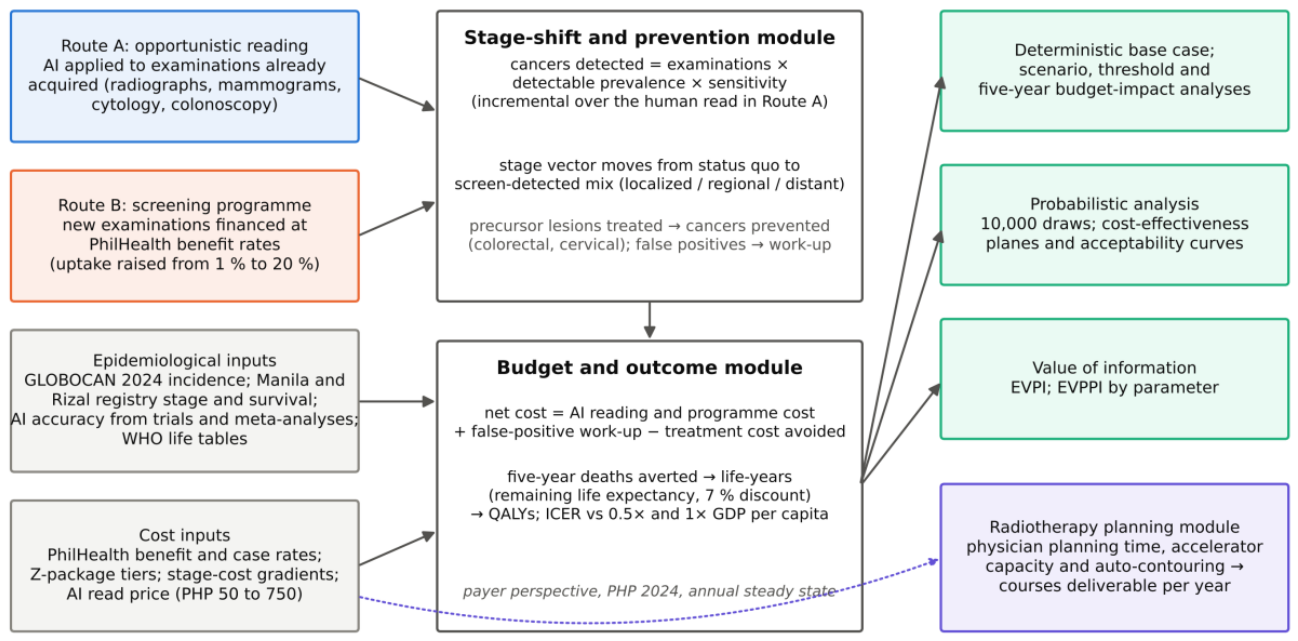
Figure 2.
Stage at diagnosis under the status quo and with AI-supported detection, base case. (A) Opportunistic AI reading of examinations already acquired. (B) AI-supported screening programme at 20% uptake. Bars show the share of incident cases diagnosed with localized, regional and distant disease; the percentage of incident cases detected through the AI pathway is shown in each panel. Status-quo distributions are from the Manila and Rizal population-based registries (breast, colorectal, cervix) and the Lung Center of the Philippines registry (lung).
Figure 2.
Stage at diagnosis under the status quo and with AI-supported detection, base case. (A) Opportunistic AI reading of examinations already acquired. (B) AI-supported screening programme at 20% uptake. Bars show the share of incident cases diagnosed with localized, regional and distant disease; the percentage of incident cases detected through the AI pathway is shown in each panel. Status-quo distributions are from the Manila and Rizal population-based registries (breast, colorectal, cervix) and the Lung Center of the Philippines registry (lung).
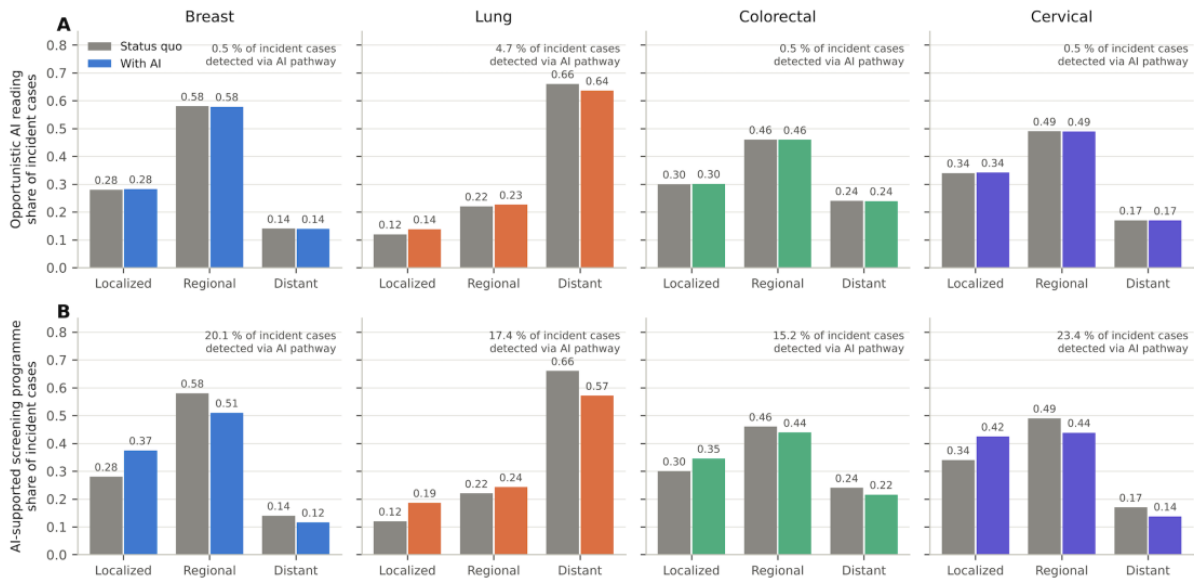
Figure 3.
Components of the net annual cost to the payer by cancer site, base case. (A) Opportunistic AI reading. (B) AI-supported screening programme at 20% uptake. Stacked bars above zero show programme or AI reading cost and the work-up of false positives; bars below zero show treatment cost avoided through stage shift and prevention; diamonds and labels give the net annual cost (PHP billion, 2024 prices). Opportunistic colonoscopy and cervical cytology include the cost of treating detected precursor lesions.
Figure 3.
Components of the net annual cost to the payer by cancer site, base case. (A) Opportunistic AI reading. (B) AI-supported screening programme at 20% uptake. Stacked bars above zero show programme or AI reading cost and the work-up of false positives; bars below zero show treatment cost avoided through stage shift and prevention; diamonds and labels give the net annual cost (PHP billion, 2024 prices). Opportunistic colonoscopy and cervical cytology include the cost of treating detected precursor lesions.
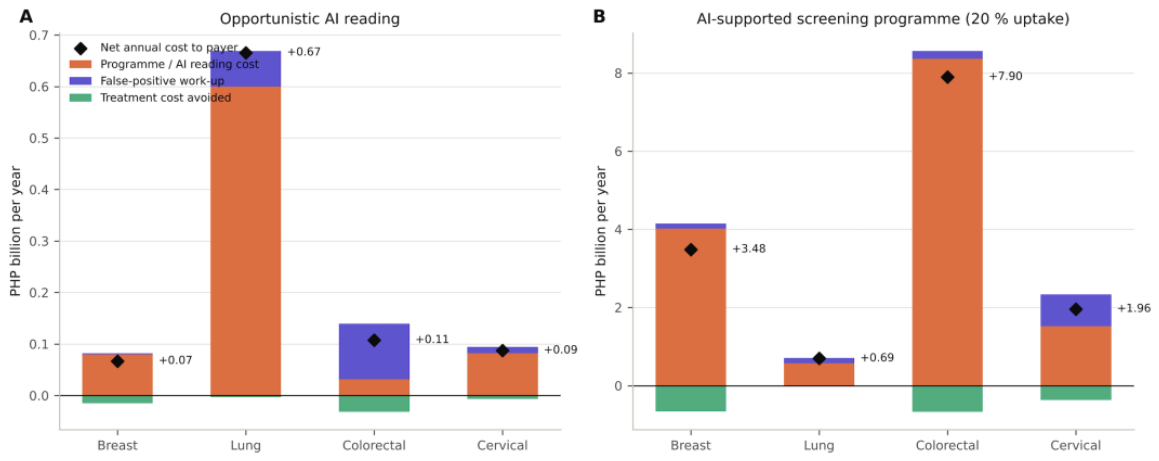
Figure 4.
Cost-effectiveness planes for opportunistic AI reading, 10,000 probabilistic draws. Each point is one draw of incremental QALYs (thousand per year) and incremental cost (PHP billion per year) relative to current human reading; diamonds mark the means. Dashed and dotted lines are willingness-to-pay thresholds of 1× and 0.5× GDP per capita (PHP 228,320 and 114,160 per QALY).
Figure 4.
Cost-effectiveness planes for opportunistic AI reading, 10,000 probabilistic draws. Each point is one draw of incremental QALYs (thousand per year) and incremental cost (PHP billion per year) relative to current human reading; diamonds mark the means. Dashed and dotted lines are willingness-to-pay thresholds of 1× and 0.5× GDP per capita (PHP 228,320 and 114,160 per QALY).
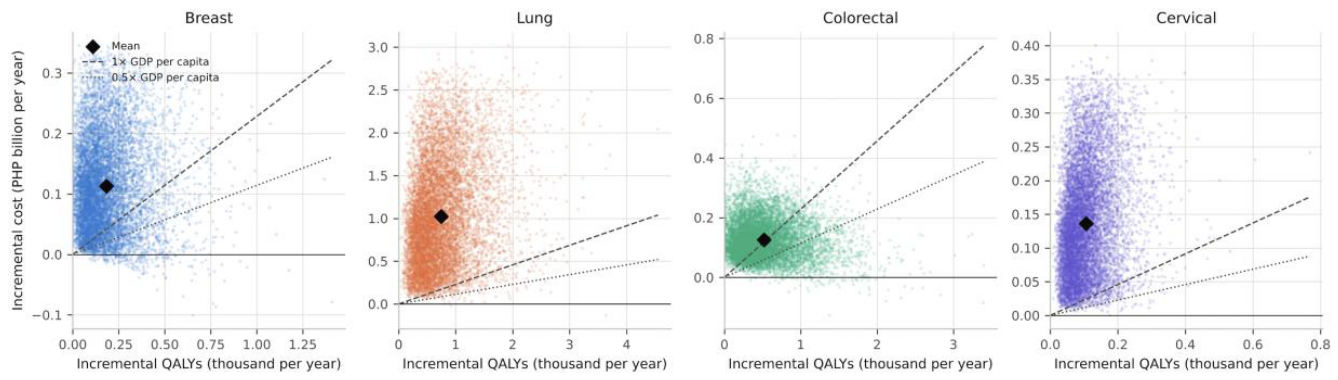
Figure 5.
Cost-effectiveness acceptability curves. (A) Opportunistic AI reading. (B) AI-supported screening programme at 20% uptake. Curves show the probability that each strategy is cost-effective across willingness-to-pay values; vertical lines mark 0.5× (dotted) and 1× (dashed) GDP per capita, and the shaded band spans the supply-side threshold estimates for the Philippines (PHP 84,317–209,411 per QALY). The black curve treats the four sites as a single programme.
Figure 5.
Cost-effectiveness acceptability curves. (A) Opportunistic AI reading. (B) AI-supported screening programme at 20% uptake. Curves show the probability that each strategy is cost-effective across willingness-to-pay values; vertical lines mark 0.5× (dotted) and 1× (dashed) GDP per capita, and the shaded band spans the supply-side threshold estimates for the Philippines (PHP 84,317–209,411 per QALY). The black curve treats the four sites as a single programme.
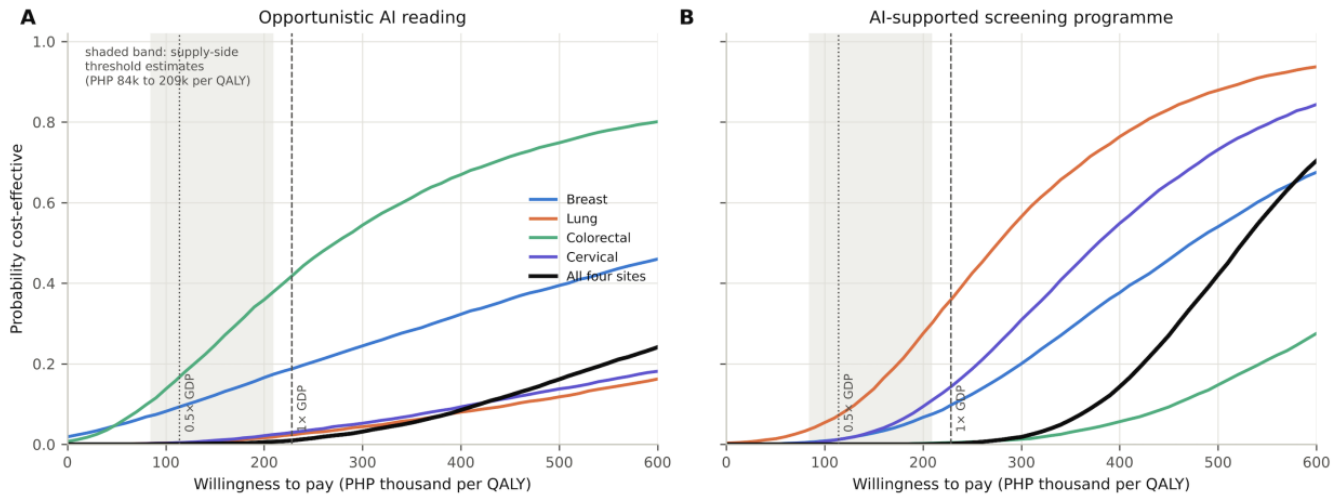
Figure 6.
One-way sensitivity analyses. (A) Lung cancer, opportunistic chest-radiograph reading. (B) Breast cancer, AI-supported mammography programme. Bars show the ICER (PHP thousand per QALY) at the lower (blue) and upper (orange) value of each parameter around the base case (vertical line); dashed and dotted lines mark 1× and 0.5× GDP per capita. Parameters that scale costs and benefits together (examination volume, programme uptake) do not change the ratio.
Figure 6.
One-way sensitivity analyses. (A) Lung cancer, opportunistic chest-radiograph reading. (B) Breast cancer, AI-supported mammography programme. Bars show the ICER (PHP thousand per QALY) at the lower (blue) and upper (orange) value of each parameter around the base case (vertical line); dashed and dotted lines mark 1× and 0.5× GDP per capita. Parameters that scale costs and benefits together (examination volume, programme uptake) do not change the ratio.
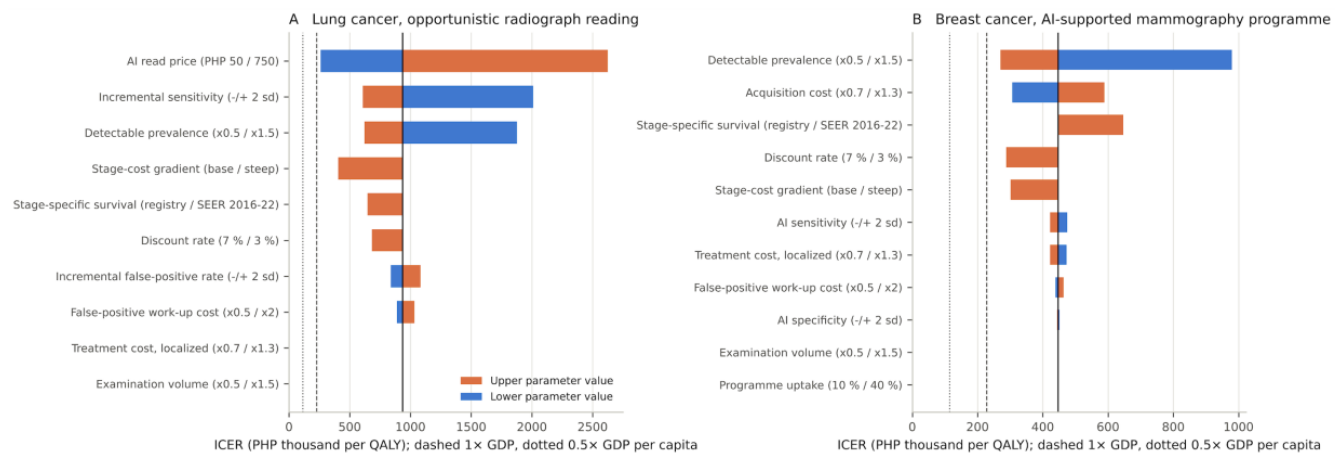
Figure 7.
Threshold analyses. (A) ICER of opportunistic AI reading as a function of the AI read price; vertical dotted lines mark the reported Philippine price of PHP 50 and the base case of PHP 250. (B) ICER of opportunistic reading as a function of the incremental false-positive rate per examination, for lung, cervical and breast cancer. (C) Maximum all-in cost per screening examination (acquisition plus AI read) at which the screening programme meets 1× and 0.5× GDP per capita per QALY, compared with the current PhilHealth rate plus AI read (logarithmic scale; values below PHP 100 shown as <0.1).
Figure 7.
Threshold analyses. (A) ICER of opportunistic AI reading as a function of the AI read price; vertical dotted lines mark the reported Philippine price of PHP 50 and the base case of PHP 250. (B) ICER of opportunistic reading as a function of the incremental false-positive rate per examination, for lung, cervical and breast cancer. (C) Maximum all-in cost per screening examination (acquisition plus AI read) at which the screening programme meets 1× and 0.5× GDP per capita per QALY, compared with the current PhilHealth rate plus AI read (logarithmic scale; values below PHP 100 shown as <0.1).
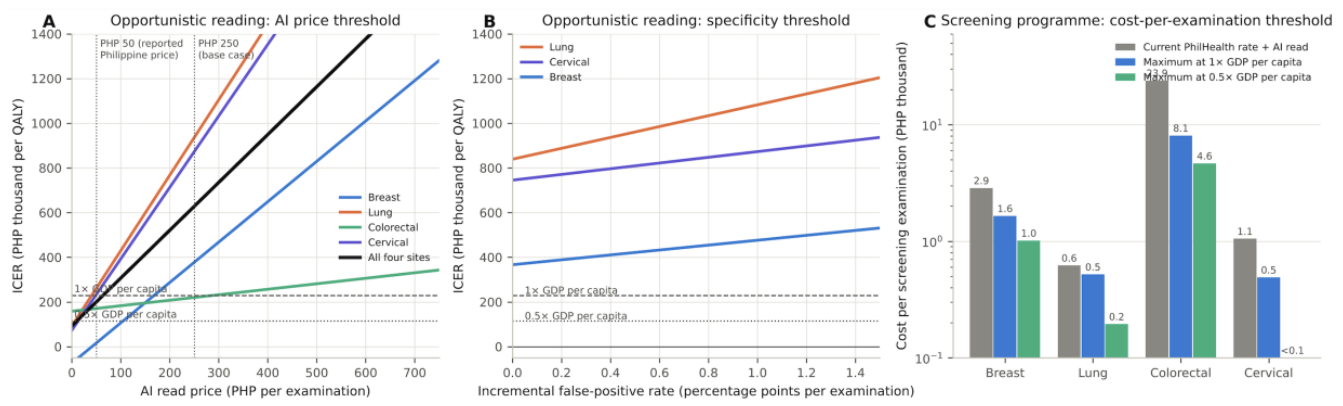
Figure 8.
Value of information for opportunistic AI reading. (A) Expected value of perfect information per year of national decision-making as a function of willingness to pay, by cancer site and for the four sites combined. (B) Expected value of partial perfect information at 1× GDP per capita for individual parameters, estimated by nonparametric regression and stacked by cancer site; parameters with negligible value are omitted.
Figure 8.
Value of information for opportunistic AI reading. (A) Expected value of perfect information per year of national decision-making as a function of willingness to pay, by cancer site and for the four sites combined. (B) Expected value of partial perfect information at 1× GDP per capita for individual parameters, estimated by nonparametric regression and stacked by cancer site; parameters with negligible value are omitted.
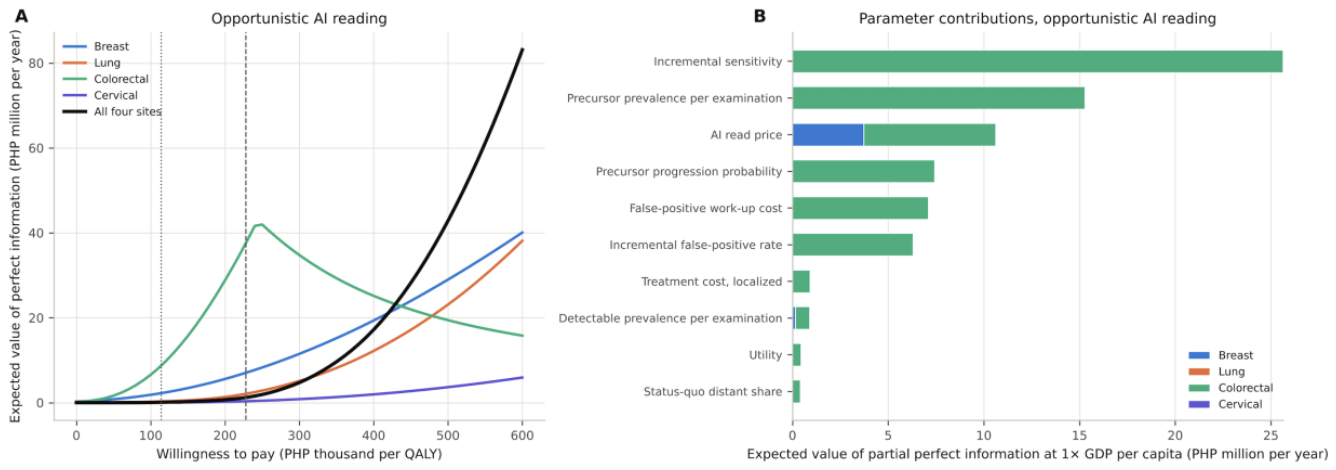
Figure 9.
Radiotherapy courses deliverable per year under current staffing with and without deep-learning auto-contouring. Bars show courses deliverable (the lesser of planning and machine capacity); orange markers show physician planning capacity; the dash-dotted line is machine capacity (53 accelerators at 450 courses each) and the dashed line the estimated need at 53% utilisation of 149,852 incident cancers. Labels give courses deliverable and, in parentheses, the gain over no auto-contouring.
Figure 9.
Radiotherapy courses deliverable per year under current staffing with and without deep-learning auto-contouring. Bars show courses deliverable (the lesser of planning and machine capacity); orange markers show physician planning capacity; the dash-dotted line is machine capacity (53 accelerators at 450 courses each) and the dashed line the estimated need at 53% utilisation of 149,852 incident cancers. Labels give courses deliverable and, in parentheses, the gain over no auto-contouring.
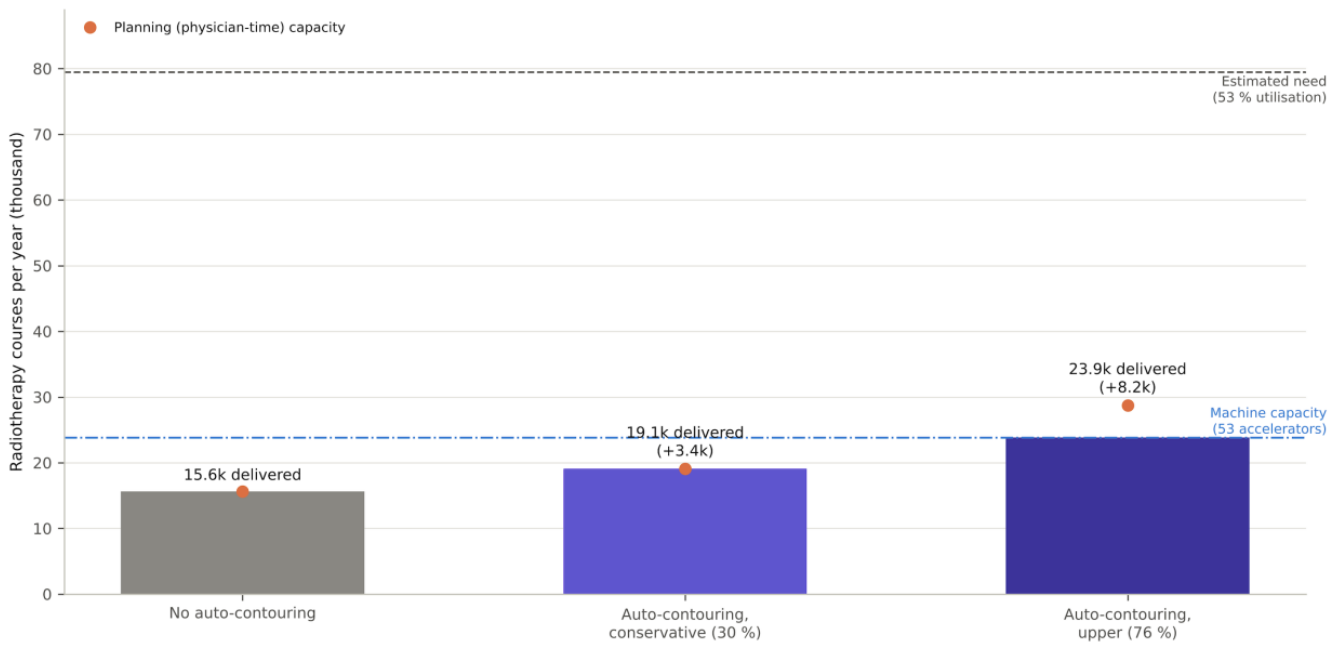

Table 1.
Site-specific model inputs. Values are base-case point estimates; sd, standard deviation used in probabilistic analysis; LCP, Lung Center of the Philippines; PSA, Philippine Statistics Authority; LDCT, low-dose computed tomography. Rows labelled assumption have no Philippine published source and are varied in sensitivity analysis (full provenance in Supplementary Data S1).
Table 1.
Site-specific model inputs. Values are base-case point estimates; sd, standard deviation used in probabilistic analysis; LCP, Lung Center of the Philippines; PSA, Philippine Statistics Authority; LDCT, low-dose computed tomography. Rows labelled assumption have no Philippine published source and are varied in sensitivity analysis (full provenance in Supplementary Data S1).
| Parameter | Breast | Lung | Colorectal | Cervical | Source |
|---|---|---|---|---|---|
| Incidence, 2024 | 28,124 | 15,312 | 17,462 | 7,829 | GLOBOCAN 2024 [1] |
| Deaths, 2024 | 11,160 | 11,715 | 9,302 | 3,389 | GLOBOCAN 2024 [1] |
| Stage at diagnosis, status quo (localized / regional / distant) | 0.28 / 0.58 / 0.14 | 0.12 / 0.22 / 0.66 | 0.30 / 0.46 / 0.24 | 0.34 / 0.49 / 0.17 | Breast: Manila and Rizal registries [4,51]; colorectal: Redaniel et al. [5]; cervix: Laudico & Mapua [4]; lung: LCP registry stage IV share, residual split assumed |
| Stage of AI-detected cases (localized / regional / distant) | 0.75 / 0.23 / 0.02 | 0.50 / 0.35 / 0.15 | 0.60 / 0.32 / 0.08 | 0.70 / 0.27 / 0.03 | Breast: Hernström et al. [21], Han et al. [52]; others: assumption |
| Five-year survival by stage, reference case | 0.68 / 0.37 / 0.10 | 0.45 / 0.26 / 0.07 | 0.64 / 0.31 / 0.11 | 0.63 / 0.30 / 0.07 | Manila and Rizal registries (IARC Sci Pub 162); lung: SEER scaled to Philippine overall survival [6] |
| Five-year survival by stage, scenario | 1.00 / 0.88 / 0.34 | 0.66 / 0.38 / 0.10 | 0.91 / 0.75 / 0.17 | 0.92 / 0.64 / 0.20 | SEER 21, 2016–2022 [53] |
| Treatment cost, localized disease (PHP) | 350,000 | 400,000 | 150,000 | 175,000 | Breast: de Rosas-Valera et al. [54]; colorectal and cervix: PhilHealth Z Benefit rates; lung: assumption |
| Cost gradient, regional / distant vs localized | 1.68 / 1.80 | 1.30 / 1.10 | 2.00 / 2.05 | 2.20 / 2.80 | Breast: Sun et al. [55]; colorectal: Z Benefit tiers, Azzani et al. [56]; cervix: Wu et al. [57]; lung: Zhang et al. [58], LCP treatment pattern |
| AI sensitivity, programme route (sd) | 0.805 (0.02) | 0.72 (0.08) | 0.95 (0.02) | 0.9 (0.04) | Gommers et al. [22]; Adam Essa [59], Nxumalo et al. [60]; Lui, Guo & Leung [61]; Cengiz et al. [62], Liu et al. [63] |
| AI specificity, programme route (sd) | 0.985 (0.0015) | 0.98 (0.01) | 0.88 (0.05) | 0.85 (0.06) | As above; lung programme flag rate from Dao et al. [64], Nam et al. [23] |
| Incremental sensitivity over human read, opportunistic route (sd) | 0.067 (0.03) | 0.3 (0.08) | 0.14 (0.07) | 0.058 (0.014) | Gommers et al. [22]; Nam et al. [23], Ueda et al. [65], Robert et al. [66]; Soleymanjahi et al. [25]; Bao et al. [26] |
| Incremental false-positive rate per examination, opportunistic (sd) | 0.001 (0.0015) | 0.004 (0.003) | 0.18 (0.04) | 0.01 (0.005) | Hernström et al. [21]; Nam et al. [23]; Hassan et al. [24] (non-neoplastic polypectomies per colonoscopy); cervix: assumption |
| Detectable cancer per examination, opportunistic / programme | 6 / 5 per 1,000 | 1 / 4 per 1,000 | 5 / 8 per 1,000 | 2 / 1.5 per 1,000 | Lung: Dao et al. [64]; breast: bracketed by Yao et al. [67], Lee et al. [68], Hernström et al. [21]; colorectal and cervix: assumption |
| Precursor lesions per examination, opportunistic / programme | — | — | 30 / 30 per 1,000 | 6 / 5 per 1,000 | Colorectal: Yeoh et al. [69]; cervix: bracketed by Zhu et al. [70], Waiketkarn et al. [71], African AVE Collaborative [27] |
| Progression of precursor to cancer (lag, years) | — | — | 0.30 (5) | 0.20 (10) | Brenner et al. [72]; McCredie et al. [73] |
| Examinations already acquired per year (opportunistic) | 400,000 | 3,000,000 | 150,000 | 400,000 | Assumption; no national counts published (varied ±50%) |
| Eligible population (programme) | 14.79 M | 4.87 M | 18.35 M | 21.44 M | PSA 2024 projections: women 40–69; 25% of adults 50–79; adults 50–74; women 30–64 |
| Screening interval, years (programme) | 2 | 1 | 10 | 3 | PhilHealth PC 2025-0014, PC 2025-0024, PC 2025-0027; cytology: assumption |
| Acquisition cost per examination, PHP (programme) | 2,610 | 370 | 23,640 | 800 | PhilHealth PC 2025-0014; chest radiograph: de Rosas-Valera et al. [54]; cytology: assumption |
| False-positive work-up cost, PHP | 6,100 | 7,220 | 5,000 | 4,000 | PhilHealth case rates (biopsy; LDCT); colorectal and cervix: assumption |
| Precursor treatment cost, PHP | — | — | 3,000 | 15,000 | Assumption |
| Mean age at diagnosis, years | 51.4 | 59.9 | 58.8 | 49.8 | Redaniel et al. [6] |
| Remaining life expectancy at that age, years | 24.1 | 14.9 | 15.6 | 24.9 | WHO life tables, Philippines 2021 |
Table 2.
Global inputs and analytic settings. GDP, gross domestic product; QALY, quality-adjusted life-year; HTAC, Health Technology Assessment Council.
Table 2.
Global inputs and analytic settings. GDP, gross domestic product; QALY, quality-adjusted life-year; HTAC, Health Technology Assessment Council.
| Parameter | Value | Source |
|---|---|---|
| Perspective | Publicly funded health-care payer (PhilHealth and Department of Health) | Department of Health [44] |
| Price year and currency | 2024 Philippine pesos; PHP 57.29 = USD 1 | World Bank [48] |
| Discount rate, costs and outcomes | 7% per year (3% in scenario analysis) | Department of Health [44] |
| Cost-effectiveness benchmarks | 0.5× and 1× GDP per capita: PHP 114,160 and PHP 228,320 per QALY; supply-side estimates PHP 84,317 (mean) and PHP 209,411 (median) | HTAC [18,45]; World Bank [47]; Gloria et al. [46] |
| AI read price per examination | PHP 250 (uniform PHP 50–750 in probabilistic analysis) | Sampang [36]; Vargas-Palacios et al. [40]; Moger et al. [41] |
| Share of already-acquired examinations routed through AI | 80% | Assumption |
| Programme uptake, baseline / with programme | 1% / 20% (5–50% in sweep) | Ulep [9]; assumption |
| Health-state utility applied to life-years gained | 0.80 (uniform 0.70–0.90) | Assumption |
| Mean time to death among five-year decedents | 2.5 years | Assumption |
| Radiation oncologists / linear accelerators | 125 / 53 | Cañal et al. [10] |
| Courses per accelerator-year | 450 | Mid-point of 200–900 patients per centre [11] |
| Physician planning hours per course / available hours per year / contouring share | 4 / 500 / 60% | Assumptions |
| Auto-contouring time saving | 30% (conservative), 76% (upper) | Chen et al. [30]; Lucido et al. [28] |
| Optimal radiotherapy utilisation | 53% of incident cancers | Flores et al. [11] |
| Radiotherapy course cost | PHP 115,500 (25 sessions × PHP 3,900 + PHP 18,000 planning) | PhilHealth [74,75] |
| Probabilistic draws / random seed | 10,000 per cancer and route / 2026 | — |
Table 3.
Deterministic base case: annual costs and outcomes by cancer site and deployment route (2024 PHP; costs and outcomes discounted at 7%; AI read price PHP 250). Programme cost includes treatment of detected precursor lesions. Life-years and QALYs are discounted; ICER, incremental cost-effectiveness ratio; M, million.
Table 3.
Deterministic base case: annual costs and outcomes by cancer site and deployment route (2024 PHP; costs and outcomes discounted at 7%; AI read price PHP 250). Programme cost includes treatment of detected precursor lesions. Life-years and QALYs are discounted; ICER, incremental cost-effectiveness ratio; M, million.
| Cancer | Examinations (thousand) | Cancers detected earlier | Cancers prevented | AI reading / programme cost (PHP M) | False positives | Work-up cost (PHP M) | Treatment cost avoided (PHP M) | Net cost (PHP M) | Deaths averted | Life-years | QALYs | ICER (PHP thousand per QALY) |
|---|---|---|---|---|---|---|---|---|---|---|---|---|
| Opportunistic AI reading | ||||||||||||
| Breast | 320 | 129 | — | 80 | 318 | 2 | 15 | 67 | 23 | 221 | 177 | 378 |
| Lung | 2,400 | 720 | — | 600 | 9,590 | 69 | 3 | 666 | 122 | 889 | 711 | 936 |
| Colorectal | 120 | 84 | 151 | 32 | 21,492 | 107 | 32 | 107 | 108 | 610 | 488 | 220 |
| Cervical | 320 | 37 | 22 | 82 | 3,194 | 13 | 7 | 87 | 20 | 125 | 100 | 873 |
| All four sites | 3,160 | 970 | 173 | 793 | 34,594 | 191 | 57 | 927 | 272 | 1,845 | 1,476 | 628 |
| AI-supported screening programme, 20% uptake | ||||||||||||
| Breast | 1,405 | 5,655 | — | 4,018 | 20,970 | 128 | 662 | 3,484 | 1,007 | 9,731 | 7,785 | 448 |
| Lung | 925 | 2,665 | — | 574 | 18,432 | 133 | 13 | 694 | 451 | 3,290 | 2,632 | 264 |
| Colorectal | 349 | 2,650 | 2,981 | 8,359 | 41,503 | 208 | 668 | 7,898 | 2,252 | 13,026 | 10,421 | 758 |
| Cervical | 1,358 | 1,833 | 1,222 | 1,517 | 203,374 | 813 | 371 | 1,959 | 1,043 | 6,560 | 5,248 | 373 |
| All four sites | 4,037 | 12,803 | 4,203 | 14,469 | 284,280 | 1,282 | 1,715 | 14,036 | 4,753 | 32,606 | 26,085 | 538 |
Table 4.
Probabilistic sensitivity analysis, 10,000 draws per cancer site and route. Intervals are 2.5th–97.5th percentiles; P, probability; thresholds 0.5× and 1× GDP per capita are PHP 114,160 and PHP 228,320 per QALY. The combined row treats the four sites as one programme.
Table 4.
Probabilistic sensitivity analysis, 10,000 draws per cancer site and route. Intervals are 2.5th–97.5th percentiles; P, probability; thresholds 0.5× and 1× GDP per capita are PHP 114,160 and PHP 228,320 per QALY. The combined row treats the four sites as one programme.
| Cancer | Mean net cost (PHP M) | 95% interval (PHP M) | Mean QALYs | 95% interval | Mean deaths averted | ICER of means (PHP thousand per QALY) | P(cost-saving) | P(cost-effective at 0.5× GDP) | P(cost-effective at 1× GDP) |
|---|---|---|---|---|---|---|---|---|---|
| Opportunistic AI reading | |||||||||
| Breast | 113 | 3 to 283 | 183 | 15 to 533 | 24 | 618 | 0.02 | 0.09 | 0.19 |
| Lung | 1,023 | 175 to 2,350 | 748 | 181 to 1,889 | 128 | 1,368 | 0.00 | 0.00 | 0.02 |
| Colorectal | 126 | 26 to 274 | 517 | 3 to 1,450 | 114 | 244 | 0.01 | 0.17 | 0.42 |
| Cervical | 136 | 23 to 311 | 106 | 30 to 248 | 21 | 1,288 | 0.00 | 0.00 | 0.03 |
| All four sites | 1,399 | 496 to 2,737 | 1,554 | 647 to 2,949 | 287 | 900 | 0.00 | 0.00 | 0.01 |
| AI-supported screening programme, 20% uptake | |||||||||
| Breast | 3,449 | 2,005 to 4,831 | 8,067 | 2,856 to 17,170 | 1,044 | 427 | 0.00 | 0.01 | 0.10 |
| Lung | 705 | 276 to 1,181 | 2,776 | 1,013 to 5,942 | 475 | 254 | 0.00 | 0.07 | 0.36 |
| Colorectal | 7,890 | 5,640 to 10,532 | 11,015 | 4,889 to 21,119 | 2,386 | 716 | 0.00 | 0.00 | 0.00 |
| Cervical | 1,982 | 1,115 to 3,197 | 5,484 | 2,449 to 10,566 | 1,098 | 361 | 0.00 | 0.01 | 0.14 |
| All four sites | 14,026 | 11,100 to 17,283 | 27,342 | 17,337 to 41,614 | 5,003 | 513 | 0.00 | 0.00 | 0.00 |
Table 5.
Scenario analyses. Each scenario changes one assumption relative to the reference case; all other inputs as in Table 1 and Table 2.
| Analysis | Route | Net annual cost (PHP billion) | Deaths averted | QALYs | ICER, four sites (PHP thousand per QALY) | ICER by site: breast / lung / colorectal / cervical (PHP thousand per QALY) |
|---|---|---|---|---|---|---|
| Reference case (7% discount, Sun et al. gradient, registry survival, AI read PHP 250) | Opportunistic | 0.93 | 272 | 1,476 | 628 | 378 / 936 / 220 / 873 |
| Reference case (7% discount, Sun et al. gradient, registry survival, AI read PHP 250) | Programme | 14.04 | 4,753 | 26,085 | 538 | 448 / 264 / 758 / 373 |
| Discount rate 3% | Opportunistic | 0.92 | 272 | 2,254 | 408 | 243 / 682 / 126 / 432 |
| Discount rate 3% | Programme | 13.83 | 4,753 | 43,172 | 320 | 288 / 192 / 459 / 178 |
| Steep stage-cost gradient (1 : 2.57 : 4.00) | Opportunistic | 0.50 | 272 | 1,476 | 341 | 231 / 404 / 186 / 849 |
| Steep stage-cost gradient (1 : 2.57 : 4.00) | Programme | 10.99 | 4,753 | 26,085 | 421 | 301 / -268 / 721 / 350 |
| SEER 2016–2022 stage-specific survival | Opportunistic | 0.93 | 269 | 1,526 | 608 | 546 / 646 / 362 / 1,129 |
| SEER 2016–2022 stage-specific survival | Programme | 14.04 | 3,447 | 19,886 | 706 | 647 / 182 / 1,178 / 492 |
| AI read price PHP 50 | Opportunistic | 0.30 | 272 | 1,476 | 200 | 16 / 261 / 171 / 233 |
| AI read price PHP 50 | Programme | 13.23 | 4,753 | 26,085 | 507 | 411 / 193 / 751 / 322 |
Table 6.
Radiotherapy planning capacity with and without deep-learning auto-contouring. Need is 53% of 149,852 incident cancers (79,422 courses); course cost PHP 115,500.
Table 6.
Radiotherapy planning capacity with and without deep-learning auto-contouring. Need is 53% of 149,852 incident cancers (79,422 courses); course cost PHP 115,500.
| Scenario | Planning capacity (courses per year) | Machine capacity (courses per year) | Courses deliverable | Additional courses | Unmet need vs 53% utilisation | Additional treatment expenditure (PHP billion per year) |
|---|---|---|---|---|---|---|
| No auto-contouring | 15,625 | 23,850 | 15,625 | 0 | 63,797 | 0.00 |
| Auto-contouring, conservative (30 %) | 19,055 | 23,850 | 19,055 | 3,430 | 60,367 | 0.40 |
| Auto-contouring, upper (76 %) | 28,722 | 23,850 | 23,850 | 8,225 | 55,572 | 0.95 |
Disclaimer/Publisher’s Note: The statements, opinions and data contained in all publications are solely those of the individual author(s) and contributor(s) and not of MDPI and/or the editor(s). MDPI and/or the editor(s) disclaim responsibility for any injury to people or property resulting from any ideas, methods, instructions or products referred to in the content. |
© 2026 by the authors. Licensee MDPI, Basel, Switzerland. This article is an open access article distributed under the terms and conditions of the Creative Commons Attribution (CC BY) license (http://creativecommons.org/licenses/by/4.0/).
Copyright: This open access article is published under a Creative Commons CC BY 4.0 license, which permit the free download, distribution, and reuse, provided that the author and preprint are cited in any reuse.