
Submitted:
30 October 2026
Posted:
02 November 2026
You are already at the latest version
Abstract
Decay centrality is a parameter-dependent distance-based centrality measure, and a graph is called decay-stable when the induced ranking of its vertices is independent of the decay parameter. Building on our earlier result that almost all trees are decay-unstable, we study connected unicyclic graphs. We first prove a pendant reduction which replaces the part of the graph outside a fixed pendant tree by a single path while preserving all eccentricities inside the tree. This yields a local sufficient criterion for decay-instability in a tree attached to the unique cycle. In particular, a pendant copy of K1,3 attached to the rest of the graph through one of its leaves forces decay-instability. Combining this local obstruction with the classical enumeration of labelled unicyclic graphs and a pendant-appearance theorem of McDiarmid, we prove that the proportion of decay-stable connected labelled unicyclic graphs tends to zero. Thus almost all connected labelled unicyclic graphs are decay-unstable. We conclude with remarks on possible extensions to cactus graphs.
Keywords:
decay stability
; unicyclic graphs
; pendant appearances
; cactus graphs
MSC: 05C80; 05C12; 05C07
1. Introduction
Centrality measures are a basic tool for identifying important vertices in a network. Among the classical distance-based measures, closeness centrality ranks vertices according to their distances from the remaining vertices. Decay centrality provides a related parameter-dependent measure in which a vertex at distance i contributes , where . Consequently, the ranking of the vertices may depend on the choice of the decay parameter .
A graph is called decay-stable if its ranking by decay centrality is independent of , and decay-unstable otherwise. Earlier work established structural criteria for decay-instability and proved that almost all trees are decay-unstable [1]. The present paper studies the next natural class, namely connected unicyclic graphs.
Our main structural contribution is local. For a tree attached to the unique cycle, we show that the rest of the graph can be replaced, for the purpose of computing eccentricities inside that tree, by a single pendant path of an appropriate length. This reduction leads to a branch criterion: a degree increase along a parent-child edge sufficiently far from the attachment vertex forces the eccentricity to increase in the same direction and therefore certifies decay-instability. Importantly, this criterion does not require a case distinction according to the position of the center.
We also recall the classical theorem of Harary and Norman that the center of a connected graph lies in a single block, together with Truszczyński’s characterization of the possible centers of unicyclic graphs. These results provide useful structural context for the local analysis.
For the asymptotic result we use a different mechanism. A particularly small pendant configuration, namely a copy of attached to the rest of the graph through one of its leaves, already forces decay-instability. The class of connected labelled unicyclic graphs has growth constant e, and the Pendant Appearances Theorem implies that a uniformly random graph from this class contains such a configuration with probability tending to one. This gives a short proof that almost all connected labelled unicyclic graphs are decay-unstable.
The paper is organized as follows. Section 2 reviews the relevant literature, and Section 3 fixes notation and recalls the decay-instability criterion used throughout. Section 4 contains the structural results for unicyclic graphs, the pendant reduction, the local instability criterion, and the proof of the asymptotic result. Section 5 summarizes the results and discusses possible extensions to cactus graphs.
2. Related Work
Decay centrality is a distance-based centrality measure in which the contribution of a vertex decreases geometrically with its distance from the vertex under consideration. Related formulations appear in the network formation model of Jackson and Wolinsky [2] and in the work of Dangalchev on generalized closeness [3].
Yang and Zhuhadar [4] observed that rankings arising from generalized closeness may depend on the decay parameter. Coroničová Hurajová, Gago, and Madaras [5] studied this phenomenon systematically and formulated several questions concerning decay-stability. Rupnik Poklukar and Žerovnik [6] further studied decay-stability and disproved two conjectures by showing that certain graph products are decay-unstable.
Most relevant for the present paper is our recent work on trees [1]. There we proved that almost all trees are decay-unstable. The proof uses a level-by-level construction of rooted trees, a central decomposition of arbitrary trees, and the fact that monotonic rooted trees form an asymptotically negligible subfamily for fixed root eccentricity. We also established the simple sufficient criterion recalled as Theorem 1 below. In the present paper the same criterion is combined with a local pendant reduction; the asymptotic argument then uses a pendant-appearance theorem for labelled graph classes rather than a new level-by-level enumeration.
The location of the center in unicyclic graphs is well understood. Back in 1953, Harary and Norman [7] proved that the center of every connected graph is contained in a single block. Truszczyński [8] later gave a complete characterization of the induced subgraphs of the unique cycle that can occur as centers of unicyclic graphs. We recall these results as structural background for study of unicyclic graphs.
For the asymptotic argument we use the theory of pendant appearances in random labelled graph classes. McDiarmid [9] gives a general Pendant Appearances Theorem: under a growth-constant hypothesis, a fixed attachable rooted connected graph occurs linearly many times as a pendant appearance with probability tending to one.
3. Basic Definitions
Throughout, denotes a finite, simple, connected graph. For , let denote the degree of v, and for let denote the length of a shortest path in G.
Definition 1.
Let G be a connected graph. Theeccentricityof a vertex is
Theradiusanddiameterof G are, respectively,
Thecenterof G is
A vertex v of a connected graph is a cut vertex if has more connected components than G. A block of G is a maximal connected subgraph with no cut vertex. We use the standard convention that a bridge together with its two endvertices is also a block.
Definition 2.
A connected graph isunicyclicif it contains exactly one cycle. A connected graph G is acactusif every edge belongs to at most one cycle. Equivalently, any two cycles of a cactus have at most one vertex in common.
Every unicyclic graph is therefore a cactus. If G is unicyclic and is its unique cycle, deleting the edges of leaves a collection of trees, one rooted at each vertex of the cycle. This decomposition will be used throughout Section 4.
For and , let
Thus
is the distance-degree sequence of v.
Definition 3.
Let . Thedecay centralityof a vertex is
The graph G isdecay-stableif, for every pair of vertices , one of the inequalities
or
holds. Otherwise G isdecay-unstable.
In other words, G is decay-unstable if there are two vertices u, v for which there exist such that and . The definition implies the following sufficient condition for decay-instability that will be used in continuation.
Theorem 1
Thus we seek pairs of vertices for which eccentricity and degree increase in the same direction. The presence of a cycle makes the behaviour of eccentricity less rigid than in a tree; the next section develops a local reduction that restores enough tree structure for Theorem 1 to be applied.
4. Decay-Instability of Unicyclic Graphs
4.1. Structure and Centers of Unicyclic Graphs
We first recall a classical result of Harary and Norman.
Theorem 2
(Harary and Norman [7]). Let G be a connected graph. Then the center is contained in a single block of G.
For a cactus this has a particularly simple interpretation: every nontrivial block is either a bridge edge or a cycle. Hence the center of a connected cactus is contained in the vertex set of some bridge block or of some cycle block.
Now let G be a connected unicyclic graph, and let
be its unique cycle. Removing the edges of leaves k tree components. For each , let denote the component containing , regarded as a rooted tree with root . Thus
where a trivial consists only of its root .
By Theorem 2, the center is contained in the vertex set of either a bridge block or the unique cycle. In particular, if it is contained in a bridge block then . When the center is contained in the cycle, its possible configurations were completely characterized by Truszczyński.
Theorem 3
(Truszczyński [8]). Let be a cycle, and let S be a nonempty subset of . There exists a unicyclic graph G with unique cycle whose set of central vertices is exactly S if and only if the following condition holds:
- 1.
- if k is even, there is no additional restriction on S;
- 2.
- if k is odd, then for every three-vertex path in ,
Truszczyński formulates the result in terms of the subgraph induced by the central vertices; Theorem 3 is the equivalent set-theoretic formulation used here. In particular, the fact that central vertices on the cycle need not occur in a symmetric configuration is illustrated by several examples in [8].
4.2. Pendant Reduction
We first record a local reduction that replaces the part of the graph outside a pendant tree by a single path. It gives a useful sufficient criterion for decay-instability and will also provide the local obstruction used in the asymptotic argument.
Call an induced subtree R of a connected graph G x-pendant if and every path from a vertex of to a vertex of passes through x. Equivalently, is a union of components of . Each rooted tree in the unicyclic decomposition above is -pendant.
Lemma 1.
Let R be an x-pendant tree in a connected graph G, and define
and
Let be the tree obtained from R by attaching at x a new pendant path
of length ; when , no new edge is added and . Then
Proof.
Fix . Because R is induced and x-pendant, a shortest path in G between two vertices of R cannot leave R: such a path would have to leave and re-enter through x. Hence distances between vertices of R are the same in G, R, and .
Since R is x-pendant, every path from w to a vertex
passes through x. Therefore
and hence
Consequently,
□
4.3. A Local Criterion in an Attached Tree
We apply Lemma 1 to one of the rooted trees attached to the unique cycle. For such a tree R rooted at a cycle vertex , put
Theorem 4.
Let G be a connected unicyclic graph, let , and let R be the rooted tree attached at . Let be as in Lemma 1, and define as above. Suppose that R contains an edge , where u is the parent of v, such that
Then G is decay-unstable.
Proof.
Put
so that . By Lemma 1,
so it suffices to compare the eccentricities of u and v in the tree .
Let be the endpoint of the pendant path added at . Then
and therefore
Let satisfy
If the path does not contain v, then the path in the tree passes through u, and hence
Thus .
Suppose instead that the path contains v. Then lies in the component of containing v, and hence
It follows that
Since , so
Therefore in all cases
Together with , Theorem 1 implies that G is decay-unstable. □
Remark 1.
We call the vertices of R at distance less than from theinner zoneof R. If , then , so the zone is empty and every parent-child edge satisfying
is covered by Theorem 4. If , only edges whose parent lies at distance less than from are not covered. Since
the uncovered part has bounded depth whenever the height of R is bounded. The theorem makes no assertion about the ordering of eccentricities inside the inner zone.
Remark 2.
Theorem 4 is a sufficient criterion, not a characterization of decay-instability. A unicyclic graph may be decay-unstable because of a pair lying in different attached trees, a pair involving cycle vertices, or another pair not detected by this theorem. The asymptotic argument below will use a particularly simple pendant configuration detected directly by Lemma 1.
4.4. Asymptotic Instability
We now combine the pendant reduction with a standard result on pendant appearances in random labelled graph classes.
Let denote the class of connected unicyclic graphs. For , let be the set of graphs in with vertex set , and put . The classical enumeration of connected labelled unicyclic graphs gives
see, for example, [10]. By Stirling’s formula,
We use the following terminology of McDiarmid [9].
Definition 4.
Let be a graph class, and let denote the graphs in with vertex set . We say that has agrowth constantγ, where , if
Definition 5.
Let be a connected graph H with a specified root r. Apendant appearanceof in a graph G is an induced copy of H on a vertex set W such that there is exactly one edge between W and , and the endpoint of this edge in W corresponds to r.
The rooted graph isattachableto a graph class if, whenever G has a pendant appearance of on W and , then .
Let be the rooted tree obtained from by choosing one of its leaves as the root. Then is attachable to : attaching this tree by one link edge to a connected unicyclic graph preserves connectedness and creates no additional cycle.
Figure 1 shows an example of a pendant appearance of the rooted graph used in the asymptotic argument. The induced subgraph on the highlighted vertices is a copy of , the root is the leaf x, and the only edge linking this copy to the rest of the unicyclic graph is incident with x.
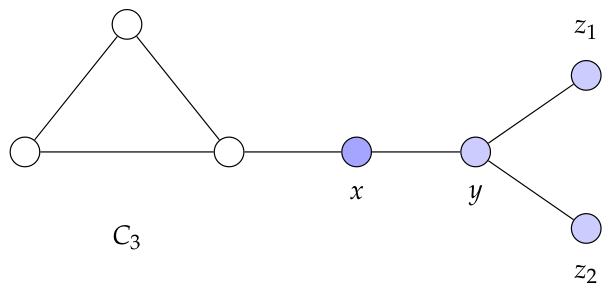
The smallest possible unicyclic part outside the pendant copy is a triangle. Even in this case, if the root is attached directly to a vertex of the triangle, there is a vertex outside the pendant copy at distance two from the root. Observe also that every connected unicyclic graph containing a pendant edge has diameter at least two. See Figure 2.
Lemma 2.
If a connected unicyclic graph G contains a pendant appearance of , then G is decay-unstable.
Proof.
Let x be the root of the pendant copy, let y be its vertex of degree three, and let R denote this copy of . Since x has one neighbour in R and is incident with the unique link edge, while y has three neighbours in R,
The tree R is x-pendant and has height . The unique edge joining R to the rest of G is a bridge, so the unique cycle of G lies entirely outside R. Hence there is a vertex outside R at distance at least two from x, and therefore
Apply Lemma 1. Since , the reduced tree satisfies
Moreover, the vertex y is adjacent to x, so its distance to the end of the added path is , and hence
By Lemma 1,
Together with
Theorem 1 implies that G is decay-unstable. □
Theorem 5.
The proportion of decay-stable connected labelled unicyclic graphs on n vertices tends to zero as . Equivalently, almost all connected labelled unicyclic graphs are decay-unstable.
Proof.
As shown above, has growth constant e and is attachable to . The Pendant Appearances Theorem recalled in [9] therefore implies that there exists a constant such that a uniformly random graph from contains more than pendant appearances of with probability tending to one as . In particular, the probability that it contains at least one such appearance tends to one.
By Lemma 2, every graph containing such an appearance is decay-unstable. Hence the proportion of decay-stable graphs in tends to zero. □
5. Conclusion and Further Work
We studied decay-instability in connected unicyclic graphs from both a local and an asymptotic point of view. The pendant reduction of Lemma 1 replaces the part of the graph outside a fixed pendant tree by a single path while preserving eccentricities inside the tree. This yields the local criterion of Theorem 4.
For the asymptotic result, only a very small local obstruction is needed: a pendant copy of attached through one of its leaves is already enough to force decay-instability. The classical enumeration of labelled unicyclic graphs shows that the corresponding graph class has growth constant e, and the Pendant Appearances Theorem implies that such a configuration occurs with probability tending to one. Consequently, almost all connected labelled unicyclic graphs are decay-unstable.
The same pendant reduction applies without change in more general connected graphs, and in particular in cactus graphs. This suggests that pendant appearances may also provide a natural route toward asymptotic decay-instability results for broader cactus classes. We believe that this may be a promising avenue for future work.
Author Contributions
Both authors contributed equally to this work.
Funding
The second author (J.Z.) was partially supported by ARIS (the Research Agency of Slovenia) through the annual work program of Rudolfovo and by the ARIS research grants P2-0248 and L1-60136. This work was also supported in part by the Horizon Europe project Quantum Excellence Centre for Quantum-Enhanced Applications (QEC4QEA).
Data Availability Statement
No data were generated by this study.
Conflicts of Interest
The authors declare no conflicts of interest.
References
- Rupnik Poklukar, D.; Žerovnik, J. Almost all trees are decay-unstable. Math. Scand. 2026, 132(1), 1–16. [Google Scholar] [CrossRef]
- Jackson, M.O.; Wolinsky, A. A strategic model of social and economic networks. J. Econ. Theory 1996, 71(1), 44–74. [Google Scholar] [CrossRef]
- Dangalchev, C. Residual closeness and generalized closeness. Int. J. Found. Comput. Sci. 2011, 22(8), 1939–1948. [Google Scholar] [CrossRef]
- Yang, R.; Zhuhadar, L. Extensions of closeness centrality? In Proceedings of the 49th Annual Southeast Regional Conference, ACM, New York, NY, USA, 2011; pp. 304–305. [Google Scholar] [CrossRef]
- Coroničová Hurajová, J.; Gago, S.; Madaras, T. On decay centrality in graphs. Math. Scand. 2018, 123(1), 39–50. [Google Scholar] [CrossRef]
- Rupnik Poklukar, D.; Žerovnik, J. Generalized closeness and decay stability of some graphs. Mathematics 2025, 13(6), 939. [Google Scholar] [CrossRef]
- Harary, F.; Norman, R.Z. The dissimilarity characteristic of Husimi trees. Ann. Math. 1953, 58(1), 134–141. [Google Scholar] [CrossRef]
- Truszczyński, M. Centers and centroids of unicyclic graphs. Math. Slovaca 1985, 35(3), 223–228. [Google Scholar]
- McDiarmid, C. Pendant appearances and components in random graphs from structured classes. Eur. J. Comb. 2024, 120, 103994. [Google Scholar] [CrossRef]
- Wright, E.M. The number of connected sparsely edged graphs. J. Graph Theory 1977, 1(4), 317–330. [Google Scholar] [CrossRef]
Figure 1.
An example of a pendant appearance of the rooted graph in a unicyclic graph. Here , the root is the leaf x, and the unique edge joining the copy to the rest of the graph is incident with the root.
Figure 1.
An example of a pendant appearance of the rooted graph in a unicyclic graph. Here , the root is the leaf x, and the unique edge joining the copy to the rest of the graph is incident with the root.
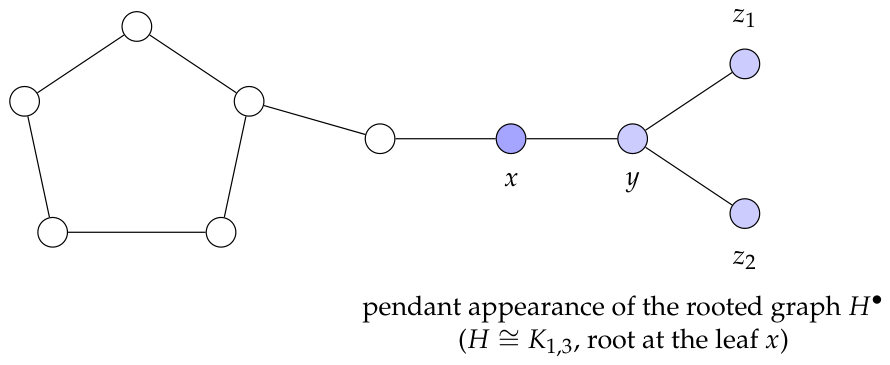
Figure 2.
A smallest unicyclic example containing a pendant appearance of . The root x is attached directly to a vertex of , so the other two cycle vertices are at distance two from x.
Figure 2.
A smallest unicyclic example containing a pendant appearance of . The root x is attached directly to a vertex of , so the other two cycle vertices are at distance two from x.
Disclaimer/Publisher’s Note: The statements, opinions and data contained in all publications are solely those of the individual author(s) and contributor(s) and not of MDPI and/or the editor(s). MDPI and/or the editor(s) disclaim responsibility for any injury to people or property resulting from any ideas, methods, instructions or products referred to in the content. |
© 2026 by the authors. Licensee MDPI, Basel, Switzerland. This article is an open access article distributed under the terms and conditions of the Creative Commons Attribution (CC BY) license.
Copyright: This open access article is published under a Creative Commons CC BY 4.0 license, which permit the free download, distribution, and reuse, provided that the author and preprint are cited in any reuse.