

Submitted:
30 October 2026
Posted:
02 November 2026
You are already at the latest version
Abstract
The purpose of this systematic literature review (SLR) was to use the Preferred Reporting Items for Systematic Reviews and Meta-Analyses (PRISMA) framework to systematically evaluate the literature on FLID and identify emerging research gaps. A systematic search was conducted in two major academic databases (Scopus & Web of Science) using predefined inclusion or exclusion criteria. The dominant theoretical frameworks identified are the Agency Theory and Impression Management Theory to explain the board's dual role to monitor and control agent behaviour while controlling and managing strategic representation through dissemination of future-oriented information and management of agency cost and information asymmetry. Other relevant theoretical frameworks include the Resource-Based View theory which provides insight into how internal resources affect FLID, Legitimacy theory which explains how stakeholder expectations affect FLID and Signalling theory which informs how information asymmetries influence FLID. The majority of previous studies on FLID were conducted in developed countries specifically in the United States. Research on this topic in developing countries such as Malaysia appears to be underrepresented. This study has identified several avenues for the potential use of alternative communication methods with respect to the examination of FLID in a post COVID-19 world that may include increased levels of uncertainty.
Keywords:
FLI
; FLID
; agency theory
; impression management theory
; corporate disclosure
1. Introduction
Traditional corporate reporting has been criticised for its historical nature. Historical information is incapable of providing stakeholders with satisfactory insights from a forward-looking perspective (Menicucci & Paolucci, 2018). Therefore, companies voluntarily disclose forward-looking information (FLI) to reduce the information gap between management and stakeholders (Menicucci & Paolucci, 2018). The FLI is a type of reporting that generally falls under voluntary disclosure. It is the management’s decision whether to disclose information compared to a standard financial disclosure which is mandatory to be disclosed. As a result, Forward-Looking Information Disclosure (FLID) has developed into a dynamic and developing field of study that covers a variety of organisational and environmental aspects (Oladejo, 2025).
The FLID can be defined as the management's plans, assessments of risks and opportunities, business predictions, and assessments of the external environment which is likely to happen in short, medium, and long term (Choi & Joseph, 2020). It also includes financial estimates such as anticipated cash flows, expected returns, future earnings, and sales projection. Researchers nowadays have significantly expanded the scope of narrative FLID beyond general forecasts to include multiple characteristics such as tone and readability (Al-Lawati et al., 2023; MN et al., 2024). Furthermore, these FLID characteristics are increasingly examined across various reporting channels such as annual reports and Environmental, Social, and Governance (ESG) reports (Choi et al., 2022).
FLID is perceived as multi-dimensional concept that fulfills different strategic purposes in business communication. Managers often use voluntary disclosures as signals to reduce information gap, lower the cost of capital and attract potential investors (Menicucci & Paolucci, 2018). In addition, management may utilise narrative tone or textual complexity during crises to maintain credibility and guide stakeholders’ perceptions (Al-Lawati et al., 2023). FLID also allows firms to manage unanticipated shocks which include geopolitical conflicts, litigation risks and supply chain disruptions by coordinating strategic reporting with stakeholders' information needs (James et al., 2023; Al-Lawati et al., 2023).
In the past, board governance structures demographics including board size, independence, gender diversity and meeting frequency were not given as much attention in empirical FLID research as internal and external variables (Gupta & Symss, 2025; Rajagopal, 2024). Nonetheless, broader research landscape has evolved by incorporating a diverse FLID research aspect. Current research on FLID has scattered across multiple themes such as board psychology, governance oversight, legal and regulatory pressures, macroeconomic shocks and sustainability narratives (Rajagopal, 2024). Current studies must shift from focusing on specific board traits to a thorough and comprehensive picture of the FLID literature due to the evolution on FLID research (Gupta & Symss, 2025). This provides reason to why this study only incorporates journal papers from year 2022 to 2026 which limits it to current five years of research.
1.1. The Need for a Systematic Review
SLR is necessary as a rigorous methodology to overcome the fragmentation of empirical evidence in this field. A systematic review employs structured, transparent, and repeatable processes to minimise implicit bias, while traditional or narrative reviews frequently offer subjective and perhaps biased summaries (Clark et al., 2020). This review uses an organised approach based on the Preferred Reporting Items for Systematic Reviews and Meta-Analyses (PRISMA) criteria to thoroughly discover and synthesise the research. Using a PRISMA-based approach ensure great transparency, permits replication in the future, and gives empirical data precedence over personal interpretations (Choi & Joseph, 2020).
Additionally, a systematic review is an essential diagnostic tool for assessing the quality and methodological rigor of the body of existing work. It makes it possible for researchers to find important knowledge gaps, reveal conflicts that are hidden, and draw attention to methodological issues that limit the field's advancement (Joseph et al., 2023). This methodology assists in determining which issues have been answered and which need more investigation by establishing a transparent empirical foundation (Page et al., 2021). As a conclusion, this SLR offers an organised, impartial, and comprehensive picture of FLID literature that is not possible with standard reviews.
A major limitation in current studies is the absence of a comprehensive framework that summarises how emerging themes relate with conventional FLID reporting frameworks (Gupta & Symss, 2025). While traditional research concentrates heavily on standardised governance variables, it frequently overlooks how factors such as geopolitical disruptions, executive narcissism, and litigation risk affect corporate communication (James et al., 2023). This gap is noticeable in emerging markets, where weak institutional enforcement and concentrated ownership often lead to a reporting designed merely to satisfy formal requirements rather than meaningful disclosure, particularly FLID.
The main objective of this study is to identify the research themes related to FLID. With the aim of developing a relevant systematic review, the main research question is developed as follows: What are the primary themes of FLID studies within corporate annual reports? By answering this question, this study can be expanded beyond specific board characteristics and explore the different aspects of FLID.
2. Methodology
In this section, the method employed to retrieve articles related to FLID is being discussed. The method used to carry out the systematic review is known as PRISMA, or Preferred Reporting Items for Systematic reviews and Meta-Analyses. The PRISMA approach includes three main elements which are resources, systematic review process, and data abstraction and analysis.
2.1. PRISMA
The PRISMA is a set of standard guidelines employed by the researchers to conduct systematic literature review. There are a few unique benefits of the PRISMA approach. Among the benefits is it offers a transparent and accurate review process (Nguyen, 2026). In addition, the PRISMA approach also offers replicable procedures to enable other researchers to follow the exact same search protocol (Nguyen, 2026). As stated by Page et al. (2021), PRISMA allows researchers to first identify why the review was done, what was done and finally what was found. Therefore, the PRISMA approach enables extensive search associated with FLID to be conducted. The flow diagram of this study is illustrated in Figure 1.
2.1.1. Resources
Two databases were utilised namely Scopus and Web of Science (WoS). There are a few reasons that supported why these two databases were selected. Scopus and WoS are the two most widely used databases among the academic researchers and cover wide range of disciplines which include social sciences (Bharathi & Aditya, 2024). As further explained by Bharathi and Aditya (2024), in terms of quality, these two databases provide reliable, high-quality and high-impact research within the social science discipline. Apart from that, Scopus and WoS offer flexible formulation of search strings with unlimited terms and the conveniency to export paper lists in several formats (Polychronopoulos & Nguyen-Duc, 2024).
2.1.2. Systematic Review Process
There are three phases involved in the systematic review process which are identification, screening, and inclusion. Each phase is explained in detail in the following paragraphs.
a. Identification
Under identification phase, keywords and other connected terms on FLI were identified from past literature which will later be used to search for information. The draft search string was generated using an AI tool which is Gemini AI. The AI generated search string was then refined manually to make sure each search term used are relevance to the research question. This is to enable accurate retrieval of articles from the two databases. The strategy of incorporating both AI tools and human intervention is introduced by Spillias et al. (2024). The used of AI tools in developing the search strings allowed comprehensive list of related words and synonyms to be generated which may be overlooked by researchers (Lefebvre et al., 2024). However, human intervention is important in enhancing the search string as AI tools alone cannot develop a high-quality search string (Spillias et al., 2024). The keywords and search strings developed are presented in Table 1.
The development of the search strings was very important to be used to search for articles from Scopus and WoS. As a result, the search strings used in the databases successfully retrieved 900 articles from Scopus and another 1,148 articles from WoS. Overall, the total number of articles retrieved from both Scopus and WoS under identification phase were 2,048 articles. However, a total of 550 articles were removed due to duplication and exist in both Scopus and WoS databases leaving the remaining 1,498 articles.
b. Screening
Under screening phase, the remaining articles were 1,498 after the identification phase were further screened. The screening process is based on the inclusion and exclusion criteria, presented in Table 2, which has been determined at the earlier stage of screening phase. Literature type falls under the first inclusion and exclusion criteria whereby review articles, books, book chapters, conference proceedings were excluded from this study. The reason research articles were included is they are the primary sources with academic relevance and scientific rigor (Sigua et al., 2026). The second inclusion and exclusion criteria is on the review timeline of five years from year 2022 until 2026. Limiting the timeline, especially to latest five years of research, ensure the study data reflect current practices which will be useful and relevant to the review (Covidence, 2024). For the final inclusion and exclusion criteria, only articles in English are to be reviewed to avoid risk of misinterpretation and to save time on translation work. Other reason would be because English is a dominant in academic publishing.
The remaining articles after the inclusion and exclusion process were 159 articles. Out of the 159 articles, six articles were not able to be retrieved or downloaded due to restricted access which left 153 articles remained. Assessment of eligibility is another important process where thorough examination on the titles, abstracts and full contents was checked to ensure the appropriateness of articles. From this process, 142 articles were excluded because the focus is not on annual report, public companies and FLID but rather on the disclosure in media social, disclosure on Sustainable Development Goal, tax reporting and ESG.
c. Inclusion
Under inclusion phase, which is the final phase in the systematic review process, the articles remained were now available to be reviewed and further analysed. From a total of 2,048 articles retrieved from the search strings, 2,037 articles had been excluded from the search. Consequently, only 11 articles remained under inclusion phase.
2.1.3. Data Abstraction and Analysis
The remaining 11 articles were analysed to answer the research question. The abstracts from each article were being reviewed first to get an overview of the articles. Subsequently, full content of the articles is examined to identify what are the themes of the FLID studies. Qualitative content analysis technique is employed to identify the themes. The following section presented detailed themes as result of the systematic review process.
3. Findings
As a result of the systematic review process, four main themes were identified from the remaining articles regarding to FLID. The four main themes are i) Boardroom governance and monitoring determinants, ii) Board behaviors, incentives, and impression management, iii) Geopolitical shocks, trade risks, and crisis disclosures, and iv) Regulatory environments, litigation risks, and readability. The results extracted from this systematic review are summarised in Table 3. The detail of each theme is presented in the discussion section.
Out of the 11 reviewed articles, nine articles specifically used a theoretical framework with a total of seven distinct theories. The most widely applied theories were the agency theory and impression management theory. They are applied either on their own or in conjunction with other theories. Studies by Boateng et al. (2022) and Chen et al. (2024b) employed the agency theory as the standalone theory while Bujaki et al. (2024) exclusively adopted the impression management theory. On the other hand, Rajabalizadeh et al. (2026) integrated both the agency theory and impression management theory to explain board disclosure choices by balancing both mandatory disclosure commitments with strategic future-oriented disclosure. The other theories which include the resource-based view theory (RBVT), legitimacy theory, resource dependence theory, critical mass theory, transparent disclosure theory and obfuscatory disclosure theory were used less often in explaining FLID (e.g., Al-Lawati, 2022; Choi et al., 2022; Lin & Zhao, 2026). Notably, nearly half of the studies adopted a multi-theory approach which is by integrating economic and behavioral theories to better explain FLID (e.g., Afroze et al., 2026; Chen et al., 2024a; Rajabalizadeh et al., 2026).
From the overall 11 articles being reviewed in this paper, four articles were on the extent of FLID in the United States (Jain & Madadian, 2026; Rajabalizadeh et al., 2026; Fu et al., 2025; Chen et al., 2024b). Two studies were conducted in China by Lin and Zhao (2026) and Chen et al. (2024a). Meanwhile, for the remaining five articles, studies were conducted in the United Kingdom, Canada, Oman, Malaysia, and Ghana (Afroze et al., 2026; Bujaki et al., 2024; Al-Lawati, 2022; Choi et al., 2022; Boateng et al., 2022).
As for the timeframe, the samples span from 1993 until 2024. A study by Jain and Madadian (2026) focused on studies from 1993 until 2021 with samples of 34737 publicly listed firms and Fu et al. (2025) relied on 5145 samples ranging from 1996 to 2002. Meanwhile, Rajabalizadeh et al. (2026) studied 20,511 firms as samples from 2002 until 2020, Chen et al. (2024b) examined 21487 listed firms from year 2003 to 2019, Chen et al. (2024a) selected 2007 to 2016 with a total sample of 8,437 listed non-financial firms and Boateng et al. (2022) relied on five-year post IFRS adoption period which was 2007 until 2011 to examine 110 listed non-financial firms. On the other hand, five studies were conducted from 2011 until 2024 with 44917 listed firms as samples, 2014 until 2020 with samples of 238 listed financial institutions, 2015 until 2021 with 630 listed companies, a sample of 213 public listed companies from 2017 to 2019 and 474 public listed companies from year 2019 until 2022 (Lin & Zhao, 2026; Al-Lawati, 2022; Afroze et al., 2026; Choi et al., 2022; Bujaki et al., 2024).
A majority of the study employed mixed method which is the combination of both qualitative and quantitative approach with nine out of 11 articles. One study employed qualitative and the remaining one employed quantitative approach. As for the year of publication, three out of 11 articles were published in 2026, one article in 2025 and another four in 2024. The remaining articles were published in 2023 with one article and 2022 with two articles.
4. Discussion
This section emphasised the primary themes identified in the FLID research. The in-depth discussion of each theme is provided in the following paragraphs.
4.1. Boardroom Governance and Monitoring Determinants
The first primary theme identified from the systematic review discusses how internal corporate governance structures, board composition and internal committee monitoring act as fundamental drivers of voluntary reporting which include FLID. Based on the collected articles, a well-structured board directly enhances the transparency and scope of qualitative disclosures. This can be proven from the studies by Choi et al. (2022) in Malaysia and Boateng et al. (2022) in Ghana where larger board size and board gender diversity improve FLID by offering a more comprehensive strategic oversight to reduce the agency cost. A study by Afroze et al. (2026) in the United Kingdom revealed that the initiative by the companies to establish cybersecurity committees and to include more female directors improve FLID on cyber risks and mitigation measures. Accordingly, Al-Lawati (2022) emphasised that board with political connection or ruling members have easy access to resources such as financial and confidential resources. Hence, they are able to provide more FLID.
4.2. Board Behaviors, Incentives, and Impression Management
The second primary theme identified from the systematic review is on how board behaviors, qualities and compensation incentive able to influence optimistic or positive FLID for impression management. The board commonly manipulates narrative disclosure to control external impressions and safeguard their personal interests instead of solely acting as neutral or unbiased information providers. Rajabalizadeh et al. (2026) showed that narcissistic board, especially the CEO, tend to produce repetitive FLI in the Management’s Discussion and Analysis (MD&A) section to demonstrate achievements and leadership competency. Chen et al. (2024a) and Chen et al. (2024b) also discovered that self-serving overinvestments board and overpaid board utilised FLID as one of the strategies to minimise public criticism, conceal self-serving overinvestments decision and justify excessive compensation. In short, FLID is often exploited as one of the tools for impression management and to restore companies’ reputation.
4.3. Geopolitical Shocks, Trade Risks, and Crisis Disclosures
The third primary theme identified from the systematic review focuses on how companies adapt their narrative tone and qualitative disclosure strategies in facing global crises and severe geopolitical trade conflicts. This is because global crises and severe geopolitical trade conflicts force companies to balance their voluntary FLID with market stability. In Lin and Zhao (2026), the study discovered that firms increase their textual vagueness and optimistic FLID significantly in their MD&A section. The reason is to hide operational difficulties and signal false confidence. With regard to global crisis such as the COVID-19, Bujaki et al. (2024) discovered that there is an increasing trend to disclose more negative tones such as the use of word loss, adverse and uncertainty in FLID. The board also includes more explanation to blame the COVID-19 pandemic as reasons for any future poor or unfavorable performance to protect their reputation and from being blamed. Altogether, the board is forced to modify their corporate disclosure, particularly the FLID due to global crises and geopolitical trade conflicts.
4.4. Regulatory Environments, Litigation Risks, and Readability
The fourth primary theme identified from the systematic review examines how legal environments, litigation threats and financial statement comparability determine the complexity and readability of corporate reporting. The board decision to include comprehensive or adopt complex and defensive language is heavily influenced by external regulatory pressures. According to Jain and Madadian (2026), managers tend to lengthen, complicate and include more FLID in their MD&A section in an event where the companies’ financial statements exhibit poor comparability compared to its industry peers. The expanded FLID purpose is to act as a voluntary signal to reduce information gaps arises from complex accounting treatment. On the other hand, a study by Fu et al. (2025) showed that companies tend to disclose less defensive legal language which led to clearer and more readable FLID if they are exposed to lower litigation risk. In short, regulatory environment, litigation risk and readability have influence on the corporate reporting structure particularly on FLID.
5. Conclusions
In conclusion, the literature on FLID is firmly grounded on theoretical frameworks, with agency theory and impression management theory serving as the primary drivers of research. Together, these dominant theories explain how board balance contractual monitoring and agency costs against strategic and future-oriented disclosure. Additional theories such as the RBVT, legitimacy theory, and signaling theory further clarify how internal board resources and external stakeholder pressures influence disclosure decisions. The broad adoption of multi-theory approaches demonstrates that economic or behavioral models alone cannot fully explain the complex nature of corporate reporting. Ultimately, this theoretical perspective reveals that the FLID deployed by the board spans from authentic operational transparency to strategic impression management.
This study is not excluded from limitations. First, the systematic review is conducted by retrieving articles only from the two prominent databases of Scopus and WoS. With limited database used, related articles available in other databases may not have been captured. Second, the inclusion criteria only include articles from research articles. The other literature such as working papers, doctoral dissertations, master's theses and conference proceedings may introduce additional insights. Third, this study solely focused on FLID reported in the companies’ annual report. Other reporting channels such as the company’s social media and official website are omitted from the review.
As for future research, there are several key recommendations proposed based on the findings from this systematic review. First, in terms of the geographical distribution, prior studies tend to focus on the United States (four out of 11 studies) whereas other countries such as Malaysia remain limited. More studies can be initiated to include developing countries such as Malaysia to address geographic imbalance in FLID literature. Furthermore, inclusion of developing countries offers valuable insights into how managers balance regulatory compliance with strategic transparency as developing countries are often perceived as politically and economically unstable which later leads to unfavourable business operations. Second, more studies should be conducted by selecting samples from more recent years, such as the post-COVID-19 period to have understandings on how FLID practices evolved during severe global uncertainty.
Author Contributions
Conceptualization, C.J.; methodology, J.K.A.C.; validation, C.J. and S.N.; formal analysis, J.K.A.C.; investigation, J.K.A.C.; resources, C.J.; data curation, C.J.; writing—original draft preparation, J.K.A.C.; writing—review and editing, C.J. and S.N.; visualization, S.N.; supervision, C.J.; project administration, C.J. All authors have read and agreed to the published version of the manuscript.
Funding
This research received no external funding.
Institutional Review Board Statement
Not applicable.
Informed Consent Statement
Not applicable.
Data Availability Statement
All the data can be obtained from the corresponding author upon request.
Acknowledgments
The authors would like to thank Universiti Teknologi MARA for providing the research facilities and institutional resources in completing this research.
Conflicts of Interest
The authors declare no conflict of interest.
Abbreviations
The following abbreviations are used in this manuscript:
| FLID | Forward-looking information disclosure |
| FLI | Forward-looking information |
| PRISMA | Preferred Reporting Items for Systematic Reviews and Meta-Analyses |
| SLR | Systematic literature review |
References
- Afroze, D.; Ghosh, R.; Dey, P. K. Cybersecurity disclosure in the UK: The role of board attributes and female director critical mass. J. Enterp. Inf. Manag. 2026, 39(4), 1309–1338. [Google Scholar] [CrossRef]
- Al-Lawati, H. Politically connected firms and forward-looking disclosure in the era of Oman Vision 2040. J. Risk Financ. Manag. 2022, 15(6), 233. [Google Scholar] [CrossRef]
- Al-Lawati, H.; Hussainey, K.; Sagitova, R. Forward-looking disclosure tone in the chairman’s statement: obfuscation or truthful explanations. Int. J. Account. Inf. Manag. 2023, 31(5), 838–863. [Google Scholar] [CrossRef]
- Bharathi, M.; Aditya, S. S. T. Scopus & WoS: The Ultimate Tool for Scholarly Research. Adv. Comput. Technol. Its Appl. 2024, 7(3), 31–40. [Google Scholar]
- Boateng, R. N.; Tawiah, V.; Tackie, G. Corporate governance and voluntary disclosures in annual reports: A Post-International Financial Reporting Standard adoption evidence from an emerging capital market. Int. J. Account. Inf. Manag. 2022, 30(2), 252–276. [Google Scholar] [CrossRef]
- Bujaki, M.; Mansurov, A.; McConomy, B. The content, evolution and determinants of COVID-19 disclosures in Canadian financial statements and MD&A documents: An impression management perspective. Can. J. Adm. Sci. Rev. Can. Des. Sci. Del' Adm. 2024, 41(3), 414–445. [Google Scholar] [CrossRef]
- Chen, J. J.; Liu, J.; Xie, L.; Cheng, X. Impression management, forward-looking strategy-related disclosure, and excess executive compensation: Evidence from China. Br. Account. Rev. 2024a, 56(6), 101430. [Google Scholar] [CrossRef]
- Chen, J. J.; Song, P.; Loi, F. L. Strategic forward-looking non-earnings disclosure and overinvestment. Br. Account. Rev. 2024b, 56(6), 101431. [Google Scholar] [CrossRef]
- Choi, J. K. A.; Joseph, C. A systematic review - determinants of forward-looking information disclosure by Malaysian companies. Int. J. Serv. Manag. Sustain. 2020, 5(2), 13–36. [Google Scholar] [CrossRef]
- Choi, J. K. A.; Joseph, C.; Voon, B. H. Determinants of forward-looking information disclosure by top Malaysian companies within a resource-based view framework. Manag. Account. Rev. 2022, 21(3), 1–32. [Google Scholar]
- Clark, W. R.; Clark, L. A.; Raffo, D. M.; Williams, R. I., Jr. Extending Fisch and Block’s (2018) tips for a systematic review in management and business literature. Manag. Rev. Q. 2020, 71(1), 215–231. [Google Scholar] [CrossRef]
- Covidence. A practical guide: Protocol development for systematic reviews; Veritas Health Innovation Ltd, 2024; Available online: https://www.covidence.org.
- Dobečková, M.; Maršálek, R. Learning Without Walls: A Systematic Review of Evaluation Approaches and Educational Outcomes in Chemistry and Science Field Trip Research. Educ. Sci. 2026, 16(9), 1378. [Google Scholar] [CrossRef]
- Fu, S.; Wang, K.; Zhang, L.; Zheng, L. Bogging down investors: An unintended consequence of litigation risk. Contemp. Account. Res. 2025, 42(2), 1045–1078. [Google Scholar] [CrossRef]
- Gupta, R.; Symss, J. Corporate Governance and Risk Disclosure: An Integrative Review from an Institutional Perspective. J. Mark. Soc. Res. 2025, 2(10), 75–90. [Google Scholar]
- Jain, A.; Madadian, O. Financial statement comparability and qualitative disclosures. J. Account. Public Policy 2026, 56(1), 107418. [Google Scholar] [CrossRef]
- James, B. J.; Joseph, C.; Said, R. Disclosure of Strategic Management Accounting Information: Evidence from award-winning organizations in Malaysia. Manag. Account. Rev. 2023, 22(3), 117–144. [Google Scholar] [CrossRef]
- Joseph, C.; Janang, J. T.; Syed Yusuf, S. N.; Rahmat, M. Factors influencing corporate ethical values disclosures: A systematic literature review. Int. J. Bus. Soc. 2023, 24(1), 219–236. [Google Scholar] [CrossRef]
- Lefebvre, C.; Glanville, J.; Briscoe, S.; Featherstone, R.; Littlewood, A.; Metzendorf, M.-I.; Noel-Storr, A.; Paynter, R.; Rader, T.; Thomas, J.; Wieland, L. S. Technical supplement to Chapter 4: Searching for and selecting studies. In Cochrane handbook for systematic reviews of interventions (Version 6.5).; Higgins, J. P. T., Thomas, J., Chandler, J., Cumpston, M., Li, T., Page, M. J., Welch, V. A., Eds.; Cochrane., 2024; Available online: https://www.cochrane.org/authors/handbooks-and-manuals/handbook/chapter04-techsupplonlinepdfv65270924.
- Lin, J.; Zhao, Y. How does the U.S. Entity List affect the narrative information disclosure strategies of Chinese firms? China J. Account. Res. 2026, 19(1), 100477. [Google Scholar] [CrossRef]
- Menicucci, E.; Paolucci, G. Forward-looking information in integrated reporting: a theoretical framework. Afr. J. Bus. Manag. 2018, 12(18), 41–55. [Google Scholar] [CrossRef]
- MN, N.; Shenoy, S. S.; Chakraborty, S.; Abhilash. Unraveling the determinants and consequences of mandatory IFRS convergence in India: insights from systematic literature review. Cogent Bus. Manag. 2024, 11(1), 2411446. [Google Scholar] [CrossRef]
- Nguyen, L. T. CEO early-life experiences and corporate outcomes: A systematic literature review using the ADO model. J. Trade Sci. 2026, 14(3), 228–256. [Google Scholar] [CrossRef]
- Oladejo, T. M. Board capability, intellectual capital and forward-looking information disclosure in listedmanufacturing firms in Nigeria. Gusau J. Account. Financ. 2025, 6(3), 270–283. [Google Scholar] [CrossRef]
- Page, M. J.; McKenzie, J. E.; Bossuyt, P. M.; Boutron, I.; Hoffmann, T. C.; Mulrow, C. D.; Shamseer, L.; Tetzlaff, J.M.; Akl, E.A.; Brennan, S.E.; Chou, R.; Glanville, J.; Grimshaw, J.M.; Hróbjartsson, A.; Lalu, M.M.; Li, T.; Loder, E.W.; Mayo Wilson, E.; McDonald, S.; McGuinness, L.A.; Stewart, L.A.; Thomas, J.; Tricco, A.C.; Welch, V.A.; Whiting, P.; Moher, D. The PRISMA 2020 statement: An updated guideline for reporting systematic reviews. Int. J. Surg. 2021, 88(1), 105906. [Google Scholar]
- Polychronopoulos, D.; Nguyen-Duc, A. Migrant entrepreneurship support in Europe: a PRISMA systematic literature review. F1000Research 2024, 12(1300), 1–52. [Google Scholar] [CrossRef]
- Rajabalizadeh, J.; Tsileponis, N.; Leventis, S.; Hesarzadeh, R. CEO narcissism and repetitive language in MD&A disclosures: Informative reinforcement or opportunistic obfuscation? The British Accounting Review, 2026; p. 101944. [Google Scholar]
- Rajagopal, B. A systematic review of corporate governance and forward-looking information disclosure. Adv. Res. J. Bus. Manag. 2024, 3(1), 110–124. [Google Scholar]
- Sigua, J. C. C.; Guzman, N. M. C.; Cuzco, P. A. F. Lack of institutional support in the SAFPI individual teaching process: A bibliometric analysis in Scopus using PRISMA. Asian J. Early Child. Elem. Educ. 2026, 4(4), 204–220. [Google Scholar] [CrossRef]
- Spillias, S.; Tuohy, P.; Andreotta, M.; Annand-Jones, R.; Boschetti, F.; Cvitanovic, C.; Duggan, J.; Fulton, E. A.; Karcher, D. B.; Paris, C.; Shellock, R.; Trebilco, R. Human-AI collaboration to identify literature for evidence synthesis. Cell Rep. Sustain. 2024, 1(7), 1001132. [Google Scholar] [CrossRef]
Figure 1.
Flow of the study (Adapted from Dobečková & Maršálek, 2026).
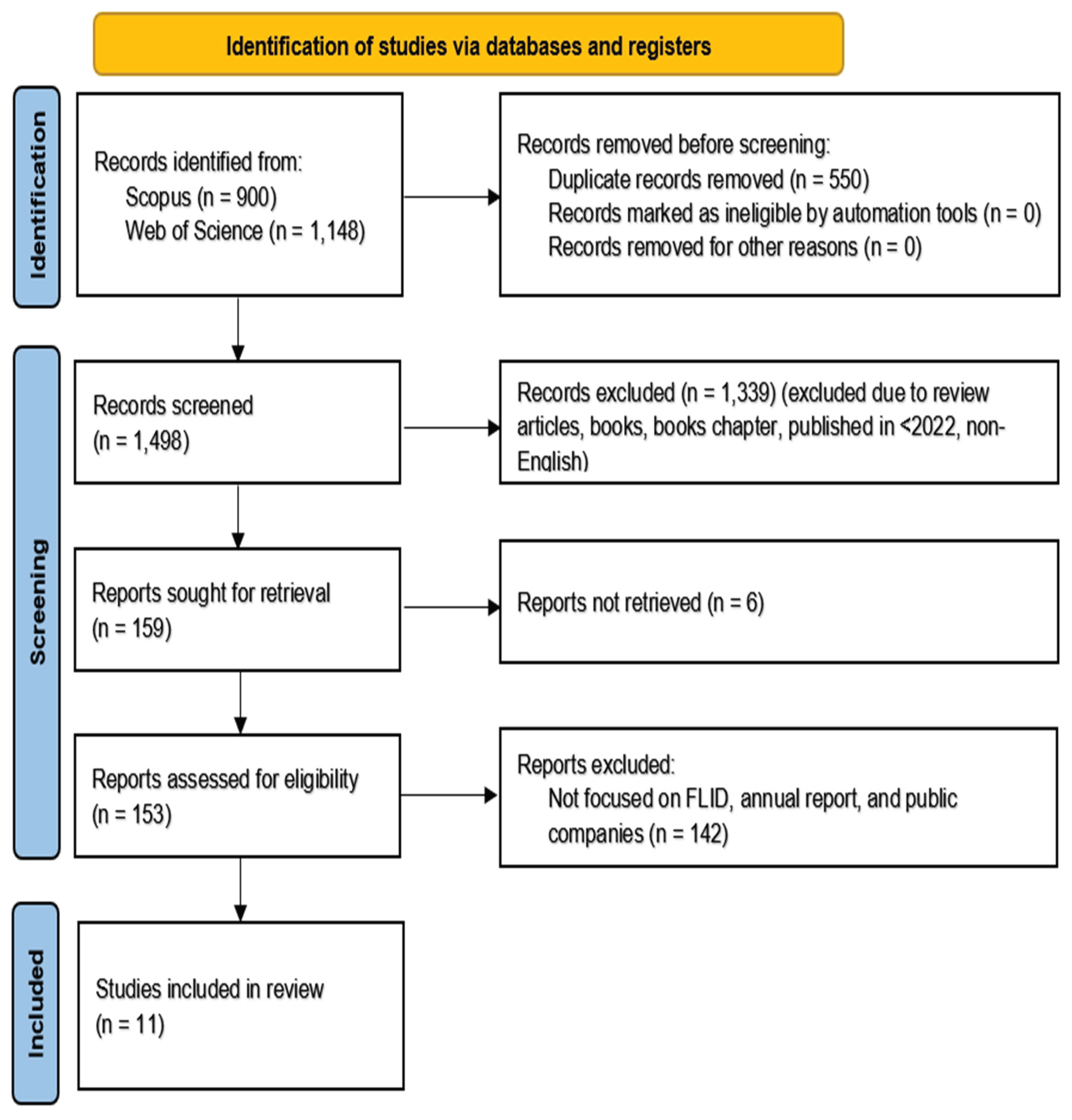

Table 1.
Keywords and search strings.
| Databases | Search Strings |
| Scopus | TITLE-ABS-KEY ( ( "forward looking information" OR "forward-looking information" OR "future oriented information" OR "future-oriented information" OR "projected information" OR "future prospects" OR "strategic disclosure" OR "voluntary disclosure" OR "forecast disclosure" OR "FLID" OR "FLI" OR "management discussion and analysis" OR "MD&A" ) AND ( "annual report" OR "annual reports" OR "corporate report" OR "corporate reports" OR "narrative report" OR "narrative reports" OR "corporate disclosure" OR "corporate disclosures" ) ) |
| Web of Science | TS=( ( "forward looking information*" OR "forward-looking information*" OR "future oriented information*" OR "future-oriented information*" OR "projected information*" OR "future prospect*" OR "strategic disclosure*" OR "voluntary disclosure*" OR "forecast disclosure*" OR "FLID" OR "FLI" OR "management discussion and analysis" OR "MD&A" ) AND ( "annual report*" OR "corporate report*" OR "narrative report*" OR "corporate disclosure*" ) ) |
Table 2.
The inclusion and exclusion criteria.
| Criterion | Inclusion | Exclusion |
| Literature type | Journals (research articles) | Journals (review articles, books, book chapters, conference proceedings) |
| Timeline | Between 2022 and 2026 | < 2022 |
| Language | English | Non-English |
Table 3.
Table of findings.
| Research Theme | Author(s) | Theory Applied | Geographic Context | ||
| Boardroom Governance and Monitoring Determinants | Afroze et al. (2026) | Resource-based view theory Critical mass theory |
United Kingdom | ||
| Al-Lawati (2022) | Impression management theory Resource dependence theory |
Oman | |||
| Choi et al. (2022) | Resource-based view theory | Malaysia | |||
| Boateng et al. (2022) | Agency theory | Ghana | |||
| Board Behaviors, Incentives, and Impression Management | Rajabalizadeh et al. (2026) | Agency theory Impression management theory |
United States | ||
| Chen et al. (2024a) | Agency theory Legitimacy theory |
China | |||
| Chen et al. (2024b) | Agency theory | United States | |||
| Geopolitical Shocks, Trade Risks, and Crisis Disclosures | Lin and Zhao (2026) | Transparent disclosure theory Obfuscatory disclosure theory |
China | ||
| Bujaki et al. (2024) | Impression management theory | China | |||
| Regulatory Environments, Litigation Risks, and Readability | Jain and Madadian (2026) | N/A | United States | ||
| Fu et al. (2025) | N/A | United States | |||
| Research Theme (continued) | Author(s) (continued) | Time Period Studied | Sample Size | Method Category | Year of Publication |
| Boardroom Governance and Monitoring Determinants | Afroze et al. (2026) | 2015 to 2021 | 630 | Mixed Method | 2024 |
| Al-Lawati (2022) | 2014 to 2020 | 238 | Mixed Method | 2023 | |
| Choi et al. (2022) | 2017 to 2019 | 213 | Quantitative | 2022 | |
| Boateng et al. (2022) | 2007 to 2011 | 110 | Mixed Method | 2022 | |
| Board Behaviors, Incentives, and Impression Management | Rajabalizadeh et al. (2026) | 2002 to 2020 | 20,511 | Mixed Method | 2026 |
| Chen et al. (2024a) | 2007 to 2016 | 8,437 | Mixed Method | 2024 | |
| Chen et al. (2024b) | 2003 to 2019 | 21,487 | Mixed Method | 2024 | |
| Geopolitical Shocks, Trade Risks, and Crisis Disclosures | Lin and Zhao (2026) | 2011 to 2024 | 44,917 | Mixed Method | 2026 |
| Bujaki et al. (2024) | 2019 to 2022 | 474 | Mixed Method | 2024 | |
| Regulatory Environments, Litigation Risks, and Readability | Jain and Madadian (2026) | 1993 to 2021 | 34,737 | Mixed Method | 2026 |
| Fu et al. (2025) | 1996 to 2002 | 5,145 | Qualitative | 2025 | |
Disclaimer/Publisher’s Note: The statements, opinions and data contained in all publications are solely those of the individual author(s) and contributor(s) and not of MDPI and/or the editor(s). MDPI and/or the editor(s) disclaim responsibility for any injury to people or property resulting from any ideas, methods, instructions or products referred to in the content. |
© 2026 by the authors. Licensee MDPI, Basel, Switzerland. This article is an open access article distributed under the terms and conditions of the Creative Commons Attribution (CC BY) license (http://creativecommons.org/licenses/by/4.0/).
Copyright: This open access article is published under a Creative Commons CC BY 4.0 license, which permit the free download, distribution, and reuse, provided that the author and preprint are cited in any reuse.