
Submitted:
27 October 2026
Posted:
28 October 2026
You are already at the latest version
Abstract
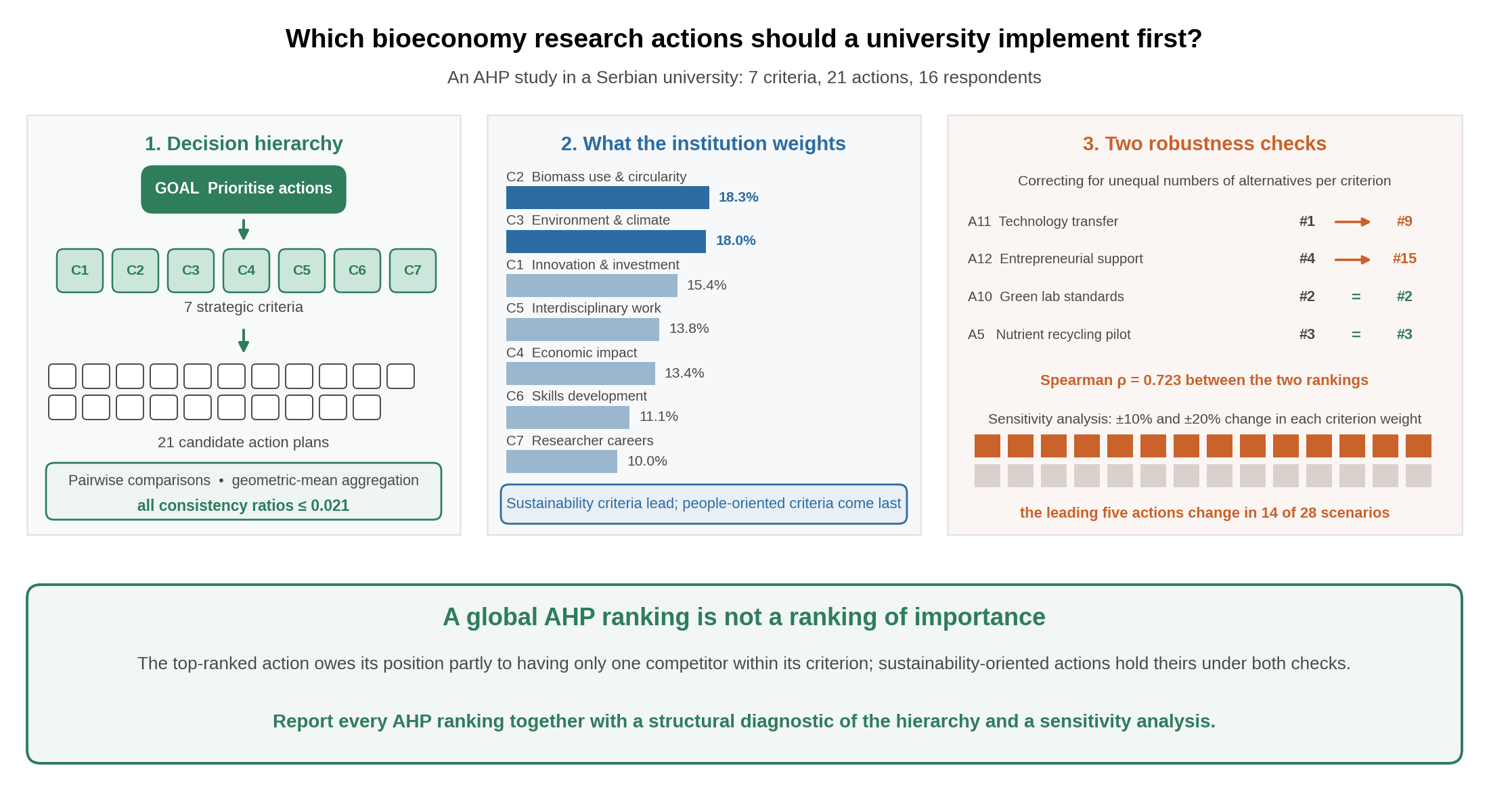
Higher education institutions are increasingly expected to act as drivers of the bioeconomy, yet strategic planning in this field routinely produces action portfolios far larger than the resources available to implement them, and the choice of what to implement first is usually made implicitly rather than on a traceable basis. This paper applies the Analytic Hierarchy Process to the prioritisation of twenty-one bioeconomy research action plans at a private university in Serbia. Seven criteria and the candidate actions were generated in a Quadruple Helix expert workshop combined with SWOT and TOWS analysis; sixteen institutional respondents completed pairwise comparisons, which were aggregated by the geometric mean method and screened with the consistency ratio. At criterion level, priorities concentrate on sustainable biomass use and circularity integration (18.3%) and environmental and climate contribution (18.0%), while researcher career support ranks last (10.0%). At action level, the highest global priority belongs to an internal technology transfer and commercialization system (7.14%), which sits under the criterion ranked only fifth. Two robustness checks qualify that result: correcting for the unequal number of alternatives per criterion moves this action from first to ninth place, and a sensitivity analysis shows that the leading five actions change in half of the scenarios tested. Sustainability-oriented actions remain stable under both checks.
Keywords:
bioeconomy
; analytic hierarchy process
; higher education institutions
; quadruple helix
; strategic prioritisation
; knowledge valorisation
; circular economy
; multi-criteria decision making
Copyright: This open access article is published under a Creative Commons CC BY 4.0 license, which permit the free download, distribution, and reuse, provided that the author and preprint are cited in any reuse.