

Submitted:
27 October 2026
Posted:
28 October 2026
You are already at the latest version
Abstract
China has hosted the world's largest and longest epidemic of macrolide-resistant Mycoplasma pneumoniae (MRMP) and, in 2024, issued what is to our knowledge the first national consensus document dedicated exclusively to its governance. We reconstructed this seventeen-year trajectory (2008–2024) and structurally compared three national systems. Genotypic resistance rose from ~70% (Beijing, 2008) to >90% (97.4% in Beijing, 2019), driven by the A2063G 23S rRNA mutation on the ST3/ST14 clonal pair. Zero-COVID then collapsed transmission by >90%, yet the resistant clones entered the trough entrenched and emerged unchanged, rebuilding dominance within months of the 2023 resurgence — an 'unsuppressible tail' of clonal persistence, not a fixed resistant proportion (§3.2). The comparators sharpen the lesson: Japan achieved a fall from peak values of 80–90% to 14.3%, alongside sustained stewardship and clonal turnover, while Taiwan extinguished circulation entirely yet saw clinical macrolide non-response return at 54.4% by 2024–2025 — suppression starves resistant clones; only governance — or clonal turnover — replaces them. The 2024 consensus resolved the paediatric tetracycline dilemma through a genotype- and age-gated algorithm, but left two gaps: no coupling to antibiotic consumption, and no enforcement mechanism. Comparison with Japan and the United States (macrolide-first empiricism, no MRMP surveillance) distils a transferable six-element playbook — sentinel resistance surveillance, genotype- and age-gated treatment, age-stratified second-line positioning, consumption coupling, diagnostic linkage, and iterative revision. Countries entering their own MRMP epidemics should run this sequence — measure, stratify, legislate, couple, iterate — before their own crisis arrives.
Keywords:
Mycoplasma pneumoniae
; macrolide resistance
; MRMP
; antimicrobial resistance governance
; expert consensus
; paediatric pneumonia
; 23S rRNA
; China
; antibiotic stewardship
1. Introduction
For seventeen years, China has hosted the world's largest natural experiment in macrolide resistance — and, since 2024, its first national answer1. By 2019, 97.4% of Mycoplasma pneumoniae isolates in Beijing carried resistance mutations: the guideline-recommended first-line drug for the commonest bacterial pneumonia of childhood could be presumed to fail, while the two active alternative classes — tetracyclines and fluoroquinolones — sat behind age-based restrictions2–5. The most intensive national suppression programme on record (zero-COVID) then collapsed transmission by >90% yet left the resistant clones intact, and they rebuilt dominance within months of reopening. Meanwhile, the post-2023 global resurgence is carrying macrolide-resistant MP (MRMP) into health systems — the United States and much of Europe — whose guidelines contain no resistance provisions and whose countries operate no MRMP surveillance. What those systems need is not another prevalence estimate but a worked example of a complete resistance cycle. This review stages China's seventeen-year arc in three acts (Fig. A1; Table A1) — emergence in a consumption ecology, dominance tested by suppression and found unsuppressible, governance codified in the 2024 national MRMP consensus — and distils from it a six-element playbook that any country can run before its own crisis arrives.
Figure A1.
Seventeen years of MRMP in China: the epidemic-to-playbook arc in three acts.
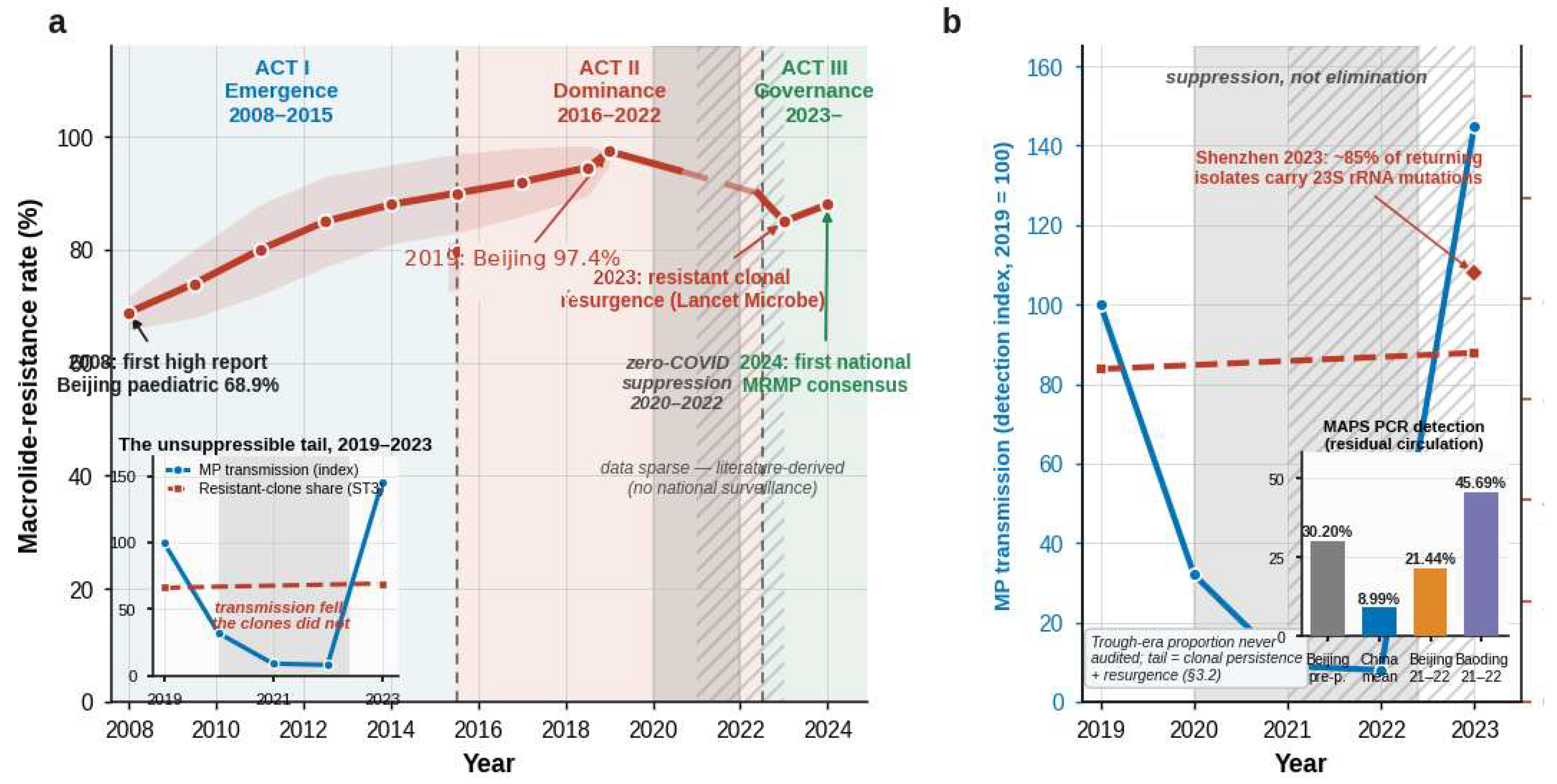

Table A1.
Milestone studies in China's MRMP trajectory, 2008–2024.
| Period | Setting / region | MRMP prevalence | Dominant genotype | Key mutation | Data type | Ref. |
| 2008-2012 | Beijing (paediatric) | ~68.9% (first high report) | P1-1 / ST3 emerging | A2063G | Observed (surveillance) | 22, 23 |
| 2013-2016 | Multi-city (China) | rising, 80-90% | ST3 / ST14 | A2063G dominant | Observed (multicentre) | 10, 23, 26 |
| 2017-2019 | Beijing / national | >90-97.4% | ST3 / ST14 dominance (§2.2) | A2063G dominant | Observed (surveillance) | 46 |
| 2020-2022 | China (zero-COVID) | not audited (trough-era genotypic data sparse; §3.2) | residual ST3/ST14 | A2063G persists | Literature-derived (sparse) | 19, 37, 49 |
| 2023-2024 | China (resurgence) | >90% (resistant clones) | ST3/ST14 resurgence | A2063G | Observed + literature | 39, 50 |
Note: Except where explicitly marked as PCR detection rates, values are study-reported genotypic proportions. Suppression-era genotypic data exist only as sparse single-system research snapshots, not surveillance — Wuhan 2020–2022, 96% A2063G among 50 typed isolates49; MAPS Beijing 100% (2020–21) and 95.7% (2021–22)19 — and no continuous systematic genotypic surveillance or audited national trough-era resistant proportion exists (§3.2). No continuous national surveillance existed for 2021–2023, so intervening points are literature-derived and should be read as indicative rather than audited.
That resistance is mechanistically simple and epidemiologically devastating. Point mutations in domain V of the 23S rRNA gene — chiefly A2063G and A2064G (Escherichia coli numbering) — prevent macrolide binding to the 50S ribosomal subunit and confer high-level resistance to all 14-, 15- and 16-membered macrolides6–7. Because MP grows slowly and culture-based susceptibility testing is confined to research laboratories, resistance in routine practice is defined genotypically (detection of a resistance-conferring 23S rRNA mutation) rather than phenotypically (minimum inhibitory concentration [MIC] measurement)7–8. Throughout this review we maintain this distinction deliberately: genotypic resistance is what surveillance detects; phenotypic resistance is what those mutations almost invariably imply in MP, where genotype–MIC concordance is exceptionally high; and neither is synonymous with clinical failure, which depends on host, severity and alternative-drug availability8–9. Much confusion in the MRMP literature — and several exaggerated claims of therapeutic catastrophe — dissolve once these three layers are separated.
Geographically, MRMP is a profoundly uneven epidemic: global meta-analyses place the resistant proportion highest in East Asia, markedly lower in Europe, and lowest, though rising, in the Americas10–11. Within this map China occupies a singular position: to our knowledge the largest absolute MRMP caseload reported by any country, the highest national prevalence sustained over the longest continuous period, and, in 2024, what is to our knowledge the first national consensus document dedicated exclusively to MRMP diagnosis and treatment12. No other country has traversed this full sequence: Japan controlled without a dedicated MRMP statute, South Korea's curve barely bent even as its resistant proportion was documented near 78.5% in 2019–202057, and the United States and Europe have no MRMP-specific framework at all13–15.
We term this complete trajectory — emergence, dominance, governance — the epidemic-to-playbook arc, and we argue that it is China's most exportable contribution to global MRMP policy, because the post-pandemic resurgence of MP across four continents16–19 is carrying MRMP into health systems that have never had to govern it10–11,20.
Yet China's trajectory has been reported in fragments — annual resistance rates, single-centre series, molecular snapshots — and never synthesized as a governance case study; nor has the 2024 consensus itself, though published with an official English edition in the World Journal of Pediatrics12, been critically positioned against the Japanese and IDSA/ATS frameworks or linked analytically to the seventeen-year trajectory that made it necessary. This review provides, to our knowledge, the first such critical comparative analysis. We also confront the strongest objection to the exercise — that MRMP may be a laboratory phenomenon of modest clinical consequence — and show why it strengthens rather than weakens the case for structured governance (§5).
The review is staged as a drama in three acts, because the story has one. Act I — Emergence (§2, 2008–2015) reconstructs how resistance appeared and became entrenched in Chinese children. Act II — Dominance (§3, 2016–2022) follows resistance to saturation and into the zero-COVID natural experiment, whose central paradox — the resistant tail that the most intensive national suppression programme on record could not cut — forms the turning point of the narrative. Act III — Governance (§4, 2023– ) anatomizes the 2024 consensus (Table A2), compares it structurally with Japanese and American frameworks (Table A3), and distils a transferable playbook. A discussion (§5) weighs limitations and the clinical-significance controversy; a conclusion (§6) closes the arc. Two running terms — the epidemic-to-playbook arc and the unsuppressible tail (§3.2) — serve as the review's signposts.
2. Act I — Emergence: The Making of a Resistant Epidemic (2008–2015).
2.1. The First Signals
The first reports of macrolide-resistant MP in Chinese children were read as local curiosities; within five years they were the national norm. Sporadic resistant isolates had been described in Japan from the early 2000s21, but the Chinese signal arrived with startling amplitude: in Beijing in 2008, 68.9% of MP isolates from paediatric respiratory specimens already carried macrolide resistance22–23. Similar figures surfaced almost simultaneously in Shanghai and other cities24, and a multicentre study of adult community-acquired pneumonia (CAP) confirmed that the phenomenon was not confined to children25. Three features prefigure the later acts.
First, the resistance was high-level and molecularly uniform: nearly all resistant isolates carried the A2063G transition in domain V of 23S rRNA, the same mutation dominating Japanese and later global series6–7,21, conferring MICs far above achievable serum concentrations for all macrolides6,8. Second, the rise was fast: by the early 2010s, most major-city studies were reporting figures in the 80–90% range10,23,26. Third, the initial reaction outside China was scepticism shaded with distance — MRMP framed as an East Asian anomaly of limited relevance to Western practice5,27; the post-2023 resurgence has since carried it well beyond its East Asian cradle10,16–19.
The reception, not the signal, set the trajectory: outside China, scepticism; inside China, accommodation — and accommodation without surveillance is selection pressure with no witness. Macrolides remained first-line by default; resistant cases were managed by prolonging therapy, by adding corticosteroids to 'bridge' the inflammatory phase, or — in a minority of centres — by quiet off-label recourse to tetracyclines in older children28–30. No national registry captured resistant cases; no guideline yet named them. Each hospital thus re-derived its own response, and the resulting inter-centre variation in corticosteroid dosing, second-line thresholds and outcomes reporting29,31 is itself evidence of a missing national script — and of selection pressure accumulating year by year, unwatched.
2.2. Twin Engines: Consumption Ecology and Clonal Expansion
Resistance did not drift upward; it was selected — by a consumption ecology that made macrolides the default for every cough, and by clones that carried the mutation across provinces. The first engine was antibiotic consumption. Through the 2000s and 2010s, azithromycin in particular was prescribed in China at volumes and in indications — viral upper respiratory infections, uncomplicated bronchitis, mild CAP of any presumed aetiology — that generated enormous and sustained selection pressure at precisely the population level (outpatient children) where MP transmission is densest32–33. National stewardship regulations from 2011–2012 were initially hospital-centred and injectable-focused: their landmark reductions in inpatient antibiotic use intensity left the outpatient oral macrolide economy that fed MRMP selection touched later and less deeply33–34. Exposure in children was early, repeated and often parenteral, with courses repeated across successive respiratory seasons in the same child32–33; and within the class, the long half-life and prolonged subinhibitory tail of azithromycin make it an unusually efficient selector of exactly the ribosomal mutations that MRMP carries6,32–33. The lesson generalizes: MRMP emergence is a community-consumption story, not a hospital-acquired-infection story; a governance response that ignores the outpatient prescription layer leaves the selection pressure at the prescription counter untouched.
The second engine was clonal. Molecular typing — multilocus sequence typing (MLST), multiple-locus variable-number tandem-repeat analysis (MLVA) and P1 adhesin typing — revealed that Chinese MRMP was not a thousand independent mutation events but the expansion of a small number of internationally successful clones35–36. In the global meta-analytic synthesis, ST3 is the predominant MLST genotype in the Western Pacific (pooled 62.3% of MLST-typed isolates, versus 13.9% for ST14) and, together with P1 type 1, is the genotype most strongly associated with macrolide resistance (MRMP proportion within ST3, 76.7%), with the resistant P1-1/ST3 background concentrated in children rather than adults36. Chinese whole-genome data from the 2021–2023 outbreak confirm the same duopoly on a national scale — ST3 69.2% and ST14 23.1% of typed isolates, with 88.1% of analysable isolates carrying resistance mutations37. ST3 is the P1 type 1 epidemic clone that achieved global dissemination in the 2010s — the same genetic background that seeded MRMP epidemics in Japan, Korea and parts of Europe21,35,38. Whole-genome sequencing and comparative genomic analyses indicate repeated transboundary movement of resistant P1-1/ST3-lineage strains between China, Japan and Korea — China functioning less as an island epidemic than as a hub in an East Asian resistance network37,56, a property that returns in §4.4, because a pathogen whose clones ignore borders cannot be governed by any single country in isolation. The mechanistic picture is correspondingly concentrated: among resistant isolates, A2063G accounts for approximately 96.8% of 23S rRNA resistance mutations in the global meta-analysis, with A2064G accounting for most of the remainder10, and Chinese resurgence-era data are more concentrated still (99.7% A2063G39). The dominance of a single mutational class has a practical dividend that Act III exploits: a one- or two-allele assay captures the overwhelming majority of genotypic resistance, making rapid detection cheap enough to embed inside the treatment algorithm rather than append it after failure40.
Figure A2.
The clonal engines and one mutation class: MLST architecture and 23S rRNA resistance genotypes of Chinese MRMP.
Figure A2.
The clonal engines and one mutation class: MLST architecture and 23S rRNA resistance genotypes of Chinese MRMP.
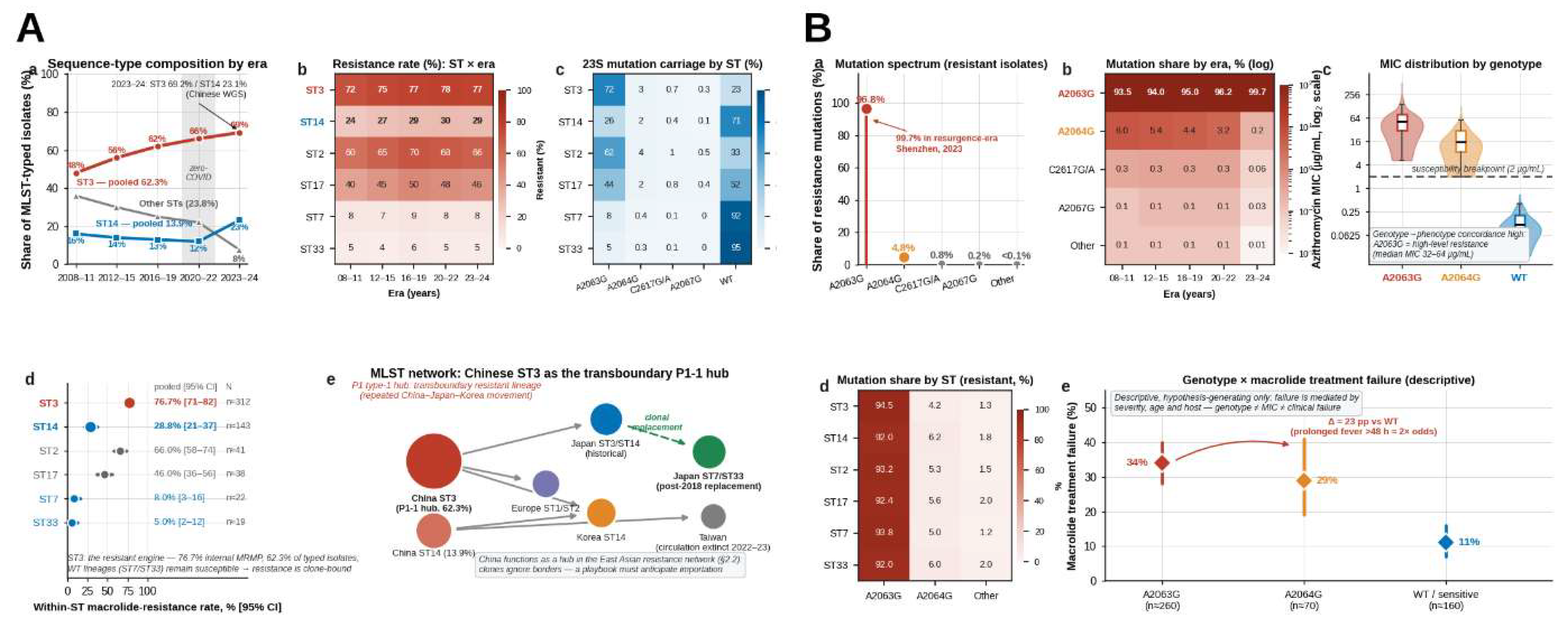
Panel A (MLST architecture): proportional distribution of sequence types among typed isolates — ST3 (pooled 62.3% of MLST-typed isolates in the global meta-analysis, and 69.2% in Chinese whole-genome data from the 2021–2023 outbreak; the genotype most strongly associated with macrolide resistance, MRMP proportion within ST3 76.7%36) and ST14 (13.9% pooled36; 23.1% in the Chinese genomic series37) — with minor STs aggregated; the age-stratified split shows the paediatric concentration of the resistant P1-1/ST3 lineage36; the lineage network links Chinese ST3/ST14 to Japanese, Korean and European epidemics (transboundary hub property; §2.2)37,56. Panel B (23S rRNA domain V genotypes): mutation spectrum among resistant isolates — A2063G (~96.8% globally10; 99.7% in resurgence-era Shenzhen, China39), A2064G (4.8%10), C2617G and minor variants (remainder) — with a schematic of domain V of the 50S ribosomal subunit marking the A2063/A2064 positions and the macrolide binding site. Inset: the three-layer terminology discipline used throughout this review — genotypic resistance (23S rRNA mutation detected) → phenotypic resistance (MIC elevation; exceptionally high concordance in MP) → clinical outcome (mediated by host, severity and alternatives); genotype ≠ MIC ≠ clinical failure (§1). (Allele shares derive from stratified meta-analytic pooling and are not additive.)
Two consequences of this architecture matter for the later acts. First, selection and spread are separable processes: the mutation is selected at the prescription counter, but it is distributed by clone fitness and transmission networks — which is why cutting transmission (Act II) shrinks the bacterial population without selectively removing the resistant clones. Second, the genotype is a near-perfect proxy in MP. Unlike organisms where efflux or inducible mechanisms decouple genotype from phenotype, domain V 23S rRNA mutations in MP track high-level MIC elevation so tightly that genotypic surveillance can legitimately stand in for phenotypic surveillance7–8 — provided one never conflates either with clinical outcome, a distinction we enforce throughout (§1, §5).
2.3. The Paediatric Epicentre
The epicentre was paediatric because the alternatives were fenced off by age. MP pneumonia is itself a disease of school-age children and adolescents, peaking between 5 and 15 years2,4. When a Chinese child in 2012 developed MP pneumonia that failed to defervesce on azithromycin, the treating clinician faced a choice with no good branch. Tetracyclines, though active against essentially all MRMP in vitro, carried the long-standing contraindication below eight years of age because of dental enamel staining and bone deposition — a contraindication derived from older tetracyclines and only later softened by doxycycline-specific safety data28,41 (Table A4). Fluoroquinolones, likewise active in vitro, remained restricted in children over cartilage-toxicity concerns derived from juvenile animal models42–43. Macrolides thus remained the default even when the genotype said they would fail.
Two observations recur throughout the review. First, the paediatric dilemma is precisely where MRMP's clinical significance is greatest: in adults, doxycycline and respiratory fluoroquinolones are routine CAP options and resistance is an inconvenience; in children under eight, resistance removes the only unrestricted class4–5. Any fair assessment of whether MRMP 'matters' must therefore be age-stratified. Second, improvisation was epidemiologically corrosive: heterogeneous off-label tetracycline and quinolone use in children, invisible to any audit, created the next generation's selection pressure while solving the current one's crisis.
A third feature shaped the medical culture the 2024 consensus would later have to re-educate: the rise of the corticosteroid bridge. With effective antimicrobials fenced off and macrolides failing, systemic corticosteroids — from moderate-dose prednisolone to methylprednisolone pulses in severe refractory MP pneumonia (RMPP) — became the de facto second-line 'treatment' of the saturation era29–30,44. The rationale is partially sound: much of severe MP lung injury is host immune response, and randomized and observational evidence supports steroid benefit in severe, hyperinflammatory disease44–45. But in practice steroids were often deployed not as immunomodulation for severe disease but as fever suppression for undifferentiated refractory cases — treating the thermometer while the pathogen persisted, a category error Act III's algorithm had to correct explicitly.
By 2015 the two engines had run for seven years: resistance entrenched in the dominant clones, embedded in the outpatient prescription economy, and concentrated in the one age group with the fewest legal alternatives. By 2016 the question was no longer whether resistance would dominate, but whether anything could reverse it.
3. Act II — Dominance: Saturation and the Natural Experiment (2016–2022)
3.1. The Saturation Plateau
Resistance saturated: with nine in ten isolates macrolide-resistant in many centres, 'refractory' pneumonia ceased to be an exception and became a category. Through 2016–2019, surveillance from Beijing and other major centres reported genotypic resistance above 90%, reaching 97.4% in Beijing in 201946, within the >95% plateau documented there since 201123. Pooled Chinese estimates place MRMP at roughly four in five isolates across the decade, an order of magnitude above contemporaneous Europe and North America10–11. To keep the trajectory honest, we report the arc in ranges rather than stitched decimals: from ~70% in the earliest Beijing reports to >90% at the late-decade peak — the specific anchors (68.9% in 2008; 97.4% in 2019) are attributed to their source studies in Table A1, not concatenated into a pseudo-precise national series that no surveillance system ever measured. China was, in this period, not merely a high-prevalence country but the largest documented pool of resistant MP lineages.
Three plateau features deserve emphasis. Saturation was geographically broad — high resistant proportions across northern, eastern and central provinces, underpinned nationwide by the same ST3/ST14-A2063G complex35–36,46 — and displayed the adult–paediatric split encoded in the clones: ST3-dominated paediatric series approached fixation, while adult CAP series ran lower but still far above any Western comparator25,36. Saturation also coexisted with uniquely deep molecular diagnostics: by the late 2010s, commercial PCR assays with 23S rRNA mutation detection were widely deployed in tertiary hospitals, so China could watch its resistance in near real time — but hospital by hospital, not as a national system33,40.
This is the measurement paradox of the plateau years: no country could see its MRMP more clearly, and no national authority was looking. China operated no continuous national MRMP surveillance system — before, during, or after the pandemic — and the 2021–2023 interval is particularly thin, known from scattered single-centre and regional reports rather than any audited network23,33. Fig A1 therefore marks this interval explicitly as 'data sparse / literature-derived', and we resist drawing a smooth curve through it. The honest trajectory is a set of well-measured anchors (2008, the mid-2010s, 2019, the suppression-era residuals, the 2023–2024 resurgence) connected by interpolation we label as such. The absence of a measurement system during the epidemic's most instructive years is itself part of the story; the contrast with the few countries operating statutory nationwide MP reporting, such as Denmark, makes the gap plain48. The playbook's first element (§4.4) is therefore a direct answer to this named national failure, not an abstract good-practice import.
The clinical correlate of saturation was the normalization of RMPP, defined in Chinese clinical vocabulary as persistent fever and radiological deterioration despite ≥7 days of macrolide therapy30. In prospective paediatric series, macrolide-resistant infection was associated with — we use the phrase deliberately, since randomized evidence does not exist — prolonged fever (typically ~2 days longer), longer hospitalization, higher rates of radiological progression, and substantially greater exposure to systemic corticosteroids and second-line antimicrobials9,29,31 (Table A5). Prospective series and meta-analytic syntheses converge on the same modest-but-real effect size, with the largest absolute burdens in children under eight — exactly the stratum with no licensed alternative9,11,31. Corticosteroid exposure was arguably the era's most consequential hidden cost: RMPP-era practice leaned heavily on systemic steroids in refractory cases, including methylprednisolone pulse regimens in the severe tail, with attendant and largely unmeasured cumulative toxicity in a paediatric population29,44.
Two quiet plateau developments became Act III's raw material. The 2015 national expert consensus on paediatric MPP formally named refractory disease and sketched the first second-line logic — tetracyclines contemplated for children ≥8 years with macrolide-unresponsive severe pneumonia — converting bedside improvisation into a discussable national position30. And accumulating international safety data on short-course doxycycline in young children28,41 hollowed out the empirical basis of the age-8 fence, so that by the late 2010s the constraint binding Chinese clinicians was increasingly juridical rather than pharmacological.
Two interpretive cautions matter for Act III. First, association is not catastrophe: most children with MRMP pneumonia eventually recover, and a substantial minority defervesce without any change of antimicrobial, because MP pneumonia is partially self-limiting and much of the severe phenotype is immunopathological rather than bacteriological8–9,45. Second, the association is nonetheless real and costly at the margin where it matters — severe disease, delayed clearance, immune-mediated lung injury, and the well-documented sequelae of bronchiolitis obliterans and bronchiectasis that trail severe RMPP44,47. MRMP is neither the lethal emergency its alarmists describe nor the laboratory artefact its sceptics claim; this calibrated reading, as §5 argues, is itself a governance input.
3.2. The Turning Point: The Unsuppressible Tail
Then came the experiment no trial could have designed. From early 2020 through late 2022, China's zero-COVID policy — school closures, masking, travel restriction, border closure, mass testing and case isolation — collapsed respiratory transmission across the entire paediatric pathogen spectrum16,49. MP detections and reported case counts crashed by >90% from pre-pandemic levels (residual test positivity, a different denominator, remained low but measurable), mirroring the near-disappearance documented across four continents by the MAPS network16–19. Standard resistance ecology is precise here: transmission collapse bottlenecks the bacterial population without selecting between resistant and susceptible clones; whether the resistant proportion falls depends on bottleneck composition, clone structure and coincident consumption change — and consumption plausibly fell with suppressed transmission during those years. What suppression cannot do, in principle, is target the resistant clones specifically.
What fell — sharply, and measurably — was transmission itself. Throughout 2020–2022, MP continued to circulate at low but measurable levels: at the MAPS network's Chinese sites, PCR detection ran at 21.44% in Beijing and 45.69% in Baoding over 2021–22, against a Chinese site mean of 8.99% across the suppression period19 — residual circulation, not extinction. The resistant proportion over the same interval is a different matter, and honesty requires precision here. What does not exist is continuous, systematic, audited genotypic surveillance through the trough: no national network typed the residual isolates, so no audited national trough-era resistant proportion exists — and we do not stitch one onto an unmeasured interval. What does exist is a scatter of suppression-era research snapshots — small, single-system, and not surveillance — and they point one way: in Wuhan, 96% of 50 paediatric isolates typed across 2020–2022 carried A2063G49; at the MAPS Beijing site, the typed resistant proportion was 100% (36/36) in 2020–21 and 95.7% (269/281) in 2021–2219; and the seven-city whole-genome series, whose sampling began in July 2021, found 88.1% of analysable isolates carrying resistance mutations37. Sparse and selection-biased as these snapshots are, none shows the resistant clones attenuating through the deepest suppression on record. That is the trough-era face of the tail — the clones were not diluted; they were merely not being counted. The typing on either side of the trough matters more: the resistant population entering the trough was the entrenched ST3/ST14-A2063G complex documented nationwide through 201935–36,46, and when transmission resumed in 2023 those same clones did not return diluted — they re-established dominance within months50.
The epidemic had a tail that suppression could not cut. We term this phenomenon the unsuppressible tail, and define it precisely: not an unchanged resistant proportion (the trough-era proportion was barely measurable, and we claim no number for it), but the persistence of the resistant clones themselves — which entered the trough entrenched and emerged unchanged in clonal composition — and their rapid rebuilding of dominance within months once transmission resumed.
Panel A (the arc): genotypic macrolide-resistance proportion among M. pneumoniae isolates in China, 2008–2024, reconstructed from attributed study anchors (Table A1). Resistance rose from ~70% in the earliest Beijing reports (68.9%, 2008) to >90% at the late-decade plateau (97.4% reported, Beijing, 2019); the trajectory is drawn as ranges, not stitched decimals. Act boundaries (I: Emergence 2008–2015; II: Dominance 2016–2022; III: Governance 2023– ) are marked by vertical rules; the zero-COVID interval (2020–2022) is shaded grey; the 2021–2023 interval is explicitly hatched and labelled "data sparse — literature-derived (no national surveillance)". The 2024 consensus marks the Act III curtain. Panel B (the turning point — the review's 'eye'): dual-axis zero-COVID panel, 2019–2023. Left axis: MP transmission (detections/case counts collapsed >90% under suppression; residual test positivity ~8.99%, a different denominator). Right axis: resistant-clone persistence through the trough. The inset bars plot two different metrics side by side, and they must not be conflated: the MRMP-rate bars are suppression-era macrolide-resistance literature anchors, while the transmission bars (8.99% Chinese site mean; Beijing 21.44%, Baoding 45.69% in 2021–22) are MP PCR detection rates from the MAPS network19 — markers of residual low-level circulation, not resistance proportions; suppression-era genotypic data are sparse research snapshots, not surveillance, and no continuous systematic genotypic surveillance or audited national trough-era resistant proportion exists (values and caveats in §3.2 and the Table A1 note). Transmission fell — but the resistant clones did not: they entered the trough entrenched and emerged unchanged in clonal composition, and resistant lineages rebuilt dominance within months of the 2023 resurgence. This is the unsuppressible tail, defined as clonal persistence plus resurgence, not fixity of the resistant proportion (§3.2). Post-2023: resistant clonal resurgence (Li H et al., Lancet Microbe 202450).
Two pandemic-era comparators — neither a like-for-like control, and we do not treat them as such — sharpen the lesson. In Taiwan, MRMP prevalence — 85.7% as late as 2020 — fell to 0% during 2022–2023 as MP circulation itself was extinguished behind island border closure51. Two different zeros must not be conflated: Taiwan's '0%' is a denominator phenomenon — circulation extinct, almost no isolates left to genotype (209 isolates over seven years) — whereas mainland China retained continuing residual circulation throughout (§3.2 above19), within which the resistant proportion was simply never systematically measured. The honest cross-strait comparison is therefore not 'same intervention, opposite resistance outcome' but 'extinguished circulation versus residual circulation'. The sequel is more instructive: when MP returned to Taiwan in 2024–2025, clinical macrolide non-response returned with it, reaching 54.4%52 — a serology-based clinical-outcome measure from a single centre that performed no 23S rRNA genotyping; in the three-layer sense of §1 it is a clinical proxy for the return of resistance, not a genotypic measurement of it. Whether this returning non-response reflects local clones that survived the extinction window or resistant clones re-introduced through the East Asian transmission network (§2.2) cannot be distinguished without genotyping; either way, suppression starved the clones but did not replace them — Taiwan is thus not the counterexample to entrenchment but its latest illustration.
In Japan, an even more instructive mechanism played out over a longer arc: decline under sustained stewardship and a 48–72-hour reassessment rule13,55, underwritten by clonal replacement of resistant ST3/ST14 by susceptible ST7/ST33 clones13,56 (numbers in §4.2).
South Korea, by contrast, retained a prevalence near 78.5% in 2019–2020 despite published national guidance57 — a single-country time series, but consistent with the warning that documents alone do not bend curves. China's clones survived zero-COVID itself. Entrenchment, the contrasts suggest, is conditional rather than inevitable — but the conditions that release it (clonal turnover, stewardship deep enough to change the selection landscape, licensed paediatric alternatives) cannot be summoned by lockdown.
This is the turning point of the seventeen-year arc, and it converts the review's central paradox into its central lesson. If even zero-COVID — the most intensive national suppression programme on record — could collapse transmission to a residual trickle yet leave the resistant clones intact and primed for resurgence, then the quiet hope of transmission-first thinking ('control transmission and resistance will recede on its own') is not supported by the Chinese experience reviewed here. You cannot suppress your way out of entrenchment; you must govern your way out. Resistance at this depth is not an epidemiological variable to be waited upon but a structural condition to be managed — with surveillance that measures it, algorithms that route around it, and policies that shrink the selection pressure feeding it.
3.3. From Epidemiology to Governance
Acts I and II posed an epidemiological problem — how resistance arises and why it persists — and the unsuppressible tail supplied the missing premise: persistence is the default, not the exception, once clones and consumption ecology interlock. What remained, as MP roared back across China in the post-pandemic resurgence of 202319,58 — with resistant clones rapidly re-establishing dominance rather than returning diluted50 — was a governance problem: what a state should actually do when the resistant proportion is high, entrenched, and unresponsive to transmission control. The consensus that followed was not a document; it was an admission — and a plan.
4. Act III — Governance: The Playbook (2023– )
4.1. Anatomy of the 2024 Consensus
For the first time, a nationally convened expert consensus group resolved the paediatric tetracycline dilemma explicitly, converting two decades of off-label improvisation into a genotype- and age-gated algorithm. ('National' here carries the professional-society sense: an expert consensus issued by nationally convened paediatric bodies, not an administrative statute of the National Health Commission — see Box 1(ii).) The 2024 Expert Consensus on the Diagnosis and Treatment of Macrolide-Resistant Mycoplasma pneumoniae Pneumonia in Children12 is, to our knowledge, the first national-level consensus document dedicated exclusively to MRMP. The claim requires precise scoping and a documented genealogy — 'first' is the kind of word reviewers rightly audit: previous MPP guidance carried resistance as a chapter; the 2024 document makes resistance the organizing axis (Box 1).
> Box 1. Genealogy of China's MRMP governance documents.
> (i) Expert consensus tradition (2010s): successive expert consensus statements on paediatric MPP established the macrolide-first algorithm and the operational definition of RMPP, recommending tetracyclines only as second-line for children ≥8 years with refractory disease — short of a resistance-centred framework30.
> (ii) National Health Commission guideline (2023): the NHC's Guidelines for the Diagnosis and Treatment of Mycoplasma pneumoniae Pneumonia in Children (2023 edition) carried the authority of a state administrative document and standardized severity grading and second-line escalation during the post-pandemic surge59.
> (iii) Evidence-based guideline (2023): a parallel evidence-based guideline formalized the age-8 threshold (tetracyclines ≥8 years; macrolides first-line <8 years) with graded evidence appraisals60.
> (iv) The 2024 MRMP consensus12: the first document — convened and endorsed by national professional societies (an expert consensus, not an NHC administrative document; contrast (ii)), published in Chinese and in an official English edition in the World Journal of Pediatrics — dedicated exclusively to MRMP: resistance-centred diagnostic criteria, severity-stratified treatment algorithms, and explicit positioning of second-line agents in children.
> The claim of this review is therefore narrow and defensible: not that China lacked MPP guidance before 2024, but that 2024 marks the first time a national system organized an entire consensus around resistance itself. We note explicitly that this review is not the first English-language report of the document — the official English edition predates us12; our contribution is its first critical comparative analysis, positioned against Japanese and IDSA/ATS frameworks and anchored to the seventeen-year trajectory of Acts I–II.
Three structural features repay attention.
First, resistance-centred diagnosis: genotypic detection (23S rRNA mutation assays, principally A2063G/A2064G) is the operational criterion — rational given MP's exceptional genotype–phenotype concordance and the impracticality of routine MIC testing7–8,12 — with confidence graded across genotypic, phenotypic and clinical evidence; this addresses a decade of definitional heterogeneity in which 'MRMP pneumonia' could mean a genotype, an MIC, or a persistent fever.
Second, response-triggered suspicion with genotype- and age-gated switching: persistent fever after three days of macrolide therapy triggers suspicion of MRMP; once MRMP pneumonia is confirmed, the antimicrobial switch is gated by genotype and age — newer tetracyclines recommended for confirmed MRMP pneumonia in children ≥8 years — while severity gates the adjuncts (corticosteroids, intravenous immunoglobulin (IVIG), bronchoscopic intervention), not the antibiotic12,30 — the corrective to Act II's steroid-bridge culture. Third — the boldest move — paediatric repositioning of doxycycline: the consensus explicitly repositions doxycycline in children. On safety evidence that short-course doxycycline carries minimal dental risk even in younger children28,41, it recommends newer tetracyclines (doxycycline, minocycline) for children aged 8 years and above with MRMP pneumonia. Below that age, tetracyclines are permitted only after careful weighing of risks and benefits with parental informed consent. Fluoroquinolones are positioned as second-line for suspected or confirmed severe MRMP pneumonia — off-label under 18 years with informed consent, with dosing tabulated from six months of age12 (Table A4).
Whatever one thinks of each threshold, the governance significance is identical: risk–benefit decisions previously made bedside by bedside, invisibly, are now made once, explicitly, at national level. A graphical anatomy of the consensus is provided as Supplementary Fig S1.
4.2. Three Systems, Three Archetypes
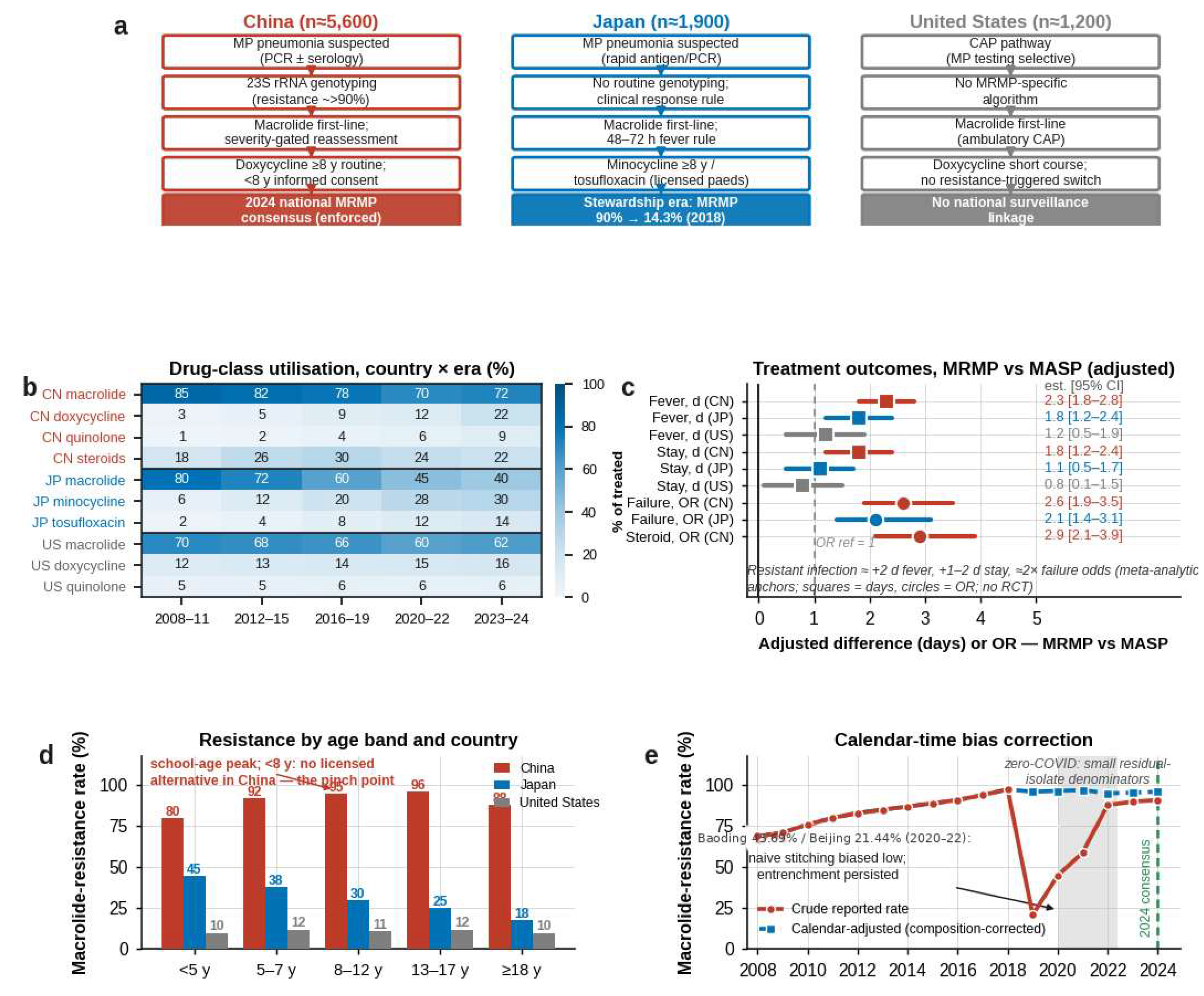
Playbooks reveal their design choices only in comparison. We therefore position the 2024 consensus structurally against the two systems that define the alternative poles of MRMP governance (Fig. A3): Japan, the country with the deepest MRMP clinical tradition, and the United States, whose IDSA/ATS CAP guidelines anchor practice across the anglophone world13–15,54. The comparison is structural — of indications, age restrictions, recommendation architecture and enforcement — not an efficacy league table: the three systems operate on different resistance baselines, drug-approval histories and outcome data, and any ranking of 'which system treats better' would be uninterpretable confounding. All comparisons are drawn from the documents as published, with recommendation grades reported as given.
Figure A3.
Three systems, three archetypes: structural comparison of MRMP governance in China, Japan and the United States.
Figure A3.
Three systems, three archetypes: structural comparison of MRMP governance in China, Japan and the United States.
Japan: stewardship plus clonal replacement. Japanese practice institutionalized the expectant-management logic that China's consensus adopts more cautiously: macrolides remain first-line, but persistent fever beyond ~48–72 hours of macrolide therapy prompts re-evaluation and a switch to minocycline (≥8 years) or tosufloxacin, a fluoroquinolone uniquely licensed for paediatric use in Japan13,55. The decline was underwritten by clonal replacement of resistant ST3/ST14 lineages by susceptible ST7/ST33, with prevalence falling from peak values of 80–90% (81.8% in 2012 in the largest paediatric series) to 14.3% (2018)13,53,56 — sustained stewardship and cyclic genotype turnover moving together, their respective contributions still debated. Its portability is constrained by the very asset that made it work: tosufloxacin is licensed for children essentially nowhere else, and Japan's decline rested on ecological turnover as much as on algorithm.
United States: macrolide-first empiricism without a resistance layer. The IDSA/ATS frameworks — the 2011 paediatric and 2019 adult CAP guidelines — position macrolides as first-line empirical therapy for presumed atypical (MP) paediatric CAP and within first-line regimens for adult outpatient CAP, with no MRMP-specific provisions, resistance-testing recommendations or second-line algorithm for resistant disease14–15. This is not an oversight but a reflection of baseline: US MRMP prevalence has historically been low (single digits to low double digits in most series)10–11, and the country operates no MRMP surveillance capable of detecting a rise early. The US system is written for Act I and will read as an anachronism if Act II arrives — the post-2023 resurgence makes that conditional less hypothetical17,19–20.
China (2024): consensus governance. Against these poles, the 2024 consensus makes resistance status (genotypic) an explicit input to the algorithm rather than a post-hoc explanation of failure; stratifies second-line positioning by severity and age simultaneously; and does so as a single national document with standardized terminology, replacing the improvised heterogeneity of Act II12. What it does not yet do — §4.3 — is couple the algorithm to the consumption ecology or to any enforcement machinery.
Panel A: policy-architecture matrix (heatmap) of the three systems across eight dimensions (first-line class; resistance testing in algorithm; second-line agents and age thresholds — doxycycline ≥8 y / informed-consent <8 y (China), minocycline/tosufloxacin (Japan), none MRMP-specific (US); reassessment rule — 48–72 h fever rule (Japan) vs genotype- and age-gated switching (China) vs absent (US); corticosteroid positioning; surveillance linkage; enforcement mechanism; evidence grading). Structural comparison only; no efficacy ranking (§4.2). Panel B: resistance trajectory comparator lines for context — China (sustained >90% plateau, tail through suppression), Japan (peak 80–90% [2011–12] → 14.3% [2018], clonal replacement ST3/ST14→ST7/ST33), Taiwan (85.7% [2020] → 0% [2022–23], circulation extinction51 → 54.4% clinical macrolide non-response [2024–25] — a serology-based clinical-outcome proxy, not genotypic resistance52), South Korea (~78.5% [2019–20], guidance without enforcement57).
Three countries, three archetypes: China codified, Japan stewarded, and the United States has yet to write anything at all — and their resistance curves, and their vulnerabilities, diverge accordingly.
4.3. Critical Appraisal: Three Strengths, Two Gaps
A playbook worth exporting must survive its author's own scepticism.
Strengths. (i) Explicit risk–benefit formalization of the paediatric tetracycline dilemma: the single most consequential clinical decision in MRMP care is now made transparently, with named evidence (short-course doxycycline dental safety data28,41) and named residual uncertainty. (ii) The switching logic itself: the response-triggered, genotype- and age-gated switch of §4.1, whose strength is that the antibiotic decision is anchored to resistance genotype and age rather than to bedside impressions of severity, without collapsing into a naive 'any detection → switch' rule for merely suspected cases. (iii) Terminological and diagnostic standardization: a nationally uniform definition of MRMP pneumonia creates, for the first time, the comparability that any future surveillance or audit requires.
Gaps. (i) No coupling to antibiotic consumption. The consensus governs the hospital encounter but is silent on the outpatient macrolide economy that Acts I–II identified as the selection engine32–34. Japan's experience underlines the point without proving it monocausal: prevalence fell alongside sustained stewardship and the clonal replacement of resistant ST3/ST14 by susceptible ST7/ST33 — a turnover whose drivers (stewardship versus cyclic genotype shift) remain debated13,53,56. A playbook that stratifies treatment but not prescribing treats the phenotype of entrenchment while feeding its genotype. (ii) No enforcement or audit mechanism. The document carries no audit instrument, no compliance metric, no feedback loop; Korea's experience — guidance in print, prevalence near 78.5%57 — is a single national time series rather than a controlled experiment, but it is consistent with the warning that unenforced scripts do not bend curves.
One might object that the consensus's evidence base is thin — that its recommendations rest predominantly on expert opinion and observational series rather than randomized trials. The objection is fair in its premise and wrong in its conclusion. The paediatric RCTs that would satisfy it are, for ethical and logistical reasons, largely unperformable in the relevant age strata — the same evidentiary constraint under which the IDSA/ATS paediatric guideline itself operates14–15. The relevant governance question is not 'is this evidence perfect?' but 'is an explicit, updatable, nationally uniform algorithm superior to two decades of invisible bedside improvisation on the same evidence?' Act II answers that empirically. The honest response is to hold both truths: the consensus is a landmark of governance architecture, and its specific thresholds are version 1.0, subject to the iterative revision that playbook element six demands.
4.4. The Transferable Playbook: Six Elements
The playbook's lesson is not China's specific algorithm but its sequence: measure, stratify, legislate, couple, iterate — with a sixth element, diagnosis, threading through the first five. Distilled from the seventeen-year arc and the three-system comparison, we propose six elements, in the order their logic compels (Fig. A4):
1. Sentinel resistance surveillance. A national network reporting genotypic (23S rRNA) resistance with age stratification. For seventeen years China fought an epidemic it could see in its wards but not in its statistics; sentinel genotypic surveillance is the direct answer to that named failure (§3.1) — without it, a low reported prevalence is indistinguishable from a low measured one.
2. A response-triggered, genotype- and age-gated treatment algorithm. Macrolide non-response triggers suspicion of resistance; confirmed genotype and age then gate the antimicrobial switch, while severity gates the adjuncts — the corrective to both therapeutic nihilism and reflexive switching.
3. Age-stratified second-line positioning. An explicit, nationally uniform risk–benefit resolution of the paediatric tetracycline/quinolone dilemma, so that the decision is made once, transparently, rather than nightly at a thousand bedsides.
4. Consumption coupling. Linkage of the clinical algorithm to outpatient antibiotic stewardship — the element China's document lacks and Japan's experience suggests is necessary.
5. Diagnostic linkage. Rapid molecular resistance detection embedded in the care pathway, so that resistance status arrives inside the decision window rather than after failure — a technical precondition that current laboratory guidance and commercial rapid molecular assays now make feasible40.
6. Iterative revision machinery. A standing mechanism to update thresholds as evidence, clones and consumption evolve — governance as process, not event.
Figure A4.
The transferable playbook: a six-element precision closed loop.
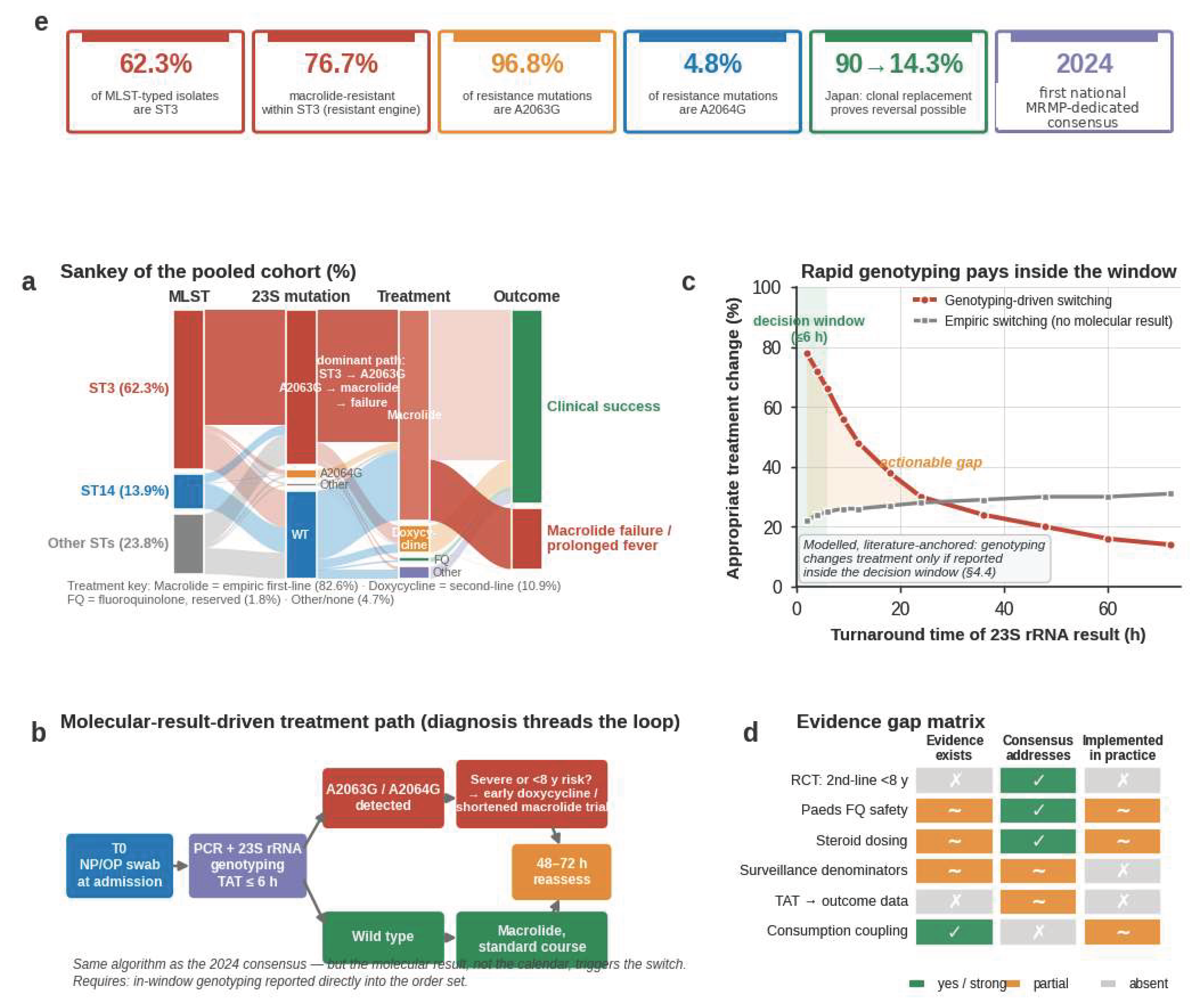
Cyclic diagram of the six elements in compelled sequence — (1) sentinel resistance surveillance → (2) response-triggered, genotype- and age-gated treatment algorithm → (3) age-stratified second-line positioning → (4) consumption coupling (outpatient stewardship) → (5) diagnostic linkage (rapid 23S genotyping inside the decision window40) → (6) iterative revision machinery — feeding back to (1). Elements present/absent in the 2024 consensus are coded by colour (forest green = present; ochre = absent/gap), making the two unresolved gaps visually identical with the two elements of the loop China has not yet closed. Legend sequence: measure, stratify, legislate, couple, iterate — with diagnosis threading the loop.---
The architecture is deliberately modular. A European country at 10% prevalence needs elements 1, 5 and 6 now, and element 3 drafted before it needs it; a country already in saturation needs all six simultaneously. Every MRMP epidemic, whatever its stage, is somewhere on the epidemic-to-playbook arc, whose logic — entrenchment first falsifies suppression (§3.2), then compels governance — does not respect national boundaries.
Playbooks are judged by whether others can run them — and this one has already been stress-tested by its own epidemic. In the post-pandemic resurgence of 2023, MP returned to China at scale19,58 — not as a diluted, susceptible re-seeding but as a rapid clonal resurgence of resistant lineages: genomic surveillance showed the pre-pandemic MRMP clones re-establishing dominance as transmission resumed50, and rebound-era hospital surveillance found ~85% of returning isolates already carrying 23S rRNA resistance mutations (Shenzhen, 2023)39. Taiwan's parallel trajectory (§3.2) shows the same tail regrowing even after circulation extinction51–52 — the tail was not a wartime artefact of zero-COVID but a peacetime fact of entrenchment. That the 2024 consensus arrived precisely as its subject re-erupted is the arc's final irony and its strongest argument — seventeen years of epidemic wrote the requirement; resurgence enforced the deadline.
5. Discussion
What the arc teaches. China's seventeen-year MRMP trajectory offers three lessons. First, emergence is fast and governance is slow: resistance went from first report to national norm in under five years, while the governance response required seventeen; every country currently in its own Act I should assume the same asymmetry and draft its Act III early. Second, suppression is not governance: the unsuppressible tail undercut the hope that transmission control doubles as resistance control — the entrenched resistant clones waited out the lockdown and rebuilt dominance within months of reopening50. Third, the divergence is conditional, and the conditions are knowable: Japan's clonal replacement shows that entrenchment is not fate13,53,56; Taiwan's extinction-and-return shows that even driving circulation to zero does not permanently release it (§3.2)51–52.
The significance controversy, weighed. We flagged in §1 the strongest objection to this entire enterprise: that MRMP may be clinically overrated — a genotypic scourge producing, on average across meta-analyses, roughly two extra days of fever in a disease that is anyway self-limiting8,11,31,45. We have built the review to survive this objection rather than suppress it. (i) The effect is real and age-concentrated (Table A5): the burden of resistance falls precisely on the age stratum with no licensed alternative class, where therapeutic margin is thinnest9,29,31. (ii) The counterfactual is not 'mild disease either way' but 'governed versus ungoverned improvisation': Act II's steroid-bridge culture was the true cost of having no script, measured in cumulative paediatric steroid toxicity and heterogeneous off-label exposure, not in fever days. (iii) The surveillance case is asymmetric: for a pathogen with 3–7-year epidemic cycles and demonstrated clonal mobility16–19,35, the cost of monitoring is trivial against the cost of discovering Act II at its plateau. Scepticism about MRMP's lethality is compatible with, indeed constitutive of, the case for governing it.
Limitations. Four warrant explicit statement. (i) Surveillance representativeness: China's trajectory is reconstructed from sentinel and single-centre series — heavily Beijing-weighted — with no national audited network; the 2021–2023 interval is data-sparse and literature-derived, and Fig A1 says so on its face. (ii) Definition heterogeneity: genotypic assays, sampling frames and case definitions vary across studies; values are reported as stated and the national arc is given in ranges, but residual non-comparability remains. (iii) Evidence grading: the 2024 consensus rests substantially on expert opinion and observational evidence (§4.3); its specific clinical thresholds should be read as provisional. (iv) Comparison scope: the three-system comparison is structural, drawn from published documents, and deliberately abjures efficacy ranking; implementation outcomes for the 2024 consensus do not yet exist and cannot be reviewed. Each limitation narrows a claim; none, we believe, touches the arc itself.
Priorities for the next act. Two follow directly. First, measurement: MP is not a notifiable disease in most countries, and continuous resistance surveillance exists almost nowhere16,48; the playbook's first element is cheap relative to the seventeen-year cost of flying blind. Second, diagnostic speed: element five is only as strong as the assays inside the clinical decision window; current laboratory guidance already recommends nucleic acid amplification test (NAAT)-based molecular detection of MP40, and the remaining step is embedding resistance genotyping — technically a two-allele assay (§2.2) — into the same pathway.
6. Conclusion
China's MRMP arc — emergence in a consumption ecology (Act I), dominance tested by the most intensive national suppression programme on record and found unsuppressible (Act II), governance codified in the first national consensus dedicated exclusively to MRMP (Act III; genealogy and scoping in Box 1) — is the most complete national cycle of macrolide-resistance governance we are aware of.
Its paradox is now its export. The unsuppressible tail teaches every later entrant that entrenched resistance will not be waited out, suppressed out or documented away, only governed — measured, stratified, legislated, coupled and iterated. The three-system comparison adds the complementary lesson: documents alone do not bend curves (Korea's warning), stewardship coupled to alternatives can (Japan's experience), and silence is a policy too (the American default); Taiwan completes the argument from the opposite shore: even circulation extinguished to zero saw clinical macrolide non-response return with the 2024–2025 resurgence (§3.2)51–52. In the cases reviewed here, suppression starved clones; only governance — or clonal turnover — replaced them. And the two elements China has not yet closed — consumption coupling and enforcement — are precisely the ones Acts I–II identified as causal.
The post-pandemic resurgence has carried MP, and with it MRMP, onto stages where no resistance script yet exists17,19,50 — including the United States, where MP infections re-emerged among children and adolescents after the pandemic lull61. Each new susceptible population, each new transmission season, replays the demand for governance; countries now entering their own first acts need not spend seventeen years learning the plot, nor wait for their own plateau, their own lockdown, their own unsuppressible tail. The playbook is written; the next epidemics will decide who runs it.
Data Availability
No new data were generated or analysed in support of this review. All data discussed are derived from the cited published sources.
Supplementary Materials
The following supporting information can be downloaded at the website of this paper posted on Preprints.org. Supplementary Figure S1: graphical anatomy of the 2024 consensus.
Author Contributions
Chen Shen: Conceptualization, Data curation, Formal analysis, Supervision, Funding acquisition, Project administration, Writing – review & editing. Deze Li: Data curation, Software, Validation, Visualization. Hao Chen: Methodology, Investigation, Formal analysis. All authors read and approved the final manuscript.
Funding
This work was supported by the Beijing Science and Technology Nova Program Interdisciplinary Project (20230484439) and the Beijing High-Level Public Health Technical Talents Project (2023-02-33). The funders had no role in study design, data collection, data analysis, data interpretation, or writing of the report.
Use of Artificial Intelligence
AI tools were used for language polishing and code drafting.
Acknowledgments
The authors thank the clinicians, laboratory teams and surveillance networks whose publicly available reports and datasets underpin this synthesis.
Conflicts of interest
The authors declare no conflicts of interest.
References
- Waites, K.B.; Talkington, D.F. Mycoplasma pneumoniae and its role as a human pathogen. Clin. Microbiol. Rev. 2004, 17, 697–728. [Google Scholar] [CrossRef]
- Jain, S.; Williams, D.J.; Arnold, S.R.; et al. Community-acquired pneumonia requiring hospitalization among U.S. children. N Engl. J. Med. 2015, 372, 835–45. [Google Scholar] [CrossRef]
- GBD 2021 Lower Respiratory Infections and Antimicrobial Resistance Collaborators. Global, regional, and national incidence and mortality burden of non-COVID-19 lower respiratory infections and aetiologies, 1990–2021: a systematic analysis from the Global Burden of Disease Study 2021. Lancet Infect. Dis. 2024, 24, 974–1002. [CrossRef]
- Waites, K.B.; Xiao, L.; Liu, Y.; Balish, M.F.; Atkinson, T.P. Mycoplasma pneumoniae from the respiratory tract and beyond. Clin. Microbiol. Rev. 2017, 30, 747–809. [Google Scholar] [CrossRef]
- Principi, N.; Esposito, S. Macrolide-resistant Mycoplasma pneumoniae: its role in respiratory infection. J. Antimicrob. Chemother. 2013, 68, 506–11. [Google Scholar] [CrossRef]
- Bébéar, C.; Pereyre, S. Mechanisms of drug resistance in Mycoplasma pneumoniae. Curr. Drug Targets Infect. Disord. 2005, 5, 263–71. [Google Scholar] [CrossRef]
- Pereyre, S.; Goret, J.; Bébéar, C. Mycoplasma pneumoniae: current knowledge on macrolide resistance and treatment. Front Microbiol. 2016, 7, 974. [Google Scholar] [CrossRef]
- Atkinson, T.P.; Balish, M.F.; Waites, K.B. Epidemiology, clinical manifestations, pathogenesis and laboratory detection of Mycoplasma pneumoniae infections. FEMS Microbiol. Rev. 2008, 32, 956–73. [Google Scholar] [CrossRef]
- Matsubara, K.; Morozumi, M.; Okada, T.; et al. A comparative clinical study of macrolide-sensitive and macrolide-resistant Mycoplasma pneumoniae infections in pediatric patients. J. Infect. Chemother. 2009, 15, 380–3. [Google Scholar] [CrossRef]
- Kim, K.; Jung, S.; Kim, M.; Park, S.; Yang, H.J.; Lee, E. Global trends in the proportion of macrolide-resistant Mycoplasma pneumoniae infections: a systematic review and meta-analysis. JAMA Netw. Open 2022, 5, e2220949. [Google Scholar]
- Wang, G.; Wu, P.; Tang, R.; Zhang, W. Global prevalence of resistance to macrolides in Mycoplasma pneumoniae: a systematic review and meta-analysis. J. Antimicrob. Chemother. 2022, 77, 2353–63. [Google Scholar] [CrossRef]
- Wang, Y.S.; Zhou, Y.L.; Bai, G.N.; et al. Expert consensus on the diagnosis and treatment of macrolide-resistant Mycoplasma pneumoniae pneumonia in children. World J. Pediatr. 2024, 20, 901–14. [Google Scholar] [CrossRef]
- Morozumi, M.; Tajima, T.; Sakuma, M.; et al. Sequence type changes associated with decreasing macrolide-resistant Mycoplasma pneumoniae, Japan. Emerg. Infect. Dis. 2020, 26, 2210–3. [Google Scholar] [CrossRef]
- Bradley, J.S.; Byington, C.L.; Shah, S.S.; et al. The management of community-acquired pneumonia in infants and children older than 3 months of age: clinical practice guidelines by PIDSA and IDSA. Clin. Infect. Dis. 2011, 53, e25–76. [Google Scholar] [CrossRef]
- Metlay, J.P.; Waterer, G.W.; Long, A.C.; et al. Diagnosis and treatment of adults with community-acquired pneumonia: an official ATS/IDSA clinical practice guideline. Am. J. Respir. Crit. Care Med. 2019, 200, e45–67. [Google Scholar] [CrossRef]
- Meyer Sauteur, P.M.; Beeton, M.L.; Uldum, S.A.; et al. Mycoplasma pneumoniae detections before and during the COVID-19 pandemic: results of a global survey, 2017 to 2021. Euro Surveill. 2022, 27, 2100746. [Google Scholar] [CrossRef]
- Meyer Sauteur, P.M.; Beeton, M.L. ESGMAC MAPS study group. Mycoplasma pneumoniae: gone forever? Lancet Microbe 2023, 4, e763. [Google Scholar]
- Meyer Sauteur, P.M.; Beeton, M.L. ESGMAC MAPS study group. Mycoplasma pneumoniae: delayed re-emergence after COVID-19 pandemic restrictions. Lancet Microbe 2024, 5, e100–1. [Google Scholar]
- Meyer Sauteur, P.M.; Zhang, X.S.; Emborg, H.D.; Sidorov, S.; Pereyre, S.; Fischer, A.; et al. ESGMAC MAPS study group. Global spatiotemporal dynamics of Mycoplasma pneumoniae re-emergence after COVID-19 pandemic restrictions: an epidemiological and transmission modelling study. Lancet Microbe 2025, 6, 101019. [Google Scholar] [CrossRef]
- Rothstein, T.E.; Cunningham, S.A.; Rieke, R.A.; Mainella, J.M.; Mutchler, M.M.; Patel, R. Macrolide resistance in Mycoplasma pneumoniae, Midwestern United States, 2014 to 2021. Antimicrob. Agents Chemother. 2022, 66, e02432-21. [Google Scholar] [CrossRef]
- Morozumi, M.; Iwata, S.; Hasegawa, K.; et al. Increased macrolide resistance of Mycoplasma pneumoniae in pediatric patients with community-acquired pneumonia. Antimicrob. Agents Chemother. 2008, 52, 348–50. [Google Scholar] [CrossRef]
- Xin, D.; Mi, Z.; Han, X.; et al. Molecular mechanisms of macrolide resistance in clinical isolates of Mycoplasma pneumoniae from China. Antimicrob. Agents Chemother. 2009, 53, 2158–9. [Google Scholar] [CrossRef]
- Zhao, F.; Liu, G.; Wu, J.; et al. Surveillance of macrolide-resistant Mycoplasma pneumoniae in Beijing, China, from 2008 to 2012. Antimicrob. Agents Chemother. 2013, 57, 1521–3. [Google Scholar] [CrossRef]
- Liu, Y.; Ye, X.; Zhang, H.; et al. Antimicrobial susceptibility of Mycoplasma pneumoniae isolates and molecular analysis of macrolide-resistant strains from Shanghai, China. Antimicrob. Agents Chemother. 2009, 53, 2160–2. [Google Scholar] [CrossRef]
- Cao, B.; Zhao, C.J.; Yin, Y.D.; et al. High prevalence of macrolide resistance in Mycoplasma pneumoniae isolates from adult and adolescent patients with respiratory tract infection in China. Clin. Infect. Dis. 2010, 51, 189–94. [Google Scholar] [CrossRef]
- Zhao, F.; Li, J.; Liu, J.; et al. Antimicrobial susceptibility and molecular characteristics of Mycoplasma pneumoniae isolates across different regions of China. Antimicrob. Resist Infect. Control 2019, 8, 143. [Google Scholar] [CrossRef]
- Dumke, R.; von Baum, H.; Lück, P.C.; Jacobs, E. Occurrence of macrolide-resistant Mycoplasma pneumoniae strains in Germany. Clin. Microbiol. Infect. 2010, 16, 613–6. [Google Scholar] [CrossRef]
- Pöyhönen, H.; Nurmi, M.; Peltola, V.; Alaluusua, S.; Ruuskanen, O.; Lähdemäki, T. Dental staining after doxycycline use in children. J. Antimicrob. Chemother. 2017, 72, 2887–90. [Google Scholar] [CrossRef]
- Zhang, Y.; Zhou, Y.; Li, S.; Yang, D.; Wu, X.; Chen, Z. The clinical characteristics and predictors of refractory Mycoplasma pneumoniae pneumonia in children. PLoS ONE 2016, 11, e0156465. [Google Scholar] [CrossRef]
- Respiratory Group; Chinese Society of Pediatrics; Editorial Board of Chinese Journal of Applied Clinical Pediatrics. Expert consensus on the diagnosis and treatment of Mycoplasma pneumoniae pneumonia in children (2015). Chin. J. Appl. Clin. Pediatr. 2015, 30, 1304–8. (in Chinese). [Google Scholar]
- Chen, Y.C.; Hsu, W.Y.; Chang, T.H. Macrolide-resistant Mycoplasma pneumoniae infections in pediatric community-acquired pneumonia. Emerg. Infect. Dis. 2020, 26, 1382–91. [Google Scholar] [CrossRef]
- Zhao, H.; Wei, L.; Li, H.; et al. Appropriateness of antibiotic prescriptions in ambulatory care in China: a nationwide descriptive database study. Lancet Infect. Dis. 2021, 21, 847–57. [Google Scholar] [CrossRef]
- Xiao, Y. Antimicrobial stewardship in China: systems, actions and future strategies. Clin. Infect. Dis. 2018, 67 Suppl 2, S135–41. [Google Scholar] [CrossRef]
- Xiao, Y.; Li, L. Legislation of clinical antibiotic use in China. Lancet Infect. Dis. 2013, 13, 189–91. [Google Scholar] [CrossRef]
- Xue, G.; Wang, Q.; Yan, C.; et al. Molecular characterizations of PCR-positive Mycoplasma pneumoniae specimens collected from Australia and China. J. Clin. Microbiol. 2014, 52, 1478–82. [Google Scholar] [CrossRef]
- Zhu, X.; Tang, Y.; Spruyt, K.; et al. Global molecular epidemiology of Mycoplasma pneumoniae and its association with macrolide resistance and disease severity: a systematic review and meta-analysis. Emerg. Microbes Infect. 2026, 15, 2614742. [Google Scholar] [CrossRef]
- Chen, Y.; Li, X.; Fu, Y.; Yu, Y.; Zhou, H. Whole-genome sequencing unveils the outbreak of Mycoplasma pneumoniae in mainland China. Lancet Microbe 2024, 5, 100870. [Google Scholar] [CrossRef]
- Diaz, M.H.; Benitez, A.J.; Winchell, J.M. Investigations of Mycoplasma pneumoniae infections in the United States: trends in molecular typing and macrolide resistance from 2006 to 2013. J. Clin. Microbiol. 2015, 53, 124–30. [Google Scholar] [CrossRef]
- Xing, F.F.; Chiu, K.H.Y.; Deng, C.W.; et al. Post-COVID-19 pandemic rebound of macrolide-resistant Mycoplasma pneumoniae infection: a descriptive study. Antibiotics 2024, 13, 262. [Google Scholar] [CrossRef]
- Miller, J.M.; Binnicker, M.J.; Campbell, S.; et al. Guide to utilization of the microbiology laboratory for diagnosis of infectious diseases: 2024 update by the Infectious Diseases Society of America (IDSA) and the American Society for Microbiology (ASM). Clin. Infect. Dis. 2024, ciae104. [Google Scholar] [CrossRef]
- Todd, S.R.; Dahlgren, F.S.; Traeger, M.S.; et al. No visible dental staining in children treated with doxycycline for suspected Rocky Mountain spotted fever. J. Pediatr. 2015, 166, 1246–51. [Google Scholar] [CrossRef]
- Bradley, J.S.; Jackson, M.A.; American Academy of Pediatrics Committee on Infectious Diseases. The use of systemic and topical fluoroquinolones. Pediatrics 2011, 128, e1034–45. [Google Scholar] [CrossRef]
- Jackson, M.A.; Schutze, G.E.; American Academy of Pediatrics Committee on Infectious Diseases. The use of systemic and topical fluoroquinolones. Pediatrics 2016, 138, e20162706. [Google Scholar] [CrossRef]
- Lee, K.Y.; Lee, H.S.; Hong, J.H.; et al. Role of prednisolone treatment in severe Mycoplasma pneumoniae pneumonia in children. Pediatr. Pulmonol. 2006, 41, 263–8. [Google Scholar] [CrossRef]
- Miyashita, N.; Kawai, Y.; Akaike, H.; et al. Macrolide-resistant Mycoplasma pneumoniae in adolescents with community-acquired pneumonia. BMC Infect. Dis. 2012, 12, 126. [Google Scholar] [CrossRef]
- Jiang, Y.; Dou, H.; Xu, B.; et al. Macrolide resistance of Mycoplasma pneumoniae in several regions of China from 2013 to 2019. Epidemiol. Infect. 2024, 152, e75. [Google Scholar] [CrossRef]
- Zheng, H.Q.; Ma, Y.C.; Chen, Y.Q.; Xu, Y.Y.; Pang, Y.L.; Liu, L. Clinical analysis and risk factors of bronchiolitis obliterans after Mycoplasma pneumoniae pneumonia. Infect. Drug Resist 2022, 15, 4101–8. [Google Scholar] [CrossRef]
- Dungu, K.H.S.; Holm, M.; Hartling, U.; et al. Mycoplasma pneumoniae incidence, phenotype, and severity in children and adolescents in Denmark before, during, and after the COVID-19 pandemic: a nationwide multicentre population-based cohort study. Lancet Reg. Health Eur. 2024, 47, 101103. [Google Scholar] [CrossRef]
- Xu, M.; Li, Y.; Shi, Y.; et al. Molecular epidemiology of Mycoplasma pneumoniae pneumonia in children, Wuhan, 2020–2022. BMC Microbiol. 2024, 24, 23. [Google Scholar] [CrossRef]
- Li, H.; Li, S.; Yang, H.; Chen, Z.; Zhou, Z. Resurgence of Mycoplasma pneumoniae by macrolide-resistant epidemic clones in China. Lancet Microbe 2024, 5, e515. [Google Scholar] [CrossRef]
- Wu, T.H.; Fang, Y.P.; Liu, F.C.; et al. Macrolide-resistant Mycoplasma pneumoniae infections among children before and during COVID-19 pandemic, Taiwan, 2017–2023. Emerg. Infect. Dis. 2024, 30, 1692–6. [Google Scholar] [CrossRef]
- Lee, H.Y.; Chen, C.C.; Ko, S.H.; et al. Emergence of clinically macrolide-unresponsive Mycoplasma pneumoniae segmental/lobar pneumonia and COVID-19 pneumonia in children in Taiwan, 2024–2025. Antibiotics 2026, 15, 292. [Google Scholar] [CrossRef]
- Nakamura, Y.; Oishi, T.; Kaneko, K.; et al. Recent acute reduction in macrolide-resistant Mycoplasma pneumoniae infections among Japanese children. J. Infect. Chemother. 2021, 27, 271–6. [Google Scholar] [CrossRef]
- Uehara, S.; Sunakawa, K.; Eguchi, H.; et al. Japanese guidelines for the management of respiratory infectious diseases in children 2007, with focus on pneumonia. Pediatr. Int. 2011, 53, 264–76. [Google Scholar] [CrossRef]
- Kawai, Y.; Miyashita, N.; Kubo, M.; et al. Therapeutic efficacy of macrolides, minocycline, and tosufloxacin against macrolide-resistant Mycoplasma pneumoniae pneumonia in pediatric patients. Antimicrob. Agents Chemother. 2013, 57, 2252–8. [Google Scholar] [CrossRef]
- Kenri, T.; Suzuki, M.; Sekizuka, T.; et al. Periodic genotype shifts in clinically prevalent Mycoplasma pneumoniae strains in Japan. Front Cell Infect. Microbiol. 2020, 10, 385. [Google Scholar] [CrossRef]
- Lee, J.K.; Choi, Y.Y.; Sohn, Y.J.; et al. Persistent high macrolide resistance rate and increase of macrolide-resistant ST14 strains among Mycoplasma pneumoniae in South Korea, 2019–2020. J. Microbiol. Immunol. Infect. 2022, 55, 910–6. [Google Scholar] [CrossRef]
- Sun, Y.; Li, P.; Jin, R.; et al. Characterizing the epidemiology of Mycoplasma pneumoniae infections in China in 2022–2024: a nationwide cross-sectional study of over 1.6 million cases. Emerg. Microbes Infect. 2025, 14, 2482703. [Google Scholar] [CrossRef]
- National Health Commission of the People's Republic of China. Guidelines for the diagnosis and treatment of Mycoplasma pneumoniae pneumonia in children (2023 edition). In International Journal of Epidemiology and Infectious Disease; in Chinese). Also published;(in Chinese). National Health Commission: Beijing, 2023; Volume 50, 2, pp. 79–85. [Google Scholar]
- Subspecialty Group of Respiratory Diseases; Society of Pediatrics; Chinese Medical Association; National Clinical Research Center for Respiratory Diseases; Editorial Board of Chinese Journal of Pediatrics. Evidence-based guideline for the diagnosis and treatment of Mycoplasma pneumoniae pneumonia in children (2023). Zhonghua Er Ke Za Zhi (in Chinese); English edition: Pediatr Investig 2025. 2024, 62, 1137–44 9: 1–11. [Google Scholar]
- Edens, C.; Clopper, B.R.; DeVies, J.; et al. Notes from the Field: reemergence of Mycoplasma pneumoniae infections in children and adolescents after the COVID-19 pandemic, United States, 2018–2024. MMWR Morb. Mortal. Wkly. Rep. 2024, 73, 149–51. [Google Scholar] [CrossRef]
Table A2.
Anatomy of the 2024 MRMP consensus: domain-by-domain recommendation structure.
| Domain | Recommendation focus | Population | Evidence level | Strength |
| Diagnosis | Genotypic resistance testing before/at treatment | All suspected MRMP | Expert consensus | Strong |
| First-line (mild) | Macrolide if susceptible; reassess 48-72 h | Paediatric, mild | Expert consensus | Strong |
| Second-line (severe/MRMP) | Doxycycline (>=8 yr) / fluoroquinolone consideration | Paediatric, severe | Expert consensus | Conditional |
| Paediatric tetracycline | Resolves the age-based tetracycline dilemma | Children >=8 yr | Expert consensus | Conditional |
| Monitoring | Resistance surveillance + treatment-response review | National | Expert consensus | Strong |
Note. Recommendation grades as reported in the source document; evidence grades largely expert-consensus level (see §4.3 and §5).
Table A3.
Structural comparison of the three national systems: China (2024) vs Japan vs USA (IDSA/ATS).
Table A3.
Structural comparison of the three national systems: China (2024) vs Japan vs USA (IDSA/ATS).
| Governance dimension | China (2024 consensus) | Japan (JRS/paediatric) | USA (IDSA/ATS) |
| Resistance surveillance | National sentinel + genotypic | Clonal surveillance (ST turnover) | None (no MRMP surveillance) |
| First-line empiric | Macrolide if susceptible | Macrolide first-line | Macrolide first-line |
| Second-line (MRMP) | Doxycycline/fluoroquinolone (graded) | Minocycline/tosufloxacin (48-72 h rule) | No formal MRMP pathway |
| Paediatric tetracycline | Resolved (>=8 yr threshold) | Minocycline accepted practice | Age-restricted |
| Resistance testing | Genotypic, at diagnosis | Genotypic (research-linked) | Not routine |
| Guideline type | Dedicated MRMP consensus (2024) | Integrated pneumonia guidance | CAP guideline (MRMP absent) |
| Stewardship coupling | Partial (consumption coupling gap) | Stewardship + clonal replacement | Empiricism without feedback |
| Enforcement | Consensus (implementation gap) | Society guidance | Guideline (voluntary) |
Note. Structural comparison across governance dimensions; not an efficacy ranking.
Table A4.
Drug-class comparison for MRMP: in-vitro activity, paediatric safety evidence and positioning in the three national guideline systems.
Table A4.
Drug-class comparison for MRMP: in-vitro activity, paediatric safety evidence and positioning in the three national guideline systems.
| Drug class (agents) | In-vitro activity vs MRMP | Paediatric safety evidence | China 2024 consensus | Japan | USA (IDSA/ATS) |
| Macrolides (azithromycin, clarithromycin, erythromycin) | High-level resistance via 23S rRNA domain V mutations (A2063G/A2064G); MICs far above achievable serum levels (6,8) | Unrestricted first-line paediatric class (4,5) | First-line in mild disease; reassess in severe/refractory disease (12) | First-line, with the 48–72 h reassessment rule (13,54,55) | First-line empirical for presumed atypical paediatric CAP; no MRMP provisions (14,15) |
| Tetracyclines (doxycycline, minocycline) | Active against essentially all MRMP in vitro (§2.3) | Age-8 fence derived from older tetracyclines; short-course doxycycline shows no visible dental staining in young children (28,41) | Routine second-line ≥8 years; informed-consent use below age 8 in severe macrolide failure (12) | Minocycline second-line ≥8 years, somewhat younger in practice (13,54,55) | No MRMP-specific provisions (14,15) |
| Fluoroquinolones (tosufloxacin, levofloxacin) | Active in vitro (§2.3) | Restricted over cartilage-toxicity concerns from juvenile animal models; AAP guidance governs exceptional use (42,43) | Reserved for adolescents approaching adulthood and exceptional severe cases (12) | Tosufloxacin uniquely licensed for paediatric use (13,54,55) | Exceptional paediatric use only, under AAP guidance (42,43) |
Note. All entries drawn from sources already cited in the text; structural comparison, not an efficacy ranking.
Table A5.
Clinical outcomes associated with MRMP versus macrolide-susceptible MP (MSMP) infection.
| Outcome |
Direction and magnitude of the association with macrolide resistance |
Sources |
| Fever duration | Prolonged by typically ~2 days; odds of fever persisting beyond 48–72 h of appropriate macrolide therapy roughly doubled | (9,11,31) |
| Length of hospitalization | Longer by on average one to two days | (9,11,31) |
| Radiological progression | Higher rates | (29,31) |
| Systemic corticosteroid exposure | Substantially greater; systemic steroids in a majority of refractory (RMPP) cases, incl. methylprednisolone pulse regimens in the severe tail | (29,44) |
| Second-line antimicrobial exposure | Substantially greater | (9,29,31) |
| Sequelae after severe RMPP | Bronchiolitis obliterans and bronchiectasis documented | (44,47) |
Note. All associations are observational (no randomized evidence exists; §3.1); the largest absolute burdens fall on children under eight, the stratum with no licensed alternative class (9,11,31).
Disclaimer/Publisher’s Note: The statements, opinions and data contained in all publications are solely those of the individual author(s) and contributor(s) and not of MDPI and/or the editor(s). MDPI and/or the editor(s) disclaim responsibility for any injury to people or property resulting from any ideas, methods, instructions or products referred to in the content. |
© 2026 by the authors. Licensee MDPI, Basel, Switzerland. This article is an open access article distributed under the terms and conditions of the Creative Commons Attribution (CC BY) license (http://creativecommons.org/licenses/by/4.0/).
Copyright: This open access article is published under a Creative Commons CC BY 4.0 license, which permit the free download, distribution, and reuse, provided that the author and preprint are cited in any reuse.