

Submitted:
20 October 2026
Posted:
22 October 2026
You are already at the latest version
Abstract
The transition from manually administered networks toward programmable, automated and AI-enabled networking is not only a technological transformation; it is a workforce-capability problem. This study examines how emerging IT professionals in Bangladesh translate perceptions of networking technology value into skills readiness and, ultimately, adoption and career intention. Drawing on the Technology Acceptance Model, Technology Readiness logic and Human Capital Theory, the study develops a capability-translation perspective in which perceived usefulness, perceived reliability and relative advantage stimulate skills readiness, while skills readiness translates into future adoption and career intention. The Group 9 Cisco master dataset contained 400 numbered records; 15 were completely blank and 385 complete responses were retained. The analysis combines data screening, descriptive diagnostics, reliability and validity assessment, multivariate regression, bootstrap mediation, effect-size analysis, predictive cross-validation and a readiness-gap diagnostic. The results show a distinctive pattern: perceived usefulness (M = 4.04), relative advantage (M = 3.93), perceived reliability (M = 3.97) and adoption/career intention (M = 4.02) were comparatively high, whereas skills readiness was lower (M = 3.60). The paired difference between technology readiness and skills readiness was 0.224 scale points (Cohen’s dz = 0.43), while the gap between adoption/career intention and skills readiness was 0.418 points (dz = 0.74). In the structural model, reliability and relative advantage significantly predicted skills readiness, while usefulness did not. Skills readiness significantly predicted adoption/career intention (β = .202, p < .001), and usefulness and relative advantage retained significant direct effects. Bootstrap mediation supported indirect effects for reliability and relative advantage, but not usefulness. The findings indicate a readiness-to-capability bottleneck: positive evaluations of AI-enabled networking do not automatically translate into perceived capability to perform automation-related work. The paper contributes a context-sensitive model of workforce readiness and offers implications for Cisco-oriented training, universities, employers and national skills policy in Bangladesh.
Keywords:
network automation
; AI-enabled networking
; skills readiness
; technology readiness
; human capital
; adoption intention
; Bangladesh
1. Introduction
Networking is entering a phase in which configuration, monitoring, optimization, security and troubleshooting are increasingly mediated by software, machine learning, generative artificial intelligence and intent-based interfaces. Recent technical work describes AI-assisted networking as capable of supporting automated configuration, anomaly detection, monitoring and operational decision-making, while emerging intent-based networking research is extending the role of large language models beyond simple intent translation toward orchestration, monitoring, compliance and automated action [1,2,3]. These developments change the competency profile expected of network professionals. The contemporary network engineer is increasingly required to combine conventional networking knowledge with scripting, automation, API literacy, data interpretation, cybersecurity awareness and the ability to supervise AI-enabled systems.
The workforce dimension is especially important in emerging economies. The World Bank’s Digital Progress and Trends Report 2025 identifies competency as a prerequisite for meaningful AI participation and notes persistent digital-skills gaps in lower- and middle-income economies [4]. The Asian Development Bank similarly finds that digital skills are spreading across occupations and that intermediate and advanced digital skills can command wage premia in Asia and the Pacific [5]. For Bangladesh, recent development evidence points to a persistent mismatch between the supply of graduates and the skills demanded by employers, despite a sizeable and youthful IT workforce [6]. Bangladesh therefore faces a dual challenge: expanding access to advanced digital technologies while ensuring that emerging professionals can acquire the practical capabilities needed to use, configure, automate and govern them.
Network automation intensifies this challenge because automation changes the nature of expertise rather than simply eliminating manual work. Engineers must understand what can be automated, formulate requirements, validate machine-generated configurations, diagnose failures and intervene when automated actions are unsafe. Cisco’s Global Networking Trends evidence identifies AI-enabled predictive network automation as a strategic priority among networking professionals, reinforcing the idea that automation capability is becoming part of mainstream network operations [7]. Yet technology availability and technology readiness do not guarantee workforce capability. A person may view AI-enabled networking as useful and reliable while still feeling insufficiently prepared to write scripts, learn automation workflows or undertake training for next-generation networking roles.
This distinction motivates the present study. Rather than treating adoption intention as the endpoint of technology acceptance, the article places skills readiness between technology perceptions and future adoption/career intention. The central question is therefore not simply whether emerging IT professionals like or trust AI-enabled networking, but whether those evaluations are translated into a perceived capacity and willingness to build the skills required for network automation.
The practical problem is a potential capability bottleneck. Networking technologies can become more intelligent faster than the workforce can become ready to use them. This is consequential for Bangladesh because employers, universities and professional certification ecosystems must decide whether to emphasize awareness, tool exposure, conceptual understanding, or hands-on automation competence. A high level of adoption intention without corresponding skills readiness may create a false sense of preparedness: individuals may be enthusiastic about AI-enabled networking but still lack confidence in scripting, automation and continuous technical learning. Conversely, strong skills readiness may be a mechanism through which favorable technology perceptions become durable career and adoption intentions.
Existing technology-adoption research frequently models usefulness, ease of use, trust, readiness and behavioral intention, but these models often stop at intention. Workforce research, by contrast, emphasizes digital skills, reskilling and human capital but does not always explain how perceptions of a specific technology ecosystem become individual skills readiness. Recent digital-skills scholarship explicitly calls for stronger alignment between skills and skilling approaches [8], while research on digital skills at work emphasizes the need for validated measures that connect workplace capabilities to changing organizational requirements [9]. The unresolved issue is therefore the mechanism connecting technology evaluation to capability formation.
The Bangladesh context makes this problem sharper. The country is simultaneously seeking higher-value IT employment, expanding digital transformation and facing skills constraints. The issue is not whether young people are exposed to digital technologies; rather, it is whether exposure, perceived technological value and confidence can be converted into the specific learning and automation capabilities demanded by emerging network roles. The Group 9 dataset is particularly suited to this problem because it includes perceived usefulness, perceived reliability, relative advantage, technology readiness, skills readiness and adoption/career intention within the same respondent pool.
Three gaps are addressed. First is an empirical gap. Research on AI readiness commonly examines organizational readiness or behavioral adoption, whereas relatively less attention is given to the intermediate capability state represented by skills readiness among emerging networking professionals. Recent studies show that technology readiness can influence AI adoption, but readiness is often treated as a direct antecedent rather than a workforce capability that must be developed [10,11]. Second is a theoretical gap. Technology acceptance logic explains why a person may intend to use a technology; Human Capital Theory explains why individuals invest in knowledge and skills. Their integration can explain a missing translation mechanism: favorable perceptions may increase the expected value of skill investment, but capability formation remains a distinct construct.
Third is a contextual gap. Much of the AI-readiness evidence comes from high-income economies, organizational samples or non-networking domains. Bangladesh offers a strategically important emerging-market setting in which ICT skills, employment and digital transformation intersect. The study therefore asks whether perceptions of usefulness, reliability and relative advantage predict skills readiness, whether skills readiness predicts adoption/career intention, and whether skills readiness mediates the influence of technology perceptions on that intention.
The general objective is to explain the formation of skills readiness for network automation and AI-enabled networking among emerging IT professionals in Bangladesh. Specifically, the study seeks to: assess the levels of perceived usefulness, perceived reliability, relative advantage, technology readiness, skills readiness and adoption/career intention; test whether usefulness, reliability and relative advantage predict skills readiness; test whether skills readiness predicts adoption/career intention; determine whether skills readiness mediates the relationships between technology perceptions and adoption/career intention; and identify whether a readiness-to-capability gap exists between technology readiness, skills readiness and adoption/career intention.
RQ1: To what extent do emerging IT professionals perceive themselves as ready for network automation and AI-enabled networking? RQ2: Which technology perceptions most strongly explain skills readiness? RQ3: Does skills readiness translate into adoption/career intention? RQ4: Does skills readiness mediate the effects of perceived usefulness, perceived reliability and relative advantage? RQ5: Is there evidence of a gap between technology readiness and actual skills readiness?
The study makes four contributions. The theoretical contribution is a capability-translation model that connects technology evaluation to human-capital readiness rather than treating behavioral intention as the only meaningful outcome. The empirical contribution is the identification of a readiness-to-capability gap in a Bangladesh-based networking workforce sample. The contextual contribution is a focus on network automation and AI-enabled networking, a domain where technical change is rapid and skills requirements are unusually specific. The practical contribution is a diagnostic distinction between being positive about automation and being ready to perform or learn automation work. This distinction can help training providers move from awareness-oriented curricula toward competency pathways involving scripting, APIs, automation platforms, validation, security and AI supervision.
A further analytical contribution is methodological. The paper does not force Technology Readiness into the final structural model merely because it is available in the questionnaire. The three-item Technology Readiness measure showed problematic discriminant overlap with Skills Readiness and Adoption/Career Intention. It is therefore retained as a descriptive and diagnostic variable, while the inferential model focuses on constructs that show more defensible conceptual separation. This is preferable to reporting a statistically convenient but theoretically indistinguishable latent-variable model.
The next section develops the conceptual and theoretical foundation and hypotheses. Section 3 describes the dataset, measurement protocol and analytical procedures. Section 4 reports the results, including the readiness-gap diagnostic, measurement quality, structural relationships and mediation. Section 5 discusses the findings in relation to theory and prior research. Section 6 presents theoretical, managerial and policy implications. Section 7 concludes with limitations and future research directions, followed by declarations and references.
2. Literature Review and Theoretical Foundation
This section integrates technology acceptance, innovation diffusion and human-capital perspectives to explain why favorable evaluations of AI-enabled networking may not be sufficient for skills development. Building on perceived usefulness in the Technology Acceptance Model [12], relative advantage in diffusion theory [16], technology readiness [22,23] and skill investment in Human Capital Theory [13], the review defines the focal constructs, evaluates their expected relationships and derives the direct and mediated hypotheses. Recent research on digital skilling and workplace digital competence further supports treating skills readiness as a distinct capability-related outcome rather than equating it with adoption intention [8,9,38].
2.1. Conceptual Background
Network automation refers broadly to the use of software, programmable interfaces and automated workflows to configure, manage, monitor and optimize networks. AI-enabled networking extends this logic by incorporating machine learning, generative AI, intelligent agents and predictive analytics into network operations. Recent networking research shows applications in configuration, security monitoring, anomaly detection, traffic management and automated troubleshooting [1,2]. The practical implication is that network professionals increasingly interact with systems that generate recommendations or configurations rather than merely execute manually specified commands. This changes competence requirements: professionals need enough foundational networking knowledge to understand system behavior and enough computational and analytical skill to automate, validate and supervise it.
Skills readiness is treated here as a perceived capability state rather than as simple awareness. The questionnaire operationalizes it through three statements: having foundational skills relevant to network automation; being able to learn scripting, automation or AI-enabled networking skills when needed; and being prepared to undertake further training for next-generation networking roles. This definition combines present capability, learning agility and future training preparedness. It is therefore narrower than general digital literacy and broader than possession of a specific certification. Contemporary digital-skills scholarship supports such a multidimensional view, emphasizing technology use, cybersecurity, communication, critical inquiry and continued development as components of workplace digital competence [9].
The term emerging IT professionals is used operationally for the eligible Group 9 respondent pool, not as a claim that every respondent held a formal network-engineering occupation. The database contains students, employed respondents, self-employed/freelancers and other respondents, with varied education, usage frequency and experience. This broad pool reflects a pipeline perspective: people who may enter, transition into or develop toward technology-intensive roles. Because the source dataset does not contain a dedicated occupational field confirming network-engineering employment, this boundary is acknowledged explicitly rather than inferred from demographic fields.
2.2. Theoretical Foundation
Technology Acceptance Model (TAM) argues that perceived usefulness is a central determinant of technology acceptance and behavioral intention [12,14]. Usefulness captures whether individuals believe a technology improves performance, productivity or task accomplishment. In the present setting, usefulness is not modeled only as a reason to adopt Cisco-related networking technologies. It is interpreted as a signal about the value of investing effort in learning automation and AI-enabled networking. If professionals believe that advanced networking technologies can improve network performance and professional tasks, learning the associated skills should have greater expected utility.
The model also incorporates relative advantage and perceived reliability because network automation is a consequential technical domain. Relative advantage represents perceived gains over less capable or conventional approaches, while reliability captures confidence that technologies can support stable professional operations. Both can influence whether individuals see advanced networking as worth learning. However, neither perception is identical to skills readiness. A person can value a technology without feeling capable of mastering it. This distinction allows the study to move beyond a simple usefulness-to-intention relationship.
Human Capital Theory conceptualizes education, training and skill acquisition as investments that can increase productivity and future economic returns [13]. The theory is especially relevant to rapidly changing technical occupations because the value of skills depends partly on their alignment with future work requirements. Network automation and AI-enabled networking create precisely such an investment environment. Skills readiness can therefore be understood as an individual's perceived stock of relevant capability combined with willingness to invest in further training. Perceptions of usefulness, reliability and relative advantage may affect the expected return to that investment, while skills readiness should in turn strengthen future adoption and career intention.
The integrated model proposes a two-stage translation process. First, technology perceptions create a perceived value environment that encourages capability formation. Second, the resulting skills readiness translates capability into adoption/career intention. This model extends technology acceptance by introducing a human-capital mechanism between technology evaluation and future-oriented intention. Technology Readiness is retained as a diagnostic construct because it captures comfort and confidence with emerging networking technologies, but its high overlap with skills readiness in the supplied data makes it unsuitable as a distinct latent predictor in the validated model.
2.3. Construct-Specific Literature
Perceived usefulness is the belief that a technology will improve performance. In network automation, usefulness can arise from faster configuration, improved consistency, better monitoring and reduced manual workload. Recent work on AI adoption consistently identifies perceived value and usefulness as important components of adoption reasoning [14,15]. For workforce development, usefulness may also create a motivational basis for learning: professionals are more likely to invest effort in capabilities when the target technology is seen as relevant to future work.
Reliability is particularly important in networking because errors can disrupt connectivity, security and organizational operations [1,7,43]. A professional who believes that AI-enabled networking tools are dependable may be more willing to build skills around them. Reliability can therefore lower perceived operational uncertainty and make skill investment more defensible. However, reliability may operate differently from usefulness: it may strengthen willingness to learn without necessarily producing an immediate intention to adopt, because adoption also requires individual capability.
Relative advantage reflects whether an innovation is perceived to be better than existing alternatives [16]. Diffusion of Innovations theory identifies relative advantage as a key innovation attribute affecting adoption [16]. In network automation, advantages may include efficiency, scalability, centralized control and improved operational visibility. When emerging professionals perceive these benefits, the opportunity cost of remaining with conventional approaches may become more salient, increasing the motivation to acquire relevant skills.
Skills readiness is the focal mechanism [8,9,38]. Digital-skilling research shows that organizations and workers require approaches that match the type of skills demanded by evolving technologies [8], while recent measurement research emphasizes the complexity of digital skills at work [9]. For network automation, readiness must include both current foundations and the capacity to learn. This makes the construct especially appropriate for an emerging-professional population in which some respondents may not yet possess advanced automation experience but can still report preparedness for training and role transition.
The final outcome combines future use of secure and advanced networking technologies, consideration of Cisco technologies when professionally appropriate, and an intention to strengthen skills in network automation and AI-enabled networking [12,14]. It therefore represents a career-oriented form of behavioral intention rather than simple product adoption. This distinction is important: the respondent may not currently control organizational technology decisions, but can still indicate an intention to develop and apply relevant capabilities in future work.
2.4. Hypotheses Development
Perceived Usefulness → Skills Readiness
TAM predicts that useful technologies create stronger acceptance and motivation [12]. In a workforce context, perceived usefulness should also raise the expected return to learning. If automation and AI-enabled networking are viewed as improving network performance and professional tasks, investing in scripting, automation and AI-related capabilities should appear more worthwhile. Recent research on digital transformation similarly emphasizes the need to align skills development with the technologies that are changing work [8,17]. However, usefulness may not be sufficient because perceived value does not necessarily equal self-assessed capability. The study therefore tests whether usefulness has a positive but potentially modest relationship with skills readiness.
H1:
Perceived usefulness positively influences skills readiness for network automation and AI-enabled networking.
Perceived Reliability → Skills Readiness
Reliability reduces uncertainty around technology use [1,43]. In networking, stable operations are a fundamental requirement, and professionals may be reluctant to invest in learning technologies that they perceive as unreliable. When advanced networking solutions are viewed as dependable, individuals have stronger grounds to treat associated skills as professionally relevant. Human Capital Theory further suggests that individuals invest in skills when expected returns justify the effort. Accordingly, reliability should strengthen readiness to acquire and update automation-related capabilities.
H2:
Perceived reliability positively influences skills readiness.
Relative Advantage → Skills Readiness
Relative advantage should create a stronger perceived opportunity cost for remaining dependent on conventional networking practices. Innovation research identifies relative advantage as a central driver of adoption [16]. In the present model, however, the expected mechanism is capability formation: professionals who see advanced networking as more efficient or capable should be more willing to build the skills necessary to benefit from it. This is especially relevant when network automation changes job tasks and requires new forms of technical competence.
H3:
Relative advantage positively influences skills readiness.
Skills Readiness → Adoption/Career Intention
Behavioral intention is unlikely to be sustained when individuals feel unable to perform the required activities [12,18]. Skills readiness should therefore be a proximal determinant of future adoption and career intention. The human-capital perspective predicts that perceived capability increases the feasibility and expected returns of pursuing a technology-intensive career path. Recent work on employee learning in AI-embedded organizations similarly links learning and adaptation to future work outcomes [18].
H4:
Skills readiness positively influences adoption/career intention.
Direct Effects on Adoption/Career Intention
Technology perceptions may also influence intention directly [12,14,16]. Useful technologies may appear more attractive for future work; relative advantage may create a preference for advanced networking approaches; and reliability may increase confidence in professional use. These paths are included so that the study can determine whether skills readiness fully or partially explains the perception-intention relationship rather than assuming mediation in advance.
H5:
Perceived usefulness positively influences adoption/career intention.
H6:
Relative advantage positively influences adoption/career intention.
H7:
Perceived reliability positively influences adoption/career intention.
Skills Readiness as a Mediator
If technology perceptions increase skills readiness and skills readiness increases adoption/career intention, then skills readiness should transmit part of the influence of those perceptions [13,24]. Such mediation is theoretically important because it distinguishes two routes to intention: a direct evaluative route and a capability-based route. A significant indirect effect would indicate that workforce readiness is not merely an outcome to be described; it is a mechanism through which technology perceptions become future-oriented professional behavior.
H8:
Skills readiness mediates the relationship between perceived usefulness and adoption/career intention.
H9:
Skills readiness mediates the relationship between perceived reliability and adoption/career intention.
H10:
Skills readiness mediates the relationship between relative advantage and adoption/career intention.
2.5. Conceptual Framework
The conceptual framework synthesizes the preceding theoretical arguments into a capability-translation model [12,13,16]. Its central proposition is that favorable evaluations of AI-enabled networking should not be assumed to translate automatically into future adoption or career-oriented behavior. Instead, the model places Skills Readiness between technology perceptions and Adoption/Career Intention, thereby treating perceived capability as a theoretically meaningful intermediate state rather than as a peripheral descriptive variable.
The framework specifies three exogenous technology perceptions-Perceived Usefulness, Perceived Reliability and Relative Advantage. Perceived Usefulness represents the expected performance and professional value of advanced networking technologies; Perceived Reliability captures whether such technologies are viewed as dependable enough to justify professional reliance and learning investment; and Relative Advantage captures the perceived superiority of automated and AI-enabled approaches over more conventional networking practices. These constructs are expected to shape Skills Readiness because professionals are more likely to invest in learning when a technology appears useful, credible and worth mastering.
Skills Readiness is positioned as the focal mediator. In this study it represents a combination of perceived foundational capability, confidence in learning scripting/automation or AI-enabled networking skills, and preparedness to undertake further training. This placement is important because it introduces a human-capital mechanism between technology evaluation and future-oriented behavior. The framework therefore allows both direct and indirect routes to Adoption/Career Intention: technology perceptions may influence intention directly, while they may also operate through the willingness and perceived ability to build the skills required to benefit from the technology.
Adoption/Career Intention is the distal outcome and captures future use, consideration of Cisco technologies when professionally appropriate, and intention to strengthen skills in network automation and AI-enabled networking. The outcome is deliberately broader than simple usage intention because the study concerns an emerging workforce in which respondents may not yet possess formal authority over enterprise technology adoption. Career-oriented skill development is therefore treated as part of the behavioral domain relevant to workforce transition.
Technology Readiness is shown separately as a diagnostic construct rather than as a validated exogenous predictor in the final inferential model. Conceptually, Technology Readiness captures comfort with experimentation and adaptation to technological change and therefore has an important place in the broader literature. Empirically, however, its supplied three-item measure overlaps strongly with Skills Readiness and Adoption/Career Intention. Retaining it descriptively allows the study to test the proposed readiness-to-capability gap without forcing an empirically indistinct construct into the final structural model.
Figure 1 should therefore be read from left to right as a translation mechanism rather than as a simple adoption chain. The arrows from Perceived Usefulness, Perceived Reliability and Relative Advantage to Skills Readiness represent the proposed capability-building relationships (H1-H3). The direct arrows from those same perceptions to Adoption/Career Intention represent the conventional evaluative route (H5-H7), while the arrow from Skills Readiness to Adoption/Career Intention represents the capability-to-intention route (H4). The corresponding indirect paths through Skills Readiness constitute the mediation hypotheses (H8-H10). This structure makes the article's theoretical contribution explicit: adoption-oriented evaluations are not treated as sufficient endpoints; they are connected to the workforce capability required to enact emerging networking technologies.
3. Methodology
The study uses a quantitative, cross-sectional, explanatory design based on the Group 9 Cisco master questionnaire [24,35]. The supplied research protocol specifies a target of 400 completed responses and a minimum benchmark of 385 valid cases after screening [19]. Responses are measured on five-point Likert scales from 1 (strongly disagree) to 5 (strongly agree). The analysis is explanatory rather than causal: because the data are cross-sectional and self-reported, the structural paths are interpreted as theoretically informed associations rather than temporal causal effects.
3.1. Study Population and Research Context
The intended context is emerging IT professionals and technology users in Bangladesh with relevant exposure to Cisco/networking technologies [4,6,21]. The questionnaire requires respondents to be at least 18 years old and to have relevant experience with Cisco or networking technologies. The unit of analysis is the individual respondent. Because the supplied database does not contain a dedicated occupation variable for network engineering, the term emerging IT professional is interpreted cautiously as the intended research population rather than a verified occupational classification for every record.
3.2. Sampling Design and Sample Size
The source documents specify a group-based master questionnaire and a target of 400 responses [19]. The database itself does not document a probability-sampling frame or response-rate denominator. Accordingly, the present analysis treats the sample as a non-probability survey dataset and does not claim population representativeness. This distinction is important for interpretation because statistical significance does not remove sampling bias.
The master protocol identifies 385 as the desired number of valid cases using the conventional Cochran large-population benchmark at 95% confidence, 5% margin of error and p = .50 [19,33]. For the structural model, a medium-effect a priori power calculation indicates minimum samples of approximately 77 for three predictors and 85 for four predictors at α = .05 and 80% power. The retained n = 385 therefore provides substantial statistical power for the proposed regression-based structural tests.
The Excel database contains 400 pre-numbered records. Records 386-400 are completely blank across the survey-response fields and have no attention-check value; they are interpreted as unused template rows rather than respondents. Records 1-385 contain complete responses, and all 385 have the attention check coded as 4 (“Agree”). No duplicate respondent IDs were identified. The final analytical sample is therefore n = 385.
3.3. Questionnaire Development and Measurement
The Group 9 master questionnaire contains multiple constructs supporting three related articles [12,22,23]. The present article uses only the constructs aligned with the skills-readiness problem: Perceived Usefulness (PU1-PU3), Perceived Reliability (REL1-REL3), Relative Advantage (RA1-RA3), Technology Readiness (TRI1-TRI3), Skills Readiness (SR1-SR3), and Adoption/Career Intention (ACI1-ACI3). Each construct has three five-point Likert items. The source protocol instructs researchers to preserve the master dataset, avoid unplanned reverse coding and report indicator reliability, internal consistency, convergent validity, discriminant validity, collinearity, structural paths and predictive measures as appropriate [19].
To make the proposed model empirically operational, the study uses six focal constructs from the Group 9 questionnaire. Table 1 summarizes the construct codes, their operational focus and the number of indicators retained for analysis. This mapping is important because it establishes the measurement boundary of the article and shows how the conceptual framework is translated into observable survey measures.
3.4. Pilot Study and Instrument Refinement
The research protocol requires expert review and a pilot involving approximately 30-50 eligible respondents before full collection [19]. The supplied files do not document whether such a pilot was actually conducted, which items were revised, or whether the current wording is the final post-pilot instrument. Therefore, this manuscript does not claim a completed pilot. The measurement weaknesses observed in the final database reinforce the importance of completing and documenting that stage in future instrument refinement.
3.5. Data Collection Procedure
The database indicates structured survey responses with demographic fields, Likert-scale items, an attention check and an optional open comment. The source documents specify voluntary participation, consent, anonymity/confidentiality and eligibility requirements [19]. However, the files do not provide a dated fieldwork log, recruitment channels, response-rate denominator or institutional approval number. These omissions are treated as reporting limitations rather than filled with assumptions.
3.6. Ethical Considerations
The questionnaire includes age eligibility, relevant-technology experience, voluntary participation and consent. The study follows the supplied protocol’s requirement that participation be voluntary and anonymous/confidential [19]. Because no institutional ethics approval identifier is present in the supplied files, the article does not invent one. Before submission, the authors should insert the actual approval or exemption information, consent procedure and data-governance statement required by the target journal.
3.7. Data Analysis Strategy
Data were screened for blank records, missing values, duplicate IDs, out-of-range Likert responses, straight-lining and multivariate outliers [24,35]. The 15 blank rows were removed. The 385 retained cases contained no missing values on the 18 focal measurement items and no duplicate IDs. No respondent displayed identical responses across all 18 focal items. Two observations exceeded the χ²(5) .999 multivariate-distance threshold; sensitivity analysis showed that removing them did not materially change the substantive conclusions, so they were retained to avoid arbitrary case deletion.
Means, standard deviations, ranges, frequencies and percentages were computed [33]. A paired-difference diagnostic compared Technology Readiness, Skills Readiness and Adoption/Career Intention. This diagnostic was deliberately added because the article’s central contribution concerns the translation of technology enthusiasm into capability.
Because the supplied environment did not include a validated PLS-SEM software export, the analysis uses transparent composite-score diagnostics rather than claiming unobserved PLS results that were not actually estimated [24,25,27]. Cronbach’s alpha, standardized item loadings against the construct composite, composite reliability (CR), average variance extracted (AVE), HTMT and variance inflation factors were calculated. This is an important methodological boundary: the resulting measurement evidence is sufficient to identify weaknesses and estimate an exploratory structural model, but further confirmatory research could reproduce the measurement model in SmartPLS, ADANCO or an equivalent validated SEM package.
The structural analysis uses standardized multiple regression with 5,000 bootstrap resamples [24,31,32]. Skills Readiness is predicted by Perceived Usefulness, Perceived Reliability and Relative Advantage. Adoption/Career Intention is predicted by the same three perceptions plus Skills Readiness. Standardized β, t statistics, p values, bootstrap confidence intervals, R², f² and 10-fold cross-validated predictive relevance are reported. Indirect effects are estimated as the product of the relevant a and b paths with percentile bootstrap confidence intervals. Harman’s single-factor result is reported only as a basic common-method diagnostic, not as proof that common-method bias is absent [20].
4. Results
This section presents the empirical findings for the 385 complete survey records. The analysis proceeds from the respondent profile and construct-level descriptives to the readiness-gap comparisons, measurement diagnostics, structural regression estimates and bootstrap mediation tests. Measurement quality is considered before interpreting hypothesized relationships, consistent with established guidance on construct reliability, convergent validity and discriminant validity [24,27,28]. The reported estimates describe associations within this cross-sectional sample and should not be interpreted as evidence of causal effects.
4.1. Respondent Profile
The retained sample consisted of 385 respondents. The largest age category was 21-25 years (41.8%), followed by 26-30 (24.2%) and 31-40 (15.8%). Males represented 64.2% and females 34.0%, with 1.9% selecting another/non-disclosure option. Students accounted for 43.4%, employed respondents 34.8%, self-employed/freelancers 16.4% and other statuses 5.5%. Educational attainment was predominantly undergraduate (41.0%), graduate (29.4%) or postgraduate (26.2%). In technology-use frequency, 28.8% reported daily use and 38.7% several-times-per-week use. Experience was relatively substantial: 31.9% reported 3-5 years and 14.5% more than five years. For AI-related feature experience, 43.6% were occasional users, 21.8% regular users, 25.7% aware but not users and 8.8% not sure/not aware.
Before evaluating the proposed relationships, it is necessary to establish who is represented in the analytical sample. Table 2 summarizes the principal demographic and technology-use characteristics of the 385 retained respondents. These characteristics provide context for interpreting the subsequent construct-level results and also clarify the breadth of the emerging-professional pipeline represented in the dataset.
4.2. Descriptive Statistics
The next step is to examine the central tendency and observed range of the focal constructs. Table 3 reports the mean, standard deviation, minimum and maximum for each construct, allowing the study to determine whether respondents generally evaluate AI-enabled networking positively and whether skills readiness keeps pace with those evaluations.
The descriptive pattern is substantively important because Skills Readiness is the lowest-rated focal construct despite generally favorable technology evaluations and strong future intention. The paired comparisons reported immediately below the table quantify this discrepancy: Technology Readiness exceeds Skills Readiness by 0.224 scale points, while Adoption/Career Intention exceeds Skills Readiness by 0.418 points. Thus, the descriptive evidence already suggests a possible readiness-to-capability gap that is examined more formally before the structural model is interpreted.
The most important descriptive result is the ordering of the constructs. Perceived Usefulness was highest among the technology evaluations (M = 4.04), followed by Adoption/Career Intention (M = 4.02), Perceived Reliability (M = 3.97), Relative Advantage (M = 3.93) and Technology Readiness (M = 3.82). Skills Readiness was the lowest focal construct (M = 3.60). The difference between Technology Readiness and Skills Readiness was 0.224 points, t(384) = 8.49, p < .001, dz = 0.43. The difference between Adoption/Career Intention and Skills Readiness was larger at 0.418 points, t(384) = 14.46, p < .001, dz = 0.74. Thus, the sample appears more confident about the value and future relevance of AI-enabled networking than about its present or near-term capability to master network automation.
The correlation structure also supports the distinctiveness of this pattern. Skills Readiness correlated moderately with Technology Readiness (r = .411) and more weakly with Perceived Usefulness (r = .133), Reliability (r = .222) and Relative Advantage (r = .213). Adoption/Career Intention correlated most strongly with Technology Readiness (r = .334) and Skills Readiness (r = .279). The modest correlations indicate that high evaluations of networking technologies do not automatically imply high skills readiness.
4.3. Measurement Model Assessment
The measurement assessment is presented in a staged sequence because evidence of construct quality is a prerequisite for interpreting structural paths [24,27,28]. The analysis first considers indicator-level performance and internal consistency, then evaluates convergent and discriminant validity. Table 4 and Table 5 provide the central diagnostic evidence used to decide which constructs can be retained as distinct components of the final inferential model.
Because the proposed model depends on distinctions among closely related perceptions and readiness constructs, the measurement properties must be examined before structural relationships are interpreted [24,27]. Table 4 brings together the principal composite diagnostics-indicator loadings, Cronbach's alpha, composite reliability (CR) and average variance extracted (AVE)-for the six focal constructs.
The table shows why the manuscript adopts a transparent exploratory stance. Several indicators fall below the conventional .70 loading benchmark, Cronbach's alpha is below .70 for all six constructs, and AVE is below .50 for four constructs. Composite reliability is closer to acceptable levels for several measures, but the combined evidence does not justify describing the supplied instrument as a uniformly strong well-established measurement model. These limitations are carried forward into the discriminant-validity assessment and the interpretation of the structural findings.
The measurement assessment reveals a central weakness that should not be hidden. Item loadings are generally around or below the conventional .70 threshold, and Cronbach’s alpha is below .70 for all six three-item constructs. Composite reliability is near .70 for most constructs but does not provide a uniformly strong measurement foundation. AVE reaches .50 for Perceived Reliability and approximately .50 for Skills Readiness, but is below .50 for the remaining constructs. These results suggest that the supplied questionnaire functions as a useful exploratory instrument but is not yet sufficiently strong to support an unequivocal strong measurement-validity claim.
This finding is substantively informative rather than merely technical. The low inter-item correlations may reflect construct breadth. Skills Readiness combines current foundational skill possession, learning ability and preparedness for further training; these are related but not identical states. Similarly, Adoption/Career Intention combines technology use, professional consideration and skill-strengthening intention. Future research should consider multidimensional or formative specifications if theory supports them, or use more homogeneous reflective indicators.
Cronbach’s alpha ranged from .337 for Technology Readiness to .512 for Perceived Reliability. These values are below conventional reflective-scale thresholds. Because alpha can be conservative and sensitive to short scales, CR was also inspected; however, the evidence still does not justify claiming strong internal consistency. The correct interpretation is therefore that measurement refinement is needed, not that the constructs have been empirically validated.
AVE was .506 for Perceived Reliability and .500 for Skills Readiness, while PU (.456), RA (.478), TR (.430) and ACI (.437) fell below the conventional .50 criterion. Convergent validity is therefore partial at best. The paper retains the constructs for exploratory structural analysis because the study objective is diagnostic and the item wording is directly aligned with the research problem, but it does not represent the measurement model as publication-ready.
HTMT diagnostics were more revealing. The strongest overlap occurred between Technology Readiness and Skills Readiness (HTMT ≈ .971) and between Technology Readiness and Adoption/Career Intention (≈ .966). These values indicate that Technology Readiness is empirically difficult to distinguish from the other readiness/intention constructs in the supplied responses. HTMT among the main value-to-capability constructs was materially lower: SR-PU ≈ .226, SR-REL ≈ .422, SR-RA ≈ .388, and SR-ACI ≈ .622. On this evidence, Technology Readiness was not used as a distinct latent predictor in the validated structural model. This decision protects construct validity and is a major reason the final model differs from a generic technology-adoption model.
Internal consistency alone cannot establish that conceptually distinct constructs are empirically distinguishable [27,28]. The study therefore examines heterotrait-monotrait (HTMT) relationships before finalizing the structural specification. Table 5 presents the selected HTMT diagnostics that are most relevant to the distinction between technology disposition, skills readiness and future intention.
The pattern is decisive for model refinement. Technology Readiness shows problematic overlap with both Skills Readiness and Adoption/Career Intention, whereas the principal value-to-capability constructs show materially lower overlap. Accordingly, Technology Readiness is retained as a descriptive and diagnostic construct, including in the readiness-gap analysis, but it is not treated as a distinct predictor in the final validated inferential model. This decision prioritizes construct validity over the mechanical inclusion of every available questionnaire construct.
4.4. Structural Model Assessment
Variance inflation factors were low. In the Skills Readiness equation, VIFs were 1.12 for Perceived Usefulness, 1.14 for Perceived Reliability and 1.16 for Relative Advantage. In the Adoption/Career Intention equation, VIFs ranged from 1.08 to 1.19. These values are far below common concern thresholds, indicating that the main structural relationships are not driven by problematic predictor collinearity.
The three perception variables explained 7.5% of the variance in Skills Readiness (R² = .075) [31,32]. The complete Adoption/Career Intention equation explained 16.7% (R² = .167). The explanatory power is therefore modest, which is plausible for an individual-level workforce model because skills readiness and career intention are influenced by many factors not captured by technology perceptions. Ten-fold cross-validation produced predictive Q²-type values of .042 for Skills Readiness and .148 for Adoption/Career Intention, indicating small but positive out-of-sample predictive relevance.
After establishing the measurement boundaries, the analysis turns to the proposed structural relationships. Table 6 reports the standardized path coefficients and hypothesis tests for the final inferential model, including bootstrap confidence intervals. The table should be read alongside the model specification: Perceived Usefulness, Perceived Reliability and Relative Advantage predict Skills Readiness; those variables also have direct paths to Adoption/Career Intention; and Skills Readiness provides the proposed capability pathway.
The results show a differentiated pattern rather than uniform support for technology-perception effects. Perceived Reliability and Relative Advantage significantly predict Skills Readiness, whereas Perceived Usefulness does not. Skills Readiness significantly predicts Adoption/Career Intention, while Perceived Usefulness and Relative Advantage retain significant direct effects on intention. Perceived Reliability becomes non-significant as a direct predictor once Skills Readiness is included, setting up the mediation interpretation reported later in the Results and developed more fully in the Discussion.
The structural results reveal a differentiated mechanism. Perceived Reliability and Relative Advantage significantly predicted Skills Readiness, while Perceived Usefulness did not. Skills Readiness was the strongest standardized predictor in the final Adoption/Career Intention equation (β = .202, p < .001), closely followed by Perceived Usefulness (β = .180) and Relative Advantage (β = .150). Perceived Reliability had a positive but non-significant direct effect on intention after Skills Readiness was entered (β = .092, p = .069). This pattern is consistent with a capability-translation interpretation: reliability appears to operate mainly by making skill investment more credible, whereas usefulness retains a more direct evaluative effect on future intention.
The direct-path results establish whether individual relationships exist, but they do not determine whether Skills Readiness is the mechanism through which technology perceptions are translated into future intention. The mediation analysis therefore estimates the indirect effects of Perceived Usefulness, Perceived Reliability and Relative Advantage through Skills Readiness. Table 7 first reports the incremental effect sizes; Table 8 then summarizes the bootstrap indirect effects.
The indirect-effect pattern reinforces the capability-translation argument. The pathway from Perceived Usefulness through Skills Readiness is not supported because its confidence interval includes zero, whereas the corresponding indirect pathways for Perceived Reliability and Relative Advantage are supported. The evidence therefore indicates selective, rather than universal, mediation: some technology perceptions appear to motivate future intention partly because they strengthen perceived capability to learn and perform the relevant skills.
4.5. Mediation Analysis
The mediation results sharpen the central contribution. Skills Readiness significantly mediates the effect of Perceived Reliability on Adoption/Career Intention and the effect of Relative Advantage on Adoption/Career Intention. The indirect effect of Usefulness is not statistically distinguishable from zero because usefulness did not significantly predict Skills Readiness. The pattern is therefore not a generic “all perceptions build skills” mechanism. Instead, reliability and relative advantage appear to create the conditions under which respondents are willing to translate favorable technology evaluations into capability readiness.
The readiness-gap diagnostic and mediation results jointly suggest a layered decision process. Respondents already recognize the usefulness of advanced networking and express relatively strong future intention, but the weaker skills-readiness score indicates that enthusiasm has not fully become capability. Reliability and relative advantage appear to be more closely connected to that capability transition than usefulness alone.
4.6. Exploratory Technology Readiness Analysis
Technology Readiness was not included as a distinct latent predictor in the validated model because of problematic HTMT overlap with Skills Readiness and Adoption/Career Intention. Nevertheless, its mean was 3.82, and it correlated .411 with Skills Readiness and .334 with Adoption/Career Intention. An exploratory regression including Technology Readiness increased the explained variance in Skills Readiness to approximately 20.7%, and Technology Readiness was a strong predictor of Skills Readiness (β ≈ .378, p < .001). It also retained a positive association with Adoption/Career Intention. These exploratory results are theoretically interesting but should not be interpreted as validated latent-variable effects until the Technology Readiness measurement model is refined.
H2, H3 and H4 were supported; H5 and H6 were also supported. H1 and H7 were not supported at the .05 level. Mediation H9 and H10 were supported, whereas H8 was not. The dominant empirical story is therefore that perceived reliability and relative advantage contribute to skills readiness, skills readiness contributes to adoption/career intention, and skills readiness partially translates reliability and relative advantage into future intention. Perceived usefulness affects intention directly but does not appear to be sufficient to build skills readiness.
5. Discussion
This study set out to explain a practical puzzle in AI-enabled networking: why a workforce can express strong enthusiasm for emerging technologies while reporting weaker readiness to acquire the skills needed to implement them. The results provide evidence for a readiness-to-capability bottleneck. The sample rated usefulness, reliability, relative advantage and future intention above the scale midpoint, yet Skills Readiness was the lowest focal construct. More importantly, the structural model shows that reliability and relative advantage-not usefulness-were the significant antecedents of skills readiness, while skills readiness was a significant predictor of adoption/career intention. This differentiates technology evaluation from capability formation.
5.1. Finding 1: Reliability and Relative Advantage Build Skills Readiness
The first major finding is that Perceived Reliability and Relative Advantage significantly predicted Skills Readiness [13,16]. This supports the logic that capability investment depends on whether a technology is perceived as credible and worth mastering. In network environments, reliability is not a peripheral attribute: unstable automation can create operational failures, configuration errors or security incidents. A professional who sees advanced networking technologies as dependable may be more willing to learn the associated practices because the technology is perceived as professionally viable. This is consistent with the broader literature showing that successful AI adoption depends on more than technical novelty and requires socio-technical readiness [10].
Relative Advantage produced a similar effect. Network automation is attractive when it is perceived to improve efficiency, control, scalability or modern operational capability. Diffusion of Innovations theory predicts that innovations perceived as advantageous are more likely to be adopted [16]. The present result extends that logic by showing that perceived advantage is associated not only with adoption intention but with readiness to acquire the skills needed to exploit the advantage. This is particularly important for emerging professionals because the perceived superiority of new technology may motivate learning and career preparation before formal adoption authority is acquired.
The practical interpretation is that training programs should not present automation skills as abstract technical requirements. They should demonstrate the concrete operational advantages that the skills unlock. Hands-on exercises that compare manual configuration with automated workflows, or traditional monitoring with AI-assisted monitoring, may strengthen the perceived return on learning. Such an approach links technical education with motivational mechanisms identified in the model.
5.2. Finding 2: Usefulness Predicts Intention but Not Skills Readiness
The second finding is more counterintuitive [12,14]. Perceived Usefulness significantly predicted Adoption/Career Intention but did not significantly predict Skills Readiness. This partially supports TAM but challenges a simple assumption that perceived value automatically generates capability investment. Respondents can recognize that AI-enabled networking is useful and still not feel ready to acquire the technical skills required to use it. This is plausible in Bangladesh’s rapidly changing technology environment, where learners may face resource constraints, limited access to labs, competing academic demands or uncertainty about which tools and certifications will remain valuable.
The result also aligns with recent scholarship distinguishing technology adoption from workforce skills formation. Digital-skilling research emphasizes fit between skill requirements and learning approaches [8], while validated digital-skills frameworks show that workplace competence contains multiple dimensions rather than a single attitude toward technology [9]. Usefulness may therefore be a necessary motivational signal but not a sufficient capability mechanism. The implication is theoretically important: technology acceptance models may overestimate the workforce consequences of perceived usefulness when the dependent outcome is skill readiness rather than intention.
For employers and universities, this means that communicating the benefits of AI-enabled networking is not enough. A skills pathway must reduce the distance between “this technology is useful” and “I know how to use it.” Curricula should therefore pair demonstrations of value with scaffolded labs, scripting practice, API-based automation, troubleshooting exercises and supervised AI-assisted configuration. The missing link is not enthusiasm; it is capability-building infrastructure.
5.3. Finding 3: Skills Readiness Predicts Adoption/Career Intention
Skills Readiness was a significant predictor of Adoption/Career Intention and had the largest incremental effect among the predictors in the final model [13,18]. This result supports the human-capital interpretation. When individuals believe they possess foundational skills, can learn new automation and AI-enabled networking capabilities and are prepared for further training, future technology adoption and career development become more feasible. The result also suggests that intention is partly capability-dependent rather than purely attitudinal.
The finding is consistent with research on AI-embedded workforces, where learning and adaptation are increasingly treated as mechanisms through which organizations realize technology value [18]. It also complements the World Bank’s emphasis on competency as a foundation for AI participation and jobs [4]. The contribution here is to place skills readiness inside a technology-perception model and show that it is not merely a demographic characteristic or training outcome. It functions as a proximal bridge to future-oriented technology behavior.
The practical consequence is that career intention should not be measured independently from capability. Professional certification, lab practice, automation projects and demonstrable competence may strengthen intention more effectively than awareness campaigns alone. For employers, the model implies that recruitment and workforce planning should distinguish between candidates who are enthusiastic about AI and candidates who are demonstrably ready to learn and apply it.
5.4. Finding 4: Reliability and Relative Advantage Operate Through Skills Readiness
The mediation results provide the most distinctive evidence [24,35]. Skills Readiness significantly transmitted the effects of Perceived Reliability and Relative Advantage to Adoption/Career Intention. This indicates partial capability translation. Reliability did not have a statistically significant direct effect on intention after Skills Readiness was included, but it produced a significant indirect effect through Skills Readiness. In substantive terms, reliability may matter because it makes the technology worth learning, and learning readiness then makes future adoption plausible.
Relative Advantage showed both a significant direct effect and a significant indirect effect through Skills Readiness, indicating partial mediation. This suggests two routes: professionals may directly prefer advanced networking because it appears superior, and they may also become more willing to build the skills required to realize that advantage. The distinction is useful for managers because it implies that technology marketing and workforce development can operate together but should not be conflated.
5.5. Finding 5: The Readiness-to-Capability Gap
The paired comparisons are perhaps the most policy-relevant result. Technology Readiness averaged 3.82, whereas Skills Readiness averaged 3.60. Adoption/Career Intention averaged 4.02. The pattern is therefore not low readiness overall; it is a mismatch among levels of readiness. Respondents appear willing to engage with emerging technology and express strong future intention, but their perceived skills readiness lags behind. This is a “capability bottleneck” rather than a “technology resistance” problem.
This interpretation is consistent with the broader labor-market evidence. The World Bank reports expanding AI-skill demand and persistent digital-skill gaps in lower- and middle-income economies [4]. ADB evidence shows that intermediate and advanced digital skills are increasingly rewarded across Asia and the Pacific [5]. Bangladesh-specific development evidence likewise points to skills mismatch despite a substantial IT workforce [6]. The present data add an individual-level mechanism: the bottleneck may occur between positive technology evaluation and confidence in the ability to acquire or perform the required skills.
5.6. Additional and Unexpected Finding: Technology Readiness Is Empirically Indistinct
A further finding is methodological but theoretically meaningful [22,23,27]. Technology Readiness showed very high HTMT overlap with Skills Readiness and Adoption/Career Intention. This suggests that, in this sample and with these three-item measures, respondents may not clearly distinguish “I am comfortable adapting to new networking technology” from “I have the skills or can learn them” and “I intend to strengthen my skills.” This is not necessarily a failure of the underlying theory; it may reflect overlapping wording, a short scale and the high-level nature of the constructs.
The correct response is construct refinement rather than statistical force-fitting. Future research should separate technology disposition, objective competency, self-efficacy and behavioral intention. Objective tests, certification records or task-based assessments could establish whether self-reported technology readiness corresponds to actual automation competence.
5.7. Integrated Interpretation
Collectively, the findings suggest that AI-enabled networking readiness is best understood as a layered process [8,9,13]. First, individuals assess whether advanced networking is useful, reliable and advantageous. Second, those evaluations influence whether they see themselves as capable of acquiring relevant skills. Third, skills readiness contributes to future adoption and career intention. The process is therefore neither purely technological nor purely attitudinal. It is socio-technical and human-capital based.
The strongest theoretical insight is that the workforce transition to network automation may be constrained less by resistance to technology than by the conversion of positive perceptions into learning capability. This changes the managerial question from “How do we convince employees to adopt AI-enabled networking?” to “How do we make the path from perceived value to demonstrable capability credible, accessible and rewarding?” In Bangladesh, that question is closely linked to university curricula, employer-sponsored training, certification ecosystems and access to practical networking laboratories.
6. Theoretical and Practical Implications
The findings have implications for technology-adoption theory, human-capital development and the design of network-automation training. Their central message is that favorable technology evaluations and career intentions do not necessarily coincide with perceived practical readiness. Integrating technology acceptance [12], innovation diffusion [16] and human-capital investment [13] provides a basis for interpreting this gap, while current digital-skilling research highlights the importance of aligning training with actual workplace competencies [8,9,21]. The recommendations below are therefore framed as context-sensitive implications of exploratory survey associations, not as experimentally demonstrated interventions.
6.1. Theoretical Implications
The study confirms the usefulness of technology-acceptance logic for explaining future-oriented intention: perceived usefulness significantly predicts Adoption/Career Intention [12,14]. However, the results also show the boundary of a pure acceptance interpretation. Usefulness did not significantly predict Skills Readiness, suggesting that perceived value does not automatically become human capability. This extends technology acceptance logic by introducing skills readiness as a distinct intermediate state.
The strongest theoretical contribution is the mediated relationship from Perceived Reliability and Relative Advantage through Skills Readiness to Adoption/Career Intention [13,16]. Human Capital Theory explains why individuals invest in skills, while innovation/adoption theory explains why technology characteristics shape perceived value. Their integration creates a capability-translation mechanism. This mechanism is especially relevant for technologies whose effective use depends on specialized knowledge, such as network automation, programmable infrastructure and AI-assisted operations.
The Bangladesh setting adds an emerging-market perspective to a literature dominated by organizational or high-income settings. In a developing ICT ecosystem, the adoption problem can be inseparable from workforce development. The results indicate that perceived technology benefits coexist with a measurable skills-readiness gap. Theoretically, this suggests that AI-readiness models should include competency formation when the unit of analysis is an emerging professional rather than an organization or consumer.
6.2. Practical and Managerial Implications
First, employers should build role-based automation pathways rather than generic AI-awareness programs [21,39,41]. A network engineer, systems administrator and cybersecurity analyst require different combinations of Python or scripting, APIs, configuration management, telemetry, security controls and AI supervision. Training should therefore begin with a competency map and progress through supervised labs to production-like scenarios.
Second, employers and training providers should make reliability and relative advantage visible [7,21]. Because these perceptions were the significant antecedents of Skills Readiness, training should explicitly demonstrate why automation is dependable when properly governed and what operational advantages it creates. Case-based demonstrations can connect technical learning with real work outcomes. This is particularly important for emerging professionals who have not yet experienced the productivity benefits of automation directly.
Third, universities should treat network automation as a capability pathway rather than a single elective. Curricula can integrate networking fundamentals with Python, APIs, infrastructure as code, configuration management, version control, observability, cybersecurity and AI-assisted network operations. Assessment should move beyond theoretical exams toward practical tasks that require students to automate, validate and troubleshoot network changes.
Fourth, certification providers should emphasize evidence of competence. The results suggest that intention can exceed skills readiness. Certifications and micro-credentials can therefore be strengthened through practical demonstrations, portfolio evidence and scenario-based assessments. The objective is to reduce the gap between what an individual says they are ready to do and what they can actually demonstrate.
Fifth, organizations should create safe environments for AI-assisted networking experimentation. Emerging professionals need controlled sandboxes where generated configurations can be tested before deployment. This reduces the perceived risk of learning and encourages iterative skill acquisition. The approach is consistent with the broader AI workforce literature, which emphasizes targeted upskilling and reskilling where technical skill gaps are acute [21].
6.3. Policy and Societal Implications
For Bangladesh, the findings support a shift from measuring digital participation toward measuring job-relevant capability. Public skills initiatives can prioritize network automation, cloud networking, cybersecurity and AI operations as interconnected competency domains. Public-private partnerships involving universities, employers and certification bodies could provide shared laboratories, industry projects and apprenticeship pathways. Such interventions are consistent with Bangladesh-focused development recommendations emphasizing workforce development and skills alignment [6], and with ADB evidence that skills development is central to quality digital employment [5]. Policy should also address access: if advanced networking labs and certification pathways remain concentrated in major urban centers, the national skills pipeline may reproduce geographic inequality.
Finally, workforce policy should avoid framing AI-enabled networking solely as a threat to jobs. Network automation changes task composition and raises the value of higher-order skills such as system design, validation, troubleshooting, security and human oversight. The policy objective should therefore be capability transition: helping workers move from manual configuration toward supervisory, analytical and automation-intensive roles.
7. Conclusion, Limitations and Future Research
This study investigated skills readiness for network automation and AI-enabled networking among emerging IT professionals in Bangladesh. Using 385 complete responses from the Group 9 Cisco database, the analysis identified a clear gap between technology readiness, skills readiness and future adoption/career intention. Respondents generally perceived advanced networking technologies as useful, reliable and advantageous, and they expressed strong future-oriented intention. Yet Skills Readiness was substantially lower. The structural results further showed that reliability and relative advantage were associated with skills readiness, while usefulness mainly operated directly on adoption/career intention. Skills readiness itself was a significant predictor of future intention and mediated the effects of reliability and relative advantage.
The central conclusion is therefore that Bangladesh’s network-automation transition should be understood as a capability-formation problem. Technology enthusiasm is not equivalent to automation competence. The path to sustainable AI-enabled networking adoption requires credible technology value, accessible skill-development pathways and opportunities to demonstrate competence. The study’s most distinctive insight is the identification of a readiness-to-capability bottleneck: individuals may be ready to embrace emerging technologies before they are equally ready to perform the work that those technologies demand.
The paper contributes a capability-translation perspective that integrates technology evaluation with human-capital readiness. It also demonstrates the value of treating measurement validity as a substantive finding. Rather than forcing Technology Readiness into a structurally attractive model despite problematic discriminant validity, the study uses it diagnostically and centers a more defensible model around Skills Readiness. This produces a more cautious but more informative account of workforce preparedness.
Several limitations apply. First, the cross-sectional design prevents temporal causal inference. Second, all constructs are self-reported and may be affected by social desirability or common-method variance. Third, the supplied three-item scales show weak internal consistency and incomplete convergent validity, so the structural findings should be treated as exploratory until the instrument is refined and revalidated. Fourth, the sample is Bangladesh-specific and the sampling frame is not documented, limiting generalizability. Fifth, the database lacks an occupational field that can verify whether every respondent is an emerging IT professional in a strict employment sense. Sixth, the analysis uses composite-score regression rather than a software-verified PLS-SEM measurement model; this is a deliberate transparency choice and should be remedied in future instrument refinement.
Future studies should begin with a dedicated measurement-development phase. Skills Readiness could be separated into current competence, learning agility and training preparedness, while Adoption/Career Intention could distinguish technology adoption intention from career-development intention. Technology Readiness should be re-specified using validated dimensions rather than a short generic scale. Second, objective competency tests, certification status and practical lab performance should be integrated with survey data. Third, longitudinal studies could examine whether training actually moves respondents from technology readiness to skills readiness and then to adoption. Fourth, multi-group analysis could compare students, employed professionals and freelancers, as well as experience levels. Fifth, comparative studies across Bangladesh, India, Pakistan and other emerging economies could determine whether the capability bottleneck is context-specific or common across developing ICT labor markets. Finally, future research should examine specific automation competencies-Python, APIs, infrastructure as code, intent-based networking, AI-assisted troubleshooting and security validation-to connect perceived readiness with observable technical performance.
Author Contributions
Mahedi Sharker Moin: investigation, data curation, formal analysis and writing-original draft. Prof. Dr Kazi Abdul Mannan: supervision, conceptualisation, methodological guidance and writing-review and editing. These CRediT roles are proposed from the stated research arrangement and require both authors’ confirmation before submission.
Funding
No external funding award or grant information was documented in the materials reviewed for this manuscript; funding status remains unverified.
Informed Consent
TThe questionnaire contained a voluntary-participation statement and a consent prompt.
Data Availability Statement
The underlying Group 9 database was supplied for this analysis. Public release should occur only if permitted by the participants, institutional policy and data-protection requirements.
Conflicts of Interest
The authors must confirm and declare any financial or non-financial competing interests before submission; the available records do not support an assertion that none exist.
Funding
No external funding award or grant information was documented in the materials reviewed for this manuscript; funding status remains unverified.
Ethics Approval
The questionnaire materials describe adult eligibility, voluntary participation, consent and confidentiality provisions. The dataset does not independently verify the consent process, and no institutional ethics approval or exemption documentation was available for verification. Accordingly, the authors do not claim an approval number or exemption.
AI/Generative AI Disclosure
Generative AI assistance was used to support document preparation and analytical drafting from the supplied materials. The authors remain responsible for verifying the dataset, statistical results, citations, interpretations, ethical compliance and final manuscript.
Appendix A. Group 9 Measurement Items Used

Table A1.
Measurement Items Used in the Study.
| Code | Item |
|---|---|
| PU1 | Cisco networking solutions can improve network performance and management. |
| PU2 | Cisco technologies are useful for professional networking tasks. |
| PU3 | Cisco solutions can support reliable organisational connectivity. |
| REL1 | I perceive Cisco networking solutions as dependable for professional use. |
| REL2 | Cisco technologies are capable of supporting stable network operations. |
| REL3 | Reliability would influence my decision to use Cisco solutions. |
| RA1 | Cisco solutions can offer advantages over less capable networking approaches. |
| RA2 | Advanced networking solutions can improve efficiency and control. |
| RA3 | Cisco technologies can provide useful features for modern network environments. |
| TRI1 | I am comfortable learning emerging networking technologies. |
| TRI2 | I am interested in experimenting with AI-enabled or automated networking tools. |
| TRI3 | I feel confident adapting to rapid changes in networking technology. |
| SR1 | I have foundational skills relevant to network automation. |
| SR2 | I can learn scripting, automation or AI-enabled networking skills when needed. |
| SR3 | I am prepared to undertake further training for next-generation networking roles. |
| ACI1 | I intend to use secure and advanced networking technologies in my future work. |
| ACI2 | I would consider Cisco technologies when they fit professional requirements. |
| ACI3 | I plan to strengthen my skills in network automation and AI-enabled networking. |
References
- Z. Li, et al., “A survey on large language models for communication, network, and service management: Application insights, challenges, and future directions,” IEEE Communications Surveys & Tutorials, vol. 28, pp. 527-566, 2025. [CrossRef]
- Author et al., “The role of large language models in designing reliable networks for Internet of Things: A short review of most recent developments,” IEEE Access, vol. 13, pp. 168527-168545, 2025. [CrossRef]
- “Beyond intent translation: Research gaps in the application of generative AI for intent-based networking,” in Proc. IEEE NOMS, 2025. [CrossRef]
- World Bank, Digital Progress and Trends Report 2025: Strengthening AI Foundations. Washington, DC, USA: World Bank, 2025.
- P. Adrjan, Y. Aoki, G. Ciminelli, R. Döttling, and S. Garcia Mandico, “Skills That Pay: Digital Skills Demand and Wage Premia in Asia and the Pacific,” Asian Development Bank Economics Working Paper Series, no. 760, 2026. [CrossRef]
- World Bank, Bangladesh Development Update / Bangladesh development and skills evidence, 2025.
- Cisco, “2024 Global Networking Trends Report,” Cisco Systems, 2024.
- J. Mendoza-Chan and L. G. Pee, “Digital skilling of working adults: A systematic review,” Computers & Education, vol. 218, art. 105076, 2024. [CrossRef]
- B. Audrin, C. Audrin, and X. Salamin, “Digital skills at work - Conceptual development and empirical validation of a measurement scale,” Technological Forecasting and Social Change, vol. 202, art. 123279, 2024. [CrossRef]
- V. Uren and J. S. Edwards, “Technology readiness and the organizational journey towards AI adoption: An empirical study,” International Journal of Information Management, vol. 68, art. 102588, 2023. [CrossRef]
- “Intention to use artificial intelligence technology in university libraries: A study of readiness and awareness of AI among LIS professionals,” The Electronic Library, vol. 44, no. 4, pp. 726-743, 2026. [CrossRef]
- F. D. Davis, “Perceived usefulness, perceived ease of use, and user acceptance of information technology,” MIS Quarterly, vol. 13, no. 3, pp. 319-340, 1989. [CrossRef]
- G. S. Becker, Human Capital: A Theoretical and Empirical Analysis, with Special Reference to Education, 3rd ed. Chicago, IL, USA: University of Chicago Press, 1993.
- V. Venkatesh, M.G. Morris, G.B. Davis, and F. D. Davis, “User acceptance of information technology: Toward a unified view,” MIS Quarterly, vol. 27, no. 3, pp. 425-478, 2003. [CrossRef]
- K. Kelley et al., “Adoption of artificial intelligence: A TOP framework-based checklist for digital leaders,” Business Horizons, vol. 67, no. 4, pp. 357-368, 2024. [CrossRef]
- E. M. Rogers, Diffusion of Innovations, 5th ed. New York, NY, USA: Free Press, 2003.
- “Digital transformation and the future of work: Closing the digital skills gap,” Development and Learning in Organizations, vol. 39, no. 3, pp. 14-17, 2024. [CrossRef]
- “Employee learning and skilling in AI embedded organizations - predictors and outcomes,” Development and Learning in Organizations, vol. 38, no. 4, pp. 11-15, 2024. [CrossRef]
- CSE and CSIT, “Questionnaires: Primary Quantitative Research-Common Master Dataset for Group-Based Articles,” Summer 2026, Group 9-Cisco questionnaire and analytical protocol.
- P. M. Podsakoff, S.B. MacKenzie, J.-Y. Lee, and N. P. Podsakoff, “Common method biases in behavioral research: A critical review of the literature and recommended remedies,” Journal of Applied Psychology, vol. 88, no. 5, pp. 879-903, 2003. [CrossRef]
- Cisco AI Workforce Consortium, “AI Workforce Consortium Full Report: Technical Skills Gap,” Cisco, 2025.
- Parasuraman, “Technology Readiness Index (TRI): A multiple-item scale to measure readiness to embrace new technologies,” Journal of Service Research, vol. 2, no. 4, pp. 307-320, 2000.
- Parasuraman and C. L. Colby, “An updated and streamlined Technology Readiness Index: TRI 2.0,” Journal of Service Research, vol. 18, no. 1, pp. 59-74, 2015. [CrossRef]
- J. F. Hair, G.T.M. Hult, C.M. Ringle, M. Sarstedt, N.P. Danks, and S. Ray, A Primer on Partial Least Squares Structural Equation Modeling (PLS-SEM), 3rd ed. Thousand Oaks, CA, USA: Sage, 2022.
- J. Henseler, G. Hubona, and P. A. Ray, “Using PLS path modeling in new technology research: Updated guidelines,” Industrial Management & Data Systems, vol. 116, no. 1, pp. 2-20, 2016. [CrossRef]
- J. Henseler, T.K. Dijkstra, M. Sarstedt, C.M. Ringle, A. Diamantopoulos, D.W. Straub, D.J. Ketchen, J.F. Hair, G.T.M. Hult, and R. J. Calantone, “Common beliefs and reality about PLS: Comments on Rönkkö and Evermann,” Organizational Research Methods, vol. 17, no. 2, pp. 182-209, 2014.
- J. Henseler, C.M. Ringle, and M. Sarstedt, “A new criterion for assessing discriminant validity in variance-based structural equation modeling,” Journal of the Academy of Marketing Science, vol. 43, pp. 115-135, 2015. [CrossRef]
- Fornell and D. F. Larcker, “Evaluating structural equation models with unobservable variables and measurement error,” Journal of Marketing Research, vol. 18, no. 1, pp. 39-50, 1981. [CrossRef]
- T. K. Dijkstra and J. Henseler, “Consistent partial least squares path modeling,” MIS Quarterly, vol. 39, no. 2, pp. 297-316, 2015. [CrossRef]
- W. W. Chin, “The partial least squares approach to structural equation modeling,” in Modern Methods for Business Research, G.A. Marcoulides, Ed. Mahwah, NJ, USA: Lawrence Erlbaum, 1998, pp. 295-336.
- G. W. Stone, “Cross-validatory choice and assessment of statistical predictions,” Journal of the Royal Statistical Society: Series B, vol. 36, no. 2, pp. 111-147, 1974.
- S. Geisser, “A predictive approach to the random effect model,” Biometrika, vol. 61, no. 1, pp. 101-107, 1974.
- J. Cohen, Statistical Power Analysis for the Behavioral Sciences, 2nd ed. Hillsdale, NJ, USA: Lawrence Erlbaum, 1988.
- R. F. Kock and J. G. Lynn, “Lateral collinearity and misleading results in variance-based SEM,” Journal of the Association for Information Systems, vol. 13, no. 7, pp. 546-580, 2012.
- J. F. Hair, M. Sarstedt, C.M. Ringle, and S. P. Gudergan, Advanced Issues in Partial Least Squares Structural Equation Modeling. Thousand Oaks, CA, USA: Sage, 2018.
- “Artificial intelligence adoption in a professional service industry: A multiple case study,” Technological Forecasting and Social Change, vol. 201, art. 123251, 2024. [CrossRef]
- “Decoding AI readiness: An in-depth analysis of key dimensions in multinational corporations,” Information Systems Frontiers, 2024.
- “Modeling digital skills beyond the IT workforce: Construct definition, measurement and impact on digitalization value,” Information Technology & People, vol. 38, no. 3, pp. 1461-1504, 2024. [CrossRef]
- Asian Development Bank, “Quality Jobs and the Future of Work in Asia and the Pacific: Impacts of a Triple Transition-Demographic, Digital, and Green,” 2024.
- Asian Development Bank, “Advancing a Future Ready Digital Economy for Bangladesh,” project documentation, 2026.
- Asian Development Bank, “Digital Jobs, Skills, and Credentials,” 2024.
- World Bank, “Skills and Workforce Development,” World Bank Group, 2026.
- “AI-driven network configuration and operation,” in Proc. IEEE NOMS, 2025. [CrossRef]
- “ChatGPT-enabled network automation using API-based prompts,” in Proc. IEEE NOMS, 2024. [CrossRef]
- “KlonetAI: Automating (Com)2Nets management with human language intents,” IEEE Network, vol. 39, no. 3, pp. 12-19, 2025. [CrossRef]
Figure 1.
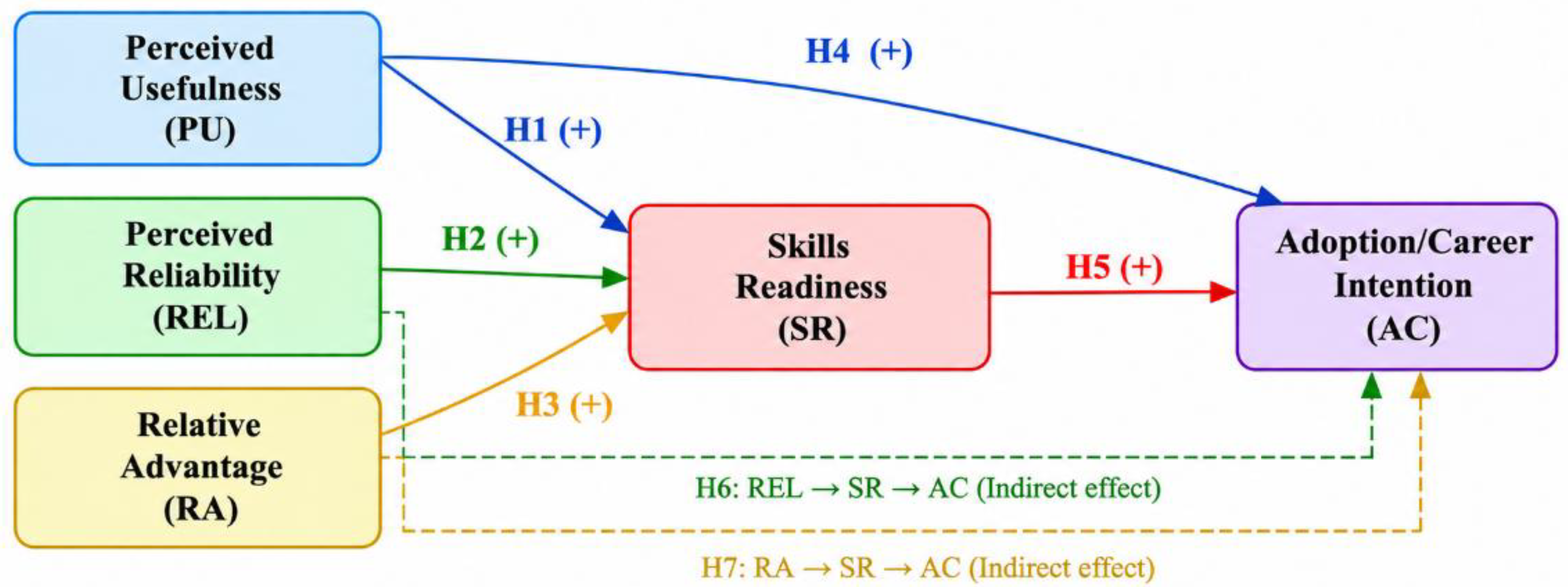
Table 1.
Constructs and Measurement Structure.
| Construct | Codes | Operational focus | Items |
|---|---|---|---|
| Perceived Usefulness | PU1-PU3 | Improves network performance and professional networking tasks | 3 |
| Perceived Reliability | REL1-REL3 | Dependability and stability for professional networking | 3 |
| Relative Advantage | RA1-RA3 | Advantages, efficiency/control and modern-network benefits | 3 |
| Technology Readiness | TRI1-TRI3 | Comfort, experimentation and adaptation to networking change | 3 |
| Skills Readiness | SR1-SR3 | Foundational skills, learning ability and training preparedness | 3 |
| Adoption/Career Intention | ACI1-ACI3 | Future use, Cisco consideration and skills strengthening | 3 |
The measurement structure is intentionally compact, with three indicators per construct. Perceived Usefulness, Perceived Reliability and Relative Advantage represent the principal technology evaluations; Technology Readiness is retained for diagnostic comparison; Skills Readiness represents the capability mechanism; and Adoption/Career Intention represents the distal outcome. The same structure is carried forward into the measurement assessment in Section 4, where the adequacy and distinctiveness of these measures are evaluated rather than assumed.
Table 2.
Demographic Profile of Respondents (n = 385).
| Characteristic | Category | n | % |
|---|---|---|---|
| Age | 18-20 | 46 | 11.9 |
| Age | 21-25 | 161 | 41.8 |
| Age | 26-30 | 93 | 24.2 |
| Age | 31-40 | 61 | 15.8 |
| Age | 41+ | 24 | 6.2 |
| Gender | Male | 247 | 64.2 |
| Gender | Female | 131 | 34.0 |
| Gender | Other / not stated | 7 | 1.9 |
| Status | Student | 167 | 43.4 |
| Status | Employed | 134 | 34.8 |
| Status | Self-employed/Freelancer | 63 | 16.4 |
| Status | Other | 21 | 5.5 |
| Education | Undergraduate | 158 | 41.0 |
| Education | Graduate | 113 | 29.4 |
| Education | Postgraduate | 101 | 26.2 |
| Education | Other | 13 | 3.4 |
| Use frequency | Daily | 111 | 28.8 |
| Use frequency | Several times/week | 149 | 38.7 |
| Use frequency | Weekly | 69 | 17.9 |
| Use frequency | Less often | 56 | 14.5 |
The profile indicates a relatively young and digitally engaged respondent pool, with the largest age group being 21-25 years and substantial representation from students as well as employed and self-employed/freelance respondents. The distribution therefore supports a pipeline interpretation of the sample rather than a claim that all respondents are established network engineers. This distinction is important when interpreting Skills Readiness and Adoption/Career Intention as workforce-transition constructs.
Table 3.
Descriptive Statistics of Focal Constructs.
| Construct | Mean | SD | Min | Max |
|---|---|---|---|---|
| PU | 4.042 | 0.472 | 2.67 | 5.00 |
| REL | 3.973 | 0.514 | 2.33 | 5.00 |
| RA | 3.934 | 0.474 | 2.67 | 5.00 |
| TR | 3.823 | 0.453 | 2.33 | 5.00 |
| SR | 3.598 | 0.500 | 2.00 | 5.00 |
| ACI | 4.016 | 0.442 | 2.67 | 5.00 |
Table 4.
Composite Measurement Diagnostics.
| Construct | Item loadings (1-3) | α | CR | AVE |
|---|---|---|---|---|
| PU | 0.696, 0.679, 0.651 | 0.402 | 0.716 | 0.456 |
| REL | 0.697, 0.710, 0.727 | 0.512 | 0.755 | 0.506 |
| RA | 0.686, 0.685, 0.703 | 0.454 | 0.733 | 0.478 |
| TR | 0.667, 0.674, 0.624 | 0.337 | 0.693 | 0.430 |
| SR | 0.720, 0.710, 0.691 | 0.500 | 0.750 | 0.500 |
| ACI | 0.666, 0.657, 0.660 | 0.355 | 0.699 | 0.437 |
Table 5.
Selected HTMT Discriminant-Validity Diagnostics.
| Pair | HTMT diagnostic | Interpretation |
|---|---|---|
| TR-SR | 0.971 | Problematic overlap |
| TR-ACI | 0.966 | Problematic overlap |
| SR-ACI | 0.622 | Acceptable separation |
| SR-REL | 0.422 | Acceptable separation |
| SR-RA | 0.388 | Acceptable separation |
| SR-PU | 0.226 | Acceptable separation |
| PU-RA | 0.632 | Below common .85/.90 cut-offs |
| REL-RA | 0.628 | Below common .85/.90 cut-offs |
Table 6.
Structural Paths and Hypothesis Testing.
| Hyp. | Path | β | t | p | 95% bootstrap CI | Decision |
|---|---|---|---|---|---|---|
| H1 | PU → SR | .052 | 1.00 | .318 | [-.062, .168] | Not supported |
| H2 | REL → SR | .163 | 3.10 | .002 | [.051, .264] | Supported |
| H3 | RA → SR | .148 | 2.79 | .005 | [.046, .269] | Supported |
| H4 | SR → ACI | .202 | 4.16 | <.001 | [.101, .257] | Supported |
| H5 | PU → ACI | .180 | 3.64 | <.001 | [.082, .253] | Supported |
| H6 | RA → ACI | .150 | 2.95 | .003 | [.041, .241] | Supported |
| H7 | REL → ACI | .092 | 1.82 | .069 | [-.009, .162] | Not supported |
Table 7.
Effect Sizes (f²) for the Final Structural Model.
| Endogenous construct | Predictor | f² |
|---|---|---|
| Skills Readiness | PU | .003 |
| Skills Readiness | REL | .025 |
| Skills Readiness | RA | .020 |
| Adoption/Career Intention | PU | .035 |
| Adoption/Career Intention | REL | .009 |
| Adoption/Career Intention | RA | .023 |
| Adoption/Career Intention | SR | .046 |
Table 8.
Bootstrap Indirect Effects Through Skills Readiness (5,000 Resamples).
| Indirect effect | Indirect β | 95% bootstrap CI | Decision |
|---|---|---|---|
| PU → SR → ACI | .010 | [-.011, .032] | Not supported |
| REL → SR → ACI | .029 | [.007, .056] | Supported |
| RA → SR → ACI | .028 | [.007, .053] | Supported |
Disclaimer/Publisher’s Note: The statements, opinions and data contained in all publications are solely those of the individual author(s) and contributor(s) and not of MDPI and/or the editor(s). MDPI and/or the editor(s) disclaim responsibility for any injury to people or property resulting from any ideas, methods, instructions or products referred to in the content. |
© 2026 by the authors. Licensee MDPI, Basel, Switzerland. This article is an open access article distributed under the terms and conditions of the Creative Commons Attribution (CC BY) license (http://creativecommons.org/licenses/by/4.0/).
Copyright: This open access article is published under a Creative Commons CC BY 4.0 license, which permit the free download, distribution, and reuse, provided that the author and preprint are cited in any reuse.