

Submitted:
21 October 2026
Posted:
21 October 2026
You are already at the latest version
Abstract
Platelet transfusion is essential in hematology but remains characterized by practice variability, uneven certainty of evidence across clinical settings, short component shelf life and clinically relevant adverse effects. This narrative review integrates evidence on efficacy, thresholds and dosing, safety, and implementation of platelet-specific patient blood management (PBM). In stable non-bleeding therapy-induced thrombocytopenia, a restrictive prophylactic threshold of 10 × 10⁹/L is supported by randomized evidence and contemporary guidelines, whereas higher thresholds increase exposure without consistent clinical benefit. Therapeutic-only strategies reduce utilization but are not equally safe across populations, particularly in acute leukemia. Platelet PBM should therefore combine indication-specific protocols, a single-adult-dose policy with reassessment, audit and feedback, post-transfusion response monitoring, refractoriness management, inventory stewardship and multidisciplinary governance. The objective is not simply fewer transfusions, but fewer unnecessary transfusions with preserved hemostatic safety.
Keywords:
transfusion
; platelets
; hemovigilance
; patient blood management
; thrombocytopenia
; thresholds
; bleeding
; hematologic malignancies
; refractoriness
; safety
1. Introduction and Rationale for Platelet-Specific PBM
Patient Blood Management (PBM) is a multidisciplinary, systematic, evidence-based and patient-centered approach intended to preserve endogenous hematopoiesis, minimize blood loss, and ensure rational, individualized use of blood components [1]. During the last two decades, PBM has become firmly established for red-cell transfusion through restrictive hemoglobin thresholds and proactive anemia management. Platelet-specific PBM (PBM-P), however, remains less mature and more heterogeneous [2,3,4,5]. This asymmetry largely reflects the evidence base: red-cell policy is supported by numerous large randomized trials, whereas platelet practice has historically depended on a smaller number of randomized studies focused mainly on prophylactic thresholds and dosing.
Hematology and oncology account for a major proportion of platelet support, much of it prophylactic. Demand is sustained by intensive myelosuppressive chemotherapy, expanding use of autologous and allogeneic hematopoietic stem-cell transplantation (HSCT), post-transplant cyclophosphamide, and advanced cellular and immune therapies. CAR-T therapy has not eliminated transfusion dependence: prolonged cytopenias are common, and real-world data demonstrate substantial transfusion requirements during the months after infusion, particularly early after treatment [6]. These developments occur in an increasingly older population with greater comorbidity and a more complex balance between hemorrhagic and thrombotic risk.
Despite evidence-based guidance, real-world platelet prescribing remains variable. Multicenter audits have documented substantial non-adherence and potentially inappropriate transfusion, creating a clear target for stewardship [3,7]. The 2025 AABB/ICTMG guideline provides a more restrictive contemporary framework and creates an opportunity to reassess legacy thresholds and routine practice [4]. In Table 1, it is describe diverse guidelines thresholds recommendation.
A central difficulty is that the clinical endpoint of platelet transfusion is not the platelet count itself but prevention or control of bleeding. The relationship between count and bleeding is nonlinear, and the same platelet count may represent very different clinical risk depending on the underlying disease, duration of thrombocytopenia, mucosal integrity, fever or sepsis, concomitant coagulation abnormalities, antithrombotic treatment and the anatomical consequences of a potential bleed. This makes platelet PBM intrinsically more dependent on clinical context than a simple laboratory-trigger model. It also explains why a policy that is appropriately restrictive in a stable patient with hypoproliferative thrombocytopenia may be inappropriate in active hemorrhage or in a patient undergoing a high-risk procedure. The practical challenge is therefore to standardize what can be standardized while preserving rapid individualized decision-making when risk is not captured by the platelet count alone [4,20,21].
Platelets are also a biologically and logistically fragile resource. Conventional storage at 20–24 °C under continuous agitation limits shelf life and favors bacterial proliferation, while unpredictable demand creates simultaneous risks of shortage and outdating. The term “platelet insecurity” describes the vulnerability of the supply chain to donor fluctuations, collection constraints, technical incidents and public-health contingencies [8]. The financial impact is substantial because of collection, processing, testing, pathogen-reduction procedures, storage and hospital handling.
These logistic constraints have direct clinical implications. Unlike red-cell inventory, platelet stock cannot be expanded indefinitely to buffer fluctuations in demand. Hematology services may generate abrupt peaks in utilization during induction chemotherapy, transplantation or cellular-therapy programs, while emergency surgery and major hemorrhage compete for the same short-lived resource. PBM-P therefore has a dual objective: reducing patient exposure to transfusions that are unlikely to provide benefit and improving the resilience of the platelet supply for patients in whom transfusion is genuinely necessary. In this sense, clinical appropriateness and inventory stewardship are complementary rather than competing goals [8].
Finally, platelet transfusion is not a benign intervention. Acute febrile and allergic reactions, bacterial contamination and sepsis, transfusion-associated circulatory overload (TACO), transfusion-related acute lung injury (TRALI), HLA/HPA alloimmunization and platelet refractoriness are clinically relevant complications [9,10,11,12]. PBM-P should therefore be understood not simply as “transfusing less”, but as a safety and stewardship framework: transfuse when expected benefit exceeds risk, use the minimum effective dose, reassess response, investigate ineffective support and preserve access to an essential but scarce component.
2. Clinical Effectiveness: Prophylactic Versus Therapeutic Platelet Transfusion
Prophylactic platelet transfusion is administered to prevent bleeding in thrombocytopenic patients without active hemorrhage, whereas therapeutic transfusion is reserved for clinically relevant bleeding or an urgent hemostatic requirement. The best-studied setting is therapy-induced hypoproliferative thrombocytopenia in hematologic malignancy and HSCT [13,14,15,16].
In stable non-bleeding patients with therapy-induced hypoproliferative thrombocytopenia, randomized trials and systematic reviews comparing prophylactic thresholds of 10 × 109/L with 20–30 × 109/L support the lower threshold as a strategy that reduces platelet exposure without a demonstrated increase in major bleeding or mortality [14,17,18]. These findings underpin the contemporary recommendation to use 10 × 109/L as the standard prophylactic trigger in this setting [4].
The importance of this evidence is not merely numerical. Historically, higher thresholds were often adopted in an attempt to create a wider safety margin, particularly during intensive chemotherapy. However, increasing the prophylactic trigger predictably increases the number of transfusion episodes and donor exposures, while randomized comparisons have not shown a corresponding improvement in the outcomes that matter most to patients. The PBM interpretation is therefore that a higher platelet count after transfusion should not be confused with greater clinical effectiveness. The relevant balance is between bleeding prevention and the burden and risk created by additional transfusion exposure [14,17,18].
The comparison between routine prophylaxis and a therapeutic-only strategy is more complex. Wandt et al. showed that a therapeutic strategy substantially reduced platelet transfusions, but severe bleeding occurred more frequently in acute myeloid leukemia, including intracranial hemorrhage [13]. In TOPPS, omission of prophylactic transfusion did not meet non-inferiority criteria: WHO grade 2–4 bleeding occurred in 50% of patients without prophylaxis compared with 43% receiving prophylaxis [19]. Meta-analytic evidence therefore supports an important distinction: therapeutic-only strategies reduce component exposure, but at the cost of more clinically significant bleeding when applied indiscriminately [15].
The Wandt and TOPPS studies also illustrate why platelet PBM should not be equated with eliminating prophylaxis. Both studies achieved meaningful reductions in platelet utilization when prophylactic transfusions were withheld, but the bleeding signal differed according to the population studied. In acute leukemia, where thrombocytopenia is often prolonged and coexists with infection, mucosal injury and intensive treatment, the increased risk of severe hemorrhage makes a universal therapeutic-only strategy difficult to justify [13]. Conversely, the shorter and more predictable thrombocytopenic phase after autologous HSCT creates a setting in which selected stable patients can be managed with closer clinical observation and therapeutic transfusion when required [4,13,19]. Thus, the same intervention—omission of routine prophylaxis—may represent appropriate PBM in one population and unsafe under-transfusion in another.
The effect is not uniform across hematologic populations. Selected clinically stable autologous HSCT recipients may derive less benefit from routine prophylaxis because the period of profound thrombocytopenia is generally shorter. This approach requires close clinical surveillance and rapid access to therapeutic transfusion and should not be extrapolated to acute leukemia or allogeneic HSCT, where prolonged aplasia, mucosal injury, infection and other complications amplify bleeding risk [4,13,19].
Platelet count alone is an imperfect predictor of hemorrhage. Prospective analyses demonstrate that fever, infection, anemia, mucosal damage, coagulopathy, medications, prior bleeding and the duration and trajectory of thrombocytopenia modify bleeding risk [20,21]. PBM therefore requires numerical thresholds to be interpreted within the whole bleeding-risk phenotype rather than used as isolated laboratory triggers.
This distinction also affects how bleeding outcomes should be interpreted in trials and audits. WHO grade ≥2 bleeding is frequently used as an endpoint, but it encompasses events of different clinical relevance, whereas rare critical-site hemorrhage is difficult to study because adequately powered trials would require very large sample sizes. Furthermore, transfusion may be administered in response to early bleeding, making exposure itself partly a marker of worsening clinical status. These methodological issues explain why evidence is strongest for common prophylactic scenarios and much weaker for critical illness, procedures and complex coagulopathies. They also support monitoring both utilization and patient-centered safety outcomes in PBM programs rather than using transfusion reduction as a surrogate for benefit [15,20,21].
Evidence in the intensive care unit is substantially weaker. Prospective observational studies demonstrate wide variation in indications and frequent poor post-transfusion increments, particularly in sepsis and hematologic malignancy [22,23]. A propensity-score analysis suggested that a more restrictive strategy could reduce platelet use without an observed increase in grade ≥ 2 bleeding or 28-day mortality [24]. Observational associations between platelet transfusion and mortality or thrombosis in sepsis and consumptive disorders remain vulnerable to confounding by indication and should not be interpreted as proof of transfusion-related harm [25,26].
The ICU is a particularly important example of the limits of count-based practice. Thrombocytopenia in critical illness is often multifactorial and may reflect sepsis, disseminated consumption, organ failure, extracorporeal support, medications or marrow suppression. Consequently, a poor post-transfusion increment does not necessarily indicate immune refractoriness, and repeated empirical dosing may add exposure without achieving a durable platelet response [22,23]. A PBM approach in this setting should first clarify the indication—active bleeding, procedure or prophylaxis—and then consider the likelihood that transfusion will produce a clinically useful hemostatic effect.
3. Indications, Thresholds and Dose: Consensus and Remaining Uncertainty
The area of greatest international consensus is stable, non-bleeding central thrombocytopenia during chemotherapy or allogeneic HSCT: the 2025 AABB/ICTMG guideline recommends prophylactic transfusion at <10 × 109/L [4]. The guideline, developed after systematic review using GRADE methodology, found no demonstrated increase in mortality or severe bleeding with restrictive practice in the populations evaluated [4,27]. Older AABB and British guidance broadly support the same direction, although recommendations diverge in selected procedural and high-risk situations [16,28].
Procedural thresholds remain a major source of variability. AABB/ICTMG 2025 recommends or conditionally suggests restrictive thresholds that vary by procedure, including <20 × 109/L before lumbar puncture, <10 × 109/L for compressible-site central venous catheter placement, <20 × 109/L for low-risk interventional radiology, and <50 × 109/L for high-risk interventional radiology or major non-neuraxial surgery [4]. The certainty of evidence is lower than in stable hypoproliferative thrombocytopenia, and these values should be interpreted as decision boundaries rather than automatic targets. These values should not be treated as mandatory targets. Procedure type, ability to achieve local hemostasis, operator experience, platelet trend and function, coagulopathy, antithrombotic therapy and urgency all modify risk.
This is clinically relevant because procedural thresholds are frequently transformed in practice from conditional recommendations into fixed pre-procedure targets. Such an approach may generate repeated transfusions to reach an arbitrary count even when the procedure is compressible, ultrasound-guided or otherwise associated with low bleeding risk. Conversely, a numerically acceptable count should not provide false reassurance for a procedure in a patient with additional hemostatic abnormalities. The PBM objective is therefore not to replace one universal threshold with another, but to embed procedure-specific guidance into a broader assessment of technical and patient-related bleeding risk [4,28].
Complex contemporary settings remain evidence gaps rather than areas for firm platelet-specific recommendations. In CAR-T recipients, practice is largely extrapolated from general oncohematology because no consolidated platelet-specific threshold has been established. Thrombocytopenia may coexist with infection, inflammation, coagulopathy, endothelial activation and anticoagulation. In cancer-associated thrombosis with thrombocytopenia, consensus and cohort data generally support full-dose anticoagulation when platelet counts are ≥50 × 109/L without routine transfusion support, whereas lower counts require individualized strategies based on thrombotic acuity and bleeding risk [29,30].
Dose is a second major PBM lever. When transfusion is indicated, one adult apheresis dose or equivalent should generally be administered, followed by clinical reassessment before repetition [4,16]. The PLADO trial demonstrated that higher prophylactic doses did not reduce bleeding; lower doses reduced the total quantity of platelets transfused but required more frequent transfusion episodes [31]. These data support a “single adult dose, then reassess” policy and argue against routine initial multi-unit orders in non-bleeding patients.
The dosing evidence is particularly suitable for implementation because it can be translated directly into prescribing behavior. A default order for one adult therapeutic dose reduces the tendency to prescribe two units pre-emptively and creates a deliberate reassessment point. That reassessment may be clinical in active bleeding and may include a post-transfusion platelet count when the objective is prophylaxis, preparation for a procedure or evaluation of suspected refractoriness. This approach does not imply that a second dose is never appropriate; rather, it requires the expected benefit of additional platelets to be reconsidered after the response to the first dose is known [4,31].
The practical implication is that platelet thresholds should function as decision-support boundaries rather than isolated triggers. A request should identify the indication, latest platelet count and sampling time, bleeding status and site, planned procedure and timing, and relevant modifiers. Exceptions are expected in complex medicine, but they should be explicit, clinically justified and auditable.
4. Safety, Adverse Events and Cumulative Exposure
Any platelet PBM program must incorporate safety as a primary outcome. The objective is not merely to reduce utilization, but to reduce avoidable exposure while preserving hemostatic safety. Each transfusion introduces biological material, volume and donor antigens, and cumulative exposure becomes particularly relevant when support is required over weeks or months [1,4,27].
Febrile non-hemolytic and allergic reactions are among the most frequent acute complications. Bacterial contamination is a distinctive platelet safety concern because room-temperature storage facilitates bacterial proliferation. Detection and pathogen-reduction strategies have reduced but not eliminated this risk [9,10,11]. Cardiopulmonary complications include TACO, particularly in older patients and those with cardiac or renal dysfunction, and TRALI, characterized by acute hypoxemia and non-cardiogenic pulmonary edema [12,32].
Repeated platelet transfusion can lead to HLA/HPA alloimmunization and refractoriness. Most poor increments are non-immune and associated with infection, fever, active bleeding, disseminated intravascular coagulation, splenomegaly or drugs; immune causes are driven mainly by HLA antibodies [10,33]. Persistent inadequate increments should trigger investigation rather than automatic additional units. A platelet count approximately 10–60 min after transfusion, with corrected count increment when appropriate, can guide assessment [34].
Refractoriness is particularly relevant to PBM because it can generate a self-perpetuating cycle of ineffective transfusion. When an inadequate increment is followed automatically by another unselected platelet dose, utilization rises while the underlying mechanism remains unresolved. Early distinction between non-immune consumption and immune refractoriness is therefore both a clinical and stewardship intervention. In a patient with ongoing bleeding, sepsis, fever or disseminated coagulation, correction of the underlying driver may be more important than repeated attempts to normalize the platelet count. When immune refractoriness is suspected, coordinated investigation with the Blood Bank allows scarce crossmatch-compatible or HLA-selected components to be reserved for patients most likely to benefit [33,34].
ABO-identical or compatible platelets generally provide better post-transfusion increments; however, the 2026 systematic review found very-low-certainty evidence for differences in clinically significant bleeding, mortality, acute transfusion reactions or refractoriness [35]. Thus, ABO-identical/compatible components should be prioritized when feasible, particularly in repeatedly transfused patients, without compromising timely access to platelet support. Transfusion-related immunomodulation (TRIM) describes biologically plausible immunosuppressive and pro-inflammatory effects mediated by cellular and soluble factors [36,37]. Observational associations between platelet transfusion and thrombosis or mortality should be interpreted cautiously because confounding by indication is substantial [26,38].
The corrected count increment should likewise be used selectively rather than as a routine endpoint after every transfusion. Its greatest value is in patients with repeated inadequate responses, where it helps establish whether the observed increment is disproportionate to the platelet dose and recipient size. The clinical response remains essential: an apparently satisfactory laboratory increment does not replace assessment of hemostasis in a bleeding patient, and a low increment in a patient with major ongoing consumption may not justify an immune work-up. PBM therefore links laboratory monitoring to a specific clinical question rather than increasing testing indiscriminately [34].
Patients with leukemia, HSCT and CAR-T therapy are particularly exposed because platelet support may continue for prolonged periods. In the DESCAR-T cohort, more than half of patients with large B-cell lymphoma treated with CAR-T required transfusion support during the six months after infusion, with the greatest utilization during the first month [6]. Minimizing exposure in these settings means avoiding transfusions without expected benefit, not withholding clinically indicated support.
5. Platelet PBM Strategies, Implementation and Future Perspectives
Platelet PBM should become an institutional stewardship program that defines when to transfuse, how much to transfuse, how response is assessed and how safety is monitored. The cornerstone is an indication-specific policy separating non-bleeding prophylaxis, planned procedures, active bleeding and specialist-directed exceptions. Platelet count alone should not trigger transfusion; bleeding phenotype, platelet trend and function, procedure-related risk, coagulopathy, infection, antithrombotic therapy and underlying disease must also be considered [4]. The principal components of a practical platelet PBM implementation bundle, together with suggested quality indicators, are summarized in Table 2.
Electronic orders should require the indication, latest platelet count and sampling time, bleeding status/site, planned procedure and timing, and justification for exceptions or repeated doses. Decision support can display the relevant threshold, flag prophylactic orders above it and discourage initial multi-unit orders while preserving immediate override for major bleeding. Audit should be coupled with targeted feedback and multidisciplinary governance. These principles can be integrated into a stepwise clinical decision-support pathway, as proposed in Figure 1.
The electronic request is an especially powerful implementation point because it occurs before exposure has taken place. Mandatory documentation can make the indication visible, while context-sensitive decision support can display the relevant threshold and identify orders that fall outside the local pathway. The aim is not to create a rigid electronic barrier: major bleeding must always allow immediate override. Instead, the system should make the default action evidence-based and require active justification when clinicians depart from that default. The same data fields can subsequently support audit, allowing services to distinguish appropriate exceptions from systematic overuse.
Real-world data support feasibility. Solves et al. reported that annual platelet transfusions decreased from 8028 to 6880 (14% overall), with reductions of 15.6% in hospitalized hematology patients and 34.5% in outpatients; reported platelet-related adverse events decreased from 51 patients in 2023 to 35 in 2024 [5]. Other programs combining education, audit and structured oversight have reduced use or improved appropriateness without a clear signal of increased severe bleeding or mortality [39,40,41,42]. Before-and-after designs cannot establish causality, but they demonstrate that transfusion culture can be modified.
Implementation studies also show that education alone is unlikely to be sufficient. Sustainable change requires repeated measurement, feedback and clinical ownership. High-use services should receive their own utilization and appropriateness data, ideally alongside bleeding and adverse-event outcomes. A multidisciplinary transfusion committee can then identify whether excess use reflects knowledge gaps, order-set design, procedure pathways, delayed laboratory information or genuine case-mix differences. This governance structure is particularly important when introducing restrictive policies, because clinicians need a rapid mechanism for discussing exceptions and safety signals [5,39,40,41,42].
Post-transfusion assessment is another underused PBM intervention. Repeated transfusion without an adequate increment should trigger investigation. Non-immune causes should be assessed first; persistent inadequate increments should prompt HLA/HPA antibody testing and early Blood Bank involvement, with crossmatch-compatible or HLA-selected platelets when immune refractoriness is demonstrated [33,34].
Inventory stewardship is integral because short shelf life and unpredictable demand create simultaneous risks of shortage and wastage. Demand forecasting, timely release of unused reservations, first-expire-first-out allocation and real-time monitoring of outdating should be incorporated into Blood Bank practice. Modeling reduced wastage from 10.1% to approximately 5% and shortages from 6.5% to 1.7–2.1% [43].
Inventory metrics should therefore be included in the PBM dashboard rather than treated as a separate Blood Bank problem. Useful measures include outdating, emergency shortages, redistribution, the proportion of reserved components released unused and demand by clinical service. Linking anticipated chemotherapy, HSCT, CAR-T and procedural activity to stock planning may improve forecasting, while real-time review of expiry allows redistribution before components are lost. The modeling data are encouraging but should be interpreted as proof of logistic potential rather than evidence of improved clinical outcomes [43].
Cold-stored platelets can extend product availability and retain favorable immediate hemostatic properties, making them particularly attractive for actively bleeding patients; however, processing variability and shorter in-vivo survival remain important limitations when extrapolating their use to prophylactic support in hematology [44]. Pathogen-reduction technologies improve microbiological safety, but efficacy should be considered technology-specific: a 2024 meta-analysis found no overall increase in severe bleeding with pathogen-reduced platelets, while clinically significant bleeding differed between amotosalen/UVA- and riboflavin/UV-treated components [45]. Cryopreservation offers major logistic advantages and prolonged storage, but the CLIP-II randomized trial in cardiac surgery did not establish noninferiority of cryopreserved platelets to conventional liquid-stored platelets for 24-h bleeding control and found greater blood loss and use of other blood components in several secondary outcomes [46]. These technologies should therefore be viewed as context-specific tools rather than interchangeable replacements for conventional platelets.
TPO-RAs may complement platelet PBM in persistent thrombocytopenias but are not substitutes for transfusion in acute bleeding because their effect is delayed.
Chemotherapy-induced thrombocytopenia (CIT) has the strongest emerging evidence. NCCN recommends considering romiplostim for CIT (category 2A) to maintain chemotherapy dose schedule and intensity when expected benefit outweighs risk [47]. In the phase 3 RECITE trial, 165 patients with persistent CIT with gastrointestinal cancers receiving oxaliplatin-based chemotherapy were randomized to romiplostim or placebo. No CIT-induced chemotherapy dose modification during cycles 2 and 3 occurred in 84% versus 36% (OR 10.16; 95% CI, 4.44–23.72; p < 0.001) [48]. Thromboembolic events occurred in 2% versus 0%. Earlier romiplostim data [49] and ISTH guidance supporting TPO-RA consideration when inadequate platelet recovery would otherwise require chemotherapy delay or dose reduction [50]. A phase 3 avatrombopag trial did not meet its composite primary endpoint [51], so evidence should not be extrapolated across TPO-RAs.
Evidence after cellular therapy and HCT is less robust. In a Spanish multicenter cohort of 38 patients with platelet-transfusion-dependent thrombocytopenia after anti-CD19 CAR-T therapy, eltrombopag was associated with transfusion independence in 29 (76.3%); the uncontrolled design prevents causal attribution [52]. After HCT, eltrombopag is the most studied TPO-RA. A review identified 64 reports including 1730 patients but only five randomized trials, supporting selective treatment of established prolonged thrombocytopenia rather than routine early administration to accelerate engraftment [53].
PBM endpoints differ by setting: preservation of chemotherapy relative dose intensity is central in CIT, whereas independence may be more appropriate after CAR-T or HCT. TPO-RAs should be used in diagnosis-specific pathways and never delay transfusion when immediate hemostatic support is required. Avatrombopag reduces peri-procedural transfusion or rescue therapy in adults with chronic liver disease [54], whereas prophylactic tranexamic acid did not reduce clinically relevant bleeding in thrombocytopenic hematology patients [55].
The future of platelet PBM should be individualized, data-driven and auditable. The objective is not the lowest possible platelet consumption, but the lowest avoidable transfusion exposure compatible with timely hemostatic support and demonstrable patient safety.
Evidence hierarchy used in this review: (1) guideline-supported recommendations with randomized evidence, particularly the 10 × 109/L prophylactic threshold in stable hypoproliferative thrombocytopenia; (2) conditional recommendations with lower-certainty evidence, particularly many procedure-related thresholds; and (3) evidence gaps requiring individualized practice, including CAR-T–associated thrombocytopenia, several ICU scenarios, and thrombocytopenia during anticoagulation.
6. Conclusions
The strongest evidence supports restrictive prophylaxis at 10 × 109/L in stable thrombocytopenia, avoidance of routinely higher thresholds, and one adult dose followed by reassessment. Therapeutic-only strategies may be appropriate in selected populations but cannot be generalized to acute leukemia or other high-risk settings. Procedural thresholds, critical illness, CAR-T therapy, anticoagulation and individualized prediction of bleeding remain important evidence gaps.
A mature platelet PBM program should combine evidence-based thresholds with individualized bleeding-risk assessment, active stewardship, post-transfusion response monitoring, prevention and management of refractoriness, inventory optimization and surveillance of both bleeding and transfusion-related harm. The central objective is not simply fewer transfusions, but fewer unnecessary transfusions with preserved or improved patient safety.
The next phase of platelet PBM should focus on prospective implementation research. Future studies should report not only units avoided, but clinically significant and critical-site bleeding, mortality, procedure delays, transfusion reactions, refractoriness, patient exposure to donors, wastage and cost. Better risk-prediction tools may ultimately allow prophylaxis to be targeted according to bleeding phenotype rather than platelet count alone, but such tools require validation before they can replace current evidence-based thresholds. Until then, the most defensible strategy is a layered model: restrictive defaults where evidence is strong, individualized decisions where evidence is conditional, and explicit recognition of evidence gaps rather than extrapolation presented as certainty.
Author Contributions
Conceptualization: MEMC. Participation in rounds of discussion: MEMC, RCC, MADM, APV, NRT. Literature research: MEMC, RCC, MADM, APV, NRT. Writing: MEMC, RCC, MADM, APV, NRT. Writing review: MEMC, RCC, MADM, APV, NRT. Final supervision: MEMC. All authors have read and agreed to this version of the manuscript.
Funding
This research received no external funding.
Institutional Review Board Statement
Not applicable.
Informed Consent Statement
Not applicable.
Data Availability Statement
Article did not report any data.
Conflicts of interest
MEMC has the following financial relationships: advisor on scientific boards, Speaker for Amgen, Sobi, Novartis, Sanofi, Takeda, Grifols, Novonordisk. Grants from Grifols, Amgen, Sanofi, Sobi. RCC, no conflict of interest; MADM, no conflict of interest; APV, no conflict of interest; NRT, no conflict of interest.
References
- Mueller, M.M.; Van Remoortel, H.; Meybohm, P.; et al. Patient Blood Management: Recommendations From the 2018 Frankfurt Consensus Conference. JAMA 2019, 321, 983–997. [Google Scholar] [CrossRef] [PubMed]
- García-Erce, J.A.; Sabio, F.; Jericó, C.; et al. Variabilidad en la aplicación de los programas de gestión de sangre del paciente en Iberia. Rev. Esp. Anestesiol. Reanim. 2026, 73, 502017. [Google Scholar] [CrossRef]
- Yakymi, R.; Cohn, C.S. An audit of platelet transfusions at a tertiary care center: New opportunities for patient blood management with the 2025 AABB/ICTMG platelet guidelines. Transfusion 2026, 66, 352–361. [Google Scholar] [CrossRef] [PubMed]
- Metcalf, R.A.; Nahirniak, S.; Guyatt, G.; et al. Platelet Transfusion: 2025 AABB and ICTMG International Clinical Practice Guidelines. JAMA 2025, 334, 606–617. [Google Scholar] [CrossRef] [PubMed]
- Solves, P.; Córcoles, M.; Soriano, M.; et al. Patient Blood Management in Hematology: Focusing on Platelet Transfusion. J. Clin. Med. 2025, 14, 8434. [Google Scholar] [CrossRef] [PubMed]
- Vic, S.; Thibert, J.B.; Bachy, E.; et al. Transfusion needs after CAR T-cell therapy for large B-cell lymphoma: Predictive factors and outcome (a DESCAR-T study). Blood Adv. 2024, 8, 1573–1585. [Google Scholar] [CrossRef] [PubMed]
- Hill-Strathy, M.J.; Pinkerton, P.H.; Thompson, T.A.; et al. Evaluating the appropriateness of platelet transfusions compared with evidence-based platelet guidelines: An audit of platelet transfusions at 57 hospitals. Transfusion 2021, 61, 57–71. [Google Scholar] [CrossRef] [PubMed]
- Gehrie, E.A.; Young, P.P.; Basavaraju, S.V.; et al. Addressing platelet insecurity-A national call to action. Transfusion 2024, 64, 2001–2013. [Google Scholar] [CrossRef] [PubMed]
- Wang, H.; Ren, D.; Sun, H.; Liu, J. Research progress on febrile non-hemolytic transfusion reaction. Ann. Transl. Med. 2022, 10, 1401. [Google Scholar] [CrossRef] [PubMed]
- Ho, W.F.; Wan, C.C.; Chan, K.W.; U, N.M.; Hui, P. Human platelet transfusion: A narrative review. Ann. Blood 2025, 10, 2. [Google Scholar] [CrossRef]
- Szczepiorkowski, Z.M.; Pagano, M.B. Platelet components and bacterial contamination: Hospital perspective 2022. Hematol. Am. Soc. Hematol. Educ. Program 2022, 2022, 430–436. [Google Scholar] [CrossRef] [PubMed]
- Bulle, E.B.; Klanderman, R.B.; Pendergrast, J.; Cserti-Gazdewich, C.; Callum, J.; Vlaar, A.P.J. The recipe for TACO: A narrative review on the pathophysiology and potential mitigation strategies of transfusion-associated circulatory overload. Blood Rev. 2022, 52, 100891. [Google Scholar] [CrossRef] [PubMed]
- Wandt, H.; Schaefer-Eckart, K.; Wendelin, K.; et al. Therapeutic platelet transfusion versus routine prophylactic transfusion in patients with haematological malignancies: An open-label, multicentre, randomised study. Lancet 2012, 380, 1309–1316. [Google Scholar] [CrossRef] [PubMed]
- Estcourt, L.J.; Stanworth, S.J.; Doree, C.; Hopewell, S.; Trivella, M.; Murphy, M.F. Comparison of different platelet count thresholds to guide administration of prophylactic platelet transfusion for preventing bleeding in people with haematological disorders after myelosuppressive chemotherapy or stem cell transplantation. Cochrane Database Syst. Rev. 2015, 2015, CD010983. [Google Scholar] [CrossRef] [PubMed]
- Crighton, G.L.; Estcourt, L.J.; Wood, E.M.; Trivella, M.; Doree, C.; Stanworth, S.J. A therapeutic-only versus prophylactic platelet transfusion strategy for preventing bleeding in patients with haematological disorders after myelosuppressive chemotherapy or stem cell transplantation. Cochrane Database Syst. Rev. 2015, 2015, CD010981. [Google Scholar] [CrossRef] [PubMed]
- Kaufman, R.M.; Djulbegovic, B.; Gernsheimer, T.; et al. Platelet transfusion: A clinical practice guideline from the AABB. Ann. Intern. Med. 2015, 162, 205–213. [Google Scholar] [CrossRef] [PubMed]
- Rebulla, P.; Finazzi, G.; Marangoni, F.; et al. The threshold for prophylactic platelet transfusions in adults with acute myeloid leukemia. N. Engl. J. Med. 1997, 337, 1870–1875. [Google Scholar] [CrossRef] [PubMed]
- Heckman, K.D.; Weiner, G.J.; Davis, C.S.; Strauss, R.G.; Jones, M.P.; Burns, C.P. Randomized study of prophylactic platelet transfusion threshold during induction therapy for adult acute leukemia: 10,000/microL versus 20,000/microL. J. Clin. Oncol. 1997, 15, 1143–1149. [Google Scholar] [CrossRef] [PubMed]
- Stanworth, S.J.; Estcourt, L.J.; Powter, G.; et al. A no-prophylaxis platelet-transfusion strategy for hematologic cancers. N. Engl. J. Med. 2013, 368, 1771–1780. [Google Scholar] [CrossRef] [PubMed]
- Stanworth, S.J.; Hudson, C.L.; Estcourt, L.J.; Johnson, R.J.; Wood, E.M. TOPPS Study Investigators. Risk of bleeding and use of platelet transfusions in patients with hematologic malignancies: Recurrent event analysis. Haematologica 2015, 100, 740–747. [Google Scholar] [CrossRef] [PubMed]
- Uhl, L.; Assmann, S.F.; Hamza, T.H.; et al. Laboratory predictors of bleeding and the effect of platelet and RBC transfusions on bleeding outcomes in the PLADO trial. Blood 2017, 130, 1247–1258. [Google Scholar] [CrossRef] [PubMed]
- Reizine, F.; Le Marec, S.; Le Meur, A.; et al. Prophylactic platelet transfusion response in critically ill patients: A prospective multicentre observational study. Crit. Care 2023, 27, 373. [Google Scholar] [CrossRef] [PubMed]
- Anthon, C.T.; Pene, F.; Perner, A.; et al. Thrombocytopenia and platelet transfusions in ICU patients: An international inception cohort study (PLOT-ICU). Intensive Care Med. 2023, 49, 1327–1338. [Google Scholar] [CrossRef] [PubMed]
- Berenger, J.B.; Saillard, C.; Sannini, A.; et al. Prophylactic versus restrictive platelet transfusion strategy in patients with haematological malignancies in the ICU setting, a propensity-score analysis. J. Crit. Care 2024, 83, 154817. [Google Scholar] [CrossRef] [PubMed]
- He, S.; Fan, C.; Ma, J.; Tang, C.; Chen, Y. Platelet transfusion in patients with sepsis and thrombocytopenia: A propensity score-matched analysis using a large ICU database. Front. Med. 2022, 9, 830177. [Google Scholar] [CrossRef] [PubMed]
- Pustake, M.; Deoker, S.; Garikiparthy, V.; et al. Platelet Transfusion Is Associated With Increased Thrombosis and In-Hospital Mortality Among Patients Hospitalized With Platelet Consumptive Disorders. Eur. J. Haematol. 2026, 117, 245–257. [Google Scholar] [CrossRef] [PubMed]
- Jug, R.; La Rocca, U.; Al-Riyami, A.Z.; et al. The clinical use of platelet transfusions: A systematic literature review and meta-analysis. Transfusion 2025, 65, 1155–1169. [Google Scholar] [CrossRef] [PubMed]
- Estcourt, L.J.; Birchall, J.; Allard, S.; et al. Guidelines for the use of platelet transfusions. Br. J. Haematol. 2017, 176, 365–394. [Google Scholar] [CrossRef] [PubMed]
- Carney, B.J.; Wang, T.F.; Ren, S.; et al. Anticoagulation in cancer-associated thromboembolism with thrombocytopenia: A prospective, multicenter cohort study. Blood Adv. 2021, 5, 5546–5553. [Google Scholar] [CrossRef] [PubMed]
- Wang, T.F.; Carrier, M.; Carney, B.J.; Kimpton, M.; Delluc, A. Anticoagulation management and related outcomes in patients with cancer-associated thrombosis and thrombocytopenia: A systematic review and meta-analysis. Thromb. Res. 2023, 227, 8–16. [Google Scholar] [CrossRef] [PubMed]
- Slichter, S.J.; Kaufman, R.M.; Assmann, S.F.; et al. Dose of prophylactic platelet transfusions and prevention of hemorrhage. N. Engl. J. Med. 2010, 362, 600–613. [Google Scholar] [CrossRef] [PubMed]
- van den Akker, T.A.; Grimes, Z.M.; Friedman, M.T. Transfusion-associated circulatory overload and transfusion-related acute lung injury. Am. J. Clin. Pathol. 2021, 156, 529–539. [Google Scholar] [CrossRef] [PubMed]
- Cabral, L.J.B.; Lopes, D.P.; Martins Filho, E.D.S.; et al. Anti-HLA antibody formation increases the chances of platelet refractoriness in platelet-transfused patients: A systematic review with meta-analysis. Hematol. Transfus. Cell Ther. 2025, 47, 103821. [Google Scholar] [CrossRef] [PubMed]
- Cohn, C.S. Platelet transfusion refractoriness: How do I diagnose and manage? Hematol. Am. Soc. Hematol. Educ. Program 2020, 2020, 527–532. [Google Scholar] [CrossRef] [PubMed]
- Cain, L.; Aggarwal, A.; Geneen, L.J.; et al. ABO matching for platelet transfusions for prevention or treatment of bleeding: A systematic review with meta-analysis. Transfus. Med. Rev. 2026, 40, 150928. [Google Scholar] [CrossRef] [PubMed]
- Goubran, H.; Sheridan, D.; Radosevic, J.; et al. Transfusion-related immunomodulation and cancer. Transfus. Apher. Sci. 2017, 56, 336–340. [Google Scholar] [CrossRef] [PubMed]
- Semple, J.W.; Kapur, R. Platelet immunology from the inside out. ISBT Sci. Ser. 2020, 15, 315–319. [Google Scholar] [CrossRef]
- Schmidt, A.E.; Henrichs, K.F.; Kirkley, S.A.; Refaai, M.A.; Blumberg, N. Prophylactic Preprocedure Platelet Transfusion Is Associated With Increased Risk of Thrombosis and Mortality. Am. J. Clin. Pathol. 2018, 149, 87–94. [Google Scholar] [CrossRef] [PubMed]
- Sekhar, M.; Clark, S.; Atugonza, R.; Li, A.; Chaudhry, Z. Effective implementation of a patient blood management programme for platelets. Transfus. Med. 2016, 26, 422–431. [Google Scholar] [CrossRef] [PubMed]
- Gnanaraj, J.; Basavarajegowda, A.; Kayal, S.; et al. Optimising platelet usage during induction therapy of acute myeloid leukaemia. Transfus. Med. 2023, 33, 290–296. [Google Scholar] [CrossRef] [PubMed]
- Warner, M.A.; Jambhekar, N.S.; Saadeh, S.; et al. Implementation of a Patient Blood Management Program in Hematopoietic Stem Cell Transplantation. Transfusion 2019, 59, 2840–2848. [Google Scholar] [CrossRef] [PubMed]
- Prasanth, V.; Kaur, D.; Negi, G.; et al. Implementation of a patient blood management programme for platelet therapy among haemato-oncology patients: A quasi-experimental study. Transfus. Med. 2026, 36, 165–174. [Google Scholar] [CrossRef] [PubMed]
- Schilling, M.; Rickmann, L.; Hutschenreuter, G.; Spreckelsen, C. Reduction of platelet outdating and shortage by forecasting demand with statistical learning and deep neural networks: Modeling study. JMIR Med. Inform. 2022, 10, e29978. [Google Scholar] [CrossRef] [PubMed]
- Mahajan, J.; Padula, M.P.; Marks, D.C.; Johnson, L. Cold-stored platelets: Revisiting assumptions and addressing variability to support implementation. Front. Med. 2025, 12, 1743750. [Google Scholar] [CrossRef] [PubMed]
- Cid, J.; Charry, P.; Lozano, M. Therapeutic efficacy and safety of pathogen-reduced platelet components: Results of a meta-analysis of randomized controlled trials. Vox Sang. 2024, 119, 203–211. [Google Scholar] [CrossRef] [PubMed]
- Reade, M.C.; Marks, D.C.; Howe, B.D.; et al. Cryopreserved vs Liquid-Stored Platelets for the Treatment of Surgical Bleeding: The CLIP-II Randomized Noninferiority Clinical Trial. JAMA 2026, 335, 600–608. [Google Scholar] [CrossRef] [PubMed]
- National Comprehensive Cancer Network. NCCN Clinical Practice Guidelines in Oncology: Hematopoietic Growth Factors. Version 2024. National Comprehensive Cancer Network; 2024.
- Al-Samkari, H.; Muñoz, C.; Geredeli, Ç.; et al. Romiplostim versus placebo for chemotherapy-induced thrombocytopenia. N. Engl. J. Med. 2026, 394, 1061–1073. [Google Scholar] [CrossRef] [PubMed]
- Al-Samkari, H.; Parnes, A.D.; Goodarzi, K.; Weitzman, J.I.; Connors, J.M.; Kuter, D.J. A multicenter study of romiplostim for chemotherapy-induced thrombocytopenia in solid tumors and hematologic malignancies. Haematologica 2021, 106, 1148–1157. [Google Scholar] [CrossRef] [PubMed]
- Soff, G.; Leader, A.; Al-Samkari, H.; et al. Management of chemotherapy-induced thrombocytopenia: Guidance from the ISTH Subcommittee on Hemostasis and Malignancy. J. Thromb. Haemost. 2024, 22, 53–60. [Google Scholar] [CrossRef] [PubMed]
- Al-Samkari, H.; Kolb-Sielecki, J.; Safina, S.Z.; Xue, X.; Jamieson, B.D. Avatrombopag for chemotherapy-induced thrombocytopenia in patients with non-haematological malignancies: An international, randomised, double-blind, placebo-controlled, phase 3 trial. Lancet Haematol. 2022, 9, e179–e189. [Google Scholar] [CrossRef] [PubMed]
- Mingot-Castellano, M.E.; Reguera-Ortega, J.L.; Zafra Torres, D.; et al. Use of eltrombopag to improve thrombocytopenia and transfusion requirement in anti-CD19 CAR-T cell-treated patients. J. Clin. Med. 2024, 13, 5117. [Google Scholar] [CrossRef] [PubMed]
- Elsayed, A.; Elsayed, B.; Elmarasi, M.; et al. Thrombopoietin receptor agonists in post-hematopoietic cell transplantation complicated by prolonged thrombocytopenia: A comprehensive review. Immunotargets Ther. 2024, 13, 461–486. [Google Scholar] [CrossRef] [PubMed]
- Terrault, N.; Chen, Y.C.; Izumi, N.; et al. Avatrombopag before procedures reduces need for platelet transfusion in patients with chronic liver disease and thrombocytopenia. Gastroenterology 2018, 155, 705–718. [Google Scholar] [CrossRef] [PubMed]
- Gernsheimer, T.B.; Brown, S.P.; Triulzi, D.J.; et al. Prophylactic tranexamic acid in patients with hematologic malignancy: A placebo-controlled, randomized clinical trial. Blood 2022, 140, 1254–1262. [Google Scholar] [CrossRef] [PubMed]
Figure 1.
Proposed practical platelet PBM algorithm. The algorithm is intended as a PBM decision-support framework. Procedural thresholds should not be interpreted as mandatory targets, and major or critical-site bleeding requires diagnosis-specific emergency management. CCI, corrected count increment; HLA, human leukocyte antigen; HPA, human platelet antigen.
Figure 1.
Proposed practical platelet PBM algorithm. The algorithm is intended as a PBM decision-support framework. Procedural thresholds should not be interpreted as mandatory targets, and major or critical-site bleeding requires diagnosis-specific emergency management. CCI, corrected count increment; HLA, human leukocyte antigen; HPA, human platelet antigen.
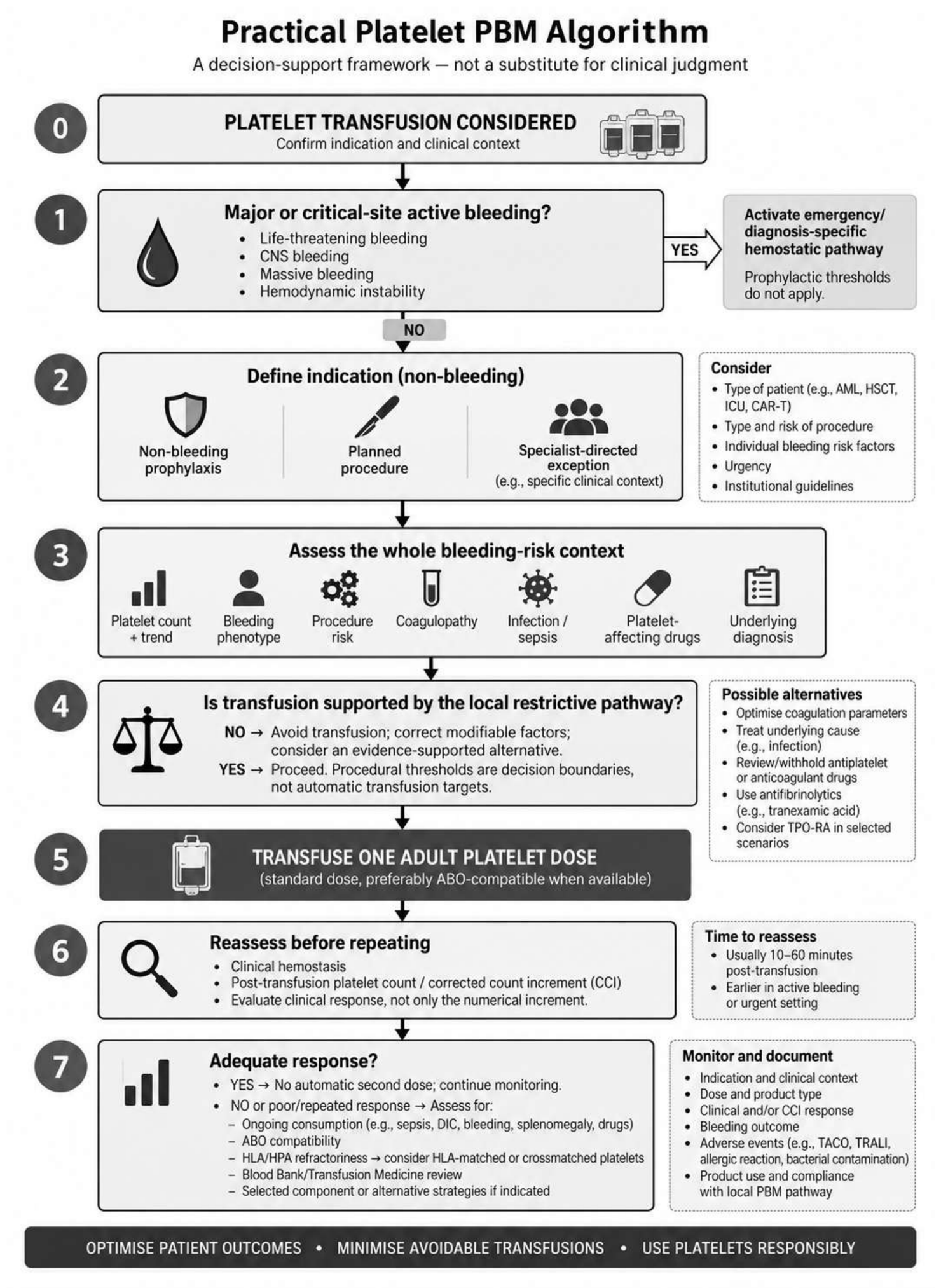

Table 1.
Practical platelet transfusion thresholds within a PBM framework.
| Clinical Scenario | Threshold/Strategy | Evidence/Consensus | PBM Interpretation |
|---|---|---|---|
| Stable non-bleeding hypoproliferative thrombocytopenia | <10 × 109/L | Guideline-supported; randomized evidence | Avoid routinely higher thresholds |
| Allogeneic HSCT, non-bleeding | <10 × 109/L | Guideline-supported | Integrate clinical bleeding risk |
| Selected stable autologous HSCT | Therapeutic-only may be considered | Selected population; trial/subgroup evidence | Close surveillance required |
| Lumbar puncture | <20 × 109/L | Guideline-supported; lower-certainty evidence | Not an automatic target |
| Compressible-site CVC | <10 × 109/L | Conditional; low/very-low certainty | Consider local hemostasis |
| Low-risk interventional radiology | <20 × 109/L | Conditional; low/very-low certainty | Individualize |
| High-risk IR / major non-neuraxial surgery | <50 × 109/L | Conditional; low/very-low certainty | Consider coagulopathy/ antithrombotics |
| Major/critical-site active bleeding | No prophylactic threshold | Clinical emergency pathway | Treat bleeding and hemostatic defect |
| CAR-T–associated thrombocytopenia | No dedicated universal threshold | Evidence gap | Extrapolate cautiously from oncohematology; individualize |
| ICU thrombocytopenia without active bleeding | No universal platelet-specific threshold | Evidence gap / observational data | Avoid automatic count-based transfusion |
| Cancer-associated thrombosis with thrombocytopenia | No universal platelet transfusion target | Evidence gap | Balance thrombotic and bleeding risk; coordinate anticoagulation |
Table 2.
Practical platelet PBM implementation bundle.
| PBM Domain | Practical Intervention | Suggested Indicator |
|---|---|---|
| Indication | Indication-specific protocol | % meeting predefined indication |
| Threshold | Restrictive threshold in ordering | % prophylactic transfusions above threshold |
| Dose | One adult dose; reassess | % initial multi-unit orders |
| Decision support | Mandatory indication/count/bleeding/procedure | Override rate |
| Audit/feedback | Service-level review | Appropriate transfusion rate |
| Safety | Monitor bleeding, mortality, reactions | Bleeding/adverse-event rates |
| Response | Post-transfusion increment/CCI when appropriate | % low increments investigated |
| Refractoriness | Non-immune causes → HLA/HPA work-up | Ineffective transfusions before review |
| Inventory | Forecasting and expiry surveillance | Wastage/shortage rates |
| Governance | Multidisciplinary committee | Regular PBM dashboard |
Disclaimer/Publisher’s Note: The statements, opinions and data contained in all publications are solely those of the individual author(s) and contributor(s) and not of MDPI and/or the editor(s). MDPI and/or the editor(s) disclaim responsibility for any injury to people or property resulting from any ideas, methods, instructions or products referred to in the content. |
© 2026 by the authors. Licensee MDPI, Basel, Switzerland. This article is an open access article distributed under the terms and conditions of the Creative Commons Attribution (CC BY) license (http://creativecommons.org/licenses/by/4.0/).
Copyright: This open access article is published under a Creative Commons CC BY 4.0 license, which permit the free download, distribution, and reuse, provided that the author and preprint are cited in any reuse.