

Submitted:
20 October 2026
Posted:
21 October 2026
You are already at the latest version
Abstract
Background: Data on erectile dysfunction (ED) in young African men are scarce. We estimated ED prevalence among male university students in Ouagadougou, Burkina Faso, and examined associated factors, psychosocial impact, and help-seeking. Methods: In this cross-sectional online survey (January-July 2026), male students aged 18-30 years at Joseph Ki-Zerbo University completed an anonymous questionnaire. The five-item International Index of Erectile Function (IIEF-5) was scored in men who had attempted intercourse in the previous four weeks, with ED defined as a score of 21 or less. Associated factors were examined by multivariable logistic regression. Results: Of 696 respondents (mean age 24.1 ± 3.2 years), 476 were evaluable. ED was present in 240 (50.4%; 95% CI 45.9-54.9); it was mild in 151 and moderate or severe in 20. Self-reported depression (adjusted odds ratio 4.04; 95% CI 1.10-14.88) and other chronic conditions (1.87; 1.11-3.15) were independently associated with ED; age, alcohol, and tobacco use were not. Among men with ED, 66.5% reported interference with academic work, and only 11.9% of those acknowledging a problem had consulted a health professional. Shame was the most cited barrier (61.4%). Conclusions: Mostly mild ED was common in this sample and was linked to depression and chronic illness rather than lifestyle. Campus services should offer confidential sexual and mental health screening.
Keywords:
erectile dysfunction
; young adult
; students
; universities
; prevalence
; depression
; help-seeking behavior
; cross-sectional studies
; Burkina Faso
1. Introduction
Erectile dysfunction (ED) is the persistent inability to attain or maintain an erection sufficient for satisfactory sexual performance [1]. It is one of the most common male sexual complaints, and reported prevalence ranges from 3% to 76.5% depending on the population studied and the definition applied [2]. Although ED has long been regarded as a disorder of ageing, it is not rare in young men. In an Italian outpatient series, one in four men presenting with new-onset ED was younger than 40 years [3], and surveys of men in their late teens and twenties have reported rates approaching 30% [4,5].
In young men, psychogenic factors such as performance anxiety, stress, and depression are thought to predominate, although vascular, endocrine, and metabolic contributors are found in a meaningful proportion of cases [6,7,8]. Depression and ED are linked in both directions, each increasing the risk of the other [9]. ED also carries psychological and relational costs that extend well beyond the sexual act itself [7,10].
Evidence from sub-Saharan Africa remains limited and heterogeneous. Studies from Senegal [11] and Burkina Faso [12,13] have documented ED in young and middle-aged men, but most drew on clinic populations or used non-standard definitions. A recent community survey of 355 sexually active men aged 18-35 years in Nairobi, Kenya, reported an IIEF-5-defined prevalence of 10.4% and identified psychological distress as the strongest correlate [14]. University students form a distinct group: they are at the age of sexual debut and partnership formation, face academic and financial pressures, drink alcohol frequently, and seldom seek care for sexual concerns. To our knowledge, no study has measured erectile function with a validated instrument among university students in Burkina Faso.
We therefore estimated the prevalence and severity of ED among male students at Joseph Ki-Zerbo University in Ouagadougou, identified sociodemographic, lifestyle, and clinical factors independently associated with ED, and described its perceived impact on academic and social life together with students’ knowledge, attitudes, and help-seeking behavior.
2. Materials and Methods
We conducted a cross-sectional, questionnaire-based study at Joseph Ki-Zerbo University (Burkina Faso; ~40,000 students), reported following STROBE guidelines. Eligible participants were male students aged 18–30 years enrolled in the 2025–2026 academic year. An anonymous French-language electronic questionnaire (KoboToolbox) was distributed via QR codes and class messaging groups between 20 January and 15 July 2026; recruitment was voluntary and self-selected. The questionnaire captured sociodemographic data, lifestyle habits, self-reported chronic conditions, sexual activity, and the 15-item International Index of Erectile Function (IIEF). The primary outcome was erectile dysfunction (ED) assessed by the IIEF-5 (score 5–25), with ED defined as a score ≤21; analyses were restricted to men who reported at least one intercourse attempt in the preceding four weeks. A sensitivity analysis used the six-item IIEF erectile function domain (ED defined as score ≤25). Impact of ED was rated on a 0–5 scale across three life domains, and barriers to help-seeking were captured via open-ended questions coded into predefined categories. Continuous variables are presented as mean ± SD or median (IQR); prevalence estimates use 95% Wilson CIs; group comparisons used Student's t-test, chi-square, or Mann–Whitney U tests as appropriate. Independent predictors of ED were identified by multivariable logistic regression (aORs, 95% CIs) and confirmed with Poisson regression yielding adjusted prevalence ratios; all analyses were performed in Python 3.11 (SciPy 1.17, statsmodels 0.15). The study was approved by the Burkina Faso Health Research Ethics Committee (CERS no. 2026-02-0090) and Joseph Ki-Zerbo University (no. 2026-00254), with electronic informed consent obtained from all participants in compliance with the Declaration of Helsinki.
3. Results
3.1. Participants
Of 706 questionnaires submitted, 10 were excluded (five pilot-version forms, four respondents older than 30 years, and one implausible age entry), leaving 696 male students for the descriptive analyses (Figure 1). Mean age was 24.1 ± 3.2 years; 70 (10.1%) were married or cohabiting, 189 (27.2%) were enrolled in health sciences, 260 (37.4%) drank alcohol, and 39 (5.6%) smoked tobacco. A chronic condition was reported by 119 (17.1%), most often gastric ulcer (40; 5.7%), haemorrhoids (23; 3.3%), or depression (19; 2.7%) (Table 1).
Overall, 476 respondents (68.4%) were evaluable for erectile function; 173 had not attempted intercourse in the previous four weeks and 47 answered "no sexual activity" to at least one IIEF-5 item. Compared with non-evaluable respondents, evaluable men were older (24.7 ± 3.2 vs. 22.9 ± 2.9 years, p < 0.001) and were more often married or cohabiting (13.7% vs. 2.3%), alcohol users (45.6% vs. 19.5%), and smokers (7.4% vs. 1.8%) (all p < 0.01; Table 1).
3.2. Prevalence and Severity of Erectile Dysfunction
The mean IIEF-5 score among the 476 evaluable men was 20.1 ± 3.9 (median 21, IQR 18-23). ED was present in 240 men (50.4%; 95% CI 45.9-54.9). It was mild in 151 (31.7%), mild to moderate in 69 (14.5%), moderate in 17 (3.6%), and severe in 3 (0.6%); a score of 16 or less, corresponding to mild to moderate or worse ED, was found in 89 men (18.7%; 95% CI 15.5-22.4) (Table 2). Using the IIEF-EF domain, 208 men (43.7%; 95% CI 39.3-48.2) had ED, and agreement between the two definitions was good (Cohen’s κ = 0.78). When the analysis was restricted to the 428 evaluable men who also reported sexual activity in the previous six months, the prevalence was 48.4%. Only 70 of the 240 men with IIEF-5-defined ED (29.2%) answered "yes" when asked directly whether they had erectile problems.
3.3. Factors Associated with Erectile Dysfunction
In bivariate analysis, ED was more frequent among men reporting any chronic condition (65.6% vs. 46.9%, p = 0.001) and depression (80.0% vs. 49.5%, p = 0.020), and less frequent among coffee drinkers (45.7% vs. 55.4%, p = 0.035). Age, marital status, field of study, alcohol use, and tobacco use were not associated with ED (Table 3).
In the multivariable model (n = 476; 240 events), self-reported depression (aOR 4.04; 95% CI 1.10-14.88; p = 0.035) and other chronic conditions (aOR 1.87; 95% CI 1.11-3.15; p = 0.019) were independently associated with ED (Table 4). Age, alcohol use, tobacco use, marital status, number of partners, and coffee consumption were not. The corresponding adjusted prevalence ratios were 1.60 (95% CI 1.17-2.20) for depression and 1.32 (95% CI 1.07-1.63) for other chronic conditions. The model showed no collinearity (maximum VIF 1.20) and acceptable calibration (Hosmer-Lemeshow p = 0.187), although its discrimination was modest (area under the curve 0.62). With EF-domain-defined ED as the outcome, the association with depression persisted (aOR 5.36; 95% CI 1.45-19.81), whereas that with other chronic conditions was attenuated (aOR 1.58; 95% CI 0.95-2.64; Supplementary Table S2).
3.4. Psychosocial and Academic Impact
Among men with ED who answered the impact items, 151 of 227 (66.5%) reported that their erectile function interfered with academic work, severely so in 26 (11.5%); 170 of 224 (75.9%) reported interference with sexual and romantic life and 176 of 231 (76.2%) with mood and social life (Table 5). Mean burden scores were higher in men with ED than in men without ED in all three domains (all p < 0.001). Men with ED were also more often dissatisfied with their sex life overall than men without ED (71 of 240, 29.6%, vs. 11 of 236, 4.7%; p < 0.001).
3.5. Knowledge, Attitudes, and Help-Seeking
Of the 696 respondents, 496 (71.3%) knew that modern medicine can treat ED; 291 (41.8%) considered modern medicine the most effective approach, 168 (24.1%) favoured traditional medicine, and 231 (33.2%) were unsure. Forty-three respondents (6.2%) stated that they would never consult a physician for ED. Of the 240 men with IIEF-5-defined ED, 112 reported that they had no erectile problem when asked whom they had consulted and two did not answer. Among the remaining 126 who acknowledged a problem, 79 (62.7%) had consulted no one, 22 (17.5%) had confided in a friend or relative, 15 (11.9%) had consulted a health professional, and 10 (7.9%) had consulted a traditional healer. Among the 635 respondents who answered the open question on barriers to consultation, shame or embarrassment was cited most often (390; 61.4%), followed by fear of judgement or stigma (93; 14.6%), cost or access (68; 10.7%), and lack of information (53; 8.3%) (Table 5).
4. Discussion
In this survey of male university students in Ouagadougou, half of those who had attempted intercourse in the previous month had an IIEF-5 score consistent with ED. Most cases were mild, and fewer than one in five men scored in the mild-to-moderate range or below. ED was independently associated with self-reported depression and with other chronic conditions, but not with age, alcohol use, or tobacco use. Men with ED reported substantial interference with academic, social, and romantic life, yet very few had sought professional help, and shame was the dominant barrier.
Our estimate lies at the upper end of those reported in young men. Mialon et al. found ED in about 30% of young Swiss men [5], and reviews of men younger than 40 years report a similar order of magnitude [4], whereas the Nairobi community survey found 10.4% among sexually active men aged 18-35 years [14]. Several features of our study probably explain the difference. The conventional IIEF-5 threshold of 21 was derived in older clinical populations, and in young men it captures many whose single lower item score reflects inexperience, a new partner, or situational anxiety rather than a persistent disorder [6]. The median score in our sample was exactly 21, so a one-point shift in the threshold changes the prevalence considerably. The discrepancy between questionnaire-defined ED and self-perceived ED, 29.2% in our sample, points in the same direction and mirrors the gap reported between IIEF-defined and self-reported ED in population surveys [22]. The proportion of men with a score of 16 or less (18.7%) and with moderate or severe ED (4.2%) is probably a better guide to clinically meaningful dysfunction in this age group. Volunteer bias may also have raised the estimate, because students with sexual concerns may have been more inclined to complete a survey on erectile function.
The strong association with depression is consistent with the bidirectional relationship described in meta-analyses [9] and with the Kenyan data, in which psychological distress was the main correlate of ED in young men [14]. It supports the view that ED in this age group is predominantly psychogenic or mixed [6], and it has a practical implication: a young man presenting with ED should be screened for depressive symptoms, and vice versa. The association with other chronic conditions is harder to interpret because the category mixes heterogeneous conditions, each reported by few participants, and it weakened when the EF-domain definition was used. Chronic illness may act through pain, fatigue, medication, or psychological burden, and our data cannot separate these pathways.
We found no association between ED and age, alcohol use, or tobacco use. A narrow age range, low tobacco exposure, and a young population in which vascular risk factors have had little time to act all limit the power to detect such effects. An earlier analysis of these data that grouped ED cases together with non-evaluable respondents suggested that older age and alcohol use were associated with abnormal erectile function. Our comparison of evaluable and non-evaluable respondents shows why: older students and those who drink alcohol were much more likely to be sexually active and therefore to have an interpretable score. This illustrates a general pitfall in IIEF-based surveys of young populations, in which sexually inactive respondents score low on the instrument without having any erectile impairment and must be excluded from the denominator.
Two-thirds of men with ED reported interference with academic work, a finding with direct relevance to university health services. ED has been associated with measurable losses in work productivity in adult populations [23]; to our knowledge, its effect on academic performance has not previously been quantified in African students. Help-seeking was strikingly low: only 11.9% of men who acknowledged an erectile problem had consulted a health professional, fewer than had confided in a friend or relative. Low consultation rates have also been reported in European surveys [24,25], but in our setting they coexist with a considerable preference for, or uncertainty about, traditional medicine and with a dominant sense of shame, as previously described in young Burkinabè men [13]. These findings argue for confidential, youth-friendly sexual health services on campus that address erectile function and mental health together.
Strengths and Limitations
The study included a large number of students from all faculties, used a validated instrument scored according to its standard algorithm, applied the IIEF only to men for whom it is valid, and tested the robustness of its findings with an alternative ED definition and a different effect measure. Several limitations must be considered. First, recruitment was voluntary and online, with no sampling frame; the approximately 700 respondents represent a small fraction of male students, and self-selection may have biased the prevalence in either direction. Second, the cross-sectional design does not allow causal inference, and the direction of the association between depression and ED cannot be established. Third, all data were self-reported; depression and other conditions were not confirmed clinically and were not measured with validated scales such as the Patient Health Questionnaire-9, and no hormonal or vascular assessment was performed. Fourth, important correlates of ED in young men, including anxiety, pornography use, relationship quality, and body mass index, were not collected. Fifth, the impact items were not validated and were phrased hypothetically for men without ED. Finally, the results apply to university students in an urban setting and cannot be extrapolated to young men in the general population of Burkina Faso.
5. Conclusions
Half of the sexually active male students surveyed had an IIEF-5 score consistent with ED, although most cases were mild. ED was associated with depression and chronic illness rather than with age or lifestyle factors, interfered with academic and social life, and was rarely brought to a health professional, largely because of shame. University health services should offer confidential screening for erectile and mental health problems, and future studies should use probability sampling, validated measures of depression and anxiety, and clinical assessment to distinguish transient from persistent dysfunction.
Author Contributions
B.K. and B.L.H.O.: Conceptualization, Methodology, Investigation, Formal analysis, Writing – original draft. O.J.D.Z.: Supervision, Methodology, Writing – review & editing. C.A.M.K.D.Y. and F.A.K.: Supervision, Conceptualization, Writing – review & editing, Project administration.
Funding
This research received no external funding.
Institutional Review Board Statement
The study was conducted in accordance with the Declaration of Helsinki and approved by the Health Research Ethics Committee of Burkina Faso (CERS; protocol code 2026-02-0090). The study was also authorized by Joseph Ki-Zerbo University (authorization no. 2026-00254/MESRI/SG/UJKZ/P/SG/DEP).
Informed Consent Statement
Electronic informed consent was obtained from all participants before they could access the questionnaire. The survey was anonymous and collected no identifying information.
Data Availability Statement
The anonymized dataset and analysis code supporting the findings of this study are available from the corresponding author on reasonable request.
Acknowledgments
The authors thank the elected student representatives of Joseph Ki-Zerbo University for their help with recruitment, and all students who took part. During the preparation of this manuscript, the authors used Claude (Anthropic) to translate the text from French, and to edit the language. The authors reviewed and edited all output and take full responsibility for the content of this publication.
Conflicts of Interest
The authors declare no conflicts of interest.
Abbreviations
aOR, adjusted odds ratio; aPR, adjusted prevalence ratio; CI, confidence interval; ED, erectile dysfunction; EF, erectile function; IIEF, International Index of Erectile Function; IIEF-5, five-item International Index of Erectile Function; IQR, interquartile range; SD, standard deviation; STROBE, Strengthening the Reporting of Observational Studies in Epidemiology; VIF, variance inflation factor.
References
- NIH Consensus Development Panel on Impotence. Impotence. JAMA 1993, 270, 83–90. [CrossRef]
- Kessler, A.; Sollie, S.; Challacombe, B.; Briggs, K.; Van Hemelrijck, M. The global prevalence of erectile dysfunction: A review. BJU Int. 2019, 124, 587–599. [Google Scholar] [CrossRef] [PubMed]
- Capogrosso, P.; Colicchia, M.; Ventimiglia, E.; et al. One patient out of four with newly diagnosed erectile dysfunction is a young man: Worrisome picture from the everyday clinical practice. J. Sex. Med. 2013, 10, 1833–1841. [Google Scholar] [CrossRef] [PubMed]
- Nguyen, H.M.T.; Gabrielson, A.T.; Hellstrom, W.J.G. Erectile dysfunction in young men: A review of the prevalence and risk factors. Sex. Med. Rev. 2017, 5, 508–520. [Google Scholar] [CrossRef] [PubMed]
- Mialon, A.; Berchtold, A.; Michaud, P.A.; Gmel, G.; Suris, J.C. Sexual dysfunctions among young men: Prevalence and associated factors. J. Adolesc. Health 2012, 51, 25–31. [Google Scholar] [CrossRef] [PubMed]
- Rastrelli, G.; Maggi, M. Erectile dysfunction in fit and healthy young men: Psychological or pathological? Transl. Androl. Urol. 2017, 6, 79–90. [Google Scholar] [CrossRef] [PubMed]
- Shamloul, R.; Ghanem, H. Erectile dysfunction. Lancet 2013, 381, 153–165. [Google Scholar] [CrossRef] [PubMed]
- Yafi, F.A.; Jenkins, L.; Albersen, M.; et al. Erectile dysfunction. Nat. Rev. Dis. Primers 2016, 2, 16003. [Google Scholar] [CrossRef] [PubMed]
- Liu, Q.; Zhang, Y.; Wang, J.; et al. Erectile dysfunction and depression: A systematic review and meta-analysis. J. Sex. Med. 2018, 15, 1073–1082. [Google Scholar] [CrossRef] [PubMed]
- Feldman, H.A.; Goldstein, I.; Hatzichristou, D.G.; Krane, R.J.; McKinlay, J.B. Impotence and its medical and psychosocial correlates: Results of the Massachusetts Male Aging Study. J. Urol. 1994, 151, 54–61. [Google Scholar] [CrossRef] [PubMed]
- Diao, B.; Ndoye, A.K.; Fall, P.A.; et al. La dysfonction érectile au Sénégal: Profil épidémiologique. Andrologie 2007, 17, 223–229. [Google Scholar] [CrossRef]
- Kaboré, F.A.; Ouédraogo, B.; Ky, B.D.; Yaméogo, C.A.M.K.D.; Kirakoya, B.; Kaboré, T. Erectile dysfunction: Prevalence, characteristics and etiological factors among urology outpatients in Burkina Faso. Int. J. Clin. Urol. 2018, 2, 15–19. [Google Scholar] [CrossRef]
- Kambou, T.; Zango, B.; Fongang, C.; Sombié, I.; Dao, B. Étude de l’insuffisance érectile dans une population d’hommes jeunes et sexuellement actifs au Burkina Faso. Afr. J. Urol. 2005, 11, 310–318. [Google Scholar]
- Oluoch, O.C.; Ngugi, B.M.; Makalliwa, G. Erectile dysfunction in young men in Nairobi County, Kenya: A community-based study. medRxiv 2026, preprint. [Google Scholar] [CrossRef]
- von Elm, E.; Altman, D.G.; Egger, M.; Pocock, S.J.; Gøtzsche, P.C.; Vandenbroucke, J.P. The Strengthening the Reporting of Observational Studies in Epidemiology (STROBE) statement: Guidelines for reporting observational studies. Lancet 2007, 370, 1453–1457. [Google Scholar] [CrossRef] [PubMed]
- Harvard Humanitarian Initiative. KoboToolbox. Available online: https://www.kobotoolbox.org.
- Rosen, R.C.; Riley, A.; Wagner, G.; Osterloh, I.H.; Kirkpatrick, J.; Mishra, A. The International Index of Erectile Function (IIEF): A multidimensional scale for assessment of erectile dysfunction. Urology 1997, 49, 822–830. [Google Scholar] [CrossRef] [PubMed]
- Rosen, R.C.; Cappelleri, J.C.; Smith, M.D.; Lipsky, J.; Peña, B.M. Development and evaluation of an abridged, 5-item version of the International Index of Erectile Function (IIEF-5) as a diagnostic tool for erectile dysfunction. Int. J. Impot. Res. 1999, 11, 319–326. [Google Scholar] [CrossRef] [PubMed]
- Cappelleri, J.C.; Rosen, R.C.; Smith, M.D.; Mishra, A.; Osterloh, I.H. Diagnostic evaluation of the erectile function domain of the International Index of Erectile Function. Urology 1999, 54, 346–351. [Google Scholar] [CrossRef] [PubMed]
- Zou, G. A modified Poisson regression approach to prospective studies with binary data. Am. J. Epidemiol. 2004, 159, 702–706. [Google Scholar] [CrossRef] [PubMed]
- Seabold, S.; Perktold, J. Statsmodels: Econometric and statistical modeling with Python. In Proceedings of the 9th Python in Science Conference, Austin, TX, USA, 28 June-3 July 2010; pp. 92–96. [Google Scholar] [CrossRef]
- Amand, C.; Tong, S.; Tardy, A.L.; McGraw, T.; Stewart, A.; Cruz-Rivera, M. A population-based survey of self-reported and IIEF-defined erectile dysfunction among adult men in the United States in 2021. BMC Public Health 2025, 25, 4172. [Google Scholar] [CrossRef] [PubMed]
- Goldstein, I.; Goren, A.; Li, V.W.; Maculaitis, M.C.; Tang, W.Y.; Hassan, T.A. The association of erectile dysfunction with productivity and absenteeism in eight countries globally. Int. J. Clin. Pract. 2019, 73, e13384. [Google Scholar] [CrossRef] [PubMed]
- Giuliano, F.; Chevret-Measson, M.; Tsatsaris, A.; Reitz, C.; Murino, M.; Thonneau, P. Prevalence of erectile dysfunction in France: Results of an epidemiological survey of a representative sample of 1004 men. Eur. Urol. 2002, 42, 382–389. [Google Scholar] [CrossRef] [PubMed]
- Costa, P.; Avances, C.; Wagner, L. Dysfonction érectile: Connaissances, souhaits et attitudes. Résultats d’une enquête française réalisée auprès de 5099 hommes âgés de 18 à 70 ans. Prog. Urol. 2003, 13, 85–91. [Google Scholar] [PubMed]
Figure 1.
Flow of participants through the study. ED, erectile dysfunction; IIEF-5, five-item International Index of Erectile Function.
Figure 1.
Flow of participants through the study. ED, erectile dysfunction; IIEF-5, five-item International Index of Erectile Function.
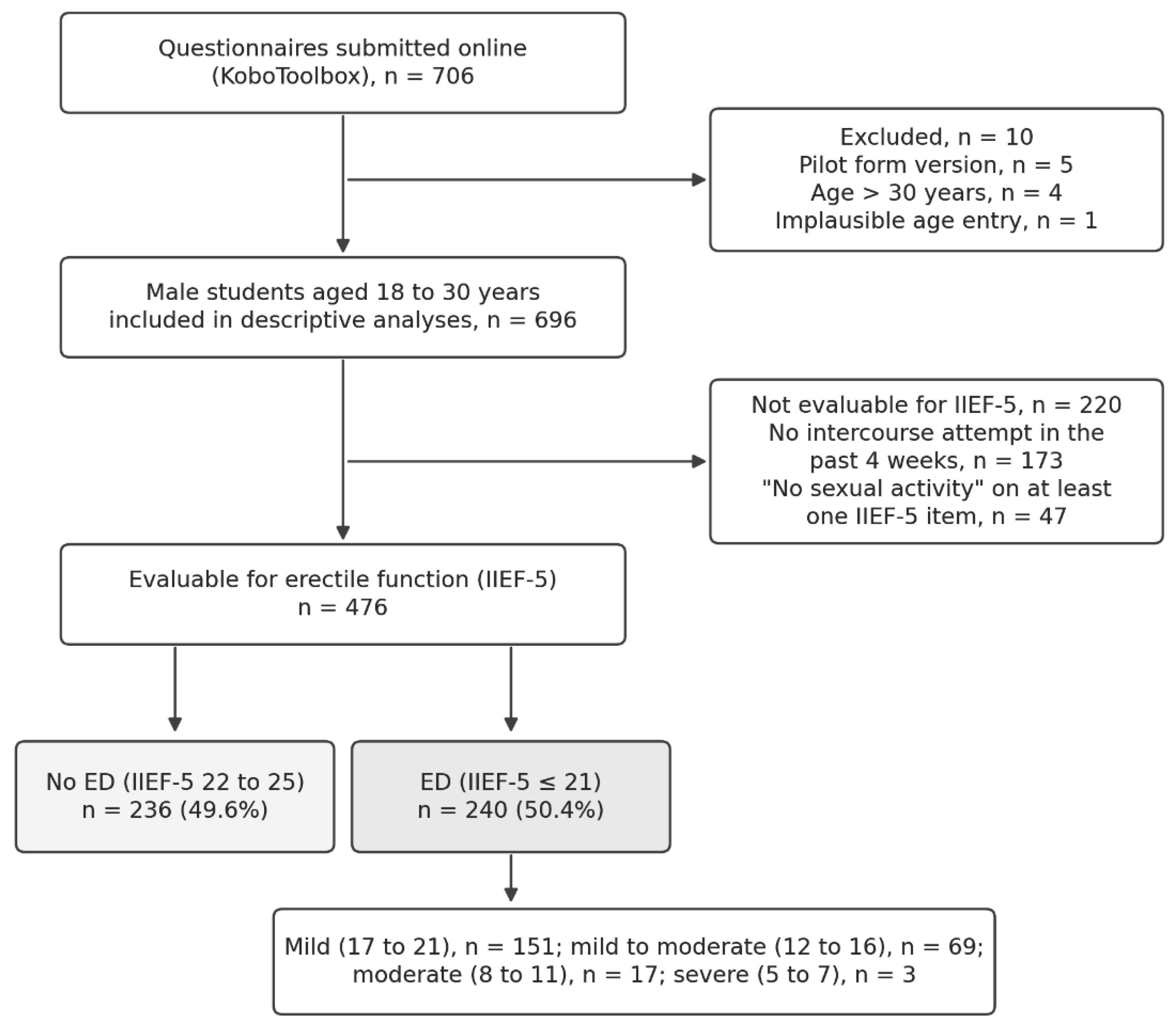

Table 1.
Characteristics of the 696 male students, overall and by evaluability for erectile function.
Table 1.
Characteristics of the 696 male students, overall and by evaluability for erectile function.
| Characteristic | All (N = 696) | Evaluable (n = 476) | Not evaluable (n = 220) | p |
|---|---|---|---|---|
| Age, years, mean ± SD | 24.1 ± 3.2 | 24.7 ± 3.2 | 22.9 ± 2.9 | <0.001 |
| Age > 24 years | 300 (43.1) | 237 (49.8) | 63 (28.6) | <0.001 |
| Married or cohabiting | 70 (10.1) | 65 (13.7) | 5 (2.3) | <0.001 |
| Degree programme † | 0.213 | |||
| Bachelor | 447 (71.0) | 298 (69.3) | 149 (74.5) | |
| Master | 113 (17.9) | 85 (19.8) | 28 (14.0) | |
| Doctorate | 70 (11.1) | 47 (10.9) | 23 (11.5) | |
| Health sciences programme | 189 (27.2) | 119 (25.0) | 70 (31.8) | 0.060 |
| Religion | 0.174 | |||
| Christian | 351 (50.4) | 247 (51.9) | 104 (47.3) | |
| Muslim | 280 (40.2) | 181 (38.0) | 99 (45.0) | |
| Traditional | 56 (8.0) | 43 (9.0) | 13 (5.9) | |
| Other | 9 (1.3) | 5 (1.1) | 4 (1.8) | |
| Secondary paid activity | 342 (49.1) | 246 (51.7) | 96 (43.6) | 0.048 |
| At least one child | 80 (11.5) | 75 (15.8) | 5 (2.3) | <0.001 |
| Two or more current partners | 62 (8.9) | 54 (11.3) | 8 (3.6) | <0.001 |
| Alcohol use | 260 (37.4) | 217 (45.6) | 43 (19.5) | <0.001 |
| Tobacco use | 39 (5.6) | 35 (7.4) | 4 (1.8) | 0.003 |
| Coffee consumption | 343 (49.3) | 243 (51.1) | 100 (45.5) | 0.170 |
| Any self-reported chronic condition ‡ | 119 (17.1) | 90 (18.9) | 29 (13.2) | 0.062 |
| Gastric ulcer | 40 (5.7) | 34 (7.1) | 6 (2.7) | 0.020 |
| Haemorrhoids | 23 (3.3) | 18 (3.8) | 5 (2.3) | 0.301 |
| Depression | 19 (2.7) | 15 (3.2) | 4 (1.8) | 0.316 |
| Sickle cell disease | 11 (1.6) | 8 (1.7) | 3 (1.4) | 1.000 |
| Asthma | 7 (1.0) | 7 (1.5) | 0 (0.0) | 0.104 |
| Cardiac disease or hypertension | 5 (0.7) | 1 (0.2) | 4 (1.8) | 0.037 |
Values are n (%) unless stated otherwise. p-values compare evaluable with non-evaluable respondents (Student’s t-test, Pearson’s chi-square test, or Fisher’s exact test when an expected cell count was below 5). † Degree programme was missing for 66 respondents; percentages use the 630 with data. ‡ Self-reported, from a predefined list; participants could report more than one condition. SD, standard deviation.
Table 2.
Distribution of IIEF-5 scores and prevalence of erectile dysfunction among evaluable men (n = 476).
Table 2.
Distribution of IIEF-5 scores and prevalence of erectile dysfunction among evaluable men (n = 476).
| IIEF-5 category (score) | n (%) | 95% CI |
|---|---|---|
| IIEF-5 score, mean ± SD | 20.1 ± 3.9 | |
| IIEF-5 score, median (IQR) | 21 (18-23) | |
| No ED (22-25) | 236 (49.6) | |
| ED, any severity (5-21) | 240 (50.4) | 45.9-54.9 |
| Mild (17-21) | 151 (31.7) | 27.7-36.0 |
| Mild to moderate (12-16) | 69 (14.5) | 11.6-17.9 |
| Moderate (8-11) | 17 (3.6) | 2.2-5.6 |
| Severe (5-7) | 3 (0.6) | 0.2-1.8 |
| Sensitivity analyses | ||
| IIEF-EF domain score ≤ 25 (6 items) | 208 (43.7) | 39.3-48.2 |
| IIEF-5 ≤ 21, restricted to men sexually active in the past 6 months (n = 428) | 207 (48.4) | 43.7-53.1 |
| IIEF-5 ≤ 16 (mild to moderate or worse) | 89 (18.7) | 15.5-22.4 |
Severity categories follow Rosen et al. [18]. The IIEF erectile function (EF) domain comprises items 1 to 5 and 15 (score 1-30) [19]. CIs are Wilson intervals. CI, confidence interval; ED, erectile dysfunction; IIEF-5, five-item International Index of Erectile Function; IQR, interquartile range; SD, standard deviation.
Table 3.
Bivariate analysis of factors associated with erectile dysfunction among evaluable men (n = 476).
Table 3.
Bivariate analysis of factors associated with erectile dysfunction among evaluable men (n = 476).
| Variable | ED if exposed, n/N (%) | ED if not exposed, n/N (%) | p |
|---|---|---|---|
| Age, years, mean ± SD | 24.5 ± 3.1 | 24.8 ± 3.3 | 0.391 |
| Age > 24 years | 116/237 (48.9) | 124/239 (51.9) | 0.522 |
| Married or cohabiting | 27/65 (41.5) | 213/411 (51.8) | 0.123 |
| Health sciences programme | 54/119 (45.4) | 186/357 (52.1) | 0.204 |
| Secondary paid activity | 128/246 (52.0) | 112/230 (48.7) | 0.467 |
| Two or more current partners | 32/54 (59.3) | 208/422 (49.3) | 0.168 |
| Alcohol use | 101/217 (46.5) | 139/259 (53.7) | 0.122 |
| Tobacco use | 18/35 (51.4) | 222/441 (50.3) | 0.901 |
| Coffee consumption | 111/243 (45.7) | 129/233 (55.4) | 0.035 |
| Any self-reported chronic condition | 59/90 (65.6) | 181/386 (46.9) | 0.001 |
| Gastric ulcer | 18/34 (52.9) | 222/442 (50.2) | 0.760 |
| Self-reported depression | 12/15 (80.0) | 228/461 (49.5) | 0.020 |
| Haemorrhoids | 13/18 (72.2) | 227/458 (49.6) | 0.059 |
| Sickle cell disease § | 5/8 (62.5) | 235/468 (50.2) | 0.724 |
For age, values are mean ± SD in men with ED and men without ED. p-values are from Pearson’s chi-square test or, where marked §, Fisher’s exact test; Student’s t-test for age. ED, erectile dysfunction; SD, standard deviation.
Table 4.
Multivariable analysis of factors associated with erectile dysfunction (n = 476; 240 events).
Table 4.
Multivariable analysis of factors associated with erectile dysfunction (n = 476; 240 events).
| Variable | aOR (95% CI) | p | aPR (95% CI) | p |
|---|---|---|---|---|
| Age (per 5-year increase) | 0.93 (0.68-1.28) | 0.664 | 0.97 (0.83-1.12) | 0.655 |
| Married or cohabiting | 0.73 (0.41-1.31) | 0.293 | 0.85 (0.62-1.16) | 0.304 |
| Two or more current partners | 1.44 (0.78-2.63) | 0.241 | 1.16 (0.91-1.49) | 0.229 |
| Alcohol use | 0.78 (0.53-1.14) | 0.197 | 0.89 (0.74-1.07) | 0.217 |
| Tobacco use | 1.04 (0.50-2.18) | 0.915 | 0.99 (0.70-1.38) | 0.937 |
| Coffee consumption | 0.80 (0.54-1.18) | 0.262 | 0.90 (0.74-1.09) | 0.290 |
| Self-reported depression | 4.04 (1.10-14.88) | 0.035 | 1.60 (1.17-2.20) | 0.004 |
| Other chronic condition ‖ | 1.87 (1.11-3.15) | 0.019 | 1.32 (1.07-1.63) | 0.011 |
aORs are from multivariable logistic regression and aPRs from Poisson regression with robust standard errors; both models include all variables shown. ‖ Any self-reported chronic condition other than depression (mainly gastric ulcer, haemorrhoids, sickle cell disease, and asthma). Model diagnostics (logistic model): maximum variance inflation factor 1.20; Hosmer-Lemeshow χ2 = 11.27, p = 0.187; area under the curve 0.62. aOR, adjusted odds ratio; aPR, adjusted prevalence ratio; CI, confidence interval.
Table 5.
Perceived impact, sexual satisfaction, and help-seeking among men with erectile dysfunction, and perceived barriers to consultation among all respondents.
Table 5.
Perceived impact, sexual satisfaction, and help-seeking among men with erectile dysfunction, and perceived barriers to consultation among all respondents.
| Item | n (%) | p |
|---|---|---|
| A. Perceived burden among men with ED (0-5 scale) | ||
| Academic work (n = 227) | ||
| None (0) | 76 (33.5) | |
| Mild (1-2) | 70 (30.8) | |
| Moderate (3) | 55 (24.2) | |
| Severe (4-5) | 26 (11.5) | |
| Mean score, ED vs. no ED | 1.73 vs. 0.62 | <0.001 |
| Sexual and romantic life (n = 224) | ||
| None (0) | 54 (24.1) | |
| Mild (1-2) | 72 (32.1) | |
| Moderate (3) | 56 (25.0) | |
| Severe (4-5) | 42 (18.8) | |
| Mean score, ED vs. no ED | 2.13 vs. 0.81 | <0.001 |
| Mood and social life (n = 231) | ||
| None (0) | 55 (23.8) | |
| Mild (1-2) | 72 (31.2) | |
| Moderate (3) | 64 (27.7) | |
| Severe (4-5) | 40 (17.3) | |
| Mean score, ED vs. no ED | 2.12 vs. 0.76 | <0.001 |
| B. Satisfaction with sex life among men with ED (n = 240) | ||
| Very dissatisfied | 26 (10.8) | |
| Moderately dissatisfied | 45 (18.8) | |
| Neither satisfied nor dissatisfied | 70 (29.2) | |
| Satisfied | 91 (37.9) | |
| Very satisfied | 8 (3.3) | |
| C. Help-seeking among men with ED who acknowledged a problem (n = 126) | ||
| Consulted no one | 79 (62.7) | |
| Confided in a friend or relative | 22 (17.5) | |
| Consulted a health professional | 15 (11.9) | |
| Consulted a traditional healer | 10 (7.9) | |
| D. Perceived barriers to consultation, all respondents (n = 635) ¶ | ||
| Shame or embarrassment | 390 (61.4) | |
| Fear of judgement or stigma | 93 (14.6) | |
| Cost or access | 68 (10.7) | |
| Lack of information | 53 (8.3) | |
| Taboo | 20 (3.1) | |
| Pride or threat to masculinity | 19 (3.0) | |
| Doubt about treatment effectiveness | 18 (2.8) | |
| Distrust of health professionals | 15 (2.4) | |
| Preference for traditional medicine | 2 (0.3) | |
| No opinion or no reason given | 41 (6.5) |
The burden items asked how much the participant’s erectile function affected, or would affect, each domain; group sizes vary because of missing or out-of-range answers. p-values compare men with and without ED (Mann-Whitney U test). ¶ Free-text answers coded into categories; one answer could be assigned to more than one category, so percentages do not sum to 100. ED, erectile dysfunction.
Disclaimer/Publisher’s Note: The statements, opinions and data contained in all publications are solely those of the individual author(s) and contributor(s) and not of MDPI and/or the editor(s). MDPI and/or the editor(s) disclaim responsibility for any injury to people or property resulting from any ideas, methods, instructions or products referred to in the content. |
© 2026 by the authors. Licensee MDPI, Basel, Switzerland. This article is an open access article distributed under the terms and conditions of the Creative Commons Attribution (CC BY) license (http://creativecommons.org/licenses/by/4.0/).
Copyright: This open access article is published under a Creative Commons CC BY 4.0 license, which permit the free download, distribution, and reuse, provided that the author and preprint are cited in any reuse.