

Submitted:
19 October 2026
Posted:
21 October 2026
You are already at the latest version
Abstract
The objective was to compare the linear, spatial, and temporal variables of the Marcha Batida (MB) and Marcha Picada (MP) gaits, aiming to characterize and identify their differences. 135 ridden Mangalarga Marchador horses were evaluated. The following variables were measured: speed, length, frequency, and duration of strides; distribution of stride time in each type of support; time and position of the diagonal dissociation; type and distance of the lateral limb footprints. At the same speed (3.88 m/s), MB and MP presented the same frequency, duration, and length of strides. MB showed a predominance of diagonal supports, followed by thoracic tripedal, pelvic tripedal, lateral bipedal, quadrupedal and pelvic monopedal supports, while MP showed a predominance of lateral supports, followed by diagonal supports, thoracic and pelvic tripedal supports, and pelvic unipedal support. All MP animals showed dissociation starting with the thoracic limb and were more dissociated than the MB. Most MB horses showed overstepping, while in the MP, the predominance was of animals with overstepping and an average distance of 17.68 centimeters. It is concluded that MB and MP presented differences in the kinematic variables analyzed, and the values found showed divergence from the description of the current breed standard.
Keywords:
equine
; stride
; dissociation
; gaited horses
; motion capture
1. Introduction
The equine industry plays a strategic role in Brazilian agribusiness, driving a production chain that generates approximately 7 billion dollars annually and creates thousands of direct and indirect jobs [12]. This scenario highlights the economic and social relevance of activities related to horse breeding and use in the country, with the Mangalarga Marchador (MM) breed standing out as it represents the largest and most representative equine population, comprising approximately 780,000 registered animals [4]. The two natural intermediate-speed gait modalities permitted for the breed, according to the breed standard, are the Marcha Batida (MB) and the Marcha Picada (MP). These gaits provide trunk stability during movement and offer comfort to the rider, which is highly valued in activities related to work, sport, and leisure. As translated from the breed standard: “Marcha Batida/Picada is a natural, symmetrical, four-beat gait, with lateral and diagonal support interspersed with moments of triple support” [2]. Although the MM breed standard describes MB and MP under a single definition, scientific evidence has pointed to biomechanical differences between them, reinforcing the need to deepen the understanding of these gaits, especially because the distribution of support times and the quality of limb movement constitute the main criteria for evaluation in official breed competitions. In this context, previous studies have already reported divergences between these gaits, such as the lower stride frequency of the MP compared to the MB [5] and, conversely, a higher frequency associated with shorter stride length in the MP [17].
During the Mangalarga Marchador National Gait Competition, horses and riders participate in a functional performance test lasting approximately 1.5 h, during which the horses are presented at marcha under the rider’s direction and evaluated by qualified judges according to six criteria: gait movement, comfort, efficiency, training, style, and regularity [3]. These criteria encompass aspects directly related to locomotor coordination and support patterns, rider comfort, stride length and efficiency, responsiveness to the rider’s aids, overall posture and balance, and the maintenance of a consistent gait, rhythm, speed, and style throughout the performance [3]. Therefore, objective characterization of the locomotor patterns underlying MB and MP is particularly relevant for understanding the biomechanical characteristics associated with these functional evaluation criteria.
Non-invasive equipment capable of tracking locomotion in horses and providing quantitative gait parameters is essential for identifying gait types, their variations, and guiding technicians and breeders in the evaluation process [5]. This is because traditional gait evaluations may present low reliability, as subtle changes are not always easily perceived by the naked eye, and available scoring systems do not encompass the full range of locomotor variations. In this sense, kinematics is one of the available tools that allows the quantification of body movements through spatial, temporal, and linear parameters, being widely used in equines both for detecting locomotor abnormalities [9] and for characterizing movement patterns [8,14,16,19]. By providing objective and reproducible measurements, it allows the identification of subtle changes in movement and reduces biases related to evaluator expectations. Thus, the use of technology emerges as a more precise, standardized, and fair alternative for comparing animals and evaluating gaits, and in the future, this approach may also contribute to training and supporting judges in various equestrian disciplines.
Considering the above, the objective of this study was to compare temporal, linear, and spatial kinematic variables of the MB and MP in national champion Mangalarga Marchador horses, in order to quantitatively characterize and distinguish these gaits and, thereby, support a possible revision and update of the gait definitions present in the current breed standard. We investigated whether the visible locomotor differences between the gaits arise from real distinctions in the kinematic profiles of each modality. The results obtained provide a deeper understanding of the particularities between the batida and picada gaits and support future studies investigating the factors responsible for these locomotor differences.
2. Materials and Methods
2.1. Animals
The study was conducted during the judging of the 40th National Mangalarga Marchador Horse Exhibition, held from July 17 to 29, 2023, at Parque de Exposições Bolívar de Andrade, in Belo Horizonte, Minas Gerais, Brazil —the largest event of the breed. For data collection, all ridden horses presented in the arena in both gait modalities (batida and picada) were recorded using a high-resolution camera, ensuring complete capture of movement and enabling precise kinematic analyses. After the conclusion of each judging session and the announcement of results, only the videos of award-winning horses in their respective categories —“Campeão,” “Reservado Campeão,” and “Primeiro Prêmio,” corresponding to 1st, 2nd, and 3rd place in gait, were selected to compose the database, as they represent the highest-ranked individuals and, therefore, benchmarks of quality nationwide. In total, 135 horses were analyzed, distributed across 45 categories, including 26 MB categories (36 stallions and 42 mares) and 19 MP categories (24 stallions and 33 mares), resulting in 78 MB individuals and 57 MP individuals. The horses were aged 39 months or older and were classified according to sex, gait modality, and age group within the respective competition categories. The mean age was 68.12 ± 23.27 months, with ages ranging from 39 months and 1 day to 140 months and 25 days.
It is important to note that all horses participating in the National Exhibition must have an official genealogical registration issued by the Brazilian Association of Mangalarga Marchador Horse Breeders (ABCCMM), the organization responsible for the breed’s registration and genealogical records, which is accredited by the Brazilian Ministry of Agriculture and Livestock. This registration certifies the horses’ identity, pedigree, and breed purity. Furthermore, eligibility for participation in the National Exhibition requires horses to have previously obtained first or second place awards at official regional exhibitions and competitions listed in the breed’s official calendar.
Geldings were excluded from the analysis to maintain greater homogeneity within the male group. In the Mangalarga Marchador breed, the definitive registration of males as stallions requires compliance with the Breed Standard and specific zootechnical criteria, including a minimum height of 1.47 m and a maximum of 1.57 m [2]. In practice, males that do not meet one or more of the requirements for definitive registration as stallions may be castrated and subsequently registered in the breed's gelding horse registry, which has less restrictive registration requirements. Therefore, the inclusion of geldins could introduce greater heterogeneity into the male group, as these animals may not meet the same selection criteria applied to males eligible for definitive registration as stallions. Furthermore, sex-based stratification was retained because the official breed classification distinguishes males and females. Although the primary focus was to characterize the kinematic differences between MB and MP, sex-specific mean values were reported to facilitate comparisons and provide reference data for future studies investigating the potential influence of sex on gait characteristics.
During the National Exhibition of the Mangalarga Marchador Horse, an official veterinary team appointed by the ABCCMM conducts routine veterinary inspections of the participating horses throughout the event. Horses considered clinically unsuitable for continuation in the competition, including those presenting signs that could compromise their performance or welfare, are withdrawn from the track and do not proceed with the official evaluation. Therefore, for the present study, only videos of horses that remained eligible to compete and completed their participation in the respective evaluation were included in the analysis. This procedure provided an official screening of the participating animals and ensured that horses excluded from the competition during the event were not included in the dataset.
2.2. Kinematic Data Acquisition
To standardize the evaluation conditions, two experienced judges from the official panel of the ABCCMM were selected, each responsible for riding and handling the horses of one gait modality. This division ensured greater standardization and technical consistency, avoiding interference arising from individual riding differences and rider influence. Both judges wore a GPS wearable device when riding horses, enabling continuous monitoring of speed and ensuring that the animals remained within the intermediate gait speed range while passing through the data collection station, with speeds between 3.33 and 3.88 m/s. This approach favored uniform comparison among individuals and reduced potential variability in the analyses due to speed fluctuations along the track and preserves the characteristic features of the marcha gaits [3].
The animals included in this study were recorded in slow motion using a single video camera (iPad Pro 2020, 2nd generation), with a frame rate of 240 frames per second (Hz), positioned on a wooden table approximately one meter above the ground and eight meters perpendicular to the filming plane. This setup allowed for two-dimensional capture of at least two complete strides, defined as two successive contacts of the same limb. For spatial calibration of the images and subsequent analysis using Tracker© software (version 6.0.9), the length of the hind cannon bone of all horses was measured using a measuring tape, considering the distance between the tibiotarsal–metatarsal and metatarsophalangeal joints. This measurement was selected due to its low variability—with a mean of 31.81 cm (SD ± 2.50)—and its ease and speed of acquisition. For individual video calibration, the specific measurement corresponding to each animal was used, ensuring greater accuracy.
The filming plane was previously delimited by four cones positioned on the competition track, along a straight section of the arena with a flat, firm surface composed of sand and compacted soil, away from the curves. This arrangement minimized the influence of turning movements on locomotion and ensured that horses were recorded while moving in a straight line, naturally and consistently from the right side. During filming, only one horse-and-rider combination was present in the designated recording area at a time, while the horse performed the gait required for evaluation under the judge’s instructions. The filming area and the direction of movement are illustrated in Figure 1.
2.3. Kinematics Variables of Interest
2.3.1. Percentage Distribution of Support Phases
The percentage distribution of support times was calculated for quadrupedal, tripedal (thoracic and pelvic), bipedal (diagonal, lateral, thoracic, and pelvic), monopedal (thoracic and pelvic), and suspension phases over two complete strides. Quadrupedal support was defined as the simultaneous contact of all four limbs with the ground. Tripedal thoracic support was defined as the simultaneous contact of both pelvic limbs and one thoracic limb (left or right), whereas tripedal pelvic support was defined as the simultaneous contact of both thoracic limbs and one pelvic limb (left or right). Bipedal diagonal support was defined as the simultaneous contact of one thoracic limb and the contralateral pelvic limb, whereas bipedal lateral support was defined as the simultaneous contact of the ipsilateral thoracic and pelvic limbs. Bipedal thoracic support was defined as the simultaneous contact of both thoracic limbs, whereas bipedal pelvic support was defined as the simultaneous contact of both pelvic limbs. Monopedal thoracic support was defined as ground contact of a single thoracic limb (left or right), whereas monopedal pelvic support was defined as ground contact of a single pelvic limb (left or right). The suspension phase was defined as the period during which none of the four limbs was in contact with the ground. The support phase of each limb was considered from the first hoof contact with the ground (toe, heel, or sole) until the final toe contact at the moment of take-off. To determine the percentage of support times in each stride, a frame-by-frame count was performed from the onset of support to the complete lift-off of each of the four limbs [15]. The number of frames corresponding to quadrupedal, thoracic tripedal, pelvic tripedal, diagonal bipedal, lateral bipedal, thoracic bipedal, pelvic bipedal, thoracic monopedal, pelvic monopedal, or suspension phases was divided by the total number of frames in the stride to obtain the percentage distribution of the different support phases.
2.3.2. Stride Length, Frequency, Duration, and Speed:
The values of the kinematic variables of the forelimbs and hindlimbs were obtained through analysis using the Tracker software. The following variables were measured: Stride length: defined as the displacement of the forelimb or hindlimb between two successive hoof contacts during a complete stride, calculated as the average of the four limbs over two complete strides (m); Stride time: defined as the interval between two successive contacts of the same limb, determined as the average stride duration of the four limbs over two complete strides (s); Stride frequency: defined as the number of strides per second, calculated based on the time required to complete one stride and expressed as the average of the four limbs over two complete strides (strides/s); Speed: calculated as the ratio between stride length and the time taken by each limb, expressed as the average of the four limbs over two complete strides (km/h).
2.3.3. Diagonal Dissociation
Diagonal dissociation was defined as the time interval between the successive contact of the hindlimb and the contralateral forelimb, or the successive contact of the forelimb and the contralateral hindlimb, and was subdivided into “Intensity” and “Position,” with the following definitions: Intensity: a variable composed of the numerical values of dissociation. It represents the dissociation time in relation to the total stride duration (percentage) and reflects the magnitude of this characteristic in the evaluated horses. The individual mean response was calculated as the average of the four values obtained from the two strides analyzed per animal, considering both left and right sides. From the individual mean, the average dissociation of each group (stallions and mares of MP and MB) was then determined; Position: a nominal variable that expresses the position at which dissociation occurred. The result was expressed as the frequency (percentage) of each type of dissociation relative to the total number of strides evaluated (two strides). This variable was classified as “starting with forelimb,” “starting with hindlimb,” and “did not dissociate”.
2.3.4. Hoof Print:
The distance between the hoof prints of the forelimb and hindlimb was evaluated on both the right and left sides of each animal during the two analyzed strides, totaling four footprints per animal. The total number of footprints presented by all animals in each group was counted, and the results for overreaching, underreaching, and overtracking were expressed as frequency (percentage) relative to the total number of footprints recorded. Subsequently, the distance between hoof prints was measured in centimeters, as illustrated in Figure 2. The results were presented as mean and standard deviation
A. Underreaching hindlimb: defined as the hindlimb hoof print positioned behind the footprint left by the forelimb hoof. If the hindlimb hoof contacted the ground behind the forelimb footprint at a minimal distance, it was considered underreaching of zero centimeters; B. Overreaching hindlimb: defined when the hindlimb hoof landed on any part of the track left by the forelimb; C. Overtracking hindlimb: defined as the hindlimb hoof contacting the ground at any point ahead of the footprint left by the forelimb hoof. If the hindlimb hoof landed in front of the forelimb footprint at a minimal distance, it was considered overtracking of zero centimeters.
2.4. Statistical Methods
Median values for all analyzed traits regarding gait type and sex were compared using the Mann-Whitney test. The significance level assumed was 0.05. All the analyses were performed using the R software [18].
3. Results
3.1. Speed, Length, Frequency, and Duration of Strides
There was no difference in speed between the groups (p > 0.05) as expected given speed was controlled for by the rider. Additionally, at the same speed, MB and MP showed similar values (p > 0.05) for stride length, stride frequency, and stride duration (Table 1).
3.2. Distribution of Stride Time in Each Type of Support
When comparing the distribution of support times between MB and MP were ridden at the same speed, a difference (p > 0.05) was observed in the distribution of support times, except for pelvic tripedal support (Table 2). Furthermore, the MB group showed a predominance of diagonal supports (87.61%), followed by thoracic tripedal supports (6.13%), pelvic tripedal supports (1.19%), lateral bipedal supports (0.48%), quadrupedal supports (0.46%), and pelvic monopedal supports (0.42%). In contrast, the MP group showed a predominance of lateral supports (44.95%), followed by diagonal supports (35.87%), thoracic tripedal supports (14.0%), pelvic tripedal supports (2.05%), and pelvic monopedal support (1.44%).
Animals were stratified by sex for the analyses, following the official competition structure of the Mangalarga Marchador breed. During official evaluations, stallions and mares are assessed separately, with distinct competition categories for each sex. This separation is particularly relevant because sexual dimorphism is recognized in the breed standard, with males generally exhibiting greater body size and females generally presenting a smaller body size. These differences in body dimensions represent morphological characteristics that may influence locomotor and kinematic parameters and should therefore be considered when interpreting gait-related measurements.
3.3. Time and Position of the Diagonal Dissociation
The diagonal landing dissociation percentage was also different (p < 0.05) between MB (1.03%) and MP (11.81%) gaits (Table 3), with less variation between individuals in MP (Figure 3). No differences were found between the sexes within the groups.
All animals in the MP group showed diagonal dissociation starting with forelimb (Table 4). On the other hand, we observed significant variations in the MB group, with 42.18% of the total dissociation starting with forelimb, 30.61% with hindlimb, and 27.21% of the animals in this group did not dissociate.
3.4. Type and Distance of the Lateral Limb Footprints
While almost all MP animals showed overtracking hindlimb (97.81%) due to a small number of females that exhibited overreaching hind limb (3.79%), slightly more than half of the MB animals presented overreaching hindlimb (60.90%), and the remainder (39.10%) presented underreaching hindlimb (Table 5).
Among the MB animals that exhibited hindlimb underreaching, the mean distance from the heel of the forelimb to the toe of the hindlimb was 4.65 cm. In the MP group, the mean distance from the heel of the hindlimb to the toe of the forelimb was 17.05 cm (Table 6)
4. Discussion
Standardization of speed using a GPS device allowed the horse testing within a previously established range, with no differences observed between the MB and MP (p > 0.05). Under these conditions, efforts were made to minimize the influence of speed variation on the analyzed variables, enabling a more consistent interpretation of the biomechanical variables. A previous study demonstrated that increasing speed is associated with higher stride frequency, a reduction or disappearance of tripedal supports, and an increased occurrence of monopodal supports and suspension phases. These changes may compromise the fundamental characteristic of marching gaits, namely, continuous contact with the ground, which is considered one of the main features contributing to rider comfort during riding. Based on these findings, the authors recommended that, to preserve the characteristic features of the marcha gait during competition judging, horses should not exceed a maximum speed of 3.88 ms [16]. In the present study, the gaits of animals from both experimental groups were ridden within the maximum speed recommended [16], and in agreement with this author, the typical characteristics of marcha gaits were preserved (absence of full suspension during movement), meaning that the animals always maintained at least one limb in contact with the ground.
The results revealed distinct locomotor patterns between MB and MP in most of the analyzed variables. Differences were observed in the distribution of support times, except for pelvic tripedal support (p > 0.05), which may indicate a possible point of biomechanical similarity between the gaits. In general, MB was characterized by a predominance of diagonal supports, whereas MP showed a higher frequency of lateral supports. These findings are consistent with previous studies that also reported a higher frequency of diagonal supports in MB and greater lateral dissociation in MP [8,15]. From a biomechanical perspective, the predominance of diagonal supports in MB suggests a more synchronized locomotor pattern, potentially associated with greater trunk stability, whereas the higher occurrence of lateral supports in MP reflects a distinct support pattern characterized by greater dissociation between limb movements. Although 27.21% of the MB horses did not exhibit dissociation of the diagonal limbs, this finding did not necessarily indicate a loss of the characteristic gait pattern. No suspension phase was observed in either gait group, as at least one limb remained in contact with the ground throughout the stride cycle. This continuous ground contact is a defining characteristic of MB and MP gaits and distinguishes them from locomotor patterns involving a suspension phase. These findings are consistent with the literature reporting the occurrence of suspension phases in MB and MP gaits only at higher speeds and during trot [15,16].
The occurrence of support types not described in the breed standard, such as monopedal and bipedal supports of the hindlimbs, may be associated with differences in the duration of the support phase between forelimbs and hindlimbs [8]. Studies conducted on other four-beat marcha gaits have shown that hindlimbs may remain in contact with the ground for longer periods, which may favor the emergence of these support patterns [15].
Comparison with the literature reinforces the complexity of support distribution during locomotion. While some studies indicate a predominance of diagonal supports, others highlight high variability in the occurrence of lateral, tripedal, and monopedal supports [8,11,14,15,16]. This variability underscores the challenges in objectively characterizing marcha gaits and suggests that currently used evaluation models, which are predominantly subjective, may limit standardization and consistency in classifying locomotor patterns.
No differences were observed in stride length, frequency, or duration between MB and MP (p > 0.05). This result may be related to the requirement of maintaining a maximum speed during evaluation, suggesting that the locomotor system adjusts its parameters to maintain efficiency and stability under controlled conditions. However, the literature presents conflicting results regarding stride frequency, possibly due to differences in speed and methodologies used. While studies conducted [5] indicated lower stride frequency in MP compared to MB, others [16] observed the opposite behavior in Pampa horses, with higher frequency in MP, reinforcing the influence of speed on kinematic variables.
The analysis of diagonal dissociation also revealed differences between the modalities, with a greater degree of dissociation in MP compared to MB. In MP, a longer temporal interval between contacts of diagonal limbs was observed, resulting in a more dissociated and consistent pattern. In contrast, MB showed lower dissociation and greater variability, including different patterns regarding which limb initiated dissociation (forelimb or hindlimb), or even its absence. These results corroborate the findings of [8], who also observed greater dissociation in MP compared to MB and emphasized that this characteristic directly influences the distribution of supports throughout the stride. The reasons for the differences observed in dissociation patterns among horses performing Marcha Batida remain unclear. Further studies are needed to investigate the factors underlying this variation and to determine whether it is related to individual, morphological, biomechanical, or other characteristics of the horses. Although no clear dissociation was observed in the 27.21% of the MB animals in the present study, this finding does not characterize the MB as a non-marching gait, as none of the horses lost continuous contact with the ground at any point during locomotion.
The analysis of footprint patterns also revealed marked differences between the two evaluated modalities. While MB showed a predominance of overreaching followed by underreaching, with no occurrence of overtracking, MP showed a predominance of overtracking, indicating greater projection of the hindlimbs. These results may be related to the dynamics of support distribution throughout the stride. It is suggested that the occurrence of quadrupedal supports in MB may limit the projection of the hindlimbs beyond the forelimbs, whereas the greater proportion of lateral supports and forward advancement in MP may favor overtracking. It is also noteworthy that this is one of the first studies to systematically evaluate footprint patterns in gaited horses, which limits direct comparisons with the available literature. Nevertheless, the results presented contribute significantly to advancing knowledge on the biomechanics of Mangalarga Marchador gaits and reinforce the importance of using quantitative approaches to characterize these locomotor patterns.
These results should be interpreted in conjunction with studies investigating the mechanisms underlying the expression of MP in Mangalarga Marchador horses. Previous studies reported kinematic differences among animals with different DMRT3 (Doublesex and mab-3-related transcription factor 3) genotypes, particularly regarding diagonal advancement at lift-off and the proportion of diagonal support. According to the authors, these differences may be associated with the role of DMRT3 in interlimb coordination, although the occurrence of differences in only two kinematic variables suggests that other genetic and environmental factors may also contribute to the expression of this gait. Thus, the findings of the present study, although derived from distinct experimental approaches, support the existence of a complex neuromuscular and biomechanical organization underlying the expression of different gait patterns in Mangalarga Marchador horses [9].
In addition to intrinsic gait-related factors, aspects related to riding may also influence kinematic variables. It was demonstrated [13] that the positioning of the head-neck segment, controlled by the rider, can alter the animal’s center of gravity and, consequently, affect dissociation, stride length, and overall gait expression, as well as potentially impact equine welfare.
Future studies should further investigate the temporal and spatial characteristics of lateral dissociation between the forelimbs and hindlimbs to provide a more comprehensive comparison between MB and MP. In particular, quantifying the timing and position of lateral dissociation could contribute to a more detailed understanding of the coordination patterns underlying these two gaits and may help clarify their biomechanical differences. Although these variables were not included in the present study, their systematic assessment in future research could represent an important step toward a more comprehensive kinematic characterization of the locomotor patterns of Mangalarga Marchador horses. Furthermore, speed is an important factor influencing equine locomotion and may alter several temporal and support-related kinematic parameters. Therefore, evaluating MB and MP across multiple controlled speeds could provide a more comprehensive understanding of how their kinematic patterns change with increasing velocity. Such an approach would help distinguish gait-specific characteristics from changes primarily associated with speed and could further clarify the biomechanical differences between these two gaits. Future studies should investigate both gaits across a range of standardized speeds.
5. Conclusions
This study demonstrated distinct locomotor patterns and kinematic characteristics between the MB and MP gaits in Mangalarga Marchador horses. The observed differences were expressed in the distribution of stance phase durations, the degree and pattern of diagonal dissociation, and hoofprint characteristics. Notably, MP exhibited a more consistent locomotor pattern and was more closely aligned with the characteristics described in the current breed standard, particularly regarding support distribution and dissociation. In contrast, MB showed greater variability in diagonal dissociation, with 27.21% of the animals showing no diagonal dissociation. The occurrence of quadrupedal support, a support pattern not described in the current breed standard, was also identified. These findings provide quantitative evidence that the current definition does not fully encompass the range of locomotor patterns observed in MB and MP.
Furthermore, the results revealed discrepancies in relation to the current breed standard, which establishes that the stance times of diagonal supports should be longer than those of lateral supports and that overtracking should occur during movement. In the present study, however, these criteria were not consistently observed. Overall, the results of this study contribute to a more objective and detailed understanding of the kinematic particularities of the MB and MP gaits, expanding the available knowledge in the literature, especially given the scarcity of comparative studies between these two gait modalities. Moreover, the information generated may support improvements in functional evaluation, the definition of judging criteria, and, eventually, future revisions of the breed standard, thereby promoting more accurate selection and the continuous development of the Mangalarga Marchador breed.
Author Contributions
Conceptualization, F.C.Á.S., A.S.C.R., and A.B.d.S.X.; data curation, F.C.Á.S., A.S.G., H.S.M., H.P.C., M.C.V.S., P.M.d.F., and T.H.S.; formal analysis, R.R.W. and Â.M.Q.L.; funding acquisition, P.F.; investigation, F.C.Á.S., A.S.G., H.S.M., H.P.C., M.C.V.S., P.M.d.F., P.F., and T.H.S.; methodology, F.C.Á.S., A.S.C.R., A.B.d.S.X., R.R.W., and Â.M.Q.L.; project administration, F.C.Á.S. and A.S.C.R.; resources, F.C.Á.S. and P.F.; software, F.C.Á.S. and A.B.d.S.X.; supervision, A.S.C.R. and A.B.d.S.X.; validation, F.C.Á.S., A.S.C.R., A.B.d.S.X., R.R.W., and Â.M.Q.L.; visualization, F.C.Á.S. and A.B.d.S.X.; writing—original draft, F.C.Á.S.; writing—review and editing, F.C.Á.S., A.S.C.R., A.B.d.S.X., R.R.W., Â.M.Q.L., and P.F. All authors have read and agreed to the published version of the manuscript.
Funding
This study was conducted with the support of the Coordenação de Aperfeiçoamento de Pessoal de Nível Superior—Brasil (CAPES—Finance Code 001), Conselho Nacional de Desenvolvimento Científico e Tecnológico (CNPQ) and Fundação de Amparo à Pesquisa do Estado de Minas Gerais (FAPEMIG). It was also supported by the Postgraduate Program in Animal Science at the School of Veterinary Medicine of the School of Veterinary Medicine of Universidade Federal de Minas Gerais.
Institutional Review Board Statement
The study protocol was approved by the Animal Use Ethics Committee of the Universidade Federal de Minas Gerais (CEUA/UFMG, protocol nº 110/2023; 24 April 2023).
Informed Consent Statement
Not applicable.
Data Availability Statement
We encourage all authors of articles published in MDPI journals to share their research data. In this section, please provide details regarding where data supporting reported results can be found, including links to publicly archived datasets analyzed or generated during the study. Where no new data were created, or where data is unavailable due to privacy or ethical restrictions, a statement is still required. Suggested Data Availability Statements are available in section “MDPI Research Data Policies” at https://www.mdpi.com/ethics.
Acknowledgments
The authors acknowledge the Brazilian Mangalarga Marchador Breeders Association for the financial support and for the logistical support provided for data collection during the 40th National Exhibition of the Mangalarga Marchador. The authors also thank the Brazilian Federal Agency for Support and Evaluation of Graduate Education (CAPES), the National Council for Scientific and Technological Development (CNPq), and the Postgraduate Program in Zootechnics and Postgraduate Program in Animal Science at the School of Veterinary Medicine, Federal University of Minas Gerais (UFMG), for institutional and financial support.
Conflicts of Interest
The authors declare no conflicts of interest.
Abbreviations
The following abbreviations are used in this manuscript:
| ABCCMM | Brazilian Association of Mangalarga Marchador Horse Breeders |
| MB | Marcha Batida |
| MP | Marcha Picada |
| ms | Meters per second |
| m | Meters |
| steps/s | Steps per second |
| sec | Seconds |
References
- ABCCMM—Associação Brasileira dos Criadores do Cavalo Mangalarga Marchador. Em Busca da Marcha Ideal. Rev. Of. Da ABCCMM 1988, 1, 68–69. Available online: http://www.abccmm.org.br/revista (accessed on 23 January 2026).
- ABCCMM—Associação Brasileira dos Criadores do Cavalo Mangalarga Marchador. Padrão da Raça; ABCCMM: Belo Horizonte, 2000; Volume 4p. [Google Scholar]
- ABCCMM—Associação Brasileira dos Criadores do Cavalo Mangalarga Marchador. Regulamento Geral para Eventos Oficializados do Cavalo Mangalarga Marchador; ABCCMM: Belo Horizonte, 2009; p. 41p. [Google Scholar]
- ABCCMM—Associação Brasileira dos Criadores do Cavalo Mangalarga Marchador. Números da Raça. Revista Oficial da ABCCMM 2022, 33, 6. Available online: http://www.abccmm.org.br/revista (accessed on 23 January 2025).
- Clayton, H. The Dynamic Horse: A Biomechanical Guide to Equine Movement and Performance; Sport Horse Publications: Mason, MI, USA, 2004. [Google Scholar]
- Clayton, H.M.; Hobbs, S.J. A review of biomechanical gait classification with reference to collected trot, passage and piaffe in dressage horses. Animals 2019, 9, 763. [Google Scholar] [CrossRef]
- Da Costa Barcelos, K.M.; de Rezende, A.S.C.; Biggi, M.; Lana, Â.M.Q.; Maruch, S.; Faleiros, R.R. Prevalência de doenças tarsais em cavalos campeões Mangalarga Marchador na modalidade marcha picada e sua associação com ângulo tarsal. J. Equine Vet. Sci. 2016, 47, 25–30. [Google Scholar]
- Fonseca, M.G. Mangalarga Marchador: Estudo Morfométrico, Cinemático e Genético da Marcha Batida e da Marcha Picada. Ph.D. Thesis, Universidade Estadual Paulista (UNESP), Jaboticabal, Brazil, 2018. [Google Scholar]
- Fonseca, M.G.; Silvatti, A.; Lage, J.; et al. Kinematics of marcha picada of Mangalarga Marchador horses with AA and AC genotypes of DMRT3. Comp. Exerc. Physiol. 2018, 14, e51. [Google Scholar] [CrossRef]
- Frigerio, M. A.; Cisneros, D. G.; Llorente, I. S.; Díaz, G. M.; Sanróman, J. L. A kinematic comparison of the locomotor pattern of horses sedated with detomidine alone and in combination with low doses of butorphanol. Equine Vet. J. 2019, 51(6), 825–830. [Google Scholar] [CrossRef]
- Hussni, C.A.; Wissdorf, H.; Nicoletti, J.L.M. Variações da marcha em cavalos da raça Mangalarga Marchador. Ciência Rural 1996, 26, 91–95. [Google Scholar] [CrossRef]
- IBGE—Instituto Brasileiro de Geografia e Estatística. Pesquisa da Pecuária Municipal 2016; IBGE: Rio de Janeiro, Brazil, 2016. [Google Scholar]
- Martins, N.A.; Fonseca, B.P.A.; Silvatti, A.P.; Valente, F.L.; Soares, N.L.; Simonato, S.P.; Rosa, L.P.; Andrade, M.O.; Barcelos, K.M.d.C. Head and neck positions affect equine kinematic variables in marcha batida gait—A pilot study. Animals 2025, 15, 1090. [Google Scholar] [CrossRef]
- Menezes, B.D. Desempenho Físico e Qualidade da Movimentação de Equinos Mangalarga Marchador Treinados com Aparelho de Eletroestimulação de Corpo Inteiro. Master’s Dissertation, Universidade Federal de Minas Gerais, Belo Horizonte, Brazil, 2022. [Google Scholar]
- Nicodemus, M.C.; Clayton, H.M. Temporal variables of four-beat, stepping gaits of gaited horses. Appl. Anim. Behav. Sci. 2003, 80, 133–142. [Google Scholar] [CrossRef]
- Procópio, A.M. Análise Cinemática da Locomoção de Equinos Marchadores. Ph.D. Thesis, Universidade Federal de Minas Gerais, Belo Horizonte, Brazil, 2005. [Google Scholar]
- Procópio, A.M.; Bergmann, J.A.G.; Menzel, H.J.; Bretas, M.S.; Senhor, J.; Fantini, P. Curvas angulares-tempo das articulações dos equinos marchadores. Arq. Bras. Med. Vet. Zootec. 2007, 59, 41–48. [Google Scholar] [CrossRef]
- R Core Team. R: A Language and Environment for Statistical Computing; R Foundation for Statistical Computing: Vienna, Austria, 2022; Available online: https://www.R-project.org/.
- Santos, F.C.A. Cinemática das Marchas Batida e Picada Durante o Julgamento de Equinos Montados da 39ª Exposição Nacional do Cavalo Mangalarga Marchador. Master’s Dissertation, Universidade Federal de Minas Gerais, Belo Horizonte, Brazil, 2023. [Google Scholar]
- Shaffer, S.K.; Medjaouri, O.; Swenson, B.; Eliason, T.; Nicolella, D.P. A markerless approach for full-body biomechanics of horses. Animals 2025, 15, 2281. [Google Scholar] [CrossRef]
- Simonato, S.P. Influência da Posição de Cabeça e Pescoço na Cinemática da Pelve e Articulação Coxofemoral de Equinos Durante a Marcha. Ph.D. Thesis, Universidade Federal de Viçosa, Viçosa, Brazil, 2020. [Google Scholar]
- Simonato, S.P.; Bernardina, G.R.; Ferreira, L.C.; Silvatti, A.P.; Barcelos, K.M.; Fonseca, B.P. 3D kinematics of the thoracolumbar spine in Mangalarga Marchador horses performing marcha batida—A preliminary report. PLoS ONE 2021, 16, e0253697. [Google Scholar] [CrossRef]
- Staiger, E.A.; Pereira de Toledo, A.; Rizzato Paschoal, V.; Patterson Rosa, L. Variation in four horse gait categories illustrated by quantitative analysis with ANALOC-E. Vet. Med. Int. 2025, 2025, 4906015. [Google Scholar] [CrossRef]
Figure 1.
Distances and positions of each of the system components of the data collection station during the gait judging at the 40th National Mangalarga Marchador Horse Exhibition, where red = representation of the location that was measured (distance between the tibiotarsometatarsal and metatarsometalangeal joints) for video calibration in the software.
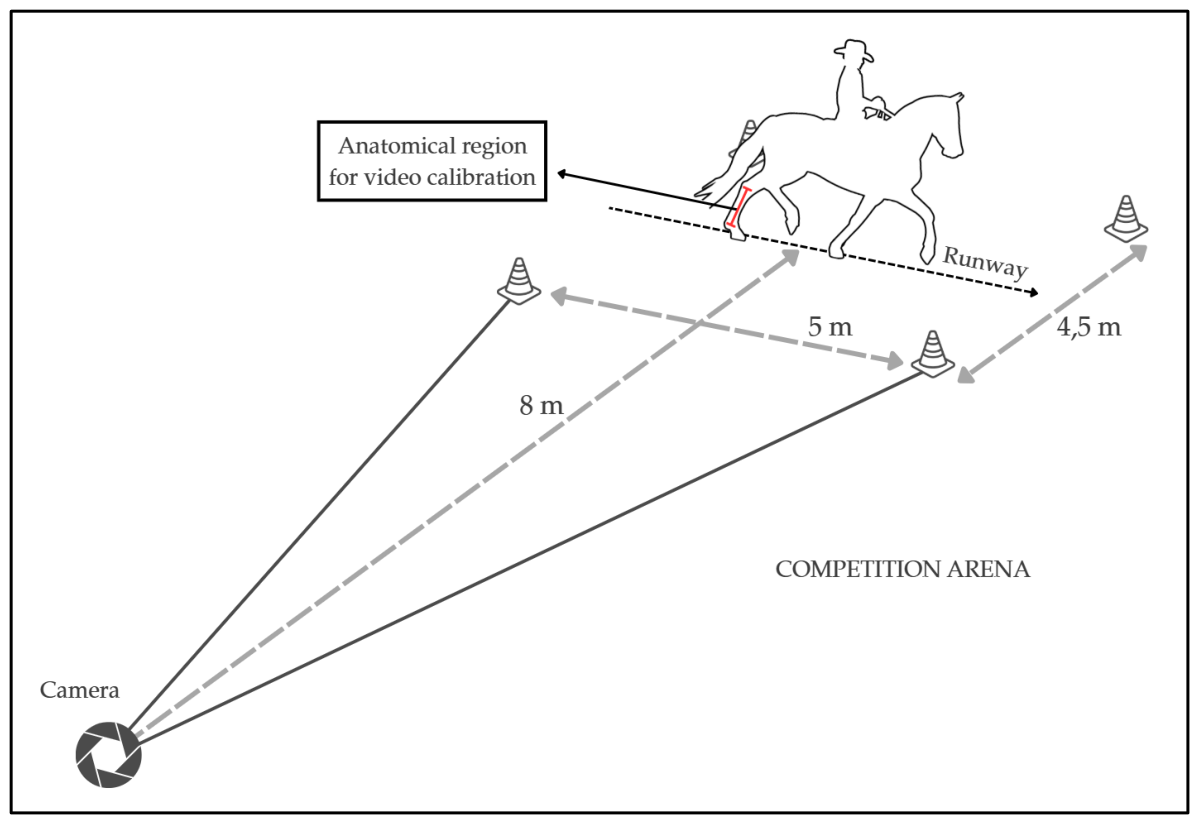
Figure 2.
Diagram for determining the distance between footprints in centimeters (cm), where gray = representation of the hindlimb hoofprint, black = representation of the forelimb hoofprint.
Figure 2.
Diagram for determining the distance between footprints in centimeters (cm), where gray = representation of the hindlimb hoofprint, black = representation of the forelimb hoofprint.
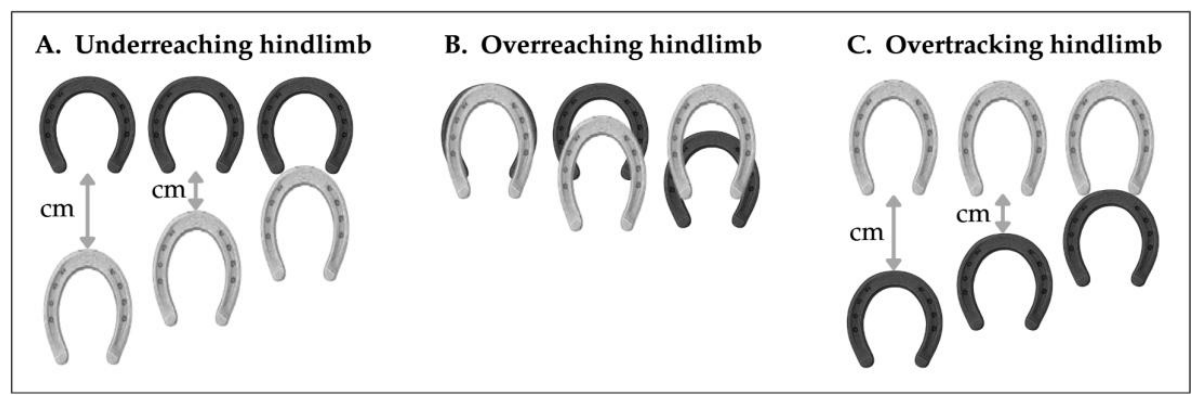

Table 1.
Median and interquartile range of the duration, length, frequency and speed of the strides of Marcha Batida or Marcha Picada gaits, during the kinematic evaluation at the 40th National Exhibition of the Mangalarga Marchador Horse.
Table 1.
Median and interquartile range of the duration, length, frequency and speed of the strides of Marcha Batida or Marcha Picada gaits, during the kinematic evaluation at the 40th National Exhibition of the Mangalarga Marchador Horse.
| Variable | Gait | |
|---|---|---|
| Marcha Batida (n=78) |
Marcha Picada (n=57) |
|
| Speed (meters/s) | 3.76A (3.50-4.30) | 3.94A (3.56-4.40) |
| Length (m) | 1.75A (1.64-1.89) | 1.81A (1.65-1.91) |
| Frequency (steps/s) | 2.18A (2.08-2.34) | 2.18A (2.11-2.47) |
| Duration (sec) | 0.46A (0.43-0.48) | 0.46A (0.40-0.47) |
Equal capital letters indicate no significant difference between groups within the same row according to the Mann-Whitney test (p > 0.05). meters/s: meters per second; m: meters; steps/s: steps per second; sec: seconds.
Table 2.
Distribution of time spent in each type of support relative to the total stride duration (%) (median (MIN:MAX)) in stallions or mares, of Marcha Batida or Marcha Picada gait, during the kinematic evaluation at the 40th National Exhibition of the Mangalarga Marchador Horse.
Table 2.
Distribution of time spent in each type of support relative to the total stride duration (%) (median (MIN:MAX)) in stallions or mares, of Marcha Batida or Marcha Picada gait, during the kinematic evaluation at the 40th National Exhibition of the Mangalarga Marchador Horse.
| Support type | Marcha Batida | Marcha Picada | |||||||
|---|---|---|---|---|---|---|---|---|---|
| General (n=78) |
Stallions (n=36) |
Mares (n=42) |
General (n=57) |
Stallions (n=24) |
Mares (n=33) |
||||
| Suspension (%) | 0.00A | 0.00a | 0.00a | 0.00A | 0.00a | 0.00a | |||
| Quadrupedal (%) | 0.46A | 1.07a (0.00:7.44) |
0.00b (0.00:7.35) |
0.00B | 0.00a (0.00:0.00) |
0.00a (0.00:0.00) |
|||
| Tripedal | Thoracic (%) | 6.13A | 5.55a (0.00:15.07) |
6.52a (0.00:13.96) |
14.60B | 11.66a (5.58:17.46) |
16.96b (8.99:23.53) |
||
| Pelvic (%) | 1.19A | 2.32a (0.00:8.22) |
0.83b (0.00:21.79) |
2.05A | 3.23a (0.00:13.91) |
0.46b (0.00:8.82) |
|||
| Bipedal | Diagonal (%) | 87.61A | 86.92a (74.43:96.86) |
88.06a (66.24:93.69) |
35.87B | 37.55a (16.96:48.60) |
35.65a (20.55:45.12) |
||
| Lateral (%) | 0.48A | 0.00a (0.00:8.44) |
0.97a (0.00:6.42) |
44.95B | 46.85a (33.33:61.54) |
43.78a (29.65:54.79) |
|||
| Pelvic (%) | 0.0A | 0.43a (0.00:0.43) |
0.41b (0.00:1.00) |
0.00B | 0.00a (0.00:0.00) |
0.00a (0.00:0.00) |
|||
| Monopedal | Pelvic (%) | 0.42A | 0.00a (0.00:4.65) |
0.97b (0.00:8.04) |
1.44B | 1.02a (0.00:7.94) |
2.56a (0.00:7.57) |
||
In the same row, different capital letters indicate significant differences between gait type and small letter indicate significant differences between sexes within the same gait type (Mann–Whitney, p > 0.05).
Table 3.
Relative diagonal dissociation (median, minimum and maximum) in relation to the total stride time (%) of stallions or mares, with Marcha Batida or Marcha Picada gaits, evaluated by videogrammetry during the 40th National Exhibition of the Mangalarga Marchador Horse. ‡Medians differ between gait types Mann-Whitney test, p<0.05); *Medians differ between sexes within the same gait type Mann-Whitney test, p<0.05).
| Variable | Marcha Batida | Marcha Picada | ||||||
|---|---|---|---|---|---|---|---|---|
| General (n=57) |
Stallions (n=24) |
Mares (n=33) |
General (n=57) |
Stallions (n=24) |
Mares (n=33) |
|||
| Diagonal dissociation time (%) | 1.03A | 1.06a (0.24;3.47) |
0.94a (0.00;2.61) |
11.81B | 11.70b (9.25;16.28) |
11.22b (8.09;14.34) |
||
Table 4.
Occurrence of dissociation starting with forelimb, hindlimb or did not dissociate in relation to the total dissociation (%) of stallions or mares, with Marcha Batida or Marcha Picada gaits, evaluated by videogrammetry during the 40th National Mangalarga Marchador Horse Exhibition.
Table 4.
Occurrence of dissociation starting with forelimb, hindlimb or did not dissociate in relation to the total dissociation (%) of stallions or mares, with Marcha Batida or Marcha Picada gaits, evaluated by videogrammetry during the 40th National Mangalarga Marchador Horse Exhibition.
| Variable | Type | Marcha Batida | Marcha Picada | |||||
|---|---|---|---|---|---|---|---|---|
| General (n=78) |
Stallions (n=36) |
Mares (n=42) |
General (n=57) |
Stallions (n=24) |
Mares (n=33) |
|||
| Diagonal dissociation position | Starting with forelimb (%) |
42.18 | 50.69 | 51.19 | 100.00 | 100.00 | 100.00 | |
| Starting with hindlimb (%) |
30.61 | 36.12 | 28.58 | 0.00 | 0.00 | 0.00 | ||
| Did not dissociate (%) |
27.21 | 13.19 | 20.23 | 0.00 | 0.00 | 0.00 | ||
Table 5.
Occurrence of underreaching hindlimb, overreaching hindlimb or overtraking hindlimb relation to the total number of footprints (%) of stallions or mares, with Marcha Batida or Marcha Picada gaits, during kinematic evaluation at the 40th National Mangalarga Marchador Horse Exhibition.
Table 5.
Occurrence of underreaching hindlimb, overreaching hindlimb or overtraking hindlimb relation to the total number of footprints (%) of stallions or mares, with Marcha Batida or Marcha Picada gaits, during kinematic evaluation at the 40th National Mangalarga Marchador Horse Exhibition.
| Footprint type |
Marcha Batida | Marcha Picada | ||||||
|---|---|---|---|---|---|---|---|---|
| General (n=78) |
Stallions (n=36) |
Mares (n=42) |
General (n=57) |
Stallions (n=24) |
Mares (n=33) |
|||
| Underreaching hindlimb (%) |
39.10 | 39.58 | 38.69 | 0.00 | 0.00 | 0.00 | ||
| Overreaching hindlimb (%) | 60.90 | 60.42 | 61.31 | 2.19 | 0.00 | 3.79 | ||
| Overtraking hindlimb (%) | 0.00 | 0.00 | 0.00 | 97.81 | 100.00 | 96.21 | ||
Table 6.
Distance (centimeters) between the pelvic and thoracic hooves of stallions or mares, with Marcha Batida or Marcha Picada gaits, that presented hindfoot or overfoot during kinematic evaluation at the 40th National Mangalarga Marchador Horse Exhibition.
Table 6.
Distance (centimeters) between the pelvic and thoracic hooves of stallions or mares, with Marcha Batida or Marcha Picada gaits, that presented hindfoot or overfoot during kinematic evaluation at the 40th National Mangalarga Marchador Horse Exhibition.
| Footprint type |
Marcha Batida | Marcha Picada | ||||||
|---|---|---|---|---|---|---|---|---|
| General (n=78) |
Stallions (n=36) |
Mares (n=42) |
General (n=57) |
Stallions (n=24) |
Mares (n=33) |
|||
| Underreaching hindlimb (cm) | 4.65 (0.00;14.00) |
3.82 (0.00;14.00) |
5.37 (0.00;14.00) |
- | - | - | ||
| Overtracking hindlimb (cm) | - | - | - | 17.05 (0.24;33.30) |
21.14 (1.07;39.00) |
13.96 (0.24;33.30) |
||
Disclaimer/Publisher’s Note: The statements, opinions and data contained in all publications are solely those of the individual author(s) and contributor(s) and not of MDPI and/or the editor(s). MDPI and/or the editor(s) disclaim responsibility for any injury to people or property resulting from any ideas, methods, instructions or products referred to in the content. |
© 2026 by the authors. Licensee MDPI, Basel, Switzerland. This article is an open access article distributed under the terms and conditions of the Creative Commons Attribution (CC BY) license (http://creativecommons.org/licenses/by/4.0/).
Copyright: This open access article is published under a Creative Commons CC BY 4.0 license, which permit the free download, distribution, and reuse, provided that the author and preprint are cited in any reuse.