

Submitted:
19 October 2026
Posted:
20 October 2026
You are already at the latest version
Abstract
In many real-life decision-making and machine-learning applications, efficient depiction and classification of imprecise, incomplete, and uncertain information still remains a challenging problem. Conventional hesitant intuitionistic fuzzy metrics assign equal weights to all attributes and may not be able to reflect the attribute-specific discriminative information, though hesitant intuitionistic fuzzy sets (HIFSs) are capable of providing an effective and flexible framework for the simultaneous representation of hesitant membership and hesitant nonmembership components. To address the aforementioned issue conveniently, an Adaptive Attribute-Weighted Hesitant Intuitionistic Fuzzy Metric-Induced Kernel (AAW-HIFM)-Induced Kernel similarity framework is proposed for explainable and robust classification. The proposed framework incorporates data-driven attribute weights on a Canberra-inspired HIFS metric while effectively maintaining the contributions of both hesitant membership and hesitant nonmembership components. Some of the important mathematical properties of the proposed metric and induced kernel are rigorously established. Further, an adaptive attribute-weight mechanism is introduced to identify the relative importance of individual attributes, which enables the classification framework to furnish interpretable information of the features that contribute to class assignments. The proposed AAW-HIFM-KSVM is evaluated against both the conventional and benchmark metric measures. A comprehensive experimental analysis is conducted using multiple benchmark datasets procured from established machine learning repository. The repeated cross-validation, ablation analysis, sensitivity analysis, and controlled perturbation experiments are conducted to evaluate the predictive performance, stability, and robustness of the proposed approach. The experimental findings demonstrate that the proposed AAW-HIFM-KSVM enhances the discriminative capability of the HIFS-based classification approach while providing greater interpretability and resilience to uncertain or perturbed input information. Hence, the proposed framework provides a unified approach for uncertainty-aware, explanation, and robust classification based on HIFS information.
Keywords:
adaptive attribute-weighted HIFS metric
; canberra mrtric
; similarity measure
; uncertainty modeling
; AAW-HIFM-KSVM
1. Introduction
Classification algorithms capable of addressing uncertain, imprecise, complex, and heterogeneous information are getting popularity among researchers due to the rapid development of data-driven decision-making. In many real-life applications, an observation’s data cannot be characterized adequately by a single deterministic value since domain experts, decision-makers, or information sources may provide different degrees of confidence regarding the same attribute. In particular, such uncertainty, imprecision, or vagueness becomes vital in areas involving behavioral assessment, healthcare, human judgments, risk analysis, sustainability evaluation, and intelligent decision-support systems. Fuzzy sets and intuitionistic fuzzy sets (IFSs) have been introduced as necessary tools to represent and process the aforementioned issues associated with decision-making problems and intelligent systems [1,2,3,4]. IFS, in particular, extended the fuzzy set [1] by incorporating the nonmembership component alongside the membership component. Such representations provide more flexibility in expressing the uncertainty [2,3] and have found applications in decision-making, pattern recognition, medicine, etc. [3,4,5]. Consequently, the developing of mathematical formulations, distance measures, and similarity measures capable of exploiting and preserving such uncertainty, imprecision, vagueness, incompleteness, heterogeneous, and hesitant information remains an important direction of research in computational intelligence [3,4,5,6].
Fuzzy set [1] assigning a single membership value to each element may be insufficient to represent the situation when several plausible membership values are simultaneously available. To address the issues Hesitant Fuzzy Sets (HFSs) were introduced to express the problem when a decision-maker hesitates among several possible membership degrees [6]. After that, HFSs have been successfully applied in the areas such as clustering, classification, pattern recognition, decision-making, information-retrieval, medical diagnosis, etc [7]. However, only hesitant membership information associated with an HFS does not clearly illustrate the hesitant degree of not belonging of an element to a particular concept. Therefore, hesitant and intuitionitic information simultaneously provides a richer representation of aforementioned issue. To incorporate both types of information with an integrated framework, Hesitant Intuitionistic Fuzzy Set (HIFS) was introduced [8].
Though HIFSs can provide richer and more flexible representation of the aforementioned uncertainty, the efficacy of an HIFS-based classification model is substantially influenced by the employed distance metric or similarity measure for comparing hesitant intuitionistic fuzzy representation of the information. Several measures of similarity, proposed for many real-life uncertainty-aware problems, have been applied successfully [9,10,11,12].
A key challenge of most of the existing measures is that they assume all the attributes are equally important. However, the above assumption is practically unrealistic, as different attributes might possess different levels of discriminatory information, and the attribute associated strongly with the target class should have a greater influence on the measures than those with weak discriminatory features [13,14]. Therefore, equal weighting can overlook vital information by reducing the efficacy of the distance-based classification model, particularly in the applications consisting of redundant and noisy values and heterogeneous attributes. In such cases, only increasing the attributes may not improve the performance of classification framework and there is a need for an effective metric capable of identifying and appropriately weighting information that is most relevant to the classification task.
A second key challenge concerns the robustness of the classification framework. Data collected from real environments is frequently affected by inherent uncertainties of many kinds, measurement errors, missing or incomplete observations, and expert disagreements. Small irregularities in the uncertainty components may significantly affect the corresponding distance and sometimes the assigned class [15,16]. Although theoretical properties of several uncertainty-aware distance or similarity measures has been studied in details, empirical assessment usually emphasized on predictive performance under nominal conditions, with minimally focused on systematic assessment under controlled perturbations [16,17]. Therefore, an uncertainty-aware classification framework should aim not only high accuracy but also for controlled changes in its metric values and classifications under moderate perturbations of the input information.
A third challenge is interpretability. In general, conventional classification approaches provide class label without signifying attributes mainly contributed for the decision. This shortcoming dilutes the utilities in the domain where the basis of the prediction should be understood by the decision-makers [18,19,20]. The attribute-weighting provide a natural mechanism representing the relative importance of individual attributes. By integrating attribute weights into the distance measure, the resulting classification approach can give an interpretable explanation of the resemblance or distinction of an observation from a reference class [21,22].
To address these challenges, an Adaptive Attribute-Weighted Hesitant Intuitionistic Fuzzy Metric (AAW-HIFM) is proposed for robust and explanation classification. The proposed approach introduces non-negative, normalized attribute weights on the Canberra-inspired [23,24,25,26] HIFS metric that adapt to the attribute’s discriminatory information [13,27,28,29]. It also incorporates hesitant membership and hesitant nonmembership information while allowing relatively important attribute exert greater influence on the proposed metric framework [13,30]. The weighting mechanism maintains the metric framework while providing an interpretable representation of attributes particularly relevant in the uncertainty-aware classification [13,31,32]. The proposed framework further introduces an attribute-level decomposition of the distance, allowing the contribution of individual attributes to a classification decision to be quantified. Consequently, the framework does not merely determine the most similar class but also provides information regarding why a particular observation is assigned to that class. In addition, the stability of the proposed metric is investigated under controlled perturbations of hesitant membership and non-membership values. This enables the relationship between perturbation magnitude, metric variation, and classification stability to be examined systematically.
The primary contributions of this manuscript are outlined below:
- Incorporating data-driven attribute importance into a Canberra-inspired HIFS metric an AAW-HIFM is developed along with its important mathematical properties.
- An HIFM-induced exponential similarity is proposed which turns out to be a kernel.
- The validity, boundedness, continuity, and stability properties of the HIFM-induced kernel are established.
- An explainable classification mechanism is developed by decomposing the overall HIFS distance into attribute-level contributions and using the learned weights to quantify the relative importance of individual attributes.
- Controlled perturbation-based robustness is examined to demonstrate influence uncertainty or noise influences HIFS-based metric values and classification outcomes.
- Ablation, sensitivity, repeated-validation, and statistical analyses are carried out to independently estimate the influences of HIFS representation, attribute weighting, the proposed HIFS metric, and perturbation robustness.
The remainder of this paper is organized as follows. Section 2 presents the necessary preliminaries concerning HFSs, IFSs, HIFSs, and relevant distance measures. Section 3 introduces the proposed adaptive attribute-weighted HIFS metric and establishes its theoretical properties. Section 4 develops the explainable and robust classification framework. Section 5 describes the complexity analysis of the proposed framework. Section 6 presents the experimental results and provides comparative, ablation, sensitivity, robustness, interpretability, the principal findings of the proposed framework. Finally, Section 7 concludes the study and outlines limitations and directions for future research.
2. Preliminaries
2.1. Definition [1,2]
Let X denote a finite set of universe of discourse. A fuzzy set F over X defined by Zadeh [1] can be represented as
where μF(x) ∈ [0, 1] denotes the grade of membership of x in F.
F = {(x, μF(x)), x∈X}
An IFS I over the universe of discourse X defined by Atanassov [2] can be represented as
where μI(x) ∈ [0, 1] and νI(x) ∈ [0, 1] denote the grades of membership and nonmembership of x in I, respectively, such that 0 ≤ μI(x) + νI(x) ≤ 1 ∀ x ∈ X. Also, πI(x) = 1 − μI(x) − νI(x) is the degree of hesitation of x to I.
I = {(x, μI(x), νI(x)), x∈X}
2.2. Definition [6]
An HFS H defined over X can be given by
where for all j = 1, 2, …, k.
2.3. Definition [8]
A HIFS H over X is expressed as
where are the hesitant membership and hesitant nonmembership sets, respectively, with , and .
2.4. Definition [9,10,11,12,13]
Let and two HIFS defined on the finite set of universe of discourse X = {x1, x2,…, xn}. The distance between H1 and H2 can be expressed as follows:
Normalized HIFS Hamming distance:
Normalized HIFS Euclidean distance:
Normalized Weighted HIFS Hamming distance:
Normalized HIFS Euclidean distance:
where wt ≥ 0 denote importance weight of attribute xt, with
2.5. Definition [23,24,25,26]
2.6. Definition (Conditionally Negative Definite (CND) Metric [34])
A systemic metric function D:X × X → ℝ is defined as condionally negative definite if D(x, x) = 0 for any finite set {x1, x2,…, xm} ⊆ X and real scalars k1, k2,…, km such as
2.7. Definition (Positive Semidefinite (PSD) Kernel [35])
A systemic kernel function K:X × X → ℝ is defined as positive semidefinite, for any finite set {x1, x2,…, xm} ⊆ X and k1, k2,…, km ∈ ℝ, the quadratic form satisfies
2.8. Definition (Metric-Induced Kernel [33])
For a conditionally negative definite metric D:X × X → ℝ+, where ℝ+ set of non-negative real numbers, the metric-induced kernel (KD) is defined as
where D(x, y) is the metric measuring dissimilarity between x, y ∈ X, λ > 0 is the kernel decay parameter controlling rate of decrease of similarity corresponding to the increase of distance. Obviously, KD(x, y) ∈ [0, 1]. Also, x = y, KD(x, y) = 1, KD(x, y) → 0 as D(x, y) tends to infinity.
KD(x, y) = exp(−λD(x, y))
Theorem 1 (Schoenberg’s Theorem [34]). Let D:X × X → ℝ be a symmetric function such that D(x, x) = 0 ∀ x ∈ X. The following kernel
is positive semi definite for all λ > 0 if and only if D(x, y) is conditionally negative definite (CND).
KD(x, y) = exp(−λD(x, y))∀x, y ∈ X
3. Proposed Method
3.1. Definition (Computing Adaptive Attribute Weights)
An adaptive weighting method is applied to the proposed HIFS metric to accommodate the diverse discriminatory importance of attributes. Let the dataset has N instances with n attributes. For each attribute t, using (9), a HIFS-based dispersion coefficient is computed from average pairwise dissimilarity among the instances. This coefficient quantifies the extent to which the attribute differentiates the available HIFS patterns. This HIFS-based dispersion coefficient measures the contribution of the ability of the attribute to discriminate among the available HIFS patterns. Since the HIFS-based classification framework is proposed to be employed, the attribute-wise between-class and within-class distance are computed to measure class-separating capability. Then, the coefficient is normalized across all the attributes and combined with class-discrimination information to produce the adaptive attribute wt ≥ 0 satisfying . The resulting weights wt are then included into the proposed HIFS metric. This enables more informative attribute to apply more influence on the overall distance while preserving an interpretable from each individual attribute. The method of computing adaptive attribute weights is illustrated below.
For attribute t, the HIFS representation of instance xt is
Hs(xt) = 〈Ms,t, Ns,t〉
Where Ms,t and Ns,t denote the hesitant membership and hesitant nonmembership components. Calculate the average pair-wise dissimilarity of attribute t using Canberra-inspired [23,24,25,26] HIFS metric of Equation (9) as follows:
where
Thus, δt measures how strongly attribute t differentiates the observations.
Now define
Obviously,
Now define between-class and within-class discrimination for attribute t as
And
where is the HIFS prototype of class c and is the overall prototype.
A discrimination coefficient then be defined as
where ε > 0 is a small constant used to avoid the indeterminate form. Normalizing the above expression, we obtain
A simple combined attribute weighting scheme can be expressed as
Consequently, wt ≥ 0 and . An attribute therefore receives a larger weight when it provides both substantial HIFS discrimination and stronger class-separation information. Using the Equation (18), we define the Adaptive Attribute-Weighted Hesitant Intuitionistic Fuzzy Metric (AAW-HIFM) as follows
3.2. Definition
Let HIFS(X) be the set of HIFSs defined on a finite universe of discourse X, then an Adaptive Attribute-Weighted Hesitant Intuitionistic Fuzzy Metric (AAW-HIFM) is defined as follows:
where:
Proof. For each H1, H2, H3 ∈ HIFS(X), we prove the following axioms:
Axiom [3]:
Axiom [4]: To prove the triangle inequality, we use the following lemma.
Thus, D satisfies the triangle inequality on [0, ∞).
Applying the above lemma1 on hesitant membership components of HIFSs, we obtain
Similarly, applying the lemma1 on hesitant nonmembership components of HIFSs, we obtain
Adding (24) and (25), we get
Multiplying by adapted attribute weight wt and summing the above inequality over t, we obtain
Hence is a metric on HIFS(X) and (HIFS(X), ) is a metric space.
Theorem 2 (Conditionally negative definiteness of ).
The proposed AAW-HIFM defined in (22) is CND.
Proof. Using scalar Canberra metric of (23) on hesitant components of HIFS, we obtain
Then, D will be CND, if, for every , , …, and real scalars α1, α2, …, αn satisfying ,
Let us assume for each , , then from (27), we obtain
where
=f(xi − xj)∀ xi, xj ∈ ℝ,
Now f will be CND, if
∀ x1, x2,…, xn ∈ ℝ and for all real scalars α1, α2, …, αn satisfying
Now, introduce complementary function
Using the hyperbolic function identity on (31), we obtain
We know that a function f1:ℝ ⟶ ℂ is positive definite, if for every finite collection x1, x2,…, xn ∈ ℝ and complex coefficients c1, c2, …, cn,
Now taking Fourier transform of , we obtain
Thus, is positive definite.
Similarly, is also positive definite.
Therefore, from (32), we obtain g(x) is also positive definite.
for all real coefficients αi.
∀ xi, xj ∈ ℝ and .
⇒ f(xi − xj) is CND.
is CND.
Again, for , define , where εε > 0 and thus .
Now we have,
Since εε → 0+, each scalar term converges to the definition in (27). If , then . Further, . Since the sum is finite, taking limit of (35) gives
Therefore, is CND on [0, ∞).
As each scalar Canberra metric term defined on hesitant components is CND, then its every finite non-negative linear combinations is also CND. Subsequently, the attribute weights wt ≥ 0 and fixed independently of HIFS pairs and the hesitant components are compared through a fixed component-wise correspondence. Therefore, AAW-HIFM defined in (22) is CND.
Theorem 3.
Let be the AAW-HIFM defined in (22) with non-negative attribute weights wt;t = 1, 2, …,n. For λ > 0, we define
for all H, G ∈ HIFS(X).
Then, is positive semidefinite (PSD) for every λ > 0.
Proof.
By Theorem 2, is CND. Moreover, is symmetric and for all H ∈ HIFS(X). Therefore, by Schoenberg’s Theorem [34], the function
is PSD for every λ > 0.
Hence, is a valid kernel on HIFS(X).
Theorem 4 (Lipschitz Stability under Bounded Perturbations of the AAW-HIFM-Induced Kernel).
Let be AAW-HIFM on HIFS(X) defined in (22), and let be the variations of Hi, Hj, respectively, satisfying , for some εi,εj ≥ 0. Then, the -induced kernel satisfies the following:
That is the AAW-HIFM-induced kernel is Lipschitz stable with respect to AAW-HIFM.
Proof. Since is a metric, by reverse triangle inequality
Since is λ-Lipschitz on [0, ∞), by mean value theorem, there exists θ satisfying such that
[Using (38)]
Thus, bounded perturbations of the HIFS inputs result in proportionally bounded perturbations of the HIFM-induced kernel. Therefore, is Lipschitz stable with respect to with respect to the AAW-HIFM. This gives the robustness of the AAW-HIFM-induced kernel.
Theorem 5
The proposed AAW-HIFM-induced kernel satisfies the following properties:
Boundedness:
Since , therefore,
Moreover, for
For Hi ≠ Hj, .
Hence the proposed kernel provides a normalized similarity measure. The identical AAW-HIFSs have similarity 1, whereas increasingly distinct AAW-HIFSs have progressively smaller similarity value.
Symmetry:
Since , is symmetric.
Continuity:
If the AAW-HIFM is continuous with respect to the underlying HIFS representation, then is continuous.
In particular, if , then .
Hence . This demonstrates the continuity of the kernel at coincident HIFSs.
Sensitivity of with respect to the HIFM:
The sensitivity of to the underlying metric can be computed using differentiation. Therefore,
This shows that λ controls the sensitivity of the AAW-HIFM-induced kernel to changes in the AAW-HIFM. Therefore, for smaller value of λ, the kernel changes slowly with the metric distance and is relatively insensitive to small variations. For larger value of λ, the kernel decreases rapidly as the AAW-HIFM increases and is more sensitive to local distance differences. Therefore,
Thus, is convex and monotonically decreasing as a function of .
Relative Sensitivity of :
We have,
Hence the relative rate of change is constant i.e., . Thus, λ has a direct interpretation as the relative sensitivity parameter of the AAW-HIFM-induced kernel.
Limiting behavior:
Hence .
As the AAW-HIFM increases .
Thus, .
If AAW-HIFM has a finite upper bound Dmax, however, the kernel does not approach zero within the actual space unless Dmax is sufficiently large. In that case,
Monotonicity:
Since , the kernel is strictly decreasing with respect to the AAW-HIFM. Therefore, .
Thus the proposed kernel preserves the ordering induced by the proposed AAW-HIFM.
Adapted Attribute-Weight Sensitivity:
Since AAW-HIFM is attribute-weighted, the kernel inherits sensitivity to the attribute. Let us assume that
where wt represents the contribution of attribute t. Then
Differentiating (40) with respect to wt, we obtain
From (41), we observe that the variation of weight of an attribute has little effect on AAW-HIFM if its contribution is minimum, whereas is more sensitive to the weight of an attribute if its contribution is substantial. The sensitivity of is also modulated by λ.
Stability with respect to attribute weights:
Suppose two weight vectors w and w/ produce metric and and if
then
Therefore, moderate perturbation AAW results in bounded changes in .
Normalization:
Since , the kernel is naturally normalized on the diagonal. Consequently,
This makes the kernel value directly interpretable as similarity levels, although they should not be interpretable as probabilities.
Scale behavior and the role of λ:
The parameter λ controls the effective scale of AAW-HIFM . If is multiplied by a constant k,
then
Thus, scaling is mathematically equivalent to rescaling parameter. Thus, λ should be chosen consistently with the scale of the AAW-HIFM.
4. AAW-HIFM-Induced Kernel-Based Support Vector Machine (AAW-HIFM-KSVM) for Explainable and Robust Classification
4.1.
4.1.1. Training Dataset
Let us consider the labelled dataset
where xi is the i-th observation of dimension p with class label ci. We assume ci ∈ {−1,+1} for binary classification. For each attribute t, the hesitant intuitionistic fuzzy representation of each attribute xi is given by Equation (13).
4.1.2. Adaptive Attribute Weights
Let us represent the attribute level Canberra-inspired HIFS dissimilarity by dt(xi, cj). For each attribute t, the dispersion and class-discrimination quantities can be expressed using (14). Let at ≥ 0 be the resulting attribute importance score. Using (21), normalize the score. If all the scores are, uniform weights may be used. These weights are evaluated using on the relevant training data. Since the class discrimination uses labels, the weights must be re-estimated within each training fold during cross-validation.
4.1.3. AAW-HIFM Distance
The attribute weighted distance between two observations is given by
The above describes the weighted decomposition of proposed AAW-HIFM.
4.1.4. Exponential AAW-HIFM-Induced Kernel
Construct the kernel-matrix using
where λ > 0 is the parameter to control the rate at which kernel similarity increases as metric distance increases.
4.1.5. SVM Model and Classification Rule
For binary classification, the soft-margin kernel SVM solves the dual optimization problem.
subject to
Here CSVM denotes the SVM regularization parameter and αi denotes the Lagrange multipliers.
Solving the optimization problem (45), we obtain the decision function for a new observation x as follows:
where β is the learned intercept. Observation with αi > 0 are support vector and the predicted class is
For multiclass classification, the above binary classification framework can be extended using a one-versus-one or one-versus-rest approach.
4.2. Explainability Mechanism
The proposed method provides the complementary forms of explanations.
4.2.1. Global Attribute Importance
Report the learned weights W = {w1, w2, …, wp}. A larger wt indicates the attribute t receives a larger contribution to the weighted HIFS distance. These weights demonstrate the distance-based importance of attributes and not just automatic causal effect.
4.2.2. Instance-Level Distance Explanation
For a test observation x and training observation xi, we define the attribute-level contribution as
γt(xi, x) = wtdt(xi, x)
The overall distance then satisfies
Consequently, the contributions identify the attributes that account for the greatest portions of the distance between the test observation and a selected training observation or support vector.
The corresponding kernel similarity can be represented by
4.2.3. Support Vector Explanation
The contribution of support vector xi to decision score is
si(x) = αiciκλ(xi, x)
Thus,
Positive and negative values of si(x) demonstrate support vectors pushing the decision scoring in opposite directions.
Equations (47)–(52) provide the necessary explanation framework: the attribute contributions explain the underlying distances, while support-vector contributions explain how the fitted SVM combines similarities to determine class.
4.2.4. Robustness Assessment
By using perturbation of HIFS representation, robustness can be assessed while keeping the fitted model fixed. Let be a perturbed observation of x. The perturbation must preserve the admissibly condition of the HIFS representation.
If
then the reverse triangle inequality gives
For the exponential kernel, the mean value theorem gives
This bound follows because the derivative magnitude of e−λz, for z > 0, is at most λ. For the SVM decision function, Equation (46), gives
[since |ci|=1 and αi ≥ 0]
The Equation (56) provides an useful bound under the stated assumptions. It bounds the changes in the decision score, rather than guaranteeing that every prediction remains unchanged.
In particular, if
then the sign of the decision score cannot change under a perturbation satisfying Equation (43). Consequently, the predicted binary class is unchanged
Below, a performance-based classification algorithm is outlined:
4.3. Algorithm: AAW-HIFM-KSVM
Input:
Labelled dataset , Number of attributes p, Hesitant intuitionistic fuzzy representation and Canberra-inspired attribute-level distance dt, kernel parameter λ, SVM regularization parameter CSVM > 0, perturbation magnitudes ε for robustness assessment, cross-validation folds and stopping criteria for hyperparameter selection.
Output:
Predicted class labels, fitted AAW-HIFM-KSVM classifier, adaptive attribute weights, kernel matrix and support vectors, attribute-level explanations and robustness measurements.
Training phase:
- Partition the labelled dataset into training, validation, and test datasets preserving class proportion where appropriate.
- Fit the preprocessing transformations using training data and construct admissible HIFS representations for every training observation.
- For each attribute t = 1, 2, …, p, compute its HIFS-based dispersion and class-discrimination score atusing the definition.
- Normalize the score to obtain, , using a prefined fallback if all scores vanish.
- Compute dt(xi, xj) for all pairs of training observations and construct the aggregate distance matrix using Equation (43).
- Verify the theoretical assumptions required for the metric-induced kernel. Numerically inspect symmetry and eigen values of the resulting kernel matrix as a diagnostic.
- Construct
- Optimize the soft-margin kernel SVM in Equation (45) and estimate the intercept β.
- Select λ and CSVM using training only cross-validation or a nested validation procedure. Re-estimate adaptive weights within each training fold.
- Store the preprocessing parameters, HIFS encoding rules, attribute weights, kernel parameter, support vectors, coefficients, and intercept.
Prediction and explanation phase:
- Transform each new observation into its HIFS representation using the fitted preprocessing rules.
- Compute its AAW-HIFM distance to the training observations required by the fitted SVM.
- Calculate kernel similarities and evaluate the decision function in Equation (46).
- Assign the class-label using Equation (47), or selected multiclass rule.
- Calculate the attribute-level distance contributions using Equation (48) and support-vector contributions using Equation (51).
- For robustness evaluation, perturb test HIFS representations at predefined magnitudes, recompute decision scores and labels, and support prediction-flip rates and performance changes.
Return the fitted classifiers, predicted labels, learned attribute weights, explanations, and robustness evaluation.
5. Complexity Analysis
Let N denote the number of training observations, p the number of attributes, q the maximum number of hesitant membership or nonmembership values per attribute, Nsv the number of support vectors.

Table 1.
Time complexity table.
| Operation | Indicative Time Complexity |
|---|---|
| Estimate the pair-wise attribute dispersion | O(N2pq) |
| Compute the aggregate training distance | O(N2pq) |
| Construct the exponential kernel | O(N2), after distances are available |
| Train the kernel SVM | Up to O(N3) for generic dense quadratic programming solvers |
| Predict one observation | O(Nsvpq) |
| Generate distance explanation for one observation | O(Nsvpq) if calculated for the vectors |
The estimates assume that each attribute-level distance can be computed in O(q) time. Actual costs depend on the exact hesitant-set alignment and aggregation operations. The dense kernel matrix requires O(N2) memory. For large datasets, this can be the principal computational limitation.
6. Experiments, Results, and Discussions
6.1. Experiments and Results
To establish the efficacy, robustness, and general applicability of the proposed AAW-HIFM-KSVM classifier, the proposed classifier has undergone with following comparative analysis:
For the above purpose, seven publicly available datasets namely Wine [41], NSL-KDD [42], Student Performance [43], xAPI-Edu-Data [44], Energy Efficiency [45], Appliances Energy Prediction [46], and Air Quality [47] were considered. The datasets are assessed from established machine-learning repositories and have undergone the same preprocessing process, HIFS representation schemes, and other experimental protocols. The preprocessed datasets are described briefly in Table 2.
The experiments were repeated with five repetitions, 50 runs per dataset and method, and repeated stratified 10-fold cross-validation strategy. The proposed AAW-HIFM-KSVM was compared with linear SVM and RBF-SVM [36,37] on Wine [41] and NSL-KDD [42] datasets under identical training/test partitions. The results are reported as Mean ± Standard Deviation (SD) across the evaluation runs The evaluation metrics such as, accuracy, balanced accuracy, macro-precision, macro-recall, and macro-F1 are used represent the results. The mean of the class-wise recall values gives balanced accuracy, so the potential class imbalance can be accounted. All the preprocessing produces were performed on that training dataset to prevent data leakage. The corresponding results are represented in Figure 1.
To assess AAW’s contribution, the proposed AAW-HIFM-KSVM was compared with a baseline equal-weight HIFM-KSVM approach across the considered datasets [41,42,43,44,45,46,47]. The comparative analysis was designed as a controlled ablation study to isolate the effect of attribute–weight mechanism. For equal-weight approach a weight of 1/p is assigned to each of the p attributes, where the proposed approach estimated AAWs from the training data subject unit sum constraint. Both the competing approaches employed same metric, kernel, data preprocessing, data partitions, and other experimental protocol as discussed earlier. The performances are evaluated using the evaluation metrics: accuracy, balanced accuracy, macro-precision, macro-recall, and macro-F1, and the results were reported as Mean ± SD. The obtained results are illustrated in Figure 2.
To demonstrate the efficacy of the proposed AA-HIFM-KSVM over competing approaches, an extensive comparative analysis was conducted with the Xu-Xia [38], Xu-Xia [39], Chen et al. [40], and equal-weight HIFM-KSVM methods under similar experimental conditions. The algorithm SVM was incorporated on all the competing distance measures [38,39,40] to make the a fair comparison. The performances are evaluated using the evaluation metrics: accuracy, balanced accuracy, macro-precision, macro-recall, and macro-F1, and the results were reported as Mean ± SD. The obtained results are illustrated in Figure 3, Figure 4 and Figure 5.
6.2. Parameter Sensitivity Analysis
The analysis of hyperparameter sensitivity was conducted with respect to λ and CSVM. It assessed the individual parameter’s effect on the classification performance by determining the stability of the predictive performance and decision score over reasonable ranges of parameter values. A logarithmic grid was used for CSVM, with candidate values belonging to {0.001, 0.01, 0.1, 1, 10, 100, 1000}. To evaluate the proposed HIFM’s scale, the λ was taken as , where the median distance is the median non-zero pair-wise metric computed from training data and q ∈ {0.01, 0.1, 1, 10, 100} is the dimensionless scaling factor. The resulting parameter combinations were computed with the help of same partitions and preprocessing protocol and the selection was performed on the training data using cross-validation. The final performance was assessed on the test data. The evaluation metrics were reported as Mean ± SD across the evaluation runs. The obtained results are represented diagrammatically by Figure 6, Figure 7, Figure 8 and Figure 9.
6.3. Discussions and Comparative Assessment
The obtained experimental results represented by Figure 1, Figure 2, Figure 3, Figure 4, Figure 5, Figure 6, Figure 7, Figure 8 and Figure 9 illustrate a comparative analysis of the classification and predictive performance, AAW’s contributions, hyperparameter selections, and decision score stability of proposed AAW-HIFM-KSVM approach. Figure 1 depicts a comparative assessment of the proposed approach with the competing approaches such as, equal-weights HIFM-KSVM, linear SVM, and RBF-SVM across the Wine and NSL-KDD [41,42] datasets. The proposed approach provides competitive performance across all the considered evaluation measures. It also demonstrates that the improved performance can be attributed to the influence of AAW. Also, incorporating HIFM and its induced kernel can provide a competitive performance in comparison to conventional SVM under considered experimental setup. Figure 2 demonstrate ablation analysis between AAW-HIFM-KSVM and the equal-weight HIFM-KSVM baseline across the datasets [43,44,45,46,47]. The reported results provide a stronger support for AAW formulation across the evaluated performance under identical experimental condition. It suggests that data-dependent weight assignments can influence the classification performance, while performance improvement may be attributed specifically to AAW only if the experimental conditions and remaining components are assumed to be identical across the experimental runs.
Figure 3, Figure 4 and Figure 5 presents a comparative assessment of the proposed approach with benchmark approaches such as, Xu and Xia [38,39], Chen et al. [40], and equal-weight HIFM-KSVM across the datasets [43,44,45,46,47]. To establish a more consistent classification framework and for fair comparison, Xu and Xia [38,39] and Chen et al.’s [40] distances underwent to exponential kernel representation and an SVM classifier was incorporated on the corresponding kernel representations. The results depict higher performance in all the considered evaluation measures for the proposed approach than others.
Figure 6 and Figure 7 describe the variation of mean macro-F1 scores over the tested hyperparameters combinations for the two datasets [41,42]. The response surface suggests that the performance of the proposed approach depends on the joint selection of λ and CSVM. Also, relatively low performance at some hyperparameters combinations and higher in intermediate region of response surface demonstrate that a single arbitrary hyperparameters combinations may not provide consistent results. Therefore, the sensitivity analysis supports the selection of hyperparameters through cross-validation. The macro-F1 scores of 96.8% and 94.6% for the Wine [41] and NSL-KDD [42] datasets respectively highest scores identified for a particular combinations of hyperparameters evaluated from the training datasets and these should not be interpreted as proof of a global optimum.
Similarly, Figure 9 describes the comparison of macro-F1 scores, mean absolute decision-scores, predictive-flip rate, and training time for four different configurations hyperparameters for the considered datasets [41,42] and the macro-F1 scores of 96.8% and 94.6% appears to provide best choice for corresponding configuration. Also, the computational time for training data is substantially higher for NSL-KDD [42] than for Wine [42] as number of instances in NSL-KDD reasonably higher as reported in Table 1. Overall, the experiment suggests that the proposed AAW-HIFM-KSVM has competing performance offering systematic framework for incorporating attribute’s importance and HIFM-based classification model. The equal weight ablation analysis demonstrates evidence of AAW’s contribution in the proposed framework, while the comparative assessment provided the broader efficacy of proposed approach over conventional SVMs and competing HIFS-based distance methods under identical experimental conditions. The hyperparameter sensitivity analysis further emphasized the importance of selecting the λ and CSVM parameters using a consistent cross-validation technique.
7. Conclusions
This introduced an AAW-HIFM-KSVM framework for uncertainty-aware, explainable, and robust classification. The proposed approach integrates AAW with a Canberra-inspired HIFM to describe relative discriminatory importance of individual attributes while preserving HIFS information. It provides a balanced framework for classification by combining the proposed HIFM with an HIFM-induced kernel-based SVM classifier.
The primary contribution of this study is the development of a unified HIFM-based classification framework incorporating adaptive attribute importance, HIFM-based kernel similarity, attribute led distance decomposition, and support vector-based decision explanations. The theoretical study addresses the development of HIFM and its important mathematical properties, HIFM-induced kernel similarity, condition of PSD, stability under bounded perturbations, and associated explainability framework. Further, the time complexity of proposed approach is discussed briefly.
The experimental study compares the proposed framework with conventional and equal-weight HIFM-KSVM approaches. The study also conducted on hyperparameter sensitivity, decision-score stability, prediction-flip rate, and computational cost. The comparative highlights the potential benefits of AAW and provides a basis to study across the datasets with diverse sizes, features, and application domains. The proposed approach exhibits competitive performance across the evaluation metrics over the competing approaches across all the considered datasets under identical experimental framework.
In spite of its high prospect as classifier, the proposed AAW-HIFM-KSVM has several limitations. First, the quality and suitability of the HIFS representation highly influence the method’s efficacy. Second, the AAW mechanism depends on class-discrimination and dispersion computed from the training data. Third, for large scale applications, the computational cost may enhance significantly. Finally, the robustness of bounded perturbations and sensitivity studies were conducted under specified experimental framework and such analysis provides a controlled assessment.
Future works may be executed towards the following directions.
In future, an superior HIFS framework can be investigated for numeric, categorical, ordinal, and mixed-type attributes.
In future, the stability and adaptability of the AAW can be investigated with reference to diverse applications.
In future, further theoretical properties of the HIFM-induced kernel can be studied.
In future, the scalability of the proposed classification framework can be studied.
In future, the robustness and generalization properties of the proposed approach can be explored in comprehensive manners.
In future, the proposed approach’s application domain can be diversified to determine its general applicability.
Author Contributions
For research articles with several authors, a short paragraph specifying their individual contributions must be provided. The following statements should be used “Conceptualization, X.X. and Y.Y.; methodology, X.X.; software, X.X.; validation, X.X., Y.Y. and Z.Z.; formal analysis, X.X.; investigation, X.X.; resources, X.X.; data curation, X.X.; writing—original draft preparation, X.X.; writing—review and editing, X.X.; visualization, X.X.; supervision, X.X.; project administration, X.X.; funding acquisition, Y.Y. All authors have read and agreed to the published version of the manuscript.” Please turn to the CRediT taxonomyfor the term explanation. Authorship must be limited to those who have contributed substantially to the work reported.
Funding
This research received no external funding.
Institutional Review Board Statement
Not applicable.
Informed Consent Statement
Not applicable.
Data Availability Statement
The datasets used in this study are publicly available from established machine-learning repositories. No new dataset was created for this study.
Conflicts of Interest
The authors declare no conflicts of interest.
Abbreviations
The following abbreviations are used in this manuscript:
| MDPI | Multidisciplinary Digital Publishing Institute |
| DOAJ | Directory of open access journals |
| TLA | Three-letter acronym |
| LD | Linear dichroism |
References
- Zadeh, L.A. Fuzzy sets. Inf. Control 1965, 8, 338–353. [Google Scholar] [CrossRef]
- Atanassov, K.T. Intuitionistic fuzzy sets. Fuzzy Sets Syst. 1986, 20, 87–96. [Google Scholar] [CrossRef]
- Wu, X.; Tang, H.; Zhu, Z.; Liu, L.; Chen, G.; et al. Nonlinear strict distance and similarity measures for intuitionistic fuzzy sets with applications to pattern classification and medical diagnosis. Sci. Rep. 2023, 13, 13918. [Google Scholar] [CrossRef] [PubMed]
- Du, K.; Fan, R.; Wang, Y.; et al. A data-driven group emergency decision-making method based on interval-valued intuitionistic hesitant fuzzy sets and its application in COVID-19 pandemic. Appl. Soft Comput. 2023, 139, 110213. [Google Scholar] [CrossRef] [PubMed]
- Li, L.; Xu, Y. An extended hesitant fuzzy set for modeling multi-source uncertainty and its applications in multiple-attribute decision-making. Expert Syst. Appl. 2024, 238, 121834. [Google Scholar] [CrossRef]
- Torra, V. Hesitant fuzzy sets. Int. J. Intell. Syst. 2010, 25, 529–539. [Google Scholar] [CrossRef]
- Xu, Z. Hesitant Fuzzy Sets Theory; Studies in Fuzziness and Soft Computing; Springer: Berlin/Heidelberg, Germany, 2014; Volume 314. [Google Scholar] [CrossRef]
- Yao, D.; Wang, C. Hesitant intuitionistic fuzzy entropy/cross-entropy and their applications. Soft Comput. 2018, 22, 2809–2824. [Google Scholar] [CrossRef]
- Jang, M.W.; Park, J.H.; Son, M.J. Probabilistic picture hesitant fuzzy sets and their application to multi-criteria decision-making. AIMS Math. 2023, 8, 8522–8559. [Google Scholar] [CrossRef]
- Ashraf, S.; Ahmed, M.; Naeem, M.; Duodu, Q.; Božanić, D. Novel complex intuitionistic hesitant fuzzy distance measures for solving decision-support problems. Discret. Dyn. Nat. Soc. 2024, 7498053. [Google Scholar] [CrossRef]
- Wu, X.; Zhu, Z.; Chen, S.-M. Strict intuitionistic fuzzy distance/similarity measures based on Jensen–Shannon divergence. Inf. Sci. 2024, 661, 120144. [Google Scholar] [CrossRef]
- Gupta, S.; Joshi, D.K.; Awasthi, N.; Pant, M.; Joshi, B.P.; Chaube, S. Distance and similarity measures of hesitant bi-fuzzy set and its applications in renewable energy systems. Math. Comput. Simul. 2024, 219, 321–336. [Google Scholar] [CrossRef]
- Hussain, Z.; Zahra, S.; Hussain, R.; Ali, M.; Chountas, P. A novel methodology for distance and similarity measures in hesitant fuzzy sets: Enhancing pattern recognition and decision-making. Symmetry 2026, 18, 947. [Google Scholar] [CrossRef]
- Bisht, G.; Pal, A.K. Prospect-regret theory based decision-making approach for incomplete probabilistic hesitant fuzzy environment: An application to medical field. Expert Syst. Appl. 2024, 250, 123906. [Google Scholar] [CrossRef]
- Faizi, S.; Sałabun, W.; Shah, M.; Rashid, T. A novel approach employing hesitant intuitionistic fuzzy linguistic Einstein aggregation operators within the EDAS approach for multicriteria group decision making. Heliyon 2024, 10, e31407. [Google Scholar] [CrossRef] [PubMed]
- Ranjbar, M.; Effati, S. Group decision making in the analytic hierarchy process by hesitant fuzzy numbers. Sci. Rep. 2023, 13, 21864. [Google Scholar] [CrossRef] [PubMed]
- Das, S.; Datta, S.; Chaudhuri, B.B. Handling data irregularities in classification: Foundations, trends, and future challenges. Pattern Recognit. 2018, 81, 674–693. [Google Scholar] [CrossRef]
- Padró-Ferragut, C.; Martínez-Plumed, F.; Ramírez-Quintana, M.J. Robustness under noise: Assessing the impact of perturbed key attributes on machine learning models. Int. J. Data Sci. Anal. 2026. [Google Scholar] [CrossRef]
- Molnar, C. Interpretable Machine Learning: A Guide for Making Black Box Models Explainable, 2nd ed.; 2022. [Google Scholar]
- Ribeiro, M.T.; Singh, S.; Guestrin, C. “Why should I trust you?” Explaining the predictions of any classifier. In Proceedings of the 22nd ACM SIGKDD International Conference on Knowledge Discovery and Data Mining; ACM: New York, NY, USA, 2016; pp. 1135–1144. [Google Scholar]
- Lundberg, S.M.; Lee, S.-I. A unified approach to interpreting model predictions. Adv. Neural Inf. Process. Syst. 2017, 30, 4765–4774. [Google Scholar]
- Rudin, C.; Chen, C.; Chen, Z.; Huang, H.; Semenova, L.; Zhong, C. Interpretable machine learning: Fundamental principles and 10 grand challenges. Nat. Mach. Intell. 2021, 3, 694–698. [Google Scholar]
- Lance, G.N.; Williams, W.T. Computer programs for hierarchical polythetic classification similarity analysis. Comput. J. 1966, 9, 60–64. [Google Scholar] [CrossRef]
- Lance, G.N.; Williams, W.T. Mixed-data classificatory programs I. Agglomerative systems. Aust. Comput. J. 1967, 15–20. [Google Scholar]
- Emran, S.M.; Ye, N. Robustness of Canberra metric in computer intrusion detection. In Proceedings of 2001 IEEE Workshop on Information Assurance and Security; US Military Academy: West Point, NY, USA, 2001; pp. 80–84. [Google Scholar]
- Mazarbhuiya, F.A.; AlZahrani, M.Y.; Georgieva, L. Anomaly Detection Using Agglomerative Hierarchical Clustering Algorithm; Lecture Notes in Electrical Engineering; Springer: Singapore, 2018; Volume 514, pp. 475–484. [Google Scholar]
- Wu, X.; Zhu, Z.; Chen, S.-M. Strict intuitionistic fuzzy distance/similarity measures based on Jensen–Shannon divergence. Inf. Sci. 2024, 661, 120144. [Google Scholar] [CrossRef]
- Boulaaras, S.; Mostafa, G.E.; Jan, R.; et al. Applications of distance measure between dual hesitant fuzzy sets in medical diagnosis and weighted dual hesitant fuzzy sets in making decision. Sci. Rep. 2024, 14, 26214. [Google Scholar] [CrossRef] [PubMed]
- Coletti, G.; Petturiti, D.; Bouchon-Meunier, B. Weighted and Choquet LpL^p distance representation of comparative dissimilarity relations on fuzzy description profiles. Ann. Math. Artif. Intell. 2024, 92, 1407–1436. [Google Scholar] [CrossRef]
- Ashraf, S.; Ahmed, M.; Naeem, M.; Duodu, Q.; Božanić, D. Novel Complex Intuitionistic Hesitant Fuzzy Distance Measures for Solving Decision-Support Problems. Discret. Dyn. Nat. Soc. 2024, 2024, 7498053. [Google Scholar] [CrossRef]
- Huang, W.; Zhang, F.; Wang, S.; Kong, F. A novel knowledge-based similarity measure on intuitionistic fuzzy sets and its applications in pattern recognition. Expert Syst. Appl. 2024, 249, 123835. [Google Scholar] [CrossRef]
- Wang, T.; Wu, X.; Garg, H.; Liu, Q. Novel strict intuitionistic fuzzy similarity measures based on fuzzy negation and their applications. Expert Syst. Appl. 2024, 252, 124192. [Google Scholar] [CrossRef]
- Alpay, D.; Dijksma, A.; Volok, D. Similarity metrics, metrics, and conditionally negative definite functions. Theor. Comput. Sci. 2025, 1047, 115326. [Google Scholar] [CrossRef]
- Hein, M.; Bousquet, O. Hilbertian metrics and positive definite kernels on probability measures. In International Conference on Computational Learning Theor; Springer: Berlin/Heidelberg, Germany, 2005; pp. 630–645. [Google Scholar] [CrossRef]
- Schoenberg, I.J. Metric spaces and positive definite functions. Trans. Am. Math. Soc. 1938, 44, 522–536. [Google Scholar] [CrossRef]
- Cortes, C.; Vapnik, V. Support-vector networks. Mach. Learn. 1995, 20, 273–297. [Google Scholar] [CrossRef]
- Schölkopf, B.; Smola, A.J. Learning with Kernels: Support Vector Machines, Regularization, Optimization, and Beyond; MIT Press: Cambridge, MA, USA, 2002. [Google Scholar] [CrossRef]
- Xu, Z.; Xia, M. Distance and similarity measures for hesitant fuzzy sets. Inf. Sci. 2011, 181, 2128–2138. [Google Scholar] [CrossRef]
- Xu, Z.; Xia, M. On distance and correlation measures of hesitant fuzzy information. Int. J. Intell. Syst. 2011, 26, 410–425. [Google Scholar] [CrossRef]
- Chen, X.; Li, J.; Qian, L.; Hu, X. Distance and similarity measures for intuitionistic hesitant fuzzy sets. In Proceedings of the 2016 International Conference on Artificial Intelligence and Applications (Verify the Proceedings Title Against the Publisher Record), Bangkok, Thailand, 25 January 2016. [Google Scholar] [CrossRef]
- Aeberhard, S.; Coomans, D.; de Vel, O. Comparative analysis of statistical pattern recognition methods in high dimensional settings. Pattern Recognit. 1994, 27, 1065–1077. [Google Scholar] [CrossRef]
- Tavallaee, M.; Bagheri, E.; Lu, W.; Ghorbani, A.A. A detailed analysis of the KDD CUP 99 data set. In Proceedings of the 2009 IEEE Symposium on Computational Intelligence for Security and Defense Applications; IEEE: New York, NY, USA, 2009; pp. 1–6. [Google Scholar] [CrossRef]
- Cortez, P. Student Performance [Dataset]. UCI Machine Learning Repository. 2008. [CrossRef]
- Amrieh, E.A.; Hamtini, T.; Aljarah, I. Mining educational data to predict student’s academic performance using ensemble methods. Int. J. Database Theory Appl. 2016, 9, 119–136. [Google Scholar] [CrossRef]
- Tsanas, A.; Xifara, A. Accurate quantitative estimation of energy performance of residential buildings using statistical machine learning tools. Energy Build. 2012, 49, 560–567. [Google Scholar] [CrossRef]
- Candanedo, L. Appliances Energy Prediction [Dataset]. UCI Machine Learning Repository. 2017. Available online: https://doi.org/10.24432/C5VC8G (accessed on 15 July 2025).
- Vito, S. Air Quality [Dataset]. UCI Machine Learning Repository. 2008, pp. 1–6. Available online: https://doi.org/10.24432/C5060Z (accessed on 10 May 2026).
Figure 1.
Comparative classification performances of SVM and HIFM-KSVM methods.
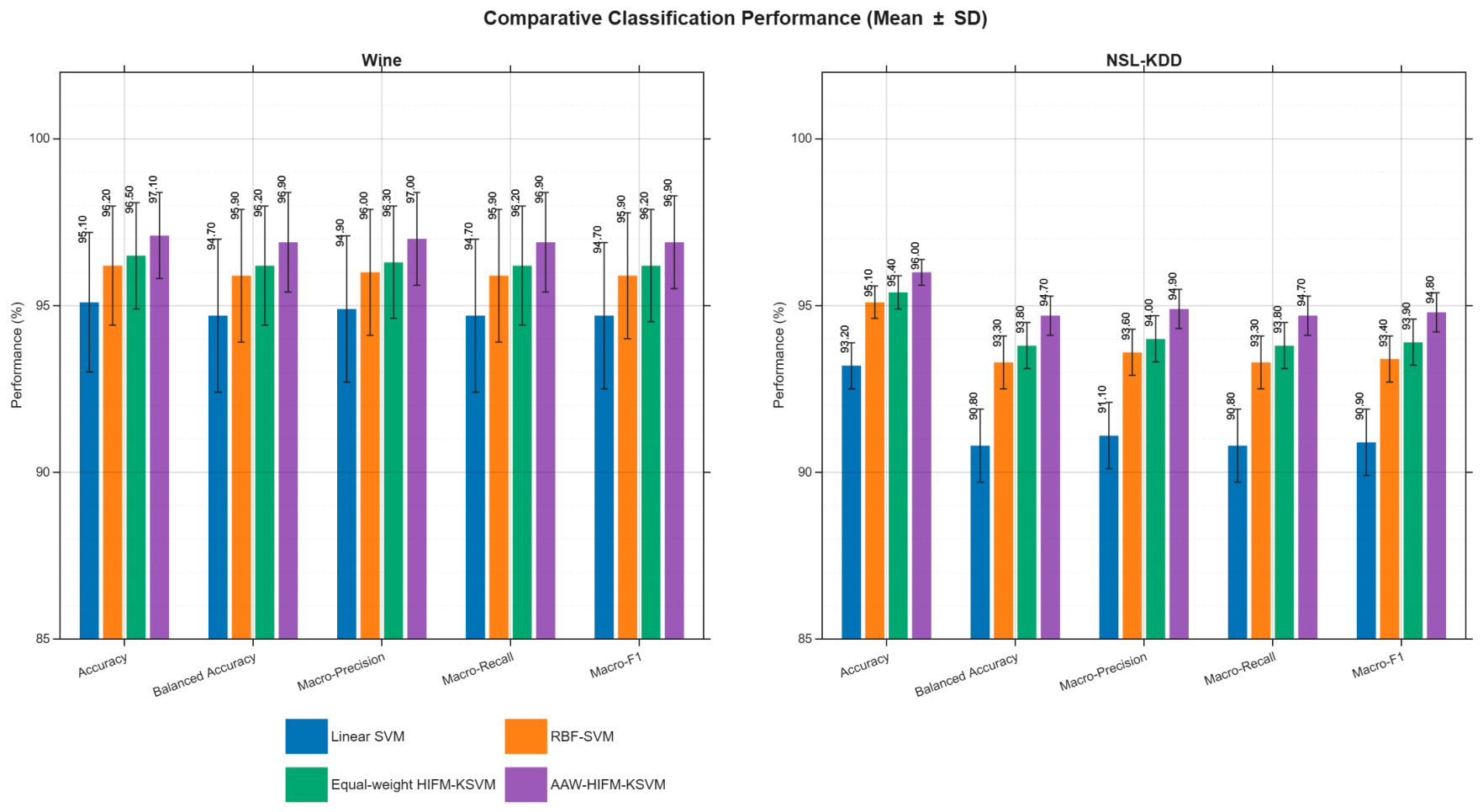
Figure 2.
Contribution of AAW to classification performance compared with the equal-weight HIFM-KSVM approach across five datasets.
Figure 2.
Contribution of AAW to classification performance compared with the equal-weight HIFM-KSVM approach across five datasets.
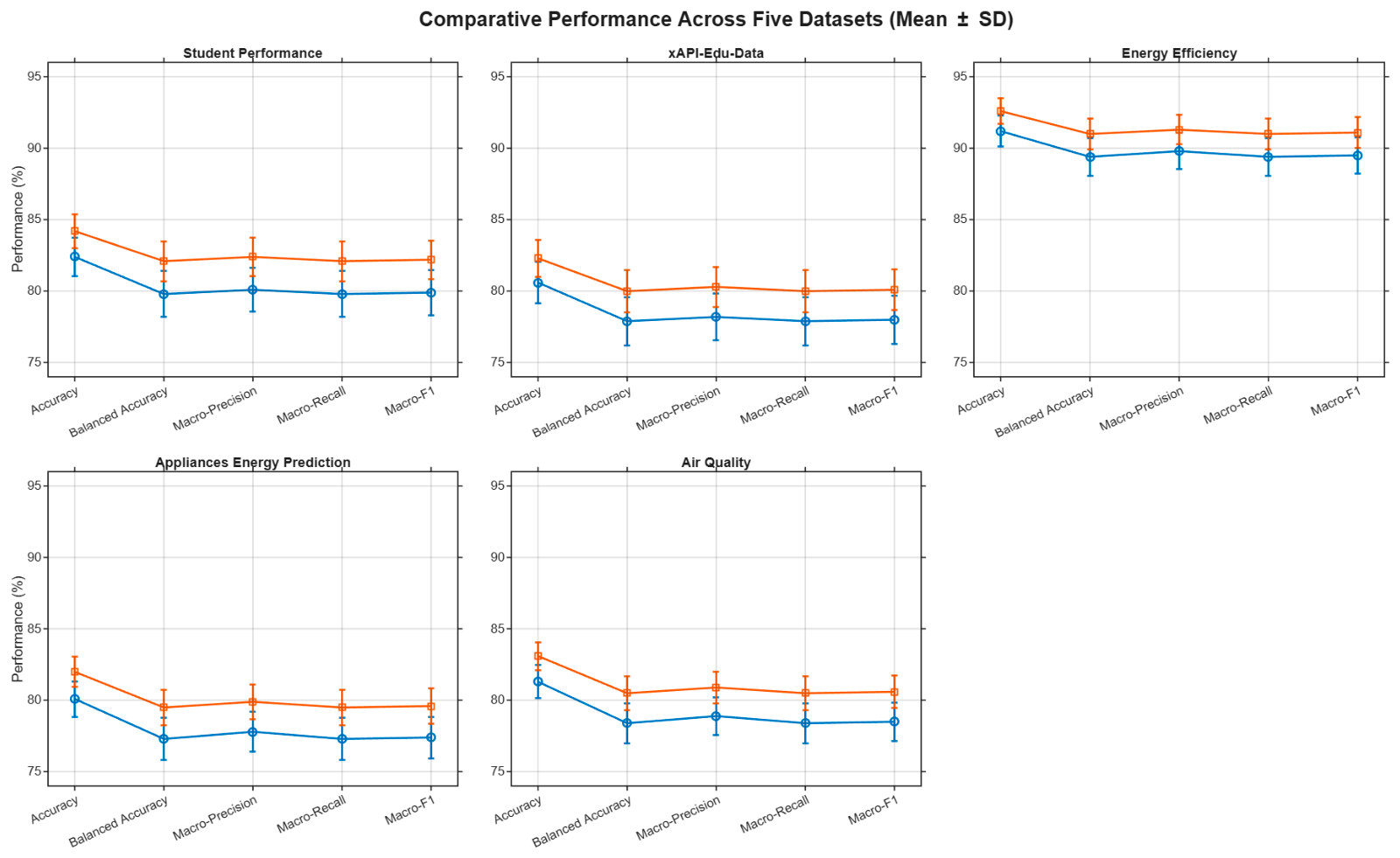
Figure 3.
Comparative analysis of classification performances of competing approaches with the proposed approach on the Student Performance, xAPI-Edu-Data, and Energy Efficiency datasets.
Figure 3.
Comparative analysis of classification performances of competing approaches with the proposed approach on the Student Performance, xAPI-Edu-Data, and Energy Efficiency datasets.
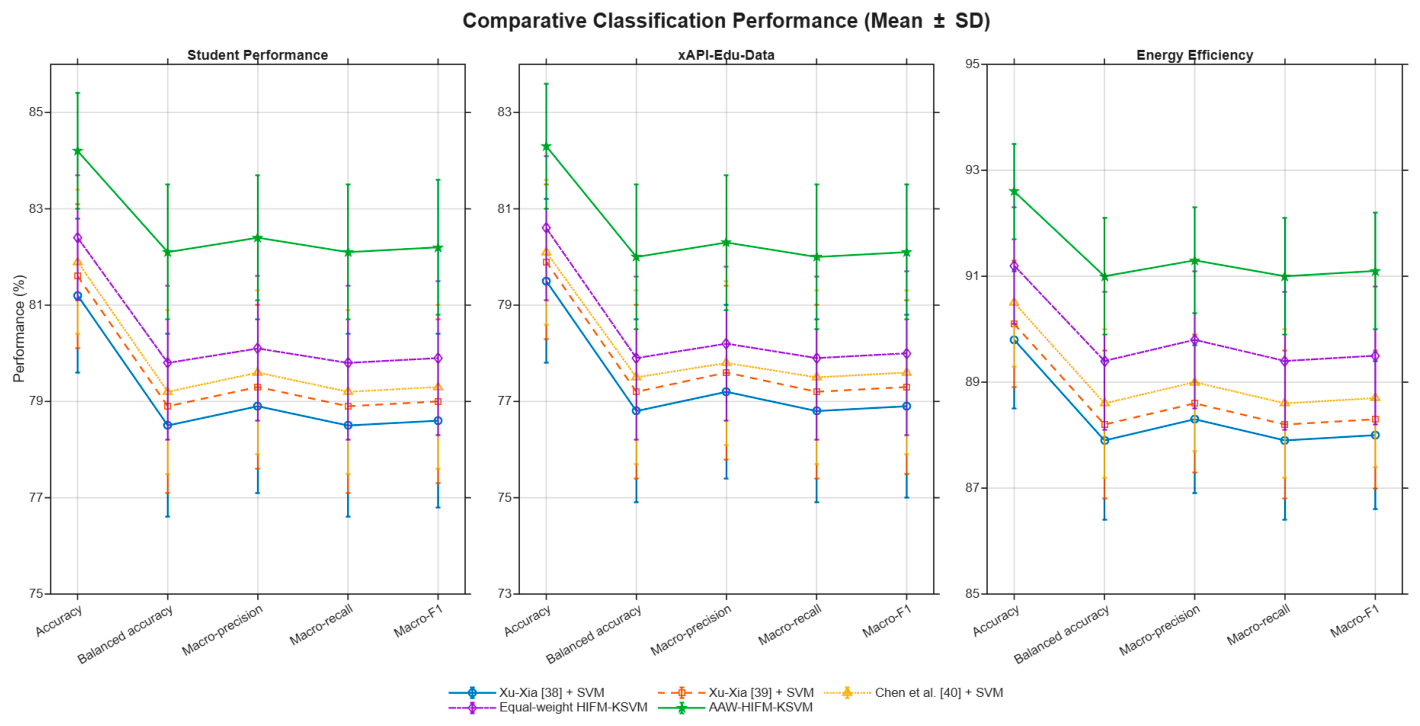
Figure 4.
Comparative analysis of classification performances of competing approaches with the proposed approach on the Appliances Energy Prediction and Air Quality datasets.
Figure 4.
Comparative analysis of classification performances of competing approaches with the proposed approach on the Appliances Energy Prediction and Air Quality datasets.
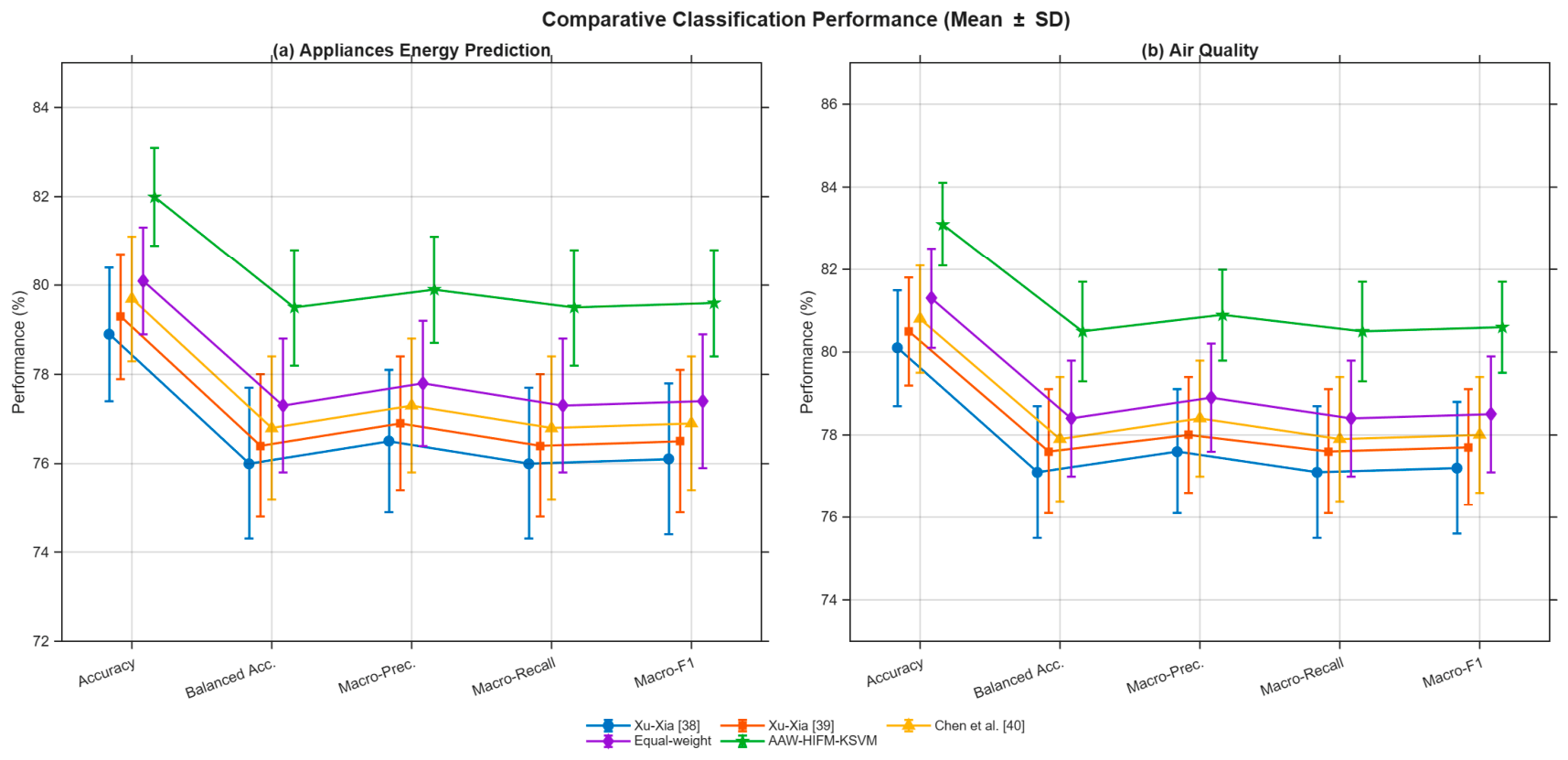
Figure 5.
Comparative analysis of classification performances of competing approaches with the proposed approach on the Wine and NSL-KDD datasets.
Figure 5.
Comparative analysis of classification performances of competing approaches with the proposed approach on the Wine and NSL-KDD datasets.
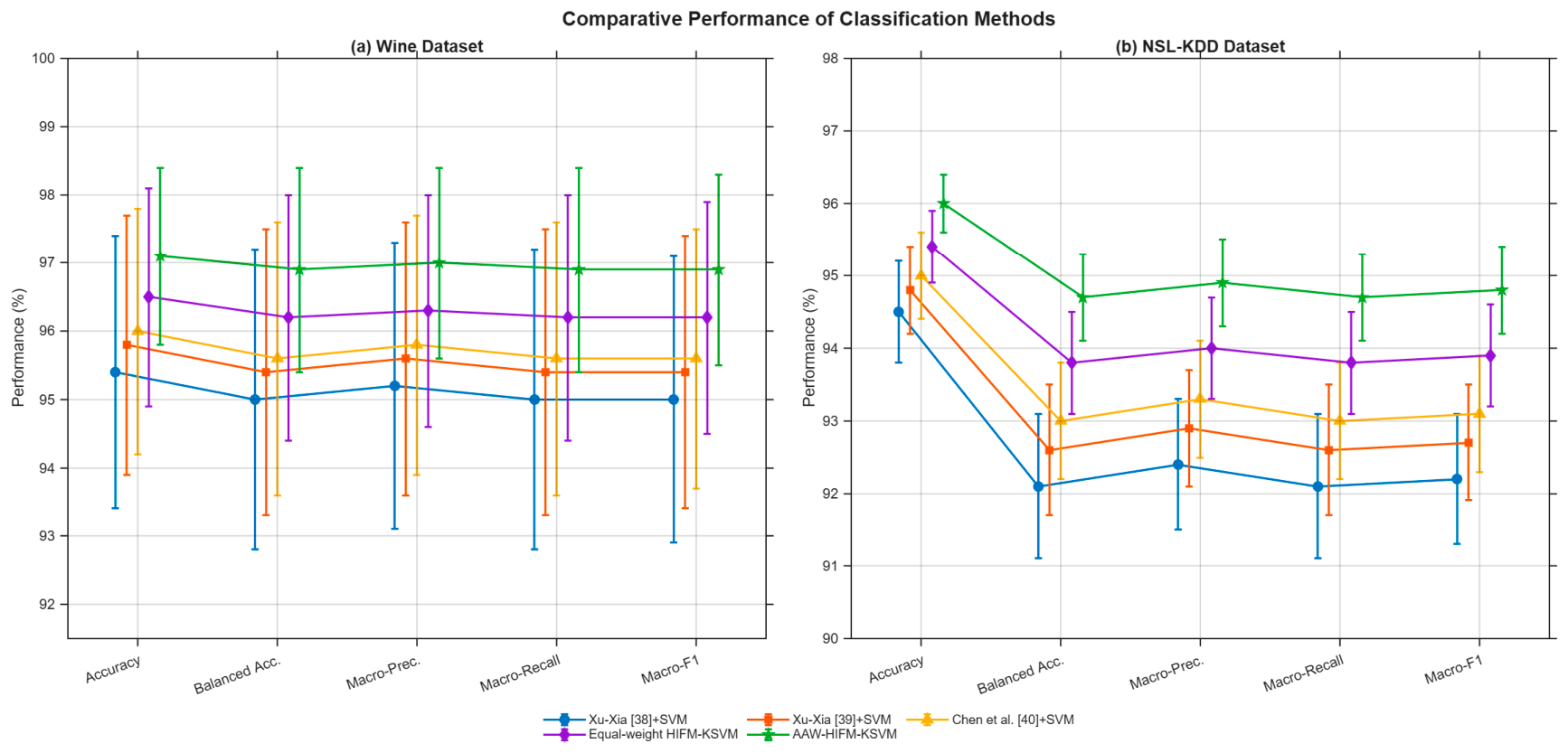
Figure 6.
Mean macro-F1 (%) across evaluation runs on the Wine dataset.
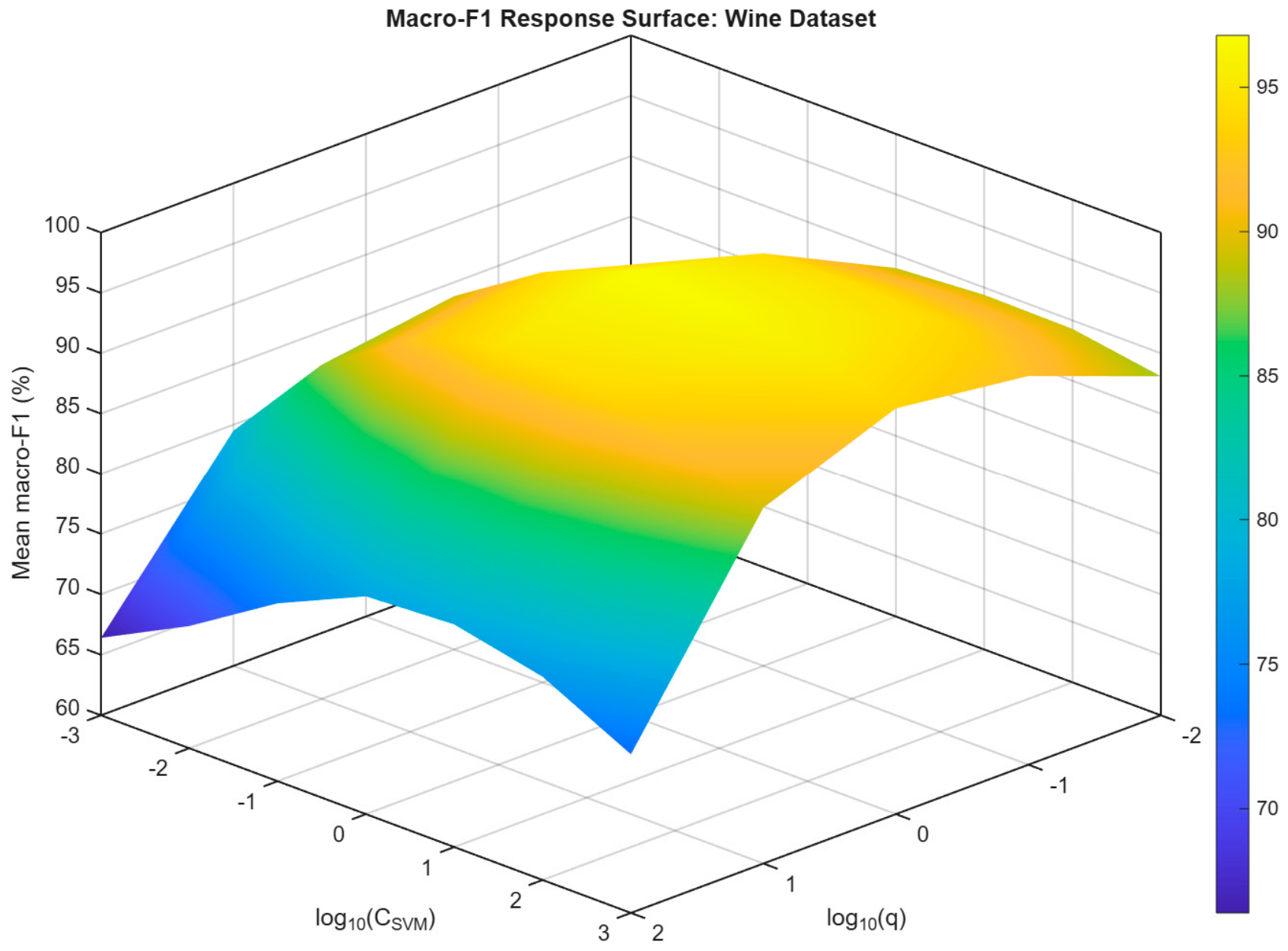
Figure 7.
Mean macro-F1 (%) across evaluation runs on the NSL-KDD dataset.
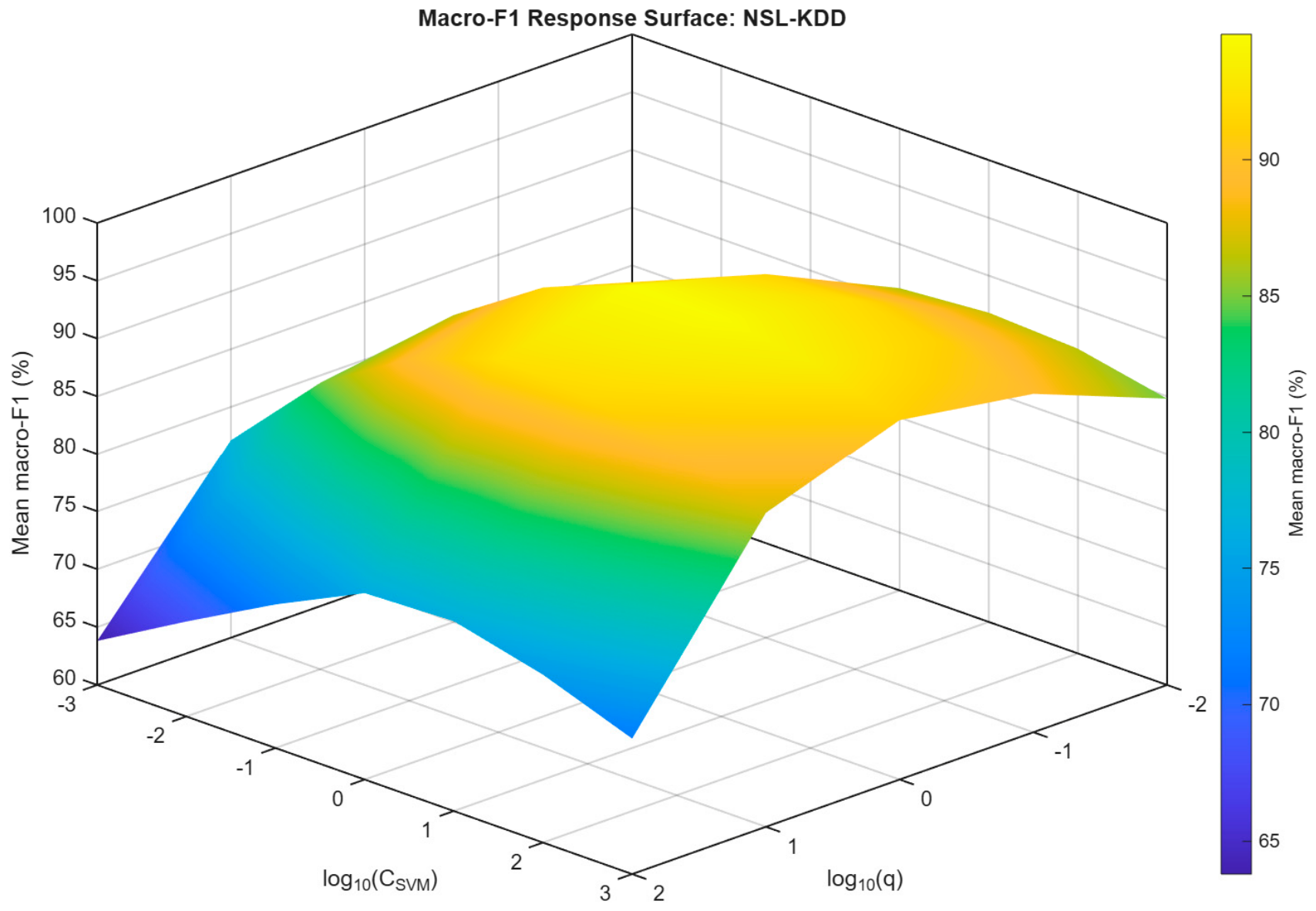
Figure 8.
Analysis of predictive performance at the selected configuration.
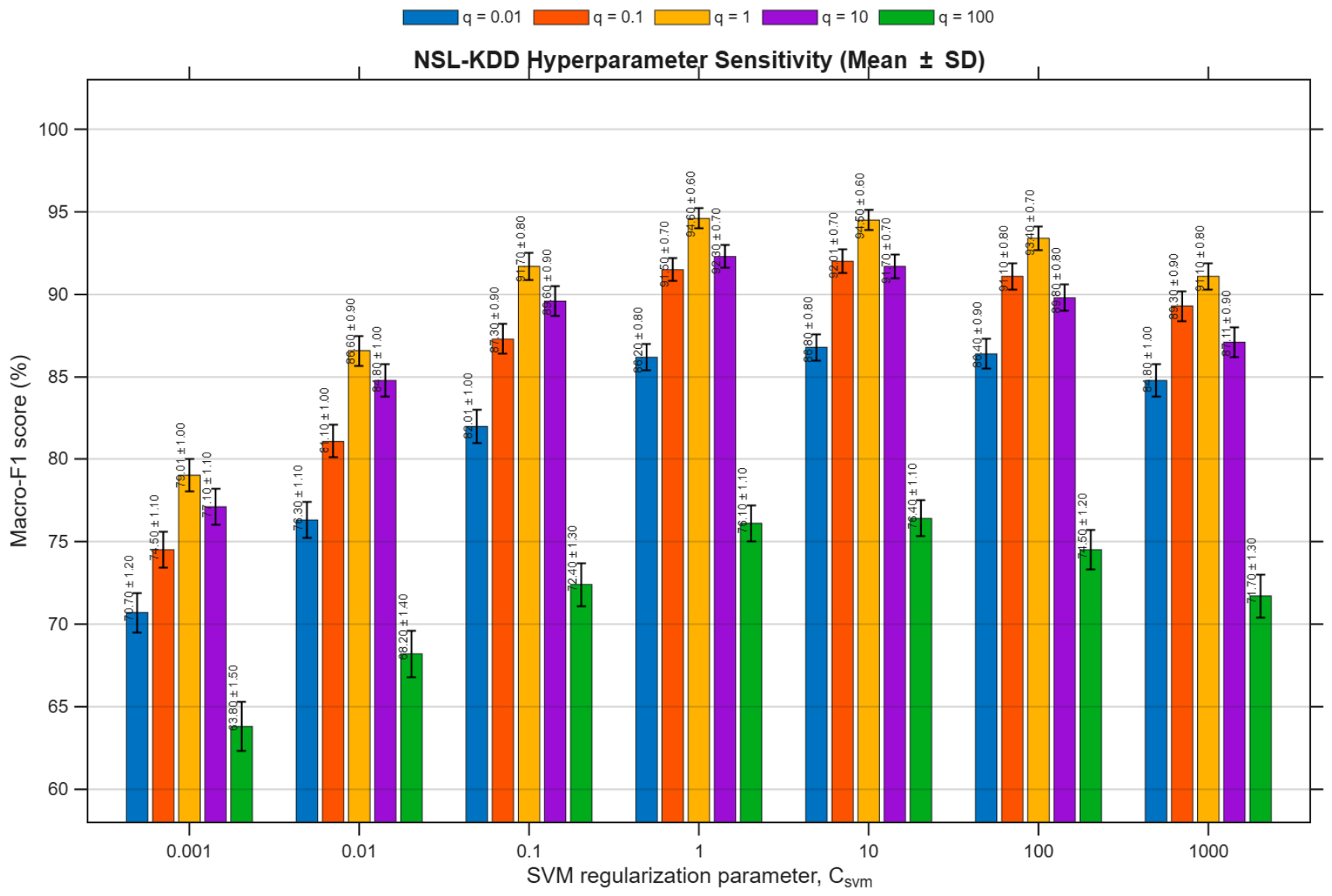
Figure 9.
Analysis of decision-score stability and computational cost.
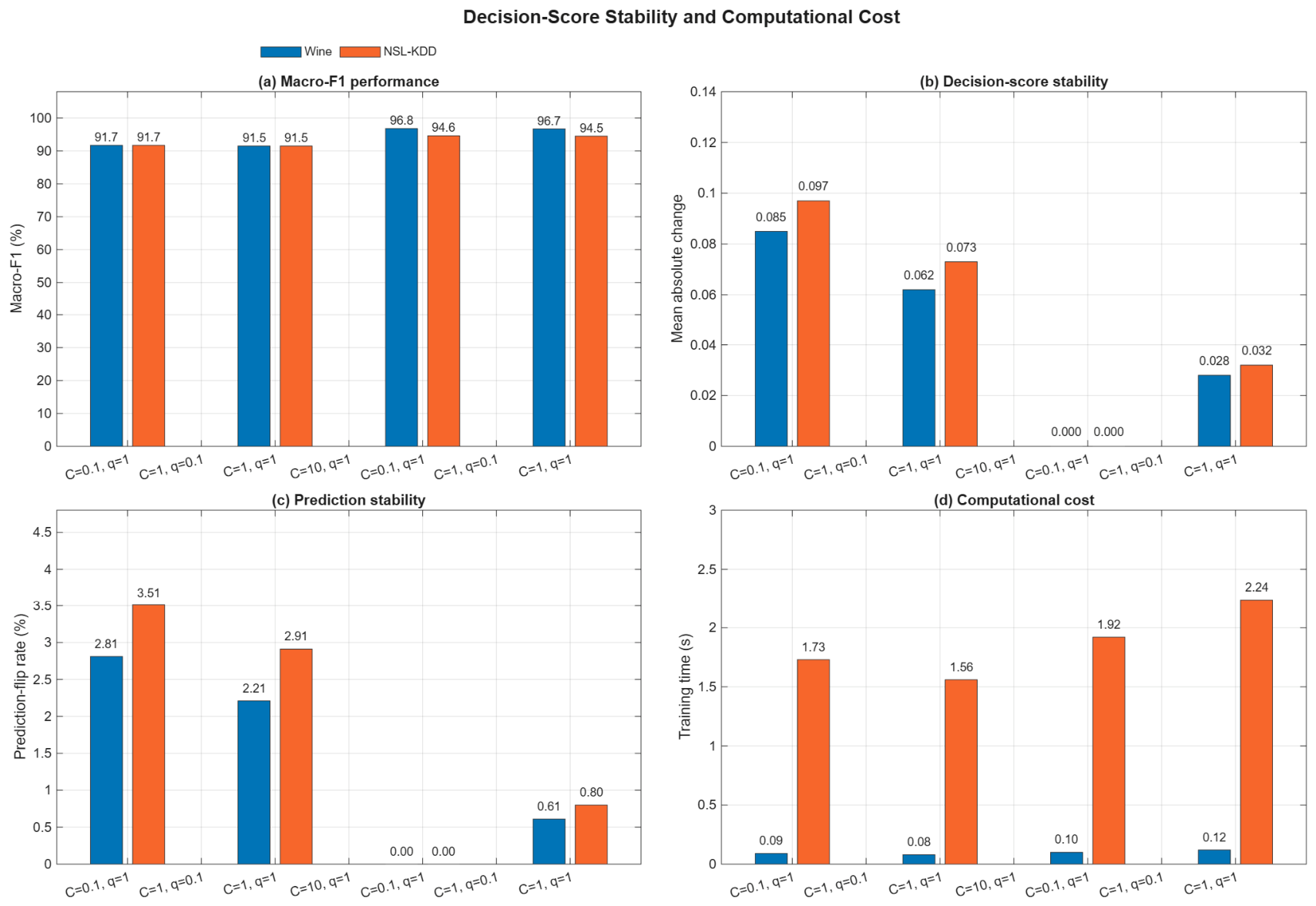
Table 2.
Dataset characteristics and preprocessing specification.
| Dataset | Input Features Retained | Target Definition/Class | Discretization Rule/Thresolds | Class Counts After Preprocessing |
|---|---|---|---|---|
| Wine dataset [41] | 13 chemical features | 3 Classes: Class 1, Class 2, Class 3 | No discretization, used original class label | Class 1: 59; Class 2: 71; Class 3: 48; Total: 178 |
| NSL-KDD dataset [42] | 41 standard connection attributes | 4 Classes: Normal, DoS, Probe, Combined (U2R and R2L) | The original attack labels were mapped into 4 stated groups | Normal: 77,052; DoS: 53,384; Probe: 14,078; U2R/R2L: 4003; Total: |
| Student Performance dataset [43] | 32 non-target columns from 33 | 2 Classes: Pass/Fail based on final grade | Proposed rule: Pass if final grade ≥ 10 Fail if final grade < 10 |
Pass: 547; Fail: 102; Total: 649 |
| xAPI-Edu-Data dataset [44] | 16 non-target columns from 17 | 3 Classes: Low, Middle, High | No discretization, used original class label | Low: 126; Middle: 213; High: 141; Total: 480 |
| Energy Efficiency dataset [45] | 8 original building design predictors | 3 Classes derived from heating load: Low, Middle, High | Rule: divide heating load into 3 bins using 33.33% and 66.67% quantities estimated from training data | Low: 250; Middle: 246; High: 272; Total: 768 |
| Appliances Energy Prediction dataset [46] | Measured environmental and weather predictors | 3 classes derived from Appliances energy consumption: Low, Medium, High | Rule: three training data tertiles of appliances | Low: 6576; Medium: 6580; High: 6579; Total: 19,735 |
| Air Quality dataset [47] | Valid pollutant and sensor measurements as predictors; exclude CO(GT) from the input when it is the target | 3 classes derived from carbon monoxide concentration: Low, Moderate, High | Rule: three training data tertiles of valid CO observations | Low: 3199; Moderate: 3120; High: 3119; Total: 9438 |
Disclaimer/Publisher’s Note: The statements, opinions and data contained in all publications are solely those of the individual author(s) and contributor(s) and not of MDPI and/or the editor(s). MDPI and/or the editor(s) disclaim responsibility for any injury to people or property resulting from any ideas, methods, instructions or products referred to in the content. |
© 2026 by the authors. Licensee MDPI, Basel, Switzerland. This article is an open access article distributed under the terms and conditions of the Creative Commons Attribution (CC BY) license (http://creativecommons.org/licenses/by/4.0/).
Copyright: This open access article is published under a Creative Commons CC BY 4.0 license, which permit the free download, distribution, and reuse, provided that the author and preprint are cited in any reuse.