

Submitted:
19 October 2026
Posted:
20 October 2026
You are already at the latest version
Abstract
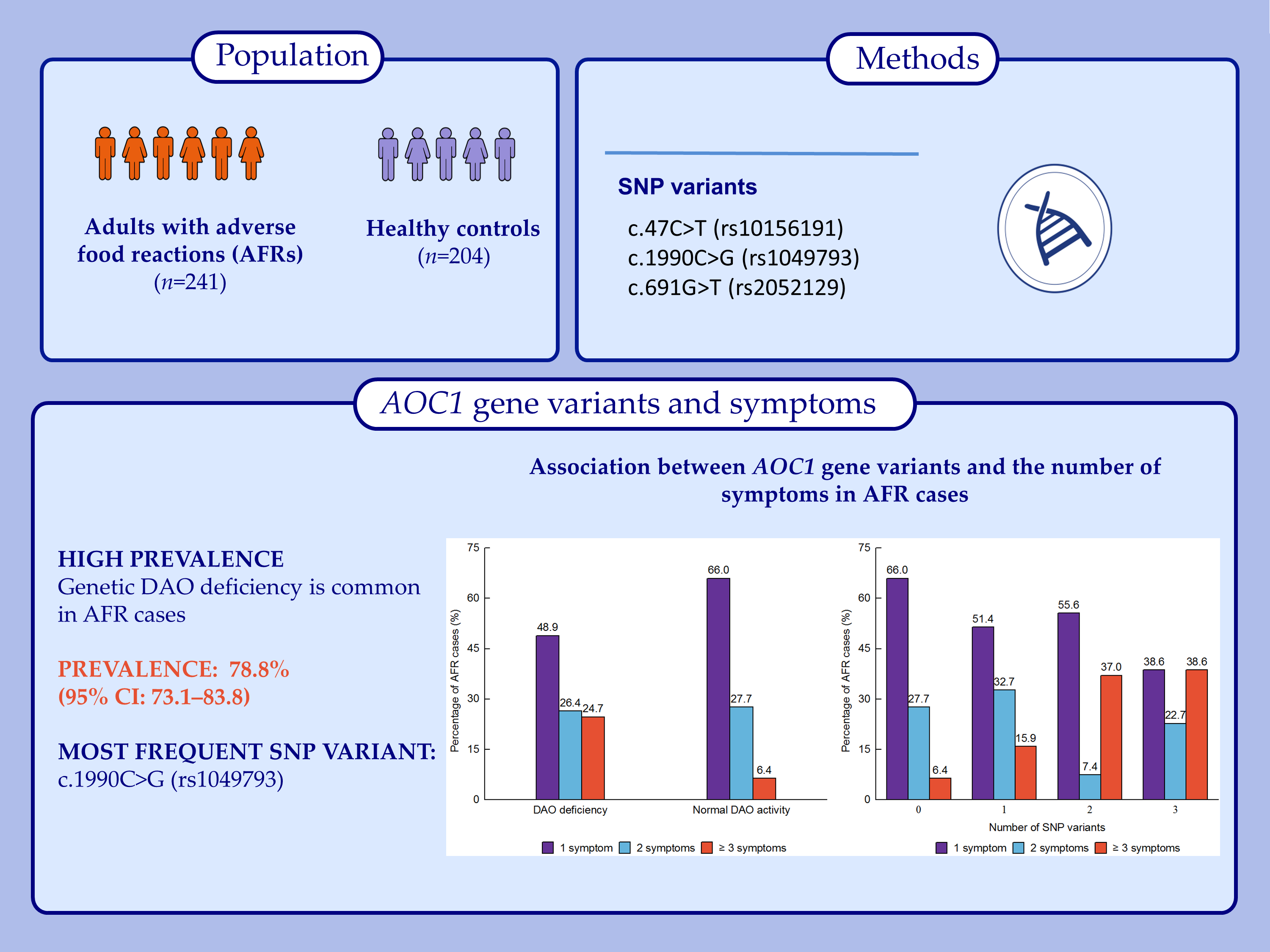
Background: The prevalence of adverse food reactions (AFRs) in adults appears to be on the rise. Among the various mechanisms underlying AFRs, reduced histamine degradation capacity is one of the crucial pathophysiological bases. Diamine oxidase (DAO) is the key enzyme responsible for degrading exogenous histamine from food, and certain single nucleotide polymorphism (SNP) variants in the amine oxidase copper-containing 1 (AOC1) gene encoding this enzyme are closely associated with reduced DAO activity. Methods: In an epidemiological study of food allergy among adults in Ganzhou, eastern China, we collected oral mucosal samples from 241 cases with self-reported AFRs and 204 healthy controls without a history of AFRs or allergic diseases to analyze three SNP variants associated with DAO deficiency (rs10156191, rs1049793, and rs2052129). Results: The prevalence of genetic DAO deficiency among adults with AFRs was 78.8% (95% CI: 73.1–83.8), with rs1049793 being the most frequent SNP variant. There were no significant differences in the distribution of the three SNP variants and allele variants between AFR cases and controls. Among AFR cases, the proportion of individuals with DAO deficiency who self-reported ≥3 AFR symptoms was significantly higher than that in the normal DAO activity group (24.7% vs. 6.4%; P = 0.006). Furthermore, the number of SNP variants was significantly, albeit weakly, positively correlated with the number of self-reported AFR symptoms (rs = 0.218, P = 0.001). The proportion of AFR cases presenting with ≥3 symptoms exhibited a stepwise increase with the accumulation of SNP variants. Conclusions: There is a high prevalence of genetic DAO deficiency among adults with AFRs in Ganzhou. AOC1 genotyping is helpful for identifying genetically susceptible individuals who are prone to experiencing multi-system AFR symptoms.
Keywords:
adults
; adverse food reactions
; AOC1 gene
; genetic DAO deficiency
; diamine oxidase
; food allergy
; histamine intolerance
; single nucleotide polymorphisms
1. Introduction
Adverse food reactions (AFRs) are well-documented, and their prevalence in adults appears to be on the rise, potentially impairing quality of life [1]. The clinical spectrum of AFRs is broad, encompassing phenotypes such as immunoglobulin E (IgE)-mediated food allergy (FA), histamine intolerance (HIT), celiac disease, and non-celiac gluten sensitivity [2]. Among the various mechanisms underlying AFRs, reduced histamine degradation capacity is one of the crucial pathophysiological bases [3]. Diamine oxidase (DAO), located in the upper intestinal mucosa, is the key enzyme responsible for degrading exogenous histamine from food, thereby preventing ingested histamine from entering the systemic circulation and triggering systemic reactions [4,5]. However, when DAO activity is insufficient, the consumption of histamine-rich foods (e.g., fermented foods, processed meats, processed fish) or histamine liberators (e.g., citrus fruits) leads to the accumulation of unmetabolized histamine in the body, thereby triggering HIT [6]. This state of impaired or deficient DAO activity can cause patients to develop multi-system pseudo-allergic symptoms involving the skin, respiratory tract, and gastrointestinal system [7]. Furthermore, DAO deficiency has also been suggested to be associated with celiac disease and non-celiac gluten sensitivity [8]. Importantly, the impact of DAO deficiency extends beyond non-allergic intolerances. Recent evidence indicates that low serum DAO levels are also associated with exacerbated IgE-mediated responses; specifically, allergic patients with reduced DAO activity exhibit impaired resolution of wheals in skin prick tests (SPTs). This suggests that a compromised capacity to degrade histamine can prolong and intensify cutaneous allergic reactions, bridging the gap between classic FA and HIT [9].
Given the pivotal role of DAO activity in maintaining histamine homeostasis, genetic variations in its encoding gene, amine oxidase copper-containing 1 (AOC1), located on human chromosome 7 (7q34-q36), have emerged as key factors explaining individual differences in DAO enzyme activity [10]. To date, researchers have identified 85 single nucleotide polymorphisms (SNPs) within this gene, some of which have been confirmed to be closely associated with reduced DAO activity. The most extensively studied are the coding region variants c.47C>T (rs10156191) and c.1990C>G (rs1049793), and the promoter region variant c.691G>T (rs2052129) [11,12]. Population-based studies have demonstrated that these variants are associated with specific clinical phenotypes. For instance, rs1049793 is the most common variant in the Mexican population and is highly correlated with allergic symptoms such as allergic rhinitis [13]. Among Hispanic patients with allergic asthma and rhinitis, carriers of the rs1049793 variant are more likely to exhibit pronounced allergic symptoms even when their IgE levels are low [14].
The unique geographical and dietary landscape of Ganzhou, eastern China, offers a compelling setting for investigating the clinical impact of DAO deficiency. Known as the "Navel Orange Capital of the World," Ganzhou is abundant in citrus fruits, which act as typical histamine liberators. Concurrently, as a predominant Hakka settlement area, the region retains a strong tradition of consuming fermented foods such as fermented tofu, pickled vegetables, and preserved fruits, which naturally contain high levels of histamine. This dual dietary exposure exposes the local population to a high environmental histamine load. Consequently, this high load may unmask clinical symptoms in individuals carrying SNP variants, who might otherwise remain asymptomatic in low-histamine environments. However, the distribution characteristics of AOC1 gene variants and their association with symptoms within the AFR population in this region remain unclear. Therefore, this study aims to determine the prevalence of genetic DAO deficiency associated with the three most relevant SNP variants (rs10156191, rs1049793, and rs2052129) of the AOC1 gene among AFR adults in Ganzhou, and to further explore the association between SNP variants and self-reported AFR symptoms.
2. Materials and Methods
2.1. Participants
Between 2024 and 2025, we conducted an epidemiological study on FA among adults in Nankang District, Ganzhou, Jiangxi Province. The study protocol was approved by the Ethics Committee of the China National Center for Food Safety Risk Assessment (Approval No.: 2024108). All participants provided written informed consent before enrollment. The entire survey was conducted in Chinese.
The study included 241 cases with self-reported AFRs (102 men, 139 women, mean age 50.3 ± 12.6 years), and 204 healthy controls without a history of AFRs or allergic diseases (83 men, 121 women, mean age 48.5 ± 12.5 years). Controls matched to AFR cases by gender and age were invited to participate in the study. All participants were of Han ethnicity. The baseline characteristics of the included participants are summarized in Table 1. There were no statistically significant differences in baseline characteristics, including gender, age, and body mass index, between AFR cases and controls (all P > 0.05).
2.2. IgE Sensitization Tests
2.2.1. Skin Prick and Prick-Prick Tests
SPTs were performed on the majority of participants using commercial lancet and reagents (GREER Laboratories, Lenoir, NC, USA). The test panel covered 20 suspected food allergens: milk, egg white, fish, shrimp, crab, peanut, almond, cashew, hazelnut, walnut, sesame, soybean, peach, strawberry, pineapple, apple, wheat, buckwheat, beef, and mutton. Additionally, a skin prick-prick test (SPPT) using fresh mango was performed for AFR cases with a self-reported mango allergy.
2.2.2. Allergen-Specific IgE Detection (sIgE)
A 10 mL peripheral venous blood sample was collected from all participants. Allergen-specific IgE levels in the plasma against milk, egg white, fish, shrimp, crab, peanut, almond, cashew, hazelnut, walnut, sesame, soybean, peach, strawberry, apple, wheat, gluten, buckwheat, beef, and mutton were measured using the RIDA®qLine sIgE kit (R-Biopharm Asia-Pacific (Guangdong) Biotechnology Co., Ltd., Zhuhai, Guangdong, China).
2.2.3. Basophil Activation Test (BAT)
The BAT-Histaplus® basophil activation histamine release test kit (R-Biopharm Asia-Pacific (Guangdong) Biotechnology Co., Ltd., Zhuhai, Guangdong, China) was used to evaluate histamine release. Fresh whole blood cells from a subset of participants were incubated with target allergens to activate sensitized basophils, and the released histamine was quantitatively detected. The test panel covered 20 suspected food allergens: milk, egg white, fish, shrimp, crab, clam, peanut, almond, cashew, hazelnut, walnut, sesame, soybean, peach, orange, mango, wheat, buckwheat, rice, and beef.
2.3. AOC1 Variant Genotyping
Two oral mucosa samples were collected from each participant. Three SNP variants of the AOC1 gene were analyzed for each sample, including rs10156191, rs1049793, and rs2052129.
According to standard hygienic protocols, oral mucosal sampling was performed by swabbing the inner cheek with a sterile cotton swab. This protocol required maintaining oral cleanliness for at least 60 minutes prior to sampling. DNA was extracted from the samples using an automated extraction program on the Archimed 384 platform (Kunpeng Gene (Beijing) Scientific Instrument Co., Ltd., Beijing, China) with the Starlighter HS Probe qPCR Mix Kit (Beijing Qihengxing Biotechnology Co., Ltd., Beijing, China). Samples were genotyped using multiplex single-nucleotide primer extension and analyzed via capillary electrophoresis on the ABI 3500 Genetic Analyzer (Thermo Fisher Scientific, Applied Biosystems, Waltham, MA, USA).
2.4. Statistical Analyses
Self-reported AFR were defined as any adverse reaction to food reported by the participants. Diagnosed IgE-mediated FA was defined as self-reported symptoms associated with the ingestion of specific foods, accompanied by evidence of FA demonstrated by positive results in at least two of the following tests: SPT/SPPT, sIgE, and BAT. Genetic DAO deficiency was defined as the presence of one or more alleles associated with low DAO activity among the three analyzed SNP variants of the AOC1 gene.
Descriptive statistics are presented as frequencies and percentages for categorical variables, and as means and standard deviations (SDs) for continuous variables. Pearson’s chi-square test and the independent samples t-test were used to compare baseline categorical and continuous characteristics between cases and controls, respectively. The Clopper-Pearson exact method was used to calculate the prevalence of DAO deficiency and SNP variants, along with their 95% confidence intervals (CIs). Depending on sample size and data distribution, Pearson’s chi-square test or Fisher’s exact test was employed to compare the frequencies of SNP variants, the number of SNP variants, and different genotype combinations across groups. Odds Ratios (ORs) and their corresponding 95% CIs were calculated using 2×2 contingency tables. Spearman’s rank correlation was used to compare the association between the number of SNP variants and the number of AFR symptoms. Statistical analyses were performed using IBM SPSS Statistics for Windows, version 21 (IBM Corp., Armonk, NY, USA). Hardy-Weinberg equilibrium (HWE) for each SNP variant was evaluated using an exact test via R software (version 4.6.1; R Core Team 2026). A P-value < 0.05 was considered statistically significant.
3. Results
The genotypes for the three target SNP variants (rs10156191, rs1049793, and rs2052129) were stratified into three categories based on enzymatic activity: (1) wild-type homozygotes, exhibiting normal DAO activity; (2) heterozygotes, exhibiting reduced DAO activity; and (3) mutated homozygotes, characterized by absent DAO activity [4,7].
3.1. Prevalence of DAO Deficiency
The prevalence of genetic DAO deficiency in AFR cases was 78.8% (95% CI: 73.1–83.8), which was significantly lower than that in the healthy controls (86.8%, 95% CI: 81.3–91.1; P = 0.028). Among 241 AFR cases, 16 were diagnosed with IgE-mediated FA. Differences in the prevalence of DAO deficiency between FA cases (93.8%, 95% CI: 69.8–99.8) and controls (82.1%, 95% CI: 78.1–85.6) were not found (P = 0.326).
3.2. AOC1 Genotype and Allelic Variants
The distribution and number of SNP variants in AFR cases and controls are shown in Table 2. In AFR cases, the most frequent SNP variant was rs1049793 (70.1%), followed by rs2052129 (30.3%) and rs10156191 (29.0%). There was no significant difference in the distribution of the three SNP variants between the cases and controls (all P > 0.05). Specifically, the OR for rs1049793 was 1.348 (95% CI: 0.882–2.058), for rs2052129 was 1.202 (95% CI: 0.807–1.791), and for rs10156191 was 1.142 (95% CI: 0.762–1.713). These results indicate that these variants do not show a significant association with disease risk in the studied population. The frequency of AFR cases carrying zero, one, two, or three SNP variants was 21.2%, 47.7%, 12.0%, and 19.1%, respectively.
The distribution and number of SNP variants in FA cases and controls are shown in Table 3. There was no significant difference in the distribution of the three SNP variants between the cases and controls (all P > 0.05). The frequency of FA cases carrying one SNP was significantly higher than that of the controls (P = 0.036).
Table 4 presents the results of the gender-stratified analysis of SNP variants of the AOC1 gene. In both male and female subgroups, no statistically significant differences were observed in the distribution of the three SNP variants between the AFR cases and healthy controls (all P > 0.05). However, regarding the distribution of the number of SNP variants in the male subgroup, we found that the proportion of individuals carrying zero variants was significantly higher in the male AFR cases compared to the male controls (25.5% vs. 13.3%, P = 0.038).
The characteristics of allelic variants of the AOC1 gene associated with DAO deficiency are presented in Table 5. Except for rs2052129 in the healthy controls, which lacked mutated homozygotes (P = 0.001), the genotype distributions of the remaining SNP variants in both the AFR cases and the healthy controls were in HWE (all P > 0.05). There were no significant differences in the distribution of allelic variants between AFR cases and healthy controls (all P > 0.05). Among all three SNP variants, heterozygous carriers were more common than homozygous carriers.
The frequencies of SNP combinations are shown in Table 6. A total of 17 distinct SNP combinations (genotype combinations) were identified in AFR cases. The most prevalent was genotype combination 3 (wild-type homozygotes for rs10156191 and rs2052129; heterozygote for rs1049793; n = 70), followed by genotype combination 1 (wild-type homozygotes for rs10156191, rs1049793, and rs2052129; n = 51) and genotype combination 5 (wild-type homozygotes for rs10156191 and rs2052129; homozygote for rs1049793; n = 39). In healthy controls, 15 distinct genotype combinations were identified. The most common was genotype combination 3 (wild-type homozygotes for rs10156191 and rs2052129; heterozygote for rs1049793; n = 72), followed by genotype combination 11 (heterozygotes for rs10156191, rs1049793, and rs2052129; n = 31).
3.3. Association of DAO Deficiency with AFR Symptoms
Among the 241 AFR cases, 225 had available symptom information, of which 178 (79.1%) were identified as having DAO deficiency. Except for diarrhoea or vomiting, the frequencies of all other symptoms were higher in the DAO deficiency group than in the normal DAO activity group. Specifically, the frequencies of DAO-deficient individuals experiencing itching, tingling, or swelling in the mouth, lips or throat (38.2%); red, sore or running eyes (14.0%); and breathlessness (7.9%) were all significantly higher than those in the normal DAO activity group (all P < 0.05; Table 7). The proportion of individuals with DAO deficiency who self-reported ≥3 AFR symptoms was 24.7% (44/178), which was significantly higher than the 6.4% (3/47) observed in the normal DAO activity group (P = 0.006; Figure 1a).
3.4. Association of SNP Variants with Symptom Severity
Spearman rank correlation analysis revealed a significant, albeit weak, positive correlation between the number of SNP variants and the number of self-reported AFR symptoms (rs = 0.218, P = 0.001). As shown in Figure 1b, the proportion of AFR cases presenting with ≥3 symptoms exhibited a stepwise increase with the accumulation of SNP variants, reaching 6.4%, 15.9%, 37.0%, and 38.6% for those with zero, one, two, and three SNP variants, respectively.
4. Discussion
With the increasing complexity of modern diets and the rising consumption of fermented and processed foods, clinical visits for histamine-related adverse reactions are on the rise, making the underlying pathogenesis a hot topic in both clinical and basic research. While DAO deficiency is a recognized mechanism for HIT [15], its role in the broader spectrum of AFRs requires clarification. This study provides the first epidemiological data on AOC1 genetic variants in AFR cases in Ganzhou, eastern China, revealing a high prevalence of genetic DAO deficiency while demonstrating a complex association with AFR symptoms.
The prevalence of genetic DAO deficiency in our adult AFR cases was 78.8%. This figure is lower than the reported prevalence in patients with lower urinary tract symptoms (88%) [16] and patients with insomnia-related symptoms (82.6%) [17], aligns closely with findings in Spanish female patients with fibromyalgia (74.5%) [18] and Caucasian populations with symptoms of HIT (79%) [19], but is notably higher than the 44% reported in a healthy Swedish adults [20]. Additionally, this prevalence is significantly higher than the 66% observed in predominantly Spanish healthy newborns [21].
A striking finding in the present study is the exceptionally high prevalence of DAO deficiency in healthy controls (86.8%), which was statistically higher than in the AFR cases. This contrasts with the traditional view that DAO deficiency is a direct risk factor for all food intolerances. The Han population in Ganzhou may carry a high background frequency of these variants without manifesting symptoms, suggesting that genetic variants alone are necessary but not sufficient for disease. The AFRs include various non-immunological reactions. The "dilution" of prevalence of DAO deficiency in AFR cases might indicate that other mechanisms (e.g., psychological factors, other enzyme deficiencies) play larger roles in mild AFRs, whereas DAO deficiency is specifically critical in severe phenotypes. Our subgroup analysis showed that patients with confirmed IgE-mediated FA had a 93.8% prevalence of DAO deficiency. This suggests that while DAO deficiency might not predict mild AFR, it may be strongly linked to the severity of immune responses or gut barrier dysfunction facilitating allergen sensitization.
We observed a significant deviation from HWE in the healthy controls at rs2052129, driven by the complete absence of the mutated homozygous (T/T) genotype. Given that DAO activity is significantly lower in patients homozygous for this SNP variant [19], this absence likely reflects negative selection; individuals with the T/T genotype may suffer from severe HIT symptoms, precluding their classification as "healthy" controls. Thus, this deviation reinforces the functional pathogenicity of rs2052129 rather than suggesting a technical error.
Interestingly, the distribution of SNP variants in our study population (rs1049793 > rs2052129 > rs10156191) is similar to that of a Mexican population but differs from that of European populations [18,22]. This suggests a distinct genetic background in the Chinese population, where rs1049793 may be the predominant driver of reduced DAO activity, contrasting with rs10156191 often mentioned in European literature [18,23].
It is noteworthy that DAO deficiency is strongly associated with specific symptoms typically considered to be IgE-mediated, including itching, tingling, or swelling in the mouth, lips or throat; red, sore or running eyes; and breathlessness. The correlation between low DAO activity and the impaired resolution of wheals in SPTs provides a mechanistic explanation for these findings: reduced enzymatic activity allows histamine to persist in the circulation and tissues longer, thereby amplifying the clinical manifestation of the allergic response [9]. Thus, AOC1 genotyping could serve as a valuable tool not just for diagnosing HIT, but for identifying AFR cases at risk of severe, multisystem involvement.
Despite the high background prevalence of DAO deficiency, this study confirms a significant positive correlation between the number of SNP variants and the severity of clinical symptoms in AFR patients, demonstrating a clear gene-dosage effect. As the number of SNP variants increased from one to two and three, the proportion of individuals exhibiting ≥3 clinical symptoms rose significantly from 15.9% to 37.0% and 38.6%, respectively. This suggests that the accumulation of multiple SNP variants may synergistically reduce DAO enzymatic activity, impair histamine metabolism, and consequently lead to the manifestation of multi-systemic symptoms. These findings align with previous studies, indicating that DAO genotypic load is a key determinant of phenotypic severity [24,25]. Additionally, the marginal difference in symptom prevalence between individuals with two versus three SNP variants may imply a "threshold effect" in enzymatic activity reduction, or suggest that under high genetic load, environmental factors and other metabolic pathways play an increasingly prominent regulatory role. When multiple SNP variants cumulatively reduce DAO activity below this threshold, even normal dietary histamine loads can trigger systemic reactions. As demonstrated in a comprehensive review of Brazilian foods, plant-based items such as eggplant, soy sauce, and sprouts, while not individually sufficient to cause intoxication, can significantly contribute to the total histamine burden of a meal, thereby triggering symptoms in genetically susceptible individuals [26].
It is interesting to see that only 6.6% of the participants who report AFR have analytical confirmation of FA, while 79.1% of the participants who report FA-like symptoms show genetic predisposition to DAO deficiency. This fact may justify trying DAO supplementation in such a population and evaluating whether it improves their symptoms. Oral DAO enzyme supplementation, which enhances intestinal histamine degradation, or adherence to a low-histamine diet, may improve the quality of life and clinical manifestations associated with HIT [25,27]. In this context, genetic screening to identify carriers of SNP variants of the AOC1 gene represents a promising strategy for early diagnosis and phenotypic characterization of AFR cases. This approach enables personalized interventions, allowing dietary recommendations and DAO supplementation to be tailored to each patient's genetic background, thereby improving therapeutic efficacy, enhancing quality of life, and alleviating the socioeconomic burden of AFRs.
5. Conclusions
The prevalence of genetic DAO deficiency is notably high (78.8%) among adults with AFRs in Ganzhou. Future studies across diverse regions are warranted to comprehensively map China's genetic landscape regarding DAO deficiency. This study found that individuals with DAO deficiency had a higher proportion presenting with ≥3 AFR symptoms, and the number of SNP variants was significantly positively correlated with the self-reported number of AFR symptoms. These findings indicate that AOC1 genotyping can help identify genetically susceptible individuals prone to multi-system AFR symptoms. Future research should further investigate the cumulative effects of risk alleles and evaluate the potential of AOC1 gene variants as biomarkers for genetic susceptibility to DAO deficiency in populations with AFRs.
Author Contributions
Conceptualization, Y.C.; methodology, Y.C. and C.d.L.; investigation, J.X., C.L., Q.L. and L.Y.; data curation, Y.C.; writing—review and editing, Y.L., C.d.L. and Y.C. All authors have read and agreed to the published version of the manuscript.
Funding
This research was funded by the National Key Research and Development Program of China, grant number 2024YFF1105903.
Institutional Review Board Statement
The study was conducted in accordance with the Declaration of Helsinki, and approved by the Ethics Committee of the China National Center for Food Safety Risk Assessment (protocol code 2024108, May 21, 2024).
Informed Consent Statement
Informed consent was obtained from all subjects involved in the study.
Data Availability Statement
The raw data supporting the conclusions of this article will be made available by the authors without undue reservation.
Acknowledgments
The authors acknowledge all of the collaborators involved in the population survey and laboratory analysis for providing the data essential to this analysis. The authors have reviewed and edited the output and take full responsibility for the content of this publication.
Conflicts of Interest
The authors declare no conflicts of interest. The funders had no role in the design of the study; in the collection, analyses, or interpretation of data; in the writing of the manuscript; or in the decision to publish the results.
Abbreviations
The following abbreviations are used in this manuscript:
| AFR | Adverse food reaction |
| AOC1 | Amine oxidase copper-containing 1 |
| BAT | Basophil activation test |
| CI | Confidence interval |
| DAO | Diamine oxidase |
| FA | Food allergy |
| HIT | Histamine intolerance |
| HWE | Hardy-Weinberg equilibrium |
| IgE | Immunoglobulin E |
| SD | Standard deviation |
| sIgE | Allergen-specific IgE |
| SNP | Single nucleotide polymorphism |
| SPPT | Skin prick-prick test |
| SPT | Skin prick test |
References
- Rentzos, G.; Johanson, L.; Goksör, E.; Telemo, E.; Lundbäck, B.; Ekerljung, L. Prevalence of food hypersensitivity in relation to IgE sensitisation to common food allergens among the general adult population in West Sweden. Clin. Transl. Allergy 2019, 9, 22. [Google Scholar] [CrossRef]
- Hage, G.; Sacre, Y.; Haddad, J.; Hajj, M.; Sayegh, L.N.; Fakhoury-Sayegh, N. Food hypersensitivity: Distinguishing allergy from intolerance, main characteristics, and symptoms-A narrative review. Nutrients 2025, 17, 1359. [Google Scholar] [CrossRef]
- Hrubisko, M.; Danis, R.; Huorka, M.; Wawruch, M. Histamine intolerance-The more we know the less we know. A review. Nutrients 2021, 13, 2228. [Google Scholar] [CrossRef]
- Aguilar-Rodea, P.; Mejía-Ramírez, V.; Hernández-Munguía, R.; Ramírez-Vargas, S.; Tovar-Vivar, D.; Leyva-Hernández, J.; Nacar-Gutiérrez, J.C.; Morales-Martínez, M.; Palafox-Zaldivar, A. The prevalence of diamine oxidase polymorphisms and their association with histamine intolerance symptomatology in the Mexican population. Biomedicines 2025, 13, 2280. [Google Scholar] [CrossRef]
- Tan, Z.; Ou, Y.; Cai, W.; Zheng, Y.; Li, H.; Mao, Y.; Zhou, S.; Tu, J. Advances in the clinical application of histamine and diamine oxidase (DAO) activity: A review. Catalysts 2023, 13, 48. [Google Scholar] [CrossRef]
- Maintz, L.; Benfadal, S.; Allam, J.P.; Hagemann, T.; Fimmers, R.; Novak, N. Evidence for a reduced histamine degradation capacity in a subgroup of patients with atopic eczema. J. Allergy Clin. Immunol. 2006, 117, 1106–1112. [Google Scholar] [CrossRef]
- Blasco-Fontecilla, H.; Bella-Fernández, M.; Wang, P.; Martin-Moratinos, M.; Li, C. Prevalence and clinical picture of diamine oxidase gene variants in children and adolescents with attention deficit hyperactivity disorder: A pilot study. J. Clin. Med. 2024, 13, 1659. [Google Scholar] [CrossRef]
- Griauzdaitė, K.; Maselis, K.; Žvirblienė, A.; Vaitkus, A.; Jančiauskas, D.; Banaitytė-Baleišienė, I.; Kupčinskas, L.; Rastenytė, D. Associations between migraine, celiac disease, non-celiac gluten sensitivity and activity of diamine oxidase. Med. Hypotheses 2020, 142, 109738. [Google Scholar] [CrossRef]
- Wagner, A.; Buczyłko, K.; Zielińska-Bliźniewska, H.; Wagner, W. Impaired resolution of wheals in the skin prick test and low diamine oxidase blood level in allergic patients. Postep. Dermatol. Alergol. 2019, 36, 538–543. [Google Scholar] [CrossRef]
- Chassande, O.; Renard, S.; Barbry, P.; Lazdunski, M. The human gene for diamine oxidase, an amiloride binding protein. Molecular cloning, sequencing, and characterization of the promoter. J. Biol. Chem. 1994, 269, 14484–14489. [Google Scholar] [CrossRef]
- Ayuso, P.; García-Martín, E.; Martínez, C.; Agúndez, J.A.G. Genetic variability of human diamine oxidase: occurrence of three nonsynonymous polymorphisms and study of their effect on serum enzyme activity. Pharmacogenet. Genom. 2007, 17, 687–693. [Google Scholar] [CrossRef]
- García-Martín, E.; Ayuso, P.; Martínez, C.; Agúndez, J.A.G. Improved analytical sensitivity reveals the occurrence of gender-related variability in diamine oxidase enzyme activity in healthy individuals. Clin. Biochem. 2007, 40, 1339–1341. [Google Scholar] [CrossRef]
- Meza-Velázquez, R.; López-Márquez, F.; Espinosa-Padilla, S.; Rivera-Guillen, M.; Gutíerrez-Díaz, N.; Pérez-Armendáriz, L.; Rosales-González, M. Association between two polymorphisms of histamine-metabolising enzymes and the severity of allergic rhinitis in a group of Mexican children. Allergol. Immunopathol. 2016, 44, 433–438. [Google Scholar] [CrossRef]
- García-Martín, E.; García-Menaya, J.; Sánchez, B.; Martínez, C.; Rosendo, R.; Agúndez, J.A. Polymorphisms of histamine-metabolizing enzymes and clinical manifestations of asthma and allergic rhinitis. Clin. Exp. Allergy 2007, 37, 1175–1182. [Google Scholar] [CrossRef]
- Maintz, L.; Novak, N. Histamine and histamine intolerance. Am. J. Clin. Nutr. 2007, 85, 1185–1196. [Google Scholar] [CrossRef]
- Ponce Díaz-Reixa, J.; Aller Rodríguez, M.; Martínez Breijo, S.; Suanzes Hernández, J.; Ruiz Casares, E.; Perucho Alcalde, T.; Bohorquez Cruz, M.; Mosquera Seoane, T.; Sánchez Merino, J.M.; Freire Calvo, J.; et al. Lower urinary tract symptoms (LUTS) as a new clinical presentation of histamine intolerance: A prevalence study of genetic diamine oxidase deficiency. J. Clin. Med. 2023, 12, 6870. [Google Scholar] [CrossRef]
- López García, R.; Ferrer-Garcia, J.; Sansalvador, A.; Quera-Salva, M.A. Prevalence of diamine oxidase enzyme (DAO) deficiency in subjects with insomnia-related symptoms. J. Clin. Med. 2024, 13, 4583. [Google Scholar] [CrossRef]
- Okutan, G.; Ruiz Casares, E.; Perucho Alcalde, T.; Sánchez Niño, G.M.; Penadés, B.F.; Terrén Lora, A.; Torrente Estríngana, L.; López Oliva, S.; San Mauro Martín, I. Prevalence of genetic diamine oxidase (DAO) deficiency in female patients with fibromyalgia in Spain. Biomedicines 2023, 11, 660. [Google Scholar] [CrossRef]
- Duelo, A.; Comas-Basté, O.; Sánchez-Pérez, S.; Veciana-Nogués, M.T.; Ruiz-Casares, E.; Vidal-Carou, M.C.; Latorre-Moratalla, M.L. Pilot study on the prevalence of diamine oxidase gene variants in patients with symptoms of histamine intolerance. Nutrients 2024, 16, 1142. [Google Scholar] [CrossRef]
- van Odijk, J.; Weisheit, A.; Arvidsson, M.; Miron, N.; Nwaru, B.; Ekerljung, L. The use of DAO as a marker for histamine intolerance: Measurements and determinants in a large random population-based survey. Nutrients 2023, 15, 2887. [Google Scholar] [CrossRef]
- Fortes Marin, E.; Carrera Marcolin, L.; Martí Melero, L.; Tintoré Gazulla, M.; Beltran Porres, M. The prevalence of single nucleotide polymorphisms of the AOC1 gene associated with diamine oxidase (DAO) enzyme deficiency in healthy newborns: A prospective population-based cohort study. Genes 2025, 16, 141. [Google Scholar] [CrossRef]
- Meza-Velázquez, R.; López-Márquez, F.; Espinosa-Padilla, S.; Rivera-Guillen, M.; Ávila-Hernández, J.; Rosales-González, M. Association of diamine oxidase and histamine N-methyltransferase polymorphisms with presence of migraine in a group of Mexican mothers of children with allergies. Neurología 2017, 32, 500–507. [Google Scholar] [CrossRef]
- García-Martín, E.; Martínez, C.; Serrador, M.; Alonso-Navarro, H.; Ayuso, P.; Navacerrada, F.; Agúndez, J.A.G.; Jiménez-Jiménez, F.J. Diamine oxidase rs10156191 and rs2052129 variants are associated with the risk for migraine. Headache 2015, 55, 276–286. [Google Scholar] [CrossRef]
- Maintz, L.; Yu, C.F.; Rodríguez, E.; Baurecht, H.; Bieber, T.; Illig, T.; Weidinger, S.; Novak, N. Association of single nucleotide polymorphisms in the diamine oxidase gene with diamine oxidase serum activities. Allergy 2011, 66, 893–902. [Google Scholar] [CrossRef]
- Schnedl, W.J.; Enko, D. Histamine intolerance originates in the gut. Nutrients 2021, 13, 1262. [Google Scholar] [CrossRef]
- Gloria, M.B.A.; Diniz, F.B.; Dala-Paula, B.M.; Philadelpho, B.; Goncalves, J.E.; Ferreira, E.S.; Sarkadi, L.S. Histamine in Brazilian foods: A comprehensive review of occurrence and risk assessment for intoxication and intolerance. Food Sci. Nutr. 2025, 13, e71151. [Google Scholar] [CrossRef]
- Comas-Basté, O.; Sánchez-Pérez, S.; Veciana-Nogués, M.T.; Latorre-Moratalla, M.; Vidal-Carou, M.D.C. Histamine intolerance: The current state of the art. Biomolecules 2020, 10, 1181. [Google Scholar] [CrossRef]
Figure 1.
Association between AOC1 gene variants and the number of symptoms in AFR cases. (a) DAO activity status. (b) Number of SNP variants. AFR: adverse food reaction; AOC1: amine oxidase copper-containing 1; DAO: diamine oxidase; SNP: single nucleotide polymorphism.
Figure 1.
Association between AOC1 gene variants and the number of symptoms in AFR cases. (a) DAO activity status. (b) Number of SNP variants. AFR: adverse food reaction; AOC1: amine oxidase copper-containing 1; DAO: diamine oxidase; SNP: single nucleotide polymorphism.
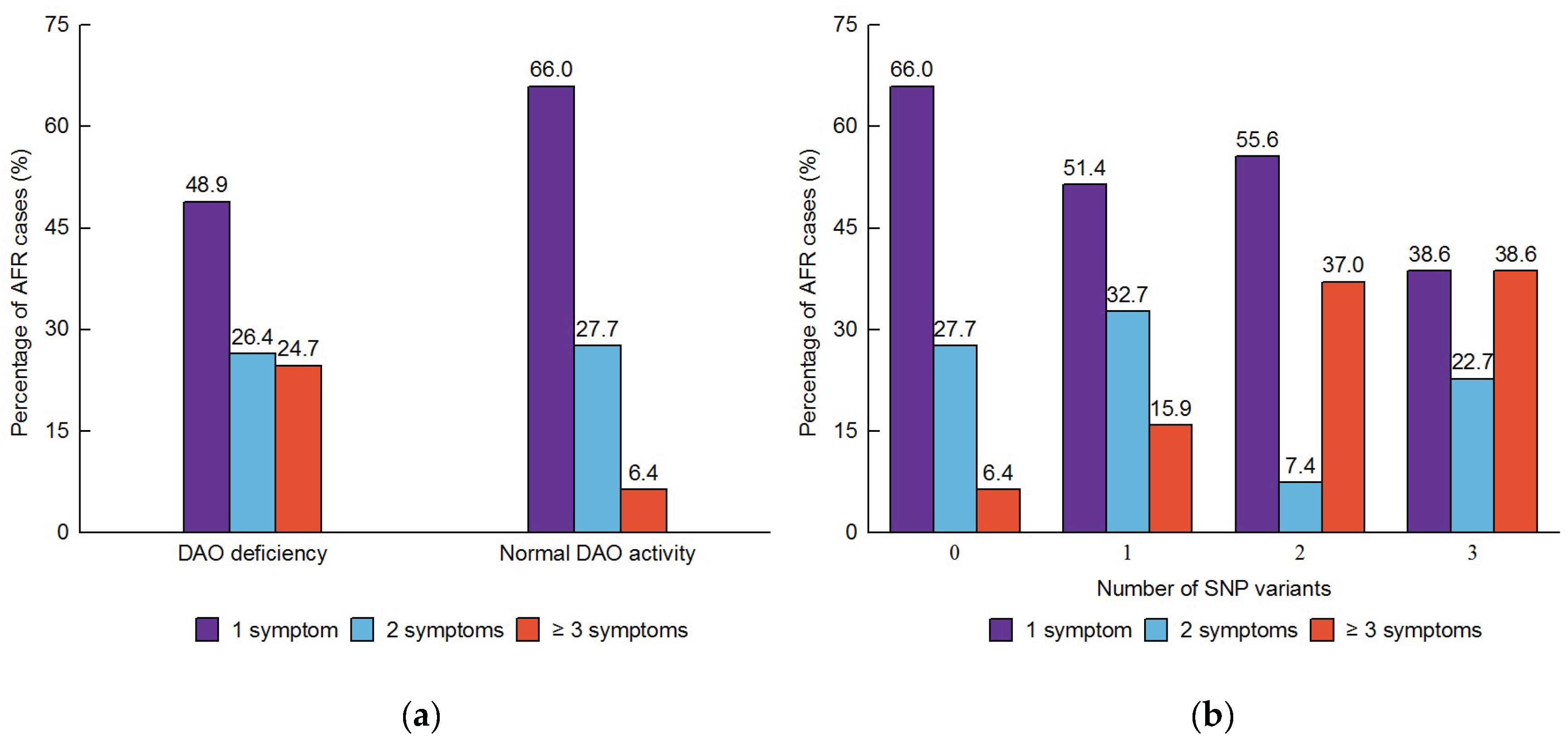

Table 1.
Baseline characteristics of AFR cases and healthy controls.
| Characteristics | AFR cases (n = 241) | Controls (n = 204) | P-Value | |||
|---|---|---|---|---|---|---|
| Mean ± SD | Range | Mean ± SD | Range | |||
| Age (years) | 50.3 ± 12.6 | 20.1–70.7 | 48.5 ± 12.5 | 20.2–70.0 | 0.138 | |
| Weight (kg) | 62.1 ± 11.2 | 37.9–92.0 | 62.4 ± 10.9 | 39.3–94.6 | 0.844 | |
| Height (m) | 1.58 ± 0.08 | 1.38–1.82 | 1.59 ± 0.08 | 1.40–1.85 | 0.121 | |
| Body mass index | 24.8 ± 3.7 | 16.6–34.5 | 24.5 ± 3.6 | 16.5–34.8 | 0.448 | |
AFR: adverse food reaction; SD: standard deviation.
Table 2.
Prevalence of SNP variants of the AOC1 gene in AFR cases and healthy controls.
| SNP variants of the AOC1 gene | AFR cases (n = 241) % (95% CI) |
Controls (n = 204) % (95% CI) |
P-Value |
|---|---|---|---|
| SNP variants | |||
| c.47C>T (rs10156191) | 29.0 (23.4–35.2) | 31.9 (25.5–38.7) | 0.520 |
| c.1990C>G (rs1049793) | 70.1 (63.9–75.8) | 76.0 (69.5–81.7) | 0.167 |
| c.691G>T (rs2052129) | 30.3 (24.6–36.5) | 34.3 (27.8–41.3) | 0.365 |
| Number of SNP variants | |||
| 0 | 21.2 (16.2–26.9) | 13.2 (8.9–18.7) | 0.028 |
| 1 | 47.7 (41.3–54.2) | 51.0 (43.9–58.0) | 0.493 |
| 2 | 12.0 (8.2–16.8) | 16.2 (11.4–22.0) | 0.209 |
| 3 | 19.1 (14.3–24.6) | 19.6 (14.4–25.7) | 0.890 |
AFR: adverse food reaction; AOC1: amine oxidase copper-containing 1; CI: confidence interval; SNP: single nucleotide polymorphism. Bold is for significant P-values.
Table 3.
Prevalence of SNP variants of the AOC1 gene in FA cases and controls.
| SNP variants of the AOC1 gene | FA cases (n = 16) % (95% CI) |
Controls (n = 429) % (95% CI) |
P-Value |
|---|---|---|---|
| SNP variants | |||
| c.47C>T (rs10156191) | 25.0 (7.3–52.4) | 30.5 (26.2–35.1) | 0.786 |
| c.1990C>G (rs1049793) | 87.5 (61.7–98.4) | 72.3 (67.8–76.4) | 0.255 |
| c.691G>T (rs2052129) | 18.8 (4.0–45.6) | 32.6 (28.2–37.3) | 0.243 |
| Number of SNP variants | |||
| 0 | 6.2 (0.2–30.2) | 17.9 (14.4–21.9) | 0.326 |
| 1 | 75.0 (47.6–92.7) | 48.3 (43.4–53.1) | 0.036 |
| 2 | 0 | 14.5 (11.3–18.1) | 0.144 |
| 3 | 18.8 (4.0–45.6) | 19.3 (15.7–23.4) | 1.000 |
AFR: adverse food reaction; AOC1: amine oxidase copper-containing 1; CI: confidence interval; FA: food allergy; SNP: single nucleotide polymorphism. Bold is for significant P-values.
Table 4.
Prevalence of SNP variants of the AOC1 gene by gender in AFR cases and healthy controls.
| Males | Females | |||||
|---|---|---|---|---|---|---|
| SNP variants of the AOC1 gene | AFR cases (n = 102) % (95% CI) |
Controls (n = 83) % (95% CI) |
P-Value | AFR cases (n = 139) % (95% CI) |
Controls (n = 121) % (95% CI) |
P-Value |
| SNP variants | ||||||
| c.47C>T (rs10156191) | 28.4 (19.9–38.2) | 38.6 (28.1–49.9) | 0.145 | 29.5 (22.1–37.8) | 27.3 (19.6–36.1) | 0.692 |
| c.1990C>G (rs1049793) | 67.6 (57.7–76.6) | 71.1 (60.1–80.5) | 0.615 | 71.9 (63.7–79.2) | 79.3 (71.0–86.2) | 0.167 |
| c.691G>T (rs2052129) | 27.5 (19.1–37.2) | 39.8 (29.2–51.1) | 0.077 | 32.4 (24.7–40.8) | 30.6 (22.5–39.6) | 0.756 |
| Number of SNP variants | ||||||
| 0 | 25.5 (17.4–35.1) | 13.3 (6.8–22.5) | 0.038 | 18.0 (12.0–25.4) | 13.2 (7.8–20.6) | 0.293 |
| 1 | 45.1 (35.2–55.3) | 45.8 (34.8–57.1) | 0.926 | 49.6 (41.1–58.2) | 54.5 (45.2–63.6) | 0.430 |
| 2 | 9.8 (4.8–17.3) | 19.3 (11.4–29.4) | 0.065 | 13.7 (8.4–20.5) | 14.0 (8.4–21.5) | 0.929 |
| 3 | 19.6 (12.4-28.6) | 21.7 (13.4–32.1) | 0.728 | 18.7 (12.6–26.2) | 18.2 (11.8–26.2) | 0.914 |
AFR: adverse food reaction; AOC1: amine oxidase copper-containing 1; CI: confidence interval; SNP: single nucleotide polymorphism. Bold is for significant P-values.
Table 5.
Characteristics of allelic variants of the AOC1 gene in AFR cases and healthy controls.
| Allelic variants | AFR cases (n = 241) % | Controls (n = 204) % | P-Value |
|---|---|---|---|
| c.47C>T (rs10156191) C/C | 71.0 | 68.1 | |
| C/T | 26.1 | 30.4 | 0.390 |
| T/T | 2.9 | 1.5 | |
| c.1990C>G (rs1049793) C/C | 29.9 | 24.0 | |
| C/G | 48.5 | 56.9 | 0.204 |
| GG | 21.6 | 19.1 | |
| c.691G>T (rs2052129) G/G | 69.7 | 65.7 | |
| G/T | 29.5 | 34.3 | 0.171 |
| T/T | 0.8 | 0 |
AFR: adverse food reaction; AOC1: amine oxidase copper-containing 1.
Table 6.
Genotype combinations detected in AFR cases and healthy controls.
| Genotype Combinations |
c.47C>T rs10156191 |
c.1990C>G rs1049793 |
c.691G>T rs2052129 |
AFR Cases (n = 241) % (95% CI) |
Controls (n = 204) % (95% CI) |
P-Value |
|---|---|---|---|---|---|---|
| 1 | C/C | C/C | G/G | 21.2 (16.2–26.9) | 13.2 (8.9–18.7) | 0.028 |
| 2 | C/C | C/C | G/T | 0.4 (0–2.3) | 1.0 (0.1–3.5) | 0.596 |
| 3 | C/C | C/G | G/G | 29.0 (23.4–35.2) | 35.3 (28.7–42.3) | 0.159 |
| 4 | C/C | C/G | G/T | 3.7 (1.7–7.0) | 4.4 (2.0–8.2) | 0.718 |
| 5 | C/C | G/G | G/G | 16.2 (11.8–21.5) | 13.2 (8.9–18.7) | 0.383 |
| 6 | C/C | G/G | G/T | 0.4 (0–2.3) | 1.0 (0.1–3.5) | 0.596 |
| 7 | C/T | C/C | G/G | 0.4 (0–2.3) | 1.0 (0.1–3.5) | 0.596 |
| 8 | C/T | C/C | G/T | 5 (2.6–8.5) | 8.3 (4.9–13) | 0.153 |
| 9 | C/T | C/C | T/T | 0.4 (0–2.3) | 0 | 1.000 |
| 10 | C/T | C/G | G/G | 0.8 (0.1–3.0) | 1.0 (0.1–3.5) | 1.000 |
| 11 | C/T | C/G | G/T | 14.9 (10.7–20.1) | 15.2 (10.6–20.9) | 0.939 |
| 12 | C/T | G/G | G/G | 0.8 (0.1–3.0) | 1.0 (0.1–3.5) | 1.000 |
| 13 | C/T | G/G | G/T | 3.7 (1.7–7.0) | 3.9 (1.7–7.6) | 0.918 |
| 14 | T/T | C/C | G/G | 1.2 (0.3–3.6) | 0.5 (0–2.7) | 0.629 |
| 15 | T/T | C/C | G/T | 0.8 (0.1–3.0) | 0 | 0.502 |
| 16 | T/T | C/C | T/T | 0.4 (0–2.3) | 0 | 1.000 |
| 17 | T/T | C/G | G/G | 0 | 0.5 (0–2.7) | 0.458 |
| 18 | T/T | C/G | G/T | 0 | 0.5 (0–2.7) | 0.458 |
| 19 | T/T | G/G | G/T | 0.4 (0–2.3) | 0 | 1.000 |
AFR: adverse food reaction; AOC1: amine oxidase copper-containing 1; CI: confidence interval. Bold is for significant P-values.
Table 7.
Comparison of symptoms between AFR cases with DAO deficiency and those with normal DAO activity.
Table 7.
Comparison of symptoms between AFR cases with DAO deficiency and those with normal DAO activity.
|
Symptoms |
DAO deficiency (n = 178) % | Normal DAO activity (n = 47) % |
P-Value |
|---|---|---|---|
| Itching, tingling or swelling in the mouth, lips or throat | 38.2 | 19.1 | 0.014 |
| Rash, nettle sting like rash or itchy skin | 76.4 | 76.6 | 0.978 |
| Diarrhoea or vomiting (other than food poisoning) | 24.2 | 25.5 | 0.845 |
| Runny or stuffy nose | 12.9 | 6.4 | 0.161 |
| Red, sore or running eyes | 14.0 | 4.3 | 0.048 |
| Difficulty swallowing | 5.6 | 2.1 | 0.290 |
| Breathlessness | 7.9 | 0 | 0.034 |
| Stiffness in joints | 5.6 | 2.1 | 0.290 |
| Fainting or dizziness | 12.4 | 8.5 | 0.328 |
| Headaches | 7.3 | 6.4 | 0.561 |
| Others | 3.9 | 0 | 0.189 |
AFR: adverse food reaction; DAO: diamine oxidase. Bold is for significant P-values.
Disclaimer/Publisher’s Note: The statements, opinions and data contained in all publications are solely those of the individual author(s) and contributor(s) and not of MDPI and/or the editor(s). MDPI and/or the editor(s) disclaim responsibility for any injury to people or property resulting from any ideas, methods, instructions or products referred to in the content. |
© 2026 by the authors. Licensee MDPI, Basel, Switzerland. This article is an open access article distributed under the terms and conditions of the Creative Commons Attribution (CC BY) license (http://creativecommons.org/licenses/by/4.0/).
Copyright: This open access article is published under a Creative Commons CC BY 4.0 license, which permit the free download, distribution, and reuse, provided that the author and preprint are cited in any reuse.